×
Request Free Sample ×

Kindly complete the form below to receive a free sample of this Report

* Please use a valid business email

Leading companies partner with us for data-driven Insights

clients tt-cursor
Hero Background
English
Chinese
French
Japanese
Korean
German
Spanish

CNC Machine Market Analysis

ID: MRFR/Equip/8629-HCR
100 Pages
Snehal Singh
October 2025

CNC Machine Market Research Report Information By Type (Metal Cutting and Metal Forming), By Application (Automotive, General Machinery, Precision Engineering, Transport Machinery, and Others), And By Region (North America, Europe, Asia-Pacific, And Rest Of The World) –Market Forecast Till 2035

Share:
Download PDF ×

We do not share your information with anyone. However, we may send you emails based on your report interest from time to time. You may contact us at any time to opt-out.

CNC Machine Market Infographic
×
CNC Machine Market Infographic Full View
Purchase Options

Market Analysis

In-depth Analysis of CNC Machine Market Industry Landscape

The market dynamics of the CNC (Computer Numerical Control) machine market are multifaceted, influenced by a range of factors that collectively shape supply and demand for these precision machining tools. One of the primary drivers is the growing emphasis on automation and precision in manufacturing processes across various industries. As businesses seek to enhance efficiency and accuracy in production, the demand for CNC machines has witnessed a steady rise. These machines, capable of executing complex machining tasks with high precision, are integral to modern manufacturing operations.

Technological advancements play a pivotal role in the CNC machine market dynamics. Continuous innovations in software, control systems, and tooling technologies contribute to the evolution of CNC machines. Integration of artificial intelligence, data analytics, and the Internet of Things (IoT) into CNC systems is becoming increasingly common, enabling manufacturers to achieve higher levels of automation, productivity, and real-time monitoring. As a result, industries are compelled to upgrade their machining capabilities, fostering the demand for advanced CNC machines.

The aerospace and automotive sectors are significant contributors to the CNC machine market. The need for intricate and precise components in these industries has driven the adoption of CNC machining for manufacturing parts with tight tolerances. Additionally, the medical and electronics sectors, where precision is paramount, further fuel the demand for CNC machines. The versatility of these machines makes them adaptable to various applications, from prototyping to large-scale production.

Global economic factors also impact the CNC machine market dynamics. Economic growth, industrialization, and infrastructure development contribute to increased investments in manufacturing sectors, driving the demand for CNC machines. Conversely, economic downturns may result in reduced capital expenditure by industries, affecting the market negatively.

Market dynamics are also influenced by the competitive landscape within the CNC machine industry. The market comprises established players, regional manufacturers, and emerging entrants, each vying for market share. Competitive strategies, including product innovation, pricing, and strategic partnerships, play a crucial role in shaping the market. Mergers and acquisitions are common, enabling companies to broaden their product portfolios and expand their global footprint.

Government policies and regulations are significant determinants of the CNC machine market dynamics. Policies supporting technological advancements, research and development, and incentives for manufacturing industries can positively impact the market. Conversely, trade restrictions, tariffs, and regulatory hurdles may pose challenges to market players.

The aftermarket segment is another integral aspect of the CNC machine market dynamics. Post-sales services, including maintenance, repair, and parts replacement, contribute substantially to the revenue stream for manufacturers. The availability of efficient aftermarket support is a key factor influencing customers' decisions when choosing CNC machines, as it directly impacts the overall cost of ownership and machine uptime.

Environmental considerations are gaining prominence in the CNC machine market dynamics. Increasing awareness of sustainability and energy efficiency is driving manufacturers to develop eco-friendly CNC machines. This trend is reinforced by government initiatives promoting green manufacturing practices and the adoption of energy-efficient technologies.

The market dynamics of the CNC machine industry are shaped by a confluence of factors, including technological advancements, industry-specific demands, economic conditions, competitive strategies, government policies, aftermarket services, and environmental considerations. As manufacturing processes continue to evolve, the CNC machine market will likely witness ongoing changes, and industry players must remain agile to navigate these dynamic forces successfully.


Author
Snehal Singh
Assistant Manager - Research

High acumen in analyzing complex macro & micro markets with more than 6 years of work experience in the field of market research. By implementing her analytical skills in forecasting and estimation into market research reports, she has expertise in Packaging, Construction, and Equipment domains. She handles a team size of 20-25 resources and ensures smooth running of the projects, associated marketing activities, and client servicing.

Leave a Comment

FAQs

How much is the CNC Machine market?

The global CNC Machine market size was valued at USD 83676.10 Billion in 2024.

What is the growth rate of the CNC Machine market?

The global market is foreseen to grow at a CAGR of 5.0% throughout the forecast period, 2025-2035.

Which region held largest market share in the CNC Machine market?

Asia Pacific had largest share of the global market

Who are the key players in the CNC Machine market?

The key players in market are Siemens AG, Bonsai Technologies Private Limited, Ramco Specialties Inc., Versatech LLC, Sandvik, Yamazaki Mazak Corporation, Amada Machine Tools Co. Ltd, Okuma Corporation, ANCA Group, Hyundai WIA, and Komatsu Ltd.

Which type led the CNC Machine market?

The metal-cutting category dominated the market in 2022.

Which application had largest market share in the CNC Machine market?

Automotive had the largest share of the global market.

Market Summary

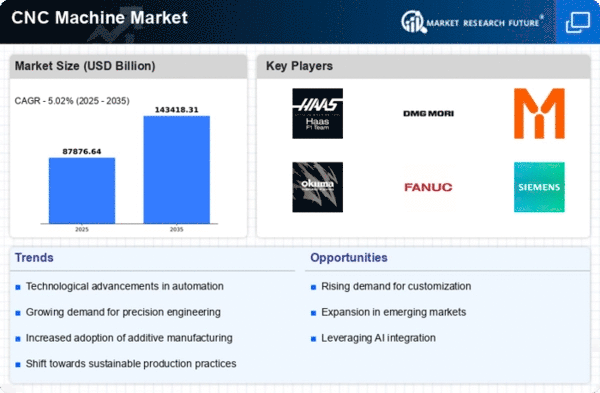
As per MRFR analysis, the CNC Machine Market Size was estimated at 83676.1 USD Billion in 2024. The CNC Machine industry is projected to grow from 87876.84 USD Billion in 2025 to 143418.31 USD Billion by 2035, exhibiting a compound annual growth rate (CAGR) of 5.02 during the forecast period 2025 - 2035.

Key Market Trends & Highlights

The CNC Machine Market is experiencing a transformative shift towards automation and customization.

  • The integration of smart technologies is reshaping CNC machine capabilities, enhancing efficiency and precision. Sustainability initiatives are driving manufacturers to adopt eco-friendly practices in CNC machining processes. The metal cutting segment remains the largest, while the woodworking segment is witnessing rapid growth due to increased demand for customized solutions. Rising demand for automation and advancements in CNC technology are key drivers propelling market expansion, particularly in North America and the Asia-Pacific region.

Market Size & Forecast

2024 Market Size 83676.1 (USD Billion)
2035 Market Size 143418.31 (USD Billion)
CAGR (2025 - 2035) 5.02%
Largest Regional Market Share in 2024 North America

Major Players

Haas Automation (US), <a href="https://in.dmgmori.com/products/machines">DMG Mori</a> (DE), Mazak (JP), Okuma (JP), Fanuc (JP), Siemens (DE), Emag (DE), <a href="https://www.hurco.com/fr/products">Hurco </a>(US), Toshiba Machine (JP)

Market Trends

The CNC Machine Market is currently experiencing a transformative phase characterized by rapid technological advancements and evolving consumer demands. Automation and precision engineering are at the forefront, driving manufacturers to innovate and enhance their product offerings. The global demand for high-precision CNC machines continues to rise as manufacturers prioritize automated production cycles.

The integration of artificial intelligence and machine learning into CNC systems appears to be reshaping operational efficiencies, enabling businesses to achieve higher levels of productivity and accuracy. 

Furthermore, the growing emphasis on sustainability and eco-friendly practices is influencing the design and manufacturing processes within the sector, as companies strive to reduce their environmental footprint while maintaining competitive advantages. 

The CNC Machine Market is witnessing a shift towards customization and flexibility in production. With a rising demand for small CNC machines which are suitable for Space-constrained workshops, This market is also focusing providing high-precision output without a large physical footprint.

As industries increasingly seek tailored solutions to meet specific requirements, CNC machinery are being adapted to accommodate diverse applications across various sectors. This trend suggests a potential for growth in niche markets, where specialized machinery can cater to unique manufacturing needs. 

Overall, the CNC Machine Market is poised for continued evolution, driven by technological innovation and changing market dynamics, which may lead to new opportunities and challenges in the coming years.

Integration of Smart Technologies

The incorporation of smart technologies into CNC machines is revolutionizing the manufacturing landscape. Automation and artificial intelligence are enhancing operational efficiency, enabling predictive maintenance, and reducing costs. This trend indicates a growing demand for intelligent solutions that optimize production processes.

Focus on Sustainability

There is a growing emphasis on sustainable practices within the CNC Machine Market. Companies are increasingly adopting eco-friendly materials and processes, aiming to minimize their environmental impact while meeting regulatory standards and consumer expectations. The transition toward sustainable manufacturing has led to the development of energy-efficient CNC machinery models.

Customization and Precision

The demand for customized solutions is rising, prompting manufacturers to develop CNC machines that can adapt to various applications. Maintaining high-tier CNC equipment requires a skilled workforce capable of handling sophisticated software interfaces.This trend indicates a shift towards more versatile machinery capable of handling diverse production needs.

Long-Term Stability Factor 

When evaluating CNC machine cost, stakeholders often consider the long-term savings generated by reduced scrap rates. In the CNC machine market, the structural integrity and mechanical stability of older units are often the primary reasons they are considered for refurbishment rather than replacement. This is a strong reason for that used CNC machines are opted for.

CNC Machine Market Market Drivers

Sustainability Initiatives

Sustainability initiatives are influencing the CNC Machine Industry as manufacturers seek to minimize their environmental impact. The integration of energy-efficient CNC machines and sustainable manufacturing practices is becoming a priority for companies aiming to reduce waste and energy consumption. For example, CNC machines that utilize eco-friendly materials and processes are gaining traction in the market. This shift towards sustainability not only aligns with regulatory requirements but also appeals to environmentally conscious consumers. As a result, the demand for sustainable CNC solutions is expected to contribute positively to the overall market growth.

Technological Advancements

The CNC Machine Industry is witnessing rapid technological advancements that enhance precision and efficiency in manufacturing processes. Innovations such as artificial intelligence and machine learning are being integrated into CNC cutting machines, allowing for smarter operations and predictive maintenance. For instance, the adoption of IoT-enabled CNC machines facilitates real-time monitoring and data analytics, leading to reduced downtime and improved productivity. As manufacturers increasingly seek to optimize their operations, the demand for advanced CNC machines is expected to grow, contributing to the market's projected value of 83676.1 USD Billion in 2024.

Customization and Flexibility

Customization and flexibility in manufacturing processes are becoming paramount in the CNC Machine Market. As consumer preferences shift towards personalized products, manufacturers are increasingly turning to CNC machines that offer versatile machining capabilities. This adaptability allows for the production of complex geometries and tailored solutions, meeting the diverse needs of various industries. Consequently, the demand for CNC machines that can accommodate such customization is likely to rise, further driving market growth. The ability to efficiently produce small batches of unique products positions CNC technology as a vital asset in contemporary manufacturing.

Growing Demand for Automation

The Global CNC Machine Market is significantly driven by the increasing demand for automation across various sectors, including automotive, aerospace, and electronics. Automation enhances production efficiency and reduces labor costs, making CNC machines an attractive investment for manufacturers. As industries strive to improve their operational capabilities, the market for CNC machines is projected to expand, with a compound annual growth rate of 5.0% from 2025 to 2035. This trend is expected to propel the market value to approximately 143114.4 USD Billion by 2035, reflecting the critical role of CNC technology in modern manufacturing.

Rising Adoption in Emerging Economies

Emerging economies are increasingly adopting CNC machines, contributing to the growth of the Global CNC Machine Industry. Countries in Asia-Pacific, particularly China and India, are experiencing rapid industrialization and urbanization, leading to heightened demand for precision manufacturing. The expansion of manufacturing hubs in these regions is likely to drive investments in CNC technology, as companies seek to enhance their production capabilities. This trend is indicative of a broader shift towards advanced manufacturing practices, which is expected to bolster the market's growth trajectory in the coming years.

Market Segment Insights

By Application: Metal Cutting (Largest) vs. Woodworking (Fastest-Growing)

The CNC machine market exhibits varied applications, with metal cutting dominating the landscape due to its widespread use in manufacturing industries. This segment boasts the largest share, primarily driven by its necessity in precision engineering and fabrication processes across sectors like automotive, aerospace, and general manufacturing. Meanwhile, woodworking is emerging rapidly as a significant player, capitalizing on the growing demand for customized furniture and intricate designs, thus reflecting a strong upward trend in its market presence. Growth trends in the CNC machine applications sector are being shaped by technological advancements and increasing demand for automation. Metal cutting remains vital as industries strive for precision and efficiency, whereas woodworking is gaining traction with the rise of digital fabrication methods. Additionally, the electronics manufacturing segment is also witnessing growth, as the demand for precise machining in the production of smaller, intricate components continues to rise. This diverse growth landscape indicates a robust evolution in the CNC machine market, adapting to varied industry needs.

Woodworking (Dominant) vs. Electronics Manufacturing (Emerging)

In the CNC machine market, woodworking has established itself as a dominant application, propelled by the booming demand for tailored solutions in the furniture industry and interior design. The segment benefits from innovative techniques that enhance design fidelity and reduce production times, making it a preferred choice for both large-scale manufacturers and small workshops. In contrast, electronics manufacturing is an emerging segment, characterized by its focus on precision machining for tiny, intricate components that are increasingly essential in modern technology. This segment is driven by rapid advancements in electronics and the need for higher accuracy in part production, catering to a technology-savvy market. Together, these segments represent a dynamic interplay of traditional craftsmanship and cutting-edge technology.

By End Use Industry: Aerospace (Largest) vs. Automotive (Fastest-Growing)

In the CNC Machine Market, the aerospace sector holds the largest market share, primarily due to its high demand for precision-engineered components. This segment leverages CNC machines for manufacturing complex parts that are essential for aircraft, leading to significant investments by aerospace companies. <br>In contrast, Heavy-duty <a href="https://www.marketresearchfuture.com/reports/cnc-router-market-8321">CNC router</a> remains the backbone of the automotive industry’s engine block production lines. The rapid adoption of electric vehicles and advancements in automotive technology spur the demand for CNC machining to create precise components efficiently.

Aerospace: CNC Machining (Dominant) vs. Automotive: CNC Machining (Emerging)

The aerospace sector's reliance on CNC machining is characterized by its stringent quality requirements and the need for lightweight, high-strength materials. As a dominant force in the market, aerospace applications utilize CNC machines for the production of critical components like turbine blades and airframe structures. Meanwhile, the automotive industry represents an emerging segment where CNC technologies are gaining traction alongside advancements in materials and electrical vehicle manufacturing. The automotive sector focuses on optimizing production processes, enhancing customization, and integrating smart technologies, making it a rapidly evolving arena for CNC machine usage.

By Machine Type: Vertical Machining Center (Largest) vs. Laser Cutting Machine (Fastest-Growing)

The CNC machine market is significantly influenced by various machine types, with the Vertical Machining Center holding the largest market share due to its versatility and efficiency in machining operations. Other notable segments include Horizontal Machining Centers, Cylindrical Grinding Machines, and cutting technologies such as Laser and Plasma Cutting Machines. Each of these machines caters to specific industrial needs, contributing to a diversified market landscape.

Vertical Machining Center (Dominant) vs. Laser Cutting Machine (Emerging)

Vertical Machining Centers are widely recognized for their adaptability in various machining processes, which solidifies their position as the dominant segment in the CNC machine market. These machines excel in precision tasks and are favored in industries requiring high-quality finishes. Conversely, <a href="https://www.marketresearchfuture.com/reports/laser-cutting-machines-market-6894">Laser Cutting Machines</a> are emerging as a strong contender, significantly gaining traction due to their speed and efficiency in cutting complex geometries. Their ability to enhance productivity and reduce operational costs is driving their rapid adoption, making them one of the fastest-growing segments in the market.

By Control Type: Computer Numerical Control (Largest) vs. Manual Control (Fastest-Growing)

The CNC machine market's control type segment is primarily dominated by <a href="https://www.marketresearchfuture.com/reports/computer-numerical-controls-machine-tools-market-25501">Computer Numerical Control machine tools</a>, which has established itself as the largest segment due to its precision, efficiency, and ability to automate repetitive tasks. Manual Control, while smaller in market share, is witnessing rapid growth as it appeals to businesses seeking cost-effective solutions or those focused on traditional manufacturing techniques. Hybrid Control combines advantages from both CNC and manual systems, offering flexibility but represents a smaller share overall.

Control Type: Computer Numerical Control (Dominant) vs. Manual Control (Emerging)

Computer Numerical Control (CNC) machines are recognized as the dominant players in the CNC machine market due to their advanced capabilities, enabling high precision and efficiency in production. These machines are ideal for complex tasks and can handle a variety of materials, making them a preferred choice among manufacturers looking for automation. On the other hand, Manual Control systems are rapidly emerging, driven by a resurgence in traditional machining. These systems offer flexibility, lower initial investment, and are often favored by smaller shops or those requiring less complex operations. As technology evolves, the demand for both types of control continues to shape the dynamics of the CNC machine market.

By Material Type: Metal (Largest) vs. Plastic (Fastest-Growing)

The CNC machine market is primarily dominated by the metal segment, which represents the largest share of market demand due to its extensive applications in automotive, aerospace, and industrial sectors. Metal components, known for their strength and durability, require precise machining that CNC machines provide, resulting in a significant preference from manufacturers. Following metal, plastic is emerging rapidly as a valuable material in various applications, especially in sectors like consumer goods and electronics where lightweight and corrosion-resistant components are highly sought after.

Metal (Dominant) vs. Plastic (Emerging)

Metal is regarded as the dominant material type in the CNC machine market, favored for its ability to produce robust and high-performance components essential in many industries. It offers excellent machinability and a wide range of surface finishes, making it suitable for precision engineering. In contrast, plastic is emerging as a significant contender, particularly in the production of lightweight and flexible parts. The increasing demand for innovative designs and cost-effective, high-volume production in industries such as consumer electronics is driving the entry of plastics into the CNC machining space. As technology advances, the capability to machine plastics with accuracy and efficiency further bolsters its position in the market.

Get more detailed insights about CNC Machine Market Research Report - Global Forecast till 2035

Regional Insights

North America : Leading Market Innovators

North America continues to lead the CNC machine market, holding a significant share of 41,800.0. The growth is driven by advancements in manufacturing technologies, increased automation, and a strong demand for precision engineering across various sectors. Regulatory support for innovation and sustainability further catalyzes market expansion, making it a hub for CNC technology development. The United States stands out as the primary market, with key players like Haas Automation and Hurco leading the charge. The competitive landscape is characterized by a mix of established firms and emerging startups, all vying for market share. The presence of major manufacturers ensures a robust supply chain and innovation pipeline, solidifying North America's position as a global leader in CNC machinery.

Europe : Robust Manufacturing Backbone

Europe's CNC machine market is valued at €25,000.0, driven by a strong manufacturing sector and increasing demand for automation. The region benefits from stringent regulations that promote efficiency and sustainability, encouraging investments in advanced CNC technologies. Countries like Germany and Italy are at the forefront, with a focus on high-quality production and innovation in machine tools. Germany leads the European market, hosting major players like DMG Mori and Siemens. The competitive landscape is marked by a blend of traditional manufacturers and innovative tech firms. The European market is characterized by a strong emphasis on R&D, ensuring that it remains competitive on a global scale. The region's commitment to quality and precision continues to attract investments in CNC technology.

Asia-Pacific : Emerging Market Potential

The Asia-Pacific CNC machine market, valued at $15,000.0, is rapidly growing due to increasing industrialization and a shift towards automation. Countries like Japan and China are leading this growth, driven by rising demand for precision manufacturing in automotive and electronics sectors. Government initiatives to boost manufacturing capabilities further support market expansion. Japan is a key player in the CNC market, with companies like Mazak and Okuma leading the way. The competitive landscape is evolving, with both established firms and new entrants focusing on innovation and cost-effectiveness. The region's growth potential is significant, as more industries adopt CNC technology to enhance productivity and efficiency.

Middle East and Africa : Developing Industrial Landscape

The CNC machine market in the Middle East and Africa is valued at $2,876.1, reflecting a developing industrial landscape. The growth is driven by increasing investments in manufacturing and infrastructure projects, alongside a rising demand for automation in various sectors. Regulatory frameworks are gradually evolving to support industrial growth, enhancing the market's potential. Countries like South Africa and the UAE are emerging as key players in the CNC market, with a focus on diversifying their economies. The competitive landscape is characterized by a mix of local and international firms, all aiming to capture market share. As the region continues to develop its manufacturing capabilities, the demand for CNC machines is expected to rise significantly.

Key Players and Competitive Insights

The CNC Machine Market is currently characterized by a dynamic competitive landscape, driven by technological advancements and increasing demand for precision manufacturing across various industries. Key players such as Haas Automation (US), DMG Mori (DE), and Mazak (JP) are strategically positioned to leverage innovation and digital transformation to enhance their market presence. These companies are focusing on expanding their product portfolios and enhancing operational efficiencies, which collectively shapes a competitive environment that is increasingly reliant on advanced technologies and customer-centric solutions.In terms of business tactics, companies are localizing manufacturing to reduce lead times and optimize supply chains, which is crucial in a market that appears moderately fragmented. The collective influence of these key players is significant, as they not only compete on technological capabilities but also on their ability to respond to regional market demands and customer preferences. This competitive structure fosters an environment where agility and responsiveness are paramount.
In November DMG Mori (DE) announced the launch of a new line of hybrid CNC machines that integrate additive manufacturing capabilities. This strategic move is indicative of the company's commitment to innovation and reflects a broader trend towards hybrid manufacturing solutions. By combining traditional subtractive methods with additive processes, DMG Mori aims to enhance production flexibility and reduce material waste, positioning itself as a leader in sustainable manufacturing practices.Similarly, in October 2025, Mazak (JP) unveiled its latest CNC control technology, which incorporates advanced AI algorithms to optimize machining processes. This development not only enhances operational efficiency but also aligns with the growing trend of AI integration in manufacturing. By investing in smart technologies, Mazak is likely to improve its competitive edge, enabling customers to achieve higher productivity and lower operational costs.
In December Haas Automation (US) announced a strategic partnership with a leading software firm to develop cloud-based solutions for CNC machine monitoring and predictive maintenance. This collaboration is expected to enhance the company's service offerings, allowing customers to leverage data analytics for improved machine performance. Such strategic alliances are becoming increasingly important as companies seek to differentiate themselves in a market that is rapidly evolving towards digitalization and smart manufacturing.
As of December the CNC Machine Market is witnessing trends that emphasize digitalization, sustainability, and AI integration. The shift towards strategic alliances is reshaping the competitive landscape, as companies recognize the need to collaborate to enhance their technological capabilities. Moving forward, competitive differentiation is likely to evolve from traditional price-based competition to a focus on innovation, technology, and supply chain reliability, underscoring the importance of adaptability in a fast-changing market.

Key Companies in the CNC Machine Market include

Industry Developments

  • Q2 2024: DMG MORI opens new manufacturing facility in Davis, California to expand U.S. CNC machine production DMG MORI inaugurated a new state-of-the-art manufacturing plant in Davis, California, aimed at increasing its CNC machine tool production capacity for the North American market and supporting local supply chains.
  • Q2 2024: Mazak launches new INTEGREX i-250H S AM CNC multitasking machine with hybrid additive manufacturing capabilities Mazak introduced its latest CNC multitasking machine, the INTEGREX i-250H S AM, which combines advanced subtractive and additive manufacturing technologies for high-precision, complex part production.
  • Q3 2024: Siemens and FANUC announce strategic partnership to develop AI-driven CNC control systems Siemens and FANUC revealed a collaboration to co-develop next-generation CNC controllers leveraging artificial intelligence for real-time process optimization and predictive maintenance.
  • Q2 2024: Okuma Corporation acquires controlling stake in Taiwan’s Leadwell CNC Machines Mfg. Corp. Okuma expanded its global footprint by acquiring a majority share in Leadwell, a Taiwanese CNC machine manufacturer, to strengthen its presence in the Asia-Pacific region.
  • Q1 2025: Haas Automation secures $120 million contract to supply CNC machines to U.S. Department of Defense Haas Automation won a major government contract to deliver advanced CNC machining centers for defense manufacturing applications, supporting domestic production initiatives.
  • Q2 2025: Hyundai WIA opens new smart CNC machine plant in Ulsan, South Korea Hyundai WIA launched a new smart factory in Ulsan, integrating IoT and robotics to automate CNC machine production and improve efficiency.
  • Q2 2024: JTEKT launches new high-speed, five-axis CNC machining center for aerospace applications JTEKT introduced a next-generation five-axis CNC machining center designed for high-precision aerospace component manufacturing, featuring advanced vibration control and thermal stability.
  • Q3 2024: Doosan Machine Tools unveils collaborative robot-integrated CNC turning center Doosan launched a new CNC turning center equipped with integrated collaborative robotics, enabling automated part loading and unloading for lights-out manufacturing.
  • Q1 2025: Makino announces global rollout of digital twin platform for CNC machine optimization Makino introduced a digital twin solution for its CNC machines, allowing manufacturers to simulate, monitor, and optimize machining processes in real time across multiple facilities.
  • Q2 2025: Hurco launches new CNC control software with AI-powered adaptive machining Hurco released a major update to its CNC control software, incorporating artificial intelligence to automatically adjust machining parameters for improved efficiency and reduced scrap.
  • Q2 2024: FANUC debuts next-generation CNC controller with integrated cybersecurity features FANUC unveiled its latest CNC controller, featuring enhanced cybersecurity protocols and real-time monitoring to protect against industrial cyber threats.
  • Q3 2024: GROB-WERKE announces $80 million expansion of U.S. CNC machine assembly operations GROB-WERKE committed $80 million to expand its U.S. assembly plant, increasing capacity for CNC machine production and creating 200 new jobs.

Future Outlook

CNC Machine Market Future Outlook

The CNC Machine Market is projected to grow at a 5.02% CAGR from 2025 to 2035, driven by automation, technological advancements, and increasing demand for precision manufacturing. Global supply chain shifts are prompting the CNC industry to diversify its sourcing of raw castings and electronic controllers.

New opportunities lie in:

  • <p>Expansion into additive manufacturing integration services. Development of AI-driven predictive maintenance solutions. Launch of customized CNC machine solutions for niche industries.</p>

By 2035, the CNC Machine Market is expected to be robust, reflecting substantial growth and innovation.

Market Segmentation

CNC Machine Market Application Outlook

  • Metal Cutting
  • Woodworking
  • Plastic Machining
  • Composite Machining
  • Electronics Manufacturing

CNC Machine Market Control Type Outlook

  • Computer Numerical Control
  • Manual Control
  • Hybrid Control

CNC Machine Market Machine Type Outlook

  • Vertical Machining Center
  • Horizontal Machining Center
  • Cylindrical Grinding Machine
  • Laser Cutting Machine
  • Plasma Cutting Machine

CNC Machine Market Material Type Outlook

  • Metal
  • Plastic
  • Wood
  • Ceramics
  • Composites

CNC Machine Market End Use Industry Outlook

  • Aerospace
  • Automotive
  • Medical Devices
  • Consumer Electronics
  • Industrial Equipment

Report Scope

MARKET SIZE 2024 83676.1(USD Billion)
MARKET SIZE 2025 87876.84(USD Billion)
MARKET SIZE 2035 143418.31(USD Billion)
COMPOUND ANNUAL GROWTH RATE (CAGR) 5.02% (2025 - 2035)
REPORT COVERAGE Revenue Forecast, Competitive Landscape, Growth Factors, and Trends
BASE YEAR 2024
Market Forecast Period 2025 - 2035
Historical Data 2019 - 2024
Market Forecast Units USD Billion
Key Companies Profiled Haas Automation (US), DMG Mori (DE), Mazak (JP), Okuma (JP), Fanuc (JP), Siemens (DE), Emag (DE), Hurco (US), Toshiba Machine (JP)
Segments Covered Application, End Use Industry, Machine Type, Control Type, Material Type
Key Market Opportunities Integration of advanced automation and artificial intelligence in the CNC Machine Market enhances operational efficiency.
Key Market Dynamics Technological advancements and automation drive competitive dynamics in the CNC Machine Market, reshaping manufacturing processes.
Countries Covered North America, Europe, APAC, South America, MEA

FAQs

How much is the CNC Machine market?

The global CNC Machine market size was valued at USD 83676.10 Billion in 2024.

What is the growth rate of the CNC Machine market?

The global market is foreseen to grow at a CAGR of 5.0% throughout the forecast period, 2025-2035.

Which region held largest market share in the CNC Machine market?

Asia Pacific had largest share of the global market

Who are the key players in the CNC Machine market?

The key players in market are Siemens AG, Bonsai Technologies Private Limited, Ramco Specialties Inc., Versatech LLC, Sandvik, Yamazaki Mazak Corporation, Amada Machine Tools Co. Ltd, Okuma Corporation, ANCA Group, Hyundai WIA, and Komatsu Ltd.

Which type led the CNC Machine market?

The metal-cutting category dominated the market in 2022.

Which application had largest market share in the CNC Machine market?

Automotive had the largest share of the global market.

  1. SECTION I: EXECUTIVE SUMMARY AND KEY HIGHLIGHTS |
    1. EXECUTIVE SUMMARY |
      1. Market Overview |
      2. Key Findings |
      3. Market Segmentation |
      4. Competitive Landscape |
      5. Challenges and Opportunities |
      6. Future Outlook 2
  2. SECTION II: SCOPING, METHODOLOGY AND MARKET STRUCTURE |
    1. MARKET INTRODUCTION |
      1. Definition |
      2. Scope of the study |--
    2. RESEARCH METHODOLOGY |
      1. Overview |
      2. Data Mining |
      3. Secondary Research |
      4. Primary Research |--
      5. Forecasting Model |
      6. Market Size Estimation |--
      7. Data Triangulation |
      8. Validation 3
  3. SECTION III: QUALITATIVE ANALYSIS |
    1. MARKET DYNAMICS |
      1. Overview |
      2. Drivers |
      3. Restraints |
      4. Opportunities |
    2. MARKET FACTOR ANALYSIS |
      1. Value chain Analysis |
      2. Porter's Five Forces Analysis |--
      3. COVID-19 Impact Analysis |--
  4. SECTION IV: QUANTITATIVE ANALYSIS |
    1. Life Sciences, BY Application (USD Billion) |
      1. Metal Cutting |
      2. Woodworking |
      3. Plastic Machining |
      4. Composite Machining |
      5. Electronics Manufacturing |
    2. Life Sciences, BY End Use Industry (USD Billion) |
      1. Aerospace |
      2. Automotive |
      3. Medical Devices |
      4. Consumer Electronics |
      5. Industrial Equipment |
    3. Life Sciences, BY Machine Type (USD Billion) |
      1. Vertical Machining Center |
      2. Horizontal Machining Center |
      3. Cylindrical Grinding Machine |
      4. Laser Cutting Machine |
      5. Plasma Cutting Machine |
    4. Life Sciences, BY Control Type (USD Billion) |
      1. Computer Numerical Control |
      2. Manual Control |
      3. Hybrid Control |
    5. Life Sciences, BY Material Type (USD Billion) |
      1. Metal |
      2. Plastic |
      3. Wood |
      4. Ceramics |
      5. Composites |
    6. Life Sciences, BY Region (USD Billion) |
      1. North America |--
      2. Europe |--
      3. APAC |--
      4. South America |--
      5. MEA |--
  5. SECTION V: COMPETITIVE ANALYSIS |
    1. Competitive Landscape |
      1. Overview |
      2. Competitive Analysis |
      3. Market share Analysis |
      4. Major Growth Strategy in the Life Sciences |
      5. Competitive Benchmarking |
      6. Leading Players in Terms of Number of Developments in the Life Sciences |
      7. Key developments and growth strategies |--
      8. Major Players Financial Matrix |--
    2. Company Profiles |
      1. Haas Automation (US) |--
      2. DMG Mori (DE) |--
      3. Mazak (JP) |--
      4. Okuma (JP) |--
      5. Fanuc (JP) |--
      6. Siemens (DE) |--
      7. Emag (DE) |--
      8. Hurco (US) |--
      9. Toshiba Machine (JP) |--
    3. Appendix |
      1. References |
      2. Related Reports

Life Sciences Market Segmentation

Life Sciences By Application (USD Billion, 2025-2035)

  • Metal Cutting
  • Woodworking
  • Plastic Machining
  • Composite Machining
  • Electronics Manufacturing

Life Sciences By End Use Industry (USD Billion, 2025-2035)

  • Aerospace
  • Automotive
  • Medical Devices
  • Consumer Electronics
  • Industrial Equipment

Life Sciences By Machine Type (USD Billion, 2025-2035)

  • Vertical Machining Center
  • Horizontal Machining Center
  • Cylindrical Grinding Machine
  • Laser Cutting Machine
  • Plasma Cutting Machine

Life Sciences By Control Type (USD Billion, 2025-2035)

  • Computer Numerical Control
  • Manual Control
  • Hybrid Control

Life Sciences By Material Type (USD Billion, 2025-2035)

  • Metal
  • Plastic
  • Wood
  • Ceramics
  • Composites
Infographic

Free Sample Request

Kindly complete the form below to receive a free sample of this Report

Get Free Sample

Customer Strories

Compare Licence

×
Features License Type
Single User Multiuser License Enterprise User
Price $4,950 $5,950 $7,250
Maximum User Access Limit 1 User Upto 10 Users Unrestricted Access Throughout the Organization
Free Customization
Direct Access to Analyst
Deliverable Format
Platform Access
Discount on Next Purchase 10% 15% 15%
Printable Versions