Request Free Sample ×

Kindly complete the form below to receive a free sample of this Report

* Please use a valid business email

Leading companies partner with us for data-driven Insights

clients tt-cursor
Hero Background
English
Chinese
French
Japanese
Korean
German
Spanish

Cloud Computing Market Share

ID: MRFR/ICT/0507-CR
141 Pages
Ankit Gupta
February 2026

Cloud Computing Market By Service Model (PaaS, SaaS, IaaS), Deployment (Public, Private, Hybrid), By Deployment Model (Public, Private, Hybrid), By Organization Size (Large Enterprises, Small and Medium-Sized Enterprises (SMEs)), By Application (Data Backup and Recovery, Application Hosting, Disaster Recovery, Big Data Analytics), By Industry Vertical (Banking, Financial Services, and Insurance (BFSI), IT and Telecommunications, Government Public Sector, Healthcare, Retail and Consumer Goods, Manufacturing) and By Regional (North America, Europe, South America, Asia Pacific, Middle East and Africa) – Forecast to 2035.

Share:
Download PDF ×

We do not share your information with anyone. However, we may send you emails based on your report interest from time to time. You may contact us at any time to opt-out.

Cloud Computing Market Infographic
Purchase Options

Market Share

Cloud Computing Market Share Analysis

In the cut-throat world of cloud computing, businesses use different plans to place themselves and get a share in the market. A popular method is standing out by offering different services. Companies that offer cloud services set themselves apart by creating a wide range of services for different businesses and industries. These services are tailor-made to meet specific needs. Suppliers work hard to give a wide range of services more than just basic foundation. They have special projects for health, money and online shopping businesses that make them stronger in the competition. Market share positioning also relies heavily on pricing strategies.

Cloud computing companies usually use flexible and low-cost pricing to draw many different customers. This involves pay-as-you-go systems, booked items and amount reductions. Providers try to attract all businesses by offering clear and low-cost prices. They want small companies with little money as well as big firms looking to save on IT costs. Partnerships and teamwork are important parts of how you stand in the cloud computing industry. Making deals with other tech companies helps cloud service providers improve their services by working together.

For example, working with companies that make software and protect the computer can help cloud providers to offer more services together. This helps them get a bigger share of customers who have different needs. Building up the world's infrastructure is a main plan to make sure there are strong businesses everywhere. Big cloud companies spend a lot to build more data centers in different areas. This worldwide presence lets them give quick services without much delay, follow rules for where data should stay and help companies based in many different places. The closeness of data centers to users is important for giving fast and trustworthy cloud services. Business plans that focus on the customers like great customer service, teaching programs and community involvement greatly help in getting a big share of the market.

Companies that care about making their customers happy and involved create better connections with people who use them. This means giving tools for learning, certificates and groups where people can talk about their experiences and good ways to do things. Good experiences with customers help keep them coming back and bring in new ones. This is helped by a strong support system.

Author
Author Profile
Ankit Gupta
Team Lead - Research

Ankit Gupta is a seasoned market intelligence and strategic research professional with over six plus years of experience in the ICT and Semiconductor industries. With academic roots in Telecom, Marketing, and Electronics, he blends technical insight with business strategy. Ankit has led 200+ projects, including work for Fortune 500 clients like Microsoft and Rio Tinto, covering market sizing, tech forecasting, and go-to-market strategies. Known for bridging engineering and enterprise decision-making, his insights support growth, innovation, and investment planning across diverse technology markets.

Leave a Comment

FAQs

What is the projected market valuation of cloud computing by 2035?

<p>The cloud computing market is projected to reach a valuation of 1200.0 USD Billion by 2035.</p>

What was the overall market valuation of cloud computing in 2024?

<p>In 2024, the overall market valuation of cloud computing was 500.0 USD Billion.</p>

What is the expected CAGR for the cloud computing market from 2025 to 2035?

<p>The expected CAGR for the cloud computing market during the forecast period 2025 - 2035 is 8.28%.</p>

Which companies are considered key players in the cloud computing market?

<p>Key players in the cloud computing market include Amazon Web Services, Microsoft Azure, Google Cloud, and IBM Cloud.</p>

How does the public cloud segment compare to the private cloud segment in terms of valuation?

<p>The public cloud segment was valued at 200.0 USD Billion in 2024 and is projected to reach 480.0 USD Billion by 2035, whereas the private cloud segment was valued at 150.0 USD Billion and is expected to grow to 300.0 USD Billion.</p>

What are the projected valuations for the Software as a Service (SaaS) segment by 2035?

<p>The Software as a Service (SaaS) segment is projected to grow from 250.0 USD Billion in 2024 to 650.0 USD Billion by 2035.</p>

What is the expected growth of the hybrid cloud segment from 2024 to 2035?

<p>The hybrid cloud segment is expected to grow from 100.0 USD Billion in 2024 to 250.0 USD Billion by 2035.</p>

Which end-user segment is projected to have the highest valuation by 2035?

<p>The large enterprises segment is projected to have the highest valuation, growing from 200.0 USD Billion in 2024 to 500.0 USD Billion by 2035.</p>

What is the anticipated growth for the healthcare industry vertical in the cloud computing market?

<p>The healthcare industry vertical is expected to grow from 100.0 USD Billion in 2024 to 250.0 USD Billion by 2035.</p>

How does the valuation of the application cloud segment compare to the storage cloud segment by 2035?

<p>The application cloud segment is projected to reach 450.0 USD Billion by 2035, while the storage cloud segment is expected to grow to 250.0 USD Billion.</p>

Market Summary

Cloud Computing Market - Quick Answer
 
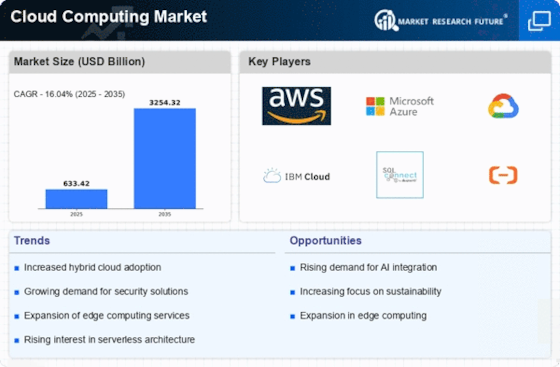
The global Cloud Computing market was valued at USD 791.17 billion in 2024 and is projected to grow from USD 928.86 Billion in 2025 to USD 4.96 trillion by 2035, at a CAGR of 18.2% (2025–2035). Growth is driven by rapid AI and generative AI workload integration, enterprise digital transformation across BFSI and healthcare, multi-cloud and hybrid cloud adoption, edge computing expansion, and surging demand for scalable, cost-efficient cloud infrastructure. North America is the largest market (35.81% share); Asia-Pacific is the fastest-growing region.
 
Source: Market Research Future (MRFR)
 

USD 4,955.98 Billion by 2035 18.02% CAGR North America - Largest
Projected Market Value Digital Infrastructure Growth Asia-Pacific - Fastest Growing
 
Published by: Market Research Future (MRFR)   |   Last Updated: March 2026   |   Forecast Period: 2025–2035   |   Base Year: 2024

Key Market Trends & Highlights

The Cloud Computing Market is experiencing robust growth driven by digital transformation and AI adoption. Key trends highlight rapid expansion in emerging regions and a shift toward hybrid/multi-cloud strategies.

  • North America remains the dominant market, holding the largest share due to advanced IT infrastructure, early adoption, and home to giants like AWS, Atlantic.net, Azure, and Google Cloud. Asia Pacific is the fastest-expanding, fueled by rapid digitalization in China, India, and Japan, government initiatives like "Make in India," and booming data centers. The market grows via scalable IT infrastructure demands, digital transformation across sectors, and tech advances like AI, IoT, big data, and 5G. Rising adoption of hybrid cloud solutions and the growing need for high-performance computing are key drivers propelling market growth. Rise of AI workloads such as generative AI, autonomous vehicles, real-time analytics, boosts need for specialized, high-performance cloud resources.

Market Size & Forecast

2024 Market Size USD 791.17 Billion
2035 Market Size USD 4,955.98 Billion
CAGR (2025 - 2035) 18.2%
Largest Regional Market Share in 2024 North America

Major Players

Key players such as Amazon Web Services, Atlantic.net, Google Cloud Platform, Microsoft Corporation, Oracle, Salesforce, Tencent Cloud, IBM Cloud, and SAP SE are advancing cloud ecosystems with integrated AI capabilities. These firms are embedding automation, machine learning, and intelligent resource management into cloud platforms. The market is shifting toward self-optimizing and AI-driven infrastructure. This evolution is accelerating enterprise-scale digital transformation

Market Trends

The Digital transformation coupled with technology advances have led to explosive growth in the Global Cloud Computing Market. Key drivers such as the growing number of artificial intelligent workloads, the move to hybrid/multi-cloud environments, and the increasing pressure for low latency processing delivered via edge computing. All of which imply that companies today are focused on scalability, cost effectiveness, and innovation to remain competitive versus hyper-scalers like AWS, Azure, and Google Cloud. AI is becoming increasingly integrated into Cloud services and Companies are working to optimize their Cloud environments based on generative AI, automation, and real-time analytics. In addition, businesses have been forced to comply with regulations which have resulted in increased levels of sovereignty and region cloud adoption. Serverless architectures allow for simplified operations through the use of pay as you go type models which have reduced the amount of time required to manage infrastructure.

Rapidly Integrating AI

The cloud tech space is being taken over by AI and machine learning capabilities. Companies are utilizing Generative AI, predictive analytics and automation to drive cloud computing, with AI-native services like Large Language Models (LLMs) and Machine Learning Operations (ML Ops) supported by all major Cloud Service Providers (CSPs), allowing enterprises to develop and deploy intelligent applications scalable, yet without significant internal expertise. The increase in the market for AI workloads relies upon GPU architecture designed for optimization and elastic support.

Multi-Cloud Strategies

To minimize vendor lock-in, optimize costs and take advantage of best-in-class services, enterprises are selecting both multi-cloud and hybrid-cloud solutions that enable them to run applications across AWS, Azure and Google Cloud. Kubernetes allows seamless interoperability, with loading and balancing workloads for AI, analytics and compliance. This flexibility provides enterprises with increased resilience and maturity in rapidly-changing environments.

Growth in Edge Compute

Edge computing processes data near the source via 5G and compact AI chips, slashing latency for IoT, autonomous systems, and real-time apps in manufacturing and smart cities. It complements centralized clouds for training while enabling instant decisions, fostering hybrid edge-cloud models for efficiency.

The exponential surge in digital data volume, coupled with the potential advantages of cloud computing, is propelling the global expansion of cloud computing markets.

Cloud Computing Market Market Drivers

Cost Efficiency and Scalable Infrastructure

One of the most significant drivers of cloud market expansion is the cost-efficient and scalable infrastructure model that cloud providers offer. Cloud computing eliminates hefty upfront capital expenditures on hardware and reduces ongoing maintenance and staffing costs. Instead, businesses pay on a pay-as-you-go or subscription basis, allowing them to match spending with actual resource usage, improve ROI, and avoid under- or over-provisioning. This model is especially beneficial for startups, SMEs, and organizations with seasonal or fluctuating demands. Scalability enables enterprises to rapidly scale compute and storage resources up or down in real time without infrastructure overhauls, supporting business agility and cost optimization. As a result, more organizations leverage cloud platforms not only to save costs but also to improve financial flexibility in dynamic market environments.

Integration of AI, Big Data, and Advanced Analytics

AI, machine learning, and Big Data analytics represent growing drivers in the cloud environment as high volumes of data will require scalable and flexible processing for business applications. Cloud Computing offers on-demand access to high-performance computing resources which are necessary for both the development of complex AI models through the use of multi-layer neural networks and for executing real-time analytics as well as automating and streamlining decision-making processes. The inclusion of Artificial Intelligence (AI) and Advanced Analytics into cloud computing enhances overall operational efficiency, provides predictable insights into a company's future, and allows for greater personalization based upon an organization’s target customer base by leveraging the functionality provided by and the technology within cloud computing solutions. In industries such as healthcare, finance and manufacturing, companies are leveraging cloud-based analytics to identify trends from large amounts of data that result in increased productivity and greater opportunities for innovation. As these industries continue to rely on data-driven strategies, the global demand for cloud platforms' capabilities to expand global market demand.

Rising Digital Transformation Across Industries Like BFSI and Healthcare

Digital change in cloud operations in BFSI, and healthcare. Cloud enables remote access for staff from various locations without dedicated office equipment. Industries replace rigid legacy systems with adaptable cloud alternatives that support business expansion. Integration with existing tools occurs with minimal disruption through phased migrations. BFSI employs cloud for continuous data analysis to detect risks early. Healthcare supports remote consultations with stable connectivity. Cloud automates compliance tracking with detailed access logs. Costs align with actual usage, allowing automatic scaling during quiet periods. Capacity adjusts for peak demands like financial reporting cycles or health surges. Cloud facilitates rapid testing of new services using pre-built templates. Secure data sharing enhances collaboration with partners and suppliers. Healthcare leverages cloud for image analysis and predictive outcome tools, accelerating diagnoses. BFSI builds dynamic risk models updated with current data for lending decisions. These capabilities drives the operational continuity and innovation across sectors.

 
The growth of the cloud computing market is propelled by hybrid cloud adoption, digital transformation initiatives, and AI-driven services, with the cloud computing market growth outlook remaining strong through the forecast period.

Market Segment Insights

By Deployment Model: Public Cloud (Largest) vs. Hybrid Cloud (Fastest-Growing)

<p>In the cloud computing market, deployment models are categorized mainly into Public, Private, Hybrid, and Multi-Cloud. The Public Cloud holds the largest market share due to its wide accessibility, scalability, and cost-effectiveness, which attract small to large enterprises. On the other hand, the Hybrid Cloud model is gaining traction as organizations seek to combine the benefits of both Public and Private Clouds, leading to a more balanced approach towards data management and security.</p>

<p>Public Cloud (Dominant) vs. Hybrid Cloud (Emerging)</p>

<p>The Public Cloud is a dominant force within the cloud computing landscape, offering extensive resources and services managed by third-party providers over the internet. Its inherent flexibility and pay-as-you-go pricing model appeal to businesses looking to minimize upfront costs. Conversely, the Hybrid Cloud represents an emerging trend, enabling companies to utilize both public and private infrastructures. This approach facilitates greater control over sensitive data while leveraging the scalability of public services. As organizations increasingly prioritize a tailored solution that meets their distinct needs, the Hybrid Cloud is anticipated to witness robust growth.</p>

By Service Model: Software as a Service (Largest) vs. Infrastructure as a Service (Fastest-Growing)

<p>In the cloud computing market, the service model segment is predominantly characterized by three primary values - Infrastructure as a Service (IaaS), Platform as a Service (PaaS), and Software as a Service (SaaS). Software as a Service holds the largest market share due to its widespread adoption across various industries, enabling organizations to access software applications over the internet without the need for local installation. In contrast, Infrastructure as a Service is emerging as the fastest-growing segment, driven by the increasing demand for flexible and cost-effective computing infrastructure.</p>

<p>Service Model: SaaS (Dominant) vs. IaaS (Emerging)</p>

<p>Software as a Service (SaaS) has established itself as the dominant player in the cloud computing service model segment, characterized by easy deployment, scalability, and accessibility that meets the needs of diverse business users. Major companies leverage SaaS models to streamline operations and ensure efficient software updates. Meanwhile, Infrastructure as a Service (IaaS) is rapidly emerging as a key component for businesses seeking advanced computing resources without the overhead costs of physical infrastructure. The appeal of IaaS lies in its pay-as-you-go pricing model and the ability to scale resources as needed, making it particularly attractive for startups and enterprises undergoing <a href="https://www.marketresearchfuture.com/reports/digital-transformation-market-8685" target="_blank" title="digital transformation">digital transformation</a>.</p>

By End User: Small and Medium Enterprises (Largest) vs. Large Enterprises (Fastest-Growing)

The cloud computing market exhibits a diverse range of end users, with Small and Medium Enterprises (SMEs) holding the largest share, reflecting their increasing reliance on cloud solutions to enhance productivity and operational efficiency. Following closely are Large Enterprises, which are also significant contributors to the market, though they represent a smaller share compared to SMEs. Government Organizations and Educational Institutions make up the remaining segments, showcasing a balanced distribution of demand across various sectors.

Small and Medium Enterprises (Dominant) vs. Large Enterprises (Emerging)

Small and Medium Enterprises (SMEs) have established themselves as dominant players in the cloud computing market, leveraging cost-effective solutions to streamline operations and drive innovation. Their adaptive approach to utilizing cloud services has led to increased competitiveness, allowing them to compete with larger firms. On the other hand, Large Enterprises, while traditionally perceived as slow to adopt new technologies, are quickly becoming an emerging force as they implement comprehensive cloud strategies to optimize their vast resources and enhance scalability. This dynamic is stimulating significant advancements in enterprise-level cloud adoption, showcasing a shift in how businesses of all sizes harness the power of cloud technologies.

By Industry Vertical: Healthcare (Largest) vs. Financial Services (Fastest-Growing)

<p>The cloud computing market shows diverse segment distribution, with Healthcare leading as the largest segment due to its expansive need for data management, electronic health records, and telemedicine. Financial Services closely follows, capitalizing on the necessity for secure data storage and real-time transaction processing. Recent trends have indicated a shift toward integrated cloud solutions in both segments, reflecting an increasing reliance on technology for operational efficiency and regulatory compliance. Growth trends are decidedly favorable for Financial Services, which is positioned as the fastest-growing segment. This is supported by increasing digital transformation initiatives, regulatory mandates for data availability, and a rising emphasis on secure cloud solutions. Meanwhile, Healthcare is experiencing steady growth driven by technological advancements, increasing patient expectations, and higher demand for healthcare accessibility and efficiency, marking both sectors as pivotal in the cloud computing landscape.</p>

<p>Healthcare: Dominant vs. Financial Services: Emerging</p>

<p>Healthcare stands out as a dominant force in the cloud computing market, owing to its critical reliance on cloud technologies for managing vast amounts of patient data, ensuring compliance with strict regulations, and facilitating innovative solutions like telehealth. The segment benefits from a shift towards electronic health records and <a href="https://www.marketresearchfuture.com/reports/data-analytics-market-1689" target="_blank" title="data analytics">data analytics</a>, enabling improved patient care and operational efficiency. Conversely, Financial Services are emerging as a key player, driven by the need for robust cybersecurity solutions and flexible storage options to support evolving digital banking needs. This sector's agility in adopting cloud-based financial technologies, such as blockchain and fintech innovations, highlights its rapid transformation and adaptability to market demands.</p>

By Cloud Type: Compute Cloud (Largest) vs. Storage Cloud (Fastest-Growing)

In the cloud computing market, the Compute Cloud segment holds the largest share, driven by the increasing demand for computing power and resources for diverse applications. This segment is followed closely by Storage Cloud, which is gaining traction due to the exponential growth in data generation and the need for reliable data storage solutions. As businesses continue their digital transformation journeys, both segments are integral to meeting evolving technology needs. The market for cloud computing is witnessing robust growth trends, with the Compute Cloud leading the way as organizations prioritize efficient processing capabilities. In contrast, Storage Cloud is emerging as the fastest-growing segment, fueled by trends such as big data analytics and IoT implementations. Companies are increasingly investing in scalable storage solutions to accommodate vast amounts of data while optimizing operational costs, thus propelling this segment's rapid expansion.

Compute Cloud (Dominant) vs. Application Cloud (Emerging)

Compute Cloud stands as a dominant force within the cloud computing landscape, characterized by its ability to provide on-demand computing resources that cater to a variety of workloads. Enterprises utilize this segment for running applications, data analytics, and high-performance computing needs. As the backbone of many digital services, Demand for Compute Cloud continues to grow due to its scalability and flexibility. On the other hand, Application Cloud is considered an emerging segment that is gaining momentum, facilitating the delivery of software applications over the internet rather than through traditional means. As SaaS (Software as a Service) solutions become increasingly popular among businesses, Application Cloud is expected to expand its footprint, providing critical applications such as CRM and ERP efficiently and cost-effectively.

Get more detailed insights about Cloud Computing Market Research Report - Global Forecast to 2035

Regional Insights

North America : Cloud Innovation Leader

North America is the largest market for Cloud Computing services, holding 35.81% of the global market share. The region's growth is driven by increasing demand for high-performance computing, data security, and regulatory compliance. The presence of major tech companies and a robust startup ecosystem further fuel innovation and adoption of cloud solutions. North America commands the largest share of the global cloud computing market at USD 283,319.41 million, driven by hyperscaler dominance from AWS, Azure, Atlantic.net and Google Cloud headquartered in the U.S. Early adoption of AI/ML workloads, robust data center infrastructure, and high enterprise spending fueled by tech giants like Fortune 500 firms propel its leadership. The region's mature ecosystem supports hybrid/multi-cloud strategies, regulatory compliance via FedRAMP, and innovation in edge computing, contributing over 35% globally. Venture capital inflows and Silicon Valley R&D further accelerate growth at 15.8% CAGR, positioning it as the innovation hub amid surging GenAI demand.

Europe : Emerging Cloud Market

Europe is witnessing a significant rise in the Cloud Computing market, accounting for approximately 27.57% of the global share. Europe holds a strong USD 218,126.67 million market, emphasizing data sovereignty through GDPR and sovereign cloud initiatives like GAIA-X. Key drivers include BFSI digitization in financial hubs like London and Frankfurt, alongside manufacturing shifts to Industry 4.0 via PaaS platforms. Hyperscalers expand via local data centers in Ireland and Germany, while public sector cloud migrations boost adoption. Despite slower growth than Asia at 18.6% CAGR, its focus on sustainable green clouds and cybersecurity standards solidifies its position, representing balanced public-private investments.

Asia-Pacific : Rapidly Growing Cloud Sector

Asia-Pacific is rapidly emerging as a key player in the Cloud Computing market, holding 25.89% of the global market share. Asia-Pacific represents one of the fastest-growing regions in the cloud computing market, propelled by rapid digital transformation across China, India, Japan, and Southeast Asia. Rising investments in telecommunications, e-commerce, fintech, healthcare, and smart city projects are increasing demand for scalable cloud infrastructure and services. Governments in the region are also promoting cloud adoption through supportive policies and data center expansions, which accelerate enterprise migrations to cloud platforms. China, in particular, is a major contributor due to its massive user base, growing AI and big data deployments, and strong regional cloud providers. SMEs and large corporations alike are adopting cloud for cost optimization and competitive agility. The region’s growth trajectory, fueled by infrastructure build-outs and innovation, positions Asia-Pacific as a critical driver of global cloud computing expansion.

Middle East and Africa : Emerging Cloud Frontier

The Middle East and Africa region is gradually emerging in the Cloud Computing market, currently holding about 4.71% of the global share. The growth is driven by digital infrastructure investment and government-led transformation programs. Countries such as the UAE, Saudi Arabia, and South Africa are leading the charge, implementing cloud services to support smart city initiatives, e-government platforms, and enterprise modernization. Cloud adoption in MEA is supported by expanding internet connectivity and rising demand for scalable, secure solutions across telecom, banking, and retail sectors. Private and hybrid cloud models are gaining traction due to regulatory preferences and data governance needs. Additionally, increased deployment of SaaS solutions in MEA SMEs is contributing to a diversified cloud ecosystem, making the region a notable emerging market for global cloud providers.

South America : Rapid Adoption

The South America region is in a rapid adoption phase, supported by expanding internet access, growing digital services demand, and increased investments in cloud infrastructure across Brazil, Argentina, and Mexico. Enterprises in the region are transitioning from legacy systems to cloud platforms to enhance scalability, operational efficiency, and application delivery. Public cloud services, especially SaaS for CRM, collaboration, and productivity, have seen strong uptake, while IaaS and PaaS adoption are gaining momentum among mid-sized enterprises. Cloud providers are expanding local data center presence and partnerships to improve performance and compliance with data residency requirements. Although South America’s total revenue is lower than other major regions, its high growth potential and improving digital ecosystems make it an important emerging market in the global cloud computing landscape currently holding about 6.02% of the global share.

Key Players and Competitive Insights

The global cloud computing landscape is dominated by a small set of hyperscale providers that control the majority of market share while an extensive long tail of specialized and regional players addresses niche and industry-specific needs. Amazon Web Services (AWS) remains the undisputed global leader in cloud infrastructure services, commanding 24.50% of market share through extensive IaaS, PaaS, and evolving AI-native services and a vast global footprint supported by continuous innovation. Microsoft Azure follows with 17.33% market share, leveraging deep enterprise software integration and hybrid cloud solutions that appeal to large customers. Google Cloud Platform (GCP) maintains strong momentum, growing faster than peers and capturing around 13.86% share with strengths in analytics, data services, and AI workloads. These big three AWS, Azure, and GCP collectively represent well over half of total global cloud infrastructure spending, shaping pricing, innovation, and enterprise adoption trends.
 
Beyond the hyperscale tier, Atlantic.net, Oracle Cloud, Alibaba Cloud, IBM Cloud, Huawei Cloud, and Tencent Cloud fill critical roles as tier-two global and regional providers with specialist offerings in enterprise applications, compliance-centric deployments, and localized services. Salesforce Cloud excels in SaaS-centric CRM and enterprise productivity stacks, while SAP SE and ServiceNow focus on business process and workflow automation cloud services. VMware distinguishes itself with hybrid and multi-cloud infrastructure strategies, enabling consistent operations across on-premises and public environments. Rackspace Technology and DigitalOcean target managed services and developer-friendly hosted infrastructure segments respectively, appealing to SMBs and specialized workloads. In this competitive arena, Atlantic.Net occupies a distinct niche with over 30 years of experience as a trusted cloud and managed hosting provider offering HIPAA-compliant, PCI-ready, and GPU-enabled services tailored to compliance-sensitive industries and technical users. With data centers in major global regions and partnerships such as the NVIDIA Cloud Service Provider program, Atlantic.Net delivers flexibility, affordability, and high-performance computing solutions for developers, regulated enterprises, and organizations that prioritize security and expert support alongside cloud scalability.
 
In summary, while hyperscalers set the pace in scale, innovation, and revenue, the broader cloud landscape includes a diverse set of players that compete through specialization, vertical expertise, geographic focus, and managed service excellence. Emerging trends such as AI-augmented cloud services, hybrid and multi-cloud architectures, and industry-specific regulatory compliance continue to shape competitive dynamics. Smaller but highly capable providers like Atlantic.Net thrive by serving markets that demand tight security, compliance, and personalized service attributes that large hyperscale providers increasingly enable through dedicated offerings but do not always deliver with the same level of hands-on support. This mosaic of dominant global giants and focused specialists defines today’s competitive cloud environment, where breadth, depth, and strategic differentiation drive provider success and customer choice.
 
Atlantic.Net – A prominent U.S.-based provider of hosting and cloud infrastructure solutions.
 
Estimated Market Presence: High (Global)
Atlantic.Net provides cloud services and specializes in delivering secure, scalable, and cost-effective cloud infrastructure solutions to organizations around the world. With over three decades of experience in both cloud computing and hosting, Atlantic.Net offers customers cloud virtual servers, secure block storage, snapshot backups, managed services, and GPU computing in order to meet modern enterprise requirements. Its cloud infrastructure spans multiple international data centers, providing high availability, and HIPAA, SOC2, and PCI compliant. With certified data center facilities across North America (New York, Dallas, Orlando, San Francisco, and Ashburn), as well as international locations in London, Singapore, and Toronto, Atlantic.Net has the global capacity to provision infrastructure for customers in over 100 countries.
 
Recent News:
2025:Net has launched new HIPAA-Compliant GPU Hosting service, designed exclusively for healthcare, biotech, and medical companies.
2025:Net has introduced its latest innovation ‘GPU Cloud Hosting’. The service will enable users to deploy a GPU Cloud server in less than 60 seconds.
2025:Net launched of its upgraded Secure Block Storage (SBS) solution, designed to be ultra-fast, scalable, affordable, and resilient.
2025:Net has signed a multi-year partnership with Major league soccer’s San Jose Earthquakes, becoming the team’s official Cloud server Hostin Platform and Official Accelerated Compute Provider.
 
Unique Selling Points (USPs)
 
GPU Cloud Hosting: Optimized for AI, ML, and graphics-intensive workloads with configurations up to 94GB memory.
Rapid Deployment: Cloud servers provisioned in under 60 seconds.
Developer-Friendly: One-click app deployment, API access, and flexible billing.
Scalability: From small business workloads to enterprise-grade AI projects.
Promotional Offers: One-year free hosting for new clients, including G3 8GB plan and block storage.
 
Client Use Cases
 
Healthcare Providers & SaaS Vendors: Secure environments for HIPAA-compliant applications.
AI & Research Teams: GPU-powered cloud servers for machine learning and deep learning workloads.
Global Enterprises: Low-latency performance through multiple data centers in the U.S., Canada, and Singapore.
 
Amazon Web Services (AWS) – Undisputed Market Leader
 
Estimated Market Presence: High (Global)
Amazon Web Services (AWS) remains the dominant force in the Cloud Computing Market, holding a leading global share of approximately 24.5%. As a comprehensive pioneer, AWS provides over 200 fully featured services, including advanced generative AI tools and scalable infrastructure. By leveraging its early-mover advantage and massive global network of data centers, AWS empowers enterprises to shift from fixed hardware costs to flexible, on-demand spending, effectively setting the standard for reliability and innovation across the industry.
 
Recent News:
2025: AWS doubles investment in AWS Generative AI Innovation Center to accelerate customer adoption of generative AI cloud services.
2025: AWS opens the first APAC Innovation Hub in Singapore to accelerate cloud and AI adoption across the region.
 
Microsoft Corporation – Intelligent Cloud Leader
 
Estimated Market Presence: High (Global)
Microsoft Corporation has solidified its position as the "Enterprise AI Leader" within the Cloud Services Market. Through its Intelligent Cloud segment, Microsoft’s flagship platform, Azure, has captured a significant market share of 17.33%. By integrating generative AI across its stack via the Azure OpenAI Service, Microsoft provides scalable infrastructure and advanced developer tools. This strategic focus on hybrid cloud and AI-driven productivity empowers global organizations to accelerate digital transformation with unparalleled security and reliability.
 
Recent News:
2026: Microsoft expands Azure AI infrastructure with new data centers optimized for generative AI workloads globally.
2025: Microsoft launches Azure Copilot enhancements integrating AI across compute, security, and management services.
 
Google Cloud Platform (GCP) – Data Analytics Leader
 
Estimated Market Presence: High (Global)
Google Cloud Platform (GCP) is professionally tagged as the AI and Data Analytics Leader within the Cloud Services Market. Holding an 13.86% global market share, GCP distinguishes itself through high-performance infrastructure like Tensor Processing Units (TPUs) and the Vertex AI platform. By leveraging Google’s private global fiber network, it offers unmatched latency and scaling for data-heavy enterprises. This focus on "AI-native" innovation and open-source leadership, particularly with Kubernetes, makes it the premier choice for advanced technical integration.
 
Recent News:
2026: Google Cloud and Liberty Global agree five-year AI and cloud infrastructure collaboration across European markets.
2026: Google Cloud announced the launch of its new cloud region in Thailand.


Key Companies in the Cloud Computing Market include

Industry Developments

Recent developments in the Global Cloud Computing Market reflect a dynamic and rapidly evolving landscape. Within the market, companies like Amazon Web Services and Microsoft are continuously expanding their service offerings, while Alibaba Cloud and Google are focusing on enhancing infrastructure to support increased digital demands. The market is dominated by big cloud computing companies such as Amazon Web Services, Microsoft Azure, and Google Cloud.  Several cloud computing software companies are investing heavily in AI-driven platforms and hybrid cloud solutions. Demand for cloud computing software services continues to rise due to increasing reliance on SaaS and PaaS models. Notably, in October 2023, Salesforce and Cloudflare announced a strategic partnership aimed at integrating their platforms to enhance security and performance for enterprises. In September 2023, IBM revealed an acquisition of a niche AI cloud startup to bolster its hybrid cloud capabilities.

Recent market valuations indicate that investor confidence remains strong, with significant growth seen across major players, particularly in sectors such as e-commerce and remote collaboration tools. Furthermore, over the past few years, advancements in multi-cloud strategies have gained traction, encouraging organizations to adopt more flexible and resilient cloud solutions. The engagement of various key players, including VMware and Cisco, in fostering hybrid cloud environments is propelling the market forward, ensuring that enterprises can efficiently adapt to changing technological landscapes and business needs. Key cloud computing stats indicate strong adoption across SMEs and large enterprises worldwide. Global cloud computing revenue is expected to surpass USD 3.2 trillion by 2035. The growing cloud computing value proposition lies in scalability, cost efficiency, and advanced analytics.

Future Outlook

Cloud Computing Market Future Outlook

The Cloud Computing Market is projected to grow at a 18.2% CAGR from 2025 to 2035, driven by increasing demand for high-performance computing and enhanced security features.

New opportunities lie in:

  • <p>Hybrid/Multi-Cloud Adoption for Flexibility and Resilience AI-Powered Services and Edge Computing Expansion Emerging Markets Like Asia-Pacific via Government Initiatives</p>

By 2035, the Cloud Computing Market is expected to be a pivotal component of global digital infrastructure.

Market Segmentation

Cloud Computing Market Application Outlook

  • Data Backup and Recovery
  • Application Hosting
  • Disaster Recovery
  • Big Data Analytics

Cloud Computing Market Service Model Outlook

  • Platform-as-a-Service (PaaS)
  • Software-as-a-Service (SaaS)
  • Infrastructure-as-a-Service (IAAS)

Cloud Computing Market Deployment Model Outlook

  • Public Cloud
  • Private Cloud
  • Hybrid Cloud

Cloud Computing Market Industry Vertical Outlook

  • Banking
  • Financial Services
  • and Insurance (BFSI)
  • IT and Telecommunications
  • Government Public Sector
  • Healthcare
  • Retail and Consumer Goods
  • Manufacturing
  • Education
  • Others

Cloud Computing Market Organization Size Outlook

  • Large Enterprises
  • Small And Medium-Sized Enterprises (SMEs)

Report Scope

MARKET SIZE 2024 791,174.00 (USD Million)
MARKET SIZE 2025 928,864.54 (USD Million)
MARKET SIZE 2035 4,955,981.67 (USD Million)
COMPOUND ANNUAL GROWTH RATE (CAGR) 18.2% (2025 - 2035)
REPORT COVERAGE Revenue Forecast, Competitive Landscape, Growth Factors, and Trends
BASE YEAR 2024
Market Forecast Period 2025 - 2035
Historical Data 2019 - 2024
Market Forecast Units USD Million
Key Companies Profiled Amazon Web Services (AWS), Google Cloud Platform (GCP), Microsoft Corporation, Atlantic.Net, VMware, Oracle Cloud, Rackspace Technology, DigitalOcean, Salesforce Cloud, Tencent Cloud, Alibaba Cloud, IBM Cloud, Huawei Cloud, SAP SE, and ServiceNow
Segments Covered By Services Model ·       Platform-as-a-Service (PaaS)  o   Application Development and Platforms  o   Application Testing and Quality  o   Analytics and Reporting  o   Data Management     ·       Software-as-a-Service (SaaS)  o   Customer Relationship Management  o   Enterprise Resource Management  o   Human Capital Management  o   Content Management  o   Collaboration and Productivity Suites  o   Collaboration and Productivity Suites  o   Other SaaS Service Models     ·       Infrastructure-as-a-Service (IAAS)  o   Primary Storage  o   Disaster Recovery and Backup  o   Archiving  o   Compute   By Deployment Model ·       Public     ·       Private     ·       Hybrid     By Organization Size ·       Large Enterprises ·       Small And Medium-Sized Enterprises (SMEs) By Application ·       Data Backup and Recovery ·       Application Hosting     ·       Disaster Recovery     ·       Big Data Analytics By Industry Vertical ·       Banking, Financial Services, And Insurance (BFSI)     ·       IT And Telecommunications     ·       Government Public Sector     ·       Healthcare     ·       Retail And Consumer Goods     ·       Manufacturing     ·       Education     ·       Others 
Key Market Opportunities Hybrid/Multi-Cloud Adoption for Flexibility and Resilience; AI-Powered Services and Edge Computing Expansion; Emerging Markets Like Asia-Pacific via Government Initiatives
Key Market Dynamics Rising Digital Transformation Across Industries Like BFSI and Healthcare; Integration of AI, Big Data, and Advanced Analytics; Cost Efficiency and Scalable Infrastructure
Countries Covered ·       North America: US, Canada, Mexico ·       Europe: Germany, UK, France, Italy, Spain, Rest of Europe ·       APAC: China, India, Japan, South Korea, Malaysia, Thailand, Indonesia, Rest of APAC ·       South America: Brazil, Argentina, Rest of South America ·       MEA: GCC Countries, South Africa, Rest of MEA

FAQs

What is the projected market valuation of cloud computing by 2035?

<p>The cloud computing market is projected to reach a valuation of 1200.0 USD Billion by 2035.</p>

What was the overall market valuation of cloud computing in 2024?

<p>In 2024, the overall market valuation of cloud computing was 500.0 USD Billion.</p>

What is the expected CAGR for the cloud computing market from 2025 to 2035?

<p>The expected CAGR for the cloud computing market during the forecast period 2025 - 2035 is 8.28%.</p>

Which companies are considered key players in the cloud computing market?

<p>Key players in the cloud computing market include Amazon Web Services, Microsoft Azure, Google Cloud, and IBM Cloud.</p>

How does the public cloud segment compare to the private cloud segment in terms of valuation?

<p>The public cloud segment was valued at 200.0 USD Billion in 2024 and is projected to reach 480.0 USD Billion by 2035, whereas the private cloud segment was valued at 150.0 USD Billion and is expected to grow to 300.0 USD Billion.</p>

What are the projected valuations for the Software as a Service (SaaS) segment by 2035?

<p>The Software as a Service (SaaS) segment is projected to grow from 250.0 USD Billion in 2024 to 650.0 USD Billion by 2035.</p>

What is the expected growth of the hybrid cloud segment from 2024 to 2035?

<p>The hybrid cloud segment is expected to grow from 100.0 USD Billion in 2024 to 250.0 USD Billion by 2035.</p>

Which end-user segment is projected to have the highest valuation by 2035?

<p>The large enterprises segment is projected to have the highest valuation, growing from 200.0 USD Billion in 2024 to 500.0 USD Billion by 2035.</p>

What is the anticipated growth for the healthcare industry vertical in the cloud computing market?

<p>The healthcare industry vertical is expected to grow from 100.0 USD Billion in 2024 to 250.0 USD Billion by 2035.</p>

How does the valuation of the application cloud segment compare to the storage cloud segment by 2035?

<p>The application cloud segment is projected to reach 450.0 USD Billion by 2035, while the storage cloud segment is expected to grow to 250.0 USD Billion.</p>

  1. SECTION I: EXECUTIVE SUMMARY AND KEY HIGHLIGHTS
    1. | 1.1 EXECUTIVE SUMMARY
    2. | | 1.1.1 Market Overview
    3. | | 1.1.2 Key Findings
    4. | | 1.1.3 Market Segmentation
    5. | | 1.1.4 Competitive Landscape
    6. | | 1.1.5 Challenges and Opportunities
    7. | | 1.1.6 Future Outlook
  2. SECTION II: SCOPING, METHODOLOGY AND MARKET STRUCTURE
    1. | 2.1 MARKET INTRODUCTION
    2. | | 2.1.1 Definition
    3. | | 2.1.2 Scope of the study
    4. | | | 2.1.2.1 Research Objective
    5. | | | 2.1.2.2 Assumption
    6. | | | 2.1.2.3 Limitations
    7. | 2.2 RESEARCH METHODOLOGY
    8. | | 2.2.1 Overview
    9. | | 2.2.2 Data Mining
    10. | | 2.2.3 Secondary Research
    11. | | 2.2.4 Primary Research
    12. | | | 2.2.4.1 Primary Interviews and Information Gathering Process
    13. | | | 2.2.4.2 Breakdown of Primary Respondents
    14. | | 2.2.5 Forecasting Model
    15. | | 2.2.6 Market Size Estimation
    16. | | | 2.2.6.1 Bottom-Up Approach
    17. | | | 2.2.6.2 Top-Down Approach
    18. | | 2.2.7 Data Triangulation
    19. | | 2.2.8 Validation
  3. SECTION III: QUALITATIVE ANALYSIS
    1. | 3.1 MARKET DYNAMICS
    2. | | 3.1.1 Overview
    3. | | 3.1.2 Drivers
    4. | | 3.1.3 Restraints
    5. | | 3.1.4 Opportunities
    6. | 3.2 MARKET FACTOR ANALYSIS
    7. | | 3.2.1 Value chain Analysis
    8. | | 3.2.2 Porter's Five Forces Analysis
    9. | | | 3.2.2.1 Bargaining Power of Suppliers
    10. | | | 3.2.2.2 Bargaining Power of Buyers
    11. | | | 3.2.2.3 Threat of New Entrants
    12. | | | 3.2.2.4 Threat of Substitutes
    13. | | | 3.2.2.5 Intensity of Rivalry
    14. | | 3.2.3 COVID-19 Impact Analysis
    15. | | | 3.2.3.1 Market Impact Analysis
    16. | | | 3.2.3.2 Regional Impact
    17. | | | 3.2.3.3 Opportunity and Threat Analysis
  4. SECTION IV: QUANTITATIVE ANALYSIS
    1. | 4.1 Information and Communications Technology, BY Deployment Model (USD Billion)
    2. | | 4.1.1 Public Cloud
    3. | | 4.1.2 Private Cloud
    4. | | 4.1.3 Hybrid Cloud
    5. | | 4.1.4 Multi-Cloud
    6. | 4.2 Information and Communications Technology, BY Service Model (USD Billion)
    7. | | 4.2.1 Infrastructure as a Service
    8. | | 4.2.2 Platform as a Service
    9. | | 4.2.3 Software as a Service
    10. | 4.3 Information and Communications Technology, BY End User (USD Billion)
    11. | | 4.3.1 Small and Medium Enterprises
    12. | | 4.3.2 Large Enterprises
    13. | | 4.3.3 Government Organizations
    14. | | 4.3.4 Educational Institutions
    15. | 4.4 Information and Communications Technology, BY Industry Vertical (USD Billion)
    16. | | 4.4.1 Healthcare
    17. | | 4.4.2 Financial Services
    18. | | 4.4.3 Retail
    19. | | 4.4.4 Manufacturing
    20. | 4.5 Information and Communications Technology, BY Cloud Type (USD Billion)
    21. | | 4.5.1 Compute Cloud
    22. | | 4.5.2 Storage Cloud
    23. | | 4.5.3 Network Cloud
    24. | | 4.5.4 Application Cloud
    25. | 4.6 Information and Communications Technology, BY Region (USD Billion)
    26. | | 4.6.1 North America
    27. | | | 4.6.1.1 US
    28. | | | 4.6.1.2 Canada
    29. | | 4.6.2 Europe
    30. | | | 4.6.2.1 Germany
    31. | | | 4.6.2.2 UK
    32. | | | 4.6.2.3 France
    33. | | | 4.6.2.4 Russia
    34. | | | 4.6.2.5 Italy
    35. | | | 4.6.2.6 Spain
    36. | | | 4.6.2.7 Rest of Europe
    37. | | 4.6.3 APAC
    38. | | | 4.6.3.1 China
    39. | | | 4.6.3.2 India
    40. | | | 4.6.3.3 Japan
    41. | | | 4.6.3.4 South Korea
    42. | | | 4.6.3.5 Malaysia
    43. | | | 4.6.3.6 Thailand
    44. | | | 4.6.3.7 Indonesia
    45. | | | 4.6.3.8 Rest of APAC
    46. | | 4.6.4 South America
    47. | | | 4.6.4.1 Brazil
    48. | | | 4.6.4.2 Mexico
    49. | | | 4.6.4.3 Argentina
    50. | | | 4.6.4.4 Rest of South America
    51. | | 4.6.5 MEA
    52. | | | 4.6.5.1 GCC Countries
    53. | | | 4.6.5.2 South Africa
    54. | | | 4.6.5.3 Rest of MEA
  5. SECTION V: COMPETITIVE ANALYSIS
    1. | 5.1 Competitive Landscape
    2. | | 5.1.1 Overview
    3. | | 5.1.2 Competitive Analysis
    4. | | 5.1.3 Market share Analysis
    5. | | 5.1.4 Major Growth Strategy in the Information and Communications Technology
    6. | | 5.1.5 Competitive Benchmarking
    7. | | 5.1.6 Leading Players in Terms of Number of Developments in the Information and Communications Technology
    8. | | 5.1.7 Key developments and growth strategies
    9. | | | 5.1.7.1 New Product Launch/Service Deployment
    10. | | | 5.1.7.2 Merger & Acquisitions
    11. | | | 5.1.7.3 Joint Ventures
    12. | | 5.1.8 Major Players Financial Matrix
    13. | | | 5.1.8.1 Sales and Operating Income
    14. | | | 5.1.8.2 Major Players R&D Expenditure. 2023
    15. | 5.2 Company Profiles
    16. | | 5.2.1 Amazon Web Services (US)
    17. | | | 5.2.1.1 Financial Overview
    18. | | | 5.2.1.2 Products Offered
    19. | | | 5.2.1.3 Key Developments
    20. | | | 5.2.1.4 SWOT Analysis
    21. | | | 5.2.1.5 Key Strategies
    22. | | 5.2.2 Microsoft Azure (US)
    23. | | | 5.2.2.1 Financial Overview
    24. | | | 5.2.2.2 Products Offered
    25. | | | 5.2.2.3 Key Developments
    26. | | | 5.2.2.4 SWOT Analysis
    27. | | | 5.2.2.5 Key Strategies
    28. | | 5.2.3 Google Cloud (US)
    29. | | | 5.2.3.1 Financial Overview
    30. | | | 5.2.3.2 Products Offered
    31. | | | 5.2.3.3 Key Developments
    32. | | | 5.2.3.4 SWOT Analysis
    33. | | | 5.2.3.5 Key Strategies
    34. | | 5.2.4 IBM Cloud (US)
    35. | | | 5.2.4.1 Financial Overview
    36. | | | 5.2.4.2 Products Offered
    37. | | | 5.2.4.3 Key Developments
    38. | | | 5.2.4.4 SWOT Analysis
    39. | | | 5.2.4.5 Key Strategies
    40. | | 5.2.5 Oracle Cloud (US)
    41. | | | 5.2.5.1 Financial Overview
    42. | | | 5.2.5.2 Products Offered
    43. | | | 5.2.5.3 Key Developments
    44. | | | 5.2.5.4 SWOT Analysis
    45. | | | 5.2.5.5 Key Strategies
    46. | | 5.2.6 Alibaba Cloud (CN)
    47. | | | 5.2.6.1 Financial Overview
    48. | | | 5.2.6.2 Products Offered
    49. | | | 5.2.6.3 Key Developments
    50. | | | 5.2.6.4 SWOT Analysis
    51. | | | 5.2.6.5 Key Strategies
    52. | | 5.2.7 Salesforce (US)
    53. | | | 5.2.7.1 Financial Overview
    54. | | | 5.2.7.2 Products Offered
    55. | | | 5.2.7.3 Key Developments
    56. | | | 5.2.7.4 SWOT Analysis
    57. | | | 5.2.7.5 Key Strategies
    58. | | 5.2.8 Tencent Cloud (CN)
    59. | | | 5.2.8.1 Financial Overview
    60. | | | 5.2.8.2 Products Offered
    61. | | | 5.2.8.3 Key Developments
    62. | | | 5.2.8.4 SWOT Analysis
    63. | | | 5.2.8.5 Key Strategies
    64. | | 5.2.9 DigitalOcean (US)
    65. | | | 5.2.9.1 Financial Overview
    66. | | | 5.2.9.2 Products Offered
    67. | | | 5.2.9.3 Key Developments
    68. | | | 5.2.9.4 SWOT Analysis
    69. | | | 5.2.9.5 Key Strategies
    70. | | 5.2.10 VMware (US)
    71. | | | 5.2.10.1 Financial Overview
    72. | | | 5.2.10.2 Products Offered
    73. | | | 5.2.10.3 Key Developments
    74. | | | 5.2.10.4 SWOT Analysis
    75. | | | 5.2.10.5 Key Strategies
    76. | 5.3 Appendix
    77. | | 5.3.1 References
    78. | | 5.3.2 Related Reports
  6. LIST OF FIGURES
    1. | 6.1 MARKET SYNOPSIS
    2. | 6.2 NORTH AMERICA MARKET ANALYSIS
    3. | 6.3 US MARKET ANALYSIS BY DEPLOYMENT MODEL
    4. | 6.4 US MARKET ANALYSIS BY SERVICE MODEL
    5. | 6.5 US MARKET ANALYSIS BY END USER
    6. | 6.6 US MARKET ANALYSIS BY INDUSTRY VERTICAL
    7. | 6.7 US MARKET ANALYSIS BY CLOUD TYPE
    8. | 6.8 CANADA MARKET ANALYSIS BY DEPLOYMENT MODEL
    9. | 6.9 CANADA MARKET ANALYSIS BY SERVICE MODEL
    10. | 6.10 CANADA MARKET ANALYSIS BY END USER
    11. | 6.11 CANADA MARKET ANALYSIS BY INDUSTRY VERTICAL
    12. | 6.12 CANADA MARKET ANALYSIS BY CLOUD TYPE
    13. | 6.13 EUROPE MARKET ANALYSIS
    14. | 6.14 GERMANY MARKET ANALYSIS BY DEPLOYMENT MODEL
    15. | 6.15 GERMANY MARKET ANALYSIS BY SERVICE MODEL
    16. | 6.16 GERMANY MARKET ANALYSIS BY END USER
    17. | 6.17 GERMANY MARKET ANALYSIS BY INDUSTRY VERTICAL
    18. | 6.18 GERMANY MARKET ANALYSIS BY CLOUD TYPE
    19. | 6.19 UK MARKET ANALYSIS BY DEPLOYMENT MODEL
    20. | 6.20 UK MARKET ANALYSIS BY SERVICE MODEL
    21. | 6.21 UK MARKET ANALYSIS BY END USER
    22. | 6.22 UK MARKET ANALYSIS BY INDUSTRY VERTICAL
    23. | 6.23 UK MARKET ANALYSIS BY CLOUD TYPE
    24. | 6.24 FRANCE MARKET ANALYSIS BY DEPLOYMENT MODEL
    25. | 6.25 FRANCE MARKET ANALYSIS BY SERVICE MODEL
    26. | 6.26 FRANCE MARKET ANALYSIS BY END USER
    27. | 6.27 FRANCE MARKET ANALYSIS BY INDUSTRY VERTICAL
    28. | 6.28 FRANCE MARKET ANALYSIS BY CLOUD TYPE
    29. | 6.29 RUSSIA MARKET ANALYSIS BY DEPLOYMENT MODEL
    30. | 6.30 RUSSIA MARKET ANALYSIS BY SERVICE MODEL
    31. | 6.31 RUSSIA MARKET ANALYSIS BY END USER
    32. | 6.32 RUSSIA MARKET ANALYSIS BY INDUSTRY VERTICAL
    33. | 6.33 RUSSIA MARKET ANALYSIS BY CLOUD TYPE
    34. | 6.34 ITALY MARKET ANALYSIS BY DEPLOYMENT MODEL
    35. | 6.35 ITALY MARKET ANALYSIS BY SERVICE MODEL
    36. | 6.36 ITALY MARKET ANALYSIS BY END USER
    37. | 6.37 ITALY MARKET ANALYSIS BY INDUSTRY VERTICAL
    38. | 6.38 ITALY MARKET ANALYSIS BY CLOUD TYPE
    39. | 6.39 SPAIN MARKET ANALYSIS BY DEPLOYMENT MODEL
    40. | 6.40 SPAIN MARKET ANALYSIS BY SERVICE MODEL
    41. | 6.41 SPAIN MARKET ANALYSIS BY END USER
    42. | 6.42 SPAIN MARKET ANALYSIS BY INDUSTRY VERTICAL
    43. | 6.43 SPAIN MARKET ANALYSIS BY CLOUD TYPE
    44. | 6.44 REST OF EUROPE MARKET ANALYSIS BY DEPLOYMENT MODEL
    45. | 6.45 REST OF EUROPE MARKET ANALYSIS BY SERVICE MODEL
    46. | 6.46 REST OF EUROPE MARKET ANALYSIS BY END USER
    47. | 6.47 REST OF EUROPE MARKET ANALYSIS BY INDUSTRY VERTICAL
    48. | 6.48 REST OF EUROPE MARKET ANALYSIS BY CLOUD TYPE
    49. | 6.49 APAC MARKET ANALYSIS
    50. | 6.50 CHINA MARKET ANALYSIS BY DEPLOYMENT MODEL
    51. | 6.51 CHINA MARKET ANALYSIS BY SERVICE MODEL
    52. | 6.52 CHINA MARKET ANALYSIS BY END USER
    53. | 6.53 CHINA MARKET ANALYSIS BY INDUSTRY VERTICAL
    54. | 6.54 CHINA MARKET ANALYSIS BY CLOUD TYPE
    55. | 6.55 INDIA MARKET ANALYSIS BY DEPLOYMENT MODEL
    56. | 6.56 INDIA MARKET ANALYSIS BY SERVICE MODEL
    57. | 6.57 INDIA MARKET ANALYSIS BY END USER
    58. | 6.58 INDIA MARKET ANALYSIS BY INDUSTRY VERTICAL
    59. | 6.59 INDIA MARKET ANALYSIS BY CLOUD TYPE
    60. | 6.60 JAPAN MARKET ANALYSIS BY DEPLOYMENT MODEL
    61. | 6.61 JAPAN MARKET ANALYSIS BY SERVICE MODEL
    62. | 6.62 JAPAN MARKET ANALYSIS BY END USER
    63. | 6.63 JAPAN MARKET ANALYSIS BY INDUSTRY VERTICAL
    64. | 6.64 JAPAN MARKET ANALYSIS BY CLOUD TYPE
    65. | 6.65 SOUTH KOREA MARKET ANALYSIS BY DEPLOYMENT MODEL
    66. | 6.66 SOUTH KOREA MARKET ANALYSIS BY SERVICE MODEL
    67. | 6.67 SOUTH KOREA MARKET ANALYSIS BY END USER
    68. | 6.68 SOUTH KOREA MARKET ANALYSIS BY INDUSTRY VERTICAL
    69. | 6.69 SOUTH KOREA MARKET ANALYSIS BY CLOUD TYPE
    70. | 6.70 MALAYSIA MARKET ANALYSIS BY DEPLOYMENT MODEL
    71. | 6.71 MALAYSIA MARKET ANALYSIS BY SERVICE MODEL
    72. | 6.72 MALAYSIA MARKET ANALYSIS BY END USER
    73. | 6.73 MALAYSIA MARKET ANALYSIS BY INDUSTRY VERTICAL
    74. | 6.74 MALAYSIA MARKET ANALYSIS BY CLOUD TYPE
    75. | 6.75 THAILAND MARKET ANALYSIS BY DEPLOYMENT MODEL
    76. | 6.76 THAILAND MARKET ANALYSIS BY SERVICE MODEL
    77. | 6.77 THAILAND MARKET ANALYSIS BY END USER
    78. | 6.78 THAILAND MARKET ANALYSIS BY INDUSTRY VERTICAL
    79. | 6.79 THAILAND MARKET ANALYSIS BY CLOUD TYPE
    80. | 6.80 INDONESIA MARKET ANALYSIS BY DEPLOYMENT MODEL
    81. | 6.81 INDONESIA MARKET ANALYSIS BY SERVICE MODEL
    82. | 6.82 INDONESIA MARKET ANALYSIS BY END USER
    83. | 6.83 INDONESIA MARKET ANALYSIS BY INDUSTRY VERTICAL
    84. | 6.84 INDONESIA MARKET ANALYSIS BY CLOUD TYPE
    85. | 6.85 REST OF APAC MARKET ANALYSIS BY DEPLOYMENT MODEL
    86. | 6.86 REST OF APAC MARKET ANALYSIS BY SERVICE MODEL
    87. | 6.87 REST OF APAC MARKET ANALYSIS BY END USER
    88. | 6.88 REST OF APAC MARKET ANALYSIS BY INDUSTRY VERTICAL
    89. | 6.89 REST OF APAC MARKET ANALYSIS BY CLOUD TYPE
    90. | 6.90 SOUTH AMERICA MARKET ANALYSIS
    91. | 6.91 BRAZIL MARKET ANALYSIS BY DEPLOYMENT MODEL
    92. | 6.92 BRAZIL MARKET ANALYSIS BY SERVICE MODEL
    93. | 6.93 BRAZIL MARKET ANALYSIS BY END USER
    94. | 6.94 BRAZIL MARKET ANALYSIS BY INDUSTRY VERTICAL
    95. | 6.95 BRAZIL MARKET ANALYSIS BY CLOUD TYPE
    96. | 6.96 MEXICO MARKET ANALYSIS BY DEPLOYMENT MODEL
    97. | 6.97 MEXICO MARKET ANALYSIS BY SERVICE MODEL
    98. | 6.98 MEXICO MARKET ANALYSIS BY END USER
    99. | 6.99 MEXICO MARKET ANALYSIS BY INDUSTRY VERTICAL
    100. | 6.100 MEXICO MARKET ANALYSIS BY CLOUD TYPE
    101. | 6.101 ARGENTINA MARKET ANALYSIS BY DEPLOYMENT MODEL
    102. | 6.102 ARGENTINA MARKET ANALYSIS BY SERVICE MODEL
    103. | 6.103 ARGENTINA MARKET ANALYSIS BY END USER
    104. | 6.104 ARGENTINA MARKET ANALYSIS BY INDUSTRY VERTICAL
    105. | 6.105 ARGENTINA MARKET ANALYSIS BY CLOUD TYPE
    106. | 6.106 REST OF SOUTH AMERICA MARKET ANALYSIS BY DEPLOYMENT MODEL
    107. | 6.107 REST OF SOUTH AMERICA MARKET ANALYSIS BY SERVICE MODEL
    108. | 6.108 REST OF SOUTH AMERICA MARKET ANALYSIS BY END USER
    109. | 6.109 REST OF SOUTH AMERICA MARKET ANALYSIS BY INDUSTRY VERTICAL
    110. | 6.110 REST OF SOUTH AMERICA MARKET ANALYSIS BY CLOUD TYPE
    111. | 6.111 MEA MARKET ANALYSIS
    112. | 6.112 GCC COUNTRIES MARKET ANALYSIS BY DEPLOYMENT MODEL
    113. | 6.113 GCC COUNTRIES MARKET ANALYSIS BY SERVICE MODEL
    114. | 6.114 GCC COUNTRIES MARKET ANALYSIS BY END USER
    115. | 6.115 GCC COUNTRIES MARKET ANALYSIS BY INDUSTRY VERTICAL
    116. | 6.116 GCC COUNTRIES MARKET ANALYSIS BY CLOUD TYPE
    117. | 6.117 SOUTH AFRICA MARKET ANALYSIS BY DEPLOYMENT MODEL
    118. | 6.118 SOUTH AFRICA MARKET ANALYSIS BY SERVICE MODEL
    119. | 6.119 SOUTH AFRICA MARKET ANALYSIS BY END USER
    120. | 6.120 SOUTH AFRICA MARKET ANALYSIS BY INDUSTRY VERTICAL
    121. | 6.121 SOUTH AFRICA MARKET ANALYSIS BY CLOUD TYPE
    122. | 6.122 REST OF MEA MARKET ANALYSIS BY DEPLOYMENT MODEL
    123. | 6.123 REST OF MEA MARKET ANALYSIS BY SERVICE MODEL
    124. | 6.124 REST OF MEA MARKET ANALYSIS BY END USER
    125. | 6.125 REST OF MEA MARKET ANALYSIS BY INDUSTRY VERTICAL
    126. | 6.126 REST OF MEA MARKET ANALYSIS BY CLOUD TYPE
    127. | 6.127 KEY BUYING CRITERIA OF INFORMATION AND COMMUNICATIONS TECHNOLOGY
    128. | 6.128 RESEARCH PROCESS OF MRFR
    129. | 6.129 DRO ANALYSIS OF INFORMATION AND COMMUNICATIONS TECHNOLOGY
    130. | 6.130 DRIVERS IMPACT ANALYSIS: INFORMATION AND COMMUNICATIONS TECHNOLOGY
    131. | 6.131 RESTRAINTS IMPACT ANALYSIS: INFORMATION AND COMMUNICATIONS TECHNOLOGY
    132. | 6.132 SUPPLY / VALUE CHAIN: INFORMATION AND COMMUNICATIONS TECHNOLOGY
    133. | 6.133 INFORMATION AND COMMUNICATIONS TECHNOLOGY, BY DEPLOYMENT MODEL, 2024 (% SHARE)
    134. | 6.134 INFORMATION AND COMMUNICATIONS TECHNOLOGY, BY DEPLOYMENT MODEL, 2024 TO 2035 (USD Billion)
    135. | 6.135 INFORMATION AND COMMUNICATIONS TECHNOLOGY, BY SERVICE MODEL, 2024 (% SHARE)
    136. | 6.136 INFORMATION AND COMMUNICATIONS TECHNOLOGY, BY SERVICE MODEL, 2024 TO 2035 (USD Billion)
    137. | 6.137 INFORMATION AND COMMUNICATIONS TECHNOLOGY, BY END USER, 2024 (% SHARE)
    138. | 6.138 INFORMATION AND COMMUNICATIONS TECHNOLOGY, BY END USER, 2024 TO 2035 (USD Billion)
    139. | 6.139 INFORMATION AND COMMUNICATIONS TECHNOLOGY, BY INDUSTRY VERTICAL, 2024 (% SHARE)
    140. | 6.140 INFORMATION AND COMMUNICATIONS TECHNOLOGY, BY INDUSTRY VERTICAL, 2024 TO 2035 (USD Billion)
    141. | 6.141 INFORMATION AND COMMUNICATIONS TECHNOLOGY, BY CLOUD TYPE, 2024 (% SHARE)
    142. | 6.142 INFORMATION AND COMMUNICATIONS TECHNOLOGY, BY CLOUD TYPE, 2024 TO 2035 (USD Billion)
    143. | 6.143 BENCHMARKING OF MAJOR COMPETITORS
  7. LIST OF TABLES
    1. | 7.1 LIST OF ASSUMPTIONS
    2. | | 7.1.1
    3. | 7.2 North America MARKET SIZE ESTIMATES; FORECAST
    4. | | 7.2.1 BY DEPLOYMENT MODEL, 2025-2035 (USD Billion)
    5. | | 7.2.2 BY SERVICE MODEL, 2025-2035 (USD Billion)
    6. | | 7.2.3 BY END USER, 2025-2035 (USD Billion)
    7. | | 7.2.4 BY INDUSTRY VERTICAL, 2025-2035 (USD Billion)
    8. | | 7.2.5 BY CLOUD TYPE, 2025-2035 (USD Billion)
    9. | 7.3 US MARKET SIZE ESTIMATES; FORECAST
    10. | | 7.3.1 BY DEPLOYMENT MODEL, 2025-2035 (USD Billion)
    11. | | 7.3.2 BY SERVICE MODEL, 2025-2035 (USD Billion)
    12. | | 7.3.3 BY END USER, 2025-2035 (USD Billion)
    13. | | 7.3.4 BY INDUSTRY VERTICAL, 2025-2035 (USD Billion)
    14. | | 7.3.5 BY CLOUD TYPE, 2025-2035 (USD Billion)
    15. | 7.4 Canada MARKET SIZE ESTIMATES; FORECAST
    16. | | 7.4.1 BY DEPLOYMENT MODEL, 2025-2035 (USD Billion)
    17. | | 7.4.2 BY SERVICE MODEL, 2025-2035 (USD Billion)
    18. | | 7.4.3 BY END USER, 2025-2035 (USD Billion)
    19. | | 7.4.4 BY INDUSTRY VERTICAL, 2025-2035 (USD Billion)
    20. | | 7.4.5 BY CLOUD TYPE, 2025-2035 (USD Billion)
    21. | 7.5 Europe MARKET SIZE ESTIMATES; FORECAST
    22. | | 7.5.1 BY DEPLOYMENT MODEL, 2025-2035 (USD Billion)
    23. | | 7.5.2 BY SERVICE MODEL, 2025-2035 (USD Billion)
    24. | | 7.5.3 BY END USER, 2025-2035 (USD Billion)
    25. | | 7.5.4 BY INDUSTRY VERTICAL, 2025-2035 (USD Billion)
    26. | | 7.5.5 BY CLOUD TYPE, 2025-2035 (USD Billion)
    27. | 7.6 Germany MARKET SIZE ESTIMATES; FORECAST
    28. | | 7.6.1 BY DEPLOYMENT MODEL, 2025-2035 (USD Billion)
    29. | | 7.6.2 BY SERVICE MODEL, 2025-2035 (USD Billion)
    30. | | 7.6.3 BY END USER, 2025-2035 (USD Billion)
    31. | | 7.6.4 BY INDUSTRY VERTICAL, 2025-2035 (USD Billion)
    32. | | 7.6.5 BY CLOUD TYPE, 2025-2035 (USD Billion)
    33. | 7.7 UK MARKET SIZE ESTIMATES; FORECAST
    34. | | 7.7.1 BY DEPLOYMENT MODEL, 2025-2035 (USD Billion)
    35. | | 7.7.2 BY SERVICE MODEL, 2025-2035 (USD Billion)
    36. | | 7.7.3 BY END USER, 2025-2035 (USD Billion)
    37. | | 7.7.4 BY INDUSTRY VERTICAL, 2025-2035 (USD Billion)
    38. | | 7.7.5 BY CLOUD TYPE, 2025-2035 (USD Billion)
    39. | 7.8 France MARKET SIZE ESTIMATES; FORECAST
    40. | | 7.8.1 BY DEPLOYMENT MODEL, 2025-2035 (USD Billion)
    41. | | 7.8.2 BY SERVICE MODEL, 2025-2035 (USD Billion)
    42. | | 7.8.3 BY END USER, 2025-2035 (USD Billion)
    43. | | 7.8.4 BY INDUSTRY VERTICAL, 2025-2035 (USD Billion)
    44. | | 7.8.5 BY CLOUD TYPE, 2025-2035 (USD Billion)
    45. | 7.9 Russia MARKET SIZE ESTIMATES; FORECAST
    46. | | 7.9.1 BY DEPLOYMENT MODEL, 2025-2035 (USD Billion)
    47. | | 7.9.2 BY SERVICE MODEL, 2025-2035 (USD Billion)
    48. | | 7.9.3 BY END USER, 2025-2035 (USD Billion)
    49. | | 7.9.4 BY INDUSTRY VERTICAL, 2025-2035 (USD Billion)
    50. | | 7.9.5 BY CLOUD TYPE, 2025-2035 (USD Billion)
    51. | 7.10 Italy MARKET SIZE ESTIMATES; FORECAST
    52. | | 7.10.1 BY DEPLOYMENT MODEL, 2025-2035 (USD Billion)
    53. | | 7.10.2 BY SERVICE MODEL, 2025-2035 (USD Billion)
    54. | | 7.10.3 BY END USER, 2025-2035 (USD Billion)
    55. | | 7.10.4 BY INDUSTRY VERTICAL, 2025-2035 (USD Billion)
    56. | | 7.10.5 BY CLOUD TYPE, 2025-2035 (USD Billion)
    57. | 7.11 Spain MARKET SIZE ESTIMATES; FORECAST
    58. | | 7.11.1 BY DEPLOYMENT MODEL, 2025-2035 (USD Billion)
    59. | | 7.11.2 BY SERVICE MODEL, 2025-2035 (USD Billion)
    60. | | 7.11.3 BY END USER, 2025-2035 (USD Billion)
    61. | | 7.11.4 BY INDUSTRY VERTICAL, 2025-2035 (USD Billion)
    62. | | 7.11.5 BY CLOUD TYPE, 2025-2035 (USD Billion)
    63. | 7.12 Rest of Europe MARKET SIZE ESTIMATES; FORECAST
    64. | | 7.12.1 BY DEPLOYMENT MODEL, 2025-2035 (USD Billion)
    65. | | 7.12.2 BY SERVICE MODEL, 2025-2035 (USD Billion)
    66. | | 7.12.3 BY END USER, 2025-2035 (USD Billion)
    67. | | 7.12.4 BY INDUSTRY VERTICAL, 2025-2035 (USD Billion)
    68. | | 7.12.5 BY CLOUD TYPE, 2025-2035 (USD Billion)
    69. | 7.13 APAC MARKET SIZE ESTIMATES; FORECAST
    70. | | 7.13.1 BY DEPLOYMENT MODEL, 2025-2035 (USD Billion)
    71. | | 7.13.2 BY SERVICE MODEL, 2025-2035 (USD Billion)
    72. | | 7.13.3 BY END USER, 2025-2035 (USD Billion)
    73. | | 7.13.4 BY INDUSTRY VERTICAL, 2025-2035 (USD Billion)
    74. | | 7.13.5 BY CLOUD TYPE, 2025-2035 (USD Billion)
    75. | 7.14 China MARKET SIZE ESTIMATES; FORECAST
    76. | | 7.14.1 BY DEPLOYMENT MODEL, 2025-2035 (USD Billion)
    77. | | 7.14.2 BY SERVICE MODEL, 2025-2035 (USD Billion)
    78. | | 7.14.3 BY END USER, 2025-2035 (USD Billion)
    79. | | 7.14.4 BY INDUSTRY VERTICAL, 2025-2035 (USD Billion)
    80. | | 7.14.5 BY CLOUD TYPE, 2025-2035 (USD Billion)
    81. | 7.15 India MARKET SIZE ESTIMATES; FORECAST
    82. | | 7.15.1 BY DEPLOYMENT MODEL, 2025-2035 (USD Billion)
    83. | | 7.15.2 BY SERVICE MODEL, 2025-2035 (USD Billion)
    84. | | 7.15.3 BY END USER, 2025-2035 (USD Billion)
    85. | | 7.15.4 BY INDUSTRY VERTICAL, 2025-2035 (USD Billion)
    86. | | 7.15.5 BY CLOUD TYPE, 2025-2035 (USD Billion)
    87. | 7.16 Japan MARKET SIZE ESTIMATES; FORECAST
    88. | | 7.16.1 BY DEPLOYMENT MODEL, 2025-2035 (USD Billion)
    89. | | 7.16.2 BY SERVICE MODEL, 2025-2035 (USD Billion)
    90. | | 7.16.3 BY END USER, 2025-2035 (USD Billion)
    91. | | 7.16.4 BY INDUSTRY VERTICAL, 2025-2035 (USD Billion)
    92. | | 7.16.5 BY CLOUD TYPE, 2025-2035 (USD Billion)
    93. | 7.17 South Korea MARKET SIZE ESTIMATES; FORECAST
    94. | | 7.17.1 BY DEPLOYMENT MODEL, 2025-2035 (USD Billion)
    95. | | 7.17.2 BY SERVICE MODEL, 2025-2035 (USD Billion)
    96. | | 7.17.3 BY END USER, 2025-2035 (USD Billion)
    97. | | 7.17.4 BY INDUSTRY VERTICAL, 2025-2035 (USD Billion)
    98. | | 7.17.5 BY CLOUD TYPE, 2025-2035 (USD Billion)
    99. | 7.18 Malaysia MARKET SIZE ESTIMATES; FORECAST
    100. | | 7.18.1 BY DEPLOYMENT MODEL, 2025-2035 (USD Billion)
    101. | | 7.18.2 BY SERVICE MODEL, 2025-2035 (USD Billion)
    102. | | 7.18.3 BY END USER, 2025-2035 (USD Billion)
    103. | | 7.18.4 BY INDUSTRY VERTICAL, 2025-2035 (USD Billion)
    104. | | 7.18.5 BY CLOUD TYPE, 2025-2035 (USD Billion)
    105. | 7.19 Thailand MARKET SIZE ESTIMATES; FORECAST
    106. | | 7.19.1 BY DEPLOYMENT MODEL, 2025-2035 (USD Billion)
    107. | | 7.19.2 BY SERVICE MODEL, 2025-2035 (USD Billion)
    108. | | 7.19.3 BY END USER, 2025-2035 (USD Billion)
    109. | | 7.19.4 BY INDUSTRY VERTICAL, 2025-2035 (USD Billion)
    110. | | 7.19.5 BY CLOUD TYPE, 2025-2035 (USD Billion)
    111. | 7.20 Indonesia MARKET SIZE ESTIMATES; FORECAST
    112. | | 7.20.1 BY DEPLOYMENT MODEL, 2025-2035 (USD Billion)
    113. | | 7.20.2 BY SERVICE MODEL, 2025-2035 (USD Billion)
    114. | | 7.20.3 BY END USER, 2025-2035 (USD Billion)
    115. | | 7.20.4 BY INDUSTRY VERTICAL, 2025-2035 (USD Billion)
    116. | | 7.20.5 BY CLOUD TYPE, 2025-2035 (USD Billion)
    117. | 7.21 Rest of APAC MARKET SIZE ESTIMATES; FORECAST
    118. | | 7.21.1 BY DEPLOYMENT MODEL, 2025-2035 (USD Billion)
    119. | | 7.21.2 BY SERVICE MODEL, 2025-2035 (USD Billion)
    120. | | 7.21.3 BY END USER, 2025-2035 (USD Billion)
    121. | | 7.21.4 BY INDUSTRY VERTICAL, 2025-2035 (USD Billion)
    122. | | 7.21.5 BY CLOUD TYPE, 2025-2035 (USD Billion)
    123. | 7.22 South America MARKET SIZE ESTIMATES; FORECAST
    124. | | 7.22.1 BY DEPLOYMENT MODEL, 2025-2035 (USD Billion)
    125. | | 7.22.2 BY SERVICE MODEL, 2025-2035 (USD Billion)
    126. | | 7.22.3 BY END USER, 2025-2035 (USD Billion)
    127. | | 7.22.4 BY INDUSTRY VERTICAL, 2025-2035 (USD Billion)
    128. | | 7.22.5 BY CLOUD TYPE, 2025-2035 (USD Billion)
    129. | 7.23 Brazil MARKET SIZE ESTIMATES; FORECAST
    130. | | 7.23.1 BY DEPLOYMENT MODEL, 2025-2035 (USD Billion)
    131. | | 7.23.2 BY SERVICE MODEL, 2025-2035 (USD Billion)
    132. | | 7.23.3 BY END USER, 2025-2035 (USD Billion)
    133. | | 7.23.4 BY INDUSTRY VERTICAL, 2025-2035 (USD Billion)
    134. | | 7.23.5 BY CLOUD TYPE, 2025-2035 (USD Billion)
    135. | 7.24 Mexico MARKET SIZE ESTIMATES; FORECAST
    136. | | 7.24.1 BY DEPLOYMENT MODEL, 2025-2035 (USD Billion)
    137. | | 7.24.2 BY SERVICE MODEL, 2025-2035 (USD Billion)
    138. | | 7.24.3 BY END USER, 2025-2035 (USD Billion)
    139. | | 7.24.4 BY INDUSTRY VERTICAL, 2025-2035 (USD Billion)
    140. | | 7.24.5 BY CLOUD TYPE, 2025-2035 (USD Billion)
    141. | 7.25 Argentina MARKET SIZE ESTIMATES; FORECAST
    142. | | 7.25.1 BY DEPLOYMENT MODEL, 2025-2035 (USD Billion)
    143. | | 7.25.2 BY SERVICE MODEL, 2025-2035 (USD Billion)
    144. | | 7.25.3 BY END USER, 2025-2035 (USD Billion)
    145. | | 7.25.4 BY INDUSTRY VERTICAL, 2025-2035 (USD Billion)
    146. | | 7.25.5 BY CLOUD TYPE, 2025-2035 (USD Billion)
    147. | 7.26 Rest of South America MARKET SIZE ESTIMATES; FORECAST
    148. | | 7.26.1 BY DEPLOYMENT MODEL, 2025-2035 (USD Billion)
    149. | | 7.26.2 BY SERVICE MODEL, 2025-2035 (USD Billion)
    150. | | 7.26.3 BY END USER, 2025-2035 (USD Billion)
    151. | | 7.26.4 BY INDUSTRY VERTICAL, 2025-2035 (USD Billion)
    152. | | 7.26.5 BY CLOUD TYPE, 2025-2035 (USD Billion)
    153. | 7.27 MEA MARKET SIZE ESTIMATES; FORECAST
    154. | | 7.27.1 BY DEPLOYMENT MODEL, 2025-2035 (USD Billion)
    155. | | 7.27.2 BY SERVICE MODEL, 2025-2035 (USD Billion)
    156. | | 7.27.3 BY END USER, 2025-2035 (USD Billion)
    157. | | 7.27.4 BY INDUSTRY VERTICAL, 2025-2035 (USD Billion)
    158. | | 7.27.5 BY CLOUD TYPE, 2025-2035 (USD Billion)
    159. | 7.28 GCC Countries MARKET SIZE ESTIMATES; FORECAST
    160. | | 7.28.1 BY DEPLOYMENT MODEL, 2025-2035 (USD Billion)
    161. | | 7.28.2 BY SERVICE MODEL, 2025-2035 (USD Billion)
    162. | | 7.28.3 BY END USER, 2025-2035 (USD Billion)
    163. | | 7.28.4 BY INDUSTRY VERTICAL, 2025-2035 (USD Billion)
    164. | | 7.28.5 BY CLOUD TYPE, 2025-2035 (USD Billion)
    165. | 7.29 South Africa MARKET SIZE ESTIMATES; FORECAST
    166. | | 7.29.1 BY DEPLOYMENT MODEL, 2025-2035 (USD Billion)
    167. | | 7.29.2 BY SERVICE MODEL, 2025-2035 (USD Billion)
    168. | | 7.29.3 BY END USER, 2025-2035 (USD Billion)
    169. | | 7.29.4 BY INDUSTRY VERTICAL, 2025-2035 (USD Billion)
    170. | | 7.29.5 BY CLOUD TYPE, 2025-2035 (USD Billion)
    171. | 7.30 Rest of MEA MARKET SIZE ESTIMATES; FORECAST
    172. | | 7.30.1 BY DEPLOYMENT MODEL, 2025-2035 (USD Billion)
    173. | | 7.30.2 BY SERVICE MODEL, 2025-2035 (USD Billion)
    174. | | 7.30.3 BY END USER, 2025-2035 (USD Billion)
    175. | | 7.30.4 BY INDUSTRY VERTICAL, 2025-2035 (USD Billion)
    176. | | 7.30.5 BY CLOUD TYPE, 2025-2035 (USD Billion)
    177. | 7.31 PRODUCT LAUNCH/PRODUCT DEVELOPMENT/APPROVAL
    178. | | 7.31.1
    179. | 7.32 ACQUISITION/PARTNERSHIP
    180. | | 7.32.1

Information and Communications Technology Market Segmentation

Information and Communications Technology By Deployment Model (USD Billion, 2025-2035)

  • Public Cloud
  • Private Cloud
  • Hybrid Cloud
  • Multi-Cloud

Information and Communications Technology By Service Model (USD Billion, 2025-2035)

  • Infrastructure as a Service
  • Platform as a Service
  • Software as a Service

Information and Communications Technology By End User (USD Billion, 2025-2035)

  • Small and Medium Enterprises
  • Large Enterprises
  • Government Organizations
  • Educational Institutions

Information and Communications Technology By Industry Vertical (USD Billion, 2025-2035)

  • Healthcare
  • Financial Services
  • Retail
  • Manufacturing

Information and Communications Technology By Cloud Type (USD Billion, 2025-2035)

  • Compute Cloud
  • Storage Cloud
  • Network Cloud
  • Application Cloud
Infographic

Free Sample Request

Kindly complete the form below to receive a free sample of this Report

Get Free Sample

Customer Strories

Compare Licence

×
Features License Type
Single User Multiuser License Enterprise User
Price $4,950 $5,950 $7,250
Maximum User Access Limit 1 User Upto 10 Users Unrestricted Access Throughout the Organization
Free Customization
Direct Access to Analyst
Deliverable Format
Platform Access
Discount on Next Purchase 10% 15% 15%
Printable Versions