
×
Hero Background
English
Chinese
French
Japanese
Korean
German
Spanish

Cloud Business Email Market Trends

ID: MRFR/ICT/3034-HCR
100 Pages
Shubham Munde
October 2025

Cloud Business Email Market Research Report: Information By Operating System (Windows, Linux, UNIX, Mainframe), By Organization Size (SMEs and Large Enterprises), By Vertical (BFSI, Healthcare, Retail, IT & Telecommunication) And By Region (North America, Europe, Asia-Pacific, And Rest Of The World) –Market Forecast Till 2035

Share:
Download PDF ×

We do not share your information with anyone. However, we may send you emails based on your report interest from time to time. You may contact us at any time to opt-out.

Cloud Business Email Market Infographic
Purchase Options

Market Trends

Key Emerging Trends in the Cloud Business Email Market

The Cloud Business Email market has grown due to global companies' growing adoption of cloud-based solutions. Organizations are seeing the benefits of switching to cloud-based email systems. Cloud arrangements' flexibility, agility, and cost-effectiveness drove this change. Businesses are thrilled to streamline their communication, and cloud business email services provide a reliable solution.

One notable industry trend is the rise of cloud business email platforms with integrated collaborative effort tools. Companies are seeking comprehensive communication solutions beyond email as remote work becomes increasingly popular. Cloud email providers respond by integrating continuous informing, video conferencing, and document sharing. Current work situations demand regular coordinated effort and communication for efficiency, therefore this pattern fits.

Security concerns have also driven Cloud Business Email industry trends. Businesses are prioritizing email security as digital threats evolve. Cloud email providers are responding with encryption, threat intelligence, and multidimensional validation. Improved security features should provide organizations confidence that their sensitive data and correspondences are safe in the cloud.

The market is also experiencing a surge in AI and ML in cloud corporate email systems. These advances are improving email sorting, automating repetitive tasks, and identifying security threats. Human intelligence-powered features improve email frameworks by reducing manual mediation, improving accuracy, and providing valuable customer behavior data.

Cost-effectiveness drives cloud corporate email adoption. Organizations are seeing the financial benefits of switching from capital-intensive, on-premise email to membership-based cloud services. Cloud email providers provide flexible pricing, allowing organizations to grow their email services to meet their needs. All else being equal, cloud business email is cost-effective for corporations since it assures fair remuneration for assets used.


Author
Shubham Munde
Research Analyst Level II

With a technical background in information technology & semiconductors, Shubham has 4.5+ years of experience in market research and analytics with the tasks of data mining, analysis, and project execution. He is the POC for our clients, for their consulting projects running under the ICT/Semiconductor domain. Shubham holds a Bachelor’s in Information and Technology and a Master of Business Administration (MBA). Shubham has executed over 150 research projects for our clients under the brand name Market Research Future in the last 2 years. His core skill is building the research respondent relation for gathering the primary information from industry and market estimation for niche markets. He is having expertise in conducting secondary & primary research, market estimations, market projections, competitive analysis, analysing current market trends and market dynamics, deep-dive analysis on market scenarios, consumer behaviour, technological impact analysis, consulting, analytics, etc. He has worked on fortune 500 companies' syndicate and consulting projects along with several government projects. He has worked on the projects of top tech brands such as IBM, Google, Microsoft, AWS, Meta, Oracle, Cisco Systems, Samsung, Accenture, VMware, Schneider Electric, Dell, HP, Ericsson, and so many others. He has worked on Metaverse, Web 3.0, Zero-Trust security, cyber-security, blockchain, quantum computing, robotics, 5G technology, High-Performance computing, data centers, AI, automation, IT equipment, sensors, semiconductors, consumer electronics and so many tech domain projects.

Leave a Comment

FAQs

What is the current valuation of the Cloud Business Email Market?

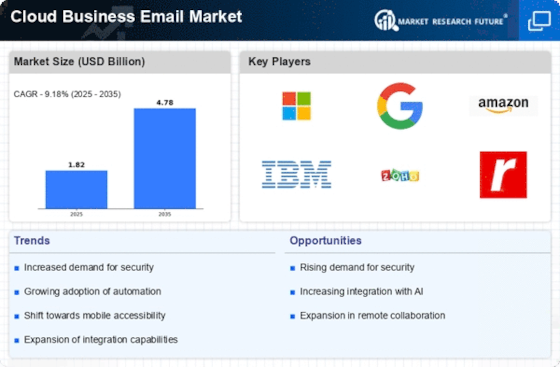
The Cloud Business Email Market was valued at 1.82 USD Billion in 2024.

What is the projected market size for the Cloud Business Email Market by 2035?

The market is projected to reach 4.783 USD Billion by 2035.

What is the expected CAGR for the Cloud Business Email Market during the forecast period?

The expected CAGR for the Cloud Business Email Market from 2025 to 2035 is 9.18%.

Which companies are the key players in the Cloud Business Email Market?

Key players include Microsoft, Google, Amazon, IBM, Zoho, Rackspace, Salesforce, Atmail, and FastMail.

How does the market valuation for SMEs compare to that of large enterprises?

In 2024, the market valuation for SMEs was 0.73 USD Billion, while for large enterprises, it was 1.09 USD Billion.

What are the segment valuations for different operating systems in the Cloud Business Email Market?

In 2024, Windows was valued at 0.73 USD Billion, Linux at 0.45 USD Billion, UNIX at 0.32 USD Billion, and Mainframe at 0.32 USD Billion.

Market Summary

As per MRFR analysis, the Cloud Business Email Market Size was estimated at 1.82 USD Billion in 2024. The Cloud Business Email industry is projected to grow from 1.987 USD Billion in 2025 to 4.783 USD Billion by 2035, exhibiting a compound annual growth rate (CAGR) of 9.18 during the forecast period 2025 - 2035.

Key Market Trends & Highlights

The Cloud Business Email Market is experiencing robust growth driven by security enhancements and integration capabilities.

  • The market is witnessing an increased focus on security measures to protect sensitive business communications.
  • Integration with collaboration tools is becoming essential as businesses seek seamless workflows and enhanced productivity.
  • Adoption of AI and automation technologies is on the rise, streamlining email management and improving user experience.
  • The growing demand for remote work solutions and enhanced security features are key drivers propelling market expansion, particularly in North America and the Asia-Pacific region.

Market Size & Forecast

2024 Market Size 1.82 (USD Billion)
2035 Market Size 4.783 (USD Billion)
CAGR (2025 - 2035) 9.18%
Largest Regional Market Share in 2024 North America

Major Players

<p>Microsoft (US), Google (US), Amazon (US), IBM (US), Zoho (IN), Rackspace (US), Salesforce (US), Atmail (AU), FastMail (AU)</p>

Market Trends

The Cloud Business Email Market is currently experiencing a transformative phase characterized by rapid technological advancements and evolving user expectations. Organizations are increasingly recognizing the necessity of secure, reliable, and efficient email solutions that can seamlessly integrate with other cloud-based services. This shift is driven by the growing demand for remote collaboration tools and the need for enhanced cybersecurity measures. As businesses continue to migrate to cloud environments, the emphasis on scalability and flexibility in email solutions becomes paramount. Furthermore, the integration of artificial intelligence and machine learning into email platforms is reshaping how users interact with their communications, potentially leading to more personalized and efficient experiences. In addition to technological innovations, the Cloud Business Email Market is also influenced by regulatory changes and compliance requirements. Organizations are compelled to adopt email solutions that not only meet their operational needs but also adhere to stringent data protection laws. This trend suggests a growing awareness among businesses regarding the importance of safeguarding sensitive information. As the market evolves, it appears that providers who can offer robust security features alongside user-friendly interfaces will likely gain a competitive edge. Overall, the Cloud Business Email Market is poised for continued growth as it adapts to the dynamic landscape of modern business communication.

Increased Focus on Security

As cyber threats become more sophisticated, there is a heightened emphasis on security within the Cloud Business Email Market. Organizations are prioritizing solutions that offer advanced encryption, multi-factor authentication, and robust spam filtering to protect sensitive information.

Integration with Collaboration Tools

The trend towards remote work has led to a surge in demand for email solutions that integrate seamlessly with collaboration platforms. This integration enhances productivity by allowing users to manage communications and projects within a unified interface.

Adoption of AI and Automation

The incorporation of artificial intelligence and automation in email services is gaining traction. These technologies can streamline workflows, improve email sorting, and provide intelligent responses, thereby enhancing user experience and efficiency.

Cloud Business Email Market Market Drivers

Enhanced Security Features

Security remains a critical concern within the Cloud Business Email Market. As cyber threats evolve, businesses are increasingly prioritizing email security solutions that protect sensitive information. Cloud-based email providers are responding by implementing advanced security measures, such as end-to-end encryption and multi-factor authentication. Recent statistics indicate that organizations utilizing cloud email services with robust security features experience a 30% reduction in phishing attacks. This heightened focus on security not only safeguards company data but also builds trust among clients and stakeholders, making secure cloud email solutions a vital component of business operations.

Cost Efficiency and Scalability

Cost efficiency and scalability are pivotal factors influencing the Cloud Business Email Market. Organizations are increasingly recognizing the financial benefits of transitioning to cloud-based email solutions, which often reduce the need for extensive on-premises infrastructure. By adopting cloud email services, businesses can lower operational costs while enjoying the flexibility to scale their email solutions according to their needs. Recent analyses indicate that companies can save up to 40% on email management costs by utilizing cloud services. This cost-effectiveness, combined with the ability to easily adjust service levels, positions cloud business email as an attractive option for enterprises of all sizes.

Integration with Business Applications

The integration of cloud business email services with various business applications is a driving force in the Cloud Business Email Market. Companies are seeking solutions that seamlessly connect email with customer relationship management (CRM) systems, project management tools, and other essential software. This integration enhances productivity by streamlining workflows and facilitating better communication across departments. Data suggests that organizations leveraging integrated email solutions report a 25% increase in operational efficiency. As businesses continue to seek ways to optimize their processes, the demand for integrated cloud email services is likely to rise, further propelling market growth.

Growing Demand for Remote Work Solutions

The Cloud Business Email Market experiences a notable surge in demand for remote work solutions. As organizations increasingly adopt flexible work arrangements, the need for reliable and accessible email services becomes paramount. This trend is reflected in the rising number of businesses transitioning to cloud-based email systems, which offer enhanced accessibility and collaboration features. According to recent data, the market for cloud-based email services is projected to grow at a compound annual growth rate of approximately 15% over the next five years. This growth is driven by the necessity for seamless communication tools that support remote teams, thereby reinforcing the importance of cloud business email solutions in modern workplaces.

Regulatory Compliance and Data Sovereignty

Regulatory compliance and data sovereignty are becoming increasingly significant in the Cloud Business Email Market. As data protection regulations tighten, businesses must ensure that their email solutions comply with local and international laws. Cloud email providers are adapting by offering services that align with various regulatory requirements, such as GDPR and HIPAA. This focus on compliance not only mitigates legal risks but also enhances customer confidence in the services provided. Data indicates that organizations prioritizing compliance in their email solutions are likely to experience a 20% increase in customer trust and retention, underscoring the importance of regulatory adherence in the cloud business email landscape.

Market Segment Insights

By Operating System: Windows (Largest) vs. Linux (Fastest-Growing)

<p>In the Cloud Business Email Market, the operating system segment showcases a diverse distribution of market share among four primary systems: Windows, Linux, UNIX, and Mainframe. Windows holds a dominant position, benefiting from its widespread usage in business environments, leading to a significant share of cloud business email deployments. Linux follows closely behind, presenting a strong user base, particularly among companies looking for customization and flexibility in their cloud services. UNIX and Mainframe continue to serve niche markets yet contribute to the overall landscape through specific use cases in larger enterprises.</p>

<p>Operating System: Windows (Dominant) vs. Linux (Emerging)</p>

<p>Windows remains the dominant operating system in the Cloud Business Email Market, favored for its familiarity, integration capabilities, and extensive support ecosystem. Organizations leveraging Windows-based solutions benefit from seamless connectivity with existing infrastructure and myriad applications tailored to business communications. In contrast, Linux is rapidly emerging as a preferred choice, particularly among tech-savvy businesses seeking open-source solutions. Linux's adaptability, cost-effectiveness, and robust security features appeal to enterprises striving for efficiency and customization. While Windows leads the market, Linux’s growth trajectory highlights its increasing acceptance, driven by a demand for innovation and versatility.</p>

By Organization Size: SMEs (Largest) vs. Large Enterprises (Fastest-Growing)

<p>In the Cloud Business Email Market, Small and Medium Enterprises (SMEs) hold the largest share among the organization sizes, reflecting their increasing reliance on cloud solutions for communication. This segment benefits from cost-effective solutions that enhance productivity while minimizing operational overhead. Conversely, Large Enterprises, while currently contributing a smaller portion to the market, are witnessing rapid growth driven by their need to integrate sophisticated tools and secure communications as they scale. The growth trends indicate that SMEs are embracing cloud business email solutions more slowly due to resource constraints but represent a stable customer base. In contrast, the fast-growing demand from Large Enterprises stems from the need for enhanced security, compliance, and efficiency. This shift is propelled by the digital transformation initiatives undertaken by these organizations, which prioritize scalable and flexible communication solutions.</p>

<p>SMEs: Dominant vs. Large Enterprises: Emerging</p>

<p>Small and Medium Enterprises (SMEs) represent the dominant force in the Cloud Business Email Market, characterized by their need for cost-effective and scalable communication solutions. Their adoption of cloud services is primarily driven by the need for flexibility and accessibility, allowing employees to stay connected regardless of location. SMEs tend to favor simpler, more affordable options that still meet their essential business needs. On the other hand, Large Enterprises are emerging as a powerful segment, catering to complex needs such as compliance, data security, and integration with other enterprise applications. The technological advancements and budgets available to Large Enterprises enable them to adopt more sophisticated cloud email solutions that align with their intricate organizational structures and communication requirements.</p>

By Vertical: BFSI (Largest) vs. Healthcare (Fastest-Growing)

<p>In the Cloud Business Email Market, the BFSI sector holds the largest market share, driven by the increasing demand for secure communication and regulatory compliance. With financial institutions prioritizing data protection, BFSI's reliance on cloud-based email solutions has strengthened its position as the leading segment. Conversely, the Healthcare sector, while smaller in terms of share, is witnessing rapid growth as telemedicine and digital health records proliferate, contributing to the rising adoption of cloud business email solutions in this domain.</p>

<p>BFSI (Dominant) vs. Healthcare (Emerging)</p>

<p>The BFSI sector is characterized by stringent regulatory standards and a high demand for security and confidentiality in communications. This sector's dominance is bolstered by the need for data protection and swift transaction processing. On the other hand, the Healthcare sector is emerging as a significant player due to the increasing digitization of health services and the necessity for secure, efficient communication among healthcare providers. As healthcare organizations seek to enhance collaboration and streamline patient communications, the growth potential in this segment is substantial.</p>

Get more detailed insights about Cloud Business Email Market Research Report- Global Forecast 2035

Regional Insights

North America : Cloud Innovation Leader

North America is the largest market for cloud business email, holding approximately 45% of the global share. The region's growth is driven by increasing digital transformation initiatives, a robust IT infrastructure, and a high demand for secure communication solutions. Regulatory frameworks, such as the CCPA, further catalyze the adoption of cloud services, ensuring data privacy and security compliance. The United States leads the market, with major players like Microsoft, Google, and Amazon dominating the landscape. The competitive environment is characterized by continuous innovation and service diversification. Canada also plays a significant role, contributing to the market with its growing tech sector and emphasis on cloud adoption, making it the second-largest market in the region with around 15% share.

Europe : Regulatory-Driven Growth

Europe is witnessing significant growth in the cloud business email market, driven by stringent data protection regulations like GDPR. This region holds approximately 30% of the global market share, with Germany and the UK being the largest contributors. The demand for secure and compliant email solutions is propelling businesses to adopt cloud services, ensuring they meet regulatory requirements while enhancing operational efficiency. Germany leads the market, followed closely by the UK, both fostering a competitive landscape with local and international players. Companies like Zoho and Salesforce are expanding their presence, catering to the unique needs of European businesses. The emphasis on data sovereignty and privacy is shaping the market dynamics, encouraging innovation and investment in cloud technologies.

Asia-Pacific : Rapid Adoption of Cloud Solutions

Asia-Pacific is rapidly emerging as a significant player in the cloud business email market, holding around 20% of the global share. The region's growth is fueled by increasing internet penetration, a burgeoning SME sector, and a shift towards digital communication. Countries like India and Australia are leading this transformation, supported by favorable government policies promoting digitalization and cloud adoption. India is witnessing a surge in demand for cloud services, with local players like Zoho gaining traction alongside global giants. Australia also plays a crucial role, with a strong emphasis on cybersecurity and compliance. The competitive landscape is evolving, with numerous startups and established companies vying for market share, making it a dynamic environment for cloud business email solutions.

Middle East and Africa : Emerging Market Potential

The Middle East and Africa region is gradually emerging in the cloud business email market, currently holding about 5% of the global share. The growth is driven by increasing internet connectivity, a young population, and a rising number of startups. Countries like South Africa and the UAE are at the forefront, with government initiatives supporting digital transformation and cloud adoption across various sectors. South Africa leads the market, with a growing emphasis on cloud solutions among businesses. The UAE is also making significant strides, with a focus on becoming a tech hub in the region. The competitive landscape is characterized by both local and international players, with a focus on providing tailored solutions to meet the unique needs of the region's diverse market.

Key Players and Competitive Insights

The Cloud Business Email Market is currently characterized by a dynamic competitive landscape, driven by rapid technological advancements and an increasing demand for secure, scalable communication solutions. Major players such as Microsoft (US), Google (US), and Zoho (IN) are at the forefront, each adopting distinct strategies to enhance their market positioning. Microsoft (US) continues to leverage its extensive ecosystem, integrating its email services with productivity tools like Microsoft 365, thereby fostering user retention and engagement. Google (US), on the other hand, emphasizes innovation through its AI-driven features in Google Workspace, aiming to streamline user experience and enhance collaboration. Meanwhile, Zoho (IN) focuses on affordability and customization, appealing to small and medium-sized enterprises (SMEs) seeking tailored solutions. Collectively, these strategies contribute to a competitive environment that is increasingly focused on user-centric innovations and integrated service offerings.

In terms of business tactics, companies are increasingly localizing their services to cater to regional preferences and regulatory requirements. This localization, coupled with supply chain optimization, is essential in a market that appears moderately fragmented, with numerous players vying for market share. The collective influence of key players shapes the market structure, as they engage in strategic partnerships and collaborations to enhance their service offerings and expand their geographical reach.

In August 2025, Microsoft (US) announced the launch of a new security feature for its Outlook platform, aimed at enhancing data protection for enterprise users. This strategic move underscores Microsoft's commitment to addressing growing concerns around cybersecurity, particularly as businesses increasingly migrate to cloud-based solutions. By prioritizing security, Microsoft not only strengthens its competitive edge but also reassures clients about the safety of their communications.

In September 2025, Google (US) unveiled a significant update to its Google Workspace, incorporating advanced AI capabilities that facilitate smarter email management and automated responses. This development is indicative of Google's strategy to maintain its leadership in innovation, as it seeks to differentiate its offerings in a crowded market. The integration of AI not only enhances user experience but also positions Google as a forward-thinking player in the realm of cloud business email.

In July 2025, Zoho (IN) expanded its The Cloud Business Email Market with a localized version of its email services. This strategic expansion reflects Zoho's focus on catering to SMEs in diverse regions, thereby enhancing its competitive positioning. By offering tailored solutions that align with local business practices, Zoho is likely to capture a significant share of the European market, further diversifying its customer base.

As of October 2025, the Cloud Business Email Market is witnessing trends that emphasize digitalization, sustainability, and the integration of AI technologies. Strategic alliances among key players are increasingly shaping the competitive landscape, as companies collaborate to enhance their service offerings and address evolving customer needs. Looking ahead, it appears that competitive differentiation will increasingly pivot from price-based strategies to a focus on innovation, technological advancements, and the reliability of supply chains. This shift suggests that companies that prioritize these elements are likely to thrive in an ever-evolving market.

Key Companies in the Cloud Business Email Market market include

Industry Developments

November 2022: To give the complete cloud email security available on the market, Abnormal Security, the industry-leading behavioral AI-based security platform, announced the launch of its newest product. The most recent invention shields users from growing email platform threats, becoming more frequent and severe as attackers discover new ways to hit businesses.

Future Outlook

Cloud Business Email Market Future Outlook

<p>The Cloud Business Email Market is projected to grow at a 9.18% CAGR from 2024 to 2035, driven by increasing demand for remote collaboration and enhanced security features.</p>

New opportunities lie in:

  • <p>Integration of AI-driven email management tools</p>
  • <p>Expansion of customizable email solutions for SMEs</p>
  • <p>Development of advanced security protocols for cloud email services</p>

<p>By 2035, the market is expected to be robust, reflecting substantial growth and innovation.</p>

Market Segmentation

Cloud Business Email Market Vertical Outlook

  • BFSI
  • Healthcare
  • Retail
  • IT & Telecommunication

Cloud Business Email Market Operating System Outlook

  • Windows
  • Linux
  • UNIX
  • Mainframe

Cloud Business Email Market Organization Size Outlook

  • SMEs
  • Large Enterprises

Report Scope

MARKET SIZE 20241.82(USD Billion)
MARKET SIZE 20251.987(USD Billion)
MARKET SIZE 20354.783(USD Billion)
COMPOUND ANNUAL GROWTH RATE (CAGR)9.18% (2024 - 2035)
REPORT COVERAGERevenue Forecast, Competitive Landscape, Growth Factors, and Trends
BASE YEAR2024
Market Forecast Period2025 - 2035
Historical Data2019 - 2024
Market Forecast UnitsUSD Billion
Key Companies ProfiledMarket analysis in progress
Segments CoveredMarket segmentation analysis in progress
Key Market OpportunitiesIntegration of artificial intelligence enhances security and efficiency in the Cloud Business Email Market.
Key Market DynamicsRising demand for secure communication drives innovation and competition in the Cloud Business Email Market.
Countries CoveredNorth America, Europe, APAC, South America, MEA

FAQs

What is the current valuation of the Cloud Business Email Market?

The Cloud Business Email Market was valued at 1.82 USD Billion in 2024.

What is the projected market size for the Cloud Business Email Market by 2035?

The market is projected to reach 4.783 USD Billion by 2035.

What is the expected CAGR for the Cloud Business Email Market during the forecast period?

The expected CAGR for the Cloud Business Email Market from 2025 to 2035 is 9.18%.

Which companies are the key players in the Cloud Business Email Market?

Key players include Microsoft, Google, Amazon, IBM, Zoho, Rackspace, Salesforce, Atmail, and FastMail.

How does the market valuation for SMEs compare to that of large enterprises?

In 2024, the market valuation for SMEs was 0.73 USD Billion, while for large enterprises, it was 1.09 USD Billion.

What are the segment valuations for different operating systems in the Cloud Business Email Market?

In 2024, Windows was valued at 0.73 USD Billion, Linux at 0.45 USD Billion, UNIX at 0.32 USD Billion, and Mainframe at 0.32 USD Billion.

  1. SECTION I: EXECUTIVE SUMMARY AND KEY HIGHLIGHTS
    1. EXECUTIVE SUMMARY
      1. Market Overview
      2. Key Findings
      3. Market Segmentation
      4. Competitive Landscape
      5. Challenges and Opportunities
      6. Future Outlook
  2. SECTION II: SCOPING, METHODOLOGY AND MARKET STRUCTURE
    1. MARKET INTRODUCTION
      1. Definition
      2. Scope of the study
    2. RESEARCH METHODOLOGY
      1. Overview
      2. Data Mining
      3. Secondary Research
      4. Primary Research
      5. Forecasting Model
      6. Market Size Estimation
      7. Data Triangulation
      8. Validation
  3. SECTION III: QUALITATIVE ANALYSIS
    1. MARKET DYNAMICS
      1. Overview
      2. Drivers
      3. Restraints
      4. Opportunities
    2. MARKET FACTOR ANALYSIS
      1. Value chain Analysis
      2. Porter's Five Forces Analysis
      3. COVID-19 Impact Analysis
  4. SECTION IV: QUANTITATIVE ANALYSIS
    1. Information and Communications Technology, BY Operating System (USD Billion)
      1. Windows
      2. Linux
      3. UNIX
      4. Mainframe
    2. Information and Communications Technology, BY Organization Size (USD Billion)
      1. SMEs
      2. Large Enterprises
    3. Information and Communications Technology, BY Vertical (USD Billion)
      1. BFSI
      2. Healthcare
      3. Retail
      4. IT & Telecommunication
    4. Information and Communications Technology, BY Region (USD Billion)
      1. North America
      2. Europe
      3. APAC
      4. South America
      5. MEA
  5. SECTION V: COMPETITIVE ANALYSIS
    1. Competitive Landscape
      1. Overview
      2. Competitive Analysis
      3. Market share Analysis
      4. Major Growth Strategy in the Information and Communications Technology
      5. Competitive Benchmarking
      6. Leading Players in Terms of Number of Developments in the Information and Communications Technology
      7. Key developments and growth strategies
      8. Major Players Financial Matrix
    2. Company Profiles
      1. Microsoft (US)
      2. Google (US)
      3. Amazon (US)
      4. IBM (US)
      5. Zoho (IN)
      6. Rackspace (US)
      7. Salesforce (US)
      8. Atmail (AU)
      9. FastMail (AU)
    3. Appendix
      1. References
      2. Related Reports
  6. LIST OF FIGURES
    1. MARKET SYNOPSIS
    2. NORTH AMERICA MARKET ANALYSIS
    3. US MARKET ANALYSIS BY OPERATING SYSTEM
    4. US MARKET ANALYSIS BY ORGANIZATION SIZE
    5. US MARKET ANALYSIS BY VERTICAL
    6. CANADA MARKET ANALYSIS BY OPERATING SYSTEM
    7. CANADA MARKET ANALYSIS BY ORGANIZATION SIZE
    8. CANADA MARKET ANALYSIS BY VERTICAL
    9. EUROPE MARKET ANALYSIS
    10. GERMANY MARKET ANALYSIS BY OPERATING SYSTEM
    11. GERMANY MARKET ANALYSIS BY ORGANIZATION SIZE
    12. GERMANY MARKET ANALYSIS BY VERTICAL
    13. UK MARKET ANALYSIS BY OPERATING SYSTEM
    14. UK MARKET ANALYSIS BY ORGANIZATION SIZE
    15. UK MARKET ANALYSIS BY VERTICAL
    16. FRANCE MARKET ANALYSIS BY OPERATING SYSTEM
    17. FRANCE MARKET ANALYSIS BY ORGANIZATION SIZE
    18. FRANCE MARKET ANALYSIS BY VERTICAL
    19. RUSSIA MARKET ANALYSIS BY OPERATING SYSTEM
    20. RUSSIA MARKET ANALYSIS BY ORGANIZATION SIZE
    21. RUSSIA MARKET ANALYSIS BY VERTICAL
    22. ITALY MARKET ANALYSIS BY OPERATING SYSTEM
    23. ITALY MARKET ANALYSIS BY ORGANIZATION SIZE
    24. ITALY MARKET ANALYSIS BY VERTICAL
    25. SPAIN MARKET ANALYSIS BY OPERATING SYSTEM
    26. SPAIN MARKET ANALYSIS BY ORGANIZATION SIZE
    27. SPAIN MARKET ANALYSIS BY VERTICAL
    28. REST OF EUROPE MARKET ANALYSIS BY OPERATING SYSTEM
    29. REST OF EUROPE MARKET ANALYSIS BY ORGANIZATION SIZE
    30. REST OF EUROPE MARKET ANALYSIS BY VERTICAL
    31. APAC MARKET ANALYSIS
    32. CHINA MARKET ANALYSIS BY OPERATING SYSTEM
    33. CHINA MARKET ANALYSIS BY ORGANIZATION SIZE
    34. CHINA MARKET ANALYSIS BY VERTICAL
    35. INDIA MARKET ANALYSIS BY OPERATING SYSTEM
    36. INDIA MARKET ANALYSIS BY ORGANIZATION SIZE
    37. INDIA MARKET ANALYSIS BY VERTICAL
    38. JAPAN MARKET ANALYSIS BY OPERATING SYSTEM
    39. JAPAN MARKET ANALYSIS BY ORGANIZATION SIZE
    40. JAPAN MARKET ANALYSIS BY VERTICAL
    41. SOUTH KOREA MARKET ANALYSIS BY OPERATING SYSTEM
    42. SOUTH KOREA MARKET ANALYSIS BY ORGANIZATION SIZE
    43. SOUTH KOREA MARKET ANALYSIS BY VERTICAL
    44. MALAYSIA MARKET ANALYSIS BY OPERATING SYSTEM
    45. MALAYSIA MARKET ANALYSIS BY ORGANIZATION SIZE
    46. MALAYSIA MARKET ANALYSIS BY VERTICAL
    47. THAILAND MARKET ANALYSIS BY OPERATING SYSTEM
    48. THAILAND MARKET ANALYSIS BY ORGANIZATION SIZE
    49. THAILAND MARKET ANALYSIS BY VERTICAL
    50. INDONESIA MARKET ANALYSIS BY OPERATING SYSTEM
    51. INDONESIA MARKET ANALYSIS BY ORGANIZATION SIZE
    52. INDONESIA MARKET ANALYSIS BY VERTICAL
    53. REST OF APAC MARKET ANALYSIS BY OPERATING SYSTEM
    54. REST OF APAC MARKET ANALYSIS BY ORGANIZATION SIZE
    55. REST OF APAC MARKET ANALYSIS BY VERTICAL
    56. SOUTH AMERICA MARKET ANALYSIS
    57. BRAZIL MARKET ANALYSIS BY OPERATING SYSTEM
    58. BRAZIL MARKET ANALYSIS BY ORGANIZATION SIZE
    59. BRAZIL MARKET ANALYSIS BY VERTICAL
    60. MEXICO MARKET ANALYSIS BY OPERATING SYSTEM
    61. MEXICO MARKET ANALYSIS BY ORGANIZATION SIZE
    62. MEXICO MARKET ANALYSIS BY VERTICAL
    63. ARGENTINA MARKET ANALYSIS BY OPERATING SYSTEM
    64. ARGENTINA MARKET ANALYSIS BY ORGANIZATION SIZE
    65. ARGENTINA MARKET ANALYSIS BY VERTICAL
    66. REST OF SOUTH AMERICA MARKET ANALYSIS BY OPERATING SYSTEM
    67. REST OF SOUTH AMERICA MARKET ANALYSIS BY ORGANIZATION SIZE
    68. REST OF SOUTH AMERICA MARKET ANALYSIS BY VERTICAL
    69. MEA MARKET ANALYSIS
    70. GCC COUNTRIES MARKET ANALYSIS BY OPERATING SYSTEM
    71. GCC COUNTRIES MARKET ANALYSIS BY ORGANIZATION SIZE
    72. GCC COUNTRIES MARKET ANALYSIS BY VERTICAL
    73. SOUTH AFRICA MARKET ANALYSIS BY OPERATING SYSTEM
    74. SOUTH AFRICA MARKET ANALYSIS BY ORGANIZATION SIZE
    75. SOUTH AFRICA MARKET ANALYSIS BY VERTICAL
    76. REST OF MEA MARKET ANALYSIS BY OPERATING SYSTEM
    77. REST OF MEA MARKET ANALYSIS BY ORGANIZATION SIZE
    78. REST OF MEA MARKET ANALYSIS BY VERTICAL
    79. KEY BUYING CRITERIA OF INFORMATION AND COMMUNICATIONS TECHNOLOGY
    80. RESEARCH PROCESS OF MRFR
    81. DRO ANALYSIS OF INFORMATION AND COMMUNICATIONS TECHNOLOGY
    82. DRIVERS IMPACT ANALYSIS: INFORMATION AND COMMUNICATIONS TECHNOLOGY
    83. RESTRAINTS IMPACT ANALYSIS: INFORMATION AND COMMUNICATIONS TECHNOLOGY
    84. SUPPLY / VALUE CHAIN: INFORMATION AND COMMUNICATIONS TECHNOLOGY
    85. INFORMATION AND COMMUNICATIONS TECHNOLOGY, BY OPERATING SYSTEM, 2024 (% SHARE)
    86. INFORMATION AND COMMUNICATIONS TECHNOLOGY, BY OPERATING SYSTEM, 2024 TO 2035 (USD Billion)
    87. INFORMATION AND COMMUNICATIONS TECHNOLOGY, BY ORGANIZATION SIZE, 2024 (% SHARE)
    88. INFORMATION AND COMMUNICATIONS TECHNOLOGY, BY ORGANIZATION SIZE, 2024 TO 2035 (USD Billion)
    89. INFORMATION AND COMMUNICATIONS TECHNOLOGY, BY VERTICAL, 2024 (% SHARE)
    90. INFORMATION AND COMMUNICATIONS TECHNOLOGY, BY VERTICAL, 2024 TO 2035 (USD Billion)
    91. BENCHMARKING OF MAJOR COMPETITORS
  7. LIST OF TABLES
    1. LIST OF ASSUMPTIONS
    2. North America MARKET SIZE ESTIMATES; FORECAST
      1. BY OPERATING SYSTEM, 2025-2035 (USD Billion)
      2. BY ORGANIZATION SIZE, 2025-2035 (USD Billion)
      3. BY VERTICAL, 2025-2035 (USD Billion)
    3. US MARKET SIZE ESTIMATES; FORECAST
      1. BY OPERATING SYSTEM, 2025-2035 (USD Billion)
      2. BY ORGANIZATION SIZE, 2025-2035 (USD Billion)
      3. BY VERTICAL, 2025-2035 (USD Billion)
    4. Canada MARKET SIZE ESTIMATES; FORECAST
      1. BY OPERATING SYSTEM, 2025-2035 (USD Billion)
      2. BY ORGANIZATION SIZE, 2025-2035 (USD Billion)
      3. BY VERTICAL, 2025-2035 (USD Billion)
    5. Europe MARKET SIZE ESTIMATES; FORECAST
      1. BY OPERATING SYSTEM, 2025-2035 (USD Billion)
      2. BY ORGANIZATION SIZE, 2025-2035 (USD Billion)
      3. BY VERTICAL, 2025-2035 (USD Billion)
    6. Germany MARKET SIZE ESTIMATES; FORECAST
      1. BY OPERATING SYSTEM, 2025-2035 (USD Billion)
      2. BY ORGANIZATION SIZE, 2025-2035 (USD Billion)
      3. BY VERTICAL, 2025-2035 (USD Billion)
    7. UK MARKET SIZE ESTIMATES; FORECAST
      1. BY OPERATING SYSTEM, 2025-2035 (USD Billion)
      2. BY ORGANIZATION SIZE, 2025-2035 (USD Billion)
      3. BY VERTICAL, 2025-2035 (USD Billion)
    8. France MARKET SIZE ESTIMATES; FORECAST
      1. BY OPERATING SYSTEM, 2025-2035 (USD Billion)
      2. BY ORGANIZATION SIZE, 2025-2035 (USD Billion)
      3. BY VERTICAL, 2025-2035 (USD Billion)
    9. Russia MARKET SIZE ESTIMATES; FORECAST
      1. BY OPERATING SYSTEM, 2025-2035 (USD Billion)
      2. BY ORGANIZATION SIZE, 2025-2035 (USD Billion)
      3. BY VERTICAL, 2025-2035 (USD Billion)
    10. Italy MARKET SIZE ESTIMATES; FORECAST
      1. BY OPERATING SYSTEM, 2025-2035 (USD Billion)
      2. BY ORGANIZATION SIZE, 2025-2035 (USD Billion)
      3. BY VERTICAL, 2025-2035 (USD Billion)
    11. Spain MARKET SIZE ESTIMATES; FORECAST
      1. BY OPERATING SYSTEM, 2025-2035 (USD Billion)
      2. BY ORGANIZATION SIZE, 2025-2035 (USD Billion)
      3. BY VERTICAL, 2025-2035 (USD Billion)
    12. Rest of Europe MARKET SIZE ESTIMATES; FORECAST
      1. BY OPERATING SYSTEM, 2025-2035 (USD Billion)
      2. BY ORGANIZATION SIZE, 2025-2035 (USD Billion)
      3. BY VERTICAL, 2025-2035 (USD Billion)
    13. APAC MARKET SIZE ESTIMATES; FORECAST
      1. BY OPERATING SYSTEM, 2025-2035 (USD Billion)
      2. BY ORGANIZATION SIZE, 2025-2035 (USD Billion)
      3. BY VERTICAL, 2025-2035 (USD Billion)
    14. China MARKET SIZE ESTIMATES; FORECAST
      1. BY OPERATING SYSTEM, 2025-2035 (USD Billion)
      2. BY ORGANIZATION SIZE, 2025-2035 (USD Billion)
      3. BY VERTICAL, 2025-2035 (USD Billion)
    15. India MARKET SIZE ESTIMATES; FORECAST
      1. BY OPERATING SYSTEM, 2025-2035 (USD Billion)
      2. BY ORGANIZATION SIZE, 2025-2035 (USD Billion)
      3. BY VERTICAL, 2025-2035 (USD Billion)
    16. Japan MARKET SIZE ESTIMATES; FORECAST
      1. BY OPERATING SYSTEM, 2025-2035 (USD Billion)
      2. BY ORGANIZATION SIZE, 2025-2035 (USD Billion)
      3. BY VERTICAL, 2025-2035 (USD Billion)
    17. South Korea MARKET SIZE ESTIMATES; FORECAST
      1. BY OPERATING SYSTEM, 2025-2035 (USD Billion)
      2. BY ORGANIZATION SIZE, 2025-2035 (USD Billion)
      3. BY VERTICAL, 2025-2035 (USD Billion)
    18. Malaysia MARKET SIZE ESTIMATES; FORECAST
      1. BY OPERATING SYSTEM, 2025-2035 (USD Billion)
      2. BY ORGANIZATION SIZE, 2025-2035 (USD Billion)
      3. BY VERTICAL, 2025-2035 (USD Billion)
    19. Thailand MARKET SIZE ESTIMATES; FORECAST
      1. BY OPERATING SYSTEM, 2025-2035 (USD Billion)
      2. BY ORGANIZATION SIZE, 2025-2035 (USD Billion)
      3. BY VERTICAL, 2025-2035 (USD Billion)
    20. Indonesia MARKET SIZE ESTIMATES; FORECAST
      1. BY OPERATING SYSTEM, 2025-2035 (USD Billion)
      2. BY ORGANIZATION SIZE, 2025-2035 (USD Billion)
      3. BY VERTICAL, 2025-2035 (USD Billion)
    21. Rest of APAC MARKET SIZE ESTIMATES; FORECAST
      1. BY OPERATING SYSTEM, 2025-2035 (USD Billion)
      2. BY ORGANIZATION SIZE, 2025-2035 (USD Billion)
      3. BY VERTICAL, 2025-2035 (USD Billion)
    22. South America MARKET SIZE ESTIMATES; FORECAST
      1. BY OPERATING SYSTEM, 2025-2035 (USD Billion)
      2. BY ORGANIZATION SIZE, 2025-2035 (USD Billion)
      3. BY VERTICAL, 2025-2035 (USD Billion)
    23. Brazil MARKET SIZE ESTIMATES; FORECAST
      1. BY OPERATING SYSTEM, 2025-2035 (USD Billion)
      2. BY ORGANIZATION SIZE, 2025-2035 (USD Billion)
      3. BY VERTICAL, 2025-2035 (USD Billion)
    24. Mexico MARKET SIZE ESTIMATES; FORECAST
      1. BY OPERATING SYSTEM, 2025-2035 (USD Billion)
      2. BY ORGANIZATION SIZE, 2025-2035 (USD Billion)
      3. BY VERTICAL, 2025-2035 (USD Billion)
    25. Argentina MARKET SIZE ESTIMATES; FORECAST
      1. BY OPERATING SYSTEM, 2025-2035 (USD Billion)
      2. BY ORGANIZATION SIZE, 2025-2035 (USD Billion)
      3. BY VERTICAL, 2025-2035 (USD Billion)
    26. Rest of South America MARKET SIZE ESTIMATES; FORECAST
      1. BY OPERATING SYSTEM, 2025-2035 (USD Billion)
      2. BY ORGANIZATION SIZE, 2025-2035 (USD Billion)
      3. BY VERTICAL, 2025-2035 (USD Billion)
    27. MEA MARKET SIZE ESTIMATES; FORECAST
      1. BY OPERATING SYSTEM, 2025-2035 (USD Billion)
      2. BY ORGANIZATION SIZE, 2025-2035 (USD Billion)
      3. BY VERTICAL, 2025-2035 (USD Billion)
    28. GCC Countries MARKET SIZE ESTIMATES; FORECAST
      1. BY OPERATING SYSTEM, 2025-2035 (USD Billion)
      2. BY ORGANIZATION SIZE, 2025-2035 (USD Billion)
      3. BY VERTICAL, 2025-2035 (USD Billion)
    29. South Africa MARKET SIZE ESTIMATES; FORECAST
      1. BY OPERATING SYSTEM, 2025-2035 (USD Billion)
      2. BY ORGANIZATION SIZE, 2025-2035 (USD Billion)
      3. BY VERTICAL, 2025-2035 (USD Billion)
    30. Rest of MEA MARKET SIZE ESTIMATES; FORECAST
      1. BY OPERATING SYSTEM, 2025-2035 (USD Billion)
      2. BY ORGANIZATION SIZE, 2025-2035 (USD Billion)
      3. BY VERTICAL, 2025-2035 (USD Billion)
    31. PRODUCT LAUNCH/PRODUCT DEVELOPMENT/APPROVAL
    32. ACQUISITION/PARTNERSHIP

Cloud Business Email Market Segmentation

Cloud Business Email Operating System Outlook (USD Billion, 2018-2032)

  • Windows
  • Linux
  • UNIX
  • Mainframe

Cloud Business Email Organization Size Outlook (USD Billion, 2018-2032)

  • SMEs
  • Large Enterprises

Cloud Business Email Vertical Outlook (USD Billion, 2018-2032)

  • BFSI
  • Healthcare
  • Retail
  • IT & Telecommunication

Cloud Business Email Regional Outlook (USD Billion, 2018-2032)

  • North America Outlook (USD Billion, 2018-2032)

    • North America Cloud Business Email by Operating System
      • Windows
      • Linux
      • UNIX
      • Mainframe
    • North America Cloud Business Email by Organization Size
      • SMEs
      • Large Enterprises
    • North America Cloud Business Email by Vertical
      • BFSI
      • Healthcare
      • Retail
      • IT & Telecommunication
    • US Outlook (USD Billion, 2018-2032)

    • US Cloud Business Email by Operating System
      • Windows
      • Linux
      • UNIX
      • Mainframe
    • US Cloud Business Email by Organization Size
      • SMEs
      • Large Enterprises
    • US Cloud Business Email by Vertical
      • BFSI
      • Healthcare
      • Retail
      • IT & Telecommunication
    • CANADA Outlook (USD Billion, 2018-2032)

    • CANADA Cloud Business Email by Operating System
      • Windows
      • Linux
      • UNIX
      • Mainframe
    • CANADA Cloud Business Email by Organization Size
      • SMEs
      • Large Enterprises
    • CANADA Cloud Business Email by Vertical
      • BFSI
      • Healthcare
      • Retail
      • IT & Telecommunication
  • Europe Outlook (USD Billion, 2018-2032)

    • Europe Cloud Business Email by Operating System
      • Windows
      • Linux
      • UNIX
      • Mainframe
    • Europe Cloud Business Email by Organization Size
      • SMEs
      • Large Enterprises
    • Europe Cloud Business Email by Vertical
      • BFSI
      • Healthcare
      • Retail
      • IT & Telecommunication
    • Germany Outlook (USD Billion, 2018-2032)

    • Germany Cloud Business Email by Operating System
      • Windows
      • Linux
      • UNIX
      • Mainframe
    • Germany Cloud Business Email by Organization Size
      • SMEs
      • Large Enterprises
    • Germany Cloud Business Email by Vertical
      • BFSI
      • Healthcare
      • Retail
      • IT & Telecommunication
    • France Outlook (USD Billion, 2018-2032)

    • France Cloud Business Email by Operating System
      • Windows
      • Linux
      • UNIX
      • Mainframe
    • France Cloud Business Email by Organization Size
      • SMEs
      • Large Enterprises
    • France Cloud Business Email by Vertical
      • BFSI
      • Healthcare
      • Retail
      • IT & Telecommunication
    • UK Outlook (USD Billion, 2018-2032)

    • UK Cloud Business Email by Operating System
      • Windows
      • Linux
      • UNIX
      • Mainframe
    • UK Cloud Business Email by Organization Size
      • SMEs
      • Large Enterprises
    • UK Cloud Business Email by Vertical
      • BFSI
      • Healthcare
      • Retail
      • IT & Telecommunication
    • ITALY Outlook (USD Billion, 2018-2032)

    • ITALY Cloud Business Email by Operating System
      • Windows
      • Linux
      • UNIX
      • Mainframe
    • ITALY Cloud Business Email by Organization Size
      • SMEs
      • Large Enterprises
    • ITALY Cloud Business Email by Vertical
      • BFSI
      • Healthcare
      • Retail
      • IT & Telecommunication
    • SPAIN Outlook (USD Billion, 2018-2032)

    • Spain Cloud Business Email by Operating System
      • Windows
      • Linux
      • UNIX
      • Mainframe
    • Spain Cloud Business Email by Organization Size
      • SMEs
      • Large Enterprises
    • Spain Cloud Business Email by Vertical
      • BFSI
      • Healthcare
      • Retail
      • IT & Telecommunication
    • Rest Of Europe Outlook (USD Billion, 2018-2032)

    • Rest Of Europe Cloud Business Email by Operating System
      • Windows
      • Linux
      • UNIX
      • Mainframe
    • Rest Of Europe Cloud Business Email by Organization Size
      • SMEs
      • Large Enterprises
    • Rest Of Europe Cloud Business Email by Vertical
      • BFSI
      • Healthcare
      • Retail
      • IT & Telecommunication
  • Asia-Pacific Outlook (USD Billion, 2018-2032)

    • Asia-Pacific Cloud Business Email by Operating System
      • Windows
      • Linux
      • UNIX
      • Mainframe
    • Asia-Pacific Cloud Business Email by Organization Size
      • SMEs
      • Large Enterprises
    • Asia-Pacific Cloud Business Email by Vertical
      • BFSI
      • Healthcare
      • Retail
      • IT & Telecommunication
    • China Outlook (USD Billion, 2018-2032)

    • China Cloud Business Email by Operating System
      • Windows
      • Linux
      • UNIX
      • Mainframe
    • China Cloud Business Email by Organization Size
      • SMEs
      • Large Enterprises
    • China Cloud Business Email by Vertical
      • BFSI
      • Healthcare
      • Retail
      • IT & Telecommunication
    • Japan Outlook (USD Billion, 2018-2032)

    • Japan Cloud Business Email by Operating System
      • Windows
      • Linux
      • UNIX
      • Mainframe
    • Japan Cloud Business Email by Organization Size

      • SMEs
      • Large Enterprises
    • Japan Cloud Business Email by Vertical

      • BFSI
      • Healthcare
      • Retail
      • IT & Telecommunication
    • India Outlook (USD Billion, 2018-2032)

    • India Cloud Business Email by Operating System
      • Windows
      • Linux
      • UNIX
      • Mainframe
    • India Cloud Business Email by Organization Size
      • SMEs
      • Large Enterprises
    • India Cloud Business Email by Vertical
      • BFSI
      • Healthcare
      • Retail
      • IT & Telecommunication
    • Australia Outlook (USD Billion, 2018-2032)

    • Australia Cloud Business Email by Operating System
      • Windows
      • Linux
      • UNIX
      • Mainframe
    • Australia Cloud Business Email by Organization Size
      • SMEs
      • Large Enterprises
    • Australia Cloud Business Email by Vertical
      • BFSI
      • Healthcare
      • Retail
      • IT & Telecommunication
    • Rest of Asia-Pacific Outlook (USD Billion, 2018-2032)

    • Rest of Asia-Pacific Cloud Business Email by Operating System
      • Windows
      • Linux
      • UNIX
      • Mainframe
    • Rest of Asia-Pacific Cloud Business Email by Organization Size
      • SMEs
      • Large Enterprises
    • Rest of Asia-Pacific Cloud Business Email by Vertical
      • BFSI
      • Healthcare
      • Retail
      • IT & Telecommunication
  • Rest of the World Outlook (USD Billion, 2018-2032)

    • Rest of the World Cloud Business Email by Operating System
      • Windows
      • Linux
      • UNIX
      • Mainframe
    • Rest of the World Cloud Business Email by Organization Size
      • SMEs
      • Large Enterprises
    • Rest of the World Cloud Business Email by Vertical
      • BFSI
      • Healthcare
      • Retail
      • IT & Telecommunication
    • Middle East Outlook (USD Billion, 2018-2032)

    • Middle East Cloud Business Email by Operating System
      • Windows
      • Linux
      • UNIX
      • Mainframe
    • Middle East Cloud Business Email by Organization Size
      • SMEs
      • Large Enterprises
    • Middle East Cloud Business Email by Vertical
      • BFSI
      • Healthcare
      • Retail
      • IT & Telecommunication
    • Africa Outlook (USD Billion, 2018-2032)

    • Africa Cloud Business Email by Operating System
      • Windows
      • Linux
      • UNIX
      • Mainframe
    • Africa Cloud Business Email by Organization Size
      • SMEs
      • Large Enterprises
    • Africa Cloud Business Email by Vertical
      • BFSI
      • Healthcare
      • Retail
      • IT & Telecommunication
    • Latin America Outlook (USD Billion, 2018-2032)

    • Latin America Cloud Business Email by Operating System
      • Windows
      • Linux
      • UNIX
      • Mainframe
    • Latin America Cloud Business Email by Organization Size
      • SMEs
      • Large Enterprises
    • Latin America Cloud Business Email by Vertical
      • BFSI
      • Healthcare
      • Retail
      • IT & Telecommunication
Infographic

Free Sample Request

Kindly complete the form below to receive a free sample of this Report

Get Free Sample

Customer Strories

Compare Licence

×
Features License Type
Single User Multiuser License Enterprise User
Price $4,950 $5,950 $7,250
Maximum User Access Limit 1 User Upto 10 Users Unrestricted Access Throughout the Organization
Free Customization
Direct Access to Analyst
Deliverable Format
Platform Access
Discount on Next Purchase 10% 15% 15%
Printable Versions