
Request Free Sample ×

Kindly complete the form below to receive a free sample of this Report

* Please use a valid business email

Leading companies partner with us for data-driven Insights

clients tt-cursor
Hero Background
English
Chinese
French
Japanese
Korean
German
Spanish

China Robotics Market Share

ID: MRFR/SEM/11143-HCR
200 Pages
Apoorva Priyadarshi
Last Updated: April 06, 2026

China Robotics Market Size, Share & Industry Analysis: By Component (Hardware, Software, and Service), By Robot Type (Traditional industrial robots, Cobots, Professional service robots, and Others), By Application (Manufacturing, Healthcare, Aerospace & Defense, Media & Entertainment, Logistics, and Others) – Industry Forecast Till 2035

Share:
Download PDF ×

We do not share your information with anyone. However, we may send you emails based on your report interest from time to time. You may contact us at any time to opt-out.

China Robotics Market Infographic
Purchase Options

Market Share

China Robotics Market Share Analysis

The Entertainment Robots Market is experiencing dynamic trends that are reshaping the landscape of robotic technology used for entertainment purposes. One prominent trend in this domain is the integration of artificial intelligence (AI) and machine learning (ML) into entertainment robots. AI-powered robots are becoming more sophisticated, enabling them to interact with users in more intelligent and intuitive ways, enhancing their entertainment value and user experience.

Another significant trend is the increasing personalization and customization of entertainment robots. Manufacturers are focusing on designing robots that can cater to individual preferences and needs. This trend involves the development of robots with adaptable personalities, customizable features, and the ability to learn and adapt to user behavior, providing a more tailored and engaging experience.

Furthermore, there's a growing emphasis on multi-functionality in entertainment robots. Instead of single-purpose robots, manufacturers are developing versatile robots capable of performing various tasks and activities. These robots are designed to engage users through multiple functions, such as educational activities, companionship, gaming, and even household chores, expanding their utility and appeal.

Additionally, the incorporation of advanced sensors and perception technologies is a notable trend in entertainment robots. Enhanced sensor technologies, including improved vision and spatial recognition capabilities, enable robots to navigate environments more effectively, interact seamlessly with users, and offer a more immersive and interactive experience.

Moreover, there's an increasing trend toward social interaction and emotional intelligence in entertainment robots. Manufacturers are focusing on developing robots that can understand human emotions, respond appropriately, and establish emotional connections with users. These robots are designed to provide companionship, emotional support, and entertainment, catering to users' psychological and emotional needs.

Another trend driving the entertainment robot market is the integration of robotics with augmented reality (AR) and virtual reality (VR) technologies. AR and VR features enhance the immersive experience of interacting with robots, creating virtual environments, and adding interactive elements to entertainment activities, thereby enriching the overall user experience.

Furthermore, the shift towards more affordable and accessible entertainment robots is gaining traction. Manufacturers are striving to make entertainment robots more cost-effective and user-friendly, making them accessible to a broader consumer base and expanding their market reach.

Lastly, the trend of ethical and responsible robotics is gaining importance. Manufacturers are focusing on ensuring that entertainment robots adhere to ethical guidelines and safety standards, addressing concerns related to data privacy, security, and ethical use of AI in robotics.

In summary, the Entertainment Robots Market is witnessing trends such as AI integration, personalization, multi-functionality, advanced sensors, social interaction, AR/VR integration, affordability, and ethical considerations. These trends reflect the industry's efforts to develop innovative and engaging robots that cater to diverse entertainment needs while ensuring safety, ethical use, and enhanced user experiences.


Author
Author Profile
Apoorva Priyadarshi
Research Analyst

With 4+ years of experience in Market Intelligence and Strategic Research, Apoorv specializes in ICT, Semiconductor, and BFSI markets. Combining strong analytical capabilities with a deep understanding of technology-driven industries, he focuses on delivering data-driven insights that support strategic decision-making. With a background in technology and business research, Apoorv has contributed to numerous global market studies, competitive landscape analyses, and opportunity assessments across sectors such as semiconductors, digital banking, cybersecurity, and telecommunications.

Leave a Comment

FAQs

What is the current valuation of the China Robotics Market as of 2024?

<p>The overall market valuation was 7.095 USD Billion in 2024.</p>

What is the projected market size for the China Robotics Market in 2035?

<p>The projected valuation for the China Robotics Market in 2035 is 15.72 USD Billion.</p>

What is the expected CAGR for the China Robotics Market during the forecast period 2025 - 2035?

<p>The expected CAGR for the China Robotics Market during the forecast period 2025 - 2035 is 7.5%.</p>

Which segments are included in the China Robotics Market?

<p>The segments include components, robot types, and applications.</p>

What are the projected valuations for hardware, software, and services in the components segment?

<p>The projected valuations are 5.5 USD Billion for hardware, 4.5 USD Billion for software, and 5.72 USD Billion for services.</p>

How do traditional industrial robots and cobots compare in terms of market valuation?

<p>Traditional industrial robots are projected to reach 6.5 USD Billion, while cobots are expected to reach 3.5 USD Billion.</p>

What applications are driving growth in the China Robotics Market?

<p>Key applications include manufacturing, healthcare, logistics, and aerospace & defense.</p>

What is the projected valuation for the healthcare application in the China Robotics Market?

<p>The projected valuation for the healthcare application is 3.0 USD Billion.</p>

Who are the key players in the China Robotics Market?

<p>Key players include ABB, Fanuc, KUKA, Yaskawa, Siemens, Midea Group, Siasun Robot & Automation, Estun Automation, Hikvision, and Gree Electric Appliances.</p>

What is the expected growth trajectory for the logistics application in the China Robotics Market?

<p>The logistics application is projected to grow to 2.5 USD Billion by 2035.</p>

Market Summary

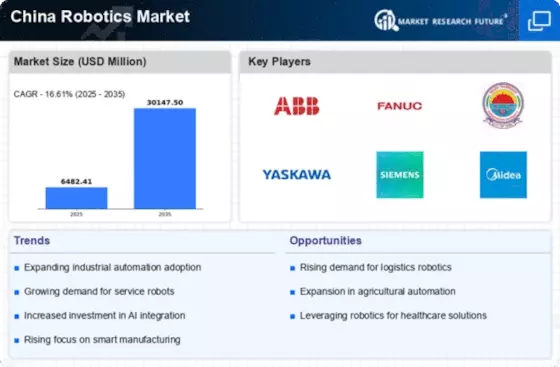
As per analysis, the China Robotics Market is projected to grow from USD 5,583.05 Million in 2024 to USD 30,147.5 Million by 2035, exhibiting a compound annual growth rate (CAGR) of 16.61% during the forecast period (2025 - 2035).

Key Market Trends & Highlights

The China Robotics Market is poised for substantial growth, driven by technological advancements and increasing automation demands.

  • Industrial robotics remains the largest segment, primarily fueled by the manufacturing sector's automation needs.
  • Service robotics is the fastest-growing segment, particularly in healthcare applications, reflecting a shift towards enhanced patient care.
  • Investment in research and development is surging, indicating a strong commitment to innovation within the robotics industry.
  • Government support and rising labor costs are key drivers, propelling the demand for automation across various sectors.

Market Size & Forecast

2024 Market Size 5559.05 (USD Million)
2035 Market Size 30147.5 (USD Million)
CAGR (2025 - 2035) 16.61%

Major Players

<p>ABB (CN), Fanuc (CN), KUKA (CN), Yaskawa (CN), Siemens (CN), Midea Group (CN), Siasun (CN), Estun Automation (CN), Hikvision (CN), Gree Electric Appliances (CN)</p>

Market Trends

The China Robotics Market is currently experiencing a transformative phase characterized by rapid advancements in technology and increasing adoption across various sectors. The government has implemented supportive policies aimed at fostering innovation and enhancing the competitiveness of domestic robotics manufacturers. This has led to a surge in research and development activities, particularly in areas such as artificial intelligence, automation, and machine learning. As a result, industries ranging from manufacturing to healthcare are integrating robotic solutions to improve efficiency and productivity. Furthermore, the growing emphasis on smart manufacturing and Industry Four Point Zero initiatives is driving the demand for advanced robotic systems, which are expected to play a pivotal role in reshaping the industrial landscape in China. In addition to industrial applications, the China Robotics Market is witnessing a notable rise in service robots, particularly in sectors like logistics, retail, and healthcare. The increasing urbanization and changing demographics are contributing to the demand for robots that can assist in various tasks, from delivery services to elderly care. Moreover, the focus on enhancing the quality of life through robotics is becoming more pronounced, as consumers seek innovative solutions to everyday challenges. Overall, the China Robotics Market appears poised for substantial growth, driven by technological advancements, supportive government policies, and evolving consumer needs.

Increased Investment in Research and Development

The China Robotics Market is seeing a marked increase in investment directed towards research and development. This trend is largely fueled by government initiatives that encourage innovation and technological advancement. As a result, domestic companies are focusing on creating cutting-edge robotic solutions that cater to both industrial and consumer needs.

Expansion of Service Robotics

There is a growing trend towards the expansion of service robotics within the China Robotics Market. This encompasses a variety of applications, including logistics, healthcare, and retail. The demand for robots that can perform tasks such as delivery and assistance in healthcare settings is on the rise, reflecting changing consumer preferences.

Integration of Artificial Intelligence

The integration of artificial intelligence into robotic systems is becoming increasingly prevalent in the China Robotics Market. This development enhances the capabilities of robots, allowing for more sophisticated interactions and improved decision-making processes. As AI technology continues to evolve, its application in robotics is expected to expand significantly.

China Robotics Market Market Drivers

Government Support and Policy Initiatives

The China Robotics Market benefits significantly from robust government support and policy initiatives aimed at fostering technological advancement. The Chinese government has implemented various policies, such as the Made in China 2025 strategy, which emphasizes the development of high-tech industries, including robotics. This initiative aims to elevate the domestic robotics sector, with a target of achieving a market size of 100 billion yuan by 2025. Furthermore, local governments are providing financial incentives and subsidies to encourage the adoption of robotics in manufacturing and other sectors. This supportive environment is likely to accelerate innovation and growth within the China Robotics Market, positioning it as a global leader in robotics technology.

Technological Advancements and Innovation

Technological advancements play a pivotal role in shaping the China Robotics Market. The rapid evolution of robotics technology, including improvements in artificial intelligence, machine learning, and sensor technologies, is driving the development of more sophisticated robotic systems. For instance, collaborative robots, or cobots, are gaining traction in various industries, allowing for safer human-robot interactions. The market for industrial robots in China is projected to reach 200 billion yuan by 2026, reflecting the increasing adoption of advanced robotics solutions. This continuous innovation not only enhances operational efficiency but also expands the application scope of robotics across diverse sectors, thereby propelling the growth of the China Robotics Market.

Rising Labor Costs and Workforce Shortages

The China Robotics Market is experiencing a surge in demand for automation solutions due to rising labor costs and workforce shortages. As the country undergoes rapid urbanization and industrialization, the cost of labor has escalated, prompting manufacturers to seek efficient alternatives. According to recent data, labor costs in China have increased by approximately 10% annually over the past few years. This trend has led to a growing interest in robotics, particularly in sectors such as manufacturing, logistics, and agriculture. Companies are increasingly investing in robotic solutions to enhance productivity and maintain competitiveness. Consequently, the China Robotics Market is poised for substantial growth as businesses strive to automate processes and mitigate the impact of labor shortages.

Growing Demand for Automation in Manufacturing

The demand for automation in manufacturing is a key driver of the China Robotics Market. As manufacturers seek to improve efficiency, reduce production costs, and enhance product quality, the adoption of robotic systems has become increasingly prevalent. The Chinese manufacturing sector is undergoing a transformation, with a focus on smart manufacturing and Industry 4.0 principles. Reports indicate that the market for industrial robots in China is expected to grow at a compound annual growth rate of 15% over the next five years. This trend is indicative of the broader shift towards automation, as companies recognize the potential of robotics to streamline operations and respond to market demands more effectively. The China Robotics Market is thus positioned to thrive in this evolving landscape.

Expansion of Robotics Applications in Various Sectors

The expansion of robotics applications across various sectors is significantly influencing the China Robotics Market. Beyond traditional manufacturing, robotics is increasingly being integrated into sectors such as healthcare, agriculture, and logistics. For example, the use of robotic surgical systems in hospitals is on the rise, enhancing precision and patient outcomes. In agriculture, autonomous drones and robotic harvesters are revolutionizing farming practices, improving efficiency and yield. The logistics sector is also witnessing the deployment of automated guided vehicles (AGVs) to streamline warehouse operations. This diversification of applications is likely to drive growth in the China Robotics Market, as businesses across different sectors recognize the benefits of adopting robotic technologies.

Market Segment Insights

By Component: Hardware (Largest) vs. Software (Fastest-Growing)

<p>In the China Robotics Market, the distribution of market share among the component segments indicates that hardware remains the largest segment due to its foundational role in robot construction and functionality. Hardware components like <a href="https://www.marketresearchfuture.com/reports/sensor-market-4392" target="_blank" title="sensor">sensors</a>, actuators, and controllers have a significant presence, enabling effective robot operations across various industries. In contrast, the software segment is experiencing rapid growth as automation and artificial intelligence applications advance, making it the fastest-growing segment in the market. As manufacturers increasingly integrate smart technology into their robots, software solutions have become essential for enhancing operational efficiency and adaptability. Growth trends in the China Robotics Market are primarily driven by the increasing demand for automation in manufacturing, logistics, and healthcare sectors. As businesses seek to improve productivity and reduce operational costs, investments in robotic solutions are rising. Additionally, the proliferation of artificial intelligence is pushing the software segment forward, as companies look for innovative ways to enhance robot capabilities. With advancements in robotics technology, including machine learning algorithms and real-time data processing, the software segment is expected to continue its rapid expansion, complementing the established hardware market.</p>

<p>Hardware: Sensors (Dominant) vs. Software Solutions (Emerging)</p>

<p>In the China Robotics Market, sensors represent the dominant hardware segment due to their critical role in facilitating interaction between robots and their environments. These devices provide essential data to robotic systems, enabling them to perform tasks with accuracy and reliability. As robotics applications expand across various sectors, the demand for high-performance sensors has grown significantly. Conversely, software solutions are emerging as vital components in enhancing robot intelligence and functionality. They empower robots to process information, learn from their experiences, and adapt to dynamic environments. This evolution is fostering a new wave of smart robotics that leverage advanced software capabilities, making the software segment essential for future developments in the industry.</p>

By Robot Type: Traditional Industrial Robots (Largest) vs. Cobots (Fastest-Growing)

<p>The China Robotics Market shows a diverse landscape with notable segments including Traditional Industrial Robots, Cobots, Professional Service Robots, and Others. Traditional Industrial Robots dominate the market, accounting for a significant portion of the total robot deployment, primarily in manufacturing sectors. In contrast, Cobots are rapidly gaining traction, particularly in small to medium-sized enterprises, which are increasingly adopting these user-friendly robots to enhance productivity and streamline operations.</p>

<p>Traditional Industrial Robots (Dominant) vs. Cobots (Emerging)</p>

<p>Traditional Industrial Robots have long been the backbone of automated manufacturing processes in China, characterized by their high payload capacity and precision. They are predominantly used in large-scale manufacturing plants and assembly lines, where reliability and efficiency are key. Meanwhile, Cobots are emerging rapidly, designed to work collaboratively alongside human operators. Their ease of use and adaptability make them suitable for small and medium enterprises, offering flexible solutions for diverse applications. The rise of Industry 4.0 and the demand for more agile production systems are driving Cobots' popularity, positioning them as a significant growth area in the robotics sector.</p>

By Application: Manufacturing (Largest) vs. Healthcare (Fastest-Growing)

<p>In the China Robotics Market, the manufacturing sector holds the largest share, dominating the landscape with a significant focus on automation and efficiency. The deployment of industrial robots in manufacturing processes has revolutionized production lines, leading to increased productivity and reduced labor costs. Following closely, the healthcare application has shown promising growth and is rapidly gaining attention due to the aging population and the increasing demand for advanced medical solutions.</p>

<p>Manufacturing: Dominant vs. Healthcare: Emerging</p>

<p>Manufacturing robots are robust, efficient, and designed to handle repetitive tasks with precision, making them indispensable in sectors like automotive and electronics. Conversely, healthcare robots are emerging with applications ranging from surgical assistance to patient care. The integration of AI and machine learning in healthcare robotics is set to enhance their capabilities further, making them faster and more reliable. As the demand for automation increases across various industries in China, both segments are poised to expand but in different trajectories, with manufacturing leading in current utilization while healthcare is budding into a significant market influence.</p>

By Type: Collaborative Robots (Largest) vs. Autonomous Mobile Robots (Fastest-Growing)

<p>The China Robotics Market exhibits a diverse landscape characterized by various types of robots. Collaborative Robots hold the largest share of the market, favored for their ability to work alongside human operators safely. In contrast, Autonomous Mobile Robots are emerging as the fastest-growing segment, increasingly utilized across industries for their efficiency in navigating environments autonomously. Both segments contribute significantly to the overall growth of robotics in China, driven by technological advancements and increased automation in various sectors.</p>

<p>Collaborative Robots (Dominant) vs. Autonomous Mobile Robots (Emerging)</p>

<p>Collaborative Robots are at the forefront of the China Robotics Market, characterized by their interactive capabilities and safety features, making them ideal for industries such as manufacturing and logistics. Their dominance is attributed to broad acceptance in workplaces, allowing human workers and robots to coexist harmoniously. Conversely, Autonomous Mobile Robots represent an emerging segment, increasingly adopted for their ability to transport materials and products without human intervention. With advancements in machine learning and sensor technologies, these robots are becoming essential in navigating complex environments, thereby reshaping operational efficiencies in warehouses and distribution centers.</p>

By Functionality: Material Handling (Largest) vs. Welding (Fastest-Growing)

<p>In the China Robotics Market, the 'Functionality' segment demonstrates a diverse distribution of market share across its various applications. Material Handling segment leads with the largest share due to the vast supply chain and logistics demands in the region. Following closely are Robotics used for Welding and Assembly, which together represent a significant portion of market activity as manufacturing sectors seek efficiency and quality improvements. Despite their smaller share, Inspection and Painting functionalities are also essential, catering to specialized needs in quality control and finishing processes.</p>

<p>Material Handling (Dominant) vs. Welding (Emerging)</p>

<p>Material Handling remains the dominant functionality in the China Robotics Market, primarily due to the extensive investment in logistics and warehousing solutions driven by e-commerce and industrial growth. This functionality includes the automation of transporting goods, picking, and packing processes, ensuring high efficiency and accuracy. Conversely, Welding is identified as an emerging segment, rapidly gaining traction as industries focus on enhancing operational quality and safety in manufacturing. The rising demand for automated welding solutions stems from the need for consistent quality and reduced errors, positioning it as a pivotal area in the evolving robotics landscape.</p>

Get more detailed insights about China Robotics Market Research Report - Forecast till 2035

Regional Insights

Key Players and Competitive Insights

The Robotics Market in China is characterized by a dynamic competitive landscape, driven by rapid technological advancements and increasing demand across various sectors, including manufacturing, healthcare, and logistics. Key players such as ABB (CN), Fanuc (CN), and Midea Group (CN) are strategically positioning themselves through innovation and regional expansion. ABB (CN) focuses on integrating AI and IoT into its robotic solutions, enhancing operational efficiency. Meanwhile, Fanuc (CN) emphasizes automation in manufacturing processes, leveraging its expertise in robotics to cater to the growing demand for smart factories. Midea Group (CN) is diversifying its portfolio by investing in collaborative robots, which are gaining traction in small and medium-sized enterprises, thereby shaping the competitive environment through a focus on versatility and adaptability.

The business tactics employed by these companies include localizing manufacturing and optimizing supply chains to enhance responsiveness to market demands. The market structure appears moderately fragmented, with several players competing for market share. However, the collective influence of major companies like KUKA (CN) and Yaskawa (CN) contributes to a competitive atmosphere where innovation and technological advancements are paramount. This competitive structure fosters an environment where companies must continuously evolve to maintain their market positions.

In December 2025, KUKA (CN) announced a strategic partnership with a leading Chinese automotive manufacturer to develop advanced robotic solutions tailored for electric vehicle production. This collaboration is significant as it not only enhances KUKA's foothold in the automotive sector but also aligns with the growing trend towards electric mobility, positioning the company favorably in a rapidly changing market.

In November 2025, Yaskawa (CN) launched a new series of collaborative robots designed specifically for the electronics industry. This move is indicative of Yaskawa's commitment to innovation and its ability to respond to the unique needs of high-tech manufacturing. By focusing on precision and flexibility, Yaskawa aims to capture a larger share of the electronics market, which is increasingly reliant on automation.

In October 2025, Midea Group (CN) expanded its robotics division by acquiring a startup specializing in AI-driven robotic solutions. This acquisition is strategically important as it enhances Midea's capabilities in AI integration, allowing the company to offer more sophisticated automation solutions. This move reflects a broader trend in the market where companies are seeking to bolster their technological expertise through acquisitions.

As of January 2026, current competitive trends in the Robotics Market are heavily influenced by digitalization, sustainability, and AI integration. Strategic alliances are becoming increasingly vital, as companies recognize the need to collaborate to enhance their technological capabilities and market reach. The competitive differentiation is likely to evolve from traditional price-based competition to a focus on innovation, technology, and supply chain reliability. This shift suggests that companies that prioritize R&D and strategic partnerships will be better positioned to thrive in the future.

Key Companies in the China Robotics Market include

Industry Developments

Future Outlook

China Robotics Market Future Outlook

The China Robotics Market is projected to grow at a 16.61% CAGR from 2025 to 2035, driven by advancements in AI, automation, and increased industrial demand.

New opportunities lie in:

  • Development of autonomous delivery robots for urban <a href="https://www.marketresearchfuture.com/reports/logistics-market-5076" target="_blank" title="logistics">logistics</a>.
  • Integration of robotics in smart manufacturing processes.
  • Expansion of robotic solutions in healthcare for elderly care.

By 2035, the market is expected to be robust, driven by innovation and diverse applications.

Market Segmentation

China Robotics Market Type Outlook

  • Collaborative Robots
  • Autonomous Mobile Robots
  • Articulated Robots
  • SCARA Robots
  • Delta Robots

China Robotics Market End Use Outlook

  • Manufacturing
  • Healthcare
  • Agriculture
  • Logistics
  • Construction

China Robotics Market Technology Outlook

  • Artificial Intelligence
  • Machine Learning
  • Computer Vision
  • Sensor Technology
  • Automation

China Robotics Market Application Outlook

  • Industrial Robotics
  • Service Robotics
  • Medical Robotics
  • Agricultural Robotics
  • Logistics Robotics

China Robotics Market Functionality Outlook

  • Material Handling
  • Welding
  • Assembly
  • Painting
  • Inspection

Report Scope

MARKET SIZE 2024 5559.05(USD Million)
MARKET SIZE 2025 6583.04(USD Million)
MARKET SIZE 2035 30147.5(USD Million)
COMPOUND ANNUAL GROWTH RATE (CAGR) 16.61% (2024 - 2035)
REPORT COVERAGE Revenue Forecast, Competitive Landscape, Growth Factors, and Trends
BASE YEAR 2024
Market Forecast Period 2025 - 2035
Historical Data 2019 - 2024
Market Forecast Units USD Million
Key Companies Profiled ABB (CN), Fanuc (CN), KUKA (CN), Yaskawa (CN), Siemens (CN), Midea Group (CN), Siasun (CN), Estun Automation (CN), Hikvision (CN), Gree Electric Appliances (CN)
Segments Covered Application, End Use, Technology, Type, Functionality
Key Market Opportunities Growing demand for automation in manufacturing and logistics sectors drives the China Robotics Market.
Key Market Dynamics Rapid advancements in automation technologies drive competitive dynamics in China's robotics market.
Countries Covered China

FAQs

What is the current valuation of the China Robotics Market as of 2024?

<p>The overall market valuation was 7.095 USD Billion in 2024.</p>

What is the projected market size for the China Robotics Market in 2035?

<p>The projected valuation for the China Robotics Market in 2035 is 15.72 USD Billion.</p>

What is the expected CAGR for the China Robotics Market during the forecast period 2025 - 2035?

<p>The expected CAGR for the China Robotics Market during the forecast period 2025 - 2035 is 7.5%.</p>

Which segments are included in the China Robotics Market?

<p>The segments include components, robot types, and applications.</p>

What are the projected valuations for hardware, software, and services in the components segment?

<p>The projected valuations are 5.5 USD Billion for hardware, 4.5 USD Billion for software, and 5.72 USD Billion for services.</p>

How do traditional industrial robots and cobots compare in terms of market valuation?

<p>Traditional industrial robots are projected to reach 6.5 USD Billion, while cobots are expected to reach 3.5 USD Billion.</p>

What applications are driving growth in the China Robotics Market?

<p>Key applications include manufacturing, healthcare, logistics, and aerospace & defense.</p>

What is the projected valuation for the healthcare application in the China Robotics Market?

<p>The projected valuation for the healthcare application is 3.0 USD Billion.</p>

Who are the key players in the China Robotics Market?

<p>Key players include ABB, Fanuc, KUKA, Yaskawa, Siemens, Midea Group, Siasun Robot & Automation, Estun Automation, Hikvision, and Gree Electric Appliances.</p>

What is the expected growth trajectory for the logistics application in the China Robotics Market?

<p>The logistics application is projected to grow to 2.5 USD Billion by 2035.</p>

  1. SECTION I: EXECUTIVE SUMMARY AND KEY HIGHLIGHTS
    1. | 1.1 EXECUTIVE SUMMARY
    2. | | 1.1.1 Market Overview
    3. | | 1.1.2 Key Findings
    4. | | 1.1.3 Market Segmentation
    5. | | 1.1.4 Competitive Landscape
    6. | | 1.1.5 Challenges and Opportunities
    7. | | 1.1.6 Future Outlook
  2. SECTION II: SCOPING, METHODOLOGY AND MARKET STRUCTURE
    1. | 2.1 MARKET INTRODUCTION
    2. | | 2.1.1 Definition
    3. | | 2.1.2 Scope of the study
    4. | | | 2.1.2.1 Research Objective
    5. | | | 2.1.2.2 Assumption
    6. | | | 2.1.2.3 Limitations
    7. | 2.2 RESEARCH METHODOLOGY
    8. | | 2.2.1 Overview
    9. | | 2.2.2 Data Mining
    10. | | 2.2.3 Secondary Research
    11. | | 2.2.4 Primary Research
    12. | | | 2.2.4.1 Primary Interviews and Information Gathering Process
    13. | | | 2.2.4.2 Breakdown of Primary Respondents
    14. | | 2.2.5 Forecasting Model
    15. | | 2.2.6 Market Size Estimation
    16. | | | 2.2.6.1 Bottom-Up Approach
    17. | | | 2.2.6.2 Top-Down Approach
    18. | | 2.2.7 Data Triangulation
    19. | | 2.2.8 Validation
  3. SECTION III: QUALITATIVE ANALYSIS
    1. | 3.1 MARKET DYNAMICS
    2. | | 3.1.1 Overview
    3. | | 3.1.2 Drivers
    4. | | 3.1.3 Restraints
    5. | | 3.1.4 Opportunities
    6. | 3.2 MARKET FACTOR ANALYSIS
    7. | | 3.2.1 Value chain Analysis
    8. | | 3.2.2 Porter's Five Forces Analysis
    9. | | | 3.2.2.1 Bargaining Power of Suppliers
    10. | | | 3.2.2.2 Bargaining Power of Buyers
    11. | | | 3.2.2.3 Threat of New Entrants
    12. | | | 3.2.2.4 Threat of Substitutes
    13. | | | 3.2.2.5 Intensity of Rivalry
    14. | | 3.2.3 COVID-19 Impact Analysis
    15. | | | 3.2.3.1 Market Impact Analysis
    16. | | | 3.2.3.2 Regional Impact
    17. | | | 3.2.3.3 Opportunity and Threat Analysis
  4. SECTION IV: QUANTITATIVE ANALYSIS
    1. | 4.1 Semiconductor & Electronics, BY Component (USD Billion)
    2. | | 4.1.1 Hardware
    3. | | 4.1.2 Software
    4. | | 4.1.3 Service
    5. | 4.2 Semiconductor & Electronics, BY Robot Type (USD Billion)
    6. | | 4.2.1 Traditional industrial robots
    7. | | 4.2.2 Cobots
    8. | | 4.2.3 Professional service robots
    9. | | 4.2.4 Others
    10. | 4.3 Semiconductor & Electronics, BY Application (USD Billion)
    11. | | 4.3.1 Manufacturing
    12. | | 4.3.2 Healthcare
    13. | | 4.3.3 Aerospace & Defense
    14. | | 4.3.4 Media & Entertainment
    15. | | 4.3.5 Logistics
    16. | | 4.3.6 Others
    17. | 4.4 Semiconductor & Electronics, BY Region (USD Billion)
    18. | | 4.4.1 North America
    19. | | | 4.4.1.1 US
    20. | | | 4.4.1.2 Canada
    21. | | 4.4.2 Europe
    22. | | | 4.4.2.1 Germany
    23. | | | 4.4.2.2 UK
    24. | | | 4.4.2.3 France
    25. | | | 4.4.2.4 Russia
    26. | | | 4.4.2.5 Italy
    27. | | | 4.4.2.6 Spain
    28. | | | 4.4.2.7 Rest of Europe
    29. | | 4.4.3 APAC
    30. | | | 4.4.3.1 China
    31. | | | 4.4.3.2 India
    32. | | | 4.4.3.3 Japan
    33. | | | 4.4.3.4 South Korea
    34. | | | 4.4.3.5 Malaysia
    35. | | | 4.4.3.6 Thailand
    36. | | | 4.4.3.7 Indonesia
    37. | | | 4.4.3.8 Rest of APAC
    38. | | 4.4.4 South America
    39. | | | 4.4.4.1 Brazil
    40. | | | 4.4.4.2 Mexico
    41. | | | 4.4.4.3 Argentina
    42. | | | 4.4.4.4 Rest of South America
    43. | | 4.4.5 MEA
    44. | | | 4.4.5.1 GCC Countries
    45. | | | 4.4.5.2 South Africa
    46. | | | 4.4.5.3 Rest of MEA
  5. SECTION V: COMPETITIVE ANALYSIS
    1. | 5.1 Competitive Landscape
    2. | | 5.1.1 Overview
    3. | | 5.1.2 Competitive Analysis
    4. | | 5.1.3 Market share Analysis
    5. | | 5.1.4 Major Growth Strategy in the Semiconductor & Electronics
    6. | | 5.1.5 Competitive Benchmarking
    7. | | 5.1.6 Leading Players in Terms of Number of Developments in the Semiconductor & Electronics
    8. | | 5.1.7 Key developments and growth strategies
    9. | | | 5.1.7.1 New Product Launch/Service Deployment
    10. | | | 5.1.7.2 Merger & Acquisitions
    11. | | | 5.1.7.3 Joint Ventures
    12. | | 5.1.8 Major Players Financial Matrix
    13. | | | 5.1.8.1 Sales and Operating Income
    14. | | | 5.1.8.2 Major Players R&D Expenditure. 2023
    15. | 5.2 Company Profiles
    16. | | 5.2.1 ABB (CH)
    17. | | | 5.2.1.1 Financial Overview
    18. | | | 5.2.1.2 Products Offered
    19. | | | 5.2.1.3 Key Developments
    20. | | | 5.2.1.4 SWOT Analysis
    21. | | | 5.2.1.5 Key Strategies
    22. | | 5.2.2 Fanuc (JP)
    23. | | | 5.2.2.1 Financial Overview
    24. | | | 5.2.2.2 Products Offered
    25. | | | 5.2.2.3 Key Developments
    26. | | | 5.2.2.4 SWOT Analysis
    27. | | | 5.2.2.5 Key Strategies
    28. | | 5.2.3 KUKA (DE)
    29. | | | 5.2.3.1 Financial Overview
    30. | | | 5.2.3.2 Products Offered
    31. | | | 5.2.3.3 Key Developments
    32. | | | 5.2.3.4 SWOT Analysis
    33. | | | 5.2.3.5 Key Strategies
    34. | | 5.2.4 Yaskawa (JP)
    35. | | | 5.2.4.1 Financial Overview
    36. | | | 5.2.4.2 Products Offered
    37. | | | 5.2.4.3 Key Developments
    38. | | | 5.2.4.4 SWOT Analysis
    39. | | | 5.2.4.5 Key Strategies
    40. | | 5.2.5 Siemens (DE)
    41. | | | 5.2.5.1 Financial Overview
    42. | | | 5.2.5.2 Products Offered
    43. | | | 5.2.5.3 Key Developments
    44. | | | 5.2.5.4 SWOT Analysis
    45. | | | 5.2.5.5 Key Strategies
    46. | | 5.2.6 Midea Group (CN)
    47. | | | 5.2.6.1 Financial Overview
    48. | | | 5.2.6.2 Products Offered
    49. | | | 5.2.6.3 Key Developments
    50. | | | 5.2.6.4 SWOT Analysis
    51. | | | 5.2.6.5 Key Strategies
    52. | | 5.2.7 Siasun Robot & Automation (CN)
    53. | | | 5.2.7.1 Financial Overview
    54. | | | 5.2.7.2 Products Offered
    55. | | | 5.2.7.3 Key Developments
    56. | | | 5.2.7.4 SWOT Analysis
    57. | | | 5.2.7.5 Key Strategies
    58. | | 5.2.8 Estun Automation (CN)
    59. | | | 5.2.8.1 Financial Overview
    60. | | | 5.2.8.2 Products Offered
    61. | | | 5.2.8.3 Key Developments
    62. | | | 5.2.8.4 SWOT Analysis
    63. | | | 5.2.8.5 Key Strategies
    64. | | 5.2.9 Hikvision (CN)
    65. | | | 5.2.9.1 Financial Overview
    66. | | | 5.2.9.2 Products Offered
    67. | | | 5.2.9.3 Key Developments
    68. | | | 5.2.9.4 SWOT Analysis
    69. | | | 5.2.9.5 Key Strategies
    70. | | 5.2.10 Gree Electric Appliances (CN)
    71. | | | 5.2.10.1 Financial Overview
    72. | | | 5.2.10.2 Products Offered
    73. | | | 5.2.10.3 Key Developments
    74. | | | 5.2.10.4 SWOT Analysis
    75. | | | 5.2.10.5 Key Strategies
    76. | 5.3 Appendix
    77. | | 5.3.1 References
    78. | | 5.3.2 Related Reports
  6. LIST OF FIGURES
    1. | 6.1 MARKET SYNOPSIS
    2. | 6.2 NORTH AMERICA MARKET ANALYSIS
    3. | 6.3 US MARKET ANALYSIS BY COMPONENT
    4. | 6.4 US MARKET ANALYSIS BY ROBOT TYPE
    5. | 6.5 US MARKET ANALYSIS BY APPLICATION
    6. | 6.6 CANADA MARKET ANALYSIS BY COMPONENT
    7. | 6.7 CANADA MARKET ANALYSIS BY ROBOT TYPE
    8. | 6.8 CANADA MARKET ANALYSIS BY APPLICATION
    9. | 6.9 EUROPE MARKET ANALYSIS
    10. | 6.10 GERMANY MARKET ANALYSIS BY COMPONENT
    11. | 6.11 GERMANY MARKET ANALYSIS BY ROBOT TYPE
    12. | 6.12 GERMANY MARKET ANALYSIS BY APPLICATION
    13. | 6.13 UK MARKET ANALYSIS BY COMPONENT
    14. | 6.14 UK MARKET ANALYSIS BY ROBOT TYPE
    15. | 6.15 UK MARKET ANALYSIS BY APPLICATION
    16. | 6.16 FRANCE MARKET ANALYSIS BY COMPONENT
    17. | 6.17 FRANCE MARKET ANALYSIS BY ROBOT TYPE
    18. | 6.18 FRANCE MARKET ANALYSIS BY APPLICATION
    19. | 6.19 RUSSIA MARKET ANALYSIS BY COMPONENT
    20. | 6.20 RUSSIA MARKET ANALYSIS BY ROBOT TYPE
    21. | 6.21 RUSSIA MARKET ANALYSIS BY APPLICATION
    22. | 6.22 ITALY MARKET ANALYSIS BY COMPONENT
    23. | 6.23 ITALY MARKET ANALYSIS BY ROBOT TYPE
    24. | 6.24 ITALY MARKET ANALYSIS BY APPLICATION
    25. | 6.25 SPAIN MARKET ANALYSIS BY COMPONENT
    26. | 6.26 SPAIN MARKET ANALYSIS BY ROBOT TYPE
    27. | 6.27 SPAIN MARKET ANALYSIS BY APPLICATION
    28. | 6.28 REST OF EUROPE MARKET ANALYSIS BY COMPONENT
    29. | 6.29 REST OF EUROPE MARKET ANALYSIS BY ROBOT TYPE
    30. | 6.30 REST OF EUROPE MARKET ANALYSIS BY APPLICATION
    31. | 6.31 APAC MARKET ANALYSIS
    32. | 6.32 CHINA MARKET ANALYSIS BY COMPONENT
    33. | 6.33 CHINA MARKET ANALYSIS BY ROBOT TYPE
    34. | 6.34 CHINA MARKET ANALYSIS BY APPLICATION
    35. | 6.35 INDIA MARKET ANALYSIS BY COMPONENT
    36. | 6.36 INDIA MARKET ANALYSIS BY ROBOT TYPE
    37. | 6.37 INDIA MARKET ANALYSIS BY APPLICATION
    38. | 6.38 JAPAN MARKET ANALYSIS BY COMPONENT
    39. | 6.39 JAPAN MARKET ANALYSIS BY ROBOT TYPE
    40. | 6.40 JAPAN MARKET ANALYSIS BY APPLICATION
    41. | 6.41 SOUTH KOREA MARKET ANALYSIS BY COMPONENT
    42. | 6.42 SOUTH KOREA MARKET ANALYSIS BY ROBOT TYPE
    43. | 6.43 SOUTH KOREA MARKET ANALYSIS BY APPLICATION
    44. | 6.44 MALAYSIA MARKET ANALYSIS BY COMPONENT
    45. | 6.45 MALAYSIA MARKET ANALYSIS BY ROBOT TYPE
    46. | 6.46 MALAYSIA MARKET ANALYSIS BY APPLICATION
    47. | 6.47 THAILAND MARKET ANALYSIS BY COMPONENT
    48. | 6.48 THAILAND MARKET ANALYSIS BY ROBOT TYPE
    49. | 6.49 THAILAND MARKET ANALYSIS BY APPLICATION
    50. | 6.50 INDONESIA MARKET ANALYSIS BY COMPONENT
    51. | 6.51 INDONESIA MARKET ANALYSIS BY ROBOT TYPE
    52. | 6.52 INDONESIA MARKET ANALYSIS BY APPLICATION
    53. | 6.53 REST OF APAC MARKET ANALYSIS BY COMPONENT
    54. | 6.54 REST OF APAC MARKET ANALYSIS BY ROBOT TYPE
    55. | 6.55 REST OF APAC MARKET ANALYSIS BY APPLICATION
    56. | 6.56 SOUTH AMERICA MARKET ANALYSIS
    57. | 6.57 BRAZIL MARKET ANALYSIS BY COMPONENT
    58. | 6.58 BRAZIL MARKET ANALYSIS BY ROBOT TYPE
    59. | 6.59 BRAZIL MARKET ANALYSIS BY APPLICATION
    60. | 6.60 MEXICO MARKET ANALYSIS BY COMPONENT
    61. | 6.61 MEXICO MARKET ANALYSIS BY ROBOT TYPE
    62. | 6.62 MEXICO MARKET ANALYSIS BY APPLICATION
    63. | 6.63 ARGENTINA MARKET ANALYSIS BY COMPONENT
    64. | 6.64 ARGENTINA MARKET ANALYSIS BY ROBOT TYPE
    65. | 6.65 ARGENTINA MARKET ANALYSIS BY APPLICATION
    66. | 6.66 REST OF SOUTH AMERICA MARKET ANALYSIS BY COMPONENT
    67. | 6.67 REST OF SOUTH AMERICA MARKET ANALYSIS BY ROBOT TYPE
    68. | 6.68 REST OF SOUTH AMERICA MARKET ANALYSIS BY APPLICATION
    69. | 6.69 MEA MARKET ANALYSIS
    70. | 6.70 GCC COUNTRIES MARKET ANALYSIS BY COMPONENT
    71. | 6.71 GCC COUNTRIES MARKET ANALYSIS BY ROBOT TYPE
    72. | 6.72 GCC COUNTRIES MARKET ANALYSIS BY APPLICATION
    73. | 6.73 SOUTH AFRICA MARKET ANALYSIS BY COMPONENT
    74. | 6.74 SOUTH AFRICA MARKET ANALYSIS BY ROBOT TYPE
    75. | 6.75 SOUTH AFRICA MARKET ANALYSIS BY APPLICATION
    76. | 6.76 REST OF MEA MARKET ANALYSIS BY COMPONENT
    77. | 6.77 REST OF MEA MARKET ANALYSIS BY ROBOT TYPE
    78. | 6.78 REST OF MEA MARKET ANALYSIS BY APPLICATION
    79. | 6.79 KEY BUYING CRITERIA OF SEMICONDUCTOR & ELECTRONICS
    80. | 6.80 RESEARCH PROCESS OF MRFR
    81. | 6.81 DRO ANALYSIS OF SEMICONDUCTOR & ELECTRONICS
    82. | 6.82 DRIVERS IMPACT ANALYSIS: SEMICONDUCTOR & ELECTRONICS
    83. | 6.83 RESTRAINTS IMPACT ANALYSIS: SEMICONDUCTOR & ELECTRONICS
    84. | 6.84 SUPPLY / VALUE CHAIN: SEMICONDUCTOR & ELECTRONICS
    85. | 6.85 SEMICONDUCTOR & ELECTRONICS, BY COMPONENT, 2024 (% SHARE)
    86. | 6.86 SEMICONDUCTOR & ELECTRONICS, BY COMPONENT, 2024 TO 2035 (USD Billion)
    87. | 6.87 SEMICONDUCTOR & ELECTRONICS, BY ROBOT TYPE, 2024 (% SHARE)
    88. | 6.88 SEMICONDUCTOR & ELECTRONICS, BY ROBOT TYPE, 2024 TO 2035 (USD Billion)
    89. | 6.89 SEMICONDUCTOR & ELECTRONICS, BY APPLICATION, 2024 (% SHARE)
    90. | 6.90 SEMICONDUCTOR & ELECTRONICS, BY APPLICATION, 2024 TO 2035 (USD Billion)
    91. | 6.91 BENCHMARKING OF MAJOR COMPETITORS
  7. LIST OF TABLES
    1. | 7.1 LIST OF ASSUMPTIONS
    2. | | 7.1.1
    3. | 7.2 North America MARKET SIZE ESTIMATES; FORECAST
    4. | | 7.2.1 BY COMPONENT, 2025-2035 (USD Billion)
    5. | | 7.2.2 BY ROBOT TYPE, 2025-2035 (USD Billion)
    6. | | 7.2.3 BY APPLICATION, 2025-2035 (USD Billion)
    7. | 7.3 US MARKET SIZE ESTIMATES; FORECAST
    8. | | 7.3.1 BY COMPONENT, 2025-2035 (USD Billion)
    9. | | 7.3.2 BY ROBOT TYPE, 2025-2035 (USD Billion)
    10. | | 7.3.3 BY APPLICATION, 2025-2035 (USD Billion)
    11. | 7.4 Canada MARKET SIZE ESTIMATES; FORECAST
    12. | | 7.4.1 BY COMPONENT, 2025-2035 (USD Billion)
    13. | | 7.4.2 BY ROBOT TYPE, 2025-2035 (USD Billion)
    14. | | 7.4.3 BY APPLICATION, 2025-2035 (USD Billion)
    15. | 7.5 Europe MARKET SIZE ESTIMATES; FORECAST
    16. | | 7.5.1 BY COMPONENT, 2025-2035 (USD Billion)
    17. | | 7.5.2 BY ROBOT TYPE, 2025-2035 (USD Billion)
    18. | | 7.5.3 BY APPLICATION, 2025-2035 (USD Billion)
    19. | 7.6 Germany MARKET SIZE ESTIMATES; FORECAST
    20. | | 7.6.1 BY COMPONENT, 2025-2035 (USD Billion)
    21. | | 7.6.2 BY ROBOT TYPE, 2025-2035 (USD Billion)
    22. | | 7.6.3 BY APPLICATION, 2025-2035 (USD Billion)
    23. | 7.7 UK MARKET SIZE ESTIMATES; FORECAST
    24. | | 7.7.1 BY COMPONENT, 2025-2035 (USD Billion)
    25. | | 7.7.2 BY ROBOT TYPE, 2025-2035 (USD Billion)
    26. | | 7.7.3 BY APPLICATION, 2025-2035 (USD Billion)
    27. | 7.8 France MARKET SIZE ESTIMATES; FORECAST
    28. | | 7.8.1 BY COMPONENT, 2025-2035 (USD Billion)
    29. | | 7.8.2 BY ROBOT TYPE, 2025-2035 (USD Billion)
    30. | | 7.8.3 BY APPLICATION, 2025-2035 (USD Billion)
    31. | 7.9 Russia MARKET SIZE ESTIMATES; FORECAST
    32. | | 7.9.1 BY COMPONENT, 2025-2035 (USD Billion)
    33. | | 7.9.2 BY ROBOT TYPE, 2025-2035 (USD Billion)
    34. | | 7.9.3 BY APPLICATION, 2025-2035 (USD Billion)
    35. | 7.10 Italy MARKET SIZE ESTIMATES; FORECAST
    36. | | 7.10.1 BY COMPONENT, 2025-2035 (USD Billion)
    37. | | 7.10.2 BY ROBOT TYPE, 2025-2035 (USD Billion)
    38. | | 7.10.3 BY APPLICATION, 2025-2035 (USD Billion)
    39. | 7.11 Spain MARKET SIZE ESTIMATES; FORECAST
    40. | | 7.11.1 BY COMPONENT, 2025-2035 (USD Billion)
    41. | | 7.11.2 BY ROBOT TYPE, 2025-2035 (USD Billion)
    42. | | 7.11.3 BY APPLICATION, 2025-2035 (USD Billion)
    43. | 7.12 Rest of Europe MARKET SIZE ESTIMATES; FORECAST
    44. | | 7.12.1 BY COMPONENT, 2025-2035 (USD Billion)
    45. | | 7.12.2 BY ROBOT TYPE, 2025-2035 (USD Billion)
    46. | | 7.12.3 BY APPLICATION, 2025-2035 (USD Billion)
    47. | 7.13 APAC MARKET SIZE ESTIMATES; FORECAST
    48. | | 7.13.1 BY COMPONENT, 2025-2035 (USD Billion)
    49. | | 7.13.2 BY ROBOT TYPE, 2025-2035 (USD Billion)
    50. | | 7.13.3 BY APPLICATION, 2025-2035 (USD Billion)
    51. | 7.14 China MARKET SIZE ESTIMATES; FORECAST
    52. | | 7.14.1 BY COMPONENT, 2025-2035 (USD Billion)
    53. | | 7.14.2 BY ROBOT TYPE, 2025-2035 (USD Billion)
    54. | | 7.14.3 BY APPLICATION, 2025-2035 (USD Billion)
    55. | 7.15 India MARKET SIZE ESTIMATES; FORECAST
    56. | | 7.15.1 BY COMPONENT, 2025-2035 (USD Billion)
    57. | | 7.15.2 BY ROBOT TYPE, 2025-2035 (USD Billion)
    58. | | 7.15.3 BY APPLICATION, 2025-2035 (USD Billion)
    59. | 7.16 Japan MARKET SIZE ESTIMATES; FORECAST
    60. | | 7.16.1 BY COMPONENT, 2025-2035 (USD Billion)
    61. | | 7.16.2 BY ROBOT TYPE, 2025-2035 (USD Billion)
    62. | | 7.16.3 BY APPLICATION, 2025-2035 (USD Billion)
    63. | 7.17 South Korea MARKET SIZE ESTIMATES; FORECAST
    64. | | 7.17.1 BY COMPONENT, 2025-2035 (USD Billion)
    65. | | 7.17.2 BY ROBOT TYPE, 2025-2035 (USD Billion)
    66. | | 7.17.3 BY APPLICATION, 2025-2035 (USD Billion)
    67. | 7.18 Malaysia MARKET SIZE ESTIMATES; FORECAST
    68. | | 7.18.1 BY COMPONENT, 2025-2035 (USD Billion)
    69. | | 7.18.2 BY ROBOT TYPE, 2025-2035 (USD Billion)
    70. | | 7.18.3 BY APPLICATION, 2025-2035 (USD Billion)
    71. | 7.19 Thailand MARKET SIZE ESTIMATES; FORECAST
    72. | | 7.19.1 BY COMPONENT, 2025-2035 (USD Billion)
    73. | | 7.19.2 BY ROBOT TYPE, 2025-2035 (USD Billion)
    74. | | 7.19.3 BY APPLICATION, 2025-2035 (USD Billion)
    75. | 7.20 Indonesia MARKET SIZE ESTIMATES; FORECAST
    76. | | 7.20.1 BY COMPONENT, 2025-2035 (USD Billion)
    77. | | 7.20.2 BY ROBOT TYPE, 2025-2035 (USD Billion)
    78. | | 7.20.3 BY APPLICATION, 2025-2035 (USD Billion)
    79. | 7.21 Rest of APAC MARKET SIZE ESTIMATES; FORECAST
    80. | | 7.21.1 BY COMPONENT, 2025-2035 (USD Billion)
    81. | | 7.21.2 BY ROBOT TYPE, 2025-2035 (USD Billion)
    82. | | 7.21.3 BY APPLICATION, 2025-2035 (USD Billion)
    83. | 7.22 South America MARKET SIZE ESTIMATES; FORECAST
    84. | | 7.22.1 BY COMPONENT, 2025-2035 (USD Billion)
    85. | | 7.22.2 BY ROBOT TYPE, 2025-2035 (USD Billion)
    86. | | 7.22.3 BY APPLICATION, 2025-2035 (USD Billion)
    87. | 7.23 Brazil MARKET SIZE ESTIMATES; FORECAST
    88. | | 7.23.1 BY COMPONENT, 2025-2035 (USD Billion)
    89. | | 7.23.2 BY ROBOT TYPE, 2025-2035 (USD Billion)
    90. | | 7.23.3 BY APPLICATION, 2025-2035 (USD Billion)
    91. | 7.24 Mexico MARKET SIZE ESTIMATES; FORECAST
    92. | | 7.24.1 BY COMPONENT, 2025-2035 (USD Billion)
    93. | | 7.24.2 BY ROBOT TYPE, 2025-2035 (USD Billion)
    94. | | 7.24.3 BY APPLICATION, 2025-2035 (USD Billion)
    95. | 7.25 Argentina MARKET SIZE ESTIMATES; FORECAST
    96. | | 7.25.1 BY COMPONENT, 2025-2035 (USD Billion)
    97. | | 7.25.2 BY ROBOT TYPE, 2025-2035 (USD Billion)
    98. | | 7.25.3 BY APPLICATION, 2025-2035 (USD Billion)
    99. | 7.26 Rest of South America MARKET SIZE ESTIMATES; FORECAST
    100. | | 7.26.1 BY COMPONENT, 2025-2035 (USD Billion)
    101. | | 7.26.2 BY ROBOT TYPE, 2025-2035 (USD Billion)
    102. | | 7.26.3 BY APPLICATION, 2025-2035 (USD Billion)
    103. | 7.27 MEA MARKET SIZE ESTIMATES; FORECAST
    104. | | 7.27.1 BY COMPONENT, 2025-2035 (USD Billion)
    105. | | 7.27.2 BY ROBOT TYPE, 2025-2035 (USD Billion)
    106. | | 7.27.3 BY APPLICATION, 2025-2035 (USD Billion)
    107. | 7.28 GCC Countries MARKET SIZE ESTIMATES; FORECAST
    108. | | 7.28.1 BY COMPONENT, 2025-2035 (USD Billion)
    109. | | 7.28.2 BY ROBOT TYPE, 2025-2035 (USD Billion)
    110. | | 7.28.3 BY APPLICATION, 2025-2035 (USD Billion)
    111. | 7.29 South Africa MARKET SIZE ESTIMATES; FORECAST
    112. | | 7.29.1 BY COMPONENT, 2025-2035 (USD Billion)
    113. | | 7.29.2 BY ROBOT TYPE, 2025-2035 (USD Billion)
    114. | | 7.29.3 BY APPLICATION, 2025-2035 (USD Billion)
    115. | 7.30 Rest of MEA MARKET SIZE ESTIMATES; FORECAST
    116. | | 7.30.1 BY COMPONENT, 2025-2035 (USD Billion)
    117. | | 7.30.2 BY ROBOT TYPE, 2025-2035 (USD Billion)
    118. | | 7.30.3 BY APPLICATION, 2025-2035 (USD Billion)
    119. | 7.31 PRODUCT LAUNCH/PRODUCT DEVELOPMENT/APPROVAL
    120. | | 7.31.1
    121. | 7.32 ACQUISITION/PARTNERSHIP
    122. | | 7.32.1

Semiconductor & Electronics Market Segmentation

Semiconductor & Electronics By Component (USD Billion, 2025-2035)

  • Hardware
  • Software
  • Service

Semiconductor & Electronics By Robot Type (USD Billion, 2025-2035)

  • Traditional industrial robots
  • Cobots
  • Professional service robots
  • Others

Semiconductor & Electronics By Application (USD Billion, 2025-2035)

  • Manufacturing
  • Healthcare
  • Aerospace & Defense
  • Media & Entertainment
  • Logistics
  • Others
Infographic

Free Sample Request

Kindly complete the form below to receive a free sample of this Report

Get Free Sample

Customer Strories

Compare Licence

×
Features License Type
Single User Multiuser License Enterprise User
Price $4,950 $5,950 $7,250
Maximum User Access Limit 1 User Upto 10 Users Unrestricted Access Throughout the Organization
Free Customization
Direct Access to Analyst
Deliverable Format
Platform Access
Discount on Next Purchase 10% 15% 15%
Printable Versions