×
Hero Background
English
Chinese
French
Japanese
Korean
German
Spanish

Cenospheres Market Share

ID: MRFR/CnM/0853-HCR
110 Pages
Chitranshi Jaiswal
October 2025

Cenospheres Market Research Report Information by Type (Gray Cenospheres and White Cenospheres), End-Use Industry (Refractory, Building and Construction, Oil and Gas, Automotive, Paints and Coatings, and Others), and Region (Asia-Pacific, North America, Latin America, Europe, and the Middle East & Africa)—Forecast till 2035

Share:
Download PDF ×

We do not share your information with anyone. However, we may send you emails based on your report interest from time to time. You may contact us at any time to opt-out.

Cenospheres Market Infographic
Purchase Options

Market Share

Cenospheres Market Share Analysis

Market share positioning strategies play a crucial role in the competitive landscape of the Cenospheres Market. Cenospheres, lightweight, hollow ceramic microspheres derived from fly ash, are widely used in various industries like construction, oil & gas, automotive, and aerospace due to their unique properties. In this market, companies employ several strategies to position themselves effectively and capture a larger share. One such strategy is differentiation. Companies differentiate their cenospheres based on quality, purity, particle size distribution, and chemical composition to meet specific industry requirements. By offering superior quality or specialized variations, companies can carve out a niche for themselves and attract customers seeking unique features.

The growth opportunities are saving the market from the challenging factors. An increase in infrastructure investments in emerging countries is likely to be a growth opportunity during the evaluation period.

Another significant strategy is cost leadership. Some companies focus on producing cenospheres at the lowest possible cost without compromising quality. By optimizing production processes, sourcing raw materials efficiently, and achieving economies of scale, these companies can offer competitive prices, appealing to price-sensitive customers. Cost leadership can help companies gain a larger market share, especially in price-driven segments where affordability is a primary concern for customers.

Furthermore, market segmentation is a widely used strategy in the cenospheres market. Companies identify distinct customer segments based on factors such as industry applications, geographic regions, or specific product requirements. By tailoring their marketing efforts, product features, and distribution channels to address the needs of different segments, companies can effectively penetrate various markets and capture a larger share within each segment. For example, a company may focus on supplying high-strength cenospheres to the construction industry while targeting the automotive sector with lightweight variants.

Additionally, strategic partnerships and collaborations are instrumental in enhancing market share positioning. Companies may form alliances with raw material suppliers, distributors, or research institutions to strengthen their supply chain, expand market reach, or develop innovative products. By leveraging complementary capabilities and resources through partnerships, companies can gain a competitive edge and increase their presence in the market. Collaborations also enable companies to access new markets or technologies, accelerating growth and market penetration.

Moreover, continuous innovation and product development are key strategies employed by companies in the cenospheres market. By investing in research and development, companies strive to enhance the properties and performance of cenospheres, making them more suitable for a broader range of applications. Innovation can lead to the introduction of novel products with unique features, giving companies a competitive advantage and driving market share growth. Whether it's developing cenospheres with improved strength, thermal insulation properties, or surface characteristics, innovation plays a pivotal role in maintaining market leadership.

Lastly, effective marketing and branding strategies are essential for market share positioning in the cenospheres market. Companies invest in building strong brand identities, promoting product benefits, and creating awareness among customers about the applications and advantages of cenospheres. Through targeted marketing campaigns, participation in industry events, and online presence, companies aim to establish themselves as preferred suppliers and influencers in the market. A well-executed branding strategy can enhance customer loyalty, increase market visibility, and ultimately drive higher market share.


Author
Chitranshi Jaiswal
Research Analyst Level I

In her 3 years of experience in the market research field, she has handled critical cross-domain projects. She has an in-depth knowledge of market estimation & analysis, problem-solving, primary as well as secondary research, and team management.She holds an engineering degree and is an MBA professional from a well-known university, capable of evaluating the market and competitive conditions. An exceptional strategist with excellent communication skills and a passion for delivering cutting-edge & practical insights for the market. Proficient in multi-tasking, and can successfully deal with competing demands, while maintaining complete confidentiality. Generated business through active client and project development, networking, and high-quality responses. Her knowledge and skills have helped in making solid business decisions, securing funding from investors, and avoiding business failures.

Leave a Comment

FAQs

What is the projected valuation for the Cenospheres Market by 2035?

The Cenospheres Market is slated to achieve a valuation of USD 715 million.

What is the projected CAGR for the Cenospheres Market during the forecast period of 2020- 2035?

The projected CAGR would be 12.5% during the forecast 2035.

What could prevent the Cenospheres Market growth?

Lack of raw material and quality control can hinder Cenospheres Market growth.

Which region has the largest Cenospheres Market share?

The North American Cenospheres Market has the largest market share.

What is driving the North American Cenospheres Market ahead?

Oil & gas and shale gas exploration to drive the market ahead.

Market Summary

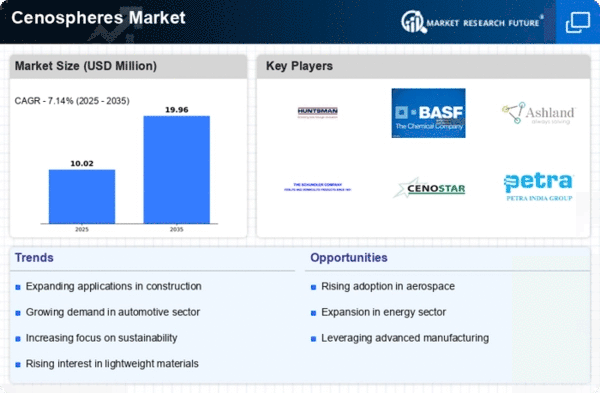
As per MRFR analysis, the Cenospheres Market Size was estimated at 9.35 USD Million in 2024. The Cenospheres industry is projected to grow from 10.01 in 2025 to 19.96 by 2035, exhibiting a compound annual growth rate (CAGR) of 7.14 during the forecast period 2025 - 2035.

Key Market Trends & Highlights

The Cenospheres Market is poised for growth driven by sustainability and technological advancements.

  • The market is witnessing a pronounced shift towards sustainability, influencing product development and application.
  • Technological advancements are enhancing the performance and versatility of cenospheres across various sectors.
  • North America remains the largest market, while Asia-Pacific is emerging as the fastest-growing region for cenospheres.
  • The rising demand in the construction sector and advancements in material science are key drivers propelling market expansion.

Market Size & Forecast

2024 Market Size 9.35 (USD Million)
2035 Market Size 19.96 (USD Million)
CAGR (2025 - 2035) 7.14%
Largest Regional Market Share in 2024 North America

Major Players

<p>Huntsman Corporation (US), BASF SE (DE), Ashland Global Holdings Inc. (US), Schundler Company (US), CenoStar Corporation (US), Cenosphere India Pvt Ltd (IN), Cenospheres Ltd (GB), Ceno Technologies (US)</p>

Market Trends

The Cenospheres Market is currently experiencing a notable transformation, driven by increasing demand across various industries. These lightweight, hollow spheres, primarily derived from coal combustion, are gaining traction due to their unique properties, such as low density and thermal insulation. As industries seek sustainable alternatives to traditional materials, the appeal of cenospheres continues to grow. This shift is particularly evident in sectors like construction, automotive, and aerospace, where the need for lightweight and durable materials is paramount. Furthermore, the rising emphasis on eco-friendly practices is propelling the adoption of cenospheres, as they contribute to reducing the overall carbon footprint of products. In addition to the environmental benefits, the versatility of cenospheres is becoming increasingly recognized. Their applications extend beyond traditional uses, finding roles in advanced composites, paints, and coatings. This diversification suggests a robust future for the Cenospheres Market, as manufacturers explore innovative ways to incorporate these materials into new products. The ongoing research and development efforts indicate a potential for enhanced performance characteristics, which may further solidify cenospheres' position in the market. Overall, the Cenospheres Market appears poised for growth, driven by a combination of sustainability, versatility, and innovation.

Sustainability Focus

The growing emphasis on sustainable materials is influencing the Cenospheres Market. Industries are increasingly seeking eco-friendly alternatives, and cenospheres, with their low environmental impact, are becoming a preferred choice.

Technological Advancements

Innovations in processing techniques are enhancing the properties of cenospheres. These advancements are likely to improve their performance in various applications, making them more attractive to manufacturers.

Diverse Applications

Cenospheres are finding new uses beyond traditional sectors. Their incorporation into advanced composites and coatings suggests a trend towards broader market acceptance and utilization.

Cenospheres Market Market Drivers

Market Growth Projections

The Global Cenospheres Market Industry is projected to experience robust growth over the coming years. With a market value anticipated to reach 344 USD Million in 2024 and an impressive increase to 1288.5 USD Million by 2035, the trajectory indicates a strong upward trend. The compound annual growth rate of 12.76% from 2025 to 2035 suggests that the demand for cenospheres will continue to rise as industries increasingly recognize their benefits. This growth is likely to be fueled by the expanding applications and innovations in manufacturing processes, positioning cenospheres as a key material in various sectors.

Advancements in Oil and Gas Industry

The Global Cenospheres Market Industry benefits from advancements in the oil and gas sector, where cenospheres are utilized as lightweight additives in drilling fluids and cementing applications. These materials enhance the performance of drilling operations by reducing density and improving flow characteristics. As the global oil and gas industry continues to evolve, the demand for efficient and cost-effective solutions is paramount. The market for cenospheres is likely to expand as companies seek to optimize their operations. This trend is expected to contribute to a projected market value of 1288.5 USD Million by 2035, reflecting a growing reliance on cenospheres in this critical sector.

Rising Demand in Construction Sector

The Global Cenospheres Market Industry experiences a notable surge in demand driven by the construction sector. Cenospheres Market, known for their lightweight and insulating properties, are increasingly utilized in concrete and other building materials. This trend is particularly evident as the global construction market is projected to reach approximately 10 trillion USD by 2024. The incorporation of cenospheres not only enhances the strength-to-weight ratio of construction materials but also contributes to sustainability efforts. As a result, the market for cenospheres is expected to grow significantly, with estimates indicating a market value of 344 USD Million in 2024.

Increasing Focus on Sustainable Materials

The Global Cenospheres Market Industry is witnessing a shift towards sustainable materials, as environmental concerns gain prominence across various sectors. Cenospheres Market, being a byproduct of coal combustion, offer a unique opportunity to utilize waste materials while reducing the carbon footprint. This aligns with global sustainability goals and regulations aimed at minimizing environmental impact. Industries such as automotive and aerospace are increasingly adopting cenospheres for lightweight applications, which enhances fuel efficiency and reduces emissions. The growing emphasis on sustainability is likely to drive the market forward, as companies seek innovative solutions that meet regulatory standards and consumer expectations.

Technological Innovations in Manufacturing

The Global Cenospheres Market Industry is significantly influenced by technological innovations in manufacturing processes. Advances in extraction and processing techniques have improved the quality and availability of cenospheres, making them more accessible to various industries. Innovations such as enhanced separation methods and improved purification processes have led to higher purity levels and better performance characteristics. As manufacturers adopt these technologies, the market is expected to witness increased competition and product differentiation. This could potentially lead to a compound annual growth rate of 12.76% from 2025 to 2035, as companies strive to capitalize on the enhanced capabilities of cenospheres.

Expanding Applications in Various Industries

The Global Cenospheres Market Industry is characterized by expanding applications across diverse sectors, including automotive, aerospace, and consumer goods. Cenospheres Market are increasingly utilized in lightweight composites, insulation materials, and as fillers in various products. This versatility is driving demand as industries seek to enhance product performance while reducing weight. For instance, in the automotive sector, the use of cenospheres in body panels and components contributes to improved fuel efficiency. As these applications continue to grow, the market for cenospheres is poised for substantial expansion, reflecting the adaptability of these materials in meeting the evolving needs of various industries.

Market Segment Insights

By Application: Construction (Largest) vs. Automotive (Fastest-Growing)

<p>The Cenospheres Market is markedly influenced by its diverse applications, primarily within the construction and automotive sectors. Construction holds the largest share, driven by the increasing demand for lightweight materials that enhance structural integrity and reduce overall building weight. The automotive sector is gaining traction, leveraging cenospheres to improve fuel efficiency and emissions in vehicle manufacturing, thus capturing a growing market share adjacent to construction.</p>

<p>Construction: Largest vs. Automotive: Fastest-Growing</p>

<p>The construction segment is characterized by its extensive use of cenospheres in concrete and other building materials, due to their lightweight properties which contribute to energy efficiency and durability. This segment remains dominant as infrastructure projects continue to proliferate globally. On the other hand, the automotive segment is emerging rapidly, utilizing cenospheres to manufacture lighter components that aid in improving vehicle performance. The shift towards sustainable and efficient automotive solutions, particularly electric vehicles, is propelling this segment forward, creating significant growth opportunities as manufacturers seek innovative materials to meet evolving regulatory standards.</p>

By End Use: Lightweight Fillers (Largest) vs. Thermal Insulation (Fastest-Growing)

<p>In the Cenospheres Market, the distribution of end-use segments highlights Lightweight Fillers as the largest contributor, utilized across various applications for its effective cost-saving properties. Thermal Insulation follows closely, gaining momentum due to its increasing adoption across construction and industrial applications. Other notable segments include Refractory Materials, Composite Materials, and Paints and Coatings which also play significant roles but are not as dominant in market share compared to Lightweight Fillers and Thermal Insulation. The growth trends within the Cenospheres Market are primarily driven by advancements in construction and manufacturing technologies. The demand for Lightweight Fillers is consistent as industries seek to reduce weight without compromising structural integrity. Meanwhile, Thermal Insulation is emerging as a fast-growing segment, driven by a global push towards energy efficiency and sustainability, providing a competitive edge in various thermal applications.</p>

<p>Lightweight Fillers (Dominant) vs. Thermal Insulation (Emerging)</p>

<p>Lightweight Fillers are regarded as the dominant segment in the Cenospheres Market due to their exceptional performance in reducing weight and enhancing efficiency in various applications, particularly in construction, automotive, and consumer goods. Their widespread adoption stems from their ability to minimize material costs while maintaining superior quality. On the other hand, Thermal Insulation is identified as an emerging segment, experiencing rapid growth fueled by a surge in energy conservation initiatives across industries. This segment benefits from innovations in material science, leading to enhanced performance characteristics in thermal resistance, making it particularly appealing for building insulation and various industrial applications. Together, these segments reflect the diverse applications and evolving needs of the Cenospheres Market.</p>

By Type: Hollow Spheres (Largest) vs. Microspheres (Fastest-Growing)

<p>In the Cenospheres Market, the type segment is characterized by a diverse distribution of hollow spheres, solid spheres, microspheres, nanoparticles, and microballoons. Among these, hollow spheres hold the largest market share due to their widespread applications in construction, automotive, and aerospace industries, where lightweight materials are essential for enhancing performance and reducing costs. On the other hand, microspheres are gaining traction for their innovative uses in various sectors, driving a rapidly growing market segment.</p>

<p>Hollow Spheres (Dominant) vs. Microspheres (Emerging)</p>

<p>Hollow spheres dominate the cenospheres market thanks to their lightweight, durable characteristics, making them ideal for applications in lightweight composites and insulation materials. Their unique structure offers excellent thermal resistance and low density, which are critical for sectors such as construction and automotive manufacturing. In contrast, microspheres are emerging as a significant player due to their versatility in applications like cosmetics, pharmaceuticals, and specialty coatings. As manufacturers seek to improve product performance, these microspheres are becoming increasingly sought after for their ability to enhance product characteristics such as flow, stability, and texture.</p>

By Source: Fly Ash (Largest) vs. Volcanic Ash (Fastest-Growing)

<p>In the Cenospheres Market, Fly Ash currently holds the largest market share, driven by its widespread availability and use in construction and industrial applications. Volcanic Ash, while not the largest, is emerging as the fastest-growing source due to its environmental advantages and high performance in specific applications. Natural Sources and Industrial Waste also contribute significantly but are less dominant compared to the top two segments. Growth trends indicate a rising demand for sustainable and environmentally friendly materials, propelling the use of Volcanic Ash. Regulatory frameworks are favoring the adoption of recycled materials, while innovation in processing technologies enhances the quality of Cenospheres derived from Industrial Waste. These dynamics suggest a robust competitive landscape, with careful attention to sourcing practices influencing market share distributions.</p>

<p>Fly Ash (Dominant) vs. Recycled Materials (Emerging)</p>

<p>Fly Ash serves as the dominant source in the Cenospheres Market, owing to its cost-effectiveness and utility in construction, offering strength and durability to concrete mixtures. This material comes from the combustion of pulverized coal, making it readily available as a byproduct in many regions. In contrast, Recycled Materials represent an emerging segment, tapping into the growing trend of sustainability. These materials, sourced from industrial byproducts and waste, not only reduce landfill impact but also enhance the ecological profile of cenospheres. While Fly Ash boasts established demand, Recycled Materials are gaining traction as companies aim for eco-friendly solutions. The competition between these two sources is intensifying, highlighting a shift towards more sustainable material use.</p>

By Functionality: Buoyancy (Largest) vs. Thermal Resistance (Fastest-Growing)

<p>In the Cenospheres Market, Buoyancy holds the largest share, driven by its essential applications in various industries, such as construction and oil & gas. This property enables products to float, making it ideal for lightweight aggregate in concrete and other materials, thereby fostering widespread adoption. Meanwhile, Thermal Resistance is emerging as the fastest-growing segment, owing to increasing demand for insulation in high-temperature applications and energy-efficient solutions, capturing attention in sectors like automotive and aerospace.</p>

<p>Buoyancy (Dominant) vs. Thermal Resistance (Emerging)</p>

<p>Buoyancy is a dominant functionality in the Cenospheres Market, characterized by its unique ability to enhance the lightweight composition of materials, facilitating significant efficiencies in transportation and handling. Industries prioritize buoys' properties due to their advantages in reducing material weight while maintaining structural integrity. In contrast, Thermal Resistance is regarded as an emerging functionality that is capturing market share due to its ability to withstand high temperatures and provide safety in critical applications. This property is becoming increasingly vital as industries focus on thermal insulation and energy conservation, leading to innovative applications and material blends in sectors such as aerospace and automotive.</p>

Get more detailed insights about Cenospheres Market Research Report - Global Forecast till 2035

Regional Insights

North America : Market Leader in Cenospheres

North America continues to lead the cenospheres market, holding a significant share of 4.68 in 2024. The growth is driven by increasing demand in construction, automotive, and aerospace sectors, alongside stringent regulations promoting lightweight materials. The region's focus on innovation and sustainability further propels market expansion, with companies investing in advanced technologies to enhance product performance and reduce environmental impact. The United States is the primary contributor to this market, with key players like Huntsman Corporation and Ashland Global Holdings Inc. leading the charge. The competitive landscape is characterized by a mix of established firms and emerging players, all vying for market share. The presence of robust manufacturing capabilities and a well-developed supply chain supports the region's dominance, ensuring a steady supply of high-quality cenospheres to meet growing demand.

Europe : Emerging Market with Growth Potential

Europe's cenospheres market is poised for growth, currently valued at 2.8. The increasing adoption of cenospheres in various applications, including construction and automotive, is driving demand. Regulatory frameworks aimed at reducing carbon footprints and enhancing energy efficiency are also significant catalysts for market growth. The region's commitment to sustainability and innovation is expected to further boost the market in the coming years. Germany and the UK are leading the charge in this market, with companies like BASF SE and Cenospheres Ltd playing pivotal roles. The competitive landscape is evolving, with both established firms and new entrants focusing on product development and strategic partnerships. The presence of advanced research institutions in Europe fosters innovation, ensuring that the region remains competitive in The Cenospheres.

Asia-Pacific : Rapidly Growing Market Segment

The Asia-Pacific cenospheres market, valued at 1.7, is experiencing rapid growth driven by increasing industrialization and urbanization. Countries like India and China are witnessing a surge in demand for lightweight materials in construction and automotive sectors. Government initiatives promoting infrastructure development and sustainable practices are also contributing to market expansion, making this region a focal point for future growth in the cenospheres market. India is emerging as a key player, with companies like Cenosphere India Pvt Ltd leading the market. The competitive landscape is characterized by a mix of local and international players, all striving to capture market share. The region's growing manufacturing capabilities and investment in research and development are expected to enhance the quality and availability of cenospheres, further driving market growth.

Middle East and Africa : Niche Market with Potential

The Middle East and Africa cenospheres market is currently valued at 0.17, representing a niche segment with significant growth potential. The market is driven by increasing demand for lightweight materials in construction and oil & gas industries. Regulatory initiatives aimed at promoting sustainable practices are also beginning to influence market dynamics, albeit at a slower pace compared to other regions. The focus on infrastructure development in several countries is expected to catalyze growth in this sector. Countries like South Africa and the UAE are emerging as key players in this market. The competitive landscape is still developing, with a few local companies and international firms exploring opportunities. As the region invests in infrastructure and industrial projects, the demand for cenospheres is likely to increase, presenting opportunities for growth and expansion in the coming years.

Key Players and Competitive Insights

The Cenospheres Market is currently characterized by a dynamic competitive landscape, driven by increasing demand across various industries such as construction, automotive, and oil & gas. Key players are actively engaging in strategies that emphasize innovation, regional expansion, and sustainability. For instance, Huntsman Corporation (US) has been focusing on enhancing its product portfolio through research and development initiatives aimed at improving the performance characteristics of its cenospheres. Similarly, BASF SE (DE) is leveraging its extensive global network to optimize supply chains and enhance customer engagement, thereby solidifying its market position. These strategies collectively contribute to a competitive environment that is increasingly focused on technological advancements and customer-centric solutions.

In terms of business tactics, companies are localizing manufacturing to reduce lead times and costs, while also optimizing supply chains to enhance efficiency. The market structure appears moderately fragmented, with several players vying for market share. However, the collective influence of major companies like Ashland Global Holdings Inc. (US) and CenoStar Corporation (US) is notable, as they continue to innovate and expand their operational footprints, thereby shaping the competitive dynamics of the market.

In November 2025, Ashland Global Holdings Inc. (US) announced a strategic partnership with a leading construction materials company to develop advanced lightweight materials utilizing cenospheres. This collaboration is expected to enhance product offerings and cater to the growing demand for sustainable construction solutions. The strategic importance of this partnership lies in its potential to position Ashland as a frontrunner in the sustainable materials segment, aligning with global trends towards eco-friendly construction practices.

In October 2025, CenoStar Corporation (US) launched a new line of high-performance cenospheres specifically designed for the automotive industry. This product line aims to meet the increasing demand for lightweight materials that enhance fuel efficiency and reduce emissions. The introduction of these specialized cenospheres indicates CenoStar's commitment to innovation and its strategic focus on tapping into the automotive sector, which is undergoing a significant transformation towards sustainability.

In December 2025, Cenospheres Ltd (GB) expanded its production capabilities by investing in a new facility aimed at increasing output and improving product quality. This expansion is crucial as it not only enhances Cenospheres Ltd's operational capacity but also positions the company to better serve its growing customer base in Europe and beyond. The strategic move reflects a broader trend of companies investing in infrastructure to meet rising demand and improve competitive positioning.

As of December 2025, the competitive trends in the Cenospheres Market are increasingly defined by digitalization, sustainability, and the integration of advanced technologies such as AI. Strategic alliances are becoming more prevalent, as companies recognize the value of collaboration in driving innovation and enhancing market reach. Looking ahead, competitive differentiation is likely to evolve from traditional price-based competition to a focus on innovation, technological advancements, and supply chain reliability. This shift underscores the importance of adaptability and forward-thinking strategies in navigating the complexities of the market.

Key Companies in the Cenospheres Market market include

Industry Developments

In May 2021,

Omya International AG, a chief market leader in cenospheres manufacturing, announced introducing the newest functionalized Calcium Carbonates product line for PET applications named OmyaPET. It is the latest and most cost-effective opacifier usually used in manufacturing white opaque PET bottles. 


Report Overview

The Cenospheres Market Analysis has shown the progress of the market at the global level. The effects of chief existing factors such as the drivers, challenges, opportunities and restraints were discussed in detail. The COVID-19 report stated the loss and further improvements to recover from it. The key players' involvement was studied with their planned strategies. The segmentation analysis report discussed the major segments and their growth. The regional update of the Cenospheres Market shows the regions covered and their progress in every region. The recent developments have propelled the market's demand globally.

The market will successfully reach the estimated CAGR value during the review period.

Key Industrial Segments

By Type 

    • Gray Cenospheres Market 
    • White Cenospheres Market

By End-Use Industry 

    • Refractory
    • Building and Construction
    • Oil and Gas
    • Automotive
    • Paints and Coatings
    • Others

Future Outlook

Cenospheres Market Future Outlook

<p>The Cenospheres Market is projected to grow at a 7.14% CAGR from 2024 to 2035, driven by increasing demand in construction, automotive, and aerospace sectors.</p>

New opportunities lie in:

  • <p>Development of high-performance cenosphere composites for lightweight applications.</p>
  • <p>Expansion into emerging markets with tailored product offerings.</p>
  • <p>Investment in advanced extraction technologies to enhance yield and reduce costs.</p>

<p>By 2035, the Cenospheres Market is expected to achieve robust growth, solidifying its position as a key material in various industries.</p>

Market Segmentation

Cenospheres Market Type Outlook

  • Hollow Spheres
  • Solid Spheres
  • Microspheres
  • Nanoparticles
  • Microballoons

Cenospheres Market Source Outlook

  • Fly Ash
  • Volcanic Ash
  • Natural Sources
  • Industrial Waste
  • Recycled Materials

Cenospheres Market End Use Outlook

  • Lightweight Fillers
  • Thermal Insulation
  • Refractory Materials
  • Composite Materials
  • Paints and Coatings

Cenospheres Market Application Outlook

  • Construction
  • Automotive
  • Aerospace
  • Oil and Gas
  • Marine

Cenospheres Market Functionality Outlook

  • Buoyancy
  • Thermal Resistance
  • Lightweight Properties
  • Chemical Resistance
  • Acoustic Properties

Report Scope

MARKET SIZE 20249.35(USD Million)
MARKET SIZE 202510.01(USD Million)
MARKET SIZE 203519.96(USD Million)
COMPOUND ANNUAL GROWTH RATE (CAGR)7.14% (2024 - 2035)
REPORT COVERAGERevenue Forecast, Competitive Landscape, Growth Factors, and Trends
BASE YEAR2024
Market Forecast Period2025 - 2035
Historical Data2019 - 2024
Market Forecast UnitsUSD Million
Key Companies ProfiledHuntsman Corporation (US), BASF SE (DE), Ashland Global Holdings Inc. (US), Schundler Company (US), CenoStar Corporation (US), Cenosphere India Pvt Ltd (IN), Cenospheres Ltd (GB), Ceno Technologies (US)
Segments CoveredApplication, End Use, Type, Source, Functionality
Key Market OpportunitiesGrowing demand for lightweight materials in construction and automotive sectors enhances opportunities in the Cenospheres Market.
Key Market DynamicsRising demand for lightweight materials drives innovation and competition in the cenosphere market.
Countries CoveredNorth America, Europe, APAC, South America, MEA

FAQs

What is the projected valuation for the Cenospheres Market by 2035?

The Cenospheres Market is slated to achieve a valuation of USD 715 million.

What is the projected CAGR for the Cenospheres Market during the forecast period of 2020- 2035?

The projected CAGR would be 12.5% during the forecast 2035.

What could prevent the Cenospheres Market growth?

Lack of raw material and quality control can hinder Cenospheres Market growth.

Which region has the largest Cenospheres Market share?

The North American Cenospheres Market has the largest market share.

What is driving the North American Cenospheres Market ahead?

Oil &amp; gas and shale gas exploration to drive the market ahead.

  1. Executive Summary
  2. Market Introduction
    1. Market Definition
    2. Scope of the
      1. Research
      2. Assumptions & Limitations
    3. Study
    4. Objectives
    5. Markets Structure
    6. Key Takeaways
  3. Market Research Methodology
    1. Research Process
    2. Primary Research
    3. Secondary Research
    4. Market Size Estimation
    5. Forecast Model
  4. Market Dynamics of the Global Cenospheres
    1. Market
    2. Introduction
    3. Drivers
    4. Restraints
    5. Opportunities
    6. Challenges
    7. Trends/Technology
  5. Market Factor Analysis of the Global Cenospheres
    1. Market
    2. Supply Chain Analysis
      1. Raw Type Suppliers
      2. Distributors/Retailers/Wholesalers/E-Commerce
      3. End Users
      4. Bargaining
      5. Bargaining Power
      6. Threat of Substitutes
      7. Intensity of Competitive Rivalry
    3. Manufacturers/Producers
    4. Porter’s Five Forces Analysis
    5. Threat of New Entrants
    6. Power of Buyers
    7. of Suppliers
    8. Pricing Analysis
  6. Global Cenospheres Market, by Type
    1. Introduction
    2. Gray Cenospheres
      1. Market Estimates
      2. Market Estimates & Forecast,
    3. & Forecast, 2020−2027
    4. by Region, 2020−2027
    5. White Cenospheres
      1. Market Estimates & Forecast,
      2. Market Estimates & Forecast, by Region, 2020−2027
  7. Global Cenospheres Market, by End-Use Industry
    1. Introduction
    2. Refractory
      1. Market
      2. Market Estimates &
    3. Estimates & Forecast, 2020−2027
    4. Forecast, by Region, 2020−2027
    5. Building and Construction
      1. Market Estimates & Forecast, 2020−2027
  8. Market Estimates & Forecast, by Region, 2020−2027
    1. Oil and Gas
    2. Automotive
    3. Paints and Coatings
    4. Others
  9. Market Estimates & Forecast, 2020−2027
  10. Market Estimates & Forecast, by Region, 2020−2027
  11. Market Estimates & Forecast, 2020−2027
  12. Market Estimates & Forecast, by Region, 2020−2027
  13. Market Estimates & Forecast, 2020−2027
  14. Market Estimates & Forecast, by Region, 2020−2027
  15. Market Estimates & Forecast, 2020−2027
  16. Market Estimates & Forecast, by Region, 2020−2027
  17. Global Cenospheres Market, by Region
    1. Introduction
    2. North America
      1. Market Estimates &
      2. Market Estimates & Forecast,
      3. Market Estimates & Forecast,
      4. US
    3. Forecast, 2020−2027
    4. by Type, 2020−2027
    5. by End-Use Industry, 2020−2027
  18. Market Estimates & Forecast, by Type, 2020−2027
    1. Industry, 2020−2027
  19. Market Estimates & Forecast, End-Use
  20. Canada
  21. Market Estimates & Forecast,
  22. Market Estimates & Forecast, by Type, 2020−2027
    1. Industry, 2020−2027
    2. Market Estimates & Forecast, 2020−2027
  23. Market Estimates & Forecast, by End-Use
    1. Europe
  24. Market Estimates & Forecast, by Type, 2020−2027
  25. Market Estimates & Forecast, by End-Use Industry, 2020−2027
    1. Germany
    2. Market Estimates & Forecast, 2020−2027
  26. Market Estimates & Forecast, by Type,
  27. Market Estimates & Forecast, by End-Use Industry, 2020−2027
    1. France
    2. Market Estimates & Forecast, 2020−2027
  28. Market Estimates & Forecast, by Type,
  29. Market Estimates & Forecast, by End-Use Industry, 2020−2027
    1. Italy
    2. Market Estimates & Forecast, 2020−2027
  30. Market Estimates & Forecast, by Type,
  31. Market Estimates & Forecast, by End-Use Industry, 2020−2027
    1. Spain
    2. Market Estimates & Forecast, 2020−2027
    3. & Forecast, by End-Use Industry, 2020−2027
    4. UK
    5. & Forecast, 2020−2027
    6. Forecast, by End-Use Industry, 2020−2027
    7. Russia
    8. Estimates & Forecast, 2020−2027
    9. & Forecast, by End-Use Industry, 2020−2027
    10. & Forecast, 2020−2027
    11. Forecast, by End-Use Industry, 2020−2027
    12. of Europe
    13. Market Estimates & Forecast, 2020−2027
  32. Market Estimates & Forecast, by Type,2020−2027
  33. Market Estimates
  34. Market Estimates
  35. Market Estimates & Forecast, by Type,2020−2027
  36. Market Estimates &
  37. Market
  38. Market Estimates & Forecast, by Type,2020−2027
  39. Market Estimates
  40. Poland
  41. Market Estimates
  42. Market Estimates & Forecast, by Type, 2020−2027
  43. Market Estimates &
  44. Rest
  45. Market Estimates & Forecast, by Type,
  46. Market Estimates & Forecast, by End-Use Industry, 2020−2027
    1. Asia-Pacific
      1. Market Estimates &
      2. Market Estimates & Forecast,
      3. Market Estimates & Forecast,
      4. China
    2. Forecast, 2020−2027
    3. by Type, 2020−2027
    4. by End-Use Industry, 2020−2027
    5. & Forecast, 2020−2027
    6. & Forecast, by End-Use Industry, 2020−2027
    7. India
    8. Market Estimates & Forecast, 2020−2027
    9. by Type, 2020−2027
  47. Market Estimates & Forecast, by End-Use Industry, 2020−2027
    1. & Forecast, by Type, 2020−2027
    2. & Forecast, 2020−2027
    3. & Forecast, by End-Use Industry, 2020−2027
    4. Rest of Asia-Pacific
    5. Market Estimates & Forecast, 2020−2027
    6. by Type, 2020−2027
  48. Japan
  49. Market Estimates & Forecast, 2020−2027
  50. Market Estimates
  51. Market Estimates & Forecast, by End-Use Industry,
  52. Australia & New Zealand
  53. Market Estimates
  54. Market Estimates & Forecast, by Type, 2020−2027
  55. Market Estimates
  56. Market Estimates & Forecast,
  57. Market Estimates & Forecast, by End-Use Industry, 2020−2027
    1. Middle East
      1. Market Estimates & Forecast,
      2. Market Estimates & Forecast, by Type,
      3. Market Estimates & Forecast, by End-Use
      4. GCC
      5. Israel
      6. North Africa
    2. & Africa
    3. Industry, 2020−2027
    4. & Forecast, by Type, 2020−2027
    5. & Forecast, by Type, 2020−2027
  58. Market Estimates & Forecast, by Type, 2020−2027
    1. Industry, 2020−2027
    2. Forecast, 2020−2027
    3. Forecast, by End-Use Industry, 2020−2027
    4. of Middle East & Africa
    5. Forecast, by Type, 2020−2027
    6. Forecast, 2020−2027
    7. by Type, 2020−2027
    8. by End-Use Industry, 2020−2027
    9. & Forecast, 2020−2027
    10. Forecast, by End-Use Industry, 2020−2027
    11. Argentina
    12. Market Estimates & Forecast, 2020−2027
    13. & Forecast, by End-Use Industry, 2020−2027
    14. Mexico
    15. Market Estimates & Forecast, 2020−2027
    16. & Forecast, by End-Use Industry, 2020−2027
    17. Rest of Latin America
    18. by Type, 2020−2027
  59. Market Estimates & Forecast, by End-Use
  60. Turkey
  61. Market Estimates &
  62. Market Estimates & Forecast, by Type, 2020−2027
  63. Market Estimates &
  64. Rest
  65. Market Estimates & Forecast, 2020−2027
  66. Market Estimates &
  67. Market Estimates & Forecast, by End-Use Industry, 2020−2027
    1. Latin America
      1. Market Estimates &
      2. Market Estimates & Forecast,
      3. Market Estimates & Forecast,
      4. Brazil
  68. Market Estimates & Forecast, by End-Use Industry, 2020−2027
  69. Company Landscape
    1. Introduction
    2. Market Strategy
    3. Key Development Analysis (Expansion/Mergers & Acquisitions/Joint
    4. Ventures/New Product Development/Agreements/Investments)
    5. Company Profiles
    6. Petra Buildcare
      1. Financial Updates
      2. Product/Business Segment Overview
      3. Strategy
      4. SWOT Analysis
      5. Company Overview
      6. Strategy
      7. Key Developments
    7. Products
    8. Company Overview
    9. Key Developments
    10. PR Group
    11. Financial Updates
    12. Product/Business Segment Overview
    13. SWOT Analysis
    14. Ceno Technologies
      1. Company Overview
      2. Financial Updates
      3. Key Developments
      4. SWOT Analysis
    15. Product/Business Segment Overview
    16. Strategy
    17. Reslab
      1. Financial Updates
      2. Product/Business Segment Overview
      3. Strategy
      4. SWOT Analysis
      5. Financial Updates
      6. Product/Business Segment Overview
      7. Strategy
      8. SWOT Analysis
      9. Company Overview
      10. Strategy
      11. Key Developments
    18. Microfiller
    19. Company Overview
    20. Key Developments
    21. 3M
    22. Company Overview
    23. Key Developments
    24. CenoStar
    25. Financial Updates
    26. Product/Business Segment Overview
    27. SWOT Analysis
    28. Cenosphere India Pvt. Ltd
      1. Financial Updates
      2. Product/Business Segment Overview
      3. Strategy
      4. SWOT Analysis
      5. Company
      6. Financial Updates
      7. Product/Business Segment Overview
      8. Key Developments
      9. SWOT Analysis
      10. Company Overview
      11. Product/Business
      12. Strategy
      13. SWOT Analysis
    29. Company Overview
    30. Key Developments
    31. Durgesh Merchandise Pvt. Ltd
    32. Overview
    33. Strategy
    34. Omya
    35. Financial Updates
    36. Segment Overview
    37. Key Developments
    38. Envirospheres
      1. Company Overview
      2. Strategy
      3. Key Developments
    39. Financial Updates
    40. Product/Business Segment Overview
    41. SWOT Analysis
    42. Qingdao Eastchem Inc.
      1. Company
      2. Financial Updates
      3. Product/Business Segment Overview
      4. Key Developments
      5. SWOT Analysis
    43. Overview
    44. Strategy
    45. Delamin
      1. Financial
      2. Product/Business Segment
      3. Strategy
      4. SWOT Analysis
    46. Limited
    47. Company Overview
    48. Updates
    49. Overview
    50. Key Developments
  70. Conclusion
  71. LIST OF TABLES
  72. Global Cenospheres Market: by Region, 2020−2027
  73. North America: Cenospheres Market, by Country, 2020−2027
  74. Europe: Cenospheres Market, by Country, 2020−2027
  75. Asia-Pacific: Cenospheres Market, by Country, 2020−2027
  76. Middle East & Africa: Cenospheres Market, by Country,
  77. Latin America: Cenospheres Market,
    1. by Country, 2020−2027
  78. Global Cenospheres Type
  79. Market, by Regions, 2020−2027
  80. North America:
  81. Cenospheres Type Market, by Country, 2020−2027
  82. Europe:
  83. Cenospheres Type Market, by Country, 2020−2027
    1. Table10 Asia-Pacific:
  84. Cenospheres Type Market, by Country, 2020−2027
    1. Table11 Middle
  85. East & Africa: Cenospheres Type Market, by Country, 2020−2027
    1. Table12
  86. Latin America: Cenospheres Type Market, by Country, 2020−2027
    1. Table13
  87. Global Cenospheres End-Use Industry Market, by Regions, 2020−2027
    1. Table14 North America: Cenospheres End-Use Industry Market,
    2. by Country, 2020−2027
    3. Table15 Europe: Cenospheres End-Use
  88. Industry Market, by Country, 2020−2027
    1. Table16 Asia-Pacific:
  89. Cenospheres End-Use Industry Market, by Country, 2020−2027
    1. Table17
  90. Middle East & Africa: Cenospheres End-Use Industry Market, by Country,
    1. Table18 Latin America: Cenospheres by End-Use
  91. Industry Market, by Country, 2020-2027
    1. Table19 Global
  92. Type Market, by Region, 2020−2027
    1. Table20 Global End-Use
  93. Industry Market, by Region, 2020−2027
    1. Table21 North
  94. America: Cenospheres Market, by Country, 2020−2027
    1. Table22
  95. North America: Cenospheres Market, by Type, 2020−2027
    1. Table23
  96. North America: Cenospheres Market, by End-Use Industry, 2020−2027
  97. Table24 Europe: Cenospheres Market, by Country, 2020−2027
  98. Table25 Europe: Cenospheres Market, by Type, 2020−2027
  99. Table26 Europe: Cenospheres Market, by End-Use Industry, 2020−2027
  100. Table27 Asia-Pacific: Cenospheres Market, by Country,
    1. Table28 Asia-Pacific: Cenospheres
  101. Market, by Type, 2020−2027
    1. Table29 Asia-Pacific: Cenospheres
  102. Market, by End-Use Industry, 2020−2027
    1. Table30 Middle
  103. East & Africa: Cenospheres Market, by Country, 2020−2027
    1. Table31
  104. Middle East & Africa: Cenospheres Market, by Type, 2020−2027
  105. Table32 Middle East & Africa: Cenospheres Market, by End-Use
    1. Industry, 2020−2027
    2. Table33 Latin America: Cenospheres
  106. Market, by Country, 2020−2027
    1. Table34 Latin
  107. America: Cenospheres Market, by Type, 2020−2027
    1. Table35 Latin
  108. America: Cenospheres Market, by End-Use Industry, 2020−2027
  109. LIST OF FIGURES
  110. Global Cenospheres Market Segmentation
  111. Forecast Research Methodology
    1. FIGURE 3
    2. Five Forces Analysis of Global Cenospheres Market
  112. Value
    1. Chain of Global Cenospheres Market
  113. Global Cenospheres
  114. Market, 2020−2027, by Country, 2020
  115. Share of Global
  116. Cenospheres Market, by Type, 2020−2027
  117. Global Cenospheres
  118. Market Size, by Type, 2020
  119. Share of Global Cenospheres
  120. Market, by Type, 2020−2027
  121. Global Cenospheres Market
    1. Size, by End-Use Industry, 2020
    2. FIGURE10 Share of Global Cenospheres
  122. Market, by End-Use Industry, 2020−2027

Cenospheres Market Segmentation

Market Segmentation Overview

  • Detailed segmentation data will be available in the full report
  • Comprehensive analysis by multiple parameters
  • Regional and country-level breakdowns
  • Market size forecasts by segment
Infographic

Free Sample Request

Kindly complete the form below to receive a free sample of this Report

Get Free Sample

Customer Strories

Compare Licence

×
Features License Type
Single User Multiuser License Enterprise User
Price $4,950 $5,950 $7,250
Maximum User Access Limit 1 User Upto 10 Users Unrestricted Access Throughout the Organization
Free Customization
Direct Access to Analyst
Deliverable Format
Platform Access
Discount on Next Purchase 10% 15% 15%
Printable Versions