Request Free Sample ×

Kindly complete the form below to receive a free sample of this Report

* Please use a valid business email

Leading companies partner with us for data-driven Insights

clients tt-cursor
Hero Background
English
Chinese
French
Japanese
Korean
German
Spanish

Cell Lysis Disruption Market Trends

ID: MRFR/HC/6886-HCR
111 Pages
Nidhi Mandole
Last Updated: April 06, 2026

Cell Lysis and Disruption Market Research Report: Size, Share, Trend Analysis By Technique (Reagent Based, Physical Disruption), Product (Consumables, Instruments), Cell Type (Mammalian Cells, Microbial Cells) and End-User (Research Laboratories and Institutes) - Growth Outlook & Industry Forecast 2025 To 2035

Share:
Download PDF ×

We do not share your information with anyone. However, we may send you emails based on your report interest from time to time. You may contact us at any time to opt-out.

Cell Lysis Disruption Market Infographic
Purchase Options

Market Trends

Key Emerging Trends in the Cell Lysis Disruption Market

The changes brought about by technological advancements in life sciences studies coupled with the rising demand for biopharmaceuticals and personalized medicine have led to significant trends in cell lysis and disruption market. Cell lysis and disruption techniques have found a place in many applications that include genomics, proteomics, cell-based assays among others. More efficient methods of destroying cells have been sought following an enhanced understanding of cellular mechanisms. Therefore, intracellular contents like DNA, RNA proteins etc are set free through cell lysis and disruption as fundamental experiments on cellular function and science breakthroughs.

The face of the market has changed due to advancements in technology applied in lysing where new devices offer improved effectiveness; reliability; reproducibility; versatility etc., thus during cell disruption processes. Meanwhile mechanical bead milling or high pressure homogenization represent evolving homogenization methods whereas chemical or enzymatic lyses are some non-mechanical strategies being developed for researchers accordingly. At the same time automation and robotics are being employed in procedures involving this technique hence increased laboratory workflows standardization with capacity-enhancement.

The increased utilization of biologics and cell therapies in recent times has led to an increasing need for effective methods of breaking cells, which consequently release bioactive molecules. For large volume processing as well as maintaining product quality in a biopharmaceutical production, homogenization and ultrasonication techniques are especially appropriate. This is consistent with broader industry trends aimed at enhancing efficiency and optimization of bioprocessing.

This has led to a growing interest in precision medicine where cell lysis techniques have been adopted by scientists in order to understand disease mechanisms, identify biomarkers and develop targeted therapies. Diagnostic applications based on individual patient profiles require good cell disruption that retains molecule integrity than the one obtained from average ones.

To meet different stakeholders’ needs who often deal with vast number of cells types or sample sizes, modular and adaptive systems are being developed which allow one customizes speed, pressure, sample preparation etc as well. Life sciences applications can rely on this versatility of cell lysis solutions.

The fragmentation process may be employed together with sample preparations to increase efficiency while reducing analysis time. Such integrated systems include sample preparation; lysis and finally down stream analysis hence giving researchers a full package solution when either processing their samples or carrying out tests on them.


Author
Author Profile
Nidhi Mandole
Senior Research Analyst

She is an extremely curious individual currently working in Healthcare and Medical Devices Domain. Nidhi is comfortably versed in data centric research backed by healthcare educational background. She leverages extensive data mining and analytics tools such as Primary and Secondary Research, Statistical Analysis, Machine Learning, Data Modelling. Her key role also involves Technical Sales Support, Client Interaction and Project management within the Healthcare team. Lastly, she showcases extensive affinity towards learning new skills and remain fascinated in implementing them.

Leave a Comment

FAQs

What is the projected market valuation of the Cell Lysis and Disruption Market by 2035?

<p>The projected market valuation for the Cell Lysis and Disruption Market is 17.3 USD Billion by 2035.</p>

What was the market valuation of the Cell Lysis and Disruption Market in 2024?

<p>The overall market valuation was 6.833 USD Billion in 2024.</p>

What is the expected CAGR for the Cell Lysis and Disruption Market during the forecast period 2025 - 2035?

<p>The expected CAGR for the Cell Lysis and Disruption Market during the forecast period 2025 - 2035 is 8.81%.</p>

Which companies are considered key players in the Cell Lysis and Disruption Market?

<p>Key players in the market include Thermo Fisher Scientific, Merck KGaA, Bio-Rad Laboratories, Qiagen, and Agilent Technologies.</p>

What are the main techniques used in the Cell Lysis and Disruption Market?

<p>The main techniques in the market include Reagent Based and Physical Disruption, with valuations of 8.5 and 8.8 USD Billion respectively by 2035.</p>

How do the product segments of the Cell Lysis and Disruption Market compare?

By 2035, Consumables are projected to reach 8.5 USD Billion, while Instruments are expected to reach 8.8 USD Billion.

What is the market size for different cell types in the Cell Lysis and Disruption Market?

By 2035, Mammalian Cells are projected at 6.5 USD Billion, Microbial Cells at 5.0 USD Billion, and Others at 5.8 USD Billion.

Which end-users are driving the Cell Lysis and Disruption Market?

Pharmaceutical and Biotechnology Companies are projected to reach 8.5 USD Billion by 2035, leading the end-user segment.

What trends are influencing the growth of the Cell Lysis and Disruption Market?

The growth of the Cell Lysis and Disruption Market appears to be influenced by advancements in biotechnology and increasing research activities.

How does the market for Cell Lysis and Disruption compare across different regions?

While specific regional data is not provided, the overall growth trends suggest a robust expansion in various global markets.

Market Summary

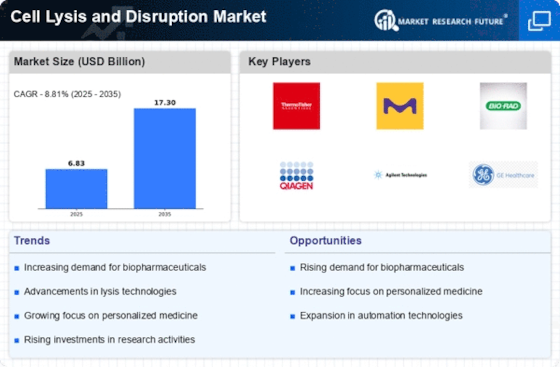
As per Market Research Future analysis, the Cell Lysis and Disruption Market Size was estimated at 6.833 USD Billion in 2024. The Cell Lysis and Disruption industry is projected to grow from 7.435 USD Billion in 2025 to 17.3 USD Billion by 2035, exhibiting a compound annual growth rate (CAGR) of 8.81% during the forecast period 2025 - 2035

Key Market Trends & Highlights

The Cell Lysis and Disruption Market is experiencing robust growth driven by technological advancements and increasing demand for biopharmaceuticals.

  • Technological advancements in lysis methods are enhancing efficiency and effectiveness in cell disruption processes. North America remains the largest market, while Asia-Pacific is emerging as the fastest-growing region in this sector. The reagent-based segment dominates the market, whereas the physical disruption segment is witnessing rapid growth. Rising research activities in biotechnology and the expansion of the pharmaceutical industry are key drivers propelling market growth.

Market Size & Forecast

2024 Market Size 6.833 (USD Billion)
2035 Market Size 17.3 (USD Billion)
CAGR (2025 - 2035) 8.81%
Largest Regional Market Share in 2024 Americas

Major Players

<a href="https://www.thermofisher.com/in/en/home/life-science/protein-biology/protein-biology-learning-center/protein-biology-resource-library/pierce-protein-methods/traditional-methods-cell-lysis.html">Thermo Fisher Scientific</a> (US), Merck KGaA (DE), Bio-Rad Laboratories (US), Qiagen (NL), Agilent Technologies (US), GE Healthcare (GB), Becton, Dickinson and Company (US), Promega Corporation (US), Sartorius AG (DE)

Market Trends

The Cell Lysis and Disruption Market is currently experiencing a notable evolution, driven by advancements in biotechnology and the increasing demand for efficient cell extraction techniques. This market encompasses a variety of methods and technologies aimed at breaking down cellular structures to release biomolecules for research and therapeutic applications. The growing focus on personalized medicine and the development of biologics are propelling the need for effective lysis solutions, as researchers seek to isolate proteins, nucleic acids, and other critical components from cells. Furthermore, the rise of synthetic biology and genomics is likely to enhance the relevance of this market, as innovative applications emerge that require precise and reliable cell disruption methods. In addition, the Cell Lysis and Disruption Market is influenced by the expanding biopharmaceutical sector, which necessitates robust and scalable lysis technologies. As companies strive to improve productivity and reduce costs, there is a shift towards automation and integration of lysis processes within larger workflows. This trend suggests a potential for increased collaboration between equipment manufacturers and end-users, fostering the development of tailored solutions that meet specific research needs. Overall, the market appears poised for growth, with ongoing research and development efforts likely to yield new methodologies and products that enhance the efficiency and effectiveness of cell lysis and disruption techniques.

Technological Advancements in Lysis Methods

Recent innovations in lysis technologies are transforming the Cell Lysis and Disruption Market. New methods, such as microfluidics and acoustic lysis, are emerging, offering enhanced efficiency and precision. These advancements enable researchers to achieve higher yields of target biomolecules while minimizing damage to sensitive cellular components.

Integration of Automation in Lysis Processes

The trend towards automation within laboratory workflows is becoming increasingly prominent in the Cell Lysis and Disruption Market. Automated systems streamline lysis procedures, reduce human error, and improve reproducibility. This shift is particularly beneficial for high-throughput applications, where efficiency and consistency are paramount.

Growing Demand for Biologics and Personalized Medicine

The rising interest in biologics and personalized medicine is significantly impacting the Cell Lysis and Disruption Market. As the focus on tailored therapies intensifies, the need for effective cell lysis techniques to extract and analyze biomolecules becomes more critical. This trend is likely to drive innovation and investment in lysis technologies.

Cell Lysis Disruption Market Market Drivers

Adoption of Advanced Lysis Technologies

The Cell Lysis and Disruption Market is increasingly characterized by the adoption of advanced lysis technologies, which are designed to improve efficiency and yield in cellular disruption processes. Innovations such as microfluidics, ultrasonic lysis, and enzymatic methods are gaining traction among researchers and manufacturers. These technologies not only enhance the extraction of cellular components but also reduce processing times and costs. As industries seek to streamline their operations and improve productivity, the demand for these advanced lysis solutions is likely to grow. This trend indicates a promising future for the Cell Lysis and Disruption Market, as it adapts to the evolving needs of various sectors, including pharmaceuticals, biotechnology, and academic research.

Increasing Focus on Genomics and Proteomics

The Cell Lysis and Disruption Market is witnessing a heightened focus on genomics and proteomics, which are critical fields in modern biological research. As the demand for high-throughput analysis of genetic material and proteins escalates, the need for efficient cell lysis techniques becomes paramount. The Cell Lysis and Disruption is projected to exceed 62 billion USD by 2026, reflecting a growing interest in personalized medicine and targeted therapies. This trend suggests that the Cell Lysis and Disruption Market will play a crucial role in supporting these initiatives by providing innovative lysis solutions that enhance the efficiency and accuracy of genomic and proteomic studies.

Rising Research Activities in Biotechnology

The Cell Lysis and Disruption Market is experiencing a surge in research activities, particularly within biotechnology sectors. This increase is driven by the need for advanced methodologies to extract cellular components for various applications, including drug development and genetic research. According to recent data, the biotechnology sector is projected to grow at a compound annual growth rate of approximately 7.4% over the next five years. This growth is likely to enhance the demand for efficient cell lysis techniques, as researchers seek to optimize their workflows and improve yield. Consequently, the Cell Lysis and Disruption Market stands to benefit from this trend, as innovative lysis solutions become essential for meeting the evolving needs of researchers and developers in the field.

Growing Applications in Environmental and Food Testing

The Cell Lysis and Disruption Market is expanding its reach into environmental and food testing applications, where the need for accurate analysis of microbial content is critical. As regulatory standards become more stringent, the demand for reliable lysis methods to detect pathogens and contaminants in food and environmental samples is increasing. This trend is supported by the rising awareness of food safety and environmental health, prompting industries to invest in advanced testing technologies. The market for food safety testing is projected to grow significantly, which may drive the demand for effective cell lysis solutions. Thus, the Cell Lysis and Disruption Market is likely to benefit from this diversification, as it provides essential tools for ensuring compliance and safety in these sectors.

Expansion of Pharmaceutical and Biopharmaceutical Industries

The Cell Lysis and Disruption Market is significantly influenced by the expansion of pharmaceutical and biopharmaceutical industries. As these sectors continue to grow, driven by increasing investments in drug discovery and development, the demand for effective cell lysis methods is expected to rise. The biopharmaceutical market alone is anticipated to reach a valuation of over 500 billion USD by 2026, indicating a robust growth trajectory. This expansion necessitates the use of advanced lysis technologies to facilitate the extraction of proteins, nucleic acids, and other biomolecules from cells. Therefore, the Cell Lysis and Disruption Market is poised to capitalize on this growth, providing essential tools and solutions to support the burgeoning pharmaceutical landscape.

Market Segment Insights

By Technique: Reagent Based (Largest) vs. Physical Disruption (Fastest-Growing)

In the Cell Lysis and Disruption Market, the reagent-based technique holds the largest share, primarily due to its widespread application in various biotechnological and pharmaceutical contexts. This method leverages specific chemical reactions to effectively disrupt cell membranes, making it a preferred choice among researchers and laboratories. Physical disruption techniques, while currently smaller in market share, are gaining traction due to their ability to preserve biomolecules and deliver consistent results, thus appealing to emerging sectors like synthetic biology and personalized medicine.

Technique: Reagent Based (Dominant) vs. Physical Disruption (Emerging)

Reagent-based techniques dominate the Cell Lysis and Disruption Market as they offer selective lysis, which is crucial for applications in genomics, proteomics, and other molecular biology practices. They are known for their efficiency and versatility, catering to a broad range of sample types. On the other hand, physical disruption techniques, such as bead milling and sonication, are becoming increasingly popular, recognized for their ability to minimize contamination and maximize yield. This emerging trend is fueled by the growing demand for high-quality cellular material in biopharmaceutical processes, leading to innovations in equipment and methodologies that enhance the effectiveness of physical disruption.

By Product: Consumables (Largest) vs. Instruments (Fastest-Growing)

The Cell Lysis and Disruption Market is notably characterized by the dominance of consumables, which play a crucial role in the overall market share distribution. Consumables, including reagents and kits, constitute the largest segment as they are essential for various applications in molecular biology, diagnostics, and bioprocessing. This segment benefits from a recurring demand due to its consumable nature, driving consistent sales and market stability. In contrast, instruments hold a substantial value as well, representing the fastest-growing segment in this market. Their innovation and technological advancements support growth, attracting increased investments and market interest.

Consumables (Dominant) vs. Instruments (Emerging)

Consumables in the Cell Lysis and Disruption Market represent a dominant force due to their essentiality in laboratory settings, particularly in molecular biology applications. These products, including buffers and lysis reagents, are critical for efficient cell disruption and are utilized across various research and clinical laboratories. Their recurring purchase nature solidifies their market position. On the other hand, instruments are emerging as a significant segment, driven by innovations in technologies such as microfluidics and automation. These instruments offer enhanced precision and reproducibility, catering to the needs of modern research environments. As laboratories increasingly prioritize efficiency and automation, the instruments segment is poised for robust growth.

By Cell Type: Mammalian Cells (Largest) vs. Microbial Cells (Fastest-Growing)

In the Cell Lysis and Disruption Market, the segment of Mammalian Cells holds a significant market share, primarily driven by its extensive application in biopharmaceuticals and research laboratories. This segment is favored for its ability to facilitate the extraction of complex biomolecules efficiently, thus positioning it as the largest contributor to market dynamics. On the other hand, the Microbial Cells segment is witnessing rapid growth due to increasing applications in biotechnology, food, and agricultural sectors, making it a key player in this market.

Mammalian Cells (Dominant) vs. Microbial Cells (Emerging)

Mammalian Cells are often deemed the dominant force in the Cell Lysis and Disruption Market due to their crucial role in drug development and therapeutic production. These cells offer several advantages, including post-translational modifications that are essential for the efficacy of biopharmaceuticals. Conversely, Microbial Cells are emerging as a dynamic segment, driven by innovations in synthetic biology and fermentation processes. They are highly advantageous due to their rapid growth rates and the ability to produce complex proteins without the resource intensity of mammalian systems. This contrast highlights the strategic importance of both segments as they cater to different industrial needs.

By End-User: Pharmaceutical and Biotechnology Companies (Largest) vs. Research Laboratories and Institutes (Fastest-Growing)

In the Cell Lysis and Disruption Market, the distribution of market share among end-users reveals that pharmaceutical and biotechnology companies hold the largest share, driven by their extensive research and development activities. This segment capitalizes on advanced technologies for cell disruption to accelerate drug discovery and development processes. Conversely, research laboratories and institutes are noted as the fastest-growing segment, as they increasingly adopt lysis techniques for various scientific investigations, thereby expanding their market presence.

Pharmaceutical and Biotechnology Companies (Dominant) vs. Research Laboratories and Institutes (Emerging)

Pharmaceutical and biotechnology companies represent the dominant force in the cell lysis and disruption market due to their established infrastructure and focus on innovative therapies. Their investments in bioprocessing and clinical research drive the demand for efficient lysis techniques to extract crucial biomolecules. On the other hand, research laboratories and institutes serve as the emerging segment, as they are rapidly increasing their adoption of cell disruption technologies for experimental applications. This emerging segment benefits from collaborations with academic and industrial partners, leading to increased funding and resource allocation, thus strengthening their position in the market.

Get more detailed insights about Cell Lysis and Disruption Market Research Report - Forecast till 2035

Regional Insights

North America : Innovation and Market Leadership

North America is the largest market for cell lysis and disruption technologies, holding approximately 45% of the global market share. The region's growth is driven by increasing research activities in biotechnology and pharmaceuticals, alongside a surge in demand for advanced cell analysis techniques. Regulatory support from agencies like the FDA further catalyzes innovation and adoption of new technologies, ensuring compliance and safety in research applications. The United States leads the market, supported by a robust presence of key players such as Thermo Fisher Scientific, Bio-Rad Laboratories, and Agilent Technologies. The competitive landscape is characterized by continuous innovation and strategic partnerships among these companies, enhancing their product offerings. Canada also plays a significant role, contributing to the region's overall market growth through investments in life sciences and healthcare research.

Europe : Emerging Regulatory Frameworks

Europe is the second-largest market for cell lysis and disruption technologies, accounting for approximately 30% of the global market share. The region's growth is propelled by stringent regulatory frameworks that promote safety and efficacy in biopharmaceutical research. Countries like Germany and the UK are at the forefront, with increasing investments in biotechnology and life sciences, fostering innovation and demand for advanced cell lysis solutions. Germany is a key player in this market, hosting major companies such as Merck KGaA and Sartorius AG. The competitive landscape is marked by a focus on research and development, with firms striving to meet the evolving regulatory standards. The European Medicines Agency (EMA) plays a crucial role in shaping the market, ensuring that products meet high safety and efficacy standards, thus driving market growth.

Asia-Pacific : Rapid Growth and Investment

Asia-Pacific is witnessing rapid growth in the cell lysis and disruption market, holding approximately 20% of the global market share. The region's expansion is driven by increasing investments in biotechnology and healthcare, alongside a growing demand for advanced research tools. Countries like China and India are leading this growth, supported by government initiatives aimed at enhancing research capabilities and fostering innovation in life sciences. China is emerging as a significant player, with a strong presence of local and international companies. The competitive landscape is evolving, with firms focusing on technological advancements and collaborations to enhance their product offerings. The region's market dynamics are further influenced by the increasing adoption of cell lysis technologies in academic and research institutions, driving demand for innovative solutions.

Middle East and Africa : Untapped Market Opportunities

The Middle East and Africa region is gradually emerging in the cell lysis and disruption market, currently holding about 5% of the global market share. The growth is primarily driven by increasing investments in healthcare and biotechnology sectors, alongside a rising demand for advanced research tools. Countries like South Africa and the UAE are leading this growth, supported by government initiatives aimed at enhancing research capabilities and fostering innovation in life sciences. South Africa is becoming a key player in this market, with a growing number of research institutions and collaborations with international firms. The competitive landscape is characterized by a focus on developing localized solutions to meet regional needs. As the market matures, there is significant potential for growth, particularly in academic and research institutions, which are increasingly adopting cell lysis technologies to enhance their research capabilities.

Key Players and Competitive Insights

The Cell Lysis and Disruption Market is currently characterized by a dynamic competitive landscape, driven by increasing demand for biopharmaceuticals and advancements in molecular biology techniques. Key players such as Thermo Fisher Scientific (US), Merck KGaA (DE), and Bio-Rad Laboratories (US) are strategically positioned to leverage their extensive product portfolios and innovative capabilities. Thermo Fisher Scientific (US) focuses on enhancing its technological offerings through continuous innovation, while Merck KGaA (DE) emphasizes strategic partnerships to expand its market reach. Bio-Rad Laboratories (US) is actively investing in research and development to introduce novel solutions, thereby shaping a competitive environment that prioritizes innovation and customer-centric approaches.

In terms of business tactics, companies are increasingly localizing manufacturing and optimizing supply chains to enhance operational efficiency. The market appears moderately fragmented, with a mix of established players and emerging companies vying for market share. The collective influence of these key players fosters a competitive structure that encourages innovation and responsiveness to market demands, ultimately benefiting end-users.

In August 2025, Thermo Fisher Scientific (US) announced the launch of a new line of cell lysis reagents designed to improve the efficiency of protein extraction from various cell types. This strategic move is likely to enhance their product offerings and cater to the growing needs of researchers in the biopharmaceutical sector. By focusing on innovation, Thermo Fisher aims to solidify its position as a leader in the market, responding to the increasing demand for high-quality reagents.

In September 2025, Merck KGaA (DE) entered into a collaboration with a leading biotechnology firm to develop advanced cell disruption technologies. This partnership is indicative of Merck's strategy to enhance its technological capabilities and expand its product portfolio. By aligning with innovative firms, Merck KGaA is likely to accelerate its growth trajectory and strengthen its competitive edge in the cell lysis and disruption market.

In July 2025, Bio-Rad Laboratories (US) unveiled a new automated cell lysis system aimed at streamlining laboratory workflows. This introduction reflects Bio-Rad's commitment to enhancing operational efficiency for its customers. The automation of cell lysis processes is expected to reduce time and labor costs, thereby appealing to a broader customer base and reinforcing Bio-Rad's market presence.

As of October 2025, current competitive trends in the Cell Lysis and Disruption Market are increasingly defined by digitalization, sustainability, and the integration of artificial intelligence. Strategic alliances among key players are shaping the landscape, fostering innovation and collaborative development. Looking ahead, competitive differentiation is likely to evolve from traditional price-based competition to a focus on technological advancements, innovative solutions, and reliable supply chains, positioning companies to better meet the evolving needs of the market.

Key Companies in the Cell Lysis Disruption Market include

Industry Developments

  • Q2 2024: Thermo Fisher Scientific Launches New KingFisher Apex Purification System for Cell Lysis Applications Thermo Fisher Scientific announced the launch of its KingFisher Apex Purification System, designed to automate cell lysis and nucleic acid purification for research and clinical laboratories.
  • Q2 2024: Merck KGaA Opens New Bioprocessing Facility in Massachusetts to Expand Cell Lysis Reagent Production Merck KGaA inaugurated a new bioprocessing facility in Massachusetts, increasing its capacity for manufacturing cell lysis reagents used in biopharmaceutical production.
  • Q3 2024: QIAGEN Partners with Hamilton Robotics to Integrate Automated Cell Lysis Workflows QIAGEN announced a strategic partnership with Hamilton Robotics to co-develop automated cell lysis and sample preparation workflows for genomics and proteomics research.
  • Q3 2024: Beckman Coulter Life Sciences Acquires Cell Lysis Technology Startup LysiGen Beckman Coulter Life Sciences completed the acquisition of LysiGen, a startup specializing in advanced cell lysis technologies for single-cell analysis and bioprocessing.
  • Q4 2024: Promega Corporation Launches New Cell Lysis Buffer for High-Throughput Protein Extraction Promega Corporation introduced a new cell lysis buffer optimized for high-throughput protein extraction, targeting pharmaceutical and academic research labs.
  • Q4 2024: Sartorius AG Announces $100M Investment in Cell Lysis Instrument Manufacturing Expansion Sartorius AG revealed a $100 million investment to expand its manufacturing capabilities for cell lysis instruments at its Goettingen, Germany site.
  • Q1 2025: Thermo Fisher Scientific Receives CE Mark for New Cell Lysis Kit for Clinical Diagnostics Thermo Fisher Scientific received CE Mark approval for its latest cell lysis kit, enabling its use in clinical diagnostic laboratories across Europe.
  • Q1 2025: Bio-Rad Laboratories Appoints Dr. Lisa Chen as VP of Cell Lysis Product Development Bio-Rad Laboratories announced the appointment of Dr. Lisa Chen as Vice President of Cell Lysis Product Development, strengthening its leadership team in life sciences.
  • Q2 2025: Agilent Technologies Wins Major Contract to Supply Cell Lysis Systems to Leading Biotech Firm Agilent Technologies secured a multi-year contract to supply its cell lysis systems to a top biotechnology company for use in therapeutic protein production.
  • Q2 2025: Eppendorf Launches New Automated Cell Disruption Platform for Bioprocessing Eppendorf introduced an automated cell disruption platform designed to streamline cell lysis and extraction processes in bioprocessing applications.
  • Q3 2025: Roche Expands Cell Lysis Reagent Portfolio with Launch of FastLys Pro Roche announced the launch of FastLys Pro, a new reagent for rapid and efficient cell lysis, aimed at accelerating workflows in molecular biology labs.
  • Q3 2025: PerkinElmer Secures $30M Funding to Develop Next-Generation Cell Lysis Technologies PerkinElmer received $30 million in funding to advance research and development of next-generation cell lysis technologies for genomics and proteomics applications.

Future Outlook

Cell Lysis Disruption Market Future Outlook

The Cell Lysis and Disruption Market is projected to grow at 8.81% CAGR from 2025 to 2035, driven by advancements in biotechnology and increasing demand for cell-based therapies.

New opportunities lie in:

  • Development of automated cell lysis systems for high-throughput applications.</p><p>Expansion into emerging markets with tailored lysis solutions.</p><p>Partnerships with biotech firms for innovative lysis technologies.

By 2035, the market is expected to solidify its position as a critical component in biopharmaceutical development.

Market Segmentation

Cell Lysis Disruption Market Product Outlook

  • Consumables
  • Instruments

Cell Lysis Disruption Market End-User Outlook

  • Research Laboratories and Institutes
  • Pharmaceutical and Biotechnology Companies
  • Others

Cell Lysis Disruption Market Cell Type Outlook

  • Mammalian Cells
  • Microbial Cells
  • Others

Cell Lysis Disruption Market Technique Outlook

  • Reagent Based
  • Physical Disruption

Report Scope

MARKET SIZE 2024 6.833(USD Billion)
MARKET SIZE 2025 7.435(USD Billion)
MARKET SIZE 2035 17.3(USD Billion)
COMPOUND ANNUAL GROWTH RATE (CAGR) 8.81% (2025 - 2035)
REPORT COVERAGE Revenue Forecast, Competitive Landscape, Growth Factors, and Trends
BASE YEAR 2024
Market Forecast Period 2025 - 2035
Historical Data 2019 - 2024
Market Forecast Units USD Billion
Key Companies Profiled Thermo Fisher Scientific (US), Merck KGaA (DE), Bio-Rad Laboratories (US), Qiagen (NL), Agilent Technologies (US), GE Healthcare (GB), Becton, Dickinson and Company (US), Promega Corporation (US), Sartorius AG (DE)
Segments Covered Technique
Key Market Opportunities Advancements in microfluidics and automation enhance efficiency in the Cell Lysis and Disruption Market.
Key Market Dynamics Technological advancements in cell lysis methods drive innovation and competition within the cell lysis and disruption market.
Countries Covered North America, Europe, APAC, South America, MEA

FAQs

What is the projected market valuation of the Cell Lysis and Disruption Market by 2035?

<p>The projected market valuation for the Cell Lysis and Disruption Market is 17.3 USD Billion by 2035.</p>

What was the market valuation of the Cell Lysis and Disruption Market in 2024?

<p>The overall market valuation was 6.833 USD Billion in 2024.</p>

What is the expected CAGR for the Cell Lysis and Disruption Market during the forecast period 2025 - 2035?

<p>The expected CAGR for the Cell Lysis and Disruption Market during the forecast period 2025 - 2035 is 8.81%.</p>

Which companies are considered key players in the Cell Lysis and Disruption Market?

<p>Key players in the market include Thermo Fisher Scientific, Merck KGaA, Bio-Rad Laboratories, Qiagen, and Agilent Technologies.</p>

What are the main techniques used in the Cell Lysis and Disruption Market?

<p>The main techniques in the market include Reagent Based and Physical Disruption, with valuations of 8.5 and 8.8 USD Billion respectively by 2035.</p>

How do the product segments of the Cell Lysis and Disruption Market compare?

By 2035, Consumables are projected to reach 8.5 USD Billion, while Instruments are expected to reach 8.8 USD Billion.

What is the market size for different cell types in the Cell Lysis and Disruption Market?

By 2035, Mammalian Cells are projected at 6.5 USD Billion, Microbial Cells at 5.0 USD Billion, and Others at 5.8 USD Billion.

Which end-users are driving the Cell Lysis and Disruption Market?

Pharmaceutical and Biotechnology Companies are projected to reach 8.5 USD Billion by 2035, leading the end-user segment.

What trends are influencing the growth of the Cell Lysis and Disruption Market?

The growth of the Cell Lysis and Disruption Market appears to be influenced by advancements in biotechnology and increasing research activities.

How does the market for Cell Lysis and Disruption compare across different regions?

While specific regional data is not provided, the overall growth trends suggest a robust expansion in various global markets.

  1. SECTION I: EXECUTIVE SUMMARY AND KEY HIGHLIGHTS
    1. | 1.1 EXECUTIVE SUMMARY
    2. | | 1.1.1 Market Overview
    3. | | 1.1.2 Key Findings
    4. | | 1.1.3 Market Segmentation
    5. | | 1.1.4 Competitive Landscape
    6. | | 1.1.5 Challenges and Opportunities
    7. | | 1.1.6 Future Outlook
  2. SECTION II: SCOPING, METHODOLOGY AND MARKET STRUCTURE
    1. | 2.1 MARKET INTRODUCTION
    2. | | 2.1.1 Definition
    3. | | 2.1.2 Scope of the study
    4. | | | 2.1.2.1 Research Objective
    5. | | | 2.1.2.2 Assumption
    6. | | | 2.1.2.3 Limitations
    7. | 2.2 RESEARCH METHODOLOGY
    8. | | 2.2.1 Overview
    9. | | 2.2.2 Data Mining
    10. | | 2.2.3 Secondary Research
    11. | | 2.2.4 Primary Research
    12. | | | 2.2.4.1 Primary Interviews and Information Gathering Process
    13. | | | 2.2.4.2 Breakdown of Primary Respondents
    14. | | 2.2.5 Forecasting Model
    15. | | 2.2.6 Market Size Estimation
    16. | | | 2.2.6.1 Bottom-Up Approach
    17. | | | 2.2.6.2 Top-Down Approach
    18. | | 2.2.7 Data Triangulation
    19. | | 2.2.8 Validation
  3. SECTION III: QUALITATIVE ANALYSIS
    1. | 3.1 MARKET DYNAMICS
    2. | | 3.1.1 Overview
    3. | | 3.1.2 Drivers
    4. | | 3.1.3 Restraints
    5. | | 3.1.4 Opportunities
    6. | 3.2 MARKET FACTOR ANALYSIS
    7. | | 3.2.1 Value chain Analysis
    8. | | 3.2.2 Porter's Five Forces Analysis
    9. | | | 3.2.2.1 Bargaining Power of Suppliers
    10. | | | 3.2.2.2 Bargaining Power of Buyers
    11. | | | 3.2.2.3 Threat of New Entrants
    12. | | | 3.2.2.4 Threat of Substitutes
    13. | | | 3.2.2.5 Intensity of Rivalry
    14. | | 3.2.3 COVID-19 Impact Analysis
    15. | | | 3.2.3.1 Market Impact Analysis
    16. | | | 3.2.3.2 Regional Impact
    17. | | | 3.2.3.3 Opportunity and Threat Analysis
  4. SECTION IV: QUANTITATIVE ANALYSIS
    1. | 4.1 Healthcare, BY Technique (USD Billion)
    2. | | 4.1.1 Reagent Based
    3. | | 4.1.2 Physical Disruption
    4. | 4.2 Healthcare, BY Product (USD Billion)
    5. | | 4.2.1 Consumables
    6. | | 4.2.2 Instruments
    7. | 4.3 Healthcare, BY Cell Type (USD Billion)
    8. | | 4.3.1 Mammalian Cells
    9. | | 4.3.2 Microbial Cells
    10. | | 4.3.3 Others
    11. | 4.4 Healthcare, BY End-User (USD Billion)
    12. | | 4.4.1 Research Laboratories and Institutes
    13. | | 4.4.2 Pharmaceutical and Biotechnology Companies
    14. | | 4.4.3 Others
    15. | 4.5 Healthcare, BY Region (USD Billion)
    16. | | 4.5.1 North America
    17. | | | 4.5.1.1 US
    18. | | | 4.5.1.2 Canada
    19. | | 4.5.2 Europe
    20. | | | 4.5.2.1 Germany
    21. | | | 4.5.2.2 UK
    22. | | | 4.5.2.3 France
    23. | | | 4.5.2.4 Russia
    24. | | | 4.5.2.5 Italy
    25. | | | 4.5.2.6 Spain
    26. | | | 4.5.2.7 Rest of Europe
    27. | | 4.5.3 APAC
    28. | | | 4.5.3.1 China
    29. | | | 4.5.3.2 India
    30. | | | 4.5.3.3 Japan
    31. | | | 4.5.3.4 South Korea
    32. | | | 4.5.3.5 Malaysia
    33. | | | 4.5.3.6 Thailand
    34. | | | 4.5.3.7 Indonesia
    35. | | | 4.5.3.8 Rest of APAC
    36. | | 4.5.4 South America
    37. | | | 4.5.4.1 Brazil
    38. | | | 4.5.4.2 Mexico
    39. | | | 4.5.4.3 Argentina
    40. | | | 4.5.4.4 Rest of South America
    41. | | 4.5.5 MEA
    42. | | | 4.5.5.1 GCC Countries
    43. | | | 4.5.5.2 South Africa
    44. | | | 4.5.5.3 Rest of MEA
  5. SECTION V: COMPETITIVE ANALYSIS
    1. | 5.1 Competitive Landscape
    2. | | 5.1.1 Overview
    3. | | 5.1.2 Competitive Analysis
    4. | | 5.1.3 Market share Analysis
    5. | | 5.1.4 Major Growth Strategy in the Healthcare
    6. | | 5.1.5 Competitive Benchmarking
    7. | | 5.1.6 Leading Players in Terms of Number of Developments in the Healthcare
    8. | | 5.1.7 Key developments and growth strategies
    9. | | | 5.1.7.1 New Product Launch/Service Deployment
    10. | | | 5.1.7.2 Merger & Acquisitions
    11. | | | 5.1.7.3 Joint Ventures
    12. | | 5.1.8 Major Players Financial Matrix
    13. | | | 5.1.8.1 Sales and Operating Income
    14. | | | 5.1.8.2 Major Players R&D Expenditure. 2023
    15. | 5.2 Company Profiles
    16. | | 5.2.1 Thermo Fisher Scientific (US)
    17. | | | 5.2.1.1 Financial Overview
    18. | | | 5.2.1.2 Products Offered
    19. | | | 5.2.1.3 Key Developments
    20. | | | 5.2.1.4 SWOT Analysis
    21. | | | 5.2.1.5 Key Strategies
    22. | | 5.2.2 Merck KGaA (DE)
    23. | | | 5.2.2.1 Financial Overview
    24. | | | 5.2.2.2 Products Offered
    25. | | | 5.2.2.3 Key Developments
    26. | | | 5.2.2.4 SWOT Analysis
    27. | | | 5.2.2.5 Key Strategies
    28. | | 5.2.3 Bio-Rad Laboratories (US)
    29. | | | 5.2.3.1 Financial Overview
    30. | | | 5.2.3.2 Products Offered
    31. | | | 5.2.3.3 Key Developments
    32. | | | 5.2.3.4 SWOT Analysis
    33. | | | 5.2.3.5 Key Strategies
    34. | | 5.2.4 Qiagen (NL)
    35. | | | 5.2.4.1 Financial Overview
    36. | | | 5.2.4.2 Products Offered
    37. | | | 5.2.4.3 Key Developments
    38. | | | 5.2.4.4 SWOT Analysis
    39. | | | 5.2.4.5 Key Strategies
    40. | | 5.2.5 Agilent Technologies (US)
    41. | | | 5.2.5.1 Financial Overview
    42. | | | 5.2.5.2 Products Offered
    43. | | | 5.2.5.3 Key Developments
    44. | | | 5.2.5.4 SWOT Analysis
    45. | | | 5.2.5.5 Key Strategies
    46. | | 5.2.6 GE Healthcare (GB)
    47. | | | 5.2.6.1 Financial Overview
    48. | | | 5.2.6.2 Products Offered
    49. | | | 5.2.6.3 Key Developments
    50. | | | 5.2.6.4 SWOT Analysis
    51. | | | 5.2.6.5 Key Strategies
    52. | | 5.2.7 Becton, Dickinson and Company (US)
    53. | | | 5.2.7.1 Financial Overview
    54. | | | 5.2.7.2 Products Offered
    55. | | | 5.2.7.3 Key Developments
    56. | | | 5.2.7.4 SWOT Analysis
    57. | | | 5.2.7.5 Key Strategies
    58. | | 5.2.8 Promega Corporation (US)
    59. | | | 5.2.8.1 Financial Overview
    60. | | | 5.2.8.2 Products Offered
    61. | | | 5.2.8.3 Key Developments
    62. | | | 5.2.8.4 SWOT Analysis
    63. | | | 5.2.8.5 Key Strategies
    64. | | 5.2.9 Sartorius AG (DE)
    65. | | | 5.2.9.1 Financial Overview
    66. | | | 5.2.9.2 Products Offered
    67. | | | 5.2.9.3 Key Developments
    68. | | | 5.2.9.4 SWOT Analysis
    69. | | | 5.2.9.5 Key Strategies
    70. | 5.3 Appendix
    71. | | 5.3.1 References
    72. | | 5.3.2 Related Reports
  6. LIST OF FIGURES
    1. | 6.1 MARKET SYNOPSIS
    2. | 6.2 NORTH AMERICA MARKET ANALYSIS
    3. | 6.3 US MARKET ANALYSIS BY TECHNIQUE
    4. | 6.4 US MARKET ANALYSIS BY PRODUCT
    5. | 6.5 US MARKET ANALYSIS BY CELL TYPE
    6. | 6.6 US MARKET ANALYSIS BY END-USER
    7. | 6.7 CANADA MARKET ANALYSIS BY TECHNIQUE
    8. | 6.8 CANADA MARKET ANALYSIS BY PRODUCT
    9. | 6.9 CANADA MARKET ANALYSIS BY CELL TYPE
    10. | 6.10 CANADA MARKET ANALYSIS BY END-USER
    11. | 6.11 EUROPE MARKET ANALYSIS
    12. | 6.12 GERMANY MARKET ANALYSIS BY TECHNIQUE
    13. | 6.13 GERMANY MARKET ANALYSIS BY PRODUCT
    14. | 6.14 GERMANY MARKET ANALYSIS BY CELL TYPE
    15. | 6.15 GERMANY MARKET ANALYSIS BY END-USER
    16. | 6.16 UK MARKET ANALYSIS BY TECHNIQUE
    17. | 6.17 UK MARKET ANALYSIS BY PRODUCT
    18. | 6.18 UK MARKET ANALYSIS BY CELL TYPE
    19. | 6.19 UK MARKET ANALYSIS BY END-USER
    20. | 6.20 FRANCE MARKET ANALYSIS BY TECHNIQUE
    21. | 6.21 FRANCE MARKET ANALYSIS BY PRODUCT
    22. | 6.22 FRANCE MARKET ANALYSIS BY CELL TYPE
    23. | 6.23 FRANCE MARKET ANALYSIS BY END-USER
    24. | 6.24 RUSSIA MARKET ANALYSIS BY TECHNIQUE
    25. | 6.25 RUSSIA MARKET ANALYSIS BY PRODUCT
    26. | 6.26 RUSSIA MARKET ANALYSIS BY CELL TYPE
    27. | 6.27 RUSSIA MARKET ANALYSIS BY END-USER
    28. | 6.28 ITALY MARKET ANALYSIS BY TECHNIQUE
    29. | 6.29 ITALY MARKET ANALYSIS BY PRODUCT
    30. | 6.30 ITALY MARKET ANALYSIS BY CELL TYPE
    31. | 6.31 ITALY MARKET ANALYSIS BY END-USER
    32. | 6.32 SPAIN MARKET ANALYSIS BY TECHNIQUE
    33. | 6.33 SPAIN MARKET ANALYSIS BY PRODUCT
    34. | 6.34 SPAIN MARKET ANALYSIS BY CELL TYPE
    35. | 6.35 SPAIN MARKET ANALYSIS BY END-USER
    36. | 6.36 REST OF EUROPE MARKET ANALYSIS BY TECHNIQUE
    37. | 6.37 REST OF EUROPE MARKET ANALYSIS BY PRODUCT
    38. | 6.38 REST OF EUROPE MARKET ANALYSIS BY CELL TYPE
    39. | 6.39 REST OF EUROPE MARKET ANALYSIS BY END-USER
    40. | 6.40 APAC MARKET ANALYSIS
    41. | 6.41 CHINA MARKET ANALYSIS BY TECHNIQUE
    42. | 6.42 CHINA MARKET ANALYSIS BY PRODUCT
    43. | 6.43 CHINA MARKET ANALYSIS BY CELL TYPE
    44. | 6.44 CHINA MARKET ANALYSIS BY END-USER
    45. | 6.45 INDIA MARKET ANALYSIS BY TECHNIQUE
    46. | 6.46 INDIA MARKET ANALYSIS BY PRODUCT
    47. | 6.47 INDIA MARKET ANALYSIS BY CELL TYPE
    48. | 6.48 INDIA MARKET ANALYSIS BY END-USER
    49. | 6.49 JAPAN MARKET ANALYSIS BY TECHNIQUE
    50. | 6.50 JAPAN MARKET ANALYSIS BY PRODUCT
    51. | 6.51 JAPAN MARKET ANALYSIS BY CELL TYPE
    52. | 6.52 JAPAN MARKET ANALYSIS BY END-USER
    53. | 6.53 SOUTH KOREA MARKET ANALYSIS BY TECHNIQUE
    54. | 6.54 SOUTH KOREA MARKET ANALYSIS BY PRODUCT
    55. | 6.55 SOUTH KOREA MARKET ANALYSIS BY CELL TYPE
    56. | 6.56 SOUTH KOREA MARKET ANALYSIS BY END-USER
    57. | 6.57 MALAYSIA MARKET ANALYSIS BY TECHNIQUE
    58. | 6.58 MALAYSIA MARKET ANALYSIS BY PRODUCT
    59. | 6.59 MALAYSIA MARKET ANALYSIS BY CELL TYPE
    60. | 6.60 MALAYSIA MARKET ANALYSIS BY END-USER
    61. | 6.61 THAILAND MARKET ANALYSIS BY TECHNIQUE
    62. | 6.62 THAILAND MARKET ANALYSIS BY PRODUCT
    63. | 6.63 THAILAND MARKET ANALYSIS BY CELL TYPE
    64. | 6.64 THAILAND MARKET ANALYSIS BY END-USER
    65. | 6.65 INDONESIA MARKET ANALYSIS BY TECHNIQUE
    66. | 6.66 INDONESIA MARKET ANALYSIS BY PRODUCT
    67. | 6.67 INDONESIA MARKET ANALYSIS BY CELL TYPE
    68. | 6.68 INDONESIA MARKET ANALYSIS BY END-USER
    69. | 6.69 REST OF APAC MARKET ANALYSIS BY TECHNIQUE
    70. | 6.70 REST OF APAC MARKET ANALYSIS BY PRODUCT
    71. | 6.71 REST OF APAC MARKET ANALYSIS BY CELL TYPE
    72. | 6.72 REST OF APAC MARKET ANALYSIS BY END-USER
    73. | 6.73 SOUTH AMERICA MARKET ANALYSIS
    74. | 6.74 BRAZIL MARKET ANALYSIS BY TECHNIQUE
    75. | 6.75 BRAZIL MARKET ANALYSIS BY PRODUCT
    76. | 6.76 BRAZIL MARKET ANALYSIS BY CELL TYPE
    77. | 6.77 BRAZIL MARKET ANALYSIS BY END-USER
    78. | 6.78 MEXICO MARKET ANALYSIS BY TECHNIQUE
    79. | 6.79 MEXICO MARKET ANALYSIS BY PRODUCT
    80. | 6.80 MEXICO MARKET ANALYSIS BY CELL TYPE
    81. | 6.81 MEXICO MARKET ANALYSIS BY END-USER
    82. | 6.82 ARGENTINA MARKET ANALYSIS BY TECHNIQUE
    83. | 6.83 ARGENTINA MARKET ANALYSIS BY PRODUCT
    84. | 6.84 ARGENTINA MARKET ANALYSIS BY CELL TYPE
    85. | 6.85 ARGENTINA MARKET ANALYSIS BY END-USER
    86. | 6.86 REST OF SOUTH AMERICA MARKET ANALYSIS BY TECHNIQUE
    87. | 6.87 REST OF SOUTH AMERICA MARKET ANALYSIS BY PRODUCT
    88. | 6.88 REST OF SOUTH AMERICA MARKET ANALYSIS BY CELL TYPE
    89. | 6.89 REST OF SOUTH AMERICA MARKET ANALYSIS BY END-USER
    90. | 6.90 MEA MARKET ANALYSIS
    91. | 6.91 GCC COUNTRIES MARKET ANALYSIS BY TECHNIQUE
    92. | 6.92 GCC COUNTRIES MARKET ANALYSIS BY PRODUCT
    93. | 6.93 GCC COUNTRIES MARKET ANALYSIS BY CELL TYPE
    94. | 6.94 GCC COUNTRIES MARKET ANALYSIS BY END-USER
    95. | 6.95 SOUTH AFRICA MARKET ANALYSIS BY TECHNIQUE
    96. | 6.96 SOUTH AFRICA MARKET ANALYSIS BY PRODUCT
    97. | 6.97 SOUTH AFRICA MARKET ANALYSIS BY CELL TYPE
    98. | 6.98 SOUTH AFRICA MARKET ANALYSIS BY END-USER
    99. | 6.99 REST OF MEA MARKET ANALYSIS BY TECHNIQUE
    100. | 6.100 REST OF MEA MARKET ANALYSIS BY PRODUCT
    101. | 6.101 REST OF MEA MARKET ANALYSIS BY CELL TYPE
    102. | 6.102 REST OF MEA MARKET ANALYSIS BY END-USER
    103. | 6.103 KEY BUYING CRITERIA OF HEALTHCARE
    104. | 6.104 RESEARCH PROCESS OF MRFR
    105. | 6.105 DRO ANALYSIS OF HEALTHCARE
    106. | 6.106 DRIVERS IMPACT ANALYSIS: HEALTHCARE
    107. | 6.107 RESTRAINTS IMPACT ANALYSIS: HEALTHCARE
    108. | 6.108 SUPPLY / VALUE CHAIN: HEALTHCARE
    109. | 6.109 HEALTHCARE, BY TECHNIQUE, 2024 (% SHARE)
    110. | 6.110 HEALTHCARE, BY TECHNIQUE, 2024 TO 2035 (USD Billion)
    111. | 6.111 HEALTHCARE, BY PRODUCT, 2024 (% SHARE)
    112. | 6.112 HEALTHCARE, BY PRODUCT, 2024 TO 2035 (USD Billion)
    113. | 6.113 HEALTHCARE, BY CELL TYPE, 2024 (% SHARE)
    114. | 6.114 HEALTHCARE, BY CELL TYPE, 2024 TO 2035 (USD Billion)
    115. | 6.115 HEALTHCARE, BY END-USER, 2024 (% SHARE)
    116. | 6.116 HEALTHCARE, BY END-USER, 2024 TO 2035 (USD Billion)
    117. | 6.117 BENCHMARKING OF MAJOR COMPETITORS
  7. LIST OF TABLES
    1. | 7.1 LIST OF ASSUMPTIONS
    2. | | 7.1.1
    3. | 7.2 North America MARKET SIZE ESTIMATES; FORECAST
    4. | | 7.2.1 BY TECHNIQUE, 2025-2035 (USD Billion)
    5. | | 7.2.2 BY PRODUCT, 2025-2035 (USD Billion)
    6. | | 7.2.3 BY CELL TYPE, 2025-2035 (USD Billion)
    7. | | 7.2.4 BY END-USER, 2025-2035 (USD Billion)
    8. | 7.3 US MARKET SIZE ESTIMATES; FORECAST
    9. | | 7.3.1 BY TECHNIQUE, 2025-2035 (USD Billion)
    10. | | 7.3.2 BY PRODUCT, 2025-2035 (USD Billion)
    11. | | 7.3.3 BY CELL TYPE, 2025-2035 (USD Billion)
    12. | | 7.3.4 BY END-USER, 2025-2035 (USD Billion)
    13. | 7.4 Canada MARKET SIZE ESTIMATES; FORECAST
    14. | | 7.4.1 BY TECHNIQUE, 2025-2035 (USD Billion)
    15. | | 7.4.2 BY PRODUCT, 2025-2035 (USD Billion)
    16. | | 7.4.3 BY CELL TYPE, 2025-2035 (USD Billion)
    17. | | 7.4.4 BY END-USER, 2025-2035 (USD Billion)
    18. | 7.5 Europe MARKET SIZE ESTIMATES; FORECAST
    19. | | 7.5.1 BY TECHNIQUE, 2025-2035 (USD Billion)
    20. | | 7.5.2 BY PRODUCT, 2025-2035 (USD Billion)
    21. | | 7.5.3 BY CELL TYPE, 2025-2035 (USD Billion)
    22. | | 7.5.4 BY END-USER, 2025-2035 (USD Billion)
    23. | 7.6 Germany MARKET SIZE ESTIMATES; FORECAST
    24. | | 7.6.1 BY TECHNIQUE, 2025-2035 (USD Billion)
    25. | | 7.6.2 BY PRODUCT, 2025-2035 (USD Billion)
    26. | | 7.6.3 BY CELL TYPE, 2025-2035 (USD Billion)
    27. | | 7.6.4 BY END-USER, 2025-2035 (USD Billion)
    28. | 7.7 UK MARKET SIZE ESTIMATES; FORECAST
    29. | | 7.7.1 BY TECHNIQUE, 2025-2035 (USD Billion)
    30. | | 7.7.2 BY PRODUCT, 2025-2035 (USD Billion)
    31. | | 7.7.3 BY CELL TYPE, 2025-2035 (USD Billion)
    32. | | 7.7.4 BY END-USER, 2025-2035 (USD Billion)
    33. | 7.8 France MARKET SIZE ESTIMATES; FORECAST
    34. | | 7.8.1 BY TECHNIQUE, 2025-2035 (USD Billion)
    35. | | 7.8.2 BY PRODUCT, 2025-2035 (USD Billion)
    36. | | 7.8.3 BY CELL TYPE, 2025-2035 (USD Billion)
    37. | | 7.8.4 BY END-USER, 2025-2035 (USD Billion)
    38. | 7.9 Russia MARKET SIZE ESTIMATES; FORECAST
    39. | | 7.9.1 BY TECHNIQUE, 2025-2035 (USD Billion)
    40. | | 7.9.2 BY PRODUCT, 2025-2035 (USD Billion)
    41. | | 7.9.3 BY CELL TYPE, 2025-2035 (USD Billion)
    42. | | 7.9.4 BY END-USER, 2025-2035 (USD Billion)
    43. | 7.10 Italy MARKET SIZE ESTIMATES; FORECAST
    44. | | 7.10.1 BY TECHNIQUE, 2025-2035 (USD Billion)
    45. | | 7.10.2 BY PRODUCT, 2025-2035 (USD Billion)
    46. | | 7.10.3 BY CELL TYPE, 2025-2035 (USD Billion)
    47. | | 7.10.4 BY END-USER, 2025-2035 (USD Billion)
    48. | 7.11 Spain MARKET SIZE ESTIMATES; FORECAST
    49. | | 7.11.1 BY TECHNIQUE, 2025-2035 (USD Billion)
    50. | | 7.11.2 BY PRODUCT, 2025-2035 (USD Billion)
    51. | | 7.11.3 BY CELL TYPE, 2025-2035 (USD Billion)
    52. | | 7.11.4 BY END-USER, 2025-2035 (USD Billion)
    53. | 7.12 Rest of Europe MARKET SIZE ESTIMATES; FORECAST
    54. | | 7.12.1 BY TECHNIQUE, 2025-2035 (USD Billion)
    55. | | 7.12.2 BY PRODUCT, 2025-2035 (USD Billion)
    56. | | 7.12.3 BY CELL TYPE, 2025-2035 (USD Billion)
    57. | | 7.12.4 BY END-USER, 2025-2035 (USD Billion)
    58. | 7.13 APAC MARKET SIZE ESTIMATES; FORECAST
    59. | | 7.13.1 BY TECHNIQUE, 2025-2035 (USD Billion)
    60. | | 7.13.2 BY PRODUCT, 2025-2035 (USD Billion)
    61. | | 7.13.3 BY CELL TYPE, 2025-2035 (USD Billion)
    62. | | 7.13.4 BY END-USER, 2025-2035 (USD Billion)
    63. | 7.14 China MARKET SIZE ESTIMATES; FORECAST
    64. | | 7.14.1 BY TECHNIQUE, 2025-2035 (USD Billion)
    65. | | 7.14.2 BY PRODUCT, 2025-2035 (USD Billion)
    66. | | 7.14.3 BY CELL TYPE, 2025-2035 (USD Billion)
    67. | | 7.14.4 BY END-USER, 2025-2035 (USD Billion)
    68. | 7.15 India MARKET SIZE ESTIMATES; FORECAST
    69. | | 7.15.1 BY TECHNIQUE, 2025-2035 (USD Billion)
    70. | | 7.15.2 BY PRODUCT, 2025-2035 (USD Billion)
    71. | | 7.15.3 BY CELL TYPE, 2025-2035 (USD Billion)
    72. | | 7.15.4 BY END-USER, 2025-2035 (USD Billion)
    73. | 7.16 Japan MARKET SIZE ESTIMATES; FORECAST
    74. | | 7.16.1 BY TECHNIQUE, 2025-2035 (USD Billion)
    75. | | 7.16.2 BY PRODUCT, 2025-2035 (USD Billion)
    76. | | 7.16.3 BY CELL TYPE, 2025-2035 (USD Billion)
    77. | | 7.16.4 BY END-USER, 2025-2035 (USD Billion)
    78. | 7.17 South Korea MARKET SIZE ESTIMATES; FORECAST
    79. | | 7.17.1 BY TECHNIQUE, 2025-2035 (USD Billion)
    80. | | 7.17.2 BY PRODUCT, 2025-2035 (USD Billion)
    81. | | 7.17.3 BY CELL TYPE, 2025-2035 (USD Billion)
    82. | | 7.17.4 BY END-USER, 2025-2035 (USD Billion)
    83. | 7.18 Malaysia MARKET SIZE ESTIMATES; FORECAST
    84. | | 7.18.1 BY TECHNIQUE, 2025-2035 (USD Billion)
    85. | | 7.18.2 BY PRODUCT, 2025-2035 (USD Billion)
    86. | | 7.18.3 BY CELL TYPE, 2025-2035 (USD Billion)
    87. | | 7.18.4 BY END-USER, 2025-2035 (USD Billion)
    88. | 7.19 Thailand MARKET SIZE ESTIMATES; FORECAST
    89. | | 7.19.1 BY TECHNIQUE, 2025-2035 (USD Billion)
    90. | | 7.19.2 BY PRODUCT, 2025-2035 (USD Billion)
    91. | | 7.19.3 BY CELL TYPE, 2025-2035 (USD Billion)
    92. | | 7.19.4 BY END-USER, 2025-2035 (USD Billion)
    93. | 7.20 Indonesia MARKET SIZE ESTIMATES; FORECAST
    94. | | 7.20.1 BY TECHNIQUE, 2025-2035 (USD Billion)
    95. | | 7.20.2 BY PRODUCT, 2025-2035 (USD Billion)
    96. | | 7.20.3 BY CELL TYPE, 2025-2035 (USD Billion)
    97. | | 7.20.4 BY END-USER, 2025-2035 (USD Billion)
    98. | 7.21 Rest of APAC MARKET SIZE ESTIMATES; FORECAST
    99. | | 7.21.1 BY TECHNIQUE, 2025-2035 (USD Billion)
    100. | | 7.21.2 BY PRODUCT, 2025-2035 (USD Billion)
    101. | | 7.21.3 BY CELL TYPE, 2025-2035 (USD Billion)
    102. | | 7.21.4 BY END-USER, 2025-2035 (USD Billion)
    103. | 7.22 South America MARKET SIZE ESTIMATES; FORECAST
    104. | | 7.22.1 BY TECHNIQUE, 2025-2035 (USD Billion)
    105. | | 7.22.2 BY PRODUCT, 2025-2035 (USD Billion)
    106. | | 7.22.3 BY CELL TYPE, 2025-2035 (USD Billion)
    107. | | 7.22.4 BY END-USER, 2025-2035 (USD Billion)
    108. | 7.23 Brazil MARKET SIZE ESTIMATES; FORECAST
    109. | | 7.23.1 BY TECHNIQUE, 2025-2035 (USD Billion)
    110. | | 7.23.2 BY PRODUCT, 2025-2035 (USD Billion)
    111. | | 7.23.3 BY CELL TYPE, 2025-2035 (USD Billion)
    112. | | 7.23.4 BY END-USER, 2025-2035 (USD Billion)
    113. | 7.24 Mexico MARKET SIZE ESTIMATES; FORECAST
    114. | | 7.24.1 BY TECHNIQUE, 2025-2035 (USD Billion)
    115. | | 7.24.2 BY PRODUCT, 2025-2035 (USD Billion)
    116. | | 7.24.3 BY CELL TYPE, 2025-2035 (USD Billion)
    117. | | 7.24.4 BY END-USER, 2025-2035 (USD Billion)
    118. | 7.25 Argentina MARKET SIZE ESTIMATES; FORECAST
    119. | | 7.25.1 BY TECHNIQUE, 2025-2035 (USD Billion)
    120. | | 7.25.2 BY PRODUCT, 2025-2035 (USD Billion)
    121. | | 7.25.3 BY CELL TYPE, 2025-2035 (USD Billion)
    122. | | 7.25.4 BY END-USER, 2025-2035 (USD Billion)
    123. | 7.26 Rest of South America MARKET SIZE ESTIMATES; FORECAST
    124. | | 7.26.1 BY TECHNIQUE, 2025-2035 (USD Billion)
    125. | | 7.26.2 BY PRODUCT, 2025-2035 (USD Billion)
    126. | | 7.26.3 BY CELL TYPE, 2025-2035 (USD Billion)
    127. | | 7.26.4 BY END-USER, 2025-2035 (USD Billion)
    128. | 7.27 MEA MARKET SIZE ESTIMATES; FORECAST
    129. | | 7.27.1 BY TECHNIQUE, 2025-2035 (USD Billion)
    130. | | 7.27.2 BY PRODUCT, 2025-2035 (USD Billion)
    131. | | 7.27.3 BY CELL TYPE, 2025-2035 (USD Billion)
    132. | | 7.27.4 BY END-USER, 2025-2035 (USD Billion)
    133. | 7.28 GCC Countries MARKET SIZE ESTIMATES; FORECAST
    134. | | 7.28.1 BY TECHNIQUE, 2025-2035 (USD Billion)
    135. | | 7.28.2 BY PRODUCT, 2025-2035 (USD Billion)
    136. | | 7.28.3 BY CELL TYPE, 2025-2035 (USD Billion)
    137. | | 7.28.4 BY END-USER, 2025-2035 (USD Billion)
    138. | 7.29 South Africa MARKET SIZE ESTIMATES; FORECAST
    139. | | 7.29.1 BY TECHNIQUE, 2025-2035 (USD Billion)
    140. | | 7.29.2 BY PRODUCT, 2025-2035 (USD Billion)
    141. | | 7.29.3 BY CELL TYPE, 2025-2035 (USD Billion)
    142. | | 7.29.4 BY END-USER, 2025-2035 (USD Billion)
    143. | 7.30 Rest of MEA MARKET SIZE ESTIMATES; FORECAST
    144. | | 7.30.1 BY TECHNIQUE, 2025-2035 (USD Billion)
    145. | | 7.30.2 BY PRODUCT, 2025-2035 (USD Billion)
    146. | | 7.30.3 BY CELL TYPE, 2025-2035 (USD Billion)
    147. | | 7.30.4 BY END-USER, 2025-2035 (USD Billion)
    148. | 7.31 PRODUCT LAUNCH/PRODUCT DEVELOPMENT/APPROVAL
    149. | | 7.31.1
    150. | 7.32 ACQUISITION/PARTNERSHIP
    151. | | 7.32.1

Healthcare Market Segmentation

Healthcare By Technique (USD Billion, 2025-2035)

  • Reagent Based
  • Physical Disruption

Healthcare By Product (USD Billion, 2025-2035)

  • Consumables
  • Instruments

Healthcare By Cell Type (USD Billion, 2025-2035)

  • Mammalian Cells
  • Microbial Cells
  • Others

Healthcare By End-User (USD Billion, 2025-2035)

  • Research Laboratories and Institutes
  • Pharmaceutical and Biotechnology Companies
  • Others
Infographic

Free Sample Request

Kindly complete the form below to receive a free sample of this Report

Get Free Sample

Customer Strories

Compare Licence

×
Features License Type
Single User Multiuser License Enterprise User
Price $4,950 $5,950 $7,250
Maximum User Access Limit 1 User Upto 10 Users Unrestricted Access Throughout the Organization
Free Customization
Direct Access to Analyst
Deliverable Format
Platform Access
Discount on Next Purchase 10% 15% 15%
Printable Versions