Request Free Sample ×

Kindly complete the form below to receive a free sample of this Report

* Please use a valid business email

Leading companies partner with us for data-driven Insights

clients tt-cursor
Hero Background
English
Chinese
French
Japanese
Korean
German
Spanish

Cell Banking Outsourcing Market Share

ID: MRFR/LS/7653-HCR
125 Pages
Satyendra Maurya
April 2026

Cell Banking Outsourcing Market Research Report: Size, Share, Trend Analysis By Cell Type (Stem Cell Banking, Non-Stem Cell Banking), By Applications (Cell Bank Storage, Cell Bank Preparation, Bank Characterization & Testing), and Region (North America, Europe, Asia-Pacific, Rest of the World) - Growth Outlook & Industry Forecast Till 2035

Share:
Download PDF ×

We do not share your information with anyone. However, we may send you emails based on your report interest from time to time. You may contact us at any time to opt-out.

Cell Banking Outsourcing Market Infographic
Purchase Options

Market Share

Cell Banking Outsourcing Market Share Analysis

The Cell Banking Outsourcing market is a dynamic sector in the biopharmaceutical enterprise, witnessing widespread growth. Market percentage positioning strategies play a vital role in determining the achievement of organizations running in this space. To effectively position themselves inside the Cell Banking Outsourcing market, businesses want a comprehensive understanding of the industry's dynamics. Factors inclusive of growing demand for biologics, improvements in Cell remedy, and stringent regulatory requirements shape the panorama. Companies aiming to steady a sizable market percentage often adopt a strategy of specialization. The Cell Banking Outsourcing market is not restricted to a selected area. Successful groups often strategize for global expansion to tap into numerous markets. Establishing a presence in key regions permits them to attain a broader consumer base and adapt to various regulatory landscapes. Staying in advance within the market requires continuous technological innovation. Companies invest in modern technology for cell line improvement, garages, and retrieval. The integration of automation and synthetic intelligence enhances performance, attracting clients searching for present-day answers. Collaboration is a key method for market positioning. Companies forge strategic partnerships with biopharmaceutical companies, research institutions, and agreement production companies. These alliances now not only develop carrier offerings but also create synergies for mutual growth. Given the extremely regulated nature of the biopharmaceutical industry, compliance with international first-class requirements is paramount. Companies that prioritize and exhibit sturdy, great warranty measures role themselves as dependable partners for clients looking for compliance and risk mitigation. Recognizing the numerous needs of customers, a hit corporation within the Cell Banking Outsourcing market provides customizable offerings. Tailoring solutions to suit precise requirements, whether in phrases of Cell type, scale, or procedure, complements client satisfaction and loyalty. Building and maintaining a sturdy emblem popularity is essential in a market where trust is paramount. Companies that continually supply on promises, adhere to timelines and show transparency in their methods are likely to attract and hold faithful shoppers. Regulatory frameworks governing the biopharmaceutical industry are concerned with consistent modifications. Companies positioning themselves for achievement inside the Cell Banking Outsourcing market invest in regulatory intelligence and demonstrate adaptability to evolving compliance requirements. Establishing concept leadership via actively participating in industry meetings, publishing studies, and imparting instructional assets positions agencies as experts in the area. This now not only draws clients but also contributes to shaping enterprise standards.

Author
Author Profile
Satyendra Maurya
Research Analyst

An accomplished research analyst with high proficiency in market forecasting, data visualization, competitive benchmarking, and others. He holds a pronounced track record in research and consulting projects for sectors such as life sciences, medical devices, and healthcare IT. His capabilities in qualitative and quantitative analysis have resulted in positive client outcomes. Working on niche market trends, opportunities, sales, and forecasted value is part of his skill set.

Leave a Comment

FAQs

What is the projected market valuation of the Cell Banking Outsourcing Market by 2035?

<p>The projected market valuation for the Cell Banking Outsourcing Market is expected to reach 44.43 USD Billion by 2035.</p>

What was the market valuation of the Cell Banking Outsourcing Market in 2024?

<p>The overall market valuation was 13.13 USD Billion in 2024.</p>

What is the expected CAGR for the Cell Banking Outsourcing Market during the forecast period 2025 - 2035?

<p>The expected CAGR for the Cell Banking Outsourcing Market during the forecast period 2025 - 2035 is 11.68%.</p>

Which application segment is projected to have the highest valuation by 2035?

<p>The Cell Line Development segment is projected to reach 13.25 USD Billion by 2035.</p>

What are the key players in the Cell Banking Outsourcing Market?

<p>Key players in the market include Thermo Fisher Scientific, Merck KGaA, Lonza Group, and Fujifilm Holdings Corporation.</p>

How does the valuation of the Biopreservation segment change from 2024 to 2035?

<p>The Biopreservation segment valuation is expected to increase from 4.12 USD Billion in 2024 to 13.66 USD Billion by 2035.</p>

What is the projected valuation for the Stem Cells segment by 2035?

The Stem Cells segment is projected to reach a valuation of 14.25 USD Billion by 2035.

Which end-use segment is expected to grow the most by 2035?

The Pharmaceutical Companies segment is expected to grow significantly, reaching 17.5 USD Billion by 2035.

What services are included in the Cell Banking Outsourcing Market?

Services include Cell Banking Services, Cell Storage Services, Cell Processing Services, and Cell Distribution Services.

What is the projected valuation for the Cell Processing Services segment by 2035?

The Cell Processing Services segment is projected to reach 13.5 USD Billion by 2035.

Market Summary

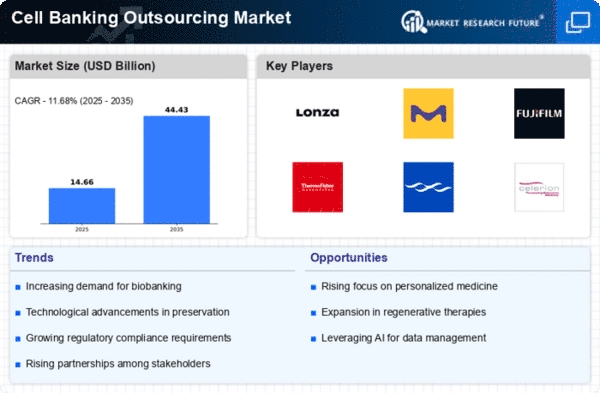
As per MRFR analysis, the Cell Banking Outsourcing Market Size was estimated at 13.13 USD Billion in 2024. The Cell Banking Outsourcing industry is projected to grow from 14.81 USD Billion in 2025 to 44.43 USD Billion by 2035, exhibiting a compound annual growth rate (CAGR) of 11.68% during the forecast period 2026 - 2035.

Key Market Trends & Highlights

The Cell Banking Outsourcing Market is poised for substantial growth driven by technological advancements and increasing demand for personalized medicine.

  • The market experiences a rising demand for personalized medicine, particularly in North America, which remains the largest market. Technological advancements in cell preservation are enhancing the efficiency and reliability of cell banking services. Asia-Pacific emerges as the fastest-growing region, driven by increasing investments in biopharmaceuticals and regenerative medicine. The growth of the gene therapy segment, alongside rising prevalence of chronic diseases, indicates a strong market driven by advancements in cell culture technologies.

Market Size & Forecast

2024 Market Size 13.13 (USD Billion)
2035 Market Size 44.43 (USD Billion)
CAGR (2025 - 2035) 11.68%
Largest Regional Market Share in 2024 North America

Major Players

<a title="Lonza" href="https://www.lonza.com/integrated-biologics/mammalian/cell-line-development" target="_blank" rel="noopener">Lonza</a> (CH), Merck KGaA (DE), Fujifilm (JP), <a title="Thermo Fisher Scientific" href="https://www.thermofisher.com/in/en/home/industrial/pharma-biopharma/drug-discovery-development/drug-discovery-development-services/custom-services/custom-cell-engineering-services.html" target="_blank" rel="noopener">Thermo Fisher Scientific</a> (US), Charles River Laboratories (US), Celerion (US), BioLife Sciences (US), Cryoport (US)

Market Trends

The Cell Banking Outsourcing Market is currently experiencing a notable transformation, driven by advancements in biotechnology and an increasing demand for personalized medicine. As organizations seek to optimize their resources, outsourcing cell banking services has emerged as a strategic approach. This trend allows companies to focus on core competencies while leveraging specialized expertise in cell preservation and management. Furthermore, the growing emphasis on regulatory compliance and quality assurance in biobanking practices particularly within the evolving stem cell banking market  has prompted many firms to partner with established outsourcing providers, ensuring adherence to stringent industry standards In addition, the Cell Banking Outsourcing Market is witnessing a shift towards automation and digitalization. The integration of advanced technologies, such as artificial intelligence and machine learning, is enhancing operational efficiency and data management capabilities across outsourced cell banking services.. This evolution not only streamlines processes but also improves the accuracy of cell tracking and inventory management. As the market continues to evolve, stakeholders are likely to explore innovative solutions that address the complexities of cell banking, ultimately fostering a more robust and responsive ecosystem for biopharmaceutical development and research and player banking initiatives..

Rising Demand for Personalized Medicine

The Cell Banking Outsourcing Market is seeing a rise in demand for personalized medicine, which necessitates the preservation of diverse cell types. This trend reflects the expanding stem cell banking market,tailored therapies, prompting organizations to outsource cell banking to ensure access to a wide range of biological materials.

Technological Advancements in Cell Preservation

Recent innovations in cell preservation techniques are significantly impacting the Cell Banking Outsourcing Market. These advancements indicate a shift towards more effective methods for maintaining cell viability and functionality. Consequently, outsourcing partners are likely to adopt these technologies, enhancing their service offerings and attracting more clients.

Growing Emphasis on Regulatory Compliance

The Cell Banking Outsourcing Market is increasingly influenced by stringent regulatory requirements. This trend highlights the necessity for service providers to ensure compliance with various standards. As organizations seek reliable partners, those with robust quality assurance processes may gain a competitive edge in the market.

Cell Banking Outsourcing Market Market Drivers

Market Growth Projections

The Global Cell Banking Outsourcing Market Industry is poised for substantial growth, with projections indicating a market size of 3.75 USD Billion in 2024 and an anticipated increase to 18.8 USD Billion by 2035. This trajectory suggests a remarkable compound annual growth rate (CAGR) of 15.78% from 2025 to 2035. Such growth is indicative of the increasing reliance on outsourced cell banking services across various sectors, including biotechnology and pharmaceuticals. The market dynamics reflect a broader trend towards specialization and efficiency, as organizations seek to leverage the expertise of outsourcing partners to enhance their operational capabilities.

Regulatory Support and Compliance

The Global Cell Banking Outsourcing Market Industry benefits from a favorable regulatory environment that encourages outsourcing practices. Regulatory bodies are increasingly recognizing the importance of cell banking in supporting clinical research and therapeutic development. This regulatory support facilitates compliance with stringent quality standards, thereby enhancing the credibility of outsourced cell banking services. Companies are more inclined to outsource their cell banking operations to specialized providers who possess the necessary expertise in navigating complex regulatory landscapes. As regulatory frameworks continue to evolve, the outsourcing of cell banking services is likely to gain traction, ensuring that organizations can focus on their core competencies while adhering to compliance requirements.

Growing Focus on Personalized Medicine

The Global Cell Banking Outsourcing Market Industry is increasingly influenced by the growing focus on personalized medicine. As healthcare shifts towards tailored treatment approaches, the demand for diverse cell types and genetic materials intensifies. Outsourced cell banking services provide the necessary infrastructure to support the development of personalized therapies, ensuring that researchers have access to a wide range of biological materials. This trend is likely to drive market growth, with projections indicating a substantial increase in demand for cell banking services. The ability to customize treatments based on individual patient profiles underscores the importance of outsourcing in facilitating advancements in personalized medicine.

Cost Efficiency and Resource Optimization

Cost efficiency remains a driving factor in the Global Cell Banking Outsourcing Market Industry. By outsourcing cell banking operations, organizations can significantly reduce overhead costs associated with maintaining in-house facilities and personnel. This approach allows companies to allocate resources more effectively, focusing on research and development rather than operational complexities. The potential for cost savings is particularly appealing to small and medium-sized enterprises that may lack the financial capacity to invest in extensive cell banking infrastructure. As the market continues to grow, the emphasis on resource optimization through outsourcing is expected to strengthen, enabling organizations to enhance their operational efficiency while maintaining high-quality standards.

Increasing Demand for Cell-Based Therapies

The Global Cell Banking Outsourcing Market Industry experiences a notable surge in demand for cell-based therapies, driven by advancements in regenerative medicine and personalized healthcare. As the healthcare landscape evolves, the need for reliable cell storage and management solutions becomes paramount. In 2024, the market is projected to reach 3.75 USD Billion, reflecting the growing reliance on cell banks for therapeutic applications. This trend is expected to continue, with projections indicating a market size of 18.8 USD Billion by 2035, suggesting a robust compound annual growth rate (CAGR) of 15.78% from 2025 to 2035. Such growth underscores the critical role of outsourcing in meeting the increasing therapeutic demands.

Technological Advancements in Cell Preservation

Technological innovations play a pivotal role in shaping the Global Cell Banking Outsourcing Market Industry. Enhanced cryopreservation techniques and automated cell processing systems are revolutionizing the way cells are stored and managed. These advancements not only improve the viability of stored cells but also streamline operational efficiencies for outsourcing partners. As a result, organizations are increasingly outsourcing their cell banking needs to leverage these cutting-edge technologies. The integration of artificial intelligence and machine learning in cell banking processes further enhances data management and quality control, positioning outsourcing as a strategic choice for companies aiming to maintain competitive advantages in a rapidly evolving market.

Market Segment Insights

By Application: Biopreservation (Largest) vs. Tissue Engineering (Fastest-Growing)

<p>In the Cell Banking Outsourcing Market, the application segment is notably diverse, comprising critical areas such as Cell Line Development, Biopreservation, Tissue Engineering, and Regenerative Medicine. Among these, Biopreservation holds the largest market share, reflecting its essential role in the long-term storage and preservation of cellular products. Meanwhile, Tissue Engineering is emerging as the fastest-growing application, driven by rising needs for innovative therapeutic solutions and improvements in living tissue products. Growth trends in the cell banking outsourcing sector are significantly influenced by advancements in biotechnologies and increased funding for regenerative medicine research. The expanding applications of cell lines in various therapeutic areas and the evolving regulations that favor biobanking practices contribute to the sector's robust expansion. Key drivers include the growing number of clinical trials requiring cell banking services and a heightened consumer awareness of personalized medicine, which bolster the demand for these specialized applications.</p>

<p>Biopreservation: Dominant vs. Tissue Engineering: Emerging</p>

<p>Biopreservation serves as a cornerstone of the cell banking outsourcing market, providing vital methodologies for preserving cells and tissues under controlled conditions. It plays a dominant role due to its pivotal function in maintaining cellular integrity during storage, minimizing degradation over time, and facilitating the long-term viability of biological samples. On the other hand, Tissue Engineering represents an emerging frontier within the market, characterized by innovations aimed at developing functional tissues to replace or repair damaged ones. Both segments showcase critical growth potential; while Biopreservation underpins established practices, Tissue Engineering is rapidly evolving with new technologies and materials that enhance cellular functionality and therapeutic outcomes.</p>

By End Use: Pharmaceutical Companies (Largest) vs. Biotechnology Companies (Fastest-Growing)

<p>The Cell Banking Outsourcing Market exhibits a diverse array of end-use segments, with pharmaceutical companies holding the largest market share. This dominance stems from their extensive investment in research and development, as well as their critical need for reliable cell storage solutions in drug development processes. Biotechnology companies, while currently a smaller segment, are rapidly increasing their share as the demand for personalized medicine and innovative therapies rises, signaling a growing reliance on outsourced cell storage solutions. Growth trends in this segment are driven by advancements in biobanking technologies and increasing partnerships between outsourcing firms and pharmaceutical giants. Research institutions are also contributing significantly, focusing on novel therapies and personalized medicine, while academic institutions are seeking collaboration opportunities. The increasing need for efficient, regulatory-compliant cell banking solutions is projected to provide considerable growth opportunities for outsourcing services in this market.</p>

<p>Pharmaceutical Companies: Dominant vs. Biotechnology Companies: Emerging</p>

<p>Pharmaceutical companies are characterized by substantial resources dedicated to drug development and regulatory compliance, making their need for cell banking outsourcing paramount. They prioritize high-quality cell storage solutions to ensure the integrity and viability of biological samples for clinical trials and research. In contrast, biotechnology companies, while currently less dominant, are emerging rapidly due to their focus on innovative biotechnological advancements and personalized treatment approaches. This segment is characterized by agility and a strong emphasis on research-driven development, creating a fertile ground for partnerships with outsourcing services that can meet their evolving demands. As biotechnology continues to foster a wave of innovation, this sector's reliance on outsourced cell storage solutions is expected to expand significantly.</p>

By Cell Type: Human Cells (Largest) vs. Stem Cells (Fastest-Growing)

<p>In the Cell Banking Outsourcing Market, Human Cells command the largest market share, being the most widely utilized and preferred option among researchers and biotech companies. Their extensive application in drug development, genetic research, and regenerative medicine significantly bolsters their market dominance. Following closely are Stem Cells, which have gained momentum due to their potential therapeutic applications, including tissue repair and genetic vascularization. The market for Stem Cells is witnessing rapid growth driven by increasing investments in R&D, advancements in cell therapy, and a surge in the prevalence of chronic diseases. The rising demand for personalized medicine and innovative treatment solutions reinforces the adoption of Stem Cells, positioning them as a leading focus area within cell banking outsourcing strategies. This trend indicates a shift towards more advanced biological applications, creating opportunities for specialized service providers to meet evolving research needs.</p>

<p>Human Cells: Dominant vs. Stem Cells: Emerging</p>

<p>Human Cells, as the dominant player in the Cell Banking Outsourcing Market, are characterized by their established protocols, extensive repositories, and well-documented usage. They play a crucial role in various biomedical applications, including vaccine development and gene editing, reflecting their importance in both clinical and research settings. On the other hand, Stem Cells, which are classified as emerging in this context, exhibit remarkable versatility in regenerative medicine, attracting significant attention for their differentiating capabilities and potential to treat previously incurable conditions. The increasing recognition of their therapeutic advantages and the push for innovative healthcare solutions are driving the appeal for Stem Cell banking and services, compelling various stakeholders to invest in this promising segment.</p>

By Service Type: Cell Banking Services (Largest) vs. Cell Processing Services (Fastest-Growing)

<p>In the Cell Banking Outsourcing Market, the distribution of market share among the service types reveals that Cell Banking Services dominate the landscape, representing a significant portion of the sector. Following closely are Cell Storage Services, known for their reliability, and Cell Processing Services, which, while smaller in share, are gaining traction due to their innovation and efficiency. Cell Distribution Services, though essential, contribute a modest share relative to the leading services.</p>

<p>Cell Banking Services (Dominant) vs. Cell Processing Services (Emerging)</p>

<p>Cell Banking Services stand as the dominant force in the outsourcing segment, characterized by robust protocols for the management and preservation of biological materials. This service is highly sought after for its comprehensive solutions that meet regulatory standards. On the other hand, Cell Processing Services are emerging rapidly, driven by advancements in technology and demand for personalized medicine. These services focus on the manipulation of cells for therapeutic applications, providing significant growth opportunities as they adapt to evolving market needs. The interplay of these services highlights a dual focus on traditional practices and innovation within the industry.</p>

Get more detailed insights about Cell Banking Outsourcing Market Research Report - Forecast till 2035.

Regional Insights

North America : Market Leader in Cell Banking

North America is poised to maintain its leadership in the Cell Banking Outsourcing Market, holding a significant market share of 6.58 in 2024. The region's growth is driven by increasing demand for biopharmaceuticals and advancements in cell therapy technologies. Regulatory support from agencies like the FDA further catalyzes market expansion, ensuring compliance and safety in cell banking practices. The rising prevalence of chronic diseases also fuels the need for effective cell storage solutions. The competitive landscape in North America is robust, featuring key players such as Thermo Fisher Scientific, Charles River Laboratories, and Lonza. These companies are investing heavily in R&D to enhance their service offerings and maintain market share. The presence of advanced infrastructure and a skilled workforce further strengthens the region's position. As the market evolves, partnerships and collaborations among these players are expected to drive innovation and efficiency in cell banking services.

Europe : Emerging Market with Growth Potential

Europe is witnessing a notable increase in the Cell Banking Outsourcing Market, with a market size of 3.93. The region benefits from a strong regulatory framework that encourages innovation and ensures high-quality standards in cell banking. The European Medicines Agency (EMA) plays a crucial role in establishing guidelines that facilitate market growth. Additionally, the rising demand for personalized medicine and regenerative therapies is propelling the need for efficient cell storage solutions. Leading countries in Europe, such as Germany, France, and the UK, are at the forefront of this market. Major players like Merck KGaA and Fujifilm are expanding their operations to meet the growing demand. The competitive landscape is characterized by strategic partnerships and collaborations aimed at enhancing service offerings. As the market matures, the focus on sustainability and ethical practices in cell banking is expected to shape future developments.

Asia-Pacific : Rapidly Growing Market Landscape

The Asia-Pacific region is emerging as a significant player in the Cell Banking Outsourcing Market, with a market size of 2.61. This growth is driven by increasing investments in biopharmaceutical research and development, coupled with a rising demand for advanced cell therapies. Regulatory bodies in countries like Japan and Australia are enhancing their frameworks to support the burgeoning market, ensuring compliance and safety in cell banking practices. The region's diverse population also presents unique opportunities for personalized medicine solutions. Countries such as Japan, China, and India are leading the charge in this market. Key players like Fujifilm and Cryoport are expanding their presence to cater to the growing demand. The competitive landscape is marked by collaborations between local and international firms, aimed at leveraging technological advancements. As the market evolves, the focus on innovation and quality assurance will be paramount for sustained growth.

Middle East and Africa : Nascent Market with Untapped Potential

The Middle East and Africa region currently represents a nascent market in the Cell Banking Outsourcing sector, with a market size of only 0.01. However, there is significant potential for growth driven by increasing healthcare investments and a rising awareness of biobanking practices. Governments in the region are beginning to recognize the importance of cell banking in advancing medical research and improving healthcare outcomes, which could lead to favorable regulatory changes in the future. Countries like South Africa and the UAE are starting to develop their cell banking capabilities, albeit at a slower pace compared to other regions. The competitive landscape is still emerging, with few key players currently operating. As the market matures, there will be opportunities for international firms to enter and establish a presence, particularly in response to the growing demand for advanced healthcare solutions.

Key Players and Competitive Insights

The Cell Banking Outsourcing Market is characterized by a dynamic competitive landscape, driven by increasing demand for biopharmaceuticals and advancements in cell-based therapies. Key players such as Lonza (CH), Merck KGaA (DE), and Thermo Fisher Scientific (US) are strategically positioned to leverage their extensive capabilities in cell culture and bioprocessing. Lonza (CH) focuses on innovation through its robust R&D initiatives, while Merck KGaA (DE) emphasizes partnerships to enhance its service offerings. Thermo Fisher Scientific (US) is actively pursuing digital transformation to streamline operations and improve customer engagement, collectively shaping a competitive environment that prioritizes technological advancement and operational efficiency.In terms of business tactics, companies are increasingly localizing manufacturing to reduce lead times and optimize supply chains. The market appears moderately fragmented, with several players vying for market share. However, the collective influence of major companies like Charles River Laboratories (US) and Cryoport (US) is notable, as they implement strategies that enhance their competitive positioning and operational capabilities.
In November Lonza (CH) announced a strategic partnership with a leading biotechnology firm to co-develop a new cell therapy platform. This collaboration is expected to enhance Lonza's service portfolio and strengthen its position in the rapidly evolving cell therapy market. The strategic importance of this partnership lies in its potential to accelerate innovation and expand market reach, aligning with the growing demand for advanced therapeutic solutions.
In October Merck KGaA (DE) launched a new suite of cell banking services aimed at improving the efficiency of biopharmaceutical production. This initiative reflects Merck's commitment to enhancing its operational capabilities and meeting the evolving needs of its clients. The launch is significant as it positions Merck as a leader in providing comprehensive solutions that address the complexities of cell banking and bioproduction.
In September Thermo Fisher Scientific (US) unveiled a new digital platform designed to optimize cell culture workflows. This platform integrates advanced analytics and automation, enabling researchers to streamline their processes and improve productivity. The introduction of this technology underscores Thermo Fisher's focus on digitalization and its potential to redefine operational efficiencies in the cell banking sector.
As of December current trends in the Cell Banking Outsourcing Market indicate a strong emphasis on digitalization, sustainability, and AI integration. Strategic alliances are increasingly shaping the competitive landscape, fostering innovation and collaboration among key players. Looking ahead, competitive differentiation is likely to evolve from traditional price-based competition to a focus on innovation, technology, and supply chain reliability, as companies strive to meet the growing demands of the biopharmaceutical industry.

Key Companies in the Cell Banking Outsourcing Market include

Industry Developments

  • Q2 2024: Lonza Expands Cell and Gene Therapy Manufacturing Facility in Houston Lonza announced the expansion of its Houston facility to increase capacity for cell and gene therapy manufacturing, including cell banking services, to meet growing demand from biopharma clients.
  • Q2 2024: Charles River Laboratories Opens New Cell Solutions Center in Massachusetts Charles River Laboratories opened a new Cell Solutions Center in Shrewsbury, MA, enhancing its cell banking outsourcing capabilities for biopharmaceutical and advanced therapy clients.
  • Q3 2024: WuXi Advanced Therapies Launches Expanded Cell Banking Services in Philadelphia WuXi Advanced Therapies, a subsidiary of WuXi AppTec, launched expanded cell banking outsourcing services at its Philadelphia facility, supporting global clients in cell and gene therapy development.
  • Q2 2024: AGC Biologics Announces New Cell Banking Suite at Seattle Facility AGC Biologics unveiled a new cell banking suite at its Seattle site, designed to support increased demand for GMP-compliant cell banking outsourcing from biopharma partners.
  • Q1 2024: Thermo Fisher Scientific Expands Cell Banking Services with New Cryopreservation Technology Thermo Fisher Scientific introduced advanced cryopreservation technology to its cell banking outsourcing services, aiming to improve cell viability and storage for research and clinical applications.
  • Q2 2024: Fujifilm Diosynth Biotechnologies Opens New Cell Banking Facility in Texas Fujifilm Diosynth Biotechnologies opened a new cell banking facility in College Station, Texas, to provide expanded outsourcing services for cell line development and storage.
  • Q3 2024: Samsung Biologics Launches Expanded Cell Banking Outsourcing Market Services Samsung Biologics announced the launch of expanded cell banking outsourcing services at its Songdo campus, supporting global biopharma clients with GMP-compliant solutions.
  • Q2 2024: Eurofins Scientific Acquires Cell Line Banking Business from Local Biotech Eurofins Scientific acquired the cell line banking business of a regional biotech company, strengthening its position in the cell banking outsourcing market.
  • Q1 2024: Catalent Expands Cell Banking Capabilities at Maryland Facility Catalent announced the expansion of its cell banking capabilities at its Harmans, Maryland facility, enhancing its service offering for advanced therapy developers.
  • Q2 2024: BioReliance Launches Next-Generation Cell Banking Platform BioReliance, a Merck KGaA company, launched a next-generation cell banking platform to streamline and accelerate the creation and storage of GMP-compliant cell banks for clients.
  • Q3 2024: Porton Advanced Opens New Cell Banking and Manufacturing Facility in China Porton Advanced opened a new facility in Suzhou, China, dedicated to cell banking and advanced therapy manufacturing, expanding its outsourcing service capacity.
  • Q2 2024: Aldevron Announces Strategic Partnership with Biotech Startup for Cell Banking Services Aldevron entered a strategic partnership with a biotech startup to provide cell banking outsourcing services, supporting the startup’s cell therapy pipeline.

Key Players

  • CordLife (Singapore)
  • Cleancells (France)
  • Charles River Laboratories (US)
  • BSL Bioservice (Germany)
  • BioReliance (US)
  • Sartorius (Germany)
  • Covance (US)
  • LifeCell International Pvt. Ltd. (India)
  • Goodwin Biotechnology Inc.(US)
  • GlobalStem Inc.(US)
  • , Cryo-Cell International Inc. (US)
  • Lonza (Switzerland)
  • PX’TherapeuticsSA (France)
  • Wuxi Apptec (China)
  • SGS Life Sciences (Switzerland)

Future Outlook

Cell Banking Outsourcing Market Future Outlook

The Cell Banking Outsourcing Market is projected to grow at 11.68% CAGR from 2025 to 2035, driven by advancements in biobanking technologies and increasing demand for personalized medicine.

New opportunities lie in:

  • <p>Expansion of automated cryopreservation systems for enhanced efficiency. Development of specialized cell storage solutions for regenerative medicine. Strategic partnerships with biotech firms to enhance service offerings.</p>

By 2035, the market is expected to solidify its position as a leader in biobanking solutions.

Market Segmentation

Cell Banking Outsourcing Market End User Outlook

  • Biopharmaceutical Companies
  • Research Institutions
  • Academic Organizations
  • Contract Research Organizations

Cell Banking Outsourcing Market Cell Type Outlook

  • Stem Cells
  • Somatic Cells
  • Germ Cells
  • Primary Cells

Cell Banking Outsourcing Market Application Outlook

  • Cell Line Development
  • Tissue Engineering
  • Gene Therapy
  • Regenerative Medicine

Cell Banking Outsourcing Market Service Type Outlook

  • Cell Banking
  • Cell Processing
  • Cell Storage
  • Cell Distribution

Report Scope

MARKET SIZE 2024 13.13(USD Billion)
MARKET SIZE 2025 14.81(USD Billion)
MARKET SIZE 2035 44.43(USD Billion)
COMPOUND ANNUAL GROWTH RATE (CAGR) 11.68% (2025 - 2035)
REPORT COVERAGE Revenue Forecast, Competitive Landscape, Growth Factors, and Trends
BASE YEAR 2024
Market Forecast Period 2026 - 2035
Historical Data 2019 - 2024
Market Forecast Units USD Billion
Key Companies Profiled Lonza (CH), Merck KGaA (DE), Fujifilm (JP), Thermo Fisher Scientific (US), Charles River Laboratories (US), Celerion (US), BioLife Sciences (US), Cryoport (US)
Segments Covered Application, Cell Type, Service Type, End User
Key Market Opportunities Integration of advanced biobanking technologies enhances efficiency in the Cell Banking Outsourcing Market.
Key Market Dynamics Rising demand for personalized medicine drives growth in cell banking outsourcing, enhancing operational efficiency and regulatory compliance.
Countries Covered North America, Europe, APAC, South America, MEA

FAQs

What is the projected market valuation of the Cell Banking Outsourcing Market by 2035?

<p>The projected market valuation for the Cell Banking Outsourcing Market is expected to reach 44.43 USD Billion by 2035.</p>

What was the market valuation of the Cell Banking Outsourcing Market in 2024?

<p>The overall market valuation was 13.13 USD Billion in 2024.</p>

What is the expected CAGR for the Cell Banking Outsourcing Market during the forecast period 2025 - 2035?

<p>The expected CAGR for the Cell Banking Outsourcing Market during the forecast period 2025 - 2035 is 11.68%.</p>

Which application segment is projected to have the highest valuation by 2035?

<p>The Cell Line Development segment is projected to reach 13.25 USD Billion by 2035.</p>

What are the key players in the Cell Banking Outsourcing Market?

<p>Key players in the market include Thermo Fisher Scientific, Merck KGaA, Lonza Group, and Fujifilm Holdings Corporation.</p>

How does the valuation of the Biopreservation segment change from 2024 to 2035?

<p>The Biopreservation segment valuation is expected to increase from 4.12 USD Billion in 2024 to 13.66 USD Billion by 2035.</p>

What is the projected valuation for the Stem Cells segment by 2035?

The Stem Cells segment is projected to reach a valuation of 14.25 USD Billion by 2035.

Which end-use segment is expected to grow the most by 2035?

The Pharmaceutical Companies segment is expected to grow significantly, reaching 17.5 USD Billion by 2035.

What services are included in the Cell Banking Outsourcing Market?

Services include Cell Banking Services, Cell Storage Services, Cell Processing Services, and Cell Distribution Services.

What is the projected valuation for the Cell Processing Services segment by 2035?

The Cell Processing Services segment is projected to reach 13.5 USD Billion by 2035.

  1. SECTION I: EXECUTIVE SUMMARY AND KEY HIGHLIGHTS
    1. | 1.1 EXECUTIVE SUMMARY
    2. | | 1.1.1 Market Overview
    3. | | 1.1.2 Key Findings
    4. | | 1.1.3 Market Segmentation
    5. | | 1.1.4 Competitive Landscape
    6. | | 1.1.5 Challenges and Opportunities
    7. | | 1.1.6 Future Outlook
  2. SECTION II: SCOPING, METHODOLOGY AND MARKET STRUCTURE
    1. | 2.1 MARKET INTRODUCTION
    2. | | 2.1.1 Definition
    3. | | 2.1.2 Scope of the study
    4. | | | 2.1.2.1 Research Objective
    5. | | | 2.1.2.2 Assumption
    6. | | | 2.1.2.3 Limitations
    7. | 2.2 RESEARCH METHODOLOGY
    8. | | 2.2.1 Overview
    9. | | 2.2.2 Data Mining
    10. | | 2.2.3 Secondary Research
    11. | | 2.2.4 Primary Research
    12. | | | 2.2.4.1 Primary Interviews and Information Gathering Process
    13. | | | 2.2.4.2 Breakdown of Primary Respondents
    14. | | 2.2.5 Forecasting Model
    15. | | 2.2.6 Market Size Estimation
    16. | | | 2.2.6.1 Bottom-Up Approach
    17. | | | 2.2.6.2 Top-Down Approach
    18. | | 2.2.7 Data Triangulation
    19. | | 2.2.8 Validation
  3. SECTION III: QUALITATIVE ANALYSIS
    1. | 3.1 MARKET DYNAMICS
    2. | | 3.1.1 Overview
    3. | | 3.1.2 Drivers
    4. | | 3.1.3 Restraints
    5. | | 3.1.4 Opportunities
    6. | 3.2 MARKET FACTOR ANALYSIS
    7. | | 3.2.1 Value chain Analysis
    8. | | 3.2.2 Porter's Five Forces Analysis
    9. | | | 3.2.2.1 Bargaining Power of Suppliers
    10. | | | 3.2.2.2 Bargaining Power of Buyers
    11. | | | 3.2.2.3 Threat of New Entrants
    12. | | | 3.2.2.4 Threat of Substitutes
    13. | | | 3.2.2.5 Intensity of Rivalry
    14. | | 3.2.3 COVID-19 Impact Analysis
    15. | | | 3.2.3.1 Market Impact Analysis
    16. | | | 3.2.3.2 Regional Impact
    17. | | | 3.2.3.3 Opportunity and Threat Analysis
  4. SECTION IV: QUANTITATIVE ANALYSIS
    1. | 4.1 Healthcare, BY Application (USD Billion)
    2. | | 4.1.1 Cell Line Development
    3. | | 4.1.2 Biopreservation
    4. | | 4.1.3 Tissue Engineering
    5. | | 4.1.4 Regenerative Medicine
    6. | 4.2 Healthcare, BY End Use (USD Billion)
    7. | | 4.2.1 Pharmaceutical Companies
    8. | | 4.2.2 Biotechnology Companies
    9. | | 4.2.3 Research Institutions
    10. | | 4.2.4 Academic Institutions
    11. | 4.3 Healthcare, BY Cell Type (USD Billion)
    12. | | 4.3.1 Human Cells
    13. | | 4.3.2 Animal Cells
    14. | | 4.3.3 Stem Cells
    15. | | 4.3.4 Primary Cells
    16. | 4.4 Healthcare, BY Service Type (USD Billion)
    17. | | 4.4.1 Cell Banking Services
    18. | | 4.4.2 Cell Storage Services
    19. | | 4.4.3 Cell Processing Services
    20. | | 4.4.4 Cell Distribution Services
    21. | 4.5 Healthcare, BY Region (USD Billion)
    22. | | 4.5.1 North America
    23. | | | 4.5.1.1 US
    24. | | | 4.5.1.2 Canada
    25. | | 4.5.2 Europe
    26. | | | 4.5.2.1 Germany
    27. | | | 4.5.2.2 UK
    28. | | | 4.5.2.3 France
    29. | | | 4.5.2.4 Russia
    30. | | | 4.5.2.5 Italy
    31. | | | 4.5.2.6 Spain
    32. | | | 4.5.2.7 Rest of Europe
    33. | | 4.5.3 APAC
    34. | | | 4.5.3.1 China
    35. | | | 4.5.3.2 India
    36. | | | 4.5.3.3 Japan
    37. | | | 4.5.3.4 South Korea
    38. | | | 4.5.3.5 Malaysia
    39. | | | 4.5.3.6 Thailand
    40. | | | 4.5.3.7 Indonesia
    41. | | | 4.5.3.8 Rest of APAC
    42. | | 4.5.4 South America
    43. | | | 4.5.4.1 Brazil
    44. | | | 4.5.4.2 Mexico
    45. | | | 4.5.4.3 Argentina
    46. | | | 4.5.4.4 Rest of South America
    47. | | 4.5.5 MEA
    48. | | | 4.5.5.1 GCC Countries
    49. | | | 4.5.5.2 South Africa
    50. | | | 4.5.5.3 Rest of MEA
  5. SECTION V: COMPETITIVE ANALYSIS
    1. | 5.1 Competitive Landscape
    2. | | 5.1.1 Overview
    3. | | 5.1.2 Competitive Analysis
    4. | | 5.1.3 Market share Analysis
    5. | | 5.1.4 Major Growth Strategy in the Healthcare
    6. | | 5.1.5 Competitive Benchmarking
    7. | | 5.1.6 Leading Players in Terms of Number of Developments in the Healthcare
    8. | | 5.1.7 Key developments and growth strategies
    9. | | | 5.1.7.1 New Product Launch/Service Deployment
    10. | | | 5.1.7.2 Merger & Acquisitions
    11. | | | 5.1.7.3 Joint Ventures
    12. | | 5.1.8 Major Players Financial Matrix
    13. | | | 5.1.8.1 Sales and Operating Income
    14. | | | 5.1.8.2 Major Players R&D Expenditure. 2023
    15. | 5.2 Company Profiles
    16. | | 5.2.1 Thermo Fisher Scientific (US)
    17. | | | 5.2.1.1 Financial Overview
    18. | | | 5.2.1.2 Products Offered
    19. | | | 5.2.1.3 Key Developments
    20. | | | 5.2.1.4 SWOT Analysis
    21. | | | 5.2.1.5 Key Strategies
    22. | | 5.2.2 Merck KGaA (DE)
    23. | | | 5.2.2.1 Financial Overview
    24. | | | 5.2.2.2 Products Offered
    25. | | | 5.2.2.3 Key Developments
    26. | | | 5.2.2.4 SWOT Analysis
    27. | | | 5.2.2.5 Key Strategies
    28. | | 5.2.3 Lonza Group (CH)
    29. | | | 5.2.3.1 Financial Overview
    30. | | | 5.2.3.2 Products Offered
    31. | | | 5.2.3.3 Key Developments
    32. | | | 5.2.3.4 SWOT Analysis
    33. | | | 5.2.3.5 Key Strategies
    34. | | 5.2.4 Fujifilm Holdings Corporation (JP)
    35. | | | 5.2.4.1 Financial Overview
    36. | | | 5.2.4.2 Products Offered
    37. | | | 5.2.4.3 Key Developments
    38. | | | 5.2.4.4 SWOT Analysis
    39. | | | 5.2.4.5 Key Strategies
    40. | | 5.2.5 Celerion (US)
    41. | | | 5.2.5.1 Financial Overview
    42. | | | 5.2.5.2 Products Offered
    43. | | | 5.2.5.3 Key Developments
    44. | | | 5.2.5.4 SWOT Analysis
    45. | | | 5.2.5.5 Key Strategies
    46. | | 5.2.6 Charles River Laboratories (US)
    47. | | | 5.2.6.1 Financial Overview
    48. | | | 5.2.6.2 Products Offered
    49. | | | 5.2.6.3 Key Developments
    50. | | | 5.2.6.4 SWOT Analysis
    51. | | | 5.2.6.5 Key Strategies
    52. | | 5.2.7 BioLife Sciences (US)
    53. | | | 5.2.7.1 Financial Overview
    54. | | | 5.2.7.2 Products Offered
    55. | | | 5.2.7.3 Key Developments
    56. | | | 5.2.7.4 SWOT Analysis
    57. | | | 5.2.7.5 Key Strategies
    58. | | 5.2.8 Cryoport (US)
    59. | | | 5.2.8.1 Financial Overview
    60. | | | 5.2.8.2 Products Offered
    61. | | | 5.2.8.3 Key Developments
    62. | | | 5.2.8.4 SWOT Analysis
    63. | | | 5.2.8.5 Key Strategies
    64. | 5.3 Appendix
    65. | | 5.3.1 References
    66. | | 5.3.2 Related Reports
  6. LIST OF FIGURES
    1. | 6.1 MARKET SYNOPSIS
    2. | 6.2 NORTH AMERICA MARKET ANALYSIS
    3. | 6.3 US MARKET ANALYSIS BY APPLICATION
    4. | 6.4 US MARKET ANALYSIS BY END USE
    5. | 6.5 US MARKET ANALYSIS BY CELL TYPE
    6. | 6.6 US MARKET ANALYSIS BY SERVICE TYPE
    7. | 6.7 CANADA MARKET ANALYSIS BY APPLICATION
    8. | 6.8 CANADA MARKET ANALYSIS BY END USE
    9. | 6.9 CANADA MARKET ANALYSIS BY CELL TYPE
    10. | 6.10 CANADA MARKET ANALYSIS BY SERVICE TYPE
    11. | 6.11 EUROPE MARKET ANALYSIS
    12. | 6.12 GERMANY MARKET ANALYSIS BY APPLICATION
    13. | 6.13 GERMANY MARKET ANALYSIS BY END USE
    14. | 6.14 GERMANY MARKET ANALYSIS BY CELL TYPE
    15. | 6.15 GERMANY MARKET ANALYSIS BY SERVICE TYPE
    16. | 6.16 UK MARKET ANALYSIS BY APPLICATION
    17. | 6.17 UK MARKET ANALYSIS BY END USE
    18. | 6.18 UK MARKET ANALYSIS BY CELL TYPE
    19. | 6.19 UK MARKET ANALYSIS BY SERVICE TYPE
    20. | 6.20 FRANCE MARKET ANALYSIS BY APPLICATION
    21. | 6.21 FRANCE MARKET ANALYSIS BY END USE
    22. | 6.22 FRANCE MARKET ANALYSIS BY CELL TYPE
    23. | 6.23 FRANCE MARKET ANALYSIS BY SERVICE TYPE
    24. | 6.24 RUSSIA MARKET ANALYSIS BY APPLICATION
    25. | 6.25 RUSSIA MARKET ANALYSIS BY END USE
    26. | 6.26 RUSSIA MARKET ANALYSIS BY CELL TYPE
    27. | 6.27 RUSSIA MARKET ANALYSIS BY SERVICE TYPE
    28. | 6.28 ITALY MARKET ANALYSIS BY APPLICATION
    29. | 6.29 ITALY MARKET ANALYSIS BY END USE
    30. | 6.30 ITALY MARKET ANALYSIS BY CELL TYPE
    31. | 6.31 ITALY MARKET ANALYSIS BY SERVICE TYPE
    32. | 6.32 SPAIN MARKET ANALYSIS BY APPLICATION
    33. | 6.33 SPAIN MARKET ANALYSIS BY END USE
    34. | 6.34 SPAIN MARKET ANALYSIS BY CELL TYPE
    35. | 6.35 SPAIN MARKET ANALYSIS BY SERVICE TYPE
    36. | 6.36 REST OF EUROPE MARKET ANALYSIS BY APPLICATION
    37. | 6.37 REST OF EUROPE MARKET ANALYSIS BY END USE
    38. | 6.38 REST OF EUROPE MARKET ANALYSIS BY CELL TYPE
    39. | 6.39 REST OF EUROPE MARKET ANALYSIS BY SERVICE TYPE
    40. | 6.40 APAC MARKET ANALYSIS
    41. | 6.41 CHINA MARKET ANALYSIS BY APPLICATION
    42. | 6.42 CHINA MARKET ANALYSIS BY END USE
    43. | 6.43 CHINA MARKET ANALYSIS BY CELL TYPE
    44. | 6.44 CHINA MARKET ANALYSIS BY SERVICE TYPE
    45. | 6.45 INDIA MARKET ANALYSIS BY APPLICATION
    46. | 6.46 INDIA MARKET ANALYSIS BY END USE
    47. | 6.47 INDIA MARKET ANALYSIS BY CELL TYPE
    48. | 6.48 INDIA MARKET ANALYSIS BY SERVICE TYPE
    49. | 6.49 JAPAN MARKET ANALYSIS BY APPLICATION
    50. | 6.50 JAPAN MARKET ANALYSIS BY END USE
    51. | 6.51 JAPAN MARKET ANALYSIS BY CELL TYPE
    52. | 6.52 JAPAN MARKET ANALYSIS BY SERVICE TYPE
    53. | 6.53 SOUTH KOREA MARKET ANALYSIS BY APPLICATION
    54. | 6.54 SOUTH KOREA MARKET ANALYSIS BY END USE
    55. | 6.55 SOUTH KOREA MARKET ANALYSIS BY CELL TYPE
    56. | 6.56 SOUTH KOREA MARKET ANALYSIS BY SERVICE TYPE
    57. | 6.57 MALAYSIA MARKET ANALYSIS BY APPLICATION
    58. | 6.58 MALAYSIA MARKET ANALYSIS BY END USE
    59. | 6.59 MALAYSIA MARKET ANALYSIS BY CELL TYPE
    60. | 6.60 MALAYSIA MARKET ANALYSIS BY SERVICE TYPE
    61. | 6.61 THAILAND MARKET ANALYSIS BY APPLICATION
    62. | 6.62 THAILAND MARKET ANALYSIS BY END USE
    63. | 6.63 THAILAND MARKET ANALYSIS BY CELL TYPE
    64. | 6.64 THAILAND MARKET ANALYSIS BY SERVICE TYPE
    65. | 6.65 INDONESIA MARKET ANALYSIS BY APPLICATION
    66. | 6.66 INDONESIA MARKET ANALYSIS BY END USE
    67. | 6.67 INDONESIA MARKET ANALYSIS BY CELL TYPE
    68. | 6.68 INDONESIA MARKET ANALYSIS BY SERVICE TYPE
    69. | 6.69 REST OF APAC MARKET ANALYSIS BY APPLICATION
    70. | 6.70 REST OF APAC MARKET ANALYSIS BY END USE
    71. | 6.71 REST OF APAC MARKET ANALYSIS BY CELL TYPE
    72. | 6.72 REST OF APAC MARKET ANALYSIS BY SERVICE TYPE
    73. | 6.73 SOUTH AMERICA MARKET ANALYSIS
    74. | 6.74 BRAZIL MARKET ANALYSIS BY APPLICATION
    75. | 6.75 BRAZIL MARKET ANALYSIS BY END USE
    76. | 6.76 BRAZIL MARKET ANALYSIS BY CELL TYPE
    77. | 6.77 BRAZIL MARKET ANALYSIS BY SERVICE TYPE
    78. | 6.78 MEXICO MARKET ANALYSIS BY APPLICATION
    79. | 6.79 MEXICO MARKET ANALYSIS BY END USE
    80. | 6.80 MEXICO MARKET ANALYSIS BY CELL TYPE
    81. | 6.81 MEXICO MARKET ANALYSIS BY SERVICE TYPE
    82. | 6.82 ARGENTINA MARKET ANALYSIS BY APPLICATION
    83. | 6.83 ARGENTINA MARKET ANALYSIS BY END USE
    84. | 6.84 ARGENTINA MARKET ANALYSIS BY CELL TYPE
    85. | 6.85 ARGENTINA MARKET ANALYSIS BY SERVICE TYPE
    86. | 6.86 REST OF SOUTH AMERICA MARKET ANALYSIS BY APPLICATION
    87. | 6.87 REST OF SOUTH AMERICA MARKET ANALYSIS BY END USE
    88. | 6.88 REST OF SOUTH AMERICA MARKET ANALYSIS BY CELL TYPE
    89. | 6.89 REST OF SOUTH AMERICA MARKET ANALYSIS BY SERVICE TYPE
    90. | 6.90 MEA MARKET ANALYSIS
    91. | 6.91 GCC COUNTRIES MARKET ANALYSIS BY APPLICATION
    92. | 6.92 GCC COUNTRIES MARKET ANALYSIS BY END USE
    93. | 6.93 GCC COUNTRIES MARKET ANALYSIS BY CELL TYPE
    94. | 6.94 GCC COUNTRIES MARKET ANALYSIS BY SERVICE TYPE
    95. | 6.95 SOUTH AFRICA MARKET ANALYSIS BY APPLICATION
    96. | 6.96 SOUTH AFRICA MARKET ANALYSIS BY END USE
    97. | 6.97 SOUTH AFRICA MARKET ANALYSIS BY CELL TYPE
    98. | 6.98 SOUTH AFRICA MARKET ANALYSIS BY SERVICE TYPE
    99. | 6.99 REST OF MEA MARKET ANALYSIS BY APPLICATION
    100. | 6.100 REST OF MEA MARKET ANALYSIS BY END USE
    101. | 6.101 REST OF MEA MARKET ANALYSIS BY CELL TYPE
    102. | 6.102 REST OF MEA MARKET ANALYSIS BY SERVICE TYPE
    103. | 6.103 KEY BUYING CRITERIA OF HEALTHCARE
    104. | 6.104 RESEARCH PROCESS OF MRFR
    105. | 6.105 DRO ANALYSIS OF HEALTHCARE
    106. | 6.106 DRIVERS IMPACT ANALYSIS: HEALTHCARE
    107. | 6.107 RESTRAINTS IMPACT ANALYSIS: HEALTHCARE
    108. | 6.108 SUPPLY / VALUE CHAIN: HEALTHCARE
    109. | 6.109 HEALTHCARE, BY APPLICATION, 2024 (% SHARE)
    110. | 6.110 HEALTHCARE, BY APPLICATION, 2024 TO 2035 (USD Billion)
    111. | 6.111 HEALTHCARE, BY END USE, 2024 (% SHARE)
    112. | 6.112 HEALTHCARE, BY END USE, 2024 TO 2035 (USD Billion)
    113. | 6.113 HEALTHCARE, BY CELL TYPE, 2024 (% SHARE)
    114. | 6.114 HEALTHCARE, BY CELL TYPE, 2024 TO 2035 (USD Billion)
    115. | 6.115 HEALTHCARE, BY SERVICE TYPE, 2024 (% SHARE)
    116. | 6.116 HEALTHCARE, BY SERVICE TYPE, 2024 TO 2035 (USD Billion)
    117. | 6.117 BENCHMARKING OF MAJOR COMPETITORS
  7. LIST OF TABLES
    1. | 7.1 LIST OF ASSUMPTIONS
    2. | | 7.1.1
    3. | 7.2 North America MARKET SIZE ESTIMATES; FORECAST
    4. | | 7.2.1 BY APPLICATION, 2025-2035 (USD Billion)
    5. | | 7.2.2 BY END USE, 2025-2035 (USD Billion)
    6. | | 7.2.3 BY CELL TYPE, 2025-2035 (USD Billion)
    7. | | 7.2.4 BY SERVICE TYPE, 2025-2035 (USD Billion)
    8. | 7.3 US MARKET SIZE ESTIMATES; FORECAST
    9. | | 7.3.1 BY APPLICATION, 2025-2035 (USD Billion)
    10. | | 7.3.2 BY END USE, 2025-2035 (USD Billion)
    11. | | 7.3.3 BY CELL TYPE, 2025-2035 (USD Billion)
    12. | | 7.3.4 BY SERVICE TYPE, 2025-2035 (USD Billion)
    13. | 7.4 Canada MARKET SIZE ESTIMATES; FORECAST
    14. | | 7.4.1 BY APPLICATION, 2025-2035 (USD Billion)
    15. | | 7.4.2 BY END USE, 2025-2035 (USD Billion)
    16. | | 7.4.3 BY CELL TYPE, 2025-2035 (USD Billion)
    17. | | 7.4.4 BY SERVICE TYPE, 2025-2035 (USD Billion)
    18. | 7.5 Europe MARKET SIZE ESTIMATES; FORECAST
    19. | | 7.5.1 BY APPLICATION, 2025-2035 (USD Billion)
    20. | | 7.5.2 BY END USE, 2025-2035 (USD Billion)
    21. | | 7.5.3 BY CELL TYPE, 2025-2035 (USD Billion)
    22. | | 7.5.4 BY SERVICE TYPE, 2025-2035 (USD Billion)
    23. | 7.6 Germany MARKET SIZE ESTIMATES; FORECAST
    24. | | 7.6.1 BY APPLICATION, 2025-2035 (USD Billion)
    25. | | 7.6.2 BY END USE, 2025-2035 (USD Billion)
    26. | | 7.6.3 BY CELL TYPE, 2025-2035 (USD Billion)
    27. | | 7.6.4 BY SERVICE TYPE, 2025-2035 (USD Billion)
    28. | 7.7 UK MARKET SIZE ESTIMATES; FORECAST
    29. | | 7.7.1 BY APPLICATION, 2025-2035 (USD Billion)
    30. | | 7.7.2 BY END USE, 2025-2035 (USD Billion)
    31. | | 7.7.3 BY CELL TYPE, 2025-2035 (USD Billion)
    32. | | 7.7.4 BY SERVICE TYPE, 2025-2035 (USD Billion)
    33. | 7.8 France MARKET SIZE ESTIMATES; FORECAST
    34. | | 7.8.1 BY APPLICATION, 2025-2035 (USD Billion)
    35. | | 7.8.2 BY END USE, 2025-2035 (USD Billion)
    36. | | 7.8.3 BY CELL TYPE, 2025-2035 (USD Billion)
    37. | | 7.8.4 BY SERVICE TYPE, 2025-2035 (USD Billion)
    38. | 7.9 Russia MARKET SIZE ESTIMATES; FORECAST
    39. | | 7.9.1 BY APPLICATION, 2025-2035 (USD Billion)
    40. | | 7.9.2 BY END USE, 2025-2035 (USD Billion)
    41. | | 7.9.3 BY CELL TYPE, 2025-2035 (USD Billion)
    42. | | 7.9.4 BY SERVICE TYPE, 2025-2035 (USD Billion)
    43. | 7.10 Italy MARKET SIZE ESTIMATES; FORECAST
    44. | | 7.10.1 BY APPLICATION, 2025-2035 (USD Billion)
    45. | | 7.10.2 BY END USE, 2025-2035 (USD Billion)
    46. | | 7.10.3 BY CELL TYPE, 2025-2035 (USD Billion)
    47. | | 7.10.4 BY SERVICE TYPE, 2025-2035 (USD Billion)
    48. | 7.11 Spain MARKET SIZE ESTIMATES; FORECAST
    49. | | 7.11.1 BY APPLICATION, 2025-2035 (USD Billion)
    50. | | 7.11.2 BY END USE, 2025-2035 (USD Billion)
    51. | | 7.11.3 BY CELL TYPE, 2025-2035 (USD Billion)
    52. | | 7.11.4 BY SERVICE TYPE, 2025-2035 (USD Billion)
    53. | 7.12 Rest of Europe MARKET SIZE ESTIMATES; FORECAST
    54. | | 7.12.1 BY APPLICATION, 2025-2035 (USD Billion)
    55. | | 7.12.2 BY END USE, 2025-2035 (USD Billion)
    56. | | 7.12.3 BY CELL TYPE, 2025-2035 (USD Billion)
    57. | | 7.12.4 BY SERVICE TYPE, 2025-2035 (USD Billion)
    58. | 7.13 APAC MARKET SIZE ESTIMATES; FORECAST
    59. | | 7.13.1 BY APPLICATION, 2025-2035 (USD Billion)
    60. | | 7.13.2 BY END USE, 2025-2035 (USD Billion)
    61. | | 7.13.3 BY CELL TYPE, 2025-2035 (USD Billion)
    62. | | 7.13.4 BY SERVICE TYPE, 2025-2035 (USD Billion)
    63. | 7.14 China MARKET SIZE ESTIMATES; FORECAST
    64. | | 7.14.1 BY APPLICATION, 2025-2035 (USD Billion)
    65. | | 7.14.2 BY END USE, 2025-2035 (USD Billion)
    66. | | 7.14.3 BY CELL TYPE, 2025-2035 (USD Billion)
    67. | | 7.14.4 BY SERVICE TYPE, 2025-2035 (USD Billion)
    68. | 7.15 India MARKET SIZE ESTIMATES; FORECAST
    69. | | 7.15.1 BY APPLICATION, 2025-2035 (USD Billion)
    70. | | 7.15.2 BY END USE, 2025-2035 (USD Billion)
    71. | | 7.15.3 BY CELL TYPE, 2025-2035 (USD Billion)
    72. | | 7.15.4 BY SERVICE TYPE, 2025-2035 (USD Billion)
    73. | 7.16 Japan MARKET SIZE ESTIMATES; FORECAST
    74. | | 7.16.1 BY APPLICATION, 2025-2035 (USD Billion)
    75. | | 7.16.2 BY END USE, 2025-2035 (USD Billion)
    76. | | 7.16.3 BY CELL TYPE, 2025-2035 (USD Billion)
    77. | | 7.16.4 BY SERVICE TYPE, 2025-2035 (USD Billion)
    78. | 7.17 South Korea MARKET SIZE ESTIMATES; FORECAST
    79. | | 7.17.1 BY APPLICATION, 2025-2035 (USD Billion)
    80. | | 7.17.2 BY END USE, 2025-2035 (USD Billion)
    81. | | 7.17.3 BY CELL TYPE, 2025-2035 (USD Billion)
    82. | | 7.17.4 BY SERVICE TYPE, 2025-2035 (USD Billion)
    83. | 7.18 Malaysia MARKET SIZE ESTIMATES; FORECAST
    84. | | 7.18.1 BY APPLICATION, 2025-2035 (USD Billion)
    85. | | 7.18.2 BY END USE, 2025-2035 (USD Billion)
    86. | | 7.18.3 BY CELL TYPE, 2025-2035 (USD Billion)
    87. | | 7.18.4 BY SERVICE TYPE, 2025-2035 (USD Billion)
    88. | 7.19 Thailand MARKET SIZE ESTIMATES; FORECAST
    89. | | 7.19.1 BY APPLICATION, 2025-2035 (USD Billion)
    90. | | 7.19.2 BY END USE, 2025-2035 (USD Billion)
    91. | | 7.19.3 BY CELL TYPE, 2025-2035 (USD Billion)
    92. | | 7.19.4 BY SERVICE TYPE, 2025-2035 (USD Billion)
    93. | 7.20 Indonesia MARKET SIZE ESTIMATES; FORECAST
    94. | | 7.20.1 BY APPLICATION, 2025-2035 (USD Billion)
    95. | | 7.20.2 BY END USE, 2025-2035 (USD Billion)
    96. | | 7.20.3 BY CELL TYPE, 2025-2035 (USD Billion)
    97. | | 7.20.4 BY SERVICE TYPE, 2025-2035 (USD Billion)
    98. | 7.21 Rest of APAC MARKET SIZE ESTIMATES; FORECAST
    99. | | 7.21.1 BY APPLICATION, 2025-2035 (USD Billion)
    100. | | 7.21.2 BY END USE, 2025-2035 (USD Billion)
    101. | | 7.21.3 BY CELL TYPE, 2025-2035 (USD Billion)
    102. | | 7.21.4 BY SERVICE TYPE, 2025-2035 (USD Billion)
    103. | 7.22 South America MARKET SIZE ESTIMATES; FORECAST
    104. | | 7.22.1 BY APPLICATION, 2025-2035 (USD Billion)
    105. | | 7.22.2 BY END USE, 2025-2035 (USD Billion)
    106. | | 7.22.3 BY CELL TYPE, 2025-2035 (USD Billion)
    107. | | 7.22.4 BY SERVICE TYPE, 2025-2035 (USD Billion)
    108. | 7.23 Brazil MARKET SIZE ESTIMATES; FORECAST
    109. | | 7.23.1 BY APPLICATION, 2025-2035 (USD Billion)
    110. | | 7.23.2 BY END USE, 2025-2035 (USD Billion)
    111. | | 7.23.3 BY CELL TYPE, 2025-2035 (USD Billion)
    112. | | 7.23.4 BY SERVICE TYPE, 2025-2035 (USD Billion)
    113. | 7.24 Mexico MARKET SIZE ESTIMATES; FORECAST
    114. | | 7.24.1 BY APPLICATION, 2025-2035 (USD Billion)
    115. | | 7.24.2 BY END USE, 2025-2035 (USD Billion)
    116. | | 7.24.3 BY CELL TYPE, 2025-2035 (USD Billion)
    117. | | 7.24.4 BY SERVICE TYPE, 2025-2035 (USD Billion)
    118. | 7.25 Argentina MARKET SIZE ESTIMATES; FORECAST
    119. | | 7.25.1 BY APPLICATION, 2025-2035 (USD Billion)
    120. | | 7.25.2 BY END USE, 2025-2035 (USD Billion)
    121. | | 7.25.3 BY CELL TYPE, 2025-2035 (USD Billion)
    122. | | 7.25.4 BY SERVICE TYPE, 2025-2035 (USD Billion)
    123. | 7.26 Rest of South America MARKET SIZE ESTIMATES; FORECAST
    124. | | 7.26.1 BY APPLICATION, 2025-2035 (USD Billion)
    125. | | 7.26.2 BY END USE, 2025-2035 (USD Billion)
    126. | | 7.26.3 BY CELL TYPE, 2025-2035 (USD Billion)
    127. | | 7.26.4 BY SERVICE TYPE, 2025-2035 (USD Billion)
    128. | 7.27 MEA MARKET SIZE ESTIMATES; FORECAST
    129. | | 7.27.1 BY APPLICATION, 2025-2035 (USD Billion)
    130. | | 7.27.2 BY END USE, 2025-2035 (USD Billion)
    131. | | 7.27.3 BY CELL TYPE, 2025-2035 (USD Billion)
    132. | | 7.27.4 BY SERVICE TYPE, 2025-2035 (USD Billion)
    133. | 7.28 GCC Countries MARKET SIZE ESTIMATES; FORECAST
    134. | | 7.28.1 BY APPLICATION, 2025-2035 (USD Billion)
    135. | | 7.28.2 BY END USE, 2025-2035 (USD Billion)
    136. | | 7.28.3 BY CELL TYPE, 2025-2035 (USD Billion)
    137. | | 7.28.4 BY SERVICE TYPE, 2025-2035 (USD Billion)
    138. | 7.29 South Africa MARKET SIZE ESTIMATES; FORECAST
    139. | | 7.29.1 BY APPLICATION, 2025-2035 (USD Billion)
    140. | | 7.29.2 BY END USE, 2025-2035 (USD Billion)
    141. | | 7.29.3 BY CELL TYPE, 2025-2035 (USD Billion)
    142. | | 7.29.4 BY SERVICE TYPE, 2025-2035 (USD Billion)
    143. | 7.30 Rest of MEA MARKET SIZE ESTIMATES; FORECAST
    144. | | 7.30.1 BY APPLICATION, 2025-2035 (USD Billion)
    145. | | 7.30.2 BY END USE, 2025-2035 (USD Billion)
    146. | | 7.30.3 BY CELL TYPE, 2025-2035 (USD Billion)
    147. | | 7.30.4 BY SERVICE TYPE, 2025-2035 (USD Billion)
    148. | 7.31 PRODUCT LAUNCH/PRODUCT DEVELOPMENT/APPROVAL
    149. | | 7.31.1
    150. | 7.32 ACQUISITION/PARTNERSHIP
    151. | | 7.32.1

Healthcare Market Segmentation

Healthcare By Application (USD Billion, 2025-2035)

  • Cell Line Development
  • Biopreservation
  • Tissue Engineering
  • Regenerative Medicine

Healthcare By End Use (USD Billion, 2025-2035)

  • Pharmaceutical Companies
  • Biotechnology Companies
  • Research Institutions
  • Academic Institutions

Healthcare By Cell Type (USD Billion, 2025-2035)

  • Human Cells
  • Animal Cells
  • Stem Cells
  • Primary Cells

Healthcare By Service Type (USD Billion, 2025-2035)

  • Cell Banking Services
  • Cell Storage Services
  • Cell Processing Services
  • Cell Distribution Services
Infographic

Free Sample Request

Kindly complete the form below to receive a free sample of this Report

Get Free Sample

Customer Strories

Compare Licence

×
Features License Type
Single User Multiuser License Enterprise User
Price $4,950 $5,950 $7,250
Maximum User Access Limit 1 User Upto 10 Users Unrestricted Access Throughout the Organization
Free Customization
Direct Access to Analyst
Deliverable Format
Platform Access
Discount on Next Purchase 10% 15% 15%
Printable Versions