Request Free Sample ×

Kindly complete the form below to receive a free sample of this Report

* Please use a valid business email

Leading companies partner with us for data-driven Insights

clients tt-cursor
Hero Background
English
Chinese
French
Japanese
Korean
German
Spanish

Carrageenan Market Trends

ID: MRFR/FnB/0233-HCR
110 Pages
Harshita Gorde
March 2026

Carrageenan Market Size, Share, Industry Trend & Analysis Research Report Information By Type (Kappa, Iota, and Lambda), By Application (Food & beverages, Personal care, Pharmaceuticals, and Others), And By Region (Asia-Pacific, North America, Europe, And The Rest Of The World) – Forecast Till 2035

Share:
Download PDF ×

We do not share your information with anyone. However, we may send you emails based on your report interest from time to time. You may contact us at any time to opt-out.

Carrageenan Market Infographic
Purchase Options

Market Trends

Key Emerging Trends in the Carrageenan Market

The Carrageenan market has undergone significant shifts in recent years, influenced by a range of factors that impact its supply, demand, and applications. One notable trend in the market is the increasing demand for natural and plant-based ingredients in the food and beverage industry. Carrageenan, derived from red seaweed, is valued for its gelling, thickening, and stabilizing properties, making it a sought-after ingredient in various processed foods, dairy products, and plant-based alternatives. As consumers gravitate towards cleaner labels and healthier choices, the natural origin of carrageenan aligns with the growing preference for plant-based and sustainable ingredients in the food supply chain.

The rise of alternative and plant-based products represents another significant trend in the carrageenan market. As the popularity of plant-based diets continues to soar, manufacturers are seeking functional ingredients like carrageenan to enhance the texture and stability of plant-based foods and beverages. Carrageenan's versatility in providing a creamy texture in dairy alternatives and improving the mouthfeel of plant-based proteins has positioned it as a valuable ingredient in the formulation of meat substitutes, dairy-free desserts, and other plant-based offerings.

Health-conscious consumers are increasingly scrutinizing not only the source of ingredients but also the nutritional profile of the products they consume. In response, the carrageenan market has witnessed a trend towards low-sugar and reduced-fat formulations. Carrageenan's ability to replace fat in certain applications without compromising texture or mouthfeel has led to its incorporation in products catering to health-conscious consumers who seek reduced-calorie options without sacrificing taste and texture.

Despite its widespread use, carrageenan has faced scrutiny regarding its safety and potential health effects. This has led to shifts in consumer perception and regulatory scrutiny in some regions. However, the carrageenan market has responded by emphasizing the importance of quality and adherence to industry standards. Ongoing research and the development of new extraction methods contribute to addressing concerns, ensuring that carrageenan continues to meet safety standards and regulatory requirements.

The global demand for convenience foods and ready-to-eat products has propelled the carrageenan market, particularly in the processed food sector. Carrageenan's ability to enhance the texture and stability of products such as sauces, dressings, and ready meals has made it a preferred choice for manufacturers looking to meet consumer demands for convenience without compromising on quality. The convenience trend is further amplified by the hectic lifestyles of modern consumers who seek time-saving and hassle-free food options.

Geographically, the carrageenan market dynamics are influenced by factors such as seaweed cultivation practices, weather conditions, and regulatory frameworks. Countries with a significant seaweed cultivation industry, such as Indonesia and the Philippines, play a crucial role in the global carrageenan supply chain. Changes in cultivation practices, weather-related challenges, and regulatory developments in these regions can impact the availability and pricing of carrageenan on the global market.

The pharmaceutical and cosmetic industries contribute to the diversification of carrageenan applications. The unique properties of carrageenan, such as its ability to form gels and stabilize emulsions, make it valuable in pharmaceutical formulations and cosmetic products. From wound care products to skincare formulations, carrageenan finds applications beyond the food and beverage sector, contributing to its overall market resilience and versatility.

Collaborations and strategic partnerships within the carrageenan industry influence market trends. Companies are exploring alliances to enhance their research and development capabilities, improve production processes, and expand market reach. These collaborations contribute to the overall competitiveness of the carrageenan market, fostering innovation and addressing evolving consumer needs.

Author
Author Profile
Harshita Gorde
Research Analyst

Harshita Post graduate MBA in Business Administration from Welingkar Institute, Mumbai and 5 years of experience in the field of product market research. As a Research Analyst, I have cross-domain experience in packaging, and industrial Automation & Equipment. I am currently looking after the research process of packaging, logistics & transportation, and industrial automation & equipment at Market Research Future Reports. My responsibilities at the organization involve handling syndicate and custom reports as well as responding to client inquiries, and organize, co-ordinate with a group of 5 to 6 persons to manage all workflows.

Leave a Comment

FAQs

What is the current valuation of the Carrageenan Market as of 2024?

<p>The Carrageenan Market was valued at 0.952 USD Billion in 2024.</p>

What is the projected market valuation for Carrageenan by 2035?

The market is projected to reach 4.994 USD Billion by 2035.

What is the expected CAGR for the Carrageenan Market during the forecast period 2025 - 2035?

The expected CAGR for the Carrageenan Market during 2025 - 2035 is 16.26%.

Which companies are considered key players in the Carrageenan Market?

Key players in the Carrageenan Market include CP Kelco, DuPont, Irish Seaweeds, Gelymar, and Cargill.

What are the main types of carrageenan and their market valuations?

The main types of carrageenan include Kappa, Iota, and Lambda, with valuations of 2.497, 1.497, and 1.0 USD Billion respectively by 2035.

How does the food and beverages segment perform in the Carrageenan Market?

The food and beverages segment is projected to reach 2.497 USD Billion by 2035.

What is the market valuation for the personal care application of carrageenan?

The personal care application of carrageenan is expected to reach 0.95 USD Billion by 2035.

What is the projected valuation for the pharmaceuticals application of carrageenan?

The pharmaceuticals application is projected to reach 0.715 USD Billion by 2035.

What is the expected market performance for other applications of carrageenan?

Other applications of carrageenan are expected to reach 0.832 USD Billion by 2035.

How does the Carrageenan Market's growth compare across different applications?

The Carrageenan Market shows varied growth across applications, with food and beverages leading at 2.497 USD Billion by 2035.

Market Summary

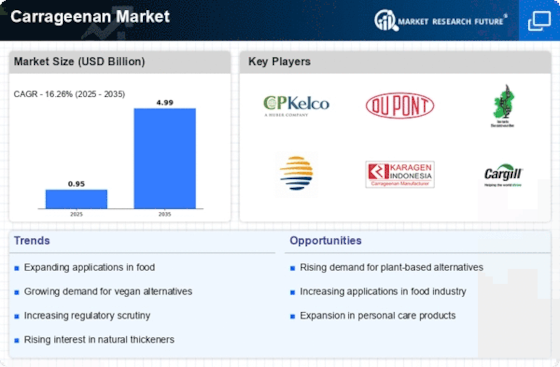
As per Market Research Future analysis, the Carrageenan Market Size was estimated at 0.952 USD Billion in 2024. The Carrageenan industry is projected to grow from 1.107 USD Billion in 2025 to 4.994 USD Billion by 2035, exhibiting a compound annual growth rate (CAGR) of 16.26% during the forecast period 2025 - 2035

Key Market Trends & Highlights

The Carrageenan Market is experiencing robust growth driven by evolving consumer preferences and technological advancements.

  • The demand for plant-based products is rising, significantly influencing the Carrageenan Market. North America remains the largest market, while Asia-Pacific is emerging as the fastest-growing region. In the food and beverages segment, Kappa carrageenan continues to dominate, whereas Iota is gaining traction in pharmaceuticals. Key market drivers include the increasing application in the food industry and regulatory support for natural ingredients.

Market Size & Forecast

2024 Market Size 0.952 (USD Billion)
2035 Market Size 4.994 (USD Billion)
CAGR (2025 - 2035) 16.26%
Largest Regional Market Share in 2024 North America

Major Players

CP Kelco (US), DuPont (US), Irish Seaweeds (IE), <a href="https://www.gelymar.com/products/">Gelymar</a> (CL), Karagen Indonesia (ID), Cargill (US), FMC Corporation (US), Meron Group (IL), Agarmex (MX)

Market Trends

The Carrageenan Market is currently experiencing a dynamic phase characterized by evolving consumer preferences and increasing applications across various industries. This natural thickening agent, derived from red seaweed, is gaining traction in food and beverage sectors due to its ability to enhance texture and stability. Additionally, the growing trend towards plant-based and clean-label products is propelling demand, as manufacturers seek alternatives to synthetic additives. The versatility of carrageenan in dairy, meat, and plant-based products suggests a robust future for this market. Moreover, the Carrageenan Market is witnessing a shift towards sustainable sourcing practices. As environmental concerns rise, stakeholders are increasingly focusing on responsible harvesting methods and eco-friendly production processes. This shift not only aligns with consumer expectations but also enhances brand reputation. Furthermore, innovations in extraction techniques and product formulations are likely to drive growth, as companies strive to meet the diverse needs of their clientele. Overall, the Carrageenan Market appears poised for continued expansion, driven by both consumer demand and industry advancements. Also, the carrageenan gum market is witnessing robust growth due to rising demand for plant-based and clean-label food products, as well as expanding applications in personal care and pharmaceuticals.

Rising Demand for Plant-Based Products

The Carrageenan Market is seeing a notable increase in demand for plant-based alternatives. As consumers become more health-conscious and environmentally aware, the shift towards vegan and vegetarian options is influencing product formulations. Carrageenan serves as a natural stabilizer and thickener, making it an ideal choice for plant-based dairy and meat substitutes.

Focus on Clean Labeling

There is a growing emphasis on clean labeling within the Carrageenan Market. Consumers are increasingly scrutinizing ingredient lists, preferring products that are free from artificial additives. This trend is prompting manufacturers to highlight the natural origins of carrageenan, thereby enhancing its appeal in a market that values transparency and simplicity.

Sustainability Initiatives

Sustainability is becoming a central theme in the Carrageenan Market. Companies are adopting eco-friendly practices, from responsible sourcing of seaweed to sustainable production methods. This focus on environmental stewardship not only meets consumer expectations but also positions brands favorably in a competitive landscape.

Carrageenan Market Market Drivers

Growth in the Cosmetics Sector

The carrageenan Market Industry is also witnessing growth due to its increasing use in the cosmetics and personal care sector. Carrageenan Market is valued for its emulsifying and stabilizing properties, making it a popular ingredient in lotions, creams, and other beauty products. The Carrageenan Market has shown a consistent upward trajectory, with projections indicating a compound annual growth rate of around 4% over the next few years. This growth is likely to drive demand for carrageenan, as manufacturers seek to formulate products that are both effective and appealing to consumers. The incorporation of carrageenan in cosmetic formulations not only enhances product performance but also aligns with the industry's shift towards natural and sustainable ingredients, thereby reinforcing its relevance in the Carrageenan Market Industry.

Rising Application in Food Industry

The Carrageenan Market Industry is experiencing a notable increase in demand due to its extensive application in the food sector. Carrageenan Market serves as a thickening and gelling agent, enhancing the texture and stability of various food products, including dairy, meat, and plant-based alternatives. The food industry is projected to account for a substantial share of the carrageenan market, with estimates suggesting a growth rate of approximately 5% annually. This trend is driven by consumer preferences for natural ingredients and clean-label products, which align with the properties of carrageenan. As manufacturers seek to improve product quality and meet evolving consumer expectations, the utilization of carrageenan is likely to expand, further solidifying its position within the Carrageenan Market Industry.

Regulatory Support for Natural Ingredients

The Carrageenan Market Industry benefits from increasing regulatory support for natural ingredients in food and cosmetics. Regulatory bodies are progressively endorsing the use of carrageenan as a safe and effective additive, which is likely to bolster consumer confidence and drive market growth. As regulations evolve to favor natural and clean-label products, manufacturers are more inclined to incorporate carrageenan into their formulations. This trend is particularly relevant in regions where consumers are becoming more health-conscious and demanding transparency in ingredient sourcing. The supportive regulatory environment may facilitate the expansion of the carrageenan market, as it aligns with the broader movement towards natural and sustainable ingredients in various industries.

Increasing Demand for Plant-Based Alternatives

The Carrageenan Market Industry is significantly influenced by the rising demand for plant-based food products. As consumers increasingly adopt vegetarian and vegan diets, the need for natural thickening agents in plant-based alternatives has surged. Carrageenan Market, derived from red seaweed, is particularly well-suited for this purpose, providing texture and stability to products such as dairy-free yogurts and meat substitutes. Market analysis indicates that the plant-based food sector is expected to grow at a rate of approximately 10% annually, which could substantially boost the demand for carrageenan. This trend reflects a broader shift towards healthier eating habits and sustainability, positioning carrageenan as a key ingredient in the evolving landscape of the Carrageenan Market Industry.

Technological Advancements in Extraction Processes

Technological advancements in the extraction and processing of carrageenan are poised to enhance its market potential. Innovations in extraction techniques, such as enzymatic and environmentally friendly methods, are likely to improve the yield and quality of carrageenan, making it more appealing to manufacturers. These advancements may also reduce production costs, thereby increasing the competitiveness of carrageenan in various applications. As the Carrageenan Market Industry continues to evolve, the adoption of these technologies could lead to a more efficient supply chain and greater availability of high-quality carrageenan products. This, in turn, may stimulate demand across multiple sectors, including food, cosmetics, and pharmaceuticals.

Market Segment Insights

By Type: Kappa (Largest) vs. Iota (Fastest-Growing)

<p>In the Carrageenan Market, the types are segmented primarily into Kappa, Iota, and Lambda. Kappa carrageenan currently holds the largest market share, attributed to its wide applications in the food and pharmaceutical sectors. It is known for its gelling properties which are critical in various food formulations. Iota carrageenan, while smaller in terms of market share compared to Kappa, is recognized as the fastest-growing segment due to its rising demand in dairy products and health foods, particularly for its emulsifying capabilities.</p>

<p>Kappa (Dominant) vs. Iota (Emerging)</p>

<p>Kappa carrageenan is characterized by its ability to form strong gels, making it essential in the production of various food products including dairy and meat alternatives. It has established itself as the dominant type in the Carrageenan Market due to its versatility and effectiveness in enhancing texture and stability. On the other hand, Iota carrageenan, known for its unique gel strength and elastic properties, is gaining traction in the industry. Its growth is driven by increasing consumer preference for natural and plant-based ingredients, positioning it as an emerging alternative, especially in the dairy and confectionery sectors.</p>

By Application: Food & Beverages (Largest) vs. Pharmaceuticals (Fastest-Growing)

<p>In the carrageenan market, the application sectors are distinctly divided among food & beverages, personal care, pharmaceuticals, and others. Food & beverages represent the largest application segment, capturing a significant portion of the market share due to the rising demand for natural and organic food products. This segment utilizes carrageenan as a thickening and gelling agent, enhancing texture and stability in various products, such as dairy, processed meat, and plant-based alternatives. On the other hand, the pharmaceuticals segment is emerging as the fastest-growing application, driven by increased research and development in drug formulation. Carrageenan's biocompatibility and natural origin make it an attractive excipient in pharmaceutical applications, particularly in controlled-release formulations and as a stabilizer in drug delivery systems. As health consciousness rises among consumers, the demand for natural alternatives in pharmaceuticals is expected to surge.</p>

<p>Food & Beverages (Dominant) vs. Pharmaceuticals (Emerging)</p>

<p>The food & beverages sector holds a dominant position in the carrageenan market. Its widespread application in food products, including dairy, plant-based alternatives, and processed foods, highlights the segment's integral role in improving texture and stability while appealing to health-conscious consumers. Companies are increasingly focusing on innovative food formulations to meet consumer demand for clean-label ingredients. Conversely, the pharmaceuticals sector is emerging rapidly. The growing interest in biopharmaceuticals and natural products has led to increased usage of carrageenan in drug formulations, especially in gels and emulsions. This shift is poised to enhance delivery efficacy and patient compliance, positioning pharmaceuticals as a critical area for future market expansion.</p>

Carrageenan Market Application Insights

The Carrageenan Market Analysis, based on application, includes Food &amp; beverages, Personal care, Pharmaceuticals, and Others. The food &amp; beverages hold the largest market value of 72.8% in 2022. Carrageenan Market is used in bakery, dairy, and meat products and beverages as it provides altering viscosity and texture that improves their sensory properties. It also has applications in pharmaceuticals as it acts as excipients, foaming agents, wetting, solubilizing, and stabilizing agents.

Get more detailed insights about Carrageenan Market Research Report - Forecast till 2035

Regional Insights

North America : Innovation and Demand Growth

North America is the largest market for carrageenan, holding approximately 40% of the global share, driven by increasing demand in the food and beverage sector, particularly in dairy and meat products. Regulatory support for natural ingredients and clean label trends are significant growth catalysts. The U.S. is the primary contributor, with Canada following as the second-largest market, accounting for around 15% of the share. The competitive landscape is dominated by key players such as CP Kelco, DuPont, and Cargill, which are investing in R&D to innovate carrageenan applications. The presence of established food manufacturers and a growing trend towards plant-based products further enhance market dynamics. The region's focus on sustainability and natural ingredients aligns with consumer preferences, ensuring continued growth in the carrageenan market share.

Europe : Regulatory Support and Innovation

Europe is a significant player in the carrageenan market, holding approximately 30% of the global share, with strong demand driven by the food industry, particularly in dairy and confectionery products. The region benefits from stringent regulations that favor natural additives, enhancing consumer trust. Germany and France are the largest markets, contributing around 10% and 8% respectively, with a growing trend towards organic and clean label products. The competitive landscape features key players like Irish Seaweeds and Gelymar, who are focusing on sustainable sourcing and innovative applications. The European market is characterized by a high level of research and development, with companies investing in new product formulations to meet evolving consumer preferences. The emphasis on health and wellness is driving the demand for carrageenan as a natural thickening agent.

Asia-Pacific : Emerging Markets and Growth Potential

Asia-Pacific is rapidly emerging as a key market for carrageenan, holding approximately 25% of the global share, with significant growth driven by increasing food production and consumption. Countries like China and Indonesia are leading the market, accounting for around 12% and 6% respectively. The rising demand for processed foods and the growing trend towards vegetarian and vegan diets are major growth drivers in the region. The competitive landscape is becoming increasingly dynamic, with local players like Karagen Indonesia gaining traction alongside global giants. The region's focus on food safety and quality standards is prompting investments in carrageenan production. Additionally, the growing awareness of health benefits associated with natural ingredients is further propelling market growth, making Asia-Pacific a vital area for future expansion in the carrageenan sector.

Middle East and Africa : Resource-Rich and Emerging Market

The Middle East and Africa region is gradually establishing itself in the carrageenan market, holding approximately 5% of the global share. The growth is primarily driven by increasing food processing activities and a rising demand for natural food additives. Countries like South Africa and Egypt are leading the market, with a growing interest in health-conscious food products. The region's diverse culinary traditions are also contributing to the demand for carrageenan in various applications. The competitive landscape is characterized by a mix of local and international players, with companies exploring sustainable sourcing of seaweed. The region's potential for growth is significant, as investments in food technology and processing capabilities are on the rise. The increasing focus on food safety and quality standards is expected to further enhance the market dynamics in the coming years.

Key Players and Competitive Insights

Leading market players are investing heavily in research and development in order to expand their product lines, which will help the Carrageenan Market, grow even more. Market participants are also undertaking a variety of strategic activities to expand their footprint, with important market developments including new product launches, contractual agreements, mergers and acquisitions, higher investments, and collaboration with other organizations. To expand and survive in a more competitive and rising market climate, carrageenan industry must offer cost-effective items.
Manufacturing locally to minimize operational costs is one of the key business tactics used by manufacturers in the Carrageenan industry to benefit clients and increase the market sector. In recent years, the market for Carrageenan Market has offered some of the most significant advantages to food & beverage and pharmaceutical industries.
Major players in the Carrageenan Market, including Ingredion Incorporated, TBK Manufacturing Corporation, PT Fortuna Cahaya Cemerlang, Cargill Incorporated, LTD, Danlink Ingredients, Caldic B.V., ACCEL Carrageenan Market Corporation, MCPI Corporation, Scalzo Food Industries, Marcel Trading Corporation, Soriano SA, Gelymar SA, Birmingham Biotech Ltd, Kerry Group, and others, are attempting to increase market demand by investing in research and development operations.
CP Kelco is a nature-based ingredient solutions company of 90 years working with food, beverage, consumer, and industrial product manufacturers globally. They focus on ingredient innovation and problem-solving to develop customized solutions that help their regional insights, meet manufacturers' goals and address consumer needs and preferences. Their key product line consists of gellan gum, pectin, xantham gum, carrageenan, diutan gum, fermentation-derived cellulose, refined locust bean gum, and microparticulate whey protein concentrate. In November 202, CP Kelco US launched a NUTRAVA citrus fiber, that will help in emulsion stabilization, suspension, viscosity, and in providing water holding capacity.
In May 2020, CP Kelco's Cebu was acquired by Marcel, which will help the company in dealing with four carrageenan plants.
The Cargill has helped farmers for more than 150 years to grow more and connect them to the border market. They are developing new products that provide consumers with their requirements, advancing nutrition, food safety, and sustainability. They collaborate with various key markets to innovate and manage risk to provide for the future globally. They have experience with new technologies and insights to be a trusted partner for food, agriculture, financial and industrial customers.
In July 2018, Cargill announced the extension of its seabird portfolio with the invention of the new Satiagel Carrageenan Market Extract, which is specially designed for texturing solutions for creamy dairy desserts.

Key Companies in the Carrageenan Market include

Industry Developments

On March 22, 2024, CP Kelco, who have recently expanded their production in a European plant, announced the increase of the output of carrageenan to match the growing demands of beverages and food industry. This advancement will assist CP Kelco serve developing markets of dairy substitutes, sauces and meat substitutes in which carrageenan is the most common gelling agent for thickening and stabilizing.

In January 2024, the FMC Corporation’s launch of a new product containing carrageenan and targeting almond and oat-based milks is expected to improve the result of such products by altering the way they feel and taste. Alvin M Rahm, a spokesperson of FMC Corporation emphasized this plant-based trend is a useful product to have in the portfolio given most consumers are looking for plant-based alternatives.

In December 2023, Genufood, an Indian company, launched a new range of ingredients for the health and wellness industry which are carrageenan based. These new ingredients are being promoted for gut health since they are known to have prebiotic effects, thereby fueling the interest in functional foods.

In November 2023, Ingredion disclosed a collaboration with a top rank European food maker to offer carrageenan-based solutions which enhance the preservation and quality of plant-based meat products. This collaboration is part of the plans of Ingredion in expanding its presence in the ever-emerging market of plant protein.

In October 2023, the Philippines, a major resource of carrageenan, had new guidelines on sustainability aimed at reducing the negative effects of carrageenan production. The undertaking comprises reducing the carbon emissions associated with the harvesting of seaweed the main raw material for production of carrageenan and the promotion of good farming practices within the industry.

In September 2023, a new carrageenan containing offerings have been launched by Du Pont nutrition and biosciences which target the cosmetic and personal care sector. This product is intended to improve the texture and stability of certain skin care products, highlighting the popularity of vegetable skin care products in the personal care market.

Future Outlook

Carrageenan Market Future Outlook

The Carrageenan Market Size is projected to grow at a 16.26% CAGR from 2025 to 2035, driven by increasing demand in food, pharmaceuticals, and cosmetics.

New opportunities lie in:

  • Expansion into plant-based food products
  • Development of innovative carrageenan blends for enhanced functionality
  • Strategic partnerships with health-focused brands for product diversification

By 2035, the Carrageenan Market is expected to achieve substantial growth and diversification.

Market Segmentation

Carrageenan Market Type Outlook

  • Kappa
  • Iota
  • Lambda

Carrageenan Market Application Outlook

  • Food & beverages
  • Personal care
  • Pharmaceuticals
  • Others

Report Scope

MARKET SIZE 2024 0.952(USD Billion)
MARKET SIZE 2025 1.107(USD Billion)
MARKET SIZE 2035 4.994(USD Billion)
COMPOUND ANNUAL GROWTH RATE (CAGR) 16.26% (2025 - 2035)
REPORT COVERAGE Revenue Forecast, Competitive Landscape, Growth Factors, and Trends
BASE YEAR 2024
Market Forecast Period 2025 - 2035
Historical Data 2019 - 2024
Market Forecast Units USD Billion
Key Companies Profiled CP Kelco (US), DuPont (US), Irish Seaweeds (IE), Gelymar (CL), Karagen Indonesia (ID), Cargill (US), FMC Corporation (US), Meron Group (IL), Agarmex (MX)
Segments Covered Type, Application, Region
Key Market Opportunities Growing demand for plant-based food products enhances opportunities in the Carrageenan Market.
Key Market Dynamics Rising demand for plant-based food products drives innovation and competition in the Carrageenan market.
Countries Covered North America, Europe, APAC, South America, MEA

FAQs

What is the current valuation of the Carrageenan Market as of 2024?

<p>The Carrageenan Market was valued at 0.952 USD Billion in 2024.</p>

What is the projected market valuation for Carrageenan by 2035?

The market is projected to reach 4.994 USD Billion by 2035.

What is the expected CAGR for the Carrageenan Market during the forecast period 2025 - 2035?

The expected CAGR for the Carrageenan Market during 2025 - 2035 is 16.26%.

Which companies are considered key players in the Carrageenan Market?

Key players in the Carrageenan Market include CP Kelco, DuPont, Irish Seaweeds, Gelymar, and Cargill.

What are the main types of carrageenan and their market valuations?

The main types of carrageenan include Kappa, Iota, and Lambda, with valuations of 2.497, 1.497, and 1.0 USD Billion respectively by 2035.

How does the food and beverages segment perform in the Carrageenan Market?

The food and beverages segment is projected to reach 2.497 USD Billion by 2035.

What is the market valuation for the personal care application of carrageenan?

The personal care application of carrageenan is expected to reach 0.95 USD Billion by 2035.

What is the projected valuation for the pharmaceuticals application of carrageenan?

The pharmaceuticals application is projected to reach 0.715 USD Billion by 2035.

What is the expected market performance for other applications of carrageenan?

Other applications of carrageenan are expected to reach 0.832 USD Billion by 2035.

How does the Carrageenan Market's growth compare across different applications?

The Carrageenan Market shows varied growth across applications, with food and beverages leading at 2.497 USD Billion by 2035.

  1. SECTION I: EXECUTIVE SUMMARY AND KEY HIGHLIGHTS
    1. | 1.1 EXECUTIVE SUMMARY
    2. | | 1.1.1 Market Overview
    3. | | 1.1.2 Key Findings
    4. | | 1.1.3 Market Segmentation
    5. | | 1.1.4 Competitive Landscape
    6. | | 1.1.5 Challenges and Opportunities
    7. | | 1.1.6 Future Outlook
  2. SECTION II: SCOPING, METHODOLOGY AND MARKET STRUCTURE
    1. | 2.1 MARKET INTRODUCTION
    2. | | 2.1.1 Definition
    3. | | 2.1.2 Scope of the study
    4. | | | 2.1.2.1 Research Objective
    5. | | | 2.1.2.2 Assumption
    6. | | | 2.1.2.3 Limitations
    7. | 2.2 RESEARCH METHODOLOGY
    8. | | 2.2.1 Overview
    9. | | 2.2.2 Data Mining
    10. | | 2.2.3 Secondary Research
    11. | | 2.2.4 Primary Research
    12. | | | 2.2.4.1 Primary Interviews and Information Gathering Process
    13. | | | 2.2.4.2 Breakdown of Primary Respondents
    14. | | 2.2.5 Forecasting Model
    15. | | 2.2.6 Market Size Estimation
    16. | | | 2.2.6.1 Bottom-Up Approach
    17. | | | 2.2.6.2 Top-Down Approach
    18. | | 2.2.7 Data Triangulation
    19. | | 2.2.8 Validation
  3. SECTION III: QUALITATIVE ANALYSIS
    1. | 3.1 MARKET DYNAMICS
    2. | | 3.1.1 Overview
    3. | | 3.1.2 Drivers
    4. | | 3.1.3 Restraints
    5. | | 3.1.4 Opportunities
    6. | 3.2 MARKET FACTOR ANALYSIS
    7. | | 3.2.1 Value chain Analysis
    8. | | 3.2.2 Porter's Five Forces Analysis
    9. | | | 3.2.2.1 Bargaining Power of Suppliers
    10. | | | 3.2.2.2 Bargaining Power of Buyers
    11. | | | 3.2.2.3 Threat of New Entrants
    12. | | | 3.2.2.4 Threat of Substitutes
    13. | | | 3.2.2.5 Intensity of Rivalry
    14. | | 3.2.3 COVID-19 Impact Analysis
    15. | | | 3.2.3.1 Market Impact Analysis
    16. | | | 3.2.3.2 Regional Impact
    17. | | | 3.2.3.3 Opportunity and Threat Analysis
  4. SECTION IV: QUANTITATIVE ANALYSIS
    1. | 4.1 Food, Beverages & Nutrition, BY Type (USD Billion)
    2. | | 4.1.1 Kappa
    3. | | 4.1.2 Iota
    4. | | 4.1.3 Lambda
    5. | 4.2 Food, Beverages & Nutrition, BY Application (USD Billion)
    6. | | 4.2.1 Food & beverages
    7. | | 4.2.2 Personal care
    8. | | 4.2.3 Pharmaceuticals
    9. | | 4.2.4 Others
    10. | 4.3 Food, Beverages & Nutrition, BY Region (USD Billion)
    11. | | 4.3.1 North America
    12. | | | 4.3.1.1 US
    13. | | | 4.3.1.2 Canada
    14. | | 4.3.2 Europe
    15. | | | 4.3.2.1 Germany
    16. | | | 4.3.2.2 UK
    17. | | | 4.3.2.3 France
    18. | | | 4.3.2.4 Russia
    19. | | | 4.3.2.5 Italy
    20. | | | 4.3.2.6 Spain
    21. | | | 4.3.2.7 Rest of Europe
    22. | | 4.3.3 APAC
    23. | | | 4.3.3.1 China
    24. | | | 4.3.3.2 India
    25. | | | 4.3.3.3 Japan
    26. | | | 4.3.3.4 South Korea
    27. | | | 4.3.3.5 Malaysia
    28. | | | 4.3.3.6 Thailand
    29. | | | 4.3.3.7 Indonesia
    30. | | | 4.3.3.8 Rest of APAC
    31. | | 4.3.4 South America
    32. | | | 4.3.4.1 Brazil
    33. | | | 4.3.4.2 Mexico
    34. | | | 4.3.4.3 Argentina
    35. | | | 4.3.4.4 Rest of South America
    36. | | 4.3.5 MEA
    37. | | | 4.3.5.1 GCC Countries
    38. | | | 4.3.5.2 South Africa
    39. | | | 4.3.5.3 Rest of MEA
  5. SECTION V: COMPETITIVE ANALYSIS
    1. | 5.1 Competitive Landscape
    2. | | 5.1.1 Overview
    3. | | 5.1.2 Competitive Analysis
    4. | | 5.1.3 Market share Analysis
    5. | | 5.1.4 Major Growth Strategy in the Food, Beverages & Nutrition
    6. | | 5.1.5 Competitive Benchmarking
    7. | | 5.1.6 Leading Players in Terms of Number of Developments in the Food, Beverages & Nutrition
    8. | | 5.1.7 Key developments and growth strategies
    9. | | | 5.1.7.1 New Product Launch/Service Deployment
    10. | | | 5.1.7.2 Merger & Acquisitions
    11. | | | 5.1.7.3 Joint Ventures
    12. | | 5.1.8 Major Players Financial Matrix
    13. | | | 5.1.8.1 Sales and Operating Income
    14. | | | 5.1.8.2 Major Players R&D Expenditure. 2023
    15. | 5.2 Company Profiles
    16. | | 5.2.1 CP Kelco (US)
    17. | | | 5.2.1.1 Financial Overview
    18. | | | 5.2.1.2 Products Offered
    19. | | | 5.2.1.3 Key Developments
    20. | | | 5.2.1.4 SWOT Analysis
    21. | | | 5.2.1.5 Key Strategies
    22. | | 5.2.2 DuPont (US)
    23. | | | 5.2.2.1 Financial Overview
    24. | | | 5.2.2.2 Products Offered
    25. | | | 5.2.2.3 Key Developments
    26. | | | 5.2.2.4 SWOT Analysis
    27. | | | 5.2.2.5 Key Strategies
    28. | | 5.2.3 Irish Seaweeds (IE)
    29. | | | 5.2.3.1 Financial Overview
    30. | | | 5.2.3.2 Products Offered
    31. | | | 5.2.3.3 Key Developments
    32. | | | 5.2.3.4 SWOT Analysis
    33. | | | 5.2.3.5 Key Strategies
    34. | | 5.2.4 Gelymar (CL)
    35. | | | 5.2.4.1 Financial Overview
    36. | | | 5.2.4.2 Products Offered
    37. | | | 5.2.4.3 Key Developments
    38. | | | 5.2.4.4 SWOT Analysis
    39. | | | 5.2.4.5 Key Strategies
    40. | | 5.2.5 Karagen Indonesia (ID)
    41. | | | 5.2.5.1 Financial Overview
    42. | | | 5.2.5.2 Products Offered
    43. | | | 5.2.5.3 Key Developments
    44. | | | 5.2.5.4 SWOT Analysis
    45. | | | 5.2.5.5 Key Strategies
    46. | | 5.2.6 Cargill (US)
    47. | | | 5.2.6.1 Financial Overview
    48. | | | 5.2.6.2 Products Offered
    49. | | | 5.2.6.3 Key Developments
    50. | | | 5.2.6.4 SWOT Analysis
    51. | | | 5.2.6.5 Key Strategies
    52. | | 5.2.7 FMC Corporation (US)
    53. | | | 5.2.7.1 Financial Overview
    54. | | | 5.2.7.2 Products Offered
    55. | | | 5.2.7.3 Key Developments
    56. | | | 5.2.7.4 SWOT Analysis
    57. | | | 5.2.7.5 Key Strategies
    58. | | 5.2.8 Meron Group (IL)
    59. | | | 5.2.8.1 Financial Overview
    60. | | | 5.2.8.2 Products Offered
    61. | | | 5.2.8.3 Key Developments
    62. | | | 5.2.8.4 SWOT Analysis
    63. | | | 5.2.8.5 Key Strategies
    64. | | 5.2.9 Agarmex (MX)
    65. | | | 5.2.9.1 Financial Overview
    66. | | | 5.2.9.2 Products Offered
    67. | | | 5.2.9.3 Key Developments
    68. | | | 5.2.9.4 SWOT Analysis
    69. | | | 5.2.9.5 Key Strategies
    70. | 5.3 Appendix
    71. | | 5.3.1 References
    72. | | 5.3.2 Related Reports
  6. LIST OF FIGURES
    1. | 6.1 MARKET SYNOPSIS
    2. | 6.2 NORTH AMERICA MARKET ANALYSIS
    3. | 6.3 US MARKET ANALYSIS BY TYPE
    4. | 6.4 US MARKET ANALYSIS BY APPLICATION
    5. | 6.5 CANADA MARKET ANALYSIS BY TYPE
    6. | 6.6 CANADA MARKET ANALYSIS BY APPLICATION
    7. | 6.7 EUROPE MARKET ANALYSIS
    8. | 6.8 GERMANY MARKET ANALYSIS BY TYPE
    9. | 6.9 GERMANY MARKET ANALYSIS BY APPLICATION
    10. | 6.10 UK MARKET ANALYSIS BY TYPE
    11. | 6.11 UK MARKET ANALYSIS BY APPLICATION
    12. | 6.12 FRANCE MARKET ANALYSIS BY TYPE
    13. | 6.13 FRANCE MARKET ANALYSIS BY APPLICATION
    14. | 6.14 RUSSIA MARKET ANALYSIS BY TYPE
    15. | 6.15 RUSSIA MARKET ANALYSIS BY APPLICATION
    16. | 6.16 ITALY MARKET ANALYSIS BY TYPE
    17. | 6.17 ITALY MARKET ANALYSIS BY APPLICATION
    18. | 6.18 SPAIN MARKET ANALYSIS BY TYPE
    19. | 6.19 SPAIN MARKET ANALYSIS BY APPLICATION
    20. | 6.20 REST OF EUROPE MARKET ANALYSIS BY TYPE
    21. | 6.21 REST OF EUROPE MARKET ANALYSIS BY APPLICATION
    22. | 6.22 APAC MARKET ANALYSIS
    23. | 6.23 CHINA MARKET ANALYSIS BY TYPE
    24. | 6.24 CHINA MARKET ANALYSIS BY APPLICATION
    25. | 6.25 INDIA MARKET ANALYSIS BY TYPE
    26. | 6.26 INDIA MARKET ANALYSIS BY APPLICATION
    27. | 6.27 JAPAN MARKET ANALYSIS BY TYPE
    28. | 6.28 JAPAN MARKET ANALYSIS BY APPLICATION
    29. | 6.29 SOUTH KOREA MARKET ANALYSIS BY TYPE
    30. | 6.30 SOUTH KOREA MARKET ANALYSIS BY APPLICATION
    31. | 6.31 MALAYSIA MARKET ANALYSIS BY TYPE
    32. | 6.32 MALAYSIA MARKET ANALYSIS BY APPLICATION
    33. | 6.33 THAILAND MARKET ANALYSIS BY TYPE
    34. | 6.34 THAILAND MARKET ANALYSIS BY APPLICATION
    35. | 6.35 INDONESIA MARKET ANALYSIS BY TYPE
    36. | 6.36 INDONESIA MARKET ANALYSIS BY APPLICATION
    37. | 6.37 REST OF APAC MARKET ANALYSIS BY TYPE
    38. | 6.38 REST OF APAC MARKET ANALYSIS BY APPLICATION
    39. | 6.39 SOUTH AMERICA MARKET ANALYSIS
    40. | 6.40 BRAZIL MARKET ANALYSIS BY TYPE
    41. | 6.41 BRAZIL MARKET ANALYSIS BY APPLICATION
    42. | 6.42 MEXICO MARKET ANALYSIS BY TYPE
    43. | 6.43 MEXICO MARKET ANALYSIS BY APPLICATION
    44. | 6.44 ARGENTINA MARKET ANALYSIS BY TYPE
    45. | 6.45 ARGENTINA MARKET ANALYSIS BY APPLICATION
    46. | 6.46 REST OF SOUTH AMERICA MARKET ANALYSIS BY TYPE
    47. | 6.47 REST OF SOUTH AMERICA MARKET ANALYSIS BY APPLICATION
    48. | 6.48 MEA MARKET ANALYSIS
    49. | 6.49 GCC COUNTRIES MARKET ANALYSIS BY TYPE
    50. | 6.50 GCC COUNTRIES MARKET ANALYSIS BY APPLICATION
    51. | 6.51 SOUTH AFRICA MARKET ANALYSIS BY TYPE
    52. | 6.52 SOUTH AFRICA MARKET ANALYSIS BY APPLICATION
    53. | 6.53 REST OF MEA MARKET ANALYSIS BY TYPE
    54. | 6.54 REST OF MEA MARKET ANALYSIS BY APPLICATION
    55. | 6.55 KEY BUYING CRITERIA OF FOOD, BEVERAGES & NUTRITION
    56. | 6.56 RESEARCH PROCESS OF MRFR
    57. | 6.57 DRO ANALYSIS OF FOOD, BEVERAGES & NUTRITION
    58. | 6.58 DRIVERS IMPACT ANALYSIS: FOOD, BEVERAGES & NUTRITION
    59. | 6.59 RESTRAINTS IMPACT ANALYSIS: FOOD, BEVERAGES & NUTRITION
    60. | 6.60 SUPPLY / VALUE CHAIN: FOOD, BEVERAGES & NUTRITION
    61. | 6.61 FOOD, BEVERAGES & NUTRITION, BY TYPE, 2024 (% SHARE)
    62. | 6.62 FOOD, BEVERAGES & NUTRITION, BY TYPE, 2024 TO 2035 (USD Billion)
    63. | 6.63 FOOD, BEVERAGES & NUTRITION, BY APPLICATION, 2024 (% SHARE)
    64. | 6.64 FOOD, BEVERAGES & NUTRITION, BY APPLICATION, 2024 TO 2035 (USD Billion)
    65. | 6.65 BENCHMARKING OF MAJOR COMPETITORS
  7. LIST OF TABLES
    1. | 7.1 LIST OF ASSUMPTIONS
    2. | | 7.1.1
    3. | 7.2 North America MARKET SIZE ESTIMATES; FORECAST
    4. | | 7.2.1 BY TYPE, 2025-2035 (USD Billion)
    5. | | 7.2.2 BY APPLICATION, 2025-2035 (USD Billion)
    6. | 7.3 US MARKET SIZE ESTIMATES; FORECAST
    7. | | 7.3.1 BY TYPE, 2025-2035 (USD Billion)
    8. | | 7.3.2 BY APPLICATION, 2025-2035 (USD Billion)
    9. | 7.4 Canada MARKET SIZE ESTIMATES; FORECAST
    10. | | 7.4.1 BY TYPE, 2025-2035 (USD Billion)
    11. | | 7.4.2 BY APPLICATION, 2025-2035 (USD Billion)
    12. | 7.5 Europe MARKET SIZE ESTIMATES; FORECAST
    13. | | 7.5.1 BY TYPE, 2025-2035 (USD Billion)
    14. | | 7.5.2 BY APPLICATION, 2025-2035 (USD Billion)
    15. | 7.6 Germany MARKET SIZE ESTIMATES; FORECAST
    16. | | 7.6.1 BY TYPE, 2025-2035 (USD Billion)
    17. | | 7.6.2 BY APPLICATION, 2025-2035 (USD Billion)
    18. | 7.7 UK MARKET SIZE ESTIMATES; FORECAST
    19. | | 7.7.1 BY TYPE, 2025-2035 (USD Billion)
    20. | | 7.7.2 BY APPLICATION, 2025-2035 (USD Billion)
    21. | 7.8 France MARKET SIZE ESTIMATES; FORECAST
    22. | | 7.8.1 BY TYPE, 2025-2035 (USD Billion)
    23. | | 7.8.2 BY APPLICATION, 2025-2035 (USD Billion)
    24. | 7.9 Russia MARKET SIZE ESTIMATES; FORECAST
    25. | | 7.9.1 BY TYPE, 2025-2035 (USD Billion)
    26. | | 7.9.2 BY APPLICATION, 2025-2035 (USD Billion)
    27. | 7.10 Italy MARKET SIZE ESTIMATES; FORECAST
    28. | | 7.10.1 BY TYPE, 2025-2035 (USD Billion)
    29. | | 7.10.2 BY APPLICATION, 2025-2035 (USD Billion)
    30. | 7.11 Spain MARKET SIZE ESTIMATES; FORECAST
    31. | | 7.11.1 BY TYPE, 2025-2035 (USD Billion)
    32. | | 7.11.2 BY APPLICATION, 2025-2035 (USD Billion)
    33. | 7.12 Rest of Europe MARKET SIZE ESTIMATES; FORECAST
    34. | | 7.12.1 BY TYPE, 2025-2035 (USD Billion)
    35. | | 7.12.2 BY APPLICATION, 2025-2035 (USD Billion)
    36. | 7.13 APAC MARKET SIZE ESTIMATES; FORECAST
    37. | | 7.13.1 BY TYPE, 2025-2035 (USD Billion)
    38. | | 7.13.2 BY APPLICATION, 2025-2035 (USD Billion)
    39. | 7.14 China MARKET SIZE ESTIMATES; FORECAST
    40. | | 7.14.1 BY TYPE, 2025-2035 (USD Billion)
    41. | | 7.14.2 BY APPLICATION, 2025-2035 (USD Billion)
    42. | 7.15 India MARKET SIZE ESTIMATES; FORECAST
    43. | | 7.15.1 BY TYPE, 2025-2035 (USD Billion)
    44. | | 7.15.2 BY APPLICATION, 2025-2035 (USD Billion)
    45. | 7.16 Japan MARKET SIZE ESTIMATES; FORECAST
    46. | | 7.16.1 BY TYPE, 2025-2035 (USD Billion)
    47. | | 7.16.2 BY APPLICATION, 2025-2035 (USD Billion)
    48. | 7.17 South Korea MARKET SIZE ESTIMATES; FORECAST
    49. | | 7.17.1 BY TYPE, 2025-2035 (USD Billion)
    50. | | 7.17.2 BY APPLICATION, 2025-2035 (USD Billion)
    51. | 7.18 Malaysia MARKET SIZE ESTIMATES; FORECAST
    52. | | 7.18.1 BY TYPE, 2025-2035 (USD Billion)
    53. | | 7.18.2 BY APPLICATION, 2025-2035 (USD Billion)
    54. | 7.19 Thailand MARKET SIZE ESTIMATES; FORECAST
    55. | | 7.19.1 BY TYPE, 2025-2035 (USD Billion)
    56. | | 7.19.2 BY APPLICATION, 2025-2035 (USD Billion)
    57. | 7.20 Indonesia MARKET SIZE ESTIMATES; FORECAST
    58. | | 7.20.1 BY TYPE, 2025-2035 (USD Billion)
    59. | | 7.20.2 BY APPLICATION, 2025-2035 (USD Billion)
    60. | 7.21 Rest of APAC MARKET SIZE ESTIMATES; FORECAST
    61. | | 7.21.1 BY TYPE, 2025-2035 (USD Billion)
    62. | | 7.21.2 BY APPLICATION, 2025-2035 (USD Billion)
    63. | 7.22 South America MARKET SIZE ESTIMATES; FORECAST
    64. | | 7.22.1 BY TYPE, 2025-2035 (USD Billion)
    65. | | 7.22.2 BY APPLICATION, 2025-2035 (USD Billion)
    66. | 7.23 Brazil MARKET SIZE ESTIMATES; FORECAST
    67. | | 7.23.1 BY TYPE, 2025-2035 (USD Billion)
    68. | | 7.23.2 BY APPLICATION, 2025-2035 (USD Billion)
    69. | 7.24 Mexico MARKET SIZE ESTIMATES; FORECAST
    70. | | 7.24.1 BY TYPE, 2025-2035 (USD Billion)
    71. | | 7.24.2 BY APPLICATION, 2025-2035 (USD Billion)
    72. | 7.25 Argentina MARKET SIZE ESTIMATES; FORECAST
    73. | | 7.25.1 BY TYPE, 2025-2035 (USD Billion)
    74. | | 7.25.2 BY APPLICATION, 2025-2035 (USD Billion)
    75. | 7.26 Rest of South America MARKET SIZE ESTIMATES; FORECAST
    76. | | 7.26.1 BY TYPE, 2025-2035 (USD Billion)
    77. | | 7.26.2 BY APPLICATION, 2025-2035 (USD Billion)
    78. | 7.27 MEA MARKET SIZE ESTIMATES; FORECAST
    79. | | 7.27.1 BY TYPE, 2025-2035 (USD Billion)
    80. | | 7.27.2 BY APPLICATION, 2025-2035 (USD Billion)
    81. | 7.28 GCC Countries MARKET SIZE ESTIMATES; FORECAST
    82. | | 7.28.1 BY TYPE, 2025-2035 (USD Billion)
    83. | | 7.28.2 BY APPLICATION, 2025-2035 (USD Billion)
    84. | 7.29 South Africa MARKET SIZE ESTIMATES; FORECAST
    85. | | 7.29.1 BY TYPE, 2025-2035 (USD Billion)
    86. | | 7.29.2 BY APPLICATION, 2025-2035 (USD Billion)
    87. | 7.30 Rest of MEA MARKET SIZE ESTIMATES; FORECAST
    88. | | 7.30.1 BY TYPE, 2025-2035 (USD Billion)
    89. | | 7.30.2 BY APPLICATION, 2025-2035 (USD Billion)
    90. | 7.31 PRODUCT LAUNCH/PRODUCT DEVELOPMENT/APPROVAL
    91. | | 7.31.1
    92. | 7.32 ACQUISITION/PARTNERSHIP
    93. | | 7.32.1

Food, Beverages & Nutrition Market Segmentation

Food, Beverages & Nutrition By Type (USD Billion, 2025-2035)

  • Kappa
  • Iota
  • Lambda

Food, Beverages & Nutrition By Application (USD Billion, 2025-2035)

  • Food & beverages
  • Personal care
  • Pharmaceuticals
  • Others
Infographic

Free Sample Request

Kindly complete the form below to receive a free sample of this Report

Get Free Sample

Customer Strories

Compare Licence

×
Features License Type
Single User Multiuser License Enterprise User
Price $4,950 $5,950 $7,250
Maximum User Access Limit 1 User Upto 10 Users Unrestricted Access Throughout the Organization
Free Customization
Direct Access to Analyst
Deliverable Format
Platform Access
Discount on Next Purchase 10% 15% 15%
Printable Versions