×
Request Free Sample ×

Kindly complete the form below to receive a free sample of this Report

* Please use a valid business email

Leading companies partner with us for data-driven Insights

clients tt-cursor
Hero Background
English
Chinese
French
Japanese
Korean
German
Spanish

CAR T Cell Therapy Market Size

ID: MRFR/HC/6630-CR
200 Pages
Rahul Gotadki
July 2025

CAR T Cell Therapy Market Research Report: Size, Share, Trend Analysis By Therapeutic Area (Oncology, Autoimmune Diseases, Infectious Diseases), By Cell Source (Autologous, Allogeneic, Gene-Edited), \By Product - Abecma (idecabtagene vicleucel), Breyanzi (lisocabtagene maraleucel), Breyanzi (lisocabtagene maraleucel), Kymriah (tisagenlecleucel), Tecartus (brexucabtagene autoleucel), Yescarta (axicabtagene ciloleucel), Other products), By Indication- (Leukemia, Lymphoma, Multiple Lymphoma, Other Indications), By Demographic - (Adults, Pediatrics), By End Use - (Hospitals, Cancer Treatment Centers, Specialty Clinics and Other End Users), and By Regional (North America, Europe, South America, Asia Pacific, Middle East and Africa) - Growth Outlook & Industry Forecast Till 2035

Share:
Download PDF ×

We do not share your information with anyone. However, we may send you emails based on your report interest from time to time. You may contact us at any time to opt-out.

CAR T Cell Therapy Market Infographic
Purchase Options

Car T Cell Therapy Size

CAR T Cell Therapy Market Growth Projections and Opportunities

Revolutionizing Cancer Treatment: A Deep Dive into CAR T Cell Therapy

In the realm of cancer treatment, Chimeric Antigen Receptor (CAR) T Cell Therapy stands as a beacon of hope, representing a groundbreaking immunotherapy. Let's delve into the intricacies of this therapy, its applications, and the factors propelling its growth on the global stage.

Understanding CAR T Cell Therapy: A Game-Changer in Cancer Treatment

CAR T Cell Therapy operates at the forefront of immunotherapy, offering a personalized approach to cancer treatment. The process involves isolating T cells from the patient's body and introducing the CAR gene. This genetic modification equips the T cells with a specific receptor that binds to a particular protein on the patient's cancer cells. This targeted approach enhances the body's ability to identify and eliminate cancer cells.

Driving Forces: Product Development and Clinical Studies

The market for CAR T Cell Therapy is set to soar, propelled by the surge in product development initiatives by various pharmaceutical and biotechnology companies. As these companies invest in creating innovative solutions for cancer treatment, the therapy's market share is anticipated to witness significant growth. The landscape is further enriched by a substantial increase in clinical studies within this domain. Researchers and healthcare professionals are exploring the potential of CAR T Cell Therapy across various cancer types, expanding its applications and refining its efficacy.

Global Prevalence of Cancer and FDA Approvals

The escalating prevalence of cancer worldwide is a pivotal factor bolstering the demand for advanced and effective treatment options. CAR T Cell Therapy, with its targeted and personalized approach, is emerging as a key player in the fight against cancer. The therapy's effectiveness is underscored by the growing number of approvals from the United States Food and Drug Administration (FDA) for cancer treatment therapies. These approvals validate the therapy's safety and efficacy, fostering increased adoption in clinical settings.

Market Dynamics: Growth Factors and Anticipated Expansion

The CAR T Cell Therapy market is poised for robust growth, fueled by a convergence of factors. The ongoing surge in product development efforts addresses the need for diverse and innovative solutions in cancer treatment. This commitment to innovation is reflected in the expanding scope of clinical studies, unraveling new possibilities for CAR T Cell Therapy applications.

The global landscape of cancer prevalence acts as a driving force, urging healthcare providers to explore and implement advanced treatment modalities. CAR T Cell Therapy, with its promise of personalized and targeted treatment, aligns seamlessly with this demand for more effective and tailored cancer therapies.

The string of FDA approvals further cements the therapy's standing in the market, instilling confidence in healthcare professionals and patients alike. As the therapy gains traction, its integration into standard cancer treatment protocols is becoming increasingly likely.

Challenges and Opportunities: Navigating the Future

While the prospects for CAR T Cell Therapy are bright, challenges persist. The intricate nature of genetic modifications and personalized treatments poses logistical and regulatory challenges. However, the industry's commitment to overcoming these obstacles, coupled with continuous advancements in gene editing technologies, signals a positive trajectory for CAR T Cell Therapy.

Opportunities abound in the evolving landscape of cancer treatment. The therapy's success stories, coupled with ongoing research and development, pave the way for a future where CAR T Cell Therapy becomes an integral part of the cancer treatment arsenal.

Conclusion: Paving the Way for Personalized Cancer Care

In conclusion, Chimeric Antigen Receptor (CAR) T Cell Therapy is not just a treatment; it represents a paradigm shift in the approach to cancer care. The convergence of product development, clinical studies, global cancer prevalence, and FDA approvals positions CAR T Cell Therapy as a transformative force in the field of oncology. As the therapy continues to evolve, it holds the promise of providing more patients with a personalized and targeted approach to cancer treatment, offering renewed hope and possibilities in the fight against this formidable disease.
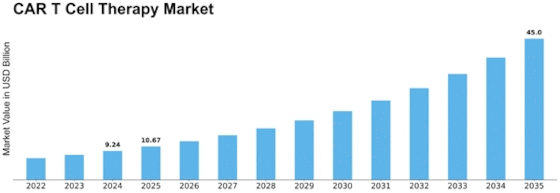
CAR T Cell Therapy Market Size Graph
Author
Rahul Gotadki
Research Manager

He holds an experience of about 9+ years in Market Research and Business Consulting, working under the spectrum of Life Sciences and Healthcare domains. Rahul conceptualizes and implements a scalable business strategy and provides strategic leadership to the clients. His expertise lies in market estimation, competitive intelligence, pipeline analysis, customer assessment, etc.

Leave a Comment

FAQs

What is the projected market valuation of the CAR T Cell Therapy Market by 2035?

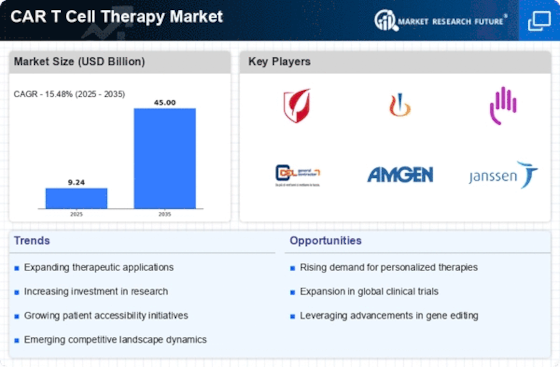
<p>The CAR T Cell Therapy Market is projected to reach a valuation of 45.0 USD Billion by 2035.</p>

What was the market valuation of CAR T Cell Therapy in 2024?

<p>In 2024, the CAR T Cell Therapy Market was valued at 9.238 USD Billion.</p>

What is the expected CAGR for the CAR T Cell Therapy Market from 2025 to 2035?

<p>The expected CAGR for the CAR T Cell Therapy Market during the forecast period 2025 - 2035 is 15.48%.</p>

Which therapeutic areas are expected to drive growth in the CAR T Cell Therapy Market?

<p>Oncology, Autoimmune Diseases, and Infectious Diseases are key therapeutic areas driving growth, with oncology projected to reach 25.0 USD Billion.</p>

Who are the key players in the CAR T Cell Therapy Market?

<p>Key players in the CAR T Cell Therapy Market include Gilead Sciences, Novartis, Bristol-Myers Squibb, and others.</p>

What are the projected valuations for different cell sources in the CAR T Cell Therapy Market?

<p>Autologous cell sources are projected to reach 25.0 USD Billion, while allogeneic sources may reach 15.0 USD Billion by 2035.</p>

Which indications are expected to dominate the CAR T Cell Therapy Market?

<p>Multiple Myeloma, Non-Hodgkin Lymphoma, and Acute Lymphoblastic Leukemia are expected to dominate, with Multiple Myeloma projected at 22.5 USD Billion.</p>

What is the expected market size for hospitals as end users of CAR T Cell Therapy?

<p>Hospitals are expected to account for a market size of 14.0 USD Billion as end users of CAR T Cell Therapy by 2035.</p>

How do research institutes contribute to the CAR T Cell Therapy Market?

<p>Research institutes are projected to contribute a market size of 11.0 USD Billion as end users by 2035.</p>

What is the anticipated market size for cancer treatment centers in the CAR T Cell Therapy Market?

<p>Cancer treatment centers are expected to reach a market size of 20.0 USD Billion by 2035.</p>

Market Summary

As per Market Research Future analysis, the CAR T Cell Therapy Market was estimated at 5.7 USD Billion in 2025. The CAR T Cell Therapy industry is projected to grow from 7.2 USD Billion in 2026 to 62.2 USD Billion by 2035, exhibiting a compound annual growth rate (CAGR) of 27.1% during the forecast period 2026 - 2035

Key Market Trends & Highlights

The CAR T Cell Therapy Market is poised for substantial growth driven by technological advancements and increasing investment in biotechnology.

  • North America remains the largest market for CAR T Cell Therapy Market, reflecting a robust healthcare infrastructure and high treatment adoption rates. The Asia-Pacific region is emerging as the fastest-growing market, fueled by increasing healthcare investments and a rising patient population. Oncology continues to dominate the CAR T Cell Therapy Market segment, while therapies for autoimmune diseases are experiencing rapid growth. Key market drivers include the rising incidence of cancer and advancements in research and development, which are propelling the market forward.

Market Size & Forecast

2025 Market Size 5.7 (USD Billion)
2035 Market Size 62.2 (USD Billion)
CAGR (2026 - 2035) 15.48%
Largest Regional Market Share in 2024 North America

Major Players

<a href="https://www.gilead.com/stories/experiencing-car-t-cell-therapy-and-empowering-others-through-peer-to-peer-support-chucks-story">Gilead Sciences</a> (US), Novartis (CH), <a href="https://www.bms.com/media/media-library/scientific-media-resources/targeting-cancer-with-cell-therapy.html">Bristol-Myers Squibb</a> (US), Celgene (US), Amgen (US), Janssen Pharmaceuticals (US), AbbVie (US), Sangamo Therapeutics (US), Celyad Oncology (BE)

Market Trends

The CAR T Cell Therapy Market is currently experiencing a transformative phase, characterized by rapid advancements in technology and an increasing understanding of the therapeutic potential of engineered T cells. This innovative approach to cancer treatment harnesses the body's immune system to target and eliminate malignant cells, leading to promising outcomes for patients with certain types of hematological malignancies. As research progresses, the market is likely to expand, driven by ongoing clinical trials and the introduction of new therapies from leading CAR T companies and CAR T cell therapy companies.. Regulatory bodies are also playing a crucial role in shaping the landscape, as they evaluate the safety and efficacy of these novel treatments. Moreover, the CAR T Cell Therapy Market is witnessing a surge in collaborations between CAR T cell companiesand academic institutions. These partnerships aim to enhance research capabilities and expedite the development of next-generation therapies. The growing prevalence of cancer and the demand for personalized medicine further fuel this market's growth. As stakeholders continue to invest in research and development, the CAR T Cell Therapy Market appears poised for significant evolution, potentially leading to broader applications beyond hematological cancers, including solid tumors.

Technological Advancements

The CAR T Cell Therapy Market is benefiting from continuous technological innovations that enhance the efficacy and safety of treatments. New methodologies in gene editing and cell engineering are emerging, which may lead to more effective therapies with fewer side effects These developments are being actively pursued by leading CAR T companies and CAR T cell therapy companies..

Collaborative Research Efforts

There is a noticeable trend of increased collaboration between pharmaceutical companies and research institutions. These partnerships are likely to accelerate the development of CAR T therapies, fostering innovation and expanding treatment options for patients.

Regulatory Developments

Regulatory agencies are actively shaping the CAR T Cell Therapy Market by establishing guidelines that ensure the safety and efficacy of new therapies. This regulatory framework may influence the pace of market growth and the introduction of novel treatments and contributing to an increase in the CAR T Cell Therapy Market Size..

CAR T Cell Therapy Market Market Drivers

Rising Incidence of Cancer

The increasing prevalence of various cancers is a primary driver for the CAR T Cell Therapy Market. As cancer cases rise, the demand for innovative treatment options intensifies. According to recent statistics, cancer is projected to affect millions annually, necessitating advanced therapies. CAR T cell therapy, known for its ability to target specific cancer cells, offers a promising solution. This therapy has shown remarkable efficacy in treating hematological malignancies, with response rates exceeding 80% in some cases. The growing patient population seeking effective treatments propels the CAR T Cell Therapy Market forward, as healthcare providers look for cutting-edge solutions to combat this escalating health crisis.

Growing Awareness and Acceptance

The growing awareness and acceptance of CAR T cell therapies among healthcare professionals and patients significantly impact the CAR T Cell Therapy Market. Educational initiatives and outreach programs have increased understanding of the benefits and potential of CAR T therapies. As more clinicians become familiar with these advanced treatments, the likelihood of their adoption in clinical practice rises. Additionally, patient advocacy groups play a vital role in promoting awareness, leading to increased demand for CAR T therapies. This heightened acceptance is likely to drive market growth, as more patients seek out these innovative options for their cancer treatment.

Regulatory Support and Approvals

Regulatory support plays a pivotal role in shaping the CAR T Cell Therapy Market. Regulatory agencies are increasingly recognizing the potential of CAR T therapies, expediting the approval process for new treatments. Recent approvals for several CAR T products have set a precedent, encouraging further development in this field. The streamlined regulatory pathways not only facilitate quicker access to therapies for patients but also instill confidence in investors and manufacturers. As more CAR T therapies gain regulatory approval, the market is expected to expand, providing patients with access to innovative treatment options that were previously unavailable.

Increasing Investment in Biotechnology

The surge in investment within the biotechnology sector is a crucial driver for the CAR T Cell Therapy Market. Venture capital and private equity funding have reached unprecedented levels, with billions directed towards companies specializing in CAR T cell therapies. This influx of capital facilitates the acceleration of clinical trials and the commercialization of new therapies. Furthermore, partnerships between biotech firms and academic institutions foster collaborative research, enhancing the development of innovative CAR T products. As financial backing continues to grow, the CAR T Cell Therapy Market is likely to witness rapid advancements, leading to a wider array of treatment options for patients.

Advancements in Research and Development

Ongoing advancements in research and development significantly influence the CAR T Cell Therapy Market. Continuous innovations in genetic engineering and cell processing technologies enhance the efficacy and safety profiles of CAR T therapies. Recent studies indicate that novel CAR constructs and combination therapies are being explored, potentially expanding the treatment landscape. The investment in R&D is substantial, with billions allocated to developing next-generation CAR T therapies. This focus on innovation not only improves patient outcomes but also attracts interest from pharmaceutical companies, thereby driving market growth. As new therapies emerge, the CAR T Cell Therapy Market is poised for expansion, catering to a broader range of malignancies.

Market Segment Insights

By Therapeutic Area: Oncology (Largest) vs. Autoimmune Diseases (Fastest-Growing)

The CAR T Cell Therapy Market is primarily dominated by the oncology segment, which commands a significant portion of the total market share. Within oncology, therapies targeting hematologic malignancies have gained robust acceptance, driven by high clinical efficacy and multiple FDA approvals. In contrast, the <a href="../../../reports/autoimmune-disease-treatment-market-5586">autoimmune diseases</a> segment, while currently smaller in total market share, is emerging rapidly as innovative CAR T therapies are developed to address conditions such as rheumatoid arthritis and lupus. This shift reflects the evolving landscape of CAR T therapy applications beyond traditional oncology.

Oncology: Dominant vs. Autoimmune Diseases: Emerging

Oncology remains the dominant therapeutic area for CAR T cell therapy, attributed to its established applications in the treatment of various blood cancers like lymphomas and leukemias. The success of products such as Kymriah and Yescarta has solidified oncology's leading position, showcasing superior patient outcomes and broader clinical use. Meanwhile, the autoimmune diseases segment is rapidly emerging, with research focusing on harnessing CAR T cell technology to modify immune responses. This area is characterized by innovative clinical trials and collaborations aiming to deliver groundbreaking therapies, indicating a strong potential for future market expansion as more treatments receive regulatory approval.

By Cell Source: Autologous (Largest) vs. Allogeneic (Fastest-Growing)

In the CAR T Cell Therapy Market, the cell source segment is primarily divided into three categories: Autologous, Allogeneic, and Gene-Edited. Autologous CAR T cell therapies hold the largest share, driven by their established presence and effective track records in treating hematologic malignancies. Meanwhile, Allogeneic therapies are rapidly gaining traction, noted for their potential to treat a broader patient population and reduce treatment times, making them appealing alternatives in the competitive landscape. The growth trends within this segment illustrate a two-fold path: while Autologous therapies continue to dominate due to their personalized approach, Allogeneic therapies are emerging as the fastest-growing segment, fueled by advancements in gene-editing technologies and the need for off-the-shelf solutions. This shift signifies a changing investor interest as they seek scalable options that can effectively meet the rising demand for CAR T cell therapies in oncology and beyond.

Autologous (Dominant) vs. Allogeneic (Emerging)

The Autologous CAR T cell therapy segment remains dominant in the market due to its personalized nature, where cells are harvested from the patient and modified before reinfusion. This method has proven effective in various cases of hematological cancers. Autologous therapies benefit from long-standing clinical data demonstrating their efficacy and safety. In contrast, the Allogeneic segment is rapidly emerging, differing by using cells from healthy donors, which enables the possibility of off-the-shelf treatments that can be administered immediately. This innovation not only caters to a larger patient demographic but also reduces the duration of treatment preparation, addressing a critical gap in the market. Both segments represent significant progress in cell therapy technologies, responding to the evolving needs of patients and clinicians.

By Indication: Acute Lymphoblastic Leukemia (Largest) vs. Non-Hodgkin Lymphoma (Fastest-Growing)

In the CAR T Cell Therapy Market, the indications for treatment are increasingly pivotal. Acute Lymphoblastic Leukemia (ALL) has established itself as the largest segment, holding the most significant market share due to its higher prevalence among patients requiring innovative therapies. Non-Hodgkin Lymphoma (NHL), while smaller in share, is rapidly gaining traction, reflecting a shift in therapeutic focus as healthcare professionals seek advanced and effective treatment options for this heterogeneous cancer group. The growth trends within this segment are driven largely by ongoing clinical trials and a surge in product approvals that cater to unmet medical needs. The market is embracing novel formulations and combination therapies aimed at improving efficacy and accessibility for patients with ALL and NHL. As research continues to unfold, new indications and treatment regimens are expected to enhance the therapeutic landscape, further driving market expansion.

Acute Lymphoblastic Leukemia (Dominant) vs. Non-Hodgkin Lymphoma (Emerging)

Acute Lymphoblastic Leukemia (ALL) remains the dominant indication in the CAR T Cell Therapy Market due to its substantial patient population and the critical need for innovative therapies. With established CAR T products showing high response rates, ALL has attracted significant research and investment. Conversely, Non-Hodgkin Lymphoma (NHL) is emerging rapidly, characterized by a diverse patient base and varying subtypes that present unique challenges and opportunities for tailored therapies. The ongoing development of CAR T therapies for NHL is fueled by promising clinical data and the expanding indication scope, which is anticipated to bolster market share as new products are introduced and adopted in clinical practice.

By End User: Hospitals (Largest) vs. Cancer Treatment Centers (Fastest-Growing)

In the CAR T Cell Therapy Market, hospitals hold the largest share among the end-user segment, primarily due to their established infrastructure and access to a broader patient demographic. They provide advanced healthcare services, facilitate quicker patient management, and are equipped with experts specializing in innovative therapies. In contrast, cancer treatment centers are emerging as a vital component, showing significant growth as they focus exclusively on oncological care, establishing a more concentrated approach to CAR T therapies.

End User: Hospitals (Dominant) vs. Cancer Treatment Centers (Emerging)

Hospitals are currently the dominant force in the CAR T Cell Therapy Market, benefiting from extensive healthcare networks and a high patient turnover. Their capability to adopt and implement CAR T therapies is enhanced by their access to cutting-edge facilities and specialized staff. On the other hand, cancer treatment centers emerge as a growing segment, positioned uniquely to cater specifically to cancer patients. These centers are rapidly expanding their CAR T Cell Therapy Market offerings, driven by increasing specialized training for healthcare professionals and focused patient care. Their reputation for personalized treatment fosters trust and ongoing patient referral, which is critical for market expansion.

Get more detailed insights about CAR T Cell Therapy Market Research Report - Global Forecast till 2035

Regional Insights

The CAR T Cell Therapy Market is exhibiting substantial growth across various regions, with North America capturing the majority holding at a valuation of 4.5 USD Billion in 2024 and projected to rise significantly to 22.5 USD Billion by 2035. This dominance can be attributed to advanced healthcare infrastructure and an increasing prevalence of hematological cancers.

Europe follows with a valuation of 2.5 USD Billion in 2024, expected to reach 10.5 USD billion by 2035, reflecting strong investments in Research and Development and the adoption of innovative therapies.In South America, the market is valued at 0.5 USD Billion in 2024, with a potential increase to 2.0 USD billion by 2035, indicating growing awareness and access to CAR T cell therapies. The Asia Pacific region holds a value of 1.5 USD Billion in 2024, projected to expand to 8.0 USD billion by 2035, driven by a rising population and improving healthcare facilities.

Lastly, the Middle East and Africa, starting at 0.24 USD billion in 2024 and potentially reaching 2.0 USD billion by 2035, reflect emerging opportunities and an increasing focus on cancer treatment solutions.Each of these regional markets presents unique growth drivers and challenges, positioning the CAR T Cell Therapy Market for significant advancements in the coming years.

Key Players and Competitive Insights

The CAR T Cell Therapy Market is witnessing significant growth driven by advancements in biotechnology and an increasing understanding of cancer immunotherapy. As a cellular therapy that modifies a patient's T cells to better recognize and attack cancer cells, CAR T cell therapy has become a key focus area for many pharmaceutical firms, leading to a highly competitive landscape. The market is characterized by rapid innovation, with companies striving to enhance the efficacy and safety profiles of their CAR T cell products while also competing to expand their market reach. Regulatory approvals, clinical trial outcomes, and strategic partnerships are critical factors influencing competitive dynamics. The presence of established players alongside emerging biotech companies creates both opportunities and challenges in this evolving market.Novartis is a prominent player in the CAR T Cell Therapy Market, known for its pioneering efforts in developing CAR T therapies. With its flagship product receiving robust market approval, Novartis has established a significant foothold in the CAR T space. The company leverages its extensive research and development capabilities to stay at the forefront of immunotherapy advancements, focusing on improving patient outcomes and expanding indications for existing products. Its strategic partnerships with academic institutions and other biotech firms bolster its innovation capabilities and enhance its market presence. Furthermore, Novartis benefits from a strong global brand reputation, a robust sales and distribution network, and a commitment to investing in next-generation therapies that position it well within the competitive dynamics of the CAR T cell therapy market.Regeneron Pharmaceuticals is also making notable strides in the CAR T Cell Therapy Market, driven by its strong commitment to leading-edge biopharmaceutical development. The company is focusing on expanding its pipeline and aims to introduce innovative CAR T therapies to address unmet medical needs. Regeneron has been actively involved in collaborations with other biotech firms and institutions to enhance its research capabilities and accelerate the development of CAR T cell therapies. The company is well-regarded for its solid fiscal foundation and infrastructure that supports extensive research operations. Key products in its emerging portfolio are poised to compete aggressively in the market. Additionally, Regeneron's strategic mergers and acquisitions have strengthened its position, allowing it to leverage synergies in product development and expand its technological capabilities in CAR T cell therapy, reinforcing its standing on a global scale.

Key Companies in the CAR T Cell Therapy Market include

Industry Developments

Several pharma companies announced late-stage pipeline progress in 2025, including next-generation CAR T therapies targeting solid tumors, marking a major shift beyond hematological cancers.

The Global CAR T-Cell Therapy Market is witnessing significant advancements, driven by continued regulatory progress and promising clinical trial outcomes. In October 2023, Gilead Sciences, through its Kite Pharma division, released encouraging data from its ongoing trials of Yescarta and Tecartus, indicating improved patient responses in relapsed lymphoma cases. Novartis has continued to expand the application of Kymriah, its FDA-approved CAR T therapy, by conducting trials in broader hematologic indications.

In September 2023, Bristol Myers Squibb reported positive results from a pivotal Phase III study of Abecma in multiple myeloma patients, reinforcing its strong position in the CAR T landscape. Additionally, Regeneron Pharmaceuticals has been investing in early-stage CAR T programs targeting solid tumors, signaling a broader industry push beyond hematologic cancers.

The market remains highly dynamic, with increased investment in R&D from companies such as Amgen, Roche, and Bristol Myers Squibb, reflecting the growing global demand for personalized cancer treatments. Strategic partnerships, regulatory approvals, and pipeline expansion are expected to shape the future of this high-growth sector.

Future Outlook

CAR T Cell Therapy Market Future Outlook

The CAR T Cell Therapy Market is projected to grow at a 27.1% CAGR from 2026 to 2035, driven by technological advancements, increasing cancer prevalence, and expanding clinical applications.

New opportunities lie in:

  • <p>Development of personalized CAR T therapies for niche cancer types. Expansion of manufacturing capabilities to reduce production costs. Strategic partnerships with healthcare providers for integrated treatment solutions.</p>

By 2035, the CAR T Cell Therapy Market is expected to achieve substantial growth and innovation.

Market Segmentation

CAR T Cell Therapy Market End User Outlook

  • Hospitals
  • Research Institutes
  • Cancer Treatment Centers

CAR T Cell Therapy Market Indication Outlook

  • Acute Lymphoblastic Leukemia
  • Non-Hodgkin Lymphoma
  • Multiple Myeloma

CAR T Cell Therapy Market Cell Source Outlook

  • Autologous
  • Allogeneic
  • Gene-Edited

CAR T Cell Therapy Market Therapeutic Area Outlook

  • Oncology
  • Autoimmune Diseases
  • Infectious Diseases

Report Scope

MARKET SIZE 2025 5.7(USD Billion)
MARKET SIZE 2026 7.2(USD Billion)
MARKET SIZE 2035 62.2(USD Billion)
COMPOUND ANNUAL GROWTH RATE (CAGR) 27.1% (2026 - 2035)
REPORT COVERAGE Revenue Forecast, Competitive Landscape, Growth Factors, and Trends
BASE YEAR 2025
Market Forecast Period 2026 - 2035
Historical Data 2019 - 2024
Market Forecast Units USD Billion
Key Companies Profiled Gilead Sciences (US), Novartis (CH), Bristol-Myers Squibb (US), Celgene (US), Amgen (US), Janssen Pharmaceuticals (US), AbbVie (US), Sangamo Therapeutics (US), Celyad Oncology (BE)
Segments Covered Therapeutic Area, Cell Source, Indication, End Users, Regional
Key Market Opportunities Advancements in personalized medicine enhance efficacy and expand applications in the CAR T Cell Therapy Market.
Key Market Dynamics Rising demand for personalized medicine drives innovation and competition in the CAR T Cell Therapy market.
Countries Covered North America, Europe, APAC, South America, MEA

FAQs

What is the projected market valuation of the CAR T Cell Therapy Market by 2035?

<p>The CAR T Cell Therapy Market is projected to reach a valuation of 45.0 USD Billion by 2035.</p>

What was the market valuation of CAR T Cell Therapy in 2024?

<p>In 2024, the CAR T Cell Therapy Market was valued at 9.238 USD Billion.</p>

What is the expected CAGR for the CAR T Cell Therapy Market from 2025 to 2035?

<p>The expected CAGR for the CAR T Cell Therapy Market during the forecast period 2025 - 2035 is 15.48%.</p>

Which therapeutic areas are expected to drive growth in the CAR T Cell Therapy Market?

<p>Oncology, Autoimmune Diseases, and Infectious Diseases are key therapeutic areas driving growth, with oncology projected to reach 25.0 USD Billion.</p>

Who are the key players in the CAR T Cell Therapy Market?

<p>Key players in the CAR T Cell Therapy Market include Gilead Sciences, Novartis, Bristol-Myers Squibb, and others.</p>

What are the projected valuations for different cell sources in the CAR T Cell Therapy Market?

<p>Autologous cell sources are projected to reach 25.0 USD Billion, while allogeneic sources may reach 15.0 USD Billion by 2035.</p>

Which indications are expected to dominate the CAR T Cell Therapy Market?

<p>Multiple Myeloma, Non-Hodgkin Lymphoma, and Acute Lymphoblastic Leukemia are expected to dominate, with Multiple Myeloma projected at 22.5 USD Billion.</p>

What is the expected market size for hospitals as end users of CAR T Cell Therapy?

<p>Hospitals are expected to account for a market size of 14.0 USD Billion as end users of CAR T Cell Therapy by 2035.</p>

How do research institutes contribute to the CAR T Cell Therapy Market?

<p>Research institutes are projected to contribute a market size of 11.0 USD Billion as end users by 2035.</p>

What is the anticipated market size for cancer treatment centers in the CAR T Cell Therapy Market?

<p>Cancer treatment centers are expected to reach a market size of 20.0 USD Billion by 2035.</p>

  1. SECTION I: EXECUTIVE SUMMARY AND KEY HIGHLIGHTS
    1. | 1.1 EXECUTIVE SUMMARY
    2. | | 1.1.1 Market Overview
    3. | | 1.1.2 Key Findings
    4. | | 1.1.3 Market Segmentation
    5. | | 1.1.4 Competitive Landscape
    6. | | 1.1.5 Challenges and Opportunities
    7. | | 1.1.6 Future Outlook
  2. SECTION II: SCOPING, METHODOLOGY AND MARKET STRUCTURE
    1. | 2.1 MARKET INTRODUCTION
    2. | | 2.1.1 Definition
    3. | | 2.1.2 Scope of the study
    4. | | | 2.1.2.1 Research Objective
    5. | | | 2.1.2.2 Assumption
    6. | | | 2.1.2.3 Limitations
    7. | 2.2 RESEARCH METHODOLOGY
    8. | | 2.2.1 Overview
    9. | | 2.2.2 Data Mining
    10. | | 2.2.3 Secondary Research
    11. | | 2.2.4 Primary Research
    12. | | | 2.2.4.1 Primary Interviews and Information Gathering Process
    13. | | | 2.2.4.2 Breakdown of Primary Respondents
    14. | | 2.2.5 Forecasting Model
    15. | | 2.2.6 Market Size Estimation
    16. | | | 2.2.6.1 Bottom-Up Approach
    17. | | | 2.2.6.2 Top-Down Approach
    18. | | 2.2.7 Data Triangulation
    19. | | 2.2.8 Validation
  3. SECTION III: QUALITATIVE ANALYSIS
    1. | 3.1 MARKET DYNAMICS
    2. | | 3.1.1 Overview
    3. | | 3.1.2 Drivers
    4. | | 3.1.3 Restraints
    5. | | 3.1.4 Opportunities
    6. | 3.2 MARKET FACTOR ANALYSIS
    7. | | 3.2.1 Value chain Analysis
    8. | | 3.2.2 Porter's Five Forces Analysis
    9. | | | 3.2.2.1 Bargaining Power of Suppliers
    10. | | | 3.2.2.2 Bargaining Power of Buyers
    11. | | | 3.2.2.3 Threat of New Entrants
    12. | | | 3.2.2.4 Threat of Substitutes
    13. | | | 3.2.2.5 Intensity of Rivalry
    14. | | 3.2.3 COVID-19 Impact Analysis
    15. | | | 3.2.3.1 Market Impact Analysis
    16. | | | 3.2.3.2 Regional Impact
    17. | | | 3.2.3.3 Opportunity and Threat Analysis
  4. SECTION IV: QUANTITATIVE ANALYSIS
    1. | 4.1 Healthcare, BY Therapeutic Area (USD Billion)
    2. | | 4.1.1 Oncology
    3. | | 4.1.2 Autoimmune Diseases
    4. | | 4.1.3 Infectious Diseases
    5. | 4.2 Healthcare, BY Cell Source (USD Billion)
    6. | | 4.2.1 Autologous
    7. | | 4.2.2 Allogeneic
    8. | | 4.2.3 Gene-Edited
    9. | 4.3 Healthcare, BY Indication (USD Billion)
    10. | | 4.3.1 Acute Lymphoblastic Leukemia
    11. | | 4.3.2 Non-Hodgkin Lymphoma
    12. | | 4.3.3 Multiple Myeloma
    13. | 4.4 Healthcare, BY End User (USD Billion)
    14. | | 4.4.1 Hospitals
    15. | | 4.4.2 Research Institutes
    16. | | 4.4.3 Cancer Treatment Centers
    17. | 4.5 Healthcare, BY Region (USD Billion)
    18. | | 4.5.1 North America
    19. | | | 4.5.1.1 US
    20. | | | 4.5.1.2 Canada
    21. | | 4.5.2 Europe
    22. | | | 4.5.2.1 Germany
    23. | | | 4.5.2.2 UK
    24. | | | 4.5.2.3 France
    25. | | | 4.5.2.4 Russia
    26. | | | 4.5.2.5 Italy
    27. | | | 4.5.2.6 Spain
    28. | | | 4.5.2.7 Rest of Europe
    29. | | 4.5.3 APAC
    30. | | | 4.5.3.1 China
    31. | | | 4.5.3.2 India
    32. | | | 4.5.3.3 Japan
    33. | | | 4.5.3.4 South Korea
    34. | | | 4.5.3.5 Malaysia
    35. | | | 4.5.3.6 Thailand
    36. | | | 4.5.3.7 Indonesia
    37. | | | 4.5.3.8 Rest of APAC
    38. | | 4.5.4 South America
    39. | | | 4.5.4.1 Brazil
    40. | | | 4.5.4.2 Mexico
    41. | | | 4.5.4.3 Argentina
    42. | | | 4.5.4.4 Rest of South America
    43. | | 4.5.5 MEA
    44. | | | 4.5.5.1 GCC Countries
    45. | | | 4.5.5.2 South Africa
    46. | | | 4.5.5.3 Rest of MEA
  5. SECTION V: COMPETITIVE ANALYSIS
    1. | 5.1 Competitive Landscape
    2. | | 5.1.1 Overview
    3. | | 5.1.2 Competitive Analysis
    4. | | 5.1.3 Market share Analysis
    5. | | 5.1.4 Major Growth Strategy in the Healthcare
    6. | | 5.1.5 Competitive Benchmarking
    7. | | 5.1.6 Leading Players in Terms of Number of Developments in the Healthcare
    8. | | 5.1.7 Key developments and growth strategies
    9. | | | 5.1.7.1 New Product Launch/Service Deployment
    10. | | | 5.1.7.2 Merger & Acquisitions
    11. | | | 5.1.7.3 Joint Ventures
    12. | | 5.1.8 Major Players Financial Matrix
    13. | | | 5.1.8.1 Sales and Operating Income
    14. | | | 5.1.8.2 Major Players R&D Expenditure. 2023
    15. | 5.2 Company Profiles
    16. | | 5.2.1 Gilead Sciences (US)
    17. | | | 5.2.1.1 Financial Overview
    18. | | | 5.2.1.2 Products Offered
    19. | | | 5.2.1.3 Key Developments
    20. | | | 5.2.1.4 SWOT Analysis
    21. | | | 5.2.1.5 Key Strategies
    22. | | 5.2.2 Novartis (CH)
    23. | | | 5.2.2.1 Financial Overview
    24. | | | 5.2.2.2 Products Offered
    25. | | | 5.2.2.3 Key Developments
    26. | | | 5.2.2.4 SWOT Analysis
    27. | | | 5.2.2.5 Key Strategies
    28. | | 5.2.3 Bristol-Myers Squibb (US)
    29. | | | 5.2.3.1 Financial Overview
    30. | | | 5.2.3.2 Products Offered
    31. | | | 5.2.3.3 Key Developments
    32. | | | 5.2.3.4 SWOT Analysis
    33. | | | 5.2.3.5 Key Strategies
    34. | | 5.2.4 Celgene (US)
    35. | | | 5.2.4.1 Financial Overview
    36. | | | 5.2.4.2 Products Offered
    37. | | | 5.2.4.3 Key Developments
    38. | | | 5.2.4.4 SWOT Analysis
    39. | | | 5.2.4.5 Key Strategies
    40. | | 5.2.5 Amgen (US)
    41. | | | 5.2.5.1 Financial Overview
    42. | | | 5.2.5.2 Products Offered
    43. | | | 5.2.5.3 Key Developments
    44. | | | 5.2.5.4 SWOT Analysis
    45. | | | 5.2.5.5 Key Strategies
    46. | | 5.2.6 Janssen Pharmaceuticals (US)
    47. | | | 5.2.6.1 Financial Overview
    48. | | | 5.2.6.2 Products Offered
    49. | | | 5.2.6.3 Key Developments
    50. | | | 5.2.6.4 SWOT Analysis
    51. | | | 5.2.6.5 Key Strategies
    52. | | 5.2.7 AbbVie (US)
    53. | | | 5.2.7.1 Financial Overview
    54. | | | 5.2.7.2 Products Offered
    55. | | | 5.2.7.3 Key Developments
    56. | | | 5.2.7.4 SWOT Analysis
    57. | | | 5.2.7.5 Key Strategies
    58. | | 5.2.8 Sangamo Therapeutics (US)
    59. | | | 5.2.8.1 Financial Overview
    60. | | | 5.2.8.2 Products Offered
    61. | | | 5.2.8.3 Key Developments
    62. | | | 5.2.8.4 SWOT Analysis
    63. | | | 5.2.8.5 Key Strategies
    64. | | 5.2.9 Celyad Oncology (BE)
    65. | | | 5.2.9.1 Financial Overview
    66. | | | 5.2.9.2 Products Offered
    67. | | | 5.2.9.3 Key Developments
    68. | | | 5.2.9.4 SWOT Analysis
    69. | | | 5.2.9.5 Key Strategies
    70. | 5.3 Appendix
    71. | | 5.3.1 References
    72. | | 5.3.2 Related Reports
  6. LIST OF FIGURES
    1. | 6.1 MARKET SYNOPSIS
    2. | 6.2 NORTH AMERICA MARKET ANALYSIS
    3. | 6.3 US MARKET ANALYSIS BY THERAPEUTIC AREA
    4. | 6.4 US MARKET ANALYSIS BY CELL SOURCE
    5. | 6.5 US MARKET ANALYSIS BY INDICATION
    6. | 6.6 US MARKET ANALYSIS BY END USER
    7. | 6.7 CANADA MARKET ANALYSIS BY THERAPEUTIC AREA
    8. | 6.8 CANADA MARKET ANALYSIS BY CELL SOURCE
    9. | 6.9 CANADA MARKET ANALYSIS BY INDICATION
    10. | 6.10 CANADA MARKET ANALYSIS BY END USER
    11. | 6.11 EUROPE MARKET ANALYSIS
    12. | 6.12 GERMANY MARKET ANALYSIS BY THERAPEUTIC AREA
    13. | 6.13 GERMANY MARKET ANALYSIS BY CELL SOURCE
    14. | 6.14 GERMANY MARKET ANALYSIS BY INDICATION
    15. | 6.15 GERMANY MARKET ANALYSIS BY END USER
    16. | 6.16 UK MARKET ANALYSIS BY THERAPEUTIC AREA
    17. | 6.17 UK MARKET ANALYSIS BY CELL SOURCE
    18. | 6.18 UK MARKET ANALYSIS BY INDICATION
    19. | 6.19 UK MARKET ANALYSIS BY END USER
    20. | 6.20 FRANCE MARKET ANALYSIS BY THERAPEUTIC AREA
    21. | 6.21 FRANCE MARKET ANALYSIS BY CELL SOURCE
    22. | 6.22 FRANCE MARKET ANALYSIS BY INDICATION
    23. | 6.23 FRANCE MARKET ANALYSIS BY END USER
    24. | 6.24 RUSSIA MARKET ANALYSIS BY THERAPEUTIC AREA
    25. | 6.25 RUSSIA MARKET ANALYSIS BY CELL SOURCE
    26. | 6.26 RUSSIA MARKET ANALYSIS BY INDICATION
    27. | 6.27 RUSSIA MARKET ANALYSIS BY END USER
    28. | 6.28 ITALY MARKET ANALYSIS BY THERAPEUTIC AREA
    29. | 6.29 ITALY MARKET ANALYSIS BY CELL SOURCE
    30. | 6.30 ITALY MARKET ANALYSIS BY INDICATION
    31. | 6.31 ITALY MARKET ANALYSIS BY END USER
    32. | 6.32 SPAIN MARKET ANALYSIS BY THERAPEUTIC AREA
    33. | 6.33 SPAIN MARKET ANALYSIS BY CELL SOURCE
    34. | 6.34 SPAIN MARKET ANALYSIS BY INDICATION
    35. | 6.35 SPAIN MARKET ANALYSIS BY END USER
    36. | 6.36 REST OF EUROPE MARKET ANALYSIS BY THERAPEUTIC AREA
    37. | 6.37 REST OF EUROPE MARKET ANALYSIS BY CELL SOURCE
    38. | 6.38 REST OF EUROPE MARKET ANALYSIS BY INDICATION
    39. | 6.39 REST OF EUROPE MARKET ANALYSIS BY END USER
    40. | 6.40 APAC MARKET ANALYSIS
    41. | 6.41 CHINA MARKET ANALYSIS BY THERAPEUTIC AREA
    42. | 6.42 CHINA MARKET ANALYSIS BY CELL SOURCE
    43. | 6.43 CHINA MARKET ANALYSIS BY INDICATION
    44. | 6.44 CHINA MARKET ANALYSIS BY END USER
    45. | 6.45 INDIA MARKET ANALYSIS BY THERAPEUTIC AREA
    46. | 6.46 INDIA MARKET ANALYSIS BY CELL SOURCE
    47. | 6.47 INDIA MARKET ANALYSIS BY INDICATION
    48. | 6.48 INDIA MARKET ANALYSIS BY END USER
    49. | 6.49 JAPAN MARKET ANALYSIS BY THERAPEUTIC AREA
    50. | 6.50 JAPAN MARKET ANALYSIS BY CELL SOURCE
    51. | 6.51 JAPAN MARKET ANALYSIS BY INDICATION
    52. | 6.52 JAPAN MARKET ANALYSIS BY END USER
    53. | 6.53 SOUTH KOREA MARKET ANALYSIS BY THERAPEUTIC AREA
    54. | 6.54 SOUTH KOREA MARKET ANALYSIS BY CELL SOURCE
    55. | 6.55 SOUTH KOREA MARKET ANALYSIS BY INDICATION
    56. | 6.56 SOUTH KOREA MARKET ANALYSIS BY END USER
    57. | 6.57 MALAYSIA MARKET ANALYSIS BY THERAPEUTIC AREA
    58. | 6.58 MALAYSIA MARKET ANALYSIS BY CELL SOURCE
    59. | 6.59 MALAYSIA MARKET ANALYSIS BY INDICATION
    60. | 6.60 MALAYSIA MARKET ANALYSIS BY END USER
    61. | 6.61 THAILAND MARKET ANALYSIS BY THERAPEUTIC AREA
    62. | 6.62 THAILAND MARKET ANALYSIS BY CELL SOURCE
    63. | 6.63 THAILAND MARKET ANALYSIS BY INDICATION
    64. | 6.64 THAILAND MARKET ANALYSIS BY END USER
    65. | 6.65 INDONESIA MARKET ANALYSIS BY THERAPEUTIC AREA
    66. | 6.66 INDONESIA MARKET ANALYSIS BY CELL SOURCE
    67. | 6.67 INDONESIA MARKET ANALYSIS BY INDICATION
    68. | 6.68 INDONESIA MARKET ANALYSIS BY END USER
    69. | 6.69 REST OF APAC MARKET ANALYSIS BY THERAPEUTIC AREA
    70. | 6.70 REST OF APAC MARKET ANALYSIS BY CELL SOURCE
    71. | 6.71 REST OF APAC MARKET ANALYSIS BY INDICATION
    72. | 6.72 REST OF APAC MARKET ANALYSIS BY END USER
    73. | 6.73 SOUTH AMERICA MARKET ANALYSIS
    74. | 6.74 BRAZIL MARKET ANALYSIS BY THERAPEUTIC AREA
    75. | 6.75 BRAZIL MARKET ANALYSIS BY CELL SOURCE
    76. | 6.76 BRAZIL MARKET ANALYSIS BY INDICATION
    77. | 6.77 BRAZIL MARKET ANALYSIS BY END USER
    78. | 6.78 MEXICO MARKET ANALYSIS BY THERAPEUTIC AREA
    79. | 6.79 MEXICO MARKET ANALYSIS BY CELL SOURCE
    80. | 6.80 MEXICO MARKET ANALYSIS BY INDICATION
    81. | 6.81 MEXICO MARKET ANALYSIS BY END USER
    82. | 6.82 ARGENTINA MARKET ANALYSIS BY THERAPEUTIC AREA
    83. | 6.83 ARGENTINA MARKET ANALYSIS BY CELL SOURCE
    84. | 6.84 ARGENTINA MARKET ANALYSIS BY INDICATION
    85. | 6.85 ARGENTINA MARKET ANALYSIS BY END USER
    86. | 6.86 REST OF SOUTH AMERICA MARKET ANALYSIS BY THERAPEUTIC AREA
    87. | 6.87 REST OF SOUTH AMERICA MARKET ANALYSIS BY CELL SOURCE
    88. | 6.88 REST OF SOUTH AMERICA MARKET ANALYSIS BY INDICATION
    89. | 6.89 REST OF SOUTH AMERICA MARKET ANALYSIS BY END USER
    90. | 6.90 MEA MARKET ANALYSIS
    91. | 6.91 GCC COUNTRIES MARKET ANALYSIS BY THERAPEUTIC AREA
    92. | 6.92 GCC COUNTRIES MARKET ANALYSIS BY CELL SOURCE
    93. | 6.93 GCC COUNTRIES MARKET ANALYSIS BY INDICATION
    94. | 6.94 GCC COUNTRIES MARKET ANALYSIS BY END USER
    95. | 6.95 SOUTH AFRICA MARKET ANALYSIS BY THERAPEUTIC AREA
    96. | 6.96 SOUTH AFRICA MARKET ANALYSIS BY CELL SOURCE
    97. | 6.97 SOUTH AFRICA MARKET ANALYSIS BY INDICATION
    98. | 6.98 SOUTH AFRICA MARKET ANALYSIS BY END USER
    99. | 6.99 REST OF MEA MARKET ANALYSIS BY THERAPEUTIC AREA
    100. | 6.100 REST OF MEA MARKET ANALYSIS BY CELL SOURCE
    101. | 6.101 REST OF MEA MARKET ANALYSIS BY INDICATION
    102. | 6.102 REST OF MEA MARKET ANALYSIS BY END USER
    103. | 6.103 KEY BUYING CRITERIA OF HEALTHCARE
    104. | 6.104 RESEARCH PROCESS OF MRFR
    105. | 6.105 DRO ANALYSIS OF HEALTHCARE
    106. | 6.106 DRIVERS IMPACT ANALYSIS: HEALTHCARE
    107. | 6.107 RESTRAINTS IMPACT ANALYSIS: HEALTHCARE
    108. | 6.108 SUPPLY / VALUE CHAIN: HEALTHCARE
    109. | 6.109 HEALTHCARE, BY THERAPEUTIC AREA, 2024 (% SHARE)
    110. | 6.110 HEALTHCARE, BY THERAPEUTIC AREA, 2024 TO 2035 (USD Billion)
    111. | 6.111 HEALTHCARE, BY CELL SOURCE, 2024 (% SHARE)
    112. | 6.112 HEALTHCARE, BY CELL SOURCE, 2024 TO 2035 (USD Billion)
    113. | 6.113 HEALTHCARE, BY INDICATION, 2024 (% SHARE)
    114. | 6.114 HEALTHCARE, BY INDICATION, 2024 TO 2035 (USD Billion)
    115. | 6.115 HEALTHCARE, BY END USER, 2024 (% SHARE)
    116. | 6.116 HEALTHCARE, BY END USER, 2024 TO 2035 (USD Billion)
    117. | 6.117 BENCHMARKING OF MAJOR COMPETITORS
  7. LIST OF TABLES
    1. | 7.1 LIST OF ASSUMPTIONS
    2. | | 7.1.1
    3. | 7.2 North America MARKET SIZE ESTIMATES; FORECAST
    4. | | 7.2.1 BY THERAPEUTIC AREA, 2025-2035 (USD Billion)
    5. | | 7.2.2 BY CELL SOURCE, 2025-2035 (USD Billion)
    6. | | 7.2.3 BY INDICATION, 2025-2035 (USD Billion)
    7. | | 7.2.4 BY END USER, 2025-2035 (USD Billion)
    8. | 7.3 US MARKET SIZE ESTIMATES; FORECAST
    9. | | 7.3.1 BY THERAPEUTIC AREA, 2025-2035 (USD Billion)
    10. | | 7.3.2 BY CELL SOURCE, 2025-2035 (USD Billion)
    11. | | 7.3.3 BY INDICATION, 2025-2035 (USD Billion)
    12. | | 7.3.4 BY END USER, 2025-2035 (USD Billion)
    13. | 7.4 Canada MARKET SIZE ESTIMATES; FORECAST
    14. | | 7.4.1 BY THERAPEUTIC AREA, 2025-2035 (USD Billion)
    15. | | 7.4.2 BY CELL SOURCE, 2025-2035 (USD Billion)
    16. | | 7.4.3 BY INDICATION, 2025-2035 (USD Billion)
    17. | | 7.4.4 BY END USER, 2025-2035 (USD Billion)
    18. | 7.5 Europe MARKET SIZE ESTIMATES; FORECAST
    19. | | 7.5.1 BY THERAPEUTIC AREA, 2025-2035 (USD Billion)
    20. | | 7.5.2 BY CELL SOURCE, 2025-2035 (USD Billion)
    21. | | 7.5.3 BY INDICATION, 2025-2035 (USD Billion)
    22. | | 7.5.4 BY END USER, 2025-2035 (USD Billion)
    23. | 7.6 Germany MARKET SIZE ESTIMATES; FORECAST
    24. | | 7.6.1 BY THERAPEUTIC AREA, 2025-2035 (USD Billion)
    25. | | 7.6.2 BY CELL SOURCE, 2025-2035 (USD Billion)
    26. | | 7.6.3 BY INDICATION, 2025-2035 (USD Billion)
    27. | | 7.6.4 BY END USER, 2025-2035 (USD Billion)
    28. | 7.7 UK MARKET SIZE ESTIMATES; FORECAST
    29. | | 7.7.1 BY THERAPEUTIC AREA, 2025-2035 (USD Billion)
    30. | | 7.7.2 BY CELL SOURCE, 2025-2035 (USD Billion)
    31. | | 7.7.3 BY INDICATION, 2025-2035 (USD Billion)
    32. | | 7.7.4 BY END USER, 2025-2035 (USD Billion)
    33. | 7.8 France MARKET SIZE ESTIMATES; FORECAST
    34. | | 7.8.1 BY THERAPEUTIC AREA, 2025-2035 (USD Billion)
    35. | | 7.8.2 BY CELL SOURCE, 2025-2035 (USD Billion)
    36. | | 7.8.3 BY INDICATION, 2025-2035 (USD Billion)
    37. | | 7.8.4 BY END USER, 2025-2035 (USD Billion)
    38. | 7.9 Russia MARKET SIZE ESTIMATES; FORECAST
    39. | | 7.9.1 BY THERAPEUTIC AREA, 2025-2035 (USD Billion)
    40. | | 7.9.2 BY CELL SOURCE, 2025-2035 (USD Billion)
    41. | | 7.9.3 BY INDICATION, 2025-2035 (USD Billion)
    42. | | 7.9.4 BY END USER, 2025-2035 (USD Billion)
    43. | 7.10 Italy MARKET SIZE ESTIMATES; FORECAST
    44. | | 7.10.1 BY THERAPEUTIC AREA, 2025-2035 (USD Billion)
    45. | | 7.10.2 BY CELL SOURCE, 2025-2035 (USD Billion)
    46. | | 7.10.3 BY INDICATION, 2025-2035 (USD Billion)
    47. | | 7.10.4 BY END USER, 2025-2035 (USD Billion)
    48. | 7.11 Spain MARKET SIZE ESTIMATES; FORECAST
    49. | | 7.11.1 BY THERAPEUTIC AREA, 2025-2035 (USD Billion)
    50. | | 7.11.2 BY CELL SOURCE, 2025-2035 (USD Billion)
    51. | | 7.11.3 BY INDICATION, 2025-2035 (USD Billion)
    52. | | 7.11.4 BY END USER, 2025-2035 (USD Billion)
    53. | 7.12 Rest of Europe MARKET SIZE ESTIMATES; FORECAST
    54. | | 7.12.1 BY THERAPEUTIC AREA, 2025-2035 (USD Billion)
    55. | | 7.12.2 BY CELL SOURCE, 2025-2035 (USD Billion)
    56. | | 7.12.3 BY INDICATION, 2025-2035 (USD Billion)
    57. | | 7.12.4 BY END USER, 2025-2035 (USD Billion)
    58. | 7.13 APAC MARKET SIZE ESTIMATES; FORECAST
    59. | | 7.13.1 BY THERAPEUTIC AREA, 2025-2035 (USD Billion)
    60. | | 7.13.2 BY CELL SOURCE, 2025-2035 (USD Billion)
    61. | | 7.13.3 BY INDICATION, 2025-2035 (USD Billion)
    62. | | 7.13.4 BY END USER, 2025-2035 (USD Billion)
    63. | 7.14 China MARKET SIZE ESTIMATES; FORECAST
    64. | | 7.14.1 BY THERAPEUTIC AREA, 2025-2035 (USD Billion)
    65. | | 7.14.2 BY CELL SOURCE, 2025-2035 (USD Billion)
    66. | | 7.14.3 BY INDICATION, 2025-2035 (USD Billion)
    67. | | 7.14.4 BY END USER, 2025-2035 (USD Billion)
    68. | 7.15 India MARKET SIZE ESTIMATES; FORECAST
    69. | | 7.15.1 BY THERAPEUTIC AREA, 2025-2035 (USD Billion)
    70. | | 7.15.2 BY CELL SOURCE, 2025-2035 (USD Billion)
    71. | | 7.15.3 BY INDICATION, 2025-2035 (USD Billion)
    72. | | 7.15.4 BY END USER, 2025-2035 (USD Billion)
    73. | 7.16 Japan MARKET SIZE ESTIMATES; FORECAST
    74. | | 7.16.1 BY THERAPEUTIC AREA, 2025-2035 (USD Billion)
    75. | | 7.16.2 BY CELL SOURCE, 2025-2035 (USD Billion)
    76. | | 7.16.3 BY INDICATION, 2025-2035 (USD Billion)
    77. | | 7.16.4 BY END USER, 2025-2035 (USD Billion)
    78. | 7.17 South Korea MARKET SIZE ESTIMATES; FORECAST
    79. | | 7.17.1 BY THERAPEUTIC AREA, 2025-2035 (USD Billion)
    80. | | 7.17.2 BY CELL SOURCE, 2025-2035 (USD Billion)
    81. | | 7.17.3 BY INDICATION, 2025-2035 (USD Billion)
    82. | | 7.17.4 BY END USER, 2025-2035 (USD Billion)
    83. | 7.18 Malaysia MARKET SIZE ESTIMATES; FORECAST
    84. | | 7.18.1 BY THERAPEUTIC AREA, 2025-2035 (USD Billion)
    85. | | 7.18.2 BY CELL SOURCE, 2025-2035 (USD Billion)
    86. | | 7.18.3 BY INDICATION, 2025-2035 (USD Billion)
    87. | | 7.18.4 BY END USER, 2025-2035 (USD Billion)
    88. | 7.19 Thailand MARKET SIZE ESTIMATES; FORECAST
    89. | | 7.19.1 BY THERAPEUTIC AREA, 2025-2035 (USD Billion)
    90. | | 7.19.2 BY CELL SOURCE, 2025-2035 (USD Billion)
    91. | | 7.19.3 BY INDICATION, 2025-2035 (USD Billion)
    92. | | 7.19.4 BY END USER, 2025-2035 (USD Billion)
    93. | 7.20 Indonesia MARKET SIZE ESTIMATES; FORECAST
    94. | | 7.20.1 BY THERAPEUTIC AREA, 2025-2035 (USD Billion)
    95. | | 7.20.2 BY CELL SOURCE, 2025-2035 (USD Billion)
    96. | | 7.20.3 BY INDICATION, 2025-2035 (USD Billion)
    97. | | 7.20.4 BY END USER, 2025-2035 (USD Billion)
    98. | 7.21 Rest of APAC MARKET SIZE ESTIMATES; FORECAST
    99. | | 7.21.1 BY THERAPEUTIC AREA, 2025-2035 (USD Billion)
    100. | | 7.21.2 BY CELL SOURCE, 2025-2035 (USD Billion)
    101. | | 7.21.3 BY INDICATION, 2025-2035 (USD Billion)
    102. | | 7.21.4 BY END USER, 2025-2035 (USD Billion)
    103. | 7.22 South America MARKET SIZE ESTIMATES; FORECAST
    104. | | 7.22.1 BY THERAPEUTIC AREA, 2025-2035 (USD Billion)
    105. | | 7.22.2 BY CELL SOURCE, 2025-2035 (USD Billion)
    106. | | 7.22.3 BY INDICATION, 2025-2035 (USD Billion)
    107. | | 7.22.4 BY END USER, 2025-2035 (USD Billion)
    108. | 7.23 Brazil MARKET SIZE ESTIMATES; FORECAST
    109. | | 7.23.1 BY THERAPEUTIC AREA, 2025-2035 (USD Billion)
    110. | | 7.23.2 BY CELL SOURCE, 2025-2035 (USD Billion)
    111. | | 7.23.3 BY INDICATION, 2025-2035 (USD Billion)
    112. | | 7.23.4 BY END USER, 2025-2035 (USD Billion)
    113. | 7.24 Mexico MARKET SIZE ESTIMATES; FORECAST
    114. | | 7.24.1 BY THERAPEUTIC AREA, 2025-2035 (USD Billion)
    115. | | 7.24.2 BY CELL SOURCE, 2025-2035 (USD Billion)
    116. | | 7.24.3 BY INDICATION, 2025-2035 (USD Billion)
    117. | | 7.24.4 BY END USER, 2025-2035 (USD Billion)
    118. | 7.25 Argentina MARKET SIZE ESTIMATES; FORECAST
    119. | | 7.25.1 BY THERAPEUTIC AREA, 2025-2035 (USD Billion)
    120. | | 7.25.2 BY CELL SOURCE, 2025-2035 (USD Billion)
    121. | | 7.25.3 BY INDICATION, 2025-2035 (USD Billion)
    122. | | 7.25.4 BY END USER, 2025-2035 (USD Billion)
    123. | 7.26 Rest of South America MARKET SIZE ESTIMATES; FORECAST
    124. | | 7.26.1 BY THERAPEUTIC AREA, 2025-2035 (USD Billion)
    125. | | 7.26.2 BY CELL SOURCE, 2025-2035 (USD Billion)
    126. | | 7.26.3 BY INDICATION, 2025-2035 (USD Billion)
    127. | | 7.26.4 BY END USER, 2025-2035 (USD Billion)
    128. | 7.27 MEA MARKET SIZE ESTIMATES; FORECAST
    129. | | 7.27.1 BY THERAPEUTIC AREA, 2025-2035 (USD Billion)
    130. | | 7.27.2 BY CELL SOURCE, 2025-2035 (USD Billion)
    131. | | 7.27.3 BY INDICATION, 2025-2035 (USD Billion)
    132. | | 7.27.4 BY END USER, 2025-2035 (USD Billion)
    133. | 7.28 GCC Countries MARKET SIZE ESTIMATES; FORECAST
    134. | | 7.28.1 BY THERAPEUTIC AREA, 2025-2035 (USD Billion)
    135. | | 7.28.2 BY CELL SOURCE, 2025-2035 (USD Billion)
    136. | | 7.28.3 BY INDICATION, 2025-2035 (USD Billion)
    137. | | 7.28.4 BY END USER, 2025-2035 (USD Billion)
    138. | 7.29 South Africa MARKET SIZE ESTIMATES; FORECAST
    139. | | 7.29.1 BY THERAPEUTIC AREA, 2025-2035 (USD Billion)
    140. | | 7.29.2 BY CELL SOURCE, 2025-2035 (USD Billion)
    141. | | 7.29.3 BY INDICATION, 2025-2035 (USD Billion)
    142. | | 7.29.4 BY END USER, 2025-2035 (USD Billion)
    143. | 7.30 Rest of MEA MARKET SIZE ESTIMATES; FORECAST
    144. | | 7.30.1 BY THERAPEUTIC AREA, 2025-2035 (USD Billion)
    145. | | 7.30.2 BY CELL SOURCE, 2025-2035 (USD Billion)
    146. | | 7.30.3 BY INDICATION, 2025-2035 (USD Billion)
    147. | | 7.30.4 BY END USER, 2025-2035 (USD Billion)
    148. | 7.31 PRODUCT LAUNCH/PRODUCT DEVELOPMENT/APPROVAL
    149. | | 7.31.1
    150. | 7.32 ACQUISITION/PARTNERSHIP
    151. | | 7.32.1

Healthcare Market Segmentation

Healthcare By Therapeutic Area (USD Billion, 2025-2035)

  • Oncology
  • Autoimmune Diseases
  • Infectious Diseases

Healthcare By Cell Source (USD Billion, 2025-2035)

  • Autologous
  • Allogeneic
  • Gene-Edited

Healthcare By Indication (USD Billion, 2025-2035)

  • Acute Lymphoblastic Leukemia
  • Non-Hodgkin Lymphoma
  • Multiple Myeloma

Healthcare By End User (USD Billion, 2025-2035)

  • Hospitals
  • Research Institutes
  • Cancer Treatment Centers
Infographic

Free Sample Request

Kindly complete the form below to receive a free sample of this Report

Get Free Sample

Customer Strories

Compare Licence

×
Features License Type
Single User Multiuser License Enterprise User
Price $4,950 $5,950 $7,250
Maximum User Access Limit 1 User Upto 10 Users Unrestricted Access Throughout the Organization
Free Customization
Direct Access to Analyst
Deliverable Format
Platform Access
Discount on Next Purchase 10% 15% 15%
Printable Versions