CAR T Cell Therapy Market (2026 - 2035)

CAR T Cell Therapy Market Research Report: Size, Share, Trend Analysis By Therapeutic Area (Oncology, Autoimmune Diseases, Infectious Diseases), By Cell Source (Autologous, Allogeneic, Gene-Edited), \By Product - Abecma (idecabtagene vicleucel), Breyanzi (lisocabtagene maraleucel), Breyanzi (lisocabtagene maraleucel), Kymriah (tisagenlecleucel), Tecartus (brexucabtagene autoleucel), Yescarta (axicabtagene ciloleucel), Other products), By Indication- (Leukemia, Lymphoma, Multiple Lymphoma, Other Indications), By Demographic - (Adults, Pediatrics), By End Use - (Hospitals, Cancer Treatment Centers, Specialty Clinics and Other End Users), and By Regional (North America, Europe, South America, Asia Pacific, Middle East and Africa) - Growth Outlook & Industry Forecast Till 2035

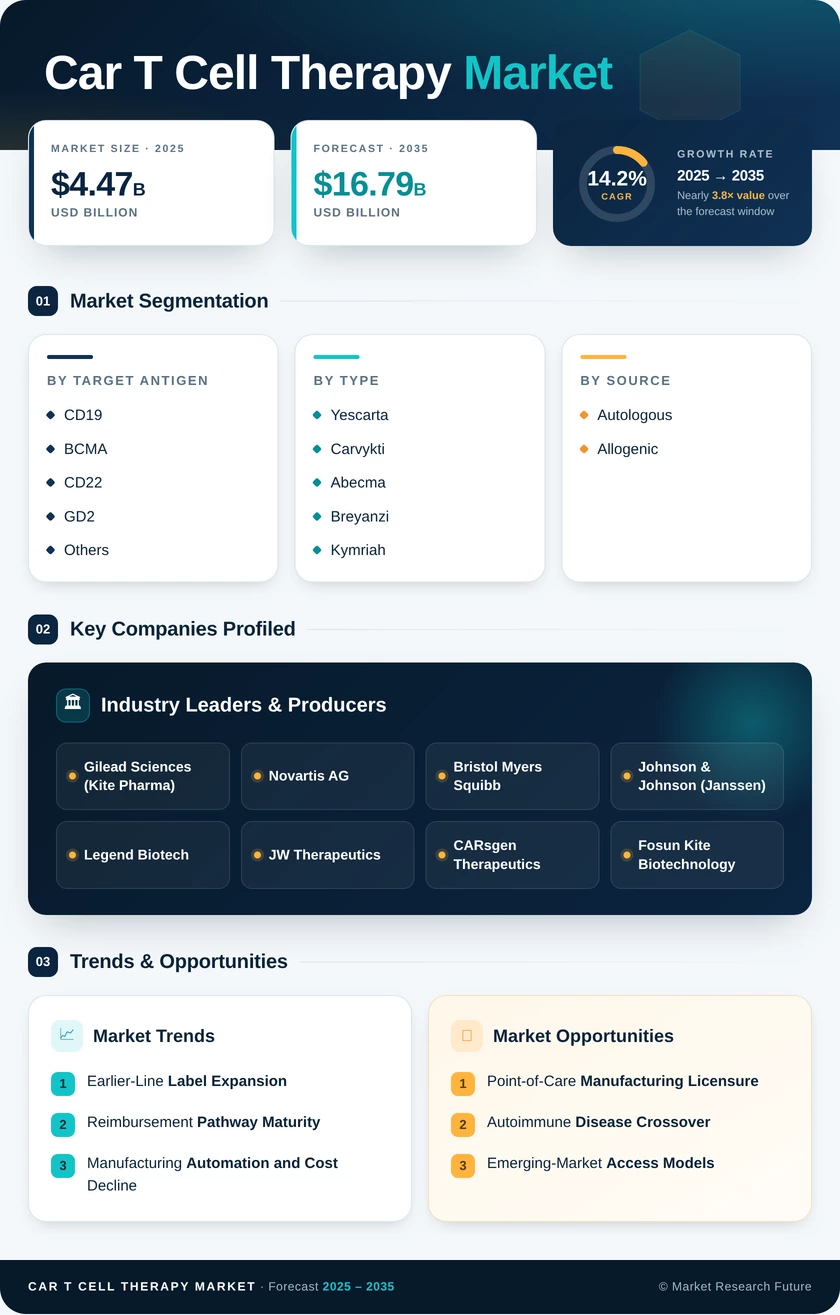
Forecast Period
2026-2035
CAGR
14.2%
2025 Market Size
USD 4.47 Billion
2035 Market Size
USD 16.79 Billion
Healthcare ● Updated August 25, 2026 Report ID: MRFR/HC/6630-CR | Pages: 200 | Author: Vikita Thakur, Rahul Gotadki
  1. 1 Market Overview |
    1. 1.1 Study Assumptions & Market Definition |
    2. 1.2 Scope of the Study |
    3. 1.3 Research Methodology |
    4. 1.4 Market Summary
  2. 2 Key Report Takeaways |
    1. 2.1 By Target Antigen |
    2. 2.2 By Cell Source and Application |
    3. 2.3 By Geography
  3. 3 Market Size & Forecast (2021–2035) |
    1. 3.1 Historical Market Size (2021–2024) |
    2. 3.2 Base Year Assessment (2025) |
    3. 3.3 Forecast Market Size (2026–2035) |
    4. 3.4 Year-over-Year Growth Analysis
  4. 4 Market Drivers Analysis |
    1. 4.1 Earlier-Line Label Expansion |
    2. 4.2 Reimbursement Pathway Maturity |
    3. 4.3 Manufacturing Automation & Cost Decline |
    4. 4.4 Asia-Pacific Regulatory Acceleration
  5. 5 Market Restraints Analysis |
    1. 5.1 Price & Budget-Impact Resistance |
    2. 5.2 Turnaround Time & Apheresis Capacity |
    3. 5.3 Safety Management Burden
  6. 6 Market Opportunity Analysis |
    1. 6.1 Point-of-Care Manufacturing Licensure |
    2. 6.2 Autoimmune Disease Crossover |
    3. 6.3 Emerging-Market Access Models |
    4. 6.4 Outcomes Data Monetization & Risk-Sharing |
    5. 6.5 Allogeneic Platform Licensing |
    6. 6.6 Industry Value Chain Analysis |
    7. 6.7 Porter's Five Forces Analysis
  7. 7 Regional Analysis |
    1. 7.1 North America | |
      1. 7.1.1 United States | |
      2. 7.1.2 Canada | |
      3. 7.1.3 Mexico |
    2. 7.2 Europe | |
      1. 7.2.1 Germany | |
      2. 7.2.2 United Kingdom | |
      3. 7.2.3 France | |
      4. 7.2.4 Italy | |
      5. 7.2.5 Spain | |
      6. 7.2.6 Nordic Countries | |
      7. 7.2.7 Russia | |
      8. 7.2.8 Rest of Europe |
    3. 7.3 Asia-Pacific | |
      1. 7.3.1 China | |
      2. 7.3.2 India | |
      3. 7.3.3 Japan | |
      4. 7.3.4 South Korea | |
      5. 7.3.5 ASEAN | |
      6. 7.3.6 Rest of Asia-Pacific |
    4. 7.4 South America | |
      1. 7.4.1 Brazil | |
      2. 7.4.2 Argentina | |
      3. 7.4.3 Rest of South America |
    5. 7.5 Middle East & Africa | |
      1. 7.5.1 Saudi Arabia | |
      2. 7.5.2 UAE | |
      3. 7.5.3 South Africa | |
      4. 7.5.4 Egypt | |
      5. 7.5.5 Rest of Middle East & Africa
  8. 8 Future Outlook (2026–2035) |
    1. 8.1 Automation & Digital Batch Control |
    2. 8.2 Beyond Oncology |
    3. 8.3 Value-Based Contracting as Default |
    4. 8.4 Supply Chain Regionalization
  9. 9 Market Segmentation Analysis |
    1. 9.1 By Target Antigen | |
      1. 9.1.1 CD19 | |
      2. 9.1.2 BCMA | |
      3. 9.1.3 CD22 | |
      4. 9.1.4 GD2 | |
      5. 9.1.5 Others |
    2. 9.2 By Product | |
      1. 9.2.1 Yescarta | |
      2. 9.2.2 Carvykti | |
      3. 9.2.3 Abecma | |
      4. 9.2.4 Breyanzi | |
      5. 9.2.5 Kymriah | |
      6. 9.2.6 Tecartus | |
      7. 9.2.7 Others |
    3. 9.3 By Cell Source | |
      1. 9.3.1 Autologous | |
      2. 9.3.2 Allogenic |
    4. 9.4 By Indication | |
      1. 9.4.1 Leukemia | |
      2. 9.4.2 Lymphoma | |
      3. 9.4.3 Multiple Myeloma | |
      4. 9.4.4 Others |
    5. 9.5 By End User | |
      1. 9.5.1 Hospitals | |
      2. 9.5.2 Cancer Care Treatment Centers | |
      3. 9.5.3 Others
  10. 10 Competitive Landscape |
    1. 10.1 Market Concentration Analysis (2026) |
    2. 10.2 Competitive Benchmarking Matrix |
    3. 10.3 Company Profiles | |
      1. 10.3.1 Gilead Sciences (Kite Pharma) | |
      2. 10.3.2 Novartis AG | |
      3. 10.3.3 Bristol Myers Squibb | |
      4. 10.3.4 Johnson & Johnson (Janssen) | |
      5. 10.3.5 Legend Biotech | |
      6. 10.3.6 JW Therapeutics | |
      7. 10.3.7 CARsgen Therapeutics | |
      8. 10.3.8 Fosun Kite Biotechnology | |
      9. 10.3.9 Autolus Therapeutics | |
      10. 10.3.10 Allogene Therapeutics | |
      11. 10.3.11 Arcellx | |
      12. 10.3.12 Immatics / Adaptimmune
  11. 11 Recent News & Developments
  12. 12 Report Scope & Methodology |
    1. 12.1 Study Period & Base Year |
    2. 12.2 Data Sources & Triangulation |
    3. 12.3 Abbreviations
  13. 13 Detailed Sources & Citations
  14. 14 Frequently Asked Questions
  15. 15 LIST OF TABLES |
  16. TABLE 1 Global CAR T Cell Therapy Market Size & Forecast, by Revenue (USD Billion), 2021–2035 |
  17. TABLE 2 Global CAR T Cell Therapy Market – Year-over-Year Growth Analysis, 2021–2035 |
  18. TABLE 3 Driver Impact Analysis Matrix, 2026–2035 |
  19. TABLE 4 Restraint Impact Analysis Matrix, 2026–2035 |
  20. TABLE 5 Global Market Size, by Region, 2021–2035 (USD Billion) |
  21. TABLE 6 North America Market Size, by Country, 2021–2035 (USD Billion) |
  22. TABLE 7 Europe Market Size, by Country, 2021–2035 (USD Billion) |
  23. TABLE 8 Asia-Pacific Market Size, by Country, 2021–2035 (USD Billion) |
  24. TABLE 9 South America Market Size, by Country, 2021–2035 (USD Billion) |
  25. TABLE 10 Middle East & Africa Market Size, by Country, 2021–2035 (USD Billion) |
  26. TABLE 11 Global Market Size, by Target Antigen, 2021–2035 (USD Billion) |
  27. TABLE 12 Global Market Size, by Type, 2021–2035 (USD Billion) |
  28. TABLE 13 Global Market Size, by Cell Source, 2021–2035 (USD Billion) |
  29. TABLE 14 Global Market Size, by Application, 2021–2035 (USD Billion) |
  30. TABLE 15 Global Market Size, by End User, 2021–2035 (USD Billion) |
  31. TABLE 16 North America Market Size, by Target Antigen and Application, 2021–2035 (USD Billion) |
  32. TABLE 17 Europe Market Size, by Target Antigen and Application, 2021–2035 (USD Billion) |
  33. TABLE 18 Asia-Pacific Market Size, by Target Antigen and Application, 2021–2035 (USD Billion) |
  34. TABLE 19 South America Market Size, by Cell Source and End User, 2021–2035 (USD Billion) |
  35. TABLE 20 Middle East & Africa Market Size, by Cell Source and End User, 2021–2035 (USD Billion) |
  36. TABLE 21 Competitive Benchmarking Matrix, 2026 |
  37. TABLE 22 Company Profiles – Key Players |
  38. TABLE 23 Recent Developments & Strategic Announcements, 2023–2025 |
  39. TABLE 24 Report Scope & Methodology Summary |
  40. TABLE 25 Detailed Sources & Citations Index
  41. 16 LIST OF FIGURES |
  42. FIGURE 1 Market Dynamics Overview – Drivers, Restraints, Opportunities |
  43. FIGURE 2 Industry Value Chain Analysis |
  44. FIGURE 3 Porter's Five Forces Assessment |
  45. FIGURE 4 Global Market Size Trend, 2021–2035 (USD Billion) |
  46. FIGURE 5 Year-over-Year Growth Curve, 2022–2035 |
  47. FIGURE 6 Market Share by Target Antigen, 2025 vs 2035 |
  48. FIGURE 7 Market Share by Type, 2025 |
  49. FIGURE 8 Autologous vs Allogenic Revenue Split, 2025–2035 |
  50. FIGURE 9 Market Share by Application, 2025 |
  51. FIGURE 10 Market Share by End User, 2025 |
  52. FIGURE 11 Regional Revenue Share Distribution, 2025 |
  53. FIGURE 12 Regional CAGR Comparison, 2026–2035 |
  54. FIGURE 13 Country-Level Growth Heat Map |
  55. FIGURE 14 Competitive Landscape Positioning Matrix |
  56. FIGURE 15 Top-5 Player Revenue Share Concentration, 2026 |
  57. FIGURE 16 Manufacturing Cost-per-Dose Decline Curve, 2021–2035

Segmentation Quick Reference

DimensionSub-SegmentsDominant SegmentFastest Growing Segment
By Target AntigenCD19, BCMA, CD22, GD2, OthersCD19GD2
By TypeYescarta, Carvykti, Abecma, Breyanzi, Kymriah, Tecartus, OthersYescartaCarvykti
By Cell SourceAutologous, AllogenicAutologousAllogenic
By ApplicationLeukemia, Lymphoma, Multiple Myeloma, OthersLymphomaMultiple Myeloma
By End UserHospitals, Cancer Care Treatment Centers, OthersHospitalsCancer Care Treatment Centers
By GeographyNorth America, Europe, Asia-Pacific, South America, Middle East & AfricaNorth AmericaAsia-Pacific


Market Segmentation Overview

By Target Antigen

Sub-SegmentKey Trend
CD19Shift into second-line settings sustains volume leadership
BCMASequential myeloma lines create repeat-treatment demand
CD22Positioned as salvage after CD19 antigen escape
GD2Pediatric neuroblastoma trials drive fastest growth
OthersClaudin18.2 and dual-target constructs entering registration


Antigen selection now determines competitive whitespace more than manufacturing know-how. CD19 saturation is pushing developers toward myeloma and solid-tumor targets where pricing power remains intact.

By Type

Sub-SegmentKey Trend
YescartaWidest certified-center footprint globally
CarvyktiStrongest survival data in earlier-line myeloma
AbecmaFacing competitive pressure from newer BCMA entrants
BreyanziBroadest B-cell indication label
KymriahAnchored in pediatric ALL franchise
TecartusDefensible mantle cell lymphoma niche
OthersRegional constructs from China, India, and Brazil


Brand-level competition is intensifying within indications rather than across them. Head-to-head myeloma positioning between BCMA products is the sharpest current battleground.

By Cell Source

Sub-SegmentKey Trend
AutologousAccounts for all approved commercial products today
AllogenicGene-edited donor platforms approaching pivotal readouts


Cell source is the structural variable in this forecast. An allogeneic approval before 2030 would compress delivered cost and unlock geographies where apheresis infrastructure simply does not exist.

By Application

Sub-SegmentKey Trend
LeukemiaPediatric and adult ALL coverage now well established
LymphomaLargest revenue pool on second-line label expansion
Multiple MyelomaFastest application growth on BCMA momentum
OthersCLL and early solid-tumor exploration


Indication mix is rebalancing toward myeloma as label expansions land. Lymphoma retains scale, but incremental growth increasingly comes from plasma-cell disease.

By End User

Sub-SegmentKey Trend
HospitalsICU escalation capability keeps volumes concentrated
Cancer Care Treatment CentersOutpatient protocols enabling faster site growth
OthersAcademic centers driving investigator-led programs


Site-of-care economics are loosening as REMS requirements relax. Specialized outpatient centers should capture a growing share of routine, lower-risk infusions through the decade.




Download PDF ×

We do not share your information with anyone. However, we may send you emails based on your report interest from time to time. You may contact us at any time to opt-out.