Request Free Sample ×

Kindly complete the form below to receive a free sample of this Report

* Please use a valid business email

Leading companies partner with us for data-driven Insights

clients tt-cursor
Hero Background
English
Chinese
French
Japanese
Korean
German
Spanish

Cannabis Market Industry Size

ID: MRFR/Agri/0444-CR
110 Pages
Tejas Chaudhary
July 2016

Cannabis Market Industry Size, Share, Industry Trend & Analysis Size, Share, Industry Analysis Information, by Derivatives (Marijuana/Flowers, Industrial Hemp, Other Concentrates/Products), by application type (Applications of Marijuana, Applications of Hemp) - Forecast from 2021 to 2030

Share:
Download PDF ×

We do not share your information with anyone. However, we may send you emails based on your report interest from time to time. You may contact us at any time to opt-out.

Cannabis Market Industry Infographic
Purchase Options

Cannabis Industry Size

Cannabis Market Industry Growth Projections and Opportunities

The North America Cannabis Market operates at the leading edge of a swiftly evolving industry, formed with the aid of various factors that replicate the converting criminal, cultural, and economic landscape surrounding cannabis. A fundamental motive force propelling this market is the increasing attractiveness and legalization of hashish for medical and leisure use in numerous jurisdictions throughout North America. The demand for hashish and related merchandise has witnessed full-size growth as purchasers discover its healing and leisure benefits. Legal and regulatory considerations play a pivotal position in shaping the dynamics of the North America Cannabis Market. As greater areas move towards legalization, regulatory frameworks are installed to govern cultivation, distribution, and intake. The evolving nature of hashish legal guidelines and policies influences market dynamics, impacting the entry of recent organizations, product availability, and basic market competitiveness. Demographic factors contribute to the segmentation of the North America Cannabis Market. Different age agencies, genders, and patron segments exhibit various options and consumption styles. For instance, clinical cannabis may be extra famous among older demographics in search of therapeutic blessings, even as more youthful customers might be drawn to recreational products. Market gamers tailor their merchandise and marketing techniques to cater to the specific desires and choices of various demographic organizations. International change and cross-border dynamics additionally impact the North America Cannabis Market. As extra countries bear in mind cannabis legalization, there are possibilities for market expansion and export of hashish merchandise. Regulatory harmonization and international partnerships play a role in shaping the landscape for the import and export of cannabis-associated goods, growing opportunities for corporations to faucet into worldwide markets. Social fairness and inclusion projects are becoming increasingly essential in the North America Cannabis Market. As the enterprise grows, there's a popularity of the historical injustices associated with cannabis prohibition, especially impacting marginalized communities. Efforts to deal with social fairness include selling diversity in ownership, assisting minority-owned groups, and deleting non-violent hashish-related criminal facts. These initiatives aim to create a more inclusive and truthful cannabis enterprise. The pandemic duration had a substantial impact on several markets and their increase. The North America Cannabis Market Forecast became further jeopardized while uncooked material manufacturing was halted and supply chain control was affected. The shipping of the goods to their final vacation spot to attain the customers turned into behind schedule. These variables have had a negative impact on the market. However, because of its scientific advantages, the enterprise will thrive in the coming years with an excessive increase in fees.

Cannabis Market Industry Size Graph
Author
Tejas Chaudhary
Research Analyst Level II

I have a degree in Engineering (Civil), with masters in Business Administration (Marketing). With more than 4 years of experience in market research and consulting, I am involved in end-to-end process of market research, proposals, project kickoffs and delivery. I have research knowledge and expertise in consumer goods/packaging domain. Also I have worked for various other domains like construction & equipment. Effectively managed and delivered more than 60 report studies for regional as well as global clientele.

Leave a Comment

FAQs

What is the current valuation of the cannabis marijuana market in 2025?

<p>The cannabis marijuana market valuation is approximately 33.0 USD Billion as of 2024.</p>

What is the projected market size for the cannabis marijuana market by 2035?

<p>The market is projected to reach 73.0 USD Billion by 2035.</p>

What is the expected CAGR for the cannabis marijuana market from 2025 to 2035?

<p>The expected CAGR for the cannabis marijuana market during the forecast period 2025 - 2035 is 7.48%.</p>

Which companies are considered key players in the cannabis marijuana market?

<p>Key players include Canopy Growth Corporation, Aurora Cannabis Inc., Curaleaf Holdings Inc., and Trulieve Cannabis Corp.</p>

What are the main segments of the cannabis marijuana market by application?

<p>The main segments by application include Medical, Recreational, Industrial, Cosmetic, and Nutraceutical.</p>

How does the market perform in terms of product type segmentation?

<p>The product type segmentation includes Flower, Concentrates, Edibles, Topicals, and Beverages.</p>

What distribution channels are utilized in the cannabis marijuana market?

<p>Distribution channels include Online, Retail, Dispensaries, Wholesale, and Direct Sales.</p>

What consumer demographics are relevant to the cannabis marijuana market?

<p>Relevant consumer demographics include Age, Gender, Income Level, Education Level, and Lifestyle.</p>

How does legislation status impact the cannabis marijuana market?

<p>Legislation status segments include Legal, Decriminalized, Illegal, Medical Use Only, and Recreational Use Only.</p>

What is the expected growth trend for the recreational segment of the cannabis market?

<p>The recreational segment is projected to grow from 15.0 USD Billion to 30.0 USD Billion by 2035.</p>

Market Summary

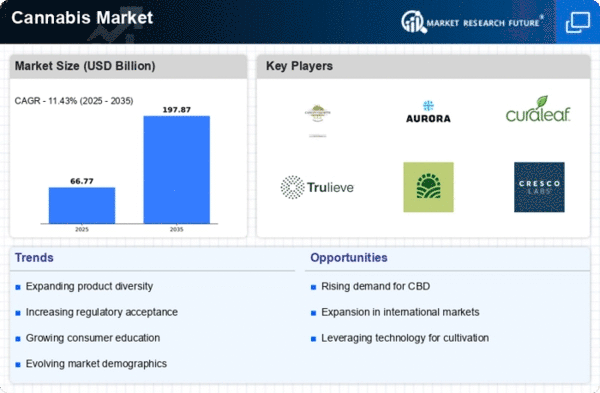
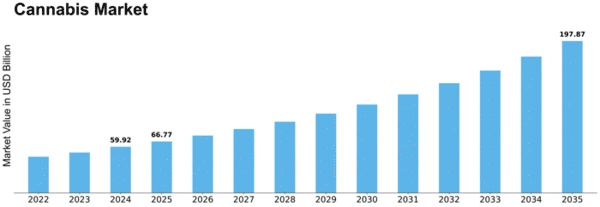
As per MRFR analysis, the Cannabis Market was estimated at 59.92 USD Billion in 2024. The cannabis industry is projected to grow from 67.45 USD Billion in 2025 to 197.87 USD Billion by 2035, exhibiting a compound annual growth rate (CAGR) of 11.43% during the forecast period 2025 - 2035.

Key Market Trends & Highlights

The cannabis market is experiencing robust growth driven by diversification and technological advancements.

  • The North American cannabis market remains the largest globally, characterized by a wide array of product offerings. In the Asia-Pacific region, the cannabis market is emerging rapidly, fueled by increasing consumer interest and regulatory shifts. The medical cannabis segment continues to dominate, while the recreational segment is witnessing the fastest growth rates. Regulatory changes and rising demand for CBD products are key drivers propelling market expansion.

Market Size & Forecast

2024 Market Size 59.92 (USD Billion)
2035 Market Size 197.87 (USD Billion)
CAGR (2025 - 2035) 11.43%
Largest Regional Market Share in 2024 North America

Major Players

<a href="https://www.canopygrowth.com/">Canopy Growth Corporation (CA)</a>, Aurora Cannabis Inc. (CA), <a href="https://ir.curaleaf.com/">Curaleaf Holdings, Inc. (US)</a>, Trulieve Cannabis Corp. (US), Green Thumb Industries Inc. (US), Cresco Labs Inc. (US), Harvest Health &amp; Recreation Inc. (US), MedMen Enterprises Inc. (US)

Market Trends

The Cannabis Market is currently experiencing a dynamic evolution, characterized by shifting consumer preferences and regulatory landscapes. As more regions embrace legalization, both for medicinal and recreational purposes, the market is witnessing an influx of new products and innovations. This diversification caters to a broader audience, including those seeking wellness solutions and recreational experiences. Furthermore, the rise of e-commerce platforms has transformed how consumers access cannabis products, making them more readily available than ever before. This trend suggests a growing acceptance and normalization of cannabis use in various societies. In addition to changing consumer behaviors, the Cannabis Market is also influenced by advancements in technology and research. Innovations in cultivation techniques, extraction methods, and product formulations are enhancing the quality and efficacy of cannabis offerings. Moreover, ongoing studies into the therapeutic benefits of cannabis are likely to bolster its reputation as a legitimate health alternative. As the market continues to mature, it appears poised for sustained growth, driven by both consumer demand and scientific validation of its benefits.

Increased Product Diversification

The Cannabis Market is witnessing a notable expansion in product offerings. This trend encompasses a wide array of items, including edibles, beverages, and topicals, catering to diverse consumer preferences. As companies innovate, they are likely to attract a broader demographic, enhancing market reach.

Technological Advancements in Cultivation

Recent developments in cultivation technology are transforming the Cannabis Market. Techniques such as hydroponics and vertical farming are improving yield efficiency and product quality. These advancements may lead to more sustainable practices and reduced environmental impact.

Growing Acceptance of Medicinal Use

The perception of cannabis as a legitimate medicinal option is gaining traction. Increased research and positive clinical outcomes are contributing to this shift. As healthcare professionals become more informed, the integration of cannabis into treatment plans may become more commonplace.

Cannabis Market Industry Market Drivers

Regulatory Changes

The evolving regulatory landscape in North America plays a pivotal role in shaping the Global Cannabis Market Industry. As more states and provinces legalize cannabis for both medicinal and recreational use, the market experiences substantial growth. For instance, in 2024, the market is projected to reach 3.34 USD Billion, reflecting the impact of these regulatory changes. The increasing acceptance of cannabis legislation not only enhances market accessibility but also encourages investment and innovation within the industry. This trend indicates a shift towards normalization, potentially leading to a more robust market framework in the coming years.

Market Diversification

Market diversification within the Global Cannabis Market Industry is becoming increasingly apparent as companies expand their product lines to cater to various consumer segments. This includes the introduction of edibles, beverages, and wellness products, which appeal to a broader audience beyond traditional cannabis users. The projected growth from 3.34 USD Billion in 2024 to 26.9 USD Billion by 2035 highlights the potential for companies to tap into new markets and demographics. By diversifying their offerings, businesses can mitigate risks associated with market fluctuations and enhance their resilience in a competitive environment.

Investment Opportunities

The Global Cannabis Market Industry is witnessing an influx of investment opportunities, driven by the increasing legalization and commercialization of cannabis. Investors are increasingly recognizing the potential for high returns in this burgeoning market. The projected growth from 3.34 USD Billion in 2024 to 26.9 USD Billion by 2035 suggests a lucrative landscape for both new and established players. This influx of capital not only supports the expansion of cultivation and distribution networks but also fosters innovation in product development and marketing strategies. Consequently, the industry is likely to attract a diverse range of investors, enhancing its overall dynamism.

Increasing Consumer Demand

Consumer demand for cannabis products continues to surge, significantly influencing the Global Cannabis Market Industry. This demand is driven by a growing awareness of the therapeutic benefits of cannabis, as well as the rising popularity of cannabis-infused products. As of 2024, the market is valued at 3.34 USD Billion, with projections suggesting it could expand to 26.9 USD Billion by 2035. This growth trajectory, characterized by a compound annual growth rate (CAGR) of 20.89% from 2025 to 2035, underscores the potential for diverse product offerings and the need for companies to adapt to evolving consumer preferences.

Technological Advancements

Technological advancements are revolutionizing the Global Cannabis Market Industry, enhancing efficiency and product quality. Innovations in cultivation techniques, such as hydroponics and vertical farming, are enabling producers to maximize yields while minimizing resource consumption. Additionally, advancements in extraction methods are leading to higher purity and potency in cannabis products. As the market evolves, these technologies are likely to play a crucial role in meeting the increasing consumer demand. The anticipated growth from 3.34 USD Billion in 2024 to 26.9 USD Billion by 2035 indicates that companies investing in technology will likely gain a competitive edge in this rapidly changing landscape.

Market Segment Insights

By Application: Medical (Largest) vs. Recreational (Fastest-Growing)

The cannabis market is witnessing a significant distribution among its applications. The Medical segment holds the largest market share, driven by the increasing acceptance of cannabis for various therapeutic uses. Patients seeking alternatives for traditional pharmaceuticals are boosting this segment, particularly in pain relief and management of chronic conditions. In contrast, the Recreational segment is experiencing rapid growth, driven by changing legal landscapes and increasing consumer acceptance. This segment caters to a growing demographic looking for cannabis as a lifestyle choice, with states and countries legalizing recreational use at an accelerating pace.

Medical (Dominant) vs. Recreational (Emerging)

The Medical cannabis segment stands as the dominant player in the industry, characterized by its extensive research and established medical protocols. With a wide range of products tailored for various medical conditions, it caters to a diverse patient population seeking natural alternatives to traditional medications. In contrast, the Recreational segment, though still emerging, is rapidly gaining traction, appealing to consumers seeking relaxation and social enjoyment. This segment is marked by innovative products and branding aimed at younger demographics, establishing its position in a saturated market. The advent of cannabis-infused edibles and beverages highlights its adaptability and connection to lifestyle trends, positioning it well for future growth.

By Product Type: Flower (Largest) vs. Edibles (Fastest-Growing)

<p>The cannabis marijuana market showcases a diverse range of product types, with Flower leading the segment in market share, captivating consumers with its traditional appeal and versatile usage. Concentrates, though smaller in share, attract a discerning clientele seeking higher potency options. Edibles, Topicals, and Beverages are carving out niche markets, appealing particularly to new consumers looking for alternative consumption methods.</p>

<p>Flower (Dominant) vs. Edibles (Emerging)</p>

<p>Flower remains the dominant product type in the cannabis sector, celebrated for its authenticity and wide-ranging effects. Its versatile usage in various consumption methods, such as smoking or vaporizing, solidifies its appeal. Conversely, Edibles have emerged as a dynamic segment, mainly due to changing consumer preferences towards discreet consumption and gourmet offerings. With inventive flavors and dosage options, Edibles attract both seasoned cannabis users and novices, contributing to their rapid growth. As the market matures, these two segments highlight distinct consumer trends, positioning Flower as a staple while Edibles are recognized for their innovation.</p>

By Distribution Channel: Retail (Largest) vs. Online (Fastest-Growing)

<p>In the cannabis marijuana market, distribution channels play a crucial role in delivering products to consumers. Retail remains the largest channel, accounting for a significant portion of overall distribution. This includes both physical locations that cater to local markets and dedicated cannabis shops which allow consumers to access a wide range of products. Online sales, however, are rapidly gaining traction, especially among younger consumers who prefer the convenience of home delivery. Together, these channels shape the purchasing landscape, balancing traditional retail experiences with the modern expectations of digital shopping.</p>

<p>Retail (Dominant) vs. Online (Emerging)</p>

<p>Retail is a dominant distribution channel in the cannabis marijuana market, characterized by its breadth and accessibility. It includes brick-and-mortar dispensaries where consumers can explore various cannabis products and receive expert guidance. The atmosphere of personal interaction encourages user engagement and brand loyalty. Conversely, Online retail is emerging as a compelling alternative, facilitated by advancements in e-commerce technologies and changing consumer preferences for convenience. As delivery options expand, more consumers are inclined to purchase cannabis products online, driven by the desire for discretion and a broader array of options. This duality in distribution strategies enables brands to cater to diverse consumer preferences, creating a holistic market approach.</p>

By Consumer Demographics: Age (Largest) vs. Gender (Fastest-Growing)

<p>In the cannabis marijuana market, age demographics reveal that younger consumers, particularly those aged 21 to 34, comprise the largest segment. This age group accounts for the highest share of cannabis consumption, driven by changing attitudes and legalization trends. Older adults, while a smaller segment currently, are increasingly exploring cannabis products, influenced by medical use and therapeutic applications. Gender dynamics show a significant shift, with female consumers rapidly increasing their presence in the market. The growth of cannabis-focused marketing targeted at women has contributed to this trend. As more women become aware of the health benefits and recreational opportunities of cannabis, their market share is expected to rise, making them one of the fastest-growing demographics and shifting the overall consumption landscape.</p>

<p>Age (Dominant) vs. Gender (Emerging)</p>

<p>The age demographic, particularly individuals aged 21 to 34, remains the dominant force in the cannabis marijuana market, largely due to their openness to cannabis consumption as part of their lifestyle. This group is often more adventurous and willing to explore various cannabis products, including edibles and concentrates. They drive trends in product innovation and social acceptance. On the other hand, the emerging female demographic represents a growing segment that is becoming increasingly influential. Women are gravitating towards cannabis for both recreational use and therapeutic benefits, leading to the development of products tailored specifically for them. This shift is reshaping marketing strategies and product offerings in the cannabis industry.</p>

By Legislation Status: Legal (Largest) vs. Decriminalized (Fastest-Growing)

<p>The cannabis marijuana market is significantly influenced by the various legislation statuses across nations and regions. The segment classified as 'Legal' commands the largest share, driven by ongoing legalization efforts and increasing acceptance among consumers. In contrast, the 'Decriminalized' segment is emerging rapidly, as many jurisdictions are shifting towards less punitive measures for cannabis possession, indicating a notable shift in public and legislative attitudes towards cannabis use. Growth trends are predominantly driven by changing social norms, increased advocacy for regulatory reforms, and rising public approval for recreational and medical use. Regions moving towards full legalization foster a robust market environment, attracting investment and encouraging innovation. Conversely, the 'Decriminalized' segment suggests a notable pivot, indicating potential for expansive growth as policies evolve, which might soon lead to further legalization efforts.</p>

<p>Legal (Dominant) vs. Medical Use Only (Emerging)</p>

<p>The 'Legal' segment of the cannabis marijuana market stands as a dominant force, characterized by established frameworks supporting both recreational and medicinal use. This status not only facilitates regulated sales and distribution networks but also elevates consumer trust and product diversity. The 'Medical Use Only' segment, while smaller, represents an emerging market addressing the therapeutic needs of patients seeking cannabis-based treatments. This segment focuses on stringent regulations governing product safety and efficacy, appealing to health-conscious consumers and medical practitioners. As research illuminates the health benefits of cannabis, this segment is likely to experience significant growth, leveraging endorsements from medical communities and patient advocacy groups to widen its market share.</p>

Get more detailed insights about Cannabis Market Industry Research Report-Forecast to 2035

Regional Insights

recreational cannabis

Key Players and Competitive Insights

The Cannabis Market is currently characterized by a dynamic competitive landscape, driven by evolving consumer preferences, regulatory changes, and increasing acceptance of cannabis products across various regions. Major players such as Canopy Growth Corporation (CA), Curaleaf Holdings, Inc. (US), and Trulieve Cannabis Corp. (US) are strategically positioning themselves through innovation and regional expansion. Canopy Growth Corporation (CA) has focused on diversifying its product portfolio, while Curaleaf Holdings, Inc. (US) emphasizes its extensive retail footprint and vertical integration. Trulieve Cannabis Corp. (US) has adopted a strategy of aggressive market penetration, particularly in the southeastern US, which collectively shapes a competitive environment that is both fragmented and rapidly evolving.
Key business tactics within the Cannabis Market include localizing manufacturing and optimizing supply chains to enhance efficiency and responsiveness to market demands. The market structure appears moderately fragmented, with numerous players vying for market share. However, the influence of key players is substantial, as they leverage their resources and capabilities to establish competitive advantages, thereby shaping the overall market dynamics.
In November 2025, Canopy Growth Corporation (CA) announced a strategic partnership with a leading beverage company to develop cannabis-infused drinks. This collaboration is poised to tap into the growing demand for alternative consumption methods, potentially expanding Canopy's market reach and enhancing its product offerings. The strategic importance of this partnership lies in its ability to leverage the beverage company's distribution network, thereby facilitating entry into new markets and consumer segments.
In October 2025, Curaleaf Holdings, Inc. (US) completed the acquisition of a regional cannabis operator, significantly increasing its market presence in the northeastern US. This acquisition is strategically vital as it not only enhances Curaleaf's operational scale but also diversifies its product range, allowing for a more comprehensive approach to meet consumer needs. The move reflects a broader trend of consolidation within the industry, as companies seek to strengthen their competitive positions through mergers and acquisitions.
In September 2025, Trulieve Cannabis Corp. (US) launched a new line of sustainable cannabis products, emphasizing eco-friendly cultivation practices. This initiative aligns with the growing consumer preference for sustainability and positions Trulieve as a leader in responsible cannabis production. The strategic importance of this launch is underscored by the increasing demand for environmentally conscious products, which may enhance brand loyalty and attract a broader customer base.
As of December 2025, current competitive trends in the Cannabis Market include a pronounced shift towards digitalization, sustainability, and the integration of AI technologies. Strategic alliances are increasingly shaping the landscape, enabling companies to pool resources and expertise to innovate and respond to market demands effectively. Looking ahead, competitive differentiation is likely to evolve from traditional price-based competition to a focus on innovation, technology, and supply chain reliability, as companies strive to meet the sophisticated needs of consumers in a rapidly changing market.

Key Companies in the Cannabis Market Industry include

Industry Developments

Future Outlook

Cannabis Market Industry Future Outlook

The Cannabis Industry is projected to grow at an 11.43% CAGR from 2025 to 2035, driven by legalization trends, product innovation, and increasing consumer acceptance.

New opportunities lie in:

  • Expansion of cannabis-infused beverage lines targeting health-conscious consumers.
  • Development of telehealth platforms for cannabis consultations and prescriptions.
  • Investment in sustainable cultivation technologies to enhance yield and reduce costs.

By 2035, the cannabis market is expected to be robust, characterized by diverse product offerings and widespread acceptance.

Market Segmentation

Cannabis Market Industry Application Outlook

  • Medical
  • Recreational
  • Industrial
  • Nutraceutical
  • Cosmetic

Cannabis Market Industry Product Type Outlook

  • Cannabis Flower
  • Cannabis Oil
  • Edibles
  • Concentrates
  • Topicals

Cannabis Market Industry Distribution Channel Outlook

  • Online
  • Retail
  • Dispensaries
  • Wholesale
  • Direct Sales

Report Scope

MARKET SIZE 2024 59.92(USD Billion)
MARKET SIZE 2025 67.45(USD Billion)
MARKET SIZE 2035 197.87(USD Billion)
COMPOUND ANNUAL GROWTH RATE (CAGR) 11.43% (2025 - 2035)
REPORT COVERAGE Revenue Forecast, Competitive Landscape, Growth Factors, and Trends
BASE YEAR 2024
Market Forecast Period 2025 - 2035
Historical Data 2019 - 2024
Market Forecast Units USD Billion
Key Companies Profiled Canopy Growth Corporation (CA), Aurora Cannabis Inc. (CA), Curaleaf Holdings, Inc. (US), Trulieve Cannabis Corp. (US), Green Thumb Industries Inc. (US), Cresco Labs Inc. (US), Harvest Health & Recreation Inc. (US), MedMen Enterprises Inc. (US)
Segments Covered Application, Product Type, Distribution Channel
Key Market Opportunities Expansion of cannabis-infused products driven by evolving consumer preferences and regulatory advancements.
Key Market Dynamics Evolving regulatory frameworks and shifting consumer preferences drive innovation and competition within the cannabis market.
Countries Covered North America, Europe, APAC, South America, MEA

FAQs

What is the current valuation of the cannabis marijuana market in 2025?

<p>The cannabis marijuana market valuation is approximately 33.0 USD Billion as of 2024.</p>

What is the projected market size for the cannabis marijuana market by 2035?

<p>The market is projected to reach 73.0 USD Billion by 2035.</p>

What is the expected CAGR for the cannabis marijuana market from 2025 to 2035?

<p>The expected CAGR for the cannabis marijuana market during the forecast period 2025 - 2035 is 7.48%.</p>

Which companies are considered key players in the cannabis marijuana market?

<p>Key players include Canopy Growth Corporation, Aurora Cannabis Inc., Curaleaf Holdings Inc., and Trulieve Cannabis Corp.</p>

What are the main segments of the cannabis marijuana market by application?

<p>The main segments by application include Medical, Recreational, Industrial, Cosmetic, and Nutraceutical.</p>

How does the market perform in terms of product type segmentation?

<p>The product type segmentation includes Flower, Concentrates, Edibles, Topicals, and Beverages.</p>

What distribution channels are utilized in the cannabis marijuana market?

<p>Distribution channels include Online, Retail, Dispensaries, Wholesale, and Direct Sales.</p>

What consumer demographics are relevant to the cannabis marijuana market?

<p>Relevant consumer demographics include Age, Gender, Income Level, Education Level, and Lifestyle.</p>

How does legislation status impact the cannabis marijuana market?

<p>Legislation status segments include Legal, Decriminalized, Illegal, Medical Use Only, and Recreational Use Only.</p>

What is the expected growth trend for the recreational segment of the cannabis market?

<p>The recreational segment is projected to grow from 15.0 USD Billion to 30.0 USD Billion by 2035.</p>

  1. SECTION I: EXECUTIVE SUMMARY AND KEY HIGHLIGHTS
    1. | 1.1 EXECUTIVE SUMMARY
    2. | | 1.1.1 Market Overview
    3. | | 1.1.2 Key Findings
    4. | | 1.1.3 Market Segmentation
    5. | | 1.1.4 Competitive Landscape
    6. | | 1.1.5 Challenges and Opportunities
    7. | | 1.1.6 Future Outlook
  2. SECTION II: SCOPING, METHODOLOGY AND MARKET STRUCTURE
    1. | 2.1 MARKET INTRODUCTION
    2. | | 2.1.1 Definition
    3. | | 2.1.2 Scope of the study
    4. | | | 2.1.2.1 Research Objective
    5. | | | 2.1.2.2 Assumption
    6. | | | 2.1.2.3 Limitations
    7. | 2.2 RESEARCH METHODOLOGY
    8. | | 2.2.1 Overview
    9. | | 2.2.2 Data Mining
    10. | | 2.2.3 Secondary Research
    11. | | 2.2.4 Primary Research
    12. | | | 2.2.4.1 Primary Interviews and Information Gathering Process
    13. | | | 2.2.4.2 Breakdown of Primary Respondents
    14. | | 2.2.5 Forecasting Model
    15. | | 2.2.6 Market Size Estimation
    16. | | | 2.2.6.1 Bottom-Up Approach
    17. | | | 2.2.6.2 Top-Down Approach
    18. | | 2.2.7 Data Triangulation
    19. | | 2.2.8 Validation
  3. SECTION III: QUALITATIVE ANALYSIS
    1. | 3.1 MARKET DYNAMICS
    2. | | 3.1.1 Overview
    3. | | 3.1.2 Drivers
    4. | | 3.1.3 Restraints
    5. | | 3.1.4 Opportunities
    6. | 3.2 MARKET FACTOR ANALYSIS
    7. | | 3.2.1 Value chain Analysis
    8. | | 3.2.2 Porter's Five Forces Analysis
    9. | | | 3.2.2.1 Bargaining Power of Suppliers
    10. | | | 3.2.2.2 Bargaining Power of Buyers
    11. | | | 3.2.2.3 Threat of New Entrants
    12. | | | 3.2.2.4 Threat of Substitutes
    13. | | | 3.2.2.5 Intensity of Rivalry
    14. | | 3.2.3 COVID-19 Impact Analysis
    15. | | | 3.2.3.1 Market Impact Analysis
    16. | | | 3.2.3.2 Regional Impact
    17. | | | 3.2.3.3 Opportunity and Threat Analysis
  4. SECTION IV: QUANTITATIVE ANALYSIS
    1. | 4.1 Healthcare, BY Application (USD Billion)
    2. | | 4.1.1 Medical
    3. | | 4.1.2 Recreational
    4. | | 4.1.3 Industrial
    5. | | 4.1.4 Cosmetic
    6. | | 4.1.5 Nutraceutical
    7. | 4.2 Healthcare, BY Product Type (USD Billion)
    8. | | 4.2.1 Flower
    9. | | 4.2.2 Concentrates
    10. | | 4.2.3 Edibles
    11. | | 4.2.4 Topicals
    12. | | 4.2.5 Beverages
    13. | 4.3 Healthcare, BY Distribution Channel (USD Billion)
    14. | | 4.3.1 Online
    15. | | 4.3.2 Retail
    16. | | 4.3.3 Dispensaries
    17. | | 4.3.4 Wholesale
    18. | | 4.3.5 Direct Sales
    19. | 4.4 Healthcare, BY Consumer Demographics (USD Billion)
    20. | | 4.4.1 Age
    21. | | 4.4.2 Gender
    22. | | 4.4.3 Income Level
    23. | | 4.4.4 Education Level
    24. | | 4.4.5 Lifestyle
    25. | 4.5 Healthcare, BY Legislation Status (USD Billion)
    26. | | 4.5.1 Legal
    27. | | 4.5.2 Decriminalized
    28. | | 4.5.3 Illegal
    29. | | 4.5.4 Medical Use Only
    30. | | 4.5.5 Recreational Use Only
    31. | 4.6 Healthcare, BY Region (USD Billion)
    32. | | 4.6.1 North America
    33. | | | 4.6.1.1 US
    34. | | | 4.6.1.2 Canada
    35. | | 4.6.2 Europe
    36. | | | 4.6.2.1 Germany
    37. | | | 4.6.2.2 UK
    38. | | | 4.6.2.3 France
    39. | | | 4.6.2.4 Russia
    40. | | | 4.6.2.5 Italy
    41. | | | 4.6.2.6 Spain
    42. | | | 4.6.2.7 Rest of Europe
    43. | | 4.6.3 APAC
    44. | | | 4.6.3.1 China
    45. | | | 4.6.3.2 India
    46. | | | 4.6.3.3 Japan
    47. | | | 4.6.3.4 South Korea
    48. | | | 4.6.3.5 Malaysia
    49. | | | 4.6.3.6 Thailand
    50. | | | 4.6.3.7 Indonesia
    51. | | | 4.6.3.8 Rest of APAC
    52. | | 4.6.4 South America
    53. | | | 4.6.4.1 Brazil
    54. | | | 4.6.4.2 Mexico
    55. | | | 4.6.4.3 Argentina
    56. | | | 4.6.4.4 Rest of South America
    57. | | 4.6.5 MEA
    58. | | | 4.6.5.1 GCC Countries
    59. | | | 4.6.5.2 South Africa
    60. | | | 4.6.5.3 Rest of MEA
  5. SECTION V: COMPETITIVE ANALYSIS
    1. | 5.1 Competitive Landscape
    2. | | 5.1.1 Overview
    3. | | 5.1.2 Competitive Analysis
    4. | | 5.1.3 Market share Analysis
    5. | | 5.1.4 Major Growth Strategy in the Healthcare
    6. | | 5.1.5 Competitive Benchmarking
    7. | | 5.1.6 Leading Players in Terms of Number of Developments in the Healthcare
    8. | | 5.1.7 Key developments and growth strategies
    9. | | | 5.1.7.1 New Product Launch/Service Deployment
    10. | | | 5.1.7.2 Merger & Acquisitions
    11. | | | 5.1.7.3 Joint Ventures
    12. | | 5.1.8 Major Players Financial Matrix
    13. | | | 5.1.8.1 Sales and Operating Income
    14. | | | 5.1.8.2 Major Players R&D Expenditure. 2023
    15. | 5.2 Company Profiles
    16. | | 5.2.1 Canopy Growth Corporation (CA)
    17. | | | 5.2.1.1 Financial Overview
    18. | | | 5.2.1.2 Products Offered
    19. | | | 5.2.1.3 Key Developments
    20. | | | 5.2.1.4 SWOT Analysis
    21. | | | 5.2.1.5 Key Strategies
    22. | | 5.2.2 Aurora Cannabis Inc. (CA)
    23. | | | 5.2.2.1 Financial Overview
    24. | | | 5.2.2.2 Products Offered
    25. | | | 5.2.2.3 Key Developments
    26. | | | 5.2.2.4 SWOT Analysis
    27. | | | 5.2.2.5 Key Strategies
    28. | | 5.2.3 Curaleaf Holdings Inc. (US)
    29. | | | 5.2.3.1 Financial Overview
    30. | | | 5.2.3.2 Products Offered
    31. | | | 5.2.3.3 Key Developments
    32. | | | 5.2.3.4 SWOT Analysis
    33. | | | 5.2.3.5 Key Strategies
    34. | | 5.2.4 Trulieve Cannabis Corp. (US)
    35. | | | 5.2.4.1 Financial Overview
    36. | | | 5.2.4.2 Products Offered
    37. | | | 5.2.4.3 Key Developments
    38. | | | 5.2.4.4 SWOT Analysis
    39. | | | 5.2.4.5 Key Strategies
    40. | | 5.2.5 Green Thumb Industries Inc. (US)
    41. | | | 5.2.5.1 Financial Overview
    42. | | | 5.2.5.2 Products Offered
    43. | | | 5.2.5.3 Key Developments
    44. | | | 5.2.5.4 SWOT Analysis
    45. | | | 5.2.5.5 Key Strategies
    46. | | 5.2.6 Cresco Labs Inc. (US)
    47. | | | 5.2.6.1 Financial Overview
    48. | | | 5.2.6.2 Products Offered
    49. | | | 5.2.6.3 Key Developments
    50. | | | 5.2.6.4 SWOT Analysis
    51. | | | 5.2.6.5 Key Strategies
    52. | | 5.2.7 Harvest Health & Recreation Inc. (US)
    53. | | | 5.2.7.1 Financial Overview
    54. | | | 5.2.7.2 Products Offered
    55. | | | 5.2.7.3 Key Developments
    56. | | | 5.2.7.4 SWOT Analysis
    57. | | | 5.2.7.5 Key Strategies
    58. | | 5.2.8 MedMen Enterprises Inc. (US)
    59. | | | 5.2.8.1 Financial Overview
    60. | | | 5.2.8.2 Products Offered
    61. | | | 5.2.8.3 Key Developments
    62. | | | 5.2.8.4 SWOT Analysis
    63. | | | 5.2.8.5 Key Strategies
    64. | | 5.2.9 Tilray Brands Inc. (CA)
    65. | | | 5.2.9.1 Financial Overview
    66. | | | 5.2.9.2 Products Offered
    67. | | | 5.2.9.3 Key Developments
    68. | | | 5.2.9.4 SWOT Analysis
    69. | | | 5.2.9.5 Key Strategies
    70. | 5.3 Appendix
    71. | | 5.3.1 References
    72. | | 5.3.2 Related Reports
  6. LIST OF FIGURES
    1. | 6.1 MARKET SYNOPSIS
    2. | 6.2 NORTH AMERICA MARKET ANALYSIS
    3. | 6.3 US MARKET ANALYSIS BY APPLICATION
    4. | 6.4 US MARKET ANALYSIS BY PRODUCT TYPE
    5. | 6.5 US MARKET ANALYSIS BY DISTRIBUTION CHANNEL
    6. | 6.6 US MARKET ANALYSIS BY CONSUMER DEMOGRAPHICS
    7. | 6.7 US MARKET ANALYSIS BY LEGISLATION STATUS
    8. | 6.8 CANADA MARKET ANALYSIS BY APPLICATION
    9. | 6.9 CANADA MARKET ANALYSIS BY PRODUCT TYPE
    10. | 6.10 CANADA MARKET ANALYSIS BY DISTRIBUTION CHANNEL
    11. | 6.11 CANADA MARKET ANALYSIS BY CONSUMER DEMOGRAPHICS
    12. | 6.12 CANADA MARKET ANALYSIS BY LEGISLATION STATUS
    13. | 6.13 EUROPE MARKET ANALYSIS
    14. | 6.14 GERMANY MARKET ANALYSIS BY APPLICATION
    15. | 6.15 GERMANY MARKET ANALYSIS BY PRODUCT TYPE
    16. | 6.16 GERMANY MARKET ANALYSIS BY DISTRIBUTION CHANNEL
    17. | 6.17 GERMANY MARKET ANALYSIS BY CONSUMER DEMOGRAPHICS
    18. | 6.18 GERMANY MARKET ANALYSIS BY LEGISLATION STATUS
    19. | 6.19 UK MARKET ANALYSIS BY APPLICATION
    20. | 6.20 UK MARKET ANALYSIS BY PRODUCT TYPE
    21. | 6.21 UK MARKET ANALYSIS BY DISTRIBUTION CHANNEL
    22. | 6.22 UK MARKET ANALYSIS BY CONSUMER DEMOGRAPHICS
    23. | 6.23 UK MARKET ANALYSIS BY LEGISLATION STATUS
    24. | 6.24 FRANCE MARKET ANALYSIS BY APPLICATION
    25. | 6.25 FRANCE MARKET ANALYSIS BY PRODUCT TYPE
    26. | 6.26 FRANCE MARKET ANALYSIS BY DISTRIBUTION CHANNEL
    27. | 6.27 FRANCE MARKET ANALYSIS BY CONSUMER DEMOGRAPHICS
    28. | 6.28 FRANCE MARKET ANALYSIS BY LEGISLATION STATUS
    29. | 6.29 RUSSIA MARKET ANALYSIS BY APPLICATION
    30. | 6.30 RUSSIA MARKET ANALYSIS BY PRODUCT TYPE
    31. | 6.31 RUSSIA MARKET ANALYSIS BY DISTRIBUTION CHANNEL
    32. | 6.32 RUSSIA MARKET ANALYSIS BY CONSUMER DEMOGRAPHICS
    33. | 6.33 RUSSIA MARKET ANALYSIS BY LEGISLATION STATUS
    34. | 6.34 ITALY MARKET ANALYSIS BY APPLICATION
    35. | 6.35 ITALY MARKET ANALYSIS BY PRODUCT TYPE
    36. | 6.36 ITALY MARKET ANALYSIS BY DISTRIBUTION CHANNEL
    37. | 6.37 ITALY MARKET ANALYSIS BY CONSUMER DEMOGRAPHICS
    38. | 6.38 ITALY MARKET ANALYSIS BY LEGISLATION STATUS
    39. | 6.39 SPAIN MARKET ANALYSIS BY APPLICATION
    40. | 6.40 SPAIN MARKET ANALYSIS BY PRODUCT TYPE
    41. | 6.41 SPAIN MARKET ANALYSIS BY DISTRIBUTION CHANNEL
    42. | 6.42 SPAIN MARKET ANALYSIS BY CONSUMER DEMOGRAPHICS
    43. | 6.43 SPAIN MARKET ANALYSIS BY LEGISLATION STATUS
    44. | 6.44 REST OF EUROPE MARKET ANALYSIS BY APPLICATION
    45. | 6.45 REST OF EUROPE MARKET ANALYSIS BY PRODUCT TYPE
    46. | 6.46 REST OF EUROPE MARKET ANALYSIS BY DISTRIBUTION CHANNEL
    47. | 6.47 REST OF EUROPE MARKET ANALYSIS BY CONSUMER DEMOGRAPHICS
    48. | 6.48 REST OF EUROPE MARKET ANALYSIS BY LEGISLATION STATUS
    49. | 6.49 APAC MARKET ANALYSIS
    50. | 6.50 CHINA MARKET ANALYSIS BY APPLICATION
    51. | 6.51 CHINA MARKET ANALYSIS BY PRODUCT TYPE
    52. | 6.52 CHINA MARKET ANALYSIS BY DISTRIBUTION CHANNEL
    53. | 6.53 CHINA MARKET ANALYSIS BY CONSUMER DEMOGRAPHICS
    54. | 6.54 CHINA MARKET ANALYSIS BY LEGISLATION STATUS
    55. | 6.55 INDIA MARKET ANALYSIS BY APPLICATION
    56. | 6.56 INDIA MARKET ANALYSIS BY PRODUCT TYPE
    57. | 6.57 INDIA MARKET ANALYSIS BY DISTRIBUTION CHANNEL
    58. | 6.58 INDIA MARKET ANALYSIS BY CONSUMER DEMOGRAPHICS
    59. | 6.59 INDIA MARKET ANALYSIS BY LEGISLATION STATUS
    60. | 6.60 JAPAN MARKET ANALYSIS BY APPLICATION
    61. | 6.61 JAPAN MARKET ANALYSIS BY PRODUCT TYPE
    62. | 6.62 JAPAN MARKET ANALYSIS BY DISTRIBUTION CHANNEL
    63. | 6.63 JAPAN MARKET ANALYSIS BY CONSUMER DEMOGRAPHICS
    64. | 6.64 JAPAN MARKET ANALYSIS BY LEGISLATION STATUS
    65. | 6.65 SOUTH KOREA MARKET ANALYSIS BY APPLICATION
    66. | 6.66 SOUTH KOREA MARKET ANALYSIS BY PRODUCT TYPE
    67. | 6.67 SOUTH KOREA MARKET ANALYSIS BY DISTRIBUTION CHANNEL
    68. | 6.68 SOUTH KOREA MARKET ANALYSIS BY CONSUMER DEMOGRAPHICS
    69. | 6.69 SOUTH KOREA MARKET ANALYSIS BY LEGISLATION STATUS
    70. | 6.70 MALAYSIA MARKET ANALYSIS BY APPLICATION
    71. | 6.71 MALAYSIA MARKET ANALYSIS BY PRODUCT TYPE
    72. | 6.72 MALAYSIA MARKET ANALYSIS BY DISTRIBUTION CHANNEL
    73. | 6.73 MALAYSIA MARKET ANALYSIS BY CONSUMER DEMOGRAPHICS
    74. | 6.74 MALAYSIA MARKET ANALYSIS BY LEGISLATION STATUS
    75. | 6.75 THAILAND MARKET ANALYSIS BY APPLICATION
    76. | 6.76 THAILAND MARKET ANALYSIS BY PRODUCT TYPE
    77. | 6.77 THAILAND MARKET ANALYSIS BY DISTRIBUTION CHANNEL
    78. | 6.78 THAILAND MARKET ANALYSIS BY CONSUMER DEMOGRAPHICS
    79. | 6.79 THAILAND MARKET ANALYSIS BY LEGISLATION STATUS
    80. | 6.80 INDONESIA MARKET ANALYSIS BY APPLICATION
    81. | 6.81 INDONESIA MARKET ANALYSIS BY PRODUCT TYPE
    82. | 6.82 INDONESIA MARKET ANALYSIS BY DISTRIBUTION CHANNEL
    83. | 6.83 INDONESIA MARKET ANALYSIS BY CONSUMER DEMOGRAPHICS
    84. | 6.84 INDONESIA MARKET ANALYSIS BY LEGISLATION STATUS
    85. | 6.85 REST OF APAC MARKET ANALYSIS BY APPLICATION
    86. | 6.86 REST OF APAC MARKET ANALYSIS BY PRODUCT TYPE
    87. | 6.87 REST OF APAC MARKET ANALYSIS BY DISTRIBUTION CHANNEL
    88. | 6.88 REST OF APAC MARKET ANALYSIS BY CONSUMER DEMOGRAPHICS
    89. | 6.89 REST OF APAC MARKET ANALYSIS BY LEGISLATION STATUS
    90. | 6.90 SOUTH AMERICA MARKET ANALYSIS
    91. | 6.91 BRAZIL MARKET ANALYSIS BY APPLICATION
    92. | 6.92 BRAZIL MARKET ANALYSIS BY PRODUCT TYPE
    93. | 6.93 BRAZIL MARKET ANALYSIS BY DISTRIBUTION CHANNEL
    94. | 6.94 BRAZIL MARKET ANALYSIS BY CONSUMER DEMOGRAPHICS
    95. | 6.95 BRAZIL MARKET ANALYSIS BY LEGISLATION STATUS
    96. | 6.96 MEXICO MARKET ANALYSIS BY APPLICATION
    97. | 6.97 MEXICO MARKET ANALYSIS BY PRODUCT TYPE
    98. | 6.98 MEXICO MARKET ANALYSIS BY DISTRIBUTION CHANNEL
    99. | 6.99 MEXICO MARKET ANALYSIS BY CONSUMER DEMOGRAPHICS
    100. | 6.100 MEXICO MARKET ANALYSIS BY LEGISLATION STATUS
    101. | 6.101 ARGENTINA MARKET ANALYSIS BY APPLICATION
    102. | 6.102 ARGENTINA MARKET ANALYSIS BY PRODUCT TYPE
    103. | 6.103 ARGENTINA MARKET ANALYSIS BY DISTRIBUTION CHANNEL
    104. | 6.104 ARGENTINA MARKET ANALYSIS BY CONSUMER DEMOGRAPHICS
    105. | 6.105 ARGENTINA MARKET ANALYSIS BY LEGISLATION STATUS
    106. | 6.106 REST OF SOUTH AMERICA MARKET ANALYSIS BY APPLICATION
    107. | 6.107 REST OF SOUTH AMERICA MARKET ANALYSIS BY PRODUCT TYPE
    108. | 6.108 REST OF SOUTH AMERICA MARKET ANALYSIS BY DISTRIBUTION CHANNEL
    109. | 6.109 REST OF SOUTH AMERICA MARKET ANALYSIS BY CONSUMER DEMOGRAPHICS
    110. | 6.110 REST OF SOUTH AMERICA MARKET ANALYSIS BY LEGISLATION STATUS
    111. | 6.111 MEA MARKET ANALYSIS
    112. | 6.112 GCC COUNTRIES MARKET ANALYSIS BY APPLICATION
    113. | 6.113 GCC COUNTRIES MARKET ANALYSIS BY PRODUCT TYPE
    114. | 6.114 GCC COUNTRIES MARKET ANALYSIS BY DISTRIBUTION CHANNEL
    115. | 6.115 GCC COUNTRIES MARKET ANALYSIS BY CONSUMER DEMOGRAPHICS
    116. | 6.116 GCC COUNTRIES MARKET ANALYSIS BY LEGISLATION STATUS
    117. | 6.117 SOUTH AFRICA MARKET ANALYSIS BY APPLICATION
    118. | 6.118 SOUTH AFRICA MARKET ANALYSIS BY PRODUCT TYPE
    119. | 6.119 SOUTH AFRICA MARKET ANALYSIS BY DISTRIBUTION CHANNEL
    120. | 6.120 SOUTH AFRICA MARKET ANALYSIS BY CONSUMER DEMOGRAPHICS
    121. | 6.121 SOUTH AFRICA MARKET ANALYSIS BY LEGISLATION STATUS
    122. | 6.122 REST OF MEA MARKET ANALYSIS BY APPLICATION
    123. | 6.123 REST OF MEA MARKET ANALYSIS BY PRODUCT TYPE
    124. | 6.124 REST OF MEA MARKET ANALYSIS BY DISTRIBUTION CHANNEL
    125. | 6.125 REST OF MEA MARKET ANALYSIS BY CONSUMER DEMOGRAPHICS
    126. | 6.126 REST OF MEA MARKET ANALYSIS BY LEGISLATION STATUS
    127. | 6.127 KEY BUYING CRITERIA OF HEALTHCARE
    128. | 6.128 RESEARCH PROCESS OF MRFR
    129. | 6.129 DRO ANALYSIS OF HEALTHCARE
    130. | 6.130 DRIVERS IMPACT ANALYSIS: HEALTHCARE
    131. | 6.131 RESTRAINTS IMPACT ANALYSIS: HEALTHCARE
    132. | 6.132 SUPPLY / VALUE CHAIN: HEALTHCARE
    133. | 6.133 HEALTHCARE, BY APPLICATION, 2024 (% SHARE)
    134. | 6.134 HEALTHCARE, BY APPLICATION, 2024 TO 2035 (USD Billion)
    135. | 6.135 HEALTHCARE, BY PRODUCT TYPE, 2024 (% SHARE)
    136. | 6.136 HEALTHCARE, BY PRODUCT TYPE, 2024 TO 2035 (USD Billion)
    137. | 6.137 HEALTHCARE, BY DISTRIBUTION CHANNEL, 2024 (% SHARE)
    138. | 6.138 HEALTHCARE, BY DISTRIBUTION CHANNEL, 2024 TO 2035 (USD Billion)
    139. | 6.139 HEALTHCARE, BY CONSUMER DEMOGRAPHICS, 2024 (% SHARE)
    140. | 6.140 HEALTHCARE, BY CONSUMER DEMOGRAPHICS, 2024 TO 2035 (USD Billion)
    141. | 6.141 HEALTHCARE, BY LEGISLATION STATUS, 2024 (% SHARE)
    142. | 6.142 HEALTHCARE, BY LEGISLATION STATUS, 2024 TO 2035 (USD Billion)
    143. | 6.143 BENCHMARKING OF MAJOR COMPETITORS
  7. LIST OF TABLES
    1. | 7.1 LIST OF ASSUMPTIONS
    2. | | 7.1.1
    3. | 7.2 North America MARKET SIZE ESTIMATES; FORECAST
    4. | | 7.2.1 BY APPLICATION, 2025-2035 (USD Billion)
    5. | | 7.2.2 BY PRODUCT TYPE, 2025-2035 (USD Billion)
    6. | | 7.2.3 BY DISTRIBUTION CHANNEL, 2025-2035 (USD Billion)
    7. | | 7.2.4 BY CONSUMER DEMOGRAPHICS, 2025-2035 (USD Billion)
    8. | | 7.2.5 BY LEGISLATION STATUS, 2025-2035 (USD Billion)
    9. | 7.3 US MARKET SIZE ESTIMATES; FORECAST
    10. | | 7.3.1 BY APPLICATION, 2025-2035 (USD Billion)
    11. | | 7.3.2 BY PRODUCT TYPE, 2025-2035 (USD Billion)
    12. | | 7.3.3 BY DISTRIBUTION CHANNEL, 2025-2035 (USD Billion)
    13. | | 7.3.4 BY CONSUMER DEMOGRAPHICS, 2025-2035 (USD Billion)
    14. | | 7.3.5 BY LEGISLATION STATUS, 2025-2035 (USD Billion)
    15. | 7.4 Canada MARKET SIZE ESTIMATES; FORECAST
    16. | | 7.4.1 BY APPLICATION, 2025-2035 (USD Billion)
    17. | | 7.4.2 BY PRODUCT TYPE, 2025-2035 (USD Billion)
    18. | | 7.4.3 BY DISTRIBUTION CHANNEL, 2025-2035 (USD Billion)
    19. | | 7.4.4 BY CONSUMER DEMOGRAPHICS, 2025-2035 (USD Billion)
    20. | | 7.4.5 BY LEGISLATION STATUS, 2025-2035 (USD Billion)
    21. | 7.5 Europe MARKET SIZE ESTIMATES; FORECAST
    22. | | 7.5.1 BY APPLICATION, 2025-2035 (USD Billion)
    23. | | 7.5.2 BY PRODUCT TYPE, 2025-2035 (USD Billion)
    24. | | 7.5.3 BY DISTRIBUTION CHANNEL, 2025-2035 (USD Billion)
    25. | | 7.5.4 BY CONSUMER DEMOGRAPHICS, 2025-2035 (USD Billion)
    26. | | 7.5.5 BY LEGISLATION STATUS, 2025-2035 (USD Billion)
    27. | 7.6 Germany MARKET SIZE ESTIMATES; FORECAST
    28. | | 7.6.1 BY APPLICATION, 2025-2035 (USD Billion)
    29. | | 7.6.2 BY PRODUCT TYPE, 2025-2035 (USD Billion)
    30. | | 7.6.3 BY DISTRIBUTION CHANNEL, 2025-2035 (USD Billion)
    31. | | 7.6.4 BY CONSUMER DEMOGRAPHICS, 2025-2035 (USD Billion)
    32. | | 7.6.5 BY LEGISLATION STATUS, 2025-2035 (USD Billion)
    33. | 7.7 UK MARKET SIZE ESTIMATES; FORECAST
    34. | | 7.7.1 BY APPLICATION, 2025-2035 (USD Billion)
    35. | | 7.7.2 BY PRODUCT TYPE, 2025-2035 (USD Billion)
    36. | | 7.7.3 BY DISTRIBUTION CHANNEL, 2025-2035 (USD Billion)
    37. | | 7.7.4 BY CONSUMER DEMOGRAPHICS, 2025-2035 (USD Billion)
    38. | | 7.7.5 BY LEGISLATION STATUS, 2025-2035 (USD Billion)
    39. | 7.8 France MARKET SIZE ESTIMATES; FORECAST
    40. | | 7.8.1 BY APPLICATION, 2025-2035 (USD Billion)
    41. | | 7.8.2 BY PRODUCT TYPE, 2025-2035 (USD Billion)
    42. | | 7.8.3 BY DISTRIBUTION CHANNEL, 2025-2035 (USD Billion)
    43. | | 7.8.4 BY CONSUMER DEMOGRAPHICS, 2025-2035 (USD Billion)
    44. | | 7.8.5 BY LEGISLATION STATUS, 2025-2035 (USD Billion)
    45. | 7.9 Russia MARKET SIZE ESTIMATES; FORECAST
    46. | | 7.9.1 BY APPLICATION, 2025-2035 (USD Billion)
    47. | | 7.9.2 BY PRODUCT TYPE, 2025-2035 (USD Billion)
    48. | | 7.9.3 BY DISTRIBUTION CHANNEL, 2025-2035 (USD Billion)
    49. | | 7.9.4 BY CONSUMER DEMOGRAPHICS, 2025-2035 (USD Billion)
    50. | | 7.9.5 BY LEGISLATION STATUS, 2025-2035 (USD Billion)
    51. | 7.10 Italy MARKET SIZE ESTIMATES; FORECAST
    52. | | 7.10.1 BY APPLICATION, 2025-2035 (USD Billion)
    53. | | 7.10.2 BY PRODUCT TYPE, 2025-2035 (USD Billion)
    54. | | 7.10.3 BY DISTRIBUTION CHANNEL, 2025-2035 (USD Billion)
    55. | | 7.10.4 BY CONSUMER DEMOGRAPHICS, 2025-2035 (USD Billion)
    56. | | 7.10.5 BY LEGISLATION STATUS, 2025-2035 (USD Billion)
    57. | 7.11 Spain MARKET SIZE ESTIMATES; FORECAST
    58. | | 7.11.1 BY APPLICATION, 2025-2035 (USD Billion)
    59. | | 7.11.2 BY PRODUCT TYPE, 2025-2035 (USD Billion)
    60. | | 7.11.3 BY DISTRIBUTION CHANNEL, 2025-2035 (USD Billion)
    61. | | 7.11.4 BY CONSUMER DEMOGRAPHICS, 2025-2035 (USD Billion)
    62. | | 7.11.5 BY LEGISLATION STATUS, 2025-2035 (USD Billion)
    63. | 7.12 Rest of Europe MARKET SIZE ESTIMATES; FORECAST
    64. | | 7.12.1 BY APPLICATION, 2025-2035 (USD Billion)
    65. | | 7.12.2 BY PRODUCT TYPE, 2025-2035 (USD Billion)
    66. | | 7.12.3 BY DISTRIBUTION CHANNEL, 2025-2035 (USD Billion)
    67. | | 7.12.4 BY CONSUMER DEMOGRAPHICS, 2025-2035 (USD Billion)
    68. | | 7.12.5 BY LEGISLATION STATUS, 2025-2035 (USD Billion)
    69. | 7.13 APAC MARKET SIZE ESTIMATES; FORECAST
    70. | | 7.13.1 BY APPLICATION, 2025-2035 (USD Billion)
    71. | | 7.13.2 BY PRODUCT TYPE, 2025-2035 (USD Billion)
    72. | | 7.13.3 BY DISTRIBUTION CHANNEL, 2025-2035 (USD Billion)
    73. | | 7.13.4 BY CONSUMER DEMOGRAPHICS, 2025-2035 (USD Billion)
    74. | | 7.13.5 BY LEGISLATION STATUS, 2025-2035 (USD Billion)
    75. | 7.14 China MARKET SIZE ESTIMATES; FORECAST
    76. | | 7.14.1 BY APPLICATION, 2025-2035 (USD Billion)
    77. | | 7.14.2 BY PRODUCT TYPE, 2025-2035 (USD Billion)
    78. | | 7.14.3 BY DISTRIBUTION CHANNEL, 2025-2035 (USD Billion)
    79. | | 7.14.4 BY CONSUMER DEMOGRAPHICS, 2025-2035 (USD Billion)
    80. | | 7.14.5 BY LEGISLATION STATUS, 2025-2035 (USD Billion)
    81. | 7.15 India MARKET SIZE ESTIMATES; FORECAST
    82. | | 7.15.1 BY APPLICATION, 2025-2035 (USD Billion)
    83. | | 7.15.2 BY PRODUCT TYPE, 2025-2035 (USD Billion)
    84. | | 7.15.3 BY DISTRIBUTION CHANNEL, 2025-2035 (USD Billion)
    85. | | 7.15.4 BY CONSUMER DEMOGRAPHICS, 2025-2035 (USD Billion)
    86. | | 7.15.5 BY LEGISLATION STATUS, 2025-2035 (USD Billion)
    87. | 7.16 Japan MARKET SIZE ESTIMATES; FORECAST
    88. | | 7.16.1 BY APPLICATION, 2025-2035 (USD Billion)
    89. | | 7.16.2 BY PRODUCT TYPE, 2025-2035 (USD Billion)
    90. | | 7.16.3 BY DISTRIBUTION CHANNEL, 2025-2035 (USD Billion)
    91. | | 7.16.4 BY CONSUMER DEMOGRAPHICS, 2025-2035 (USD Billion)
    92. | | 7.16.5 BY LEGISLATION STATUS, 2025-2035 (USD Billion)
    93. | 7.17 South Korea MARKET SIZE ESTIMATES; FORECAST
    94. | | 7.17.1 BY APPLICATION, 2025-2035 (USD Billion)
    95. | | 7.17.2 BY PRODUCT TYPE, 2025-2035 (USD Billion)
    96. | | 7.17.3 BY DISTRIBUTION CHANNEL, 2025-2035 (USD Billion)
    97. | | 7.17.4 BY CONSUMER DEMOGRAPHICS, 2025-2035 (USD Billion)
    98. | | 7.17.5 BY LEGISLATION STATUS, 2025-2035 (USD Billion)
    99. | 7.18 Malaysia MARKET SIZE ESTIMATES; FORECAST
    100. | | 7.18.1 BY APPLICATION, 2025-2035 (USD Billion)
    101. | | 7.18.2 BY PRODUCT TYPE, 2025-2035 (USD Billion)
    102. | | 7.18.3 BY DISTRIBUTION CHANNEL, 2025-2035 (USD Billion)
    103. | | 7.18.4 BY CONSUMER DEMOGRAPHICS, 2025-2035 (USD Billion)
    104. | | 7.18.5 BY LEGISLATION STATUS, 2025-2035 (USD Billion)
    105. | 7.19 Thailand MARKET SIZE ESTIMATES; FORECAST
    106. | | 7.19.1 BY APPLICATION, 2025-2035 (USD Billion)
    107. | | 7.19.2 BY PRODUCT TYPE, 2025-2035 (USD Billion)
    108. | | 7.19.3 BY DISTRIBUTION CHANNEL, 2025-2035 (USD Billion)
    109. | | 7.19.4 BY CONSUMER DEMOGRAPHICS, 2025-2035 (USD Billion)
    110. | | 7.19.5 BY LEGISLATION STATUS, 2025-2035 (USD Billion)
    111. | 7.20 Indonesia MARKET SIZE ESTIMATES; FORECAST
    112. | | 7.20.1 BY APPLICATION, 2025-2035 (USD Billion)
    113. | | 7.20.2 BY PRODUCT TYPE, 2025-2035 (USD Billion)
    114. | | 7.20.3 BY DISTRIBUTION CHANNEL, 2025-2035 (USD Billion)
    115. | | 7.20.4 BY CONSUMER DEMOGRAPHICS, 2025-2035 (USD Billion)
    116. | | 7.20.5 BY LEGISLATION STATUS, 2025-2035 (USD Billion)
    117. | 7.21 Rest of APAC MARKET SIZE ESTIMATES; FORECAST
    118. | | 7.21.1 BY APPLICATION, 2025-2035 (USD Billion)
    119. | | 7.21.2 BY PRODUCT TYPE, 2025-2035 (USD Billion)
    120. | | 7.21.3 BY DISTRIBUTION CHANNEL, 2025-2035 (USD Billion)
    121. | | 7.21.4 BY CONSUMER DEMOGRAPHICS, 2025-2035 (USD Billion)
    122. | | 7.21.5 BY LEGISLATION STATUS, 2025-2035 (USD Billion)
    123. | 7.22 South America MARKET SIZE ESTIMATES; FORECAST
    124. | | 7.22.1 BY APPLICATION, 2025-2035 (USD Billion)
    125. | | 7.22.2 BY PRODUCT TYPE, 2025-2035 (USD Billion)
    126. | | 7.22.3 BY DISTRIBUTION CHANNEL, 2025-2035 (USD Billion)
    127. | | 7.22.4 BY CONSUMER DEMOGRAPHICS, 2025-2035 (USD Billion)
    128. | | 7.22.5 BY LEGISLATION STATUS, 2025-2035 (USD Billion)
    129. | 7.23 Brazil MARKET SIZE ESTIMATES; FORECAST
    130. | | 7.23.1 BY APPLICATION, 2025-2035 (USD Billion)
    131. | | 7.23.2 BY PRODUCT TYPE, 2025-2035 (USD Billion)
    132. | | 7.23.3 BY DISTRIBUTION CHANNEL, 2025-2035 (USD Billion)
    133. | | 7.23.4 BY CONSUMER DEMOGRAPHICS, 2025-2035 (USD Billion)
    134. | | 7.23.5 BY LEGISLATION STATUS, 2025-2035 (USD Billion)
    135. | 7.24 Mexico MARKET SIZE ESTIMATES; FORECAST
    136. | | 7.24.1 BY APPLICATION, 2025-2035 (USD Billion)
    137. | | 7.24.2 BY PRODUCT TYPE, 2025-2035 (USD Billion)
    138. | | 7.24.3 BY DISTRIBUTION CHANNEL, 2025-2035 (USD Billion)
    139. | | 7.24.4 BY CONSUMER DEMOGRAPHICS, 2025-2035 (USD Billion)
    140. | | 7.24.5 BY LEGISLATION STATUS, 2025-2035 (USD Billion)
    141. | 7.25 Argentina MARKET SIZE ESTIMATES; FORECAST
    142. | | 7.25.1 BY APPLICATION, 2025-2035 (USD Billion)
    143. | | 7.25.2 BY PRODUCT TYPE, 2025-2035 (USD Billion)
    144. | | 7.25.3 BY DISTRIBUTION CHANNEL, 2025-2035 (USD Billion)
    145. | | 7.25.4 BY CONSUMER DEMOGRAPHICS, 2025-2035 (USD Billion)
    146. | | 7.25.5 BY LEGISLATION STATUS, 2025-2035 (USD Billion)
    147. | 7.26 Rest of South America MARKET SIZE ESTIMATES; FORECAST
    148. | | 7.26.1 BY APPLICATION, 2025-2035 (USD Billion)
    149. | | 7.26.2 BY PRODUCT TYPE, 2025-2035 (USD Billion)
    150. | | 7.26.3 BY DISTRIBUTION CHANNEL, 2025-2035 (USD Billion)
    151. | | 7.26.4 BY CONSUMER DEMOGRAPHICS, 2025-2035 (USD Billion)
    152. | | 7.26.5 BY LEGISLATION STATUS, 2025-2035 (USD Billion)
    153. | 7.27 MEA MARKET SIZE ESTIMATES; FORECAST
    154. | | 7.27.1 BY APPLICATION, 2025-2035 (USD Billion)
    155. | | 7.27.2 BY PRODUCT TYPE, 2025-2035 (USD Billion)
    156. | | 7.27.3 BY DISTRIBUTION CHANNEL, 2025-2035 (USD Billion)
    157. | | 7.27.4 BY CONSUMER DEMOGRAPHICS, 2025-2035 (USD Billion)
    158. | | 7.27.5 BY LEGISLATION STATUS, 2025-2035 (USD Billion)
    159. | 7.28 GCC Countries MARKET SIZE ESTIMATES; FORECAST
    160. | | 7.28.1 BY APPLICATION, 2025-2035 (USD Billion)
    161. | | 7.28.2 BY PRODUCT TYPE, 2025-2035 (USD Billion)
    162. | | 7.28.3 BY DISTRIBUTION CHANNEL, 2025-2035 (USD Billion)
    163. | | 7.28.4 BY CONSUMER DEMOGRAPHICS, 2025-2035 (USD Billion)
    164. | | 7.28.5 BY LEGISLATION STATUS, 2025-2035 (USD Billion)
    165. | 7.29 South Africa MARKET SIZE ESTIMATES; FORECAST
    166. | | 7.29.1 BY APPLICATION, 2025-2035 (USD Billion)
    167. | | 7.29.2 BY PRODUCT TYPE, 2025-2035 (USD Billion)
    168. | | 7.29.3 BY DISTRIBUTION CHANNEL, 2025-2035 (USD Billion)
    169. | | 7.29.4 BY CONSUMER DEMOGRAPHICS, 2025-2035 (USD Billion)
    170. | | 7.29.5 BY LEGISLATION STATUS, 2025-2035 (USD Billion)
    171. | 7.30 Rest of MEA MARKET SIZE ESTIMATES; FORECAST
    172. | | 7.30.1 BY APPLICATION, 2025-2035 (USD Billion)
    173. | | 7.30.2 BY PRODUCT TYPE, 2025-2035 (USD Billion)
    174. | | 7.30.3 BY DISTRIBUTION CHANNEL, 2025-2035 (USD Billion)
    175. | | 7.30.4 BY CONSUMER DEMOGRAPHICS, 2025-2035 (USD Billion)
    176. | | 7.30.5 BY LEGISLATION STATUS, 2025-2035 (USD Billion)
    177. | 7.31 PRODUCT LAUNCH/PRODUCT DEVELOPMENT/APPROVAL
    178. | | 7.31.1
    179. | 7.32 ACQUISITION/PARTNERSHIP
    180. | | 7.32.1

Healthcare Market Segmentation

Healthcare By Application (USD Billion, 2025-2035)

  • Medical
  • Recreational
  • Industrial
  • Cosmetic
  • Nutraceutical

Healthcare By Product Type (USD Billion, 2025-2035)

  • Flower
  • Concentrates
  • Edibles
  • Topicals
  • Beverages

Healthcare By Distribution Channel (USD Billion, 2025-2035)

  • Online
  • Retail
  • Dispensaries
  • Wholesale
  • Direct Sales

Healthcare By Consumer Demographics (USD Billion, 2025-2035)

  • Age
  • Gender
  • Income Level
  • Education Level
  • Lifestyle

Healthcare By Legislation Status (USD Billion, 2025-2035)

  • Legal
  • Decriminalized
  • Illegal
  • Medical Use Only
  • Recreational Use Only
Infographic

Free Sample Request

Kindly complete the form below to receive a free sample of this Report

Get Free Sample

Customer Strories

Compare Licence

×
Features License Type
Single User Multiuser License Enterprise User
Price $4,950 $5,950 $7,250
Maximum User Access Limit 1 User Upto 10 Users Unrestricted Access Throughout the Organization
Free Customization
Direct Access to Analyst
Deliverable Format
Platform Access
Discount on Next Purchase 10% 15% 15%
Printable Versions