
×
Request Free Sample ×

Kindly complete the form below to receive a free sample of this Report

* Please use a valid business email

Leading companies partner with us for data-driven Insights

clients tt-cursor
Hero Background
English
Chinese
French
Japanese
Korean
German
Spanish

Call Control Market Trends

ID: MRFR/SEM/8983-HCR
100 Pages
Ankit Gupta
February 2026

Call Control (PBX-IP PBX) Market Size, Share and Research Report By Product (IP Extensions and TDM Extensions), By Application (Commercial and Industrial), And By Region (North America, Europe, Asia-Pacific, And Rest Of The World) –Industry Forecast Till 2035

Share:
Download PDF ×

We do not share your information with anyone. However, we may send you emails based on your report interest from time to time. You may contact us at any time to opt-out.

Call Control Market Infographic
Purchase Options

Market Trends

Key Emerging Trends in the Call Control Market

The Call Control market, encompassing Private Branch Exchange (PBX) and Internet Protocol (IP) PBX systems, has undergone noteworthy trends and transformations in recent times. Call control is at the heart of telecommunication systems, managing voice and data communication within organizations. As technology continues to evolve, several key trends are shaping the dynamics of the Call Control market.

One prominent trend in the market is the shift from traditional PBX systems to IP PBX solutions. Traditional PBX systems relied on analog technology, while IP PBX systems leverage internet protocols for voice and multimedia communication. This transition is driven by the benefits of cost savings, scalability, and enhanced features offered by IP PBX. Organizations are increasingly recognizing the flexibility and efficiency of IP-based solutions, leading to a growing adoption of IP PBX systems across various industries.

Cloud-based Call Control solutions are gaining traction as organizations seek more scalable and cost-effective alternatives. Cloud-based PBX systems eliminate the need for on-premises hardware, offering greater flexibility and accessibility. Businesses can benefit from reduced maintenance costs, seamless scalability, and the ability to access communication services from anywhere with an internet connection. This trend aligns with the broader industry shift towards cloud computing and the adoption of Software as a Service (SaaS) models.

Integration with Unified Communications (UC) is another significant trend in the Call Control market. Organizations are looking for comprehensive communication solutions that unify voice, video, messaging, and collaboration tools. The integration of call control with UC platforms enhances communication efficiency by providing a seamless experience across different channels. This trend is driven by the increasing demand for streamlined communication workflows and improved collaboration within modern workplaces.

Security concerns are playing a pivotal role in shaping the market trends of Call Control systems. With the rise of cyber threats and the importance of secure communication, businesses are prioritizing solutions that offer robust security features. Call Control systems are evolving to incorporate encryption, authentication, and other security measures to safeguard sensitive communications. This focus on security aligns with the broader emphasis on cybersecurity across various industries.

The market is also witnessing increased demand for mobile integration in Call Control systems. As mobile devices become integral to business communication, organizations are seeking solutions that seamlessly integrate with mobile platforms. Mobile-friendly interfaces, mobile device management capabilities, and the ability to make and receive calls on mobile devices using the same business number are becoming key considerations for businesses evaluating Call Control solutions.

Geographically, the Asia-Pacific region is emerging as a significant player in the Call Control market. The rapid adoption of advanced technologies, coupled with the proliferation of mobile devices, is driving the demand for efficient communication solutions in countries like China and India. The increasing number of businesses in the region, particularly small and medium-sized enterprises (SMEs), is contributing to the growth of the Call Control market.

Cost-effectiveness remains a key driver in the market trends of Call Control systems. While businesses seek advanced features and capabilities, they are also conscious of the total cost of ownership. Vendors are responding by offering flexible pricing models, subscription-based services, and bundled packages that cater to the diverse budgetary requirements of different organizations.


Author
Ankit Gupta
Team Lead - Research

Ankit Gupta is a seasoned market intelligence and strategic research professional with over six plus years of experience in the ICT and Semiconductor industries. With academic roots in Telecom, Marketing, and Electronics, he blends technical insight with business strategy. Ankit has led 200+ projects, including work for Fortune 500 clients like Microsoft and Rio Tinto, covering market sizing, tech forecasting, and go-to-market strategies. Known for bridging engineering and enterprise decision-making, his insights support growth, innovation, and investment planning across diverse technology markets.

Leave a Comment

FAQs

What is the projected market valuation for the Global Call Control (PBX-IP PBX) Market in 2035?

<p>The projected market valuation for the Global Call Control (PBX-IP PBX) Market in 2035 is 65.38 USD Billion.</p>

What was the market valuation of the Global Call Control (PBX-IP PBX) Market in 2024?

<p>The market valuation of the Global Call Control (PBX-IP PBX) Market in 2024 was 21.22 USD Billion.</p>

What is the expected CAGR for the Global Call Control (PBX-IP PBX) Market from 2025 to 2035?

<p>The expected CAGR for the Global Call Control (PBX-IP PBX) Market during the forecast period 2025 - 2035 is 10.77%.</p>

Which companies are considered key players in the Global Call Control (PBX-IP PBX) Market?

<p>Key players in the Global Call Control (PBX-IP PBX) Market include Cisco Systems, Avaya, Mitel Networks, Alcatel-Lucent, NEC Corporation, RingCentral, 8x8, Unify, and Panasonic.</p>

What are the projected valuations for IP Extensions and TDM Extensions in The Global Call Control (PBX-IP PBX)?

<p>The projected valuation for IP Extensions is expected to reach 39.12 USD Billion, while TDM Extensions may reach 26.26 USD Billion.</p>

How do the commercial and industrial applications compare in terms of market valuation?

<p>Both commercial and industrial applications are projected to have a valuation of 32.69 USD Billion in the Global Call Control (PBX-IP PBX) Market.</p>

What trends are influencing the growth of the Global Call Control (PBX-IP PBX) Market?

The growth of the Global Call Control (PBX-IP PBX) Market appears to be influenced by advancements in technology and increasing demand for efficient communication solutions.

What segment is expected to dominate the Global Call Control (PBX-IP PBX) Market by 2035?

The IP Extensions segment is likely to dominate the Global Call Control (PBX-IP PBX) Market by 2035, given its projected growth.

How does the market valuation in 2035 compare to that in 2024?

The market valuation in 2035 is expected to be significantly higher at 65.38 USD Billion compared to 21.22 USD Billion in 2024.

What implications does the projected CAGR have for businesses in The Global Call Control (PBX-IP PBX)?

The projected CAGR of 10.77% suggests that businesses in The Global Call Control (PBX-IP PBX) may experience substantial growth opportunities during the forecast period 2025 - 2035.

Market Summary

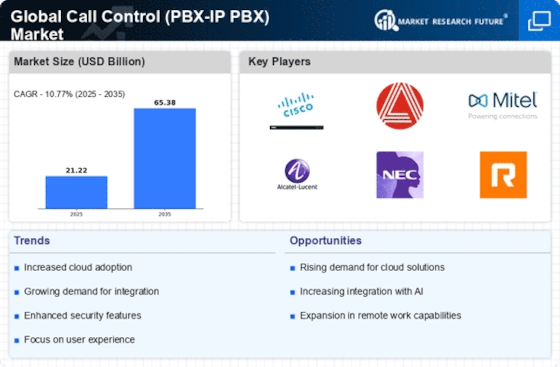
As per Market Research Future analysis, the Global Call Control Market (PBX-IP PBX) Market Size was estimated at 21.22 USD Billion in 2024. The Global Call Control industry is projected to grow from 23.51 USD Billion in 2025 to 65.38 USD Billion by 2035, exhibiting a compound annual growth rate (CAGR) of 10.77% during the forecast period 2025 - 2035

Key Market Trends & Highlights

The Global Call Control Market (PBX-IP PBX) Market is experiencing a transformative shift towards advanced technologies and solutions.

  • The integration of AI technologies is becoming increasingly prevalent in enhancing call management functionalities. North America remains the largest market, while the Asia-Pacific region is emerging as the fastest-growing area for call control solutions. IP extensions dominate the market, yet TDM extensions are witnessing rapid growth due to evolving communication needs. Rising demand for unified communications and increased focus on remote work solutions are driving market expansion.

Market Size & Forecast

2024 Market Size 21.22 (USD Billion)
2035 Market Size 65.38 (USD Billion)
CAGR (2025 - 2035) 10.77%
Largest Regional Market Share in 2024 North America

Major Players

Cisco Systems (US), Avaya (US), Mitel Networks (CA), Alcatel-Lucent (FR), NEC Corporation (JP), RingCentral (US), 8x8 (US), Unify (DE), Panasonic (JP)

Market Trends

The Global Call Control Market (PBX-IP PBX) Market is currently experiencing a transformative phase, driven by advancements in communication technologies and the increasing demand for efficient business operations. Organizations are increasingly adopting IP-based systems due to their flexibility, scalability, and cost-effectiveness. This shift is further fueled by the growing trend of remote work, which necessitates robust communication solutions that can seamlessly integrate with various platforms. As businesses seek to enhance customer engagement and streamline internal processes, the adoption of sophisticated call control systems appears to be on the rise. Moreover, the market landscape is evolving with the introduction of artificial intelligence and machine learning technologies. These innovations are likely to enhance the functionality of PBX systems, enabling features such as predictive analytics and automated call routing. Additionally, the emphasis on cybersecurity is becoming more pronounced, as organizations prioritize the protection of sensitive data within their communication frameworks. Overall, the Global Call Control Market (PBX-IP PBX) Market seems poised for substantial growth, driven by technological advancements and changing business needs.

Integration of AI Technologies

The incorporation of artificial intelligence into call control systems is becoming increasingly prevalent. AI technologies facilitate enhanced customer interactions through features like chatbots and automated responses, which can significantly improve service efficiency.

Focus on Cybersecurity

As organizations become more reliant on digital communication, the emphasis on cybersecurity within the Global Call Control Market (PBX-IP PBX) Market is intensifying. Companies are investing in advanced security measures to protect sensitive information and ensure compliance with regulations.

Shift Towards Cloud-Based Solutions

There is a noticeable trend towards cloud-based PBX systems, which offer greater flexibility and scalability. This shift allows businesses to adapt their communication infrastructure to meet evolving demands without significant upfront investments.

Call Control Market Market Drivers

Regulatory Compliance and Data Security

Regulatory compliance and data security concerns are significant drivers for the Call Control Market (PBX-IP PBX) Market. Organizations are increasingly required to adhere to stringent regulations regarding data protection and privacy. This has led to a heightened demand for communication systems that ensure secure data transmission and storage. Companies are investing in PBX solutions that offer robust security features, such as encryption and access controls, to mitigate risks associated with data breaches. Market trends suggest that businesses prioritizing compliance are more inclined to adopt advanced call control systems that align with regulatory requirements. As the landscape of data security continues to evolve, the demand for secure PBX and IP PBX solutions is expected to grow, further influencing market dynamics.

Increased Focus on Remote Work Solutions

The shift towards remote work has created a substantial demand for flexible communication solutions, thereby influencing the Call Control Market (PBX-IP PBX) Market. Organizations are increasingly adopting remote work policies, necessitating robust communication systems that can support distributed teams. This trend has led to a surge in the deployment of cloud-based PBX systems, which offer scalability and accessibility from various locations. Market data indicates that the adoption of cloud PBX solutions has risen sharply, with many businesses recognizing the need for reliable communication tools that facilitate remote collaboration. As remote work becomes a permanent fixture in many industries, the demand for effective call control systems is likely to continue its upward trajectory, shaping the future landscape of the market.

Rising Demand for Unified Communications

The increasing demand for unified communications solutions is a primary driver for the Call Control Market (PBX-IP PBX) Market. Organizations are seeking integrated systems that combine voice, video, and messaging capabilities into a single platform. This trend is evident as businesses aim to enhance collaboration and improve operational efficiency. According to recent data, the market for unified communications is projected to grow significantly, with estimates suggesting a compound annual growth rate of over 15% in the coming years. This growth is likely to propel the adoption of PBX and IP PBX systems, as they offer the necessary infrastructure to support these integrated solutions. As companies continue to prioritize seamless communication, the demand for advanced call control systems is expected to rise, further driving the market forward.

Growing Importance of Customer Experience

The emphasis on customer experience is increasingly influencing the Call Control Market (PBX-IP PBX) Market. Businesses are recognizing that effective communication is vital for maintaining customer satisfaction and loyalty. As a result, organizations are investing in advanced call control systems that provide features such as call analytics, customer relationship management integration, and personalized communication options. Data indicates that companies prioritizing customer experience are more likely to adopt sophisticated PBX solutions that enhance their service delivery. This trend is expected to drive market growth, as businesses strive to differentiate themselves in competitive landscapes by offering superior communication capabilities. The focus on customer experience is likely to remain a key driver for the adoption of call control technologies.

Technological Advancements in Communication Systems

Technological advancements play a crucial role in shaping the Call Control Market (PBX-IP PBX) Market. Innovations such as Voice over Internet Protocol (VoIP), artificial intelligence, and machine learning are transforming traditional communication systems. These technologies enhance call quality, improve customer interactions, and streamline operations. For instance, VoIP technology has enabled businesses to reduce communication costs significantly while providing advanced features like call routing and analytics. Market analysis suggests that the integration of AI into call control systems is expected to enhance user experience and operational efficiency. As these technologies continue to evolve, they are likely to drive the adoption of PBX and IP PBX solutions, as organizations seek to leverage the benefits of modern communication tools.

Market Segment Insights

By Product: IP Extensions (Largest) vs. TDM Extensions (Fastest-Growing)

In the Global Call Control Market (PBX-IP PBX) Market, the distribution of market share among the product segments reveals that IP Extensions dominate significantly. This dominance is attributed to the increasing adoption of VoIP technology and the shift towards cloud-based solutions that facilitate remote work and enhance communication capabilities. In contrast, TDM Extensions, while currently smaller in share, are witnessing a rapid growth trend as businesses look to upgrade their legacy systems to more efficient and flexible communication infrastructures.

IP Extensions (Dominant) vs. TDM Extensions (Emerging)

IP Extensions stand out as the dominant force in the Global Call Control Market (PBX-IP PBX) Market, driven by their cost-effectiveness, flexibility, and ability to integrate with modern technologies. These extensions utilize internet protocols, enabling businesses to benefit from improved communication efficiencies, scalability, and diverse features such as video conferencing and advanced voicemail options. On the other hand, TDM Extensions are emerging rapidly due to the ongoing transition from traditional telephony systems to IP-based solutions. Though traditionally associated with older infrastructure, TDM Extensions are evolving to incorporate hybrid solutions, making them attractive for organizations seeking reliable communication methods without full-scale migrations.

By Application: Commercial (Largest) vs. Industrial (Fastest-Growing)

In the Global Call Control Market (PBX-IP PBX) Market, the Commercial segment significantly dominates the market landscape, achieving a substantial market share due to its widespread adoption across various business sizes and sectors. Businesses invest heavily in PBX and IP PBX systems to enhance communication efficiency, streamline operations, and reduce costs. Consequently, this segment benefits from a steady influx of technological advancements, making it the go-to choice for many.

Application: Commercial (Dominant) vs. Industrial (Emerging)

The Commercial segment stands as a dominant force within the Global Call Control Market (PBX-IP PBX) Market, characterized by its versatility and adaptability to diverse business environments. It encompasses various organizational settings, from small offices to large enterprises, leveraging advanced communication systems to facilitate seamless interactions. On the other hand, the Industrial segment is emerging as a faster-growing entity, driven by the need for robust and reliable communication solutions in manufacturing and production settings. Industries are increasingly recognizing the importance of efficient communication for operational success and are integrating PBX technologies to meet their needs.

Get more detailed insights about Call Control (PBX-IP PBX) Market Research Report - Forecast till 2035

Regional Insights

By region, the study provides market insights into North America, Europe, Asia-Pacific, and the Rest of the World. The North American call control (PBX-IP PBX) market area will dominate due to the high adoption of unified communication technologies and VoIP technology in various large industries, such as BFSI, hospitality, and healthcare will boost the market growth in this region. Further, the US call control (PBX-IP PBX) market held the largest market share, and the Canada call control (PBX-IP PBX) market was the fastest-growing market in the North American region.

Further, the major countries studied in the market report are The US, Canada, German, France, the UK, Italy, Spain, China, Japan, India, Australia, South Korea, and Brazil.

Figure 2: Call Control Market (PBX-IP PBX) Market SHARE BY REGION 2022 (USD Billion)

Europe's call control (PBX-IP PBX) market accounts for the second-largest market share due to an increase in technological advancements and modernization in communication systems and a rise in demand from the emerging economies in this region. Further, the German call control (PBX-IP PBX) market held the largest market share, and the UK call control (PBX-IP PBX) market was the fastest-growing market in the European region.

The Asia-Pacific call control (PBX-IP PBX) Market is expected to grow at the fastest CAGR from 2024 to 2032. This is due to the increasing adoption of IP-based telephony and the need for advanced features such as call forwarding and voicemail in this region. Moreover, China’s call control (PBX-IP PBX) market held the largest market share, and the Indian call control (PBX-IP PBX) market was the fastest-growing market in the Asia-Pacific region.

Key Players and Competitive Insights

Leading market players are investing heavily in research and development to expand their product lines, which will help the call control (PBX-IP PBX) market grow even more. Market participants are also undertaking various strategic activities to expand their global footprint, with significant market developments including new product launches, contractual agreements, mergers and acquisitions, higher investments, and collaboration with other organizations. To expand and survive in a more competitive and rising market climate, the call control (PBX-IP PBX) industry must offer cost-effective items.Manufacturing locally to minimize operational costs is a critical business tactic manufacturers use in the global call control (PBX-IP PBX) industry to benefit clients and increase the market sector. Major players in the call control (PBX-IP PBX) market, including Cisco, NEC, Avaya, Panasonic, Mitel, Alcatel-Lucent Enterprise, Call Control Market LLC, Polycom LLC, EIL Global, and ERGOMAN GmbH, and others, are attempting to increase market demand by investing in research and development operations.Vonage is a telecommunications company that provides cloud communication services to businesses and individuals. Founded in 2001 and headquartered in Holmdel, New Jersey, Vonage offers a range of communication solutions, including voice-over IP (VoIP) phone systems, messaging, video conferencing, and contact center solutions. Vonage serves a diverse customer base across various industries, including healthcare, finance, retail, and professional services. Their solutions are often utilized by businesses seeking to modernize their communication infrastructure, improve customer engagement, and enhance collaboration among their teams.

In October Vonage partnered with Hacktoberfest to stimulate and celebrate assistance to the Open Source community.The company plans to help by giving access to their libraries, code snippets, and demos on GitHub.ThinkTel is a Canadian telecommunications company that provides business voice, data, and integrated cloud-based services. Established in 2003 and based in Toronto, ThinkTel focuses on delivering scalable and reliable communication solutions to businesses of all sizes across Canada. The company operates as a wholesale provider, offering various services to resellers, carriers, and managed service providers (MSPs). ThinkTel's primary offering is its Session Initiation Protocol (SIP) trunking service, which enables businesses to connect their on-premises or cloud-based phone systems to the public switched telephone network (PSTN) using IP technology.

In April ThinkTel, a division of Distributel, announced its hosted PBX unified communications offering called MaX UC in partnership with Metaswitch. ThinkTel has been delivering a fully managed hosted PBX solution since 2010 and announced the evolution of its unified communications suite.

Key Companies in the Call Control Market include

Industry Developments

February 2021: VitalPBX launched a unified communication network for businesses. The VitalPBX VitXi provides tools that allow companies to communicate regardless of location. The solution allows businesses to use a WebRTC-based softphone in their browser, with features such as chat, file-sharing, and audio or video calls.

February 2021: G12 Communications added Microsoft Connect to Teams IP PBX Service. Customers with existing phone systems can quickly and affordably migrate to Microsoft Teams and enable PSTN calling with the new Connect to Teams IP PBX Service. G12 offers a solution for all consumers who want to transition to Microsoft Teams if they wish to integrate with a Cloud PBX service, an IP PBX system, need Direct Routing, or make a complete transition to Microsoft Teams. G12's Connect to Teams portfolio G12 gives customers the flexibility needed to migrate to cloud-based voice services for Microsoft Teams.

Future Outlook

Call Control Market Future Outlook

The Global Call Control Market (PBX-IP PBX) Market is projected to grow at a 10.77% CAGR from 2025 to 2035, driven by advancements in cloud technology, increasing demand for remote communication, and enhanced integration capabilities.

New opportunities lie in:

  • Development of AI-driven call analytics tools for enhanced customer insights.</p><p>Expansion into emerging markets with tailored PBX solutions.</p><p>Integration of IoT devices for seamless communication and operational efficiency.

By 2035, the market is expected to solidify its position as a leader in communication technology.

Market Segmentation

Call Control Market Product Outlook

  • IP Extensions
  • TDM Extensions

Call Control Market Application Outlook

  • Commercial
  • Industrial

Report Scope

MARKET SIZE 2024 21.22(USD Billion)
MARKET SIZE 2025 23.51(USD Billion)
MARKET SIZE 2035 65.38(USD Billion)
COMPOUND ANNUAL GROWTH RATE (CAGR) 10.77% (2025 - 2035)
REPORT COVERAGE Revenue Forecast, Competitive Landscape, Growth Factors, and Trends
BASE YEAR 2024
Market Forecast Period 2025 - 2035
Historical Data 2019 - 2024
Market Forecast Units USD Billion
Key Companies Profiled Cisco Systems (US), Avaya (US), Mitel Networks (CA), Alcatel-Lucent (FR), NEC Corporation (JP), RingCentral (US), 8x8 (US), Unify (DE), Panasonic (JP)
Segments Covered Product, Application, Region
Key Market Opportunities Integration of artificial intelligence enhances efficiency in the Global Call Control (PBX-IP PBX) Market.
Key Market Dynamics Rising demand for cloud-based solutions drives innovation and competition in the Call Control (PBX-IP PBX) market.
Countries Covered North America, Europe, APAC, South America, MEA

FAQs

What is the projected market valuation for the Global Call Control (PBX-IP PBX) Market in 2035?

<p>The projected market valuation for the Global Call Control (PBX-IP PBX) Market in 2035 is 65.38 USD Billion.</p>

What was the market valuation of the Global Call Control (PBX-IP PBX) Market in 2024?

<p>The market valuation of the Global Call Control (PBX-IP PBX) Market in 2024 was 21.22 USD Billion.</p>

What is the expected CAGR for the Global Call Control (PBX-IP PBX) Market from 2025 to 2035?

<p>The expected CAGR for the Global Call Control (PBX-IP PBX) Market during the forecast period 2025 - 2035 is 10.77%.</p>

Which companies are considered key players in the Global Call Control (PBX-IP PBX) Market?

<p>Key players in the Global Call Control (PBX-IP PBX) Market include Cisco Systems, Avaya, Mitel Networks, Alcatel-Lucent, NEC Corporation, RingCentral, 8x8, Unify, and Panasonic.</p>

What are the projected valuations for IP Extensions and TDM Extensions in The Global Call Control (PBX-IP PBX)?

<p>The projected valuation for IP Extensions is expected to reach 39.12 USD Billion, while TDM Extensions may reach 26.26 USD Billion.</p>

How do the commercial and industrial applications compare in terms of market valuation?

<p>Both commercial and industrial applications are projected to have a valuation of 32.69 USD Billion in the Global Call Control (PBX-IP PBX) Market.</p>

What trends are influencing the growth of the Global Call Control (PBX-IP PBX) Market?

The growth of the Global Call Control (PBX-IP PBX) Market appears to be influenced by advancements in technology and increasing demand for efficient communication solutions.

What segment is expected to dominate the Global Call Control (PBX-IP PBX) Market by 2035?

The IP Extensions segment is likely to dominate the Global Call Control (PBX-IP PBX) Market by 2035, given its projected growth.

How does the market valuation in 2035 compare to that in 2024?

The market valuation in 2035 is expected to be significantly higher at 65.38 USD Billion compared to 21.22 USD Billion in 2024.

What implications does the projected CAGR have for businesses in The Global Call Control (PBX-IP PBX)?

The projected CAGR of 10.77% suggests that businesses in The Global Call Control (PBX-IP PBX) may experience substantial growth opportunities during the forecast period 2025 - 2035.

  1. SECTION I: EXECUTIVE SUMMARY AND KEY HIGHLIGHTS
    1. | 1.1 EXECUTIVE SUMMARY
    2. | | 1.1.1 Market Overview
    3. | | 1.1.2 Key Findings
    4. | | 1.1.3 Market Segmentation
    5. | | 1.1.4 Competitive Landscape
    6. | | 1.1.5 Challenges and Opportunities
    7. | | 1.1.6 Future Outlook
  2. SECTION II: SCOPING, METHODOLOGY AND MARKET STRUCTURE
    1. | 2.1 MARKET INTRODUCTION
    2. | | 2.1.1 Definition
    3. | | 2.1.2 Scope of the study
    4. | | | 2.1.2.1 Research Objective
    5. | | | 2.1.2.2 Assumption
    6. | | | 2.1.2.3 Limitations
    7. | 2.2 RESEARCH METHODOLOGY
    8. | | 2.2.1 Overview
    9. | | 2.2.2 Data Mining
    10. | | 2.2.3 Secondary Research
    11. | | 2.2.4 Primary Research
    12. | | | 2.2.4.1 Primary Interviews and Information Gathering Process
    13. | | | 2.2.4.2 Breakdown of Primary Respondents
    14. | | 2.2.5 Forecasting Model
    15. | | 2.2.6 Market Size Estimation
    16. | | | 2.2.6.1 Bottom-Up Approach
    17. | | | 2.2.6.2 Top-Down Approach
    18. | | 2.2.7 Data Triangulation
    19. | | 2.2.8 Validation
  3. SECTION III: QUALITATIVE ANALYSIS
    1. | 3.1 MARKET DYNAMICS
    2. | | 3.1.1 Overview
    3. | | 3.1.2 Drivers
    4. | | 3.1.3 Restraints
    5. | | 3.1.4 Opportunities
    6. | 3.2 MARKET FACTOR ANALYSIS
    7. | | 3.2.1 Value chain Analysis
    8. | | 3.2.2 Porter's Five Forces Analysis
    9. | | | 3.2.2.1 Bargaining Power of Suppliers
    10. | | | 3.2.2.2 Bargaining Power of Buyers
    11. | | | 3.2.2.3 Threat of New Entrants
    12. | | | 3.2.2.4 Threat of Substitutes
    13. | | | 3.2.2.5 Intensity of Rivalry
    14. | | 3.2.3 COVID-19 Impact Analysis
    15. | | | 3.2.3.1 Market Impact Analysis
    16. | | | 3.2.3.2 Regional Impact
    17. | | | 3.2.3.3 Opportunity and Threat Analysis
  4. SECTION IV: QUANTITATIVE ANALYSIS
    1. | 4.1 Semiconductor & Electronics, BY Product (USD Billion)
    2. | | 4.1.1 IP Extensions
    3. | | 4.1.2 TDM Extensions
    4. | 4.2 Semiconductor & Electronics, BY Application (USD Billion)
    5. | | 4.2.1 Commercial
    6. | | 4.2.2 Industrial
    7. | 4.3 Semiconductor & Electronics, BY Region (USD Billion)
    8. | | 4.3.1 North America
    9. | | | 4.3.1.1 US
    10. | | | 4.3.1.2 Canada
    11. | | 4.3.2 Europe
    12. | | | 4.3.2.1 Germany
    13. | | | 4.3.2.2 UK
    14. | | | 4.3.2.3 France
    15. | | | 4.3.2.4 Russia
    16. | | | 4.3.2.5 Italy
    17. | | | 4.3.2.6 Spain
    18. | | | 4.3.2.7 Rest of Europe
    19. | | 4.3.3 APAC
    20. | | | 4.3.3.1 China
    21. | | | 4.3.3.2 India
    22. | | | 4.3.3.3 Japan
    23. | | | 4.3.3.4 South Korea
    24. | | | 4.3.3.5 Malaysia
    25. | | | 4.3.3.6 Thailand
    26. | | | 4.3.3.7 Indonesia
    27. | | | 4.3.3.8 Rest of APAC
    28. | | 4.3.4 South America
    29. | | | 4.3.4.1 Brazil
    30. | | | 4.3.4.2 Mexico
    31. | | | 4.3.4.3 Argentina
    32. | | | 4.3.4.4 Rest of South America
    33. | | 4.3.5 MEA
    34. | | | 4.3.5.1 GCC Countries
    35. | | | 4.3.5.2 South Africa
    36. | | | 4.3.5.3 Rest of MEA
  5. SECTION V: COMPETITIVE ANALYSIS
    1. | 5.1 Competitive Landscape
    2. | | 5.1.1 Overview
    3. | | 5.1.2 Competitive Analysis
    4. | | 5.1.3 Market share Analysis
    5. | | 5.1.4 Major Growth Strategy in the Semiconductor & Electronics
    6. | | 5.1.5 Competitive Benchmarking
    7. | | 5.1.6 Leading Players in Terms of Number of Developments in the Semiconductor & Electronics
    8. | | 5.1.7 Key developments and growth strategies
    9. | | | 5.1.7.1 New Product Launch/Service Deployment
    10. | | | 5.1.7.2 Merger & Acquisitions
    11. | | | 5.1.7.3 Joint Ventures
    12. | | 5.1.8 Major Players Financial Matrix
    13. | | | 5.1.8.1 Sales and Operating Income
    14. | | | 5.1.8.2 Major Players R&D Expenditure. 2023
    15. | 5.2 Company Profiles
    16. | | 5.2.1 Cisco Systems (US)
    17. | | | 5.2.1.1 Financial Overview
    18. | | | 5.2.1.2 Products Offered
    19. | | | 5.2.1.3 Key Developments
    20. | | | 5.2.1.4 SWOT Analysis
    21. | | | 5.2.1.5 Key Strategies
    22. | | 5.2.2 Avaya (US)
    23. | | | 5.2.2.1 Financial Overview
    24. | | | 5.2.2.2 Products Offered
    25. | | | 5.2.2.3 Key Developments
    26. | | | 5.2.2.4 SWOT Analysis
    27. | | | 5.2.2.5 Key Strategies
    28. | | 5.2.3 Mitel Networks (CA)
    29. | | | 5.2.3.1 Financial Overview
    30. | | | 5.2.3.2 Products Offered
    31. | | | 5.2.3.3 Key Developments
    32. | | | 5.2.3.4 SWOT Analysis
    33. | | | 5.2.3.5 Key Strategies
    34. | | 5.2.4 Alcatel-Lucent (FR)
    35. | | | 5.2.4.1 Financial Overview
    36. | | | 5.2.4.2 Products Offered
    37. | | | 5.2.4.3 Key Developments
    38. | | | 5.2.4.4 SWOT Analysis
    39. | | | 5.2.4.5 Key Strategies
    40. | | 5.2.5 NEC Corporation (JP)
    41. | | | 5.2.5.1 Financial Overview
    42. | | | 5.2.5.2 Products Offered
    43. | | | 5.2.5.3 Key Developments
    44. | | | 5.2.5.4 SWOT Analysis
    45. | | | 5.2.5.5 Key Strategies
    46. | | 5.2.6 RingCentral (US)
    47. | | | 5.2.6.1 Financial Overview
    48. | | | 5.2.6.2 Products Offered
    49. | | | 5.2.6.3 Key Developments
    50. | | | 5.2.6.4 SWOT Analysis
    51. | | | 5.2.6.5 Key Strategies
    52. | | 5.2.7 8x8 (US)
    53. | | | 5.2.7.1 Financial Overview
    54. | | | 5.2.7.2 Products Offered
    55. | | | 5.2.7.3 Key Developments
    56. | | | 5.2.7.4 SWOT Analysis
    57. | | | 5.2.7.5 Key Strategies
    58. | | 5.2.8 Unify (DE)
    59. | | | 5.2.8.1 Financial Overview
    60. | | | 5.2.8.2 Products Offered
    61. | | | 5.2.8.3 Key Developments
    62. | | | 5.2.8.4 SWOT Analysis
    63. | | | 5.2.8.5 Key Strategies
    64. | | 5.2.9 Panasonic (JP)
    65. | | | 5.2.9.1 Financial Overview
    66. | | | 5.2.9.2 Products Offered
    67. | | | 5.2.9.3 Key Developments
    68. | | | 5.2.9.4 SWOT Analysis
    69. | | | 5.2.9.5 Key Strategies
    70. | 5.3 Appendix
    71. | | 5.3.1 References
    72. | | 5.3.2 Related Reports
  6. LIST OF FIGURES
    1. | 6.1 MARKET SYNOPSIS
    2. | 6.2 NORTH AMERICA MARKET ANALYSIS
    3. | 6.3 US MARKET ANALYSIS BY PRODUCT
    4. | 6.4 US MARKET ANALYSIS BY APPLICATION
    5. | 6.5 CANADA MARKET ANALYSIS BY PRODUCT
    6. | 6.6 CANADA MARKET ANALYSIS BY APPLICATION
    7. | 6.7 EUROPE MARKET ANALYSIS
    8. | 6.8 GERMANY MARKET ANALYSIS BY PRODUCT
    9. | 6.9 GERMANY MARKET ANALYSIS BY APPLICATION
    10. | 6.10 UK MARKET ANALYSIS BY PRODUCT
    11. | 6.11 UK MARKET ANALYSIS BY APPLICATION
    12. | 6.12 FRANCE MARKET ANALYSIS BY PRODUCT
    13. | 6.13 FRANCE MARKET ANALYSIS BY APPLICATION
    14. | 6.14 RUSSIA MARKET ANALYSIS BY PRODUCT
    15. | 6.15 RUSSIA MARKET ANALYSIS BY APPLICATION
    16. | 6.16 ITALY MARKET ANALYSIS BY PRODUCT
    17. | 6.17 ITALY MARKET ANALYSIS BY APPLICATION
    18. | 6.18 SPAIN MARKET ANALYSIS BY PRODUCT
    19. | 6.19 SPAIN MARKET ANALYSIS BY APPLICATION
    20. | 6.20 REST OF EUROPE MARKET ANALYSIS BY PRODUCT
    21. | 6.21 REST OF EUROPE MARKET ANALYSIS BY APPLICATION
    22. | 6.22 APAC MARKET ANALYSIS
    23. | 6.23 CHINA MARKET ANALYSIS BY PRODUCT
    24. | 6.24 CHINA MARKET ANALYSIS BY APPLICATION
    25. | 6.25 INDIA MARKET ANALYSIS BY PRODUCT
    26. | 6.26 INDIA MARKET ANALYSIS BY APPLICATION
    27. | 6.27 JAPAN MARKET ANALYSIS BY PRODUCT
    28. | 6.28 JAPAN MARKET ANALYSIS BY APPLICATION
    29. | 6.29 SOUTH KOREA MARKET ANALYSIS BY PRODUCT
    30. | 6.30 SOUTH KOREA MARKET ANALYSIS BY APPLICATION
    31. | 6.31 MALAYSIA MARKET ANALYSIS BY PRODUCT
    32. | 6.32 MALAYSIA MARKET ANALYSIS BY APPLICATION
    33. | 6.33 THAILAND MARKET ANALYSIS BY PRODUCT
    34. | 6.34 THAILAND MARKET ANALYSIS BY APPLICATION
    35. | 6.35 INDONESIA MARKET ANALYSIS BY PRODUCT
    36. | 6.36 INDONESIA MARKET ANALYSIS BY APPLICATION
    37. | 6.37 REST OF APAC MARKET ANALYSIS BY PRODUCT
    38. | 6.38 REST OF APAC MARKET ANALYSIS BY APPLICATION
    39. | 6.39 SOUTH AMERICA MARKET ANALYSIS
    40. | 6.40 BRAZIL MARKET ANALYSIS BY PRODUCT
    41. | 6.41 BRAZIL MARKET ANALYSIS BY APPLICATION
    42. | 6.42 MEXICO MARKET ANALYSIS BY PRODUCT
    43. | 6.43 MEXICO MARKET ANALYSIS BY APPLICATION
    44. | 6.44 ARGENTINA MARKET ANALYSIS BY PRODUCT
    45. | 6.45 ARGENTINA MARKET ANALYSIS BY APPLICATION
    46. | 6.46 REST OF SOUTH AMERICA MARKET ANALYSIS BY PRODUCT
    47. | 6.47 REST OF SOUTH AMERICA MARKET ANALYSIS BY APPLICATION
    48. | 6.48 MEA MARKET ANALYSIS
    49. | 6.49 GCC COUNTRIES MARKET ANALYSIS BY PRODUCT
    50. | 6.50 GCC COUNTRIES MARKET ANALYSIS BY APPLICATION
    51. | 6.51 SOUTH AFRICA MARKET ANALYSIS BY PRODUCT
    52. | 6.52 SOUTH AFRICA MARKET ANALYSIS BY APPLICATION
    53. | 6.53 REST OF MEA MARKET ANALYSIS BY PRODUCT
    54. | 6.54 REST OF MEA MARKET ANALYSIS BY APPLICATION
    55. | 6.55 KEY BUYING CRITERIA OF SEMICONDUCTOR & ELECTRONICS
    56. | 6.56 RESEARCH PROCESS OF MRFR
    57. | 6.57 DRO ANALYSIS OF SEMICONDUCTOR & ELECTRONICS
    58. | 6.58 DRIVERS IMPACT ANALYSIS: SEMICONDUCTOR & ELECTRONICS
    59. | 6.59 RESTRAINTS IMPACT ANALYSIS: SEMICONDUCTOR & ELECTRONICS
    60. | 6.60 SUPPLY / VALUE CHAIN: SEMICONDUCTOR & ELECTRONICS
    61. | 6.61 SEMICONDUCTOR & ELECTRONICS, BY PRODUCT, 2024 (% SHARE)
    62. | 6.62 SEMICONDUCTOR & ELECTRONICS, BY PRODUCT, 2024 TO 2035 (USD Billion)
    63. | 6.63 SEMICONDUCTOR & ELECTRONICS, BY APPLICATION, 2024 (% SHARE)
    64. | 6.64 SEMICONDUCTOR & ELECTRONICS, BY APPLICATION, 2024 TO 2035 (USD Billion)
    65. | 6.65 BENCHMARKING OF MAJOR COMPETITORS
  7. LIST OF TABLES
    1. | 7.1 LIST OF ASSUMPTIONS
    2. | | 7.1.1
    3. | 7.2 North America MARKET SIZE ESTIMATES; FORECAST
    4. | | 7.2.1 BY PRODUCT, 2025-2035 (USD Billion)
    5. | | 7.2.2 BY APPLICATION, 2025-2035 (USD Billion)
    6. | 7.3 US MARKET SIZE ESTIMATES; FORECAST
    7. | | 7.3.1 BY PRODUCT, 2025-2035 (USD Billion)
    8. | | 7.3.2 BY APPLICATION, 2025-2035 (USD Billion)
    9. | 7.4 Canada MARKET SIZE ESTIMATES; FORECAST
    10. | | 7.4.1 BY PRODUCT, 2025-2035 (USD Billion)
    11. | | 7.4.2 BY APPLICATION, 2025-2035 (USD Billion)
    12. | 7.5 Europe MARKET SIZE ESTIMATES; FORECAST
    13. | | 7.5.1 BY PRODUCT, 2025-2035 (USD Billion)
    14. | | 7.5.2 BY APPLICATION, 2025-2035 (USD Billion)
    15. | 7.6 Germany MARKET SIZE ESTIMATES; FORECAST
    16. | | 7.6.1 BY PRODUCT, 2025-2035 (USD Billion)
    17. | | 7.6.2 BY APPLICATION, 2025-2035 (USD Billion)
    18. | 7.7 UK MARKET SIZE ESTIMATES; FORECAST
    19. | | 7.7.1 BY PRODUCT, 2025-2035 (USD Billion)
    20. | | 7.7.2 BY APPLICATION, 2025-2035 (USD Billion)
    21. | 7.8 France MARKET SIZE ESTIMATES; FORECAST
    22. | | 7.8.1 BY PRODUCT, 2025-2035 (USD Billion)
    23. | | 7.8.2 BY APPLICATION, 2025-2035 (USD Billion)
    24. | 7.9 Russia MARKET SIZE ESTIMATES; FORECAST
    25. | | 7.9.1 BY PRODUCT, 2025-2035 (USD Billion)
    26. | | 7.9.2 BY APPLICATION, 2025-2035 (USD Billion)
    27. | 7.10 Italy MARKET SIZE ESTIMATES; FORECAST
    28. | | 7.10.1 BY PRODUCT, 2025-2035 (USD Billion)
    29. | | 7.10.2 BY APPLICATION, 2025-2035 (USD Billion)
    30. | 7.11 Spain MARKET SIZE ESTIMATES; FORECAST
    31. | | 7.11.1 BY PRODUCT, 2025-2035 (USD Billion)
    32. | | 7.11.2 BY APPLICATION, 2025-2035 (USD Billion)
    33. | 7.12 Rest of Europe MARKET SIZE ESTIMATES; FORECAST
    34. | | 7.12.1 BY PRODUCT, 2025-2035 (USD Billion)
    35. | | 7.12.2 BY APPLICATION, 2025-2035 (USD Billion)
    36. | 7.13 APAC MARKET SIZE ESTIMATES; FORECAST
    37. | | 7.13.1 BY PRODUCT, 2025-2035 (USD Billion)
    38. | | 7.13.2 BY APPLICATION, 2025-2035 (USD Billion)
    39. | 7.14 China MARKET SIZE ESTIMATES; FORECAST
    40. | | 7.14.1 BY PRODUCT, 2025-2035 (USD Billion)
    41. | | 7.14.2 BY APPLICATION, 2025-2035 (USD Billion)
    42. | 7.15 India MARKET SIZE ESTIMATES; FORECAST
    43. | | 7.15.1 BY PRODUCT, 2025-2035 (USD Billion)
    44. | | 7.15.2 BY APPLICATION, 2025-2035 (USD Billion)
    45. | 7.16 Japan MARKET SIZE ESTIMATES; FORECAST
    46. | | 7.16.1 BY PRODUCT, 2025-2035 (USD Billion)
    47. | | 7.16.2 BY APPLICATION, 2025-2035 (USD Billion)
    48. | 7.17 South Korea MARKET SIZE ESTIMATES; FORECAST
    49. | | 7.17.1 BY PRODUCT, 2025-2035 (USD Billion)
    50. | | 7.17.2 BY APPLICATION, 2025-2035 (USD Billion)
    51. | 7.18 Malaysia MARKET SIZE ESTIMATES; FORECAST
    52. | | 7.18.1 BY PRODUCT, 2025-2035 (USD Billion)
    53. | | 7.18.2 BY APPLICATION, 2025-2035 (USD Billion)
    54. | 7.19 Thailand MARKET SIZE ESTIMATES; FORECAST
    55. | | 7.19.1 BY PRODUCT, 2025-2035 (USD Billion)
    56. | | 7.19.2 BY APPLICATION, 2025-2035 (USD Billion)
    57. | 7.20 Indonesia MARKET SIZE ESTIMATES; FORECAST
    58. | | 7.20.1 BY PRODUCT, 2025-2035 (USD Billion)
    59. | | 7.20.2 BY APPLICATION, 2025-2035 (USD Billion)
    60. | 7.21 Rest of APAC MARKET SIZE ESTIMATES; FORECAST
    61. | | 7.21.1 BY PRODUCT, 2025-2035 (USD Billion)
    62. | | 7.21.2 BY APPLICATION, 2025-2035 (USD Billion)
    63. | 7.22 South America MARKET SIZE ESTIMATES; FORECAST
    64. | | 7.22.1 BY PRODUCT, 2025-2035 (USD Billion)
    65. | | 7.22.2 BY APPLICATION, 2025-2035 (USD Billion)
    66. | 7.23 Brazil MARKET SIZE ESTIMATES; FORECAST
    67. | | 7.23.1 BY PRODUCT, 2025-2035 (USD Billion)
    68. | | 7.23.2 BY APPLICATION, 2025-2035 (USD Billion)
    69. | 7.24 Mexico MARKET SIZE ESTIMATES; FORECAST
    70. | | 7.24.1 BY PRODUCT, 2025-2035 (USD Billion)
    71. | | 7.24.2 BY APPLICATION, 2025-2035 (USD Billion)
    72. | 7.25 Argentina MARKET SIZE ESTIMATES; FORECAST
    73. | | 7.25.1 BY PRODUCT, 2025-2035 (USD Billion)
    74. | | 7.25.2 BY APPLICATION, 2025-2035 (USD Billion)
    75. | 7.26 Rest of South America MARKET SIZE ESTIMATES; FORECAST
    76. | | 7.26.1 BY PRODUCT, 2025-2035 (USD Billion)
    77. | | 7.26.2 BY APPLICATION, 2025-2035 (USD Billion)
    78. | 7.27 MEA MARKET SIZE ESTIMATES; FORECAST
    79. | | 7.27.1 BY PRODUCT, 2025-2035 (USD Billion)
    80. | | 7.27.2 BY APPLICATION, 2025-2035 (USD Billion)
    81. | 7.28 GCC Countries MARKET SIZE ESTIMATES; FORECAST
    82. | | 7.28.1 BY PRODUCT, 2025-2035 (USD Billion)
    83. | | 7.28.2 BY APPLICATION, 2025-2035 (USD Billion)
    84. | 7.29 South Africa MARKET SIZE ESTIMATES; FORECAST
    85. | | 7.29.1 BY PRODUCT, 2025-2035 (USD Billion)
    86. | | 7.29.2 BY APPLICATION, 2025-2035 (USD Billion)
    87. | 7.30 Rest of MEA MARKET SIZE ESTIMATES; FORECAST
    88. | | 7.30.1 BY PRODUCT, 2025-2035 (USD Billion)
    89. | | 7.30.2 BY APPLICATION, 2025-2035 (USD Billion)
    90. | 7.31 PRODUCT LAUNCH/PRODUCT DEVELOPMENT/APPROVAL
    91. | | 7.31.1
    92. | 7.32 ACQUISITION/PARTNERSHIP
    93. | | 7.32.1

Semiconductor & Electronics Market Segmentation

Semiconductor & Electronics By Product (USD Billion, 2025-2035)

  • IP Extensions
  • TDM Extensions

Semiconductor & Electronics By Application (USD Billion, 2025-2035)

  • Commercial
  • Industrial
Infographic

Free Sample Request

Kindly complete the form below to receive a free sample of this Report

Get Free Sample

Customer Strories

Compare Licence

×
Features License Type
Single User Multiuser License Enterprise User
Price $4,950 $5,950 $7,250
Maximum User Access Limit 1 User Upto 10 Users Unrestricted Access Throughout the Organization
Free Customization
Direct Access to Analyst
Deliverable Format
Platform Access
Discount on Next Purchase 10% 15% 15%
Printable Versions