×
Request Free Sample ×

Kindly complete the form below to receive a free sample of this Report

* Please use a valid business email

Leading companies partner with us for data-driven Insights

clients tt-cursor
Hero Background
English
Chinese
French
Japanese
Korean
German
Spanish

BYOD Enterprise Mobility Market Trends

ID: MRFR/ICT/5236-HCR
100 Pages
Ankit Gupta
October 2025

BYOD and Enterprise Mobility Market Size, Share and Trends Analysis Report By Software (Mobile Device Management and Mobile Application Management), By Security (Device and Application), By Service (Managed and Professional), By Deployment (Cloud and On-Premise), By End-User (BFSI and IT & Telecom) And By Region (North America, Europe, Asia-Pacific, And Rest Of The World) –Market Forecast Till 2035.

Share:
Download PDF ×

We do not share your information with anyone. However, we may send you emails based on your report interest from time to time. You may contact us at any time to opt-out.

BYOD Enterprise Mobility Market Infographic
×
BYOD Enterprise Mobility Market Infographic Full View
Purchase Options

Market Trends

Key Emerging Trends in the BYOD Enterprise Mobility Market

The Bring Your Own Device (BYOD) and Enterprise Mobility market is shaped by a variety of factors that drive its growth and evolution, addressing the changing landscape of workplace dynamics and technological advancements. One of the primary drivers propelling the expansion of this market is the increasing demand for flexibility and productivity in the modern workplace. With the rise of remote work and the growing trend of employees using personal devices for work-related tasks, businesses are embracing BYOD and enterprise mobility solutions to empower their workforce to work from anywhere, at any time, using their preferred devices. This flexibility not only enhances employee satisfaction and productivity but also enables organizations to adapt to evolving work patterns and attract top talent in a competitive job market.

Moreover, the proliferation of mobile devices and the widespread availability of high-speed internet connectivity are driving the adoption of BYOD and enterprise mobility solutions. Smartphones, tablets, and laptops have become ubiquitous in both professional and personal settings, enabling employees to stay connected and productive while on the go. By allowing employees to use their personal devices for work-related tasks, organizations can leverage the familiarity and convenience of these devices to improve collaboration, communication, and decision-making, thereby driving efficiency and agility in the workplace.

Additionally, the increasing focus on cost optimization and resource efficiency is fueling the adoption of BYOD and enterprise mobility solutions. Traditional IT models, which rely on corporate-owned devices and on-premises infrastructure, can be costly to maintain and manage, particularly for organizations with large and distributed workforces. BYOD and enterprise mobility solutions offer a cost-effective alternative by shifting the burden of device procurement, maintenance, and management to employees while enabling centralized management and security controls to protect sensitive corporate data.

Furthermore, the growing emphasis on cybersecurity and data privacy is driving the adoption of BYOD and enterprise mobility solutions. As organizations embrace digital transformation and cloud computing, they face increasing security threats and regulatory compliance requirements related to the protection of sensitive data. BYOD and enterprise mobility solutions incorporate robust security features such as mobile device management (MDM), mobile application management (MAM), and containerization to safeguard corporate data against unauthorized access, data breaches, and malware attacks. By implementing comprehensive security measures, organizations can mitigate the risks associated with BYOD and enterprise mobility and ensure compliance with regulatory mandates.

The competitive landscape of the BYOD and enterprise mobility market is characterized by a diverse array of vendors, including device manufacturers, software providers, and managed service providers. Established players such as Apple, Samsung, and Microsoft have long dominated the market with their popular devices and productivity software suites, which cater to the diverse needs of enterprise customers. However, they face increasing competition from agile startups and specialized vendors that offer innovative solutions tailored to the unique requirements of BYOD and enterprise mobility, such as secure collaboration tools, virtual desktop infrastructure (VDI), and zero-trust security solutions.

Moreover, strategic partnerships and collaborations are becoming increasingly prevalent in the BYOD and enterprise mobility market as vendors seek to expand their capabilities and reach new customer segments. By partnering with telecommunications carriers, cloud service providers, and cybersecurity firms, BYOD and enterprise mobility vendors can offer more comprehensive solutions that address the end-to-end needs of their customers. These partnerships also enable vendors to leverage their combined expertise and resources to innovate faster and stay ahead of evolving market trends.

Author
Ankit Gupta
Senior Research Analyst

Ankit Gupta is an analyst in market research industry in ICT and SEMI industry. With post-graduation in "Telecom and Marketing Management" and graduation in "Electronics and Telecommunication" vertical he is well versed with recent development in ICT industry as a whole. Having worked on more than 150+ reports including consultation for fortune 500 companies such as Microsoft and Rio Tinto in identifying solutions with respect to business problems his opinions are inclined towards mixture of technical and managerial aspects.

Leave a Comment

FAQs

How much is the BYOD and enterprise mobility market?

The BYOD and enterprise mobility market size was valued at USD 57.39 Billion in 2023.

What is the growth rate of the BYOD and enterprise mobility market?

The market is projected to grow at a CAGR of 13.22% during the forecast period, 2024-2032.

Which region held the largest BYOD and enterprise mobility market share?

North America had the largest share of the market.

Who are the key players in the BYOD and enterprise mobility market?

The key players in the market are Honeywell International (US), Capgemini (Germany), Oracle Corporation (US), and HCL Technologies (India).

Which software type led the BYOD and enterprise mobility market?

The mobile device management category dominated the market in 2022.

Which end-user mode had the largest market in the BYOD and enterprise mobility market share?

IT & Telecom had the largest share of the market.

Market Summary

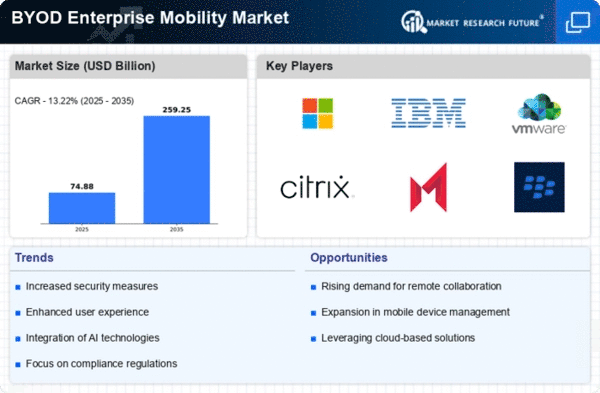
As per MRFR analysis, the BYOD Enterprise Mobility Market Size was estimated at 66.14 USD Billion in 2024. The BYOD Enterprise Mobility industry is projected to grow from 74.89 USD Billion in 2025 to 259.25 USD Billion by 2035, exhibiting a compound annual growth rate (CAGR) of 13.22 during the forecast period 2025 - 2035.

Key Market Trends & Highlights

The BYOD Enterprise Mobility Market is experiencing robust growth driven by security needs and technological advancements.

  • The market is witnessing an increased focus on security solutions to protect sensitive data across devices.
  • Integration of artificial intelligence is enhancing mobile device management capabilities, particularly in North America.
  • Remote work policies are driving demand for flexible work arrangements, especially among small enterprises.
  • Rising demand for data security and compliance, along with advancements in mobile device management solutions, are key drivers in the Asia-Pacific region.

Market Size & Forecast

2024 Market Size 66.14 (USD Billion)
2035 Market Size 259.25 (USD Billion)
CAGR (2025 - 2035) 13.22%
Largest Regional Market Share in 2024 North America

Major Players

Microsoft (US), IBM (US), VMware (US), Citrix (US), MobileIron (US), BlackBerry (CA), SAP (DE), Oracle (US), Cisco (US)

Market Trends

The BYOD Enterprise Mobility Market is currently experiencing a transformative phase, driven by the increasing integration of personal devices into corporate environments. Organizations are recognizing the potential benefits of allowing employees to use their own devices for work purposes, which can enhance productivity and employee satisfaction. This trend appears to be fueled by advancements in mobile technology and the growing demand for flexible work arrangements. As businesses adapt to this evolving landscape, they are also faced with challenges related to security and data management, necessitating the implementation of robust policies and solutions to safeguard sensitive information. Moreover, the BYOD Enterprise Mobility Market is likely to witness a surge in the adoption of mobile device management (MDM) solutions. These tools are essential for ensuring that personal devices comply with corporate security standards while maintaining user privacy. The emphasis on user experience and seamless integration of applications is becoming increasingly important, as organizations strive to create a cohesive work environment that accommodates diverse device types. As this market continues to evolve, it may also see a rise in partnerships between technology providers and enterprises, aimed at developing innovative solutions that address the unique challenges posed by BYOD policies.

Increased Focus on Security Solutions

As the BYOD Enterprise Mobility Market expands, there is a heightened emphasis on security measures. Organizations are investing in advanced security solutions to protect sensitive data accessed through personal devices. This trend indicates a proactive approach to mitigating risks associated with data breaches and unauthorized access.

Integration of Artificial Intelligence

The integration of artificial intelligence into mobile applications is becoming more prevalent within the BYOD Enterprise Mobility Market. AI technologies are being utilized to enhance user experience, streamline workflows, and provide personalized services, suggesting a shift towards more intelligent and adaptive mobile solutions.

Growth of Remote Work Policies

The BYOD Enterprise Mobility Market is witnessing a notable increase in the establishment of remote work policies. Companies are recognizing the need for flexible work arrangements, which may lead to a more significant reliance on personal devices for professional tasks, thereby reshaping traditional workplace dynamics.

BYOD Enterprise Mobility Market Market Drivers

Market Growth Projections

The Global BYOD and Enterprise Mobility Market Industry is poised for substantial growth, with projections indicating a rise from 66.1 USD Billion in 2024 to 259.3 USD Billion by 2035. This remarkable increase suggests a strong demand for mobile solutions as organizations continue to embrace BYOD policies. The anticipated CAGR of 13.22% from 2025 to 2035 reflects the industry's potential to adapt to evolving technological landscapes. As companies increasingly recognize the benefits of mobility, investments in innovative solutions are likely to surge, further driving market expansion. This growth trajectory underscores the importance of understanding market dynamics and aligning strategies with emerging trends.

Cost Efficiency and Savings

Cost efficiency is a significant factor influencing the Global BYOD and Enterprise Mobility Market Industry. Organizations that implement BYOD policies often experience reduced hardware and software costs, as employees utilize their personal devices. This approach can lead to substantial savings in IT expenditures. Moreover, the flexibility of BYOD can enhance employee satisfaction, potentially reducing turnover rates. As the market evolves, companies are likely to invest in mobile management solutions to streamline operations and ensure security. The anticipated growth from 66.1 USD Billion in 2024 to 259.3 USD Billion by 2035 indicates a strong trend towards cost-effective mobility solutions.

Enhanced Security Solutions

The increasing focus on security is a crucial driver in the Global BYOD and Enterprise Mobility Market Industry. As organizations adopt BYOD policies, the need for robust security measures becomes paramount. Companies are investing in advanced mobile device management (MDM) solutions to safeguard sensitive data and maintain compliance with regulations. This trend is likely to continue as cyber threats evolve, necessitating a proactive approach to security. The market's projected growth, with a CAGR of 13.22% from 2025 to 2035, suggests that organizations are prioritizing security investments to protect their mobile environments. Enhanced security measures not only mitigate risks but also build trust among employees and clients.

Integration of Cloud Services

The integration of cloud services is a pivotal driver in the Global BYOD and Enterprise Mobility Market Industry. Cloud computing enables organizations to store and access data remotely, facilitating seamless collaboration among employees using various devices. This trend supports the BYOD model, as employees can access necessary applications and files from their personal devices. The growing reliance on cloud services is likely to contribute to the market's expansion, with projections indicating a CAGR of 13.22% from 2025 to 2035. As businesses increasingly adopt cloud-based solutions, the demand for enterprise mobility tools that enhance accessibility and security is expected to rise.

Shift Towards Remote Work Culture

The shift towards a remote work culture is reshaping the Global BYOD and Enterprise Mobility Market Industry. Organizations are increasingly adopting flexible work arrangements, allowing employees to work from various locations. This trend necessitates the use of mobile devices and applications to facilitate communication and collaboration. As a result, companies are investing in enterprise mobility solutions that support remote work. The anticipated growth from 66.1 USD Billion in 2024 to 259.3 USD Billion by 2035 highlights the importance of mobility in modern workplaces. This cultural shift appears to be driving demand for innovative solutions that enhance productivity while ensuring data security.

Increased Adoption of Mobile Devices

The proliferation of mobile devices is a primary driver in the Global BYOD and Enterprise Mobility Market Industry. As organizations increasingly allow employees to use personal devices for work, the demand for mobile solutions rises. In 2024, the market is projected to reach 66.1 USD Billion, reflecting a growing trend towards mobility. This shift not only enhances employee productivity but also fosters a more flexible work environment. Companies are recognizing the benefits of enabling remote access and collaboration, which are essential in today's digital landscape. The integration of mobile technology into daily operations appears to be a strategic move for many enterprises.

Market Segment Insights

By Application: Mobile Device Management (Largest) vs. Security Management (Fastest-Growing)

In the BYOD Enterprise Mobility Market, Mobile Device Management (MDM) holds the largest share, reflecting its critical role in ensuring the security and management of diverse devices within an organization. This segment is essential for enterprises aiming to maintain control over employee devices while facilitating their use for work-related tasks. Following closely is Security Management, which, while currently smaller in market share, is rapidly gaining traction as businesses prioritize securing sensitive data and maintaining compliance with regulatory standards. The growth trends in this segment are driven by the increasing adoption of remote work, which has led to a higher number of personal devices accessing corporate networks. This trend emphasizes the need for robust security solutions and effective management strategies. Additionally, the rise in cyber threats is propelling organizations to invest more in Security Management, which is viewed as a crucial element for protecting organizational assets and data privacy.

Mobile Device Management: Dominant vs. Application Management: Emerging

Mobile Device Management (MDM) stands as the dominant force in the BYOD Enterprise Mobility Market due to its established framework for device control and security across various platforms. Organizations leverage MDM solutions to enforce security policies, manage app deployments, and enable remote wipe capabilities. Conversely, Application Management has emerged as a vital segment, focusing on managing app deployment, updates, and lifecycle management. This segment addresses the complexities introduced by the increasing use of applications in enterprise settings, making it essential for businesses striving to enhance productivity without compromising on security. Both segments complement each other, with MDM providing foundational device management while Application Management ensures that the apps employees use are secure and compliant.

By End Use: Small Enterprises (Largest) vs. Large Enterprises (Fastest-Growing)

In the BYOD Enterprise Mobility Market, Small Enterprises hold the largest share due to their agility and swift adoption of mobile technologies. This segment leverages BYOD policies to enhance employee productivity while keeping operational costs low, making it an appealing choice for smaller businesses. In contrast, Medium and Large Enterprises are also significant players but tend to adopt these technologies at a slower pace due to their complex structures and increased regulatory requirements.

Small Enterprises: Dominant vs. Large Enterprises: Emerging

Small Enterprises are the dominant force in the BYOD Enterprise Mobility Market, characterized by their flexibility and readiness to implement innovative mobility solutions. These businesses utilize BYOD to foster a culture of collaboration, allowing employees to use personal devices for work purposes, thus enhancing efficiency. Large Enterprises represent an emerging segment as they rapidly adapt to changing tech landscapes, focusing on secure mobility solutions that maintain employee productivity while addressing compliance and security challenges inherent to larger organizations.

By Deployment Type: Cloud-Based (Largest) vs. On-Premises (Fastest-Growing)

In the BYOD Enterprise Mobility Market, the distribution of deployment types reveals that cloud-based solutions hold a significant share, primarily due to the increasing demand for flexibility and scalability among enterprises. This model facilitates easier updates and access to resources, making it an appealing choice for businesses adopting mobile practices. On the other hand, on-premises solutions are gaining traction as companies seek enhanced security and control over their data, giving rise to a competitive dynamic between the two deployment types.

Cloud-Based (Dominant) vs. On-Premises (Emerging)

Cloud-based deployment in the BYOD Enterprise Mobility Market is characterized by its ability to provide seamless accessibility and scalability, making it a dominant choice for businesses. The integration of advanced cloud technologies allows for real-time data access, enabling organizations to respond rapidly to changing business needs. Conversely, on-premises deployment is emerging rapidly as more organizations prioritize data security and compliance. This model allows companies to maintain direct control over their infrastructure, making it particularly appealing to industries with stringent regulatory requirements. As businesses evolve, the competition between these deployment methods is set to intensify.

By Industry Vertical: Healthcare (Largest) vs. Retail (Fastest-Growing)

In the BYOD Enterprise Mobility Market, healthcare stands out as the largest segment, driven by the need for enhanced communication and operational efficiency in medical settings. This vertical relies heavily on mobile devices for remote patient monitoring and healthcare management, leveraging the flexibility and convenience offered by BYOD solutions. In contrast, the retail sector is witnessing rapid growth, predominantly fueled by the increasing adoption of mobile technologies to enhance customer experiences and streamline operations. Retailers are transforming their business models by integrating mobile solutions into inventory management and point-of-sale systems, driving higher adoption of BYOD strategies. The growth in these segments can be attributed to several factors, particularly the ongoing digital transformation across industries. The healthcare industry's focus on improving patient care through mobility solutions is a significant driver, while retail's agile adaptations to consumer behaviors and preferences elevate its growth. Moreover, the pandemic has accelerated the need for mobile access in both sectors, leading organizations to adopt BYOD more extensively to ensure seamless operations and enhance productivity.

Healthcare (Dominant) vs. Retail (Emerging)

The healthcare sector remains dominant in the BYOD Enterprise Mobility Market, characterized by stringent compliance requirements and a high reliance on mobile technologies for patient data access and telemedicine applications. The continuous evolution of mobile health solutions is reshaping how healthcare professionals engage with patients, making mobility essential for delivering timely and effective services. On the other hand, retail is emerging as a vibrant sector, propelled by innovations in customer engagement strategies and inventory management. Retailers are leveraging mobile applications to enhance customer interaction and streamline sales processes, ultimately fostering customer loyalty. This duality in market dynamics showcases how healthcare leads in necessity while retail embraces mobility for competitive edge in customer satisfaction and operational efficiency.

By Device Type: Smartphones (Largest) vs. Laptops (Fastest-Growing)

In the BYOD Enterprise Mobility Market, smartphones dominate the device type segment due to their widespread adoption and functionality, catering to the demands of mobile workforce management. They hold the largest market share, appealing to a variety of businesses looking to enhance productivity and flexibility among employees. In contrast, laptops, while traditionally prevalent, are now gaining traction as organizations seek powerful tools for remote work settings, marking them as the fastest-growing segment within this category. The growth of laptops can be attributed to the increasing demand for more robust processing capabilities, enabling a seamless transition from in-office to remote work environments. Additionally, innovations in laptop technologies, such as lightweight designs and enhanced battery life, further contribute to their appeal. As companies prioritize employee effectiveness in various working conditions, the inclination towards laptops is expected to continue on an upward trajectory, presenting significant opportunities within the market.

Smartphones: Dominant vs. Laptops: Emerging

Smartphones, being the dominant device in the BYOD Enterprise Mobility Market, offer unparalleled convenience and accessibility for employees. They enable instant communication and real-time collaboration, reshaping workplace dynamics. Their compact nature allows for easy integration into various business functions, fostering a culture of mobility and efficiency. Conversely, laptops, identified as an emerging segment, are adapting to the shift towards remote work while providing substantial processing power for demanding applications. As organizations embrace the trend of hybrid workspaces, laptops are becoming increasingly essential for tasks requiring advanced software capabilities, driving their growth. Both segments are critical as they align with the evolving needs of businesses aiming to enhance their operational agility.

Get more detailed insights about BYOD And Enterprise Mobility Market Research Report – Global Forecast To 2035

Regional Insights

North America : Market Leader in BYOD Mobility

North America continues to lead the BYOD Enterprise Mobility Market, holding a significant market share of 35.0% as of 2024. The region's growth is driven by increasing smartphone penetration, a shift towards remote work, and the demand for flexible work solutions. Regulatory support for data security and privacy further catalyzes market expansion, as organizations seek compliant solutions to manage mobile devices effectively. The competitive landscape is robust, with key players like Microsoft, IBM, and VMware dominating the market. The U.S. stands out as a primary contributor, leveraging advanced technology infrastructure and a strong focus on innovation. Companies are increasingly adopting BYOD policies to enhance productivity and employee satisfaction, making North America a pivotal region for enterprise mobility solutions.

Europe : Emerging Market with Growth Potential

Europe's BYOD Enterprise Mobility Market is poised for growth, currently valued at 15.0%. The region is witnessing a surge in demand for mobile solutions driven by digital transformation initiatives and the need for enhanced workforce flexibility. Regulatory frameworks, such as GDPR, are shaping the market by emphasizing data protection, which encourages organizations to adopt secure BYOD practices. Leading countries like Germany, the UK, and France are at the forefront of this trend, with a competitive landscape featuring major players like SAP and Oracle. The presence of established tech firms and startups alike fosters innovation, making Europe a dynamic market for BYOD solutions. As organizations increasingly recognize the benefits of mobility, the region is set to experience significant growth in the coming years.

Asia-Pacific : Rapid Growth in Mobility Solutions

The Asia-Pacific region is emerging as a significant player in the BYOD Enterprise Mobility Market, currently valued at 12.0%. The growth is fueled by rising smartphone usage, increasing internet penetration, and a growing trend towards remote work. Governments are also promoting digital initiatives, which act as catalysts for the adoption of mobile solutions across various sectors, enhancing overall productivity. Countries like China, India, and Japan are leading the charge, with a competitive landscape that includes both local and international players. Companies are increasingly investing in mobile security solutions to address concerns related to data breaches and compliance. The presence of key players such as VMware and Citrix further strengthens the market, positioning Asia-Pacific as a vital region for BYOD enterprise mobility.

Middle East and Africa : Emerging Market with Untapped Potential

The Middle East and Africa (MEA) region is gradually emerging in the BYOD Enterprise Mobility Market, currently valued at 4.14%. The growth is driven by increasing smartphone adoption and a shift towards digital transformation across various industries. Governments are investing in technology infrastructure, which is essential for supporting mobile solutions and enhancing workforce efficiency in the region. Countries like South Africa and the UAE are leading the way, with a competitive landscape that includes both local startups and international firms. The presence of key players such as BlackBerry and Cisco is notable, as they provide tailored solutions to meet regional needs. As organizations recognize the benefits of BYOD, the MEA region is expected to see substantial growth in enterprise mobility solutions.

Key Players and Competitive Insights

The BYOD Enterprise Mobility Market is characterized by a dynamic competitive landscape, driven by the increasing demand for flexible work environments and the need for enhanced security measures. Major players such as Microsoft (US), IBM (US), and VMware (US) are strategically positioned to leverage their technological prowess and extensive service offerings. Microsoft (US) focuses on integrating its cloud services with mobile device management solutions, thereby enhancing user experience and security. IBM (US) emphasizes its AI-driven analytics to optimize mobile security and compliance, while VMware (US) is concentrating on providing seamless virtualization solutions that facilitate remote work. Collectively, these strategies foster a competitive environment that prioritizes innovation and adaptability in response to evolving market demands.Key business tactics within the BYOD Enterprise Mobility Market include localized service offerings and supply chain optimization, which are essential for meeting diverse regional needs. The market structure appears moderately fragmented, with a mix of established players and emerging startups. This fragmentation allows for a variety of solutions tailored to specific business requirements, while the collective influence of key players drives technological advancements and sets industry standards.

In November Microsoft (US) announced the launch of its new mobile security framework, which integrates advanced threat protection with its existing cloud services. This strategic move is significant as it not only enhances the security posture of organizations adopting BYOD policies but also positions Microsoft (US) as a leader in the mobile security domain. By focusing on comprehensive security solutions, Microsoft (US) aims to address the growing concerns surrounding data breaches and compliance issues in mobile environments.

In October IBM (US) unveiled its latest AI-driven mobile management platform, designed to streamline device management and enhance user productivity. This initiative reflects IBM's commitment to harnessing artificial intelligence to improve operational efficiency. The introduction of this platform is likely to attract businesses seeking to optimize their mobile workforce while ensuring robust security measures are in place, thereby reinforcing IBM's competitive edge in the market.

In September VMware (US) expanded its partnership with leading telecommunications providers to enhance its mobile virtualization solutions. This collaboration aims to deliver more robust and scalable solutions for enterprises adopting BYOD strategies. The strategic importance of this partnership lies in VMware's ability to leverage telecommunications infrastructure, which could potentially lead to improved service delivery and customer satisfaction, further solidifying its market position.

As of December current competitive trends in the BYOD Enterprise Mobility Market are heavily influenced by digitalization, sustainability, and the integration of AI technologies. Strategic alliances among key players are shaping the landscape, fostering innovation and enhancing service offerings. Looking ahead, competitive differentiation is expected to evolve, with a notable shift from price-based competition to a focus on innovation, technological advancements, and supply chain reliability. This transition underscores the necessity for companies to adapt and innovate continuously to maintain their competitive advantage in an increasingly complex market.

Key Companies in the BYOD Enterprise Mobility Market include

Industry Developments

June 2023: Honeywell presented its new Honeywell Digital Prime solution, which is a cloud-based digital twin for tracking, managing, and testing process control changes and system changes. Digital Prime is an affordable option that lets users test more often for more accurate results and less reactive maintenance overall.

May 2023: HCLTech, a major player in the technology industry, has launched SmartPaaS, a Platform-as-a-Service product developed in tandem with Red Hat, to help businesses accelerate their digital transformation efforts.

Future Outlook

BYOD Enterprise Mobility Market Future Outlook

The BYOD Enterprise Mobility Market is projected to grow at a 13.22% CAGR from 2024 to 2035, driven by increasing mobile workforce demands and advancements in security technologies.

New opportunities lie in:

  • Development of AI-driven mobile device management solutions.
  • Expansion of secure cloud storage services for BYOD environments.
  • Creation of tailored training programs for employee device security awareness.

By 2035, the market is expected to be robust, reflecting substantial growth and innovation.

Market Segmentation

BYOD Enterprise Mobility Market End Use Outlook

  • Small Enterprises
  • Medium Enterprises
  • Large Enterprises

BYOD Enterprise Mobility Market Application Outlook

  • Mobile Device Management
  • Security Management
  • Data Management
  • Application Management

BYOD Enterprise Mobility Market Device Type Outlook

  • Smartphones
  • Tablets
  • Laptops

BYOD Enterprise Mobility Market Deployment Type Outlook

  • Cloud-Based
  • On-Premises

BYOD Enterprise Mobility Market Industry Vertical Outlook

  • Healthcare
  • Retail
  • Education
  • Manufacturing

Report Scope

MARKET SIZE 202466.14(USD Billion)
MARKET SIZE 202574.89(USD Billion)
MARKET SIZE 2035259.25(USD Billion)
COMPOUND ANNUAL GROWTH RATE (CAGR)13.22% (2025 - 2035)
REPORT COVERAGERevenue Forecast, Competitive Landscape, Growth Factors, and Trends
BASE YEAR2024
Market Forecast Period2025 - 2035
Historical Data2019 - 2024
Market Forecast UnitsUSD Billion
Key Companies ProfiledMicrosoft (US), IBM (US), VMware (US), Citrix (US), MobileIron (US), BlackBerry (CA), SAP (DE), Oracle (US), Cisco (US)
Segments CoveredApplication, End Use, Deployment Type, Industry Vertical, Device Type
Key Market OpportunitiesIntegration of advanced security solutions to enhance data protection in the BYOD Enterprise Mobility Market.
Key Market DynamicsRising demand for flexible work arrangements drives innovation in BYOD Enterprise Mobility solutions and security measures.
Countries CoveredNorth America, Europe, APAC, South America, MEA

FAQs

How much is the BYOD and enterprise mobility market?

The BYOD and enterprise mobility market size was valued at USD 57.39 Billion in 2023.

What is the growth rate of the BYOD and enterprise mobility market?

The market is projected to grow at a CAGR of 13.22% during the forecast period, 2024-2032.

Which region held the largest BYOD and enterprise mobility market share?

North America had the largest share of the market.

Who are the key players in the BYOD and enterprise mobility market?

The key players in the market are Honeywell International (US), Capgemini (Germany), Oracle Corporation (US), and HCL Technologies (India).

Which software type led the BYOD and enterprise mobility market?

The mobile device management category dominated the market in 2022.

Which end-user mode had the largest market in the BYOD and enterprise mobility market share?

IT & Telecom had the largest share of the market.

  1. SECTION I: EXECUTIVE SUMMARY AND KEY HIGHLIGHTS
    1. | 1.1 EXECUTIVE SUMMARY
  2. SECTION II: SCOPING, METHODOLOGY AND MARKET STRUCTURE
    1. | 2.1 MARKET INTRODUCTION
    2. | 2.2 RESEARCH METHODOLOGY
  3. SECTION III: QUALITATIVE ANALYSIS
    1. | 3.1 MARKET DYNAMICS
    2. | 3.2 MARKET FACTOR ANALYSIS
  4. SECTION IV: QUANTITATIVE ANALYSIS
    1. | 4.1 Information and Communications Technology, BY Application (USD Billion)
    2. | 4.2 Information and Communications Technology, BY End Use (USD Billion)
    3. | 4.3 Information and Communications Technology, BY Deployment Type (USD Billion)
    4. | 4.4 Information and Communications Technology, BY Industry Vertical (USD Billion)
    5. | 4.5 Information and Communications Technology, BY Device Type (USD Billion)
    6. | 4.6 Information and Communications Technology, BY Region (USD Billion)
  5. SECTION V: COMPETITIVE ANALYSIS
    1. | 5.1 Competitive Landscape
    2. | 5.2 Company Profiles
    3. | 5.3 Appendix

BYOD And Enterprise Mobility Market Segmentation

Market Segmentation Overview

  • Detailed segmentation data will be available in the full report
  • Comprehensive analysis by multiple parameters
  • Regional and country-level breakdowns
  • Market size forecasts by segment
Infographic

Free Sample Request

Kindly complete the form below to receive a free sample of this Report

Get Free Sample

Customer Strories

Compare Licence

×
Features License Type
Single User Multiuser License Enterprise User
Price $4,950 $5,950 $7,250
Maximum User Access Limit 1 User Upto 10 Users Unrestricted Access Throughout the Organization
Free Customization
Direct Access to Analyst
Deliverable Format
Platform Access
Discount on Next Purchase 10% 15% 15%
Printable Versions