
×
  • Cat-intel
  • MedIntelliX
  • Resources
  • About Us
  • Hero Background
    English
    Chinese
    French
    Japanese
    Korean
    German
    Spanish

    Broadcasting Equipment Market Analysis

    ID: MRFR/SEM/6176-CR
    101 Pages
    Ankit Gupta
    April 2023

    Broadcasting Equipment Market Research Report Information By Application (CATV, Direct Broadcasting Satellite, Terrestrial Television, IPTV, Radio), By Product (Encoders, Dish Antenna, Transmitter and repeater, Switch, Video Server, Amplifier, Modulator), And By Region (North America, Asia-Pacific, Europe, And Rest Of The World) –Market Forecast Till 2035

    Share:
    Download PDF ×

    We do not share your information with anyone. However, we may send you emails based on your report interest from time to time. You may contact us at any time to opt-out.

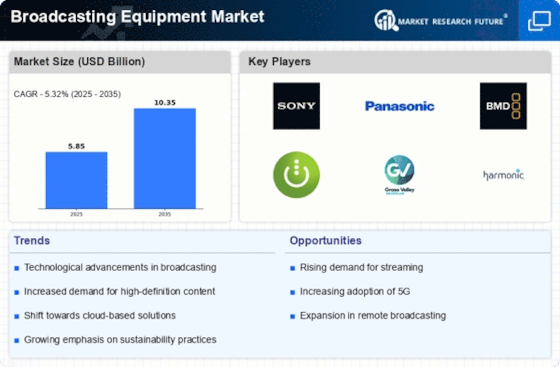
    Broadcasting Equipment Market Infographic
    Purchase Options

    Market Analysis

    In-depth Analysis of Broadcasting Equipment Market Industry Landscape

    The broadcasting equipment market is a dynamic and rapidly evolving sector, driven by advancements in technology and the ever-changing demands of the media and entertainment industry. As consumer preferences shift towards high-definition content and immersive viewing experiences, broadcasters continually seek to upgrade their equipment to stay competitive in the market.

    One of the key market dynamics shaping the broadcasting equipment industry is the constant innovation in technology. The introduction of cutting-edge solutions, such as 4K and 8K broadcasting, virtual reality (VR), and augmented reality (AR), has fueled the demand for new and upgraded equipment. Broadcasters are investing heavily in state-of-the-art cameras, video servers, and production switchers to deliver content that meets the increasingly high expectations of viewers.

    Moreover, the shift towards digital broadcasting has been a significant driver of market dynamics. The transition from analog to digital broadcasting has not only improved the quality of signals but has also opened up new avenues for broadcasters to deliver content through various platforms. As a result, there is a growing need for equipment that supports multi-platform distribution, including over-the-top (OTT) services, streaming platforms, and social media.

    Consolidation within the media industry is another noteworthy factor influencing market dynamics. Mergers and acquisitions among major broadcasting companies have created larger entities with extensive networks and a broader reach. These industry consolidations drive the demand for more sophisticated and scalable broadcasting equipment to support the expanded operations of these conglomerates.

    Global events and sports tournaments play a pivotal role in shaping the market dynamics of broadcasting equipment. The demand for high-quality live coverage of major events, such as the Olympics, World Cup, and other international competitions, drives broadcasters to upgrade their equipment to meet the technical challenges of delivering seamless and immersive experiences to viewers worldwide. This surge in demand often leads to temporary spikes in the market, prompting manufacturers to anticipate and respond to these cyclical patterns.

    Cost considerations and budget constraints are also influential factors in the broadcasting equipment market. While there is a constant drive towards adopting the latest technologies, broadcasters must balance their desire for innovation with the practicalities of budget limitations. This dynamic creates a market environment where manufacturers must offer a range of solutions, from cost-effective entry-level equipment to high-end, feature-rich products catering to the diverse needs of broadcasters.

    Regulatory changes and standards also contribute to the evolving dynamics of the broadcasting equipment market. As governments and regulatory bodies update broadcasting standards and guidelines, equipment manufacturers must adapt to meet these new requirements. This may involve enhancing the capabilities of existing equipment or developing entirely new solutions to comply with updated regulations, creating opportunities for innovation within the market.


    Author
    Ankit Gupta
    Senior Research Analyst

    Ankit Gupta is an analyst in market research industry in ICT and SEMI industry. With post-graduation in "Telecom and Marketing Management" and graduation in "Electronics and Telecommunication" vertical he is well versed with recent development in ICT industry as a whole. Having worked on more than 150+ reports including consultation for fortune 500 companies such as Microsoft and Rio Tinto in identifying solutions with respect to business problems his opinions are inclined towards mixture of technical and managerial aspects.

    Leave a Comment

    FAQs

    What is the projected market valuation of the Broadcasting Equipment Market by 2035?

    The Broadcasting Equipment Market is projected to reach a valuation of 10.35 USD Billion by 2035.

    What was the market valuation of the Broadcasting Equipment Market in 2024?

    In 2024, the Broadcasting Equipment Market was valued at 5.854 USD Billion.

    What is the expected CAGR for the Broadcasting Equipment Market during the forecast period 2025 - 2035?

    The expected CAGR for the Broadcasting Equipment Market during the forecast period 2025 - 2035 is 5.32%.

    Which companies are considered key players in the Broadcasting Equipment Market?

    Key players in the Broadcasting Equipment Market include Sony, Panasonic, Blackmagic Design, Avid Technology, Grass Valley, Harmonic, Telestream, Imagine Communications, and Evertz Microsystems.

    What are the main application segments of the Broadcasting Equipment Market?

    The main application segments include CATV, Direct Broadcasting Satellite, Terrestrial Television, IPTV, and Radio.

    What is the projected growth for the IPTV segment from 2024 to 2035?

    The IPTV segment is expected to grow from 1.5 USD Billion in 2024 to 2.5 USD Billion by 2035.

    Market Summary

    As per MRFR analysis, the Broadcasting Equipment Market was estimated at 5.854 USD Billion in 2024. The Broadcasting Equipment industry is projected to grow from 6.165 USD Billion in 2025 to 10.35 USD Billion by 2035, exhibiting a compound annual growth rate (CAGR) of 5.32 during the forecast period 2025 - 2035.

    Key Market Trends & Highlights

    The Broadcasting Equipment Market is experiencing dynamic growth driven by technological advancements and evolving consumer preferences.

    • The rise of streaming services is reshaping content delivery and consumption patterns in the market.
    • Integration of AI and automation is enhancing operational efficiency and content management across broadcasting platforms.
    • North America remains the largest market, while Asia-Pacific is emerging as the fastest-growing region in broadcasting equipment.
    • Technological advancements and the growing demand for live content are key drivers propelling the market forward.

    Market Size & Forecast

    2024 Market Size 5.854 (USD Billion)
    2035 Market Size 10.35 (USD Billion)
    CAGR (2025 - 2035) 5.32%
    Largest Regional Market Share in 2024 North America

    Major Players

    <p>Sony (JP), Panasonic (JP), Blackmagic Design (AU), Avid Technology (US), Grass Valley (CA), Harmonic (US), Telestream (US), Imagine Communications (US), Evertz Microsystems (CA)</p>

    Market Trends

    The Broadcasting Equipment Market is currently experiencing a dynamic evolution, driven by advancements in technology and changing consumer preferences. The proliferation of digital platforms has led to an increased demand for high-quality broadcasting solutions, as content creators seek to enhance viewer engagement. Innovations in streaming technology, coupled with the rise of mobile consumption, are reshaping the landscape of broadcasting. As a result, companies are investing in state-of-the-art equipment to meet the expectations of a more discerning audience. Furthermore, the integration of artificial intelligence and automation into broadcasting processes appears to streamline operations, potentially reducing costs and improving efficiency. In addition to technological advancements, regulatory changes and the growing emphasis on sustainability are influencing the Broadcasting Equipment Market. Stakeholders are increasingly aware of the environmental impact of their operations, prompting a shift towards eco-friendly equipment and practices. This trend may not only enhance brand reputation but also align with the values of a more environmentally conscious consumer base. As the market continues to evolve, it seems likely that adaptability and innovation will be crucial for companies aiming to thrive in this competitive environment.

    Rise of Streaming Services

    The surge in streaming platforms is reshaping the Broadcasting Equipment Market. Content providers are increasingly adopting advanced broadcasting technologies to deliver high-quality experiences to viewers. This trend indicates a shift from traditional broadcasting methods to more flexible, on-demand services.

    Integration of AI and Automation

    The incorporation of artificial intelligence and automation in broadcasting processes is becoming more prevalent. This development suggests that companies are seeking to enhance operational efficiency and reduce costs, while also improving content delivery and audience engagement.

    Focus on Sustainability

    There is a growing emphasis on sustainable practices within the Broadcasting Equipment Market. Companies are exploring eco-friendly equipment and solutions, reflecting a broader commitment to environmental responsibility. This trend may resonate with consumers who prioritize sustainability in their purchasing decisions.

    Broadcasting Equipment Market Market Drivers

    Technological Advancements

    The Broadcasting Equipment Market is experiencing rapid technological advancements that enhance the quality and efficiency of broadcasting. Innovations such as 4K and 8K resolution cameras, along with advanced audio equipment, are becoming standard. These technologies not only improve viewer experience but also increase production capabilities. The market for broadcasting equipment is projected to grow at a compound annual growth rate of approximately 6.5% from 2025 to 2030, driven by these advancements. Furthermore, the integration of cloud-based solutions allows for more flexible and scalable broadcasting operations, which is particularly appealing to smaller broadcasters looking to compete with larger entities. As technology continues to evolve, the Broadcasting Equipment Market is likely to see increased investment in state-of-the-art equipment.

    Growing Demand for Live Content

    The demand for live content is surging, significantly impacting the Broadcasting Equipment Market. Audiences are increasingly favoring real-time events, such as sports, concerts, and news broadcasts, which necessitate high-quality broadcasting equipment. This trend is reflected in the rising investments in live broadcasting technologies, including mobile production units and advanced streaming solutions. According to recent estimates, the live streaming market is expected to reach USD 184.3 billion by 2027, indicating a robust growth trajectory. As broadcasters strive to meet this demand, they are likely to invest in cutting-edge equipment that can deliver seamless live experiences. This growing appetite for live content is a key driver for the Broadcasting Equipment Market, pushing companies to innovate and enhance their offerings.

    Regulatory Changes and Standards

    Regulatory changes and evolving standards are shaping the Broadcasting Equipment Market in various ways. Governments and regulatory bodies are increasingly implementing new guidelines to ensure quality and safety in broadcasting. For instance, the transition to digital broadcasting has necessitated upgrades in equipment to comply with new standards. This shift has led to a significant increase in demand for compliant broadcasting equipment, as companies must adapt to remain competitive. Additionally, the push for higher quality audio and video standards, such as the adoption of ATSC 3.0 in the United States, is driving investments in advanced broadcasting technologies. As regulations continue to evolve, the Broadcasting Equipment Market is likely to see sustained growth as companies seek to meet these new requirements.

    Expansion of Broadcasting Networks

    The expansion of broadcasting networks is a crucial driver for the Broadcasting Equipment Market. As new players enter the market and existing broadcasters expand their reach, there is a growing need for advanced broadcasting equipment. This expansion is particularly evident in emerging markets, where increased access to technology and rising disposable incomes are fueling demand for diverse content. The establishment of new channels and platforms necessitates investment in high-quality broadcasting equipment to ensure competitive offerings. Furthermore, partnerships between traditional broadcasters and digital platforms are becoming more common, leading to increased demand for versatile equipment that can cater to various formats. This trend indicates a robust growth potential for the Broadcasting Equipment Market as it adapts to the evolving landscape of broadcasting.

    Increased Investment in Content Creation

    Increased investment in content creation is significantly influencing the Broadcasting Equipment Market. As competition intensifies among broadcasters, there is a heightened focus on producing high-quality, original content to attract and retain viewers. This trend is driving demand for advanced broadcasting equipment, including cameras, editing suites, and production tools. According to industry reports, content creation budgets are expected to rise by over 10% annually, reflecting the industry's commitment to quality. Additionally, the rise of independent creators and small production companies is contributing to this demand, as they seek professional-grade equipment to enhance their productions. As investment in content creation continues to grow, the Broadcasting Equipment Market is poised for substantial expansion, driven by the need for innovative and high-performance broadcasting solutions.

    Market Segment Insights

    By Application: CATV (Largest) vs. IPTV (Fastest-Growing)

    <p>In the Broadcasting Equipment Market, the application segment is predominantly led by Cable Television (CATV), which maintains the largest market share among its peers. Direct Broadcasting Satellite and Terrestrial Television also play crucial roles, capturing significant portions of the market. Radio, while a vital medium, shows a smaller share compared to CATV and other streaming technologies. This distribution underlines the leading influence of CATV in delivering content and its established infrastructure.</p>

    <p>Technology: CATV (Dominant) vs. IPTV (Emerging)</p>

    <p>Cable Television (CATV) has long been the dominant player in the Broadcasting Equipment Market, characterized by its extensive reach and established subscriber base. Its robust infrastructure supports a wide array of channels and services, ensuring viewer satisfaction. In contrast, Internet Protocol Television (IPTV) is emerging rapidly, driven by the growing adoption of high-speed internet and a shift towards on-demand content. IPTV offers flexibility and customization, appealing particularly to younger demographics who favor streaming services over traditional broadcasting. Both segments reflect diverse consumer preferences, contributing uniquely to the evolving landscape.</p>

    By Product: Encoders (Largest) vs. Transmitter and Repeaters (Fastest-Growing)

    <p>The Broadcasting Equipment Market showcases a diverse array of products including encoders, dish antennas, transmitters and repeaters, switches, video servers, amplifiers, and modulators. Among these, encoders hold the largest market share due to their critical role in encoding audio and video for various broadcasting formats. Meanwhile, transmitter and repeaters are noted for their rapid growth, driven by increasing demands for signal reliability and broadcast quality. The rising consumption of streaming services further amplifies the existing competition among these products, enhancing their market presence.</p>

    <p>Encoders (Dominant) vs. Transmitters and Repeaters (Emerging)</p>

    <p>Encoders are pivotal to the Broadcasting Equipment Market, transforming raw audio and video inputs into formats suitable for distribution. This segment benefits from technological advancements that facilitate improved efficiency and output quality, allowing for a wider range of broadcasting options. On the other hand, transmitters and repeaters are emerging as vital components, essential for maintaining signal integrity over long distances. The development of advanced transmission technologies enhances signal strength and quality, ensuring better reception. As digital broadcasting continues to expand, both segments are expected to flourish, with encoders maintaining dominance in the market and transmitters and repeaters rapidly adapting to meet evolving consumer needs.</p>

    Get more detailed insights about Broadcasting Equipment Market Research Report - Global Forecast till 2035

    Regional Insights

    North America : Innovation and Technology Hub

    North America dominates the broadcasting equipment market, holding approximately 40% of the global share, driven by technological advancements and high demand for quality content. The region benefits from a robust regulatory framework that encourages innovation and investment in broadcasting technologies. The increasing adoption of 4K and 8K broadcasting formats is further propelling market growth, alongside the rise of OTT platforms that require advanced broadcasting solutions. The United States is the largest market, followed by Canada, both showcasing a competitive landscape with key players like Avid Technology, Harmonic, and Grass Valley. The presence of major broadcasting networks and a strong focus on R&D contribute to the region's leadership. Companies are investing heavily in next-gen broadcasting technologies, ensuring they remain at the forefront of the industry.

    Europe : Emerging Market Dynamics

    Europe is witnessing significant growth in the broadcasting equipment market, accounting for around 30% of the global share. The region's growth is driven by increasing investments in digital broadcasting infrastructure and supportive regulatory frameworks that promote innovation. The European Union's initiatives to enhance digital connectivity and broadcasting standards are key catalysts for market expansion, alongside the rising demand for high-definition content. Leading countries such as Germany, the UK, and France are at the forefront, with a competitive landscape featuring major players like Sony and Panasonic. The presence of numerous broadcasting networks and a strong emphasis on content quality are driving the demand for advanced broadcasting equipment. The region's commitment to sustainability and digital transformation further enhances its market potential.

    Asia-Pacific : Rapid Growth and Adoption

    Asia-Pacific is rapidly emerging as a powerhouse in the broadcasting equipment market, holding approximately 25% of the global share. The region's growth is fueled by increasing urbanization, rising disposable incomes, and a growing appetite for digital content. Countries like China and India are leading this growth, supported by government initiatives aimed at enhancing digital infrastructure and broadcasting capabilities, which are crucial for market expansion. China is the largest market in the region, followed by India, with a competitive landscape that includes key players like Blackmagic Design and Telestream. The increasing penetration of smartphones and internet connectivity is driving demand for innovative broadcasting solutions. The region's focus on technological advancements and content diversity is expected to further boost market growth in the coming years.

    Middle East and Africa : Untapped Market Potential

    The Middle East and Africa region is witnessing a gradual expansion in the broadcasting equipment market, holding about 5% of the global share. The growth is primarily driven by increasing investments in media infrastructure and a rising demand for high-quality broadcasting solutions. Government initiatives aimed at enhancing digital broadcasting capabilities are also contributing to market development, alongside the growing popularity of streaming services in the region. Leading countries such as South Africa and the UAE are at the forefront of this growth, with a competitive landscape that includes both local and international players. The presence of key companies like Imagine Communications and Evertz Microsystems is enhancing the region's capabilities. As the market matures, the focus on innovative broadcasting technologies is expected to increase, paving the way for future growth.

    Key Players and Competitive Insights

    The Broadcasting Equipment Market is currently characterized by a dynamic competitive landscape, driven by rapid technological advancements and evolving consumer demands. Key players such as Sony (Japan), Panasonic (Japan), and Avid Technology (US) are at the forefront, each adopting distinct strategies to enhance their market positioning. Sony (Japan) emphasizes innovation through its development of advanced imaging technologies, while Panasonic (Japan) focuses on expanding its product portfolio to include more integrated solutions for broadcasting. Avid Technology (US), on the other hand, is concentrating on digital transformation, enhancing its software offerings to streamline production workflows. Collectively, these strategies not only bolster their individual market shares but also intensify competition, as companies strive to differentiate themselves in a crowded marketplace.

    In terms of business tactics, companies are increasingly localizing manufacturing to reduce costs and improve supply chain efficiency. This approach appears to be particularly relevant in the context of the Broadcasting Equipment Market, which is moderately fragmented, with several players vying for dominance. The collective influence of these key players shapes the market structure, as they engage in strategic partnerships and collaborations to enhance their technological capabilities and market reach.

    In August 2025, Sony (Japan) announced a strategic partnership with a leading cloud service provider to enhance its broadcasting solutions. This collaboration aims to integrate cloud-based technologies into Sony's existing product lines, thereby enabling broadcasters to leverage scalable and flexible solutions. The strategic importance of this move lies in its potential to position Sony as a leader in the rapidly evolving landscape of cloud broadcasting, catering to the increasing demand for remote production capabilities.

    Similarly, in July 2025, Avid Technology (US) launched a new suite of AI-driven tools designed to optimize content creation and distribution processes. This initiative reflects Avid's commitment to innovation and its recognition of the growing importance of artificial intelligence in the broadcasting sector. By integrating AI into its offerings, Avid not only enhances its competitive edge but also addresses the industry's need for more efficient and effective content management solutions.

    Moreover, in September 2025, Panasonic (Japan) unveiled a new line of eco-friendly broadcasting equipment, aligning with global sustainability trends. This strategic move not only demonstrates Panasonic's commitment to environmental responsibility but also positions the company favorably among increasingly eco-conscious consumers and businesses. The introduction of sustainable products is likely to resonate well in a market that is progressively prioritizing sustainability alongside technological advancement.

    As of October 2025, the Broadcasting Equipment Market is witnessing significant trends such as digitalization, sustainability, and the integration of artificial intelligence. Strategic alliances are becoming increasingly pivotal, as companies recognize the need to collaborate to stay competitive. Looking ahead, it is anticipated that competitive differentiation will evolve, shifting from traditional price-based competition to a focus on innovation, technological advancements, and supply chain reliability. This transition underscores the necessity for companies to adapt and innovate continuously to maintain their competitive positions in a rapidly changing market.

    Key Companies in the Broadcasting Equipment Market market include

    Industry Developments

    • Q2 2024: Imagine Communications Launches New Selenio Network Processor for IP Video Workflows Imagine Communications announced the launch of its new Selenio Network Processor, designed to support advanced IP video workflows for broadcasters, enabling seamless transition from SDI to IP infrastructure.
    • Q2 2024: Sony Electronics Announces New Flagship 4K Broadcast Camera System Sony Electronics unveiled its latest flagship 4K broadcast camera system, targeting live sports and event production, with enhanced image quality and real-time HDR capabilities.
    • Q2 2024: Grass Valley Appoints Louis Hernandez Jr. as CEO Broadcast technology provider Grass Valley announced the appointment of Louis Hernandez Jr. as its new Chief Executive Officer, effective immediately.
    • Q2 2024: Avid Technology Completes Acquisition of NextGen Video Solutions Avid Technology completed the acquisition of NextGen Video Solutions, expanding its portfolio in cloud-based broadcast production and video editing tools.
    • Q3 2024: Blackmagic Design Opens New Manufacturing Facility in Singapore Blackmagic Design announced the opening of a new manufacturing facility in Singapore to increase production capacity for its broadcast and video equipment.
    • Q3 2024: Harmonic Wins Major Contract to Supply Video Delivery Infrastructure for European Broadcaster Harmonic secured a contract to supply advanced video delivery infrastructure to a leading European broadcaster, supporting next-generation OTT and linear TV services.
    • Q3 2024: Telestream Acquires Encoding.com to Expand Cloud Media Processing Capabilities Telestream announced the acquisition of Encoding.com, enhancing its cloud-based media processing and workflow automation offerings for broadcasters.
    • Q4 2024: Rohde & Schwarz Launches New ATSC 3.0 Transmitter for US Market Rohde & Schwarz introduced a new ATSC 3.0 transmitter designed for the US broadcast market, supporting advanced digital TV standards and interactive services.
    • Q4 2024: EVS Announces Strategic Partnership with AWS for Cloud-Based Live Production EVS entered a strategic partnership with Amazon Web Services (AWS) to deliver cloud-based live production solutions for broadcasters and media companies.
    • Q1 2025: Vizrt Group Raises $100 Million in Series C Funding to Accelerate Broadcast Graphics Innovation Vizrt Group secured $100 million in Series C funding to drive innovation in broadcast graphics and real-time video production technologies.
    • Q1 2025: Panasonic Connect Unveils New Remote Production Platform for Broadcasters Panasonic Connect launched a new remote production platform, enabling broadcasters to manage live events and content creation from distributed locations.
    • Q2 2025: Haivision Systems Wins Contract to Provide Video Streaming Solutions for Major Asian Sports Network Haivision Systems was awarded a contract to supply video streaming solutions for a major Asian sports network, supporting live event coverage and remote production.

    Future Outlook

    Broadcasting Equipment Market Future Outlook

    <p>The Broadcasting Equipment Market is projected to grow at a 5.32% CAGR from 2024 to 2035, driven by technological advancements, increased content consumption, and the rise of streaming services.</p>

    New opportunities lie in:

    • <p>Development of AI-driven content management systems</p>
    • <p>Expansion into cloud-based broadcasting solutions</p>
    • <p>Investment in 5G-enabled broadcasting technologies</p>

    <p>By 2035, the market is expected to be robust, reflecting substantial growth and innovation.</p>

    Market Segmentation

    Broadcasting Equipment Market Product Outlook

    • Encoders
    • Dish Antenna
    • Transmitter and Repeaters
    • Switch
    • Video Server
    • Amplifier
    • Modulator

    Broadcasting Equipment Market Application Outlook

    • CATV
    • Direct Broadcasting Satellite
    • Terrestrial Television
    • IPTV
    • Radio

    Report Scope

    MARKET SIZE 20245.854(USD Billion)
    MARKET SIZE 20256.165(USD Billion)
    MARKET SIZE 203510.35(USD Billion)
    COMPOUND ANNUAL GROWTH RATE (CAGR)5.32% (2024 - 2035)
    REPORT COVERAGERevenue Forecast, Competitive Landscape, Growth Factors, and Trends
    BASE YEAR2024
    Market Forecast Period2025 - 2035
    Historical Data2019 - 2024
    Market Forecast UnitsUSD Billion
    Key Companies ProfiledMarket analysis in progress
    Segments CoveredMarket segmentation analysis in progress
    Key Market OpportunitiesIntegration of advanced streaming technologies enhances content delivery in the Broadcasting Equipment Market.
    Key Market DynamicsTechnological advancements and regulatory changes drive innovation and competition in the Broadcasting Equipment Market.
    Countries CoveredNorth America, Europe, APAC, South America, MEA

    FAQs

    What is the projected market valuation of the Broadcasting Equipment Market by 2035?

    The Broadcasting Equipment Market is projected to reach a valuation of 10.35 USD Billion by 2035.

    What was the market valuation of the Broadcasting Equipment Market in 2024?

    In 2024, the Broadcasting Equipment Market was valued at 5.854 USD Billion.

    What is the expected CAGR for the Broadcasting Equipment Market during the forecast period 2025 - 2035?

    The expected CAGR for the Broadcasting Equipment Market during the forecast period 2025 - 2035 is 5.32%.

    Which companies are considered key players in the Broadcasting Equipment Market?

    Key players in the Broadcasting Equipment Market include Sony, Panasonic, Blackmagic Design, Avid Technology, Grass Valley, Harmonic, Telestream, Imagine Communications, and Evertz Microsystems.

    What are the main application segments of the Broadcasting Equipment Market?

    The main application segments include CATV, Direct Broadcasting Satellite, Terrestrial Television, IPTV, and Radio.

    What is the projected growth for the IPTV segment from 2024 to 2035?

    The IPTV segment is expected to grow from 1.5 USD Billion in 2024 to 2.5 USD Billion by 2035.

    1. SECTION I: EXECUTIVE SUMMARY AND KEY HIGHLIGHTS
      1. | 1.1 EXECUTIVE SUMMARY
      2. | | 1.1.1 Market Overview
      3. | | 1.1.2 Key Findings
      4. | | 1.1.3 Market Segmentation
      5. | | 1.1.4 Competitive Landscape
      6. | | 1.1.5 Challenges and Opportunities
      7. | | 1.1.6 Future Outlook
    2. SECTION II: SCOPING, METHODOLOGY AND MARKET STRUCTURE
      1. | 2.1 MARKET INTRODUCTION
      2. | | 2.1.1 Definition
      3. | | 2.1.2 Scope of the study
      4. | | | 2.1.2.1 Research Objective
      5. | | | 2.1.2.2 Assumption
      6. | | | 2.1.2.3 Limitations
      7. | 2.2 RESEARCH METHODOLOGY
      8. | | 2.2.1 Overview
      9. | | 2.2.2 Data Mining
      10. | | 2.2.3 Secondary Research
      11. | | 2.2.4 Primary Research
      12. | | | 2.2.4.1 Primary Interviews and Information Gathering Process
      13. | | | 2.2.4.2 Breakdown of Primary Respondents
      14. | | 2.2.5 Forecasting Model
      15. | | 2.2.6 Market Size Estimation
      16. | | | 2.2.6.1 Bottom-Up Approach
      17. | | | 2.2.6.2 Top-Down Approach
      18. | | 2.2.7 Data Triangulation
      19. | | 2.2.8 Validation
    3. SECTION III: QUALITATIVE ANALYSIS
      1. | 3.1 MARKET DYNAMICS
      2. | | 3.1.1 Overview
      3. | | 3.1.2 Drivers
      4. | | 3.1.3 Restraints
      5. | | 3.1.4 Opportunities
      6. | 3.2 MARKET FACTOR ANALYSIS
      7. | | 3.2.1 Value chain Analysis
      8. | | 3.2.2 Porter's Five Forces Analysis
      9. | | | 3.2.2.1 Bargaining Power of Suppliers
      10. | | | 3.2.2.2 Bargaining Power of Buyers
      11. | | | 3.2.2.3 Threat of New Entrants
      12. | | | 3.2.2.4 Threat of Substitutes
      13. | | | 3.2.2.5 Intensity of Rivalry
      14. | | 3.2.3 COVID-19 Impact Analysis
      15. | | | 3.2.3.1 Market Impact Analysis
      16. | | | 3.2.3.2 Regional Impact
      17. | | | 3.2.3.3 Opportunity and Threat Analysis
    4. SECTION IV: QUANTITATIVE ANALYSIS
      1. | 4.1 Semiconductor & Electronics, BY Application (USD Billion)
      2. | | 4.1.1 CATV
      3. | | 4.1.2 Direct Broadcasting Satellite
      4. | | 4.1.3 Terrestrial Television
      5. | | 4.1.4 IPTV
      6. | | 4.1.5 Radio
      7. | 4.2 Semiconductor & Electronics, BY Product (USD Billion)
      8. | | 4.2.1 Encoders
      9. | | 4.2.2 Dish Antenna
      10. | | 4.2.3 Transmitter and Repeaters
      11. | | 4.2.4 Switch
      12. | | 4.2.5 Video Server
      13. | | 4.2.6 Amplifier
      14. | | 4.2.7 Modulator
      15. | 4.3 Semiconductor & Electronics, BY Region (USD Billion)
      16. | | 4.3.1 North America
      17. | | | 4.3.1.1 US
      18. | | | 4.3.1.2 Canada
      19. | | 4.3.2 Europe
      20. | | | 4.3.2.1 Germany
      21. | | | 4.3.2.2 UK
      22. | | | 4.3.2.3 France
      23. | | | 4.3.2.4 Russia
      24. | | | 4.3.2.5 Italy
      25. | | | 4.3.2.6 Spain
      26. | | | 4.3.2.7 Rest of Europe
      27. | | 4.3.3 APAC
      28. | | | 4.3.3.1 China
      29. | | | 4.3.3.2 India
      30. | | | 4.3.3.3 Japan
      31. | | | 4.3.3.4 South Korea
      32. | | | 4.3.3.5 Malaysia
      33. | | | 4.3.3.6 Thailand
      34. | | | 4.3.3.7 Indonesia
      35. | | | 4.3.3.8 Rest of APAC
      36. | | 4.3.4 South America
      37. | | | 4.3.4.1 Brazil
      38. | | | 4.3.4.2 Mexico
      39. | | | 4.3.4.3 Argentina
      40. | | | 4.3.4.4 Rest of South America
      41. | | 4.3.5 MEA
      42. | | | 4.3.5.1 GCC Countries
      43. | | | 4.3.5.2 South Africa
      44. | | | 4.3.5.3 Rest of MEA
    5. SECTION V: COMPETITIVE ANALYSIS
      1. | 5.1 Competitive Landscape
      2. | | 5.1.1 Overview
      3. | | 5.1.2 Competitive Analysis
      4. | | 5.1.3 Market share Analysis
      5. | | 5.1.4 Major Growth Strategy in the Semiconductor & Electronics
      6. | | 5.1.5 Competitive Benchmarking
      7. | | 5.1.6 Leading Players in Terms of Number of Developments in the Semiconductor & Electronics
      8. | | 5.1.7 Key developments and growth strategies
      9. | | | 5.1.7.1 New Product Launch/Service Deployment
      10. | | | 5.1.7.2 Merger & Acquisitions
      11. | | | 5.1.7.3 Joint Ventures
      12. | | 5.1.8 Major Players Financial Matrix
      13. | | | 5.1.8.1 Sales and Operating Income
      14. | | | 5.1.8.2 Major Players R&D Expenditure. 2023
      15. | 5.2 Company Profiles
      16. | | 5.2.1 Sony (JP)
      17. | | | 5.2.1.1 Financial Overview
      18. | | | 5.2.1.2 Products Offered
      19. | | | 5.2.1.3 Key Developments
      20. | | | 5.2.1.4 SWOT Analysis
      21. | | | 5.2.1.5 Key Strategies
      22. | | 5.2.2 Panasonic (JP)
      23. | | | 5.2.2.1 Financial Overview
      24. | | | 5.2.2.2 Products Offered
      25. | | | 5.2.2.3 Key Developments
      26. | | | 5.2.2.4 SWOT Analysis
      27. | | | 5.2.2.5 Key Strategies
      28. | | 5.2.3 Blackmagic Design (AU)
      29. | | | 5.2.3.1 Financial Overview
      30. | | | 5.2.3.2 Products Offered
      31. | | | 5.2.3.3 Key Developments
      32. | | | 5.2.3.4 SWOT Analysis
      33. | | | 5.2.3.5 Key Strategies
      34. | | 5.2.4 Avid Technology (US)
      35. | | | 5.2.4.1 Financial Overview
      36. | | | 5.2.4.2 Products Offered
      37. | | | 5.2.4.3 Key Developments
      38. | | | 5.2.4.4 SWOT Analysis
      39. | | | 5.2.4.5 Key Strategies
      40. | | 5.2.5 Grass Valley (CA)
      41. | | | 5.2.5.1 Financial Overview
      42. | | | 5.2.5.2 Products Offered
      43. | | | 5.2.5.3 Key Developments
      44. | | | 5.2.5.4 SWOT Analysis
      45. | | | 5.2.5.5 Key Strategies
      46. | | 5.2.6 Harmonic (US)
      47. | | | 5.2.6.1 Financial Overview
      48. | | | 5.2.6.2 Products Offered
      49. | | | 5.2.6.3 Key Developments
      50. | | | 5.2.6.4 SWOT Analysis
      51. | | | 5.2.6.5 Key Strategies
      52. | | 5.2.7 Telestream (US)
      53. | | | 5.2.7.1 Financial Overview
      54. | | | 5.2.7.2 Products Offered
      55. | | | 5.2.7.3 Key Developments
      56. | | | 5.2.7.4 SWOT Analysis
      57. | | | 5.2.7.5 Key Strategies
      58. | | 5.2.8 Imagine Communications (US)
      59. | | | 5.2.8.1 Financial Overview
      60. | | | 5.2.8.2 Products Offered
      61. | | | 5.2.8.3 Key Developments
      62. | | | 5.2.8.4 SWOT Analysis
      63. | | | 5.2.8.5 Key Strategies
      64. | | 5.2.9 Evertz Microsystems (CA)
      65. | | | 5.2.9.1 Financial Overview
      66. | | | 5.2.9.2 Products Offered
      67. | | | 5.2.9.3 Key Developments
      68. | | | 5.2.9.4 SWOT Analysis
      69. | | | 5.2.9.5 Key Strategies
      70. | 5.3 Appendix
      71. | | 5.3.1 References
      72. | | 5.3.2 Related Reports
    6. LIST OF FIGURES
      1. | 6.1 MARKET SYNOPSIS
      2. | 6.2 NORTH AMERICA MARKET ANALYSIS
      3. | 6.3 US MARKET ANALYSIS BY APPLICATION
      4. | 6.4 US MARKET ANALYSIS BY PRODUCT
      5. | 6.5 CANADA MARKET ANALYSIS BY APPLICATION
      6. | 6.6 CANADA MARKET ANALYSIS BY PRODUCT
      7. | 6.7 EUROPE MARKET ANALYSIS
      8. | 6.8 GERMANY MARKET ANALYSIS BY APPLICATION
      9. | 6.9 GERMANY MARKET ANALYSIS BY PRODUCT
      10. | 6.10 UK MARKET ANALYSIS BY APPLICATION
      11. | 6.11 UK MARKET ANALYSIS BY PRODUCT
      12. | 6.12 FRANCE MARKET ANALYSIS BY APPLICATION
      13. | 6.13 FRANCE MARKET ANALYSIS BY PRODUCT
      14. | 6.14 RUSSIA MARKET ANALYSIS BY APPLICATION
      15. | 6.15 RUSSIA MARKET ANALYSIS BY PRODUCT
      16. | 6.16 ITALY MARKET ANALYSIS BY APPLICATION
      17. | 6.17 ITALY MARKET ANALYSIS BY PRODUCT
      18. | 6.18 SPAIN MARKET ANALYSIS BY APPLICATION
      19. | 6.19 SPAIN MARKET ANALYSIS BY PRODUCT
      20. | 6.20 REST OF EUROPE MARKET ANALYSIS BY APPLICATION
      21. | 6.21 REST OF EUROPE MARKET ANALYSIS BY PRODUCT
      22. | 6.22 APAC MARKET ANALYSIS
      23. | 6.23 CHINA MARKET ANALYSIS BY APPLICATION
      24. | 6.24 CHINA MARKET ANALYSIS BY PRODUCT
      25. | 6.25 INDIA MARKET ANALYSIS BY APPLICATION
      26. | 6.26 INDIA MARKET ANALYSIS BY PRODUCT
      27. | 6.27 JAPAN MARKET ANALYSIS BY APPLICATION
      28. | 6.28 JAPAN MARKET ANALYSIS BY PRODUCT
      29. | 6.29 SOUTH KOREA MARKET ANALYSIS BY APPLICATION
      30. | 6.30 SOUTH KOREA MARKET ANALYSIS BY PRODUCT
      31. | 6.31 MALAYSIA MARKET ANALYSIS BY APPLICATION
      32. | 6.32 MALAYSIA MARKET ANALYSIS BY PRODUCT
      33. | 6.33 THAILAND MARKET ANALYSIS BY APPLICATION
      34. | 6.34 THAILAND MARKET ANALYSIS BY PRODUCT
      35. | 6.35 INDONESIA MARKET ANALYSIS BY APPLICATION
      36. | 6.36 INDONESIA MARKET ANALYSIS BY PRODUCT
      37. | 6.37 REST OF APAC MARKET ANALYSIS BY APPLICATION
      38. | 6.38 REST OF APAC MARKET ANALYSIS BY PRODUCT
      39. | 6.39 SOUTH AMERICA MARKET ANALYSIS
      40. | 6.40 BRAZIL MARKET ANALYSIS BY APPLICATION
      41. | 6.41 BRAZIL MARKET ANALYSIS BY PRODUCT
      42. | 6.42 MEXICO MARKET ANALYSIS BY APPLICATION
      43. | 6.43 MEXICO MARKET ANALYSIS BY PRODUCT
      44. | 6.44 ARGENTINA MARKET ANALYSIS BY APPLICATION
      45. | 6.45 ARGENTINA MARKET ANALYSIS BY PRODUCT
      46. | 6.46 REST OF SOUTH AMERICA MARKET ANALYSIS BY APPLICATION
      47. | 6.47 REST OF SOUTH AMERICA MARKET ANALYSIS BY PRODUCT
      48. | 6.48 MEA MARKET ANALYSIS
      49. | 6.49 GCC COUNTRIES MARKET ANALYSIS BY APPLICATION
      50. | 6.50 GCC COUNTRIES MARKET ANALYSIS BY PRODUCT
      51. | 6.51 SOUTH AFRICA MARKET ANALYSIS BY APPLICATION
      52. | 6.52 SOUTH AFRICA MARKET ANALYSIS BY PRODUCT
      53. | 6.53 REST OF MEA MARKET ANALYSIS BY APPLICATION
      54. | 6.54 REST OF MEA MARKET ANALYSIS BY PRODUCT
      55. | 6.55 KEY BUYING CRITERIA OF SEMICONDUCTOR & ELECTRONICS
      56. | 6.56 RESEARCH PROCESS OF MRFR
      57. | 6.57 DRO ANALYSIS OF SEMICONDUCTOR & ELECTRONICS
      58. | 6.58 DRIVERS IMPACT ANALYSIS: SEMICONDUCTOR & ELECTRONICS
      59. | 6.59 RESTRAINTS IMPACT ANALYSIS: SEMICONDUCTOR & ELECTRONICS
      60. | 6.60 SUPPLY / VALUE CHAIN: SEMICONDUCTOR & ELECTRONICS
      61. | 6.61 SEMICONDUCTOR & ELECTRONICS, BY APPLICATION, 2024 (% SHARE)
      62. | 6.62 SEMICONDUCTOR & ELECTRONICS, BY APPLICATION, 2024 TO 2035 (USD Billion)
      63. | 6.63 SEMICONDUCTOR & ELECTRONICS, BY PRODUCT, 2024 (% SHARE)
      64. | 6.64 SEMICONDUCTOR & ELECTRONICS, BY PRODUCT, 2024 TO 2035 (USD Billion)
      65. | 6.65 BENCHMARKING OF MAJOR COMPETITORS
    7. LIST OF TABLES
      1. | 7.1 LIST OF ASSUMPTIONS
      2. | | 7.1.1
      3. | 7.2 North America MARKET SIZE ESTIMATES; FORECAST
      4. | | 7.2.1 BY APPLICATION, 2025-2035 (USD Billion)
      5. | | 7.2.2 BY PRODUCT, 2025-2035 (USD Billion)
      6. | 7.3 US MARKET SIZE ESTIMATES; FORECAST
      7. | | 7.3.1 BY APPLICATION, 2025-2035 (USD Billion)
      8. | | 7.3.2 BY PRODUCT, 2025-2035 (USD Billion)
      9. | 7.4 Canada MARKET SIZE ESTIMATES; FORECAST
      10. | | 7.4.1 BY APPLICATION, 2025-2035 (USD Billion)
      11. | | 7.4.2 BY PRODUCT, 2025-2035 (USD Billion)
      12. | 7.5 Europe MARKET SIZE ESTIMATES; FORECAST
      13. | | 7.5.1 BY APPLICATION, 2025-2035 (USD Billion)
      14. | | 7.5.2 BY PRODUCT, 2025-2035 (USD Billion)
      15. | 7.6 Germany MARKET SIZE ESTIMATES; FORECAST
      16. | | 7.6.1 BY APPLICATION, 2025-2035 (USD Billion)
      17. | | 7.6.2 BY PRODUCT, 2025-2035 (USD Billion)
      18. | 7.7 UK MARKET SIZE ESTIMATES; FORECAST
      19. | | 7.7.1 BY APPLICATION, 2025-2035 (USD Billion)
      20. | | 7.7.2 BY PRODUCT, 2025-2035 (USD Billion)
      21. | 7.8 France MARKET SIZE ESTIMATES; FORECAST
      22. | | 7.8.1 BY APPLICATION, 2025-2035 (USD Billion)
      23. | | 7.8.2 BY PRODUCT, 2025-2035 (USD Billion)
      24. | 7.9 Russia MARKET SIZE ESTIMATES; FORECAST
      25. | | 7.9.1 BY APPLICATION, 2025-2035 (USD Billion)
      26. | | 7.9.2 BY PRODUCT, 2025-2035 (USD Billion)
      27. | 7.10 Italy MARKET SIZE ESTIMATES; FORECAST
      28. | | 7.10.1 BY APPLICATION, 2025-2035 (USD Billion)
      29. | | 7.10.2 BY PRODUCT, 2025-2035 (USD Billion)
      30. | 7.11 Spain MARKET SIZE ESTIMATES; FORECAST
      31. | | 7.11.1 BY APPLICATION, 2025-2035 (USD Billion)
      32. | | 7.11.2 BY PRODUCT, 2025-2035 (USD Billion)
      33. | 7.12 Rest of Europe MARKET SIZE ESTIMATES; FORECAST
      34. | | 7.12.1 BY APPLICATION, 2025-2035 (USD Billion)
      35. | | 7.12.2 BY PRODUCT, 2025-2035 (USD Billion)
      36. | 7.13 APAC MARKET SIZE ESTIMATES; FORECAST
      37. | | 7.13.1 BY APPLICATION, 2025-2035 (USD Billion)
      38. | | 7.13.2 BY PRODUCT, 2025-2035 (USD Billion)
      39. | 7.14 China MARKET SIZE ESTIMATES; FORECAST
      40. | | 7.14.1 BY APPLICATION, 2025-2035 (USD Billion)
      41. | | 7.14.2 BY PRODUCT, 2025-2035 (USD Billion)
      42. | 7.15 India MARKET SIZE ESTIMATES; FORECAST
      43. | | 7.15.1 BY APPLICATION, 2025-2035 (USD Billion)
      44. | | 7.15.2 BY PRODUCT, 2025-2035 (USD Billion)
      45. | 7.16 Japan MARKET SIZE ESTIMATES; FORECAST
      46. | | 7.16.1 BY APPLICATION, 2025-2035 (USD Billion)
      47. | | 7.16.2 BY PRODUCT, 2025-2035 (USD Billion)
      48. | 7.17 South Korea MARKET SIZE ESTIMATES; FORECAST
      49. | | 7.17.1 BY APPLICATION, 2025-2035 (USD Billion)
      50. | | 7.17.2 BY PRODUCT, 2025-2035 (USD Billion)
      51. | 7.18 Malaysia MARKET SIZE ESTIMATES; FORECAST
      52. | | 7.18.1 BY APPLICATION, 2025-2035 (USD Billion)
      53. | | 7.18.2 BY PRODUCT, 2025-2035 (USD Billion)
      54. | 7.19 Thailand MARKET SIZE ESTIMATES; FORECAST
      55. | | 7.19.1 BY APPLICATION, 2025-2035 (USD Billion)
      56. | | 7.19.2 BY PRODUCT, 2025-2035 (USD Billion)
      57. | 7.20 Indonesia MARKET SIZE ESTIMATES; FORECAST
      58. | | 7.20.1 BY APPLICATION, 2025-2035 (USD Billion)
      59. | | 7.20.2 BY PRODUCT, 2025-2035 (USD Billion)
      60. | 7.21 Rest of APAC MARKET SIZE ESTIMATES; FORECAST
      61. | | 7.21.1 BY APPLICATION, 2025-2035 (USD Billion)
      62. | | 7.21.2 BY PRODUCT, 2025-2035 (USD Billion)
      63. | 7.22 South America MARKET SIZE ESTIMATES; FORECAST
      64. | | 7.22.1 BY APPLICATION, 2025-2035 (USD Billion)
      65. | | 7.22.2 BY PRODUCT, 2025-2035 (USD Billion)
      66. | 7.23 Brazil MARKET SIZE ESTIMATES; FORECAST
      67. | | 7.23.1 BY APPLICATION, 2025-2035 (USD Billion)
      68. | | 7.23.2 BY PRODUCT, 2025-2035 (USD Billion)
      69. | 7.24 Mexico MARKET SIZE ESTIMATES; FORECAST
      70. | | 7.24.1 BY APPLICATION, 2025-2035 (USD Billion)
      71. | | 7.24.2 BY PRODUCT, 2025-2035 (USD Billion)
      72. | 7.25 Argentina MARKET SIZE ESTIMATES; FORECAST
      73. | | 7.25.1 BY APPLICATION, 2025-2035 (USD Billion)
      74. | | 7.25.2 BY PRODUCT, 2025-2035 (USD Billion)
      75. | 7.26 Rest of South America MARKET SIZE ESTIMATES; FORECAST
      76. | | 7.26.1 BY APPLICATION, 2025-2035 (USD Billion)
      77. | | 7.26.2 BY PRODUCT, 2025-2035 (USD Billion)
      78. | 7.27 MEA MARKET SIZE ESTIMATES; FORECAST
      79. | | 7.27.1 BY APPLICATION, 2025-2035 (USD Billion)
      80. | | 7.27.2 BY PRODUCT, 2025-2035 (USD Billion)
      81. | 7.28 GCC Countries MARKET SIZE ESTIMATES; FORECAST
      82. | | 7.28.1 BY APPLICATION, 2025-2035 (USD Billion)
      83. | | 7.28.2 BY PRODUCT, 2025-2035 (USD Billion)
      84. | 7.29 South Africa MARKET SIZE ESTIMATES; FORECAST
      85. | | 7.29.1 BY APPLICATION, 2025-2035 (USD Billion)
      86. | | 7.29.2 BY PRODUCT, 2025-2035 (USD Billion)
      87. | 7.30 Rest of MEA MARKET SIZE ESTIMATES; FORECAST
      88. | | 7.30.1 BY APPLICATION, 2025-2035 (USD Billion)
      89. | | 7.30.2 BY PRODUCT, 2025-2035 (USD Billion)
      90. | 7.31 PRODUCT LAUNCH/PRODUCT DEVELOPMENT/APPROVAL
      91. | | 7.31.1
      92. | 7.32 ACQUISITION/PARTNERSHIP
      93. | | 7.32.1

    Broadcasting Equipment Market Segmentation

    Market Segmentation Overview

    • Detailed segmentation data will be available in the full report
    • Comprehensive analysis by multiple parameters
    • Regional and country-level breakdowns
    • Market size forecasts by segment
    Infographic

    Free Sample Request

    Kindly complete the form below to receive a free sample of this Report

    Get Free Sample

    Customer Strories

    “I am very pleased with how market segments have been defined in a relevant way for my purposes (such as "Portable Freezers & refrigerators" and "last-mile"). In general the report is well structured. Thanks very much for your efforts.”

    Victoria Milne

    Founder
    Case Study
    Chemicals and Materials

    Compare Licence

    ×
    Features License Type
    Single User Multiuser License Enterprise User
    Price $4,950 $5,950 $7,250
    Maximum User Access Limit 1 User Upto 10 Users Unrestricted Access Throughout the Organization
    Free Customization
    Direct Access to Analyst
    Deliverable Format
    Platform Access
    Discount on Next Purchase 10% 15% 15%
    Printable Versions