Request Free Sample ×

Kindly complete the form below to receive a free sample of this Report

* Please use a valid business email

Leading companies partner with us for data-driven Insights

clients tt-cursor
Hero Background
English
Chinese
French
Japanese
Korean
German
Spanish

Breast Feeding Accessories Market Trends

ID: MRFR/HC/6538-HCR
200 Pages
Vikita Thakur
March 2026

Breastfeeding Accessories Market Research Report By Product Type (Breast Pumps, Breastfeeding Pillows, Nursing Pads, Breastfeeding Covers, Milk Storage Bags), By Distribution Channel (Online Retail, Supermarkets, Pharmacies, Specialty Stores), By Material Type (Silicone, Cotton, Plastic, Rubber), By End User (New Mothers, Healthcare Professionals, Breastfeeding Support Groups) and By Regional (North America, Europe, South America, Asia Pacific, Middle East and Africa) - Growth & Industry Forecast 2025 To 2035

Share:
Download PDF ×

We do not share your information with anyone. However, we may send you emails based on your report interest from time to time. You may contact us at any time to opt-out.

Breast Feeding Accessories Market Infographic
Purchase Options

Market Trends

Key Emerging Trends in the Breast Feeding Accessories Market

The market for breastfeeding accessories has witnessed a giant surge in recent years, driven in most cases by means of growing attention to the advantages associated with breastfeeding. As extra moms apprehend the dietary and immunological blessings of breastfeeding, the demand for related accessories has risen accordingly. Comfort and comfort have grown to be pivotal factors influencing shopping selections in the breastfeeding accessories market. Manufacturers are prioritizing the improvement of merchandise that ensures top-of-the-line comfort for moms for the duration of the breastfeeding procedure. Ergonomically designed nursing chairs, arms-free pumping solutions, and comfortable nursing bras are gaining popularity. The breastfeeding accessories market has appreciably benefited from the increase in e-commerce. Online platforms provide moms with a big selection of product options, unique product records, and consumer reviews, facilitating informed purchasing decisions. The ease of ordering and domestic transport has contributed to the vast boom of online income in this market. With a developing emphasis on sustainability, there is a growing demand for breastfeeding accessories made from green materials. Manufacturers are responding to this trend by incorporating sustainable practices in their manufacturing approaches and introducing merchandise, including reusable nursing pads and environmentally friendly breast milk garage packing containers. The COVID-19 pandemic has additionally encouraged market trends in breastfeeding accessories. With health and hygiene at the forefront of consumer issues, there was a surge in demand for sterilization and sanitization merchandise related to breastfeeding, including UV-light prepared sterilizers and disposable nursing pad alternatives. Celebrity endorsements and the energy of social media influencers play a significant role in shaping purchaser possibilities. Influencers regularly mention their breastfeeding journeys and suggest precise accessories, impacting the shopping decisions of their followers. This trend has contributed to the recognition of positive brands and merchandise in the market. Governments and fitness companies around the world are increasingly spotting the significance of breastfeeding for maternal and infant health. Supportive tasks, including breastfeeding awareness campaigns and the availability of lactation rooms in public areas, contribute to effective market developments by encouraging breastfeeding practices and the use of related accessories. The market is witnessing a shift toward customization and personalization of breastfeeding accessories. Products that cater to personal options and desires, together with adjustable breast pump settings and customizable nursing bras, are gaining traction as moms search for customized solutions that align with their precise breastfeeding studies.


Author
Author Profile
Vikita Thakur
Senior Research Analyst

She holds an experience of about 5+ years in market research and business consulting projects for sectors such as life sciences, medical devices, and healthcare IT. She possesses a robust background in data analysis, market estimation, competitive intelligence, pipeline analysis market trend identification, and consumer behavior insights. Her expertise lies in technical Sales support, client interaction and project management, designing and implementing market research studies, conducting competitive analysis, and synthesizing complex data into actionable recommendations that drive business growth.

Leave a Comment

FAQs

What is the current valuation of the Breastfeeding Accessories Market?

<p>The Breastfeeding Accessories Market was valued at 3.14 USD Billion in 2024.</p>

What is the projected market size for the Breastfeeding Accessories Market by 2035?

<p>The market is projected to reach 5.491 USD Billion by 2035.</p>

What is the expected CAGR for the Breastfeeding Accessories Market during the forecast period 2025 - 2035?

<p>The expected CAGR for the market during 2025 - 2035 is 5.21%.</p>

Which segment of breastfeeding accessories is expected to generate the highest revenue?

<p>Breast Pumps are anticipated to generate the highest revenue, with projections ranging from 0.9 to 1.5 USD Billion.</p>

How do online retail sales compare to other distribution channels in the market?

<p>Online retail sales are projected to grow from 0.94 to 1.63 USD Billion, surpassing other channels like supermarkets and pharmacies.</p>

What materials are predominantly used in breastfeeding accessories?

<p>Plastic is expected to dominate the material type segment, with a projected valuation from 1.0 to 1.7 USD Billion.</p>

Who are the primary end users of breastfeeding accessories?

<p>New Mothers are the primary end users, with a projected market size increasing from 1.57 to 2.67 USD Billion.</p>

Which companies are leading the Breastfeeding Accessories Market?

<p>Key players in the market include Medela, Philips Avent, Lansinoh, and Tommee Tippee.</p>

What is the expected growth trend for breastfeeding pillows in the market?

<p>Breastfeeding Pillows are projected to grow from 0.5 to 0.8 USD Billion, indicating a positive trend.</p>

How do the sales of nursing pads compare to breastfeeding covers?

Nursing Pads are expected to generate between 0.4 and 0.7 USD Billion, while Breastfeeding Covers are projected to range from 0.3 to 0.5 USD Billion.

Market Summary

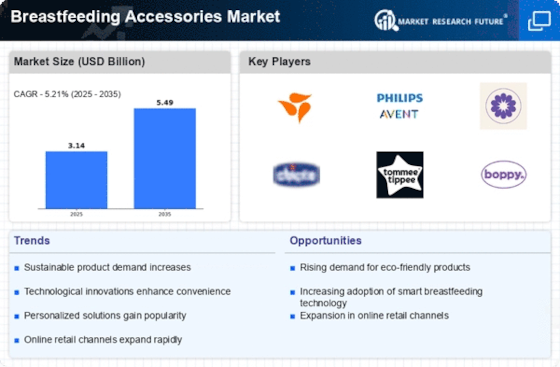
As per Market Research Future analysis, the Breastfeeding Accessories Market Size was estimated at 3.14 USD Billion in 2024. The Breastfeeding Accessories industry is projected to grow from 3.304 USD Billion in 2025 to 5.491 USD Billion by 2035, exhibiting a compound annual growth rate (CAGR) of 5.21% during the forecast period 2025 - 2035

Key Market Trends & Highlights

The Breastfeeding Accessories Market is experiencing a dynamic shift towards sustainability and innovation.

  • The North American market remains the largest, driven by heightened awareness of breastfeeding benefits and supportive policies. In the Asia-Pacific region, the market is the fastest-growing, fueled by a rising number of working mothers seeking convenient solutions. Breast pumps dominate the market as the largest segment, while breastfeeding pillows are emerging as the fastest-growing category. Key market drivers include increased awareness of breastfeeding benefits and innovations in product design and functionality.

Market Size & Forecast

2024 Market Size 3.14 (USD Billion)
2035 Market Size 5.491 (USD Billion)
CAGR (2025 - 2035) 5.21%
Largest Regional Market Share in 2024 North America

Major Players

Medela (CH), Philips Avent (GB), Lansinoh (US), Chicco (IT), Tommee Tippee (GB), <a href="https://www.boppy.com/collections/nursing-pillows?srsltid=AfmBOooGYQg4jZP5Zs16W88mBnx8sLRUp44r5E3vhFVr8JJnvMUE4C-a">Boppy</a> (US), Bravado Designs (CA), Ameda (US), Nuk (DE)

Market Trends

The Breastfeeding Accessories Market is currently experiencing a notable evolution, driven by a growing awareness of the benefits associated with breastfeeding. This shift in consumer behavior appears to be influenced by an increasing emphasis on maternal health and infant nutrition. As more parents recognize the advantages of breastfeeding, the demand for various accessories, such as breast pumps, nursing pads, and storage bags, is likely to rise. Furthermore, the market seems to be adapting to the needs of modern families, with innovative products designed to enhance convenience and comfort during the breastfeeding journey. In addition to the rising demand, the Breastfeeding Accessories Market is also witnessing a surge in product diversity. Manufacturers are increasingly focusing on creating eco-friendly and sustainable options, reflecting a broader trend towards environmental consciousness among consumers. This shift may indicate a potential for growth in niche segments, as parents seek products that align with their values. Overall, the Breastfeeding Accessories Market appears poised for continued expansion, driven by evolving consumer preferences and a commitment to supporting breastfeeding mothers and their infants.

Sustainability Focus

There is a growing trend towards eco-friendly breastfeeding accessories, as consumers increasingly prioritize sustainability. Products made from organic materials and those that minimize environmental impact are gaining traction, reflecting a shift in consumer values.

Technological Advancements

Innovations in technology are shaping the Breastfeeding Accessories Market, with smart devices and app-integrated products becoming more prevalent. These advancements aim to enhance the breastfeeding experience, offering features such as tracking milk supply and feeding schedules.

Personalization and Customization

The demand for personalized breastfeeding accessories is on the rise, as parents seek products tailored to their specific needs. Customizable options, such as adjustable nursing bras and personalized breast pump settings, are becoming increasingly popular.

Breast Feeding Accessories Market Market Drivers

Rising Number of Working Mothers

The rising number of working mothers is likely to significantly impact the Breastfeeding Accessories Market. As more women join the workforce, the need for breastfeeding accessories that facilitate breastfeeding while balancing professional responsibilities has become increasingly apparent. Products such as portable breast pumps and discreet nursing covers are in high demand, as they provide working mothers with the flexibility to maintain their breastfeeding routines. Recent data indicates that the percentage of working mothers has steadily increased, further driving the need for supportive breastfeeding solutions. Consequently, the Breastfeeding Accessories Market is poised for growth, as manufacturers respond to the needs of this demographic by offering innovative and practical breastfeeding accessories.

Supportive Policies and Legislation

Supportive policies and legislation promoting breastfeeding are likely to play a crucial role in shaping the Breastfeeding Accessories Market. Various governments and organizations have implemented policies that encourage breastfeeding, including maternity leave provisions and workplace accommodations for nursing mothers. For instance, legislation mandating breastfeeding breaks in workplaces has been adopted in several regions, facilitating a conducive environment for breastfeeding. This legislative support not only empowers mothers but also stimulates the demand for breastfeeding accessories, as mothers are more inclined to invest in products that aid their breastfeeding journey. The Breastfeeding Accessories Market is thus positioned to benefit from these favorable policies, which may lead to increased sales and market expansion.

Growing E-commerce and Online Retail

The proliferation of e-commerce and online retail platforms appears to be transforming the Breastfeeding Accessories Market. With the convenience of online shopping, mothers are increasingly turning to digital platforms to purchase breastfeeding accessories. Recent statistics suggest that online sales of breastfeeding products have seen a significant uptick, with a notable percentage of consumers preferring to shop online for privacy and ease. This shift towards e-commerce not only broadens the market reach for manufacturers but also enhances consumer access to a diverse range of breastfeeding accessories. As a result, the Breastfeeding Accessories Market is likely to experience accelerated growth, driven by the expanding online retail landscape.

Increased Awareness of Breastfeeding Benefits

The rising awareness regarding the health benefits of breastfeeding for both infants and mothers appears to be a pivotal driver in the Breastfeeding Accessories Market. Educational campaigns and healthcare initiatives have emphasized the nutritional advantages and emotional bonding associated with breastfeeding. This heightened awareness has led to an increase in breastfeeding rates, which, according to recent data, indicates that approximately 83% of infants are breastfed at some point. Consequently, the demand for breastfeeding accessories, such as breast pumps and nursing pads, has surged, as mothers seek to enhance their breastfeeding experience. The Breastfeeding Accessories Market is thus witnessing a robust growth trajectory, fueled by this growing recognition of breastfeeding's importance.

Innovations in Product Design and Functionality

Innovations in product design and functionality are emerging as a key driver in the Breastfeeding Accessories Market. Manufacturers are increasingly focusing on developing advanced products that cater to the evolving needs of breastfeeding mothers. For instance, the introduction of hands-free breast pumps and multifunctional nursing covers has gained popularity, as they offer convenience and versatility. These innovations not only enhance the breastfeeding experience but also attract tech-savvy consumers who seek modern solutions. The Breastfeeding Accessories Market is thus witnessing a wave of creativity and innovation, which is likely to propel market growth as new products continue to enter the market.

Market Segment Insights

By Type: Breast Pumps (Largest) vs. Breastfeeding Pillows (Fastest-Growing)

In the Breastfeeding Accessories Market, the type segment showcases a varied distribution of market share. Breast Pumps dominate this segment, accounting for the largest share due to their essential role in modern breastfeeding practices. Other vital components, such as Breastfeeding Pillows and Nursing Pads, also play significant roles, but they lag behind Breast Pumps in terms of overall market share. Milk Storage Bags and Breastfeeding Covers are also noteworthy players, but their shares are comparatively smaller in this diverse market. As breastfeeding trends evolve, growth in the segment is driven by increased awareness and acceptance of breastfeeding. Innovations in Breast Pumps have led to enhancements in portability and efficiency, driving their popularity. Meanwhile, Breastfeeding Pillows have emerged as the fastest-growing segment, aided by rising demand for comfort and support during breastfeeding. Consumer preferences increasingly favor products that combine functionality with ergonomic design, fueling this growth trend.

Breast Pumps (Dominant) vs. Breastfeeding Covers (Emerging)

Breast Pumps have established themselves as the dominant force within the breastfeeding accessories sector, owing to their crucial function in facilitating breastfeeding for working mothers and providing convenience. Their prevalence is largely attributed to advancements in technology, leading to more portable and efficient models that cater to varied consumer needs. Conversely, Breastfeeding Covers are emerging as a notable product within the market, gaining traction due to the increasing emphasis on breastfeeding in public. These covers offer privacy and comfort, appealing to a new generation of mothers who prioritize discretion while managing breastfeeding challenges, thus positioning itself as a significant player in the evolving landscape of breastfeeding accessories.

By Distribution Channel: Online Retail (Largest) vs. Supermarkets (Fastest-Growing)

In the Breastfeeding Accessories Market, the distribution channels reveal competitive dynamics with online retail taking the largest share, driven by the growing preference for e-commerce among consumers. Online platforms provide convenience and a diverse range of products, appealing to modern parents who value easy shopping experiences. Supermarkets occupy a significant portion of the market as well, characterized by their accessibility and the ability to offer breastfeeding products alongside other essential items for new parents. However, the fastest-growing segment is supermarkets, reflecting a trend where consumers increasingly choose to shop for breastfeeding accessories during routine grocery shopping. This shift is propelled by promotional activities, special sections for baby-related products, and the ease of purchasing items in one trip. The evolving nature of consumer behavior and a focus on in-store experiences are vital growth drivers in this channel.

Online Retail: Dominant vs. Supermarkets: Emerging

Online retail has emerged as the dominant distribution channel for breastfeeding accessories, appealing primarily to tech-savvy parents who appreciate convenience and extensive selections. This channel allows consumers to shop from the comfort of their homes and is particularly favored for its range of options, including unique and specialized products that may not be available in physical stores. Conversely, supermarkets are becoming an emerging force in this market, leveraging their existing infrastructure to promote breastfeeding accessories alongside daily essentials. They focus on creating designated sections for baby products and offering promotions, which caters to families shopping for multiple needs in one stop. This strategy enhances customer convenience and positions supermarkets as a vital player in the breastfeeding accessories market.

By Material Type: Silicone (Largest) vs. Plastic (Fastest-Growing)

The Breastfeeding Accessories Market showcases a diverse material composition where silicone emerges as the largest segment due to its durability, non-toxic properties, and ease of cleaning. Meanwhile, plastic is rapidly gaining prominence, appealing to budget-conscious consumers seeking lightweight and versatile options. The market distribution indicates a strong preference for silicone, which offers comfort and safety, especially for breastfeeding mothers and infants. In terms of growth trends, the increasing awareness regarding sustainable and safe materials has propelled silicone and plastic to the forefront of market demand. Innovations in material technology have led to the development of BPA-free plastics and more advanced silicone products, often recommended by healthcare professionals. This combination of safety, affordability, and diverse product offerings positions both materials favorably for continued growth in the breastfeeding accessories sector.

Silicone (Dominant) vs. Rubber (Emerging)

Silicone holds a dominant position in the Breastfeeding Accessories Market, recognized for its versatility and safety. Products made from silicone, such as breast pumps and nursing pads, are favored by mothers due to their hypoallergenic nature and resilience against wear and tear. In contrast, rubber, though smaller in market share, is emerging as a viable material option, particularly for teething accessories and pacifiers. Its inherent flexibility and softness make rubber appealing for various breastfeeding-related products. However, manufacturers must navigate consumer preferences for non-toxic and eco-friendly materials as they innovate. The ongoing evolution in rubber processing technology also presents opportunities for improved product offerings, which may enable it to capture a larger share of the market.

By End User: New Mothers (Largest) vs. Healthcare Professionals (Fastest-Growing)

The breastfeeding accessories market is primarily driven by three end-user segments: new mothers, healthcare professionals, and breastfeeding support groups. Among these, new mothers hold the largest market share, as they are the primary consumers of breastfeeding accessories needed for both convenience and comfort. Healthcare professionals are emerging rapidly due to their essential role in supporting breastfeeding practices and promoting related products, resulting in their increasing demand within the market. With rising awareness about breastfeeding benefits, support from healthcare providers becomes crucial, influencing market dynamics.

New Mothers (Dominant) vs. Healthcare Professionals (Emerging)

New mothers constitute the dominant segment in the breastfeeding accessories market, driven by their immediate need for products that facilitate breastfeeding successfully and comfortably. They seek items ranging from breast pumps to nursing pads that provide them with the necessary support during early motherhood. On the other hand, healthcare professionals represent an emerging segment, fostering the growth of the market through education and advocacy. They educate new mothers about breastfeeding techniques and the importance of using quality accessories, thereby fueling demand. The growing emphasis on supportive breastfeeding practices motivates healthcare professionals to recommend innovative accessories that enhance the breastfeeding experience, thus contributing to their swift market ascent.

Get more detailed insights about Breast Feeding Accessories Market Research Report - Forecast till 2035

Regional Insights

The Breastfeeding Accessories Market experienced steady growth across various regional segments, with North America leading in market valuation, projected to grow to 1.19 USD Billion by 2035. This dominance is attributable to increased awareness and supportive initiatives for breastfeeding.

Europe followed closely with a valuation of 0.5 USD Billion in 2024, expected to reach 0.9 USD Billion by 2035, as health organizations bolster breastfeeding rates through education and accessibility.

Meanwhile, the APAC region was poised for growth, moving from 0.6 USD Billion in 2024 to 1.0 USD Billion, highlights a growing demand for breastfeeding accessories.

South America and MEA represented smaller, is projected to increase from 0.2 USD Billion in 2024, respectively, and are projected to reach 0.22 USD Billion and 0.18 USD Billion by 2035.

These regions are gradually expanding their market presence as awareness regarding breastfeeding practices.

The Breastfeeding Accessories Market data signifies diverse opportunities across regions, highlighting the role of government initiatives and societal shifts in driving market growth.

Key Players and Competitive Insights

The Breastfeeding Accessories Market has seen significant evolution driven by a combination of factors such as technological innovations, increasing awareness regarding maternal health, and growing consumer demand for supportive breastfeeding products. Within this competitive landscape, a range of companies are vying for market share by offering various types of breastfeeding accessories, including breast pumps, nursing pads, and bottle sterilizers.The rising trends around sustainability and convenience are reshaping product offerings, encouraging brands to innovate and deliver quality solutions that cater to the needs of new mothers. Competitive insights reveal that players in this market are focusing on enhancing product features, expanding distribution channels, and leveraging both online and offline platforms to reach a broader consumer base.Baby Brezza holds a prominent position in the Breastfeeding Accessories Market, recognized for its innovative approach and commitment to simplifying the feeding and breastfeeding process. The company has established a strong market presence by introducing technologically advanced products that cater to the needs of modern parents. With a diverse portfolio that includes items like automatic breast pumps and baby formula makers, Baby Brezza has differentiated itself from competitors through its focus on user-friendly designs and efficiency.The brand's strengths lie in its ability to combine functionality with convenience, aimed at helping new parents navigate the challenges associated with breastfeeding and feeding infants. The company has also made significant strides in customer engagement and education, amplifying its visibility and brand loyalty in the market.Pigeon has made a remarkable impact in the Breastfeeding Accessories Market through its extensive range of products designed to support breastfeeding mothers and their infants. Known for products such as breast pumps, nursing pads, and pacifiers, Pigeon emphasizes the importance of quality and safety in its offerings. The company has a robust international market presence, recognized for its commitment to research and development that translates into highly effective and trusted products.Pigeon's strengths stem from its long-standing reputation for quality, which has allowed it to build a loyal customer base. Through strategic mergers and acquisitions, Pigeon has expanded its product lines and enhanced its market reach, ensuring it remains a key player in the breastfeeding accessories segment. The company's focus on innovation and understanding consumer needs underpins its competitive strategy, enabling it to maintain a strong foothold globally.

Key Companies in the Breast Feeding Accessories Market include

Industry Developments

Recent developments in the Breastfeeding Accessories Market have shown a notable increase in consumer demand for innovative and eco-friendly products. Companies such as Baby Brezza and Philips Avent are expanding their product lines to include more technologically advanced solutions that cater to the health and convenience of mothers.

Current affairs have highlighted a growing trend towards sustainable materials, with brands like Burt's Bees and Boon introducing products made from organic materials. In terms of financial growth, the market valuation of companies such as Medela and Tommee Tippee has seen an upward momentum, with many attributing this to a heightened awareness of breastfeeding benefits globally.

Notably, in September 2023, Pigeon announced a strategic partnership with various health organizations to promote breastfeeding education, reflecting broader social responsibility trends among companies. Additionally, major acquisitions have been relatively sparse, but reports indicate that in July 2023, Chicco acquired several innovative breastfeeding product lines to enhance its market share.

The Breastfeeding Accessories Market continues to evolve, driven by shifting consumer preferences and the increasing importance of sustainability in product offerings.

Future Outlook

Breast Feeding Accessories Market Future Outlook

The Breastfeeding Accessories Market is projected to grow at a 5.21% CAGR from 2025 to 2035, driven by increasing awareness of breastfeeding benefits and innovative product developments.

New opportunities lie in:

  • Expansion of eco-friendly breastfeeding products</p><p>Development of smart breastfeeding monitoring devices</p><p>Partnerships with healthcare providers for product distribution

By 2035, the market is expected to be robust, reflecting sustained growth and innovation.

Market Segmentation

Breast Feeding Accessories Market Type Outlook

  • Breast Pumps
  • Breastfeeding Pillows
  • Nursing Pads
  • Breastfeeding Covers
  • Milk Storage Bags

Breast Feeding Accessories Market End User Outlook

  • New Mothers
  • Healthcare Professionals
  • Breastfeeding Support Groups

Breast Feeding Accessories Market Material Type Outlook

  • Silicone
  • Cotton
  • Plastic
  • Rubber

Breast Feeding Accessories Market Distribution Channel Outlook

  • Online Retail
  • Supermarkets
  • Pharmacies
  • Specialty Stores

Report Scope

MARKET SIZE 2024 3.14(USD Billion)
MARKET SIZE 2025 3.304(USD Billion)
MARKET SIZE 2035 5.491(USD Billion)
COMPOUND ANNUAL GROWTH RATE (CAGR) 5.21% (2025 - 2035)
REPORT COVERAGE Revenue Forecast, Competitive Landscape, Growth Factors, and Trends
BASE YEAR 2024
Market Forecast Period 2025 - 2035
Historical Data 2019 - 2024
Market Forecast Units USD Billion
Key Companies Profiled Medela (CH), Philips Avent (GB), Lansinoh (US), Chicco (IT), Tommee Tippee (GB), Boppy (US), Bravado Designs (CA), Ameda (US), Nuk (DE)
Segments Covered Product Type, Distribution Channel, Material Type, End User, Regional
Key Market Opportunities Integration of smart technology in Breastfeeding Accessories Market enhances convenience and user experience.
Key Market Dynamics Rising consumer awareness and demand for sustainable breastfeeding accessories drive innovation and competition in the market.
Countries Covered North America, Europe, APAC, South America, MEA

FAQs

What is the current valuation of the Breastfeeding Accessories Market?

<p>The Breastfeeding Accessories Market was valued at 3.14 USD Billion in 2024.</p>

What is the projected market size for the Breastfeeding Accessories Market by 2035?

<p>The market is projected to reach 5.491 USD Billion by 2035.</p>

What is the expected CAGR for the Breastfeeding Accessories Market during the forecast period 2025 - 2035?

<p>The expected CAGR for the market during 2025 - 2035 is 5.21%.</p>

Which segment of breastfeeding accessories is expected to generate the highest revenue?

<p>Breast Pumps are anticipated to generate the highest revenue, with projections ranging from 0.9 to 1.5 USD Billion.</p>

How do online retail sales compare to other distribution channels in the market?

<p>Online retail sales are projected to grow from 0.94 to 1.63 USD Billion, surpassing other channels like supermarkets and pharmacies.</p>

What materials are predominantly used in breastfeeding accessories?

<p>Plastic is expected to dominate the material type segment, with a projected valuation from 1.0 to 1.7 USD Billion.</p>

Who are the primary end users of breastfeeding accessories?

<p>New Mothers are the primary end users, with a projected market size increasing from 1.57 to 2.67 USD Billion.</p>

Which companies are leading the Breastfeeding Accessories Market?

<p>Key players in the market include Medela, Philips Avent, Lansinoh, and Tommee Tippee.</p>

What is the expected growth trend for breastfeeding pillows in the market?

<p>Breastfeeding Pillows are projected to grow from 0.5 to 0.8 USD Billion, indicating a positive trend.</p>

How do the sales of nursing pads compare to breastfeeding covers?

Nursing Pads are expected to generate between 0.4 and 0.7 USD Billion, while Breastfeeding Covers are projected to range from 0.3 to 0.5 USD Billion.

  1. SECTION I: EXECUTIVE SUMMARY AND KEY HIGHLIGHTS
    1. | 1.1 EXECUTIVE SUMMARY
    2. | | 1.1.1 Market Overview
    3. | | 1.1.2 Key Findings
    4. | | 1.1.3 Market Segmentation
    5. | | 1.1.4 Competitive Landscape
    6. | | 1.1.5 Challenges and Opportunities
    7. | | 1.1.6 Future Outlook
  2. SECTION II: SCOPING, METHODOLOGY AND MARKET STRUCTURE
    1. | 2.1 MARKET INTRODUCTION
    2. | | 2.1.1 Definition
    3. | | 2.1.2 Scope of the study
    4. | | | 2.1.2.1 Research Objective
    5. | | | 2.1.2.2 Assumption
    6. | | | 2.1.2.3 Limitations
    7. | 2.2 RESEARCH METHODOLOGY
    8. | | 2.2.1 Overview
    9. | | 2.2.2 Data Mining
    10. | | 2.2.3 Secondary Research
    11. | | 2.2.4 Primary Research
    12. | | | 2.2.4.1 Primary Interviews and Information Gathering Process
    13. | | | 2.2.4.2 Breakdown of Primary Respondents
    14. | | 2.2.5 Forecasting Model
    15. | | 2.2.6 Market Size Estimation
    16. | | | 2.2.6.1 Bottom-Up Approach
    17. | | | 2.2.6.2 Top-Down Approach
    18. | | 2.2.7 Data Triangulation
    19. | | 2.2.8 Validation
  3. SECTION III: QUALITATIVE ANALYSIS
    1. | 3.1 MARKET DYNAMICS
    2. | | 3.1.1 Overview
    3. | | 3.1.2 Drivers
    4. | | 3.1.3 Restraints
    5. | | 3.1.4 Opportunities
    6. | 3.2 MARKET FACTOR ANALYSIS
    7. | | 3.2.1 Value chain Analysis
    8. | | 3.2.2 Porter's Five Forces Analysis
    9. | | | 3.2.2.1 Bargaining Power of Suppliers
    10. | | | 3.2.2.2 Bargaining Power of Buyers
    11. | | | 3.2.2.3 Threat of New Entrants
    12. | | | 3.2.2.4 Threat of Substitutes
    13. | | | 3.2.2.5 Intensity of Rivalry
    14. | | 3.2.3 COVID-19 Impact Analysis
    15. | | | 3.2.3.1 Market Impact Analysis
    16. | | | 3.2.3.2 Regional Impact
    17. | | | 3.2.3.3 Opportunity and Threat Analysis
  4. SECTION IV: QUANTITATIVE ANALYSIS
    1. | 4.1 Healthcare, BY Type (USD Billion)
    2. | | 4.1.1 Breast Pumps
    3. | | 4.1.2 Breastfeeding Pillows
    4. | | 4.1.3 Nursing Pads
    5. | | 4.1.4 Breastfeeding Covers
    6. | | 4.1.5 Milk Storage Bags
    7. | 4.2 Healthcare, BY Distribution Channel (USD Billion)
    8. | | 4.2.1 Online Retail
    9. | | 4.2.2 Supermarkets
    10. | | 4.2.3 Pharmacies
    11. | | 4.2.4 Specialty Stores
    12. | 4.3 Healthcare, BY Material Type (USD Billion)
    13. | | 4.3.1 Silicone
    14. | | 4.3.2 Cotton
    15. | | 4.3.3 Plastic
    16. | | 4.3.4 Rubber
    17. | 4.4 Healthcare, BY End User (USD Billion)
    18. | | 4.4.1 New Mothers
    19. | | 4.4.2 Healthcare Professionals
    20. | | 4.4.3 Breastfeeding Support Groups
    21. | 4.5 Healthcare, BY Region (USD Billion)
    22. | | 4.5.1 North America
    23. | | | 4.5.1.1 US
    24. | | | 4.5.1.2 Canada
    25. | | 4.5.2 Europe
    26. | | | 4.5.2.1 Germany
    27. | | | 4.5.2.2 UK
    28. | | | 4.5.2.3 France
    29. | | | 4.5.2.4 Russia
    30. | | | 4.5.2.5 Italy
    31. | | | 4.5.2.6 Spain
    32. | | | 4.5.2.7 Rest of Europe
    33. | | 4.5.3 APAC
    34. | | | 4.5.3.1 China
    35. | | | 4.5.3.2 India
    36. | | | 4.5.3.3 Japan
    37. | | | 4.5.3.4 South Korea
    38. | | | 4.5.3.5 Malaysia
    39. | | | 4.5.3.6 Thailand
    40. | | | 4.5.3.7 Indonesia
    41. | | | 4.5.3.8 Rest of APAC
    42. | | 4.5.4 South America
    43. | | | 4.5.4.1 Brazil
    44. | | | 4.5.4.2 Mexico
    45. | | | 4.5.4.3 Argentina
    46. | | | 4.5.4.4 Rest of South America
    47. | | 4.5.5 MEA
    48. | | | 4.5.5.1 GCC Countries
    49. | | | 4.5.5.2 South Africa
    50. | | | 4.5.5.3 Rest of MEA
  5. SECTION V: COMPETITIVE ANALYSIS
    1. | 5.1 Competitive Landscape
    2. | | 5.1.1 Overview
    3. | | 5.1.2 Competitive Analysis
    4. | | 5.1.3 Market share Analysis
    5. | | 5.1.4 Major Growth Strategy in the Healthcare
    6. | | 5.1.5 Competitive Benchmarking
    7. | | 5.1.6 Leading Players in Terms of Number of Developments in the Healthcare
    8. | | 5.1.7 Key developments and growth strategies
    9. | | | 5.1.7.1 New Product Launch/Service Deployment
    10. | | | 5.1.7.2 Merger & Acquisitions
    11. | | | 5.1.7.3 Joint Ventures
    12. | | 5.1.8 Major Players Financial Matrix
    13. | | | 5.1.8.1 Sales and Operating Income
    14. | | | 5.1.8.2 Major Players R&D Expenditure. 2023
    15. | 5.2 Company Profiles
    16. | | 5.2.1 Medela (CH)
    17. | | | 5.2.1.1 Financial Overview
    18. | | | 5.2.1.2 Products Offered
    19. | | | 5.2.1.3 Key Developments
    20. | | | 5.2.1.4 SWOT Analysis
    21. | | | 5.2.1.5 Key Strategies
    22. | | 5.2.2 Philips Avent (GB)
    23. | | | 5.2.2.1 Financial Overview
    24. | | | 5.2.2.2 Products Offered
    25. | | | 5.2.2.3 Key Developments
    26. | | | 5.2.2.4 SWOT Analysis
    27. | | | 5.2.2.5 Key Strategies
    28. | | 5.2.3 Lansinoh (US)
    29. | | | 5.2.3.1 Financial Overview
    30. | | | 5.2.3.2 Products Offered
    31. | | | 5.2.3.3 Key Developments
    32. | | | 5.2.3.4 SWOT Analysis
    33. | | | 5.2.3.5 Key Strategies
    34. | | 5.2.4 Chicco (IT)
    35. | | | 5.2.4.1 Financial Overview
    36. | | | 5.2.4.2 Products Offered
    37. | | | 5.2.4.3 Key Developments
    38. | | | 5.2.4.4 SWOT Analysis
    39. | | | 5.2.4.5 Key Strategies
    40. | | 5.2.5 Tommee Tippee (GB)
    41. | | | 5.2.5.1 Financial Overview
    42. | | | 5.2.5.2 Products Offered
    43. | | | 5.2.5.3 Key Developments
    44. | | | 5.2.5.4 SWOT Analysis
    45. | | | 5.2.5.5 Key Strategies
    46. | | 5.2.6 Boppy (US)
    47. | | | 5.2.6.1 Financial Overview
    48. | | | 5.2.6.2 Products Offered
    49. | | | 5.2.6.3 Key Developments
    50. | | | 5.2.6.4 SWOT Analysis
    51. | | | 5.2.6.5 Key Strategies
    52. | | 5.2.7 Bravado Designs (CA)
    53. | | | 5.2.7.1 Financial Overview
    54. | | | 5.2.7.2 Products Offered
    55. | | | 5.2.7.3 Key Developments
    56. | | | 5.2.7.4 SWOT Analysis
    57. | | | 5.2.7.5 Key Strategies
    58. | | 5.2.8 Ameda (US)
    59. | | | 5.2.8.1 Financial Overview
    60. | | | 5.2.8.2 Products Offered
    61. | | | 5.2.8.3 Key Developments
    62. | | | 5.2.8.4 SWOT Analysis
    63. | | | 5.2.8.5 Key Strategies
    64. | | 5.2.9 Nuk (DE)
    65. | | | 5.2.9.1 Financial Overview
    66. | | | 5.2.9.2 Products Offered
    67. | | | 5.2.9.3 Key Developments
    68. | | | 5.2.9.4 SWOT Analysis
    69. | | | 5.2.9.5 Key Strategies
    70. | 5.3 Appendix
    71. | | 5.3.1 References
    72. | | 5.3.2 Related Reports
  6. LIST OF FIGURES
    1. | 6.1 MARKET SYNOPSIS
    2. | 6.2 NORTH AMERICA MARKET ANALYSIS
    3. | 6.3 US MARKET ANALYSIS BY TYPE
    4. | 6.4 US MARKET ANALYSIS BY DISTRIBUTION CHANNEL
    5. | 6.5 US MARKET ANALYSIS BY MATERIAL TYPE
    6. | 6.6 US MARKET ANALYSIS BY END USER
    7. | 6.7 CANADA MARKET ANALYSIS BY TYPE
    8. | 6.8 CANADA MARKET ANALYSIS BY DISTRIBUTION CHANNEL
    9. | 6.9 CANADA MARKET ANALYSIS BY MATERIAL TYPE
    10. | 6.10 CANADA MARKET ANALYSIS BY END USER
    11. | 6.11 EUROPE MARKET ANALYSIS
    12. | 6.12 GERMANY MARKET ANALYSIS BY TYPE
    13. | 6.13 GERMANY MARKET ANALYSIS BY DISTRIBUTION CHANNEL
    14. | 6.14 GERMANY MARKET ANALYSIS BY MATERIAL TYPE
    15. | 6.15 GERMANY MARKET ANALYSIS BY END USER
    16. | 6.16 UK MARKET ANALYSIS BY TYPE
    17. | 6.17 UK MARKET ANALYSIS BY DISTRIBUTION CHANNEL
    18. | 6.18 UK MARKET ANALYSIS BY MATERIAL TYPE
    19. | 6.19 UK MARKET ANALYSIS BY END USER
    20. | 6.20 FRANCE MARKET ANALYSIS BY TYPE
    21. | 6.21 FRANCE MARKET ANALYSIS BY DISTRIBUTION CHANNEL
    22. | 6.22 FRANCE MARKET ANALYSIS BY MATERIAL TYPE
    23. | 6.23 FRANCE MARKET ANALYSIS BY END USER
    24. | 6.24 RUSSIA MARKET ANALYSIS BY TYPE
    25. | 6.25 RUSSIA MARKET ANALYSIS BY DISTRIBUTION CHANNEL
    26. | 6.26 RUSSIA MARKET ANALYSIS BY MATERIAL TYPE
    27. | 6.27 RUSSIA MARKET ANALYSIS BY END USER
    28. | 6.28 ITALY MARKET ANALYSIS BY TYPE
    29. | 6.29 ITALY MARKET ANALYSIS BY DISTRIBUTION CHANNEL
    30. | 6.30 ITALY MARKET ANALYSIS BY MATERIAL TYPE
    31. | 6.31 ITALY MARKET ANALYSIS BY END USER
    32. | 6.32 SPAIN MARKET ANALYSIS BY TYPE
    33. | 6.33 SPAIN MARKET ANALYSIS BY DISTRIBUTION CHANNEL
    34. | 6.34 SPAIN MARKET ANALYSIS BY MATERIAL TYPE
    35. | 6.35 SPAIN MARKET ANALYSIS BY END USER
    36. | 6.36 REST OF EUROPE MARKET ANALYSIS BY TYPE
    37. | 6.37 REST OF EUROPE MARKET ANALYSIS BY DISTRIBUTION CHANNEL
    38. | 6.38 REST OF EUROPE MARKET ANALYSIS BY MATERIAL TYPE
    39. | 6.39 REST OF EUROPE MARKET ANALYSIS BY END USER
    40. | 6.40 APAC MARKET ANALYSIS
    41. | 6.41 CHINA MARKET ANALYSIS BY TYPE
    42. | 6.42 CHINA MARKET ANALYSIS BY DISTRIBUTION CHANNEL
    43. | 6.43 CHINA MARKET ANALYSIS BY MATERIAL TYPE
    44. | 6.44 CHINA MARKET ANALYSIS BY END USER
    45. | 6.45 INDIA MARKET ANALYSIS BY TYPE
    46. | 6.46 INDIA MARKET ANALYSIS BY DISTRIBUTION CHANNEL
    47. | 6.47 INDIA MARKET ANALYSIS BY MATERIAL TYPE
    48. | 6.48 INDIA MARKET ANALYSIS BY END USER
    49. | 6.49 JAPAN MARKET ANALYSIS BY TYPE
    50. | 6.50 JAPAN MARKET ANALYSIS BY DISTRIBUTION CHANNEL
    51. | 6.51 JAPAN MARKET ANALYSIS BY MATERIAL TYPE
    52. | 6.52 JAPAN MARKET ANALYSIS BY END USER
    53. | 6.53 SOUTH KOREA MARKET ANALYSIS BY TYPE
    54. | 6.54 SOUTH KOREA MARKET ANALYSIS BY DISTRIBUTION CHANNEL
    55. | 6.55 SOUTH KOREA MARKET ANALYSIS BY MATERIAL TYPE
    56. | 6.56 SOUTH KOREA MARKET ANALYSIS BY END USER
    57. | 6.57 MALAYSIA MARKET ANALYSIS BY TYPE
    58. | 6.58 MALAYSIA MARKET ANALYSIS BY DISTRIBUTION CHANNEL
    59. | 6.59 MALAYSIA MARKET ANALYSIS BY MATERIAL TYPE
    60. | 6.60 MALAYSIA MARKET ANALYSIS BY END USER
    61. | 6.61 THAILAND MARKET ANALYSIS BY TYPE
    62. | 6.62 THAILAND MARKET ANALYSIS BY DISTRIBUTION CHANNEL
    63. | 6.63 THAILAND MARKET ANALYSIS BY MATERIAL TYPE
    64. | 6.64 THAILAND MARKET ANALYSIS BY END USER
    65. | 6.65 INDONESIA MARKET ANALYSIS BY TYPE
    66. | 6.66 INDONESIA MARKET ANALYSIS BY DISTRIBUTION CHANNEL
    67. | 6.67 INDONESIA MARKET ANALYSIS BY MATERIAL TYPE
    68. | 6.68 INDONESIA MARKET ANALYSIS BY END USER
    69. | 6.69 REST OF APAC MARKET ANALYSIS BY TYPE
    70. | 6.70 REST OF APAC MARKET ANALYSIS BY DISTRIBUTION CHANNEL
    71. | 6.71 REST OF APAC MARKET ANALYSIS BY MATERIAL TYPE
    72. | 6.72 REST OF APAC MARKET ANALYSIS BY END USER
    73. | 6.73 SOUTH AMERICA MARKET ANALYSIS
    74. | 6.74 BRAZIL MARKET ANALYSIS BY TYPE
    75. | 6.75 BRAZIL MARKET ANALYSIS BY DISTRIBUTION CHANNEL
    76. | 6.76 BRAZIL MARKET ANALYSIS BY MATERIAL TYPE
    77. | 6.77 BRAZIL MARKET ANALYSIS BY END USER
    78. | 6.78 MEXICO MARKET ANALYSIS BY TYPE
    79. | 6.79 MEXICO MARKET ANALYSIS BY DISTRIBUTION CHANNEL
    80. | 6.80 MEXICO MARKET ANALYSIS BY MATERIAL TYPE
    81. | 6.81 MEXICO MARKET ANALYSIS BY END USER
    82. | 6.82 ARGENTINA MARKET ANALYSIS BY TYPE
    83. | 6.83 ARGENTINA MARKET ANALYSIS BY DISTRIBUTION CHANNEL
    84. | 6.84 ARGENTINA MARKET ANALYSIS BY MATERIAL TYPE
    85. | 6.85 ARGENTINA MARKET ANALYSIS BY END USER
    86. | 6.86 REST OF SOUTH AMERICA MARKET ANALYSIS BY TYPE
    87. | 6.87 REST OF SOUTH AMERICA MARKET ANALYSIS BY DISTRIBUTION CHANNEL
    88. | 6.88 REST OF SOUTH AMERICA MARKET ANALYSIS BY MATERIAL TYPE
    89. | 6.89 REST OF SOUTH AMERICA MARKET ANALYSIS BY END USER
    90. | 6.90 MEA MARKET ANALYSIS
    91. | 6.91 GCC COUNTRIES MARKET ANALYSIS BY TYPE
    92. | 6.92 GCC COUNTRIES MARKET ANALYSIS BY DISTRIBUTION CHANNEL
    93. | 6.93 GCC COUNTRIES MARKET ANALYSIS BY MATERIAL TYPE
    94. | 6.94 GCC COUNTRIES MARKET ANALYSIS BY END USER
    95. | 6.95 SOUTH AFRICA MARKET ANALYSIS BY TYPE
    96. | 6.96 SOUTH AFRICA MARKET ANALYSIS BY DISTRIBUTION CHANNEL
    97. | 6.97 SOUTH AFRICA MARKET ANALYSIS BY MATERIAL TYPE
    98. | 6.98 SOUTH AFRICA MARKET ANALYSIS BY END USER
    99. | 6.99 REST OF MEA MARKET ANALYSIS BY TYPE
    100. | 6.100 REST OF MEA MARKET ANALYSIS BY DISTRIBUTION CHANNEL
    101. | 6.101 REST OF MEA MARKET ANALYSIS BY MATERIAL TYPE
    102. | 6.102 REST OF MEA MARKET ANALYSIS BY END USER
    103. | 6.103 KEY BUYING CRITERIA OF HEALTHCARE
    104. | 6.104 RESEARCH PROCESS OF MRFR
    105. | 6.105 DRO ANALYSIS OF HEALTHCARE
    106. | 6.106 DRIVERS IMPACT ANALYSIS: HEALTHCARE
    107. | 6.107 RESTRAINTS IMPACT ANALYSIS: HEALTHCARE
    108. | 6.108 SUPPLY / VALUE CHAIN: HEALTHCARE
    109. | 6.109 HEALTHCARE, BY TYPE, 2024 (% SHARE)
    110. | 6.110 HEALTHCARE, BY TYPE, 2024 TO 2035 (USD Billion)
    111. | 6.111 HEALTHCARE, BY DISTRIBUTION CHANNEL, 2024 (% SHARE)
    112. | 6.112 HEALTHCARE, BY DISTRIBUTION CHANNEL, 2024 TO 2035 (USD Billion)
    113. | 6.113 HEALTHCARE, BY MATERIAL TYPE, 2024 (% SHARE)
    114. | 6.114 HEALTHCARE, BY MATERIAL TYPE, 2024 TO 2035 (USD Billion)
    115. | 6.115 HEALTHCARE, BY END USER, 2024 (% SHARE)
    116. | 6.116 HEALTHCARE, BY END USER, 2024 TO 2035 (USD Billion)
    117. | 6.117 BENCHMARKING OF MAJOR COMPETITORS
  7. LIST OF TABLES
    1. | 7.1 LIST OF ASSUMPTIONS
    2. | | 7.1.1
    3. | 7.2 North America MARKET SIZE ESTIMATES; FORECAST
    4. | | 7.2.1 BY TYPE, 2025-2035 (USD Billion)
    5. | | 7.2.2 BY DISTRIBUTION CHANNEL, 2025-2035 (USD Billion)
    6. | | 7.2.3 BY MATERIAL TYPE, 2025-2035 (USD Billion)
    7. | | 7.2.4 BY END USER, 2025-2035 (USD Billion)
    8. | 7.3 US MARKET SIZE ESTIMATES; FORECAST
    9. | | 7.3.1 BY TYPE, 2025-2035 (USD Billion)
    10. | | 7.3.2 BY DISTRIBUTION CHANNEL, 2025-2035 (USD Billion)
    11. | | 7.3.3 BY MATERIAL TYPE, 2025-2035 (USD Billion)
    12. | | 7.3.4 BY END USER, 2025-2035 (USD Billion)
    13. | 7.4 Canada MARKET SIZE ESTIMATES; FORECAST
    14. | | 7.4.1 BY TYPE, 2025-2035 (USD Billion)
    15. | | 7.4.2 BY DISTRIBUTION CHANNEL, 2025-2035 (USD Billion)
    16. | | 7.4.3 BY MATERIAL TYPE, 2025-2035 (USD Billion)
    17. | | 7.4.4 BY END USER, 2025-2035 (USD Billion)
    18. | 7.5 Europe MARKET SIZE ESTIMATES; FORECAST
    19. | | 7.5.1 BY TYPE, 2025-2035 (USD Billion)
    20. | | 7.5.2 BY DISTRIBUTION CHANNEL, 2025-2035 (USD Billion)
    21. | | 7.5.3 BY MATERIAL TYPE, 2025-2035 (USD Billion)
    22. | | 7.5.4 BY END USER, 2025-2035 (USD Billion)
    23. | 7.6 Germany MARKET SIZE ESTIMATES; FORECAST
    24. | | 7.6.1 BY TYPE, 2025-2035 (USD Billion)
    25. | | 7.6.2 BY DISTRIBUTION CHANNEL, 2025-2035 (USD Billion)
    26. | | 7.6.3 BY MATERIAL TYPE, 2025-2035 (USD Billion)
    27. | | 7.6.4 BY END USER, 2025-2035 (USD Billion)
    28. | 7.7 UK MARKET SIZE ESTIMATES; FORECAST
    29. | | 7.7.1 BY TYPE, 2025-2035 (USD Billion)
    30. | | 7.7.2 BY DISTRIBUTION CHANNEL, 2025-2035 (USD Billion)
    31. | | 7.7.3 BY MATERIAL TYPE, 2025-2035 (USD Billion)
    32. | | 7.7.4 BY END USER, 2025-2035 (USD Billion)
    33. | 7.8 France MARKET SIZE ESTIMATES; FORECAST
    34. | | 7.8.1 BY TYPE, 2025-2035 (USD Billion)
    35. | | 7.8.2 BY DISTRIBUTION CHANNEL, 2025-2035 (USD Billion)
    36. | | 7.8.3 BY MATERIAL TYPE, 2025-2035 (USD Billion)
    37. | | 7.8.4 BY END USER, 2025-2035 (USD Billion)
    38. | 7.9 Russia MARKET SIZE ESTIMATES; FORECAST
    39. | | 7.9.1 BY TYPE, 2025-2035 (USD Billion)
    40. | | 7.9.2 BY DISTRIBUTION CHANNEL, 2025-2035 (USD Billion)
    41. | | 7.9.3 BY MATERIAL TYPE, 2025-2035 (USD Billion)
    42. | | 7.9.4 BY END USER, 2025-2035 (USD Billion)
    43. | 7.10 Italy MARKET SIZE ESTIMATES; FORECAST
    44. | | 7.10.1 BY TYPE, 2025-2035 (USD Billion)
    45. | | 7.10.2 BY DISTRIBUTION CHANNEL, 2025-2035 (USD Billion)
    46. | | 7.10.3 BY MATERIAL TYPE, 2025-2035 (USD Billion)
    47. | | 7.10.4 BY END USER, 2025-2035 (USD Billion)
    48. | 7.11 Spain MARKET SIZE ESTIMATES; FORECAST
    49. | | 7.11.1 BY TYPE, 2025-2035 (USD Billion)
    50. | | 7.11.2 BY DISTRIBUTION CHANNEL, 2025-2035 (USD Billion)
    51. | | 7.11.3 BY MATERIAL TYPE, 2025-2035 (USD Billion)
    52. | | 7.11.4 BY END USER, 2025-2035 (USD Billion)
    53. | 7.12 Rest of Europe MARKET SIZE ESTIMATES; FORECAST
    54. | | 7.12.1 BY TYPE, 2025-2035 (USD Billion)
    55. | | 7.12.2 BY DISTRIBUTION CHANNEL, 2025-2035 (USD Billion)
    56. | | 7.12.3 BY MATERIAL TYPE, 2025-2035 (USD Billion)
    57. | | 7.12.4 BY END USER, 2025-2035 (USD Billion)
    58. | 7.13 APAC MARKET SIZE ESTIMATES; FORECAST
    59. | | 7.13.1 BY TYPE, 2025-2035 (USD Billion)
    60. | | 7.13.2 BY DISTRIBUTION CHANNEL, 2025-2035 (USD Billion)
    61. | | 7.13.3 BY MATERIAL TYPE, 2025-2035 (USD Billion)
    62. | | 7.13.4 BY END USER, 2025-2035 (USD Billion)
    63. | 7.14 China MARKET SIZE ESTIMATES; FORECAST
    64. | | 7.14.1 BY TYPE, 2025-2035 (USD Billion)
    65. | | 7.14.2 BY DISTRIBUTION CHANNEL, 2025-2035 (USD Billion)
    66. | | 7.14.3 BY MATERIAL TYPE, 2025-2035 (USD Billion)
    67. | | 7.14.4 BY END USER, 2025-2035 (USD Billion)
    68. | 7.15 India MARKET SIZE ESTIMATES; FORECAST
    69. | | 7.15.1 BY TYPE, 2025-2035 (USD Billion)
    70. | | 7.15.2 BY DISTRIBUTION CHANNEL, 2025-2035 (USD Billion)
    71. | | 7.15.3 BY MATERIAL TYPE, 2025-2035 (USD Billion)
    72. | | 7.15.4 BY END USER, 2025-2035 (USD Billion)
    73. | 7.16 Japan MARKET SIZE ESTIMATES; FORECAST
    74. | | 7.16.1 BY TYPE, 2025-2035 (USD Billion)
    75. | | 7.16.2 BY DISTRIBUTION CHANNEL, 2025-2035 (USD Billion)
    76. | | 7.16.3 BY MATERIAL TYPE, 2025-2035 (USD Billion)
    77. | | 7.16.4 BY END USER, 2025-2035 (USD Billion)
    78. | 7.17 South Korea MARKET SIZE ESTIMATES; FORECAST
    79. | | 7.17.1 BY TYPE, 2025-2035 (USD Billion)
    80. | | 7.17.2 BY DISTRIBUTION CHANNEL, 2025-2035 (USD Billion)
    81. | | 7.17.3 BY MATERIAL TYPE, 2025-2035 (USD Billion)
    82. | | 7.17.4 BY END USER, 2025-2035 (USD Billion)
    83. | 7.18 Malaysia MARKET SIZE ESTIMATES; FORECAST
    84. | | 7.18.1 BY TYPE, 2025-2035 (USD Billion)
    85. | | 7.18.2 BY DISTRIBUTION CHANNEL, 2025-2035 (USD Billion)
    86. | | 7.18.3 BY MATERIAL TYPE, 2025-2035 (USD Billion)
    87. | | 7.18.4 BY END USER, 2025-2035 (USD Billion)
    88. | 7.19 Thailand MARKET SIZE ESTIMATES; FORECAST
    89. | | 7.19.1 BY TYPE, 2025-2035 (USD Billion)
    90. | | 7.19.2 BY DISTRIBUTION CHANNEL, 2025-2035 (USD Billion)
    91. | | 7.19.3 BY MATERIAL TYPE, 2025-2035 (USD Billion)
    92. | | 7.19.4 BY END USER, 2025-2035 (USD Billion)
    93. | 7.20 Indonesia MARKET SIZE ESTIMATES; FORECAST
    94. | | 7.20.1 BY TYPE, 2025-2035 (USD Billion)
    95. | | 7.20.2 BY DISTRIBUTION CHANNEL, 2025-2035 (USD Billion)
    96. | | 7.20.3 BY MATERIAL TYPE, 2025-2035 (USD Billion)
    97. | | 7.20.4 BY END USER, 2025-2035 (USD Billion)
    98. | 7.21 Rest of APAC MARKET SIZE ESTIMATES; FORECAST
    99. | | 7.21.1 BY TYPE, 2025-2035 (USD Billion)
    100. | | 7.21.2 BY DISTRIBUTION CHANNEL, 2025-2035 (USD Billion)
    101. | | 7.21.3 BY MATERIAL TYPE, 2025-2035 (USD Billion)
    102. | | 7.21.4 BY END USER, 2025-2035 (USD Billion)
    103. | 7.22 South America MARKET SIZE ESTIMATES; FORECAST
    104. | | 7.22.1 BY TYPE, 2025-2035 (USD Billion)
    105. | | 7.22.2 BY DISTRIBUTION CHANNEL, 2025-2035 (USD Billion)
    106. | | 7.22.3 BY MATERIAL TYPE, 2025-2035 (USD Billion)
    107. | | 7.22.4 BY END USER, 2025-2035 (USD Billion)
    108. | 7.23 Brazil MARKET SIZE ESTIMATES; FORECAST
    109. | | 7.23.1 BY TYPE, 2025-2035 (USD Billion)
    110. | | 7.23.2 BY DISTRIBUTION CHANNEL, 2025-2035 (USD Billion)
    111. | | 7.23.3 BY MATERIAL TYPE, 2025-2035 (USD Billion)
    112. | | 7.23.4 BY END USER, 2025-2035 (USD Billion)
    113. | 7.24 Mexico MARKET SIZE ESTIMATES; FORECAST
    114. | | 7.24.1 BY TYPE, 2025-2035 (USD Billion)
    115. | | 7.24.2 BY DISTRIBUTION CHANNEL, 2025-2035 (USD Billion)
    116. | | 7.24.3 BY MATERIAL TYPE, 2025-2035 (USD Billion)
    117. | | 7.24.4 BY END USER, 2025-2035 (USD Billion)
    118. | 7.25 Argentina MARKET SIZE ESTIMATES; FORECAST
    119. | | 7.25.1 BY TYPE, 2025-2035 (USD Billion)
    120. | | 7.25.2 BY DISTRIBUTION CHANNEL, 2025-2035 (USD Billion)
    121. | | 7.25.3 BY MATERIAL TYPE, 2025-2035 (USD Billion)
    122. | | 7.25.4 BY END USER, 2025-2035 (USD Billion)
    123. | 7.26 Rest of South America MARKET SIZE ESTIMATES; FORECAST
    124. | | 7.26.1 BY TYPE, 2025-2035 (USD Billion)
    125. | | 7.26.2 BY DISTRIBUTION CHANNEL, 2025-2035 (USD Billion)
    126. | | 7.26.3 BY MATERIAL TYPE, 2025-2035 (USD Billion)
    127. | | 7.26.4 BY END USER, 2025-2035 (USD Billion)
    128. | 7.27 MEA MARKET SIZE ESTIMATES; FORECAST
    129. | | 7.27.1 BY TYPE, 2025-2035 (USD Billion)
    130. | | 7.27.2 BY DISTRIBUTION CHANNEL, 2025-2035 (USD Billion)
    131. | | 7.27.3 BY MATERIAL TYPE, 2025-2035 (USD Billion)
    132. | | 7.27.4 BY END USER, 2025-2035 (USD Billion)
    133. | 7.28 GCC Countries MARKET SIZE ESTIMATES; FORECAST
    134. | | 7.28.1 BY TYPE, 2025-2035 (USD Billion)
    135. | | 7.28.2 BY DISTRIBUTION CHANNEL, 2025-2035 (USD Billion)
    136. | | 7.28.3 BY MATERIAL TYPE, 2025-2035 (USD Billion)
    137. | | 7.28.4 BY END USER, 2025-2035 (USD Billion)
    138. | 7.29 South Africa MARKET SIZE ESTIMATES; FORECAST
    139. | | 7.29.1 BY TYPE, 2025-2035 (USD Billion)
    140. | | 7.29.2 BY DISTRIBUTION CHANNEL, 2025-2035 (USD Billion)
    141. | | 7.29.3 BY MATERIAL TYPE, 2025-2035 (USD Billion)
    142. | | 7.29.4 BY END USER, 2025-2035 (USD Billion)
    143. | 7.30 Rest of MEA MARKET SIZE ESTIMATES; FORECAST
    144. | | 7.30.1 BY TYPE, 2025-2035 (USD Billion)
    145. | | 7.30.2 BY DISTRIBUTION CHANNEL, 2025-2035 (USD Billion)
    146. | | 7.30.3 BY MATERIAL TYPE, 2025-2035 (USD Billion)
    147. | | 7.30.4 BY END USER, 2025-2035 (USD Billion)
    148. | 7.31 PRODUCT LAUNCH/PRODUCT DEVELOPMENT/APPROVAL
    149. | | 7.31.1
    150. | 7.32 ACQUISITION/PARTNERSHIP
    151. | | 7.32.1

Healthcare Market Segmentation

Healthcare By Type (USD Billion, 2025-2035)

  • Breast Pumps
  • Breastfeeding Pillows
  • Nursing Pads
  • Breastfeeding Covers
  • Milk Storage Bags

Healthcare By Distribution Channel (USD Billion, 2025-2035)

  • Online Retail
  • Supermarkets
  • Pharmacies
  • Specialty Stores

Healthcare By Material Type (USD Billion, 2025-2035)

  • Silicone
  • Cotton
  • Plastic
  • Rubber

Healthcare By End User (USD Billion, 2025-2035)

  • New Mothers
  • Healthcare Professionals
  • Breastfeeding Support Groups
Infographic

Free Sample Request

Kindly complete the form below to receive a free sample of this Report

Get Free Sample

Customer Strories

Compare Licence

×
Features License Type
Single User Multiuser License Enterprise User
Price $4,950 $5,950 $7,250
Maximum User Access Limit 1 User Upto 10 Users Unrestricted Access Throughout the Organization
Free Customization
Direct Access to Analyst
Deliverable Format
Platform Access
Discount on Next Purchase 10% 15% 15%
Printable Versions