×
Hero Background
English
Chinese
French
Japanese
Korean
German
Spanish

Biorefinery Market Size

ID: MRFR/EnP/9769-HCR
128 Pages
Anshula Mandaokar
October 2025

Biorefinery Market Research Report Information By Type (First Generation, Second Generation, and Third Generation), By Product (Energy Driven and Material Driven), By Technology (Industrial Technology, Physico-Chemical, and Thermochemical), and By Region (North America, Europe, Asia-Pacific, and Rest Of The World) – Market Forecast Till 2035

Share:
Download PDF ×

We do not share your information with anyone. However, we may send you emails based on your report interest from time to time. You may contact us at any time to opt-out.

Biorefinery Market Infographic
Purchase Options

Biorefinery Size

Biorefinery Market Growth Projections and Opportunities

The Biorefinery market is fashioned with the aid of a large number of elements that together impact its development and evolution. One of the number one propellers is the rising global awareness of sustainable and renewable assets of electricity and chemical compounds. Biorefineries play a critical component in this paradigm shift by making use of biomass, which includes agricultural residues and organic waste, to supply a number of treasured merchandise, together with biofuels, biochemicals, and biomaterials. As the sector grapples with concerns related to weather exchange and finite fossil gasoline resources, the demand for Biorefinery answers has witnessed a splendid uptick. Government policies and rules additionally play a crucial element in the steerage of the Biorefinery market. Many nations are imposing supportive regulatory frameworks and incentives to promote the development and adoption of Biorefinery technology. Incentives such as tax credits, subsidies, and renewable electricity mandates inspire corporations to invest in Biorefinery infrastructure, fostering a good environment for marketplace development. Additionally, stringent environmental rules on emissions and waste disposal similarly power the adoption of Biorefinery techniques that align with sustainable practices. Market situations are also impacted by patron cognizance and preferences for sustainable merchandise. As environmental awareness grows amongst purchasers, there may be a growing demand for merchandise derived from renewable sources. Biorefineries cater to this demand by generating bio-based merchandise that provides a decreased environmental footprint in comparison to their traditional opposite numbers. This shift in client choices, in addition, propels the market as industries try to meet sustainability dreams and capitalize on the escalating market for green products. The challenges going through the biorefinery market consist of feedstock availability, technological scalability, and competition with installed fossil gasoline-based total industries. Ensuring a steady and sustainable supply of biomass feedstocks is critical for the uninterrupted operation of biorefineries. Additionally, scaling up Biorefinery methods to meet business needs while preserving monetary feasibility remains a major assignment. Overcoming those demanding situations requires collaborative efforts from industry stakeholders, governments, and study institutions to cope with the technical, logistical, and financial elements of Biorefinery operations. In the give up, the Biorefinery market is intricately impacted by way of a mixture of environmental imperatives, supportive rules, technological developments, patron alternatives, and financial components. As the arena transitions closer to a more sustainable and circular financial system, biorefineries are poised to play an important part in presenting renewable options to conventional industries. Continuous innovation, supportive regulations, and strategic collaborations are vital for unlocking the entire potential of the Biorefinery market and fostering a more sustainable future.
Biorefinery Market Size Graph
Author
Anshula Mandaokar
Team Lead - Research

Anshula Mandaokar holds an academic degree in Chemical Engineering and has been contributing to the field for more than 5 years. She has expertise in Market Research and Business Consulting and serves as a Team Lead for a reputed Market Research firm under the Chemicals and Materials domain spectrum. She has worked on multiple projects, generating explicit results in a quick turnaround time. Her understanding of data interpretation justifies her role as a leader.

Leave a Comment

FAQs

What is the current valuation of the Biorefinery Market as of 2024?

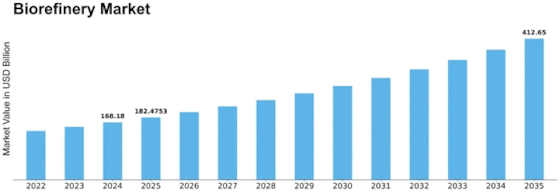
The Biorefinery Market was valued at 168.18 USD Billion in 2024.

What is the projected market valuation for the Biorefinery Market in 2035?

The market is projected to reach a valuation of 412.65 USD Billion by 2035.

What is the expected CAGR for the Biorefinery Market during the forecast period 2025 - 2035?

The expected CAGR for the Biorefinery Market during the forecast period 2025 - 2035 is 8.5%.

Which companies are considered key players in the Biorefinery Market?

Key players in the Biorefinery Market include Neste, Valero Energy Corporation, Renewable Energy Group, BASF, Cargill, ADM, TotalEnergies, POET, and Green Plains Inc.

What are the market segments within the Biorefinery Market?

The Biorefinery Market segments include Type, Product, and Technology.

What was the valuation range for First Generation biorefinery technologies in 2024?

The valuation range for First Generation biorefinery technologies was between 50.0 and 120.0 USD Billion in 2024.

Market Summary

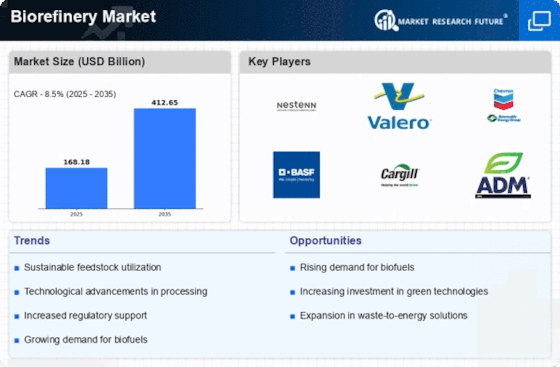
As per MRFR analysis, the Biorefinery Market Size was estimated at 168.18 USD Billion in 2024. The Biorefinery industry is projected to grow from 182.48 USD Billion in 2025 to 412.65 USD Billion by 2035, exhibiting a compound annual growth rate (CAGR) of 8.5 during the forecast period 2025 - 2035.

Key Market Trends & Highlights

The Biorefinery Market is poised for substantial growth driven by sustainability and technological advancements.

  • Sustainable feedstock utilization is becoming increasingly prevalent in the Biorefinery Market, particularly in North America.
  • Technological advancements in processing are enhancing efficiency and reducing costs, thereby attracting investments in Asia-Pacific.
  • The integration of circular economy principles is gaining traction, especially within the fastest-growing second generation segment.
  • Rising demand for renewable energy and government incentives are key drivers propelling the expansion of the energy-driven segment.

Market Size & Forecast

2024 Market Size 168.18 (USD Billion)
2035 Market Size 412.65 (USD Billion)
CAGR (2025 - 2035) 8.5%
Largest Regional Market Share in 2024 North America

Major Players

<p>Neste (FI), Valero Energy Corporation (US), Renewable Energy Group (US), BASF (DE), Cargill (US), ADM (US), TotalEnergies (FR), POET (US), Green Plains Inc. (US)</p>

Market Trends

The Biorefinery Market is currently experiencing a transformative phase, driven by the increasing demand for sustainable energy solutions and the need to reduce greenhouse gas emissions. This sector focuses on converting biomass into valuable products, including biofuels, biochemicals, and biomaterials. As environmental concerns gain prominence, stakeholders are exploring innovative technologies and processes to enhance efficiency and reduce waste. The integration of advanced biotechnologies and the development of new feedstock sources are pivotal in shaping the future landscape of this market. Furthermore, collaboration among industry players, research institutions, and government entities appears to be fostering a conducive environment for growth and innovation. In addition, the Biorefinery Market is likely to witness a surge in investments as companies seek to capitalize on the potential of renewable resources. The shift towards circular economy principles is encouraging the adoption of biorefinery concepts across various sectors, including agriculture, forestry, and waste management. This trend suggests a growing recognition of the economic and environmental benefits associated with biorefining processes. As the market evolves, it may also face challenges related to regulatory frameworks and the need for infrastructure development, which could influence the pace of adoption and implementation of biorefinery technologies.

Sustainable Feedstock Utilization

The emphasis on sustainable feedstock is becoming increasingly pronounced within the Biorefinery Market. Stakeholders are exploring diverse biomass sources, including agricultural residues, forestry by-products, and organic waste. This trend indicates a shift towards utilizing materials that minimize environmental impact while maximizing resource efficiency. The focus on sustainability not only aligns with global environmental goals but also enhances the economic viability of biorefinery operations.

Technological Advancements in Processing

Technological innovations are playing a crucial role in the evolution of the Biorefinery Market. Advanced processing techniques, such as enzymatic hydrolysis and gasification, are being developed to improve the conversion efficiency of biomass into valuable products. This trend suggests that ongoing research and development efforts are likely to yield more efficient and cost-effective biorefining processes, thereby enhancing the overall competitiveness of the market.

Integration of Circular Economy Principles

The integration of circular economy principles is gaining traction within the Biorefinery Market. This approach emphasizes the recycling and repurposing of materials, thereby reducing waste and promoting sustainability. As industries increasingly adopt circular practices, the biorefinery sector is expected to play a pivotal role in creating closed-loop systems that enhance resource efficiency and minimize environmental footprints.

Biorefinery Market Market Drivers

Government Incentives and Policies

Government incentives and supportive policies play a crucial role in propelling the Biorefinery Market. Various countries have implemented tax credits, grants, and subsidies to encourage the development of biorefineries. For instance, the Renewable Fuel Standard in the United States mandates the blending of biofuels with conventional fuels, thereby stimulating demand. Such regulatory frameworks not only enhance the economic viability of biorefineries but also attract investments. The Biorefinery Market is expected to benefit from these favorable conditions, as they create a conducive environment for innovation and expansion in biorefinery technologies.

Rising Demand for Renewable Energy

The increasing demand for renewable energy sources is a pivotal driver for the Biorefinery Market. As nations strive to reduce their carbon footprints and transition away from fossil fuels, biorefineries are positioned as a viable solution. The market for biofuels, a key output of biorefineries, is projected to reach approximately 200 billion USD by 2026. This surge is driven by government policies promoting renewable energy adoption and the need for sustainable alternatives in transportation and heating. Consequently, the Biorefinery Market is likely to experience substantial growth as it aligns with global energy goals and environmental sustainability initiatives.

Expansion of Bioproduct Applications

The expansion of bioproduct applications is a notable driver for the Biorefinery Market. Biorefineries are not limited to biofuels; they also produce a range of biochemicals, bioplastics, and other value-added products. The market for bioplastics, for instance, is anticipated to grow significantly, driven by the demand for sustainable packaging solutions. This diversification of products enhances the economic viability of biorefineries and attracts investment. As industries seek to reduce their reliance on petrochemicals, the Biorefinery Market is poised for growth, offering innovative solutions that meet the evolving needs of various sectors.

Technological Innovations in Biomass Conversion

Technological advancements in biomass conversion processes are significantly influencing the Biorefinery Market. Innovations such as enzymatic hydrolysis, gasification, and fermentation technologies are enhancing the efficiency and yield of biofuel production. For example, the development of advanced fermentation techniques has improved the conversion rates of lignocellulosic biomass, making it a more attractive feedstock. As these technologies continue to evolve, they are likely to reduce production costs and increase the competitiveness of biorefineries. The Biorefinery Market stands to gain from these innovations, which may lead to more sustainable and economically viable operations.

Growing Awareness of Environmental Sustainability

The rising awareness of environmental sustainability among consumers and businesses is a significant driver for the Biorefinery Market. As public concern regarding climate change and resource depletion intensifies, there is a marked shift towards sustainable practices. This trend is reflected in the increasing preference for products derived from renewable resources, including biofuels and biochemicals. The Biorefinery Market is likely to capitalize on this shift, as consumers demand greener alternatives. Furthermore, companies are increasingly adopting sustainability goals, which further propels the need for biorefinery solutions that align with these objectives.

Market Segment Insights

By Type: First Generation (Largest) vs. Second Generation (Fastest-Growing)

<p>In the Biorefinery Market, the segment distribution is notably led by First Generation technologies, which dominate the landscape due to their established processes and widespread adaptation. This segment primarily focuses on feedstocks like sugar and starch, which have historically been utilized for biofuel production. In contrast, the Second Generation segment is rapidly gaining momentum, driven by innovative technologies and a growing emphasis on sustainability, allowing it to become a formidable competitor in the market.</p>

<p>Biorefinery Market Technologies: First Generation (Dominant) vs. Second Generation (Emerging)</p>

<p>First Generation biorefineries primarily utilize food crops and animal fats as feedstocks, making them the dominant force in the market due to their established infrastructure and lower processing costs. However, these technologies are often criticized for their impact on food supply and sustainability. On the other hand, Second Generation biorefineries leverage non-food biomass, such as agricultural residues and waste, which are becoming increasingly popular due to their potential for lower environmental impact. This segment is emerging as a critical player, driven by advancements in fermentation and gasification technologies, aiming to create a more sustainable biorefinery ecosystem.</p>

By Product: Energy Driven (Largest) vs. Material Driven (Fastest-Growing)

<p>In the Biorefinery Market, the 'Energy Driven' segment holds a significant share, driven by the increasing demand for renewable energy sources and the shift towards sustainable energy solutions. This segment serves as the backbone for biofuels and bioenergy production, contributing to global efforts in reducing carbon footprints and enhancing energy security. On the other hand, the 'Material Driven' segment is gaining momentum, particularly with advancements in biomaterials and bioplastics, indicating a notable shift in consumer preferences toward environmentally-friendly materials.</p>

<p>Energy Driven (Dominant) vs. Material Driven (Emerging)</p>

<p>The 'Energy Driven' segment is a dominant player in the Biorefinery Market, focusing on the production of biofuels, electricity, and various forms of renewable energy. This segment appeals to industries seeking to transition away from conventional fossil fuels. Conversely, the 'Material Driven' segment represents an emerging opportunity, targeting the growing need for sustainable materials in manufacturing and packaging. Companies operating in this segment are emphasizing innovation in biopolymers and biodegradable materials, which cater to eco-conscious consumers and regulatory pressures. Together, these segments highlight the biorefinery's role in fostering a sustainable future.</p>

By Technology: Industrial Technology (Largest) vs. Physico-Chemical (Fastest-Growing)

<p>The Biorefinery Market is currently dominated by the Industrial Technology segment, which encompasses a wide array of processes and technologies that convert biomass into bioproducts, chemicals, and fuels. This segment has successfully established itself as the largest in market share, largely due to its integration into established industries and the efficiency of its processes. In contrast, the Physico-Chemical segment, which employs physical and chemical methods for biomass conversion, is emerging rapidly, with its innovative methods gaining traction in various applications.</p>

<p>Technology: Industrial Technology (Dominant) vs. Physico-Chemical (Emerging)</p>

<p>Industrial Technology occupies a prominent role within the Biorefinery Market, leveraging established processes to optimize production and increase efficiency. It is equipped with advanced facilities that facilitate the transformation of feedstocks into valuable products. On the other hand, the Physico-Chemical segment is rapidly emerging as an innovative alternative due to its ability to not only improve yield but also minimize environmental impact. This segment's methods often involve milder reaction conditions, which attract significant interest due to sustainability demands. Together, these technologies signify the ongoing evolution within the biorefinery landscape.</p>

Get more detailed insights about Biorefinery Market Research Report—Global Forecast till 2035

Regional Insights

North America : Leading Innovation and Investment

North America is the largest market for biorefineries, holding approximately 45% of the global share. The region benefits from strong government support, including tax incentives and grants for renewable energy projects. The increasing demand for sustainable fuels and chemicals, coupled with stringent environmental regulations, drives market growth. The U.S. is the primary contributor, followed by Canada, which is also expanding its biorefinery capabilities. The competitive landscape in North America is robust, featuring key players such as Valero Energy Corporation, Renewable Energy Group, and ADM. These companies are investing heavily in advanced technologies to enhance production efficiency and reduce costs. The presence of established infrastructure and a skilled workforce further strengthens the market position of these players, making North America a hub for biorefinery innovation.

Europe : Sustainability and Innovation Focus

Europe is the second-largest market for biorefineries, accounting for around 30% of the global market share. The region is driven by ambitious sustainability goals and regulatory frameworks, such as the European Green Deal, which aims to make Europe climate-neutral by 2050. This regulatory push is fostering innovation and investment in biorefinery technologies, particularly in countries like Germany and France, which are leading the charge in renewable energy initiatives. Germany, France, and the Netherlands are at the forefront of the European biorefinery market, with significant investments from companies like BASF and TotalEnergies. The competitive landscape is characterized by a mix of established firms and innovative startups, all vying to capitalize on the growing demand for biofuels and biochemicals. The European market is also seeing increased collaboration between industry and academia to drive research and development in biorefinery technologies.

Asia-Pacific : Emerging Markets and Growth Potential

Asia-Pacific is rapidly emerging as a significant player in the biorefinery market, holding approximately 20% of the global share. The region's growth is fueled by increasing energy demands, government initiatives promoting renewable energy, and a growing awareness of environmental issues. Countries like China and India are leading the charge, with substantial investments in biorefinery projects aimed at reducing reliance on fossil fuels and enhancing energy security. China is the largest market in the region, followed by India, which is also making strides in biorefinery technology. The competitive landscape is evolving, with both domestic and international players entering the market. Companies are focusing on developing innovative biorefinery processes to convert agricultural waste into valuable biofuels and chemicals, thereby addressing both energy and waste management challenges.

Middle East and Africa : Resource-Rich Opportunities

The Middle East and Africa region is gradually recognizing the potential of biorefineries, currently holding about 5% of the global market share. The growth is driven by the need for diversification away from oil dependency and the increasing demand for sustainable energy solutions. Countries like South Africa and the UAE are exploring biorefinery projects to enhance energy security and promote environmental sustainability, supported by government initiatives and funding. South Africa is leading the way in biorefinery development, with several pilot projects underway. The competitive landscape is still developing, with a mix of local and international players entering the market. The region's unique resources, such as agricultural waste and biomass, present significant opportunities for biorefinery innovations, making it an attractive area for investment and growth.

Key Players and Competitive Insights

Leading market players are investing heavily in research and development in order to expand their product lines, which will help the Biorefinery Market, grow even more. Market participants are also undertaking a variety of strategic activities to expand their global footprint, with important market developments including new product launches, contractual agreements, mergers and acquisitions, higher investments, and collaboration with other organizations. To expand and survive in a more competitive and rising market climate, Biorefinery industry must offer cost-effective items.

Manufacturing locally to minimize operational costs is one of the key business tactics used by manufacturers in the global Biorefinery industry to benefit clients and increase the market sector. In recent years, the Biorefinery industry has offered some of the most significant advantages to medicine. Major players in the Biorefinery Market, including Honeywell International Inc., Chempolis, Sekab, Ørsted A/S, IES BIOGAS srl, AB HOLDING SPA, Zea2 Bioworks, UPM Global, Neste, and BTS Biogas Srl/GmbH, are attempting to increase market demand by investing in research and development operations.

Verified BioEnergie AG (VERBIO) produces and distributes biofuels. It generates biomethane, bioethanol, and biodiesel. The company produces biodiesel using domestic rapeseed oil and other vegetable oils and fatty acids, bioethanol using starch and sucrose, and biogas using agricultural waste. Biofertilizer, animal feed, disinfection solution, sterol, and medicinal glycerin are all produced by VERBIO for usage as raw materials in the food, cosmetics, and pharmaceutical industries. It has facilities throughout Germany for production, storage, and other purposes. Zorbig, Sachsen-Anhalt, Germany serves as the home office for VERBIO. In Nevada, United States, VERBIO opened the first cellulosic RNG factory in May 2022.

The company claims that their new technique, which collects the wasted field straw that would otherwise rot, benefits farmers. At the end of the production process is straw humus, a premium biofertilizer.

Environmental management services are offered by Veolia Environnement SA (Veolia). The business provides solutions for the treatment and distribution of drinking water, wastewater treatment, waste collection, waste-to-energy processing, waste dismantling, and hazardous waste processing. It provides comprehensive energy solutions across the whole conversion cycle, from purchasing energies entering an industrial site to constructing new facilities or updating old ones to marketing the power generated. Veolia carries out its business operations under the construct, own, and operate (BOO) and public BOT contracts.

It provides services to public agencies, local governments, businesses, and individuals in Europe, Asia, North America, Latin America, Africa, the Middle East, and Oceania. The head office of Veolia is located in Paris, Ile-de-France, France. Veolia began construction in April 2022 on the largest biorefinery project in the world, which would generate carbon dioxide-free bio-methanol from a Finnish pulp mill. The refinery will employ Veolia's cutting-edge technology of commercial bio product-derived bio methanol production, which integrates the crude sulphate methanol refining into the pulp production process. It was developed with Metsä Fibre, the largest cooperative forestry association in Europe.

Key Companies in the Biorefinery Market market include

Industry Developments

September 2022: In Carling Saint-Avold, France, AFYREN announced the opening of AFYREN NEOXY, their first sizable factory. The news was released on the Chemesis business platform. Through purification, extraction, and fermentation, carboxylic acids are directly obtained from sugar beetroot co-products to offer a low-carbon substitute.

June 2022: Fintoil and Neste Engineering Solutions have chosen Emerson automation software and solutions to maximise the operational performance of their Hamina-Kotka biorefinery. Advanced biofuels and biochemical feedstocks are produced at the factory in Finland, which will aid in lowering emissions and dependence on fossil fuels.

In January 2024, Neste Corporation announced their plans to increase the production and capacity of renewable diesel alongside a sustainable aviation fuel (SAF) biorefinery facility located in Rotterdam Netherlands, furthering the expansion for low carbon fuel support. The expansion of the biorefinery facility is anticipated to assist in achieving the company’s goals.

In December 2023, Total Energies reported a new collaboration with an agricultural industry leader to construct a biorefinery in France that will use agricultural waste, and non-food crops to create biofuels and tackle the fossil fuels problem. This theory is directed in conjunction with Total Energies’ new initiative focus.

In November 2023, Chevron Renewable Energy Group commenced the operation of the newly enhanced biorefinery located in Iowa USA for their new facility that aims on adding used cooking oils and animal fats on top of the already wide range of feedstocks. This is part of the company’s goal of producing more renewable fuels.

In October 2023, Shell made an announcement concerning their new investment in Singapore for a new biorefinery project intending to support the global reduction of carbon through aviation and maritime fueling. Shell, as a producer of bio-based fuels, hopes to increase the carbon reduction target alongside other biorefinery producers.

In September 2023, Bunge and BP’s joint venture, BP Bunge Bioenergia, commenced production of sugarcane ethanol in Brazil as part of a new biorefinery initiative. The project sets out to increase output of biofuels that are sustainable and are in great demand in the transportation industry.

In August 2023, Eni started building its second biorefinery in Italy targeting the production of HVO biofuels. The facility is expected to be completed by 2025.

In July 2023, UPM Biofuels stated the intention to construct another biorefinery in Germany focused on renewable diesel and naphtha production from sustainable feedstock. In their investment, they made a major move towards increasing Europe’s production of biofuel.

Future Outlook

Biorefinery Market Future Outlook

<p>The Biorefinery Market is poised for growth at 8.5% CAGR from 2024 to 2035, driven by increasing demand for sustainable fuels, waste management solutions, and technological advancements.</p>

New opportunities lie in:

  • <p>Development of integrated biorefinery systems for diverse feedstocks</p>
  • <p>Expansion into bioplastics production from renewable resources</p>
  • <p>Investment in carbon capture technologies for enhanced sustainability</p>

<p>By 2035, the Biorefinery Market is expected to achieve substantial growth and innovation.</p>

Market Segmentation

Biorefinery Market Type Outlook

  • First Generation
  • Second Generation
  • Third Generation

Biorefinery Market Product Outlook

  • Energy Driven
  • Material Driven

Biorefinery Market Technology Outlook

  • Industrial Technology
  • Physico-Chemical
  • Thermochemical

Report Scope

MARKET SIZE 2024168.18(USD Billion)
MARKET SIZE 2025182.48(USD Billion)
MARKET SIZE 2035412.65(USD Billion)
COMPOUND ANNUAL GROWTH RATE (CAGR)8.5% (2024 - 2035)
REPORT COVERAGERevenue Forecast, Competitive Landscape, Growth Factors, and Trends
BASE YEAR2024
Market Forecast Period2025 - 2035
Historical Data2019 - 2024
Market Forecast UnitsUSD Billion
Key Companies ProfiledMarket analysis in progress
Segments CoveredMarket segmentation analysis in progress
Key Market OpportunitiesAdvancements in waste-to-energy technologies enhance sustainability in the Biorefinery Market.
Key Market DynamicsTechnological advancements and regulatory shifts drive innovation and competition in the biorefinery market.
Countries CoveredNorth America, Europe, APAC, South America, MEA

FAQs

What is the current valuation of the Biorefinery Market as of 2024?

The Biorefinery Market was valued at 168.18 USD Billion in 2024.

What is the projected market valuation for the Biorefinery Market in 2035?

The market is projected to reach a valuation of 412.65 USD Billion by 2035.

What is the expected CAGR for the Biorefinery Market during the forecast period 2025 - 2035?

The expected CAGR for the Biorefinery Market during the forecast period 2025 - 2035 is 8.5%.

Which companies are considered key players in the Biorefinery Market?

Key players in the Biorefinery Market include Neste, Valero Energy Corporation, Renewable Energy Group, BASF, Cargill, ADM, TotalEnergies, POET, and Green Plains Inc.

What are the market segments within the Biorefinery Market?

The Biorefinery Market segments include Type, Product, and Technology.

What was the valuation range for First Generation biorefinery technologies in 2024?

The valuation range for First Generation biorefinery technologies was between 50.0 and 120.0 USD Billion in 2024.

  1. SECTION I: EXECUTIVE SUMMARY AND KEY HIGHLIGHTS
    1. EXECUTIVE SUMMARY
      1. Market Overview
      2. Key Findings
      3. Market Segmentation
      4. Competitive Landscape
      5. Challenges and Opportunities
      6. Future Outlook
  2. SECTION II: SCOPING, METHODOLOGY AND MARKET STRUCTURE
    1. MARKET INTRODUCTION
      1. Definition
      2. Scope of the study
    2. RESEARCH METHODOLOGY
      1. Overview
      2. Data Mining
      3. Secondary Research
      4. Primary Research
      5. Forecasting Model
      6. Market Size Estimation
      7. Data Triangulation
      8. Validation
  3. SECTION III: QUALITATIVE ANALYSIS
    1. MARKET DYNAMICS
      1. Overview
      2. Drivers
      3. Restraints
      4. Opportunities
    2. MARKET FACTOR ANALYSIS
      1. Value chain Analysis
      2. Porter's Five Forces Analysis
      3. COVID-19 Impact Analysis
  4. SECTION IV: QUANTITATIVE ANALYSIS
    1. Energy & Power, BY Type (USD Billion)
      1. First Generation
      2. Second Generation
      3. Third Generation
    2. Energy & Power, BY Product (USD Billion)
      1. Energy Driven
      2. Material Driven
    3. Energy & Power, BY Technology (USD Billion)
      1. Industrial Technology
      2. Physico-Chemical
      3. Thermochemical
    4. Energy & Power, BY Region (USD Billion)
      1. North America
      2. Europe
      3. APAC
      4. South America
      5. MEA
  5. SECTION V: COMPETITIVE ANALYSIS
    1. Competitive Landscape
      1. Overview
      2. Competitive Analysis
      3. Market share Analysis
      4. Major Growth Strategy in the Energy & Power
      5. Competitive Benchmarking
      6. Leading Players in Terms of Number of Developments in the Energy & Power
      7. Key developments and growth strategies
      8. Major Players Financial Matrix
    2. Company Profiles
      1. Neste (FI)
      2. Valero Energy Corporation (US)
      3. Renewable Energy Group (US)
      4. BASF (DE)
      5. Cargill (US)
      6. ADM (US)
      7. TotalEnergies (FR)
      8. POET (US)
      9. Green Plains Inc. (US)
    3. Appendix
      1. References
      2. Related Reports
  6. LIST OF FIGURES
    1. MARKET SYNOPSIS
    2. NORTH AMERICA MARKET ANALYSIS
    3. US MARKET ANALYSIS BY TYPE
    4. US MARKET ANALYSIS BY PRODUCT
    5. US MARKET ANALYSIS BY TECHNOLOGY
    6. CANADA MARKET ANALYSIS BY TYPE
    7. CANADA MARKET ANALYSIS BY PRODUCT
    8. CANADA MARKET ANALYSIS BY TECHNOLOGY
    9. EUROPE MARKET ANALYSIS
    10. GERMANY MARKET ANALYSIS BY TYPE
    11. GERMANY MARKET ANALYSIS BY PRODUCT
    12. GERMANY MARKET ANALYSIS BY TECHNOLOGY
    13. UK MARKET ANALYSIS BY TYPE
    14. UK MARKET ANALYSIS BY PRODUCT
    15. UK MARKET ANALYSIS BY TECHNOLOGY
    16. FRANCE MARKET ANALYSIS BY TYPE
    17. FRANCE MARKET ANALYSIS BY PRODUCT
    18. FRANCE MARKET ANALYSIS BY TECHNOLOGY
    19. RUSSIA MARKET ANALYSIS BY TYPE
    20. RUSSIA MARKET ANALYSIS BY PRODUCT
    21. RUSSIA MARKET ANALYSIS BY TECHNOLOGY
    22. ITALY MARKET ANALYSIS BY TYPE
    23. ITALY MARKET ANALYSIS BY PRODUCT
    24. ITALY MARKET ANALYSIS BY TECHNOLOGY
    25. SPAIN MARKET ANALYSIS BY TYPE
    26. SPAIN MARKET ANALYSIS BY PRODUCT
    27. SPAIN MARKET ANALYSIS BY TECHNOLOGY
    28. REST OF EUROPE MARKET ANALYSIS BY TYPE
    29. REST OF EUROPE MARKET ANALYSIS BY PRODUCT
    30. REST OF EUROPE MARKET ANALYSIS BY TECHNOLOGY
    31. APAC MARKET ANALYSIS
    32. CHINA MARKET ANALYSIS BY TYPE
    33. CHINA MARKET ANALYSIS BY PRODUCT
    34. CHINA MARKET ANALYSIS BY TECHNOLOGY
    35. INDIA MARKET ANALYSIS BY TYPE
    36. INDIA MARKET ANALYSIS BY PRODUCT
    37. INDIA MARKET ANALYSIS BY TECHNOLOGY
    38. JAPAN MARKET ANALYSIS BY TYPE
    39. JAPAN MARKET ANALYSIS BY PRODUCT
    40. JAPAN MARKET ANALYSIS BY TECHNOLOGY
    41. SOUTH KOREA MARKET ANALYSIS BY TYPE
    42. SOUTH KOREA MARKET ANALYSIS BY PRODUCT
    43. SOUTH KOREA MARKET ANALYSIS BY TECHNOLOGY
    44. MALAYSIA MARKET ANALYSIS BY TYPE
    45. MALAYSIA MARKET ANALYSIS BY PRODUCT
    46. MALAYSIA MARKET ANALYSIS BY TECHNOLOGY
    47. THAILAND MARKET ANALYSIS BY TYPE
    48. THAILAND MARKET ANALYSIS BY PRODUCT
    49. THAILAND MARKET ANALYSIS BY TECHNOLOGY
    50. INDONESIA MARKET ANALYSIS BY TYPE
    51. INDONESIA MARKET ANALYSIS BY PRODUCT
    52. INDONESIA MARKET ANALYSIS BY TECHNOLOGY
    53. REST OF APAC MARKET ANALYSIS BY TYPE
    54. REST OF APAC MARKET ANALYSIS BY PRODUCT
    55. REST OF APAC MARKET ANALYSIS BY TECHNOLOGY
    56. SOUTH AMERICA MARKET ANALYSIS
    57. BRAZIL MARKET ANALYSIS BY TYPE
    58. BRAZIL MARKET ANALYSIS BY PRODUCT
    59. BRAZIL MARKET ANALYSIS BY TECHNOLOGY
    60. MEXICO MARKET ANALYSIS BY TYPE
    61. MEXICO MARKET ANALYSIS BY PRODUCT
    62. MEXICO MARKET ANALYSIS BY TECHNOLOGY
    63. ARGENTINA MARKET ANALYSIS BY TYPE
    64. ARGENTINA MARKET ANALYSIS BY PRODUCT
    65. ARGENTINA MARKET ANALYSIS BY TECHNOLOGY
    66. REST OF SOUTH AMERICA MARKET ANALYSIS BY TYPE
    67. REST OF SOUTH AMERICA MARKET ANALYSIS BY PRODUCT
    68. REST OF SOUTH AMERICA MARKET ANALYSIS BY TECHNOLOGY
    69. MEA MARKET ANALYSIS
    70. GCC COUNTRIES MARKET ANALYSIS BY TYPE
    71. GCC COUNTRIES MARKET ANALYSIS BY PRODUCT
    72. GCC COUNTRIES MARKET ANALYSIS BY TECHNOLOGY
    73. SOUTH AFRICA MARKET ANALYSIS BY TYPE
    74. SOUTH AFRICA MARKET ANALYSIS BY PRODUCT
    75. SOUTH AFRICA MARKET ANALYSIS BY TECHNOLOGY
    76. REST OF MEA MARKET ANALYSIS BY TYPE
    77. REST OF MEA MARKET ANALYSIS BY PRODUCT
    78. REST OF MEA MARKET ANALYSIS BY TECHNOLOGY
    79. KEY BUYING CRITERIA OF ENERGY & POWER
    80. RESEARCH PROCESS OF MRFR
    81. DRO ANALYSIS OF ENERGY & POWER
    82. DRIVERS IMPACT ANALYSIS: ENERGY & POWER
    83. RESTRAINTS IMPACT ANALYSIS: ENERGY & POWER
    84. SUPPLY / VALUE CHAIN: ENERGY & POWER
    85. ENERGY & POWER, BY TYPE, 2024 (% SHARE)
    86. ENERGY & POWER, BY TYPE, 2024 TO 2035 (USD Billion)
    87. ENERGY & POWER, BY PRODUCT, 2024 (% SHARE)
    88. ENERGY & POWER, BY PRODUCT, 2024 TO 2035 (USD Billion)
    89. ENERGY & POWER, BY TECHNOLOGY, 2024 (% SHARE)
    90. ENERGY & POWER, BY TECHNOLOGY, 2024 TO 2035 (USD Billion)
    91. BENCHMARKING OF MAJOR COMPETITORS
  7. LIST OF TABLES
    1. LIST OF ASSUMPTIONS
    2. North America MARKET SIZE ESTIMATES; FORECAST
      1. BY TYPE, 2025-2035 (USD Billion)
      2. BY PRODUCT, 2025-2035 (USD Billion)
      3. BY TECHNOLOGY, 2025-2035 (USD Billion)
    3. US MARKET SIZE ESTIMATES; FORECAST
      1. BY TYPE, 2025-2035 (USD Billion)
      2. BY PRODUCT, 2025-2035 (USD Billion)
      3. BY TECHNOLOGY, 2025-2035 (USD Billion)
    4. Canada MARKET SIZE ESTIMATES; FORECAST
      1. BY TYPE, 2025-2035 (USD Billion)
      2. BY PRODUCT, 2025-2035 (USD Billion)
      3. BY TECHNOLOGY, 2025-2035 (USD Billion)
    5. Europe MARKET SIZE ESTIMATES; FORECAST
      1. BY TYPE, 2025-2035 (USD Billion)
      2. BY PRODUCT, 2025-2035 (USD Billion)
      3. BY TECHNOLOGY, 2025-2035 (USD Billion)
    6. Germany MARKET SIZE ESTIMATES; FORECAST
      1. BY TYPE, 2025-2035 (USD Billion)
      2. BY PRODUCT, 2025-2035 (USD Billion)
      3. BY TECHNOLOGY, 2025-2035 (USD Billion)
    7. UK MARKET SIZE ESTIMATES; FORECAST
      1. BY TYPE, 2025-2035 (USD Billion)
      2. BY PRODUCT, 2025-2035 (USD Billion)
      3. BY TECHNOLOGY, 2025-2035 (USD Billion)
    8. France MARKET SIZE ESTIMATES; FORECAST
      1. BY TYPE, 2025-2035 (USD Billion)
      2. BY PRODUCT, 2025-2035 (USD Billion)
      3. BY TECHNOLOGY, 2025-2035 (USD Billion)
    9. Russia MARKET SIZE ESTIMATES; FORECAST
      1. BY TYPE, 2025-2035 (USD Billion)
      2. BY PRODUCT, 2025-2035 (USD Billion)
      3. BY TECHNOLOGY, 2025-2035 (USD Billion)
    10. Italy MARKET SIZE ESTIMATES; FORECAST
      1. BY TYPE, 2025-2035 (USD Billion)
      2. BY PRODUCT, 2025-2035 (USD Billion)
      3. BY TECHNOLOGY, 2025-2035 (USD Billion)
    11. Spain MARKET SIZE ESTIMATES; FORECAST
      1. BY TYPE, 2025-2035 (USD Billion)
      2. BY PRODUCT, 2025-2035 (USD Billion)
      3. BY TECHNOLOGY, 2025-2035 (USD Billion)
    12. Rest of Europe MARKET SIZE ESTIMATES; FORECAST
      1. BY TYPE, 2025-2035 (USD Billion)
      2. BY PRODUCT, 2025-2035 (USD Billion)
      3. BY TECHNOLOGY, 2025-2035 (USD Billion)
    13. APAC MARKET SIZE ESTIMATES; FORECAST
      1. BY TYPE, 2025-2035 (USD Billion)
      2. BY PRODUCT, 2025-2035 (USD Billion)
      3. BY TECHNOLOGY, 2025-2035 (USD Billion)
    14. China MARKET SIZE ESTIMATES; FORECAST
      1. BY TYPE, 2025-2035 (USD Billion)
      2. BY PRODUCT, 2025-2035 (USD Billion)
      3. BY TECHNOLOGY, 2025-2035 (USD Billion)
    15. India MARKET SIZE ESTIMATES; FORECAST
      1. BY TYPE, 2025-2035 (USD Billion)
      2. BY PRODUCT, 2025-2035 (USD Billion)
      3. BY TECHNOLOGY, 2025-2035 (USD Billion)
    16. Japan MARKET SIZE ESTIMATES; FORECAST
      1. BY TYPE, 2025-2035 (USD Billion)
      2. BY PRODUCT, 2025-2035 (USD Billion)
      3. BY TECHNOLOGY, 2025-2035 (USD Billion)
    17. South Korea MARKET SIZE ESTIMATES; FORECAST
      1. BY TYPE, 2025-2035 (USD Billion)
      2. BY PRODUCT, 2025-2035 (USD Billion)
      3. BY TECHNOLOGY, 2025-2035 (USD Billion)
    18. Malaysia MARKET SIZE ESTIMATES; FORECAST
      1. BY TYPE, 2025-2035 (USD Billion)
      2. BY PRODUCT, 2025-2035 (USD Billion)
      3. BY TECHNOLOGY, 2025-2035 (USD Billion)
    19. Thailand MARKET SIZE ESTIMATES; FORECAST
      1. BY TYPE, 2025-2035 (USD Billion)
      2. BY PRODUCT, 2025-2035 (USD Billion)
      3. BY TECHNOLOGY, 2025-2035 (USD Billion)
    20. Indonesia MARKET SIZE ESTIMATES; FORECAST
      1. BY TYPE, 2025-2035 (USD Billion)
      2. BY PRODUCT, 2025-2035 (USD Billion)
      3. BY TECHNOLOGY, 2025-2035 (USD Billion)
    21. Rest of APAC MARKET SIZE ESTIMATES; FORECAST
      1. BY TYPE, 2025-2035 (USD Billion)
      2. BY PRODUCT, 2025-2035 (USD Billion)
      3. BY TECHNOLOGY, 2025-2035 (USD Billion)
    22. South America MARKET SIZE ESTIMATES; FORECAST
      1. BY TYPE, 2025-2035 (USD Billion)
      2. BY PRODUCT, 2025-2035 (USD Billion)
      3. BY TECHNOLOGY, 2025-2035 (USD Billion)
    23. Brazil MARKET SIZE ESTIMATES; FORECAST
      1. BY TYPE, 2025-2035 (USD Billion)
      2. BY PRODUCT, 2025-2035 (USD Billion)
      3. BY TECHNOLOGY, 2025-2035 (USD Billion)
    24. Mexico MARKET SIZE ESTIMATES; FORECAST
      1. BY TYPE, 2025-2035 (USD Billion)
      2. BY PRODUCT, 2025-2035 (USD Billion)
      3. BY TECHNOLOGY, 2025-2035 (USD Billion)
    25. Argentina MARKET SIZE ESTIMATES; FORECAST
      1. BY TYPE, 2025-2035 (USD Billion)
      2. BY PRODUCT, 2025-2035 (USD Billion)
      3. BY TECHNOLOGY, 2025-2035 (USD Billion)
    26. Rest of South America MARKET SIZE ESTIMATES; FORECAST
      1. BY TYPE, 2025-2035 (USD Billion)
      2. BY PRODUCT, 2025-2035 (USD Billion)
      3. BY TECHNOLOGY, 2025-2035 (USD Billion)
    27. MEA MARKET SIZE ESTIMATES; FORECAST
      1. BY TYPE, 2025-2035 (USD Billion)
      2. BY PRODUCT, 2025-2035 (USD Billion)
      3. BY TECHNOLOGY, 2025-2035 (USD Billion)
    28. GCC Countries MARKET SIZE ESTIMATES; FORECAST
      1. BY TYPE, 2025-2035 (USD Billion)
      2. BY PRODUCT, 2025-2035 (USD Billion)
      3. BY TECHNOLOGY, 2025-2035 (USD Billion)
    29. South Africa MARKET SIZE ESTIMATES; FORECAST
      1. BY TYPE, 2025-2035 (USD Billion)
      2. BY PRODUCT, 2025-2035 (USD Billion)
      3. BY TECHNOLOGY, 2025-2035 (USD Billion)
    30. Rest of MEA MARKET SIZE ESTIMATES; FORECAST
      1. BY TYPE, 2025-2035 (USD Billion)
      2. BY PRODUCT, 2025-2035 (USD Billion)
      3. BY TECHNOLOGY, 2025-2035 (USD Billion)
    31. PRODUCT LAUNCH/PRODUCT DEVELOPMENT/APPROVAL
    32. ACQUISITION/PARTNERSHIP

Biorefinery Market Segmentation

Biorefinery Type Outlook (USD Billion, 2018-2032)

First Generation

Second Generation

Third Generation

Biorefinery Product Outlook (USD Billion, 2018-2032)

Energy Driven

Material Driven

Biorefinery Technology Outlook (USD Billion, 2018-2032)

Industrial technology

Physico-Chemical

Thermochemical

Biorefinery Regional Outlook (USD Billion, 2018-2032)

North America Outlook (USD Billion, 2018-2032)

Biorefinery by Type

First Generation

Second Generation

Third Generation

Biorefinery by Product

Energy Driven

Material Driven

Biorefinery by Technology

Industrial technology

Physico-Chemical

Thermochemical

US Outlook (USD Billion, 2018-2032)

Biorefinery by Type

First Generation

Second Generation

Third Generation

Biorefinery by Product

Energy Driven

Material Driven

Biorefinery by Technology

Industrial technology

Physico-Chemical

Thermochemical

Canada Outlook (USD Billion, 2018-2032)

Biorefinery by Type

First Generation

Second Generation

Third Generation

Biorefinery by Product

Energy Driven

Material Driven

Biorefinery by Technology

Industrial technology

Physico-Chemical

Thermochemical

Europe Outlook (USD Billion, 2018-2032)

Biorefinery by Type

First Generation

Second Generation

Third Generation

Biorefinery by Product

Energy Driven

Material Driven

Biorefinery by Technology

Industrial technology

Physico-Chemical

Thermochemical

Germany Outlook (USD Billion, 2018-2032)

Biorefinery by Type

First Generation

Second Generation

Third Generation

Biorefinery by Product

Energy Driven

Material Driven

Biorefinery by Technology

Industrial technology

Physico-Chemical

Thermochemical

France Outlook (USD Billion, 2018-2032)

Biorefinery by Type

First Generation

Second Generation

Third Generation

Biorefinery by Product

Energy Driven

Material Driven

Biorefinery by Technology

Industrial technology

Physico-Chemical

Thermochemical

UK Outlook (USD Billion, 2018-2032)

Biorefinery by Type

First Generation

Second Generation

Third Generation

Biorefinery by Product

Energy Driven

Material Driven

Biorefinery by Technology

Industrial technology

Physico-Chemical

Thermochemical

Italy Outlook (USD Billion, 2018-2032)

Biorefinery by Type

First Generation

Second Generation

Third Generation

Biorefinery by Product

Energy Driven

Material Driven

Biorefinery by Technology

Industrial technology

Physico-Chemical

Thermochemical

Spain Outlook (USD Billion, 2018-2032)

Biorefinery by Type

First Generation

Second Generation

Third Generation

Biorefinery by Product

Energy Driven

Material Driven

Biorefinery by Technology

Industrial technology

Physico-Chemical

Thermochemical

Rest Of Europe Outlook (USD Billion, 2018-2032)

Biorefinery by Type

First Generation

Second Generation

Third Generation

Biorefinery by Product

Energy Driven

Material Driven

Biorefinery by Technology

Industrial technology

Physico-Chemical

Thermochemical

Asia-Pacific Outlook (USD Billion, 2018-2032)

Biorefinery by Type

First Generation

Second Generation

Third Generation

Biorefinery by Product

Energy Driven

Material Driven

Biorefinery by Technology

Industrial technology

Physico-Chemical

Thermochemical

China Outlook (USD Billion, 2018-2032)

Biorefinery by Type

First Generation

Second Generation

Third Generation

Biorefinery by Product

Energy Driven

Material Driven

Biorefinery by Technology

Industrial technology

Physico-Chemical

Thermochemical

Japan Outlook (USD Billion, 2018-2032)

Biorefinery by Type

First Generation

Second Generation

Third Generation

Biorefinery by Product

Energy Driven

Material Driven

Biorefinery by Technology

Industrial technology

Physico-Chemical

Thermochemical

India Outlook (USD Billion, 2018-2032)

Biorefinery by Type

First Generation

Second Generation

Third Generation

Biorefinery by Product

Energy Driven

Material Driven

Biorefinery by Technology

Industrial technology

Physico-Chemical

Thermochemical

Australia Outlook (USD Billion, 2018-2032)

Biorefinery by Type

First Generation

Second Generation

Third Generation

Biorefinery by Product

Energy Driven

Material Driven

Biorefinery by Technology

Industrial technology

Physico-Chemical

Thermochemical

Rest of Asia-Pacific Outlook (USD Billion, 2018-2032)

Biorefinery by Type

First Generation

Second Generation

Third Generation

Biorefinery by Product

Energy Driven

Material Driven

Biorefinery by Technology

Industrial technology

Physico-Chemical

Thermochemical

Rest of the World Outlook (USD Billion, 2018-2032)

Biorefinery by Type

First Generation

Second Generation

Third Generation

Biorefinery by Product

Energy Driven

Material Driven

Biorefinery by Technology

Industrial technology

Physico-Chemical

Thermochemical

Middle East Outlook (USD Billion, 2018-2032)

Biorefinery by Type

First Generation

Second Generation

Third Generation

Biorefinery by Product

Energy Driven

Material Driven

Biorefinery by Technology

Industrial technology

Physico-Chemical

Thermochemical

Africa Outlook (USD Billion, 2018-2032)

Biorefinery by Type

First Generation

Second Generation

Third Generation

Biorefinery by Product

Energy Driven

Material Driven

Biorefinery by Technology

Industrial technology

Physico-Chemical

Thermochemical

Latin America Outlook (USD Billion, 2018-2032)

Biorefinery by Type

First Generation

Second Generation

Third Generation

Biorefinery by Product

Energy Driven

Material Driven

Biorefinery by Technology

Industrial technology

Physico-Chemical

Thermochemical

Infographic

Free Sample Request

Kindly complete the form below to receive a free sample of this Report

Get Free Sample

Customer Strories

Compare Licence

×
Features License Type
Single User Multiuser License Enterprise User
Price $4,950 $5,950 $7,250
Maximum User Access Limit 1 User Upto 10 Users Unrestricted Access Throughout the Organization
Free Customization
Direct Access to Analyst
Deliverable Format
Platform Access
Discount on Next Purchase 10% 15% 15%
Printable Versions