
×
Hero Background
English
Chinese
French
Japanese
Korean
German
Spanish

Biorational Pesticides Market Trends

ID: MRFR/Agri/6097-HCR
90 Pages
Snehal Singh
October 2025

Biorational Pesticides Market Research Report Information by Source (Botanical, Microbials, Minerals, and Others), Mode of Application (Foliar Spray, Soil Treatment, Trunk Injection, and Others), Type, Crop Type, and Region — Global Forecast till 2035

Share:
Download PDF ×

We do not share your information with anyone. However, we may send you emails based on your report interest from time to time. You may contact us at any time to opt-out.

Biorational Pesticides Market Infographic
Purchase Options

Market Trends

Key Emerging Trends in the Biorational Pesticides Market

Biorational Pesticides Market is experiencing substantial growth, and companies operating in this sector are implementing various market share positioning strategies. A primary strategy involves ongoing research and development to introduce innovative biorational pesticide formulations. These formulations often leverage natural compounds, beneficial microorganisms, or plant extracts, aiming to provide effective pest control while minimizing environmental impact. Companies that continuously innovate in this space can differentiate their products, attract environmentally conscious consumers, and gain a larger market share.

Strategic collaborations and partnerships play a crucial role in the Biorational Pesticides Market. Companies often engage with agricultural research institutions, biotechnology firms, and environmental organizations to enhance their understanding of biorational solutions and access cutting-edge technologies. Such collaborations contribute to the development of novel formulations, as well as the sharing of knowledge and resources. Partnerships with distribution networks and agricultural cooperatives also help companies expand their market reach and penetrate new regions effectively.

Geographical expansion is a significant strategy as companies seek to tap into diverse agricultural landscapes. The effectiveness of biorational pesticides may vary based on local pest pressures, climate conditions, and crop types. Therefore, companies strategically enter new markets by adapting their formulations to suit specific regional needs, complying with local regulations, and establishing strong distribution networks. By broadening their geographical presence, companies can address the unique challenges faced by farmers globally and increase their market share.

Market penetration is fundamental in the Biorational Pesticides Market, focusing on increasing market share within existing regions. This involves targeted marketing campaigns, educational initiatives, and collaboration with agricultural extension services to create awareness about the benefits of biorational pesticides. Demonstrations, field trials, and providing technical support to farmers are common tactics to boost product adoption and strengthen market penetration.

Sustainability and environmental considerations are integral to market share positioning strategies for biorational pesticides. With growing awareness of the ecological impact of conventional pesticides, farmers and consumers are increasingly seeking sustainable alternatives. Companies that emphasize the eco-friendly nature of their biorational pesticides, highlighting reduced chemical residues, non-toxicity to beneficial organisms, and minimal impact on non-target species, can position themselves favorably and attract environmentally conscious customers, contributing to a larger market share.

Price positioning is a critical strategy wherein companies strategically set the prices of their biorational pesticides. This involves offering competitive pricing, volume discounts, or creating premium formulations with enhanced features. Understanding the cost sensitivity of farmers in different regions and market segments is crucial for effective price positioning, allowing companies to cater to a diverse range of agricultural budgets.

Investment in marketing and education is pivotal for gaining a competitive advantage in the Biorational Pesticides Market. Companies allocate resources to build strong brand identities, create informative marketing materials, and establish educational campaigns. Engaging with farmers, agricultural professionals, and environmental groups through workshops, seminars, and online platforms helps increase awareness and foster positive perceptions, ultimately influencing market share. North America is poised to lead the market share for biorational pesticides throughout the forecast period, driven by the rising demand for organic products in the region. However, the Asia-Pacific market is expected to register the highest Compound Annual Growth Rate (CAGR) during this period, with China and India emerging as the largest country-level markets for biorational pesticides in the region. Factors such as increasing environmental concerns, awareness about the benefits of biorational pesticides, and the expanding cultivation of fruits and vegetables are key drivers boosting the demand for biorational pesticides in the Asia-Pacific region.


Author
Snehal Singh
Assistant Manager - Research

High acumen in analyzing complex macro & micro markets with more than 6 years of work experience in the field of market research. By implementing her analytical skills in forecasting and estimation into market research reports, she has expertise in Packaging, Construction, and Equipment domains. She handles a team size of 20-25 resources and ensures smooth running of the projects, associated marketing activities, and client servicing.

Leave a Comment

FAQs

Name the players involved in the biorational pesticides market.

biorational pesticides market includes players like Syngenta AG (Switzerland), Bayer AG (Germany), BASF SE (Germany), Monsanto Bioag (US), Valent Biosciences (Canada), Isagro SAP (Italy), Dowdupont (US), Marrone Bio Innovations (US), Koppert (The Netherlands), and Russell IPM (UK)

What are the types included in the biorational pesticides market report?

biorational pesticides market report includes types like biorational fungicides, biorational nematicides, biorational insecticides, and others.

What are the crop types included in the biorational pesticides market report?

biorational pesticides market report includes crop types like cereals & grains, oilseeds & pulses, fruits & vegetables, and others.

What are the applications included in the biorational pesticides market report?

biorational pesticides market report includes applications like soil treatment, trunk injection, biorational pesticides foliar spray, and others.

What can hinder the biorational pesticides market growth?

biorational pesticides market may find growth difficult with lack of infrastructure and low shelf life.

Market Summary

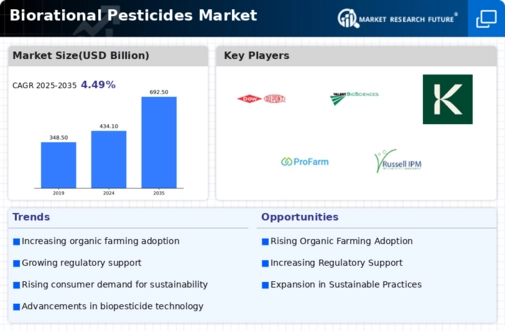
The Global Biorational Pesticides Market is projected to grow from 434.1 USD Billion in 2024 to 692.5 USD Billion by 2035.

Key Market Trends & Highlights

Biorational Pesticides Market Key Trends and Highlights

  • The market is expected to experience a compound annual growth rate (CAGR) of 4.34% from 2025 to 2035. By 2035, the market valuation is anticipated to reach 692.5 USD Billion, indicating robust growth potential. In 2024, the market is valued at 434.1 USD Billion, reflecting a strong foundation for future expansion. Growing adoption of sustainable agricultural practices due to increasing environmental concerns is a major market driver.

Market Size & Forecast

2024 Market Size 434.1 (USD Billion)
2035 Market Size 692.5 (USD Billion)
CAGR (2025-2035) 4.34%
Largest Regional Market Share in 2024 south_america)

Major Players

<p>Bayer AG (Germany), Syngenta AG (Switzerland), Monsanto Bioag (US), BASF SE (Germany), Dowdupont (US), Valent Biosciences (Canada), Isagro SAP (Italy), Koppert (The Netherlands), Marrone Bio Innovations (US), Russell IPM (UK)</p>

Market Trends

Biorational Pesticides Market Market Drivers

Market Growth Projections

The Global Biorational Pesticides Market Industry is on a growth trajectory, with projections indicating a market value of 434.1 USD Billion in 2024 and an expected increase to 692.5 USD Billion by 2035. This growth is underpinned by a compound annual growth rate (CAGR) of 4.34% from 2025 to 2035. Such figures suggest a robust demand for biorational pesticides, driven by factors such as increasing organic farming practices, regulatory support for sustainable agriculture, and heightened awareness of environmental impacts. The market's expansion reflects a broader shift towards sustainable pest management solutions in response to global agricultural challenges.

Increasing Demand for Organic Produce

The rising consumer preference for organic produce is a pivotal driver in the Global Biorational Pesticides Market Industry. As more consumers become aware of the health and environmental impacts of synthetic pesticides, the demand for biorational alternatives is likely to increase. This shift is evidenced by the growth of organic farming, which has seen a substantial rise in acreage globally. In 2024, the market is projected to reach 434.1 USD Billion, with biorational pesticides playing a crucial role in meeting the needs of organic farmers who seek effective pest control solutions without compromising their organic status.

Rising Awareness of Environmental Impact

Growing awareness of the environmental consequences of chemical pesticide use is a significant driver for the Global Biorational Pesticides Market Industry. Stakeholders, including farmers, consumers, and policymakers, are increasingly recognizing the need for sustainable pest management solutions that reduce ecological harm. This awareness is leading to a shift towards biorational pesticides, which are perceived as safer alternatives. Educational campaigns and initiatives aimed at promoting sustainable agriculture practices further support this trend. As a result, the market is poised for growth, with projections indicating a substantial increase in demand for biorational products in the coming years.

Regulatory Support for Sustainable Practices

Regulatory frameworks worldwide increasingly favor sustainable agricultural practices, which bolster the Global Biorational Pesticides Market Industry. Governments are implementing policies that encourage the use of environmentally friendly pest control methods, including biorational pesticides. For instance, the European Union has established regulations that promote integrated pest management strategies, which often incorporate biorational products. This regulatory support not only enhances market growth but also aligns with global sustainability goals. As a result, the market is expected to grow at a CAGR of 4.34% from 2025 to 2035, reflecting the positive impact of these policies on biorational pesticide adoption.

Technological Advancements in Pest Management

Technological innovations are transforming pest management strategies, significantly impacting the Global Biorational Pesticides Market Industry. Advances in biotechnology and formulation techniques have led to the development of more effective biorational products that target specific pests while minimizing harm to beneficial organisms. For example, the introduction of microbial pesticides and plant extracts has expanded the range of available biorational options for farmers. These innovations not only enhance pest control efficacy but also contribute to sustainable agricultural practices. As the market evolves, it is anticipated that these technological advancements will drive further growth, contributing to the projected market value of 692.5 USD Billion by 2035.

Global Population Growth and Food Security Concerns

The escalating global population and the corresponding need for food security are driving factors in the Global Biorational Pesticides Market Industry. As the world population is expected to reach approximately 9.7 billion by 2050, the demand for increased agricultural productivity becomes paramount. Biorational pesticides offer a sustainable approach to enhancing crop yields while minimizing environmental impact. This is particularly relevant in regions facing food scarcity challenges. The market's growth trajectory reflects this urgency, with an anticipated value of 434.1 USD Billion in 2024, as agricultural stakeholders seek effective solutions to meet the food demands of a growing population.

Market Segment Insights

Get more detailed insights about Biorational Pesticides Market Research Report – Global Forecast till 2028

Regional Insights

Key Companies in the Biorational Pesticides Market market include

Industry Developments

December 2023: Marrone Bio Innovations has unveiled Vintegra, a specialty pest control product for vegetables and fruits. The formulation contains active ingredients derived exclusively from naturally occurring substances and is, therefore, able to protect minor and beneficial living organisms. Marrone Bio highlighted that Vintegra is beneficial to the crops since it not only helps in the suppression of pests but also enhances the crop's tolerance to abiotic stresses thereby making it suitable in IPM systems.

The company seeks to increase the scope of the product in North America and Europe, which are encouraged by the regulatory requirements and consumer expectations of eco-friendly solutions for agriculture. This launch is indicative of Marrone Bio’s activities to expand the use of bioprotectants.

October 2023: BASF SE has launched a new biorational insecticide, EcoShield, which is said to target a variety of pests that damage crops while also being environmentally friendly. To lessen dependence on synthetic pesticides, EcoShield utilizes biological extracts and metabolites that target crucial stages in the life cycle of pests. According to BASF, it can be easily integrated into existing pest management programs as it is compatible with existing practices and pesticides.

The product is aimed primarily at Latin America and Asia-Pacific regions which are characterized by high intensity of pest pressure as well as high demand for environmentally sustainable agriculture solutions. In addition, BASF is actively undertaking efforts to partner with local distributors to promote the product's use and improve its availability.

Biorational Pesticides Market, by Source

    • Botanical
    • Microbials
    • Minerals
    • Others

Biorational Pesticides Market, by Mode of Application

    • Foliar Spray
    • Soil Treatment
    • Trunk Injection
    • Others

Biorational Pesticides Market, by Type

    • Biorational Insecticides
    • Biorational Fungicides
    • Biorational Nematicides
    • Others

 Biorational Pesticides Market, by Crop Type

    • Fruits & Vegetables
    • Cereals & Grains
    • Oilseeds & Pulses
    • Other

Biorational Pesticides Market, by Region

    • North America
      • US
      • Canada
      • Mexico
    • Europe
      • Germany
      • France
      • Italy
      • Spain
      • UK
      • Rest of Europe
    • Asia-Pacific
      • Japan
      • China
      • India
      • Australia and New Zealand
      • Rest of Asia-Pacific
    • Rest of the World (RoW)
      • South America
      • Middle East
      • Africa

Key Players in the Global Biorational Pesticides Market

    • Bayer AG (Germany)
    • Monsanto Bioag (US)
    • BASF SE (Germany)
    • Dowdupont (US)
    • Valent Biosciences (Canada)
    • Isagro SAP (Italy)
    • Koppert (The Netherlands)
    • Marrone Bio Innovations (US)
    • Russell IPM (UK)

Intended Audience

    • Biorational Pesticides Market producers/processors
    • Agrochemical manufacturers
    • Dealers and distributors
    • Raw material suppliers and distributors
    • Traders, exporters, and importers

Future Outlook

Biorational Pesticides Market Future Outlook

<p>The Global Biorational Pesticides Market is projected to grow at a 4.34% CAGR from 2024 to 2035, driven by increasing demand for sustainable agriculture and regulatory support.</p>

New opportunities lie in:

  • <p>Develop biopesticide formulations targeting specific pests to enhance efficacy. Invest in R&amp;D for innovative delivery systems to improve application efficiency. Expand market presence in emerging economies through strategic partnerships with local distributors.</p>

<p>By 2035, the market is expected to achieve substantial growth, reflecting a robust shift towards sustainable agricultural practices.</p>

Market Segmentation

Intended Audience

  • Traders
  • exporters
  • and importers
  • Raw material suppliers and distributors
  • Dealers and distributors
  • Agrochemical manufacturers
  • Biorational Pesticides Market producers/processors

Biorational Pesticides Market, by Type

  • Others
  • Biorational Nematicides
  • Biorational Fungicides
  • Biorational Insecticides

Biorational Pesticides Market, by Region

  • Rest of the World (RoW)
  • South America
  • Middle East
  • Africa
  • Asia-Pacific
  • Japan
  • China
  • India
  • Australia and New Zealand
  • Rest of Asia-Pacific
  • Europe
  • Germany
  • France
  • Italy
  • Spain
  • UK
  • Rest of Europe
  • North America
  • US
  • Canada
  • Mexico
  • Russell IPM (UK)
  • Marrone Bio Innovations (US)
  • Koppert (The Netherlands)
  • Isagro SAP (Italy)
  • Valent Biosciences (Canada)
  • Dowdupont (US)
  • BASF SE (Germany)
  • Monsanto Bioag (US)
  • Syngenta AG (Switzerland)
  • Bayer AG (Germany)
  • Traders
  • exporters
  • and importers
  • Raw material suppliers and distributors
  • Dealers and distributors
  • Agrochemical manufacturers
  • Biorational Pesticides Market producers/processors

Biorational Pesticides Market, by Source

  • Others
  • Minerals
  • Microbials
  • Botanical

 Biorational Pesticides Market, by Crop Type

  • Other
  • Oilseeds & Pulses
  • Cereals & Grains
  • Fruits & Vegetables

Biorational Pesticides Market, by Mode of Application

  • Others
  • Trunk Injection
  • Soil Treatment
  • Foliar Spray

Key Players in the Global Biorational Pesticides Market

  • Russell IPM (UK)
  • Marrone Bio Innovations (US)
  • Koppert (The Netherlands)
  • Isagro SAP (Italy)
  • Valent Biosciences (Canada)
  • Dowdupont (US)
  • BASF SE (Germany)
  • Monsanto Bioag (US)
  • Syngenta AG (Switzerland)
  • Bayer AG (Germany)
  • Traders
  • exporters
  • and importers
  • Raw material suppliers and distributors
  • Dealers and distributors
  • Agrochemical manufacturers
  • Biorational Pesticides Market producers/processors

Report Scope

{}

FAQs

Name the players involved in the biorational pesticides market.

biorational pesticides market includes players like Syngenta AG (Switzerland), Bayer AG (Germany), BASF SE (Germany), Monsanto Bioag (US), Valent Biosciences (Canada), Isagro SAP (Italy), Dowdupont (US), Marrone Bio Innovations (US), Koppert (The Netherlands), and Russell IPM (UK)

What are the types included in the biorational pesticides market report?

biorational pesticides market report includes types like biorational fungicides, biorational nematicides, biorational insecticides, and others.

What are the crop types included in the biorational pesticides market report?

biorational pesticides market report includes crop types like cereals &amp; grains, oilseeds &amp; pulses, fruits &amp; vegetables, and others.

What are the applications included in the biorational pesticides market report?

biorational pesticides market report includes applications like soil treatment, trunk injection, biorational pesticides foliar spray, and others.

What can hinder the biorational pesticides market growth?

biorational pesticides market may find growth difficult with lack of infrastructure and low shelf life.

  1. Executive Summary
  2. Scope of the Report
    1. Market Definition
    2. Scope of the Study
      1. Research Objectives
      2. Assumptions & Limitations
    3. Market Structure
  3. Market Research Methodology
    1. Research Process
    2. Secondary Research
    3. Primary Research
    4. Forecast Model
  4. Market Landscape
    1. Supply Chain Analysis
      1. Raw Material Suppliers
      2. Manufacturers/Producers
      3. Distributors/Retailers/Wholesalers/E-Commerce
      4. End Users
    2. Porter’s Five Forces Analysis
      1. Threat of New Entrants
      2. Bargaining Power of Buyers
      3. Bargaining Power of Suppliers
      4. Threat of Substitutes
      5. Internal Rivalry
  5. Market Dynamics of Global Biorational Pesticides Market
    1. Introduction
    2. Drivers
    3. Restraints
    4. Opportunities
    5. Challenges
  6. Global Biorational Pesticides Market, by Source
    1. Introduction
    2. Botanical
      1. Market Estimates & Forecast, 2021-2028
      2. Market Estimates & Forecast, by Region, 2021-2028
    3. Microbials
      1. Market Estimates & Forecast, 2021-2028
      2. Market Estimates & Forecast, by Region, 2021-2028
    4. Minerals
      1. Market Estimates & Forecast, 2021-2028
      2. Market Estimates & Forecast, by Region, 2021-2028
    5. Others
      1. Market Estimates & Forecast, 2021-2028
      2. Market Estimates & Forecast, by Region, 2021-2028
  7. Global Biorational Pesticides Market, by Mode of Application
    1. Introduction
    2. Foliar Spray
      1. Market Estimates & Forecast, 2021-2028
      2. Market Estimates & Forecast, by Region, 2021-2028
    3. Soil Treatment
      1. Market Estimates & Forecast, 2021-2028
      2. Market Estimates & Forecast, by Region, 2021-2028
    4. Trunk Injection
      1. Market Estimates & Forecast, 2021-2028
      2. Market Estimates & Forecast, by Region, 2021-2028
    5. Others
      1. Market Estimates & Forecast, 2021-2028
      2. Market Estimates & Forecast, by Region, 2021-2028
  8. Global Biorational Pesticides Market, by Type
    1. Introduction
    2. Biorational Insecticides
      1. Market Estimates & Forecast, 2021-2028
      2. Market Estimates & Forecast, by Region, 2021-2028
    3. Biorational Fungicides
      1. Market Estimates & Forecast, 2021-2028
      2. Market Estimates & Forecast, by Region, 2021-2028
    4. Biorational Nematicides
      1. Market Estimates & Forecast, 2021-2028
      2. Market Estimates & Forecast, by Region, 2021-2028
    5. Others
      1. Market Estimates & Forecast, 2021-2028
      2. Market Estimates & Forecast, by Region, 2021-2028
  9. Global Biorational Pesticides Market, by Crop Type
    1. Introduction
    2. Fruits & Vegetables
      1. Market Estimates & Forecast, 2021-2028
      2. Market Estimates & Forecast, by Region, 2021-2028
    3. Cereals & Grains
      1. Market Estimates & Forecast, 2021-2028
      2. Market Estimates & Forecast, by Region, 2021-2028
    4. Oilseeds & Pulses
      1. Market Estimates & Forecast, 2021-2028
      2. Market Estimates & Forecast, by Region, 2021-2028
    5. Others
      1. Market Estimates & Forecast, 2021-2028
      2. Market Estimates & Forecast, by Region, 2021-2028
  10. Global Biorational Pesticides Market, by Region
    1. Introduction
    2. North America
      1. Market Estimates & Forecast, 2021-2028
      2. Market Estimates & Forecast, by Source, 2021-2028
      3. Market Estimates & Forecast, by Mode of Application, 2021-2028
      4. Market Estimates & Forecast, by Type, 2021-2028
      5. Market Estimates & Forecast, by Crop Type, 2021-2028
      6. US
      7. Canada
      8. Mexico
    3. Europe
      1. Market Estimates & Forecast, 2021-2028
      2. Market Estimates & Forecast, by Source, 2021-2028
      3. Market Estimates & Forecast, by Mode of Application, 2021-2028
      4. Market Estimates & Forecast, by Type, 2021-2028
      5. Market Estimates & Forecast, by Crop Type, 2021-2028
      6. Germany
      7. France
      8. Italy
      9. Spain
      10. UK
      11. Rest of Europe
    4. Asia-Pacific
      1. Market Estimates & Forecast, 2021-2028
      2. Market Estimates & Forecast, by Source, 2021-2028
      3. Market Estimates & Forecast, by Mode of Application, 2021-2028
      4. Market Estimates & Forecast, by Type, 2021-2028
      5. Market Estimates & Forecast, by Crop Type, 2021-2028
      6. China
      7. India
      8. Japan
      9. Australia & New Zealand
      10. Rest of Asia-Pacific
    5. Rest of the World (RoW)
      1. Market Estimates & Forecast, 2021-2028
      2. Market Estimates & Forecast, by Source, 2021-2028
      3. Market Estimates & Forecast, by Mode of Application, 2021-2028
      4. Market Estimates & Forecast, by Type, 2021-2028
      5. Market Estimates & Forecast, by Crop Type, 2021-2028
      6. South America
      7. The Middle East
      8. Africa
  11. Company Landscape
    1. Introduction
    2. Market Strategy
    3. Key Development Analysis
    4. (Expansions/ Mergers and Acquisitions/ Joint Ventures/ New Product Developments/ Agreements/ Investments
  12. Company Profiles
    1. Bayer Cropscience
      1. Company Overview
      2. Financial Updates
      3. Product/Business Segment Overview
      4. Strategy
      5. Key Developments
      6. SWOT Analysis
    2. Syngenta
      1. Company Overview
      2. Financial Updates
      3. Product/Business Segment Overview
      4. Strategy
      5. Key Developments
      6. SWOT Analysis
    3. Monsanto Bioag
      1. Company Overview
      2. Financial Updates
      3. Product/Business Segment Overview
      4. Strategy
      5. Key Developments
      6. SWOT Analysis
    4. BASF SE
      1. Company Overview
      2. Financial Updates
      3. Product/Business Segment Overview
      4. Strategy
      5. Key Developments
      6. SWOT Analysis
    5. Dowdupont
      1. Company Overview
      2. Financial Updates
      3. Product/Business Segment Overview
      4. Strategy
      5. Key Developments
      6. SWOT Analysis
    6. Valent Biosciences
      1. Company Overview
      2. Financial Updates
      3. Product/Business Segment Overview
      4. Strategy
      5. Key Developments
      6. SWOT Analysis
    7. Isagro SAP
      1. Company Overview
      2. Financial Updates
      3. Product/Business Segment Overview
      4. Strategy
      5. Key Developments
      6. SWOT Analysis
    8. Koppert
      1. Company Overview
      2. Financial Updates
      3. Product/Business Segment Overview
      4. Strategy
      5. Key Developments
      6. SWOT Analysis
    9. Marrone Bio Innovations
      1. Company Overview
      2. Financial Updates
      3. Product/Business Segment Overview
      4. Strategy
      5. Key Developments
      6. SWOT Analysis
    10. Russell IPM
      1. Company Overview
      2. Financial Updates
      3. Product/Business Segment Overview
      4. Strategy
      5. Key Developments
      6. SWOT Analysis
  13. Conclusion
  14. LIST OF TABLES
  15. Global Biorational Pesticides Market, by Region, 2021-2028 (USD Million)
  16. Global Biorational Pesticides Market, by Source, 2021-2028 (USD Million)
  17. Global Biorational Pesticides Market, by Mode of Mode of Application, 2021-2028 (USD Million)
  18. Global Biorational Pesticides Market, by Type, 2021-2028 (USD Million)
  19. Global Biorational Pesticides Market, by Crop Type, 2021-2028 (USD Million)
  20. North America: Starch Derivatives Market, by Country, 2021-2028 (USD Million)
  21. North America: Starch Derivatives Market, by Source, 2021-2028 (USD Million)
  22. North America: Starch Derivatives Market, by Mode of Mode of Application, 2021-2028 (USD Million)
  23. North America: Starch Derivatives Market, by Type, 2021-2028 (USD Million)
  24. North America: Starch Derivatives Market, by Crop Type, 2021-2028 (USD Million)
  25. US: Starch Derivatives Market, by Source, 2021-2028 (USD Million)
  26. US: Starch Derivatives Market, by Mode of Mode of Application, 2021-2028 (USD Million)
  27. US: Starch Derivatives Market, by Type, 2021-2028 (USD Million)
  28. US: Starch Derivatives Market, by Crop Type, 2021-2028 (USD Million)
  29. Canada: Starch Derivatives Market, by Source, 2021-2028 (USD Million)
  30. Canada: Starch Derivatives Market, by Mode of Mode of Application, 2021-2028 (USD Million)
  31. Canada: Starch Derivatives Market, by Type, 2021-2028 (USD Million)
  32. Canada: Starch Derivatives Market, by Crop Type, 2021-2028 (USD Million)
  33. Mexico: Starch Derivatives Market, by Source, 2021-2028 (USD Million)
  34. Mexico: Starch Derivatives Market, by Mode of Mode of Application, 2021-2028 (USD Million)
  35. Mexico: Starch Derivatives Market, by Type, 2021-2028 (USD Million)
  36. Mexico: Starch Derivatives Market, by Crop Type, 2021-2028 (USD Million)
  37. Europe: Starch Derivatives Market, by Country, 2021-2028 (USD Million)
  38. Europe: Starch Derivatives Market, by Source, 2021-2028 (USD Million)
  39. Europe: Starch Derivatives Market, by Mode of Mode of Application, 2021-2028 (USD Million)
  40. Europe: Starch Derivatives Market, by Type, 2021-2028 (USD Million)
  41. Europe: Starch Derivatives Market, by Crop Type, 2021-2028 (USD Million)
  42. Germany: Starch Derivatives Market, by Source, 2021-2028 (USD Million)
  43. Germany: Starch Derivatives Market, by Mode of Mode of Application, 2021-2028 (USD Million)
  44. Germany: Starch Derivatives Market, by Type, 2021-2028 (USD Million)
  45. Germany: Starch Derivatives Market, by Crop Type, 2021-2028 (USD Million)
  46. France: Starch Derivatives Market, by Source, 2021-2028 (USD Million)
  47. France: Starch Derivatives Market, by Mode of Mode of Application, 2021-2028 (USD Million)
  48. France: Starch Derivatives Market, by Type, 2021-2028 (USD Million)
  49. France: Starch Derivatives Market, by Crop Type, 2021-2028 (USD Million)
  50. Italy: Starch Derivatives Market, by Source, 2021-2028 (USD Million)
  51. Italy: Starch Derivatives Market, by Mode of Mode of Application, 2021-2028 (USD Million)
  52. Italy: Starch Derivatives Market, by Type, 2021-2028 (USD Million)
  53. Italy: Starch Derivatives Market, by Crop Type, 2021-2028 (USD Million)
  54. Spain: Starch Derivatives Market, by Source, 2021-2028 (USD Million)
  55. Spain: Starch Derivatives Market, by Mode of Mode of Application, 2021-2028 (USD Million)
  56. Spain: Starch Derivatives Market, by Type, 2021-2028 (USD Million)
  57. Spain: Starch Derivatives Market, by Crop Type, 2021-2028 (USD Million)
  58. UK: Starch Derivatives Market, by Source, 2021-2028 (USD Million)
  59. UK: Starch Derivatives Market, by Mode of Application, 2021-2028 (USD Million)
  60. UK: Starch Derivatives Market, by Type, 2021-2028 (USD Million)
  61. UK: Starch Derivatives Market, by Crop Type, 2021-2028 (USD Million)
  62. Rest of Europe: Starch Derivatives Market, by Source, 2021-2028 (USD Million)
  63. Rest of Europe: Starch Derivatives Market, by Mode of Application, 2021-2028 (USD Million)
  64. Rest of Europe: Starch Derivatives Market, by Type, 2021-2028 (USD Million)
  65. Rest of Europe: Starch Derivatives Market, by Crop Type, 2021-2028 (USD Million)
  66. Asia-Pacific: Starch Derivatives Market, by Country, 2021-2028 (USD Million)
  67. Asia-Pacific: Starch Derivatives Market, by Source, 2021-2028 (USD Million)
  68. Asia-Pacific: Starch Derivatives Market, by Mode of Application, 2021-2028 (USD Million)
  69. Asia-Pacific: Starch Derivatives Market, by Type, 2021-2028 (USD Million)
  70. Asia-Pacific: Starch Derivatives Market, by Crop Type, 2021-2028 (USD Million)
  71. China: Starch Derivatives Market, by Source, 2021-2028 (USD Million)
  72. China: Starch Derivatives Market, by Mode of Application, 2021-2028 (USD Million)
  73. China: Starch Derivatives Market, by Type, 2021-2028 (USD Million)
  74. China: Starch Derivatives Market, by Crop Type, 2021-2028 (USD Million)
  75. India: Starch Derivatives Market, by Source, 2021-2028 (USD Million)
  76. India: Starch Derivatives Market, by Mode of Application, 2021-2028 (USD Million)
  77. India: Starch Derivatives Market, by Type, 2021-2028 (USD Million)
  78. India: Starch Derivatives Market, by Crop Type, 2021-2028 (USD Million)
  79. Japan: Starch Derivatives Market, by Source, 2021-2028 (USD Million)
  80. Japan: Starch Derivatives Market, by Mode of Application, 2021-2028 (USD Million)
  81. Japan: Starch Derivatives Market, by Type, 2021-2028 (USD Million)
  82. Japan: Starch Derivatives Market, by Crop Type, 2021-2028 (USD Million)
  83. Australia and New Zealand: Starch Derivatives Market, by Source, 2021-2028 (USD Million)
  84. Australia and New Zealand: Starch Derivatives Market, by Mode of Application, 2021-2028 (USD Million)
  85. Australia and New Zealand: Starch Derivatives Market, by Type, 2021-2028 (USD Million)
  86. Australia and New Zealand: Starch Derivatives Market, by Crop Type, 2021-2028 (USD Million)
  87. Rest of Asia-Pacific: Starch Derivatives Market, by Source, 2021-2028 (USD Million)
  88. Rest of Asia-Pacific: Starch Derivatives Market, by Mode of Application, 2021-2028 (USD Million)
  89. Rest of Asia-Pacific: Starch Derivatives Market, by Type, 2021-2028 (USD Million)
  90. Rest of Asia-Pacific: Starch Derivatives Market, by Crop Type, 2021-2028 (USD Million)
  91. Rest of the World (RoW): Starch Derivatives Market, by Country, 2021-2028 (USD Million)
  92. Rest of the World (RoW): Starch Derivatives Market, by Source, 2021-2028 (USD Million)
  93. Rest of the World (RoW): Starch Derivatives Market, by Mode of Application, 2021-2028 (USD Million)
  94. Rest of the World (RoW): Starch Derivatives Market, by Type, 2021-2028 (USD Million)
  95. Rest of the World (RoW): Starch Derivatives Market, by Crop Type, 2021-2028 (USD Million)
  96. South America: Starch Derivatives Market, by Source, 2021-2028 (USD Million)
  97. South America: Starch Derivatives Market, by Mode of Application, 2021-2028 (USD Million)
  98. South America: Starch Derivatives Market, by Type, 2021-2028 (USD Million)
  99. South America: Starch Derivatives Market, by Crop Type, 2021-2028 (USD Million)
  100. Middle East: Starch Derivatives Market, by Source, 2021-2028 (USD Million)
  101. Middle East: Starch Derivatives Market, by Mode of Application, 2021-2028 (USD Million)
  102. Middle East: Starch Derivatives Market, by Type, 2021-2028 (USD Million)
  103. Middle East: Starch Derivatives Market, by Crop Type, 2021-2028 (USD Million)
  104. Africa: Starch Derivatives Market, by Source, 2021-2028 (USD Million)
  105. Africa: Starch Derivatives Market, by Mode of Application, 2021-2028 (USD Million)
  106. Africa: Starch Derivatives Market, by Type, 2021-2028 (USD Million)
  107. Africa: Starch Derivatives Market, by Crop Type, 2021-2028 (USD Million)
  108. LIST OF FIGURES
  109. Global Biorational Pesticides Market Segmentation
  110. Forecast Research Methodology
  111. Five Forces Analysis of Global Biorational Pesticides Market
  112. Value Chain of Global Biorational Pesticides Market
  113. Share of Global Biorational Pesticides Market in 2021, by Country (%)
  114. Global Biorational Pesticides Market, by Region, 2021-2028,
  115. Global Biorational Pesticides Market Size, by Source, 2021
  116. Share of Global Biorational Pesticides Market, by Source, 2021-2028 (%)
  117. Global Biorational Pesticides Market Size, by Mode of Application, 2021
  118. Share of Global Biorational Pesticides Market, by Mode of Application, 2021-2028 (%)
  119. Global Biorational Pesticides Market Size, by Type, 2021
  120. Share of Global Biorational Pesticides Market, by Type, 2021-2028 (%)
  121. Global Biorational Pesticides Market Size, by Crop Type, 2021
  122. Share of Global Biorational Pesticides Market, by Crop Type, 2021-2028 (%)

Biorational Pesticides Market Segmentation

Market Segmentation Overview

  • Detailed segmentation data will be available in the full report
  • Comprehensive analysis by multiple parameters
  • Regional and country-level breakdowns
  • Market size forecasts by segment
Infographic

Free Sample Request

Kindly complete the form below to receive a free sample of this Report

Get Free Sample

Customer Strories

Compare Licence

×
Features License Type
Single User Multiuser License Enterprise User
Price $4,950 $5,950 $7,250
Maximum User Access Limit 1 User Upto 10 Users Unrestricted Access Throughout the Organization
Free Customization
Direct Access to Analyst
Deliverable Format
Platform Access
Discount on Next Purchase 10% 15% 15%
Printable Versions