×
Hero Background
English
Chinese
French
Japanese
Korean
German
Spanish

Biorational Pesticides Market Analysis

ID: MRFR/Agri/6097-HCR
90 Pages
Snehal Singh
October 2025

Biorational Pesticides Market Research Report Information by Source (Botanical, Microbials, Minerals, and Others), Mode of Application (Foliar Spray, Soil Treatment, Trunk Injection, and Others), Type, Crop Type, and Region — Global Forecast till 2035

Share:
Download PDF ×

We do not share your information with anyone. However, we may send you emails based on your report interest from time to time. You may contact us at any time to opt-out.

Biorational Pesticides Market Infographic
Purchase Options

Market Analysis

In-depth Analysis of Biorational Pesticides Market Industry Landscape

Biorational Pesticides Market Size is significantly influenced by various market factors that collectively shape its growth and prominence in modern agriculture. A key driving force is the increasing global awareness and emphasis on sustainable farming practices. As concerns about environmental impact and human health continue to rise, farmers are turning towards biorational pesticides as a more eco-friendly and targeted alternative to traditional chemical pesticides. This shift is reinforced by the growing demand from consumers for food produced through environmentally responsible means, contributing to the expansion of the biorational pesticides market. The research on Biorational Pesticides Market size indicates a growth rate of 4.49% in the forecast period from 2021 to 2028. It is anticipated to reach a value of USD 555.97 billion by 2028. Government regulations and policies play a pivotal role in shaping the Biorational Pesticides Market Size. Regulatory bodies worldwide are implementing stringent measures to control the use of chemical pesticides due to their adverse effects on ecosystems and human health. The favorable regulatory environment for biorational pesticides, which are often considered safer and more environmentally friendly, acts as a catalyst for market growth. Incentives and support programs encouraging the adoption of biorational pesticides further contribute to their increased acceptance among farmers.

The escalating global population and the subsequent demand for food security are critical factors driving the adoption of biorational pesticides. As traditional agricultural practices face challenges such as pest resistance and environmental concerns, biorational pesticides offer a sustainable solution. Their eco-friendly nature, coupled with effective pest management, makes them an attractive option for farmers aiming to boost yields without compromising long-term environmental health.

Advancements in biotechnology and research contribute to the innovation within the Biorational Pesticides Market. Ongoing efforts in the development of new strains of biorational pesticides, their optimization, and the discovery of novel mechanisms for pest control enhance the effectiveness and versatility of these products. These innovations keep the market dynamic, offering farmers a range of biorational pesticide options tailored to specific crops and pest challenges.

Economic considerations, such as the cost-effectiveness of biorational pesticides, influence their adoption rates among farmers. While initial costs may sometimes be higher compared to traditional chemical pesticides, the long-term benefits, including sustainable pest management and reduced environmental impact, make biorational pesticides economically viable. Economic stability and the availability of financial support further contribute to the market's growth.

The ongoing global emphasis on integrated pest management (IPM) practices also plays a crucial role in the Biorational Pesticides Market. Integrated pest management focuses on a holistic approach that combines various pest control methods, including the use of biorational pesticides. As IPM gains recognition as a sustainable and effective pest management strategy, the demand for biorational pesticides is expected to increase, fostering market expansion.

Environmental sustainability and consumer preferences for organic products contribute to the market's growth. Biorational pesticides align with the principles of organic farming, as they are derived from natural sources and have minimal impact on non-target organisms. As consumers increasingly seek organic and sustainably produced food, the demand for crops treated with biorational pesticides rises, creating a positive feedback loop for market expansion.

Collaborations and partnerships within the agricultural industry are essential factors shaping the Biorational Pesticides Market. Collaborative efforts between research institutions, agricultural input suppliers, and farmers facilitate the development, testing, and adoption of biorational pesticides. These partnerships contribute to the dissemination of knowledge, ensuring that farmers are well-informed about the benefits and proper application of these products.

Author
Snehal Singh
Assistant Manager - Research

High acumen in analyzing complex macro & micro markets with more than 6 years of work experience in the field of market research. By implementing her analytical skills in forecasting and estimation into market research reports, she has expertise in Packaging, Construction, and Equipment domains. She handles a team size of 20-25 resources and ensures smooth running of the projects, associated marketing activities, and client servicing.

Leave a Comment

FAQs

Name the players involved in the biorational pesticides market.

biorational pesticides market includes players like Syngenta AG (Switzerland), Bayer AG (Germany), BASF SE (Germany), Monsanto Bioag (US), Valent Biosciences (Canada), Isagro SAP (Italy), Dowdupont (US), Marrone Bio Innovations (US), Koppert (The Netherlands), and Russell IPM (UK)

What are the types included in the biorational pesticides market report?

biorational pesticides market report includes types like biorational fungicides, biorational nematicides, biorational insecticides, and others.

What are the crop types included in the biorational pesticides market report?

biorational pesticides market report includes crop types like cereals & grains, oilseeds & pulses, fruits & vegetables, and others.

What are the applications included in the biorational pesticides market report?

biorational pesticides market report includes applications like soil treatment, trunk injection, biorational pesticides foliar spray, and others.

What can hinder the biorational pesticides market growth?

biorational pesticides market may find growth difficult with lack of infrastructure and low shelf life.

Market Summary

As per MRFR analysis, the Biorational Pesticides Market Size was estimated at 8.94 USD Billion in 2024. The Biorational Pesticides industry is projected to grow from 10.04 USD Billion in 2025 to 28.93 USD Billion by 2035, exhibiting a compound annual growth rate (CAGR) of 11.23 during the forecast period 2025 - 2035.

Key Market Trends & Highlights

The Biorational Pesticides Market is experiencing robust growth driven by sustainability and innovation.

  • The market is witnessing increased adoption of organic farming practices, particularly in North America.
  • Regulatory support for sustainable agricultural practices is enhancing market dynamics in the Asia-Pacific region.
  • Technological advancements in product development are fostering growth in the liquid segment, which remains the largest.
  • Rising consumer demand for sustainable products and growing awareness of health risks associated with chemical pesticides are key drivers propelling market expansion.

Market Size & Forecast

2024 Market Size 8.94 (USD Billion)
2035 Market Size 28.93 (USD Billion)
CAGR (2025 - 2035) 11.23%
Largest Regional Market Share in 2024 North America

Major Players

<p>BASF SE (DE), Syngenta AG (CH), Bayer AG (DE), FMC Corporation (US), Valent BioSciences LLC (US), Certis USA LLC (US), Marrone Bio Innovations Inc. (US), Biobest Group NV (BE), AgraQuest Inc. (US)</p>

Market Trends

The Biorational Pesticides Market is currently experiencing a notable shift towards sustainable agricultural practices. This transition is driven by increasing awareness of environmental concerns and the adverse effects of conventional pesticides on ecosystems and human health. As consumers demand safer food options, farmers are exploring alternatives that minimize chemical residues while maintaining crop yields. The rise of organic farming and integrated pest management strategies further supports the adoption of biorational solutions, which are perceived as less harmful and more environmentally friendly. Moreover, regulatory frameworks are evolving to favor biorational products, as governments worldwide recognize the need for sustainable pest control methods. This regulatory support, combined with advancements in biotechnology, is likely to enhance the development and availability of innovative biorational pesticides. As a result, the market is poised for growth, with stakeholders increasingly investing in research and development to meet the changing demands of agriculture. The future landscape of the Biorational Pesticides Market appears promising, as it aligns with global sustainability goals and the push for eco-friendly agricultural practices.

Increased Adoption of Organic Farming

The Biorational Pesticides Market is witnessing a surge in organic farming practices. Farmers are increasingly opting for biorational solutions to comply with organic certification requirements. This trend reflects a broader commitment to sustainable agriculture, as organic farming emphasizes the use of natural inputs and minimizes synthetic chemicals.

Regulatory Support for Sustainable Practices

Regulatory bodies are progressively endorsing biorational pesticides as part of their commitment to environmental sustainability. This support is evident in the formulation of policies that encourage the use of less harmful pest control methods. Such regulations are likely to facilitate market growth by providing a favorable environment for biorational products.

Technological Advancements in Product Development

Innovations in biotechnology are driving the development of new biorational pesticides. Research efforts are focused on enhancing the efficacy and safety of these products, making them more appealing to farmers. As technology continues to evolve, the Biorational Pesticides Market may see an influx of novel solutions that address pest management challenges.

Biorational Pesticides Market Market Drivers

Market Growth Projections

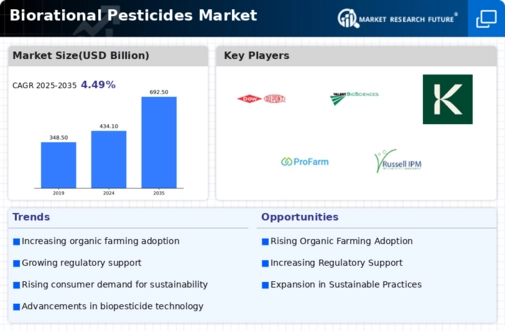
The Global Biorational Pesticides Market Industry is on a growth trajectory, with projections indicating a market value of 434.1 USD Billion in 2024 and an expected increase to 692.5 USD Billion by 2035. This growth is underpinned by a compound annual growth rate (CAGR) of 4.34% from 2025 to 2035. Such figures suggest a robust demand for biorational pesticides, driven by factors such as increasing organic farming practices, regulatory support for sustainable agriculture, and heightened awareness of environmental impacts. The market's expansion reflects a broader shift towards sustainable pest management solutions in response to global agricultural challenges.

Increasing Demand for Organic Produce

The rising consumer preference for organic produce is a pivotal driver in the Global Biorational Pesticides Market Industry. As more consumers become aware of the health and environmental impacts of synthetic pesticides, the demand for biorational alternatives is likely to increase. This shift is evidenced by the growth of organic farming, which has seen a substantial rise in acreage globally. In 2024, the market is projected to reach 434.1 USD Billion, with biorational pesticides playing a crucial role in meeting the needs of organic farmers who seek effective pest control solutions without compromising their organic status.

Rising Awareness of Environmental Impact

Growing awareness of the environmental consequences of chemical pesticide use is a significant driver for the Global Biorational Pesticides Market Industry. Stakeholders, including farmers, consumers, and policymakers, are increasingly recognizing the need for sustainable pest management solutions that reduce ecological harm. This awareness is leading to a shift towards biorational pesticides, which are perceived as safer alternatives. Educational campaigns and initiatives aimed at promoting sustainable agriculture practices further support this trend. As a result, the market is poised for growth, with projections indicating a substantial increase in demand for biorational products in the coming years.

Regulatory Support for Sustainable Practices

Regulatory frameworks worldwide increasingly favor sustainable agricultural practices, which bolster the Global Biorational Pesticides Market Industry. Governments are implementing policies that encourage the use of environmentally friendly pest control methods, including biorational pesticides. For instance, the European Union has established regulations that promote integrated pest management strategies, which often incorporate biorational products. This regulatory support not only enhances market growth but also aligns with global sustainability goals. As a result, the market is expected to grow at a CAGR of 4.34% from 2025 to 2035, reflecting the positive impact of these policies on biorational pesticide adoption.

Technological Advancements in Pest Management

Technological innovations are transforming pest management strategies, significantly impacting the Global Biorational Pesticides Market Industry. Advances in biotechnology and formulation techniques have led to the development of more effective biorational products that target specific pests while minimizing harm to beneficial organisms. For example, the introduction of microbial pesticides and plant extracts has expanded the range of available biorational options for farmers. These innovations not only enhance pest control efficacy but also contribute to sustainable agricultural practices. As the market evolves, it is anticipated that these technological advancements will drive further growth, contributing to the projected market value of 692.5 USD Billion by 2035.

Global Population Growth and Food Security Concerns

The escalating global population and the corresponding need for food security are driving factors in the Global Biorational Pesticides Market Industry. As the world population is expected to reach approximately 9.7 billion by 2050, the demand for increased agricultural productivity becomes paramount. Biorational pesticides offer a sustainable approach to enhancing crop yields while minimizing environmental impact. This is particularly relevant in regions facing food scarcity challenges. The market's growth trajectory reflects this urgency, with an anticipated value of 434.1 USD Billion in 2024, as agricultural stakeholders seek effective solutions to meet the food demands of a growing population.

Market Segment Insights

By Application: Agriculture (Largest) vs. Horticulture (Fastest-Growing)

<p>In the Biorational Pesticides Market, the application in Agriculture stands out as the largest segment, capturing a significant share of the overall market. This can be attributed to the widespread adoption of sustainable practices among farmers aiming to reduce chemical inputs while enhancing crop yields. The demand for biorational pesticides in agriculture is driven by the need for effective pest management solutions that comply with environmentally-friendly standards. Meanwhile, the Horticulture segment is rapidly gaining momentum, driven by an increasing interest in organic farming practices and the need for innovative pest control methods in the cultivation of various fruits, vegetables, and ornamental plants.</p>

<p>Agriculture (Dominant) vs. Horticulture (Emerging)</p>

<p>The Agriculture segment is currently the dominant application area in the Biorational Pesticides Market, characterized by the high adoption of biorational solutions due to regulatory pressures and a growing consumer preference for organic produce. This segment encompasses a diverse range of crop types, including cereals, legumes, and root vegetables, all of which benefit from the use of eco-friendly pest management. In contrast, the Horticulture segment, labeled as emerging, is witnessing substantial growth as growers increasingly shift towards organic methods to cultivate ornamental plants and high-value crops. This shift is fueled by consumer trends favoring organic produce, which propels demand for tailor-made biorational products that align with sustainable horticultural practices.</p>

By Formulation Type: Liquid (Largest) vs. Emulsifiable Concentrate (Fastest-Growing)

<p>In the Biorational Pesticides Market, the formulation type segment showcases a diverse range of products, with liquid formulations holding the largest market share. These formulations are favored in various agricultural practices for their ease of application, effectiveness, and ability to uniformly distribute active ingredients. Granular formulations also hold a significant portion of the market, providing targeted application methods, especially for soil treatments. Wettable powders follow closely, prized for their versatility, while emulsifiable concentrates are emerging rapidly due to their high efficacy in controlling pests and diseases. As the market evolves, the shift towards sustainable and environmentally friendly farming practices is driving growth in the biorational pesticides sector. Liquid formulations are being driven by their user-friendly nature, enabling farmers to apply necessary treatments efficiently. Meanwhile, emulsifiable concentrates are gaining momentum as growers seek innovative solutions that enhance crop protection. The demand for granular and wettable powders remains stable, appealing to specific agricultural needs while integrating with integrated pest management strategies.</p>

<p>Liquid (Dominant) vs. Wettable Powder (Emerging)</p>

<p>Liquid formulations are recognized as the dominant force in the Biorational Pesticides Market due to their superior handling and application properties. They offer a straightforward approach for farmers, allowing for rapid implementation and effective pest management with consistent results. In contrast, wettable powders, positioned as emerging solutions, serve as an attractive alternative with their unique benefits such as increased adhesion to plant surfaces and reduced runoff. Both formulation types cater to different agricultural needs; however, liquid formulations lead by volume while wettable powders are gaining popularity among organic farms and environmentally conscious growers, reflecting a shift in consumer preference towards products that align with sustainable farming practices.</p>

By Active Ingredient: Microbial (Largest) vs. Botanical (Fastest-Growing)

<p>The Biorational Pesticides Market showcases a diverse distribution of active ingredients, with microbial types commanding the largest share. These natural agents, derived from microorganisms, play a crucial role in pest control by utilizing beneficial microbes to manage agricultural pests. Following microbial, botanical pesticides represent a dynamic segment with increasing acceptance among organic growers, emphasizing plant-derived substances known for their safety and efficacy. This shift towards organic farming practices further solidifies the need for effective botanical solutions in sustainable agriculture.</p>

<p>Microbial (Dominant) vs. Botanical (Emerging)</p>

<p>Microbial pesticides, such as those derived from Bacillus thuringiensis, are considered dominant in the Biorational Pesticides Market due to their proven efficacy and eco-friendliness. They offer targeted pest control without harming beneficial organisms, leading to their widespread adoption by environmentally responsible growers. In contrast, botanical pesticides are emerging as a viable alternative with a growing market presence. Derived from plant extracts, these solutions not only address pest issues but also align with the organic farming trend, appealing to consumers who prioritize sustainability. Their natural origins enhance their marketability, positioning botanical products as attractive options for integrated pest management strategies.</p>

By Mode of Action: Contact (Largest) vs. Systemic (Fastest-Growing)

<p>In the Biorational Pesticides Market, the mode of action segment reveals a diverse distribution of market share among various strategies. The dominant category, contact pesticides, is widely recognized for their immediate lethality upon application, ensuring significant penetration within agricultural practices. Conversely, systemic pesticides have been showing strong potential for growth, appealing to a market that values prolonged effectiveness and lower environmental impact.</p>

<p>Contact (Dominant) vs. Systemic (Emerging)</p>

<p>Contact pesticides function by directly affecting the target pests upon surface contact, leading to quick results. This effectiveness makes them a staple in many pest management programs, especially for immediate control situations. On the other hand, systemic pesticides, which are absorbed by the plant and provide protection from the inside out, are gaining traction among users looking for sustainable solutions. They tend to offer longer-lasting effects, reducing the need for repeated applications, aligning well with the growing environmental awareness trends among consumers and farmers.</p>

By End Use: Crop Protection (Largest) vs. Public Health (Fastest-Growing)

<p>The Biorational Pesticides Market is segmented into Crop Protection, Public Health, Soil Health, and Post-Harvest Management. Crop Protection accounts for the largest market share, driven by its pivotal role in sustainable agriculture and the rising demand for organic farming practices. As consumers increasingly favor environmentally friendly solutions, the Crop Protection segment's influence continues to expand, catering to a broad range of crops while supporting integrated pest management strategies. Meanwhile, the Public Health segment is rapidly gaining traction, primarily due to the heightened awareness of pest-borne diseases and the growing need for effective public health initiatives.</p>

<p>Crop Protection (Dominant) vs. Soil Health (Emerging)</p>

<p>Crop Protection remains the dominant value in the Biorational Pesticides Market, characterized by its essential function in safeguarding crop yield and quality through personalized pest control solutions. This segment is supported by advancements in biopesticide formulations, which are increasingly favored for their reduced environmental impact and enhanced efficacy. On the other hand, Soil Health is emerging as a critical segment, focusing on the long-term sustainability of agricultural practices. This value is gaining attention due to the recognized importance of maintaining soil biodiversity and health to support sustainable farming. As agricultural practices evolve, the emphasis on soil revitalization is likely to increase, fostering a more balanced ecosystem.</p>

Get more detailed insights about Biorational Pesticides Market Research Report – Global Forecast till 2028

Regional Insights

North America : Market Leader in Biorational Solutions

North America is poised to maintain its leadership in the biorational pesticides market, holding a significant share of 4.47 in 2024. The region's growth is driven by increasing consumer demand for sustainable agricultural practices and stringent regulations promoting eco-friendly pest control solutions. The adoption of integrated pest management (IPM) strategies further fuels market expansion, as farmers seek effective alternatives to conventional pesticides. The competitive landscape in North America is robust, featuring key players such as BASF SE, Syngenta AG, and Bayer AG. The U.S. stands out as the largest market, supported by extensive research and development initiatives. Companies are increasingly investing in innovative biorational products to meet the rising demand for organic farming solutions. This trend is expected to continue, solidifying North America's position as a hub for biorational pesticide innovation.

Europe : Growing Demand for Sustainable Practices

Europe's biorational pesticides market is on the rise, with a market size of 2.68 in 2024. The region is experiencing a shift towards sustainable agricultural practices, driven by consumer preferences for organic products and regulatory frameworks that encourage the use of environmentally friendly pest control methods. The European Union's Green Deal and Farm to Fork Strategy are pivotal in promoting biorational solutions, enhancing market growth. Leading countries in this region include Germany, France, and the Netherlands, where significant investments in research and development are being made. Key players like BASF SE and Syngenta AG are actively involved in developing innovative biorational products tailored to local agricultural needs. The competitive landscape is characterized by collaboration between industry stakeholders and regulatory bodies to ensure compliance and promote sustainable practices.

Asia-Pacific : Emerging Market with Growth Potential

The Asia-Pacific region is witnessing a burgeoning interest in biorational pesticides, with a market size of 1.79 in 2024. This growth is fueled by increasing agricultural productivity demands and a shift towards sustainable farming practices. Governments are implementing policies to reduce chemical pesticide usage, thereby creating a favorable environment for biorational solutions. The rising awareness of food safety and environmental concerns further drives market demand. Countries like China, India, and Australia are at the forefront of this market, with significant investments in agricultural innovation. The competitive landscape features both multinational corporations and local players, including FMC Corporation and Valent BioSciences LLC. As the region continues to embrace sustainable agriculture, the biorational pesticides market is expected to expand rapidly, attracting new entrants and fostering innovation.

Middle East and Africa : Untapped Potential in Agriculture

The Middle East and Africa region currently shows a nascent biorational pesticides market, with a size of 0.0 in 2024. However, there is significant potential for growth as agricultural practices evolve and the demand for sustainable pest control solutions increases. The region's diverse agricultural landscape presents opportunities for biorational products, particularly in organic farming initiatives. Governments are beginning to recognize the importance of sustainable agriculture, which may catalyze market development. Countries such as South Africa and Kenya are exploring biorational solutions to enhance crop yields and ensure food security. The competitive landscape is still developing, with local and international players looking to establish a foothold. As awareness of the benefits of biorational pesticides grows, the region is likely to see increased investment and innovation in this sector, paving the way for future market expansion.

Key Players and Competitive Insights

The Biorational Pesticides Market is currently characterized by a dynamic competitive landscape, driven by increasing demand for sustainable agricultural practices and the need for effective pest management solutions. Key players such as BASF SE (DE), Syngenta AG (CH), and Bayer AG (DE) are actively shaping the market through strategic innovations and partnerships. These companies are focusing on developing environmentally friendly products that align with regulatory trends and consumer preferences, thereby enhancing their market positioning and operational focus.

In terms of business tactics, companies are increasingly localizing manufacturing to reduce costs and improve supply chain efficiency. The market appears moderately fragmented, with several players vying for market share. However, the collective influence of major companies like FMC Corporation (US) and Valent BioSciences LLC (US) is notable, as they leverage their extensive distribution networks and R&D capabilities to maintain competitive advantages.

In November 2025, BASF SE (DE) announced a strategic partnership with a leading agricultural technology firm to enhance its digital pest management solutions. This collaboration is expected to integrate advanced data analytics and AI into their product offerings, thereby improving the efficacy of biorational pesticides. Such a move not only positions BASF at the forefront of technological innovation but also reflects a broader trend towards digital transformation in the agricultural sector.

Similarly, in October 2025, Syngenta AG (CH) launched a new line of biopesticides aimed at organic farming, which underscores its commitment to sustainability. This product line is designed to meet the growing consumer demand for organic produce, thereby expanding Syngenta's market reach and reinforcing its brand as a leader in sustainable agriculture. The introduction of these products is likely to enhance Syngenta's competitive edge in a market increasingly focused on eco-friendly solutions.

In September 2025, Bayer AG (DE) made headlines by acquiring a small biotech firm specializing in microbial pest control. This acquisition is anticipated to bolster Bayer's portfolio of biorational products and enhance its R&D capabilities. By integrating innovative microbial solutions, Bayer aims to diversify its offerings and respond to the evolving needs of farmers seeking sustainable pest management options.

As of December 2025, the competitive trends in the Biorational Pesticides Market are increasingly defined by digitalization, sustainability, and the integration of AI technologies. Strategic alliances are becoming pivotal in shaping the landscape, as companies collaborate to enhance product efficacy and market reach. Looking ahead, it is likely that competitive differentiation will evolve from traditional price-based strategies to a focus on innovation, technological advancements, and supply chain reliability, reflecting a broader shift towards sustainable agricultural practices.

Key Companies in the Biorational Pesticides Market market include

Industry Developments

December 2023: Marrone Bio Innovations has unveiled Vintegra, a specialty pest control product for vegetables and fruits. The formulation contains active ingredients derived exclusively from naturally occurring substances and is, therefore, able to protect minor and beneficial living organisms. Marrone Bio highlighted that Vintegra is beneficial to the crops since it not only helps in the suppression of pests but also enhances the crop's tolerance to abiotic stresses thereby making it suitable in IPM systems.

The company seeks to increase the scope of the product in North America and Europe, which are encouraged by the regulatory requirements and consumer expectations of eco-friendly solutions for agriculture. This launch is indicative of Marrone Bio’s activities to expand the use of bioprotectants.

October 2023: BASF SE has launched a new biorational insecticide, EcoShield, which is said to target a variety of pests that damage crops while also being environmentally friendly. To lessen dependence on synthetic pesticides, EcoShield utilizes biological extracts and metabolites that target crucial stages in the life cycle of pests. According to BASF, it can be easily integrated into existing pest management programs as it is compatible with existing practices and pesticides.

The product is aimed primarily at Latin America and Asia-Pacific regions which are characterized by high intensity of pest pressure as well as high demand for environmentally sustainable agriculture solutions. In addition, BASF is actively undertaking efforts to partner with local distributors to promote the product's use and improve its availability.

Biorational Pesticides Market, by Source

    • Botanical
    • Microbials
    • Minerals
    • Others

Biorational Pesticides Market, by Mode of Application

    • Foliar Spray
    • Soil Treatment
    • Trunk Injection
    • Others

Biorational Pesticides Market, by Type

    • Biorational Insecticides
    • Biorational Fungicides
    • Biorational Nematicides
    • Others

 Biorational Pesticides Market, by Crop Type

    • Fruits & Vegetables
    • Cereals & Grains
    • Oilseeds & Pulses
    • Other

Biorational Pesticides Market, by Region

    • North America
      • US
      • Canada
      • Mexico
    • Europe
      • Germany
      • France
      • Italy
      • Spain
      • UK
      • Rest of Europe
    • Asia-Pacific
      • Japan
      • China
      • India
      • Australia and New Zealand
      • Rest of Asia-Pacific
    • Rest of the World (RoW)
      • South America
      • Middle East
      • Africa

Key Players in the Global Biorational Pesticides Market

    • Bayer AG (Germany)
    • Monsanto Bioag (US)
    • BASF SE (Germany)
    • Dowdupont (US)
    • Valent Biosciences (Canada)
    • Isagro SAP (Italy)
    • Koppert (The Netherlands)
    • Marrone Bio Innovations (US)
    • Russell IPM (UK)

Intended Audience

    • Biorational Pesticides Market producers/processors
    • Agrochemical manufacturers
    • Dealers and distributors
    • Raw material suppliers and distributors
    • Traders, exporters, and importers

Future Outlook

Biorational Pesticides Market Future Outlook

<p>The Biorational Pesticides Market is projected to grow at 11.23% CAGR from 2024 to 2035, driven by increasing organic farming practices and regulatory support for sustainable agriculture.</p>

New opportunities lie in:

  • <p>Development of biopesticide formulations targeting specific pests</p>
  • <p>Expansion into emerging markets with tailored product offerings</p>
  • <p>Investment in R&D for innovative delivery systems and application technologies</p>

<p>By 2035, the Biorational Pesticides Market is expected to achieve substantial growth and market penetration.</p>

Market Segmentation

Biorational Pesticides Market End Use Outlook

  • Crop Protection
  • Public Health
  • Soil Health
  • Post-Harvest Management

Biorational Pesticides Market Application Outlook

  • Agriculture
  • Horticulture
  • Forestry
  • Aquaculture

Biorational Pesticides Market Mode of Action Outlook

  • Contact
  • Systemic
  • Repellent
  • Insect Growth Regulator

Biorational Pesticides Market Formulation Type Outlook

  • Liquid
  • Granular
  • Wettable Powder
  • Emulsifiable Concentrate

Biorational Pesticides Market Active Ingredient Outlook

  • Microbial
  • Botanical
  • Biochemical
  • Mineral

Report Scope

MARKET SIZE 20248.94(USD Billion)
MARKET SIZE 202510.04(USD Billion)
MARKET SIZE 203528.93(USD Billion)
COMPOUND ANNUAL GROWTH RATE (CAGR)11.23% (2024 - 2035)
REPORT COVERAGERevenue Forecast, Competitive Landscape, Growth Factors, and Trends
BASE YEAR2024
Market Forecast Period2025 - 2035
Historical Data2019 - 2024
Market Forecast UnitsUSD Billion
Key Companies ProfiledBASF SE (DE), Syngenta AG (CH), Bayer AG (DE), FMC Corporation (US), Valent BioSciences LLC (US), Certis USA LLC (US), Marrone Bio Innovations Inc. (US), Biobest Group NV (BE), AgraQuest Inc. (US)
Segments CoveredApplication, Formulation Type, Active Ingredient, Mode of Action, End Use
Key Market OpportunitiesGrowing demand for sustainable agriculture drives innovation in the Biorational Pesticides Market.
Key Market DynamicsRising consumer preference for sustainable agriculture drives demand for biorational pesticides amid regulatory shifts.
Countries CoveredNorth America, Europe, APAC, South America, MEA

FAQs

Name the players involved in the biorational pesticides market.

biorational pesticides market includes players like Syngenta AG (Switzerland), Bayer AG (Germany), BASF SE (Germany), Monsanto Bioag (US), Valent Biosciences (Canada), Isagro SAP (Italy), Dowdupont (US), Marrone Bio Innovations (US), Koppert (The Netherlands), and Russell IPM (UK)

What are the types included in the biorational pesticides market report?

biorational pesticides market report includes types like biorational fungicides, biorational nematicides, biorational insecticides, and others.

What are the crop types included in the biorational pesticides market report?

biorational pesticides market report includes crop types like cereals &amp; grains, oilseeds &amp; pulses, fruits &amp; vegetables, and others.

What are the applications included in the biorational pesticides market report?

biorational pesticides market report includes applications like soil treatment, trunk injection, biorational pesticides foliar spray, and others.

What can hinder the biorational pesticides market growth?

biorational pesticides market may find growth difficult with lack of infrastructure and low shelf life.

  1. Executive Summary
  2. Scope of the Report
    1. Market Definition
    2. Scope of the Study
      1. Research Objectives
      2. Assumptions & Limitations
    3. Market Structure
  3. Market Research Methodology
    1. Research Process
    2. Secondary Research
    3. Primary Research
    4. Forecast Model
  4. Market Landscape
    1. Supply Chain Analysis
      1. Raw Material Suppliers
      2. Manufacturers/Producers
      3. Distributors/Retailers/Wholesalers/E-Commerce
      4. End Users
    2. Porter’s Five Forces Analysis
      1. Threat of New Entrants
      2. Bargaining Power of Buyers
      3. Bargaining Power of Suppliers
      4. Threat of Substitutes
      5. Internal Rivalry
  5. Market Dynamics of Global Biorational Pesticides Market
    1. Introduction
    2. Drivers
    3. Restraints
    4. Opportunities
    5. Challenges
  6. Global Biorational Pesticides Market, by Source
    1. Introduction
    2. Botanical
      1. Market Estimates & Forecast, 2021-2028
      2. Market Estimates & Forecast, by Region, 2021-2028
    3. Microbials
      1. Market Estimates & Forecast, 2021-2028
      2. Market Estimates & Forecast, by Region, 2021-2028
    4. Minerals
      1. Market Estimates & Forecast, 2021-2028
      2. Market Estimates & Forecast, by Region, 2021-2028
    5. Others
      1. Market Estimates & Forecast, 2021-2028
      2. Market Estimates & Forecast, by Region, 2021-2028
  7. Global Biorational Pesticides Market, by Mode of Application
    1. Introduction
    2. Foliar Spray
      1. Market Estimates & Forecast, 2021-2028
      2. Market Estimates & Forecast, by Region, 2021-2028
    3. Soil Treatment
      1. Market Estimates & Forecast, 2021-2028
      2. Market Estimates & Forecast, by Region, 2021-2028
    4. Trunk Injection
      1. Market Estimates & Forecast, 2021-2028
      2. Market Estimates & Forecast, by Region, 2021-2028
    5. Others
      1. Market Estimates & Forecast, 2021-2028
      2. Market Estimates & Forecast, by Region, 2021-2028
  8. Global Biorational Pesticides Market, by Type
    1. Introduction
    2. Biorational Insecticides
      1. Market Estimates & Forecast, 2021-2028
      2. Market Estimates & Forecast, by Region, 2021-2028
    3. Biorational Fungicides
      1. Market Estimates & Forecast, 2021-2028
      2. Market Estimates & Forecast, by Region, 2021-2028
    4. Biorational Nematicides
      1. Market Estimates & Forecast, 2021-2028
      2. Market Estimates & Forecast, by Region, 2021-2028
    5. Others
      1. Market Estimates & Forecast, 2021-2028
      2. Market Estimates & Forecast, by Region, 2021-2028
  9. Global Biorational Pesticides Market, by Crop Type
    1. Introduction
    2. Fruits & Vegetables
      1. Market Estimates & Forecast, 2021-2028
      2. Market Estimates & Forecast, by Region, 2021-2028
    3. Cereals & Grains
      1. Market Estimates & Forecast, 2021-2028
      2. Market Estimates & Forecast, by Region, 2021-2028
    4. Oilseeds & Pulses
      1. Market Estimates & Forecast, 2021-2028
      2. Market Estimates & Forecast, by Region, 2021-2028
    5. Others
      1. Market Estimates & Forecast, 2021-2028
      2. Market Estimates & Forecast, by Region, 2021-2028
  10. Global Biorational Pesticides Market, by Region
    1. Introduction
    2. North America
      1. Market Estimates & Forecast, 2021-2028
      2. Market Estimates & Forecast, by Source, 2021-2028
      3. Market Estimates & Forecast, by Mode of Application, 2021-2028
      4. Market Estimates & Forecast, by Type, 2021-2028
      5. Market Estimates & Forecast, by Crop Type, 2021-2028
      6. US
      7. Canada
      8. Mexico
    3. Europe
      1. Market Estimates & Forecast, 2021-2028
      2. Market Estimates & Forecast, by Source, 2021-2028
      3. Market Estimates & Forecast, by Mode of Application, 2021-2028
      4. Market Estimates & Forecast, by Type, 2021-2028
      5. Market Estimates & Forecast, by Crop Type, 2021-2028
      6. Germany
      7. France
      8. Italy
      9. Spain
      10. UK
      11. Rest of Europe
    4. Asia-Pacific
      1. Market Estimates & Forecast, 2021-2028
      2. Market Estimates & Forecast, by Source, 2021-2028
      3. Market Estimates & Forecast, by Mode of Application, 2021-2028
      4. Market Estimates & Forecast, by Type, 2021-2028
      5. Market Estimates & Forecast, by Crop Type, 2021-2028
      6. China
      7. India
      8. Japan
      9. Australia & New Zealand
      10. Rest of Asia-Pacific
    5. Rest of the World (RoW)
      1. Market Estimates & Forecast, 2021-2028
      2. Market Estimates & Forecast, by Source, 2021-2028
      3. Market Estimates & Forecast, by Mode of Application, 2021-2028
      4. Market Estimates & Forecast, by Type, 2021-2028
      5. Market Estimates & Forecast, by Crop Type, 2021-2028
      6. South America
      7. The Middle East
      8. Africa
  11. Company Landscape
    1. Introduction
    2. Market Strategy
    3. Key Development Analysis
    4. (Expansions/ Mergers and Acquisitions/ Joint Ventures/ New Product Developments/ Agreements/ Investments
  12. Company Profiles
    1. Bayer Cropscience
      1. Company Overview
      2. Financial Updates
      3. Product/Business Segment Overview
      4. Strategy
      5. Key Developments
      6. SWOT Analysis
    2. Syngenta
      1. Company Overview
      2. Financial Updates
      3. Product/Business Segment Overview
      4. Strategy
      5. Key Developments
      6. SWOT Analysis
    3. Monsanto Bioag
      1. Company Overview
      2. Financial Updates
      3. Product/Business Segment Overview
      4. Strategy
      5. Key Developments
      6. SWOT Analysis
    4. BASF SE
      1. Company Overview
      2. Financial Updates
      3. Product/Business Segment Overview
      4. Strategy
      5. Key Developments
      6. SWOT Analysis
    5. Dowdupont
      1. Company Overview
      2. Financial Updates
      3. Product/Business Segment Overview
      4. Strategy
      5. Key Developments
      6. SWOT Analysis
    6. Valent Biosciences
      1. Company Overview
      2. Financial Updates
      3. Product/Business Segment Overview
      4. Strategy
      5. Key Developments
      6. SWOT Analysis
    7. Isagro SAP
      1. Company Overview
      2. Financial Updates
      3. Product/Business Segment Overview
      4. Strategy
      5. Key Developments
      6. SWOT Analysis
    8. Koppert
      1. Company Overview
      2. Financial Updates
      3. Product/Business Segment Overview
      4. Strategy
      5. Key Developments
      6. SWOT Analysis
    9. Marrone Bio Innovations
      1. Company Overview
      2. Financial Updates
      3. Product/Business Segment Overview
      4. Strategy
      5. Key Developments
      6. SWOT Analysis
    10. Russell IPM
      1. Company Overview
      2. Financial Updates
      3. Product/Business Segment Overview
      4. Strategy
      5. Key Developments
      6. SWOT Analysis
  13. Conclusion
  14. LIST OF TABLES
  15. Global Biorational Pesticides Market, by Region, 2021-2028 (USD Million)
  16. Global Biorational Pesticides Market, by Source, 2021-2028 (USD Million)
  17. Global Biorational Pesticides Market, by Mode of Mode of Application, 2021-2028 (USD Million)
  18. Global Biorational Pesticides Market, by Type, 2021-2028 (USD Million)
  19. Global Biorational Pesticides Market, by Crop Type, 2021-2028 (USD Million)
  20. North America: Starch Derivatives Market, by Country, 2021-2028 (USD Million)
  21. North America: Starch Derivatives Market, by Source, 2021-2028 (USD Million)
  22. North America: Starch Derivatives Market, by Mode of Mode of Application, 2021-2028 (USD Million)
  23. North America: Starch Derivatives Market, by Type, 2021-2028 (USD Million)
  24. North America: Starch Derivatives Market, by Crop Type, 2021-2028 (USD Million)
  25. US: Starch Derivatives Market, by Source, 2021-2028 (USD Million)
  26. US: Starch Derivatives Market, by Mode of Mode of Application, 2021-2028 (USD Million)
  27. US: Starch Derivatives Market, by Type, 2021-2028 (USD Million)
  28. US: Starch Derivatives Market, by Crop Type, 2021-2028 (USD Million)
  29. Canada: Starch Derivatives Market, by Source, 2021-2028 (USD Million)
  30. Canada: Starch Derivatives Market, by Mode of Mode of Application, 2021-2028 (USD Million)
  31. Canada: Starch Derivatives Market, by Type, 2021-2028 (USD Million)
  32. Canada: Starch Derivatives Market, by Crop Type, 2021-2028 (USD Million)
  33. Mexico: Starch Derivatives Market, by Source, 2021-2028 (USD Million)
  34. Mexico: Starch Derivatives Market, by Mode of Mode of Application, 2021-2028 (USD Million)
  35. Mexico: Starch Derivatives Market, by Type, 2021-2028 (USD Million)
  36. Mexico: Starch Derivatives Market, by Crop Type, 2021-2028 (USD Million)
  37. Europe: Starch Derivatives Market, by Country, 2021-2028 (USD Million)
  38. Europe: Starch Derivatives Market, by Source, 2021-2028 (USD Million)
  39. Europe: Starch Derivatives Market, by Mode of Mode of Application, 2021-2028 (USD Million)
  40. Europe: Starch Derivatives Market, by Type, 2021-2028 (USD Million)
  41. Europe: Starch Derivatives Market, by Crop Type, 2021-2028 (USD Million)
  42. Germany: Starch Derivatives Market, by Source, 2021-2028 (USD Million)
  43. Germany: Starch Derivatives Market, by Mode of Mode of Application, 2021-2028 (USD Million)
  44. Germany: Starch Derivatives Market, by Type, 2021-2028 (USD Million)
  45. Germany: Starch Derivatives Market, by Crop Type, 2021-2028 (USD Million)
  46. France: Starch Derivatives Market, by Source, 2021-2028 (USD Million)
  47. France: Starch Derivatives Market, by Mode of Mode of Application, 2021-2028 (USD Million)
  48. France: Starch Derivatives Market, by Type, 2021-2028 (USD Million)
  49. France: Starch Derivatives Market, by Crop Type, 2021-2028 (USD Million)
  50. Italy: Starch Derivatives Market, by Source, 2021-2028 (USD Million)
  51. Italy: Starch Derivatives Market, by Mode of Mode of Application, 2021-2028 (USD Million)
  52. Italy: Starch Derivatives Market, by Type, 2021-2028 (USD Million)
  53. Italy: Starch Derivatives Market, by Crop Type, 2021-2028 (USD Million)
  54. Spain: Starch Derivatives Market, by Source, 2021-2028 (USD Million)
  55. Spain: Starch Derivatives Market, by Mode of Mode of Application, 2021-2028 (USD Million)
  56. Spain: Starch Derivatives Market, by Type, 2021-2028 (USD Million)
  57. Spain: Starch Derivatives Market, by Crop Type, 2021-2028 (USD Million)
  58. UK: Starch Derivatives Market, by Source, 2021-2028 (USD Million)
  59. UK: Starch Derivatives Market, by Mode of Application, 2021-2028 (USD Million)
  60. UK: Starch Derivatives Market, by Type, 2021-2028 (USD Million)
  61. UK: Starch Derivatives Market, by Crop Type, 2021-2028 (USD Million)
  62. Rest of Europe: Starch Derivatives Market, by Source, 2021-2028 (USD Million)
  63. Rest of Europe: Starch Derivatives Market, by Mode of Application, 2021-2028 (USD Million)
  64. Rest of Europe: Starch Derivatives Market, by Type, 2021-2028 (USD Million)
  65. Rest of Europe: Starch Derivatives Market, by Crop Type, 2021-2028 (USD Million)
  66. Asia-Pacific: Starch Derivatives Market, by Country, 2021-2028 (USD Million)
  67. Asia-Pacific: Starch Derivatives Market, by Source, 2021-2028 (USD Million)
  68. Asia-Pacific: Starch Derivatives Market, by Mode of Application, 2021-2028 (USD Million)
  69. Asia-Pacific: Starch Derivatives Market, by Type, 2021-2028 (USD Million)
  70. Asia-Pacific: Starch Derivatives Market, by Crop Type, 2021-2028 (USD Million)
  71. China: Starch Derivatives Market, by Source, 2021-2028 (USD Million)
  72. China: Starch Derivatives Market, by Mode of Application, 2021-2028 (USD Million)
  73. China: Starch Derivatives Market, by Type, 2021-2028 (USD Million)
  74. China: Starch Derivatives Market, by Crop Type, 2021-2028 (USD Million)
  75. India: Starch Derivatives Market, by Source, 2021-2028 (USD Million)
  76. India: Starch Derivatives Market, by Mode of Application, 2021-2028 (USD Million)
  77. India: Starch Derivatives Market, by Type, 2021-2028 (USD Million)
  78. India: Starch Derivatives Market, by Crop Type, 2021-2028 (USD Million)
  79. Japan: Starch Derivatives Market, by Source, 2021-2028 (USD Million)
  80. Japan: Starch Derivatives Market, by Mode of Application, 2021-2028 (USD Million)
  81. Japan: Starch Derivatives Market, by Type, 2021-2028 (USD Million)
  82. Japan: Starch Derivatives Market, by Crop Type, 2021-2028 (USD Million)
  83. Australia and New Zealand: Starch Derivatives Market, by Source, 2021-2028 (USD Million)
  84. Australia and New Zealand: Starch Derivatives Market, by Mode of Application, 2021-2028 (USD Million)
  85. Australia and New Zealand: Starch Derivatives Market, by Type, 2021-2028 (USD Million)
  86. Australia and New Zealand: Starch Derivatives Market, by Crop Type, 2021-2028 (USD Million)
  87. Rest of Asia-Pacific: Starch Derivatives Market, by Source, 2021-2028 (USD Million)
  88. Rest of Asia-Pacific: Starch Derivatives Market, by Mode of Application, 2021-2028 (USD Million)
  89. Rest of Asia-Pacific: Starch Derivatives Market, by Type, 2021-2028 (USD Million)
  90. Rest of Asia-Pacific: Starch Derivatives Market, by Crop Type, 2021-2028 (USD Million)
  91. Rest of the World (RoW): Starch Derivatives Market, by Country, 2021-2028 (USD Million)
  92. Rest of the World (RoW): Starch Derivatives Market, by Source, 2021-2028 (USD Million)
  93. Rest of the World (RoW): Starch Derivatives Market, by Mode of Application, 2021-2028 (USD Million)
  94. Rest of the World (RoW): Starch Derivatives Market, by Type, 2021-2028 (USD Million)
  95. Rest of the World (RoW): Starch Derivatives Market, by Crop Type, 2021-2028 (USD Million)
  96. South America: Starch Derivatives Market, by Source, 2021-2028 (USD Million)
  97. South America: Starch Derivatives Market, by Mode of Application, 2021-2028 (USD Million)
  98. South America: Starch Derivatives Market, by Type, 2021-2028 (USD Million)
  99. South America: Starch Derivatives Market, by Crop Type, 2021-2028 (USD Million)
  100. Middle East: Starch Derivatives Market, by Source, 2021-2028 (USD Million)
  101. Middle East: Starch Derivatives Market, by Mode of Application, 2021-2028 (USD Million)
  102. Middle East: Starch Derivatives Market, by Type, 2021-2028 (USD Million)
  103. Middle East: Starch Derivatives Market, by Crop Type, 2021-2028 (USD Million)
  104. Africa: Starch Derivatives Market, by Source, 2021-2028 (USD Million)
  105. Africa: Starch Derivatives Market, by Mode of Application, 2021-2028 (USD Million)
  106. Africa: Starch Derivatives Market, by Type, 2021-2028 (USD Million)
  107. Africa: Starch Derivatives Market, by Crop Type, 2021-2028 (USD Million)
  108. LIST OF FIGURES
  109. Global Biorational Pesticides Market Segmentation
  110. Forecast Research Methodology
  111. Five Forces Analysis of Global Biorational Pesticides Market
  112. Value Chain of Global Biorational Pesticides Market
  113. Share of Global Biorational Pesticides Market in 2021, by Country (%)
  114. Global Biorational Pesticides Market, by Region, 2021-2028,
  115. Global Biorational Pesticides Market Size, by Source, 2021
  116. Share of Global Biorational Pesticides Market, by Source, 2021-2028 (%)
  117. Global Biorational Pesticides Market Size, by Mode of Application, 2021
  118. Share of Global Biorational Pesticides Market, by Mode of Application, 2021-2028 (%)
  119. Global Biorational Pesticides Market Size, by Type, 2021
  120. Share of Global Biorational Pesticides Market, by Type, 2021-2028 (%)
  121. Global Biorational Pesticides Market Size, by Crop Type, 2021
  122. Share of Global Biorational Pesticides Market, by Crop Type, 2021-2028 (%)

Biorational Pesticides Market Segmentation

Market Segmentation Overview

  • Detailed segmentation data will be available in the full report
  • Comprehensive analysis by multiple parameters
  • Regional and country-level breakdowns
  • Market size forecasts by segment
Infographic

Free Sample Request

Kindly complete the form below to receive a free sample of this Report

Get Free Sample

Customer Strories

Compare Licence

×
Features License Type
Single User Multiuser License Enterprise User
Price $4,950 $5,950 $7,250
Maximum User Access Limit 1 User Upto 10 Users Unrestricted Access Throughout the Organization
Free Customization
Direct Access to Analyst
Deliverable Format
Platform Access
Discount on Next Purchase 10% 15% 15%
Printable Versions