
×
Hero Background
English
Chinese
French
Japanese
Korean
German
Spanish

Bioelectronic Sensors Market Size

ID: MRFR/SEM/10826-HCR
128 Pages
Ankit Gupta
October 2025

Bioelectronic Sensors Market Research Report Information By Type (Bio-Electronic Devices, Bio-Electronic Medicine), By Product (Electrochemical Biosensors, Piezoelectric Biosensors, Thermal Biosensors And Optical Biosensors), By Application (Biochips, Implantable Devices, Prosthetics, Artificial organs, Molecular Motors And Others) And By Region (North America, Europe, Asia-Pacific, And Rest Of The World) – Industry Size, Share and Forecast Till 2035

Share:
Download PDF ×

We do not share your information with anyone. However, we may send you emails based on your report interest from time to time. You may contact us at any time to opt-out.

Bioelectronic Sensors Market Infographic
Purchase Options

Bioelectronic Sensors Size

Bioelectronic Sensors Market Growth Projections and Opportunities

The Bioelectronic Sensors Market is a dynamic and rapidly evolving sector, influenced by various market factors that shape its growth trajectory. One key factor driving the expansion of this market is the increasing demand for innovative healthcare solutions. As the global population continues to grow and age, there is a rising prevalence of chronic diseases, necessitating the development of advanced diagnostic and monitoring tools. Bioelectronic sensors, with their ability to provide real-time, accurate, and personalized health information, are gaining prominence in the medical field, driving market growth.

Moreover, stringent regulations and standards in the healthcare industry play a pivotal role in shaping the Bioelectronic Sensors Market. With a heightened focus on patient safety and data security, regulatory bodies are imposing stringent guidelines for the approval and commercialization of bioelectronic devices. Compliance with these regulations is essential for market players to gain market approval and build trust among end-users. The adherence to quality standards also fosters innovation and ensures the delivery of reliable and effective bioelectronic sensor solutions.

Technological advancements are another significant market factor influencing the growth of the Bioelectronic Sensors Market. Continuous research and development efforts in the field of sensor technologies are leading to the introduction of more sophisticated and efficient bioelectronic sensors. Miniaturization, improved sensitivity, and enhanced connectivity are some of the technological trends driving the market forward. These advancements not only enhance the performance of bioelectronic sensors but also contribute to their broader integration into various applications, further expanding market opportunities.

The increasing awareness and acceptance of personalized medicine are also contributing to the growth of the Bioelectronic Sensors Market. Patients and healthcare providers are recognizing the benefits of personalized healthcare approaches, and bioelectronic sensors play a crucial role in enabling precision medicine. The ability of these sensors to monitor specific biomarkers in real-time allows for personalized diagnosis, treatment, and monitoring, enhancing the overall effectiveness of healthcare interventions.

Market competition and the presence of key players are additional factors shaping the bioelectronic sensors landscape. The market is characterized by the presence of established companies as well as emerging players, leading to a competitive environment. Strategic collaborations, partnerships, and mergers and acquisitions are common strategies employed by market players to gain a competitive edge and expand their market share. The competition fosters innovation and drives continuous improvements in bioelectronic sensor technologies.

Furthermore, economic factors and funding initiatives contribute to the market dynamics. Economic stability and favorable investment climates encourage research and development activities in the bioelectronic sensor sector. Government initiatives and funding support for healthcare technologies and innovations further accelerate market growth. The availability of funds facilitates the development and commercialization of bioelectronic sensor technologies, making them more accessible to healthcare providers and end-users.
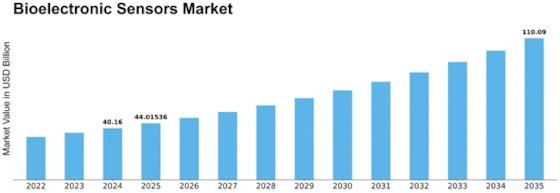
Bioelectronic Sensors Market Size Graph
Author
Ankit Gupta
Senior Research Analyst

Ankit Gupta is an analyst in market research industry in ICT and SEMI industry. With post-graduation in "Telecom and Marketing Management" and graduation in "Electronics and Telecommunication" vertical he is well versed with recent development in ICT industry as a whole. Having worked on more than 150+ reports including consultation for fortune 500 companies such as Microsoft and Rio Tinto in identifying solutions with respect to business problems his opinions are inclined towards mixture of technical and managerial aspects.

Leave a Comment

FAQs

What is the projected market valuation of the Bioelectronic Sensors Market by 2035?

The Bioelectronic Sensors Market is projected to reach a valuation of 110.09 USD Billion by 2035.

What was the market valuation of the Bioelectronic Sensors Market in 2024?

In 2024, the Bioelectronic Sensors Market was valued at 40.16 USD Billion.

What is the expected CAGR for the Bioelectronic Sensors Market during the forecast period 2025 - 2035?

The expected CAGR for the Bioelectronic Sensors Market during the forecast period 2025 - 2035 is 9.6%.

Which companies are considered key players in the Bioelectronic Sensors Market?

Key players in the Bioelectronic Sensors Market include Medtronic, Abbott Laboratories, Boston Scientific, Siemens Healthineers, Philips, Johnson & Johnson, Biosense Webster, NeuroMetrix, and Sotera Wireless.

What are the main segments of the Bioelectronic Sensors Market?

The main segments of the Bioelectronic Sensors Market include Type, Product, and Application.

How much is the Bio-Electronic Devices segment projected to be worth by 2035?

The Bio-Electronic Devices segment is projected to be worth 55.04 USD Billion by 2035.

Market Summary

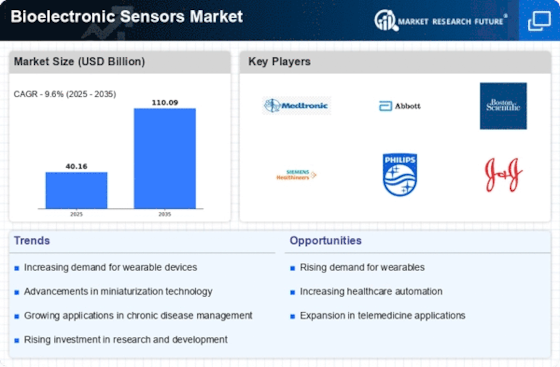
As per MRFR analysis, the Bioelectronic Sensors Market Size was estimated at 40.16 USD Billion in 2024. The Bioelectronic Sensors industry is projected to grow from 44.01 USD Billion in 2025 to 110.09 USD Billion by 2035, exhibiting a compound annual growth rate (CAGR) of 9.6 during the forecast period 2025 - 2035.

Key Market Trends & Highlights

The Bioelectronic Sensors Market is poised for substantial growth driven by technological advancements and increasing healthcare demands.

  • The market is witnessing a notable integration with wearable technology, enhancing user engagement and data collection. There is a pronounced focus on personalized healthcare, which is reshaping patient monitoring and treatment approaches. Advancements in sensor technology are propelling the development of more efficient and accurate bioelectronic devices. Rising demand for remote patient monitoring and increased investment in healthcare technology are key drivers fueling market expansion.

Market Size & Forecast

2024 Market Size 40.16 (USD Billion)
2035 Market Size 110.09 (USD Billion)
CAGR (2025 - 2035) 9.6%
Largest Regional Market Share in 2024 North America

Major Players

<p>Medtronic (US), Abbott Laboratories (US), Boston Scientific (US), Siemens Healthineers (DE), Philips (NL), Johnson &amp; Johnson (US), Biosense Webster (US), NeuroMetrix (US), Sotera Wireless (US)</p>

Market Trends

The Bioelectronic Sensors Market is currently experiencing a transformative phase, driven by advancements in technology and increasing demand for innovative healthcare solutions. These sensors, which bridge the gap between biological systems and electronic devices, are becoming integral in various applications, including diagnostics, monitoring, and therapeutic interventions. The convergence of miniaturization, enhanced sensitivity, and connectivity features is propelling the development of sophisticated bioelectronic devices. As healthcare systems evolve, the integration of these sensors into wearable technology and point-of-care testing is likely to redefine patient care and management. Moreover, the growing emphasis on personalized medicine and preventive healthcare is fostering a conducive environment for the Bioelectronic Sensors Market. Stakeholders are increasingly focusing on research and development to create sensors that can provide real-time data and insights into individual health conditions. This trend is further supported by collaborations between technology firms and healthcare providers, aiming to enhance the efficacy of bioelectronic solutions. As the market continues to mature, it appears poised for substantial growth, with innovations that could potentially revolutionize how health data is collected and utilized.

Integration with Wearable Technology

The Bioelectronic Sensors Market is witnessing a notable trend towards the integration of sensors with wearable devices. This convergence allows for continuous health monitoring and data collection, enhancing user engagement and providing valuable insights into personal health metrics. As consumers increasingly seek convenience and real-time feedback, the demand for such integrated solutions is likely to rise.

Focus on Personalized Healthcare

There is a growing emphasis on personalized healthcare solutions within the Bioelectronic Sensors Market. This trend reflects a shift towards tailored medical interventions based on individual health data. By leveraging bioelectronic sensors, healthcare providers can offer customized treatment plans, potentially improving patient outcomes and satisfaction.

Advancements in Sensor Technology

Technological advancements are significantly shaping the Bioelectronic Sensors Market. Innovations in materials, design, and functionality are leading to the development of more sensitive and accurate sensors. These improvements not only enhance performance but also expand the range of applications, making bioelectronic sensors more versatile and effective in various healthcare settings.

Bioelectronic Sensors Market Market Drivers

Growing Awareness of Preventive Healthcare

The Bioelectronic Sensors Market is also witnessing growth due to the increasing awareness of preventive healthcare. As individuals become more health-conscious, there is a rising demand for tools that facilitate proactive health management. Bioelectronic sensors play a crucial role in this paradigm shift by enabling users to monitor their health metrics continuously. This trend is supported by Market Research Future indicating that the preventive healthcare market is expected to reach USD 4 trillion by 2026. The ability of bioelectronic sensors to provide real-time feedback empowers users to make informed health decisions, thereby driving the adoption of these technologies in everyday life and contributing to the overall growth of the Bioelectronic Sensors Market.

Rising Demand for Remote Patient Monitoring

The Bioelectronic Sensors Market is experiencing a notable surge in demand for remote patient monitoring solutions. This trend is largely driven by the increasing prevalence of chronic diseases, which necessitate continuous health monitoring. According to recent estimates, the number of individuals with chronic conditions is projected to reach 1.5 billion by 2025. Bioelectronic sensors facilitate real-time data collection, enabling healthcare providers to monitor patients' health remotely. This capability not only enhances patient outcomes but also reduces healthcare costs associated with hospital visits. As a result, the integration of bioelectronic sensors into telehealth platforms is becoming increasingly prevalent, indicating a robust growth trajectory for the Bioelectronic Sensors Market.

Technological Advancements in Sensor Design

Technological advancements in sensor design are significantly influencing the Bioelectronic Sensors Market. Innovations such as miniaturization, improved sensitivity, and enhanced data processing capabilities are making bioelectronic sensors more effective and user-friendly. For instance, the development of flexible and stretchable sensors allows for better integration with the human body, leading to more accurate readings. Market data suggests that the bioelectronic sensors segment is expected to grow at a compound annual growth rate of 12% over the next five years. These advancements not only improve the performance of bioelectronic sensors but also expand their applications across various fields, including diagnostics and therapeutics, thereby driving the overall market growth.

Increased Investment in Healthcare Technology

The Bioelectronic Sensors Market is benefiting from increased investment in healthcare technology. Governments and private entities are allocating substantial funds to research and development in bioelectronics, aiming to enhance healthcare delivery systems. For example, funding for bioelectronic research has seen a rise of approximately 20% in the last two years, reflecting a growing recognition of the potential of these technologies. This influx of capital is fostering innovation and accelerating the development of new bioelectronic sensors that can provide more accurate and timely health data. Consequently, the Bioelectronic Sensors Market is poised for significant expansion as new products enter the market, catering to diverse healthcare needs.

Regulatory Support for Innovative Medical Devices

Regulatory support for innovative medical devices is a key driver for the Bioelectronic Sensors Market. Regulatory bodies are increasingly recognizing the importance of bioelectronic sensors in enhancing patient care and are streamlining approval processes for these devices. This supportive regulatory environment encourages manufacturers to invest in the development of new bioelectronic sensors. Recent initiatives have been launched to expedite the review of innovative medical technologies, which could potentially shorten the time to market for new products. As a result, the Bioelectronic Sensors Market is likely to see a surge in new entrants and innovations, further propelling market growth and expanding the range of available bioelectronic solutions.

Market Segment Insights

By Type: Bio-Electronic Devices (Largest) vs. Bio-Electronic Medicine (Fastest-Growing)

<p>In the Bioelectronic Sensors Market, Bio-Electronic Devices hold the largest share, reflecting significant demand across various applications, including diagnostics and therapeutic monitoring. These devices have become essential in integrating biological signals with electronic interfaces, enhancing patient care and treatment outcomes. Conversely, Bio-Electronic Medicine is gaining traction as a transformative approach to managing health conditions, indicating a growing recognition of its potential benefits and applications in the field of healthcare.</p>

<p>Bio-Electronic Devices (Dominant) vs. Bio-Electronic Medicine (Emerging)</p>

<p>Bio-Electronic Devices are at the forefront of the Bioelectronic Sensors Market, characterized by their advanced integration of technology and biocompatibility. These devices are widely used in monitoring physiological signals, providing critical data for real-time healthcare solutions. As the dominant segment, they benefit from extensive research and development, leading to innovative products that improve diagnosis and treatment efficacy. On the other hand, Bio-Electronic Medicine is emerging rapidly, leveraging bioelectronic technology for therapeutic applications. This segment is poised for growth due to increasing interest in non-invasive treatment options, aimed at improving patient outcomes through neuromodulation and targeted therapies.</p>

By Product: Electrochemical Biosensors (Largest) vs. Optical Biosensors (Fastest-Growing)

<p>In the Bioelectronic Sensors Market, Electrochemical Biosensors hold the largest share due to their widespread application in clinical diagnostics and environmental monitoring. Piezoelectric and Thermal Biosensors follow as noteworthy segments, catering to specific industries such as food safety and medical diagnostics. Optical Biosensors, although currently smaller in market share, are rapidly gaining traction due to advancements in technology and the increasing demand for non-invasive monitoring solutions. Their unique functionality and versatility are reshaping the competitive landscape.</p>

<p>Electrochemical Biosensors (Dominant) vs. Optical Biosensors (Emerging)</p>

<p>Electrochemical Biosensors have established themselves as the dominant force in the Bioelectronic Sensors Market, offering reliability and accuracy in various applications, including glucose monitoring and pathogen detection. Their ability to deliver rapid results at a relatively low cost makes them favorable in clinical settings. In contrast, Optical Biosensors are emerging rapidly, driven by innovations in optical sensing technology that enables detection of biomolecules at lower concentrations. The versatility of Optical Biosensors facilitates usage in diverse fields such as healthcare and environmental testing, positioning them as a key player in the future market landscape.</p>

By Application: Biochips (Largest) vs. Implantable Devices (Fastest-Growing)

<p>In the Bioelectronic Sensors Market, the application segment is primarily led by biochips, which command a significant market share due to their widespread use in diagnostics and disease detection. Following closely are implantable devices, prosthetics, and artificial organs, which together comprise a substantial portion of the market, while molecular motors and other applications hold a smaller, though still relevant, share of the market. Each of these segments plays a unique role in advancing the capabilities of bioelectronic sensors in healthcare applications.</p>

<p>Biochips (Dominant) vs. Implantable Devices (Emerging)</p>

<p>Biochips represent the dominant segment within the Bioelectronic Sensors Market, attributing their leadership to robust demand for rapid diagnostics and personalized medicine. They often integrate with microfluidics and nanotechnology for enhanced performance. On the other hand, implantable devices are becoming an emerging trend due to advances in miniaturization and biocompatibility, allowing them to offer real-time monitoring and management of chronic health conditions. This shift is driven by increasing patient acceptance of wearable technologies, alongside a growing need for personalized health solutions that can be tracked and monitored continuously.</p>

Get more detailed insights about Bioelectronic Sensors Market Research Report – Forecast till 2035

Regional Insights

North America : Innovation and Market Leadership

North America is the largest market for bioelectronic sensors, holding approximately 45% of the global market share. The region benefits from advanced healthcare infrastructure, high R&D investments, and a growing prevalence of chronic diseases. Regulatory support from agencies like the FDA further accelerates market growth, fostering innovation and adoption of new technologies. The increasing demand for minimally invasive procedures and remote patient monitoring is driving the market forward. The United States is the leading country in this region, home to major players such as Medtronic, Abbott Laboratories, and Boston Scientific. The competitive landscape is characterized by continuous innovation and strategic partnerships among key players. The presence of established healthcare systems and a focus on personalized medicine are also contributing to the growth of bioelectronic sensors in North America.

Europe : Regulatory Support and Growth

Europe is the second-largest market for bioelectronic sensors, accounting for around 30% of the global market share. The region is witnessing significant growth driven by increasing healthcare expenditures, a rising aging population, and advancements in technology. Regulatory frameworks, such as the EU Medical Device Regulation, are enhancing product safety and efficacy, thereby boosting consumer confidence and market demand. The focus on digital health solutions is also a key driver for market expansion. Germany, France, and the UK are the leading countries in this market, with a strong presence of key players like Siemens Healthineers and Philips. The competitive landscape is marked by innovation and collaboration among companies, research institutions, and healthcare providers. The emphasis on improving patient outcomes and reducing healthcare costs is shaping the future of bioelectronic sensors in Europe.

Asia-Pacific : Rapid Growth and Adoption

Asia-Pacific is rapidly emerging as a significant market for bioelectronic sensors, holding approximately 20% of the global market share. The region's growth is fueled by increasing healthcare investments, a rising prevalence of chronic diseases, and a growing demand for advanced medical technologies. Government initiatives aimed at improving healthcare infrastructure and access to medical devices are also contributing to market expansion. Countries like China and India are leading this growth trajectory. China and Japan are the primary markets in this region, with a strong focus on innovation and technology adoption. The competitive landscape is evolving, with both local and international players vying for market share. Key companies are investing in R&D to develop advanced bioelectronic solutions tailored to the needs of the region, thereby enhancing their market presence and competitiveness.

Middle East and Africa : Untapped Market Opportunities

The Middle East and Africa represent an emerging market for bioelectronic sensors, accounting for about 5% of the global market share. The region is characterized by a growing demand for advanced healthcare solutions, driven by increasing investments in healthcare infrastructure and rising awareness of chronic diseases. Regulatory bodies are beginning to establish frameworks that support the introduction of innovative medical technologies, which is expected to catalyze market growth in the coming years. Countries like South Africa and the UAE are leading the way in adopting bioelectronic sensors, with a focus on improving healthcare delivery and patient outcomes. The competitive landscape is still developing, with opportunities for both local and international players to enter the market. The presence of key players is gradually increasing, as they seek to capitalize on the untapped potential in this region.

Key Players and Competitive Insights

Leading market players are investing heavily in research and development in order to expand their product lines, which will help the Bioelectronic Sensors Market, grow even more. Market participants are also undertaking a variety of strategic activities to expand their global footprint, with important market developments including new product launches, contractual agreements, mergers and acquisitions, higher investments, and collaboration with other organizations. To expand and survive in a more competitive and rising market climate, Bioelectronic Sensorsindustry must offer cost-effective items.

Manufacturing locally to minimize operational costs is one of the key business tactics used by manufacturers in the global Bioelectronic Sensors industry to benefit clients and increase the market sector. In recent years, the Bioelectronic Sensors industry has offered some of the most significant advantages to medicine. Major players in the Bioelectronic Sensors Market, including Salvia Bioelectronics, LifeSensors, OmniVision Technologies Inc., AgaMatrix Inc., Sensirion AG, Broadcom Inc., Sotera Wireless, and Omnivision Technologies and others, are attempting to increase market demand by investing in research and development operations.

F. Hoffmann-La Roche AG, better known as Roche, is a Swiss global healthcare firm with two divisions: pharmaceuticals and diagnostics. Roche Holding AG, its holding company, has shares listed on the SIX Swiss Exchange. The company's headquarters are in Basel. Roche is the world's fifth-largest pharmaceutical firm by sales and the world's top provider of cancer therapies. In February 2019, The firm stated that it will purchase Spark Therapeutics for US$4.3 billion ($114.50 per share), adding Spark's gene therapy portfolio to its previously acquired assets. Spark already has an authorized medication for Leber's congenital amaurosis, Luxturna, which costs $850,000 per patient.

Medtronic plc is a medical device firm based in the United States. Because of its 2015 acquisition of Irish-based Covidien, the company's operational and executive offices are in Minneapolis, Minnesota, and its legal headquarters are in Ireland. While it is headquartered in the United States, it has operations in over 150 countries and employs over 90,000 people. It creates and produces healthcare technology and therapies. In April 2022, Medtronic plc established a collaboration with GE Healthcare to meet the requirements and demands of Ambulatory Surgery Centres.

Medtronic established a strategic alliance with CathWorks, a coronary artery disease (CAD) technology company, in July. Medtronic has the option to buy CathWorks in the future under a separate arrangement.

Key Companies in the Bioelectronic Sensors Market market include

Industry Developments

In January 2022, The Alliance for Advancing Bioelectronic Medicine organized the first Bioelectronic Medicine Day, which featured a health awareness campaign. The initiative assisted efforts and breakthroughs in the field of bioelectronic medicine.

In June 2021, The FDA has authorized Medtronic's (Ireland) Vanta spinal cord stimulator. The new device uses Medtronic's AdaptiveStim technology to give tailored pain management that responds to a patient's movement or body position through an in-built accelerometer.

In January 2020, Medtronic plc (Ireland) has purchased Stimgenics, a pioneer in Differential Target Multiplexed, a revolutionary spinal cord stimulation therapy that is now available on the market.

Future Outlook

Bioelectronic Sensors Market Future Outlook

<p>The Bioelectronic Sensors Market is projected to grow at a 9.6% CAGR from 2024 to 2035, driven by advancements in technology, increasing healthcare demands, and rising investments in R&amp;D.</p>

New opportunities lie in:

  • <p>Development of wearable bioelectronic devices for continuous health monitoring.</p>
  • <p>Integration of AI algorithms for enhanced data analytics in bioelectronic sensors.</p>
  • <p>Expansion into emerging markets with tailored bioelectronic solutions.</p>

<p>By 2035, the Bioelectronic Sensors Market is expected to achieve substantial growth and innovation.</p>

Market Segmentation

Bioelectronic Sensors Market Type Outlook

  • Bio-Electronic Devices
  • Bio-Electronic Medicine

Bioelectronic Sensors Market Product Outlook

  • Electrochemical Biosensors
  • Piezoelectric Biosensors
  • Thermal Biosensors
  • Optical Biosensors

Bioelectronic Sensors Market Application Outlook

  • Biochips
  • Implantable Devices
  • Prosthetics
  • Artificial organs
  • Molecular Motors
  • Others

Report Scope

MARKET SIZE 2024 40.16(USD Billion)
MARKET SIZE 2025 44.01(USD Billion)
MARKET SIZE 2035 110.09(USD Billion)
COMPOUND ANNUAL GROWTH RATE (CAGR) 9.6% (2024 - 2035)
REPORT COVERAGE Revenue Forecast, Competitive Landscape, Growth Factors, and Trends
BASE YEAR 2024
Market Forecast Period 2025 - 2035
Historical Data 2019 - 2024
Market Forecast Units USD Billion
Key Companies Profiled Market analysis in progress
Segments Covered Market segmentation analysis in progress
Key Market Opportunities Integration of advanced materials enhances performance and expands applications in the Bioelectronic Sensors Market.
Key Market Dynamics Technological advancements and regulatory changes drive innovation and competition in the Bioelectronic Sensors Market.
Countries Covered North America, Europe, APAC, South America, MEA

FAQs

What is the projected market valuation of the Bioelectronic Sensors Market by 2035?

The Bioelectronic Sensors Market is projected to reach a valuation of 110.09 USD Billion by 2035.

What was the market valuation of the Bioelectronic Sensors Market in 2024?

In 2024, the Bioelectronic Sensors Market was valued at 40.16 USD Billion.

What is the expected CAGR for the Bioelectronic Sensors Market during the forecast period 2025 - 2035?

The expected CAGR for the Bioelectronic Sensors Market during the forecast period 2025 - 2035 is 9.6%.

Which companies are considered key players in the Bioelectronic Sensors Market?

Key players in the Bioelectronic Sensors Market include Medtronic, Abbott Laboratories, Boston Scientific, Siemens Healthineers, Philips, Johnson &amp; Johnson, Biosense Webster, NeuroMetrix, and Sotera Wireless.

What are the main segments of the Bioelectronic Sensors Market?

The main segments of the Bioelectronic Sensors Market include Type, Product, and Application.

How much is the Bio-Electronic Devices segment projected to be worth by 2035?

The Bio-Electronic Devices segment is projected to be worth 55.04 USD Billion by 2035.

  1. SECTION I: EXECUTIVE SUMMARY AND KEY HIGHLIGHTS
    1. EXECUTIVE SUMMARY
      1. Market Overview
      2. Key Findings
      3. Market Segmentation
      4. Competitive Landscape
      5. Challenges and Opportunities
      6. Future Outlook 2
  2. SECTION II: SCOPING, METHODOLOGY AND MARKET STRUCTURE
    1. MARKET INTRODUCTION
      1. Definition
      2. Scope of the study
    2. RESEARCH METHODOLOGY
      1. Overview
      2. Data Mining
      3. Secondary Research
      4. Primary Research
      5. Forecasting Model
      6. Market Size Estimation
      7. Data Triangulation
      8. Validation 3
  3. SECTION III: QUALITATIVE ANALYSIS
    1. MARKET DYNAMICS
      1. Overview
      2. Drivers
      3. Restraints
      4. Opportunities
    2. MARKET FACTOR ANALYSIS
      1. Value chain Analysis
      2. Porter's Five Forces Analysis
      3. COVID-19 Impact Analysis
  4. SECTION IV: QUANTITATIVE ANALYSIS
    1. Semiconductor & Electronics, BY Type (USD Billion)
      1. Bio-Electronic Devices
      2. Bio-Electronic Medicine
    2. Semiconductor & Electronics, BY Product (USD Billion)
      1. Electrochemical Biosensors
      2. Piezoelectric Biosensors
      3. Thermal Biosensors
      4. Optical Biosensors
    3. Semiconductor & Electronics, BY Application (USD Billion)
      1. Biochips
      2. Implantable Devices
      3. Prosthetics
      4. Artificial organs
      5. Molecular Motors
      6. Others
    4. Semiconductor & Electronics, BY Region (USD Billion)
      1. North America
      2. Europe
      3. APAC
      4. South America
      5. MEA
  5. SECTION V: COMPETITIVE ANALYSIS
    1. Competitive Landscape
      1. Overview
      2. Competitive Analysis
      3. Market share Analysis
      4. Major Growth Strategy in the Semiconductor & Electronics
      5. Competitive Benchmarking
      6. Leading Players in Terms of Number of Developments in the Semiconductor & Electronics
      7. Key developments and growth strategies
      8. Major Players Financial Matrix
    2. Company Profiles
      1. Medtronic (US)
      2. Abbott Laboratories (US)
      3. Boston Scientific (US)
      4. Siemens Healthineers (DE)
      5. Philips (NL)
      6. Johnson & Johnson (US)
      7. Biosense Webster (US)
      8. NeuroMetrix (US)
      9. Sotera Wireless (US)
    3. Appendix
      1. References
      2. Related Reports 6 LIST OF FIGURES
    4. MARKET SYNOPSIS
    5. NORTH AMERICA MARKET ANALYSIS
    6. US MARKET ANALYSIS BY TYPE
    7. US MARKET ANALYSIS BY PRODUCT
    8. US MARKET ANALYSIS BY APPLICATION
    9. CANADA MARKET ANALYSIS BY TYPE
    10. CANADA MARKET ANALYSIS BY PRODUCT
    11. CANADA MARKET ANALYSIS BY APPLICATION
    12. EUROPE MARKET ANALYSIS
    13. GERMANY MARKET ANALYSIS BY TYPE
    14. GERMANY MARKET ANALYSIS BY PRODUCT
    15. GERMANY MARKET ANALYSIS BY APPLICATION
    16. UK MARKET ANALYSIS BY TYPE
    17. UK MARKET ANALYSIS BY PRODUCT
    18. UK MARKET ANALYSIS BY APPLICATION
    19. FRANCE MARKET ANALYSIS BY TYPE
    20. FRANCE MARKET ANALYSIS BY PRODUCT
    21. FRANCE MARKET ANALYSIS BY APPLICATION
    22. RUSSIA MARKET ANALYSIS BY TYPE
    23. RUSSIA MARKET ANALYSIS BY PRODUCT
    24. RUSSIA MARKET ANALYSIS BY APPLICATION
    25. ITALY MARKET ANALYSIS BY TYPE
    26. ITALY MARKET ANALYSIS BY PRODUCT
    27. ITALY MARKET ANALYSIS BY APPLICATION
    28. SPAIN MARKET ANALYSIS BY TYPE
    29. SPAIN MARKET ANALYSIS BY PRODUCT
    30. SPAIN MARKET ANALYSIS BY APPLICATION
    31. REST OF EUROPE MARKET ANALYSIS BY TYPE
    32. REST OF EUROPE MARKET ANALYSIS BY PRODUCT
    33. REST OF EUROPE MARKET ANALYSIS BY APPLICATION
    34. APAC MARKET ANALYSIS
    35. CHINA MARKET ANALYSIS BY TYPE
    36. CHINA MARKET ANALYSIS BY PRODUCT
    37. CHINA MARKET ANALYSIS BY APPLICATION
    38. INDIA MARKET ANALYSIS BY TYPE
    39. INDIA MARKET ANALYSIS BY PRODUCT
    40. INDIA MARKET ANALYSIS BY APPLICATION
    41. JAPAN MARKET ANALYSIS BY TYPE
    42. JAPAN MARKET ANALYSIS BY PRODUCT
    43. JAPAN MARKET ANALYSIS BY APPLICATION
    44. SOUTH KOREA MARKET ANALYSIS BY TYPE
    45. SOUTH KOREA MARKET ANALYSIS BY PRODUCT
    46. SOUTH KOREA MARKET ANALYSIS BY APPLICATION
    47. MALAYSIA MARKET ANALYSIS BY TYPE
    48. MALAYSIA MARKET ANALYSIS BY PRODUCT
    49. MALAYSIA MARKET ANALYSIS BY APPLICATION
    50. THAILAND MARKET ANALYSIS BY TYPE
    51. THAILAND MARKET ANALYSIS BY PRODUCT
    52. THAILAND MARKET ANALYSIS BY APPLICATION
    53. INDONESIA MARKET ANALYSIS BY TYPE
    54. INDONESIA MARKET ANALYSIS BY PRODUCT
    55. INDONESIA MARKET ANALYSIS BY APPLICATION
    56. REST OF APAC MARKET ANALYSIS BY TYPE
    57. REST OF APAC MARKET ANALYSIS BY PRODUCT
    58. REST OF APAC MARKET ANALYSIS BY APPLICATION
    59. SOUTH AMERICA MARKET ANALYSIS
    60. BRAZIL MARKET ANALYSIS BY TYPE
    61. BRAZIL MARKET ANALYSIS BY PRODUCT
    62. BRAZIL MARKET ANALYSIS BY APPLICATION
    63. MEXICO MARKET ANALYSIS BY TYPE
    64. MEXICO MARKET ANALYSIS BY PRODUCT
    65. MEXICO MARKET ANALYSIS BY APPLICATION
    66. ARGENTINA MARKET ANALYSIS BY TYPE
    67. ARGENTINA MARKET ANALYSIS BY PRODUCT
    68. ARGENTINA MARKET ANALYSIS BY APPLICATION
    69. REST OF SOUTH AMERICA MARKET ANALYSIS BY TYPE
    70. REST OF SOUTH AMERICA MARKET ANALYSIS BY PRODUCT
    71. REST OF SOUTH AMERICA MARKET ANALYSIS BY APPLICATION
    72. MEA MARKET ANALYSIS
    73. GCC COUNTRIES MARKET ANALYSIS BY TYPE
    74. GCC COUNTRIES MARKET ANALYSIS BY PRODUCT
    75. GCC COUNTRIES MARKET ANALYSIS BY APPLICATION
    76. SOUTH AFRICA MARKET ANALYSIS BY TYPE
    77. SOUTH AFRICA MARKET ANALYSIS BY PRODUCT
    78. SOUTH AFRICA MARKET ANALYSIS BY APPLICATION
    79. REST OF MEA MARKET ANALYSIS BY TYPE
    80. REST OF MEA MARKET ANALYSIS BY PRODUCT
    81. REST OF MEA MARKET ANALYSIS BY APPLICATION
    82. KEY BUYING CRITERIA OF SEMICONDUCTOR & ELECTRONICS
    83. RESEARCH PROCESS OF MRFR
    84. DRO ANALYSIS OF SEMICONDUCTOR & ELECTRONICS
    85. DRIVERS IMPACT ANALYSIS: SEMICONDUCTOR & ELECTRONICS
    86. RESTRAINTS IMPACT ANALYSIS: SEMICONDUCTOR & ELECTRONICS
    87. SUPPLY / VALUE CHAIN: SEMICONDUCTOR & ELECTRONICS
    88. SEMICONDUCTOR & ELECTRONICS, BY TYPE, 2024 (% SHARE)
    89. SEMICONDUCTOR & ELECTRONICS, BY TYPE, 2024 TO 2035 (USD Billion)
    90. SEMICONDUCTOR & ELECTRONICS, BY PRODUCT, 2024 (% SHARE)
    91. SEMICONDUCTOR & ELECTRONICS, BY PRODUCT, 2024 TO 2035 (USD Billion)
    92. SEMICONDUCTOR & ELECTRONICS, BY APPLICATION, 2024 (% SHARE)
    93. SEMICONDUCTOR & ELECTRONICS, BY APPLICATION, 2024 TO 2035 (USD Billion)
    94. BENCHMARKING OF MAJOR COMPETITORS 7 LIST OF TABLES
    95. LIST OF ASSUMPTIONS
    96. North America MARKET SIZE ESTIMATES; FORECAST
      1. BY TYPE, 2025-2035 (USD Billion)
      2. BY PRODUCT, 2025-2035 (USD Billion)
      3. BY APPLICATION, 2025-2035 (USD Billion)
    97. US MARKET SIZE ESTIMATES; FORECAST
      1. BY TYPE, 2025-2035 (USD Billion)
      2. BY PRODUCT, 2025-2035 (USD Billion)
      3. BY APPLICATION, 2025-2035 (USD Billion)
    98. Canada MARKET SIZE ESTIMATES; FORECAST
      1. BY TYPE, 2025-2035 (USD Billion)
      2. BY PRODUCT, 2025-2035 (USD Billion)
      3. BY APPLICATION, 2025-2035 (USD Billion)
    99. Europe MARKET SIZE ESTIMATES; FORECAST
      1. BY TYPE, 2025-2035 (USD Billion)
      2. BY PRODUCT, 2025-2035 (USD Billion)
      3. BY APPLICATION, 2025-2035 (USD Billion)
    100. Germany MARKET SIZE ESTIMATES; FORECAST
      1. BY TYPE, 2025-2035 (USD Billion)
      2. BY PRODUCT, 2025-2035 (USD Billion)
      3. BY APPLICATION, 2025-2035 (USD Billion)
    101. UK MARKET SIZE ESTIMATES; FORECAST
      1. BY TYPE, 2025-2035 (USD Billion)
      2. BY PRODUCT, 2025-2035 (USD Billion)
      3. BY APPLICATION, 2025-2035 (USD Billion)
    102. France MARKET SIZE ESTIMATES; FORECAST
      1. BY TYPE, 2025-2035 (USD Billion)
      2. BY PRODUCT, 2025-2035 (USD Billion)
      3. BY APPLICATION, 2025-2035 (USD Billion)
    103. Russia MARKET SIZE ESTIMATES; FORECAST
      1. BY TYPE, 2025-2035 (USD Billion)
      2. BY PRODUCT, 2025-2035 (USD Billion)
      3. BY APPLICATION, 2025-2035 (USD Billion)
    104. Italy MARKET SIZE ESTIMATES; FORECAST
      1. BY TYPE, 2025-2035 (USD Billion)
      2. BY PRODUCT, 2025-2035 (USD Billion)
      3. BY APPLICATION, 2025-2035 (USD Billion)
    105. Spain MARKET SIZE ESTIMATES; FORECAST
      1. BY TYPE, 2025-2035 (USD Billion)
      2. BY PRODUCT, 2025-2035 (USD Billion)
      3. BY APPLICATION, 2025-2035 (USD Billion)
    106. Rest of Europe MARKET SIZE ESTIMATES; FORECAST
      1. BY TYPE, 2025-2035 (USD Billion)
      2. BY PRODUCT, 2025-2035 (USD Billion)
      3. BY APPLICATION, 2025-2035 (USD Billion)
    107. APAC MARKET SIZE ESTIMATES; FORECAST
      1. BY TYPE, 2025-2035 (USD Billion)
      2. BY PRODUCT, 2025-2035 (USD Billion)
      3. BY APPLICATION, 2025-2035 (USD Billion)
    108. China MARKET SIZE ESTIMATES; FORECAST
      1. BY TYPE, 2025-2035 (USD Billion)
      2. BY PRODUCT, 2025-2035 (USD Billion)
      3. BY APPLICATION, 2025-2035 (USD Billion)
    109. India MARKET SIZE ESTIMATES; FORECAST
      1. BY TYPE, 2025-2035 (USD Billion)
      2. BY PRODUCT, 2025-2035 (USD Billion)
      3. BY APPLICATION, 2025-2035 (USD Billion)
    110. Japan MARKET SIZE ESTIMATES; FORECAST
      1. BY TYPE, 2025-2035 (USD Billion)
      2. BY PRODUCT, 2025-2035 (USD Billion)
      3. BY APPLICATION, 2025-2035 (USD Billion)
    111. South Korea MARKET SIZE ESTIMATES; FORECAST
      1. BY TYPE, 2025-2035 (USD Billion)
      2. BY PRODUCT, 2025-2035 (USD Billion)
      3. BY APPLICATION, 2025-2035 (USD Billion)
    112. Malaysia MARKET SIZE ESTIMATES; FORECAST
      1. BY TYPE, 2025-2035 (USD Billion)
      2. BY PRODUCT, 2025-2035 (USD Billion)
      3. BY APPLICATION, 2025-2035 (USD Billion)
    113. Thailand MARKET SIZE ESTIMATES; FORECAST
      1. BY TYPE, 2025-2035 (USD Billion)
      2. BY PRODUCT, 2025-2035 (USD Billion)
      3. BY APPLICATION, 2025-2035 (USD Billion)
    114. Indonesia MARKET SIZE ESTIMATES; FORECAST
      1. BY TYPE, 2025-2035 (USD Billion)
      2. BY PRODUCT, 2025-2035 (USD Billion)
      3. BY APPLICATION, 2025-2035 (USD Billion)
    115. Rest of APAC MARKET SIZE ESTIMATES; FORECAST
      1. BY TYPE, 2025-2035 (USD Billion)
      2. BY PRODUCT, 2025-2035 (USD Billion)
      3. BY APPLICATION, 2025-2035 (USD Billion)
    116. South America MARKET SIZE ESTIMATES; FORECAST
      1. BY TYPE, 2025-2035 (USD Billion)
      2. BY PRODUCT, 2025-2035 (USD Billion)
      3. BY APPLICATION, 2025-2035 (USD Billion)
    117. Brazil MARKET SIZE ESTIMATES; FORECAST
      1. BY TYPE, 2025-2035 (USD Billion)
      2. BY PRODUCT, 2025-2035 (USD Billion)
      3. BY APPLICATION, 2025-2035 (USD Billion)
    118. Mexico MARKET SIZE ESTIMATES; FORECAST
      1. BY TYPE, 2025-2035 (USD Billion)
      2. BY PRODUCT, 2025-2035 (USD Billion)
      3. BY APPLICATION, 2025-2035 (USD Billion)
    119. Argentina MARKET SIZE ESTIMATES; FORECAST
      1. BY TYPE, 2025-2035 (USD Billion)
      2. BY PRODUCT, 2025-2035 (USD Billion)
      3. BY APPLICATION, 2025-2035 (USD Billion)
    120. Rest of South America MARKET SIZE ESTIMATES; FORECAST
      1. BY TYPE, 2025-2035 (USD Billion)
      2. BY PRODUCT, 2025-2035 (USD Billion)
      3. BY APPLICATION, 2025-2035 (USD Billion)
    121. MEA MARKET SIZE ESTIMATES; FORECAST
      1. BY TYPE, 2025-2035 (USD Billion)
      2. BY PRODUCT, 2025-2035 (USD Billion)
      3. BY APPLICATION, 2025-2035 (USD Billion)
    122. GCC Countries MARKET SIZE ESTIMATES; FORECAST
      1. BY TYPE, 2025-2035 (USD Billion)
      2. BY PRODUCT, 2025-2035 (USD Billion)
      3. BY APPLICATION, 2025-2035 (USD Billion)
    123. South Africa MARKET SIZE ESTIMATES; FORECAST
      1. BY TYPE, 2025-2035 (USD Billion)
      2. BY PRODUCT, 2025-2035 (USD Billion)
      3. BY APPLICATION, 2025-2035 (USD Billion)
    124. Rest of MEA MARKET SIZE ESTIMATES; FORECAST
      1. BY TYPE, 2025-2035 (USD Billion)
      2. BY PRODUCT, 2025-2035 (USD Billion)
      3. BY APPLICATION, 2025-2035 (USD Billion)
    125. PRODUCT LAUNCH/PRODUCT DEVELOPMENT/APPROVAL
    126. ACQUISITION/PARTNERSHIP

Bioelectronic Sensors Market Segmentation

Bioelectronic Sensors Market By Type Outlook (USD Billion, 2020-2034)

  • Bio-Electronic Devices
  • Bio-Electronic Medicine

Bioelectronic Sensors Market By Product Outlook (USD Billion, 2020-2034)

  • Electrochemical Biosensors
  • Piezoelectric Biosensors
  • Thermal Biosensors
  • Optical Biosensors

Bioelectronic Sensors Market By Application Outlook (USD Billion, 2020-2034)

  • Biochips
  • Implantable Devices
  • Prosthetics
  • Artificial organs
  • Molecular Motors
  • Others

Bioelectronic Sensors Market Regional Outlook (USD Billion, 2020-2034)

  • North America Outlook (USD Billion, 2020-2034)
    • North America Bioelectronic Sensors Market by Type
  • Bio-Electronic Devices
  • Bio-Electronic Medicine
    • North America Bioelectronic Sensors Market by Product
      • Electrochemical Biosensors
      • Piezoelectric Biosensors
      • Thermal Biosensors
      • Optical Biosensors
    • North America Bioelectronic Sensors Market by Application
      • Biochips
      • Implantable Devices
      • Prosthetics
      • Artificial organs
      • Molecular Motors
      • Others
    • US Outlook (USD Billion, 2020-2034)
    • US Bioelectronic Sensors Market by Type
  • Bio-Electronic Devices
  • Bio-Electronic Medicine
    • US Bioelectronic Sensors Market by Product
      • Electrochemical Biosensors
      • Piezoelectric Biosensors
      • Thermal Biosensors
      • Optical Biosensors
    • US Bioelectronic Sensors Market by Application
      • Biochips
      • Implantable Devices
      • Prosthetics
      • Artificial organs
      • Molecular Motors
      • Others
    • CANADA Outlook (USD Billion, 2020-2034)
    • CANADA Bioelectronic Sensors Market by Type
  • Bio-Electronic Devices
  • Bio-Electronic Medicine
    • CANADA Bioelectronic Sensors Market by Product
      • Electrochemical Biosensors
      • Piezoelectric Biosensors
      • Thermal Biosensors
      • Optical Biosensors
    • CANADA Bioelectronic Sensors Market by Application
      • Biochips
      • Implantable Devices
      • Prosthetics
      • Artificial organs
      • Molecular Motors
      • Others
  • Europe Outlook (USD Billion, 2020-2034)
    • Europe Bioelectronic Sensors Market by Type
  • Bio-Electronic Devices
  • Bio-Electronic Medicine
    • Europe Bioelectronic Sensors Market by Product
      • Electrochemical Biosensors
      • Piezoelectric Biosensors
      • Thermal Biosensors
      • Optical Biosensors
    • Europe Bioelectronic Sensors Market by Application
      • Biochips
      • Implantable Devices
      • Prosthetics
      • Artificial organs
      • Molecular Motors
      • Others
    • Germany Outlook (USD Billion, 2020-2034)
    • Germany Bioelectronic Sensors Market by Type
  • Bio-Electronic Devices
  • Bio-Electronic Medicine
    • Germany Bioelectronic Sensors Market by Product
      • Electrochemical Biosensors
      • Piezoelectric Biosensors
      • Thermal Biosensors
      • Optical Biosensors
    • Germany Bioelectronic Sensors Market by Application
      • Biochips
      • Implantable Devices
      • Prosthetics
      • Artificial organs
      • Molecular Motors
      • Others
    • France Outlook (USD Billion, 2020-2034)
    • France Bioelectronic Sensors Market by Type
  • Bio-Electronic Devices
  • Bio-Electronic Medicine
    • France Bioelectronic Sensors Market by Product
      • Electrochemical Biosensors
      • Piezoelectric Biosensors
      • Thermal Biosensors
      • Optical Biosensors
    • France Bioelectronic Sensors Market by Application
      • Biochips
      • Implantable Devices
      • Prosthetics
      • Artificial organs
      • Molecular Motors
      • Others
    • UK Outlook (USD Billion, 2020-2034)
    • UK Bioelectronic Sensors Market by Type
  • Bio-Electronic Devices
  • Bio-Electronic Medicine
    • UK Bioelectronic Sensors Market by Product
      • Electrochemical Biosensors
      • Piezoelectric Biosensors
      • Thermal Biosensors
      • Optical Biosensors
    • UK Bioelectronic Sensors Market by Application
      • Biochips
      • Implantable Devices
      • Prosthetics
      • Artificial organs
      • Molecular Motors
      • Others
    • ITALY Outlook (USD Billion, 2020-2034)
    • ITALY Bioelectronic Sensors Market by Type
  • Bio-Electronic Devices
  • Bio-Electronic Medicine
    • ITALY Bioelectronic Sensors Market by Product
      • Electrochemical Biosensors
      • Piezoelectric Biosensors
      • Thermal Biosensors
      • Optical Biosensors
    • ITALY Bioelectronic Sensors Market by Application
      • Biochips
      • Implantable Devices
      • Prosthetics
      • Artificial organs
      • Molecular Motors
      • Others
    • SPAIN Outlook (USD Billion, 2020-2034)
    • Spain Bioelectronic Sensors Market by Type
  • Bio-Electronic Devices
  • Bio-Electronic Medicine
    • Spain Bioelectronic Sensors Market by Product
      • Electrochemical Biosensors
      • Piezoelectric Biosensors
      • Thermal Biosensors
      • Optical Biosensors
    • Spain Bioelectronic Sensors Market by Application
      • Biochips
      • Implantable Devices
      • Prosthetics
      • Artificial organs
      • Molecular Motors
      • Others
    • Rest Of Europe Outlook (USD Billion, 2020-2034)
    • Rest Of Europe Bioelectronic Sensors Market by Type
  • Bio-Electronic Devices
  • Bio-Electronic Medicine
    • REST OF EUROPE Bioelectronic Sensors Market by Product
      • Electrochemical Biosensors
      • Piezoelectric Biosensors
      • Thermal Biosensors
      • Optical Biosensors
    • REST OF EUROPE Bioelectronic Sensors Market by Application
      • Biochips
      • Implantable Devices
      • Prosthetics
      • Artificial organs
      • Molecular Motors
      • Others
  • Asia-Pacific Outlook (USD Billion, 2020-2034)
    • Asia-Pacific Bioelectronic Sensors Market by Type
  • Bio-Electronic Devices
  • Bio-Electronic Medicine
    • Asia-Pacific Bioelectronic Sensors Market by Product
      • Electrochemical Biosensors
      • Piezoelectric Biosensors
      • Thermal Biosensors
      • Optical Biosensors
    • Asia-Pacific Bioelectronic Sensors Market by Application
      • Biochips
      • Implantable Devices
      • Prosthetics
      • Artificial organs
      • Molecular Motors
      • Others
    • China Outlook (USD Billion, 2020-2034)
    • China Bioelectronic Sensors Market by Type
  • Bio-Electronic Devices
  • Bio-Electronic Medicine
    • China Bioelectronic Sensors Market by Product
      • Electrochemical Biosensors
      • Piezoelectric Biosensors
      • Thermal Biosensors
      • Optical Biosensors
    • China Bioelectronic Sensors Market by Application
      • Biochips
      • Implantable Devices
      • Prosthetics
      • Artificial organs
      • Molecular Motors
      • Others
    • Japan Outlook (USD Billion, 2020-2034)
    • Japan Bioelectronic Sensors Market by Type
  • Bio-Electronic Devices
  • Bio-Electronic Medicine
    • Japan Bioelectronic Sensors Market by Product
      • Electrochemical Biosensors
      • Piezoelectric Biosensors
      • Thermal Biosensors
      • Optical Biosensors
    • Japan Bioelectronic Sensors Market by Application
      • Biochips
      • Implantable Devices
      • Prosthetics
      • Artificial organs
      • Molecular Motors
      • Others
    • India Outlook (USD Billion, 2020-2034)
    • India Bioelectronic Sensors Market by Type
  • Bio-Electronic Devices
  • Bio-Electronic Medicine
    • India Bioelectronic Sensors Market by Product
      • Electrochemical Biosensors
      • Piezoelectric Biosensors
      • Thermal Biosensors
      • Optical Biosensors
    • India Bioelectronic Sensors Market by Application
      • Biochips
      • Implantable Devices
      • Prosthetics
      • Artificial organs
      • Molecular Motors
      • Others
    • Australia Outlook (USD Billion, 2020-2034)
    • Australia Bioelectronic Sensors Market by Type
  • Bio-Electronic Devices
  • Bio-Electronic Medicine
    • Australia Bioelectronic Sensors Market by Product
      • Electrochemical Biosensors
      • Piezoelectric Biosensors
      • Thermal Biosensors
      • Optical Biosensors l
    • Australia Bioelectronic Sensors Market by Application
      • Biochips
      • Implantable Devices
      • Prosthetics
      • Artificial organs
      • Molecular Motors
      • Others
    • Rest of Asia-Pacific Outlook (USD Billion, 2020-2034)
    • Rest of Asia-Pacific Bioelectronic Sensors Market by Type
  • Bio-Electronic Devices
  • Bio-Electronic Medicine
    • Rest of Asia-Pacific Bioelectronic Sensors Market by Product
      • Electrochemical Biosensors
      • Piezoelectric Biosensors
      • Thermal Biosensors
      • Optical Biosensors
    • Rest of Asia-Pacific Bioelectronic Sensors Market by Application
      • Biochips
      • Implantable Devices
      • Prosthetics
      • Artificial organs
      • Molecular Motors
      • Others
  • Rest of the World Outlook (USD Billion, 2020-2034)
    • Rest of the World Bioelectronic Sensors Market by Type
  • Bio-Electronic Devices
  • Bio-Electronic Medicine
    • Rest of the World Bioelectronic Sensors Market by Product
      • Electrochemical Biosensors
      • Piezoelectric Biosensors
      • Thermal Biosensors
      • Optical Biosensors
    • Rest of the World Bioelectronic Sensors Market by Application
      • Biochips
      • Implantable Devices
      • Prosthetics
      • Artificial organs
      • Molecular Motors
      • Others
    • Middle East Outlook (USD Billion, 2020-2034)
    • Middle East Bioelectronic Sensors Market by Type
  • Bio-Electronic Devices
  • Bio-Electronic Medicine
    • Middle East Bioelectronic Sensors Market by Product
      • Electrochemical Biosensors
      • Piezoelectric Biosensors
      • Thermal Biosensors
      • Optical Biosensors
    • Middle East Bioelectronic Sensors Market by Application
      • Biochips
      • Implantable Devices
      • Prosthetics
      • Artificial organs
      • Molecular Motors
      • Others
    • Africa Outlook (USD Billion, 2020-2034)
    • Africa Bioelectronic Sensors Market by Type
  • Bio-Electronic Devices
  • Bio-Electronic Medicine
    • Africa Bioelectronic Sensors Market by Product
      • Electrochemical Biosensors
      • Piezoelectric Biosensors
      • Thermal Biosensors
      • Optical Biosensors
    • Africa Bioelectronic Sensors Market by Application
      • Biochips
      • Implantable Devices
      • Prosthetics
      • Artificial organs
      • Molecular Motors
      • Others
    • Latin America Outlook (USD Billion, 2020-2034)
    • Latin America Bioelectronic Sensors Market by Type
  • Bio-Electronic Devices
  • Bio-Electronic Medicine
    • Latin America Bioelectronic Sensors Market by Product
      • Electrochemical Biosensors
      • Piezoelectric Biosensors
      • Thermal Biosensors
      • Optical Biosensors
    • Latin America Bioelectronic Sensors Market by Application
      • Biochips
      • Implantable Devices
      • Prosthetics
      • Artificial organs
      • Molecular Motors
      • Others
Infographic

Free Sample Request

Kindly complete the form below to receive a free sample of this Report

Get Free Sample

Customer Strories

Compare Licence

×
Features License Type
Single User Multiuser License Enterprise User
Price $4,950 $5,950 $7,250
Maximum User Access Limit 1 User Upto 10 Users Unrestricted Access Throughout the Organization
Free Customization
Direct Access to Analyst
Deliverable Format
Platform Access
Discount on Next Purchase 10% 15% 15%
Printable Versions