Request Free Sample ×

Kindly complete the form below to receive a free sample of this Report

* Please use a valid business email

Leading companies partner with us for data-driven Insights

clients tt-cursor
Hero Background
English
Chinese
French
Japanese
Korean
German
Spanish

Bioceramics Market Trends

ID: MRFR/CnM/5203-HCR
100 Pages
Anshula Mandaokar
Last Updated: April 06, 2026

Bioceramics Market Research Report Information By Material (Aluminum Oxide, Zirconia, Calcium Phosphate And Others), By Application (Orthopedic, Dental Implants, Biomedical And Others) And By Region (North America, Europe, Asia-Pacific, And Rest Of The World) –Market Forecast Till 2035

Share:
Download PDF ×

We do not share your information with anyone. However, we may send you emails based on your report interest from time to time. You may contact us at any time to opt-out.

Bioceramics Market Infographic
Purchase Options

Market Trends

Key Emerging Trends in the Bioceramics Market

The bioceramics market is experiencing notable trends that underscore its growth and evolving dynamics. Bioceramics, a specialized branch of ceramic materials designed for medical and healthcare applications, have witnessed increased traction in recent years. One prominent trend shaping the market is the escalating demand for orthopedic implants. As the global population ages, there is a corresponding rise in musculoskeletal disorders, leading to a surge in the need for bioceramic implants. These substances provide biocompatibility, longevity, and an excellent mechanical response, thus being suitable for situations like replaceable joints and implants for teeth.

In addition to that, another trend in bioceramic market is increased emphasis in research and development to up materials properties. The continuous scientific work will emphasize the improvement of the biocompatibility and functionality of bioceramics designed for the technical applications in medicine. This led to the production of several bioceramic linings, bioresorbable ceramics and nano structured ceramics. Innovations in this respect expand the possible uses and simultaneously promote the overall market development because they meet a number of requirements that patients have to tackle their medical problems.

Increasing cognizance concerning the environmental effect on medical waste is causing a shift towards bioresorbable bioceramics to be adopted. These substances, not going to stay longer and be absorbed eventually, are free from subsequent operations for the removal of implants. The fact that it was adopted into the conscientious environmental domain is in line with the global trends of environmentally sustainable activities by various industries. Accordingly, resorbable bioceramics can replace the place of non-bioactive materials in bone grafts and tissue engineering.

Also, the involvement of bioceramics in the sphere of regenerative medicine brings about a mega challenge for the manufacturers as well as the market. Bioceramics, the class of such materials, are of great importance for tissue engineering and regenerative medicine, assist restoring condition of the impacted organic tissues. This technology goes beyond the standard orthopedic, but is also useful as a dental, cardiovascular and neurological regeneration. The multifaceted nature of bioceramics is to be the first in the building of groundbreaking medical solutions.

Pan-global collaborations and strategic arrangements have become common features in the bioceramics market between research tautologies, healthcare establishments and industry leaders. Such collaborations are targeted at collectively expending resources, knowledge, and R&D funding to speed up the process of new bioceramic creation and commercialization. These flow backs of ideas not only unleash creativity but also help create an ecosystem of technology transfer and knowledge exchange.

Despite these difficulties, prices of bioceramics are a concern especially because the prices really go up to over excessive costs and regulatory oversight is there which is an extra step in putting the product out on the market. The laborious processes employed in producing these bioceramic materials, and in which strict measures of quality and safety must be complied, are a substantial reason bioceramic materials are more expensive. Since these hurdles cannot be ignored, there is a necessity to work through the loop-holes of process optimisation, scalability, and compliance with other bodies regulating the growth of this market.


Author
Author Profile
Anshula Mandaokar
Team Lead - Research

Anshula Mandaokar holds an academic degree in Chemical Engineering and has been contributing to the field for more than 5 years. She has expertise in Market Research and Business Consulting and serves as a Team Lead for a reputed Market Research firm under the Chemicals and Materials domain spectrum. She has worked on multiple projects, generating explicit results in a quick turnaround time. Her understanding of data interpretation justifies her role as a leader.

Leave a Comment

FAQs

What is the current valuation of the Bioceramics Market as of 2024?

<p>The Bioceramics Market was valued at 13.54 USD Billion in 2024.</p>

What is the projected market size for the Bioceramics Market in 2035?

<p>The market is projected to reach 34.25 USD Billion by 2035.</p>

What is the expected CAGR for the Bioceramics Market during the forecast period 2025 - 2035?

<p>The expected CAGR for the Bioceramics Market during 2025 - 2035 is 8.8%.</p>

Which application segment is anticipated to grow the most in the Bioceramics Market?

<p>The Orthopedic application segment is projected to grow from 4.0 USD Billion to 10.0 USD Billion by 2035.</p>

What are the key materials driving the Bioceramics Market?

<p>Calcium Phosphate and Zirconia are key materials, with projected valuations of 10.25 USD Billion each by 2035.</p>

Who are the leading players in the Bioceramics Market?

<p>Key players include CeramTec GmbH, Stryker Corporation, and Zimmer Biomet Holdings, Inc.</p>

What is the projected growth for the Surgical application segment in the Bioceramics Market?

The Surgical application segment is expected to grow from 3.0 USD Billion to 8.0 USD Billion by 2035.

How does the market for Biomaterials compare to other end-use segments?

The Biomaterials segment is projected to grow from 4.0 USD Billion to 10.0 USD Billion, indicating strong demand.

What is the expected growth trajectory for the Dental segment in the Bioceramics Market?

The Dental segment is anticipated to increase from 2.5 USD Billion to 6.25 USD Billion by 2035.

What role do companies like Medtronic PLC play in the Bioceramics Market?

Companies like Medtronic PLC contribute to innovation and market growth, enhancing product offerings in the Bioceramics sector.

Market Summary

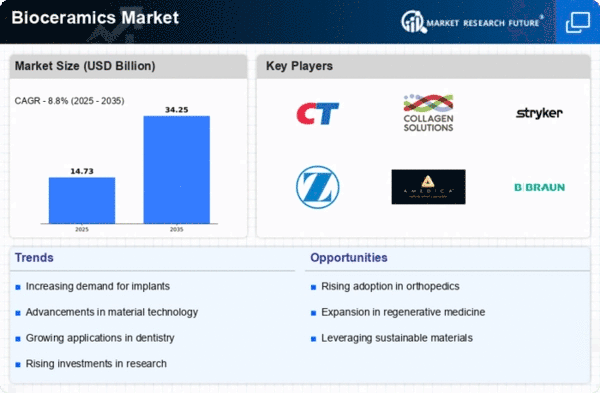
As per MRFR analysis, the Bioceramics Market Size was estimated at 13.54 USD Billion in 2024. The Bioceramics industry is projected to grow from 14.73 USD Billion in 2025 to 34.25 USD Billion by 2035, exhibiting a compound annual growth rate (CAGR) of 8.8% during the forecast period 2025 - 2035.

Key Market Trends & Highlights

The Bioceramics Market is experiencing robust growth driven by diverse applications and technological advancements.

  • The demand for bioceramics in orthopedics is rising, particularly in North America, which remains the largest market.
  • Advancements in dental applications are propelling the growth of bioceramics, with dental implants being the largest segment.
  • Innovations in regenerative medicine are fostering interest in bioceramics, especially in the Asia-Pacific region, the fastest-growing market.
  • Key market drivers include increasing applications in orthopedics and a growing focus on regenerative medicine, supported by technological advancements.

Market Size & Forecast

2024 Market Size 13.54 (USD Billion)
2035 Market Size 34.25 (USD Billion)
CAGR (2025 - 2035) 8.8%
Largest Regional Market Share in 2024 North America

Major Players

CeramTec (DE), Collagen Solutions (GB), Stryker (US), Zimmer Biomet (US), Amedica Corporation (US), B. Braun Melsungen AG (DE), Medtronic (US), DePuy Synthes (US), Heraeus Medical (DE)

Market Trends

The Bioceramics Market is currently experiencing a notable evolution, driven by advancements in material science and increasing applications in the medical field. The demand for bioceramics is primarily fueled by their biocompatibility and mechanical properties, which make them suitable for various applications, including dental implants, orthopedic devices, and tissue engineering. As healthcare providers seek innovative solutions to enhance patient outcomes, the integration of bioceramics into medical devices appears to be gaining momentum. Furthermore, the growing emphasis on minimally invasive procedures is likely to bolster the adoption of bioceramics, as these materials can facilitate better integration with biological tissues. In addition to the medical sector, the Bioceramics Market is also witnessing interest from the dental industry, where these materials are utilized for restorative applications. The increasing prevalence of dental disorders and the rising awareness of oral health are contributing to the growth of this segment. Moreover, ongoing research into novel bioceramic formulations suggests that there may be potential for new applications in regenerative medicine and drug delivery systems. Overall, the Bioceramics Market seems poised for continued expansion, driven by innovation and a focus on improving healthcare solutions.

Rising Demand in Orthopedics

The Bioceramics Market is seeing a surge in demand within the orthopedic sector. This trend is largely attributed to the increasing number of joint replacement surgeries and the need for materials that promote bone integration. Bioceramics, known for their excellent mechanical properties and biocompatibility, are becoming the preferred choice for orthopedic implants.

Advancements in Dental Applications

There is a growing trend towards the use of bioceramics in dental applications. As dental professionals seek materials that offer durability and aesthetic appeal, bioceramics are being utilized for crowns, bridges, and implants. This shift is driven by the need for materials that can withstand the oral environment while providing a natural appearance.

Innovations in Regenerative Medicine

The Bioceramics Market is also witnessing innovations aimed at regenerative medicine. Research into new bioceramic formulations suggests potential applications in tissue engineering and drug delivery systems. These advancements may lead to enhanced healing processes and improved patient outcomes, indicating a promising future for bioceramics in medical applications.

Bioceramics Market Market Drivers

Market Growth Projections

The Global Bioceramics Market Industry is projected to experience substantial growth in the coming years, with estimates indicating a market size of 13.5 USD Billion in 2024 and a remarkable increase to 34.3 USD Billion by 2035. This growth trajectory suggests a robust demand for bioceramic materials across various sectors, particularly in healthcare applications. The anticipated CAGR of 8.8% from 2025 to 2035 highlights the industry's potential for expansion, driven by technological advancements, increasing applications, and a growing awareness of the benefits of bioceramics. Such projections underscore the importance of ongoing research and innovation in this dynamic market.

Increasing Geriatric Population

The Global Bioceramics Market Industry is significantly influenced by the increasing geriatric population, which requires advanced medical solutions for age-related health issues. As the global population ages, the demand for orthopedic and dental implants rises, driving the need for bioceramic materials known for their durability and biocompatibility. By 2035, the market is anticipated to expand to 34.3 USD Billion, underscoring the urgency for innovative solutions in elder care. This demographic shift necessitates a focus on developing bioceramics that cater to the specific needs of older patients, thereby enhancing their quality of life.

Rising Demand for Biocompatible Materials

The Global Bioceramics Market Industry experiences a notable increase in demand for biocompatible materials, driven by advancements in medical technology. As healthcare providers seek materials that promote better integration with human tissues, bioceramics are becoming increasingly favored for applications such as dental implants and orthopedic devices. The market is projected to reach 13.5 USD Billion in 2024, reflecting a growing recognition of the benefits these materials offer. This trend indicates a shift towards more sustainable and effective medical solutions, positioning bioceramics as a critical component in the future of healthcare.

Technological Advancements in Bioceramics

Technological innovations play a pivotal role in the Global Bioceramics Market Industry, enhancing the performance and applications of bioceramics. Recent developments in manufacturing techniques, such as additive manufacturing and improved sintering processes, have led to the creation of more complex and functional bioceramic structures. These advancements enable the production of customized implants that better meet patient needs. As a result, the market is expected to grow significantly, with projections indicating a CAGR of 8.8% from 2025 to 2035. This growth reflects the industry's commitment to integrating cutting-edge technology into bioceramic applications.

Regulatory Support and Standards Development

Regulatory support and the establishment of standards are crucial for the Global Bioceramics Market Industry, as they ensure the safety and efficacy of bioceramic products. Government agencies and industry associations are actively involved in creating guidelines that facilitate the approval process for new bioceramic materials. This regulatory framework not only enhances consumer confidence but also encourages innovation within the industry. As regulations evolve to accommodate emerging technologies, the market is likely to benefit from increased investment and research, fostering a conducive environment for growth and development.

Growing Applications in Orthopedics and Dentistry

The Global Bioceramics Market Industry is witnessing a surge in applications within orthopedics and dentistry, where bioceramics are increasingly utilized for their superior properties. In orthopedics, bioceramics are employed in bone grafts and joint replacements, while in dentistry, they are used for dental implants and restorative procedures. The versatility of bioceramics makes them suitable for a wide range of applications, contributing to the market's growth. As healthcare providers continue to adopt these materials for their effectiveness and safety, the industry is poised for substantial expansion, driven by ongoing research and development efforts.

Market Segment Insights

By Application: Dental (Largest) vs. Tissue Engineering (Fastest-Growing)

<p>The bioceramics market is significantly characterized by its diverse applications, prominently featuring dental and orthopedic segments. The dental segment holds the largest market share, driven by the high demand for dental implants and restorative materials. In addition, the orthopedic application leverages bioceramics for bone repair and regeneration, contributing notably to the overall market dynamics. Conversely, tissue engineering is emerging with substantial growth potential as advancements in regenerative medicine create new avenues for application, increasing its market participation.</p>

<p>Dental (Dominant) vs. Tissue Engineering (Emerging)</p>

<p>The dental segment of the bioceramics market is distinguished by its focus on advanced materials like hydroxyapatite and bioactive glass, which are essential for dental implants and prosthetics. This dominant segment benefits from rising consumer awareness about oral health and the increasing prevalence of dental disorders. Meanwhile, tissue engineering stands out as an emerging sector, utilizing bioceramics in scaffolding for cell growth and tissue regeneration. The growth in research and development, coupled with increased funding for regenerative medicine, positions tissue engineering as a vital part of the future bioceramics landscape, showcasing innovative approaches and broadening its market reach.</p>

By Material Type: Calcium Phosphate (Largest) vs. Bioactive Glass (Fastest-Growing)

The bioceramics market exhibits a diverse distribution of material types, with Calcium Phosphate leading the segment in terms of market share. This material is widely favored for its biocompatibility and osteoconductivity, making it a preferred choice in various medical applications such as bone repair and dental procedures. Following closely is Bioactive Glass, which, while holding a smaller share, is quickly gaining traction due to its excellent healing properties and ability to bond with both hard and soft tissues. Growth trends within the 'Material Type' segment indicate a robust future for Bioactive Glass, driven by increasing demand in orthopedic and dental surgeries. Innovations in bioactive materials and a growing elder population are further propelling the demand for Calcium Phosphate. As healthcare providers seek more effective and biocompatible solutions, these materials are positioned to fulfill evolving market needs, signifying a shift toward hybrid approaches in bioceramics.

Calcium Phosphate (Dominant) vs. Zirconia (Emerging)

Calcium Phosphate is widely recognized as the dominant material in the bioceramics market due to its superior bioactivity and compatibility with human tissues. It is primarily used in applications related to bone regeneration and dental implants. Conversely, Zirconia, while emerging, is being increasingly explored for its strength and aesthetic appeal, especially in dental prosthetics. Though Zirconia currently commands a smaller share, its usage is on the rise, attributable to its low reactivity and excellent mechanical properties. Manufacturers are focusing on enhancing the qualities of Zirconia, making it an attractive alternative for various medical applications. As innovation continues, both materials are carving out significant niches within the bioceramics landscape.

By End Use: Medical Devices (Largest) vs. Implants (Fastest-Growing)

<p>The Bioceramics Market showcases a diverse distribution of applications across various end uses like medical devices, biomaterials, implants, and prosthetics. Among these, medical devices hold the largest market share, primarily due to their foundational role in surgical procedures and diagnostics. Conversely, implants are emerging as the fastest-growing segment, driven by their increasing integration in orthopedic and dental procedures, where precision and biocompatibility are paramount.</p>

<p>Medical Devices (Dominant) vs. Implants (Emerging)</p>

<p>In the Bioceramics Market, medical devices represent a dominant segment, focusing on functionality and reliability in surgical and therapeutic applications. They leverage bioceramics' advantageous properties, such as biocompatibility and mechanical strength, making them essential in various healthcare settings. On the other hand, implants are rapidly emerging, gaining traction particularly in orthopedic and dental applications. Their growth is attributed to advancing technology and a rising demand for effective long-term solutions in tissue replacement and restoration. This segment emphasizes innovation in material science to enhance integration with biological systems.</p>

Get more detailed insights about Bioceramics Market Research Report-Global Forecast till 2035

Regional Insights

By region, the study provides the market insights into North America, Europe, Asia-Pacific and Rest of the World. North America is the market leader in bioceramics, due to the presence of a large number of bioceramics manufacturers, high acceptance of bioceramics in the healthcare industry, and increasing demand for bioceramics in dentistry and orthopedic applications. In addition, the area is home to several major medical device businesses that are propelling the bioceramics market forward through product research and development.

Further, the major countries studied in the market report are The US, Canada, German, France, the UK, Italy, Spain, China, Japan, India, Australia, South Korea, and Brazil.

Europe Bioceramics Market accounts for the second-largest market share due to rising demand for ceramic-based restorations is likely to drive market growth. Further, the German Bioceramics Market held the largest market share, and the UK Bioceramics Market was the fastest growing market in the European region

The Asia-Pacific Bioceramics Market is expected to grow at the fastest CAGR from 2023 to 2032. This is due to increasing healthcare cost, rising elderly population, and growing need for innovative medical devices. Moreover, China’s Bioceramics Market held the largest market share, and the Indian Bioceramics Market was the fastest growing market in the Asia-Pacific region.Germany-based independent private equity firm SHS Gesellschaft, fur Beteiligungsmanagement mbH, bought an undisclosed majority stake in CAM Bioceramics Market in July 2023.

This acquisition is intended to strengthen SHS's standing within biomedical calcium phosphate solutions; it also represents a significant step forward for the company’s growth strategy in this area of expertise.

Key Players and Competitive Insights

The Bioceramics Market is currently characterized by a dynamic competitive landscape, driven by innovation, strategic partnerships, and a growing demand for advanced biomaterials in medical applications. Key players such as CeramTec (DE), Stryker (US), and B. Braun Melsungen AG (DE) are at the forefront, each adopting distinct strategies to enhance their market positioning. CeramTec (DE) focuses on expanding its product portfolio through continuous research and development, while Stryker (US) emphasizes strategic acquisitions to bolster its technological capabilities. B. Braun Melsungen AG (DE) is actively pursuing partnerships to enhance its distribution networks, thereby increasing its global reach. Collectively, these strategies contribute to a competitive environment that is increasingly characterized by innovation and collaboration.In terms of business tactics, companies are localizing manufacturing to reduce costs and improve supply chain efficiency. The market structure appears moderately fragmented, with several players vying for market share. However, the influence of major companies is significant, as they set industry standards and drive technological advancements. This competitive structure fosters an environment where smaller firms can innovate, yet they often struggle to compete against the resources and capabilities of larger entities.

In November Stryker (US) announced the acquisition of a leading bioceramics manufacturer, which is expected to enhance its product offerings in orthopedic applications. This strategic move not only strengthens Stryker's market position but also allows for the integration of advanced bioceramic technologies into its existing product lines. Such acquisitions are indicative of a broader trend where companies seek to consolidate their market presence through strategic growth initiatives.

In October B. Braun Melsungen AG (DE) launched a new line of bioceramic implants designed for enhanced biocompatibility and patient outcomes. This product introduction reflects the company's commitment to innovation and addresses the increasing demand for high-performance biomaterials in surgical applications. By focusing on product development, B. Braun is likely to capture a larger share of the market, particularly among healthcare providers seeking reliable and effective solutions.

In September CeramTec (DE) entered into a strategic partnership with a prominent research institution to develop next-generation bioceramics. This collaboration aims to leverage cutting-edge research to create innovative materials that could redefine standards in the industry. Such partnerships are crucial as they not only enhance R&D capabilities but also position companies to respond swiftly to emerging market needs.

As of December the competitive trends in the Bioceramics Market are increasingly shaped by digitalization, sustainability, and the integration of artificial intelligence in product development. Strategic alliances are becoming more prevalent, enabling companies to pool resources and expertise to drive innovation. Looking ahead, the competitive differentiation is likely to evolve from traditional price-based competition to a focus on technological advancements, product reliability, and sustainable practices. This shift underscores the importance of innovation and supply chain resilience in maintaining a competitive edge.

Key Companies in the Bioceramics Market include

Industry Developments

March 2019, BONESUPPORTTM extends its distribution agreement with Zimmer Biomet for CERAMENTTM bone void filler in the United States.

November 2022, Tethon 3D, a ceramic 3D printer and material maker, has announced a collaboration with Fortify, a composite 3D printing start-up, to develop more technical ceramic materials for 3D printing. This collaboration will allow ceramic additive manufacturing to enter high-performance applications in industries such as aerospace, medicine, and energy.

June 2020, Amatec announced the availability of CAM Bioceramics Market' medical grade ceramic materials for use with Admaflex DLP 3D printing systems.

September 2023, Straumann Group purchased AlliedStar so as to fill some gaps in its intraoral scanner line and extend the reach of its digital solutions.Smith+Nephew launched the OR3O Dual Mobility System in India for both primary and revision hip arthroplasty in August 2023.

Future Outlook

Bioceramics Market Future Outlook

The Bioceramics Market is projected to grow at an 8.8% CAGR from 2025 to 2035, driven by advancements in medical applications, increasing demand for biocompatible materials, and rising healthcare expenditures.

New opportunities lie in:

  • Development of innovative bioceramic composites for orthopedic applications.
  • Expansion into emerging markets with tailored bioceramic solutions.
  • Investment in R&D for bioactive glass technologies to enhance product offerings.

By 2035, the Bioceramics Market is expected to achieve substantial growth, solidifying its position as a key player in the healthcare sector.

Market Segmentation

Bioceramics Market End Use Outlook

  • Healthcare
  • Dental
  • Orthopedics
  • Veterinary

Bioceramics Market Application Outlook

  • Dental Implants
  • Orthopedic Implants
  • Bone Grafts
  • Tissue Engineering

Bioceramics Market Material Type Outlook

  • Calcium Phosphate
  • Bioactive Glass
  • Zirconia
  • Alumina

Report Scope

MARKET SIZE 2024 13.54(USD Billion)
MARKET SIZE 2025 14.73(USD Billion)
MARKET SIZE 2035 34.25(USD Billion)
COMPOUND ANNUAL GROWTH RATE (CAGR) 8.8% (2025 - 2035)
REPORT COVERAGE Revenue Forecast, Competitive Landscape, Growth Factors, and Trends
BASE YEAR 2024
Market Forecast Period 2025 - 2035
Historical Data 2019 - 2024
Market Forecast Units USD Billion
Key Companies Profiled CeramTec (DE), Collagen Solutions (GB), Stryker (US), Zimmer Biomet (US), Amedica Corporation (US), B. Braun Melsungen AG (DE), Medtronic (US), DePuy Synthes (US), Heraeus Medical (DE)
Segments Covered Application, Material Type, End Use
Key Market Opportunities Advancements in biocompatible materials enhance applications in regenerative medicine within the Bioceramics Market.
Key Market Dynamics Rising demand for biocompatible materials drives innovation and competition in the bioceramics market.
Countries Covered North America, Europe, APAC, South America, MEA

FAQs

What is the current valuation of the Bioceramics Market as of 2024?

<p>The Bioceramics Market was valued at 13.54 USD Billion in 2024.</p>

What is the projected market size for the Bioceramics Market in 2035?

<p>The market is projected to reach 34.25 USD Billion by 2035.</p>

What is the expected CAGR for the Bioceramics Market during the forecast period 2025 - 2035?

<p>The expected CAGR for the Bioceramics Market during 2025 - 2035 is 8.8%.</p>

Which application segment is anticipated to grow the most in the Bioceramics Market?

<p>The Orthopedic application segment is projected to grow from 4.0 USD Billion to 10.0 USD Billion by 2035.</p>

What are the key materials driving the Bioceramics Market?

<p>Calcium Phosphate and Zirconia are key materials, with projected valuations of 10.25 USD Billion each by 2035.</p>

Who are the leading players in the Bioceramics Market?

<p>Key players include CeramTec GmbH, Stryker Corporation, and Zimmer Biomet Holdings, Inc.</p>

What is the projected growth for the Surgical application segment in the Bioceramics Market?

The Surgical application segment is expected to grow from 3.0 USD Billion to 8.0 USD Billion by 2035.

How does the market for Biomaterials compare to other end-use segments?

The Biomaterials segment is projected to grow from 4.0 USD Billion to 10.0 USD Billion, indicating strong demand.

What is the expected growth trajectory for the Dental segment in the Bioceramics Market?

The Dental segment is anticipated to increase from 2.5 USD Billion to 6.25 USD Billion by 2035.

What role do companies like Medtronic PLC play in the Bioceramics Market?

Companies like Medtronic PLC contribute to innovation and market growth, enhancing product offerings in the Bioceramics sector.

  1. SECTION I: EXECUTIVE SUMMARY AND KEY HIGHLIGHTS
    1. | 1.1 EXECUTIVE SUMMARY
    2. | | 1.1.1 Market Overview
    3. | | 1.1.2 Key Findings
    4. | | 1.1.3 Market Segmentation
    5. | | 1.1.4 Competitive Landscape
    6. | | 1.1.5 Challenges and Opportunities
    7. | | 1.1.6 Future Outlook
  2. SECTION II: SCOPING, METHODOLOGY AND MARKET STRUCTURE
    1. | 2.1 MARKET INTRODUCTION
    2. | | 2.1.1 Definition
    3. | | 2.1.2 Scope of the study
    4. | | | 2.1.2.1 Research Objective
    5. | | | 2.1.2.2 Assumption
    6. | | | 2.1.2.3 Limitations
    7. | 2.2 RESEARCH METHODOLOGY
    8. | | 2.2.1 Overview
    9. | | 2.2.2 Data Mining
    10. | | 2.2.3 Secondary Research
    11. | | 2.2.4 Primary Research
    12. | | | 2.2.4.1 Primary Interviews and Information Gathering Process
    13. | | | 2.2.4.2 Breakdown of Primary Respondents
    14. | | 2.2.5 Forecasting Model
    15. | | 2.2.6 Market Size Estimation
    16. | | | 2.2.6.1 Bottom-Up Approach
    17. | | | 2.2.6.2 Top-Down Approach
    18. | | 2.2.7 Data Triangulation
    19. | | 2.2.8 Validation
  3. SECTION III: QUALITATIVE ANALYSIS
    1. | 3.1 MARKET DYNAMICS
    2. | | 3.1.1 Overview
    3. | | 3.1.2 Drivers
    4. | | 3.1.3 Restraints
    5. | | 3.1.4 Opportunities
    6. | 3.2 MARKET FACTOR ANALYSIS
    7. | | 3.2.1 Value chain Analysis
    8. | | 3.2.2 Porter's Five Forces Analysis
    9. | | | 3.2.2.1 Bargaining Power of Suppliers
    10. | | | 3.2.2.2 Bargaining Power of Buyers
    11. | | | 3.2.2.3 Threat of New Entrants
    12. | | | 3.2.2.4 Threat of Substitutes
    13. | | | 3.2.2.5 Intensity of Rivalry
    14. | | 3.2.3 COVID-19 Impact Analysis
    15. | | | 3.2.3.1 Market Impact Analysis
    16. | | | 3.2.3.2 Regional Impact
    17. | | | 3.2.3.3 Opportunity and Threat Analysis
  4. SECTION IV: QUANTITATIVE ANALYSIS
    1. | 4.1 Chemicals and Materials, BY Application (USD Billion)
    2. | | 4.1.1 Dental
    3. | | 4.1.2 Orthopedic
    4. | | 4.1.3 Surgical
    5. | | 4.1.4 Tissue Engineering
    6. | 4.2 Chemicals and Materials, BY Material Type (USD Billion)
    7. | | 4.2.1 Calcium Phosphate
    8. | | 4.2.2 Bioactive Glass
    9. | | 4.2.3 Calcium Sulfate
    10. | | 4.2.4 Zirconia
    11. | 4.3 Chemicals and Materials, BY End Use (USD Billion)
    12. | | 4.3.1 Medical Devices
    13. | | 4.3.2 Biomaterials
    14. | | 4.3.3 Implants
    15. | | 4.3.4 Prosthetics
    16. | 4.4 Chemicals and Materials, BY Region (USD Billion)
    17. | | 4.4.1 North America
    18. | | | 4.4.1.1 US
    19. | | | 4.4.1.2 Canada
    20. | | 4.4.2 Europe
    21. | | | 4.4.2.1 Germany
    22. | | | 4.4.2.2 UK
    23. | | | 4.4.2.3 France
    24. | | | 4.4.2.4 Russia
    25. | | | 4.4.2.5 Italy
    26. | | | 4.4.2.6 Spain
    27. | | | 4.4.2.7 Rest of Europe
    28. | | 4.4.3 APAC
    29. | | | 4.4.3.1 China
    30. | | | 4.4.3.2 India
    31. | | | 4.4.3.3 Japan
    32. | | | 4.4.3.4 South Korea
    33. | | | 4.4.3.5 Malaysia
    34. | | | 4.4.3.6 Thailand
    35. | | | 4.4.3.7 Indonesia
    36. | | | 4.4.3.8 Rest of APAC
    37. | | 4.4.4 South America
    38. | | | 4.4.4.1 Brazil
    39. | | | 4.4.4.2 Mexico
    40. | | | 4.4.4.3 Argentina
    41. | | | 4.4.4.4 Rest of South America
    42. | | 4.4.5 MEA
    43. | | | 4.4.5.1 GCC Countries
    44. | | | 4.4.5.2 South Africa
    45. | | | 4.4.5.3 Rest of MEA
  5. SECTION V: COMPETITIVE ANALYSIS
    1. | 5.1 Competitive Landscape
    2. | | 5.1.1 Overview
    3. | | 5.1.2 Competitive Analysis
    4. | | 5.1.3 Market share Analysis
    5. | | 5.1.4 Major Growth Strategy in the Chemicals and Materials
    6. | | 5.1.5 Competitive Benchmarking
    7. | | 5.1.6 Leading Players in Terms of Number of Developments in the Chemicals and Materials
    8. | | 5.1.7 Key developments and growth strategies
    9. | | | 5.1.7.1 New Product Launch/Service Deployment
    10. | | | 5.1.7.2 Merger & Acquisitions
    11. | | | 5.1.7.3 Joint Ventures
    12. | | 5.1.8 Major Players Financial Matrix
    13. | | | 5.1.8.1 Sales and Operating Income
    14. | | | 5.1.8.2 Major Players R&D Expenditure. 2023
    15. | 5.2 Company Profiles
    16. | | 5.2.1 CeramTec GmbH (DE)
    17. | | | 5.2.1.1 Financial Overview
    18. | | | 5.2.1.2 Products Offered
    19. | | | 5.2.1.3 Key Developments
    20. | | | 5.2.1.4 SWOT Analysis
    21. | | | 5.2.1.5 Key Strategies
    22. | | 5.2.2 Collagen Solutions PLC (GB)
    23. | | | 5.2.2.1 Financial Overview
    24. | | | 5.2.2.2 Products Offered
    25. | | | 5.2.2.3 Key Developments
    26. | | | 5.2.2.4 SWOT Analysis
    27. | | | 5.2.2.5 Key Strategies
    28. | | 5.2.3 Stryker Corporation (US)
    29. | | | 5.2.3.1 Financial Overview
    30. | | | 5.2.3.2 Products Offered
    31. | | | 5.2.3.3 Key Developments
    32. | | | 5.2.3.4 SWOT Analysis
    33. | | | 5.2.3.5 Key Strategies
    34. | | 5.2.4 Zimmer Biomet Holdings, Inc. (US)
    35. | | | 5.2.4.1 Financial Overview
    36. | | | 5.2.4.2 Products Offered
    37. | | | 5.2.4.3 Key Developments
    38. | | | 5.2.4.4 SWOT Analysis
    39. | | | 5.2.4.5 Key Strategies
    40. | | 5.2.5 Amedica Corporation (US)
    41. | | | 5.2.5.1 Financial Overview
    42. | | | 5.2.5.2 Products Offered
    43. | | | 5.2.5.3 Key Developments
    44. | | | 5.2.5.4 SWOT Analysis
    45. | | | 5.2.5.5 Key Strategies
    46. | | 5.2.6 Biosyent Inc. (CA)
    47. | | | 5.2.6.1 Financial Overview
    48. | | | 5.2.6.2 Products Offered
    49. | | | 5.2.6.3 Key Developments
    50. | | | 5.2.6.4 SWOT Analysis
    51. | | | 5.2.6.5 Key Strategies
    52. | | 5.2.7 Medtronic PLC (IE)
    53. | | | 5.2.7.1 Financial Overview
    54. | | | 5.2.7.2 Products Offered
    55. | | | 5.2.7.3 Key Developments
    56. | | | 5.2.7.4 SWOT Analysis
    57. | | | 5.2.7.5 Key Strategies
    58. | | 5.2.8 DePuy Synthes (US)
    59. | | | 5.2.8.1 Financial Overview
    60. | | | 5.2.8.2 Products Offered
    61. | | | 5.2.8.3 Key Developments
    62. | | | 5.2.8.4 SWOT Analysis
    63. | | | 5.2.8.5 Key Strategies
    64. | | 5.2.9 Heraeus Medical GmbH (DE)
    65. | | | 5.2.9.1 Financial Overview
    66. | | | 5.2.9.2 Products Offered
    67. | | | 5.2.9.3 Key Developments
    68. | | | 5.2.9.4 SWOT Analysis
    69. | | | 5.2.9.5 Key Strategies
    70. | 5.3 Appendix
    71. | | 5.3.1 References
    72. | | 5.3.2 Related Reports
  6. LIST OF FIGURES
    1. | 6.1 MARKET SYNOPSIS
    2. | 6.2 NORTH AMERICA MARKET ANALYSIS
    3. | 6.3 US MARKET ANALYSIS BY APPLICATION
    4. | 6.4 US MARKET ANALYSIS BY MATERIAL TYPE
    5. | 6.5 US MARKET ANALYSIS BY END USE
    6. | 6.6 CANADA MARKET ANALYSIS BY APPLICATION
    7. | 6.7 CANADA MARKET ANALYSIS BY MATERIAL TYPE
    8. | 6.8 CANADA MARKET ANALYSIS BY END USE
    9. | 6.9 EUROPE MARKET ANALYSIS
    10. | 6.10 GERMANY MARKET ANALYSIS BY APPLICATION
    11. | 6.11 GERMANY MARKET ANALYSIS BY MATERIAL TYPE
    12. | 6.12 GERMANY MARKET ANALYSIS BY END USE
    13. | 6.13 UK MARKET ANALYSIS BY APPLICATION
    14. | 6.14 UK MARKET ANALYSIS BY MATERIAL TYPE
    15. | 6.15 UK MARKET ANALYSIS BY END USE
    16. | 6.16 FRANCE MARKET ANALYSIS BY APPLICATION
    17. | 6.17 FRANCE MARKET ANALYSIS BY MATERIAL TYPE
    18. | 6.18 FRANCE MARKET ANALYSIS BY END USE
    19. | 6.19 RUSSIA MARKET ANALYSIS BY APPLICATION
    20. | 6.20 RUSSIA MARKET ANALYSIS BY MATERIAL TYPE
    21. | 6.21 RUSSIA MARKET ANALYSIS BY END USE
    22. | 6.22 ITALY MARKET ANALYSIS BY APPLICATION
    23. | 6.23 ITALY MARKET ANALYSIS BY MATERIAL TYPE
    24. | 6.24 ITALY MARKET ANALYSIS BY END USE
    25. | 6.25 SPAIN MARKET ANALYSIS BY APPLICATION
    26. | 6.26 SPAIN MARKET ANALYSIS BY MATERIAL TYPE
    27. | 6.27 SPAIN MARKET ANALYSIS BY END USE
    28. | 6.28 REST OF EUROPE MARKET ANALYSIS BY APPLICATION
    29. | 6.29 REST OF EUROPE MARKET ANALYSIS BY MATERIAL TYPE
    30. | 6.30 REST OF EUROPE MARKET ANALYSIS BY END USE
    31. | 6.31 APAC MARKET ANALYSIS
    32. | 6.32 CHINA MARKET ANALYSIS BY APPLICATION
    33. | 6.33 CHINA MARKET ANALYSIS BY MATERIAL TYPE
    34. | 6.34 CHINA MARKET ANALYSIS BY END USE
    35. | 6.35 INDIA MARKET ANALYSIS BY APPLICATION
    36. | 6.36 INDIA MARKET ANALYSIS BY MATERIAL TYPE
    37. | 6.37 INDIA MARKET ANALYSIS BY END USE
    38. | 6.38 JAPAN MARKET ANALYSIS BY APPLICATION
    39. | 6.39 JAPAN MARKET ANALYSIS BY MATERIAL TYPE
    40. | 6.40 JAPAN MARKET ANALYSIS BY END USE
    41. | 6.41 SOUTH KOREA MARKET ANALYSIS BY APPLICATION
    42. | 6.42 SOUTH KOREA MARKET ANALYSIS BY MATERIAL TYPE
    43. | 6.43 SOUTH KOREA MARKET ANALYSIS BY END USE
    44. | 6.44 MALAYSIA MARKET ANALYSIS BY APPLICATION
    45. | 6.45 MALAYSIA MARKET ANALYSIS BY MATERIAL TYPE
    46. | 6.46 MALAYSIA MARKET ANALYSIS BY END USE
    47. | 6.47 THAILAND MARKET ANALYSIS BY APPLICATION
    48. | 6.48 THAILAND MARKET ANALYSIS BY MATERIAL TYPE
    49. | 6.49 THAILAND MARKET ANALYSIS BY END USE
    50. | 6.50 INDONESIA MARKET ANALYSIS BY APPLICATION
    51. | 6.51 INDONESIA MARKET ANALYSIS BY MATERIAL TYPE
    52. | 6.52 INDONESIA MARKET ANALYSIS BY END USE
    53. | 6.53 REST OF APAC MARKET ANALYSIS BY APPLICATION
    54. | 6.54 REST OF APAC MARKET ANALYSIS BY MATERIAL TYPE
    55. | 6.55 REST OF APAC MARKET ANALYSIS BY END USE
    56. | 6.56 SOUTH AMERICA MARKET ANALYSIS
    57. | 6.57 BRAZIL MARKET ANALYSIS BY APPLICATION
    58. | 6.58 BRAZIL MARKET ANALYSIS BY MATERIAL TYPE
    59. | 6.59 BRAZIL MARKET ANALYSIS BY END USE
    60. | 6.60 MEXICO MARKET ANALYSIS BY APPLICATION
    61. | 6.61 MEXICO MARKET ANALYSIS BY MATERIAL TYPE
    62. | 6.62 MEXICO MARKET ANALYSIS BY END USE
    63. | 6.63 ARGENTINA MARKET ANALYSIS BY APPLICATION
    64. | 6.64 ARGENTINA MARKET ANALYSIS BY MATERIAL TYPE
    65. | 6.65 ARGENTINA MARKET ANALYSIS BY END USE
    66. | 6.66 REST OF SOUTH AMERICA MARKET ANALYSIS BY APPLICATION
    67. | 6.67 REST OF SOUTH AMERICA MARKET ANALYSIS BY MATERIAL TYPE
    68. | 6.68 REST OF SOUTH AMERICA MARKET ANALYSIS BY END USE
    69. | 6.69 MEA MARKET ANALYSIS
    70. | 6.70 GCC COUNTRIES MARKET ANALYSIS BY APPLICATION
    71. | 6.71 GCC COUNTRIES MARKET ANALYSIS BY MATERIAL TYPE
    72. | 6.72 GCC COUNTRIES MARKET ANALYSIS BY END USE
    73. | 6.73 SOUTH AFRICA MARKET ANALYSIS BY APPLICATION
    74. | 6.74 SOUTH AFRICA MARKET ANALYSIS BY MATERIAL TYPE
    75. | 6.75 SOUTH AFRICA MARKET ANALYSIS BY END USE
    76. | 6.76 REST OF MEA MARKET ANALYSIS BY APPLICATION
    77. | 6.77 REST OF MEA MARKET ANALYSIS BY MATERIAL TYPE
    78. | 6.78 REST OF MEA MARKET ANALYSIS BY END USE
    79. | 6.79 KEY BUYING CRITERIA OF CHEMICALS AND MATERIALS
    80. | 6.80 RESEARCH PROCESS OF MRFR
    81. | 6.81 DRO ANALYSIS OF CHEMICALS AND MATERIALS
    82. | 6.82 DRIVERS IMPACT ANALYSIS: CHEMICALS AND MATERIALS
    83. | 6.83 RESTRAINTS IMPACT ANALYSIS: CHEMICALS AND MATERIALS
    84. | 6.84 SUPPLY / VALUE CHAIN: CHEMICALS AND MATERIALS
    85. | 6.85 CHEMICALS AND MATERIALS, BY APPLICATION, 2024 (% SHARE)
    86. | 6.86 CHEMICALS AND MATERIALS, BY APPLICATION, 2024 TO 2035 (USD Billion)
    87. | 6.87 CHEMICALS AND MATERIALS, BY MATERIAL TYPE, 2024 (% SHARE)
    88. | 6.88 CHEMICALS AND MATERIALS, BY MATERIAL TYPE, 2024 TO 2035 (USD Billion)
    89. | 6.89 CHEMICALS AND MATERIALS, BY END USE, 2024 (% SHARE)
    90. | 6.90 CHEMICALS AND MATERIALS, BY END USE, 2024 TO 2035 (USD Billion)
    91. | 6.91 BENCHMARKING OF MAJOR COMPETITORS
  7. LIST OF TABLES
    1. | 7.1 LIST OF ASSUMPTIONS
    2. | | 7.1.1
    3. | 7.2 North America MARKET SIZE ESTIMATES; FORECAST
    4. | | 7.2.1 BY APPLICATION, 2025-2035 (USD Billion)
    5. | | 7.2.2 BY MATERIAL TYPE, 2025-2035 (USD Billion)
    6. | | 7.2.3 BY END USE, 2025-2035 (USD Billion)
    7. | 7.3 US MARKET SIZE ESTIMATES; FORECAST
    8. | | 7.3.1 BY APPLICATION, 2025-2035 (USD Billion)
    9. | | 7.3.2 BY MATERIAL TYPE, 2025-2035 (USD Billion)
    10. | | 7.3.3 BY END USE, 2025-2035 (USD Billion)
    11. | 7.4 Canada MARKET SIZE ESTIMATES; FORECAST
    12. | | 7.4.1 BY APPLICATION, 2025-2035 (USD Billion)
    13. | | 7.4.2 BY MATERIAL TYPE, 2025-2035 (USD Billion)
    14. | | 7.4.3 BY END USE, 2025-2035 (USD Billion)
    15. | 7.5 Europe MARKET SIZE ESTIMATES; FORECAST
    16. | | 7.5.1 BY APPLICATION, 2025-2035 (USD Billion)
    17. | | 7.5.2 BY MATERIAL TYPE, 2025-2035 (USD Billion)
    18. | | 7.5.3 BY END USE, 2025-2035 (USD Billion)
    19. | 7.6 Germany MARKET SIZE ESTIMATES; FORECAST
    20. | | 7.6.1 BY APPLICATION, 2025-2035 (USD Billion)
    21. | | 7.6.2 BY MATERIAL TYPE, 2025-2035 (USD Billion)
    22. | | 7.6.3 BY END USE, 2025-2035 (USD Billion)
    23. | 7.7 UK MARKET SIZE ESTIMATES; FORECAST
    24. | | 7.7.1 BY APPLICATION, 2025-2035 (USD Billion)
    25. | | 7.7.2 BY MATERIAL TYPE, 2025-2035 (USD Billion)
    26. | | 7.7.3 BY END USE, 2025-2035 (USD Billion)
    27. | 7.8 France MARKET SIZE ESTIMATES; FORECAST
    28. | | 7.8.1 BY APPLICATION, 2025-2035 (USD Billion)
    29. | | 7.8.2 BY MATERIAL TYPE, 2025-2035 (USD Billion)
    30. | | 7.8.3 BY END USE, 2025-2035 (USD Billion)
    31. | 7.9 Russia MARKET SIZE ESTIMATES; FORECAST
    32. | | 7.9.1 BY APPLICATION, 2025-2035 (USD Billion)
    33. | | 7.9.2 BY MATERIAL TYPE, 2025-2035 (USD Billion)
    34. | | 7.9.3 BY END USE, 2025-2035 (USD Billion)
    35. | 7.10 Italy MARKET SIZE ESTIMATES; FORECAST
    36. | | 7.10.1 BY APPLICATION, 2025-2035 (USD Billion)
    37. | | 7.10.2 BY MATERIAL TYPE, 2025-2035 (USD Billion)
    38. | | 7.10.3 BY END USE, 2025-2035 (USD Billion)
    39. | 7.11 Spain MARKET SIZE ESTIMATES; FORECAST
    40. | | 7.11.1 BY APPLICATION, 2025-2035 (USD Billion)
    41. | | 7.11.2 BY MATERIAL TYPE, 2025-2035 (USD Billion)
    42. | | 7.11.3 BY END USE, 2025-2035 (USD Billion)
    43. | 7.12 Rest of Europe MARKET SIZE ESTIMATES; FORECAST
    44. | | 7.12.1 BY APPLICATION, 2025-2035 (USD Billion)
    45. | | 7.12.2 BY MATERIAL TYPE, 2025-2035 (USD Billion)
    46. | | 7.12.3 BY END USE, 2025-2035 (USD Billion)
    47. | 7.13 APAC MARKET SIZE ESTIMATES; FORECAST
    48. | | 7.13.1 BY APPLICATION, 2025-2035 (USD Billion)
    49. | | 7.13.2 BY MATERIAL TYPE, 2025-2035 (USD Billion)
    50. | | 7.13.3 BY END USE, 2025-2035 (USD Billion)
    51. | 7.14 China MARKET SIZE ESTIMATES; FORECAST
    52. | | 7.14.1 BY APPLICATION, 2025-2035 (USD Billion)
    53. | | 7.14.2 BY MATERIAL TYPE, 2025-2035 (USD Billion)
    54. | | 7.14.3 BY END USE, 2025-2035 (USD Billion)
    55. | 7.15 India MARKET SIZE ESTIMATES; FORECAST
    56. | | 7.15.1 BY APPLICATION, 2025-2035 (USD Billion)
    57. | | 7.15.2 BY MATERIAL TYPE, 2025-2035 (USD Billion)
    58. | | 7.15.3 BY END USE, 2025-2035 (USD Billion)
    59. | 7.16 Japan MARKET SIZE ESTIMATES; FORECAST
    60. | | 7.16.1 BY APPLICATION, 2025-2035 (USD Billion)
    61. | | 7.16.2 BY MATERIAL TYPE, 2025-2035 (USD Billion)
    62. | | 7.16.3 BY END USE, 2025-2035 (USD Billion)
    63. | 7.17 South Korea MARKET SIZE ESTIMATES; FORECAST
    64. | | 7.17.1 BY APPLICATION, 2025-2035 (USD Billion)
    65. | | 7.17.2 BY MATERIAL TYPE, 2025-2035 (USD Billion)
    66. | | 7.17.3 BY END USE, 2025-2035 (USD Billion)
    67. | 7.18 Malaysia MARKET SIZE ESTIMATES; FORECAST
    68. | | 7.18.1 BY APPLICATION, 2025-2035 (USD Billion)
    69. | | 7.18.2 BY MATERIAL TYPE, 2025-2035 (USD Billion)
    70. | | 7.18.3 BY END USE, 2025-2035 (USD Billion)
    71. | 7.19 Thailand MARKET SIZE ESTIMATES; FORECAST
    72. | | 7.19.1 BY APPLICATION, 2025-2035 (USD Billion)
    73. | | 7.19.2 BY MATERIAL TYPE, 2025-2035 (USD Billion)
    74. | | 7.19.3 BY END USE, 2025-2035 (USD Billion)
    75. | 7.20 Indonesia MARKET SIZE ESTIMATES; FORECAST
    76. | | 7.20.1 BY APPLICATION, 2025-2035 (USD Billion)
    77. | | 7.20.2 BY MATERIAL TYPE, 2025-2035 (USD Billion)
    78. | | 7.20.3 BY END USE, 2025-2035 (USD Billion)
    79. | 7.21 Rest of APAC MARKET SIZE ESTIMATES; FORECAST
    80. | | 7.21.1 BY APPLICATION, 2025-2035 (USD Billion)
    81. | | 7.21.2 BY MATERIAL TYPE, 2025-2035 (USD Billion)
    82. | | 7.21.3 BY END USE, 2025-2035 (USD Billion)
    83. | 7.22 South America MARKET SIZE ESTIMATES; FORECAST
    84. | | 7.22.1 BY APPLICATION, 2025-2035 (USD Billion)
    85. | | 7.22.2 BY MATERIAL TYPE, 2025-2035 (USD Billion)
    86. | | 7.22.3 BY END USE, 2025-2035 (USD Billion)
    87. | 7.23 Brazil MARKET SIZE ESTIMATES; FORECAST
    88. | | 7.23.1 BY APPLICATION, 2025-2035 (USD Billion)
    89. | | 7.23.2 BY MATERIAL TYPE, 2025-2035 (USD Billion)
    90. | | 7.23.3 BY END USE, 2025-2035 (USD Billion)
    91. | 7.24 Mexico MARKET SIZE ESTIMATES; FORECAST
    92. | | 7.24.1 BY APPLICATION, 2025-2035 (USD Billion)
    93. | | 7.24.2 BY MATERIAL TYPE, 2025-2035 (USD Billion)
    94. | | 7.24.3 BY END USE, 2025-2035 (USD Billion)
    95. | 7.25 Argentina MARKET SIZE ESTIMATES; FORECAST
    96. | | 7.25.1 BY APPLICATION, 2025-2035 (USD Billion)
    97. | | 7.25.2 BY MATERIAL TYPE, 2025-2035 (USD Billion)
    98. | | 7.25.3 BY END USE, 2025-2035 (USD Billion)
    99. | 7.26 Rest of South America MARKET SIZE ESTIMATES; FORECAST
    100. | | 7.26.1 BY APPLICATION, 2025-2035 (USD Billion)
    101. | | 7.26.2 BY MATERIAL TYPE, 2025-2035 (USD Billion)
    102. | | 7.26.3 BY END USE, 2025-2035 (USD Billion)
    103. | 7.27 MEA MARKET SIZE ESTIMATES; FORECAST
    104. | | 7.27.1 BY APPLICATION, 2025-2035 (USD Billion)
    105. | | 7.27.2 BY MATERIAL TYPE, 2025-2035 (USD Billion)
    106. | | 7.27.3 BY END USE, 2025-2035 (USD Billion)
    107. | 7.28 GCC Countries MARKET SIZE ESTIMATES; FORECAST
    108. | | 7.28.1 BY APPLICATION, 2025-2035 (USD Billion)
    109. | | 7.28.2 BY MATERIAL TYPE, 2025-2035 (USD Billion)
    110. | | 7.28.3 BY END USE, 2025-2035 (USD Billion)
    111. | 7.29 South Africa MARKET SIZE ESTIMATES; FORECAST
    112. | | 7.29.1 BY APPLICATION, 2025-2035 (USD Billion)
    113. | | 7.29.2 BY MATERIAL TYPE, 2025-2035 (USD Billion)
    114. | | 7.29.3 BY END USE, 2025-2035 (USD Billion)
    115. | 7.30 Rest of MEA MARKET SIZE ESTIMATES; FORECAST
    116. | | 7.30.1 BY APPLICATION, 2025-2035 (USD Billion)
    117. | | 7.30.2 BY MATERIAL TYPE, 2025-2035 (USD Billion)
    118. | | 7.30.3 BY END USE, 2025-2035 (USD Billion)
    119. | 7.31 PRODUCT LAUNCH/PRODUCT DEVELOPMENT/APPROVAL
    120. | | 7.31.1
    121. | 7.32 ACQUISITION/PARTNERSHIP
    122. | | 7.32.1

Chemicals and Materials Market Segmentation

Chemicals and Materials By Application (USD Billion, 2025-2035)

  • Dental
  • Orthopedic
  • Surgical
  • Tissue Engineering

Chemicals and Materials By Material Type (USD Billion, 2025-2035)

  • Calcium Phosphate
  • Bioactive Glass
  • Calcium Sulfate
  • Zirconia

Chemicals and Materials By End Use (USD Billion, 2025-2035)

  • Medical Devices
  • Biomaterials
  • Implants
  • Prosthetics
Infographic

Free Sample Request

Kindly complete the form below to receive a free sample of this Report

Get Free Sample

Customer Strories

Compare Licence

×
Features License Type
Single User Multiuser License Enterprise User
Price $4,950 $5,950 $7,250
Maximum User Access Limit 1 User Upto 10 Users Unrestricted Access Throughout the Organization
Free Customization
Direct Access to Analyst
Deliverable Format
Platform Access
Discount on Next Purchase 10% 15% 15%
Printable Versions