×
Request Free Sample ×

Kindly complete the form below to receive a free sample of this Report

* Please use a valid business email

Leading companies partner with us for data-driven Insights

clients tt-cursor
Hero Background
English
Chinese
French
Japanese
Korean
German
Spanish

Biofuels Market Analysis

ID: MRFR/EnP/2157-CR
128 Pages
Anshula Mandaokar
September 2024

Biofuels Market Size, Share & Growth Analysis Report By Type (Bioethanol, Biodiesel, Biogas, Advanced Biofuels), By Feedstock (Food Crops, Non-Food Crops, Waste Materials, Algae), By Application (Transportation, Power Generation, Heating, Industrial), By End Use (Automotive, Aviation, Marine, Residential) and By Regional (North America, Europe, South America, Asia Pacific, Middle East and Africa) - Growth & Industry Forecast to 2035

Share:
Download PDF ×

We do not share your information with anyone. However, we may send you emails based on your report interest from time to time. You may contact us at any time to opt-out.

Bio Fuels Market Infographic
Purchase Options

Market Analysis

In-depth Analysis of Bio Fuels Market Industry Landscape

The biofuels industry is characterized by strong forces that determine its course in response to a confluence of innovative advancements, market demand, and administrative frameworks. Biofuels have emerged as a major actor in the global energy landscape as people struggle with environmental concerns and search for workable energy alternatives. Endowments, fee incentives, and sustainable power targets are some of the policy tools that states employ to encourage the production and consumption of biofuels and create an environment that is conducive to market growth. Developments in biofuel production processes, such as the development of more efficient biomass conversion techniques and the use of genetically modified organisms for increased fuel yield, contribute to the growth of the industry. Continuously creative work projects promote improvements in feedstock conversion efficiency, lowering costs and raising the viability of biofuels as a conventional energy source overall. Consumers and businesses are becoming more environmentally conscious, and there is a growing trend toward greener and more sustainable energy options. Biofuels provide a greener option to traditional petroleum derivatives because they are derived from renewable resources like biomass. The need for the biofuels market to be resilient to external financial factors is growing as it pertains to long-term sustainability. The ability to provide cost-effective solutions linked to natural benefits makes biofuels a sensible option in various financial scenarios. For partners in the biofuels industry, striking a balance between meeting energy demands and ensuring natural management continues to be a fundamental challenge. Biofuels are a key component of the global movement towards greener and more sustainable energy arrangements, because of this advancement. The way the biofuels market develops going forward will be greatly influenced by how well the company handles challenges and seizes opportunities.

Author
Anshula Mandaokar
Team Lead - Research

Anshula Mandaokar holds an academic degree in Chemical Engineering and has been contributing to the field for more than 5 years. She has expertise in Market Research and Business Consulting and serves as a Team Lead for a reputed Market Research firm under the Chemicals and Materials domain spectrum. She has worked on multiple projects, generating explicit results in a quick turnaround time. Her understanding of data interpretation justifies her role as a leader.

Leave a Comment

FAQs

What is the projected market valuation of the Bio Fuels Market by 2035?

<p>The Bio Fuels Market is projected to reach a valuation of approximately 149658.05 USD Billion by 2035.</p>

What was the overall market valuation of the Bio Fuels Market in 2024?

<p>In 2024, the overall market valuation of the Bio Fuels Market was 68802.15 USD Billion.</p>

What is the expected CAGR for the Bio Fuels Market during the forecast period 2025 - 2035?

<p>The expected CAGR for the Bio Fuels Market during the forecast period 2025 - 2035 is 7.32%.</p>

Which companies are considered key players in the Bio Fuels Market?

<p>Key players in the Bio Fuels Market include POET LLC, Archer Daniels Midland Company, and Valero Energy Corporation, among others.</p>

What are the main applications of biofuels in the market?

<p>The main applications of biofuels include Transportation, Power Generation, Industrial, and Residential sectors.</p>

How does the market for biofuels by feedstock type break down?

<p>The market for biofuels by feedstock type includes Vegetable Oils, Animal Fats, Waste Oils, and Starch.</p>

What production technologies are utilized in the Bio Fuels Market?

<p>Production technologies in the Bio Fuels Market include Fermentation, Transesterification, Gasification, and Hydrothermal Liquefaction.</p>

What are the end-use segments for biofuels?

<p>End-use segments for biofuels encompass Automotive, Aviation, Marine, and Heating applications.</p>

What blend types are available in the Bio Fuels Market?

<p>Blend types in the Bio Fuels Market include Biodiesel, Bioethanol, Biobutanol, and Biogas.</p>

What was the valuation of the Transportation segment in the Bio Fuels Market in 2024?

<p>In 2024, the Transportation segment of the Bio Fuels Market was valued at 20600.0 USD Billion.</p>

Market Summary

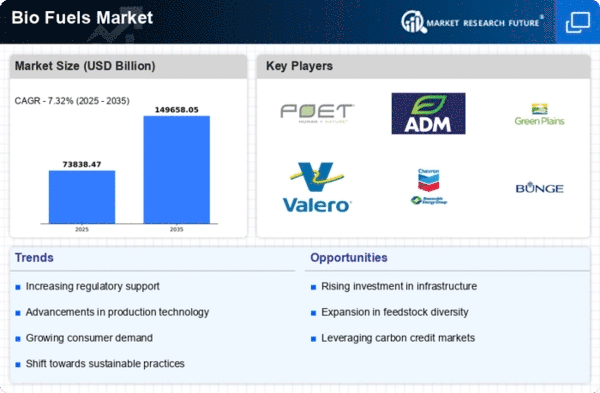
As per MRFR analysis, the Biofuels Market Size was estimated at 68802.15 USD Billion in 2024. The Bio Fuels industry is projected to grow from 73838.63 USD Billion in 2025 to 149658.05 USD Billion by 2035, exhibiting a compound annual growth rate (CAGR) of 7.32% during the forecast period 2025 - 2035.

Key Market Trends & Highlights

The Biofuels Market is experiencing robust growth driven by technological advancements and increasing consumer demand for sustainable energy solutions.

  • Technological innovations in biofuel production are enhancing efficiency and reducing costs, thereby attracting investment. North America remains the largest market for biofuels, while the Asia-Pacific region is emerging as the fastest-growing market. The transportation segment continues to dominate the market, whereas the industrial segment is witnessing rapid growth due to rising energy needs. Government incentives and consumer preference for renewable energy are key drivers propelling the biofuels market forward.

Market Size & Forecast

2024 Market Size 68802.15 (USD Billion)
2035 Market Size 149658.05 (USD Billion)
CAGR (2025 - 2035) 7.32%
Largest Regional Market Share in 2024 North America

Major Players

POET LLC (US), Archer Daniels Midland Company (US), Green Plains Inc. (US), <a href="https://www.valero.com/renewables">Valero Energy Corporation</a> (US), Renewable Energy Group Inc. (US), <a href="https://www.bunge.com/Markets-We-Serve/Biofuels">Bunge Limited</a> (US), Neste Corporation (FI), Cargill Inc. (US), BP p.l.c. (GB), TotalEnergies SE (FR)

Market Trends

The Biofuels Market is currently experiencing a transformative phase, driven by a confluence of environmental concerns and technological advancements. As nations strive to reduce greenhouse gas emissions and enhance energy security, biofuels are emerging as a viable alternative to fossil fuels. This shift is not merely a trend but appears to be a fundamental change in how energy is produced and consumed globally.

The increasing adoption of renewable energy policies and incentives is likely to further bolster the market, encouraging investments in research and development. Moreover, the integration of biofuels into existing energy infrastructures suggests a growing acceptance and reliance on these sustainable resources. In addition to regulatory support, consumer awareness regarding sustainability is on the rise.

This heightened consciousness is prompting industries to seek greener alternatives, thereby expanding the demand for biofuels across various sectors, including transportation and power generation. The Bio Fuels Market seems poised for growth, with innovations in production processes and feedstock utilization potentially enhancing efficiency and reducing costs. As the world transitions towards a more sustainable energy landscape, the role of biofuels is likely to become increasingly prominent, shaping the future of energy consumption and production.

Technological Innovations in Production

Recent advancements in biofuel production technologies are enhancing efficiency and reducing costs. Innovations such as enzyme-based processes and genetic engineering of feedstocks are likely to improve yield and sustainability. These developments may lead to a more competitive biofuels market, attracting further investment.

Regulatory Support and Policy Frameworks

Government policies and incentives aimed at promoting renewable energy sources are playing a crucial role in the Biofuels Market. Supportive regulations may encourage the adoption of biofuels, fostering a favorable environment for growth and development in this sector.

Rising Consumer Demand for Sustainability

There is a noticeable shift in consumer preferences towards sustainable energy solutions. This growing demand for environmentally friendly products is likely to drive the expansion of the Biofuels Market, as industries seek to align with consumer values and reduce their carbon footprints.

Bio Fuels Market Market Drivers

Market Growth Projections

The Biofuels Market is projected to experience substantial growth over the coming years, with estimates indicating a market size of 144.0 USD Billion in 2024. This growth trajectory is expected to continue, with projections suggesting a rise to 250 USD Billion by 2035. The anticipated compound annual growth rate of 5.14% from 2025 to 2035 reflects the increasing adoption of biofuels across various sectors, including transportation and energy generation. This upward trend underscores the industry's potential to play a significant role in the global transition towards renewable energy sources, driven by both consumer demand and regulatory support.

Diverse Feedstock Availability

The availability of diverse feedstocks is a crucial driver for the Biofuels Market. Various agricultural residues, waste materials, and dedicated energy crops can be utilized to produce biofuels, providing flexibility and resilience to the supply chain. For instance, the use of waste cooking oil and agricultural by-products not only reduces waste but also enhances the sustainability of biofuel production. This diversity in feedstock options is likely to support the industry's growth, as it allows for localized production and reduces dependency on specific crops. Consequently, the market is expected to expand, aligning with the increasing global focus on sustainable energy solutions.

Government Policies and Incentives

Government policies and incentives play a pivotal role in shaping the Biofuels Market. Many nations are implementing tax credits, subsidies, and mandates to encourage the production and consumption of biofuels. For example, the Renewable Fuel Standard in the United States mandates a certain volume of biofuels to be blended into transportation fuels. Such regulatory frameworks not only stimulate market growth but also attract investments in biofuel production facilities. As a result, the industry is anticipated to grow significantly, with projections indicating a market size of 250 USD Billion by 2035, reflecting the positive impact of supportive government measures.

Rising Demand for Renewable Energy

The Biofuels Market experiences a robust increase in demand for renewable energy sources, driven by global initiatives aimed at reducing greenhouse gas emissions. Countries are increasingly adopting policies that promote biofuels as a sustainable alternative to fossil fuels. For instance, the European Union has set ambitious targets for renewable energy usage, which includes biofuels. This shift is projected to contribute to the market's growth, with the industry expected to reach a valuation of 144.0 USD Billion by 2024. The transition towards cleaner energy sources is likely to bolster investments in biofuel technologies, enhancing production capacities and market reach.

Technological Advancements in Biofuel Production

Technological advancements are transforming the Biofuels Industry by enhancing the efficiency and sustainability of biofuel production processes. Innovations such as advanced fermentation techniques and genetic engineering of feedstocks are enabling higher yields and lower production costs. For instance, the development of second-generation biofuels from non-food feedstocks is gaining traction, reducing competition with food supply. These advancements are likely to drive market growth, as they make biofuels more economically viable. The industry is projected to witness a compound annual growth rate of 5.14% from 2025 to 2035, underscoring the potential of technology to reshape the biofuels landscape.

Increasing Awareness of Environmental Sustainability

The Biofuels Market is significantly influenced by the growing awareness of environmental sustainability among consumers and businesses. As climate change concerns escalate, there is a noticeable shift towards eco-friendly fuel alternatives. This trend is evident in the rising consumer preference for biofuels, which are perceived as cleaner options compared to traditional fossil fuels. Companies are also adopting sustainable practices, further driving the demand for biofuels. This heightened awareness is expected to propel the market forward, contributing to its anticipated growth to 250 USD Billion by 2035, as stakeholders increasingly prioritize sustainability in their operations.


Market Segment Insights

By Application: Transportation (Largest) vs. Power Generation (Fastest-Growing)

<p>In the biofuels market, the application segment is primarily dominated by transportation, which represents the largest share of overall demand. Transportation encompasses various biofuel applications such as ethanol and biodiesel, which have become integral to fuel systems in vehicles. Following transportation, the power generation segment is gradually gaining traction due to increasing awareness and regulatory push towards sustainability in energy sources, establishing a notable share of the market.</p>

<p>Power Generation: Bioethanol (Dominant) vs. Biodiesel (Emerging)</p>

<p>Within the power generation application, bioethanol emerges as a dominant force due to its established infrastructure and efficiency in energy conversion. It caters primarily to electricity generation and heating, bolstered by legislative support. Emerging into the spotlight, biodiesel is increasingly recognized for its potential to complement bioethanol in diverse power applications, driven by technological advancements and growing investments in renewable energy sources, making it a key player in the future of sustainable power generation.</p>

By Feedstock Type: Vegetable Oils (Largest) vs. Waste Oils (Fastest-Growing)

<p>In the Bio Fuels Market, Vegetable Oils hold the largest market share among feedstock types due to their high yield and favorable conversion rates into biodiesel. They are widely adopted for their quality, stability, and availability, consistently dominating the market compared to other feedstocks. In contrast, Waste Oils are positioned as a rapidly growing segment as industries and consumers shift towards sustainable practices and waste recovery, highlighting a move away from conventional sources to more innovative and eco-friendly alternatives. Growth trends in the Bio Fuels Market show a significant increase in the use of Waste Oils, driven by rising environmental regulations and the quest for energy independence. This shift is bolstered by advancements in processing technologies that enhance the efficiency of converting such feedstocks into biofuels. Furthermore, the increasing awareness regarding carbon footprints and waste management has propelled the demand for Waste Oils, establishing them as a key player in the future landscape of bioenergy production.</p>

<p>Vegetable Oils (Dominant) vs. Starch (Emerging)</p>

<p>Vegetable Oils emerge as the dominant choice for biofuel production owing to their higher oil content and better feedstock quality, making them more efficient for conversion processes. Their established supply chain, coupled with widespread agricultural practices, ensures a steady availability that is crucial for biodiesel production. Conversely, Starch-based feedstocks are seen as emerging contenders in the market, characterized by their abundant availability in agriculture, particularly from crops like corn and potatoes. While they may pose some challenges regarding conversion efficiency, they present significant potential for innovation in biofuel production. As technologies evolve, particularly in enzymatic treatments, Starch could play a pivotal role in diversifying the feedstock portfolio in the biofuels landscape.</p>

By Production Technology: Fermentation (Largest) vs. Transesterification (Fastest-Growing)

<p>The production technology segment of the biofuels market showcases a diverse landscape comprising fermentation, transesterification, gasification, and hydrothermal liquefaction. Among these, fermentation holds the largest share, attributed to its extensive application in the production of bioethanol from organic materials such as corn and sugarcane. Meanwhile, transesterification emerges as the fastest-growing technology as it transforms feedstocks like vegetable oils and animal fats into biodiesel, gaining traction due to rising diesel fuel demand and sustainability options.</p>

<p>Production Technology: Fermentation (Dominant) vs. Transesterification (Emerging)</p>

<p>Fermentation technology remains the dominant player within the biofuels market due to its established processes and broad acceptance in bioethanol production. It capitalizes on renewable resources, producing fuels with lower greenhouse gas emissions. On the other hand, transesterification is recognized as an emerging technology being adopted rapidly in various regions due to its efficiency in converting numerous feedstocks to biodiesel. The growing emphasis on sustainable transport fuels and government policies promoting biofuels further amplify transesterification's market momentum, indicating a shift towards cleaner fuel alternatives.</p>

By End Use: Automotive (Largest) vs. Aviation (Fastest-Growing)

<p>In the Bio Fuels Market, the end use distribution is predominantly led by the automotive sector, which constitutes the largest segment. This sector continues to capture a substantial share of biofuels due to the increasing reliance on renewable energy sources for transportation. The aviation industry, meanwhile, is the fastest-growing segment as it fosters advancements in sustainable aviation fuels, which are expected to revolutionize air travel in the coming years. As regulations tighten and environmental concerns mount, both sectors show a promising direction in biofuel adoption. The growth trends across these segments are indicative of a shifting landscape toward sustainable energy solutions. The automotive sector benefits from a growing consumer base that prioritizes eco-friendly transportation options, thereby propelling its expansion. Conversely, the aviation industry is witnessing significant investments aimed at developing biofuel technologies that minimize carbon emissions and enhance fuel efficiency. As the demand for greener solutions escalates, both sectors are likely to play crucial roles in shaping the future of biofuels.</p>

<p>Automotive (Dominant) vs. Aviation (Emerging)</p>

<p>In the Bio Fuels Market, the automotive segment stands out as the dominant player, benefiting from a widespread acceptance of biofuels such as bioethanol and biodiesel. This dominance is partly driven by government incentives and a growing consumer preference for environmentally friendly alternatives to fossil fuels. Automakers are increasingly integrating biofuel-compatible engines in response to regulations aimed at reducing greenhouse gas emissions. On the other hand, the aviation sector represents an emerging area of significant growth within biofuels. Sustainable aviation fuels (SAFs) are gaining traction as airlines look to mitigate their carbon footprints. While aviation remains a smaller segment compared to automotive, the rapid advancements in biofuel technologies and regulatory support position it as a crucial area for future advancements.</p>

By Blend Type: Biodiesel (Largest) vs. Bioethanol (Fastest-Growing)

<p>The Bio Fuels Market exhibits a diverse distribution of share among its blend types, with Biodiesel leading the segment significantly due to its mature supply chains and established applications in the transportation sector. In contrast, Bioethanol, while currently capturing a smaller share, is rapidly gaining traction owing to its versatility in various fuel mixtures and robust government support geared towards renewable energy solutions.</p>

<p>Bioethanol (Dominant) vs. Biogas (Emerging)</p>

<p>Bioethanol stands out as a dominant force in the Bio Fuels Market, known for its broad usage in the automotive industry and compatibility with existing infrastructure. Conversely, Biogas represents an emerging segment, leveraging organic waste materials for energy production and attracting interest for its sustainability benefits. As regulatory policies increasingly favor renewable energy sources, both segments are poised for evolution, with Bioethanol enjoying a historical advantage while Biogas is anticipated to rise due to its environmental credentials and potential for local production.</p>

Get more detailed insights about Biofuels Market Research Report - Global Forecast till 2035

Regional Insights

North America : Leading Biofuels Innovator

North America is poised to maintain its leadership in the biofuels market, with a market size of $34,500M in 2025. The region benefits from strong regulatory support, including the Renewable Fuel Standard (RFS), which mandates the blending of biofuels into the fuel supply. This regulatory framework, combined with increasing consumer demand for sustainable energy sources, drives growth in the sector. Furthermore, advancements in technology and infrastructure are enhancing production capabilities, making biofuels more accessible and affordable. The United States is the primary player in this region, hosting major companies such as POET LLC, Archer Daniels Midland Company, and Valero Energy Corporation. These key players are investing heavily in research and development to innovate and improve biofuel production processes. The competitive landscape is characterized by a mix of large corporations and emerging startups, all vying for market share in a rapidly evolving industry. With a focus on sustainability and energy independence, North America is set to lead The Bio Fuels well into the future.

Europe : Sustainable Energy Transition Leader

Europe is rapidly advancing in the biofuels market, with a market size of $20,000M projected for 2025. The region's growth is driven by stringent environmental regulations and ambitious renewable energy targets set by the European Union. Policies such as the Renewable Energy Directive (RED II) aim to increase the share of renewable energy in the transport sector, fostering demand for biofuels. This regulatory environment encourages investment in sustainable technologies and infrastructure, propelling market growth. Leading countries in Europe include Germany, France, and the Netherlands, where significant investments in biofuel production are being made. Major players like Neste Corporation and TotalEnergies SE are at the forefront, focusing on innovative solutions to enhance biofuel efficiency. The competitive landscape is marked by collaboration between governments and private sectors, aiming to achieve sustainability goals while meeting energy demands. The European biofuels market is set for robust growth as it transitions towards greener energy solutions.

Asia-Pacific : Emerging Biofuels Market Potential

The Asia-Pacific region is witnessing a significant surge in the biofuels market, with a projected size of $12,000M by 2025. This growth is fueled by increasing energy demands, rising awareness of environmental issues, and government initiatives promoting renewable energy sources. Countries like India and China are implementing policies to enhance biofuel production, aiming to reduce reliance on fossil fuels and improve energy security. The region's diverse agricultural base also provides ample feedstock for biofuel production, further driving market expansion. Key players in the Asia-Pacific biofuels market include companies like Cargill Inc. and BP p.l.c., which are investing in local production facilities to meet growing demand. The competitive landscape is evolving, with both established firms and new entrants striving to capture market share. As the region continues to prioritize sustainable energy solutions, the biofuels market is expected to flourish, supported by favorable government policies and increasing consumer acceptance of renewable energy alternatives.

Middle East and Africa : Emerging Biofuels Frontier

The Middle East and Africa (MEA) region is emerging as a new frontier in the biofuels market, with a market size of $2,302.15M anticipated by 2025. The growth in this region is driven by increasing energy demands and a shift towards renewable energy sources. Governments are beginning to recognize the importance of biofuels in achieving energy security and sustainability goals, leading to the development of supportive policies and initiatives. This transition is crucial for diversifying energy sources and reducing carbon emissions in the region. Countries like South Africa and Kenya are taking the lead in biofuel production, supported by investments from both local and international players. The competitive landscape is characterized by a mix of established companies and startups focusing on innovative biofuel solutions. As the MEA region continues to explore its biofuel potential, it is likely to attract more investments and partnerships, paving the way for a sustainable energy future.

Key Players and Competitive Insights

The Biofuels Market is currently characterized by a dynamic competitive landscape, driven by increasing demand for renewable energy sources and stringent regulatory frameworks aimed at reducing carbon emissions. Key players such as POET LLC (US), Archer Daniels Midland Company (US), and Neste Corporation (FI) are strategically positioning themselves through innovation and partnerships. POET LLC (US) focuses on enhancing its production capabilities and expanding its portfolio of biofuels, while Archer Daniels Midland Company (US) emphasizes sustainable agricultural practices and technological advancements in biofuel production. Neste Corporation (FI) is notable for its commitment to sustainability, leveraging its expertise in renewable diesel and sustainable aviation fuel to capture market share. Collectively, these strategies contribute to a competitive environment that is increasingly focused on sustainability and technological innovation. In terms of business tactics, companies are localizing manufacturing and optimizing supply chains to enhance efficiency and reduce costs. The market structure appears moderately fragmented, with several key players exerting influence over their respective segments. This fragmentation allows for a diverse range of products and innovations, although it also intensifies competition among established and emerging players. In November 2025, Neste Corporation (FI) announced a strategic partnership with a leading airline to develop sustainable aviation fuel (SAF) from waste feedstocks. This collaboration is significant as it aligns with global efforts to decarbonize the aviation sector, potentially positioning Neste as a leader in the SAF market. The partnership not only enhances Neste's product offerings but also reinforces its commitment to sustainability, which is increasingly becoming a critical factor for consumers and investors alike. In October 2025, Archer Daniels Midland Company (US) unveiled a new biofuel production facility in the Midwest, aimed at increasing its output of renewable diesel. This facility is expected to enhance the company's production capacity by 30%, reflecting a strategic move to meet the growing demand for low-carbon fuels. The investment underscores Archer Daniels Midland's focus on expanding its operational footprint and responding to market trends favoring renewable energy sources. In September 2025, POET LLC (US) launched a new initiative aimed at improving the efficiency of its bioethanol production processes through advanced digital technologies. This initiative is indicative of a broader trend towards digital transformation within the industry, as companies seek to leverage data analytics and automation to optimize production and reduce costs. By adopting these technologies, POET is likely to enhance its competitive edge in a rapidly evolving market. As of December 2025, the Biofuels Market is witnessing trends such as digitalization, sustainability, and the integration of artificial intelligence (AI) into production processes. Strategic alliances are increasingly shaping the competitive landscape, enabling companies to pool resources and expertise to drive innovation. Looking ahead, competitive differentiation is expected to evolve, with a shift from price-based competition to a focus on innovation, technology, and supply chain reliability. This transition may redefine how companies compete, emphasizing the importance of sustainable practices and technological advancements in securing market leadership.

Key Companies in the Bio Fuels Market include

Industry Developments

  • Q3 2024: At the start of July, Shell said it would temporarily pause construction work at its 820,000 tonne per year biofuels facility in Rotterdam, saying it would lose $1 billion on the stalled project by doing so. Shell announced in early July 2024 that it would temporarily halt construction at its major Rotterdam biofuels plant, citing projected losses of $1 billion on the project. The facility was intended to produce waste-based jet fuel and biodiesel and would have been among the largest in Europe.
  • Q2 2024: In June, BP said it would scale back expansion for new European sustainable aviation fuel and renewable diesel plants after biofuels dented its otherwise relatively robust profit performance in the second quarter of 2024. BP announced in June 2024 that it would reduce its planned expansion of sustainable aviation fuel and renewable diesel plants in Europe, following weaker profits attributed to the biofuels segment.

Future Outlook

Bio Fuels Market Future Outlook

The Biofuels Market is projected to grow at a 7.32% CAGR from 2025 to 2035, driven by increasing energy demands, regulatory support, and technological advancements.<br>The future outlook for the Boiler Control Market is defined by a rapid transition toward industrial automation and cloud-based monitoring. As companies prioritize decarbonization, the this market will expand through the adoption of AI-driven predictive maintenance and smart sensors that optimize fuel-to-air ratios, ensuring maximum thermal efficiency and safety compliance.

New opportunities lie in:

  • <p>Expansion of biofuel production facilities in emerging markets. Development of advanced biofuels from waste materials. Investment in R&amp;D for next-generation biofuel technologies.</p>

By 2035, the Biofuels Market is expected to be robust, driven by innovation and sustainable practices.

Market Segmentation

Biofuels Market Type Outlook

  • Biodiesel
  • Ethanol
  • Biogas
  • Biojet Fuel

Bio Fuels Market End Use Outlook

  • Automotive
  • Aviation
  • Marine
  • Power Generation

Biofuels Market Feedstock Outlook

  • Vegetable Oils
  • Animal Fats
  • Waste Oils
  • Starch

Biofuels Market Application Outlook

  • Transportation
  • Industrial
  • Residential
  • Commercial

Biofuel Market Production Technology Outlook

  • Fermentation
  • Transesterification
  • Gasification
  • Anaerobic Digestion

Report Scope

MARKET SIZE 2024 68802.15(USD Billion)
MARKET SIZE 2025 73838.63(USD Billion)
MARKET SIZE 2035 149658.05(USD Billion)
COMPOUND ANNUAL GROWTH RATE (CAGR) 7.32% (2025 - 2035)
REPORT COVERAGE Revenue Forecast, Competitive Landscape, Growth Factors, and Trends
BASE YEAR 2024
Market Forecast Period 2025 - 2035
Historical Data 2019 - 2024
Market Forecast Units USD Billion
Key Companies Profiled POET LLC (US), Archer Daniels Midland Company (US), Green Plains Inc. (US), Valero Energy Corporation (US), Renewable Energy Group Inc. (US), Bunge Limited (US), Neste Corporation (FI), Cargill Inc. (US), BP p.l.c. (GB), TotalEnergies SE (FR)
Segments Covered Application, Feedstock, Type, Production Technology, End Use
Key Market Opportunities Advancements in second-generation biofuels enhance sustainability and meet evolving regulatory standards in the Biofuels Market.
Key Market Dynamics Rising regulatory support for renewable energy sources drives innovation and competition in the biofuels sector.
Countries Covered North America, Europe, APAC, South America, MEA

FAQs

What is the projected market valuation of the Bio Fuels Market by 2035?

<p>The Bio Fuels Market is projected to reach a valuation of approximately 149658.05 USD Billion by 2035.</p>

What was the overall market valuation of the Bio Fuels Market in 2024?

<p>In 2024, the overall market valuation of the Bio Fuels Market was 68802.15 USD Billion.</p>

What is the expected CAGR for the Bio Fuels Market during the forecast period 2025 - 2035?

<p>The expected CAGR for the Bio Fuels Market during the forecast period 2025 - 2035 is 7.32%.</p>

Which companies are considered key players in the Bio Fuels Market?

<p>Key players in the Bio Fuels Market include POET LLC, Archer Daniels Midland Company, and Valero Energy Corporation, among others.</p>

What are the main applications of biofuels in the market?

<p>The main applications of biofuels include Transportation, Power Generation, Industrial, and Residential sectors.</p>

How does the market for biofuels by feedstock type break down?

<p>The market for biofuels by feedstock type includes Vegetable Oils, Animal Fats, Waste Oils, and Starch.</p>

What production technologies are utilized in the Bio Fuels Market?

<p>Production technologies in the Bio Fuels Market include Fermentation, Transesterification, Gasification, and Hydrothermal Liquefaction.</p>

What are the end-use segments for biofuels?

<p>End-use segments for biofuels encompass Automotive, Aviation, Marine, and Heating applications.</p>

What blend types are available in the Bio Fuels Market?

<p>Blend types in the Bio Fuels Market include Biodiesel, Bioethanol, Biobutanol, and Biogas.</p>

What was the valuation of the Transportation segment in the Bio Fuels Market in 2024?

<p>In 2024, the Transportation segment of the Bio Fuels Market was valued at 20600.0 USD Billion.</p>

  1. SECTION I: EXECUTIVE SUMMARY AND KEY HIGHLIGHTS
    1. | 1.1 EXECUTIVE SUMMARY
    2. | | 1.1.1 Market Overview
    3. | | 1.1.2 Key Findings
    4. | | 1.1.3 Market Segmentation
    5. | | 1.1.4 Competitive Landscape
    6. | | 1.1.5 Challenges and Opportunities
    7. | | 1.1.6 Future Outlook
  2. SECTION II: SCOPING, METHODOLOGY AND MARKET STRUCTURE
    1. | 2.1 MARKET INTRODUCTION
    2. | | 2.1.1 Definition
    3. | | 2.1.2 Scope of the study
    4. | | | 2.1.2.1 Research Objective
    5. | | | 2.1.2.2 Assumption
    6. | | | 2.1.2.3 Limitations
    7. | 2.2 RESEARCH METHODOLOGY
    8. | | 2.2.1 Overview
    9. | | 2.2.2 Data Mining
    10. | | 2.2.3 Secondary Research
    11. | | 2.2.4 Primary Research
    12. | | | 2.2.4.1 Primary Interviews and Information Gathering Process
    13. | | | 2.2.4.2 Breakdown of Primary Respondents
    14. | | 2.2.5 Forecasting Model
    15. | | 2.2.6 Market Size Estimation
    16. | | | 2.2.6.1 Bottom-Up Approach
    17. | | | 2.2.6.2 Top-Down Approach
    18. | | 2.2.7 Data Triangulation
    19. | | 2.2.8 Validation
  3. SECTION III: QUALITATIVE ANALYSIS
    1. | 3.1 MARKET DYNAMICS
    2. | | 3.1.1 Overview
    3. | | 3.1.2 Drivers
    4. | | 3.1.3 Restraints
    5. | | 3.1.4 Opportunities
    6. | 3.2 MARKET FACTOR ANALYSIS
    7. | | 3.2.1 Value chain Analysis
    8. | | 3.2.2 Porter's Five Forces Analysis
    9. | | | 3.2.2.1 Bargaining Power of Suppliers
    10. | | | 3.2.2.2 Bargaining Power of Buyers
    11. | | | 3.2.2.3 Threat of New Entrants
    12. | | | 3.2.2.4 Threat of Substitutes
    13. | | | 3.2.2.5 Intensity of Rivalry
    14. | | 3.2.3 COVID-19 Impact Analysis
    15. | | | 3.2.3.1 Market Impact Analysis
    16. | | | 3.2.3.2 Regional Impact
    17. | | | 3.2.3.3 Opportunity and Threat Analysis
  4. SECTION IV: QUANTITATIVE ANALYSIS
    1. | 4.1 Energy & Power, BY Application (USD Billion)
    2. | | 4.1.1 Transportation
    3. | | 4.1.2 Power Generation
    4. | | 4.1.3 Industrial
    5. | | 4.1.4 Residential
    6. | 4.2 Energy & Power, BY Feedstock Type (USD Billion)
    7. | | 4.2.1 Vegetable Oils
    8. | | 4.2.2 Animal Fats
    9. | | 4.2.3 Waste Oils
    10. | | 4.2.4 Starch
    11. | 4.3 Energy & Power, BY Production Technology (USD Billion)
    12. | | 4.3.1 Fermentation
    13. | | 4.3.2 Transesterification
    14. | | 4.3.3 Gasification
    15. | | 4.3.4 Hydrothermal Liquefaction
    16. | 4.4 Energy & Power, BY End Use (USD Billion)
    17. | | 4.4.1 Automotive
    18. | | 4.4.2 Aviation
    19. | | 4.4.3 Marine
    20. | | 4.4.4 Heating
    21. | 4.5 Energy & Power, BY Blend Type (USD Billion)
    22. | | 4.5.1 Biodiesel
    23. | | 4.5.2 Bioethanol
    24. | | 4.5.3 Biobutanol
    25. | | 4.5.4 Biogas
    26. | 4.6 Energy & Power, BY Region (USD Billion)
    27. | | 4.6.1 North America
    28. | | | 4.6.1.1 US
    29. | | | 4.6.1.2 Canada
    30. | | 4.6.2 Europe
    31. | | | 4.6.2.1 Germany
    32. | | | 4.6.2.2 UK
    33. | | | 4.6.2.3 France
    34. | | | 4.6.2.4 Russia
    35. | | | 4.6.2.5 Italy
    36. | | | 4.6.2.6 Spain
    37. | | | 4.6.2.7 Rest of Europe
    38. | | 4.6.3 APAC
    39. | | | 4.6.3.1 China
    40. | | | 4.6.3.2 India
    41. | | | 4.6.3.3 Japan
    42. | | | 4.6.3.4 South Korea
    43. | | | 4.6.3.5 Malaysia
    44. | | | 4.6.3.6 Thailand
    45. | | | 4.6.3.7 Indonesia
    46. | | | 4.6.3.8 Rest of APAC
    47. | | 4.6.4 South America
    48. | | | 4.6.4.1 Brazil
    49. | | | 4.6.4.2 Mexico
    50. | | | 4.6.4.3 Argentina
    51. | | | 4.6.4.4 Rest of South America
    52. | | 4.6.5 MEA
    53. | | | 4.6.5.1 GCC Countries
    54. | | | 4.6.5.2 South Africa
    55. | | | 4.6.5.3 Rest of MEA
  5. SECTION V: COMPETITIVE ANALYSIS
    1. | 5.1 Competitive Landscape
    2. | | 5.1.1 Overview
    3. | | 5.1.2 Competitive Analysis
    4. | | 5.1.3 Market share Analysis
    5. | | 5.1.4 Major Growth Strategy in the Energy & Power
    6. | | 5.1.5 Competitive Benchmarking
    7. | | 5.1.6 Leading Players in Terms of Number of Developments in the Energy & Power
    8. | | 5.1.7 Key developments and growth strategies
    9. | | | 5.1.7.1 New Product Launch/Service Deployment
    10. | | | 5.1.7.2 Merger & Acquisitions
    11. | | | 5.1.7.3 Joint Ventures
    12. | | 5.1.8 Major Players Financial Matrix
    13. | | | 5.1.8.1 Sales and Operating Income
    14. | | | 5.1.8.2 Major Players R&D Expenditure. 2023
    15. | 5.2 Company Profiles
    16. | | 5.2.1 POET LLC (US)
    17. | | | 5.2.1.1 Financial Overview
    18. | | | 5.2.1.2 Products Offered
    19. | | | 5.2.1.3 Key Developments
    20. | | | 5.2.1.4 SWOT Analysis
    21. | | | 5.2.1.5 Key Strategies
    22. | | 5.2.2 Archer Daniels Midland Company (US)
    23. | | | 5.2.2.1 Financial Overview
    24. | | | 5.2.2.2 Products Offered
    25. | | | 5.2.2.3 Key Developments
    26. | | | 5.2.2.4 SWOT Analysis
    27. | | | 5.2.2.5 Key Strategies
    28. | | 5.2.3 Green Plains Inc. (US)
    29. | | | 5.2.3.1 Financial Overview
    30. | | | 5.2.3.2 Products Offered
    31. | | | 5.2.3.3 Key Developments
    32. | | | 5.2.3.4 SWOT Analysis
    33. | | | 5.2.3.5 Key Strategies
    34. | | 5.2.4 Valero Energy Corporation (US)
    35. | | | 5.2.4.1 Financial Overview
    36. | | | 5.2.4.2 Products Offered
    37. | | | 5.2.4.3 Key Developments
    38. | | | 5.2.4.4 SWOT Analysis
    39. | | | 5.2.4.5 Key Strategies
    40. | | 5.2.5 Renewable Energy Group Inc. (US)
    41. | | | 5.2.5.1 Financial Overview
    42. | | | 5.2.5.2 Products Offered
    43. | | | 5.2.5.3 Key Developments
    44. | | | 5.2.5.4 SWOT Analysis
    45. | | | 5.2.5.5 Key Strategies
    46. | | 5.2.6 Neste Corporation (FI)
    47. | | | 5.2.6.1 Financial Overview
    48. | | | 5.2.6.2 Products Offered
    49. | | | 5.2.6.3 Key Developments
    50. | | | 5.2.6.4 SWOT Analysis
    51. | | | 5.2.6.5 Key Strategies
    52. | | 5.2.7 Bunge Limited (US)
    53. | | | 5.2.7.1 Financial Overview
    54. | | | 5.2.7.2 Products Offered
    55. | | | 5.2.7.3 Key Developments
    56. | | | 5.2.7.4 SWOT Analysis
    57. | | | 5.2.7.5 Key Strategies
    58. | | 5.2.8 Cargill, Incorporated (US)
    59. | | | 5.2.8.1 Financial Overview
    60. | | | 5.2.8.2 Products Offered
    61. | | | 5.2.8.3 Key Developments
    62. | | | 5.2.8.4 SWOT Analysis
    63. | | | 5.2.8.5 Key Strategies
    64. | | 5.2.9 BP p.l.c. (GB)
    65. | | | 5.2.9.1 Financial Overview
    66. | | | 5.2.9.2 Products Offered
    67. | | | 5.2.9.3 Key Developments
    68. | | | 5.2.9.4 SWOT Analysis
    69. | | | 5.2.9.5 Key Strategies
    70. | | 5.2.10 Shell Global (GB)
    71. | | | 5.2.10.1 Financial Overview
    72. | | | 5.2.10.2 Products Offered
    73. | | | 5.2.10.3 Key Developments
    74. | | | 5.2.10.4 SWOT Analysis
    75. | | | 5.2.10.5 Key Strategies
    76. | 5.3 Appendix
    77. | | 5.3.1 References
    78. | | 5.3.2 Related Reports
  6. LIST OF FIGURES
    1. | 6.1 MARKET SYNOPSIS
    2. | 6.2 NORTH AMERICA MARKET ANALYSIS
    3. | 6.3 US MARKET ANALYSIS BY APPLICATION
    4. | 6.4 US MARKET ANALYSIS BY FEEDSTOCK TYPE
    5. | 6.5 US MARKET ANALYSIS BY PRODUCTION TECHNOLOGY
    6. | 6.6 US MARKET ANALYSIS BY END USE
    7. | 6.7 US MARKET ANALYSIS BY BLEND TYPE
    8. | 6.8 CANADA MARKET ANALYSIS BY APPLICATION
    9. | 6.9 CANADA MARKET ANALYSIS BY FEEDSTOCK TYPE
    10. | 6.10 CANADA MARKET ANALYSIS BY PRODUCTION TECHNOLOGY
    11. | 6.11 CANADA MARKET ANALYSIS BY END USE
    12. | 6.12 CANADA MARKET ANALYSIS BY BLEND TYPE
    13. | 6.13 EUROPE MARKET ANALYSIS
    14. | 6.14 GERMANY MARKET ANALYSIS BY APPLICATION
    15. | 6.15 GERMANY MARKET ANALYSIS BY FEEDSTOCK TYPE
    16. | 6.16 GERMANY MARKET ANALYSIS BY PRODUCTION TECHNOLOGY
    17. | 6.17 GERMANY MARKET ANALYSIS BY END USE
    18. | 6.18 GERMANY MARKET ANALYSIS BY BLEND TYPE
    19. | 6.19 UK MARKET ANALYSIS BY APPLICATION
    20. | 6.20 UK MARKET ANALYSIS BY FEEDSTOCK TYPE
    21. | 6.21 UK MARKET ANALYSIS BY PRODUCTION TECHNOLOGY
    22. | 6.22 UK MARKET ANALYSIS BY END USE
    23. | 6.23 UK MARKET ANALYSIS BY BLEND TYPE
    24. | 6.24 FRANCE MARKET ANALYSIS BY APPLICATION
    25. | 6.25 FRANCE MARKET ANALYSIS BY FEEDSTOCK TYPE
    26. | 6.26 FRANCE MARKET ANALYSIS BY PRODUCTION TECHNOLOGY
    27. | 6.27 FRANCE MARKET ANALYSIS BY END USE
    28. | 6.28 FRANCE MARKET ANALYSIS BY BLEND TYPE
    29. | 6.29 RUSSIA MARKET ANALYSIS BY APPLICATION
    30. | 6.30 RUSSIA MARKET ANALYSIS BY FEEDSTOCK TYPE
    31. | 6.31 RUSSIA MARKET ANALYSIS BY PRODUCTION TECHNOLOGY
    32. | 6.32 RUSSIA MARKET ANALYSIS BY END USE
    33. | 6.33 RUSSIA MARKET ANALYSIS BY BLEND TYPE
    34. | 6.34 ITALY MARKET ANALYSIS BY APPLICATION
    35. | 6.35 ITALY MARKET ANALYSIS BY FEEDSTOCK TYPE
    36. | 6.36 ITALY MARKET ANALYSIS BY PRODUCTION TECHNOLOGY
    37. | 6.37 ITALY MARKET ANALYSIS BY END USE
    38. | 6.38 ITALY MARKET ANALYSIS BY BLEND TYPE
    39. | 6.39 SPAIN MARKET ANALYSIS BY APPLICATION
    40. | 6.40 SPAIN MARKET ANALYSIS BY FEEDSTOCK TYPE
    41. | 6.41 SPAIN MARKET ANALYSIS BY PRODUCTION TECHNOLOGY
    42. | 6.42 SPAIN MARKET ANALYSIS BY END USE
    43. | 6.43 SPAIN MARKET ANALYSIS BY BLEND TYPE
    44. | 6.44 REST OF EUROPE MARKET ANALYSIS BY APPLICATION
    45. | 6.45 REST OF EUROPE MARKET ANALYSIS BY FEEDSTOCK TYPE
    46. | 6.46 REST OF EUROPE MARKET ANALYSIS BY PRODUCTION TECHNOLOGY
    47. | 6.47 REST OF EUROPE MARKET ANALYSIS BY END USE
    48. | 6.48 REST OF EUROPE MARKET ANALYSIS BY BLEND TYPE
    49. | 6.49 APAC MARKET ANALYSIS
    50. | 6.50 CHINA MARKET ANALYSIS BY APPLICATION
    51. | 6.51 CHINA MARKET ANALYSIS BY FEEDSTOCK TYPE
    52. | 6.52 CHINA MARKET ANALYSIS BY PRODUCTION TECHNOLOGY
    53. | 6.53 CHINA MARKET ANALYSIS BY END USE
    54. | 6.54 CHINA MARKET ANALYSIS BY BLEND TYPE
    55. | 6.55 INDIA MARKET ANALYSIS BY APPLICATION
    56. | 6.56 INDIA MARKET ANALYSIS BY FEEDSTOCK TYPE
    57. | 6.57 INDIA MARKET ANALYSIS BY PRODUCTION TECHNOLOGY
    58. | 6.58 INDIA MARKET ANALYSIS BY END USE
    59. | 6.59 INDIA MARKET ANALYSIS BY BLEND TYPE
    60. | 6.60 JAPAN MARKET ANALYSIS BY APPLICATION
    61. | 6.61 JAPAN MARKET ANALYSIS BY FEEDSTOCK TYPE
    62. | 6.62 JAPAN MARKET ANALYSIS BY PRODUCTION TECHNOLOGY
    63. | 6.63 JAPAN MARKET ANALYSIS BY END USE
    64. | 6.64 JAPAN MARKET ANALYSIS BY BLEND TYPE
    65. | 6.65 SOUTH KOREA MARKET ANALYSIS BY APPLICATION
    66. | 6.66 SOUTH KOREA MARKET ANALYSIS BY FEEDSTOCK TYPE
    67. | 6.67 SOUTH KOREA MARKET ANALYSIS BY PRODUCTION TECHNOLOGY
    68. | 6.68 SOUTH KOREA MARKET ANALYSIS BY END USE
    69. | 6.69 SOUTH KOREA MARKET ANALYSIS BY BLEND TYPE
    70. | 6.70 MALAYSIA MARKET ANALYSIS BY APPLICATION
    71. | 6.71 MALAYSIA MARKET ANALYSIS BY FEEDSTOCK TYPE
    72. | 6.72 MALAYSIA MARKET ANALYSIS BY PRODUCTION TECHNOLOGY
    73. | 6.73 MALAYSIA MARKET ANALYSIS BY END USE
    74. | 6.74 MALAYSIA MARKET ANALYSIS BY BLEND TYPE
    75. | 6.75 THAILAND MARKET ANALYSIS BY APPLICATION
    76. | 6.76 THAILAND MARKET ANALYSIS BY FEEDSTOCK TYPE
    77. | 6.77 THAILAND MARKET ANALYSIS BY PRODUCTION TECHNOLOGY
    78. | 6.78 THAILAND MARKET ANALYSIS BY END USE
    79. | 6.79 THAILAND MARKET ANALYSIS BY BLEND TYPE
    80. | 6.80 INDONESIA MARKET ANALYSIS BY APPLICATION
    81. | 6.81 INDONESIA MARKET ANALYSIS BY FEEDSTOCK TYPE
    82. | 6.82 INDONESIA MARKET ANALYSIS BY PRODUCTION TECHNOLOGY
    83. | 6.83 INDONESIA MARKET ANALYSIS BY END USE
    84. | 6.84 INDONESIA MARKET ANALYSIS BY BLEND TYPE
    85. | 6.85 REST OF APAC MARKET ANALYSIS BY APPLICATION
    86. | 6.86 REST OF APAC MARKET ANALYSIS BY FEEDSTOCK TYPE
    87. | 6.87 REST OF APAC MARKET ANALYSIS BY PRODUCTION TECHNOLOGY
    88. | 6.88 REST OF APAC MARKET ANALYSIS BY END USE
    89. | 6.89 REST OF APAC MARKET ANALYSIS BY BLEND TYPE
    90. | 6.90 SOUTH AMERICA MARKET ANALYSIS
    91. | 6.91 BRAZIL MARKET ANALYSIS BY APPLICATION
    92. | 6.92 BRAZIL MARKET ANALYSIS BY FEEDSTOCK TYPE
    93. | 6.93 BRAZIL MARKET ANALYSIS BY PRODUCTION TECHNOLOGY
    94. | 6.94 BRAZIL MARKET ANALYSIS BY END USE
    95. | 6.95 BRAZIL MARKET ANALYSIS BY BLEND TYPE
    96. | 6.96 MEXICO MARKET ANALYSIS BY APPLICATION
    97. | 6.97 MEXICO MARKET ANALYSIS BY FEEDSTOCK TYPE
    98. | 6.98 MEXICO MARKET ANALYSIS BY PRODUCTION TECHNOLOGY
    99. | 6.99 MEXICO MARKET ANALYSIS BY END USE
    100. | 6.100 MEXICO MARKET ANALYSIS BY BLEND TYPE
    101. | 6.101 ARGENTINA MARKET ANALYSIS BY APPLICATION
    102. | 6.102 ARGENTINA MARKET ANALYSIS BY FEEDSTOCK TYPE
    103. | 6.103 ARGENTINA MARKET ANALYSIS BY PRODUCTION TECHNOLOGY
    104. | 6.104 ARGENTINA MARKET ANALYSIS BY END USE
    105. | 6.105 ARGENTINA MARKET ANALYSIS BY BLEND TYPE
    106. | 6.106 REST OF SOUTH AMERICA MARKET ANALYSIS BY APPLICATION
    107. | 6.107 REST OF SOUTH AMERICA MARKET ANALYSIS BY FEEDSTOCK TYPE
    108. | 6.108 REST OF SOUTH AMERICA MARKET ANALYSIS BY PRODUCTION TECHNOLOGY
    109. | 6.109 REST OF SOUTH AMERICA MARKET ANALYSIS BY END USE
    110. | 6.110 REST OF SOUTH AMERICA MARKET ANALYSIS BY BLEND TYPE
    111. | 6.111 MEA MARKET ANALYSIS
    112. | 6.112 GCC COUNTRIES MARKET ANALYSIS BY APPLICATION
    113. | 6.113 GCC COUNTRIES MARKET ANALYSIS BY FEEDSTOCK TYPE
    114. | 6.114 GCC COUNTRIES MARKET ANALYSIS BY PRODUCTION TECHNOLOGY
    115. | 6.115 GCC COUNTRIES MARKET ANALYSIS BY END USE
    116. | 6.116 GCC COUNTRIES MARKET ANALYSIS BY BLEND TYPE
    117. | 6.117 SOUTH AFRICA MARKET ANALYSIS BY APPLICATION
    118. | 6.118 SOUTH AFRICA MARKET ANALYSIS BY FEEDSTOCK TYPE
    119. | 6.119 SOUTH AFRICA MARKET ANALYSIS BY PRODUCTION TECHNOLOGY
    120. | 6.120 SOUTH AFRICA MARKET ANALYSIS BY END USE
    121. | 6.121 SOUTH AFRICA MARKET ANALYSIS BY BLEND TYPE
    122. | 6.122 REST OF MEA MARKET ANALYSIS BY APPLICATION
    123. | 6.123 REST OF MEA MARKET ANALYSIS BY FEEDSTOCK TYPE
    124. | 6.124 REST OF MEA MARKET ANALYSIS BY PRODUCTION TECHNOLOGY
    125. | 6.125 REST OF MEA MARKET ANALYSIS BY END USE
    126. | 6.126 REST OF MEA MARKET ANALYSIS BY BLEND TYPE
    127. | 6.127 KEY BUYING CRITERIA OF ENERGY & POWER
    128. | 6.128 RESEARCH PROCESS OF MRFR
    129. | 6.129 DRO ANALYSIS OF ENERGY & POWER
    130. | 6.130 DRIVERS IMPACT ANALYSIS: ENERGY & POWER
    131. | 6.131 RESTRAINTS IMPACT ANALYSIS: ENERGY & POWER
    132. | 6.132 SUPPLY / VALUE CHAIN: ENERGY & POWER
    133. | 6.133 ENERGY & POWER, BY APPLICATION, 2024 (% SHARE)
    134. | 6.134 ENERGY & POWER, BY APPLICATION, 2024 TO 2035 (USD Billion)
    135. | 6.135 ENERGY & POWER, BY FEEDSTOCK TYPE, 2024 (% SHARE)
    136. | 6.136 ENERGY & POWER, BY FEEDSTOCK TYPE, 2024 TO 2035 (USD Billion)
    137. | 6.137 ENERGY & POWER, BY PRODUCTION TECHNOLOGY, 2024 (% SHARE)
    138. | 6.138 ENERGY & POWER, BY PRODUCTION TECHNOLOGY, 2024 TO 2035 (USD Billion)
    139. | 6.139 ENERGY & POWER, BY END USE, 2024 (% SHARE)
    140. | 6.140 ENERGY & POWER, BY END USE, 2024 TO 2035 (USD Billion)
    141. | 6.141 ENERGY & POWER, BY BLEND TYPE, 2024 (% SHARE)
    142. | 6.142 ENERGY & POWER, BY BLEND TYPE, 2024 TO 2035 (USD Billion)
    143. | 6.143 BENCHMARKING OF MAJOR COMPETITORS
  7. LIST OF TABLES
    1. | 7.1 LIST OF ASSUMPTIONS
    2. | | 7.1.1
    3. | 7.2 North America MARKET SIZE ESTIMATES; FORECAST
    4. | | 7.2.1 BY APPLICATION, 2025-2035 (USD Billion)
    5. | | 7.2.2 BY FEEDSTOCK TYPE, 2025-2035 (USD Billion)
    6. | | 7.2.3 BY PRODUCTION TECHNOLOGY, 2025-2035 (USD Billion)
    7. | | 7.2.4 BY END USE, 2025-2035 (USD Billion)
    8. | | 7.2.5 BY BLEND TYPE, 2025-2035 (USD Billion)
    9. | 7.3 US MARKET SIZE ESTIMATES; FORECAST
    10. | | 7.3.1 BY APPLICATION, 2025-2035 (USD Billion)
    11. | | 7.3.2 BY FEEDSTOCK TYPE, 2025-2035 (USD Billion)
    12. | | 7.3.3 BY PRODUCTION TECHNOLOGY, 2025-2035 (USD Billion)
    13. | | 7.3.4 BY END USE, 2025-2035 (USD Billion)
    14. | | 7.3.5 BY BLEND TYPE, 2025-2035 (USD Billion)
    15. | 7.4 Canada MARKET SIZE ESTIMATES; FORECAST
    16. | | 7.4.1 BY APPLICATION, 2025-2035 (USD Billion)
    17. | | 7.4.2 BY FEEDSTOCK TYPE, 2025-2035 (USD Billion)
    18. | | 7.4.3 BY PRODUCTION TECHNOLOGY, 2025-2035 (USD Billion)
    19. | | 7.4.4 BY END USE, 2025-2035 (USD Billion)
    20. | | 7.4.5 BY BLEND TYPE, 2025-2035 (USD Billion)
    21. | 7.5 Europe MARKET SIZE ESTIMATES; FORECAST
    22. | | 7.5.1 BY APPLICATION, 2025-2035 (USD Billion)
    23. | | 7.5.2 BY FEEDSTOCK TYPE, 2025-2035 (USD Billion)
    24. | | 7.5.3 BY PRODUCTION TECHNOLOGY, 2025-2035 (USD Billion)
    25. | | 7.5.4 BY END USE, 2025-2035 (USD Billion)
    26. | | 7.5.5 BY BLEND TYPE, 2025-2035 (USD Billion)
    27. | 7.6 Germany MARKET SIZE ESTIMATES; FORECAST
    28. | | 7.6.1 BY APPLICATION, 2025-2035 (USD Billion)
    29. | | 7.6.2 BY FEEDSTOCK TYPE, 2025-2035 (USD Billion)
    30. | | 7.6.3 BY PRODUCTION TECHNOLOGY, 2025-2035 (USD Billion)
    31. | | 7.6.4 BY END USE, 2025-2035 (USD Billion)
    32. | | 7.6.5 BY BLEND TYPE, 2025-2035 (USD Billion)
    33. | 7.7 UK MARKET SIZE ESTIMATES; FORECAST
    34. | | 7.7.1 BY APPLICATION, 2025-2035 (USD Billion)
    35. | | 7.7.2 BY FEEDSTOCK TYPE, 2025-2035 (USD Billion)
    36. | | 7.7.3 BY PRODUCTION TECHNOLOGY, 2025-2035 (USD Billion)
    37. | | 7.7.4 BY END USE, 2025-2035 (USD Billion)
    38. | | 7.7.5 BY BLEND TYPE, 2025-2035 (USD Billion)
    39. | 7.8 France MARKET SIZE ESTIMATES; FORECAST
    40. | | 7.8.1 BY APPLICATION, 2025-2035 (USD Billion)
    41. | | 7.8.2 BY FEEDSTOCK TYPE, 2025-2035 (USD Billion)
    42. | | 7.8.3 BY PRODUCTION TECHNOLOGY, 2025-2035 (USD Billion)
    43. | | 7.8.4 BY END USE, 2025-2035 (USD Billion)
    44. | | 7.8.5 BY BLEND TYPE, 2025-2035 (USD Billion)
    45. | 7.9 Russia MARKET SIZE ESTIMATES; FORECAST
    46. | | 7.9.1 BY APPLICATION, 2025-2035 (USD Billion)
    47. | | 7.9.2 BY FEEDSTOCK TYPE, 2025-2035 (USD Billion)
    48. | | 7.9.3 BY PRODUCTION TECHNOLOGY, 2025-2035 (USD Billion)
    49. | | 7.9.4 BY END USE, 2025-2035 (USD Billion)
    50. | | 7.9.5 BY BLEND TYPE, 2025-2035 (USD Billion)
    51. | 7.10 Italy MARKET SIZE ESTIMATES; FORECAST
    52. | | 7.10.1 BY APPLICATION, 2025-2035 (USD Billion)
    53. | | 7.10.2 BY FEEDSTOCK TYPE, 2025-2035 (USD Billion)
    54. | | 7.10.3 BY PRODUCTION TECHNOLOGY, 2025-2035 (USD Billion)
    55. | | 7.10.4 BY END USE, 2025-2035 (USD Billion)
    56. | | 7.10.5 BY BLEND TYPE, 2025-2035 (USD Billion)
    57. | 7.11 Spain MARKET SIZE ESTIMATES; FORECAST
    58. | | 7.11.1 BY APPLICATION, 2025-2035 (USD Billion)
    59. | | 7.11.2 BY FEEDSTOCK TYPE, 2025-2035 (USD Billion)
    60. | | 7.11.3 BY PRODUCTION TECHNOLOGY, 2025-2035 (USD Billion)
    61. | | 7.11.4 BY END USE, 2025-2035 (USD Billion)
    62. | | 7.11.5 BY BLEND TYPE, 2025-2035 (USD Billion)
    63. | 7.12 Rest of Europe MARKET SIZE ESTIMATES; FORECAST
    64. | | 7.12.1 BY APPLICATION, 2025-2035 (USD Billion)
    65. | | 7.12.2 BY FEEDSTOCK TYPE, 2025-2035 (USD Billion)
    66. | | 7.12.3 BY PRODUCTION TECHNOLOGY, 2025-2035 (USD Billion)
    67. | | 7.12.4 BY END USE, 2025-2035 (USD Billion)
    68. | | 7.12.5 BY BLEND TYPE, 2025-2035 (USD Billion)
    69. | 7.13 APAC MARKET SIZE ESTIMATES; FORECAST
    70. | | 7.13.1 BY APPLICATION, 2025-2035 (USD Billion)
    71. | | 7.13.2 BY FEEDSTOCK TYPE, 2025-2035 (USD Billion)
    72. | | 7.13.3 BY PRODUCTION TECHNOLOGY, 2025-2035 (USD Billion)
    73. | | 7.13.4 BY END USE, 2025-2035 (USD Billion)
    74. | | 7.13.5 BY BLEND TYPE, 2025-2035 (USD Billion)
    75. | 7.14 China MARKET SIZE ESTIMATES; FORECAST
    76. | | 7.14.1 BY APPLICATION, 2025-2035 (USD Billion)
    77. | | 7.14.2 BY FEEDSTOCK TYPE, 2025-2035 (USD Billion)
    78. | | 7.14.3 BY PRODUCTION TECHNOLOGY, 2025-2035 (USD Billion)
    79. | | 7.14.4 BY END USE, 2025-2035 (USD Billion)
    80. | | 7.14.5 BY BLEND TYPE, 2025-2035 (USD Billion)
    81. | 7.15 India MARKET SIZE ESTIMATES; FORECAST
    82. | | 7.15.1 BY APPLICATION, 2025-2035 (USD Billion)
    83. | | 7.15.2 BY FEEDSTOCK TYPE, 2025-2035 (USD Billion)
    84. | | 7.15.3 BY PRODUCTION TECHNOLOGY, 2025-2035 (USD Billion)
    85. | | 7.15.4 BY END USE, 2025-2035 (USD Billion)
    86. | | 7.15.5 BY BLEND TYPE, 2025-2035 (USD Billion)
    87. | 7.16 Japan MARKET SIZE ESTIMATES; FORECAST
    88. | | 7.16.1 BY APPLICATION, 2025-2035 (USD Billion)
    89. | | 7.16.2 BY FEEDSTOCK TYPE, 2025-2035 (USD Billion)
    90. | | 7.16.3 BY PRODUCTION TECHNOLOGY, 2025-2035 (USD Billion)
    91. | | 7.16.4 BY END USE, 2025-2035 (USD Billion)
    92. | | 7.16.5 BY BLEND TYPE, 2025-2035 (USD Billion)
    93. | 7.17 South Korea MARKET SIZE ESTIMATES; FORECAST
    94. | | 7.17.1 BY APPLICATION, 2025-2035 (USD Billion)
    95. | | 7.17.2 BY FEEDSTOCK TYPE, 2025-2035 (USD Billion)
    96. | | 7.17.3 BY PRODUCTION TECHNOLOGY, 2025-2035 (USD Billion)
    97. | | 7.17.4 BY END USE, 2025-2035 (USD Billion)
    98. | | 7.17.5 BY BLEND TYPE, 2025-2035 (USD Billion)
    99. | 7.18 Malaysia MARKET SIZE ESTIMATES; FORECAST
    100. | | 7.18.1 BY APPLICATION, 2025-2035 (USD Billion)
    101. | | 7.18.2 BY FEEDSTOCK TYPE, 2025-2035 (USD Billion)
    102. | | 7.18.3 BY PRODUCTION TECHNOLOGY, 2025-2035 (USD Billion)
    103. | | 7.18.4 BY END USE, 2025-2035 (USD Billion)
    104. | | 7.18.5 BY BLEND TYPE, 2025-2035 (USD Billion)
    105. | 7.19 Thailand MARKET SIZE ESTIMATES; FORECAST
    106. | | 7.19.1 BY APPLICATION, 2025-2035 (USD Billion)
    107. | | 7.19.2 BY FEEDSTOCK TYPE, 2025-2035 (USD Billion)
    108. | | 7.19.3 BY PRODUCTION TECHNOLOGY, 2025-2035 (USD Billion)
    109. | | 7.19.4 BY END USE, 2025-2035 (USD Billion)
    110. | | 7.19.5 BY BLEND TYPE, 2025-2035 (USD Billion)
    111. | 7.20 Indonesia MARKET SIZE ESTIMATES; FORECAST
    112. | | 7.20.1 BY APPLICATION, 2025-2035 (USD Billion)
    113. | | 7.20.2 BY FEEDSTOCK TYPE, 2025-2035 (USD Billion)
    114. | | 7.20.3 BY PRODUCTION TECHNOLOGY, 2025-2035 (USD Billion)
    115. | | 7.20.4 BY END USE, 2025-2035 (USD Billion)
    116. | | 7.20.5 BY BLEND TYPE, 2025-2035 (USD Billion)
    117. | 7.21 Rest of APAC MARKET SIZE ESTIMATES; FORECAST
    118. | | 7.21.1 BY APPLICATION, 2025-2035 (USD Billion)
    119. | | 7.21.2 BY FEEDSTOCK TYPE, 2025-2035 (USD Billion)
    120. | | 7.21.3 BY PRODUCTION TECHNOLOGY, 2025-2035 (USD Billion)
    121. | | 7.21.4 BY END USE, 2025-2035 (USD Billion)
    122. | | 7.21.5 BY BLEND TYPE, 2025-2035 (USD Billion)
    123. | 7.22 South America MARKET SIZE ESTIMATES; FORECAST
    124. | | 7.22.1 BY APPLICATION, 2025-2035 (USD Billion)
    125. | | 7.22.2 BY FEEDSTOCK TYPE, 2025-2035 (USD Billion)
    126. | | 7.22.3 BY PRODUCTION TECHNOLOGY, 2025-2035 (USD Billion)
    127. | | 7.22.4 BY END USE, 2025-2035 (USD Billion)
    128. | | 7.22.5 BY BLEND TYPE, 2025-2035 (USD Billion)
    129. | 7.23 Brazil MARKET SIZE ESTIMATES; FORECAST
    130. | | 7.23.1 BY APPLICATION, 2025-2035 (USD Billion)
    131. | | 7.23.2 BY FEEDSTOCK TYPE, 2025-2035 (USD Billion)
    132. | | 7.23.3 BY PRODUCTION TECHNOLOGY, 2025-2035 (USD Billion)
    133. | | 7.23.4 BY END USE, 2025-2035 (USD Billion)
    134. | | 7.23.5 BY BLEND TYPE, 2025-2035 (USD Billion)
    135. | 7.24 Mexico MARKET SIZE ESTIMATES; FORECAST
    136. | | 7.24.1 BY APPLICATION, 2025-2035 (USD Billion)
    137. | | 7.24.2 BY FEEDSTOCK TYPE, 2025-2035 (USD Billion)
    138. | | 7.24.3 BY PRODUCTION TECHNOLOGY, 2025-2035 (USD Billion)
    139. | | 7.24.4 BY END USE, 2025-2035 (USD Billion)
    140. | | 7.24.5 BY BLEND TYPE, 2025-2035 (USD Billion)
    141. | 7.25 Argentina MARKET SIZE ESTIMATES; FORECAST
    142. | | 7.25.1 BY APPLICATION, 2025-2035 (USD Billion)
    143. | | 7.25.2 BY FEEDSTOCK TYPE, 2025-2035 (USD Billion)
    144. | | 7.25.3 BY PRODUCTION TECHNOLOGY, 2025-2035 (USD Billion)
    145. | | 7.25.4 BY END USE, 2025-2035 (USD Billion)
    146. | | 7.25.5 BY BLEND TYPE, 2025-2035 (USD Billion)
    147. | 7.26 Rest of South America MARKET SIZE ESTIMATES; FORECAST
    148. | | 7.26.1 BY APPLICATION, 2025-2035 (USD Billion)
    149. | | 7.26.2 BY FEEDSTOCK TYPE, 2025-2035 (USD Billion)
    150. | | 7.26.3 BY PRODUCTION TECHNOLOGY, 2025-2035 (USD Billion)
    151. | | 7.26.4 BY END USE, 2025-2035 (USD Billion)
    152. | | 7.26.5 BY BLEND TYPE, 2025-2035 (USD Billion)
    153. | 7.27 MEA MARKET SIZE ESTIMATES; FORECAST
    154. | | 7.27.1 BY APPLICATION, 2025-2035 (USD Billion)
    155. | | 7.27.2 BY FEEDSTOCK TYPE, 2025-2035 (USD Billion)
    156. | | 7.27.3 BY PRODUCTION TECHNOLOGY, 2025-2035 (USD Billion)
    157. | | 7.27.4 BY END USE, 2025-2035 (USD Billion)
    158. | | 7.27.5 BY BLEND TYPE, 2025-2035 (USD Billion)
    159. | 7.28 GCC Countries MARKET SIZE ESTIMATES; FORECAST
    160. | | 7.28.1 BY APPLICATION, 2025-2035 (USD Billion)
    161. | | 7.28.2 BY FEEDSTOCK TYPE, 2025-2035 (USD Billion)
    162. | | 7.28.3 BY PRODUCTION TECHNOLOGY, 2025-2035 (USD Billion)
    163. | | 7.28.4 BY END USE, 2025-2035 (USD Billion)
    164. | | 7.28.5 BY BLEND TYPE, 2025-2035 (USD Billion)
    165. | 7.29 South Africa MARKET SIZE ESTIMATES; FORECAST
    166. | | 7.29.1 BY APPLICATION, 2025-2035 (USD Billion)
    167. | | 7.29.2 BY FEEDSTOCK TYPE, 2025-2035 (USD Billion)
    168. | | 7.29.3 BY PRODUCTION TECHNOLOGY, 2025-2035 (USD Billion)
    169. | | 7.29.4 BY END USE, 2025-2035 (USD Billion)
    170. | | 7.29.5 BY BLEND TYPE, 2025-2035 (USD Billion)
    171. | 7.30 Rest of MEA MARKET SIZE ESTIMATES; FORECAST
    172. | | 7.30.1 BY APPLICATION, 2025-2035 (USD Billion)
    173. | | 7.30.2 BY FEEDSTOCK TYPE, 2025-2035 (USD Billion)
    174. | | 7.30.3 BY PRODUCTION TECHNOLOGY, 2025-2035 (USD Billion)
    175. | | 7.30.4 BY END USE, 2025-2035 (USD Billion)
    176. | | 7.30.5 BY BLEND TYPE, 2025-2035 (USD Billion)
    177. | 7.31 PRODUCT LAUNCH/PRODUCT DEVELOPMENT/APPROVAL
    178. | | 7.31.1
    179. | 7.32 ACQUISITION/PARTNERSHIP
    180. | | 7.32.1

Energy & Power Market Segmentation

Energy & Power By Application (USD Billion, 2025-2035)

  • Transportation
  • Power Generation
  • Industrial
  • Residential

Energy & Power By Feedstock Type (USD Billion, 2025-2035)

  • Vegetable Oils
  • Animal Fats
  • Waste Oils
  • Starch

Energy & Power By Production Technology (USD Billion, 2025-2035)

  • Fermentation
  • Transesterification
  • Gasification
  • Hydrothermal Liquefaction

Energy & Power By End Use (USD Billion, 2025-2035)

  • Automotive
  • Aviation
  • Marine
  • Heating

Energy & Power By Blend Type (USD Billion, 2025-2035)

  • Biodiesel
  • Bioethanol
  • Biobutanol
  • Biogas
Infographic

Free Sample Request

Kindly complete the form below to receive a free sample of this Report

Get Free Sample

Customer Strories

Compare Licence

×
Features License Type
Single User Multiuser License Enterprise User
Price $4,950 $5,950 $7,250
Maximum User Access Limit 1 User Upto 10 Users Unrestricted Access Throughout the Organization
Free Customization
Direct Access to Analyst
Deliverable Format
Platform Access
Discount on Next Purchase 10% 15% 15%
Printable Versions