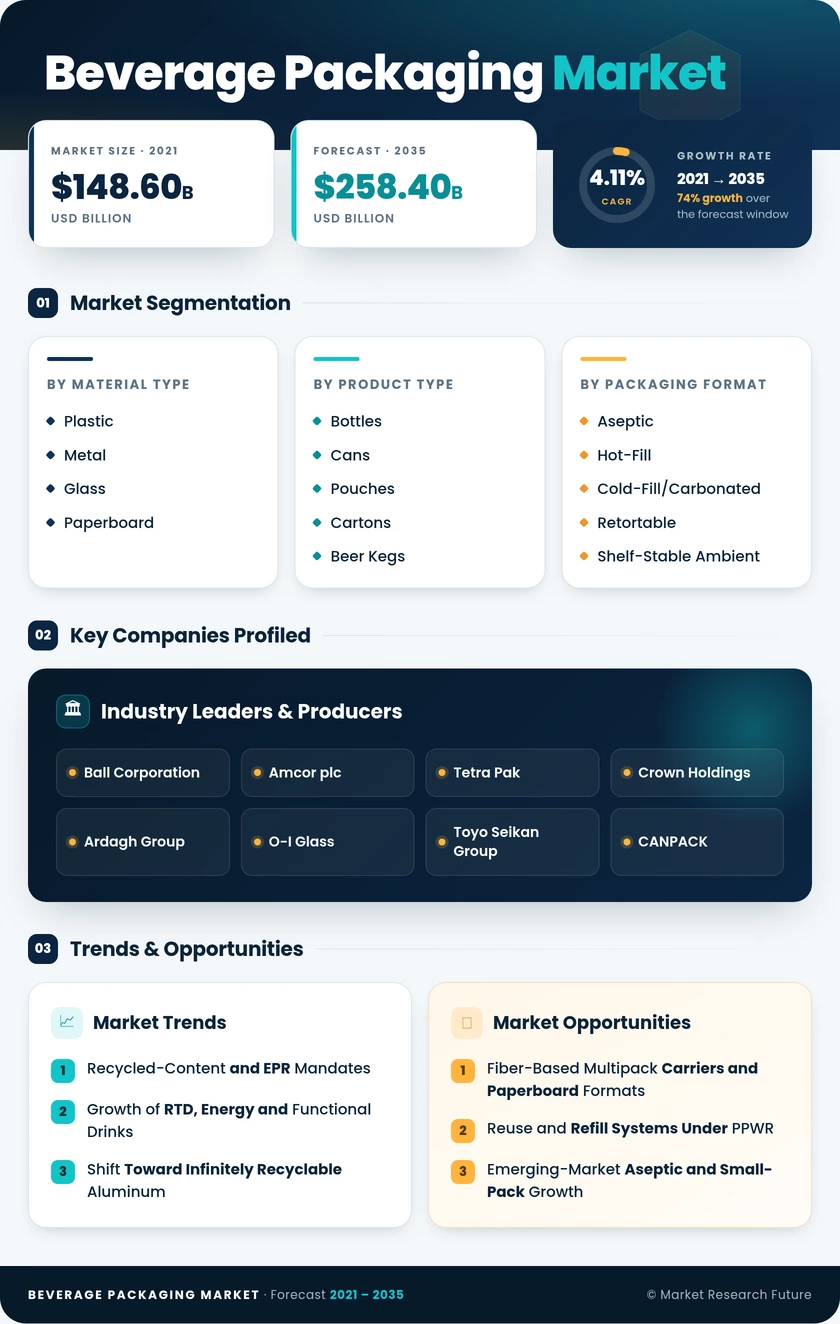
Segmentation Quick Reference
| Dimension | Sub-Segments | Dominant Segment | Fastest Growing Segment |
|---|
| By Material Type | Plastic, Metal, Glass, Paperboard | Plastic (38.6% share) | Paperboard (6.7% CAGR) |
| By Product Type | Bottles, Cans, Pouches, Cartons, Beer Kegs | Bottles (39.7% share) | Pouches (7.3% CAGR) |
| By Packaging Format | Aseptic, Hot-Fill, Cold-Fill/Carbonated, Retortable, Shelf-Stable Ambient, Chilled Distribution | Cold-Fill/Carbonated (41.8% share) | Aseptic (7.4% CAGR) |
| By Beverage Type | Carbonated Drinks, Alcoholic Beverages, Bottled Water, Milk, Fruit and Vegetable Juices, Energy Drinks, Plant-based Drinks, Other Beverage Types | Carbonated Drinks (32.4% share) | Plant-based Drinks (8.1% CAGR) |
| By Region | North America, Europe, Asia-Pacific, South America, Middle East, Africa | North America (32.4% share) | Asia-Pacific (5.4% CAGR) |
Market Segmentation Overview
| Sub-Segment | Key Trend |
|---|
| Plastic | Recycled-content quotas and lightweight PET preforms |
| Metal | Aluminum can growth on closed-loop recyclability. |
| Glass | Hybrid furnaces and premium spirits positioning |
| Paperboard | Fiber carriers replacing shrink film and plastic rings. |
Plastic leads with a 38.6% share because PET filling lines are entrenched and unit costs remain low, but EU and Californian recycled-content rules are capping its expansion. Paperboard grows fastest at a 6.7% CAGR as brand owners swap plastic multipack films for fiber carriers and expand aseptic carton use. Metal and Glass hold steady positions, with aluminum gaining on recyclability and glass defending premium niches despite carbon costs.
| Sub-Segment | Key Trend |
|---|
| Bottles | Tethered caps and barrier coatings enable lighter designs |
| Cans | Slim formats for energy drinks and RTDs |
| Pouches | Mono-material laminates and e-commerce shipping |
| Cartons | Aseptic dairy and plant-based drink growth |
| Beer Kegs | Reusable stainless-steel supply for on-premise |
Bottles lead with a 39.7% share because they serve nearly every drink category, from water to spirits. Pouches grow fastest at a 7.3% CAGR, driven by their low weight per liter and resilience in parcel shipping. Cans and Cartons capture category-specific growth in energy drinks and aseptic dairy, while Beer Kegs remain a reuse-friendly niche.
| Sub-Segment | Key Trend |
|---|
| Aseptic | Capacity additions for shelf-stable dairy and plant drinks |
| Hot-Fill | Energy penalties pressure acidic juice and tea lines |
| Cold-Fill/Carbonated | High-speed PET and can lines preserve flavor |
| Retortable | Functional broths and sports gels |
| Shelf-Stable Ambient | Retailer ESG goals reduce refrigeration. |
| Chilled Distribution | Fresh juice and premium dairy with sensor monitoring |
Cold-Fill/Carbonated leads with a 41.8% share, supported by installed high-speed lines for soft drinks, water and beer. Aseptic grows fastest at a 7.4% CAGR because it eliminates refrigeration needs in regions with weak cold chains and suits plant-based formulations. Hot-Fill faces gradual displacement by aseptic on energy cost, while Shelf-Stable Ambient and Chilled Distribution decisions increasingly follow retailer electricity and emissions targets.
| Sub-Segment | Key Trend |
|---|
| Carbonated Drinks | Zero-sugar reformulation offsets tax-driven volume loss |
| Alcoholic Beverages | Premium RTDs in slim cans and embossed glass |
| Bottled Water | Microplastic scrutiny favors rPET and aluminum. |
| Milk | UHT aseptic cartons in emerging markets |
| Fruit and Vegetable Juices | Health positioning and hot-fill to aseptic shift |
| Energy Drinks | Tall cans with premium finishes |
| Plant-based Drinks | Multi-layer barrier cartons and light protection |
| Other Beverage Types | Functional and specialty drinks |
Carbonated Drinks lead with a 32.4% share, anchoring PET and can volumes even as sugar taxes in more than 100 countries hold back growth. Plant-based Drinks grow fastest at an 8.1% CAGR, and their sensitivity to oxygen and light pushes adoption of high-barrier cartons. Energy Drinks and Alcoholic Beverages add premium can demand, while Bottled Water shifts toward recycled and metal formats under consumer scrutiny.


 Noah Malgeri
Co-Founder

 Peter Groot koerkamp
Account and Business Manager

 Younghwan Choi
Senior Retail Manager

 Mark Irwin
Management Consultant

 Akif Moroglu
Strategy & Business Development Director

 Guilherme Gomes Martins
Product Management Director

 Joseph Aguayo
Sales Operations & Pricing Manager

 La Terria Dodd
Program Support Specialist

 Rob Kooiker
Group Product Manager HVAC & Fire Protection GMA