×
Request Free Sample ×

Kindly complete the form below to receive a free sample of this Report

* Please use a valid business email

Leading companies partner with us for data-driven Insights

clients tt-cursor
Hero Background
English
Chinese
French
Japanese
Korean
German
Spanish

Benzenoid Market Size

ID: MRFR/CnM/3017-HCR
135 Pages
Anshula Mandaokar
October 2025

Benzenoid Market Research Report Information by Type (Natural and Synthetic), by Application (Food & Beverage, Cosmetics & Personal Care, Soap & Detergent, Household Products, and Others) and by Region- Forecast till 2035

Share:
Download PDF ×

We do not share your information with anyone. However, we may send you emails based on your report interest from time to time. You may contact us at any time to opt-out.

Benzenoid Market Infographic
×
Benzenoid Market Infographic Full View
Purchase Options

Benzenoid Size

Benzenoid Market Growth Projections and Opportunities

The Benzenoid market plays a role along with a number of the factoers the majority of which have an effect on the market´s patterns and its growth. Indisputably, the main catalyst is the continually growing need to implement benzenoid compounds in pharmaceutical, fragrance and agrochemical companies. Benzenoids constitute aroma affected chemical molecules that act as foundation blocks in the production of different chemical composites which are associated with the entire pharmaceuticals, perfumes and agricultural ventures.

The Benzenoid market being highly regulated featuring standards veys a key role in it. The regulation bodies in place are to limit the polluting capacity of these hydrocarbons and prevent adverse effects on the environment as well human health. Besides guaranteeing the safety and the sustainably of benzenoid-based products, manufacturers' compliance with these regulations also influences industry efforts to practice responsible behavior and aligned with global goals of environmental conservation.

The global economic climate if frequently directly the Benzech market. The exchange rates of the currencies, the geopolitical vagaries, and important macroeconomic statistics (such as inflation and fluctuation in output) can greatly affect production costs, pricing, and the general stability of the market. The other reason is that economic downturn of basic industries, such as pharmaceuticals and cosmetics, has immediate negative effect on the demand of benzenoid compounds which are the essential constituents of end-product formulation. Traders and suppliers who work in such a market face the necessity to keep pace with and to get used to new economic conditions in order to make the business right and quality decisions.

Technology and innovation are the axial factors boosting the Benzenoid market. Discoveries of new synthesis methods, techniques for purification, and the applications in benchmarking compounds are arise due to continuity of research and development activities. The introduction of new methodologies during the manufacturing process, however, boosts productivity, allowing the manufacturers to supply the high demand for variations of benzenoids while remaining profitable and with minimal environmental impact.

End-user inclination on use of Benzenoids and trends in the industry influences the market characteristics of Benzenoids. There has been a transformation in fragrance and cosmetics industries where the need of natural and sustainable commodities has pushed the market to bio-based benzenoid compounds. Besides, the research activities for the drug discovery and development by the pharmaceutical industry which are aimed at generating new benzenoid derivatives with advanced therapeutic profiles.

The proximity or distance from the country of origin can create different demand patterns in the Benzenoid market. The micro economic management of European Union member countries through varying regional regulations, raw materials availability, and industry requirements limit the market dynamics in different areas of the world. Regional differences mandate unique market approaches from manufacturers, including full compliance with local standards and adapting to regional market exigencies ( e. g. trade deals, cultural, and legislative preferences).
Benzenoid Market Size Graph
Author
Anshula Mandaokar
Team Lead - Research

Anshula Mandaokar holds an academic degree in Chemical Engineering and has been contributing to the field for more than 5 years. She has expertise in Market Research and Business Consulting and serves as a Team Lead for a reputed Market Research firm under the Chemicals and Materials domain spectrum. She has worked on multiple projects, generating explicit results in a quick turnaround time. Her understanding of data interpretation justifies her role as a leader.

Leave a Comment

FAQs

What are the major applications of Benzenoid?

Benzenoids belong to a special class of aromatic organic compound, hence it finds major applications in cosmetics & personal care, food & beverage, soap & detergent, and household products.

Geographically which is the largest segment in the in the global Benzenoid market?

Geographically, Europe is the largest segment in the global Benzenoid market. The region is estimated to retain its leading position throughout the assessment period (2017-2023), holding the significant market share.

What are the major growth catalysts for the global Benzenoid market?

Increasing consumption of flavored dairy products

Which is the largest segment in the global Benzenoid market?

By application, the sub segment – cosmetics and personal care products is the largest segment in the in the global Benzenoid market.

Who are the top players in the global Benzenoid market?

Sigma-Aldrich Co. LLC. (US), BASF SE (Germany), The Good Scents Company (US), Givaudan (Switzerland), International Flavors & Fragrances (US), Firmenich (Switzerland), Takasago (Japan), Quest International (the Netherlands), Haarmann & Reimer (Germany), and Sensient Technologies (US), are some of the leading players in the global Benzenoid market.

Market Summary

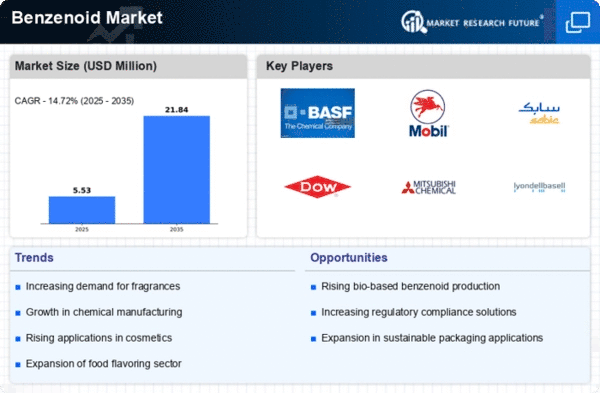
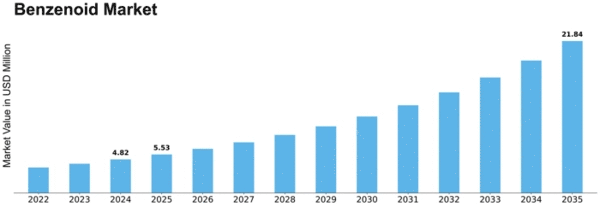
As per MRFR analysis, the Benzenoid Market Size was estimated at 4.82 USD Million in 2024. The Benzenoid industry is projected to grow from 5.53 in 2025 to 21.84 by 2035, exhibiting a compound annual growth rate (CAGR) of 14.72 during the forecast period 2025 - 2035.

Key Market Trends & Highlights

The Benzenoid Market is currently experiencing robust growth driven by sustainability and technological advancements.

  • North America remains the largest market for benzenoids, primarily due to its established fragrance and personal care industries.
  • Asia-Pacific is emerging as the fastest-growing region, fueled by increasing demand for benzenoids in pharmaceuticals and personal care products.
  • The fragrance segment continues to dominate the market, while the pharmaceutical segment is witnessing the most rapid growth.
  • Rising demand for fragrance and flavoring agents, along with expanding applications in pharmaceuticals, are key drivers of market expansion.

Market Size & Forecast

2024 Market Size 4.82 (USD Million)
2035 Market Size 21.84 (USD Million)
CAGR (2025 - 2035) 14.72%
Largest Regional Market Share in 2024 North America

Major Players

BASF SE (DE), ExxonMobil Chemical (US), SABIC (SA), Dow Inc. (US), Mitsubishi Chemical Corporation (JP), LyondellBasell Industries N.V. (NL), Eastman Chemical Company (US), Ineos Group Limited (GB), Formosa Plastics Corporation (TW)

Market Trends

The Benzenoid Market is currently experiencing a dynamic phase characterized by evolving consumer preferences and regulatory frameworks. The demand for benzenoid compounds, which are integral to various industries such as fragrances, pharmaceuticals, and food additives, appears to be on an upward trajectory. This growth is likely driven by an increasing awareness of the importance of natural and synthetic aromatic compounds in enhancing product appeal and functionality. Furthermore, the market seems to be influenced by innovations in production techniques, which may lead to more sustainable practices and improved product quality. As companies strive to meet the changing needs of consumers, the Benzenoid Market is poised for further expansion, potentially leading to new applications and market segments. In addition to consumer trends, regulatory pressures are shaping the landscape of the Benzenoid Market. Stricter guidelines regarding the use of certain chemicals in consumer products could prompt manufacturers to seek alternatives or reformulate existing products. This shift may create opportunities for companies that specialize in developing compliant and innovative benzenoid solutions. Overall, the Benzenoid Market appears to be navigating a complex environment, balancing growth opportunities with the challenges posed by regulatory changes and evolving consumer expectations.

Sustainability Initiatives

The Benzenoid Market is increasingly focusing on sustainability, with companies exploring eco-friendly production methods. This trend reflects a broader commitment to reducing environmental impact and meeting consumer demand for greener products. As a result, manufacturers are likely to invest in research and development to create sustainable benzenoid compounds.

Technological Advancements

Technological innovations are playing a crucial role in the Benzenoid Market, enhancing production efficiency and product quality. Advanced extraction and synthesis techniques may lead to the development of new benzenoid compounds, expanding their applications across various industries. This trend suggests a potential for increased competitiveness among market players.

Regulatory Compliance

The landscape of the Benzenoid Market is being shaped by evolving regulatory frameworks. Stricter regulations regarding chemical usage in consumer products may compel manufacturers to adapt their formulations. This trend indicates a growing need for compliance-focused strategies, potentially driving innovation in safer benzenoid alternatives.

Benzenoid Market Market Drivers

Rising Demand for Fragrance Products

The Global Benzenoid Market Industry experiences a notable surge in demand for fragrance products, driven by consumer preferences for personal care and household items. Fragrance compounds derived from benzenoids are integral to perfumes, cosmetics, and cleaning agents. As the global population becomes increasingly aware of personal grooming and hygiene, the fragrance segment is projected to expand significantly. In 2024, the market value is estimated at 235.94 USD Billion, with a substantial contribution from the fragrance sector. This trend suggests that the Global Benzenoid Market Industry will continue to thrive as manufacturers innovate to meet evolving consumer tastes.

Market Segment Insights

By Application: Fragrance (Largest) vs. Pharmaceuticals (Fastest-Growing)

In the Benzenoid Market, the application segment is primarily composed of Fragrance, Food Additives, Pharmaceuticals, Cosmetics, and Industrial Solvents. Among these, Fragrance holds the largest market share, driven by its widespread use in perfumes, personal care products, and household items. Following closely, the food additives application finds its significance in enhancing flavors and extending shelf life, making it a key player in the market, while Cosmetics and Industrial Solvents also contribute to the sector, albeit at a smaller scale. Growth trends in the Benzenoid Market applications reveal that Pharmaceuticals is the fastest-growing segment, propelled by an increasing demand for benzenoid compounds in drug formulations and therapeutic applications. Additionally, the Fragrance segment is expected to maintain its dominance due to continuous innovation in the fragrance industry. The rise in consumer spending on personal care and cosmetic products further fuels the growth of the Fragrance and Cosmetics segments, contributing positively to the overall market dynamics.

Fragrance (Dominant) vs. Pharmaceuticals (Emerging)

The Fragrance segment in the Benzenoid Market stands out as the dominant application, characterized by its extensive use in various consumer products, from perfumes to cleaning supplies. This segment benefits from a strong brand loyalty and a growing trend towards natural and organic fragrances which have been gaining popularity. Moreover, the continuous innovation and development of new fragrances keep consumers engaged and enhance the segment's market position. In contrast, Pharmaceuticals represents an emerging application, experiencing rapid growth due to an increasing focus on health and wellness. The utilization of benzenoid compounds in synthesizing active pharmaceutical ingredients drastically enhances their market demand. This segment signifies a shift towards incorporating more sophisticated benzenoid variations to meet stringent health regulations, thus marking its significance in the future landscape of the Benzenoid Market.

By End Use: Personal Care Products (Largest) vs. Pharmaceuticals (Fastest-Growing)

The Benzenoid market is significantly influenced by its end-use applications, with Personal Care Products holding the largest share. This category includes fragrances, cosmetics, and skincare items, which are vital for the industry's growth due to rising consumer demand for personal grooming and beauty products. Following closely, Household Products, Food and Beverage, and Industrial Applications contribute to the market dynamics, each with unique applications of benzenoids. In contrast, Pharmaceuticals is emerging as a crucial segment, showcasing robust growth driven by the increasing reliance on benzenoid-derived compounds for therapeutic benefits. As the market evolves, growth trends indicate a substantial rise in the Pharmaceuticals segment, attributed to advancements in drug formulation and the growing recognition of the benefits of benzenoid compounds in medicinal products. Additionally, increased consumer awareness regarding the quality and safety of personal care and household products is further propelling demand. The intersection of these trends showcases a transformative shift in the benzenoid market, emphasizing a higher growth trajectory for Pharmaceuticals compared to other segments.

Personal Care Products: Dominant vs. Pharmaceuticals: Emerging

The Personal Care Products segment stands as a dominant force within the Benzenoid market, characterized by its extensive application in perfumes, skincare, and hair care formulations. This segment benefits from consumer trends favoring premium and natural products, with benzenoids providing essential aromatic properties. The robust growth of this segment contrasts with the emerging Pharmaceuticals segment, which is gaining traction due to the increasing utilization of benzenoid-derived compounds in drug development and—therapeutic formulations. The Pharmaceuticals segment is set to leverage research advancements and a growing healthcare emphasis, positioning itself as a key driver of innovation in the benzenoid industry. Together, these segments reflect the diverse applications of benzenoids, catering to varying consumer needs while driving market growth.

By Type: Benzaldehyde (Largest) vs. Benzyl Acetate (Fastest-Growing)

The Benzenoid Market exhibits a diverse distribution among its primary types, with Benzaldehyde securing the largest share. This compound is widely recognized for its use in flavoring and fragrance applications, leading its segment significantly. Meanwhile, Benzyl Acetate is gaining traction as a notable player, capturing attention for its use in perfumes and as a solvent, thus emerging as a strong competitor in the market landscape. As consumer preferences shift towards natural and sustainably sourced products, growth in the Benzenoid Market is driven by the increasing demand for aromatic compounds in various applications, including personal care and food industries. Benzyl Chloride and Benzyl Alcohol follow closely, indicating a robust market environment where multiple segments are fostering growth through innovation and adaptability.

Benzaldehyde (Dominant) vs. Benzyl Chloride (Emerging)

Benzaldehyde stands out as the dominant player in the Benzenoid Market. Its extensive applications in the food and fragrance industry, attributable to its pleasant almond aroma, make it a staple for manufacturers looking to enhance product appeal. In contrast, Benzyl Chloride is recognized as an emerging component, primarily due to its role in the production of various chemicals and as an intermediate in organic synthesis. Although Benzyl Chloride currently holds a smaller market position, its versatility and increasing applications in pharmaceuticals and agrochemicals signal a promising future. As regulations around specific chemicals evolve, Benzyl Chloride's adaptability could pave the way for significant market opportunities.

By Form: Liquid (Largest) vs. Solid (Fastest-Growing)

In the Benzenoid Market, the distribution among the 'Form' segment reveals that liquid benzenoids capture the largest share, primarily due to their widespread application in various industrial sectors including solvents and perfumes. Solid benzenoids, while currently a smaller portion of the market, are gaining traction as they are increasingly used in specialty applications like fragrances and flavorings, showcasing the evolving preferences of manufacturers and end-users. Growth trends indicate a notable shift towards solid benzenoids which are recognized for their longer shelf life and enhanced stability. This emerging trend is driven by technological advancements in production processes and changing consumer preferences for sustainable products. As regulatory frameworks become more stringent, the demand for solid forms that meet these specifications is anticipated to grow significantly in the coming years.

Form: Liquid (Dominant) vs. Solid (Emerging)

Liquid benzenoids are established as the dominant form in the market, largely due to their versatility and extensive usage across various end-user industries. Their liquid nature allows for easy blending with other compounds, making them preferable in formulations ranging from personal care products to industrial solvents. In contrast, solid benzenoids are emerging as viable alternatives, particularly appealing to manufacturers looking for sustainable and eco-friendly options. These solids are characterized by their tailored release properties and appeal in niche markets. As the demand for high-quality, stable ingredients rises, solid benzenoids are expected to capture a greater share of the market, driven by innovations in processing and formulation that enhance their appeal.

By Source: Natural (Largest) vs. Synthetic (Fastest-Growing)

In the Benzenoid Market, the source segment is divided into Natural and Synthetic categories, with Natural holding the largest market share. Natural benzenoids, derived from plant sources and essential oils, are increasingly favored for their perceived safety and ecological benefits. Meanwhile, Synthetic benzenoids are rapidly expanding their market presence, particularly among manufacturers looking for consistent quality and lower costs. This competitive dynamic creates a robust landscape for consumers, as both categories continue to grow in prominence. The growth trends for the Benzenoid Market's source segment are driven by shifting consumer preferences and environmental considerations. Natural benzenoids benefit from the rising demand for organic and sustainable products, appealing to health-conscious consumers. Conversely, the Synthetic segment is gaining traction due to advancements in chemical synthesis and growing applications in fragrance, flavors, and even pharmaceuticals, showcasing a diverse range of uses that are fueling its rapid expansion.

Natural (Dominant) vs. Synthetic (Emerging)

Natural benzenoids have become the dominant force in the market, appealing to consumers looking for eco-friendly and health-oriented products. These naturally sourced compounds are integral in personal care and food industries, where they are prized for their aromatic qualities and safety profiles. On the other hand, Synthetic benzenoids are emerging with rapid advancements in synthesis technology, allowing for the production of consistent, high-quality compounds at scale. While they currently represent a smaller share of the market, their versatility in applications, lower costs, and ability to meet rising consumer demand for specific traits make them increasingly attractive to manufacturers, thus introducing a competitive dynamic between these two sources.

Get more detailed insights about Benzenoid Market Research Report- Forecast to 2035

Regional Insights

North America : Market Leader in Benzenoids

North America is poised to maintain its leadership in the Benzenoid market, holding a significant market share of 2.0 in 2025. The region's growth is driven by robust demand from the automotive, personal care, and chemical industries, alongside favorable regulatory frameworks that promote innovation and sustainability. The increasing focus on eco-friendly products is also catalyzing market expansion, as companies adapt to changing consumer preferences. The United States stands out as the leading country in this region, hosting major players such as ExxonMobil Chemical and Dow Inc. The competitive landscape is characterized by significant investments in R&D and strategic partnerships among key players. This dynamic environment fosters innovation, ensuring that North America remains at the forefront of the Benzenoid market.

Europe : Emerging Market with Growth Potential

Europe's Benzenoid market is on a growth trajectory, with a market size of 1.5 in 2025. The region benefits from stringent regulations that encourage sustainable practices and innovation in chemical production. The demand for high-quality benzenoids in sectors like cosmetics and pharmaceuticals is driving this growth, supported by government initiatives aimed at reducing environmental impact and promoting green chemistry. Leading countries such as Germany and France are home to key players like BASF SE and LyondellBasell Industries. The competitive landscape is marked by a focus on sustainability and technological advancements, with companies investing heavily in eco-friendly production methods. This commitment to innovation positions Europe as a significant player in The Benzenoid.

Asia-Pacific : Rapidly Growing Market Region

The Asia-Pacific region is witnessing rapid growth in the Benzenoid market, with a market size of 1.2 in 2025. This growth is fueled by increasing industrialization, urbanization, and rising disposable incomes, leading to higher demand for consumer goods that utilize benzenoids. Additionally, supportive government policies aimed at enhancing the chemical industry are acting as catalysts for market expansion in this region. Countries like Japan and China are leading the charge, with major companies such as Mitsubishi Chemical Corporation and Formosa Plastics Corporation playing pivotal roles. The competitive landscape is characterized by a mix of local and international players, all vying for market share through innovation and strategic collaborations. This dynamic environment is expected to drive further growth in the Benzenoid market across Asia-Pacific.

Middle East and Africa : Emerging Market with Challenges

The Benzenoid market in the Middle East and Africa is still in its nascent stages, with a market size of 0.12 in 2025. The region faces challenges such as limited industrial infrastructure and regulatory hurdles, which hinder rapid growth. However, there is a growing interest in developing the chemical sector, driven by increasing investments and government initiatives aimed at diversifying economies and enhancing local production capabilities. Countries like Saudi Arabia and South Africa are emerging as key players in this market, with local companies beginning to invest in benzenoid production. The competitive landscape is evolving, with a focus on building partnerships and collaborations to enhance market presence. As the region continues to develop, opportunities for growth in the Benzenoid market are expected to increase.

Key Players and Competitive Insights

The Benzenoid Market is currently characterized by a dynamic competitive landscape, driven by increasing demand for aromatic compounds across various industries, including fragrances, pharmaceuticals, and plastics. Key players such as BASF SE (DE), ExxonMobil Chemical (US), and Dow Inc. (US) are strategically positioned to leverage their extensive research and development capabilities, focusing on innovation and sustainability. These companies are actively pursuing partnerships and collaborations to enhance their product offerings and expand their market reach, thereby shaping a competitive environment that emphasizes technological advancement and environmental responsibility.In terms of business tactics, companies are increasingly localizing manufacturing to reduce lead times and optimize supply chains. The market structure appears moderately fragmented, with several key players exerting considerable influence. This fragmentation allows for niche players to thrive, while larger corporations capitalize on economies of scale and advanced technologies to maintain competitive advantages.In November 2025, BASF SE (DE) announced the launch of a new line of bio-based benzenoid products aimed at reducing carbon emissions. This strategic move not only aligns with global sustainability goals but also positions BASF as a leader in eco-friendly chemical solutions. The introduction of these products is likely to attract environmentally conscious consumers and businesses, enhancing BASF's market share in the growing segment of sustainable chemicals.In October 2025, ExxonMobil Chemical (US) revealed plans to invest $500 million in expanding its benzenoid production capacity in the Gulf Coast region. This expansion is expected to increase output by 20%, catering to the rising demand from the automotive and consumer goods sectors. Such a significant investment underscores ExxonMobil's commitment to maintaining its competitive edge through enhanced production capabilities and responsiveness to market needs.In September 2025, Dow Inc. (US) entered into a strategic partnership with a leading technology firm to integrate AI-driven analytics into its benzenoid production processes. This collaboration aims to optimize operational efficiency and reduce waste, reflecting a broader trend towards digital transformation in the chemical industry. By leveraging AI, Dow is likely to enhance its decision-making processes and improve product quality, thereby solidifying its position in the market.As of December 2025, current competitive trends indicate a strong shift towards digitalization, sustainability, and AI integration within the Benzenoid Market. Strategic alliances are increasingly shaping the landscape, enabling companies to pool resources and expertise to drive innovation. The competitive differentiation is expected to evolve from traditional price-based competition to a focus on technological advancements, sustainability initiatives, and supply chain reliability, suggesting a transformative period ahead for the industry.

Key Companies in the Benzenoid Market include

Industry Developments

Future Outlook

Benzenoid Market Future Outlook

The Benzenoid Market is projected to grow at a 14.72% CAGR from 2024 to 2035, driven by increasing demand in fragrances, pharmaceuticals, and agrochemicals.

New opportunities lie in:

  • Expansion into sustainable benzenoid production methods
  • Development of specialized benzenoid derivatives for niche markets
  • Strategic partnerships with fragrance and cosmetic manufacturers

By 2035, the Benzenoid Market is expected to achieve substantial growth and diversification.

Market Segmentation

Benzenoid Market Form Outlook

  • Liquid
  • Solid
  • Gas

Benzenoid Market Type Outlook

  • Benzaldehyde
  • Benzyl Alcohol
  • Benzyl Acetate
  • Benzyl Benzoate
  • Benzyl Chloride

Benzenoid Market Source Outlook

  • Natural
  • Synthetic

Benzenoid Market End Use Outlook

  • Personal Care Products
  • Household Products
  • Food and Beverage
  • Pharmaceuticals
  • Industrial Applications

Benzenoid Market Application Outlook

  • Fragrance
  • Food Additives
  • Pharmaceuticals
  • Cosmetics
  • Industrial Solvents

Report Scope

MARKET SIZE 20244.82(USD Million)
MARKET SIZE 20255.53(USD Million)
MARKET SIZE 203521.84(USD Million)
COMPOUND ANNUAL GROWTH RATE (CAGR)14.72% (2025 - 2035)
REPORT COVERAGERevenue Forecast, Competitive Landscape, Growth Factors, and Trends
BASE YEAR2024
Market Forecast Period2025 - 2035
Historical Data2019 - 2024
Market Forecast UnitsUSD Million
Key Companies ProfiledBASF SE (DE), ExxonMobil Chemical (US), SABIC (SA), Dow Inc. (US), Mitsubishi Chemical Corporation (JP), LyondellBasell Industries N.V. (NL), Eastman Chemical Company (US), Ineos Group Limited (GB), Formosa Plastics Corporation (TW)
Segments CoveredApplication, End Use, Type, Form, Source
Key Market OpportunitiesGrowing demand for natural benzenoids in fragrance and flavor industries presents significant market opportunities.
Key Market DynamicsRising demand for sustainable benzenoid products drives innovation and regulatory adaptations in the chemical industry.
Countries CoveredNorth America, Europe, APAC, South America, MEA

FAQs

What are the major applications of Benzenoid?

Benzenoids belong to a special class of aromatic organic compound, hence it finds major applications in cosmetics & personal care, food & beverage, soap & detergent, and household products.

Geographically which is the largest segment in the in the global Benzenoid market?

Geographically, Europe is the largest segment in the global Benzenoid market. The region is estimated to retain its leading position throughout the assessment period (2017-2023), holding the significant market share.

What are the major growth catalysts for the global Benzenoid market?

Increasing consumption of flavored dairy products

Which is the largest segment in the global Benzenoid market?

By application, the sub segment – cosmetics and personal care products is the largest segment in the in the global Benzenoid market.

Who are the top players in the global Benzenoid market?

Sigma-Aldrich Co. LLC. (US), BASF SE (Germany), The Good Scents Company (US), Givaudan (Switzerland), International Flavors & Fragrances (US), Firmenich (Switzerland), Takasago (Japan), Quest International (the Netherlands), Haarmann & Reimer (Germany), and Sensient Technologies (US), are some of the leading players in the global Benzenoid market.

  1. SECTION I: EXECUTIVE SUMMARY AND KEY HIGHLIGHTS
    1. | 1.1 EXECUTIVE SUMMARY
  2. SECTION II: SCOPING, METHODOLOGY AND MARKET STRUCTURE
    1. | 2.1 MARKET INTRODUCTION
    2. | 2.2 RESEARCH METHODOLOGY
  3. SECTION III: QUALITATIVE ANALYSIS
    1. | 3.1 MARKET DYNAMICS
    2. | 3.2 MARKET FACTOR ANALYSIS
  4. SECTION IV: QUANTITATIVE ANALYSIS
    1. | 4.1 Chemicals and Materials, BY Application (USD Million)
    2. | 4.2 Chemicals and Materials, BY End Use (USD Million)
    3. | 4.3 Chemicals and Materials, BY Type (USD Million)
    4. | 4.4 Chemicals and Materials, BY Form (USD Million)
    5. | 4.5 Chemicals and Materials, BY Source (USD Million)
    6. | 4.6 Chemicals and Materials, BY Region (USD Million)
  5. SECTION V: COMPETITIVE ANALYSIS
    1. | 5.1 Competitive Landscape
    2. | 5.2 Company Profiles
    3. | 5.3 Appendix

Benzenoid Market Segmentation

Market Segmentation Overview

  • Detailed segmentation data will be available in the full report
  • Comprehensive analysis by multiple parameters
  • Regional and country-level breakdowns
  • Market size forecasts by segment
Infographic

Free Sample Request

Kindly complete the form below to receive a free sample of this Report

Get Free Sample

Customer Strories

Compare Licence

×
Features License Type
Single User Multiuser License Enterprise User
Price $4,950 $5,950 $7,250
Maximum User Access Limit 1 User Upto 10 Users Unrestricted Access Throughout the Organization
Free Customization
Direct Access to Analyst
Deliverable Format
Platform Access
Discount on Next Purchase 10% 15% 15%
Printable Versions