×
Request Free Sample ×

Kindly complete the form below to receive a free sample of this Report

* Please use a valid business email

Leading companies partner with us for data-driven Insights

clients tt-cursor
Hero Background
English
Chinese
French
Japanese
Korean
German
Spanish

Barium Derivatives Market Trends

ID: MRFR/CnM/2746-HCR
140 Pages
Chitranshi Jaiswal
October 2025

Barium Derivatives Market Research Report Information by Type (Barium Carbonate, Barium Sulfate, Barium Chloride, Barium Nitrate, Barium Titanate,  Barium Oxide, and Others), End Use (Mining,  Metal Alloy, Explosive, Construction, and Others), and Region (North America, Europe, Asia-Pacific, Latin America, and the Middle East & Africa)—Forecast till 2035

Share:
Download PDF ×

We do not share your information with anyone. However, we may send you emails based on your report interest from time to time. You may contact us at any time to opt-out.

Barium Derivatives Market Infographic
×
Barium Derivatives Market Infographic Full View
Purchase Options

Market Trends

Key Emerging Trends in the Barium Derivatives Market

Barium derivatives market has seen remarkable trends, reflecting a dynamic landscape in its applications and global demand. Barium derivatives derived from barite ore have various uses in industries like chemicals, construction, health care, and electronics. A significant trend is the increasing use of barium derivatives in healthcare especially for diagnostic imaging. Barium sulfate is one of these derivatives widely used as a contrast agent in X-ray procedures to make internal organs and structures more visible. This trend is expected to continue with developments in diagnostic imaging technologies that require improved quality contrast agents. The availability of markets for growth depends on the closeness between consumer goods as well as end-use industries like aerospace, automotive sector and electronics. The Asia Pacific region is using barium derivative chemicals extensively to improve industrial efficiencies such as cleaner processes among others. Market trends are currently being influenced by environmental considerations and regulatory compliance requirements for barium derivatives. Environmental consciousness has increased around the world forcing chemical manufacturing companies to adopt sustainable practices. In this regard therefore, Barium producers are investing in cleaner technologies coupled with sustainable sourcing of raw materials so as to be in line with global efforts towards environmental responsibility. The geographical distribution of the barium derivatives market has changed considerably with major focus shifting to Asia-Pacific region. Rapid industrialization, infrastructure development and growing healthcare industry within the region are some factors responsible for increased demand for barium derivative products. China and India are emerging markets within this region representing shifts happening within global production-consumption patterns. Also, technological advancements made on production processes have played a key role shaping market trends towards barium derivatives. Innovations in extraction methods contribute to efficiency improvement; purification technologies reduce costs while enhancing quality thus making it easier meets demands from end-users at competitive prices. These advances will be useful since they help respond to changing needs among consumers which attract them towards other competing markets.
Author
Chitranshi Jaiswal
Research Analyst Level I

In her 3 years of experience in the market research field, she has handled critical cross-domain projects. She has an in-depth knowledge of market estimation & analysis, problem-solving, primary as well as secondary research, and team management.She holds an engineering degree and is an MBA professional from a well-known university, capable of evaluating the market and competitive conditions. An exceptional strategist with excellent communication skills and a passion for delivering cutting-edge & practical insights for the market. Proficient in multi-tasking, and can successfully deal with competing demands, while maintaining complete confidentiality. Generated business through active client and project development, networking, and high-quality responses. Her knowledge and skills have helped in making solid business decisions, securing funding from investors, and avoiding business failures.

Leave a Comment

FAQs

At what CAGR is the Barium Derivatives Market projected to grow during the forecast period?

Global Barium Derivatives Market is projected to grow at a 4.5% CAGR between 2019-2024.

What will be the value of the Barium Derivatives Market during the forecast period?

Global Barium Derivatives Market is predicted to touch USD 2.21 million by 2024.

Which region is expected to dominate the Barium Derivatives Market?

North America is expected to dominate the Barium Derivatives Market.

What are major applications of Barium Derivatives Market?

Global Barium Derivatives Market finds wide applications in metal alloying, construction, and mining.

Who are the key players profiled in the Barium Derivatives Market?

Key players profiled in the Barium Derivatives Market include Toronto Research Chemicals (Canada), IBC LTD (India), TPL, Inc., (Mexico), ProChem, Inc (US), JIGCHEM UNIVERSAL (China), BASF SE (Germany), Norkem (England), Alliance Global (India), AG CHEMI GROUP SRO (Czech Republic), Gemme Corp (China), Vishnu Chemicals (India), and Solvay SA (Belgium).

Market Summary

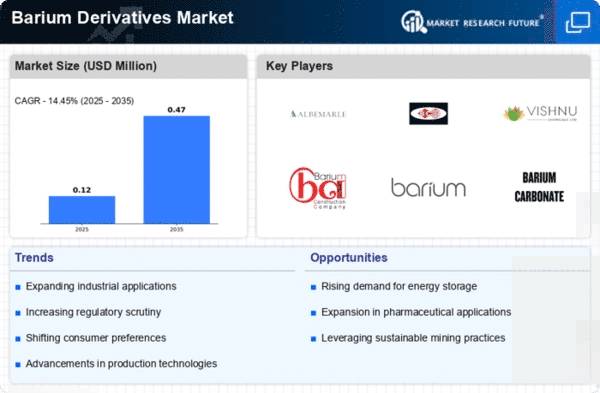
As per MRFR analysis, the Barium Derivatives Market Size was estimated at 0.106 USD Million in 2024. The Barium Derivatives industry is projected to grow from 0.121 in 2025 to 0.468 by 2035, exhibiting a compound annual growth rate (CAGR) of 14.45 during the forecast period 2025 - 2035.

Key Market Trends & Highlights

The Barium Derivatives Market is poised for growth driven by diverse applications and technological advancements.

  • North America remains the largest market for barium derivatives, primarily due to its robust glass manufacturing sector.
  • The Asia-Pacific region is emerging as the fastest-growing market, fueled by increasing demand in ceramics production.
  • The construction segment continues to dominate the market, while the healthcare segment is witnessing rapid growth due to expanding applications.
  • Rising demand in the oil and gas sector and regulatory support for environmental standards are key drivers propelling market expansion.

Market Size & Forecast

2024 Market Size 0.106 (USD Million)
2035 Market Size 0.468 (USD Million)
CAGR (2025 - 2035) 14.45%
Largest Regional Market Share in 2024 Asia-Pacific

Major Players

Albemarle Corporation (US), Barium & Chemicals Inc. (US), Barium Sulphate (UK), Barium Products Ltd. (IN), Barium Technologies (DE), Barium Carbonate Co. (CN), Barium Chemicals (JP), Barium Solutions (FR)

Market Trends

The Barium Derivatives Market is currently experiencing a phase of dynamic evolution, driven by various factors that influence demand and supply. The increasing utilization of barium compounds in diverse applications, such as electronics, glass manufacturing, and pharmaceuticals, appears to be a primary catalyst for market growth. Furthermore, the rising emphasis on sustainable practices and environmental regulations may lead to a shift towards more eco-friendly barium derivatives. This transition could potentially reshape production processes and product offerings within the industry, as manufacturers seek to align with global sustainability goals. In addition, the Barium Derivatives Market seems to be benefiting from advancements in technology, which enhance the efficiency of production methods. Innovations in extraction and processing techniques may result in higher purity levels and reduced waste, thereby appealing to a broader range of industries. As the market continues to adapt to changing consumer preferences and regulatory landscapes, it is likely that new opportunities will emerge, fostering further development and diversification of barium derivative products. Overall, the outlook for the Barium Derivatives Market remains optimistic, with potential for growth in various sectors.

Sustainable Practices in Production

The trend towards sustainability is becoming increasingly prominent within the Barium Derivatives Market. Manufacturers are exploring eco-friendly alternatives and processes to minimize environmental impact. This shift not only aligns with global sustainability initiatives but also caters to the growing consumer demand for greener products.

Technological Advancements

Technological innovations are playing a crucial role in enhancing production efficiency within the Barium Derivatives Market. Improved extraction and processing methods are likely to yield higher purity levels and reduce waste, thereby attracting a wider array of applications across different industries.

Diverse Application Areas

The Barium Derivatives Market is witnessing an expansion in application areas, particularly in sectors such as electronics, glass manufacturing, and pharmaceuticals. This diversification indicates a robust demand for barium compounds, as industries seek to leverage their unique properties for various uses.

Barium Derivatives Market Market Drivers

Expansion of the Automotive Industry

The automotive sector is a pivotal driver for the Global Barium Derivatives Market Industry, as barium compounds are increasingly employed in the manufacturing of automotive components, including glass and ceramics. The shift towards electric vehicles is also influencing the demand for barium-based materials, which are essential for battery production. With the automotive industry projected to expand, the demand for barium derivatives is expected to rise correspondingly. This growth is likely to contribute to the market's value, potentially reaching 2500 USD Million by 2035, as manufacturers seek to enhance product performance and sustainability.

Growing Demand in the Oil and Gas Sector

The Global Barium Derivatives Market Industry is experiencing a notable surge in demand from the oil and gas sector. Barium compounds, particularly barium sulfate, are utilized in drilling fluids to enhance the efficiency of oil extraction processes. As exploration activities expand globally, the need for effective drilling fluids is anticipated to increase. This trend is reflected in the projected market value of 1250 USD Million in 2024, with expectations of further growth as the industry adapts to new technologies and methodologies. The continuous investment in oil and gas exploration is likely to drive the demand for barium derivatives significantly.

Regulatory Support for Environmental Standards

The Global Barium Derivatives Market Industry is likely to benefit from increasing regulatory support aimed at environmental protection. Governments worldwide are implementing stricter regulations concerning the use of chemicals in various industries, including construction and manufacturing. Barium derivatives, particularly those that meet environmental standards, are becoming more favorable in the market. This regulatory landscape encourages manufacturers to innovate and develop eco-friendly barium compounds, potentially leading to increased market share and growth opportunities. As industries adapt to these regulations, the demand for compliant barium derivatives is expected to rise.

Increasing Applications in the Pharmaceutical Sector

The pharmaceutical industry is emerging as a significant contributor to the Global Barium Derivatives Market Industry. Barium compounds are utilized in various medical imaging procedures, particularly in barium swallow tests and gastrointestinal studies. As healthcare systems worldwide continue to evolve and expand, the demand for barium-based contrast agents is likely to increase. This trend suggests a robust growth trajectory for the market, supported by advancements in medical technology and an increasing focus on diagnostic imaging. The anticipated compound annual growth rate of 6.5% from 2025 to 2035 indicates a promising outlook for barium derivatives in the pharmaceutical domain.

Technological Advancements in Manufacturing Processes

Technological innovations in the production of barium derivatives are poised to enhance the efficiency and quality of these compounds. The Global Barium Derivatives Market Industry is benefiting from advancements in manufacturing techniques, which allow for the production of higher purity barium compounds. These innovations not only improve product performance but also reduce environmental impact, aligning with global sustainability goals. As manufacturers adopt these new technologies, the market is expected to witness increased competitiveness and growth, further solidifying its position in various industrial applications.

Market Segment Insights

By Application: Glass Manufacturing (Largest) vs. Ceramics Production (Fastest-Growing)

In the Barium Derivatives Market, the application segment is led by Glass Manufacturing, which accounts for the largest share. This segment benefits from the use of barium compounds in enhancing the quality of glass products, providing clarity and durability. Following closely, Ceramics Production is experiencing rapid growth as manufacturers increasingly incorporate barium derivatives to improve the thermal and mechanical properties of ceramics, showcasing a shift in industry preferences.

Glass Manufacturing (Dominant) vs. Ceramics Production (Emerging)

Glass Manufacturing remains the dominant sector within the Barium Derivatives Market due to its extensive application in various types of glass products, including flat glass and glass containers. The use of barium helps to enhance optical clarity and stability in glass formulations. On the other hand, Ceramics Production is emerging rapidly as an essential segment, with barium derivatives being utilized to create high-performance ceramics with superior strength and thermal resistance. This growth is supported by rising demand in the electronics and automotive sectors, where innovative ceramic materials are essential.

By End Use: Construction (Largest) vs. Healthcare (Fastest-Growing)

In the Barium Derivatives Market, the distribution of market share is notably skewed towards the construction sector, which historically has been the largest end use for these materials due to their essential role in various applications such as cement and concrete production. Other significant end uses include automotive and agriculture, but they capture a smaller share compared to construction, which dominates the market. Healthcare is emerging rapidly as a crucial segment as barium derivatives find increasing applications in medical imaging and pharmaceuticals, driving the need for specialized formulations.

Construction: Cement (Dominant) vs. Healthcare: Medical Imaging (Emerging)

The construction industry remains the backbone of the Barium Derivatives Market, as cement and concrete incorporating barium derivatives are integral to building structures. This sector capitalizes on the properties of barium for enhancing strength and durability in construction materials. In contrast, the healthcare segment is quickly evolving, with barium sulfates being indispensable in radiological imaging as contrast agents. This emerging segment is set to see accelerated growth driven by technological advancements in medical imaging techniques, underscoring the dual focus of barium derivatives in both traditional and innovative applications.

By Type: Barium Carbonate (Largest) vs. Barium Sulfate (Fastest-Growing)

The Barium Derivatives Market comprises several key players, with Barium Carbonate taking the lead due to its extensive use in glass, ceramics, and other applications. It significantly dominates the market, benefiting from its versatility and widespread adoption across various industries. Barium Sulfate, while second in market share, is witnessing rapid growth thanks to its rising application in paints, coatings, and as a contrast agent in medical imaging, making it a major focus for manufacturers seeking to capitalize on burgeoning demand.

Barium Carbonate (Dominant) vs. Barium Hydroxide (Emerging)

Barium Carbonate holds a dominant position in the Barium Derivatives Market, largely due to its extensive utilization in the production of various materials like glass and ceramics, where it enhances durability and thermal properties. In contrast, Barium Hydroxide, although emerging, is gaining traction, particularly in the production of barium salts and as a pH regulator. This shift is driven by its increasing use in chemical processes and the potential for higher purity requirements in specific applications, suggesting a gradual rise in market importance as industries seek more specialized chemical solutions.

By Form: Powder (Largest) vs. Liquid (Fastest-Growing)

In the Barium Derivatives Market, the form segment is characterized by a diverse range of product options, including Powder, Granules, Liquid, and Crystals. Among these, Powder holds the largest market share, driven by its applications in various end-use industries such as paints, plastics, and pharmaceuticals. Liquid and Granules have also shown significant presence in the market, though Liquid, in particular, is gaining traction as industries favor versatile applications and ease of handling. As manufacturers innovate their formulations, the competition within these forms intensifies, reflecting a dynamic market landscape. Growth trends in the Barium Derivatives Market highlight a compelling shift towards Liquid forms, which are being recognized for their efficiency and adaptability. This transformation is largely fueled by increasing demand from sectors like construction and chemicals, where liquid barium derivatives are preferred due to their mixed-use capabilities. Additionally, advancements in production technologies are enabling better performance and quality in the Barium derivatives, particularly for granular and crystallized forms, suggesting a robust trajectory for all forms as industries continue to explore synergies with barium derivatives to improve product performance and sustainability.

Powder (Dominant) vs. Granules (Emerging)

The Powder form of barium derivatives remains dominant in the market, attributed to its established applications and familiarity among manufacturers across various sectors. Its fine particle size and ease of dispersion make it particularly suitable for industries such as coatings, rubber, and plastics, where consistent quality and performance are paramount. On the other hand, Granules are emerging as a significant contender, especially in applications that require precise control over dissolution and reactiveness. The granular form's convenience in handling and transportation, coupled with a lower dust generation during processing, positions it as a favorable alternative as industries seek to improve operational efficiencies. While Powder maintains its strong market presence, Granules are steadily gaining ground, offering a valuable complement to traditional forms.

By Distribution Channel: Direct Sales (Largest) vs. Online Sales (Fastest-Growing)

In the Barium Derivatives Market, the distribution landscape is diverse, with Direct Sales holding the largest market share. This segment allows manufacturers to engage directly with customers, ensuring tailored solutions and customer service. Meanwhile, the Online Sales channel has gained significant traction, particularly post-pandemic, as businesses and consumers shift towards digital purchasing behaviors, reflecting a notable growth in market participation. This trend exemplifies the evolving distribution dynamics within the industry as stakeholders adapt to consumer preferences. Growth trends in the distribution channels indicate an increasing preference for Online Sales, fueled by rising internet penetration and the demand for convenient purchasing options. Meanwhile, Direct Sales remain robust, catering to specialized sectors that require direct interaction and customized services. As businesses increasingly leverage online platforms for transactions, the market is witnessing a dual evolution, balancing tradition with innovation in its distribution approach.

Direct Sales (Dominant) vs. Distributors (Emerging)

The Barium Derivatives Market is characterized by a strong presence of Direct Sales, which has established itself as the dominant distribution channel due to its personalized service and direct engagement with customers. This approach allows manufacturers to maintain close relationships with clients, ensuring tailored solutions that meet specific needs. On the other hand, the Distributors segment is emerging as a crucial player in the market, facilitating broader access to Barium derivatives for various industries. Distributors often provide value by enhancing logistics and inventory management, making products readily available. While Direct Sales focus on long-term relationships, Distributors capitalize on scale, reaching a wider audience and easing market entry for various stakeholders.

Get more detailed insights about Barium Derivatives Market Report - Forecast till 2035

Regional Insights

North America : Established Market with Growth Potential

North America is witnessing a steady growth in the Barium Derivatives market, driven by increasing demand in various industries such as pharmaceuticals and electronics. The market size is projected at $0.03 billion, reflecting a growing interest in sustainable and innovative applications. Regulatory support for environmentally friendly practices is also a catalyst for market expansion, as companies seek to comply with stringent environmental regulations. The United States leads the North American market, with key players like Albemarle Corporation and Barium & Chemicals Inc. dominating the landscape. The competitive environment is characterized by innovation and strategic partnerships, as companies aim to enhance their product offerings. The presence of established firms ensures a robust supply chain, further supporting market growth in the region.

Europe : Innovation and Sustainability Focus

Europe's Barium Derivatives market is characterized by a strong focus on innovation and sustainability, with a market size of $0.02 billion. The region is experiencing growth due to increasing applications in the automotive and construction sectors, where barium compounds are essential. Regulatory frameworks promoting sustainable practices are driving demand, as companies adapt to meet environmental standards and consumer preferences for eco-friendly products. Germany and the UK are leading countries in this market, with significant contributions from companies like Barium Sulphate and Barium Technologies. The competitive landscape is marked by a mix of established players and emerging startups, fostering innovation. Collaborative efforts among industry stakeholders are enhancing product development, ensuring that Europe remains a key player in The Barium Derivatives.

Asia-Pacific : Dominant Market with High Demand

Asia-Pacific is the largest regional market for Barium Derivatives, with a market size of $0.06 billion. The region's growth is driven by rapid industrialization and increasing demand from sectors such as electronics, automotive, and healthcare. Countries like China and India are significant contributors, supported by favorable government policies and investments in infrastructure, which are expected to further boost market growth. China stands out as a key player, with companies like Barium Carbonate Co. and Barium Chemicals leading the market. The competitive landscape is dynamic, with both local and international firms vying for market share. The presence of a robust manufacturing base and a growing consumer market positions Asia-Pacific as a powerhouse in the Barium Derivatives sector, attracting investments and fostering innovation.

Middle East and Africa : Emerging Market with Growth Opportunities

The Middle East and Africa region is emerging in the Barium Derivatives market, with a market size of $0.01 billion. Growth is driven by increasing industrial activities and a rising demand for barium compounds in construction and oil industries. The region's potential is further enhanced by government initiatives aimed at diversifying economies and promoting local manufacturing, which are expected to create new opportunities in the market. Countries like South Africa and the UAE are at the forefront of this emerging market, with a growing number of local players entering the scene. The competitive landscape is evolving, with companies focusing on establishing supply chains and enhancing product quality. As the region continues to develop, it presents significant opportunities for investment and growth in the Barium Derivatives market.

Key Players and Competitive Insights

The Barium Derivatives Market is characterized by a competitive landscape that is increasingly shaped by innovation, strategic partnerships, and regional expansions. Key players such as Albemarle Corporation (US), Barium & Chemicals Inc. (US), and Barium Products Ltd. (IN) are actively pursuing strategies that enhance their market positioning. Albemarle Corporation (US) focuses on innovation in product development, particularly in high-performance materials, which appears to be a significant driver of its competitive edge. Meanwhile, Barium & Chemicals Inc. (US) emphasizes regional expansion, particularly in emerging markets, to capture new customer bases. Barium Products Ltd. (IN) is also noted for its commitment to sustainability, which aligns with global trends towards environmentally friendly practices. Collectively, these strategies contribute to a dynamic competitive environment where differentiation is increasingly based on innovation and sustainability rather than solely on price.The market structure is moderately fragmented, with several players vying for market share. Key business tactics such as localizing manufacturing and optimizing supply chains are prevalent among these companies. For instance, Barium Technologies (DE) has localized its production facilities to reduce lead times and enhance responsiveness to customer demands. This approach not only streamlines operations but also allows for better alignment with regional market needs, thereby strengthening competitive positioning. The collective influence of these key players fosters a competitive atmosphere where agility and adaptability are paramount.

In November Albemarle Corporation (US) announced a strategic partnership with a leading technology firm to develop advanced barium-based materials for the electronics sector. This collaboration is poised to enhance Albemarle's product offerings and tap into the growing demand for high-tech applications, indicating a clear shift towards innovation-driven growth. The strategic importance of this partnership lies in its potential to position Albemarle as a leader in a niche market, thereby differentiating it from competitors.

In October Barium & Chemicals Inc. (US) launched a new line of eco-friendly barium compounds aimed at the paint and coatings industry. This initiative not only reflects the company's commitment to sustainability but also addresses the increasing regulatory pressures for environmentally safe products. The launch is likely to enhance the company's market share by appealing to environmentally conscious consumers and businesses, thereby reinforcing its competitive stance.

In September Barium Products Ltd. (IN) expanded its production capacity by 30% through the acquisition of a state-of-the-art manufacturing facility. This strategic move is expected to bolster the company's ability to meet rising demand in the Asia-Pacific region, particularly in the construction and automotive sectors. The expansion signifies a proactive approach to scaling operations and enhancing supply chain reliability, which is crucial in a competitive market.

As of December current trends in the Barium Derivatives Market are increasingly defined by digitalization, sustainability, and the integration of AI technologies. Strategic alliances are becoming more prevalent, as companies recognize the value of collaboration in driving innovation and enhancing operational efficiencies. Looking ahead, competitive differentiation is likely to evolve, with a pronounced shift from price-based competition to a focus on technological advancements, sustainable practices, and reliable supply chains. This transition underscores the importance of innovation as a key driver of market success.

Key Companies in the Barium Derivatives Market include

Industry Developments

Dec 2021

Scientists from the Australian Nuclear Science and Technology Organisation and Tokyo Tech, Kojundo Chemical Laboratory Co. Ltd. identified stable and high oxide-ion conductors using a new hexagonal perovskite-related oxide in a study conducted. These high-performance oxide-ion conductors could pave the way for solid electrolytes in renewable energy devices and next-generation batteries like solid oxide fuel cells. The ever-increasing demand for high-performance clean energy devices in today's technology era has required the creation of alternative energy components. Hexagonal perovskite derivatives containing molybdenum (Mo), barium (Ba), and niobium (Nb) oxides have been shown to have superior ionic conductivity.

Aug 2021

The Indian Finance Ministry has eliminated the existing anti-dumping tariff on Chinese imports of Barium Carbonate, an inorganic chemical in the form of white powder or granules. On Tuesday, the tax department's action came more than a month after the Directorate General of Trade Remedies (DGTR) advised the "rapid cessation" of anti-dumping duties on Chinese imports of barium carbonate.

Future Outlook

Barium Derivatives Market Future Outlook

The Barium Derivatives Market is projected to grow at a 14.45% CAGR from 2025 to 2035, driven by increasing demand in electronics, healthcare, and environmental applications.

New opportunities lie in:

  • Expansion into emerging markets with tailored barium products.
  • Development of eco-friendly barium compounds for sustainable industries.
  • Investment in advanced manufacturing technologies to enhance production efficiency.

By 2035, the Barium Derivatives Market is expected to achieve robust growth and diversification.

Market Segmentation

Barium Derivatives Market Form Outlook

  • Powder
  • Granules
  • Liquid
  • Crystals

Barium Derivatives Market Type Outlook

  • Barium Carbonate
  • Barium Sulfate
  • Barium Hydroxide
  • Barium Nitrate
  • Barium Chloride

Barium Derivatives Market End Use Outlook

  • Construction
  • Automotive
  • Aerospace
  • Healthcare
  • Agriculture

Barium Derivatives Market Application Outlook

  • Glass Manufacturing
  • Ceramics Production
  • Electronics
  • Pharmaceuticals
  • Pigments

Barium Derivatives Market Distribution Channel Outlook

  • Direct Sales
  • Distributors
  • Online Sales
  • Retail

Report Scope

MARKET SIZE 20240.106(USD Million)
MARKET SIZE 20250.121(USD Million)
MARKET SIZE 20350.468(USD Million)
COMPOUND ANNUAL GROWTH RATE (CAGR)14.45% (2025 - 2035)
REPORT COVERAGERevenue Forecast, Competitive Landscape, Growth Factors, and Trends
BASE YEAR2024
Market Forecast Period2025 - 2035
Historical Data2019 - 2024
Market Forecast UnitsUSD Million
Key Companies ProfiledAlbemarle Corporation (US), Barium & Chemicals Inc. (US), Barium Sulphate (UK), Barium Products Ltd. (IN), Barium Technologies (DE), Barium Carbonate Co. (CN), Barium Chemicals (JP), Barium Solutions (FR)
Segments CoveredApplication, End Use, Type, Form, Distribution Channel
Key Market OpportunitiesGrowing demand for barium derivatives in advanced materials and environmental applications presents significant market opportunities.
Key Market DynamicsRising demand for barium derivatives in electronics and healthcare sectors drives market growth and innovation.
Countries CoveredNorth America, Europe, APAC, South America, MEA

FAQs

At what CAGR is the Barium Derivatives Market projected to grow during the forecast period?

Global Barium Derivatives Market is projected to grow at a 4.5% CAGR between 2019-2024.

What will be the value of the Barium Derivatives Market during the forecast period?

Global Barium Derivatives Market is predicted to touch USD 2.21 million by 2024.

Which region is expected to dominate the Barium Derivatives Market?

North America is expected to dominate the Barium Derivatives Market.

What are major applications of Barium Derivatives Market?

Global Barium Derivatives Market finds wide applications in metal alloying, construction, and mining.

Who are the key players profiled in the Barium Derivatives Market?

Key players profiled in the Barium Derivatives Market include Toronto Research Chemicals (Canada), IBC LTD (India), TPL, Inc., (Mexico), ProChem, Inc (US), JIGCHEM UNIVERSAL (China), BASF SE (Germany), Norkem (England), Alliance Global (India), AG CHEMI GROUP SRO (Czech Republic), Gemme Corp (China), Vishnu Chemicals (India), and Solvay SA (Belgium).

  1. SECTION I: EXECUTIVE SUMMARY AND KEY HIGHLIGHTS
    1. | 1.1 EXECUTIVE SUMMARY
    2. | 1.1.1 Market Overview
    3. | 1.1.2 Key Findings
    4. | 1.1.3 Market Segmentation
    5. | 1.1.4 Competitive Landscape
    6. | 1.1.5 Challenges and Opportunities
    7. | 1.1.6 Future Outlook
  2. SECTION II: SCOPING, METHODOLOGY AND MARKET STRUCTURE
    1. | 2.1 MARKET INTRODUCTION
    2. | 2.1.1 Definition
    3. | 2.1.2 Scope of the study
    4. |-- 2.1.2.1 Research Objective
    5. |-- 2.1.2.2 Assumption
    6. |-- 2.1.2.3 Limitations
    7. | 2.2 RESEARCH METHODOLOGY
    8. | 2.2.1 Overview
    9. | 2.2.2 Data Mining
    10. | 2.2.3 Secondary Research
    11. | 2.2.4 Primary Research
    12. |-- 2.2.4.1 Primary Interviews and Information Gathering Process
    13. |-- 2.2.4.2 Breakdown of Primary Respondents
    14. | 2.2.5 Forecasting Model
    15. | 2.2.6 Market Size Estimation
    16. |-- 2.2.6.1 Bottom-Up Approach
    17. |-- 2.2.6.2 Top-Down Approach
    18. | 2.2.7 Data Triangulation
    19. | 2.2.8 Validation
  3. SECTION III: QUALITATIVE ANALYSIS
    1. | 3.1 MARKET DYNAMICS
    2. | 3.1.1 Overview
    3. | 3.1.2 Drivers
    4. | 3.1.3 Restraints
    5. | 3.1.4 Opportunities
    6. | 3.2 MARKET FACTOR ANALYSIS
    7. | 3.2.1 Value chain Analysis
    8. | 3.2.2 Porter's Five Forces Analysis
    9. |-- 3.2.2.1 Bargaining Power of Suppliers
    10. |-- 3.2.2.2 Bargaining Power of Buyers
    11. |-- 3.2.2.3 Threat of New Entrants
    12. |-- 3.2.2.4 Threat of Substitutes
    13. |-- 3.2.2.5 Intensity of Rivalry
    14. | 3.2.3 COVID-19 Impact Analysis
    15. |-- 3.2.3.1 Market Impact Analysis
    16. |-- 3.2.3.2 Regional Impact
    17. |-- 3.2.3.3 Opportunity and Threat Analysis
  4. SECTION IV: QUANTITATIVE ANALYSIS
    1. | 4.1 Chemicals and Materials, BY Application (USD Million)
    2. | 4.1.1 Glass Manufacturing
    3. | 4.1.2 Ceramics Production
    4. | 4.1.3 Electronics
    5. | 4.1.4 Pharmaceuticals
    6. | 4.1.5 Pigments
    7. | 4.2 Chemicals and Materials, BY End Use (USD Million)
    8. | 4.2.1 Construction
    9. | 4.2.2 Automotive
    10. | 4.2.3 Aerospace
    11. | 4.2.4 Healthcare
    12. | 4.2.5 Agriculture
    13. | 4.3 Chemicals and Materials, BY Type (USD Million)
    14. | 4.3.1 Barium Carbonate
    15. | 4.3.2 Barium Sulfate
    16. | 4.3.3 Barium Hydroxide
    17. | 4.3.4 Barium Nitrate
    18. | 4.3.5 Barium Chloride
    19. | 4.4 Chemicals and Materials, BY Form (USD Million)
    20. | 4.4.1 Powder
    21. | 4.4.2 Granules
    22. | 4.4.3 Liquid
    23. | 4.4.4 Crystals
    24. | 4.5 Chemicals and Materials, BY Distribution Channel (USD Million)
    25. | 4.5.1 Direct Sales
    26. | 4.5.2 Distributors
    27. | 4.5.3 Online Sales
    28. | 4.5.4 Retail
    29. | 4.6 Chemicals and Materials, BY Region (USD Million)
    30. | 4.6.1 North America
    31. |-- 4.6.1.1 US
    32. |-- 4.6.1.2 Canada
    33. | 4.6.2 Europe
    34. |-- 4.6.2.1 Germany
    35. |-- 4.6.2.2 UK
    36. |-- 4.6.2.3 France
    37. |-- 4.6.2.4 Russia
    38. |-- 4.6.2.5 Italy
    39. |-- 4.6.2.6 Spain
    40. |-- 4.6.2.7 Rest of Europe
    41. | 4.6.3 APAC
    42. |-- 4.6.3.1 China
    43. |-- 4.6.3.2 India
    44. |-- 4.6.3.3 Japan
    45. |-- 4.6.3.4 South Korea
    46. |-- 4.6.3.5 Malaysia
    47. |-- 4.6.3.6 Thailand
    48. |-- 4.6.3.7 Indonesia
    49. |-- 4.6.3.8 Rest of APAC
    50. | 4.6.4 South America
    51. |-- 4.6.4.1 Brazil
    52. |-- 4.6.4.2 Mexico
    53. |-- 4.6.4.3 Argentina
    54. |-- 4.6.4.4 Rest of South America
    55. | 4.6.5 MEA
    56. |-- 4.6.5.1 GCC Countries
    57. |-- 4.6.5.2 South Africa
    58. |-- 4.6.5.3 Rest of MEA
  5. SECTION V: COMPETITIVE ANALYSIS
    1. | 5.1 Competitive Landscape
    2. | 5.1.1 Overview
    3. | 5.1.2 Competitive Analysis
    4. | 5.1.3 Market share Analysis
    5. | 5.1.4 Major Growth Strategy in the Chemicals and Materials
    6. | 5.1.5 Competitive Benchmarking
    7. | 5.1.6 Leading Players in Terms of Number of Developments in the Chemicals and Materials
    8. | 5.1.7 Key developments and growth strategies
    9. |-- 5.1.7.1 New Product Launch/Service Deployment
    10. |-- 5.1.7.2 Merger & Acquisitions
    11. |-- 5.1.7.3 Joint Ventures
    12. | 5.1.8 Major Players Financial Matrix
    13. |-- 5.1.8.1 Sales and Operating Income
    14. |-- 5.1.8.2 Major Players R&D Expenditure. 2023
    15. | 5.2 Company Profiles
    16. | 5.2.1 Albemarle Corporation (US)
    17. |-- 5.2.1.1 Financial Overview
    18. |-- 5.2.1.2 Products Offered
    19. |-- 5.2.1.3 Key Developments
    20. |-- 5.2.1.4 SWOT Analysis
    21. |-- 5.2.1.5 Key Strategies
    22. | 5.2.2 Barium & Chemicals Inc. (US)
    23. |-- 5.2.2.1 Financial Overview
    24. |-- 5.2.2.2 Products Offered
    25. |-- 5.2.2.3 Key Developments
    26. |-- 5.2.2.4 SWOT Analysis
    27. |-- 5.2.2.5 Key Strategies
    28. | 5.2.3 Barium Sulphate (UK)
    29. |-- 5.2.3.1 Financial Overview
    30. |-- 5.2.3.2 Products Offered
    31. |-- 5.2.3.3 Key Developments
    32. |-- 5.2.3.4 SWOT Analysis
    33. |-- 5.2.3.5 Key Strategies
    34. | 5.2.4 Barium Products Ltd. (IN)
    35. |-- 5.2.4.1 Financial Overview
    36. |-- 5.2.4.2 Products Offered
    37. |-- 5.2.4.3 Key Developments
    38. |-- 5.2.4.4 SWOT Analysis
    39. |-- 5.2.4.5 Key Strategies
    40. | 5.2.5 Barium Technologies (DE)
    41. |-- 5.2.5.1 Financial Overview
    42. |-- 5.2.5.2 Products Offered
    43. |-- 5.2.5.3 Key Developments
    44. |-- 5.2.5.4 SWOT Analysis
    45. |-- 5.2.5.5 Key Strategies
    46. | 5.2.6 Barium Carbonate Co. (CN)
    47. |-- 5.2.6.1 Financial Overview
    48. |-- 5.2.6.2 Products Offered
    49. |-- 5.2.6.3 Key Developments
    50. |-- 5.2.6.4 SWOT Analysis
    51. |-- 5.2.6.5 Key Strategies
    52. | 5.2.7 Barium Chemicals (JP)
    53. |-- 5.2.7.1 Financial Overview
    54. |-- 5.2.7.2 Products Offered
    55. |-- 5.2.7.3 Key Developments
    56. |-- 5.2.7.4 SWOT Analysis
    57. |-- 5.2.7.5 Key Strategies
    58. | 5.2.8 Barium Solutions (FR)
    59. |-- 5.2.8.1 Financial Overview
    60. |-- 5.2.8.2 Products Offered
    61. |-- 5.2.8.3 Key Developments
    62. |-- 5.2.8.4 SWOT Analysis
    63. |-- 5.2.8.5 Key Strategies
    64. | 5.3 Appendix
    65. | 5.3.1 References
    66. | 5.3.2 Related Reports

Chemicals and Materials Market Segmentation

Chemicals and Materials By Application (USD Million, 2025-2035)

  • Glass Manufacturing
  • Ceramics Production
  • Electronics
  • Pharmaceuticals
  • Pigments

Chemicals and Materials By End Use (USD Million, 2025-2035)

  • Construction
  • Automotive
  • Aerospace
  • Healthcare
  • Agriculture

Chemicals and Materials By Type (USD Million, 2025-2035)

  • Barium Carbonate
  • Barium Sulfate
  • Barium Hydroxide
  • Barium Nitrate
  • Barium Chloride

Chemicals and Materials By Form (USD Million, 2025-2035)

  • Powder
  • Granules
  • Liquid
  • Crystals

Chemicals and Materials By Distribution Channel (USD Million, 2025-2035)

  • Direct Sales
  • Distributors
  • Online Sales
  • Retail
Infographic

Free Sample Request

Kindly complete the form below to receive a free sample of this Report

Get Free Sample

Customer Strories

Compare Licence

×
Features License Type
Single User Multiuser License Enterprise User
Price $4,950 $5,950 $7,250
Maximum User Access Limit 1 User Upto 10 Users Unrestricted Access Throughout the Organization
Free Customization
Direct Access to Analyst
Deliverable Format
Platform Access
Discount on Next Purchase 10% 15% 15%
Printable Versions