Request Free Sample ×

Kindly complete the form below to receive a free sample of this Report

* Please use a valid business email

Leading companies partner with us for data-driven Insights

clients tt-cursor
Hero Background
English
Chinese
French
Japanese
Korean
German
Spanish

Baking Mixes Market Trends

ID: MRFR/FnB/1599-CR
110 Pages
Harshita Gorde
February 2021

Baking Mixes Market Size, Share, Industry Trend & Analysis Research Report Information By Product Type (Cookies & Biscuit Mixes, Bread Mixes, Cake, Pastry, And & Muffin Mixes And Others),By Category (Gluten-Free, Conventional), By End-Use (Retail Customers, Food Service),By Distribution Channel (Store-Based And Non-Store-Based) And By Region (North America, Europe, Asia-Pacific, And Rest Of The World) – Forecast Till 2035

Share:
Download PDF ×

We do not share your information with anyone. However, we may send you emails based on your report interest from time to time. You may contact us at any time to opt-out.

Baking Mixes Market Infographic
Purchase Options

Market Trends

Key Emerging Trends in the Baking Mixes Market

Baking mixes market trends have altered dramatically in recent years, indicating shifting client preferences and habits. One significant development is the rising use of gluten-free and allergen-friendly components for baking. As more people adopt free of gluten along with allergen-sensitive diets, businesses respond by offering a variety of baking mixes that address these specific dietary requirements. This shift is connected with the broader consumer attitude regarding happiness and health, as individuals seek things that fit their nutritional needs while retaining taste and quality.

Another major development regarding the baking mixes industry is an increase in demand for luxurious and individualized goods. Customers are increasingly prepared to pay extra for great baking mixes that have distinctive tastes, premium components, and gourmet treats. This trend is directly related to the growing gourmet culture, as people seek more lavish and novel baking alternatives for enhancing their gourmet masterpieces. Manufacturers have invested in high-quality components, such as organic flours, specific carbohydrates, unique flavorings and coloring and unique and exotic flavor identities, to cater to this growing demand. Comfort continues to drive the baking mixes industry, as buyers seek time-saving choices without losing the quality of homemade items. Easy baking mixes have been made easier to use thanks to the growth need towards quick and simple food preparation. Producing easily available, simple-to-follow baking mixes with little work required, manufacturers enable consumers to enjoy handmade baked items without the laborious preparing. This trend is especially visible in the need of single-serve baking mixes, which appeal to smaller homes or individuals who value convenience.

Sociological and ecological considerations additionally affect market developments in the baking mix sector. Environmentally conscious decisions are becoming more and more important for producers as well as customers due to increased knowledge regarding sustainability and environmentally friendly methods. Because of this, there is a growing need for baking mixes featuring open supply chains, components obtained ethically, and environmentally friendly packaging. Buyers are constantly looking for things that match their views, forcing businesses to adopt sustainable practices and publicly express their commitment to responsible buying and production.

The marketplace of baking mixes has changed dramatically as a consequence of the rise of e-commerce, with a clear tendency toward online buying. Online sales of baking mixes have increased due to how convenient it is to browse and purchase items from own residence. By improving their online visibility, offering thorough product details, and utilizing e-commerce sites for reaching a wider audience, companies are taking advantage of this trend. Furthermore, the popularity and exposure of particular baking mix brands have increased due to the emergence of social networking celebrities and online recipe sharing, which has influenced consumer decisions in the digital sphere.

In summary, the market for baking mixes is undergoing dynamic changes that are being driven by changing customer tastes and larger societal trends. Manufacturers are changing their products to satisfy the wide range of needs of today's customers, from premium and gluten-free options to quick and environmentally friendly options. It is clear that as the sector develops further, elements like convenience, sustainability, health consciousness, and the impact of digital platforms will be critical in determining the direction of the business.

Author
Author Profile
Harshita Gorde
Research Analyst

Harshita Post graduate MBA in Business Administration from Welingkar Institute, Mumbai and 5 years of experience in the field of product market research. As a Research Analyst, I have cross-domain experience in packaging, and industrial Automation & Equipment. I am currently looking after the research process of packaging, logistics & transportation, and industrial automation & equipment at Market Research Future Reports. My responsibilities at the organization involve handling syndicate and custom reports as well as responding to client inquiries, and organize, co-ordinate with a group of 5 to 6 persons to manage all workflows.

Leave a Comment

FAQs

What is the projected market valuation for the Baking Mixes Market in 2035?

<p>The projected market valuation for the Baking Mixes Market in 2035 is 3.439 USD Billion.</p>

What was the market valuation of the Baking Mixes Market in 2024?

<p>The market valuation of the Baking Mixes Market in 2024 was 2.18 USD Billion.</p>

What is the expected CAGR for the Baking Mixes Market from 2025 to 2035?

<p>The expected CAGR for the Baking Mixes Market during the forecast period 2025 - 2035 is 4.23%.</p>

Which product type segment is projected to grow the most in the Baking Mixes Market?

<p>The Bread Mixes segment is projected to grow from 0.75 USD Billion in 2024 to 1.15 USD Billion by 2035.</p>

How do gluten-free baking mixes compare to conventional mixes in terms of market size?

<p>In 2024, gluten-free baking mixes were valued at 0.65 USD Billion, while conventional mixes were valued at 1.53 USD Billion.</p>

What are the key players in the Baking Mixes Market?

<p>Key players in the Baking Mixes Market include General Mills, The Kraft Heinz Company, Pinnacle Foods, and Duncan Hines.</p>

What is the market size for retail customers in the Baking Mixes Market?

The market size for retail customers in the Baking Mixes Market was 1.1 USD Billion in 2024 and is projected to reach 1.7 USD Billion by 2035.

What distribution channel is expected to see the highest growth in the Baking Mixes Market?

The Store-Based distribution channel is expected to grow from 1.3 USD Billion in 2024 to 2.1 USD Billion by 2035.

What was the market size for cake, pastry, and muffin mixes in 2024?

The market size for cake, pastry, and muffin mixes was 0.55 USD Billion in 2024.

What is the projected market size for food service in the Baking Mixes Market?

The projected market size for food service is expected to increase from 1.08 USD Billion in 2024 to 1.739 USD Billion by 2035.

Market Summary

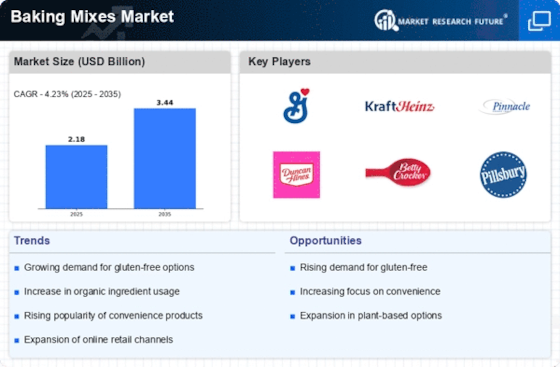
As per Market Research Future analysis, the Baking Mixes Market Size was estimated at 2.18 USD Billion in 2024. The Baking Mixes industry is projected to grow from 2.272 USD Billion in 2025 to 3.439 USD Billion by 2035, exhibiting a compound annual growth rate (CAGR) of 4.23% during the forecast period 2025 - 2035

Key Market Trends & Highlights

The Baking Mixes Market is experiencing a dynamic shift towards health-conscious and convenient offerings.

  • North America remains the largest market for baking mixes, driven by a strong demand for convenience and variety. The Asia-Pacific region is emerging as the fastest-growing market, fueled by increasing urbanization and changing consumer preferences. Cookies and biscuit mixes dominate the market, while cake, pastry, and muffin mixes are witnessing the fastest growth due to evolving consumer tastes. Health-conscious offerings and convenience initiatives are key drivers propelling market expansion across segments.

Market Size & Forecast

2024 Market Size 2.18 (USD Billion)
2035 Market Size 3.439 (USD Billion)
CAGR (2025 - 2035) 4.23%
Largest Regional Market Share in 2024 North America

Major Players

General Mills (US), The Kraft Heinz Company (US), <a href="https://pinnaclefoods.co/product-category/freeze-dried-meal/">Pinnacle Foods (US)</a>, Duncan Hines (US), Betty Crocker (US), Pillsbury (US), King Arthur Baking Company (US), Bob's Red Mill (US)

Market Trends

The Baking Mixes Market is currently experiencing a notable transformation, driven by evolving consumer preferences and an increasing inclination towards convenience in food preparation. As lifestyles become busier, individuals are seeking products that simplify cooking processes without compromising on quality or taste. This shift is reflected in the rising demand for diverse baking mixes, which cater to various dietary needs, including gluten-free and organic options. Furthermore, the market is witnessing a surge in innovative flavors and formulations, appealing to a broader audience and enhancing the overall baking experience. In addition to convenience, health consciousness among consumers is influencing purchasing decisions within the Baking Mixes Market. There is a growing awareness regarding the nutritional content of food products, prompting manufacturers to reformulate their offerings to include healthier ingredients. This trend suggests a potential for growth in segments that prioritize natural and wholesome components. As the market continues to evolve, it appears that the integration of technology in product development and marketing strategies will play a crucial role in shaping future trends, ensuring that the Baking Mixes Market remains responsive to consumer demands and preferences.

Health-Conscious Offerings

The Baking Mixes Market is increasingly focusing on health-oriented products. Consumers are gravitating towards mixes that incorporate natural ingredients, reduced sugar, and enhanced nutritional profiles. This trend indicates a shift towards more wholesome baking options, reflecting a broader societal emphasis on health and wellness.

Convenience and Accessibility

There is a marked rise in the demand for convenient baking solutions. Busy lifestyles are driving consumers to seek out products that require minimal preparation time. This trend highlights the importance of accessibility in the Baking Mixes Market, as consumers prioritize ease of use without sacrificing quality.

Diverse Flavor Profiles

The Baking Mixes Market is witnessing an expansion in flavor variety. Manufacturers are introducing unique and innovative flavors to attract a wider consumer base. This trend suggests that there is a growing appetite for experimentation in baking, encouraging consumers to explore new culinary experiences.

Baking Mixes Market Market Drivers

Diverse Flavor Profiles

The baking mixes Market is characterized by an expanding array of flavor profiles that cater to evolving consumer preferences. As palates become more adventurous, there is a growing demand for unique and exotic flavors in baking mixes. This trend is reflected in the introduction of products featuring ingredients such as matcha, chai, and various fruit infusions. Market data indicates that flavor innovation is a key driver of growth, with companies investing in research and development to create enticing new offerings. This diversification not only attracts a broader customer base but also encourages repeat purchases as consumers seek to experiment with different tastes. The Baking Mixes Market is thus likely to thrive as brands continue to push the boundaries of flavor, appealing to both traditional and contemporary baking enthusiasts.

Health-Conscious Offerings

The Baking Mixes Market is increasingly influenced by the rising demand for health-conscious products. Consumers are becoming more aware of their dietary choices, leading to a surge in the popularity of gluten-free, organic, and low-sugar baking mixes. This trend is supported by data indicating that the gluten-free segment is projected to grow at a compound annual growth rate of approximately 9% over the next few years. As a result, manufacturers are innovating to create healthier alternatives that cater to this demographic, thereby expanding their market reach. The emphasis on clean labels and natural ingredients is reshaping product formulations, which in turn drives growth within the Baking Mixes Market. Companies that adapt to these health trends are likely to capture a larger share of the market, as consumers increasingly prioritize wellness in their purchasing decisions.

Sustainability Initiatives

The Baking Mixes Market is increasingly shaped by sustainability initiatives as consumers become more environmentally conscious. There is a growing expectation for brands to adopt sustainable practices, from sourcing ingredients to packaging. Companies that prioritize eco-friendly materials and ethical sourcing are likely to resonate with consumers, leading to increased brand loyalty. Market Research Future indicates that products with sustainable certifications are gaining traction, with a notable percentage of consumers willing to pay a premium for such offerings. This shift towards sustainability not only addresses consumer concerns but also positions brands favorably in a competitive market. As the Baking Mixes Market evolves, those that embrace sustainability are expected to thrive, appealing to a demographic that values environmental responsibility.

Technological Advancements

The Baking Mixes Market is witnessing a wave of technological advancements that enhance product quality and consumer experience. Innovations in food technology, such as improved preservation methods and enhanced flavor extraction, are enabling manufacturers to create superior baking mixes. Data suggests that the integration of technology in production processes is leading to increased efficiency and consistency in product offerings. Additionally, advancements in e-commerce platforms are facilitating direct-to-consumer sales, allowing brands to reach a wider audience. This technological evolution not only streamlines operations but also enhances customer engagement through personalized marketing strategies. As the Baking Mixes Market continues to adapt to these technological changes, it is likely to see significant growth, driven by improved product offerings and enhanced consumer interaction.

Convenience and Accessibility

The Baking Mixes Market is experiencing a notable shift towards convenience and accessibility. Busy lifestyles have prompted consumers to seek quick and easy baking solutions, leading to a rise in the demand for ready-to-use baking mixes. Data suggests that the convenience segment is expected to account for a significant portion of the market share, as more individuals opt for products that save time without compromising on quality. Retailers are responding by enhancing distribution channels, making these products more accessible in supermarkets and online platforms. This trend not only caters to novice bakers but also appeals to seasoned bakers looking for efficiency. As convenience becomes a priority, the Baking Mixes Market is likely to see sustained growth, driven by the increasing availability of diverse baking mixes that meet the needs of a fast-paced society.

Market Segment Insights

By Product Type: Cookies & Biscuit Mixes (Largest) vs. Cake, Pastry, And Muffin Mixes (Fastest-Growing)

In the Baking Mixes Market, the product type segment showcases a diverse mix of offerings, with Cookies &amp; Biscuit Mixes commanding the largest market share. This segment benefits from the consumer preference for convenient baking solutions, leading to growth in urban areas where busy lifestyles drive the demand for easy-to-use products. Meanwhile, <a href="https://www.marketresearchfuture.com/reports/cakes-and-pastrie-market-25323">Cake, Pastry</a>, and Muffin Mixes are emerging as the fastest-growing category, spurred by the rising trend of home baking, particularly post-pandemic. These mixes appeal to both novice and experienced bakers seeking convenient, pre-measured solutions for a variety of baked goods. The growth of the Baking Mixes Market is largely driven by changing consumer preferences towards homemade products, with an increasing number of households looking for quick and easy baking options that do not compromise on quality. The rise of social media platforms showcasing baked goods has also played a pivotal role in popularizing these mixes, making it easier for consumers to engage with the baking process. As more people discover the joy of baking at home, the demand for innovative and flavored mixes continues to expand, further supportings the growth trajectory of Cake, Pastry, and Muffin Mixes, which cater to this burgeoning interest.

Cookies &amp; Biscuit Mixes (Dominant) vs. <a href="https://www.marketresearchfuture.com/reports/bread-mixes-market-38134" target="_blank">bread mixes</a> (Emerging)

Cookies &amp; Biscuit Mixes remain a dominant player in the Baking Mixes Market, fueled by a strong demand for snackable and convenient products that cater to consumer indulgences. This segment thrives on the versatility of flavors and formats, appealing to various age groups and enabling consumers to satisfy their sweet cravings with ease. In contrast, <a href="https://www.marketresearchfuture.com/reports/bread-mixes-market-38134" target="_blank">bread mixes</a> represent the emerging segment, appealing particularly to health-conscious consumers seeking artisanal and homemade options. The growing popularity of homemade bread, complemented by trends in clean eating and gluten-free products, is driving growth in this category. While Cookies &amp; Biscuit Mixes continue to dominate; Bread Mixes are rapidly gaining traction as consumers seek healthier and more personalized baking experiences.

By Category: Gluten-Free (Largest) vs. Conventional (Fastest-Growing)

In the Baking Mixes Market, the 'Category' segment notably distinguishes itself with Gluten-Free offerings leading in market share. The preference for Gluten-Free mixes has surged among health-conscious consumers, particularly those with dietary restrictions or celiac disease. Conventional baking mixes, while traditionally popular, are progressively being overshadowed by their Gluten-Free counterparts, which are capturing an increasingly significant proportion of the market as the demand for gluten alternatives rises. Looking ahead, the growth trends in the Baking Mixes Market indicate a robust increase in the adoption of Gluten-Free products due to heightened consumer awareness around health and wellness. The surge in lifestyle changes advocating gluten-free diets and the introduction of innovative products catering to this niche is driving growth. Meanwhile, conventional mixes, though experiencing slower growth, are adapting by incorporating more natural ingredients, ultimately enhancing their appeal to a broader audience and maintaining relevance in a competitive landscape.

Baking Mixes Market: Gluten-Free (Dominant) vs. Conventional (Emerging)

The Gluten-Free baking mix segment is dominating the market, meeting the increasing demand from consumers seeking healthier and gluten-free options. This segment is characterized by its variety of innovative flavors and formulations that are designed to replicate traditional baking experiences without the gluten. With consumers focusing on nutrition and dietary preferences, Gluten-Free mixes are often fortified with additional nutrients, making them attractive not only for those with dietary restrictions but also for health-conscious individuals. On the other hand, Conventional baking mixes, although considered traditional, are emerging as they evolve to attract modern consumers. They are now incorporating cleaner labels, organic ingredients, and natural flavors, which resonate with today&rsquo;s trends towards healthy eating. Both segments, while different in foundational concepts, are adapting to the changing market dynamics and consumer tastes.

By End-Use: Retail Customers (Largest) vs. Food Service (Fastest-Growing)

In the Baking Mixes Market, the distribution of market share between Retail Customers and Food Service is noteworthy. Retail Customers account for the largest share, primarily due to the growing trend of home baking, which has surged in popularity especially during the pandemic. This segment benefits from continuous innovations in product offerings, convenient packaging, and extensive marketing that targets home bakers, allowing them to explore various baking experiences without a steep learning curve. On the other hand, the Food Service segment is recognized as the fastest-growing. This growth is driven by an increasing number of cafes, restaurants, and catering services that are incorporating ready-to-use baking mixes into their menus. The demand for quick and consistent baking solutions in the food service industry is further supported by a lifestyle shift towards convenience, prompting business operators to seek efficient ways to serve fresh bakery items without compromising on quality.

Retail Customers (Dominant) vs. Food Service (Emerging)

Retail Customers in the Baking Mixes Market represent a dominant segment, characterized by their preference for a diverse range of products that cater to various baking needs&mdash;ranging from cakes and breads to specialty mixes. This segment thrives on trends such as gluten-free and organic mixes, which cater to health-conscious consumers aiming for quality and diversity in their baking endeavors. In contrast, the Food Service segment is emerging rapidly, fueled by the increasing reliance of food establishments on pre-mixed solutions to streamline their operations. This segment emphasizes speed and consistency, allowing <a href="https://www.marketresearchfuture.com/reports/food-service-market-11595">food service</a> providers to meet rising consumer expectations for quality baked goods while reducing preparation time and labor costs. As emerging culinary trends continue to influence consumer preferences, both segments play pivotal roles in shaping the overall landscape of the baking mixes market.

By Distribution Channel: Store-Based (Largest) vs. Non-Store-Based (Fastest-Growing)

In the Baking Mixes Market, the distribution of products among various channels reveals a strong preference for store-based methods. Store-based channels dominate sales, leveraging the familiarity and convenience of physical retail locations, where consumers can view products firsthand. Non-store-based channels, while less prevalent, are rapidly gaining traction, particularly among younger consumers accustomed to online shopping and delivery options.

Store-Based (Dominant) vs. Non-Store-Based (Emerging)

Store-based distribution remains a dominant force in the Baking Mixes Market, as traditional grocery stores and supermarkets offer consumers the tactile experience of selecting products. These locations often feature promotions and loyalty programs that encourage repeat purchases. In contrast, non-store-based distribution, encompassing online retailers and specialty websites, is becoming an emerging player in the market. This growth is driven by the convenience of shopping from home and the increasing number of consumers seeking gourmet and specialty baking mixes not available in stores. As online shopping continues to rise, non-store-based channels are expected to further enhance their presence in the baking mixes segment.

Get more detailed insights about Baking Mixes Market Research Report - Global Forecast till 2035

Regional Insights

North America : Market Leader in Baking Mixes Market

North America is the largest market for baking mixes, holding approximately 45% of the global share. The region's growth is driven by increasing consumer demand for convenience foods, coupled with a rise in home baking trends. Regulatory support for food safety and quality standards further enhances market stability. The U.S. is the primary contributor, with Canada following as the second-largest market, accounting for around 15% of the share. The competitive landscape in North America is robust, featuring key players such as General Mills, Kraft Heinz, and Duncan Hines. These companies leverage innovative product offerings and marketing strategies to capture consumer interest. The presence of established brands and a growing trend towards organic and gluten-free options are shaping the market dynamics, ensuring sustained growth in the baking mixes sector.

Europe : Emerging Trends in Baking

Europe is witnessing a significant shift in the baking mixes market, holding approximately 30% of the global share. The region's growth is fueled by increasing health consciousness among consumers, leading to a demand for organic and natural ingredients. Regulatory frameworks, such as the EU's food safety regulations, are also driving innovation and quality in product offerings. Germany and the UK are the largest markets, contributing around 12% and 10% respectively to the overall market share. Leading countries in Europe are focusing on product diversification and sustainability, with brands like Dr. Oetker and Betty Crocker gaining traction. The competitive landscape is characterized by a mix of local and international players, all vying for market share through innovative marketing strategies and product development. The trend towards convenience and ready-to-use baking solutions is expected to further enhance market growth in the coming years.

Asia-Pacific : Rapid Growth in Baking Sector

The Asia-Pacific region is emerging as a significant player in the baking mixes market, currently holding about 20% of the global share. The growth is driven by urbanization, rising disposable incomes, and a growing interest in Western baking trends. Countries like China and India are leading this growth, with China accounting for approximately 10% of the market share. Regulatory support for food safety and quality is also enhancing consumer confidence in baking products. The competitive landscape in Asia-Pacific is evolving, with both local and international brands entering the market. Key players include local companies and global giants like Pillsbury and King Arthur Baking Company. The increasing popularity of baking as a leisure activity, especially among younger demographics, is driving demand for diverse baking mixes, including gluten-free and specialty options, further propelling market growth.

Middle East and Africa : Untapped Potential in Baking

The Middle East and Africa region is gradually emerging in the baking mixes market, currently holding about 5% of the global share. The growth is primarily driven by changing consumer lifestyles, urbanization, and a growing interest in baking as a hobby. Countries like South Africa and the UAE are leading this growth, with South Africa accounting for approximately 3% of the market share. Regulatory frameworks are evolving to support food safety and quality, which is crucial for market expansion. The competitive landscape is characterized by a mix of local and international players, with brands like Bob's Red Mill gaining traction. The region's market is still developing, with significant opportunities for growth as consumer preferences shift towards convenience and ready-to-use baking solutions. The increasing availability of baking mixes in retail outlets is expected to further boost market penetration in the coming years.

Key Players and Competitive Insights

Leading market players are investing heavily in R&D to expand their product lines, which will help the baking mixes market, grow even more. Market participants are also undertaking a variety of strategic activities to expand their footprint, with important market developments including new product launches, contractual agreements, mergers and acquisitions, higher investments, and collaboration with other organizations. To expand and survive in a more competitive and rising market climate, baking mixes industry must offer cost-effective items.
Manufacturing locally to minimize operational costs is one of the key business tactics used by manufacturers in the baking mixes industry to benefit clients and increase the market sector. In recent years, the baking mixes industry has offered some of the most significant advantages to medicine. Major players in the baking mixes market, including Conagra Brands, Inc. (US), Chelsea Milling Company (US), Keto and Company (US), Continental Mills, Inc. (US), Dawn Food Products, Inc. (US) and others, are attempting to increase market demand by investing in R&D operations.
Krusteaz is a consumer food product brand line of Tukwila, Washington-based Continental Mills, presently known as The Krusteaz Company. Its first product was "the world's first" just-add-water pie crust mix, which was followed by a factory-prepared, shelf-stable flour and dried buttermilk mixture developed in 1946 or 1947 at the University of Washington's home economics department for baking biscuits, pancakes, waffles, cobbler, and dump cake.
The brand name "Crust Ease," later changed to "Krusteaz," was coined and the company founded in 1932, reportedly by four members of a Seattle bridge club; known co-founder Ada Rose Gilbreath Charters was from a Columbia County pioneer family, and raised on a farm in Dayton before attending Washington State University, back when it was known as Washington Agricultural College. In April 2022, Continental Mills has increased the variety of Kruteaz baking mixes. It has introduced three new goods. Muffin Mix and Krusteaz Chocolate Swirl Crumb Cake with a luscious cake base are the new product lines.
It's topped with a chocolate swirl ribbon and chocolate crumble.
The Archer-Daniels-Midland Company, or ADM, is an American food processing and commodities trading firm headquartered in Chicago, Illinois, founded in 1902. The company has over 270 plants and 420 crop procurement facilities around the world where cereal grains and oilseeds are processed into products utilised in the food, beverage, nutraceutical, industrial, and animal feed markets. In August 2022, ADM worked with New Culture, a pioneering dairy company that does not utilise animals. The companies' purpose in this partnership was to make alternative dairy products easier to create and market.
The relationship demonstrated both companies' commitment to acting as models for a more sustainable food future. The cooperation enabled product co-development by utilising New Culture's innovation in new ingredients and non-dairy goods.

Key Companies in the Baking Mixes Market include

Industry Developments

In March 2022, White Lily, a flour and cornmeal manufacturer, has introduced five baking mixes. Dark chocolate brownie, chocolate fudge brownie, vanilla glazed pound cake, cinnamon crumb cake with cinnamon streusel topping, and lemon glazed lemon pound cake are among the new flavours available from the company.

In June 2020, SalDoce Fine Foods marketed their products under the YesYouCan brand on eBay and Amazon Australia.

In September 2019, Promise Gluten Free has introduced a new line of gluten-free sourdough bread in the United States.

Future Outlook

Baking Mixes Market Future Outlook

The Baking Mixes Market is projected to grow at a 4.23% CAGR from 2025 to 2035, driven by increasing consumer demand for convenience and health-oriented products.

New opportunities lie in:

  • Expansion into gluten-free and organic baking mixes
  • Development of ready-to-use baking kits for home bakers
  • Partnerships with e-commerce platforms for direct-to-consumer sales

By 2035, the Baking Mixes Market is expected to achieve robust growth and diversification.

Market Segmentation

Baking Mixes Market End-Use Outlook

  • Retail Customers
  • Food Service

Baking Mixes Market Category Outlook

  • Gluten-Free
  • Conventional

Baking Mixes Market Product Type Outlook

  • Cookies & Biscuit Mixes
  • Bread Mixes
  • Cake
  • Pastry
  • And & Muffin Mixes
  • Others

Baking Mixes Market Distribution Channel Outlook

  • Store-Based
  • Non-Store-Based

Report Scope

MARKET SIZE 2024 2.18(USD Billion)
MARKET SIZE 2025 2.272(USD Billion)
MARKET SIZE 2035 3.439(USD Billion)
COMPOUND ANNUAL GROWTH RATE (CAGR) 4.23% (2025 - 2035)
REPORT COVERAGE Revenue Forecast, Competitive Landscape, Growth Factors, and Trends
BASE YEAR 2024
Market Forecast Period 2025 - 2035
Historical Data 2019 - 2024
Market Forecast Units USD Billion
Key Companies Profiled General Mills (US), The Kraft Heinz Company (US), Pinnacle Foods (US), Duncan Hines (US), Betty Crocker (US), Pillsbury (US), King Arthur Baking Company (US), Bob's Red Mill (US)
Segments Covered Product Type, Category, End-Use, Distribution Channel, Region
Key Market Opportunities Growing demand for gluten-free and organic options in the Baking Mixes Market presents significant opportunities.
Key Market Dynamics Rising consumer preference for convenient baking solutions drives innovation and competition in the baking mixes market.
Countries Covered North America, Europe, APAC, South America, MEA

FAQs

What is the projected market valuation for the Baking Mixes Market in 2035?

<p>The projected market valuation for the Baking Mixes Market in 2035 is 3.439 USD Billion.</p>

What was the market valuation of the Baking Mixes Market in 2024?

<p>The market valuation of the Baking Mixes Market in 2024 was 2.18 USD Billion.</p>

What is the expected CAGR for the Baking Mixes Market from 2025 to 2035?

<p>The expected CAGR for the Baking Mixes Market during the forecast period 2025 - 2035 is 4.23%.</p>

Which product type segment is projected to grow the most in the Baking Mixes Market?

<p>The Bread Mixes segment is projected to grow from 0.75 USD Billion in 2024 to 1.15 USD Billion by 2035.</p>

How do gluten-free baking mixes compare to conventional mixes in terms of market size?

<p>In 2024, gluten-free baking mixes were valued at 0.65 USD Billion, while conventional mixes were valued at 1.53 USD Billion.</p>

What are the key players in the Baking Mixes Market?

<p>Key players in the Baking Mixes Market include General Mills, The Kraft Heinz Company, Pinnacle Foods, and Duncan Hines.</p>

What is the market size for retail customers in the Baking Mixes Market?

The market size for retail customers in the Baking Mixes Market was 1.1 USD Billion in 2024 and is projected to reach 1.7 USD Billion by 2035.

What distribution channel is expected to see the highest growth in the Baking Mixes Market?

The Store-Based distribution channel is expected to grow from 1.3 USD Billion in 2024 to 2.1 USD Billion by 2035.

What was the market size for cake, pastry, and muffin mixes in 2024?

The market size for cake, pastry, and muffin mixes was 0.55 USD Billion in 2024.

What is the projected market size for food service in the Baking Mixes Market?

The projected market size for food service is expected to increase from 1.08 USD Billion in 2024 to 1.739 USD Billion by 2035.

  1. SECTION I: EXECUTIVE SUMMARY AND KEY HIGHLIGHTS
    1. | 1.1 EXECUTIVE SUMMARY
    2. | | 1.1.1 Market Overview
    3. | | 1.1.2 Key Findings
    4. | | 1.1.3 Market Segmentation
    5. | | 1.1.4 Competitive Landscape
    6. | | 1.1.5 Challenges and Opportunities
    7. | | 1.1.6 Future Outlook
  2. SECTION II: SCOPING, METHODOLOGY AND MARKET STRUCTURE
    1. | 2.1 MARKET INTRODUCTION
    2. | | 2.1.1 Definition
    3. | | 2.1.2 Scope of the study
    4. | | | 2.1.2.1 Research Objective
    5. | | | 2.1.2.2 Assumption
    6. | | | 2.1.2.3 Limitations
    7. | 2.2 RESEARCH METHODOLOGY
    8. | | 2.2.1 Overview
    9. | | 2.2.2 Data Mining
    10. | | 2.2.3 Secondary Research
    11. | | 2.2.4 Primary Research
    12. | | | 2.2.4.1 Primary Interviews and Information Gathering Process
    13. | | | 2.2.4.2 Breakdown of Primary Respondents
    14. | | 2.2.5 Forecasting Model
    15. | | 2.2.6 Market Size Estimation
    16. | | | 2.2.6.1 Bottom-Up Approach
    17. | | | 2.2.6.2 Top-Down Approach
    18. | | 2.2.7 Data Triangulation
    19. | | 2.2.8 Validation
  3. SECTION III: QUALITATIVE ANALYSIS
    1. | 3.1 MARKET DYNAMICS
    2. | | 3.1.1 Overview
    3. | | 3.1.2 Drivers
    4. | | 3.1.3 Restraints
    5. | | 3.1.4 Opportunities
    6. | 3.2 MARKET FACTOR ANALYSIS
    7. | | 3.2.1 Value chain Analysis
    8. | | 3.2.2 Porter's Five Forces Analysis
    9. | | | 3.2.2.1 Bargaining Power of Suppliers
    10. | | | 3.2.2.2 Bargaining Power of Buyers
    11. | | | 3.2.2.3 Threat of New Entrants
    12. | | | 3.2.2.4 Threat of Substitutes
    13. | | | 3.2.2.5 Intensity of Rivalry
    14. | | 3.2.3 COVID-19 Impact Analysis
    15. | | | 3.2.3.1 Market Impact Analysis
    16. | | | 3.2.3.2 Regional Impact
    17. | | | 3.2.3.3 Opportunity and Threat Analysis
  4. SECTION IV: QUANTITATIVE ANALYSIS
    1. | 4.1 Food, Beverages & Nutrition, BY Product Type (USD Billion)
    2. | | 4.1.1 Cookies & Biscuit Mixes
    3. | | 4.1.2 Bread Mixes
    4. | | 4.1.3 Cake, Pastry, And & Muffin Mixes
    5. | | 4.1.4 Others
    6. | 4.2 Food, Beverages & Nutrition, BY Category (USD Billion)
    7. | | 4.2.1 Gluten-Free
    8. | | 4.2.2 Conventional
    9. | 4.3 Food, Beverages & Nutrition, BY End-Use (USD Billion)
    10. | | 4.3.1 Retail Customers
    11. | | 4.3.2 Food Service
    12. | 4.4 Food, Beverages & Nutrition, BY Distribution Channel (USD Billion)
    13. | | 4.4.1 Store-Based
    14. | | 4.4.2 Non-Store-Based
    15. | 4.5 Food, Beverages & Nutrition, BY Region (USD Billion)
    16. | | 4.5.1 North America
    17. | | | 4.5.1.1 US
    18. | | | 4.5.1.2 Canada
    19. | | 4.5.2 Europe
    20. | | | 4.5.2.1 Germany
    21. | | | 4.5.2.2 UK
    22. | | | 4.5.2.3 France
    23. | | | 4.5.2.4 Russia
    24. | | | 4.5.2.5 Italy
    25. | | | 4.5.2.6 Spain
    26. | | | 4.5.2.7 Rest of Europe
    27. | | 4.5.3 APAC
    28. | | | 4.5.3.1 China
    29. | | | 4.5.3.2 India
    30. | | | 4.5.3.3 Japan
    31. | | | 4.5.3.4 South Korea
    32. | | | 4.5.3.5 Malaysia
    33. | | | 4.5.3.6 Thailand
    34. | | | 4.5.3.7 Indonesia
    35. | | | 4.5.3.8 Rest of APAC
    36. | | 4.5.4 South America
    37. | | | 4.5.4.1 Brazil
    38. | | | 4.5.4.2 Mexico
    39. | | | 4.5.4.3 Argentina
    40. | | | 4.5.4.4 Rest of South America
    41. | | 4.5.5 MEA
    42. | | | 4.5.5.1 GCC Countries
    43. | | | 4.5.5.2 South Africa
    44. | | | 4.5.5.3 Rest of MEA
  5. SECTION V: COMPETITIVE ANALYSIS
    1. | 5.1 Competitive Landscape
    2. | | 5.1.1 Overview
    3. | | 5.1.2 Competitive Analysis
    4. | | 5.1.3 Market share Analysis
    5. | | 5.1.4 Major Growth Strategy in the Food, Beverages & Nutrition
    6. | | 5.1.5 Competitive Benchmarking
    7. | | 5.1.6 Leading Players in Terms of Number of Developments in the Food, Beverages & Nutrition
    8. | | 5.1.7 Key developments and growth strategies
    9. | | | 5.1.7.1 New Product Launch/Service Deployment
    10. | | | 5.1.7.2 Merger & Acquisitions
    11. | | | 5.1.7.3 Joint Ventures
    12. | | 5.1.8 Major Players Financial Matrix
    13. | | | 5.1.8.1 Sales and Operating Income
    14. | | | 5.1.8.2 Major Players R&D Expenditure. 2023
    15. | 5.2 Company Profiles
    16. | | 5.2.1 General Mills (US)
    17. | | | 5.2.1.1 Financial Overview
    18. | | | 5.2.1.2 Products Offered
    19. | | | 5.2.1.3 Key Developments
    20. | | | 5.2.1.4 SWOT Analysis
    21. | | | 5.2.1.5 Key Strategies
    22. | | 5.2.2 The Kraft Heinz Company (US)
    23. | | | 5.2.2.1 Financial Overview
    24. | | | 5.2.2.2 Products Offered
    25. | | | 5.2.2.3 Key Developments
    26. | | | 5.2.2.4 SWOT Analysis
    27. | | | 5.2.2.5 Key Strategies
    28. | | 5.2.3 Pinnacle Foods (US)
    29. | | | 5.2.3.1 Financial Overview
    30. | | | 5.2.3.2 Products Offered
    31. | | | 5.2.3.3 Key Developments
    32. | | | 5.2.3.4 SWOT Analysis
    33. | | | 5.2.3.5 Key Strategies
    34. | | 5.2.4 Duncan Hines (US)
    35. | | | 5.2.4.1 Financial Overview
    36. | | | 5.2.4.2 Products Offered
    37. | | | 5.2.4.3 Key Developments
    38. | | | 5.2.4.4 SWOT Analysis
    39. | | | 5.2.4.5 Key Strategies
    40. | | 5.2.5 Betty Crocker (US)
    41. | | | 5.2.5.1 Financial Overview
    42. | | | 5.2.5.2 Products Offered
    43. | | | 5.2.5.3 Key Developments
    44. | | | 5.2.5.4 SWOT Analysis
    45. | | | 5.2.5.5 Key Strategies
    46. | | 5.2.6 Pillsbury (US)
    47. | | | 5.2.6.1 Financial Overview
    48. | | | 5.2.6.2 Products Offered
    49. | | | 5.2.6.3 Key Developments
    50. | | | 5.2.6.4 SWOT Analysis
    51. | | | 5.2.6.5 Key Strategies
    52. | | 5.2.7 King Arthur Baking Company (US)
    53. | | | 5.2.7.1 Financial Overview
    54. | | | 5.2.7.2 Products Offered
    55. | | | 5.2.7.3 Key Developments
    56. | | | 5.2.7.4 SWOT Analysis
    57. | | | 5.2.7.5 Key Strategies
    58. | | 5.2.8 Bob's Red Mill (US)
    59. | | | 5.2.8.1 Financial Overview
    60. | | | 5.2.8.2 Products Offered
    61. | | | 5.2.8.3 Key Developments
    62. | | | 5.2.8.4 SWOT Analysis
    63. | | | 5.2.8.5 Key Strategies
    64. | 5.3 Appendix
    65. | | 5.3.1 References
    66. | | 5.3.2 Related Reports
  6. LIST OF FIGURES
    1. | 6.1 MARKET SYNOPSIS
    2. | 6.2 NORTH AMERICA MARKET ANALYSIS
    3. | 6.3 US MARKET ANALYSIS BY PRODUCT TYPE
    4. | 6.4 US MARKET ANALYSIS BY CATEGORY
    5. | 6.5 US MARKET ANALYSIS BY END-USE
    6. | 6.6 US MARKET ANALYSIS BY DISTRIBUTION CHANNEL
    7. | 6.7 CANADA MARKET ANALYSIS BY PRODUCT TYPE
    8. | 6.8 CANADA MARKET ANALYSIS BY CATEGORY
    9. | 6.9 CANADA MARKET ANALYSIS BY END-USE
    10. | 6.10 CANADA MARKET ANALYSIS BY DISTRIBUTION CHANNEL
    11. | 6.11 EUROPE MARKET ANALYSIS
    12. | 6.12 GERMANY MARKET ANALYSIS BY PRODUCT TYPE
    13. | 6.13 GERMANY MARKET ANALYSIS BY CATEGORY
    14. | 6.14 GERMANY MARKET ANALYSIS BY END-USE
    15. | 6.15 GERMANY MARKET ANALYSIS BY DISTRIBUTION CHANNEL
    16. | 6.16 UK MARKET ANALYSIS BY PRODUCT TYPE
    17. | 6.17 UK MARKET ANALYSIS BY CATEGORY
    18. | 6.18 UK MARKET ANALYSIS BY END-USE
    19. | 6.19 UK MARKET ANALYSIS BY DISTRIBUTION CHANNEL
    20. | 6.20 FRANCE MARKET ANALYSIS BY PRODUCT TYPE
    21. | 6.21 FRANCE MARKET ANALYSIS BY CATEGORY
    22. | 6.22 FRANCE MARKET ANALYSIS BY END-USE
    23. | 6.23 FRANCE MARKET ANALYSIS BY DISTRIBUTION CHANNEL
    24. | 6.24 RUSSIA MARKET ANALYSIS BY PRODUCT TYPE
    25. | 6.25 RUSSIA MARKET ANALYSIS BY CATEGORY
    26. | 6.26 RUSSIA MARKET ANALYSIS BY END-USE
    27. | 6.27 RUSSIA MARKET ANALYSIS BY DISTRIBUTION CHANNEL
    28. | 6.28 ITALY MARKET ANALYSIS BY PRODUCT TYPE
    29. | 6.29 ITALY MARKET ANALYSIS BY CATEGORY
    30. | 6.30 ITALY MARKET ANALYSIS BY END-USE
    31. | 6.31 ITALY MARKET ANALYSIS BY DISTRIBUTION CHANNEL
    32. | 6.32 SPAIN MARKET ANALYSIS BY PRODUCT TYPE
    33. | 6.33 SPAIN MARKET ANALYSIS BY CATEGORY
    34. | 6.34 SPAIN MARKET ANALYSIS BY END-USE
    35. | 6.35 SPAIN MARKET ANALYSIS BY DISTRIBUTION CHANNEL
    36. | 6.36 REST OF EUROPE MARKET ANALYSIS BY PRODUCT TYPE
    37. | 6.37 REST OF EUROPE MARKET ANALYSIS BY CATEGORY
    38. | 6.38 REST OF EUROPE MARKET ANALYSIS BY END-USE
    39. | 6.39 REST OF EUROPE MARKET ANALYSIS BY DISTRIBUTION CHANNEL
    40. | 6.40 APAC MARKET ANALYSIS
    41. | 6.41 CHINA MARKET ANALYSIS BY PRODUCT TYPE
    42. | 6.42 CHINA MARKET ANALYSIS BY CATEGORY
    43. | 6.43 CHINA MARKET ANALYSIS BY END-USE
    44. | 6.44 CHINA MARKET ANALYSIS BY DISTRIBUTION CHANNEL
    45. | 6.45 INDIA MARKET ANALYSIS BY PRODUCT TYPE
    46. | 6.46 INDIA MARKET ANALYSIS BY CATEGORY
    47. | 6.47 INDIA MARKET ANALYSIS BY END-USE
    48. | 6.48 INDIA MARKET ANALYSIS BY DISTRIBUTION CHANNEL
    49. | 6.49 JAPAN MARKET ANALYSIS BY PRODUCT TYPE
    50. | 6.50 JAPAN MARKET ANALYSIS BY CATEGORY
    51. | 6.51 JAPAN MARKET ANALYSIS BY END-USE
    52. | 6.52 JAPAN MARKET ANALYSIS BY DISTRIBUTION CHANNEL
    53. | 6.53 SOUTH KOREA MARKET ANALYSIS BY PRODUCT TYPE
    54. | 6.54 SOUTH KOREA MARKET ANALYSIS BY CATEGORY
    55. | 6.55 SOUTH KOREA MARKET ANALYSIS BY END-USE
    56. | 6.56 SOUTH KOREA MARKET ANALYSIS BY DISTRIBUTION CHANNEL
    57. | 6.57 MALAYSIA MARKET ANALYSIS BY PRODUCT TYPE
    58. | 6.58 MALAYSIA MARKET ANALYSIS BY CATEGORY
    59. | 6.59 MALAYSIA MARKET ANALYSIS BY END-USE
    60. | 6.60 MALAYSIA MARKET ANALYSIS BY DISTRIBUTION CHANNEL
    61. | 6.61 THAILAND MARKET ANALYSIS BY PRODUCT TYPE
    62. | 6.62 THAILAND MARKET ANALYSIS BY CATEGORY
    63. | 6.63 THAILAND MARKET ANALYSIS BY END-USE
    64. | 6.64 THAILAND MARKET ANALYSIS BY DISTRIBUTION CHANNEL
    65. | 6.65 INDONESIA MARKET ANALYSIS BY PRODUCT TYPE
    66. | 6.66 INDONESIA MARKET ANALYSIS BY CATEGORY
    67. | 6.67 INDONESIA MARKET ANALYSIS BY END-USE
    68. | 6.68 INDONESIA MARKET ANALYSIS BY DISTRIBUTION CHANNEL
    69. | 6.69 REST OF APAC MARKET ANALYSIS BY PRODUCT TYPE
    70. | 6.70 REST OF APAC MARKET ANALYSIS BY CATEGORY
    71. | 6.71 REST OF APAC MARKET ANALYSIS BY END-USE
    72. | 6.72 REST OF APAC MARKET ANALYSIS BY DISTRIBUTION CHANNEL
    73. | 6.73 SOUTH AMERICA MARKET ANALYSIS
    74. | 6.74 BRAZIL MARKET ANALYSIS BY PRODUCT TYPE
    75. | 6.75 BRAZIL MARKET ANALYSIS BY CATEGORY
    76. | 6.76 BRAZIL MARKET ANALYSIS BY END-USE
    77. | 6.77 BRAZIL MARKET ANALYSIS BY DISTRIBUTION CHANNEL
    78. | 6.78 MEXICO MARKET ANALYSIS BY PRODUCT TYPE
    79. | 6.79 MEXICO MARKET ANALYSIS BY CATEGORY
    80. | 6.80 MEXICO MARKET ANALYSIS BY END-USE
    81. | 6.81 MEXICO MARKET ANALYSIS BY DISTRIBUTION CHANNEL
    82. | 6.82 ARGENTINA MARKET ANALYSIS BY PRODUCT TYPE
    83. | 6.83 ARGENTINA MARKET ANALYSIS BY CATEGORY
    84. | 6.84 ARGENTINA MARKET ANALYSIS BY END-USE
    85. | 6.85 ARGENTINA MARKET ANALYSIS BY DISTRIBUTION CHANNEL
    86. | 6.86 REST OF SOUTH AMERICA MARKET ANALYSIS BY PRODUCT TYPE
    87. | 6.87 REST OF SOUTH AMERICA MARKET ANALYSIS BY CATEGORY
    88. | 6.88 REST OF SOUTH AMERICA MARKET ANALYSIS BY END-USE
    89. | 6.89 REST OF SOUTH AMERICA MARKET ANALYSIS BY DISTRIBUTION CHANNEL
    90. | 6.90 MEA MARKET ANALYSIS
    91. | 6.91 GCC COUNTRIES MARKET ANALYSIS BY PRODUCT TYPE
    92. | 6.92 GCC COUNTRIES MARKET ANALYSIS BY CATEGORY
    93. | 6.93 GCC COUNTRIES MARKET ANALYSIS BY END-USE
    94. | 6.94 GCC COUNTRIES MARKET ANALYSIS BY DISTRIBUTION CHANNEL
    95. | 6.95 SOUTH AFRICA MARKET ANALYSIS BY PRODUCT TYPE
    96. | 6.96 SOUTH AFRICA MARKET ANALYSIS BY CATEGORY
    97. | 6.97 SOUTH AFRICA MARKET ANALYSIS BY END-USE
    98. | 6.98 SOUTH AFRICA MARKET ANALYSIS BY DISTRIBUTION CHANNEL
    99. | 6.99 REST OF MEA MARKET ANALYSIS BY PRODUCT TYPE
    100. | 6.100 REST OF MEA MARKET ANALYSIS BY CATEGORY
    101. | 6.101 REST OF MEA MARKET ANALYSIS BY END-USE
    102. | 6.102 REST OF MEA MARKET ANALYSIS BY DISTRIBUTION CHANNEL
    103. | 6.103 KEY BUYING CRITERIA OF FOOD, BEVERAGES & NUTRITION
    104. | 6.104 RESEARCH PROCESS OF MRFR
    105. | 6.105 DRO ANALYSIS OF FOOD, BEVERAGES & NUTRITION
    106. | 6.106 DRIVERS IMPACT ANALYSIS: FOOD, BEVERAGES & NUTRITION
    107. | 6.107 RESTRAINTS IMPACT ANALYSIS: FOOD, BEVERAGES & NUTRITION
    108. | 6.108 SUPPLY / VALUE CHAIN: FOOD, BEVERAGES & NUTRITION
    109. | 6.109 FOOD, BEVERAGES & NUTRITION, BY PRODUCT TYPE, 2024 (% SHARE)
    110. | 6.110 FOOD, BEVERAGES & NUTRITION, BY PRODUCT TYPE, 2024 TO 2035 (USD Billion)
    111. | 6.111 FOOD, BEVERAGES & NUTRITION, BY CATEGORY, 2024 (% SHARE)
    112. | 6.112 FOOD, BEVERAGES & NUTRITION, BY CATEGORY, 2024 TO 2035 (USD Billion)
    113. | 6.113 FOOD, BEVERAGES & NUTRITION, BY END-USE, 2024 (% SHARE)
    114. | 6.114 FOOD, BEVERAGES & NUTRITION, BY END-USE, 2024 TO 2035 (USD Billion)
    115. | 6.115 FOOD, BEVERAGES & NUTRITION, BY DISTRIBUTION CHANNEL, 2024 (% SHARE)
    116. | 6.116 FOOD, BEVERAGES & NUTRITION, BY DISTRIBUTION CHANNEL, 2024 TO 2035 (USD Billion)
    117. | 6.117 BENCHMARKING OF MAJOR COMPETITORS
  7. LIST OF TABLES
    1. | 7.1 LIST OF ASSUMPTIONS
    2. | | 7.1.1
    3. | 7.2 North America MARKET SIZE ESTIMATES; FORECAST
    4. | | 7.2.1 BY PRODUCT TYPE, 2025-2035 (USD Billion)
    5. | | 7.2.2 BY CATEGORY, 2025-2035 (USD Billion)
    6. | | 7.2.3 BY END-USE, 2025-2035 (USD Billion)
    7. | | 7.2.4 BY DISTRIBUTION CHANNEL, 2025-2035 (USD Billion)
    8. | 7.3 US MARKET SIZE ESTIMATES; FORECAST
    9. | | 7.3.1 BY PRODUCT TYPE, 2025-2035 (USD Billion)
    10. | | 7.3.2 BY CATEGORY, 2025-2035 (USD Billion)
    11. | | 7.3.3 BY END-USE, 2025-2035 (USD Billion)
    12. | | 7.3.4 BY DISTRIBUTION CHANNEL, 2025-2035 (USD Billion)
    13. | 7.4 Canada MARKET SIZE ESTIMATES; FORECAST
    14. | | 7.4.1 BY PRODUCT TYPE, 2025-2035 (USD Billion)
    15. | | 7.4.2 BY CATEGORY, 2025-2035 (USD Billion)
    16. | | 7.4.3 BY END-USE, 2025-2035 (USD Billion)
    17. | | 7.4.4 BY DISTRIBUTION CHANNEL, 2025-2035 (USD Billion)
    18. | 7.5 Europe MARKET SIZE ESTIMATES; FORECAST
    19. | | 7.5.1 BY PRODUCT TYPE, 2025-2035 (USD Billion)
    20. | | 7.5.2 BY CATEGORY, 2025-2035 (USD Billion)
    21. | | 7.5.3 BY END-USE, 2025-2035 (USD Billion)
    22. | | 7.5.4 BY DISTRIBUTION CHANNEL, 2025-2035 (USD Billion)
    23. | 7.6 Germany MARKET SIZE ESTIMATES; FORECAST
    24. | | 7.6.1 BY PRODUCT TYPE, 2025-2035 (USD Billion)
    25. | | 7.6.2 BY CATEGORY, 2025-2035 (USD Billion)
    26. | | 7.6.3 BY END-USE, 2025-2035 (USD Billion)
    27. | | 7.6.4 BY DISTRIBUTION CHANNEL, 2025-2035 (USD Billion)
    28. | 7.7 UK MARKET SIZE ESTIMATES; FORECAST
    29. | | 7.7.1 BY PRODUCT TYPE, 2025-2035 (USD Billion)
    30. | | 7.7.2 BY CATEGORY, 2025-2035 (USD Billion)
    31. | | 7.7.3 BY END-USE, 2025-2035 (USD Billion)
    32. | | 7.7.4 BY DISTRIBUTION CHANNEL, 2025-2035 (USD Billion)
    33. | 7.8 France MARKET SIZE ESTIMATES; FORECAST
    34. | | 7.8.1 BY PRODUCT TYPE, 2025-2035 (USD Billion)
    35. | | 7.8.2 BY CATEGORY, 2025-2035 (USD Billion)
    36. | | 7.8.3 BY END-USE, 2025-2035 (USD Billion)
    37. | | 7.8.4 BY DISTRIBUTION CHANNEL, 2025-2035 (USD Billion)
    38. | 7.9 Russia MARKET SIZE ESTIMATES; FORECAST
    39. | | 7.9.1 BY PRODUCT TYPE, 2025-2035 (USD Billion)
    40. | | 7.9.2 BY CATEGORY, 2025-2035 (USD Billion)
    41. | | 7.9.3 BY END-USE, 2025-2035 (USD Billion)
    42. | | 7.9.4 BY DISTRIBUTION CHANNEL, 2025-2035 (USD Billion)
    43. | 7.10 Italy MARKET SIZE ESTIMATES; FORECAST
    44. | | 7.10.1 BY PRODUCT TYPE, 2025-2035 (USD Billion)
    45. | | 7.10.2 BY CATEGORY, 2025-2035 (USD Billion)
    46. | | 7.10.3 BY END-USE, 2025-2035 (USD Billion)
    47. | | 7.10.4 BY DISTRIBUTION CHANNEL, 2025-2035 (USD Billion)
    48. | 7.11 Spain MARKET SIZE ESTIMATES; FORECAST
    49. | | 7.11.1 BY PRODUCT TYPE, 2025-2035 (USD Billion)
    50. | | 7.11.2 BY CATEGORY, 2025-2035 (USD Billion)
    51. | | 7.11.3 BY END-USE, 2025-2035 (USD Billion)
    52. | | 7.11.4 BY DISTRIBUTION CHANNEL, 2025-2035 (USD Billion)
    53. | 7.12 Rest of Europe MARKET SIZE ESTIMATES; FORECAST
    54. | | 7.12.1 BY PRODUCT TYPE, 2025-2035 (USD Billion)
    55. | | 7.12.2 BY CATEGORY, 2025-2035 (USD Billion)
    56. | | 7.12.3 BY END-USE, 2025-2035 (USD Billion)
    57. | | 7.12.4 BY DISTRIBUTION CHANNEL, 2025-2035 (USD Billion)
    58. | 7.13 APAC MARKET SIZE ESTIMATES; FORECAST
    59. | | 7.13.1 BY PRODUCT TYPE, 2025-2035 (USD Billion)
    60. | | 7.13.2 BY CATEGORY, 2025-2035 (USD Billion)
    61. | | 7.13.3 BY END-USE, 2025-2035 (USD Billion)
    62. | | 7.13.4 BY DISTRIBUTION CHANNEL, 2025-2035 (USD Billion)
    63. | 7.14 China MARKET SIZE ESTIMATES; FORECAST
    64. | | 7.14.1 BY PRODUCT TYPE, 2025-2035 (USD Billion)
    65. | | 7.14.2 BY CATEGORY, 2025-2035 (USD Billion)
    66. | | 7.14.3 BY END-USE, 2025-2035 (USD Billion)
    67. | | 7.14.4 BY DISTRIBUTION CHANNEL, 2025-2035 (USD Billion)
    68. | 7.15 India MARKET SIZE ESTIMATES; FORECAST
    69. | | 7.15.1 BY PRODUCT TYPE, 2025-2035 (USD Billion)
    70. | | 7.15.2 BY CATEGORY, 2025-2035 (USD Billion)
    71. | | 7.15.3 BY END-USE, 2025-2035 (USD Billion)
    72. | | 7.15.4 BY DISTRIBUTION CHANNEL, 2025-2035 (USD Billion)
    73. | 7.16 Japan MARKET SIZE ESTIMATES; FORECAST
    74. | | 7.16.1 BY PRODUCT TYPE, 2025-2035 (USD Billion)
    75. | | 7.16.2 BY CATEGORY, 2025-2035 (USD Billion)
    76. | | 7.16.3 BY END-USE, 2025-2035 (USD Billion)
    77. | | 7.16.4 BY DISTRIBUTION CHANNEL, 2025-2035 (USD Billion)
    78. | 7.17 South Korea MARKET SIZE ESTIMATES; FORECAST
    79. | | 7.17.1 BY PRODUCT TYPE, 2025-2035 (USD Billion)
    80. | | 7.17.2 BY CATEGORY, 2025-2035 (USD Billion)
    81. | | 7.17.3 BY END-USE, 2025-2035 (USD Billion)
    82. | | 7.17.4 BY DISTRIBUTION CHANNEL, 2025-2035 (USD Billion)
    83. | 7.18 Malaysia MARKET SIZE ESTIMATES; FORECAST
    84. | | 7.18.1 BY PRODUCT TYPE, 2025-2035 (USD Billion)
    85. | | 7.18.2 BY CATEGORY, 2025-2035 (USD Billion)
    86. | | 7.18.3 BY END-USE, 2025-2035 (USD Billion)
    87. | | 7.18.4 BY DISTRIBUTION CHANNEL, 2025-2035 (USD Billion)
    88. | 7.19 Thailand MARKET SIZE ESTIMATES; FORECAST
    89. | | 7.19.1 BY PRODUCT TYPE, 2025-2035 (USD Billion)
    90. | | 7.19.2 BY CATEGORY, 2025-2035 (USD Billion)
    91. | | 7.19.3 BY END-USE, 2025-2035 (USD Billion)
    92. | | 7.19.4 BY DISTRIBUTION CHANNEL, 2025-2035 (USD Billion)
    93. | 7.20 Indonesia MARKET SIZE ESTIMATES; FORECAST
    94. | | 7.20.1 BY PRODUCT TYPE, 2025-2035 (USD Billion)
    95. | | 7.20.2 BY CATEGORY, 2025-2035 (USD Billion)
    96. | | 7.20.3 BY END-USE, 2025-2035 (USD Billion)
    97. | | 7.20.4 BY DISTRIBUTION CHANNEL, 2025-2035 (USD Billion)
    98. | 7.21 Rest of APAC MARKET SIZE ESTIMATES; FORECAST
    99. | | 7.21.1 BY PRODUCT TYPE, 2025-2035 (USD Billion)
    100. | | 7.21.2 BY CATEGORY, 2025-2035 (USD Billion)
    101. | | 7.21.3 BY END-USE, 2025-2035 (USD Billion)
    102. | | 7.21.4 BY DISTRIBUTION CHANNEL, 2025-2035 (USD Billion)
    103. | 7.22 South America MARKET SIZE ESTIMATES; FORECAST
    104. | | 7.22.1 BY PRODUCT TYPE, 2025-2035 (USD Billion)
    105. | | 7.22.2 BY CATEGORY, 2025-2035 (USD Billion)
    106. | | 7.22.3 BY END-USE, 2025-2035 (USD Billion)
    107. | | 7.22.4 BY DISTRIBUTION CHANNEL, 2025-2035 (USD Billion)
    108. | 7.23 Brazil MARKET SIZE ESTIMATES; FORECAST
    109. | | 7.23.1 BY PRODUCT TYPE, 2025-2035 (USD Billion)
    110. | | 7.23.2 BY CATEGORY, 2025-2035 (USD Billion)
    111. | | 7.23.3 BY END-USE, 2025-2035 (USD Billion)
    112. | | 7.23.4 BY DISTRIBUTION CHANNEL, 2025-2035 (USD Billion)
    113. | 7.24 Mexico MARKET SIZE ESTIMATES; FORECAST
    114. | | 7.24.1 BY PRODUCT TYPE, 2025-2035 (USD Billion)
    115. | | 7.24.2 BY CATEGORY, 2025-2035 (USD Billion)
    116. | | 7.24.3 BY END-USE, 2025-2035 (USD Billion)
    117. | | 7.24.4 BY DISTRIBUTION CHANNEL, 2025-2035 (USD Billion)
    118. | 7.25 Argentina MARKET SIZE ESTIMATES; FORECAST
    119. | | 7.25.1 BY PRODUCT TYPE, 2025-2035 (USD Billion)
    120. | | 7.25.2 BY CATEGORY, 2025-2035 (USD Billion)
    121. | | 7.25.3 BY END-USE, 2025-2035 (USD Billion)
    122. | | 7.25.4 BY DISTRIBUTION CHANNEL, 2025-2035 (USD Billion)
    123. | 7.26 Rest of South America MARKET SIZE ESTIMATES; FORECAST
    124. | | 7.26.1 BY PRODUCT TYPE, 2025-2035 (USD Billion)
    125. | | 7.26.2 BY CATEGORY, 2025-2035 (USD Billion)
    126. | | 7.26.3 BY END-USE, 2025-2035 (USD Billion)
    127. | | 7.26.4 BY DISTRIBUTION CHANNEL, 2025-2035 (USD Billion)
    128. | 7.27 MEA MARKET SIZE ESTIMATES; FORECAST
    129. | | 7.27.1 BY PRODUCT TYPE, 2025-2035 (USD Billion)
    130. | | 7.27.2 BY CATEGORY, 2025-2035 (USD Billion)
    131. | | 7.27.3 BY END-USE, 2025-2035 (USD Billion)
    132. | | 7.27.4 BY DISTRIBUTION CHANNEL, 2025-2035 (USD Billion)
    133. | 7.28 GCC Countries MARKET SIZE ESTIMATES; FORECAST
    134. | | 7.28.1 BY PRODUCT TYPE, 2025-2035 (USD Billion)
    135. | | 7.28.2 BY CATEGORY, 2025-2035 (USD Billion)
    136. | | 7.28.3 BY END-USE, 2025-2035 (USD Billion)
    137. | | 7.28.4 BY DISTRIBUTION CHANNEL, 2025-2035 (USD Billion)
    138. | 7.29 South Africa MARKET SIZE ESTIMATES; FORECAST
    139. | | 7.29.1 BY PRODUCT TYPE, 2025-2035 (USD Billion)
    140. | | 7.29.2 BY CATEGORY, 2025-2035 (USD Billion)
    141. | | 7.29.3 BY END-USE, 2025-2035 (USD Billion)
    142. | | 7.29.4 BY DISTRIBUTION CHANNEL, 2025-2035 (USD Billion)
    143. | 7.30 Rest of MEA MARKET SIZE ESTIMATES; FORECAST
    144. | | 7.30.1 BY PRODUCT TYPE, 2025-2035 (USD Billion)
    145. | | 7.30.2 BY CATEGORY, 2025-2035 (USD Billion)
    146. | | 7.30.3 BY END-USE, 2025-2035 (USD Billion)
    147. | | 7.30.4 BY DISTRIBUTION CHANNEL, 2025-2035 (USD Billion)
    148. | 7.31 PRODUCT LAUNCH/PRODUCT DEVELOPMENT/APPROVAL
    149. | | 7.31.1
    150. | 7.32 ACQUISITION/PARTNERSHIP
    151. | | 7.32.1

Food, Beverages & Nutrition Market Segmentation

Food, Beverages & Nutrition By Product Type (USD Billion, 2025-2035)

  • Cookies & Biscuit Mixes
  • Bread Mixes
  • Cake, Pastry, And & Muffin Mixes
  • Others

Food, Beverages & Nutrition By Category (USD Billion, 2025-2035)

  • Gluten-Free
  • Conventional

Food, Beverages & Nutrition By End-Use (USD Billion, 2025-2035)

  • Retail Customers
  • Food Service

Food, Beverages & Nutrition By Distribution Channel (USD Billion, 2025-2035)

  • Store-Based
  • Non-Store-Based
Infographic

Free Sample Request

Kindly complete the form below to receive a free sample of this Report

Get Free Sample

Customer Strories

Compare Licence

×
Features License Type
Single User Multiuser License Enterprise User
Price $4,950 $5,950 $7,250
Maximum User Access Limit 1 User Upto 10 Users Unrestricted Access Throughout the Organization
Free Customization
Direct Access to Analyst
Deliverable Format
Platform Access
Discount on Next Purchase 10% 15% 15%
Printable Versions