Request Free Sample ×

Kindly complete the form below to receive a free sample of this Report

* Please use a valid business email

Leading companies partner with us for data-driven Insights

clients tt-cursor
Hero Background
English
Chinese
French
Japanese
Korean
German
Spanish

Baby Wipes Market Share

ID: MRFR/CG/5829-HCR
128 Pages
Snehal Singh
April 2026

Baby Wipes Market Size, Share, Industry Trend & Analysis Research Report By Type (Standard Wipes, Flushable Wipes, Hypoallergenic Wipes, Antibacterial Wipes), By Material (Cotton, Non-Woven Fabric, Bamboo, Polyester), By Distribution Channel (Supermarkets, Online Retail, Pharmacies, Convenience Stores), By End Use (Household, Commercial, Healthcare) and By Regional (North America, Europe, South America, Asia Pacific, Middle East and Africa) - Forecast to 2035

Share:
Download PDF ×

We do not share your information with anyone. However, we may send you emails based on your report interest from time to time. You may contact us at any time to opt-out.

Baby Wipes Market Infographic
Purchase Options

Market Share

Introduction: Navigating the Competitive Landscape of the Baby Wipes Market

In the baby wipes market, which is undergoing a transformation, competition is being driven by the rapid spread of technology, the evolution of consumer habits and the stricter regulations. This has led to the entry of new players and new brands. These new players are the traditional manufacturers, new start-ups, and sustainable brands. These new players are reshaping the market by introducing technology-based differentiators that allow them to offer consumers tailored solutions that are more respectful of the environment. Strategically, growth opportunities are emerging, especially in Asia-Pacific and North America, where the focus is on sustainable materials and smart packaging. Understanding these changes in the competitive environment will be of great importance to the strategists and the C-levels of the companies which want to take advantage of the future evolution of the baby wipes market in 2024 and 2025.

Competitive Positioning

Full-Suite Integrators

These vendors offer a comprehensive range of baby wipes products, often integrating various features to meet diverse consumer needs.

Vendor Competitive Edge Solution Focus Regional Focus
Johnson and Johnson Strong brand trust and recognition Baby care products Global
Procter and Gamble Innovative product formulations Personal care and hygiene Global
Kimberly Clark Sustainability-focused products Hygiene and personal care Global
Huggies Market leader in baby wipes Baby hygiene products North America, Europe
Pampers Innovative and trusted solutions Diapers and wipes Global

Specialized Technology Vendors

These vendors focus on niche markets or specific product innovations within the baby wipes segment.

Vendor Competitive Edge Solution Focus Regional Focus
Babyganics Organic and natural ingredients Eco-friendly baby products North America
Seventh Generation Commitment to sustainability Eco-conscious personal care North America
Earth's Best Organic baby care focus Natural baby products North America
Nature Babycare Biodegradable materials Sustainable baby products Europe, North America

Infrastructure & Equipment Providers

These vendors provide essential materials and equipment for the production of baby wipes, focusing on quality and efficiency.

Vendor Competitive Edge Solution Focus Regional Focus
Unicharm Advanced manufacturing technology Hygiene products Asia, Global
Cottonelle Softness and absorbency Personal care products North America
NBambo Nature Eco-friendly and safe materials Sustainable baby wipes Europe, North America
Chicco Focus on baby safety and comfort Baby care products Europe, Asia
Babies R Us Wide product selection Baby products retail North America

Emerging Players & Regional Champions

  • EcoWipes (USA): Specializes in biodegradable and eco-friendly baby wipes, recently partnered with a major retail chain to launch a sustainable product line, challenging established vendors by focusing on environmental sustainability.
  • Little Green (UK): Offers organic and hypoallergenic baby wipes, recently secured a contract with a national supermarket chain, positioning itself as a premium alternative to traditional brands.
  • Bamboo Baby (Australia): Focuses on bamboo-based wipes that are both soft and sustainable, recently implemented a subscription model that appeals to eco-conscious parents, complementing established brands by offering a unique product.
  • Nurture Nature (Canada): Provides plant-based baby wipes with a focus on sensitive skin, recently expanded distribution through online platforms, challenging established vendors by targeting niche markets.

Regional Trends: In 2024, there is a noticeable trend towards organic and eco-friendly baby-wipes, a result of an increased awareness of consumers of the importance of being sustainable. North America and Europe experience a rise in the demand for biodegradable products, while the Asia-Pacific region experiences a rise in the use of e-commerce. Also, a greater specialization is developing, with an emphasis on technology, and on subscription services, in order to improve the convenience of the consumers.

Collaborations & M&A Movements

  • Procter & Gamble and Unicharm entered a partnership to co-develop eco-friendly baby wipes, aiming to capture the growing demand for sustainable products in the market.
  • Kimberly-Clark acquired the baby wipes division of a regional competitor to strengthen its market share and expand its product offerings in the Asia-Pacific region.
  • Huggies and Babyganics collaborated to launch a new line of organic baby wipes, targeting health-conscious consumers and enhancing their competitive positioning in the premium segment.

Competitive Summary Table

Capability Leading Players Remarks
Sustainability Pampers, Huggies, Seventh Generation It is made of a special fabric containing only plant fibers, and is a clear sign of the company's commitment to the environment. The same hypoallergenic material is used in a new line of Huggies wipes. The biodegradable packaging and the production processes used by Seventh Generation are also a clear sign of the company's concern for the environment.
Product Innovation WaterWipes, Babyganics Water Wipes has the unique composition of 99.9 per cent. water and a drop of fruit extract, and is the purest baby wipe. A range of organic, plant-based wipes for parents who want to use gentle, safe products for their baby.
Consumer Engagement Pampers, Huggies With its loyalty program, Pampers has successfully engaged consumers, rewarding them for purchases and feedback. Huggies, with its social media, has created a strong sense of community and community among its consumers.
Distribution Network Procter & Gamble, Kimberly-Clark The products of Procter and Gamble are widely available on the market, in the stores and on the Internet. The distribution of Kimberly-Clark products has been consolidated and facilitated by the establishment of strong alliances with the major retailers.
Quality Assurance Pampers, Huggies Both Pampers and Huggies put a lot of effort into quality assurance, and in particular Pampers conducts thorough dermatological tests to ensure that the products are suitable for sensitive skin. Huggies has set up a comprehensive quality control system, which includes consumers' feedback on the diapers, so that the diapers can be improved continuously.

Conclusion: Navigating the Baby Wipes Market Landscape

The competition in the Baby Wipes Market is becoming increasingly fragmented, with established and new players vying for market share by offering differentiated strategies. The region's trend is the growing preference for eco-friendly and sustainable products, which has prompted vendors to come up with new offerings. The traditional baby wipes manufacturers are relying on their reputation to establish a strong foothold in the market and are also deploying automation and artificial intelligence solutions to improve their operational efficiency and customer engagement. While the new entrants are focusing on the flexibility and sustainability of their products to attract consumers with an awareness of the environment. In the near future, the market is expected to be driven by artificial intelligence, automation, and sustainable and flexible solutions.

Author
Author Profile
Snehal Singh
Manager - Research

High acumen in analyzing complex macro & micro markets with more than 6 years of work experience in the field of market research. By implementing her analytical skills in forecasting and estimation into market research reports, she has expertise in Packaging, Construction, and Equipment domains. She handles a team size of 20-25 resources and ensures smooth running of the projects, associated marketing activities, and client servicing.

Leave a Comment

FAQs

What is the current valuation of the Baby Wipes Market as of 2024?

<p>The Baby Wipes Market was valued at 6.04 USD Billion in 2024.</p>

What is the projected market size for the Baby Wipes Market in 2035?

<p>The Baby Wipes Market is projected to reach 10.0 USD Billion by 2035.</p>

What is the expected CAGR for the Baby Wipes Market during the forecast period 2025 - 2035?

<p>The expected CAGR for the Baby Wipes Market during the forecast period 2025 - 2035 is 4.69%.</p>

Which companies are considered key players in the Baby Wipes Market?

<p>Key players in the Baby Wipes Market include Procter & Gamble, Kimberly-Clark, Unicharm, Johnson & Johnson, Huggies, Pampers, Burt's Bees, Seventh Generation, Naty, and Babyganics.</p>

What are the different types of baby wipes available in the market?

<p>The Baby Wipes Market includes various types such as Standard Wipes, Flushable Wipes, Hypoallergenic Wipes, and Antibacterial Wipes.</p>

How did the valuation of Standard Wipes change from 2024 to 2035?

<p>The valuation of Standard Wipes increased from 2.5 USD Billion in 2024 to a projected 4.0 USD Billion in 2035.</p>

What materials are commonly used in the production of baby wipes?

<p>Common materials used in baby wipes include Cotton, Non-Woven Fabric, Bamboo, and Polyester.</p>

What distribution channels are utilized for baby wipes sales?

<p>Baby wipes are distributed through various channels, including Supermarkets, Online Retail, Pharmacies, and Convenience Stores.</p>

What is the projected growth for the Commercial end-use segment of baby wipes by 2035?

<p>The Commercial end-use segment of baby wipes is expected to grow from 1.21 USD Billion in 2024 to 2.0 USD Billion by 2035.</p>

How does the market for Hypoallergenic Wipes compare to other types in terms of valuation?

<p>Hypoallergenic Wipes had a valuation of 1.0 USD Billion in 2024 and is projected to reach 1.5 USD Billion by 2035, indicating steady growth.</p>

Market Summary

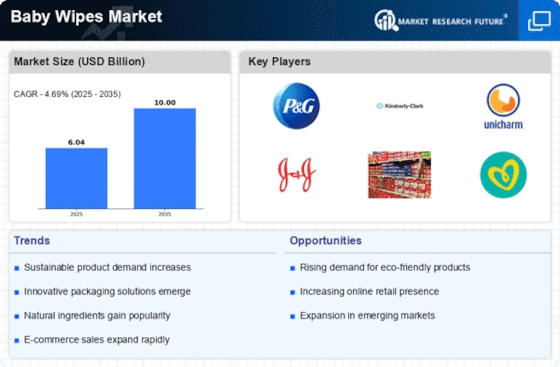
As per Market Research Future analysis, the Baby Wipes Market Size was estimated at 6.04 USD Billion in 2024. The Baby Wipes industry is projected to grow from 6.323 USD Billion in 2025 to 10.0 USD Billion by 2035, exhibiting a compound annual growth rate (CAGR) of 4.69% during the forecast period 2025 - 2035

Key Market Trends & Highlights

The Baby Wipes Market is experiencing a notable shift towards natural and eco-friendly products, driven by consumer preferences and innovations.

  • The market is witnessing a significant shift towards natural ingredients, reflecting growing consumer demand for safer products. Sustainability in packaging is becoming increasingly important, particularly in North America, where eco-conscious consumers are prevalent. E-commerce is rapidly expanding, facilitating greater access to a variety of baby wipe products across different demographics. The rising awareness of hygiene and the increasing demand for convenience are major drivers propelling the growth of standard and flushable wipes.

Market Size & Forecast

2024 Market Size 6.04 (USD Billion)
2035 Market Size 10.0 (USD Billion)
CAGR (2025 - 2035) 4.69%
Largest Regional Market Share in 2024 North America

Major Players

Procter &amp; Gamble (US), Kimberly-Clark (US), Unicharm (JP), Johnson &amp; Johnson (US), Huggies (US), Pampers (US), Burt's Bees (US), Seventh Generation (US), Naty (SE), Babyganics (US)

Market Trends

The Baby Wipes Market is currently experiencing a notable transformation, driven by evolving consumer preferences and increasing awareness regarding hygiene. Parents are increasingly seeking products that not only provide convenience but also ensure safety and environmental sustainability. This shift is prompting manufacturers to innovate and diversify their offerings, leading to a wider range of options available to consumers. The demand for natural and organic ingredients is on the rise, as more caregivers prioritize products that are free from harmful chemicals. This trend reflects a broader societal movement towards healthier lifestyles and eco-friendly choices. In addition to the focus on ingredients, the Baby Wipes Market is witnessing advancements in packaging and product design. Companies are exploring eco-conscious materials and refillable options to reduce waste, aligning with the growing emphasis on sustainability. Furthermore, the rise of e-commerce platforms is reshaping distribution channels, making it easier for consumers to access a variety of products from the comfort of their homes. As the market continues to evolve, it appears that innovation and consumer-centric strategies will play a crucial role in shaping its future trajectory.

Shift Towards Natural Ingredients

There is a growing preference among consumers for baby wipes made from natural and organic materials. This trend indicates a heightened awareness of the potential risks associated with synthetic chemicals, leading parents to seek safer alternatives for their children.

Sustainability in Packaging

Manufacturers are increasingly focusing on sustainable packaging solutions. This trend suggests a commitment to reducing environmental impact, with innovations such as biodegradable materials and refillable options gaining traction in the Baby Wipes Market.

E-commerce Growth

The rise of online shopping is significantly influencing the Baby Wipes Market. This trend highlights a shift in consumer behavior, as more parents opt for the convenience of purchasing baby wipes through e-commerce platforms, enhancing accessibility and variety.

Baby Wipes Market Market Drivers

Rising Awareness of Hygiene

In the baby wipes Market, there is an increasing awareness of hygiene and cleanliness among parents. The emphasis on maintaining high standards of cleanliness for infants has led to a greater reliance on baby wipes, which are perceived as effective tools for ensuring hygiene. This trend is supported by data indicating that the market for baby wipes is expected to reach a valuation of over 5 billion dollars by 2026. The heightened focus on hygiene, particularly in the context of infant care, suggests that parents are more inclined to invest in products that promote health and safety for their children.

Expansion of Retail Channels

The Baby Wipes Market benefits from the expansion of retail channels, which enhances product accessibility for consumers. The proliferation of supermarkets, hypermarkets, and online platforms has made it easier for parents to purchase baby wipes. This increased availability is crucial, as it allows consumers to choose from a wider variety of brands and formulations. Data suggests that e-commerce sales of baby wipes have seen a significant uptick, indicating a shift in purchasing behavior. The convenience of online shopping, coupled with the ability to compare products, is likely to further drive sales in the baby wipes segment.

Increasing Demand for Convenience

The Baby Wipes Market experiences a notable surge in demand for convenience products. Busy lifestyles and the need for quick, efficient solutions for baby care drive parents to seek out baby wipes as a practical alternative to traditional cleaning methods. This trend is particularly pronounced among working parents who prioritize time-saving products. According to recent data, the baby wipes segment is projected to grow at a compound annual growth rate of approximately 5.5% over the next few years. This growth reflects a broader consumer preference for products that simplify daily routines, thereby enhancing the appeal of baby wipes in the market.

Innovations in Product Formulation

The Baby Wipes Market is witnessing a wave of innovations in product formulation, with manufacturers increasingly focusing on developing wipes that cater to specific needs. This includes hypoallergenic options, wipes infused with natural ingredients, and those designed for sensitive skin. Such innovations not only enhance the product offerings but also align with consumer preferences for safer, gentler products. As a result, the market is likely to see a diversification of product lines, which could attract a broader customer base. The introduction of these specialized products may contribute to an increase in market share for companies that prioritize research and development.

Growing Focus on Eco-Friendly Products

The Baby Wipes Market is increasingly influenced by a growing focus on eco-friendly products. As consumers become more environmentally conscious, there is a rising demand for baby wipes that are biodegradable or made from sustainable materials. This trend is prompting manufacturers to innovate and adapt their product lines to meet these expectations. The market is likely to see a shift towards more sustainable practices, which could enhance brand loyalty among environmentally aware consumers. Companies that successfully integrate eco-friendly initiatives into their product offerings may gain a competitive edge in the evolving landscape of the baby wipes market.

Market Segment Insights

By Type: Standard Wipes (Largest) vs. Flushable Wipes (Fastest-Growing)

In the Baby Wipes Market, Standard Wipes hold the largest share, noted for their widespread availability and affordability, making them a staple for many consumers. They cater to a broad audience due to their versatile use for baby care and general hygiene. Conversely, Flushable Wipes are gaining traction, capturing attention for their convenience and environmental appeal, appealing especially to eco-conscious parents.

Flushable Wipes (Dominant) vs. Hypoallergenic Wipes (Emerging)

Flushable Wipes dominate the market as a preferred choice for parents who value ease of use and disposal, allowing for a convenient cleaning solution on-the-go. These wipes are designed to disintegrate in water, offering an eco-friendly alternative to traditional wipes. Hypoallergenic Wipes, on the other hand, are emerging as a critical segment as more consumers seek products that minimize skin irritation and allergies. These wipes often contain fewer chemicals and natural ingredients, appealing to health-conscious parents seeking safe options for their babies.

By Material: Non-Woven Fabric (Largest) vs. Cotton (Fastest-Growing)

In the Baby Wipes Market, the material segment showcases a diverse range of options with Non-Woven Fabric leading in market share due to its cost-effectiveness, softness, and versatility. Non-Woven Fabric wipes are preferred by manufacturers and consumers alike, resulting in significant adoption across various demographic segments. Cotton, on the other hand, is gaining traction, especially among health-conscious consumers seeking natural and gentler alternatives for their baby’s sensitive skin. The growth trends indicate a strong preference for eco-friendly and biodegradable materials, with Cotton experiences rapid growth driven by increasing consumer awareness regarding sustainability and environmental impact. Furthermore, innovations in processing and blending technologies have enhanced product features, making Cotton a stronger contender in the market. The demand for plush, soft wipes is accelerating the preference for Cotton wipes, positioning them as an important player in the baby wipes industry.

Cotton (Dominant) vs. Bamboo (Emerging)

Cotton wipes have emerged as a dominant choice in the Baby Wipes Market due to their hypoallergenic properties and superior softness, attracting parents who prioritize skin safety and comfort for their babies. The familiar, gentle nature of Cotton resonates well with health-conscious consumers, further solidifying its robust position. On the other hand, Bamboo wipes are viewed as an emerging segment, gaining popularity for their sustainable characteristics. Bamboo is known for being biodegradable and causing less environmental strain compared to conventional materials. With growing awareness about ecological impacts and increasing consumer demand for green products, Bamboo is attracting interest, especially among environmentally conscious parents. While Cotton remains a staple, Bamboo's rise signifies a shift towards sustainability in the baby care product landscape.

By Distribution Channel: Supermarkets (Largest) vs. Online Retail (Fastest-Growing)

The distribution of baby wipes across various channels has shown a diverse landscape. Currently, supermarkets dominate the market, providing readily accessible products to consumers. Following closely are pharmacies and <a href="https://www.marketresearchfuture.com/reports/convenience-stores-market-22842" target="_blank" rel="noopener">convenience stores</a>, which cater to niche markets. Online retail, while still a smaller percentage of the market, is gaining significant traction due to convenience and accessibility. Consumers are increasingly turning to e-commerce platforms for their baby care needs, making this segment an exciting area of growth.

Supermarkets (Dominant) vs. Online Retail (Emerging)

Supermarkets play a pivotal role in the baby wipes market, offering a wide range of products under one roof, attracting price-sensitive consumers with promotions and bulk deals. Their dominant position is bolstered by established relationships with suppliers and effective inventory management. In contrast, online retail is emerging rapidly, appealing to tech-savvy parents who prioritize convenience and are more inclined to research and compare products before making purchases. This segment is characterized by personalized shopping experiences and targeted marketing strategies, positioning it as a strong competitor in the years to come.

By End Use: Household (Largest) vs. Healthcare (Fastest-Growing)

In the Baby Wipes Market, the end use segment is dominated by the Household sector, which accounts for the largest share of demand due to the continued reliance on baby wipes for everyday hygiene and convenience use. The Commercial segment follows, with its application in restaurants, cafes, and other retail environments, but it remains significantly smaller compared to households. The Healthcare segment, while smaller, is witnessing rapid growth as healthcare facilities increasingly adopt baby wipes for their hygiene benefits, particularly in pediatric and outpatient settings.

Household (Dominant) vs. Healthcare (Emerging)

The Household segment of the Baby Wipes Market stands out as the dominant force, driven by its widespread acceptance among parents who prioritize convenience and hygiene for their infants. These products are often used for diaper changes, face cleaning, and general mess cleanup, leading to consistent demand. Conversely, the Healthcare segment is emerging, fueled by the rising awareness of hygiene standards within medical settings. Hospitals and clinics are now favoring specialized baby wipes designed for sensitive skin, acknowledging their efficacy in preventing infections and offering gentle care for infants, thereby enhancing their market presence.

Get more detailed insights about Baby Wipes Market Research Report – Global Forecast till 2035

Regional Insights

The Baby Wipes Market demonstrated varied performance across different regions, with North America leading as a significant contributor, valued at 2.2 USD Billion in 2024 and expected to reach 3.5 USD Billion by 2035. This dominance was driven by high consumer awareness and preference for hygiene products.

Following closely, Europe held a valuation of 1.5 USD Billion in 2024, rising to 2.3 USD Billion by 2035, reflecting growing trends towards convenience and eco-friendly options.

The Asia Pacific region, valued at 1.54 USD Billion in 2024 and projected to grow to 2.5 USD Billion in 2035, was rapidly expanding due to rising birth rates and increasing urbanization, whereas South America, at 0.6 USD Billion in 2024, shows potential growth to 1.0 USD Billion by 2035, mainly linked to improving retail landscapes.

The Middle East and Africa remained the smallest segment at 0.2 USD Billion in 2024, with aspirations to grow to 0.7 USD Billion, driven by increasing demand for baby care products amidst a growing population.

These regional variations in the Baby Wipes Market revenue highlighted distinct consumer behaviors and preferences, providing insights into marketing strategies and investment opportunities within these markets.

Key Players and Competitive Insights

The Baby Wipes Market has witnessed significant growth driven by the increasing demand for convenient and hygienic baby care products. With a surge in consumer awareness regarding hygiene and cleanliness, various brands are focusing on the production of high-quality baby wipes that meet diverse needs. This market is characterized by a mix of established players and emerging brands, each vying to capture market share through product innovation, aggressive marketing strategies, and consumer engagement. Companies in this sector are increasingly emphasizing environmentally friendly products and sustainable practices to attract eco-conscious consumers. The competitive landscape sees brands exploring new distribution channels, enhancing online presence, and engaging in partnerships or collaborations to enhance brand visibility and market reach. Johnson and Johnson stands out prominently in the Baby Wipes Market due to its extensive product portfolio and robust brand reputation. The company leverages its established market presence and deep understanding of consumer preferences to tailor its offerings effectively. With a strong emphasis on quality and safety, Johnson and Johnson's baby wipes are favored by many parents who seek reliable and gentle options for their babies. The company benefits from significant investments in research and development, allowing them to innovate and expand their product line continually. Their strong distribution network ensures widespread availability, making them a preferred choice among consumers globally. Moreover, the trust associated with the Johnson and Johnson brand significantly contributes to its competitive edge within the baby care segment. Babyganics has carved a niche in the Baby Wipes Market by focusing on providing safe, natural, and effective baby care products. The company is recognized for its commitment to creating baby wipes made from plant-based materials and free from harmful chemicals, appealing to health-conscious consumers. Babyganics offers a range of products that are not only popular among parents for their efficacy but also for their environmentally friendly attributes. This strategic positioning in the market aligns with the growing demand for natural products, solidifying Babyganics' brand image. Additionally, the company actively engages in marketing campaigns highlighting the safety of its products, thus enhancing consumer trust. Although the company has faced challenges in the competitive landscape, its focus on sustainable practices and quality continues to drive its growth in the market.

Key Companies in the Baby Wipes Market include

Industry Developments

Child Care

Future Outlook

Baby Wipes Market Future Outlook

The Baby Wipes Market is projected to grow at a 4.69% CAGR from 2025 to 2035, driven by increasing consumer demand for convenience and eco-friendly products.

New opportunities lie in:

  • <p>Expansion into biodegradable and sustainable product lines Development of subscription-based delivery services Partnerships with e-commerce platforms for enhanced distribution</p>

By 2035, the Baby Wipes Market is expected to achieve robust growth, reflecting evolving consumer preferences.

Market Segmentation

Baby Wipes Market Type Outlook

  • Standard Wipes
  • Flushable Wipes
  • Hypoallergenic Wipes
  • Antibacterial Wipes

Baby Wipes Market End Use Outlook

  • Household
  • Commercial
  • Healthcare

Baby Wipes Market Material Outlook

  • Cotton
  • Non-Woven Fabric
  • Bamboo
  • Polyester

Baby Wipes Market Distribution Channel Outlook

  • Supermarkets
  • Online Retail
  • Pharmacies
  • Convenience Stores

Report Scope

MARKET SIZE 2024 6.04(USD Billion)
MARKET SIZE 2025 6.323(USD Billion)
MARKET SIZE 2035 10.0(USD Billion)
COMPOUND ANNUAL GROWTH RATE (CAGR) 4.69% (2025 - 2035)
REPORT COVERAGE Revenue Forecast, Competitive Landscape, Growth Factors, and Trends
BASE YEAR 2024
Market Forecast Period 2025 - 2035
Historical Data 2019 - 2024
Market Forecast Units USD Billion
Key Companies Profiled Procter & Gamble (US), Kimberly-Clark (US), Unicharm (JP), Johnson & Johnson (US), Huggies (US), Pampers (US), Burt's Bees (US), Seventh Generation (US), Naty (SE), Babyganics (US)
Segments Covered Wipes Market Size, Share, Industry Trend & Analysis Research Report By Type, Material, Distribution Channel, End Use, Regional
Key Market Opportunities Growing demand for eco-friendly and biodegradable options in the Baby Wipes Market presents significant opportunities.
Key Market Dynamics Rising consumer preference for eco-friendly products drives innovation and competition in the baby wipes market.
Countries Covered North America, Europe, APAC, South America, MEA

FAQs

What is the current valuation of the Baby Wipes Market as of 2024?

<p>The Baby Wipes Market was valued at 6.04 USD Billion in 2024.</p>

What is the projected market size for the Baby Wipes Market in 2035?

<p>The Baby Wipes Market is projected to reach 10.0 USD Billion by 2035.</p>

What is the expected CAGR for the Baby Wipes Market during the forecast period 2025 - 2035?

<p>The expected CAGR for the Baby Wipes Market during the forecast period 2025 - 2035 is 4.69%.</p>

Which companies are considered key players in the Baby Wipes Market?

<p>Key players in the Baby Wipes Market include Procter & Gamble, Kimberly-Clark, Unicharm, Johnson & Johnson, Huggies, Pampers, Burt's Bees, Seventh Generation, Naty, and Babyganics.</p>

What are the different types of baby wipes available in the market?

<p>The Baby Wipes Market includes various types such as Standard Wipes, Flushable Wipes, Hypoallergenic Wipes, and Antibacterial Wipes.</p>

How did the valuation of Standard Wipes change from 2024 to 2035?

<p>The valuation of Standard Wipes increased from 2.5 USD Billion in 2024 to a projected 4.0 USD Billion in 2035.</p>

What materials are commonly used in the production of baby wipes?

<p>Common materials used in baby wipes include Cotton, Non-Woven Fabric, Bamboo, and Polyester.</p>

What distribution channels are utilized for baby wipes sales?

<p>Baby wipes are distributed through various channels, including Supermarkets, Online Retail, Pharmacies, and Convenience Stores.</p>

What is the projected growth for the Commercial end-use segment of baby wipes by 2035?

<p>The Commercial end-use segment of baby wipes is expected to grow from 1.21 USD Billion in 2024 to 2.0 USD Billion by 2035.</p>

How does the market for Hypoallergenic Wipes compare to other types in terms of valuation?

<p>Hypoallergenic Wipes had a valuation of 1.0 USD Billion in 2024 and is projected to reach 1.5 USD Billion by 2035, indicating steady growth.</p>

  1. SECTION I: EXECUTIVE SUMMARY AND KEY HIGHLIGHTS
    1. | 1.1 EXECUTIVE SUMMARY
    2. | | 1.1.1 Market Overview
    3. | | 1.1.2 Key Findings
    4. | | 1.1.3 Market Segmentation
    5. | | 1.1.4 Competitive Landscape
    6. | | 1.1.5 Challenges and Opportunities
    7. | | 1.1.6 Future Outlook
  2. SECTION II: SCOPING, METHODOLOGY AND MARKET STRUCTURE
    1. | 2.1 MARKET INTRODUCTION
    2. | | 2.1.1 Definition
    3. | | 2.1.2 Scope of the study
    4. | | | 2.1.2.1 Research Objective
    5. | | | 2.1.2.2 Assumption
    6. | | | 2.1.2.3 Limitations
    7. | 2.2 RESEARCH METHODOLOGY
    8. | | 2.2.1 Overview
    9. | | 2.2.2 Data Mining
    10. | | 2.2.3 Secondary Research
    11. | | 2.2.4 Primary Research
    12. | | | 2.2.4.1 Primary Interviews and Information Gathering Process
    13. | | | 2.2.4.2 Breakdown of Primary Respondents
    14. | | 2.2.5 Forecasting Model
    15. | | 2.2.6 Market Size Estimation
    16. | | | 2.2.6.1 Bottom-Up Approach
    17. | | | 2.2.6.2 Top-Down Approach
    18. | | 2.2.7 Data Triangulation
    19. | | 2.2.8 Validation
  3. SECTION III: QUALITATIVE ANALYSIS
    1. | 3.1 MARKET DYNAMICS
    2. | | 3.1.1 Overview
    3. | | 3.1.2 Drivers
    4. | | 3.1.3 Restraints
    5. | | 3.1.4 Opportunities
    6. | 3.2 MARKET FACTOR ANALYSIS
    7. | | 3.2.1 Value chain Analysis
    8. | | 3.2.2 Porter's Five Forces Analysis
    9. | | | 3.2.2.1 Bargaining Power of Suppliers
    10. | | | 3.2.2.2 Bargaining Power of Buyers
    11. | | | 3.2.2.3 Threat of New Entrants
    12. | | | 3.2.2.4 Threat of Substitutes
    13. | | | 3.2.2.5 Intensity of Rivalry
    14. | | 3.2.3 COVID-19 Impact Analysis
    15. | | | 3.2.3.1 Market Impact Analysis
    16. | | | 3.2.3.2 Regional Impact
    17. | | | 3.2.3.3 Opportunity and Threat Analysis
  4. SECTION IV: QUANTITATIVE ANALYSIS
    1. | 4.1 Consumer and Retail, BY Type (USD Billion)
    2. | | 4.1.1 Standard Wipes
    3. | | 4.1.2 Flushable Wipes
    4. | | 4.1.3 Hypoallergenic Wipes
    5. | | 4.1.4 Antibacterial Wipes
    6. | 4.2 Consumer and Retail, BY Material (USD Billion)
    7. | | 4.2.1 Cotton
    8. | | 4.2.2 Non-Woven Fabric
    9. | | 4.2.3 Bamboo
    10. | | 4.2.4 Polyester
    11. | 4.3 Consumer and Retail, BY Distribution Channel (USD Billion)
    12. | | 4.3.1 Supermarkets
    13. | | 4.3.2 Online Retail
    14. | | 4.3.3 Pharmacies
    15. | | 4.3.4 Convenience Stores
    16. | 4.4 Consumer and Retail, BY End Use (USD Billion)
    17. | | 4.4.1 Household
    18. | | 4.4.2 Commercial
    19. | | 4.4.3 Healthcare
    20. | 4.5 Consumer and Retail, BY Region (USD Billion)
    21. | | 4.5.1 North America
    22. | | | 4.5.1.1 US
    23. | | | 4.5.1.2 Canada
    24. | | 4.5.2 Europe
    25. | | | 4.5.2.1 Germany
    26. | | | 4.5.2.2 UK
    27. | | | 4.5.2.3 France
    28. | | | 4.5.2.4 Russia
    29. | | | 4.5.2.5 Italy
    30. | | | 4.5.2.6 Spain
    31. | | | 4.5.2.7 Rest of Europe
    32. | | 4.5.3 APAC
    33. | | | 4.5.3.1 China
    34. | | | 4.5.3.2 India
    35. | | | 4.5.3.3 Japan
    36. | | | 4.5.3.4 South Korea
    37. | | | 4.5.3.5 Malaysia
    38. | | | 4.5.3.6 Thailand
    39. | | | 4.5.3.7 Indonesia
    40. | | | 4.5.3.8 Rest of APAC
    41. | | 4.5.4 South America
    42. | | | 4.5.4.1 Brazil
    43. | | | 4.5.4.2 Mexico
    44. | | | 4.5.4.3 Argentina
    45. | | | 4.5.4.4 Rest of South America
    46. | | 4.5.5 MEA
    47. | | | 4.5.5.1 GCC Countries
    48. | | | 4.5.5.2 South Africa
    49. | | | 4.5.5.3 Rest of MEA
  5. SECTION V: COMPETITIVE ANALYSIS
    1. | 5.1 Competitive Landscape
    2. | | 5.1.1 Overview
    3. | | 5.1.2 Competitive Analysis
    4. | | 5.1.3 Market share Analysis
    5. | | 5.1.4 Major Growth Strategy in the Consumer and Retail
    6. | | 5.1.5 Competitive Benchmarking
    7. | | 5.1.6 Leading Players in Terms of Number of Developments in the Consumer and Retail
    8. | | 5.1.7 Key developments and growth strategies
    9. | | | 5.1.7.1 New Product Launch/Service Deployment
    10. | | | 5.1.7.2 Merger & Acquisitions
    11. | | | 5.1.7.3 Joint Ventures
    12. | | 5.1.8 Major Players Financial Matrix
    13. | | | 5.1.8.1 Sales and Operating Income
    14. | | | 5.1.8.2 Major Players R&D Expenditure. 2023
    15. | 5.2 Company Profiles
    16. | | 5.2.1 Procter & Gamble (US)
    17. | | | 5.2.1.1 Financial Overview
    18. | | | 5.2.1.2 Products Offered
    19. | | | 5.2.1.3 Key Developments
    20. | | | 5.2.1.4 SWOT Analysis
    21. | | | 5.2.1.5 Key Strategies
    22. | | 5.2.2 Kimberly-Clark (US)
    23. | | | 5.2.2.1 Financial Overview
    24. | | | 5.2.2.2 Products Offered
    25. | | | 5.2.2.3 Key Developments
    26. | | | 5.2.2.4 SWOT Analysis
    27. | | | 5.2.2.5 Key Strategies
    28. | | 5.2.3 Unicharm (JP)
    29. | | | 5.2.3.1 Financial Overview
    30. | | | 5.2.3.2 Products Offered
    31. | | | 5.2.3.3 Key Developments
    32. | | | 5.2.3.4 SWOT Analysis
    33. | | | 5.2.3.5 Key Strategies
    34. | | 5.2.4 Johnson & Johnson (US)
    35. | | | 5.2.4.1 Financial Overview
    36. | | | 5.2.4.2 Products Offered
    37. | | | 5.2.4.3 Key Developments
    38. | | | 5.2.4.4 SWOT Analysis
    39. | | | 5.2.4.5 Key Strategies
    40. | | 5.2.5 Huggies (US)
    41. | | | 5.2.5.1 Financial Overview
    42. | | | 5.2.5.2 Products Offered
    43. | | | 5.2.5.3 Key Developments
    44. | | | 5.2.5.4 SWOT Analysis
    45. | | | 5.2.5.5 Key Strategies
    46. | | 5.2.6 Pampers (US)
    47. | | | 5.2.6.1 Financial Overview
    48. | | | 5.2.6.2 Products Offered
    49. | | | 5.2.6.3 Key Developments
    50. | | | 5.2.6.4 SWOT Analysis
    51. | | | 5.2.6.5 Key Strategies
    52. | | 5.2.7 Burt's Bees (US)
    53. | | | 5.2.7.1 Financial Overview
    54. | | | 5.2.7.2 Products Offered
    55. | | | 5.2.7.3 Key Developments
    56. | | | 5.2.7.4 SWOT Analysis
    57. | | | 5.2.7.5 Key Strategies
    58. | | 5.2.8 Seventh Generation (US)
    59. | | | 5.2.8.1 Financial Overview
    60. | | | 5.2.8.2 Products Offered
    61. | | | 5.2.8.3 Key Developments
    62. | | | 5.2.8.4 SWOT Analysis
    63. | | | 5.2.8.5 Key Strategies
    64. | | 5.2.9 Naty (SE)
    65. | | | 5.2.9.1 Financial Overview
    66. | | | 5.2.9.2 Products Offered
    67. | | | 5.2.9.3 Key Developments
    68. | | | 5.2.9.4 SWOT Analysis
    69. | | | 5.2.9.5 Key Strategies
    70. | | 5.2.10 Babyganics (US)
    71. | | | 5.2.10.1 Financial Overview
    72. | | | 5.2.10.2 Products Offered
    73. | | | 5.2.10.3 Key Developments
    74. | | | 5.2.10.4 SWOT Analysis
    75. | | | 5.2.10.5 Key Strategies
    76. | 5.3 Appendix
    77. | | 5.3.1 References
    78. | | 5.3.2 Related Reports
  6. LIST OF FIGURES
    1. | 6.1 MARKET SYNOPSIS
    2. | 6.2 NORTH AMERICA MARKET ANALYSIS
    3. | 6.3 US MARKET ANALYSIS BY TYPE
    4. | 6.4 US MARKET ANALYSIS BY MATERIAL
    5. | 6.5 US MARKET ANALYSIS BY DISTRIBUTION CHANNEL
    6. | 6.6 US MARKET ANALYSIS BY END USE
    7. | 6.7 CANADA MARKET ANALYSIS BY TYPE
    8. | 6.8 CANADA MARKET ANALYSIS BY MATERIAL
    9. | 6.9 CANADA MARKET ANALYSIS BY DISTRIBUTION CHANNEL
    10. | 6.10 CANADA MARKET ANALYSIS BY END USE
    11. | 6.11 EUROPE MARKET ANALYSIS
    12. | 6.12 GERMANY MARKET ANALYSIS BY TYPE
    13. | 6.13 GERMANY MARKET ANALYSIS BY MATERIAL
    14. | 6.14 GERMANY MARKET ANALYSIS BY DISTRIBUTION CHANNEL
    15. | 6.15 GERMANY MARKET ANALYSIS BY END USE
    16. | 6.16 UK MARKET ANALYSIS BY TYPE
    17. | 6.17 UK MARKET ANALYSIS BY MATERIAL
    18. | 6.18 UK MARKET ANALYSIS BY DISTRIBUTION CHANNEL
    19. | 6.19 UK MARKET ANALYSIS BY END USE
    20. | 6.20 FRANCE MARKET ANALYSIS BY TYPE
    21. | 6.21 FRANCE MARKET ANALYSIS BY MATERIAL
    22. | 6.22 FRANCE MARKET ANALYSIS BY DISTRIBUTION CHANNEL
    23. | 6.23 FRANCE MARKET ANALYSIS BY END USE
    24. | 6.24 RUSSIA MARKET ANALYSIS BY TYPE
    25. | 6.25 RUSSIA MARKET ANALYSIS BY MATERIAL
    26. | 6.26 RUSSIA MARKET ANALYSIS BY DISTRIBUTION CHANNEL
    27. | 6.27 RUSSIA MARKET ANALYSIS BY END USE
    28. | 6.28 ITALY MARKET ANALYSIS BY TYPE
    29. | 6.29 ITALY MARKET ANALYSIS BY MATERIAL
    30. | 6.30 ITALY MARKET ANALYSIS BY DISTRIBUTION CHANNEL
    31. | 6.31 ITALY MARKET ANALYSIS BY END USE
    32. | 6.32 SPAIN MARKET ANALYSIS BY TYPE
    33. | 6.33 SPAIN MARKET ANALYSIS BY MATERIAL
    34. | 6.34 SPAIN MARKET ANALYSIS BY DISTRIBUTION CHANNEL
    35. | 6.35 SPAIN MARKET ANALYSIS BY END USE
    36. | 6.36 REST OF EUROPE MARKET ANALYSIS BY TYPE
    37. | 6.37 REST OF EUROPE MARKET ANALYSIS BY MATERIAL
    38. | 6.38 REST OF EUROPE MARKET ANALYSIS BY DISTRIBUTION CHANNEL
    39. | 6.39 REST OF EUROPE MARKET ANALYSIS BY END USE
    40. | 6.40 APAC MARKET ANALYSIS
    41. | 6.41 CHINA MARKET ANALYSIS BY TYPE
    42. | 6.42 CHINA MARKET ANALYSIS BY MATERIAL
    43. | 6.43 CHINA MARKET ANALYSIS BY DISTRIBUTION CHANNEL
    44. | 6.44 CHINA MARKET ANALYSIS BY END USE
    45. | 6.45 INDIA MARKET ANALYSIS BY TYPE
    46. | 6.46 INDIA MARKET ANALYSIS BY MATERIAL
    47. | 6.47 INDIA MARKET ANALYSIS BY DISTRIBUTION CHANNEL
    48. | 6.48 INDIA MARKET ANALYSIS BY END USE
    49. | 6.49 JAPAN MARKET ANALYSIS BY TYPE
    50. | 6.50 JAPAN MARKET ANALYSIS BY MATERIAL
    51. | 6.51 JAPAN MARKET ANALYSIS BY DISTRIBUTION CHANNEL
    52. | 6.52 JAPAN MARKET ANALYSIS BY END USE
    53. | 6.53 SOUTH KOREA MARKET ANALYSIS BY TYPE
    54. | 6.54 SOUTH KOREA MARKET ANALYSIS BY MATERIAL
    55. | 6.55 SOUTH KOREA MARKET ANALYSIS BY DISTRIBUTION CHANNEL
    56. | 6.56 SOUTH KOREA MARKET ANALYSIS BY END USE
    57. | 6.57 MALAYSIA MARKET ANALYSIS BY TYPE
    58. | 6.58 MALAYSIA MARKET ANALYSIS BY MATERIAL
    59. | 6.59 MALAYSIA MARKET ANALYSIS BY DISTRIBUTION CHANNEL
    60. | 6.60 MALAYSIA MARKET ANALYSIS BY END USE
    61. | 6.61 THAILAND MARKET ANALYSIS BY TYPE
    62. | 6.62 THAILAND MARKET ANALYSIS BY MATERIAL
    63. | 6.63 THAILAND MARKET ANALYSIS BY DISTRIBUTION CHANNEL
    64. | 6.64 THAILAND MARKET ANALYSIS BY END USE
    65. | 6.65 INDONESIA MARKET ANALYSIS BY TYPE
    66. | 6.66 INDONESIA MARKET ANALYSIS BY MATERIAL
    67. | 6.67 INDONESIA MARKET ANALYSIS BY DISTRIBUTION CHANNEL
    68. | 6.68 INDONESIA MARKET ANALYSIS BY END USE
    69. | 6.69 REST OF APAC MARKET ANALYSIS BY TYPE
    70. | 6.70 REST OF APAC MARKET ANALYSIS BY MATERIAL
    71. | 6.71 REST OF APAC MARKET ANALYSIS BY DISTRIBUTION CHANNEL
    72. | 6.72 REST OF APAC MARKET ANALYSIS BY END USE
    73. | 6.73 SOUTH AMERICA MARKET ANALYSIS
    74. | 6.74 BRAZIL MARKET ANALYSIS BY TYPE
    75. | 6.75 BRAZIL MARKET ANALYSIS BY MATERIAL
    76. | 6.76 BRAZIL MARKET ANALYSIS BY DISTRIBUTION CHANNEL
    77. | 6.77 BRAZIL MARKET ANALYSIS BY END USE
    78. | 6.78 MEXICO MARKET ANALYSIS BY TYPE
    79. | 6.79 MEXICO MARKET ANALYSIS BY MATERIAL
    80. | 6.80 MEXICO MARKET ANALYSIS BY DISTRIBUTION CHANNEL
    81. | 6.81 MEXICO MARKET ANALYSIS BY END USE
    82. | 6.82 ARGENTINA MARKET ANALYSIS BY TYPE
    83. | 6.83 ARGENTINA MARKET ANALYSIS BY MATERIAL
    84. | 6.84 ARGENTINA MARKET ANALYSIS BY DISTRIBUTION CHANNEL
    85. | 6.85 ARGENTINA MARKET ANALYSIS BY END USE
    86. | 6.86 REST OF SOUTH AMERICA MARKET ANALYSIS BY TYPE
    87. | 6.87 REST OF SOUTH AMERICA MARKET ANALYSIS BY MATERIAL
    88. | 6.88 REST OF SOUTH AMERICA MARKET ANALYSIS BY DISTRIBUTION CHANNEL
    89. | 6.89 REST OF SOUTH AMERICA MARKET ANALYSIS BY END USE
    90. | 6.90 MEA MARKET ANALYSIS
    91. | 6.91 GCC COUNTRIES MARKET ANALYSIS BY TYPE
    92. | 6.92 GCC COUNTRIES MARKET ANALYSIS BY MATERIAL
    93. | 6.93 GCC COUNTRIES MARKET ANALYSIS BY DISTRIBUTION CHANNEL
    94. | 6.94 GCC COUNTRIES MARKET ANALYSIS BY END USE
    95. | 6.95 SOUTH AFRICA MARKET ANALYSIS BY TYPE
    96. | 6.96 SOUTH AFRICA MARKET ANALYSIS BY MATERIAL
    97. | 6.97 SOUTH AFRICA MARKET ANALYSIS BY DISTRIBUTION CHANNEL
    98. | 6.98 SOUTH AFRICA MARKET ANALYSIS BY END USE
    99. | 6.99 REST OF MEA MARKET ANALYSIS BY TYPE
    100. | 6.100 REST OF MEA MARKET ANALYSIS BY MATERIAL
    101. | 6.101 REST OF MEA MARKET ANALYSIS BY DISTRIBUTION CHANNEL
    102. | 6.102 REST OF MEA MARKET ANALYSIS BY END USE
    103. | 6.103 KEY BUYING CRITERIA OF CONSUMER AND RETAIL
    104. | 6.104 RESEARCH PROCESS OF MRFR
    105. | 6.105 DRO ANALYSIS OF CONSUMER AND RETAIL
    106. | 6.106 DRIVERS IMPACT ANALYSIS: CONSUMER AND RETAIL
    107. | 6.107 RESTRAINTS IMPACT ANALYSIS: CONSUMER AND RETAIL
    108. | 6.108 SUPPLY / VALUE CHAIN: CONSUMER AND RETAIL
    109. | 6.109 CONSUMER AND RETAIL, BY TYPE, 2024 (% SHARE)
    110. | 6.110 CONSUMER AND RETAIL, BY TYPE, 2024 TO 2035 (USD Billion)
    111. | 6.111 CONSUMER AND RETAIL, BY MATERIAL, 2024 (% SHARE)
    112. | 6.112 CONSUMER AND RETAIL, BY MATERIAL, 2024 TO 2035 (USD Billion)
    113. | 6.113 CONSUMER AND RETAIL, BY DISTRIBUTION CHANNEL, 2024 (% SHARE)
    114. | 6.114 CONSUMER AND RETAIL, BY DISTRIBUTION CHANNEL, 2024 TO 2035 (USD Billion)
    115. | 6.115 CONSUMER AND RETAIL, BY END USE, 2024 (% SHARE)
    116. | 6.116 CONSUMER AND RETAIL, BY END USE, 2024 TO 2035 (USD Billion)
    117. | 6.117 BENCHMARKING OF MAJOR COMPETITORS
  7. LIST OF TABLES
    1. | 7.1 LIST OF ASSUMPTIONS
    2. | | 7.1.1
    3. | 7.2 North America MARKET SIZE ESTIMATES; FORECAST
    4. | | 7.2.1 BY TYPE, 2025-2035 (USD Billion)
    5. | | 7.2.2 BY MATERIAL, 2025-2035 (USD Billion)
    6. | | 7.2.3 BY DISTRIBUTION CHANNEL, 2025-2035 (USD Billion)
    7. | | 7.2.4 BY END USE, 2025-2035 (USD Billion)
    8. | 7.3 US MARKET SIZE ESTIMATES; FORECAST
    9. | | 7.3.1 BY TYPE, 2025-2035 (USD Billion)
    10. | | 7.3.2 BY MATERIAL, 2025-2035 (USD Billion)
    11. | | 7.3.3 BY DISTRIBUTION CHANNEL, 2025-2035 (USD Billion)
    12. | | 7.3.4 BY END USE, 2025-2035 (USD Billion)
    13. | 7.4 Canada MARKET SIZE ESTIMATES; FORECAST
    14. | | 7.4.1 BY TYPE, 2025-2035 (USD Billion)
    15. | | 7.4.2 BY MATERIAL, 2025-2035 (USD Billion)
    16. | | 7.4.3 BY DISTRIBUTION CHANNEL, 2025-2035 (USD Billion)
    17. | | 7.4.4 BY END USE, 2025-2035 (USD Billion)
    18. | 7.5 Europe MARKET SIZE ESTIMATES; FORECAST
    19. | | 7.5.1 BY TYPE, 2025-2035 (USD Billion)
    20. | | 7.5.2 BY MATERIAL, 2025-2035 (USD Billion)
    21. | | 7.5.3 BY DISTRIBUTION CHANNEL, 2025-2035 (USD Billion)
    22. | | 7.5.4 BY END USE, 2025-2035 (USD Billion)
    23. | 7.6 Germany MARKET SIZE ESTIMATES; FORECAST
    24. | | 7.6.1 BY TYPE, 2025-2035 (USD Billion)
    25. | | 7.6.2 BY MATERIAL, 2025-2035 (USD Billion)
    26. | | 7.6.3 BY DISTRIBUTION CHANNEL, 2025-2035 (USD Billion)
    27. | | 7.6.4 BY END USE, 2025-2035 (USD Billion)
    28. | 7.7 UK MARKET SIZE ESTIMATES; FORECAST
    29. | | 7.7.1 BY TYPE, 2025-2035 (USD Billion)
    30. | | 7.7.2 BY MATERIAL, 2025-2035 (USD Billion)
    31. | | 7.7.3 BY DISTRIBUTION CHANNEL, 2025-2035 (USD Billion)
    32. | | 7.7.4 BY END USE, 2025-2035 (USD Billion)
    33. | 7.8 France MARKET SIZE ESTIMATES; FORECAST
    34. | | 7.8.1 BY TYPE, 2025-2035 (USD Billion)
    35. | | 7.8.2 BY MATERIAL, 2025-2035 (USD Billion)
    36. | | 7.8.3 BY DISTRIBUTION CHANNEL, 2025-2035 (USD Billion)
    37. | | 7.8.4 BY END USE, 2025-2035 (USD Billion)
    38. | 7.9 Russia MARKET SIZE ESTIMATES; FORECAST
    39. | | 7.9.1 BY TYPE, 2025-2035 (USD Billion)
    40. | | 7.9.2 BY MATERIAL, 2025-2035 (USD Billion)
    41. | | 7.9.3 BY DISTRIBUTION CHANNEL, 2025-2035 (USD Billion)
    42. | | 7.9.4 BY END USE, 2025-2035 (USD Billion)
    43. | 7.10 Italy MARKET SIZE ESTIMATES; FORECAST
    44. | | 7.10.1 BY TYPE, 2025-2035 (USD Billion)
    45. | | 7.10.2 BY MATERIAL, 2025-2035 (USD Billion)
    46. | | 7.10.3 BY DISTRIBUTION CHANNEL, 2025-2035 (USD Billion)
    47. | | 7.10.4 BY END USE, 2025-2035 (USD Billion)
    48. | 7.11 Spain MARKET SIZE ESTIMATES; FORECAST
    49. | | 7.11.1 BY TYPE, 2025-2035 (USD Billion)
    50. | | 7.11.2 BY MATERIAL, 2025-2035 (USD Billion)
    51. | | 7.11.3 BY DISTRIBUTION CHANNEL, 2025-2035 (USD Billion)
    52. | | 7.11.4 BY END USE, 2025-2035 (USD Billion)
    53. | 7.12 Rest of Europe MARKET SIZE ESTIMATES; FORECAST
    54. | | 7.12.1 BY TYPE, 2025-2035 (USD Billion)
    55. | | 7.12.2 BY MATERIAL, 2025-2035 (USD Billion)
    56. | | 7.12.3 BY DISTRIBUTION CHANNEL, 2025-2035 (USD Billion)
    57. | | 7.12.4 BY END USE, 2025-2035 (USD Billion)
    58. | 7.13 APAC MARKET SIZE ESTIMATES; FORECAST
    59. | | 7.13.1 BY TYPE, 2025-2035 (USD Billion)
    60. | | 7.13.2 BY MATERIAL, 2025-2035 (USD Billion)
    61. | | 7.13.3 BY DISTRIBUTION CHANNEL, 2025-2035 (USD Billion)
    62. | | 7.13.4 BY END USE, 2025-2035 (USD Billion)
    63. | 7.14 China MARKET SIZE ESTIMATES; FORECAST
    64. | | 7.14.1 BY TYPE, 2025-2035 (USD Billion)
    65. | | 7.14.2 BY MATERIAL, 2025-2035 (USD Billion)
    66. | | 7.14.3 BY DISTRIBUTION CHANNEL, 2025-2035 (USD Billion)
    67. | | 7.14.4 BY END USE, 2025-2035 (USD Billion)
    68. | 7.15 India MARKET SIZE ESTIMATES; FORECAST
    69. | | 7.15.1 BY TYPE, 2025-2035 (USD Billion)
    70. | | 7.15.2 BY MATERIAL, 2025-2035 (USD Billion)
    71. | | 7.15.3 BY DISTRIBUTION CHANNEL, 2025-2035 (USD Billion)
    72. | | 7.15.4 BY END USE, 2025-2035 (USD Billion)
    73. | 7.16 Japan MARKET SIZE ESTIMATES; FORECAST
    74. | | 7.16.1 BY TYPE, 2025-2035 (USD Billion)
    75. | | 7.16.2 BY MATERIAL, 2025-2035 (USD Billion)
    76. | | 7.16.3 BY DISTRIBUTION CHANNEL, 2025-2035 (USD Billion)
    77. | | 7.16.4 BY END USE, 2025-2035 (USD Billion)
    78. | 7.17 South Korea MARKET SIZE ESTIMATES; FORECAST
    79. | | 7.17.1 BY TYPE, 2025-2035 (USD Billion)
    80. | | 7.17.2 BY MATERIAL, 2025-2035 (USD Billion)
    81. | | 7.17.3 BY DISTRIBUTION CHANNEL, 2025-2035 (USD Billion)
    82. | | 7.17.4 BY END USE, 2025-2035 (USD Billion)
    83. | 7.18 Malaysia MARKET SIZE ESTIMATES; FORECAST
    84. | | 7.18.1 BY TYPE, 2025-2035 (USD Billion)
    85. | | 7.18.2 BY MATERIAL, 2025-2035 (USD Billion)
    86. | | 7.18.3 BY DISTRIBUTION CHANNEL, 2025-2035 (USD Billion)
    87. | | 7.18.4 BY END USE, 2025-2035 (USD Billion)
    88. | 7.19 Thailand MARKET SIZE ESTIMATES; FORECAST
    89. | | 7.19.1 BY TYPE, 2025-2035 (USD Billion)
    90. | | 7.19.2 BY MATERIAL, 2025-2035 (USD Billion)
    91. | | 7.19.3 BY DISTRIBUTION CHANNEL, 2025-2035 (USD Billion)
    92. | | 7.19.4 BY END USE, 2025-2035 (USD Billion)
    93. | 7.20 Indonesia MARKET SIZE ESTIMATES; FORECAST
    94. | | 7.20.1 BY TYPE, 2025-2035 (USD Billion)
    95. | | 7.20.2 BY MATERIAL, 2025-2035 (USD Billion)
    96. | | 7.20.3 BY DISTRIBUTION CHANNEL, 2025-2035 (USD Billion)
    97. | | 7.20.4 BY END USE, 2025-2035 (USD Billion)
    98. | 7.21 Rest of APAC MARKET SIZE ESTIMATES; FORECAST
    99. | | 7.21.1 BY TYPE, 2025-2035 (USD Billion)
    100. | | 7.21.2 BY MATERIAL, 2025-2035 (USD Billion)
    101. | | 7.21.3 BY DISTRIBUTION CHANNEL, 2025-2035 (USD Billion)
    102. | | 7.21.4 BY END USE, 2025-2035 (USD Billion)
    103. | 7.22 South America MARKET SIZE ESTIMATES; FORECAST
    104. | | 7.22.1 BY TYPE, 2025-2035 (USD Billion)
    105. | | 7.22.2 BY MATERIAL, 2025-2035 (USD Billion)
    106. | | 7.22.3 BY DISTRIBUTION CHANNEL, 2025-2035 (USD Billion)
    107. | | 7.22.4 BY END USE, 2025-2035 (USD Billion)
    108. | 7.23 Brazil MARKET SIZE ESTIMATES; FORECAST
    109. | | 7.23.1 BY TYPE, 2025-2035 (USD Billion)
    110. | | 7.23.2 BY MATERIAL, 2025-2035 (USD Billion)
    111. | | 7.23.3 BY DISTRIBUTION CHANNEL, 2025-2035 (USD Billion)
    112. | | 7.23.4 BY END USE, 2025-2035 (USD Billion)
    113. | 7.24 Mexico MARKET SIZE ESTIMATES; FORECAST
    114. | | 7.24.1 BY TYPE, 2025-2035 (USD Billion)
    115. | | 7.24.2 BY MATERIAL, 2025-2035 (USD Billion)
    116. | | 7.24.3 BY DISTRIBUTION CHANNEL, 2025-2035 (USD Billion)
    117. | | 7.24.4 BY END USE, 2025-2035 (USD Billion)
    118. | 7.25 Argentina MARKET SIZE ESTIMATES; FORECAST
    119. | | 7.25.1 BY TYPE, 2025-2035 (USD Billion)
    120. | | 7.25.2 BY MATERIAL, 2025-2035 (USD Billion)
    121. | | 7.25.3 BY DISTRIBUTION CHANNEL, 2025-2035 (USD Billion)
    122. | | 7.25.4 BY END USE, 2025-2035 (USD Billion)
    123. | 7.26 Rest of South America MARKET SIZE ESTIMATES; FORECAST
    124. | | 7.26.1 BY TYPE, 2025-2035 (USD Billion)
    125. | | 7.26.2 BY MATERIAL, 2025-2035 (USD Billion)
    126. | | 7.26.3 BY DISTRIBUTION CHANNEL, 2025-2035 (USD Billion)
    127. | | 7.26.4 BY END USE, 2025-2035 (USD Billion)
    128. | 7.27 MEA MARKET SIZE ESTIMATES; FORECAST
    129. | | 7.27.1 BY TYPE, 2025-2035 (USD Billion)
    130. | | 7.27.2 BY MATERIAL, 2025-2035 (USD Billion)
    131. | | 7.27.3 BY DISTRIBUTION CHANNEL, 2025-2035 (USD Billion)
    132. | | 7.27.4 BY END USE, 2025-2035 (USD Billion)
    133. | 7.28 GCC Countries MARKET SIZE ESTIMATES; FORECAST
    134. | | 7.28.1 BY TYPE, 2025-2035 (USD Billion)
    135. | | 7.28.2 BY MATERIAL, 2025-2035 (USD Billion)
    136. | | 7.28.3 BY DISTRIBUTION CHANNEL, 2025-2035 (USD Billion)
    137. | | 7.28.4 BY END USE, 2025-2035 (USD Billion)
    138. | 7.29 South Africa MARKET SIZE ESTIMATES; FORECAST
    139. | | 7.29.1 BY TYPE, 2025-2035 (USD Billion)
    140. | | 7.29.2 BY MATERIAL, 2025-2035 (USD Billion)
    141. | | 7.29.3 BY DISTRIBUTION CHANNEL, 2025-2035 (USD Billion)
    142. | | 7.29.4 BY END USE, 2025-2035 (USD Billion)
    143. | 7.30 Rest of MEA MARKET SIZE ESTIMATES; FORECAST
    144. | | 7.30.1 BY TYPE, 2025-2035 (USD Billion)
    145. | | 7.30.2 BY MATERIAL, 2025-2035 (USD Billion)
    146. | | 7.30.3 BY DISTRIBUTION CHANNEL, 2025-2035 (USD Billion)
    147. | | 7.30.4 BY END USE, 2025-2035 (USD Billion)
    148. | 7.31 PRODUCT LAUNCH/PRODUCT DEVELOPMENT/APPROVAL
    149. | | 7.31.1
    150. | 7.32 ACQUISITION/PARTNERSHIP
    151. | | 7.32.1

Consumer and Retail Market Segmentation

Consumer and Retail By Type (USD Billion, 2025-2035)

  • Standard Wipes
  • Flushable Wipes
  • Hypoallergenic Wipes
  • Antibacterial Wipes

Consumer and Retail By Material (USD Billion, 2025-2035)

  • Cotton
  • Non-Woven Fabric
  • Bamboo
  • Polyester

Consumer and Retail By Distribution Channel (USD Billion, 2025-2035)

  • Supermarkets
  • Online Retail
  • Pharmacies
  • Convenience Stores

Consumer and Retail By End Use (USD Billion, 2025-2035)

  • Household
  • Commercial
  • Healthcare
Infographic

Free Sample Request

Kindly complete the form below to receive a free sample of this Report

Get Free Sample

Customer Strories

Compare Licence

×
Features License Type
Single User Multiuser License Enterprise User
Price $4,950 $5,950 $7,250
Maximum User Access Limit 1 User Upto 10 Users Unrestricted Access Throughout the Organization
Free Customization
Direct Access to Analyst
Deliverable Format
Platform Access
Discount on Next Purchase 10% 15% 15%
Printable Versions
%>