×
Request Free Sample ×

Kindly complete the form below to receive a free sample of this Report

* Please use a valid business email

Leading companies partner with us for data-driven Insights

clients tt-cursor
Hero Background
English
Chinese
French
Japanese
Korean
German
Spanish

Baby Cradle Market Trends

ID: MRFR/CG/9301-HCR
128 Pages
Snehal Singh
February 2026

Baby Cradle Market Size, Share, Industry Trend & Analysis Research Report Information by Product Type (Hammock Cradle and Rocking Cradle), Material Type (Fabric, Metal, and Wood), Shape (Rectangular, Round, and Oval), Category (Manual, and Electric), Distribution Channel (Store-Based [Supermarkets & Hypermarkets, Convenience Stores, and Others] and Non-Store-Based), and Region (North America, Europe, Asia-Pacific, and Rest of the World)-Forecast till 2028

Share:
Download PDF ×

We do not share your information with anyone. However, we may send you emails based on your report interest from time to time. You may contact us at any time to opt-out.

Baby Cradle Market Infographic
Purchase Options

Market Trends

Key Emerging Trends in the Baby Cradle Market

These trends are observed in the baby cradle market where parenting practices, safety considerations and design aesthetics play significant roles. Importantly, there is growing demand for multifunctional cradles that provide more than just rocking or swinging motions. Modern parents are looking for the cradles which have built in music, customizable options, and smart technology capable of remotely controlled or connected to other baby care systems. It is related to the preference for convenience and advanced usability, with parents looking at tools that are designed in line with requirements of newborns and infants as they grow. A major trend within the baby cradle market is influenced by safety features. Parents are seeking cradles with safety certifications, strong constructions and even such features as harness systems to protect their infants. In turn, brands are making use of improved safety measures such as sensor technology to detect changes in movement or positioning. The safety trend is also reflected in the higher awareness among parents regarding the need to have a safe sleeping environment for their babies. Aesthetics of design and customization possibilities are becoming more popular in the baby cradle market. Customers are searching for cribs which not only serve their purpose but also match the nursery design. The brands are following a variety of designs, color options and materials to appeal different style each from contemporary with minimalistic design to traditional yet whimsical. This trend is for parents who want beautiful and personalized environments meant just for their babies. The discussion of sustainability considerations is currently shaping trends within the baby cradle market, as more and more people are now demanding eco safe materials and production practices. Brands are reacting by including sustainable wood, non-toxic finishes, and recyclable materials in cradle designs. This sustainability wave fits into the larger movement for environmentally conscious buying, even about baby products. E-commerce is helping shape the way that consumers find and buy baby cradles. Online platforms provide a convenient channel for parents to search their preferred options, read reviews and get details about product specifications including safety features. This e-commerce trend indicates a shift in the baby products retail sector, as more parents are now moving to digital platforms for their nursery requirements especially where they want certain functions or designs. One of the newest trends in baby cradles is smart technology integration, where brands are introducing lineups that have features such as Bluetooth connectivity, sleep tracking and responsive sensors. These smart cradles serve tech-savvy new parents looking for tools that offer insights into the sleep patterns, their baby’s temperature control or even soothing sounds. This innovation trend matches the need for integrated parenting solutions that improve overall care experience.


Author
Snehal Singh
Assistant Manager - Research

High acumen in analyzing complex macro & micro markets with more than 6 years of work experience in the field of market research. By implementing her analytical skills in forecasting and estimation into market research reports, she has expertise in Packaging, Construction, and Equipment domains. She handles a team size of 20-25 resources and ensures smooth running of the projects, associated marketing activities, and client servicing.

Leave a Comment

FAQs

What is the current valuation of the Baby Cradle Market as of 2024?

<p>The Baby Cradle Market was valued at 1720.0 USD Million in 2024.</p>

What is the projected market valuation for the Baby Cradle Market in 2035?

<p>The Baby Cradle Market is projected to reach 3138.6 USD Million by 2035.</p>

What is the expected CAGR for the Baby Cradle Market during the forecast period 2025 - 2035?

<p>The expected CAGR for the Baby Cradle Market during the forecast period 2025 - 2035 is 5.62%.</p>

Which product type holds the highest market value in the Baby Cradle Market?

<p>The Portable Cradle segment holds the highest market value, ranging from 500.0 to 1000.0 USD Million.</p>

What are the key materials used in the Baby Cradle Market?

<p>Key materials include Wood, Metal, Plastic, and Fabric, with Wood valued between 600.0 and 1100.0 USD Million.</p>

How does the Baby Cradle Market segment by age group?

The market segments by age group include Newborn, Infant, and Toddler, with the Infant segment valued between 688.0 and 1220.0 USD Million.

What sales channel is expected to generate the most revenue in the Baby Cradle Market?

The Offline Retail channel is expected to generate the most revenue, with a valuation between 800.0 and 1400.0 USD Million.

Which price range segment is projected to have the highest market value?

The Medium price range segment is projected to have the highest market value, estimated between 688.0 and 1240.0 USD Million.

Who are the leading companies in the Baby Cradle Market?

Leading companies in the Baby Cradle Market include Graco, Chicco, BabyBjorn, and Summer Infant.

What trends are influencing the Baby Cradle Market in 2025?

Trends influencing the Baby Cradle Market in 2025 include increasing demand for portable and convertible cradles, reflecting changing consumer preferences.

Market Summary

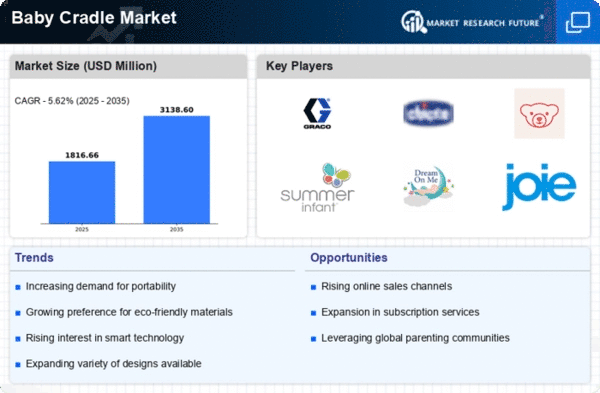
As per MRFR analysis, the Baby Cradle Market Size was estimated at 1720.0 USD Million in 2024. The Baby Cradle industry is projected to grow from 1816.66 USD Million in 2025 to 3138.6 USD Million by 2035, exhibiting a compound annual growth rate (CAGR) of 5.62% during the forecast period 2025 - 2035.

Key Market Trends & Highlights

The Baby Cradle Market is experiencing a dynamic shift towards innovation and sustainability.

  • The North American market remains the largest, driven by a strong demand for traditional cradles made from wood.
  • In contrast, the Asia-Pacific region is the fastest-growing, with a notable rise in portable cradles that cater to modern parenting needs.
  • There is a growing trend towards smart technology integration, enhancing functionality and safety features in baby cradles.
  • Market drivers such as increasing birth rates and a heightened awareness of infant safety are propelling the demand for innovative designs.

Market Size & Forecast

2024 Market Size 1720.0 (USD Million)
2035 Market Size 3138.6 (USD Million)
CAGR (2025 - 2035) 5.62%
Largest Regional Market Share in 2024 North America

Major Players

Graco (US), Chicco (IT), BabyBjorn (SE), Summer Infant (US), Dream On Me (US), Joie (GB), Mamas & Papas (GB), Bebecar (ES), Lullaby (US)

Market Trends

Baby Cradle

Baby Cradle Market Market Drivers

Increasing Birth Rates

The Global baby cradle Industry is likely to experience growth due to rising birth rates in various regions. Countries such as India and Nigeria are witnessing significant increases in their populations, which correlates with higher demand for baby products, including cradles. In 2024, the market is projected to reach 1.71 USD Billion, driven by the need for safe sleeping solutions for infants. This trend suggests that as more families are formed, the necessity for baby cradles will continue to rise, thereby contributing positively to the overall market dynamics.

Rise of E-commerce Platforms

The expansion of e-commerce platforms is transforming the purchasing landscape within the Global Baby Cradle Industry. Online shopping offers convenience and a wider selection of products, allowing parents to compare prices and features easily. This trend is particularly pronounced in regions with increasing internet penetration, where traditional retail may not be as accessible. As more consumers turn to online channels for their baby product needs, the market is expected to grow significantly, with projections indicating a market value of 1.71 USD Billion in 2024, driven by the ease of access to diverse cradle options.

Focus on Sustainable Products

There is a growing trend towards sustainability that is influencing the Global Baby Cradle Industry. Parents are increasingly seeking eco-friendly products made from sustainable materials, reflecting a broader societal shift towards environmental consciousness. This demand is prompting manufacturers to innovate and create cradles that are not only safe for infants but also environmentally responsible. As this trend continues to gain traction, it is likely to contribute to the overall market growth, with projections suggesting a market value of 2.99 USD Billion by 2035, as consumers prioritize sustainability in their purchasing decisions.

Growing Awareness of Infant Safety

There appears to be a heightened awareness regarding infant safety among new parents, which is influencing purchasing decisions in the Global Baby Cradle Industry. Parents are increasingly prioritizing products that meet safety standards and regulations. This trend is reflected in the growing demand for cradles that are designed with safety features such as breathable materials and stable structures. As a result, manufacturers are adapting their offerings to align with these safety concerns, potentially leading to a market value of 2.99 USD Billion by 2035, as parents seek reliable and safe sleeping options for their children.

Technological Advancements in Design

Innovations in design and technology are reshaping the Global Baby Cradle Industry. Manufacturers are integrating features such as adjustable heights, rocking mechanisms, and smart technology that allows parents to monitor their infants remotely. These advancements not only enhance the functionality of cradles but also appeal to tech-savvy parents who value convenience. As the market evolves, it is anticipated that these innovations will contribute to a compound annual growth rate of 5.24% from 2025 to 2035, reflecting a shift towards modern, multifunctional baby products.

Market Segment Insights

By Product Type: Traditional Cradle (Largest) vs. Portable Cradle (Fastest-Growing)

In the Baby Cradle Market, the Traditional Cradle holds a prominent position, catering to consumers who appreciate classic designs and stability for their infants. Meanwhile, the Portable Cradle is emerging as a significant player, appealing to modern parents who prioritize versatility and mobility. Market share distribution reveals that traditional options still dominate preferences, but there is an increasing shift toward portable solutions, reflecting lifestyle changes. As parents seek convenience, the demand for portable cradles is expected to rise, contributing to their growing market share in the coming years. The growth trends for the Baby Cradle segment indicate a preference for innovative features and adaptability. While Traditional Cradles have maintained their strong appeal owing to their timeless design and durability, newer entrants like the Portable Cradle are gaining traction among young families. This shift is driven by urbanization, where space constraints push parents to choose more versatile products that are lightweight and easy to move. Additionally, as awareness of infant safety and comfort rises, the emphasis on well-designed cradles, regardless of type, is also influencing consumer choices, propelling the Portable Cradle forward as a rapidly expanding segment.

Traditional Cradle (Dominant) vs. Portable Cradle (Emerging)

The Traditional Cradle is characterized by its classic design, typically made from solid wood or sturdy materials, providing a sense of security and comfort for infants. Its appeal lies in the aesthetic value it adds to nurseries, along with its easy-to-use functionality. Parents leaning toward this option often prioritize tradition and reliability, making it a dominant segment in the Baby Cradle Market. In contrast, the Portable Cradle represents an emerging trend, featuring lightweight materials and collapsible designs that resonate with the active lifestyles of many contemporary families. This segment is increasingly sought after for its convenience, allowing parents to easily transport it between rooms or during travel. With their modern design and functionality, Portable Cradles are quickly becoming essential for parents who value flexibility.

By Material Type: Wood (Largest) vs. Fabric (Fastest-Growing)

<p>The Baby Cradle Market exhibits a diverse material type segmentation with Wood holding the largest share due to its classic appeal and durability. Wood cradles remain a favored choice among parents who appreciate traditional aesthetics and long-lasting quality. In contrast, Fabric cradles are rapidly gaining traction, appealing to modern parents who seek lightweight, portable, and versatile options for their infants. The shift toward easy-to-clean and soft materials has steadily increased Fabric's market presence.</p>

<p>Wood (Dominant) vs. Fabric (Emerging)</p>

<p>Wood, as the dominant material in the Baby Cradle Market, is celebrated for its sturdiness and warm, natural appearance, making it an ideal choice for those prioritizing durability and design. However, Fabric cradles are emerging strongly, capturing the attention of parents who desire flexibility and convenience. These cradles offer soft surfaces for infants, are often machine washable, and come in various designs that cater to contemporary tastes. As environmental concerns grow, eco-friendly fabric options are also becoming popular, further driving Fabric's ascent in the market.</p>

By Age Group: Newborn (Largest) vs. Toddler (Fastest-Growing)

The Baby Cradle Market showcases a distinct distribution among age groups, with the Newborn segment capturing the largest share. This segment holds significant importance for parents seeking safe and comfortable sleeping solutions for their infants. The Infant segment, while substantial, demonstrates a more moderate market presence as babies transition to other sleeping arrangements. The Toddler segment, however, is gaining traction, as more parents recognize the importance of suitable cradles that cater to toddlers' needs, driving a shift in purchasing preferences.

Age Categories: Newborn (Dominant) vs. Toddler (Emerging)

The Newborn segment serves as the dominant force in the Baby Cradle Market, characterized by a high demand for cradles that provide maximum safety and comfort for the youngest infants. These cradles attract buyers with features like portability, safety certifications, and soothing designs that promote healthy sleep habits. In contrast, the Toddler segment is emerging as a significant player, driven by parents’ growing awareness of sleep patterns and preferences as children grow. Toddler cradles often feature multifunctionality, adjustable settings, and durable materials, appealing to parents looking to extend the life cycle of the product beyond the infant stage, thus reshaping market dynamics.

By Sales Channel: Online Retail (Largest) vs. Offline Retail (Fastest-Growing)

<p>In the Baby Cradle Market, the distribution of sales channels is notably diverse. Online retail holds a significant share, reflecting the increasing consumer preference for convenient shopping experiences. This channel benefits from a vast array of products and the ability to compare prices easily. On the other hand, offline retail, while smaller in market share, is experiencing rapid growth as parents appreciate the tactile experience of inspecting cradles before purchase and the personalized service often available in physical stores.</p>

<p>Online Retail: Dominant vs. Offline Retail: Emerging</p>

<p>Online retail has established itself as a dominant force in the Baby Cradle Market, driven by the convenience it offers consumers who prefer shopping from home. It allows for easy comparisons and access to a broader range of products. In contrast, offline retail is emerging as a significant competitor, fueled by a growing trend of experiential shopping. Many parents now seek to physically assess the quality and safety of cradles before buying, leading to increased foot traffic in stores. These two channels complement each other, each catering to distinct consumer preferences and shopping behaviors.</p>

By Price Range: Medium (Largest) vs. Low (Fastest-Growing)

<p>In the Baby Cradle Market, the price range segment reveals an intriguing landscape of consumer preferences. The medium price range segment currently holds the largest market share, appealing to a broad demographic seeking quality without excessive spending. This segment captures the attention of parents looking for durable and aesthetically pleasing cradles that provide comfort and safety for their infants. Conversely, the low price range segment is experiencing rapid growth, attracting budget-conscious consumers who prioritize affordability while still seeking adequate quality, thus expanding its footprint in the market.</p>

<p>Low (Emerging) vs. Medium (Dominant)</p>

<p>The low price range in the Baby Cradle Market is rapidly emerging, driven by the rising number of budget-conscious parents and the demand for affordable yet functional solutions. Manufacturers in this segment often focus on cost-effective materials and simple designs, ensuring that they can offer competitive prices while maintaining a basic level of safety and comfort. On the other hand, the medium price range segment remains dominant, appealing to those who value a balance of quality and price. This segment typically features higher-quality materials, enhanced safety features, and stylish designs that resonate with parents looking for longevity and aesthetics. As such, the differentiation between these segments is stark, revealing diverse consumer priorities.</p>

Get more detailed insights about Baby Cradle Market Research Report-Global Forecast till 2028

Regional Insights

North America : Market Leader in Baby Cradles

North America is poised to maintain its leadership in the baby cradle market, holding a significant share of 864.0 million in 2024. The region's growth is driven by increasing disposable incomes, a rising birth rate, and heightened awareness of child safety. Regulatory frameworks supporting product safety and innovation further catalyze market expansion. The demand for high-quality, multifunctional baby cradles is on the rise, reflecting changing consumer preferences. The competitive landscape in North America is robust, featuring key players such as Graco, Chicco, and Summer Infant. These companies are leveraging advanced technology and design to enhance product offerings. The presence of established brands fosters consumer trust, while new entrants are innovating to capture market share. The U.S. remains the largest market, followed by Canada, with a growing focus on eco-friendly and sustainable products.

Europe : Emerging Market with Growth Potential

Europe's baby cradle market is valued at 480.0 million, reflecting a growing demand driven by urbanization and changing family structures. The region is witnessing an increase in dual-income households, leading to higher spending on baby products. Regulatory bodies are emphasizing safety standards, which is influencing consumer choices towards certified products. The trend towards sustainable and organic materials is also gaining traction, aligning with European consumers' preferences for eco-friendly options. Leading countries in this market include Germany, France, and the UK, where established brands like BabyBjorn and Chicco dominate. The competitive landscape is characterized by innovation and collaboration among manufacturers. The presence of various local and international players fosters a dynamic market environment. As per the European Commission, "The safety of baby products is paramount, and regulations are in place to ensure compliance with safety standards."

Asia-Pacific : Rapidly Growing Market Segment

The Asia-Pacific region is experiencing rapid growth in the baby cradle market, valued at 288.0 million. Factors such as increasing urbanization, rising disposable incomes, and a growing middle class are driving demand. Additionally, cultural shifts towards modern parenting practices are influencing purchasing decisions. Governments are also promoting child safety regulations, which are expected to further boost market growth in the coming years. Key players in this region include Joie and Mamas & Papas, with significant market presence in countries like China, India, and Japan. The competitive landscape is evolving, with both local and international brands vying for market share. The focus on innovative designs and safety features is becoming increasingly important as consumers seek high-quality products for their children. The region's diverse market dynamics present both challenges and opportunities for growth.

Middle East and Africa : Emerging Market with Unique Challenges

The Middle East and Africa region, with a market size of 88.0 million, is emerging as a potential growth area for baby cradles. Factors such as increasing birth rates and a growing awareness of child safety are driving demand. However, the market faces challenges, including economic fluctuations and varying regulatory standards across countries. Governments are beginning to implement stricter safety regulations, which could enhance product quality and consumer trust in the long run. Leading countries in this region include South Africa and the UAE, where local and international brands are competing for market share. The presence of key players like Bebecar and Lullaby is notable, as they adapt their offerings to meet local preferences. The competitive landscape is characterized by a mix of traditional and modern retail channels, with an increasing trend towards online sales as consumers seek convenience and variety.

Key Players and Competitive Insights

The Baby Cradle Market is currently characterized by a dynamic competitive landscape, driven by innovation, consumer preferences for safety and sustainability, and the increasing demand for multifunctional products. Key players such as Graco (US), Chicco (IT), and BabyBjorn (SE) are strategically positioned to leverage these trends. Graco (US) focuses on enhancing product safety features and expanding its digital presence, while Chicco (IT) emphasizes eco-friendly materials and designs. BabyBjorn (SE) is known for its commitment to ergonomic designs and sustainability, which resonates well with environmentally conscious consumers. Collectively, these strategies contribute to a competitive environment that prioritizes innovation and consumer-centric approaches.In terms of business tactics, companies are increasingly localizing manufacturing to reduce lead times and optimize supply chains. This trend appears to be a response to the growing demand for quicker delivery and customization options. The market structure is moderately fragmented, with several players vying for market share, yet the influence of major companies remains substantial. Their ability to adapt to changing consumer preferences and operational efficiencies shapes the overall market dynamics.

In November Graco (US) announced the launch of a new line of smart cradles equipped with IoT technology, allowing parents to monitor their baby's sleep patterns via a mobile app. This strategic move not only enhances the user experience but also positions Graco (US) as a leader in integrating technology into baby products, potentially attracting tech-savvy parents looking for innovative solutions.

In October Chicco (IT) unveiled a partnership with a leading sustainable materials supplier to develop a new range of cradles made from 100% recycled materials. This initiative underscores Chicco's (IT) commitment to sustainability and aligns with the growing consumer demand for eco-friendly products. Such partnerships may enhance brand loyalty among environmentally conscious consumers and differentiate Chicco (IT) in a competitive market.

In September BabyBjorn (SE) expanded its product line to include cradles designed specifically for small living spaces, catering to urban families. This strategic expansion reflects an understanding of changing living conditions and consumer needs, potentially increasing BabyBjorn's (SE) market share among city-dwelling parents seeking space-efficient solutions.

As of December the Baby Cradle Market is witnessing trends such as digitalization, sustainability, and the integration of AI technologies. Strategic alliances among companies are increasingly shaping the competitive landscape, fostering innovation and enhancing product offerings. The shift from price-based competition to a focus on technological advancements and supply chain reliability is evident. Moving forward, differentiation will likely hinge on the ability to innovate and respond to consumer demands for safety, sustainability, and convenience.

Key Companies in the Baby Cradle Market include

Industry Developments

Future Outlook

Baby Cradle Market Future Outlook

The Baby Cradle Market is projected to grow at a 5.62% CAGR from 2025 to 2035, driven by increasing consumer awareness and demand for safety features.

New opportunities lie in:

  • Development of smart cradles with integrated monitoring systems.
  • Expansion into eco-friendly materials for sustainable product lines.
  • Partnerships with healthcare providers for cradle rental services.

By 2035, the Baby Cradle Market is expected to achieve robust growth and innovation.

Market Segmentation

Baby Cradle Market Design Outlook

  • Modern
  • Classic
  • Minimalist
  • Themed

Baby Cradle Market Material Outlook

  • Wood
  • Metal
  • Plastic
  • Fabric

Baby Cradle Market Age Group Outlook

  • Newborn
  • Infant
  • Toddler

Baby Cradle Market Product Type Outlook

  • Traditional Cradle
  • Rocking Cradle
  • Portable Cradle
  • Convertible Cradle

Baby Cradle Market Safety Features Outlook

  • Bumper Pads
  • Adjustable Height
  • Stability Locks
  • Breathable Mesh

Report Scope

MARKET SIZE 2024 1720.0(USD Million)
MARKET SIZE 2025 1816.66(USD Million)
MARKET SIZE 2035 3138.6(USD Million)
COMPOUND ANNUAL GROWTH RATE (CAGR) 5.62% (2025 - 2035)
REPORT COVERAGE Revenue Forecast, Competitive Landscape, Growth Factors, and Trends
BASE YEAR 2024
Market Forecast Period 2025 - 2035
Historical Data 2019 - 2024
Market Forecast Units USD Million
Key Companies Profiled Graco (US), Chicco (IT), BabyBjorn (SE), Summer Infant (US), Dream On Me (US), Joie (GB), Mamas & Papas (GB), Bebecar (ES), Lullaby (US)
Segments Covered Product Type, Material, Age Group, Design, Safety Features
Key Market Opportunities Integration of smart technology in Baby Cradle Market enhances safety and convenience for modern parents.
Key Market Dynamics Rising consumer preference for multifunctional baby cradles drives innovation and competition among manufacturers.
Countries Covered North America, Europe, APAC, South America, MEA

FAQs

What is the current valuation of the Baby Cradle Market as of 2024?

<p>The Baby Cradle Market was valued at 1720.0 USD Million in 2024.</p>

What is the projected market valuation for the Baby Cradle Market in 2035?

<p>The Baby Cradle Market is projected to reach 3138.6 USD Million by 2035.</p>

What is the expected CAGR for the Baby Cradle Market during the forecast period 2025 - 2035?

<p>The expected CAGR for the Baby Cradle Market during the forecast period 2025 - 2035 is 5.62%.</p>

Which product type holds the highest market value in the Baby Cradle Market?

<p>The Portable Cradle segment holds the highest market value, ranging from 500.0 to 1000.0 USD Million.</p>

What are the key materials used in the Baby Cradle Market?

<p>Key materials include Wood, Metal, Plastic, and Fabric, with Wood valued between 600.0 and 1100.0 USD Million.</p>

How does the Baby Cradle Market segment by age group?

The market segments by age group include Newborn, Infant, and Toddler, with the Infant segment valued between 688.0 and 1220.0 USD Million.

What sales channel is expected to generate the most revenue in the Baby Cradle Market?

The Offline Retail channel is expected to generate the most revenue, with a valuation between 800.0 and 1400.0 USD Million.

Which price range segment is projected to have the highest market value?

The Medium price range segment is projected to have the highest market value, estimated between 688.0 and 1240.0 USD Million.

Who are the leading companies in the Baby Cradle Market?

Leading companies in the Baby Cradle Market include Graco, Chicco, BabyBjorn, and Summer Infant.

What trends are influencing the Baby Cradle Market in 2025?

Trends influencing the Baby Cradle Market in 2025 include increasing demand for portable and convertible cradles, reflecting changing consumer preferences.

  1. SECTION I: EXECUTIVE SUMMARY AND KEY HIGHLIGHTS
    1. | 1.1 EXECUTIVE SUMMARY
    2. | | 1.1.1 Market Overview
    3. | | 1.1.2 Key Findings
    4. | | 1.1.3 Market Segmentation
    5. | | 1.1.4 Competitive Landscape
    6. | | 1.1.5 Challenges and Opportunities
    7. | | 1.1.6 Future Outlook
  2. SECTION II: SCOPING, METHODOLOGY AND MARKET STRUCTURE
    1. | 2.1 MARKET INTRODUCTION
    2. | | 2.1.1 Definition
    3. | | 2.1.2 Scope of the study
    4. | | | 2.1.2.1 Research Objective
    5. | | | 2.1.2.2 Assumption
    6. | | | 2.1.2.3 Limitations
    7. | 2.2 RESEARCH METHODOLOGY
    8. | | 2.2.1 Overview
    9. | | 2.2.2 Data Mining
    10. | | 2.2.3 Secondary Research
    11. | | 2.2.4 Primary Research
    12. | | | 2.2.4.1 Primary Interviews and Information Gathering Process
    13. | | | 2.2.4.2 Breakdown of Primary Respondents
    14. | | 2.2.5 Forecasting Model
    15. | | 2.2.6 Market Size Estimation
    16. | | | 2.2.6.1 Bottom-Up Approach
    17. | | | 2.2.6.2 Top-Down Approach
    18. | | 2.2.7 Data Triangulation
    19. | | 2.2.8 Validation
  3. SECTION III: QUALITATIVE ANALYSIS
    1. | 3.1 MARKET DYNAMICS
    2. | | 3.1.1 Overview
    3. | | 3.1.2 Drivers
    4. | | 3.1.3 Restraints
    5. | | 3.1.4 Opportunities
    6. | 3.2 MARKET FACTOR ANALYSIS
    7. | | 3.2.1 Value chain Analysis
    8. | | 3.2.2 Porter's Five Forces Analysis
    9. | | | 3.2.2.1 Bargaining Power of Suppliers
    10. | | | 3.2.2.2 Bargaining Power of Buyers
    11. | | | 3.2.2.3 Threat of New Entrants
    12. | | | 3.2.2.4 Threat of Substitutes
    13. | | | 3.2.2.5 Intensity of Rivalry
    14. | | 3.2.3 COVID-19 Impact Analysis
    15. | | | 3.2.3.1 Market Impact Analysis
    16. | | | 3.2.3.2 Regional Impact
    17. | | | 3.2.3.3 Opportunity and Threat Analysis
  4. SECTION IV: QUANTITATIVE ANALYSIS
    1. | 4.1 Consumer and Retail, BY Product Type (USD Million)
    2. | | 4.1.1 Traditional Cradle
    3. | | 4.1.2 Rocking Cradle
    4. | | 4.1.3 Portable Cradle
    5. | | 4.1.4 Convertible Cradle
    6. | 4.2 Consumer and Retail, BY Material Type (USD Million)
    7. | | 4.2.1 Wood
    8. | | 4.2.2 Metal
    9. | | 4.2.3 Plastic
    10. | | 4.2.4 Fabric
    11. | 4.3 Consumer and Retail, BY Age Group (USD Million)
    12. | | 4.3.1 Newborn
    13. | | 4.3.2 Infant
    14. | | 4.3.3 Toddler
    15. | 4.4 Consumer and Retail, BY Sales Channel (USD Million)
    16. | | 4.4.1 Online Retail
    17. | | 4.4.2 Offline Retail
    18. | | 4.4.3 Direct Sales
    19. | 4.5 Consumer and Retail, BY Price Range (USD Million)
    20. | | 4.5.1 Low
    21. | | 4.5.2 Medium
    22. | | 4.5.3 High
    23. | 4.6 Consumer and Retail, BY Region (USD Million)
    24. | | 4.6.1 North America
    25. | | | 4.6.1.1 US
    26. | | | 4.6.1.2 Canada
    27. | | 4.6.2 Europe
    28. | | | 4.6.2.1 Germany
    29. | | | 4.6.2.2 UK
    30. | | | 4.6.2.3 France
    31. | | | 4.6.2.4 Russia
    32. | | | 4.6.2.5 Italy
    33. | | | 4.6.2.6 Spain
    34. | | | 4.6.2.7 Rest of Europe
    35. | | 4.6.3 APAC
    36. | | | 4.6.3.1 China
    37. | | | 4.6.3.2 India
    38. | | | 4.6.3.3 Japan
    39. | | | 4.6.3.4 South Korea
    40. | | | 4.6.3.5 Malaysia
    41. | | | 4.6.3.6 Thailand
    42. | | | 4.6.3.7 Indonesia
    43. | | | 4.6.3.8 Rest of APAC
    44. | | 4.6.4 South America
    45. | | | 4.6.4.1 Brazil
    46. | | | 4.6.4.2 Mexico
    47. | | | 4.6.4.3 Argentina
    48. | | | 4.6.4.4 Rest of South America
    49. | | 4.6.5 MEA
    50. | | | 4.6.5.1 GCC Countries
    51. | | | 4.6.5.2 South Africa
    52. | | | 4.6.5.3 Rest of MEA
  5. SECTION V: COMPETITIVE ANALYSIS
    1. | 5.1 Competitive Landscape
    2. | | 5.1.1 Overview
    3. | | 5.1.2 Competitive Analysis
    4. | | 5.1.3 Market share Analysis
    5. | | 5.1.4 Major Growth Strategy in the Consumer and Retail
    6. | | 5.1.5 Competitive Benchmarking
    7. | | 5.1.6 Leading Players in Terms of Number of Developments in the Consumer and Retail
    8. | | 5.1.7 Key developments and growth strategies
    9. | | | 5.1.7.1 New Product Launch/Service Deployment
    10. | | | 5.1.7.2 Merger & Acquisitions
    11. | | | 5.1.7.3 Joint Ventures
    12. | | 5.1.8 Major Players Financial Matrix
    13. | | | 5.1.8.1 Sales and Operating Income
    14. | | | 5.1.8.2 Major Players R&D Expenditure. 2023
    15. | 5.2 Company Profiles
    16. | | 5.2.1 Graco (US)
    17. | | | 5.2.1.1 Financial Overview
    18. | | | 5.2.1.2 Products Offered
    19. | | | 5.2.1.3 Key Developments
    20. | | | 5.2.1.4 SWOT Analysis
    21. | | | 5.2.1.5 Key Strategies
    22. | | 5.2.2 Chicco (IT)
    23. | | | 5.2.2.1 Financial Overview
    24. | | | 5.2.2.2 Products Offered
    25. | | | 5.2.2.3 Key Developments
    26. | | | 5.2.2.4 SWOT Analysis
    27. | | | 5.2.2.5 Key Strategies
    28. | | 5.2.3 BabyBjorn (SE)
    29. | | | 5.2.3.1 Financial Overview
    30. | | | 5.2.3.2 Products Offered
    31. | | | 5.2.3.3 Key Developments
    32. | | | 5.2.3.4 SWOT Analysis
    33. | | | 5.2.3.5 Key Strategies
    34. | | 5.2.4 Summer Infant (US)
    35. | | | 5.2.4.1 Financial Overview
    36. | | | 5.2.4.2 Products Offered
    37. | | | 5.2.4.3 Key Developments
    38. | | | 5.2.4.4 SWOT Analysis
    39. | | | 5.2.4.5 Key Strategies
    40. | | 5.2.5 Dream On Me (US)
    41. | | | 5.2.5.1 Financial Overview
    42. | | | 5.2.5.2 Products Offered
    43. | | | 5.2.5.3 Key Developments
    44. | | | 5.2.5.4 SWOT Analysis
    45. | | | 5.2.5.5 Key Strategies
    46. | | 5.2.6 Joie (GB)
    47. | | | 5.2.6.1 Financial Overview
    48. | | | 5.2.6.2 Products Offered
    49. | | | 5.2.6.3 Key Developments
    50. | | | 5.2.6.4 SWOT Analysis
    51. | | | 5.2.6.5 Key Strategies
    52. | | 5.2.7 Mamas & Papas (GB)
    53. | | | 5.2.7.1 Financial Overview
    54. | | | 5.2.7.2 Products Offered
    55. | | | 5.2.7.3 Key Developments
    56. | | | 5.2.7.4 SWOT Analysis
    57. | | | 5.2.7.5 Key Strategies
    58. | | 5.2.8 Bebecar (ES)
    59. | | | 5.2.8.1 Financial Overview
    60. | | | 5.2.8.2 Products Offered
    61. | | | 5.2.8.3 Key Developments
    62. | | | 5.2.8.4 SWOT Analysis
    63. | | | 5.2.8.5 Key Strategies
    64. | | 5.2.9 Lullaby (US)
    65. | | | 5.2.9.1 Financial Overview
    66. | | | 5.2.9.2 Products Offered
    67. | | | 5.2.9.3 Key Developments
    68. | | | 5.2.9.4 SWOT Analysis
    69. | | | 5.2.9.5 Key Strategies
    70. | 5.3 Appendix
    71. | | 5.3.1 References
    72. | | 5.3.2 Related Reports
  6. LIST OF FIGURES
    1. | 6.1 MARKET SYNOPSIS
    2. | 6.2 NORTH AMERICA MARKET ANALYSIS
    3. | 6.3 US MARKET ANALYSIS BY PRODUCT TYPE
    4. | 6.4 US MARKET ANALYSIS BY MATERIAL TYPE
    5. | 6.5 US MARKET ANALYSIS BY AGE GROUP
    6. | 6.6 US MARKET ANALYSIS BY SALES CHANNEL
    7. | 6.7 US MARKET ANALYSIS BY PRICE RANGE
    8. | 6.8 CANADA MARKET ANALYSIS BY PRODUCT TYPE
    9. | 6.9 CANADA MARKET ANALYSIS BY MATERIAL TYPE
    10. | 6.10 CANADA MARKET ANALYSIS BY AGE GROUP
    11. | 6.11 CANADA MARKET ANALYSIS BY SALES CHANNEL
    12. | 6.12 CANADA MARKET ANALYSIS BY PRICE RANGE
    13. | 6.13 EUROPE MARKET ANALYSIS
    14. | 6.14 GERMANY MARKET ANALYSIS BY PRODUCT TYPE
    15. | 6.15 GERMANY MARKET ANALYSIS BY MATERIAL TYPE
    16. | 6.16 GERMANY MARKET ANALYSIS BY AGE GROUP
    17. | 6.17 GERMANY MARKET ANALYSIS BY SALES CHANNEL
    18. | 6.18 GERMANY MARKET ANALYSIS BY PRICE RANGE
    19. | 6.19 UK MARKET ANALYSIS BY PRODUCT TYPE
    20. | 6.20 UK MARKET ANALYSIS BY MATERIAL TYPE
    21. | 6.21 UK MARKET ANALYSIS BY AGE GROUP
    22. | 6.22 UK MARKET ANALYSIS BY SALES CHANNEL
    23. | 6.23 UK MARKET ANALYSIS BY PRICE RANGE
    24. | 6.24 FRANCE MARKET ANALYSIS BY PRODUCT TYPE
    25. | 6.25 FRANCE MARKET ANALYSIS BY MATERIAL TYPE
    26. | 6.26 FRANCE MARKET ANALYSIS BY AGE GROUP
    27. | 6.27 FRANCE MARKET ANALYSIS BY SALES CHANNEL
    28. | 6.28 FRANCE MARKET ANALYSIS BY PRICE RANGE
    29. | 6.29 RUSSIA MARKET ANALYSIS BY PRODUCT TYPE
    30. | 6.30 RUSSIA MARKET ANALYSIS BY MATERIAL TYPE
    31. | 6.31 RUSSIA MARKET ANALYSIS BY AGE GROUP
    32. | 6.32 RUSSIA MARKET ANALYSIS BY SALES CHANNEL
    33. | 6.33 RUSSIA MARKET ANALYSIS BY PRICE RANGE
    34. | 6.34 ITALY MARKET ANALYSIS BY PRODUCT TYPE
    35. | 6.35 ITALY MARKET ANALYSIS BY MATERIAL TYPE
    36. | 6.36 ITALY MARKET ANALYSIS BY AGE GROUP
    37. | 6.37 ITALY MARKET ANALYSIS BY SALES CHANNEL
    38. | 6.38 ITALY MARKET ANALYSIS BY PRICE RANGE
    39. | 6.39 SPAIN MARKET ANALYSIS BY PRODUCT TYPE
    40. | 6.40 SPAIN MARKET ANALYSIS BY MATERIAL TYPE
    41. | 6.41 SPAIN MARKET ANALYSIS BY AGE GROUP
    42. | 6.42 SPAIN MARKET ANALYSIS BY SALES CHANNEL
    43. | 6.43 SPAIN MARKET ANALYSIS BY PRICE RANGE
    44. | 6.44 REST OF EUROPE MARKET ANALYSIS BY PRODUCT TYPE
    45. | 6.45 REST OF EUROPE MARKET ANALYSIS BY MATERIAL TYPE
    46. | 6.46 REST OF EUROPE MARKET ANALYSIS BY AGE GROUP
    47. | 6.47 REST OF EUROPE MARKET ANALYSIS BY SALES CHANNEL
    48. | 6.48 REST OF EUROPE MARKET ANALYSIS BY PRICE RANGE
    49. | 6.49 APAC MARKET ANALYSIS
    50. | 6.50 CHINA MARKET ANALYSIS BY PRODUCT TYPE
    51. | 6.51 CHINA MARKET ANALYSIS BY MATERIAL TYPE
    52. | 6.52 CHINA MARKET ANALYSIS BY AGE GROUP
    53. | 6.53 CHINA MARKET ANALYSIS BY SALES CHANNEL
    54. | 6.54 CHINA MARKET ANALYSIS BY PRICE RANGE
    55. | 6.55 INDIA MARKET ANALYSIS BY PRODUCT TYPE
    56. | 6.56 INDIA MARKET ANALYSIS BY MATERIAL TYPE
    57. | 6.57 INDIA MARKET ANALYSIS BY AGE GROUP
    58. | 6.58 INDIA MARKET ANALYSIS BY SALES CHANNEL
    59. | 6.59 INDIA MARKET ANALYSIS BY PRICE RANGE
    60. | 6.60 JAPAN MARKET ANALYSIS BY PRODUCT TYPE
    61. | 6.61 JAPAN MARKET ANALYSIS BY MATERIAL TYPE
    62. | 6.62 JAPAN MARKET ANALYSIS BY AGE GROUP
    63. | 6.63 JAPAN MARKET ANALYSIS BY SALES CHANNEL
    64. | 6.64 JAPAN MARKET ANALYSIS BY PRICE RANGE
    65. | 6.65 SOUTH KOREA MARKET ANALYSIS BY PRODUCT TYPE
    66. | 6.66 SOUTH KOREA MARKET ANALYSIS BY MATERIAL TYPE
    67. | 6.67 SOUTH KOREA MARKET ANALYSIS BY AGE GROUP
    68. | 6.68 SOUTH KOREA MARKET ANALYSIS BY SALES CHANNEL
    69. | 6.69 SOUTH KOREA MARKET ANALYSIS BY PRICE RANGE
    70. | 6.70 MALAYSIA MARKET ANALYSIS BY PRODUCT TYPE
    71. | 6.71 MALAYSIA MARKET ANALYSIS BY MATERIAL TYPE
    72. | 6.72 MALAYSIA MARKET ANALYSIS BY AGE GROUP
    73. | 6.73 MALAYSIA MARKET ANALYSIS BY SALES CHANNEL
    74. | 6.74 MALAYSIA MARKET ANALYSIS BY PRICE RANGE
    75. | 6.75 THAILAND MARKET ANALYSIS BY PRODUCT TYPE
    76. | 6.76 THAILAND MARKET ANALYSIS BY MATERIAL TYPE
    77. | 6.77 THAILAND MARKET ANALYSIS BY AGE GROUP
    78. | 6.78 THAILAND MARKET ANALYSIS BY SALES CHANNEL
    79. | 6.79 THAILAND MARKET ANALYSIS BY PRICE RANGE
    80. | 6.80 INDONESIA MARKET ANALYSIS BY PRODUCT TYPE
    81. | 6.81 INDONESIA MARKET ANALYSIS BY MATERIAL TYPE
    82. | 6.82 INDONESIA MARKET ANALYSIS BY AGE GROUP
    83. | 6.83 INDONESIA MARKET ANALYSIS BY SALES CHANNEL
    84. | 6.84 INDONESIA MARKET ANALYSIS BY PRICE RANGE
    85. | 6.85 REST OF APAC MARKET ANALYSIS BY PRODUCT TYPE
    86. | 6.86 REST OF APAC MARKET ANALYSIS BY MATERIAL TYPE
    87. | 6.87 REST OF APAC MARKET ANALYSIS BY AGE GROUP
    88. | 6.88 REST OF APAC MARKET ANALYSIS BY SALES CHANNEL
    89. | 6.89 REST OF APAC MARKET ANALYSIS BY PRICE RANGE
    90. | 6.90 SOUTH AMERICA MARKET ANALYSIS
    91. | 6.91 BRAZIL MARKET ANALYSIS BY PRODUCT TYPE
    92. | 6.92 BRAZIL MARKET ANALYSIS BY MATERIAL TYPE
    93. | 6.93 BRAZIL MARKET ANALYSIS BY AGE GROUP
    94. | 6.94 BRAZIL MARKET ANALYSIS BY SALES CHANNEL
    95. | 6.95 BRAZIL MARKET ANALYSIS BY PRICE RANGE
    96. | 6.96 MEXICO MARKET ANALYSIS BY PRODUCT TYPE
    97. | 6.97 MEXICO MARKET ANALYSIS BY MATERIAL TYPE
    98. | 6.98 MEXICO MARKET ANALYSIS BY AGE GROUP
    99. | 6.99 MEXICO MARKET ANALYSIS BY SALES CHANNEL
    100. | 6.100 MEXICO MARKET ANALYSIS BY PRICE RANGE
    101. | 6.101 ARGENTINA MARKET ANALYSIS BY PRODUCT TYPE
    102. | 6.102 ARGENTINA MARKET ANALYSIS BY MATERIAL TYPE
    103. | 6.103 ARGENTINA MARKET ANALYSIS BY AGE GROUP
    104. | 6.104 ARGENTINA MARKET ANALYSIS BY SALES CHANNEL
    105. | 6.105 ARGENTINA MARKET ANALYSIS BY PRICE RANGE
    106. | 6.106 REST OF SOUTH AMERICA MARKET ANALYSIS BY PRODUCT TYPE
    107. | 6.107 REST OF SOUTH AMERICA MARKET ANALYSIS BY MATERIAL TYPE
    108. | 6.108 REST OF SOUTH AMERICA MARKET ANALYSIS BY AGE GROUP
    109. | 6.109 REST OF SOUTH AMERICA MARKET ANALYSIS BY SALES CHANNEL
    110. | 6.110 REST OF SOUTH AMERICA MARKET ANALYSIS BY PRICE RANGE
    111. | 6.111 MEA MARKET ANALYSIS
    112. | 6.112 GCC COUNTRIES MARKET ANALYSIS BY PRODUCT TYPE
    113. | 6.113 GCC COUNTRIES MARKET ANALYSIS BY MATERIAL TYPE
    114. | 6.114 GCC COUNTRIES MARKET ANALYSIS BY AGE GROUP
    115. | 6.115 GCC COUNTRIES MARKET ANALYSIS BY SALES CHANNEL
    116. | 6.116 GCC COUNTRIES MARKET ANALYSIS BY PRICE RANGE
    117. | 6.117 SOUTH AFRICA MARKET ANALYSIS BY PRODUCT TYPE
    118. | 6.118 SOUTH AFRICA MARKET ANALYSIS BY MATERIAL TYPE
    119. | 6.119 SOUTH AFRICA MARKET ANALYSIS BY AGE GROUP
    120. | 6.120 SOUTH AFRICA MARKET ANALYSIS BY SALES CHANNEL
    121. | 6.121 SOUTH AFRICA MARKET ANALYSIS BY PRICE RANGE
    122. | 6.122 REST OF MEA MARKET ANALYSIS BY PRODUCT TYPE
    123. | 6.123 REST OF MEA MARKET ANALYSIS BY MATERIAL TYPE
    124. | 6.124 REST OF MEA MARKET ANALYSIS BY AGE GROUP
    125. | 6.125 REST OF MEA MARKET ANALYSIS BY SALES CHANNEL
    126. | 6.126 REST OF MEA MARKET ANALYSIS BY PRICE RANGE
    127. | 6.127 KEY BUYING CRITERIA OF CONSUMER AND RETAIL
    128. | 6.128 RESEARCH PROCESS OF MRFR
    129. | 6.129 DRO ANALYSIS OF CONSUMER AND RETAIL
    130. | 6.130 DRIVERS IMPACT ANALYSIS: CONSUMER AND RETAIL
    131. | 6.131 RESTRAINTS IMPACT ANALYSIS: CONSUMER AND RETAIL
    132. | 6.132 SUPPLY / VALUE CHAIN: CONSUMER AND RETAIL
    133. | 6.133 CONSUMER AND RETAIL, BY PRODUCT TYPE, 2024 (% SHARE)
    134. | 6.134 CONSUMER AND RETAIL, BY PRODUCT TYPE, 2024 TO 2035 (USD Million)
    135. | 6.135 CONSUMER AND RETAIL, BY MATERIAL TYPE, 2024 (% SHARE)
    136. | 6.136 CONSUMER AND RETAIL, BY MATERIAL TYPE, 2024 TO 2035 (USD Million)
    137. | 6.137 CONSUMER AND RETAIL, BY AGE GROUP, 2024 (% SHARE)
    138. | 6.138 CONSUMER AND RETAIL, BY AGE GROUP, 2024 TO 2035 (USD Million)
    139. | 6.139 CONSUMER AND RETAIL, BY SALES CHANNEL, 2024 (% SHARE)
    140. | 6.140 CONSUMER AND RETAIL, BY SALES CHANNEL, 2024 TO 2035 (USD Million)
    141. | 6.141 CONSUMER AND RETAIL, BY PRICE RANGE, 2024 (% SHARE)
    142. | 6.142 CONSUMER AND RETAIL, BY PRICE RANGE, 2024 TO 2035 (USD Million)
    143. | 6.143 BENCHMARKING OF MAJOR COMPETITORS
  7. LIST OF TABLES
    1. | 7.1 LIST OF ASSUMPTIONS
    2. | | 7.1.1
    3. | 7.2 North America MARKET SIZE ESTIMATES; FORECAST
    4. | | 7.2.1 BY PRODUCT TYPE, 2025-2035 (USD Million)
    5. | | 7.2.2 BY MATERIAL TYPE, 2025-2035 (USD Million)
    6. | | 7.2.3 BY AGE GROUP, 2025-2035 (USD Million)
    7. | | 7.2.4 BY SALES CHANNEL, 2025-2035 (USD Million)
    8. | | 7.2.5 BY PRICE RANGE, 2025-2035 (USD Million)
    9. | 7.3 US MARKET SIZE ESTIMATES; FORECAST
    10. | | 7.3.1 BY PRODUCT TYPE, 2025-2035 (USD Million)
    11. | | 7.3.2 BY MATERIAL TYPE, 2025-2035 (USD Million)
    12. | | 7.3.3 BY AGE GROUP, 2025-2035 (USD Million)
    13. | | 7.3.4 BY SALES CHANNEL, 2025-2035 (USD Million)
    14. | | 7.3.5 BY PRICE RANGE, 2025-2035 (USD Million)
    15. | 7.4 Canada MARKET SIZE ESTIMATES; FORECAST
    16. | | 7.4.1 BY PRODUCT TYPE, 2025-2035 (USD Million)
    17. | | 7.4.2 BY MATERIAL TYPE, 2025-2035 (USD Million)
    18. | | 7.4.3 BY AGE GROUP, 2025-2035 (USD Million)
    19. | | 7.4.4 BY SALES CHANNEL, 2025-2035 (USD Million)
    20. | | 7.4.5 BY PRICE RANGE, 2025-2035 (USD Million)
    21. | 7.5 Europe MARKET SIZE ESTIMATES; FORECAST
    22. | | 7.5.1 BY PRODUCT TYPE, 2025-2035 (USD Million)
    23. | | 7.5.2 BY MATERIAL TYPE, 2025-2035 (USD Million)
    24. | | 7.5.3 BY AGE GROUP, 2025-2035 (USD Million)
    25. | | 7.5.4 BY SALES CHANNEL, 2025-2035 (USD Million)
    26. | | 7.5.5 BY PRICE RANGE, 2025-2035 (USD Million)
    27. | 7.6 Germany MARKET SIZE ESTIMATES; FORECAST
    28. | | 7.6.1 BY PRODUCT TYPE, 2025-2035 (USD Million)
    29. | | 7.6.2 BY MATERIAL TYPE, 2025-2035 (USD Million)
    30. | | 7.6.3 BY AGE GROUP, 2025-2035 (USD Million)
    31. | | 7.6.4 BY SALES CHANNEL, 2025-2035 (USD Million)
    32. | | 7.6.5 BY PRICE RANGE, 2025-2035 (USD Million)
    33. | 7.7 UK MARKET SIZE ESTIMATES; FORECAST
    34. | | 7.7.1 BY PRODUCT TYPE, 2025-2035 (USD Million)
    35. | | 7.7.2 BY MATERIAL TYPE, 2025-2035 (USD Million)
    36. | | 7.7.3 BY AGE GROUP, 2025-2035 (USD Million)
    37. | | 7.7.4 BY SALES CHANNEL, 2025-2035 (USD Million)
    38. | | 7.7.5 BY PRICE RANGE, 2025-2035 (USD Million)
    39. | 7.8 France MARKET SIZE ESTIMATES; FORECAST
    40. | | 7.8.1 BY PRODUCT TYPE, 2025-2035 (USD Million)
    41. | | 7.8.2 BY MATERIAL TYPE, 2025-2035 (USD Million)
    42. | | 7.8.3 BY AGE GROUP, 2025-2035 (USD Million)
    43. | | 7.8.4 BY SALES CHANNEL, 2025-2035 (USD Million)
    44. | | 7.8.5 BY PRICE RANGE, 2025-2035 (USD Million)
    45. | 7.9 Russia MARKET SIZE ESTIMATES; FORECAST
    46. | | 7.9.1 BY PRODUCT TYPE, 2025-2035 (USD Million)
    47. | | 7.9.2 BY MATERIAL TYPE, 2025-2035 (USD Million)
    48. | | 7.9.3 BY AGE GROUP, 2025-2035 (USD Million)
    49. | | 7.9.4 BY SALES CHANNEL, 2025-2035 (USD Million)
    50. | | 7.9.5 BY PRICE RANGE, 2025-2035 (USD Million)
    51. | 7.10 Italy MARKET SIZE ESTIMATES; FORECAST
    52. | | 7.10.1 BY PRODUCT TYPE, 2025-2035 (USD Million)
    53. | | 7.10.2 BY MATERIAL TYPE, 2025-2035 (USD Million)
    54. | | 7.10.3 BY AGE GROUP, 2025-2035 (USD Million)
    55. | | 7.10.4 BY SALES CHANNEL, 2025-2035 (USD Million)
    56. | | 7.10.5 BY PRICE RANGE, 2025-2035 (USD Million)
    57. | 7.11 Spain MARKET SIZE ESTIMATES; FORECAST
    58. | | 7.11.1 BY PRODUCT TYPE, 2025-2035 (USD Million)
    59. | | 7.11.2 BY MATERIAL TYPE, 2025-2035 (USD Million)
    60. | | 7.11.3 BY AGE GROUP, 2025-2035 (USD Million)
    61. | | 7.11.4 BY SALES CHANNEL, 2025-2035 (USD Million)
    62. | | 7.11.5 BY PRICE RANGE, 2025-2035 (USD Million)
    63. | 7.12 Rest of Europe MARKET SIZE ESTIMATES; FORECAST
    64. | | 7.12.1 BY PRODUCT TYPE, 2025-2035 (USD Million)
    65. | | 7.12.2 BY MATERIAL TYPE, 2025-2035 (USD Million)
    66. | | 7.12.3 BY AGE GROUP, 2025-2035 (USD Million)
    67. | | 7.12.4 BY SALES CHANNEL, 2025-2035 (USD Million)
    68. | | 7.12.5 BY PRICE RANGE, 2025-2035 (USD Million)
    69. | 7.13 APAC MARKET SIZE ESTIMATES; FORECAST
    70. | | 7.13.1 BY PRODUCT TYPE, 2025-2035 (USD Million)
    71. | | 7.13.2 BY MATERIAL TYPE, 2025-2035 (USD Million)
    72. | | 7.13.3 BY AGE GROUP, 2025-2035 (USD Million)
    73. | | 7.13.4 BY SALES CHANNEL, 2025-2035 (USD Million)
    74. | | 7.13.5 BY PRICE RANGE, 2025-2035 (USD Million)
    75. | 7.14 China MARKET SIZE ESTIMATES; FORECAST
    76. | | 7.14.1 BY PRODUCT TYPE, 2025-2035 (USD Million)
    77. | | 7.14.2 BY MATERIAL TYPE, 2025-2035 (USD Million)
    78. | | 7.14.3 BY AGE GROUP, 2025-2035 (USD Million)
    79. | | 7.14.4 BY SALES CHANNEL, 2025-2035 (USD Million)
    80. | | 7.14.5 BY PRICE RANGE, 2025-2035 (USD Million)
    81. | 7.15 India MARKET SIZE ESTIMATES; FORECAST
    82. | | 7.15.1 BY PRODUCT TYPE, 2025-2035 (USD Million)
    83. | | 7.15.2 BY MATERIAL TYPE, 2025-2035 (USD Million)
    84. | | 7.15.3 BY AGE GROUP, 2025-2035 (USD Million)
    85. | | 7.15.4 BY SALES CHANNEL, 2025-2035 (USD Million)
    86. | | 7.15.5 BY PRICE RANGE, 2025-2035 (USD Million)
    87. | 7.16 Japan MARKET SIZE ESTIMATES; FORECAST
    88. | | 7.16.1 BY PRODUCT TYPE, 2025-2035 (USD Million)
    89. | | 7.16.2 BY MATERIAL TYPE, 2025-2035 (USD Million)
    90. | | 7.16.3 BY AGE GROUP, 2025-2035 (USD Million)
    91. | | 7.16.4 BY SALES CHANNEL, 2025-2035 (USD Million)
    92. | | 7.16.5 BY PRICE RANGE, 2025-2035 (USD Million)
    93. | 7.17 South Korea MARKET SIZE ESTIMATES; FORECAST
    94. | | 7.17.1 BY PRODUCT TYPE, 2025-2035 (USD Million)
    95. | | 7.17.2 BY MATERIAL TYPE, 2025-2035 (USD Million)
    96. | | 7.17.3 BY AGE GROUP, 2025-2035 (USD Million)
    97. | | 7.17.4 BY SALES CHANNEL, 2025-2035 (USD Million)
    98. | | 7.17.5 BY PRICE RANGE, 2025-2035 (USD Million)
    99. | 7.18 Malaysia MARKET SIZE ESTIMATES; FORECAST
    100. | | 7.18.1 BY PRODUCT TYPE, 2025-2035 (USD Million)
    101. | | 7.18.2 BY MATERIAL TYPE, 2025-2035 (USD Million)
    102. | | 7.18.3 BY AGE GROUP, 2025-2035 (USD Million)
    103. | | 7.18.4 BY SALES CHANNEL, 2025-2035 (USD Million)
    104. | | 7.18.5 BY PRICE RANGE, 2025-2035 (USD Million)
    105. | 7.19 Thailand MARKET SIZE ESTIMATES; FORECAST
    106. | | 7.19.1 BY PRODUCT TYPE, 2025-2035 (USD Million)
    107. | | 7.19.2 BY MATERIAL TYPE, 2025-2035 (USD Million)
    108. | | 7.19.3 BY AGE GROUP, 2025-2035 (USD Million)
    109. | | 7.19.4 BY SALES CHANNEL, 2025-2035 (USD Million)
    110. | | 7.19.5 BY PRICE RANGE, 2025-2035 (USD Million)
    111. | 7.20 Indonesia MARKET SIZE ESTIMATES; FORECAST
    112. | | 7.20.1 BY PRODUCT TYPE, 2025-2035 (USD Million)
    113. | | 7.20.2 BY MATERIAL TYPE, 2025-2035 (USD Million)
    114. | | 7.20.3 BY AGE GROUP, 2025-2035 (USD Million)
    115. | | 7.20.4 BY SALES CHANNEL, 2025-2035 (USD Million)
    116. | | 7.20.5 BY PRICE RANGE, 2025-2035 (USD Million)
    117. | 7.21 Rest of APAC MARKET SIZE ESTIMATES; FORECAST
    118. | | 7.21.1 BY PRODUCT TYPE, 2025-2035 (USD Million)
    119. | | 7.21.2 BY MATERIAL TYPE, 2025-2035 (USD Million)
    120. | | 7.21.3 BY AGE GROUP, 2025-2035 (USD Million)
    121. | | 7.21.4 BY SALES CHANNEL, 2025-2035 (USD Million)
    122. | | 7.21.5 BY PRICE RANGE, 2025-2035 (USD Million)
    123. | 7.22 South America MARKET SIZE ESTIMATES; FORECAST
    124. | | 7.22.1 BY PRODUCT TYPE, 2025-2035 (USD Million)
    125. | | 7.22.2 BY MATERIAL TYPE, 2025-2035 (USD Million)
    126. | | 7.22.3 BY AGE GROUP, 2025-2035 (USD Million)
    127. | | 7.22.4 BY SALES CHANNEL, 2025-2035 (USD Million)
    128. | | 7.22.5 BY PRICE RANGE, 2025-2035 (USD Million)
    129. | 7.23 Brazil MARKET SIZE ESTIMATES; FORECAST
    130. | | 7.23.1 BY PRODUCT TYPE, 2025-2035 (USD Million)
    131. | | 7.23.2 BY MATERIAL TYPE, 2025-2035 (USD Million)
    132. | | 7.23.3 BY AGE GROUP, 2025-2035 (USD Million)
    133. | | 7.23.4 BY SALES CHANNEL, 2025-2035 (USD Million)
    134. | | 7.23.5 BY PRICE RANGE, 2025-2035 (USD Million)
    135. | 7.24 Mexico MARKET SIZE ESTIMATES; FORECAST
    136. | | 7.24.1 BY PRODUCT TYPE, 2025-2035 (USD Million)
    137. | | 7.24.2 BY MATERIAL TYPE, 2025-2035 (USD Million)
    138. | | 7.24.3 BY AGE GROUP, 2025-2035 (USD Million)
    139. | | 7.24.4 BY SALES CHANNEL, 2025-2035 (USD Million)
    140. | | 7.24.5 BY PRICE RANGE, 2025-2035 (USD Million)
    141. | 7.25 Argentina MARKET SIZE ESTIMATES; FORECAST
    142. | | 7.25.1 BY PRODUCT TYPE, 2025-2035 (USD Million)
    143. | | 7.25.2 BY MATERIAL TYPE, 2025-2035 (USD Million)
    144. | | 7.25.3 BY AGE GROUP, 2025-2035 (USD Million)
    145. | | 7.25.4 BY SALES CHANNEL, 2025-2035 (USD Million)
    146. | | 7.25.5 BY PRICE RANGE, 2025-2035 (USD Million)
    147. | 7.26 Rest of South America MARKET SIZE ESTIMATES; FORECAST
    148. | | 7.26.1 BY PRODUCT TYPE, 2025-2035 (USD Million)
    149. | | 7.26.2 BY MATERIAL TYPE, 2025-2035 (USD Million)
    150. | | 7.26.3 BY AGE GROUP, 2025-2035 (USD Million)
    151. | | 7.26.4 BY SALES CHANNEL, 2025-2035 (USD Million)
    152. | | 7.26.5 BY PRICE RANGE, 2025-2035 (USD Million)
    153. | 7.27 MEA MARKET SIZE ESTIMATES; FORECAST
    154. | | 7.27.1 BY PRODUCT TYPE, 2025-2035 (USD Million)
    155. | | 7.27.2 BY MATERIAL TYPE, 2025-2035 (USD Million)
    156. | | 7.27.3 BY AGE GROUP, 2025-2035 (USD Million)
    157. | | 7.27.4 BY SALES CHANNEL, 2025-2035 (USD Million)
    158. | | 7.27.5 BY PRICE RANGE, 2025-2035 (USD Million)
    159. | 7.28 GCC Countries MARKET SIZE ESTIMATES; FORECAST
    160. | | 7.28.1 BY PRODUCT TYPE, 2025-2035 (USD Million)
    161. | | 7.28.2 BY MATERIAL TYPE, 2025-2035 (USD Million)
    162. | | 7.28.3 BY AGE GROUP, 2025-2035 (USD Million)
    163. | | 7.28.4 BY SALES CHANNEL, 2025-2035 (USD Million)
    164. | | 7.28.5 BY PRICE RANGE, 2025-2035 (USD Million)
    165. | 7.29 South Africa MARKET SIZE ESTIMATES; FORECAST
    166. | | 7.29.1 BY PRODUCT TYPE, 2025-2035 (USD Million)
    167. | | 7.29.2 BY MATERIAL TYPE, 2025-2035 (USD Million)
    168. | | 7.29.3 BY AGE GROUP, 2025-2035 (USD Million)
    169. | | 7.29.4 BY SALES CHANNEL, 2025-2035 (USD Million)
    170. | | 7.29.5 BY PRICE RANGE, 2025-2035 (USD Million)
    171. | 7.30 Rest of MEA MARKET SIZE ESTIMATES; FORECAST
    172. | | 7.30.1 BY PRODUCT TYPE, 2025-2035 (USD Million)
    173. | | 7.30.2 BY MATERIAL TYPE, 2025-2035 (USD Million)
    174. | | 7.30.3 BY AGE GROUP, 2025-2035 (USD Million)
    175. | | 7.30.4 BY SALES CHANNEL, 2025-2035 (USD Million)
    176. | | 7.30.5 BY PRICE RANGE, 2025-2035 (USD Million)
    177. | 7.31 PRODUCT LAUNCH/PRODUCT DEVELOPMENT/APPROVAL
    178. | | 7.31.1
    179. | 7.32 ACQUISITION/PARTNERSHIP
    180. | | 7.32.1

Consumer and Retail Market Segmentation

Consumer and Retail By Product Type (USD Million, 2025-2035)

  • Traditional Cradle
  • Rocking Cradle
  • Portable Cradle
  • Convertible Cradle

Consumer and Retail By Material Type (USD Million, 2025-2035)

  • Wood
  • Metal
  • Plastic
  • Fabric

Consumer and Retail By Age Group (USD Million, 2025-2035)

  • Newborn
  • Infant
  • Toddler

Consumer and Retail By Sales Channel (USD Million, 2025-2035)

  • Online Retail
  • Offline Retail
  • Direct Sales

Consumer and Retail By Price Range (USD Million, 2025-2035)

  • Low
  • Medium
  • High
Infographic

Free Sample Request

Kindly complete the form below to receive a free sample of this Report

Get Free Sample

Customer Strories

Compare Licence

×
Features License Type
Single User Multiuser License Enterprise User
Price $4,950 $5,950 $7,250
Maximum User Access Limit 1 User Upto 10 Users Unrestricted Access Throughout the Organization
Free Customization
Direct Access to Analyst
Deliverable Format
Platform Access
Discount on Next Purchase 10% 15% 15%
Printable Versions