×
Request Free Sample ×

Kindly complete the form below to receive a free sample of this Report

* Please use a valid business email

Leading companies partner with us for data-driven Insights

clients tt-cursor
Hero Background
English
Chinese
French
Japanese
Korean
German
Spanish

Aviation Cyber Security Market Analysis

ID: MRFR/AD/3213-HCR
200 Pages
Sejal Akre
October 2025

Aviation Cyber Security Market Size, Share, Industry Trend & Analysis Research Report By Application (Air Traffic Management Systems, Aircraft Control Systems, Passenger Data Protection, Airport Security Systems), By Security Type (Network Security, Application Security, End-Point Security, Data Encryption), By End Use (Commercial Aviation, Military Aviation, Cargo Aviation), By Deployment Mode (Cloud-Based, On-Premise) and By Regional (North America, Europe, South America, Asia Pacific, Middle East and Africa)-Forecast to 2035 \n

Share:
Download PDF ×

We do not share your information with anyone. However, we may send you emails based on your report interest from time to time. You may contact us at any time to opt-out.

Aviation Cyber Security Market Infographic
×
Aviation Cyber Security Market Infographic Full View
Purchase Options

Market Analysis

In-depth Analysis of Aviation Cyber Security Market Industry Landscape

The dynamics of the aviation cybersecurity market represent a complex interplay of technological advancements, evolving threats, regulatory frameworks, and industry-specific challenges within the aviation sector. With the increasing digitization and connectivity of aircraft systems and ground infrastructure, cybersecurity has become a critical concern. One of the significant dynamics driving this market is the persistent threat landscape. The aviation industry faces a multitude of cyber threats, including malware, phishing attacks, ransomware, and potential vulnerabilities within the complex network of aviation systems. These threats continually evolve, necessitating proactive measures to safeguard critical aviation assets against cyber-attacks. Moreover, the rapid technological advancements within the aviation industry contribute to the dynamics of aviation cybersecurity. The adoption of advanced technologies such as IoT (Internet of Things), AI (Artificial Intelligence), and cloud computing in aviation systems enhances operational efficiency but also expands the attack surface for potential cyber threats. This necessitates robust cybersecurity solutions and strategies to mitigate vulnerabilities arising from the integration of new technologies into aviation networks. Regulatory frameworks and compliance standards significantly shape the dynamics of the aviation cybersecurity market. Aviation regulatory bodies impose stringent cybersecurity standards and regulations to ensure the safety and security of aviation systems and data. Compliance with regulations such as the FAA (Federal Aviation Administration) guidelines, ICAO (International Civil Aviation Organization) standards, and industry-specific cybersecurity protocols becomes imperative for airlines, aircraft manufacturers, and aviation service providers, driving the adoption of cybersecurity solutions and practices. Furthermore, the increasing interconnectivity between various stakeholders in the aviation ecosystem contributes to market dynamics. Airlines, airports, aircraft manufacturers, maintenance providers, and third-party service providers form an interconnected network that exchanges critical data and information. This interconnectedness amplifies the need for robust cybersecurity measures to protect sensitive data, flight systems, passenger information, and operational infrastructure from cyber threats. The evolving nature of cyber threats and the emergence of sophisticated attack vectors impact the market dynamics of aviation cybersecurity. Cybercriminals continuously devise new methods to infiltrate aviation systems, exploiting vulnerabilities in network infrastructure, software, and human factors. As the threat landscape evolves, cybersecurity solutions providers need to adapt and innovate rapidly to address emerging threats and protect aviation assets effectively. Additionally, the perception of cybersecurity as a business enabler rather than just a protective measure influences market dynamics. Companies within the aviation cybersecurity sector are increasingly emphasizing the integration of cybersecurity as an integral part of their business strategy. This approach entails embedding cybersecurity into the design of aviation systems, fostering a culture of cybersecurity awareness, and leveraging it as a competitive advantage to instill trust among stakeholders and customers. The collaborative approach among industry stakeholders also shapes the dynamics of the aviation cybersecurity market. Collaboration between airlines, aviation authorities, cybersecurity firms, and government agencies is crucial to developing comprehensive cybersecurity strategies, sharing threat intelligence, and implementing effective defense mechanisms against cyber threats. Partnerships and information-sharing networks within the aviation ecosystem foster a collective effort to combat cyber risks effectively.


Author
Sejal Akre
Senior Research Analyst

She has over 5 years of rich experience, in market research and consulting providing valuable market insights to client. Hands on expertise in management consulting, and extensive knowledge in domain including ICT, Automotive & Transportation and Aerospace & Defense. She is skilled in Go-to market strategy, industry analysis, market sizing, in depth company profiling, competitive intelligence & benchmarking and value chain amongst others.

Leave a Comment

FAQs

What was at a the expected Market Was at a the Aviation Cyber Security Market in 2024?

The Market Size was at a 74.36 Billion USD by 2024

Market Summary

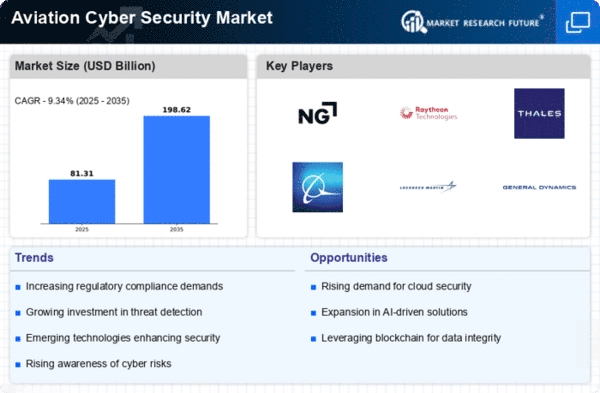
As per MRFR analysis, the Aviation Cyber Security Market Size was estimated at 74.36 USD Billion in 2024. The Aviation Cyber Security industry is projected to grow from 81.31 USD Billion in 2025 to 198.62 USD Billion by 2035, exhibiting a compound annual growth rate (CAGR) of 9.34 during the forecast period 2025 - 2035.

Key Market Trends & Highlights

The Aviation Cyber Security Market is poised for substantial growth driven by regulatory compliance and technological advancements.

  • North America remains the largest market for aviation cyber security, reflecting a robust demand for enhanced protection measures.
  • The Asia-Pacific region is emerging as the fastest-growing market, fueled by increasing investments in aviation infrastructure and security.
  • Network security continues to dominate the market, while cloud security is rapidly gaining traction as a vital component of cyber defense strategies.
  • Rising cyber threats and regulatory pressures are key drivers propelling the demand for comprehensive aviation cyber security solutions.

Market Size & Forecast

2024 Market Size 74.36 (USD Billion)
2035 Market Size 198.62 (USD Billion)
CAGR (2025 - 2035) 9.34%
Largest Regional Market Share in 2024 North America

Major Players

Northrop Grumman (US), Raytheon Technologies (US), Thales Group (FR), Boeing (US), Lockheed Martin (US), General Dynamics (US), Airbus (FR), Collins Aerospace (US), Hewlett Packard Enterprise (US)

Market Trends

Aviation Cyber Security

Aviation Cyber Security Market Market Drivers

Rising Cyber Threats

The Global aviation cyber security Market Industry is increasingly driven by the rise in cyber threats targeting aviation systems. With the aviation sector becoming more interconnected, the potential for cyberattacks has escalated. For instance, in 2024, the market is projected to reach 5.9 USD Billion, reflecting the urgent need for robust cybersecurity measures. Airlines and airports are investing heavily in advanced security technologies to mitigate risks associated with data breaches and system vulnerabilities. This trend underscores the critical importance of safeguarding sensitive passenger information and operational data, as the consequences of cyber incidents can be catastrophic.

Market Segment Insights

By Application: Network Security (Largest) vs. Cloud Security (Fastest-Growing)

The Aviation Cyber Security Market is segmented into various applications, with Network Security currently commanding the largest market share. This is primarily due to the increasing prevalence of cyber threats targeting aviation infrastructure, necessitating robust security measures to protect crucial networks. Following closely is Cloud Security, which is witnessing rapid growth as organizations migrate to cloud-based solutions for improved efficiency and scalability, leading to enhanced security concerns. As aviation companies continue to adopt digital transformation strategies, the demand for Endpoint Security, Application Security, and Data Security is also rising, although at a slower pace. These segments are essential for protecting individual devices, applications, and sensitive data respectively. The overall growth in air travel, coupled with evolving regulations surrounding data protection, is driving investment in these areas, underscoring the need for comprehensive cyber security solutions throughout the aviation industry.

Network Security (Dominant) vs. Cloud Security (Emerging)

Network Security remains a dominant force in the Aviation Cyber Security Market, primarily focusing on safeguarding the critical communication and data networks that underpin aviation operations. The increasing complexity of cyber threats has made it essential for aviation entities to invest in advanced network security protocols and technologies to prevent unauthorized access and system disruptions. On the other hand, Cloud Security has emerged as a key player as the aviation sector transitions towards cloud solutions. The shift to the cloud presents unique challenges, such as data privacy and compliance issues, making cloud security vital for maintaining operational integrity. Organizations are increasingly recognizing the importance of implementing robust cloud security frameworks to manage risks associated with cloud services, positioning it as a rapidly growing segment in the market.

By End Use: Airlines (Largest) vs. Airport Authorities (Fastest-Growing)

In the Aviation Cyber Security Market, the end-use segment is dominated by airlines, which have substantial market share due to their critical need for data protection and operational continuity. This demand is driven by increasing cyber threats in the aviation sector, making cybersecurity an essential investment for airlines to maintain customer trust and comply with regulatory requirements. Airport authorities also play a significant role, albeit with a smaller share, as they are responsible for securing public infrastructures and ensuring safe operations at airports.

Cyber Security Needs: Airlines (Dominant) vs. Airport Authorities (Emerging)

Airlines are the dominant players in the Aviation Cyber Security Market, as they prioritize investment in robust cybersecurity solutions to protect sensitive passenger information and operational data. With the increasing frequency of cyberattacks targeting the airline industry, airlines must continuously innovate and update their cybersecurity measures. On the other hand, airport authorities, while currently regarded as an emerging segment, are rapidly adapting to the evolving cyber threat landscape. They are enhancing their cybersecurity frameworks to protect airport infrastructure and passenger safety. The collaboration between airlines and airport authorities has become vital, as unified cybersecurity strategies are crucial in safeguarding the entire aviation ecosystem.

By Deployment Type: On-Premises (Largest) vs. Cloud-Based (Fastest-Growing)

The Aviation Cyber Security Market exhibits a diverse range of deployment types, with On-Premises solutions commanding the largest share due to their robust security features and control over sensitive data. Many airlines and aviation authorities prefer On-Premises deployment to mitigate risks associated with data breaches in a highly regulated environment. In contrast, Cloud-Based solutions are quickly gaining traction, reflecting the industry's shift towards more flexible, scalable, and cost-effective infrastructure. This transition is particularly pronounced among smaller airlines looking for accessible security solutions without heavy upfront investments. Growth trends within the Aviation Cyber Security segment are indicating a pronounced shift towards Cloud-Based systems as organizations prioritize agility and response to evolving cyber threats. Factors such as the increasing volume of digital data, regulatory compliance demands, and the push for remote operations are propelling the adoption of these advanced security measures. Cloud-Based solutions are appealing due to their rapid deployment capabilities and continuous updates, rendering them the fastest-growing segment within the market.

On-Premises (Dominant) vs. Cloud-Based (Emerging)

On-Premises systems are the dominant force in the Aviation Cyber Security Market, offering unparalleled control, reliability, and level of security for sensitive aviation data and systems. Organizations favor this model to ensure compliance with stringent regulatory standards and to mitigate risks associated with cyber threats. On the other hand, Cloud-Based deployment is emerging as a popular alternative, driven by the need for flexibility and scalability in cyber defense strategies. This segment is particularly favored by smaller aviation players who require effective security solutions but lack the resources for heavy infrastructure investment. The integration of cutting-edge technologies in Cloud-Based solutions continues to expand their functionality and attractiveness, positioning them as a key player in the future of aviation cyber security.

By Service Type: Managed Services (Largest) vs. Incident Response Services (Fastest-Growing)

In the Aviation Cyber Security Market, the service type segment showcases a diverse distribution of offerings. Managed Services has emerged as the largest component, capturing significant market interest due to the growing reliance on outsourced IT security solutions. Consulting Services also holds a noteworthy share, providing essential expertise in risk assessments and compliance. On the other hand, Incident Response Services is rapidly gaining traction, driven by increasing cyber threats and the need for rapid mitigation measures following security breaches.

Consulting Services (Dominant) vs. Training Services (Emerging)

Consulting Services stands out as a dominant force in the Aviation Cyber Security Market, offering strategic insight and tailored approaches to organizations grappling with cybersecurity challenges. This segment benefits from the increasing focus on regulatory compliance and risk management, enabling firms to enhance their defenses effectively. Conversely, Training Services is recognized as an emerging segment, gaining momentum as organizations prioritize workforce education to mitigate human errors in cybersecurity practices. Training services encompass comprehensive learning programs aimed at equipping personnel with the necessary skills to identify and respond to cyber threats, fostering a culture of security awareness.

By Solution Type: Threat Intelligence (Largest) vs. Identity and Access Management (Fastest-Growing)

In the Aviation Cyber Security Market, the segmentation reveals that Threat Intelligence holds the largest market share. This segment is prioritized by aviation companies due to its capability to offer proactive strategies against emerging threats. In contrast, Identity and Access Management is recognized as the fastest-growing segment, driven by increasing incidents of data breaches and the necessity for robust authentication systems to protect sensitive aviation data. The growth in Identity and Access Management highlights a critical shift in aviation cybersecurity priorities. As cyber threats become more sophisticated, aviation organizations are prioritizing solutions that provide secure access to their IT environments. This shift is propelled by regulatory compliance demands, the rise of remote access solutions, and the increasing awareness of insider threats, further enhancing the need for comprehensive identity management solutions.

Threat Intelligence (Dominant) vs. Encryption Solutions (Emerging)

Threat Intelligence is regarded as the dominant force within the Aviation Cyber Security landscape, centralizing efforts on real-time threat detection and response strategies. This segment focuses on gathering and analyzing cyber threat data to anticipate and mitigate potential risks. Conversely, Encryption Solutions are categorized as an emerging segment, gaining traction as organizations aim to protect sensitive data across communication channels. The increased adoption of cloud technologies and remote working practices has amplified the need for effective encryption methods, providing robust safeguards for stored and transmitted data. Both segments highlight a proactive approach in tackling cybersecurity challenges, with Threat Intelligence leading the charge and Encryption Solutions progressively rising in importance to fortify data security.

Get more detailed insights about Aviation Cyber Security Market Research Report - Global Forecast till 2035

Regional Insights

North America : Cybersecurity Leader in Aviation

North America is poised to maintain its leadership in the Aviation Cyber Security Market, holding a significant 40.0% share as of 2024. The region's growth is driven by increasing cyber threats, stringent regulatory frameworks, and substantial investments in advanced technologies. Government initiatives aimed at enhancing aviation security further bolster demand, ensuring that North America remains at the forefront of cybersecurity innovations in aviation. The competitive landscape is characterized by major players such as Northrop Grumman, Raytheon Technologies, and Boeing, which are heavily investing in R&D to develop cutting-edge solutions. The U.S. government plays a crucial role in shaping the market through regulations and funding, fostering an environment conducive to innovation. This robust ecosystem positions North America as a hub for aviation cybersecurity advancements.

Europe : Emerging Cybersecurity Hub

Europe is rapidly evolving as a key player in the Aviation Cyber Security Market, capturing a 20.0% market share. The region's growth is fueled by increasing regulatory requirements and a heightened focus on protecting critical aviation infrastructure from cyber threats. Initiatives by the European Union to enhance cybersecurity resilience in aviation are pivotal in driving demand for advanced security solutions across member states. Leading countries such as France and Germany are at the forefront, with companies like Thales Group and Airbus leading the charge in developing innovative cybersecurity technologies. The competitive landscape is marked by collaboration between public and private sectors, ensuring a comprehensive approach to aviation security. This synergy is essential for addressing the complex challenges posed by evolving cyber threats.

Asia-Pacific : Growing Cybersecurity Demand

Asia-Pacific is witnessing a burgeoning demand for aviation cybersecurity solutions, with a market share of 10.0%. The region's growth is driven by increasing air travel, rising cyber threats, and government initiatives aimed at enhancing aviation security. Countries like China and India are investing heavily in cybersecurity infrastructure, recognizing the importance of safeguarding their rapidly expanding aviation sectors. The competitive landscape features key players such as Collins Aerospace and local firms that are increasingly focusing on developing tailored solutions for the region's unique challenges. As air traffic continues to rise, the need for robust cybersecurity measures becomes paramount, positioning Asia-Pacific as a critical market for future growth in aviation cybersecurity.

Middle East and Africa : Emerging Cybersecurity Frontier

The Middle East and Africa region is emerging as a vital player in the Aviation Cyber Security Market, holding a 4.36% share. The growth is driven by increasing investments in aviation infrastructure and a rising awareness of cybersecurity threats. Governments in the region are implementing regulations to enhance aviation security, which is crucial for attracting international airlines and ensuring passenger safety. Countries like the UAE and South Africa are leading the charge, with local and international firms collaborating to develop effective cybersecurity solutions. The competitive landscape is characterized by a mix of established players and new entrants, all striving to address the unique challenges posed by the region's diverse aviation landscape. This collaborative effort is essential for building a resilient aviation cybersecurity framework.

Key Players and Competitive Insights

The Aviation Cyber Security Market is currently characterized by a dynamic competitive landscape, driven by increasing threats to aviation infrastructure and the growing need for robust security measures. Major players such as Northrop Grumman (US), Raytheon Technologies (US), and Thales Group (FR) are strategically positioned to leverage their technological expertise and extensive experience in defense and aerospace sectors. These companies are focusing on innovation and partnerships to enhance their cybersecurity offerings, thereby shaping a competitive environment that emphasizes advanced solutions and integrated systems.Key business tactics within this market include localizing manufacturing and optimizing supply chains to enhance responsiveness to regional security needs. The competitive structure appears moderately fragmented, with several key players exerting influence through strategic collaborations and technological advancements. This fragmentation allows for a diverse range of solutions, catering to various segments of the aviation industry, from commercial airlines to military applications.

In November Northrop Grumman (US) announced a partnership with a leading cloud service provider to enhance its cybersecurity capabilities for aviation systems. This collaboration aims to integrate advanced AI-driven analytics into their existing security frameworks, potentially improving threat detection and response times. Such strategic moves indicate a shift towards leveraging cloud technologies to bolster cybersecurity measures in aviation, reflecting a broader trend of digital transformation in the industry.

In October Raytheon Technologies (US) unveiled a new suite of cybersecurity solutions specifically designed for unmanned aerial vehicles (UAVs). This launch underscores the company's commitment to addressing emerging threats in the aviation sector, particularly as UAV usage continues to expand. By focusing on this niche market, Raytheon Technologies positions itself as a leader in UAV cybersecurity, which may enhance its competitive edge in a rapidly evolving landscape.

In September Thales Group (FR) secured a contract with a European airline to implement a comprehensive cybersecurity framework across its operations. This initiative not only strengthens the airline's defenses against cyber threats but also showcases Thales' capability to deliver tailored solutions that meet specific client needs. Such contracts are indicative of the growing demand for customized cybersecurity solutions in the aviation sector, further solidifying Thales' market position.

As of December current trends in the Aviation Cyber Security Market are heavily influenced by digitalization, sustainability, and the integration of AI technologies. Strategic alliances among key players are increasingly shaping the competitive landscape, fostering innovation and collaboration. Looking ahead, it appears that competitive differentiation will evolve from traditional price-based competition to a focus on technological innovation, reliability of supply chains, and the ability to deliver comprehensive, integrated solutions that address the complex challenges of aviation cybersecurity.

Key Companies in the Aviation Cyber Security Market include

Industry Developments

In recent months, the Aviation Cyber Security Market has seen significant developments, especially with the ongoing concerns regarding cyber threats in the aviation sector.

Companies like Lockheed Martin and Northrop Grumman have been actively investing in advanced cyber defense technologies to combat these threats.

Notable acquisitions include Microsoft acquiring CyberX in August 2020, which enhances its capabilities in industrial IoT security, proving crucial for aviation systems protection.

Additionally, Raytheon Technologies has expanded its cyber services to improve resilience against sophisticated cyber attacks.

The market has also experienced growth, as the global aviation sector increases its focus on securing critical infrastructure; estimates suggest valuations are rising due to increased expenditure on cybersecurity measures amid heightened regulatory requirements and emerging threats.

In 2021, both IBM and Cisco Systems launched initiatives aimed at safeguarding aviation networks, demonstrating the collective industry push towards robust cybersecurity frameworks.

The emphasis on collaborative innovation is evident as firms like Airbus and Thales work together on secure communication systems to bolster the industry’s defenses.

The overall landscape indicates a proactive shift towards comprehensive security solutions as awareness of cyber risks escalates globally.

Future Outlook

Aviation Cyber Security Market Future Outlook

The Aviation Cyber Security Market is projected to grow at a 9.34% CAGR from 2025 to 2035, driven by increasing cyber threats, regulatory compliance, and technological advancements.

New opportunities lie in:

  • Development of AI-driven threat detection systems
  • Integration of blockchain for secure data transactions
  • Expansion of cybersecurity training programs for aviation personnel

By 2035, the market is expected to be robust, addressing evolving cyber threats effectively.

Market Segmentation

Aviation Cyber Security Market End Use Outlook

  • Airlines
  • Airport Authorities
  • Aircraft Manufacturers
  • Government Agencies
  • Defense Organizations

Aviation Cyber Security Market Application Outlook

  • Network Security
  • Endpoint Security
  • Application Security
  • Data Security
  • Cloud Security

Aviation Cyber Security Market Service Type Outlook

  • Consulting Services
  • Managed Services
  • Training Services
  • Incident Response Services

Aviation Cyber Security Market Solution Type Outlook

  • Threat Intelligence
  • Identity and Access Management
  • Encryption Solutions
  • Security Information and Event Management

Aviation Cyber Security Market Deployment Type Outlook

  • On-Premises
  • Cloud-Based
  • Hybrid

Report Scope

MARKET SIZE 202474.36(USD Billion)
MARKET SIZE 202581.31(USD Billion)
MARKET SIZE 2035198.62(USD Billion)
COMPOUND ANNUAL GROWTH RATE (CAGR)9.34% (2025 - 2035)
REPORT COVERAGERevenue Forecast, Competitive Landscape, Growth Factors, and Trends
BASE YEAR2024
Market Forecast Period2025 - 2035
Historical Data2019 - 2024
Market Forecast UnitsUSD Billion
Key Companies ProfiledNorthrop Grumman (US), Raytheon Technologies (US), Thales Group (FR), Boeing (US), Lockheed Martin (US), General Dynamics (US), Airbus (FR), Collins Aerospace (US), Hewlett Packard Enterprise (US)
Segments CoveredApplication, End Use, Deployment Type, Service Type, Solution Type
Key Market OpportunitiesIntegration of artificial intelligence for proactive threat detection in the Aviation Cyber Security Market.
Key Market DynamicsRising regulatory scrutiny and technological advancements drive demand for robust aviation cyber security solutions.
Countries CoveredNorth America, Europe, APAC, South America, MEA

FAQs

What was at a the expected Market Was at a the Aviation Cyber Security Market in 2024?

The Market Size was at a 74.36 Billion USD by 2024

  1. SECTION I: EXECUTIVE SUMMARY AND KEY HIGHLIGHTS
    1. | 1.1 EXECUTIVE SUMMARY
    2. | 1.1.1 Market Overview
    3. | 1.1.2 Key Findings
    4. | 1.1.3 Market Segmentation
    5. | 1.1.4 Competitive Landscape
    6. | 1.1.5 Challenges and Opportunities
    7. | 1.1.6 Future Outlook
  2. SECTION II: SCOPING, METHODOLOGY AND MARKET STRUCTURE
    1. | 2.1 MARKET INTRODUCTION
    2. | 2.1.1 Definition
    3. | 2.1.2 Scope of the study
    4. |-- 2.1.2.1 Research Objective
    5. |-- 2.1.2.2 Assumption
    6. |-- 2.1.2.3 Limitations
    7. | 2.2 RESEARCH METHODOLOGY
    8. | 2.2.1 Overview
    9. | 2.2.2 Data Mining
    10. | 2.2.3 Secondary Research
    11. | 2.2.4 Primary Research
    12. |-- 2.2.4.1 Primary Interviews and Information Gathering Process
    13. |-- 2.2.4.2 Breakdown of Primary Respondents
    14. | 2.2.5 Forecasting Model
    15. | 2.2.6 Market Size Estimation
    16. |-- 2.2.6.1 Bottom-Up Approach
    17. |-- 2.2.6.2 Top-Down Approach
    18. | 2.2.7 Data Triangulation
    19. | 2.2.8 Validation
  3. SECTION III: QUALITATIVE ANALYSIS
    1. | 3.1 MARKET DYNAMICS
    2. | 3.1.1 Overview
    3. | 3.1.2 Drivers
    4. | 3.1.3 Restraints
    5. | 3.1.4 Opportunities
    6. | 3.2 MARKET FACTOR ANALYSIS
    7. | 3.2.1 Value chain Analysis
    8. | 3.2.2 Porter's Five Forces Analysis
    9. |-- 3.2.2.1 Bargaining Power of Suppliers
    10. |-- 3.2.2.2 Bargaining Power of Buyers
    11. |-- 3.2.2.3 Threat of New Entrants
    12. |-- 3.2.2.4 Threat of Substitutes
    13. |-- 3.2.2.5 Intensity of Rivalry
    14. | 3.2.3 COVID-19 Impact Analysis
    15. |-- 3.2.3.1 Market Impact Analysis
    16. |-- 3.2.3.2 Regional Impact
    17. |-- 3.2.3.3 Opportunity and Threat Analysis
  4. SECTION IV: QUANTITATIVE ANALYSIS
    1. | 4.1 Aerospace & Defense, BY Application (USD Billion)
    2. | 4.1.1 Network Security
    3. | 4.1.2 Endpoint Security
    4. | 4.1.3 Application Security
    5. | 4.1.4 Data Security
    6. | 4.1.5 Cloud Security
    7. | 4.2 Aerospace & Defense, BY End Use (USD Billion)
    8. | 4.2.1 Airlines
    9. | 4.2.2 Airport Authorities
    10. | 4.2.3 Aircraft Manufacturers
    11. | 4.2.4 Government Agencies
    12. | 4.2.5 Defense Organizations
    13. | 4.3 Aerospace & Defense, BY Deployment Type (USD Billion)
    14. | 4.3.1 On-Premises
    15. | 4.3.2 Cloud-Based
    16. | 4.3.3 Hybrid
    17. | 4.4 Aerospace & Defense, BY Service Type (USD Billion)
    18. | 4.4.1 Consulting Services
    19. | 4.4.2 Managed Services
    20. | 4.4.3 Training Services
    21. | 4.4.4 Incident Response Services
    22. | 4.5 Aerospace & Defense, BY Solution Type (USD Billion)
    23. | 4.5.1 Threat Intelligence
    24. | 4.5.2 Identity and Access Management
    25. | 4.5.3 Encryption Solutions
    26. | 4.5.4 Security Information and Event Management
    27. | 4.6 Aerospace & Defense, BY Region (USD Billion)
    28. | 4.6.1 North America
    29. |-- 4.6.1.1 US
    30. |-- 4.6.1.2 Canada
    31. | 4.6.2 Europe
    32. |-- 4.6.2.1 Germany
    33. |-- 4.6.2.2 UK
    34. |-- 4.6.2.3 France
    35. |-- 4.6.2.4 Russia
    36. |-- 4.6.2.5 Italy
    37. |-- 4.6.2.6 Spain
    38. |-- 4.6.2.7 Rest of Europe
    39. | 4.6.3 APAC
    40. |-- 4.6.3.1 China
    41. |-- 4.6.3.2 India
    42. |-- 4.6.3.3 Japan
    43. |-- 4.6.3.4 South Korea
    44. |-- 4.6.3.5 Malaysia
    45. |-- 4.6.3.6 Thailand
    46. |-- 4.6.3.7 Indonesia
    47. |-- 4.6.3.8 Rest of APAC
    48. | 4.6.4 South America
    49. |-- 4.6.4.1 Brazil
    50. |-- 4.6.4.2 Mexico
    51. |-- 4.6.4.3 Argentina
    52. |-- 4.6.4.4 Rest of South America
    53. | 4.6.5 MEA
    54. |-- 4.6.5.1 GCC Countries
    55. |-- 4.6.5.2 South Africa
    56. |-- 4.6.5.3 Rest of MEA
  5. SECTION V: COMPETITIVE ANALYSIS
    1. | 5.1 Competitive Landscape
    2. | 5.1.1 Overview
    3. | 5.1.2 Competitive Analysis
    4. | 5.1.3 Market share Analysis
    5. | 5.1.4 Major Growth Strategy in the Aerospace & Defense
    6. | 5.1.5 Competitive Benchmarking
    7. | 5.1.6 Leading Players in Terms of Number of Developments in the Aerospace & Defense
    8. | 5.1.7 Key developments and growth strategies
    9. |-- 5.1.7.1 New Product Launch/Service Deployment
    10. |-- 5.1.7.2 Merger & Acquisitions
    11. |-- 5.1.7.3 Joint Ventures
    12. | 5.1.8 Major Players Financial Matrix
    13. |-- 5.1.8.1 Sales and Operating Income
    14. |-- 5.1.8.2 Major Players R&D Expenditure. 2023
    15. | 5.2 Company Profiles
    16. | 5.2.1 Northrop Grumman (US)
    17. |-- 5.2.1.1 Financial Overview
    18. |-- 5.2.1.2 Products Offered
    19. |-- 5.2.1.3 Key Developments
    20. |-- 5.2.1.4 SWOT Analysis
    21. |-- 5.2.1.5 Key Strategies
    22. | 5.2.2 Raytheon Technologies (US)
    23. |-- 5.2.2.1 Financial Overview
    24. |-- 5.2.2.2 Products Offered
    25. |-- 5.2.2.3 Key Developments
    26. |-- 5.2.2.4 SWOT Analysis
    27. |-- 5.2.2.5 Key Strategies
    28. | 5.2.3 Thales Group (FR)
    29. |-- 5.2.3.1 Financial Overview
    30. |-- 5.2.3.2 Products Offered
    31. |-- 5.2.3.3 Key Developments
    32. |-- 5.2.3.4 SWOT Analysis
    33. |-- 5.2.3.5 Key Strategies
    34. | 5.2.4 Boeing (US)
    35. |-- 5.2.4.1 Financial Overview
    36. |-- 5.2.4.2 Products Offered
    37. |-- 5.2.4.3 Key Developments
    38. |-- 5.2.4.4 SWOT Analysis
    39. |-- 5.2.4.5 Key Strategies
    40. | 5.2.5 Lockheed Martin (US)
    41. |-- 5.2.5.1 Financial Overview
    42. |-- 5.2.5.2 Products Offered
    43. |-- 5.2.5.3 Key Developments
    44. |-- 5.2.5.4 SWOT Analysis
    45. |-- 5.2.5.5 Key Strategies
    46. | 5.2.6 General Dynamics (US)
    47. |-- 5.2.6.1 Financial Overview
    48. |-- 5.2.6.2 Products Offered
    49. |-- 5.2.6.3 Key Developments
    50. |-- 5.2.6.4 SWOT Analysis
    51. |-- 5.2.6.5 Key Strategies
    52. | 5.2.7 Airbus (FR)
    53. |-- 5.2.7.1 Financial Overview
    54. |-- 5.2.7.2 Products Offered
    55. |-- 5.2.7.3 Key Developments
    56. |-- 5.2.7.4 SWOT Analysis
    57. |-- 5.2.7.5 Key Strategies
    58. | 5.2.8 Collins Aerospace (US)
    59. |-- 5.2.8.1 Financial Overview
    60. |-- 5.2.8.2 Products Offered
    61. |-- 5.2.8.3 Key Developments
    62. |-- 5.2.8.4 SWOT Analysis
    63. |-- 5.2.8.5 Key Strategies
    64. | 5.2.9 Hewlett Packard Enterprise (US)
    65. |-- 5.2.9.1 Financial Overview
    66. |-- 5.2.9.2 Products Offered
    67. |-- 5.2.9.3 Key Developments
    68. |-- 5.2.9.4 SWOT Analysis
    69. |-- 5.2.9.5 Key Strategies
    70. | 5.3 Appendix
    71. | 5.3.1 References
    72. | 5.3.2 Related Reports

Aerospace & Defense Market Segmentation

Aerospace & Defense By Application (USD Billion, 2025-2035)

  • Network Security
  • Endpoint Security
  • Application Security
  • Data Security
  • Cloud Security

Aerospace & Defense By End Use (USD Billion, 2025-2035)

  • Airlines
  • Airport Authorities
  • Aircraft Manufacturers
  • Government Agencies
  • Defense Organizations

Aerospace & Defense By Deployment Type (USD Billion, 2025-2035)

  • On-Premises
  • Cloud-Based
  • Hybrid

Aerospace & Defense By Service Type (USD Billion, 2025-2035)

  • Consulting Services
  • Managed Services
  • Training Services
  • Incident Response Services

Aerospace & Defense By Solution Type (USD Billion, 2025-2035)

  • Threat Intelligence
  • Identity and Access Management
  • Encryption Solutions
  • Security Information and Event Management
Infographic

Free Sample Request

Kindly complete the form below to receive a free sample of this Report

Get Free Sample

Customer Strories

Compare Licence

×
Features License Type
Single User Multiuser License Enterprise User
Price $4,950 $5,950 $7,250
Maximum User Access Limit 1 User Upto 10 Users Unrestricted Access Throughout the Organization
Free Customization
Direct Access to Analyst
Deliverable Format
Platform Access
Discount on Next Purchase 10% 15% 15%
Printable Versions