×
Hero Background
English
Chinese
French
Japanese
Korean
German
Spanish

Autonomous Construction Equipment Market Analysis

ID: MRFR/PCM/11125-HCR
128 Pages
Snehal Singh
October 2025

Autonomous Construction Equipment Market Research Report Information By Autonomy (Semi-Autonomous, and Fully-Autonomous), By Type (Earth Moving Equipment, Construction Vehicles, Material Handling Equipment, and Concrete and Road Construction Equipment), By Application (Road Construction, Building Construction, and Others), And By Region (North America, Europe, Asia-Pacific, And Rest Of The World) –Market Forecast Till 2035.

Share:
Download PDF ×

We do not share your information with anyone. However, we may send you emails based on your report interest from time to time. You may contact us at any time to opt-out.

Autonomous Construction Equipment Market Infographic
Purchase Options

Market Analysis

In-depth Analysis of Autonomous Construction Equipment Market Industry Landscape

The market of Autonomous Construction Equipment (ACE) is witnessed to be through the transformation caused in the technology. Market dynamics within this area is influenced by the community of factors that characterize its forward motion. In this context, efficiency and productivity drive construction sector demand is one of the major factors. Autonomous construction equipment, together with leading technologies including AI, machine learning, and highly-advanced sensors,has turned a new page to cope with the challenges.

ACE market surge has found its footing in the goal of improved safety, reduced labor costs. Automation in construction is a promise of reducing danger to construction workers by contributing to the reduction of human operators who have to operate in dangerous environment. Such practices, apart from making a construction site safer to work on, also save the company a lot of money. The market trends show that a slow but temporal process of transition towards the autonomous approach in the construction industry leads to the better understanding of cost benefits for construction companies.

The next point is that regulations environment is a key factor which determines the course of market. The governments and governmental bodies of today, encouraged by the significant advantages of self-managed construction equipment, are developing the policies that support the technology. Incentives and laws which attract autonomous systems expansion and market nurture the market of ACE. With regulations aligning to accommodate autonomous systems, the market will eventually see a wider and rapid acceptance of these technology.

Cost efficiency is considered as an integral element of the market dynamics. Initially, investing in autonomous construction machine may prove expensive but it is proven that in the long run, the money that can be saved through the reduction in labor expenditure and the increase in operational efficiency is more significant. Due to the risk assessment of humongous initial capital costs vs. long-term benefits, construction companies ponder and the future follows the path of rapid growth.

Besides helping to shape industry relations, market dynamics are also affected by joint ventures and partnerships. Considering the fact that producers of equipment, construction firms as well as technology providers work together, there is a synergy which makes it possible for new products to develop quicker as well as more rapidly to be adopted. Such joint ventures are usually an occasion of the pooling and merging of different skill sets, resulting in the development of more complex and advanced autonomous systems. The bipolar nature of the stakeholders in the sector is building an environment that enhances innovation and quick evolutions.


Author
Snehal Singh
Assistant Manager - Research

High acumen in analyzing complex macro & micro markets with more than 6 years of work experience in the field of market research. By implementing her analytical skills in forecasting and estimation into market research reports, she has expertise in Packaging, Construction, and Equipment domains. She handles a team size of 20-25 resources and ensures smooth running of the projects, associated marketing activities, and client servicing.

Leave a Comment

FAQs

What is the projected market valuation of the Autonomous Construction Equipment Market by 2035?

The market is projected to reach a valuation of 21.5 USD Billion by 2035.

What was the market valuation of the Autonomous Construction Equipment Market in 2024?

In 2024, the market valuation was 9.411 USD Billion.

What is the expected CAGR for the Autonomous Construction Equipment Market during the forecast period 2025 - 2035?

The expected CAGR for the market during this period is 7.8%.

Which segments are included in the Autonomous Construction Equipment Market?

The market includes segments such as Autonomy, Type, and Application.

What are the projected valuations for the Semi-Autonomous and Fully-Autonomous segments by 2035?

The Semi-Autonomous segment is projected to reach 10.5 USD Billion, while the Fully-Autonomous segment is expected to reach 11.0 USD Billion.

How do the Earth Moving Equipment and Construction Vehicles segments compare in terms of projected growth?

Earth Moving Equipment is projected to grow to 7.0 USD Billion, whereas Construction Vehicles are expected to reach 5.5 USD Billion by 2035.

Market Summary

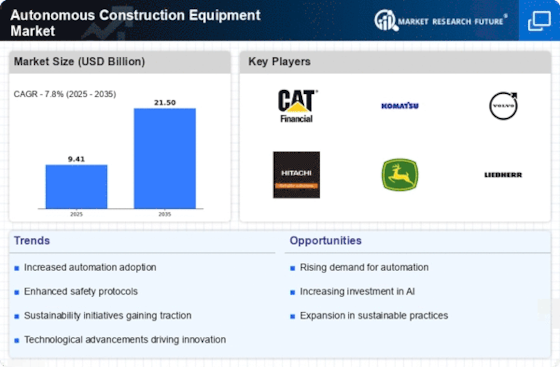
As per MRFR analysis, the Autonomous Construction Equipment Market was estimated at 9.411 USD Billion in 2024. The Autonomous Construction Equipment industry is projected to grow from 10.14 USD Billion in 2025 to 21.5 USD Billion by 2035, exhibiting a compound annual growth rate (CAGR) of 7.8 during the forecast period 2025 - 2035.

Key Market Trends & Highlights

The Autonomous Construction Equipment Market is poised for substantial growth driven by technological advancements and sustainability initiatives.

  • Technological advancements are reshaping the Autonomous Construction Equipment Market, enhancing efficiency and safety.
  • North America remains the largest market, while the Asia-Pacific region is recognized as the fastest-growing area for autonomous construction technologies.
  • The semi-autonomous segment leads in market share, whereas fully-autonomous equipment is experiencing rapid growth.
  • Increased demand for automation and labor shortages are key drivers propelling the market forward.

Market Size & Forecast

2024 Market Size 9.411 (USD Billion)
2035 Market Size 21.5 (USD Billion)
CAGR (2025 - 2035) 7.8%
Largest Regional Market Share in 2024 North America

Major Players

<p>Caterpillar (US), Komatsu (JP), Volvo Construction Equipment (SE), Hitachi Construction Machinery (JP), John Deere (US), Liebherr (DE), Doosan Infracore (KR), CASE Construction Equipment (US), Terex Corporation (US)</p>

Market Trends

The Autonomous Construction Equipment Market is currently experiencing a transformative phase, driven by advancements in technology and a growing emphasis on efficiency and safety in construction processes. The integration of artificial intelligence, machine learning, and robotics into construction machinery is reshaping traditional practices, allowing for enhanced precision and reduced labor costs. As companies increasingly adopt these innovations, the market appears poised for substantial growth, reflecting a shift towards automation that could redefine industry standards. Furthermore, the rising demand for sustainable construction practices is likely to propel the development of eco-friendly autonomous equipment, aligning with global efforts to minimize environmental impact. In addition, the Autonomous Construction Equipment Market is witnessing a surge in investment from both private and public sectors, indicating a strong belief in the potential of these technologies. Partnerships between technology firms and construction companies are becoming more common, fostering an environment of collaboration that may accelerate the deployment of autonomous solutions. As the market evolves, it seems that the focus will not only be on enhancing operational efficiency but also on ensuring safety and compliance with regulatory standards, which could further influence market dynamics in the coming years.

Technological Advancements

The ongoing evolution of technology is a primary driver in the Autonomous Construction Equipment Market. Innovations in artificial intelligence and machine learning are enabling equipment to operate with greater autonomy and efficiency. This trend suggests that as technology continues to advance, the capabilities of autonomous machinery will expand, potentially leading to more widespread adoption across various construction projects.

Sustainability Initiatives

There is a growing emphasis on sustainability within the Autonomous Construction Equipment Market. Companies are increasingly seeking equipment that not only enhances productivity but also minimizes environmental impact. This trend indicates a shift towards eco-friendly solutions, which may become a critical factor in equipment selection and investment decisions.

Collaborative Partnerships

The formation of strategic partnerships between technology providers and construction firms is becoming more prevalent. These collaborations appear to facilitate the sharing of expertise and resources, which could accelerate the development and implementation of autonomous solutions. This trend suggests that the market may see a rise in innovative products and services as a result of these alliances.

Autonomous Construction Equipment Market Market Drivers

Labor Shortages and Skill Gaps

The Autonomous Construction Equipment Market is significantly influenced by ongoing labor shortages and skill gaps in the construction workforce. As the industry faces challenges in attracting skilled labor, the adoption of autonomous equipment becomes a viable solution to mitigate these issues. By utilizing autonomous machinery, construction firms can maintain productivity levels despite a reduced workforce. This trend is particularly evident in regions where the construction labor pool is shrinking, prompting companies to invest in technology that compensates for the lack of available skilled workers. The reliance on autonomous equipment is likely to increase as firms seek to address these labor challenges.

Increased Demand for Automation

The Autonomous Construction Equipment Market is experiencing a surge in demand for automation across various construction sectors. This trend is driven by the need for enhanced efficiency and productivity on job sites. As construction projects become more complex, the integration of autonomous equipment allows for streamlined operations, reducing the time and labor costs associated with traditional methods. Reports indicate that the market for autonomous construction equipment is projected to grow at a compound annual growth rate of approximately 15% over the next five years. This growth is indicative of a broader shift towards automation, as companies seek to leverage technology to improve project outcomes and minimize human error.

Regulatory Support and Safety Standards

The Autonomous Construction Equipment Market is benefiting from an evolving regulatory landscape that increasingly supports the use of autonomous technologies. Governments and regulatory bodies are recognizing the potential of autonomous equipment to enhance safety and efficiency on construction sites. New safety standards and guidelines are being developed to facilitate the integration of these technologies, which may lead to greater acceptance and adoption within the industry. As regulations become more favorable, construction companies are likely to invest in autonomous solutions, further driving market growth. This regulatory support is crucial for fostering innovation and ensuring that safety remains a priority in the deployment of autonomous construction equipment.

Technological Innovations and Connectivity

The Autonomous Construction Equipment Market is propelled by rapid technological innovations, particularly in connectivity and data analytics. Advances in Internet of Things (IoT) technology enable autonomous equipment to communicate in real-time, enhancing operational efficiency and decision-making processes. The integration of artificial intelligence and machine learning algorithms allows for predictive maintenance and improved performance monitoring. As these technologies continue to evolve, they are expected to play a pivotal role in shaping the future of construction. The ability to collect and analyze data from autonomous equipment not only optimizes performance but also provides valuable insights for project management, thereby driving further adoption in the industry.

Sustainability and Environmental Considerations

The Autonomous Construction Equipment Market is increasingly aligned with sustainability and environmental considerations. As construction companies face pressure to reduce their carbon footprint, autonomous equipment offers a pathway to more sustainable practices. These machines are often designed to be more fuel-efficient and can optimize resource usage, leading to less waste and lower emissions. Furthermore, the ability to operate autonomously can reduce the need for multiple machines on-site, thereby minimizing environmental impact. As sustainability becomes a core focus for the construction industry, the demand for autonomous solutions that support eco-friendly practices is likely to rise, driving growth in the market.

Market Segment Insights

By Autonomy: Semi-Autonomous (Largest) vs. Fully-Autonomous (Fastest-Growing)

<p>In the Autonomous Construction Equipment Market, the distribution of market share between Semi-Autonomous and Fully-Autonomous segments is a telling indication of current trends. Semi-Autonomous equipment, which requires some level of human intervention, holds a significant portion of the market due to its established presence and reliability within the construction industry. On the other hand, Fully-Autonomous equipment is rapidly gaining traction as advancements in technology boost its capabilities and efficiency, promising to redefine workflow dynamics in construction projects.</p>

<p>Autonomy: Semi-Autonomous (Dominant) vs. Fully-Autonomous (Emerging)</p>

<p>Semi-Autonomous construction equipment is currently recognized as the dominant force in the market, primarily due to its ability to seamlessly integrate human oversight while enhancing productivity. These machines operate with a combination of autonomous technologies and operator control, making them adaptable to various construction scenarios. Conversely, Fully-Autonomous equipment, while still developing, stands out as an emerging category poised for significant growth. Its autonomous nature eliminates the need for human operators on-site, leading to improved safety and operational efficiency. As technology advances, the demand for Fully-Autonomous solutions is expected to rise, driven by the push for increased automation and cost-effective construction processes.</p>

By Type: Earth Moving Equipment (Largest) vs. Construction Vehicles (Fastest-Growing)

<p>The Autonomous Construction Equipment Market is characterized by diverse segments, with Earth Moving Equipment leading the charge. This segment encompasses various machinery, contributing significantly to the overall market shares. In contrast, Construction Vehicles are emerging rapidly, capturing attention due to their advanced capabilities and adaptability in construction tasks, thus gaining a notable share. Overall, these segments reflect distinct roles in the construction process, influencing market dynamics and growth patterns.</p>

<p>Equipment: Earth Moving (Dominant) vs. Construction Vehicles (Emerging)</p>

<p>Earth Moving Equipment, including excavators and bulldozers, remains the dominant force in the Autonomous Construction Equipment Market due to its extensive application in site preparation, grading, and excavation. These machines are pivotal for large-scale projects, leveraging autonomous technology for increased efficiency and safety. On the other hand, Construction Vehicles such as autonomous trucks and delivery vehicles are rapidly becoming essential components of the construction landscape. Their ability to navigate complex environments and streamline logistics positions them as an emerging favorite, driving innovation and reshaping operational methodologies in construction.</p>

By Application: Road Construction (Largest) vs. Building Construction (Fastest-Growing)

<p>The Autonomous Construction Equipment Market is prominently divided among three significant application segments: Road Construction, Building Construction, and Others. Among these, Road Construction holds the largest market share due to the increasing demand for infrastructure development and maintenance. The focus on enhancing road quality and capacity has pushed road construction projects to the forefront, ensuring that this segment continues to dominate the market. In contrast, the Building Construction segment is gaining traction and is recognized as the fastest-growing area within the market. This growth is largely driven by urbanization trends, as cities expand and the demand for residential and commercial buildings escalates. In recent years, the Building Construction segment has witnessed a surge in adoption of autonomous technologies, which are reshaping the construction processes to enhance efficiency and safety. As construction companies seek innovative solutions to meet modern demands, autonomous equipment has become increasingly appealing for building projects. The shift towards smart construction and sustainability has further fueled this trend, making Building Construction a promising segment for future expansion. While the Road Construction segment remains vital for infrastructure, the rapid evolution in Building Construction is set to redefine market dynamics in the coming years.</p>

<p>Road Construction (Dominant) vs. Building Construction (Emerging)</p>

<p>The Road Construction segment is characterized by its robustness and essential role in maintaining and expanding transportation networks. Autonomous equipment in this domain includes automated pavers, graders, and compactors, which streamline operations and improve overall project timelines. This segment's dominance is reflected in its ability to address the critical need for improved infrastructure that supports economic growth and connectivity. Conversely, the Building Construction segment is emerging rapidly, driven by technological advancements and changing consumer expectations. Autonomous systems in building construction encompass excavation, lifting, and assembly equipment, designed to facilitate more efficient building processes. This emerging segment is expected to embrace increased automation as companies lean towards smart construction, minimizing labor costs and enhancing safety protocols. Thus, both segments play vital yet distinct roles within the Autonomous Construction Equipment Market.</p>

Get more detailed insights about Autonomous Construction Equipment Market Research Report - Global Forecast by 2035

Regional Insights

By region, the study provides the market insights into North America, Europe, Asia-Pacific and Rest of the World. The North American Autonomous Construction Equipment Market area will dominate this market, Autonomous solutions have become more popular in the region because of its sophisticated technology infrastructure and emphasis on efficient and safe construction.

Further, the major countries studied in the market report are The US, German, France, the UK, Canada, Italy, Spain, India, Australia, South Korea, China, Japan, and Brazil.

Europe Autonomous Construction Equipment Market has the second-largest portion of the market because of the numerous efforts the regional administrations are making to upgrade the infrastructure. Further, the German Autonomous Construction Equipment Market maintained the most market share and the UK Autonomous Construction Equipment Market was the European market with the quickest rate of growth.

The Asia-Pacific Autonomous Construction Equipment Market is anticipated to expand between 2023 and 2032 at the quickest CAGR. The region's smart city development is largely responsible for the market's growth. Moreover, China’s Autonomous Construction Equipment Market maintained the most market share, and the Indian Autonomous Construction Equipment Market was the Asia-Pacific region's fastest-growing market.

Key Players and Competitive Insights

Leading market players are making huge investments in R&D to broaden their product lines, which will contribute to the market expansion for Autonomous Construction Equipment Market. Additionally, market players are engaging in a range of calculated initiatives to increase their worldwide presence, with important market developments involving the introduction of new products, contracts, M&A transactions, increased investment, and cooperation with other enterprises. To grow and endure in an increasingly cutthroat and dynamic market, Autonomous Construction Equipment industry must provide reasonably priced goods.

One of the main business strategies employed by manufacturers is to manufacture locally in order to reduce operating expenses in the Autonomous Construction Equipment industry to help customers and expand the market segment. In recent years, the Autonomous Construction Equipment industry has provided some of the infrastructure sector's biggest benefits. Major players in the Autonomous Construction Equipment Market, including Volvo Construction Equipment, Caterpillar Inc., Komatsu Ltd., Case Construction Equipment, and others, invest in operations for research and development in an effort to improve market demand.

Volvo Construction Equipment, or Volvo CE, is a significant corporation that designs, produces, and distributes equipment for the building and associated sectors. It is a company and subsidiary of the Volvo Group. The founding members of Volvo Construction Equipment were three men: Carl Gerhard and Jean Bolinder, brothers, and Johan Theofron Munktell. In December 2020, Volvo commenced shipping its ECR25 Electric compact excavators to clients exclusively powered by electricity.

Caterpillar Inc. (CAT) is an American company which manufactures equipment for mining, construction, and other engineering applications, Construction equipment is manufactured by the largest firm in the world. When the Holt Manufacturing Company and the C. L. Best Tractor Company merged in 1925 to form the new Caterpillar Tractor Company, which was headquartered in California, Caterpillar Inc. was born. The company adopted its current name when it reorganized itself as a Delaware corporation in 1986.

In June 2022, Citing "the company's best strategic interest," the corporation announced intentions to relocate its worldwide headquarters from Deerfield, Illinois, to Irving, Texas, starting later this year.

The Caterpillar Cat® 340 UHD (Ultra High Demolition) machine, which boasts enhanced autonomous capabilities, was introduced in 2024. The most recent autonomous control technologies from Caterpillar are fitted into this model specifically for demolition work, increasing accuracy and safety.

Komatsu introduced the Smart Construction Autonomous Dozer in 2023; it incorporates cutting-edge machine learning and GPS technologies. The purpose of this autonomous dozer is to increase accuracy and efficiency on construction sites by automating grading and excavating processes.

Key Companies in the Autonomous Construction Equipment Market market include

Industry Developments

For example, Develon brought new Concept-X 2.0 automated construction equipment to the Intermat exhibition held in Paris in May 2024 while also showcasing the new DX225-CX crawler excavator along with the DD100-CX dozer, which lacks a cabin. The updated system features autonomous driving, blade control with GNSS, and drill 3D grading while using a tiltrotator accessory. The productivity cost reduction plans are achieved by combining AI, ICT, and 5G technologies for drone terrain scanning drones alongside the X-Center system for real-time equipment control, which is integrated within the Concept-X system.

Hitachi Construction Machinery Co., Ltd. created a virtual version of a real construction site and developed the “Real-Time Digital Twin Platform.” Now, the construction activities, along with the autonomous machine operations, could be monitored and managed remotely through the Internet in February 2024.

Deere & Company released the new 9RX tractor model with an 830HP option in February 2024. Deere & Company differentiated the 9RX tractor into three different high HP four-track models, namely the 9RX 710, 9RX 770, and 9RX 830. Each of these tractors would come equipped with rear implement ethernet, heightened visibility features, a backup alarm, a 330-Amp alternator, and, of course, the brake controller and valve, as well as the required connectors, controllers, and harnesses.

In August 2023, New Holland, part of CNH Industries, introduced the T4 Electric Power, an autonomous electric utility tractor. T4 Electric Power came with a 110-kWh Lithium Ion battery pack with 74 horsepower. It traveled up to 8 hours on a single charge and recharged to 100% in one hour. It had advanced features such as Follow Me Mode, Invisible Bucket, and 360-degree awareness with Smart Roof cameras and sensors, as well as autonomous driving capabilities.

Future Outlook

Autonomous Construction Equipment Market Future Outlook

<p>The Autonomous Construction Equipment Market is projected to grow at a 7.8% CAGR from 2024 to 2035, driven by technological advancements, labor shortages, and increased demand for efficiency.</p>

New opportunities lie in:

  • <p>Integration of AI-driven predictive maintenance systems</p>
  • <p>Development of autonomous equipment leasing models</p>
  • <p>Expansion into emerging markets with tailored solutions</p>

<p>By 2035, the market is expected to be robust, driven by innovation and strategic partnerships.</p>

Market Segmentation

Autonomous Construction Equipment Market Type Outlook

  • Earth Moving Equipment
  • Construction Vehicles
  • Material Handling Equipment
  • Concrete and Road Construction Equipment

Autonomous Construction Equipment Market Autonomy Outlook

  • Semi-Autonomous
  • Fully-Autonomous

Autonomous Construction Equipment Market Application Outlook

  • Road Construction
  • Building Construction
  • Others

Report Scope

MARKET SIZE 20249.411(USD Billion)
MARKET SIZE 202510.14(USD Billion)
MARKET SIZE 203521.5(USD Billion)
COMPOUND ANNUAL GROWTH RATE (CAGR)7.8% (2024 - 2035)
REPORT COVERAGERevenue Forecast, Competitive Landscape, Growth Factors, and Trends
BASE YEAR2024
Market Forecast Period2025 - 2035
Historical Data2019 - 2024
Market Forecast UnitsUSD Billion
Key Companies ProfiledMarket analysis in progress
Segments CoveredMarket segmentation analysis in progress
Key Market OpportunitiesIntegration of artificial intelligence and machine learning in Autonomous Construction Equipment enhances operational efficiency and safety.
Key Market DynamicsTechnological advancements drive competitive forces, reshaping the Autonomous Construction Equipment landscape and influencing market dynamics.
Countries CoveredNorth America, Europe, APAC, South America, MEA

FAQs

What is the projected market valuation of the Autonomous Construction Equipment Market by 2035?

The market is projected to reach a valuation of 21.5 USD Billion by 2035.

What was the market valuation of the Autonomous Construction Equipment Market in 2024?

In 2024, the market valuation was 9.411 USD Billion.

What is the expected CAGR for the Autonomous Construction Equipment Market during the forecast period 2025 - 2035?

The expected CAGR for the market during this period is 7.8%.

Which segments are included in the Autonomous Construction Equipment Market?

The market includes segments such as Autonomy, Type, and Application.

What are the projected valuations for the Semi-Autonomous and Fully-Autonomous segments by 2035?

The Semi-Autonomous segment is projected to reach 10.5 USD Billion, while the Fully-Autonomous segment is expected to reach 11.0 USD Billion.

How do the Earth Moving Equipment and Construction Vehicles segments compare in terms of projected growth?

Earth Moving Equipment is projected to grow to 7.0 USD Billion, whereas Construction Vehicles are expected to reach 5.5 USD Billion by 2035.

  1. SECTION I: EXECUTIVE SUMMARY AND KEY HIGHLIGHTS
    1. EXECUTIVE SUMMARY
      1. Market Overview
      2. Key Findings
      3. Market Segmentation
      4. Competitive Landscape
      5. Challenges and Opportunities
      6. Future Outlook
  2. SECTION II: SCOPING, METHODOLOGY AND MARKET STRUCTURE
    1. MARKET INTRODUCTION
      1. Definition
      2. Scope of the study
    2. RESEARCH METHODOLOGY
      1. Overview
      2. Data Mining
      3. Secondary Research
      4. Primary Research
      5. Forecasting Model
      6. Market Size Estimation
      7. Data Triangulation
      8. Validation
  3. SECTION III: QUALITATIVE ANALYSIS
    1. MARKET DYNAMICS
      1. Overview
      2. Drivers
      3. Restraints
      4. Opportunities
    2. MARKET FACTOR ANALYSIS
      1. Value chain Analysis
      2. Porter's Five Forces Analysis
      3. COVID-19 Impact Analysis
  4. SECTION IV: QUANTITATIVE ANALYSIS
    1. Packaging & Transport, BY Autonomy (USD Billion)
      1. Semi-Autonomous
      2. Fully-Autonomous
    2. Packaging & Transport, BY Type (USD Billion)
      1. Earth Moving Equipment
      2. Construction Vehicles
      3. Material Handling Equipment
      4. Concrete and Road Construction Equipment
    3. Packaging & Transport, BY Application (USD Billion)
      1. Road Construction
      2. Building Construction
      3. Others
    4. Packaging & Transport, BY Region (USD Billion)
      1. North America
      2. Europe
      3. APAC
      4. South America
      5. MEA
  5. SECTION V: COMPETITIVE ANALYSIS
    1. Competitive Landscape
      1. Overview
      2. Competitive Analysis
      3. Market share Analysis
      4. Major Growth Strategy in the Packaging & Transport
      5. Competitive Benchmarking
      6. Leading Players in Terms of Number of Developments in the Packaging & Transport
      7. Key developments and growth strategies
      8. Major Players Financial Matrix
    2. Company Profiles
      1. Caterpillar (US)
      2. Komatsu (JP)
      3. Volvo Construction Equipment (SE)
      4. Hitachi Construction Machinery (JP)
      5. John Deere (US)
      6. Liebherr (DE)
      7. Doosan Infracore (KR)
      8. CASE Construction Equipment (US)
      9. Terex Corporation (US)
    3. Appendix
      1. References
      2. Related Reports
  6. LIST OF FIGURES
    1. MARKET SYNOPSIS
    2. NORTH AMERICA MARKET ANALYSIS
    3. US MARKET ANALYSIS BY AUTONOMY
    4. US MARKET ANALYSIS BY TYPE
    5. US MARKET ANALYSIS BY APPLICATION
    6. CANADA MARKET ANALYSIS BY AUTONOMY
    7. CANADA MARKET ANALYSIS BY TYPE
    8. CANADA MARKET ANALYSIS BY APPLICATION
    9. EUROPE MARKET ANALYSIS
    10. GERMANY MARKET ANALYSIS BY AUTONOMY
    11. GERMANY MARKET ANALYSIS BY TYPE
    12. GERMANY MARKET ANALYSIS BY APPLICATION
    13. UK MARKET ANALYSIS BY AUTONOMY
    14. UK MARKET ANALYSIS BY TYPE
    15. UK MARKET ANALYSIS BY APPLICATION
    16. FRANCE MARKET ANALYSIS BY AUTONOMY
    17. FRANCE MARKET ANALYSIS BY TYPE
    18. FRANCE MARKET ANALYSIS BY APPLICATION
    19. RUSSIA MARKET ANALYSIS BY AUTONOMY
    20. RUSSIA MARKET ANALYSIS BY TYPE
    21. RUSSIA MARKET ANALYSIS BY APPLICATION
    22. ITALY MARKET ANALYSIS BY AUTONOMY
    23. ITALY MARKET ANALYSIS BY TYPE
    24. ITALY MARKET ANALYSIS BY APPLICATION
    25. SPAIN MARKET ANALYSIS BY AUTONOMY
    26. SPAIN MARKET ANALYSIS BY TYPE
    27. SPAIN MARKET ANALYSIS BY APPLICATION
    28. REST OF EUROPE MARKET ANALYSIS BY AUTONOMY
    29. REST OF EUROPE MARKET ANALYSIS BY TYPE
    30. REST OF EUROPE MARKET ANALYSIS BY APPLICATION
    31. APAC MARKET ANALYSIS
    32. CHINA MARKET ANALYSIS BY AUTONOMY
    33. CHINA MARKET ANALYSIS BY TYPE
    34. CHINA MARKET ANALYSIS BY APPLICATION
    35. INDIA MARKET ANALYSIS BY AUTONOMY
    36. INDIA MARKET ANALYSIS BY TYPE
    37. INDIA MARKET ANALYSIS BY APPLICATION
    38. JAPAN MARKET ANALYSIS BY AUTONOMY
    39. JAPAN MARKET ANALYSIS BY TYPE
    40. JAPAN MARKET ANALYSIS BY APPLICATION
    41. SOUTH KOREA MARKET ANALYSIS BY AUTONOMY
    42. SOUTH KOREA MARKET ANALYSIS BY TYPE
    43. SOUTH KOREA MARKET ANALYSIS BY APPLICATION
    44. MALAYSIA MARKET ANALYSIS BY AUTONOMY
    45. MALAYSIA MARKET ANALYSIS BY TYPE
    46. MALAYSIA MARKET ANALYSIS BY APPLICATION
    47. THAILAND MARKET ANALYSIS BY AUTONOMY
    48. THAILAND MARKET ANALYSIS BY TYPE
    49. THAILAND MARKET ANALYSIS BY APPLICATION
    50. INDONESIA MARKET ANALYSIS BY AUTONOMY
    51. INDONESIA MARKET ANALYSIS BY TYPE
    52. INDONESIA MARKET ANALYSIS BY APPLICATION
    53. REST OF APAC MARKET ANALYSIS BY AUTONOMY
    54. REST OF APAC MARKET ANALYSIS BY TYPE
    55. REST OF APAC MARKET ANALYSIS BY APPLICATION
    56. SOUTH AMERICA MARKET ANALYSIS
    57. BRAZIL MARKET ANALYSIS BY AUTONOMY
    58. BRAZIL MARKET ANALYSIS BY TYPE
    59. BRAZIL MARKET ANALYSIS BY APPLICATION
    60. MEXICO MARKET ANALYSIS BY AUTONOMY
    61. MEXICO MARKET ANALYSIS BY TYPE
    62. MEXICO MARKET ANALYSIS BY APPLICATION
    63. ARGENTINA MARKET ANALYSIS BY AUTONOMY
    64. ARGENTINA MARKET ANALYSIS BY TYPE
    65. ARGENTINA MARKET ANALYSIS BY APPLICATION
    66. REST OF SOUTH AMERICA MARKET ANALYSIS BY AUTONOMY
    67. REST OF SOUTH AMERICA MARKET ANALYSIS BY TYPE
    68. REST OF SOUTH AMERICA MARKET ANALYSIS BY APPLICATION
    69. MEA MARKET ANALYSIS
    70. GCC COUNTRIES MARKET ANALYSIS BY AUTONOMY
    71. GCC COUNTRIES MARKET ANALYSIS BY TYPE
    72. GCC COUNTRIES MARKET ANALYSIS BY APPLICATION
    73. SOUTH AFRICA MARKET ANALYSIS BY AUTONOMY
    74. SOUTH AFRICA MARKET ANALYSIS BY TYPE
    75. SOUTH AFRICA MARKET ANALYSIS BY APPLICATION
    76. REST OF MEA MARKET ANALYSIS BY AUTONOMY
    77. REST OF MEA MARKET ANALYSIS BY TYPE
    78. REST OF MEA MARKET ANALYSIS BY APPLICATION
    79. KEY BUYING CRITERIA OF PACKAGING & TRANSPORT
    80. RESEARCH PROCESS OF MRFR
    81. DRO ANALYSIS OF PACKAGING & TRANSPORT
    82. DRIVERS IMPACT ANALYSIS: PACKAGING & TRANSPORT
    83. RESTRAINTS IMPACT ANALYSIS: PACKAGING & TRANSPORT
    84. SUPPLY / VALUE CHAIN: PACKAGING & TRANSPORT
    85. PACKAGING & TRANSPORT, BY AUTONOMY, 2024 (% SHARE)
    86. PACKAGING & TRANSPORT, BY AUTONOMY, 2024 TO 2035 (USD Billion)
    87. PACKAGING & TRANSPORT, BY TYPE, 2024 (% SHARE)
    88. PACKAGING & TRANSPORT, BY TYPE, 2024 TO 2035 (USD Billion)
    89. PACKAGING & TRANSPORT, BY APPLICATION, 2024 (% SHARE)
    90. PACKAGING & TRANSPORT, BY APPLICATION, 2024 TO 2035 (USD Billion)
    91. BENCHMARKING OF MAJOR COMPETITORS
  7. LIST OF TABLES
    1. LIST OF ASSUMPTIONS
    2. North America MARKET SIZE ESTIMATES; FORECAST
      1. BY AUTONOMY, 2025-2035 (USD Billion)
      2. BY TYPE, 2025-2035 (USD Billion)
      3. BY APPLICATION, 2025-2035 (USD Billion)
    3. US MARKET SIZE ESTIMATES; FORECAST
      1. BY AUTONOMY, 2025-2035 (USD Billion)
      2. BY TYPE, 2025-2035 (USD Billion)
      3. BY APPLICATION, 2025-2035 (USD Billion)
    4. Canada MARKET SIZE ESTIMATES; FORECAST
      1. BY AUTONOMY, 2025-2035 (USD Billion)
      2. BY TYPE, 2025-2035 (USD Billion)
      3. BY APPLICATION, 2025-2035 (USD Billion)
    5. Europe MARKET SIZE ESTIMATES; FORECAST
      1. BY AUTONOMY, 2025-2035 (USD Billion)
      2. BY TYPE, 2025-2035 (USD Billion)
      3. BY APPLICATION, 2025-2035 (USD Billion)
    6. Germany MARKET SIZE ESTIMATES; FORECAST
      1. BY AUTONOMY, 2025-2035 (USD Billion)
      2. BY TYPE, 2025-2035 (USD Billion)
      3. BY APPLICATION, 2025-2035 (USD Billion)
    7. UK MARKET SIZE ESTIMATES; FORECAST
      1. BY AUTONOMY, 2025-2035 (USD Billion)
      2. BY TYPE, 2025-2035 (USD Billion)
      3. BY APPLICATION, 2025-2035 (USD Billion)
    8. France MARKET SIZE ESTIMATES; FORECAST
      1. BY AUTONOMY, 2025-2035 (USD Billion)
      2. BY TYPE, 2025-2035 (USD Billion)
      3. BY APPLICATION, 2025-2035 (USD Billion)
    9. Russia MARKET SIZE ESTIMATES; FORECAST
      1. BY AUTONOMY, 2025-2035 (USD Billion)
      2. BY TYPE, 2025-2035 (USD Billion)
      3. BY APPLICATION, 2025-2035 (USD Billion)
    10. Italy MARKET SIZE ESTIMATES; FORECAST
      1. BY AUTONOMY, 2025-2035 (USD Billion)
      2. BY TYPE, 2025-2035 (USD Billion)
      3. BY APPLICATION, 2025-2035 (USD Billion)
    11. Spain MARKET SIZE ESTIMATES; FORECAST
      1. BY AUTONOMY, 2025-2035 (USD Billion)
      2. BY TYPE, 2025-2035 (USD Billion)
      3. BY APPLICATION, 2025-2035 (USD Billion)
    12. Rest of Europe MARKET SIZE ESTIMATES; FORECAST
      1. BY AUTONOMY, 2025-2035 (USD Billion)
      2. BY TYPE, 2025-2035 (USD Billion)
      3. BY APPLICATION, 2025-2035 (USD Billion)
    13. APAC MARKET SIZE ESTIMATES; FORECAST
      1. BY AUTONOMY, 2025-2035 (USD Billion)
      2. BY TYPE, 2025-2035 (USD Billion)
      3. BY APPLICATION, 2025-2035 (USD Billion)
    14. China MARKET SIZE ESTIMATES; FORECAST
      1. BY AUTONOMY, 2025-2035 (USD Billion)
      2. BY TYPE, 2025-2035 (USD Billion)
      3. BY APPLICATION, 2025-2035 (USD Billion)
    15. India MARKET SIZE ESTIMATES; FORECAST
      1. BY AUTONOMY, 2025-2035 (USD Billion)
      2. BY TYPE, 2025-2035 (USD Billion)
      3. BY APPLICATION, 2025-2035 (USD Billion)
    16. Japan MARKET SIZE ESTIMATES; FORECAST
      1. BY AUTONOMY, 2025-2035 (USD Billion)
      2. BY TYPE, 2025-2035 (USD Billion)
      3. BY APPLICATION, 2025-2035 (USD Billion)
    17. South Korea MARKET SIZE ESTIMATES; FORECAST
      1. BY AUTONOMY, 2025-2035 (USD Billion)
      2. BY TYPE, 2025-2035 (USD Billion)
      3. BY APPLICATION, 2025-2035 (USD Billion)
    18. Malaysia MARKET SIZE ESTIMATES; FORECAST
      1. BY AUTONOMY, 2025-2035 (USD Billion)
      2. BY TYPE, 2025-2035 (USD Billion)
      3. BY APPLICATION, 2025-2035 (USD Billion)
    19. Thailand MARKET SIZE ESTIMATES; FORECAST
      1. BY AUTONOMY, 2025-2035 (USD Billion)
      2. BY TYPE, 2025-2035 (USD Billion)
      3. BY APPLICATION, 2025-2035 (USD Billion)
    20. Indonesia MARKET SIZE ESTIMATES; FORECAST
      1. BY AUTONOMY, 2025-2035 (USD Billion)
      2. BY TYPE, 2025-2035 (USD Billion)
      3. BY APPLICATION, 2025-2035 (USD Billion)
    21. Rest of APAC MARKET SIZE ESTIMATES; FORECAST
      1. BY AUTONOMY, 2025-2035 (USD Billion)
      2. BY TYPE, 2025-2035 (USD Billion)
      3. BY APPLICATION, 2025-2035 (USD Billion)
    22. South America MARKET SIZE ESTIMATES; FORECAST
      1. BY AUTONOMY, 2025-2035 (USD Billion)
      2. BY TYPE, 2025-2035 (USD Billion)
      3. BY APPLICATION, 2025-2035 (USD Billion)
    23. Brazil MARKET SIZE ESTIMATES; FORECAST
      1. BY AUTONOMY, 2025-2035 (USD Billion)
      2. BY TYPE, 2025-2035 (USD Billion)
      3. BY APPLICATION, 2025-2035 (USD Billion)
    24. Mexico MARKET SIZE ESTIMATES; FORECAST
      1. BY AUTONOMY, 2025-2035 (USD Billion)
      2. BY TYPE, 2025-2035 (USD Billion)
      3. BY APPLICATION, 2025-2035 (USD Billion)
    25. Argentina MARKET SIZE ESTIMATES; FORECAST
      1. BY AUTONOMY, 2025-2035 (USD Billion)
      2. BY TYPE, 2025-2035 (USD Billion)
      3. BY APPLICATION, 2025-2035 (USD Billion)
    26. Rest of South America MARKET SIZE ESTIMATES; FORECAST
      1. BY AUTONOMY, 2025-2035 (USD Billion)
      2. BY TYPE, 2025-2035 (USD Billion)
      3. BY APPLICATION, 2025-2035 (USD Billion)
    27. MEA MARKET SIZE ESTIMATES; FORECAST
      1. BY AUTONOMY, 2025-2035 (USD Billion)
      2. BY TYPE, 2025-2035 (USD Billion)
      3. BY APPLICATION, 2025-2035 (USD Billion)
    28. GCC Countries MARKET SIZE ESTIMATES; FORECAST
      1. BY AUTONOMY, 2025-2035 (USD Billion)
      2. BY TYPE, 2025-2035 (USD Billion)
      3. BY APPLICATION, 2025-2035 (USD Billion)
    29. South Africa MARKET SIZE ESTIMATES; FORECAST
      1. BY AUTONOMY, 2025-2035 (USD Billion)
      2. BY TYPE, 2025-2035 (USD Billion)
      3. BY APPLICATION, 2025-2035 (USD Billion)
    30. Rest of MEA MARKET SIZE ESTIMATES; FORECAST
      1. BY AUTONOMY, 2025-2035 (USD Billion)
      2. BY TYPE, 2025-2035 (USD Billion)
      3. BY APPLICATION, 2025-2035 (USD Billion)
    31. PRODUCT LAUNCH/PRODUCT DEVELOPMENT/APPROVAL
    32. ACQUISITION/PARTNERSHIP

Autonomous Construction Equipment Market Segmentation

Autonomous Construction Equipment Market By Autonomy Outlook (USD Billion, 2018-2032)

  • Semi-Autonomous
  • Fully-Autonomous

Autonomous Construction Equipment Market By Type Outlook (USD Billion, 2018-2032)

  • Earth Moving Equipment
  • Construction Vehicles
  • Material Handling Equipment
  • Concrete and Road Construction Equipment

Autonomous Construction Equipment Market By Application Outlook (USD Billion, 2018-2032)

  • Road Construction
  • Building Construction
  • Others

Autonomous Construction Equipment Market Regional Outlook (USD Billion, 2018-2032)

  • North America Outlook (USD Billion, 2018-2032)

    • North America Autonomous Construction Equipment Market by Autonomy
  • Semi-Autonomous
  • Fully-Autonomous
    • North America Autonomous Construction Equipment Market by Type
      • Earth Moving Equipment
      • Construction Vehicles
      • Material Handling Equipment
      • Concrete and Road Construction Equipment
    • North America Autonomous Construction Equipment Market by Application
      • Road Construction
      • Building Construction
      • Others
    • US Outlook (USD Billion, 2018-2032)

    • US Autonomous Construction Equipment Market by Autonomy
  • Semi-Autonomous
  • Fully-Autonomous
    • US Autonomous Construction Equipment Market by Type
      • Earth Moving Equipment
      • Construction Vehicles
      • Material Handling Equipment
      • Concrete and Road Construction Equipment
    • US Autonomous Construction Equipment Market by Application
      • Road Construction
      • Building Construction
      • Others
    • CANADA Outlook (USD Billion, 2018-2032)

    • CANADA Autonomous Construction Equipment Market by Autonomy
  • Semi-Autonomous
  • Fully-Autonomous
    • CANADA Autonomous Construction Equipment Market by Type
      • Earth Moving Equipment
      • Construction Vehicles
      • Material Handling Equipment
      • Concrete and Road Construction Equipment
    • CANADA Autonomous Construction Equipment Market by Application
      • Road Construction
      • Building Construction
      • Others
  • Europe Outlook (USD Billion, 2018-2032)

    • Europe Autonomous Construction Equipment Market by Autonomy
  • Semi-Autonomous
  • Fully-Autonomous
    • Europe Autonomous Construction Equipment Market by Type
      • Earth Moving Equipment
      • Construction Vehicles
      • Material Handling Equipment
      • Concrete and Road Construction Equipment
    • Europe Autonomous Construction Equipment Market by Application
      • Road Construction
      • Building Construction
      • Others
    • Germany Outlook (USD Billion, 2018-2032)

    • Germany Autonomous Construction Equipment Market by Autonomy
  • Semi-Autonomous
  • Fully-Autonomous
    • Germany Autonomous Construction Equipment Market by Type
      • Earth Moving Equipment
      • Construction Vehicles
      • Material Handling Equipment
      • Concrete and Road Construction Equipment
    • Germany Autonomous Construction Equipment Market by Application
      • Road Construction
      • Building Construction
      • Others
    • France Outlook (USD Billion, 2018-2032)

    • France Autonomous Construction Equipment Market by Autonomy
  • Semi-Autonomous
  • Fully-Autonomous
    • France Autonomous Construction Equipment Market by Type
      • Earth Moving Equipment
      • Construction Vehicles
      • Material Handling Equipment
      • Concrete and Road Construction Equipment
    • France Autonomous Construction Equipment Market by Application
      • Road Construction
      • Building Construction
      • Others
    • UK Outlook (USD Billion, 2018-2032)

    • UK Autonomous Construction Equipment Market by Autonomy
  • Semi-Autonomous
  • Fully-Autonomous
    • UK Autonomous Construction Equipment Market by Type
      • Earth Moving Equipment
      • Construction Vehicles
      • Material Handling Equipment
      • Concrete and Road Construction Equipment
    • UK Autonomous Construction Equipment Market by Application
      • Road Construction
      • Building Construction
      • Others
    • ITALY Outlook (USD Billion, 2018-2032)

    • ITALY Autonomous Construction Equipment Market by Autonomy
  • Semi-Autonomous
  • Fully-Autonomous
    • ITALY Autonomous Construction Equipment Market by Type
      • Earth Moving Equipment
      • Construction Vehicles
      • Material Handling Equipment
      • Concrete and Road Construction Equipment
    • ITALY Autonomous Construction Equipment Market by Application
      • Road Construction
      • Building Construction
      • Others
    • SPAIN Outlook (USD Billion, 2018-2032)

    • Spain Autonomous Construction Equipment Market by Autonomy
  • Semi-Autonomous
  • Fully-Autonomous
    • Spain Autonomous Construction Equipment Market by Type
      • Earth Moving Equipment
      • Construction Vehicles
      • Material Handling Equipment
      • Concrete and Road Construction Equipment
    • Spain Autonomous Construction Equipment Market by Application
      • Road Construction
      • Building Construction
      • Others
    • Rest Of Europe Outlook (USD Billion, 2018-2032)

    • Rest Of Europe Autonomous Construction Equipment Market by Autonomy
  • Semi-Autonomous
  • Fully-Autonomous
    • REST OF EUROPE Autonomous Construction Equipment Market by Type
      • Earth Moving Equipment
      • Construction Vehicles
      • Material Handling Equipment
      • Concrete and Road Construction Equipment
    • REST OF EUROPE Autonomous Construction Equipment Market by Application
      • Road Construction
      • Building Construction
      • Others
  • Asia-Pacific Outlook (USD Billion, 2018-2032)

    • Asia-Pacific Autonomous Construction Equipment Market by Autonomy
  • Semi-Autonomous
  • Fully-Autonomous
    • Asia-Pacific Autonomous Construction Equipment Market by Type
      • Earth Moving Equipment
      • Construction Vehicles
      • Material Handling Equipment
      • Concrete and Road Construction Equipment
    • Asia-Pacific Autonomous Construction Equipment Market by Application
      • Road Construction
      • Building Construction
      • Others
    • China Outlook (USD Billion, 2018-2032)

    • China Autonomous Construction Equipment Market by Autonomy
  • Semi-Autonomous
  • Fully-Autonomous
    • China Autonomous Construction Equipment Market by Type
      • Earth Moving Equipment
      • Construction Vehicles
      • Material Handling Equipment
      • Concrete and Road Construction Equipment
    • China Autonomous Construction Equipment Market by Application
      • Road Construction
      • Building Construction
      • Others
    • Japan Outlook (USD Billion, 2018-2032)

    • Japan Autonomous Construction Equipment Market by Autonomy
  • Semi-Autonomous
  • Fully-Autonomous
    • Japan Autonomous Construction Equipment Market by Type
      • Earth Moving Equipment
      • Construction Vehicles
      • Material Handling Equipment
      • Concrete and Road Construction Equipment
    • Japan Autonomous Construction Equipment Market by Application
      • Road Construction
      • Building Construction
      • Others
    • India Outlook (USD Billion, 2018-2032)

    • India Autonomous Construction Equipment Market by Autonomy
  • Semi-Autonomous
  • Fully-Autonomous
    • India Autonomous Construction Equipment Market by Type
      • Earth Moving Equipment
      • Construction Vehicles
      • Material Handling Equipment
      • Concrete and Road Construction Equipment
    • India Autonomous Construction Equipment Market by Application
      • Road Construction
      • Building Construction
      • Others
    • Australia Outlook (USD Billion, 2018-2032)

    • Australia Autonomous Construction Equipment Market by Autonomy
  • Semi-Autonomous
  • Fully-Autonomous
    • Australia Autonomous Construction Equipment Market by Type
      • Earth Moving Equipment
      • Construction Vehicles
      • Material Handling Equipment
      • Concrete and Road Construction Equipment
    • Australia Autonomous Construction Equipment Market by Application
      • Road Construction
      • Building Construction
      • Others
    • Rest of Asia-Pacific Outlook (USD Billion, 2018-2032)

    • Rest of Asia-Pacific Autonomous Construction Equipment Market by Autonomy
  • Semi-Autonomous
  • Fully-Autonomous
    • Rest of Asia-Pacific Autonomous Construction Equipment Market by Type
      • Earth Moving Equipment
      • Construction Vehicles
      • Material Handling Equipment
      • Concrete and Road Construction Equipment
    • Rest of Asia-Pacific Autonomous Construction Equipment Market by Application
      • Road Construction
      • Building Construction
      • Others
  • Rest of the World Outlook (USD Billion, 2018-2032)

    • Rest of the World Autonomous Construction Equipment Market by Autonomy
  • Semi-Autonomous
  • Fully-Autonomous
    • Rest of the World Autonomous Construction Equipment Market by Type
      • Earth Moving Equipment
      • Construction Vehicles
      • Material Handling Equipment
      • Concrete and Road Construction Equipment
    • Rest of the World Autonomous Construction Equipment Market by Application
      • Road Construction
      • Building Construction
      • Others
    • Middle East Outlook (USD Billion, 2018-2032)

    • Middle East Autonomous Construction Equipment Market by Autonomy
  • Semi-Autonomous
  • Fully-Autonomous
    • Middle East Autonomous Construction Equipment Market by Type
      • Earth Moving Equipment
      • Construction Vehicles
      • Material Handling Equipment
      • Concrete and Road Construction Equipment
    • Middle East Autonomous Construction Equipment Market by Application
      • Road Construction
      • Building Construction
      • Others
    • Africa Outlook (USD Billion, 2018-2032)

    • Africa Autonomous Construction Equipment Market by Autonomy
  • Semi-Autonomous
  • Fully-Autonomous
    • Africa Autonomous Construction Equipment Market by Type
      • Earth Moving Equipment
      • Construction Vehicles
      • Material Handling Equipment
      • Concrete and Road Construction Equipment
    • Africa Autonomous Construction Equipment Market by Application
      • Road Construction
      • Building Construction
      • Others
    • Latin America Outlook (USD Billion, 2018-2032)

    • Latin America Autonomous Construction Equipment Market by Autonomy
  • Semi-Autonomous
  • Fully-Autonomous
    • Latin America Autonomous Construction Equipment Market by Type
      • Earth Moving Equipment
      • Construction Vehicles
      • Material Handling Equipment
      • Concrete and Road Construction Equipment
    • Latin America Autonomous Construction Equipment Market by Application
      • Road Construction
      • Building Construction
      • Others
Infographic

Free Sample Request

Kindly complete the form below to receive a free sample of this Report

Get Free Sample

Customer Strories

Compare Licence

×
Features License Type
Single User Multiuser License Enterprise User
Price $4,950 $5,950 $7,250
Maximum User Access Limit 1 User Upto 10 Users Unrestricted Access Throughout the Organization
Free Customization
Direct Access to Analyst
Deliverable Format
Platform Access
Discount on Next Purchase 10% 15% 15%
Printable Versions