×
Request Free Sample ×

Kindly complete the form below to receive a free sample of this Report

* Please use a valid business email

Leading companies partner with us for data-driven Insights

clients tt-cursor
Hero Background
English
Chinese
French
Japanese
Korean
German
Spanish

Automotive Silicone Market Size

ID: MRFR/CnM/4372-HCR
100 Pages
Priya Nagrale
October 2025

Global Automotive Silicone Market Size, Share & Industry Analysis Research Report Information: by-product (elastomers, adhesives & sealants, resins), application (interior & exterior parts, electrical system, engine & drive train system, suspension system), and region- Forecast till 2035

Share:
Download PDF ×

We do not share your information with anyone. However, we may send you emails based on your report interest from time to time. You may contact us at any time to opt-out.

Automotive Silicone Market Infographic
Purchase Options

Automotive Silicone Size

Automotive Silicone Market Growth Projections and Opportunities

A vehicle's suspension system is like a bunch of mechanical parts that connect the wheels to the main frame or body of the vehicle. People who design cars spend a lot of time working on these suspension systems to make sure that when you ride in a car, it feels smooth and safe. Most new cars have a suspension system that helps to make the ride comfortable and prevent the car from bouncing too much. The market for these suspension systems is pretty big, valued at about USD 49,595.31 million in 2020. It's expected to grow by 5.5% every year from 2021 to 2027. There are different types of suspension systems, like active, semi-active, and passive ones. They work in different ways to make sure the ride is just right for the driver and passengers. But, there are some challenges. The rules and standards for making these suspension systems are not the same everywhere, which can slow down the growth of the market. On the other hand, new and lighter materials and the need for special suspension systems for electric and hybrid cars could open up new opportunities for companies in this market. The market is divided into different regions like North America, Europe, Asia-Pacific, the Middle East & Africa, and South America. Different types of vehicles, like passenger cars, commercial vehicles, electric vehicles, and two-wheelers, also play a role in this market. There are different ways people can buy these systems, either when the car is first made (OEM) or later on as an upgrade (aftermarket). As we look ahead, we can expect more advancements and changes in the world of automotive suspension systems, all aimed at making our rides safer, smoother, and more comfortable.

Automotive Silicone Market Size Graph
Author
Priya Nagrale
Senior Research Analyst

With an experience of over five years in market research industry (Chemicals & Materials domain), I gather and analyze market data from diverse sources to produce results, which are then presented back to a client. Also, provide recommendations based on the findings. As a Senior Research Analyst, I perform quality checks (QC) for market estimations, QC for reports, and handle queries and work extensively on client customizations. Also, handle the responsibilities of client proposals, report planning, report finalization, and execution

Leave a Comment

FAQs

What are the different segments included in the automotive silicone market?

The automotive silicone market is segmented based on application (suspension system, interior and exterior parts, engine and drive train system, and electrical system, and product (resins, elastomers, adhesives and sealants).

Which region is expected to have maximum share in the automotive silicone market?

Asia Pacific will have the maximum share in the market during the forecast period.

What are the key factors that are adding to the growth of the automotive silicone market?

Growing demand for lightweight automobiles, government regulations regarding environmental protection, growing trend for hybrid and electric cars, and technological advancements are adding to the growth of the automotive silicone market.

Who are the key players profiled in the automotive silicone market?

Notable players profiled in the automotive silicone market include Wacker Chemie AG (Germany), Shin-Etsu Chemical Co., Ltd. (Japan), Rogers Corporation (USA), Nusil (USA), KCC Corporation (South Korea), Momentive (USA), Kaneka Corporation (Japan), Evonik Industries AG (Germany), Elkem Silicone (USA), Dow Corning Corporation (USA), CSL Silicone Inc. (Canada), Bostik (USA), and ACC Silicones Ltd (UK).

What are the different applications of automotive silicone?

Automotive silicone is widely used in the suspension system, drive train system and engine, exterior and interior parts, and electrical system.

Market Summary

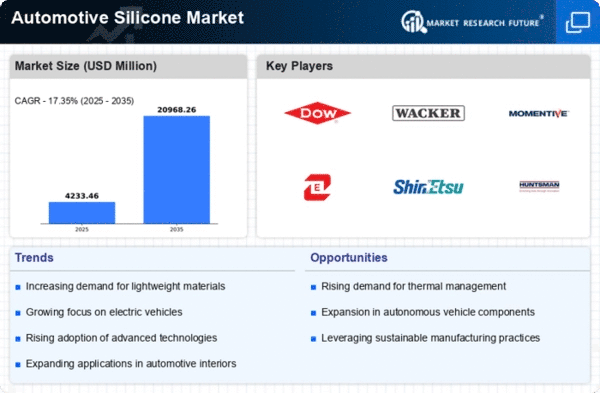
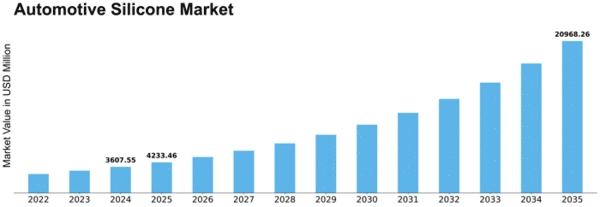
As per MRFR analysis, the Automotive Silicone Market Size was estimated at 3607.55 USD Million in 2024. The Automotive Silicone industry is projected to grow from 4233.49 USD Million in 2025 to 20968.26 USD Million by 2035, exhibiting a compound annual growth rate (CAGR) of 17.35 during the forecast period 2025 - 2035.

Key Market Trends & Highlights

The Automotive Silicone Market is poised for substantial growth driven by technological advancements and sustainability initiatives.

  • North America remains the largest market for automotive silicone, driven by robust automotive manufacturing and innovation.
  • Asia-Pacific is recognized as the fastest-growing region, reflecting a surge in electric vehicle production and adoption.
  • The sealing segment holds the largest share, while the adhesives segment is experiencing rapid growth due to increasing application in modern vehicles.
  • Key market drivers include the rising demand for lightweight materials and the growth in electric vehicle production, which are shaping industry dynamics.

Market Size & Forecast

2024 Market Size 3607.55 (USD Million)
2035 Market Size 20968.26 (USD Million)
CAGR (2025 - 2035) 17.35%
Largest Regional Market Share in 2024 Asia-Pacific

Major Players

<p>Dow Inc. (US), Wacker Chemie AG (DE), Momentive Performance Materials Inc. (US), Elkem ASA (NO), Shin-Etsu Chemical Co. Ltd. (JP), Huntsman Corporation (US), Kraton Corporation (US), Silicone Solutions (US)</p>

Market Trends

The Automotive Silicone Market is currently experiencing a notable transformation, driven by advancements in technology and increasing demand for high-performance materials. This sector is characterized by a diverse range of applications, including sealants, adhesives, and coatings, which are essential for enhancing vehicle durability and performance. As automotive manufacturers strive to meet stringent regulatory standards and consumer expectations for safety and efficiency, the integration of silicone materials appears to be a strategic choice. Furthermore, the growing emphasis on electric vehicles and lightweight materials is likely to propel the adoption of silicone solutions, as they offer superior thermal stability and flexibility compared to traditional materials. In addition, sustainability concerns are influencing the Automotive Silicone Market, with manufacturers seeking eco-friendly alternatives that do not compromise on quality. The shift towards greener production processes and materials is becoming increasingly relevant, as consumers demand more environmentally responsible products. This trend suggests that the market may continue to evolve, with innovations in silicone formulations that align with sustainability goals. Overall, the Automotive Silicone Market is poised for growth, driven by technological advancements, regulatory pressures, and a shift towards sustainable practices.

Technological Advancements

The Automotive Silicone Market is witnessing a surge in technological innovations that enhance the performance and versatility of silicone materials. These advancements enable the development of specialized formulations that cater to the unique requirements of modern vehicles, such as improved thermal resistance and durability.

Sustainability Initiatives

There is a growing trend towards sustainability within the Automotive Silicone Market, as manufacturers increasingly prioritize eco-friendly materials and production methods. This shift reflects a broader commitment to reducing environmental impact while maintaining high performance and safety standards.

Electric Vehicle Integration

The rise of electric vehicles is significantly influencing the Automotive Silicone Market, as these vehicles require advanced materials that can withstand higher temperatures and provide better insulation. Silicone's properties make it an ideal choice for various applications in electric vehicles, driving demand in this segment.

Automotive Silicone Market Market Drivers

Market Growth Projections

The Global Automotive Silicone Market Industry is poised for substantial growth, with projections indicating a market size of 3.14 USD Billion in 2024 and an anticipated increase to 6.69 USD Billion by 2035. This growth is underpinned by a compound annual growth rate (CAGR) of 7.12% from 2025 to 2035. Such figures reflect the increasing integration of silicone materials in various automotive applications, driven by advancements in technology, regulatory compliance, and evolving consumer preferences. The market's expansion is indicative of the critical role that silicone plays in the future of automotive manufacturing.

Enhanced Performance Requirements

Automotive manufacturers are continuously seeking materials that can withstand extreme conditions while providing superior performance. This trend significantly influences the Global Automotive Silicone Market Industry, as silicones offer excellent resistance to heat, moisture, and chemicals. These properties make silicone ideal for applications such as gaskets, seals, and adhesives in vehicles. The market is expected to grow at a CAGR of 7.12% from 2025 to 2035, driven by the need for high-performance materials that can meet stringent automotive standards. As vehicles become more complex, the reliance on silicone for reliable performance is likely to increase.

Growing Demand for Electric Vehicles

The increasing adoption of electric vehicles (EVs) is a primary driver for the Global Automotive Silicone Market Industry. As manufacturers strive to enhance the performance and efficiency of EVs, silicone materials are utilized for their thermal stability and electrical insulation properties. In 2024, the market is projected to reach 3.14 USD Billion, reflecting the rising need for advanced materials in EV production. Furthermore, the transition towards sustainable automotive solutions is likely to propel the demand for silicone components, which are essential for battery management systems and other critical applications in electric vehicles.

Regulatory Compliance and Safety Standards

Stringent regulations regarding vehicle emissions and safety are shaping the Global Automotive Silicone Market Industry. Manufacturers are compelled to adopt materials that comply with environmental standards while ensuring safety and durability. Silicone materials are increasingly used in applications that require compliance with these regulations, such as sealing and insulation components. The anticipated growth of the market to 6.69 USD Billion by 2035 indicates a robust response to these regulatory pressures. As automotive companies prioritize sustainability and safety, the demand for silicone solutions that meet these criteria is expected to rise.

Technological Advancements in Manufacturing

Innovations in manufacturing processes are driving the Global Automotive Silicone Market Industry forward. Advanced techniques such as 3D printing and automated production are enabling the efficient use of silicone materials in automotive applications. These advancements not only reduce production costs but also enhance the precision and quality of silicone components. As the automotive industry embraces these technologies, the demand for high-quality silicone products is likely to increase. The market's growth trajectory suggests that manufacturers will continue to invest in innovative solutions that leverage the unique properties of silicone to improve vehicle performance and reliability.

Rising Consumer Preferences for Comfort and Aesthetics

Consumer preferences are evolving towards vehicles that offer enhanced comfort and aesthetic appeal, influencing the Global Automotive Silicone Market Industry. Silicones are increasingly used in interior applications such as dashboards, trims, and seating materials due to their versatility and ability to provide a premium feel. As automotive design trends shift towards more luxurious and comfortable interiors, the demand for silicone materials is expected to grow. This trend aligns with the projected market growth, as manufacturers seek to incorporate silicone solutions that enhance both functionality and visual appeal in their vehicles.


Market Segment Insights

By Application: Sealing (Largest) vs. Adhesives (Fastest-Growing)

<p>In the Automotive Silicone Market, the application segment is crucial, with sealing emerging as the largest contributor due to its essential role in ensuring vehicle integrity and safety. Sealing compounds are widely used in various automotive components, including windows, doors, and engine parts. Adhesives, on the other hand, have gained significant traction as manufacturers shift towards lightweight materials and innovative assembly techniques, positioning them as the fastest-growing application within the segment.</p>

<p>Sealing: Dominant vs. Adhesives: Emerging</p>

<p>Sealing applications in the automotive sector utilize silicone due to its excellent resistance to heat, chemicals, and environmental conditions, making it indispensable for ensuring airtight and watertight seals in critical areas like windshields and engine compartments. Alternatively, adhesives are emerging as a key focus as automotive manufacturers increasingly adopt hybrid bonding technologies that leverage the unique properties of silicone. These adhesives provide superior strength while maintaining flexibility, catering to the rising demand for lightweight yet durable materials in vehicle manufacturing. This trend positions adhesives as a dynamic sector within the automotive silicone market, as they continue to evolve and meet the needs of modern automotive design.</p>

By End Use: Passenger Vehicle (Largest) vs. Electric Vehicle (Fastest-Growing)

<p>The Automotive Silicone Market showcases a diverse range of end uses, with passenger vehicles holding the largest market share followed by commercial vehicles, two-wheelers, and electric vehicles. Each segment plays a crucial role, but passenger vehicles dominate due to increasing consumer demand and continuous innovations in automotive technology. Commercial vehicles also represent a significant portion of the market as they require durable silicone parts for manufacturing, emphasizing their essential role in the automotive industry. As the automotive landscape evolves, electric vehicles are emerging as the fastest-growing segment, propelled by a global shift towards sustainability and electric mobility. The growing adoption of electric vehicles highlights the industry's commitment to reducing carbon emissions, significantly boosting the demand for specialized silicone applications in areas such as battery technology and thermal management systems.</p>

<p>Passenger Vehicle (Dominant) vs. Electric Vehicle (Emerging)</p>

<p>In the Automotive Silicone Market, passenger vehicles are characterized as the dominant segment due to their extensive production scale and significant utilization of silicone materials in various components such as gaskets, seals, and coatings. This segment's resilience is driven by continuous consumer preferences for comfort, safety, and technology integration. In contrast, the electric vehicle segment is labeled as emerging, rapidly gaining traction as a result of technological advancements and governmental incentives for sustainable transportation. Electric vehicles require innovative silicone solutions to address challenges like high thermal conductivity and electrical insulation in batteries. The differentiation in their applications highlights the shift in market dynamics as new automotive technologies integrate silicone materials, catering to both traditional passenger vehicles and innovative electric vehicle designs.</p>

By Type: Thermal Conductive Silicone (Largest) vs. Liquid Silicone Rubber (Fastest-Growing)

<p>In the Automotive Silicone Market, thermal conductive silicone has established itself as the largest segment, accounting for significant market share. This popularity is attributed to its efficient heat management capabilities, making it essential in various automotive applications such as electronic components and battery systems. On the other hand, liquid silicone rubber is noted for its flexibility and versatility, contributing to its rapid growth in the market. Its adoption in innovative automotive designs is set to expand its presence in the coming years. Growth trends in this segment indicate a robust demand driven by the increasing need for lightweight, high-performance materials in the automotive industry. Advances in automotive technology, particularly in electric and hybrid vehicle production, are propelling the use of thermal conductive silicone. Likewise, the rising penetration of liquid silicone rubber in regions emphasizing eco-friendly and high-performance materials showcases a promising upward trend, as manufacturers seek materials that enhance durability and performance while reducing overall weight.</p>

<p>Thermal Conductive Silicone (Dominant) vs. Room Temperature Vulcanizing Silicone (Emerging)</p>

<p>Thermal conductive silicone stands out as the dominant type in the Automotive Silicone Market due to its superior heat dissipation properties, making it a vital component in high-performance automotive applications, especially in electric vehicles. It enhances the efficiency of electronic systems while providing protective insulation. In contrast, room temperature vulcanizing (RTV) silicone is an emerging player that offers easy application and versatility in bonding and sealing. As manufacturers continue to explore new methodologies for vehicle design and safety, RTV silicone's adaptability to various automotive purposes positions it as a valuable resource in the modernization and enhancement of vehicle performance and reliability.</p>

By Formulation: One-Part Silicone (Largest) vs. Two-Part Silicone (Fastest-Growing)

<p>The Automotive Silicone Market is categorized into four primary formulation types: One-Part Silicone, Two-Part Silicone, Silicone Gel, and Silicone Foam. Among these, One-Part Silicone holds the largest market share, primarily due to its versatility and ease of application in automotive manufacturing. Conversely, Two-Part Silicone is recognized as the fastest-growing segment, driven by the increasing demand for durable and high-performance materials that can withstand extreme conditions in automotive applications. In recent years, innovations in silicone chemistry and the rising automotive production rates have catalyzed growth across these formulation types. The expansion of electric vehicles further propels the need for advanced silicone solutions, particularly where Two-Part Silicone is often preferred for its superior bonding and sealing capabilities. Consumer preferences for lightweight and adaptable materials are also steering the market towards more sustainable options, allowing both One-Part and Two-Part silicones to thrive in the evolving automotive landscape.</p>

<p>One-Part Silicone (Dominant) vs. Silicone Gel (Emerging)</p>

<p>One-Part Silicone is recognized as the dominant formulation in the Automotive Silicone Market, attracting users with its simplicity in application and reliability in performance. It is a single-component system that cures upon exposure to moisture, making it particularly desirable for manufacturers looking for ease of use and effectiveness in their assembly processes. In contrast, Silicone Gel is emerging as a notable contender due to its superior cushioning and vibration-dampening properties, essential for protecting sensitive automotive components. This formulation offers a unique blend of flexibility and stability, making it suitable for applications involving electronic components and sealing systems. With growing concerns about weight reduction and space utilization in vehicle design, both One-Part Silicone and Silicone Gel are well-positioned to capture significant market interest.</p>

By Distribution Channel: Direct Sales (Largest) vs. Online Sales (Fastest-Growing)

<p>In the Automotive Silicone Market, the distribution of sales through different channels reveals a dominant role for Direct Sales, which captures the largest share of the market. Distributors also play a significant role, facilitating access to key players within the automotive sector. Meanwhile, Online Sales are rapidly gaining traction, helped by the increasing reliance on digital platforms for procurement in the automotive industry. This landscape suggests a well-rounded approach to market distribution where traditional channels coexist with innovative online strategies.</p>

<p>Direct Sales (Dominant) vs. Online Sales (Emerging)</p>

<p>Direct Sales have established themselves as a dominant force in the Automotive Silicone Market, providing manufacturers and automotive companies with tailored solutions directly suited to their requirements. These interactions often lead to better customer relationships and a thorough understanding of specific needs in automotive applications. On the other hand, Online Sales are emerging as a vital and fast-growing channel as more buyers turn to digital platforms for their purchasing needs. Increasing digital literacy, improvements in online supply chains, and the shift towards more flexible purchasing solutions have made Online Sales appealing for both established brands and new entrants. This dynamic creates a competitive edge as companies explore ways to enhance their online presence.</p>

Get more detailed insights about Automotive Silicone Market Research Report - Forecast to 2035

Regional Insights

North America : Innovation and Growth Hub

The North American automotive silicone market is projected to reach $1,080.0M by 2025, driven by increasing vehicle production and a growing emphasis on lightweight materials. Regulatory support for eco-friendly automotive solutions is also a significant catalyst, enhancing demand for silicone products that meet stringent environmental standards. The region's focus on innovation in automotive technology further propels market growth, with manufacturers seeking advanced materials to improve vehicle performance and efficiency. Leading countries in this region include the US and Canada, where major automotive manufacturers are increasingly adopting silicone solutions for various applications, including sealants, adhesives, and coatings. Key players such as Dow Inc. and Momentive Performance Materials are at the forefront, leveraging their technological expertise to meet the evolving needs of the automotive sector. The competitive landscape is characterized by strategic partnerships and collaborations aimed at enhancing product offerings and market reach.

Europe : Sustainable Automotive Solutions

Europe's automotive silicone market is expected to reach €900.0M by 2025, fueled by stringent regulations promoting sustainability and safety in automotive manufacturing. The European Union's Green Deal and various national initiatives are pushing manufacturers to adopt eco-friendly materials, significantly boosting the demand for silicone products. This regulatory environment is a key driver, encouraging innovation and investment in sustainable automotive technologies. Germany, France, and the UK are leading countries in this market, with a strong presence of automotive giants and innovative SMEs. Companies like Wacker Chemie AG and Elkem ASA are actively involved in developing advanced silicone solutions tailored for the automotive industry. The competitive landscape is marked by a focus on R&D, with firms investing in new technologies to enhance product performance and meet regulatory requirements. The market is expected to grow as manufacturers increasingly prioritize sustainability in their operations.

Asia-Pacific : Emerging Powerhouse in Automotive

The Asia-Pacific automotive silicone market is projected to dominate with a market size of $1,800.0M by 2025, driven by rapid industrialization and increasing vehicle production in countries like China and India. The region's growing middle class is also contributing to rising demand for automobiles, further propelling the silicone market. Additionally, favorable government policies aimed at boosting the automotive sector are acting as significant growth catalysts, enhancing the adoption of silicone materials in various applications. China is the largest market in the region, with significant contributions from Japan and South Korea. The competitive landscape is characterized by the presence of major players such as Shin-Etsu Chemical Co. and Huntsman Corporation, who are investing heavily in R&D to develop innovative silicone solutions. The market is witnessing a trend towards collaboration between manufacturers and automotive companies to create tailored solutions that meet specific industry needs, ensuring sustained growth in the coming years.

Middle East and Africa : Resource-Rich Frontier

The Middle East and Africa automotive silicone market is expected to reach $827.55M by 2025, driven by increasing automotive production and a growing focus on infrastructure development. The region's strategic location and access to raw materials are enhancing its appeal as a manufacturing hub for automotive components. Additionally, government initiatives aimed at diversifying economies are fostering growth in the automotive sector, leading to increased demand for silicone products in various applications. Countries like South Africa and the UAE are leading the market, with a growing number of automotive manufacturers establishing operations in the region. The competitive landscape features key players such as Kraton Corporation and Silicone Solutions, who are focusing on expanding their product portfolios to cater to the evolving needs of the automotive industry. The market is expected to grow as investments in infrastructure and automotive manufacturing continue to rise.

Key Players and Competitive Insights

The Automotive Silicone Market is currently characterized by a dynamic competitive landscape, driven by increasing demand for lightweight materials and enhanced performance in automotive applications. Key players such as Dow Inc. (US), Wacker Chemie AG (DE), and Shin-Etsu Chemical Co. Ltd. (JP) are strategically positioned to leverage innovation and technological advancements. Dow Inc. (US) focuses on developing high-performance silicone solutions that cater to the evolving needs of electric vehicles (EVs), while Wacker Chemie AG (DE) emphasizes sustainability through its eco-friendly silicone products. Shin-Etsu Chemical Co. Ltd. (JP) is enhancing its operational focus on expanding its production capabilities to meet the growing global demand, particularly in Asia-Pacific regions. Collectively, these strategies contribute to a competitive environment that is increasingly centered around innovation and sustainability.

Key Companies in the Automotive Silicone Market include

Industry Developments

Shin-Etsu Chemical developed in March 2023 a silicone rubber for molding that is ideal for insulation covering material for onboard high-voltage cables in autos. The KE-5641-U, the new product from Shin-Etsu Chemical to make improved silicone rubber for molding, will help to solve these problems. The resistive nature of this innovative product makes its insulation performance excellent even if the thickness of the insulation system covering layers of the highly-voltage cables is reduced.

Furthermore, it enhances the flexibility of cable by thinning out such covers, which enables the production of small-diameter and lightweight, high-voltage cables, thus making them more acceptable in the automobile industry.

In September 2022, Henkel acquired Nanoramic Laboratories' Thermexit division.

In April 2022, Shin-Etsu Chemical Co., Ltd. introduced a thermal interface rubber sheet known as TC-BGI Series. It is designed to be used by electric car parts as a way of dissipating heat. High-hardness thermal interface rubber sheet with high voltage endurance and thermal conductivity.

In May 2022, Dow unveiled a brand new mouldable material that is used in adaptive driving beam (ADB) light guides within vehicles. Silastic MS-5002 mouldable silicone is a specialized Liquid Silicone Rubber (LSR) enabling the highest optical qualities due to extremely low mold fouling for faster cycle times. These materials are made specifically for injection molded parts requiring high-volume manufacturing cycles. This product launch targets to reduce the vehicle’s mass and energy requirements during production.

In January 2021, Shin-Etsu Chemical Co., Ltd. extended its silicone products portfolio aimed at producing thermal interface materials for electric vehicles because there was a need for protection against excessive heat overindulgence in lithium-ion-based batteries and other electronic control systems.

Intended Audience

    • Automotive silicone Manufacturers
    • Traders and distributors of automotive silicone
    • Research and development institutes
    • Potential investors
    • Raw material suppliers
    • Nationalized laboratory

Future Outlook

Automotive Silicone Market Future Outlook

<p>The Automotive Silicone Market is projected to grow at a 17.35% CAGR from 2024 to 2035, driven by advancements in electric vehicles, lightweight materials, and increasing demand for durability.</p>

New opportunities lie in:

  • <p>Development of high-performance silicone adhesives for electric vehicle components.</p>
  • <p>Expansion into emerging markets with tailored silicone solutions.</p>
  • <p>Investment in R&D for sustainable silicone production methods.</p>

<p>By 2035, the market is expected to achieve robust growth, positioning itself as a leader in automotive materials.</p>

Market Segmentation

Automotive Silicone Market Type Outlook

  • Thermal Conductive Silicone
  • Flame Retardant Silicone
  • Liquid Silicone Rubber
  • Room Temperature Vulcanizing Silicone

Automotive Silicone Market End Use Outlook

  • Passenger Vehicle
  • Commercial Vehicle
  • Two-Wheeler
  • Electric Vehicle

Automotive Silicone Market Application Outlook

  • Sealing
  • Adhesives
  • Coatings
  • Gaskets
  • Molding

Automotive Silicone Market Formulation Outlook

  • One-Part Silicone
  • Two-Part Silicone
  • Silicone Gel
  • Silicone Foam

Automotive Silicone Market Distribution Channel Outlook

  • Direct Sales
  • Distributors
  • Online Sales

Report Scope

MARKET SIZE 20243607.55(USD Million)
MARKET SIZE 20254233.49(USD Million)
MARKET SIZE 203520968.26(USD Million)
COMPOUND ANNUAL GROWTH RATE (CAGR)17.35% (2024 - 2035)
REPORT COVERAGERevenue Forecast, Competitive Landscape, Growth Factors, and Trends
BASE YEAR2024
Market Forecast Period2025 - 2035
Historical Data2019 - 2024
Market Forecast UnitsUSD Million
Key Companies ProfiledDow Inc. (US), Wacker Chemie AG (DE), Momentive Performance Materials Inc. (US), Elkem ASA (NO), Shin-Etsu Chemical Co. Ltd. (JP), Huntsman Corporation (US), Kraton Corporation (US), Silicone Solutions (US)
Segments CoveredApplication, End Use, Type, Formulation, Distribution Channel
Key Market OpportunitiesGrowing demand for lightweight materials enhances opportunities in the Automotive Silicone Market.
Key Market DynamicsRising demand for lightweight materials drives innovation in automotive silicone applications and formulations.
Countries CoveredNorth America, Europe, APAC, South America, MEA

FAQs

What are the different segments included in the automotive silicone market?

The automotive silicone market is segmented based on application (suspension system, interior and exterior parts, engine and drive train system, and electrical system, and product (resins, elastomers, adhesives and sealants).

Which region is expected to have maximum share in the automotive silicone market?

Asia Pacific will have the maximum share in the market during the forecast period.

What are the key factors that are adding to the growth of the automotive silicone market?

Growing demand for lightweight automobiles, government regulations regarding environmental protection, growing trend for hybrid and electric cars, and technological advancements are adding to the growth of the automotive silicone market.

Who are the key players profiled in the automotive silicone market?

Notable players profiled in the automotive silicone market include Wacker Chemie AG (Germany), Shin-Etsu Chemical Co., Ltd. (Japan), Rogers Corporation (USA), Nusil (USA), KCC Corporation (South Korea), Momentive (USA), Kaneka Corporation (Japan), Evonik Industries AG (Germany), Elkem Silicone (USA), Dow Corning Corporation (USA), CSL Silicone Inc. (Canada), Bostik (USA), and ACC Silicones Ltd (UK).

What are the different applications of automotive silicone?

Automotive silicone is widely used in the suspension system, drive train system and engine, exterior and interior parts, and electrical system.

  1. Executive Summary
  2. Scope of the Report
    1. Market Definition
    2. Scope of the
      1. Research Objectives
      2. Assumptions & Limitations
    3. Study
    4. Markets Structure
    5. Market Research Methodology
    6. Research
    7. Process
    8. Secondary Research
    9. Primary Research
    10. Forecast Model
  3. Market Impact Analysis
    1. of Global Automotive Silicone Market
    2. Supply Chain Analysis
      1. Raw material suppliers
      2. Distributors/Retailers/Wholesalers/E-commerce
      3. End users
    3. Manufacturers/Producers
    4. Porter’s
      1. Threat of New
      2. Bargaining Power of Buyers
      3. Bargaining Power of Suppliers
      4. Threat of Substitutes
    5. Five Forces Analysis
    6. Entrants
    7. Intensity of Competitive Rivalry
  4. Market Dynamics of Global Automotive Silicone Market
    1. Introduction
    2. Drivers
    3. Restraints
    4. Opportunities
    5. Challenges
    6. Trends/Technology
    7. Global Automotive Silicone Market by Product
    8. Introduction
    9. Elastomers
      1. Market Estimates & Forecast, 2020-2027
      2. Market Estimates
    10. & Forecast by Region, 2020-2027
    11. Adhesives
      1. Market Estimates & Forecast, 2020-2027
    12. Market Estimates & Forecast by Region, 2020-2027
    13. Resins
      1. Market
      2. Market Estimates & Forecast by
      3. Market Estimates & Forecast, 2020-2027
      4. Market Estimates & Forecast by Region, 2020-2027
    14. Estimates & Forecast, 2020-2027
    15. Region, 2020-2027
    16. Others
  5. Global Automotive Silicone Market, By Application
    1. Introduction
    2. Interior & exterior parts
      1. Market Estimates
      2. Market Estimates & Forecast by Region,
    3. & Forecast, 2020-2027
    4. Electrical system
      1. Market Estimates & Forecast
    5. Market Estimates & Forecast, 2020-2027
    6. by Region, 2020-2027
    7. Engine & drive train system
      1. Market Estimates & Forecast, 2020-2027
      2. Market Estimates &
    8. Forecast by Region, 2020-2027
    9. Suspension system
      1. Market Estimates & Forecast, 2020-2027
      2. Market Estimates &
    10. Forecast by Region, 2020-2027
    11. Others
      1. Market Estimates & Forecast
    12. Market Estimates & Forecast, 2020-2027
    13. by Region, 2020-2027
  6. Global Automotive Silicone
  7. Market, By Region
    1. Introduction
      1. Market Estimates & Forecast, 2020-2027
      2. Market Estimates & Forecast by Product, 2020-2027
      3. Canada
    2. North America
    3. Market Estimates & Forecast by Application, 2020-2027
    4. U.S.
    5. Estimates & Forecast, 2020-2027
    6. by Application, 2020-2027
    7. Estimates & Forecast by Product, 2020-2027
    8. Europe
      1. Market Estimates
      2. Market Estimates & Forecast
      3. Market Estimates & Forecast
      4. Germany
      5. France
      6. Spain
      7. U.K
      8. Russia
      9. Poland
    9. & Forecast, 2020-2027
    10. by Product, 2020-2027
    11. by Application, 2020-2027
    12. Estimates & Forecast by Product, 2020-2027
    13. by Product, 2020-2027
    14. Market Estimates & Forecast by Application, 2020-2027
    15. Italy
    16. Estimates & Forecast, 2020-2027
    17. by Application, 2020-2027
    18. Estimates & Forecast by Product, 2020-2027
    19. by Product, 2020-2027
    20. Market Estimates & Forecast by Application, 2020-2027
    21. & Forecast, 2020-2027
    22. by Application, 2020-2027
    23. & Forecast by Product, 2020-2027
    24. Asia Pacific
      1. Market Estimates
      2. Market Estimates &
      3. Market Estimates &
      4. China
      5. India
      6. Japan
      7. New Zealand
      8. Rest of Asia Pacific
    25. & Forecast, 2020-2027
    26. Forecast by Product, 2020-2027
    27. Forecast by Application, 2020-2027
    28. Estimates & Forecast by Product, 2020-2027
    29. & Forecast by Product, 2020-2027
    30. by Product, 2020-2027
    31. Market Estimates & Forecast by Application, 2020-2027
    32. Australia
    33. Estimates & Forecast, 2020-2027
    34. by Application, 2020-2027
    35. & Forecast, 2020-2027
    36. by Application, 2020-2027
    37. & Forecast, 2020-2027
    38. by Application, 2020-2027
    39. Middle East & Africa
      1. Market Estimates & Forecast, 2020-2027
      2. Israel
      3. North
      4. GCC
      5. Rest of Middle East & Africa
    40. Market Estimates & Forecast by Product, 2020-2027
    41. Market Estimates & Forecast by Application, 2020-2027
    42. Turkey
    43. Estimates & Forecast, 2020-2027
    44. by Application, 2020-2027
    45. & Forecast by Application, 2020-2027
    46. Africa
    47. Market Estimates & Forecast, 2020-2027
    48. & Forecast by Application, 2020-2027
    49. & Forecast, 2020-2027
    50. by Application, 2020-2027
    51. & Forecast, 2020-2027
    52. by Application, 2020-2027
    53. Latin America
      1. Market
      2. Market
      3. Brazil
      4. Mexico
      5. Argentina
    54. Market Estimates & Forecast, 2020-2027
    55. Estimates & Forecast by Product, 2020-2027
    56. Estimates & Forecast by Application, 2020-2027
    57. & Forecast, 2020-2027
    58. by Application, 2020-2027
    59. Estimates & Forecast by Product, 2020-2027
    60. & Forecast by Product, 2020-2027
    61. Rest of Latin America
    62. Forecast by Product, 2020-2027
    63. Company Landscape
    64. Introduction
    65. Market Strategy
    66. Key Development Analysis (Expansion/Merger & Acquisitions/Joint Venture/New
    67. Product Development/Agreement/Investment)
  8. Company
    1. Profiles
    2. Wacker Chemie AG
    3. Company Overview
    4. Strategy
    5. SWOT Analysis
    6. Product/Business Segment Overview
    7. Financial Updates
    8. Segment Overview
    9. Key Developments
    10. Elkem Silicone
    11. Company Overview
    12. Strategy
    13. SWOT Analysis
    14. Product/Business Segment Overview
    15. Product/Business Segment Overview
    16. Company Overview
    17. Strategy
    18. SWOT Analysis
    19. Financial Updates
    20. Segment Overview
    21. Key Developments
    22. Evonik Industries AG
    23. Company Overview
    24. Strategy
    25. SWOT Analysis
    26. Financial Updates
    27. Segment Overview
    28. Key Developments
    29. ACC Silicones Ltd
    30. Overview
    31. Product/Business Segment Overview
    32. Analysis
    33. CSL Silicone Inc.
    34. Company Overview
    35. Strategy
    36. SWOT Analysis
    37. Kaneka Corporation
    38. Company Overview
    39. Strategy
    40. SWOT Analysis
  9. Financial Updates
  10. Product/Business Segment Overview
  11. Key Developments
    1. Dow Corning Corporation
      1. Company Overview
      2. Financial Updates
      3. Strategy
      4. Key Developments
      5. SWOT Analysis
    2. Momentive
      1. Company Overview
      2. Product/Business
      3. Strategy
      4. SWOT Analysis
      5. Financial Updates
      6. Product/Business Segment Overview
      7. Key Developments
    3. Shin-Etsu Chemical Co., Ltd.
      1. Company Overview
      2. Financial Updates
      3. Strategy
      4. Key Developments
      5. SWOT Analysis
    4. Rogers Corporation
      1. Company Overview
      2. Financial Updates
      3. Strategy
      4. Key Developments
      5. SWOT Analysis
    5. Nusil
      1. Financial Updates
      2. Product/Business Segment Overview
      3. Key Developments
    6. Bostik
      1. Company Overview
      2. Product/Business
      3. Strategy
      4. SWOT Analysis
      5. Financial Updates
      6. Product/Business Segment Overview
      7. Key Developments
    7. KCC Corporation
      1. Company Overview
      2. Product/Business
      3. Strategy
      4. SWOT Analysis
      5. Company
      6. Financial Updates
      7. Strategy
      8. Key Developments
      9. SWOT
      10. Financial Updates
      11. Product/Business Segment Overview
      12. Key Developments
      13. Financial Updates
      14. Product/Business Segment Overview
      15. Key Developments
  12. Conclusion
    1. LIST
  13. OF TABLES
  14. Global Automotive
    1. Silicone market: By Region, 2020-2027
  15. North
    1. America Automotive Silicone market: By Country, 2020-2027
    2. Table 3
    3. Europe Automotive Silicone market: By Country, 2020-2027
    4. Table
  16. Asia-Pacific Automotive Silicone market: By Country, 2020-2027
  17. Middle East & Africa Automotive Silicone
    1. market: By Country, 2020-2027
  18. Latin America
    1. Automotive Silicone market: By Country, 2020-2027
    2. Table 7
    3. Global Automotive Silicone by Product Market: By Regions, 2020-2027
  19. North America Automotive Silicone by Product Market:
    1. By Country, 2020-2027
  20. Europe Automotive Silicone
    1. by Product Market: By Country, 2020-2027
    2. Table10 Asia-Pacific
    3. Automotive Silicone by Product Market: By Country, 2020-2027
    4. Table11
    5. Middle East & Africa Automotive Silicone by Product Market: By Country,
    6. Table12 Latin America Automotive Silicone
    7. by Product Market: By Country, 2020-2027
    8. Table13 Global
    9. Automotive Silicone by Application Market: By Regions, 2020-2027
    10. Table14
    11. North America Automotive Silicone by Application Market: By Country, 2020-2027
    12. Table15 Europe Automotive Silicone by Application
    13. Market: By Country, 2020-2027
    14. Table16 Asia-Pacific
    15. Automotive Silicone by Application Market: By Country, 2020-2027
    16. Table17
    17. Middle East & Africa Automotive Silicone by Application Market: By Country,
    18. Table18 Latin America Automotive Silicone
    19. by Application Market: By Country, 2020-2027
    20. Table19 Global
    21. Product Market: By Region, 2020-2027
    22. Table20 Global
    23. Application Market: By Region, 2020-2027
    24. Table21 North
  21. America Automotive Silicone market, By Country
    1. Table22 North
  22. America Automotive Silicone market, By Product
    1. Table23 North
  23. America Automotive Silicone market, By Application
    1. Table24
  24. Europe: Automotive Silicone market, By Country
    1. Table25
  25. Europe: Automotive Silicone market, By Product
    1. Table26 Europe:
  26. Automotive Silicone market, By Application
    1. Table27 Asia-Pacific:
  27. Automotive Silicone market, By Country
    1. Table28 Asia-Pacific:
  28. Automotive Silicone market, By Product
    1. Table29 Asia-Pacific:
  29. Automotive Silicone market, By Application
    1. Table30
  30. Middle East & Africa: Automotive Silicone market, By Country
    1. Table31 Middle East & Africa Automotive Silicone market,
    2. By Product
    3. Table32 Middle East & Africa Automotive Silicone
  31. market, By Application
    1. Table33 Latin America:
  32. Automotive Silicone market, By Country
    1. Table34 Latin
  33. America Automotive Silicone market, By Product
    1. Table35 Latin
  34. America Automotive Silicone market, By Application
  35. LIST OF FIGURES
  36. Global Automotive Silicone market segmentation
    1. FIGURE
  37. Forecast Printing methodology
  38. Porter’s
    1. Five Forces Analysis of Global Automotive Silicone market
  39. Value
    1. Chain of Global Automotive Silicone market
  40. Share of Global
  41. Automotive Silicone market in 2020, by country (in %)
  42. Global
    1. Automotive Silicone market, 2020-2027,
  43. Global Automotive Silicone
    1. market size by Product, 2015
  44. Share of Global Automotive Silicone
    1. market by Product, 2020-2027
  45. Global Automotive Silicone market
    1. size by Application, 2020
  46. Share of Global Automotive Silicone
    1. market by Application, 2020-2027

Automotive Silicone Market Segmentation

Market Segmentation Overview

  • Detailed segmentation data will be available in the full report
  • Comprehensive analysis by multiple parameters
  • Regional and country-level breakdowns
  • Market size forecasts by segment
Infographic

Free Sample Request

Kindly complete the form below to receive a free sample of this Report

Get Free Sample

Customer Strories

Compare Licence

×
Features License Type
Single User Multiuser License Enterprise User
Price $4,950 $5,950 $7,250
Maximum User Access Limit 1 User Upto 10 Users Unrestricted Access Throughout the Organization
Free Customization
Direct Access to Analyst
Deliverable Format
Platform Access
Discount on Next Purchase 10% 15% 15%
Printable Versions