Automotive Silicone Market (2026 - 2035)

ID: MRFR/CnM/4372-HCR 100 Pages Priya Nagrale Last Updated: November 04, 2026
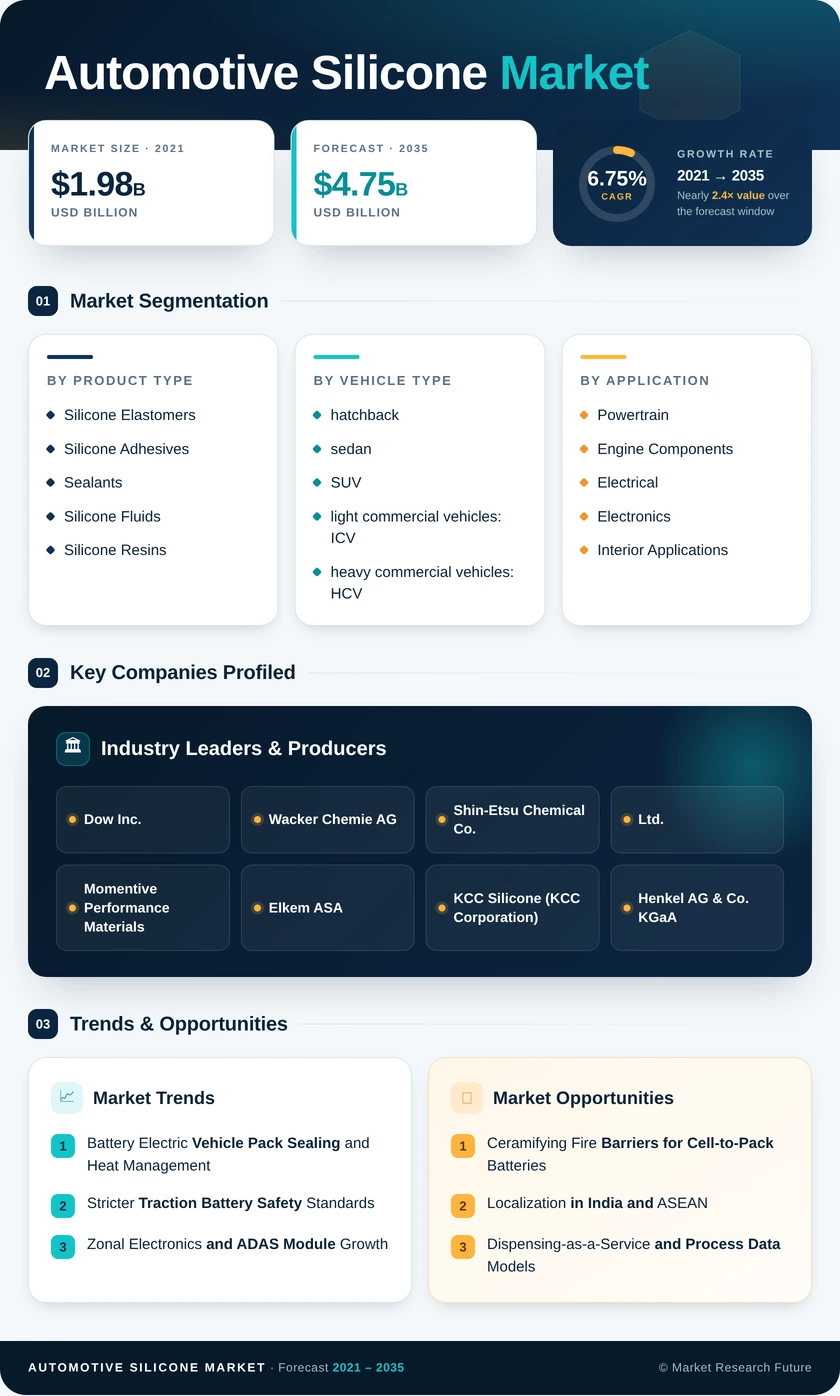
Automotive Silicone Market Research Report Information By Product Type (Silicone Elastomers, Silicone Adhesives and Sealants, Silicone Fluids, Silicone Resins, and Silicone Gels and Foams), By Vehicle Type (Hatchback and Sedan, SUV, Light Commercial Vehicles (ICV), and Heavy Commercial Vehicles (HCV)), By Application (Powertrain and Engine Components, Electrical and Electronics, Interior Applications, Exterior Applications, and Thermal Management Systems), And By Region (North America, Europe, Asia-Pacific, and Rest of the World) – Market Forecast Till 2035.
Automotive Silicone Market
Market Size
Forecast Period2026-2035
CAGR (2026-2035)6.75%
2025 Market SizeUSD 2.48 Billion
2035 Market SizeUSD 4.75 Billion
Key Players
Dow Inc.
Wacker Chemie AG
Shin-Etsu Chemical Co., Ltd.
Momentive Performance Materials
Elkem ASA
KCC Silicone
Opportunities
  • Ceramifying Fire Barriers for Cell-to-Pack Batteries
  • Localization in India and ASEAN
  • Dispensing-as-a-Service and Process Data Models
  1. 1 Market Summary | |
  2. 2 Key Report Takeaways | |
    1. 2.1 By Product Type | |
    2. 2.2 By Vehicle Type | |
    3. 2.3 By Application | |
    4. 2.4 By Region | |
  3. 3 Market Size and Forecast (2021–2035) | |
    1. 3.1 Historical Market Size (2021–2025) | |
    2. 3.2 Forecast Market Size (2026–2035) | |
    3. 3.3 Year-over-Year Growth Analysis | |
  4. 4 Driver Impact Analysis | |
    1. 4.1 Battery Electric Vehicle Pack Sealing and Heat Management | |
    2. 4.2 Stricter Traction Battery Safety Standards | |
    3. 4.3 Zonal Electronics and ADAS Module Growth | |
    4. 4.4 Higher Under-Hood Temperatures in Hybrid and Downsized Engines | |
    5. 4.5 Adhesive Bonding Replacing Mechanical Fasteners | |
    6. 4.6 Specialty Capacity Expansion in Asia | |
  5. 5 Restraints Impact Analysis | |
    1. 5.1 Siloxane and Silicon Metal Price Volatility | |
    2. 5.2 Cyclic Siloxane (D4, D5, D6) Restrictions | |
    3. 5.3 Substitution by EPDM and Thermoplastic Elastomers | |
    4. 5.4 Withdrawal of US Electric Vehicle Purchase Credits | |
    5. 5.5 Upstream Capacity Rationalization in Europe | |
  6. 6 Opportunities | |
    1. 6.1 Ceramifying Fire Barriers for Cell-to-Pack Batteries | |
    2. 6.2 Localization in India and ASEAN | |
    3. 6.3 Dispensing-as-a-Service and Process Data Models | |
    4. 6.4 Hydrogen Fuel-Cell Commercial Vehicles | |
    5. 6.5 Low-Cyclic and Bio-Based Reformulations | |
  7. 7 Regional Market Share and Country-Level Analysis | |
    1. 7.1 North America | | |
      1. 7.1.1 US | | |
      2. 7.1.2 Canada | | |
      3. 7.1.3 Mexico | |
    2. 7.2 Europe | | |
      1. 7.2.1 Germany | | |
      2. 7.2.2 UK | | |
      3. 7.2.3 France | | |
      4. 7.2.4 Italy | | |
      5. 7.2.5 Spain | | |
      6. 7.2.6 Nordic Countries | | |
      7. 7.2.7 Russia | | |
      8. 7.2.8 Rest of Europe | |
    3. 7.3 Asia-Pacific | | |
      1. 7.3.1 China | | |
      2. 7.3.2 India | | |
      3. 7.3.3 Japan | | |
      4. 7.3.4 South Korea | | |
      5. 7.3.5 ASEAN | | |
      6. 7.3.6 Rest of Asia-Pacific | |
    4. 7.4 South America | | |
      1. 7.4.1 Brazil | | |
      2. 7.4.2 Argentina | | |
      3. 7.4.3 Rest of South America | |
    5. 7.5 Middle East & Africa | | |
      1. 7.5.1 Saudi Arabia | | |
      2. 7.5.2 UAE | | |
      3. 7.5.3 South Africa | | |
      4. 7.5.4 Egypt | | |
      5. 7.5.5 Rest of MEA | |
  8. 8 Future Outlook (2026–2035) | |
    1. 8.1 Higher-Density Cells and the Fire-Safety Imperative | |
    2. 8.2 Software-Defined Vehicles and Power Electronics | |
    3. 8.3 Sustainability Reporting and Circular Silicones | |
    4. 8.4 Regional Supply Chain Realignment | |
  9. 9 Segmentation Analysis | |
    1. 9.1 By Product Type | | |
      1. 9.1.1 Silicone Elastomers | | |
      2. 9.1.2 Silicone Adhesives and Sealants | | |
      3. 9.1.3 Silicone Fluids | | |
      4. 9.1.4 Silicone Resins | | |
      5. 9.1.5 Silicone Gels and Foams | |
    2. 9.2 By Vehicle Type | | |
      1. 9.2.1 Hatchback and sedan | | |
      2. 9.2.2 SUV | | |
      3. 9.2.3 Light commercial vehicles | | |
      4. 9.2.4 Heavy commercial vehicles | |
    3. 9.3 By Application | | |
      1. 9.3.1 Powertrain and Engine Components | | |
      2. 9.3.2 Electrical and Electronics | | |
      3. 9.3.3 Interior Applications | | |
      4. 9.3.4 Exterior Applications | | |
      5. 9.3.5 Thermal Management Systems | |
  10. 10 Competitive Landscape | |
    1. 10.1 Market Concentration Analysis | |
    2. 10.2 Competitive Benchmarking Matrix | |
    3. 10.3 Company Profiles | | |
      1. 10.3.1 Dow Inc. | | |
      2. 10.3.2 Wacker Chemie AG | | |
      3. 10.3.3 Shin-Etsu Chemical Co., Ltd. | | |
      4. 10.3.4 Momentive Performance Materials | | |
      5. 10.3.5 Elkem ASA | | |
      6. 10.3.6 KCC Silicone | | |
      7. 10.3.7 Henkel AG & Co. KGaA | | |
      8. 10.3.8 H.B. Fuller Company | | |
      9. 10.3.9 Evonik Industries AG | | |
      10. 10.3.10 Avantor (NuSil) | |
  11. 11 Recent News & Developments | |
  12. 12 Report Scope and Methodology | |
  13. 13 Detailed Sources and Citations | |
  14. 14 Frequently Asked Questions (FAQs) | | LIST OF TABLES | |
  15. TABLE 1 Global Automotive Silicone Market Summary Snapshot, 2025–2035 | |
  16. TABLE 2 Global Automotive Silicone Market Size and Forecast, by Revenue (USD Billion), 2021–2035 | |
  17. TABLE 3 Driver Impact Analysis on Forecast CAGR, 2026–2035 | |
  18. TABLE 4 Restraints Impact Analysis on Forecast CAGR, 2026–2035 | |
  19. TABLE 5 Global Market Size, by Region, 2025 (USD Billion) | |
  20. TABLE 6 North America Market, by Country, 2025 | |
  21. TABLE 7 Europe Market, by Country, 2025 | |
  22. TABLE 8 Asia-Pacific Market, by Country, 2025 | |
  23. TABLE 9 South America Market, by Country, 2025 | |
  24. TABLE 10 Middle East & Africa Market, by Country, 2025 | |
  25. TABLE 11 Global Market, by Product Type, 2025–2035 | |
  26. TABLE 12 Global Market, by Vehicle Type, 2025–2035 | |
  27. TABLE 13 Global Market, by Application, 2025–2035 | |
  28. TABLE 14 Competitive Benchmarking Matrix, 2025 | |
  29. TABLE 15 Report Scope and Methodology | |
  30. TABLE 16 Detailed Sources and Citations | | LIST OF FIGURES | |
  31. FIGURE 1 Market Dynamics Overview — Drivers, Restraints and Opportunities | |
  32. FIGURE 2 Automotive Silicone Value Chain Analysis | |
  33. FIGURE 3 Porter's Five Forces Analysis | |
  34. FIGURE 4 Global Market Size Trend, 2021–2035 (USD Billion) | |
  35. FIGURE 5 Market Share, by Product Type, 2025 (%) | |
  36. FIGURE 6 Market Share, by Vehicle Type, 2025 (%) | |
  37. FIGURE 7 Market Share, by Application, 2025 (%) | |
  38. FIGURE 8 Market Share, by Region, 2025 (%) | |
  39. FIGURE 9 Country-Level Share within Asia-Pacific, 2025 (%) | |
  40. FIGURE 10 Competitive Landscape — Estimated Revenue Share Ranges, 2025

Segmentation Quick Reference

DimensionSub-SegmentsDominant SegmentFastest Growing Segment
By Product TypeSilicone Elastomers; Silicone Adhesives and Sealants; Silicone Fluids; Silicone Resins; Silicone Gels and FoamsSilicone Elastomers (36.4% share)Silicone Adhesives and Sealants (8.1% CAGR)
By Vehicle Typehatchback and sedan; SUV; light commercial vehicles: ICV; heavy commercial vehicles: HCVSUV (39.8% share)Light commercial vehicles: ICV (8.6% CAGR)
By ApplicationPowertrain and Engine Components; Electrical and Electronics; Interior Applications; Exterior Applications; Thermal Management SystemsPowertrain and Engine Components (29.8% share)Thermal Management Systems (9.6% CAGR)
By RegionNorth America; Europe; Asia-Pacific; South America; Middle East & AfricaAsia-Pacific (47.5% share)Asia-Pacific (7.6% CAGR)

Market Segmentation Overview

By Product Type

Sub-SegmentKey Trend
Silicone ElastomersLow compression set grades for high-temperature seals and hoses
Silicone Adhesives and SealantsMulti-function beads for cell-to-pack bonding and moisture exclusion
Silicone FluidsLow-cyclic formulations for damping and connector lubrication
Silicone ResinsFire-barrier laminates for battery covers.
Silicone Gels and FoamsEncapsulation of ADAS and power electronics

Silicone Elastomers keep the largest share because gaskets and turbo hoses still need heat resistance above 150°C in hybrid and combustion drives. Silicone Adhesives and Sealants grow fastest, since cell-to-pack packs let one dispensed bead bond, seal and isolate cells. Silicone Gels and Foams follow closely as electronics density rises.

By Vehicle Type

Sub-SegmentKey Trend
hatchback and sedanCost-driven switch to EPDM in non-critical exterior seals
SUVLarger battery packs and extensive underbody sealing
Light commercial vehicles: ICVElectrified last-mile fleets needing battery-grade materials
Heavy commercial vehicles: HCVNatural gas and hydrogen fuel system seals

SUV dominates because its larger packs and underbody sealing raise silicone content per vehicle. Light commercial vehicles: ICV grow fastest as delivery fleets electrify and need durable pack materials for heavy daily cycling. Hatchback and sedan remain sizable but lose some exterior seal volume to cheaper elastomers.

By Application

Sub-SegmentKey Trend
Powertrain and Engine ComponentsHoses and seals for ICE, hybrid and fuel-cell drives
Electrical and ElectronicsProtection for zonal controllers and ADAS modules
Interior ApplicationsAirbag and soft-touch coatings under substitution pressure
Exterior ApplicationsLighting seals and glazing bonding
Thermal Management SystemsGap fillers and ceramifying barriers for dense cells

Powertrain and Engine Components lead on the installed base of combustion and hybrid vehicles that still need heat-resistant seals. Thermal Management Systems grow fastest because higher cell energy density demands conductive gap fillers and fire barriers compatible with automated assembly. Electrical and Electronics rank second in growth as zonal architectures spread.


Download PDF ×

We do not share your information with anyone. However, we may send you emails based on your report interest from time to time. You may contact us at any time to opt-out.