Request Free Sample ×

Kindly complete the form below to receive a free sample of this Report

* Please use a valid business email

Leading companies partner with us for data-driven Insights

clients tt-cursor
Hero Background
English
Chinese
French
Japanese
Korean
German
Spanish

Automotive Rear View Mirror Market Analysis

ID: MRFR/AT/4310-HCR
200 Pages
Triveni Bhoyar
Last Updated: April 06, 2026

Automotive Rear-View Mirror Market Research Report By Type (Traditional Mirrors, Digital Mirrors, Smart Mirrors), By Mounting Type (Interior Mounting, Exterior Mounting), By Functionality (Manual Adjustment, Electrochromatic, Heated Mirrors, Auto-Dimming, Integrated Technology), By Application (Passenger Vehicles, Commercial Vehicles, Two-Wheelers) and By Regional (North America, Europe, South America, Asia Pacific, Middle East and Africa) - Forecast to 2035

Share:
Download PDF ×

We do not share your information with anyone. However, we may send you emails based on your report interest from time to time. You may contact us at any time to opt-out.

Automotive Rear View Mirror Market Infographic
Purchase Options

Market Analysis

In-depth Analysis of Automotive Rear View Mirror Market Industry Landscape

According to the fact of most people are more prone to door-mounted models, this is the type frequently preferred. The less number of wires required AND the fact that these units can be mostly turned from electronic and electrical system is also a leading reason behind this. It thus greatly simplifies the process with the associated doing of replacement and repair. Although the model differs because of the location, the internal mirror and the external mirror are both used to check. The rear view mirror will give you a chance to decide which features you want such as choosing a mirror or changing to a digital screen. The ability to make sharper turns and increase control of the vehicle is brought about by this. Its working is highly advanced which contributes to its high cost and even the options available in its functionality are many in number. On one hand, the modern rear view camera is a more expensive and sophisticated technology that mainly targets high-end cars, but on the other hand the traditional rear view mirror costs less and can be fitted into even low-budget models. According to the types, the same widest used ones are the indicator, auto folding and the electricity controlled. The pricier mirrors such as automatic dimming and blind spot detection lead to higher level of control and fewer accidents. The peculiarities of the automotive rear-view mirror sector are affected by multiple things that determine its development, progression, and perception of the customers. The first important aspect is the constantly changing of vehicle safety high demands and legislation. The governments all around the globe exactly mostly come up with road safety policies that orders the vehicles to have advanced safety features.

Besides, the directions of the shares follow from the expansion of mass marketed electric vehicles (EVs) and the rise of connected cars. With the automotive industry shifting towards electric propulsion as well as connectivity, the functionality of rear-view mirrors is subsequently changing to adapt to them. Car manufacturers have been given the task of including mirror-based systems which would replace the conventional mirrors for other good reasons such as creating enhanced aerodynamic efficiency in the electric and connected cars. This trend hypothetically is in line with the industry's objective to achieve drag reduction to ease aerodynamics - combined fuel efficiency for EVs and traditional vehicles.

The demand for the rear-view mirror market is also being driven by the popularity and customer requirements of automotive industry. People tend to feel the need for comfortable, with a nice user interface in their cars and hence, the modernization of mirrors is done to suit those requirements. These mirrors now act as displays and this is used to foresee navigation, entertainment or get the diagnostics of the vehicle which makes the whole experience seamless, faster and personalized. The technology hidden in mirrors does not only comply with the passengers’ desires of being offered maximum convenience, but also enriches vehicle functionality and brings about a better user experience.

Author
Author Profile
Triveni Bhoyar
Senior Research Analyst

Triveni Bhoyar has over 5 years of experience in the market research industry, specializing in the Automotive and Aerospace & Defense sectors. She has contributed to 200+ reports, including numerous custom projects for leading global companies, delivering solutions to complex business challenges. Renowned for her ability to generate valuable insights, Triveni excels in addressing unique market dynamics with precision and depth. Her expertise spans market sizing, competitive intelligence, and trend analysis, enabling clients to craft data-driven growth strategies. With strong analytical rigor and a client-centric approach, she plays a pivotal role in driving impactful, strategic decision-making.

Leave a Comment

FAQs

What is the projected market valuation of the Automotive Rear-View Mirror Market by 2035?

<p>The projected market valuation for the Automotive Rear-View Mirror Market is expected to reach 11.52 USD Billion by 2035.</p>

What was the market valuation of the Automotive Rear-View Mirror Market in 2024?

<p>The overall market valuation of the Automotive Rear-View Mirror Market was 5.89 USD Billion in 2024.</p>

What is the expected CAGR for the Automotive Rear-View Mirror Market during the forecast period 2025 - 2035?

<p>The expected CAGR for the Automotive Rear-View Mirror Market during the forecast period 2025 - 2035 is 6.29%.</p>

Which companies are considered key players in the Automotive Rear-View Mirror Market?

<p>Key players in the Automotive Rear-View Mirror Market include Gentex Corporation, Ficosa International, Magna International, and Valeo, among others.</p>

What are the different types of automotive rear-view mirrors and their market values?

<p>The market values for different types of automotive rear-view mirrors include Traditional Mirrors at 5.5 USD Billion, Digital Mirrors at 3.0 USD Billion, and Smart Mirrors at 3.02 USD Billion.</p>

How do the mounting types of automotive rear-view mirrors compare in market valuation?

<p>In terms of market valuation, Interior Mounting mirrors are projected to reach 5.56 USD Billion, while Exterior Mounting mirrors are expected to reach 5.96 USD Billion.</p>

What functionalities are available in automotive rear-view mirrors and their respective market values?

<p>The functionalities include Manual Adjustment at 3.36 USD Billion, Electrochromatic at 2.29 USD Billion, and Auto-Dimming at 2.4 USD Billion.</p>

What is the market valuation for automotive rear-view mirrors in passenger vehicles compared to commercial vehicles?

<p>The market valuation for automotive rear-view mirrors in passenger vehicles is projected to be 5.67 USD Billion, while for commercial vehicles, it is expected to be 3.45 USD Billion.</p>

What trends are influencing the growth of the Automotive Rear-View Mirror Market?

<p>Trends influencing growth include advancements in technology, increasing demand for safety features, and the rising popularity of smart mirrors.</p>

How does the Automotive Rear-View Mirror Market's growth potential compare across different vehicle applications?

<p>The growth potential appears robust across applications, with passenger vehicles leading at 5.67 USD Billion, followed by commercial vehicles at 3.45 USD Billion.</p>

Market Summary

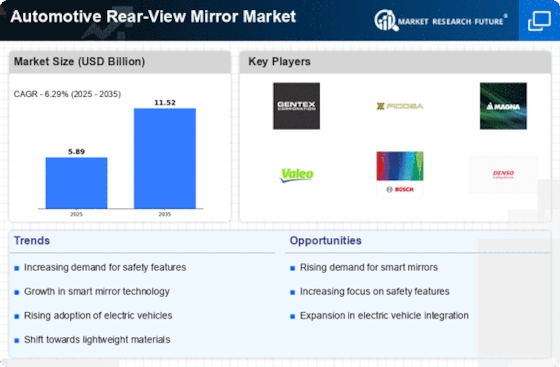
As per Market Research Future analysis, the Automotive Rear-View Mirror Market Size was estimated at 5.89 USD Billion in 2024. The Automotive Rear-View Mirror industry is projected to grow from 6.261 USD Billion in 2025 to 11.52 USD Billion by 2035, exhibiting a compound annual growth rate (CAGR) of 6.2% during the forecast period 2025 - 2035

Key Market Trends & Highlights

The Automotive Rear-View Mirror Market is experiencing a transformative shift towards smart technologies and sustainability.

  • The North American market remains the largest, driven by consumer preferences for enhanced visibility and safety features. Asia-Pacific is emerging as the fastest-growing region, reflecting a rising demand for innovative automotive solutions. Traditional mirrors continue to dominate the market, while smart mirrors are rapidly gaining traction due to technological advancements. Key market drivers include the integration of advanced safety features and the rising demand for electric vehicles, which are reshaping consumer expectations.

Market Size & Forecast

2024 Market Size 5.89 (USD Billion)
2035 Market Size 11.52 (USD Billion)
CAGR (2025 - 2035) 6.29%
Largest Regional Market Share in 2024 Asia Pacific

Major Players

<a href="https://www.gentex.com/products-technology/automotive/digital-vision/">Gentex Corporation</a> (US), Ficosa International (ES), Magna International (CA), Valeo (FR), Bosch (DE), Denso Corporation (JP), Mitsubishi Electric Corporation (JP), Continental AG (DE), Samvardhana Motherson Group (IN)

Market Trends

The Automotive Rear-View Mirror Market is currently experiencing a transformative phase, driven by advancements in technology and changing consumer preferences. The integration of smart features, such as cameras and sensors, is becoming increasingly prevalent, enhancing safety and convenience for drivers. This shift towards intelligent systems appears to be a response to the growing demand for enhanced visibility and accident prevention. Furthermore, the market is witnessing a rise in the adoption of electric vehicles, which often incorporate innovative rear-view mirror designs that align with modern aesthetics and functionality. In addition to technological advancements, sustainability is emerging as a key consideration within the Automotive Rear-View Mirror Market. Manufacturers are exploring eco-friendly materials and production processes to meet the expectations of environmentally conscious consumers. This trend suggests a broader movement towards sustainable practices in the automotive industry, where the focus is not only on performance but also on reducing environmental impact. As the market evolves, it is likely that these trends will shape the future landscape of automotive rear-view mirrors, influencing design, functionality, and consumer choices.

Integration of Smart Technologies

The Automotive Rear-View Mirror Market is increasingly incorporating smart technologies, such as integrated cameras and advanced sensors. These innovations enhance driver awareness and safety by providing real-time information about the vehicle's surroundings. As consumers prioritize safety features, the demand for mirrors equipped with these technologies is likely to grow.

Sustainability Initiatives

Sustainability is becoming a focal point in the Automotive Rear-View Mirror Market, with manufacturers exploring eco-friendly materials and production methods. This trend reflects a broader commitment to reducing environmental impact, appealing to consumers who value sustainability in their purchasing decisions.

Shift Towards Electric Vehicles

The rise of electric vehicles is influencing the Automotive Rear-View Mirror Market, as these vehicles often feature modern designs and functionalities. This shift suggests that manufacturers are adapting their products to meet the unique requirements of electric vehicles, potentially leading to innovative mirror solutions that enhance the overall driving experience.

Automotive Rear View Mirror Market Market Drivers

Rising Demand for Electric Vehicles

The Automotive Rear-View Mirror Market is poised for growth due to the rising demand for electric vehicles (EVs). As more consumers opt for EVs, manufacturers are adapting their designs to meet the unique requirements of these vehicles. The integration of lightweight materials and energy-efficient technologies in rear-view mirrors is becoming increasingly prevalent. Reports suggest that the EV market is expected to grow at a compound annual growth rate of over 20% in the coming years. This shift not only influences the design and functionality of rear-view mirrors but also encourages innovation within the Automotive Rear-View Mirror Market, as companies strive to align with the sustainability goals of the EV sector.

Integration of Advanced Safety Features

The Automotive Rear-View Mirror Market is experiencing a notable shift towards the integration of advanced safety features. This trend is driven by increasing consumer demand for enhanced safety in vehicles. Features such as blind-spot detection, lane departure warnings, and rear cross-traffic alerts are becoming standard in many new models. According to industry reports, the incorporation of these technologies is expected to boost the market significantly, with projections indicating a growth rate of approximately 7% annually over the next five years. As manufacturers prioritize safety, the Automotive Rear-View Mirror Market is likely to see a surge in demand for mirrors equipped with these innovative features, thereby enhancing overall vehicle safety and consumer confidence.

Regulatory Compliance and Safety Standards

The Automotive Rear-View Mirror Market is influenced by stringent regulatory compliance and safety standards imposed by various authorities. Governments worldwide are implementing regulations that mandate specific safety features in vehicles, including rear-view mirrors. These regulations aim to reduce accidents and enhance road safety. As a result, manufacturers are compelled to innovate and upgrade their products to meet these standards. The market is projected to grow as companies invest in research and development to create mirrors that comply with evolving regulations. This focus on safety not only benefits consumers but also drives competition within the Automotive Rear-View Mirror Market, leading to improved product offerings.

Technological Advancements in Mirror Design

Technological advancements are significantly impacting the Automotive Rear-View Mirror Market. Innovations such as electrochromatic mirrors, which automatically adjust tint based on lighting conditions, are gaining traction. These advancements enhance driver visibility and comfort, particularly during nighttime driving. Furthermore, the integration of heads-up displays and augmented reality features into rear-view mirrors is becoming more common. Market analysis indicates that the demand for these high-tech mirrors is likely to increase, with a projected market growth of around 5% annually. As technology continues to evolve, the Automotive Rear-View Mirror Market is expected to adapt, offering consumers more sophisticated and user-friendly options.

Consumer Preferences for Enhanced Visibility

Consumer preferences are shifting towards enhanced visibility features in the Automotive Rear-View Mirror Market. As drivers seek improved safety and convenience, features such as wide-angle views and integrated cameras are becoming increasingly popular. These enhancements provide drivers with a clearer view of their surroundings, reducing blind spots and improving overall safety. Market Research Future indicates that the demand for mirrors with advanced visibility features is expected to rise, with a potential growth rate of 6% over the next few years. This trend reflects a broader consumer desire for vehicles that prioritize safety and ease of use, prompting manufacturers to innovate within the Automotive Rear-View Mirror Market.

Market Segment Insights

By Type: Traditional Mirrors (Largest) vs. Smart Mirrors (Fastest-Growing)

The Automotive Rear-View Mirror Market is primarily dominated by Traditional Mirrors, which maintain a significant market share due to their long-standing presence in the industry and familiarity among consumers. Traditional Mirrors are preferred for their simplicity, effectiveness, and cost-effectiveness, making them the go-to choice for many vehicle manufacturers. In contrast, Smart Mirrors, although currently a smaller segment, are rapidly gaining traction as they integrate advanced technologies such as head-up displays, navigation aids, and enhanced safety features, appealing to tech-savvy consumers.

Traditional Mirrors (Dominant) vs. Smart Mirrors (Emerging)

Traditional Mirrors have established themselves as the dominant segment in the Automotive Rear-View Mirror Market, attributing their success to ease of use, cost efficiency, and a reliable design that has stood the test of time. They are often favored in standard vehicles due to their effectiveness in providing essential visibility to drivers. On the other hand, Smart Mirrors represent an emerging trend in the market, incorporating technology that enhances the driving experience. Features like blind-spot detection, real-time information display, and connectivity with other vehicle systems position Smart Mirrors as innovative solutions that cater to evolving consumer preferences, indicating a shift towards smarter automotive technologies.

By Mounting Type: Interior Mounting (Largest) vs. Exterior Mounting (Fastest-Growing)

In the Automotive Rear-View Mirror Market, the mounting type segment is divided into two main categories: interior and exterior mounting. The interior mounting segment holds the largest share, as it is widely adopted in various vehicle models due to its integration with the car's design and safety features. Interior mirrors are standard in almost all types of vehicles, from sedans to SUVs, contributing significantly to their dominant market position.

Mounting Type: Interior (Dominant) vs. Exterior (Emerging)

Interior mounting mirrors are designed to be seamlessly integrated within the vehicle's interior, allowing for optimal visibility and aesthetic coherence. These mirrors are preferred by manufacturers for their ease of installation and compatibility with vehicle control systems. On the other hand, exterior mounting mirrors are gaining traction as emerging solutions in the market, particularly for electric and <a href="https://www.marketresearchfuture.com/reports/autonomous-vehicles-market-1020">autonomous vehicles</a> that incorporate advanced camera technologies. As consumer preferences shift towards enhanced safety features and innovative designs, the demand for exterior mounts is expected to rise, positioning them as a key area of growth in the future.

By Functionality: Electrochromatic (Largest) vs. Auto-Dimming (Fastest-Growing)

In the Automotive Rear-View Mirror Market, the functionality segment exhibits a diverse distribution, with Electrochromatic mirrors holding the largest share due to their ability to automatically adjust tint based on ambient light conditions, enhancing visibility and safety. Following closely, Auto-Dimming mirrors are gaining traction with their convenient functionality, significantly contributing to overall market dynamics, particularly among newer vehicle models that emphasize modern technological integration and user comfort. Growth in the functionality segment is primarily driven by increasing consumer demand for safety and advanced technologies in vehicles. As automobile manufacturers focus on enhancing driver convenience and safety features, products like Heated Mirrors and Integrated Technology options are also witnessing significant adoption rates. The rising trend towards electric vehicles further fuels the demand for these advanced mirror functionalities, creating a robust competitive landscape for emerging technologies.

Electrochromatic (Dominant) vs. Auto-Dimming (Emerging)

Electrochromatic mirrors dominate the Automotive Rear-View Mirror Market due to their advanced features that cater to the growing consumer preference for safety and convenience. These mirrors adjust their tinting automatically, reducing glare from headlights of vehicles behind, which significantly improves night-time driving safety. On the other hand, Auto-Dimming mirrors are emerging as a popular choice, particularly among new car models, owing to their smart capabilities that enhance comfort and visibility for drivers. Both functionalities highlight a shift towards incorporating technology in automotive accessories, enhancing not just aesthetic appeal but also the overall driving experience. As consumers increasingly favor features that promote safety and comfort, these segments are positioned well for future growth.

By Application: Passenger Vehicles (Largest) vs. Two-Wheelers (Fastest-Growing)

The Automotive Rear-View Mirror Market exhibits a diverse application spectrum, with passenger vehicles commanding the largest share. This segment leverages a robust demand stemming from consumer preferences for safety and advanced features in modern cars. In contrast, two-wheelers are positioned as the fastest-growing segment, thanks to the rising popularity of two-wheeled transport in urban settings, where space constraints and fuel efficiency are significant factors influencing consumer choice.

Passenger Vehicles (Dominant) vs. Commercial Vehicles (Emerging)

Passenger vehicles dominate the automotive rear-view mirror market due to their significant production volumes and a growing trend towards integrating advanced features such as digital displays and blind-spot monitoring systems. On the other hand, commercial vehicles are emerging as a vital segment driven by the increasing demand for fleet management and safety regulations. The latter is adopting rear-view mirrors with improved functionalities to enhance visibility and reduce accidents, which creates a niche for innovative designs and technology within this category. As transport infrastructure evolves, both segments strive to meet differing consumer demands while adapting to advancements in automotive technology.

Get more detailed insights about Automotive Rear View Mirror Market Research Report - Forecast to 2035

Regional Insights

The Automotive Rear-View Mirror Market is experiencing diverse growth across various regions, with an overall market valuation of 4.49 USD billion anticipated in 2024. In North America, the market is valued at 1.2 USD billion, while Europe follows closely with a valuation of 1.3 USD billion, both showcasing significant demand for automotive innovation and safety standards. The Asia Pacific region dominates the market with a valuation of 1.8 USD Billion, driven by rapid vehicle production and increasing consumer preferences for advanced safety features.

South America, though smaller in comparison at 0.4 USD Billion, is witnessing gradual growth due to rising automotive consumption. The Middle East and Africa sector is valued at 0.5 USD billion, with emerging market opportunities fueled by infrastructural developments and increasing vehicle ownership. Several trends, including the shift toward intelligent vehicle systems and government initiatives promoting road safety, are influencing the Automotive Rear-View Mirror Market data. Moreover, the market growth is challenged by costs associated with R&D, yet opportunities remain abundant as manufacturers focus on innovation and enhanced design.

Overall, these regional market statistics reflect a dynamic landscape with varying growth potential and consumer preferences.

Key Players and Competitive Insights

The Automotive Rear-View Mirror Market presents a dynamic landscape characterized by rapid innovation, shifting consumer preferences, and competitive dynamics among key players. The market exhibits a robust demand driven by the increasing emphasis on safety features in vehicles and a growing focus on advanced driver-assistance systems. As automotive technologies evolve, rear-view mirrors have transitioned from traditional reflective designs to more sophisticated electronic and smart mirrors, integrating functionalities such as camera systems and digital displays. This evolution fosters intense competition among manufacturers striving to enhance product offerings while optimizing pricing strategies to capture market share. Key competitors in this sector are differentiating themselves through technological advancements, strategic partnerships, and an expanding global footprint, highlighting trends toward electrification and automation in the automotive space. Daiichi Jitsugyo has established a significant presence in the Automotive Rear-View Mirror Market through its commitment to innovation and quality. The company leverages advanced manufacturing techniques and materials that enhance the performance and durability of its rear-view mirrors. This focus has allowed Daiichi Jitsugyo to cultivate strong relationships with major automakers, providing tailored solutions that meet varying regional demands. The company's strengths lie in its ability to adapt to market trends quickly, implementing cutting-edge technologies that improve safety and convenience features within its product line. This adaptability not only enhances customer satisfaction but also reinforces Daiichi Jitsugyo's position as a reliable partner in the automotive supply chain, contributing to its competitive edge in the international arena. Continental, known for its comprehensive automotive solutions, maintains a robust presence in the Automotive Rear-View Mirror Market. The company offers a diverse range of products, including traditional and digital rear-view mirrors equipped with state-of-the-art technologies such as integrated cameras and sensor systems. Continental's strengths are underscored by its extensive research and development capabilities, enabling the introduction of innovative features that enhance functionality and driver safety. The company has also pursued strategic mergers and acquisitions to expand its market footprint, aligning with evolving industry demands and complementing its existing product range. Ultimately, Continental's established global supply chain, commitment to quality, and technological prowess position it as a key player in the competitive landscape of automotive rear view mirrors, addressing the growing needs of the modern automotive ecosystem.

Key Companies in the Automotive Rear View Mirror Market include

Industry Developments

The Automotive Rear-View Mirror Market has recently observed several notable developments. Concurrently, Continental is focusing on integrating smart technologies into its rear-view mirror products, enhancing both safety and functionality. The market has also seen an upward trend in valuations, as companies like Gentex and Valeo reported robust financial performances driven by innovation and demand for enhanced vehicle safety features.

In September 2023, Daiichi Jitsugyo announced an expansion of its manufacturing capabilities to cater to the increasing demand for advanced rear view mirror technologies.-- is this true? can you verify with exact links?

In August 2023, a significant acquisition involved Magna International acquiring a minority stake in a startup specializing in artificial intelligence-based mirror systems, which is expected to complement their existing product offerings.

 Additionally, Aisin Seiki has announced investments in Research and Development to foster innovation in auto-mirror systems, aligning with industry trends towards greater automation and driver assistance features. The current market landscape emphasizes sustainability and technological advancements, with companies like Bosch and Ficosa also actively pursuing new developments in rear view mirror technology to enhance user experience. These trends have collectively strengthened the global automotive rear-view mirror sector, reflecting a dynamic and evolving marketplace.

Future Outlook

Automotive Rear View Mirror Market Future Outlook

The Automotive Rear-View Mirror Market is projected to grow at a 6.29% CAGR from 2025 to 2035, driven by technological advancements, safety regulations, and increasing vehicle production.

New opportunities lie in:

  • <p>Integration of smart mirror technology for enhanced driver assistance systems. Development of eco-friendly materials for mirror production to meet sustainability goals. Expansion into emerging markets with tailored product offerings for local preferences.</p>

By 2035, the market is expected to be robust, driven by innovation and strategic expansions.

Market Segmentation

Automotive Rear View Mirror Market Type Outlook

  • Traditional Mirrors
  • Digital Mirrors
  • Smart Mirrors

Automotive Rear View Mirror Market Application Outlook

  • Passenger Vehicles
  • Commercial Vehicles
  • Two-Wheelers

Automotive Rear View Mirror Market Functionality Outlook

  • Manual Adjustment
  • Electrochromatic
  • Heated Mirrors
  • Auto-Dimming
  • Integrated Technology

Automotive Rear View Mirror Market Mounting Type Outlook

  • Interior Mounting
  • Exterior Mounting

Report Scope

MARKET SIZE 2024 5.89(USD Billion)
MARKET SIZE 2025 6.261(USD Billion)
MARKET SIZE 2035 11.52(USD Billion)
COMPOUND ANNUAL GROWTH RATE (CAGR) 6.29% (2025 - 2035)
REPORT COVERAGE Revenue Forecast, Competitive Landscape, Growth Factors, and Trends
BASE YEAR 2024
Market Forecast Period 2025 - 2035
Historical Data 2019 - 2024
Market Forecast Units USD Billion
Key Companies Profiled Gentex Corporation (US), Ficosa International (ES), Magna International (CA), Valeo (FR), Bosch (DE), Denso Corporation (JP), Mitsubishi Electric Corporation (JP), Continental AG (DE), Samvardhana Motherson Group (IN)
Segments Covered Type, Mounting Type, Functionality, Application, Regional
Key Market Opportunities Integration of advanced driver-assistance systems enhances safety features in the Automotive Rear-View Mirror Market.
Key Market Dynamics Technological advancements in safety features drive demand for innovative automotive rear-view mirror solutions.
Countries Covered North America, Europe, APAC, South America, MEA

FAQs

What is the projected market valuation of the Automotive Rear-View Mirror Market by 2035?

<p>The projected market valuation for the Automotive Rear-View Mirror Market is expected to reach 11.52 USD Billion by 2035.</p>

What was the market valuation of the Automotive Rear-View Mirror Market in 2024?

<p>The overall market valuation of the Automotive Rear-View Mirror Market was 5.89 USD Billion in 2024.</p>

What is the expected CAGR for the Automotive Rear-View Mirror Market during the forecast period 2025 - 2035?

<p>The expected CAGR for the Automotive Rear-View Mirror Market during the forecast period 2025 - 2035 is 6.29%.</p>

Which companies are considered key players in the Automotive Rear-View Mirror Market?

<p>Key players in the Automotive Rear-View Mirror Market include Gentex Corporation, Ficosa International, Magna International, and Valeo, among others.</p>

What are the different types of automotive rear-view mirrors and their market values?

<p>The market values for different types of automotive rear-view mirrors include Traditional Mirrors at 5.5 USD Billion, Digital Mirrors at 3.0 USD Billion, and Smart Mirrors at 3.02 USD Billion.</p>

How do the mounting types of automotive rear-view mirrors compare in market valuation?

<p>In terms of market valuation, Interior Mounting mirrors are projected to reach 5.56 USD Billion, while Exterior Mounting mirrors are expected to reach 5.96 USD Billion.</p>

What functionalities are available in automotive rear-view mirrors and their respective market values?

<p>The functionalities include Manual Adjustment at 3.36 USD Billion, Electrochromatic at 2.29 USD Billion, and Auto-Dimming at 2.4 USD Billion.</p>

What is the market valuation for automotive rear-view mirrors in passenger vehicles compared to commercial vehicles?

<p>The market valuation for automotive rear-view mirrors in passenger vehicles is projected to be 5.67 USD Billion, while for commercial vehicles, it is expected to be 3.45 USD Billion.</p>

What trends are influencing the growth of the Automotive Rear-View Mirror Market?

<p>Trends influencing growth include advancements in technology, increasing demand for safety features, and the rising popularity of smart mirrors.</p>

How does the Automotive Rear-View Mirror Market's growth potential compare across different vehicle applications?

<p>The growth potential appears robust across applications, with passenger vehicles leading at 5.67 USD Billion, followed by commercial vehicles at 3.45 USD Billion.</p>

  1. SECTION I: EXECUTIVE SUMMARY AND KEY HIGHLIGHTS
    1. | 1.1 EXECUTIVE SUMMARY
    2. | | 1.1.1 Market Overview
    3. | | 1.1.2 Key Findings
    4. | | 1.1.3 Market Segmentation
    5. | | 1.1.4 Competitive Landscape
    6. | | 1.1.5 Challenges and Opportunities
    7. | | 1.1.6 Future Outlook
  2. SECTION II: SCOPING, METHODOLOGY AND MARKET STRUCTURE
    1. | 2.1 MARKET INTRODUCTION
    2. | | 2.1.1 Definition
    3. | | 2.1.2 Scope of the study
    4. | | | 2.1.2.1 Research Objective
    5. | | | 2.1.2.2 Assumption
    6. | | | 2.1.2.3 Limitations
    7. | 2.2 RESEARCH METHODOLOGY
    8. | | 2.2.1 Overview
    9. | | 2.2.2 Data Mining
    10. | | 2.2.3 Secondary Research
    11. | | 2.2.4 Primary Research
    12. | | | 2.2.4.1 Primary Interviews and Information Gathering Process
    13. | | | 2.2.4.2 Breakdown of Primary Respondents
    14. | | 2.2.5 Forecasting Model
    15. | | 2.2.6 Market Size Estimation
    16. | | | 2.2.6.1 Bottom-Up Approach
    17. | | | 2.2.6.2 Top-Down Approach
    18. | | 2.2.7 Data Triangulation
    19. | | 2.2.8 Validation
  3. SECTION III: QUALITATIVE ANALYSIS
    1. | 3.1 MARKET DYNAMICS
    2. | | 3.1.1 Overview
    3. | | 3.1.2 Drivers
    4. | | 3.1.3 Restraints
    5. | | 3.1.4 Opportunities
    6. | 3.2 MARKET FACTOR ANALYSIS
    7. | | 3.2.1 Value chain Analysis
    8. | | 3.2.2 Porter's Five Forces Analysis
    9. | | | 3.2.2.1 Bargaining Power of Suppliers
    10. | | | 3.2.2.2 Bargaining Power of Buyers
    11. | | | 3.2.2.3 Threat of New Entrants
    12. | | | 3.2.2.4 Threat of Substitutes
    13. | | | 3.2.2.5 Intensity of Rivalry
    14. | | 3.2.3 COVID-19 Impact Analysis
    15. | | | 3.2.3.1 Market Impact Analysis
    16. | | | 3.2.3.2 Regional Impact
    17. | | | 3.2.3.3 Opportunity and Threat Analysis
  4. SECTION IV: QUANTITATIVE ANALYSIS
    1. | 4.1 Automobile, BY Type (USD Billion)
    2. | | 4.1.1 Traditional Mirrors
    3. | | 4.1.2 Digital Mirrors
    4. | | 4.1.3 Smart Mirrors
    5. | 4.2 Automobile, BY Mounting Type (USD Billion)
    6. | | 4.2.1 Interior Mounting
    7. | | 4.2.2 Exterior Mounting
    8. | 4.3 Automobile, BY Functionality (USD Billion)
    9. | | 4.3.1 Manual Adjustment
    10. | | 4.3.2 Electrochromatic
    11. | | 4.3.3 Heated Mirrors
    12. | | 4.3.4 Auto-Dimming
    13. | | 4.3.5 Integrated Technology
    14. | 4.4 Automobile, BY Application (USD Billion)
    15. | | 4.4.1 Passenger Vehicles
    16. | | 4.4.2 Commercial Vehicles
    17. | | 4.4.3 Two-Wheelers
    18. | 4.5 Automobile, BY Region (USD Billion)
    19. | | 4.5.1 North America
    20. | | | 4.5.1.1 US
    21. | | | 4.5.1.2 Canada
    22. | | 4.5.2 Europe
    23. | | | 4.5.2.1 Germany
    24. | | | 4.5.2.2 UK
    25. | | | 4.5.2.3 France
    26. | | | 4.5.2.4 Russia
    27. | | | 4.5.2.5 Italy
    28. | | | 4.5.2.6 Spain
    29. | | | 4.5.2.7 Rest of Europe
    30. | | 4.5.3 APAC
    31. | | | 4.5.3.1 China
    32. | | | 4.5.3.2 India
    33. | | | 4.5.3.3 Japan
    34. | | | 4.5.3.4 South Korea
    35. | | | 4.5.3.5 Malaysia
    36. | | | 4.5.3.6 Thailand
    37. | | | 4.5.3.7 Indonesia
    38. | | | 4.5.3.8 Rest of APAC
    39. | | 4.5.4 South America
    40. | | | 4.5.4.1 Brazil
    41. | | | 4.5.4.2 Mexico
    42. | | | 4.5.4.3 Argentina
    43. | | | 4.5.4.4 Rest of South America
    44. | | 4.5.5 MEA
    45. | | | 4.5.5.1 GCC Countries
    46. | | | 4.5.5.2 South Africa
    47. | | | 4.5.5.3 Rest of MEA
  5. SECTION V: COMPETITIVE ANALYSIS
    1. | 5.1 Competitive Landscape
    2. | | 5.1.1 Overview
    3. | | 5.1.2 Competitive Analysis
    4. | | 5.1.3 Market share Analysis
    5. | | 5.1.4 Major Growth Strategy in the Automobile
    6. | | 5.1.5 Competitive Benchmarking
    7. | | 5.1.6 Leading Players in Terms of Number of Developments in the Automobile
    8. | | 5.1.7 Key developments and growth strategies
    9. | | | 5.1.7.1 New Product Launch/Service Deployment
    10. | | | 5.1.7.2 Merger & Acquisitions
    11. | | | 5.1.7.3 Joint Ventures
    12. | | 5.1.8 Major Players Financial Matrix
    13. | | | 5.1.8.1 Sales and Operating Income
    14. | | | 5.1.8.2 Major Players R&D Expenditure. 2023
    15. | 5.2 Company Profiles
    16. | | 5.2.1 Gentex Corporation (US)
    17. | | | 5.2.1.1 Financial Overview
    18. | | | 5.2.1.2 Products Offered
    19. | | | 5.2.1.3 Key Developments
    20. | | | 5.2.1.4 SWOT Analysis
    21. | | | 5.2.1.5 Key Strategies
    22. | | 5.2.2 Ficosa International (ES)
    23. | | | 5.2.2.1 Financial Overview
    24. | | | 5.2.2.2 Products Offered
    25. | | | 5.2.2.3 Key Developments
    26. | | | 5.2.2.4 SWOT Analysis
    27. | | | 5.2.2.5 Key Strategies
    28. | | 5.2.3 Magna International (CA)
    29. | | | 5.2.3.1 Financial Overview
    30. | | | 5.2.3.2 Products Offered
    31. | | | 5.2.3.3 Key Developments
    32. | | | 5.2.3.4 SWOT Analysis
    33. | | | 5.2.3.5 Key Strategies
    34. | | 5.2.4 Valeo (FR)
    35. | | | 5.2.4.1 Financial Overview
    36. | | | 5.2.4.2 Products Offered
    37. | | | 5.2.4.3 Key Developments
    38. | | | 5.2.4.4 SWOT Analysis
    39. | | | 5.2.4.5 Key Strategies
    40. | | 5.2.5 Bosch (DE)
    41. | | | 5.2.5.1 Financial Overview
    42. | | | 5.2.5.2 Products Offered
    43. | | | 5.2.5.3 Key Developments
    44. | | | 5.2.5.4 SWOT Analysis
    45. | | | 5.2.5.5 Key Strategies
    46. | | 5.2.6 Denso Corporation (JP)
    47. | | | 5.2.6.1 Financial Overview
    48. | | | 5.2.6.2 Products Offered
    49. | | | 5.2.6.3 Key Developments
    50. | | | 5.2.6.4 SWOT Analysis
    51. | | | 5.2.6.5 Key Strategies
    52. | | 5.2.7 Mitsubishi Electric Corporation (JP)
    53. | | | 5.2.7.1 Financial Overview
    54. | | | 5.2.7.2 Products Offered
    55. | | | 5.2.7.3 Key Developments
    56. | | | 5.2.7.4 SWOT Analysis
    57. | | | 5.2.7.5 Key Strategies
    58. | | 5.2.8 Continental AG (DE)
    59. | | | 5.2.8.1 Financial Overview
    60. | | | 5.2.8.2 Products Offered
    61. | | | 5.2.8.3 Key Developments
    62. | | | 5.2.8.4 SWOT Analysis
    63. | | | 5.2.8.5 Key Strategies
    64. | | 5.2.9 Samvardhana Motherson Group (IN)
    65. | | | 5.2.9.1 Financial Overview
    66. | | | 5.2.9.2 Products Offered
    67. | | | 5.2.9.3 Key Developments
    68. | | | 5.2.9.4 SWOT Analysis
    69. | | | 5.2.9.5 Key Strategies
    70. | 5.3 Appendix
    71. | | 5.3.1 References
    72. | | 5.3.2 Related Reports
  6. LIST OF FIGURES
    1. | 6.1 MARKET SYNOPSIS
    2. | 6.2 NORTH AMERICA MARKET ANALYSIS
    3. | 6.3 US MARKET ANALYSIS BY TYPE
    4. | 6.4 US MARKET ANALYSIS BY MOUNTING TYPE
    5. | 6.5 US MARKET ANALYSIS BY FUNCTIONALITY
    6. | 6.6 US MARKET ANALYSIS BY APPLICATION
    7. | 6.7 CANADA MARKET ANALYSIS BY TYPE
    8. | 6.8 CANADA MARKET ANALYSIS BY MOUNTING TYPE
    9. | 6.9 CANADA MARKET ANALYSIS BY FUNCTIONALITY
    10. | 6.10 CANADA MARKET ANALYSIS BY APPLICATION
    11. | 6.11 EUROPE MARKET ANALYSIS
    12. | 6.12 GERMANY MARKET ANALYSIS BY TYPE
    13. | 6.13 GERMANY MARKET ANALYSIS BY MOUNTING TYPE
    14. | 6.14 GERMANY MARKET ANALYSIS BY FUNCTIONALITY
    15. | 6.15 GERMANY MARKET ANALYSIS BY APPLICATION
    16. | 6.16 UK MARKET ANALYSIS BY TYPE
    17. | 6.17 UK MARKET ANALYSIS BY MOUNTING TYPE
    18. | 6.18 UK MARKET ANALYSIS BY FUNCTIONALITY
    19. | 6.19 UK MARKET ANALYSIS BY APPLICATION
    20. | 6.20 FRANCE MARKET ANALYSIS BY TYPE
    21. | 6.21 FRANCE MARKET ANALYSIS BY MOUNTING TYPE
    22. | 6.22 FRANCE MARKET ANALYSIS BY FUNCTIONALITY
    23. | 6.23 FRANCE MARKET ANALYSIS BY APPLICATION
    24. | 6.24 RUSSIA MARKET ANALYSIS BY TYPE
    25. | 6.25 RUSSIA MARKET ANALYSIS BY MOUNTING TYPE
    26. | 6.26 RUSSIA MARKET ANALYSIS BY FUNCTIONALITY
    27. | 6.27 RUSSIA MARKET ANALYSIS BY APPLICATION
    28. | 6.28 ITALY MARKET ANALYSIS BY TYPE
    29. | 6.29 ITALY MARKET ANALYSIS BY MOUNTING TYPE
    30. | 6.30 ITALY MARKET ANALYSIS BY FUNCTIONALITY
    31. | 6.31 ITALY MARKET ANALYSIS BY APPLICATION
    32. | 6.32 SPAIN MARKET ANALYSIS BY TYPE
    33. | 6.33 SPAIN MARKET ANALYSIS BY MOUNTING TYPE
    34. | 6.34 SPAIN MARKET ANALYSIS BY FUNCTIONALITY
    35. | 6.35 SPAIN MARKET ANALYSIS BY APPLICATION
    36. | 6.36 REST OF EUROPE MARKET ANALYSIS BY TYPE
    37. | 6.37 REST OF EUROPE MARKET ANALYSIS BY MOUNTING TYPE
    38. | 6.38 REST OF EUROPE MARKET ANALYSIS BY FUNCTIONALITY
    39. | 6.39 REST OF EUROPE MARKET ANALYSIS BY APPLICATION
    40. | 6.40 APAC MARKET ANALYSIS
    41. | 6.41 CHINA MARKET ANALYSIS BY TYPE
    42. | 6.42 CHINA MARKET ANALYSIS BY MOUNTING TYPE
    43. | 6.43 CHINA MARKET ANALYSIS BY FUNCTIONALITY
    44. | 6.44 CHINA MARKET ANALYSIS BY APPLICATION
    45. | 6.45 INDIA MARKET ANALYSIS BY TYPE
    46. | 6.46 INDIA MARKET ANALYSIS BY MOUNTING TYPE
    47. | 6.47 INDIA MARKET ANALYSIS BY FUNCTIONALITY
    48. | 6.48 INDIA MARKET ANALYSIS BY APPLICATION
    49. | 6.49 JAPAN MARKET ANALYSIS BY TYPE
    50. | 6.50 JAPAN MARKET ANALYSIS BY MOUNTING TYPE
    51. | 6.51 JAPAN MARKET ANALYSIS BY FUNCTIONALITY
    52. | 6.52 JAPAN MARKET ANALYSIS BY APPLICATION
    53. | 6.53 SOUTH KOREA MARKET ANALYSIS BY TYPE
    54. | 6.54 SOUTH KOREA MARKET ANALYSIS BY MOUNTING TYPE
    55. | 6.55 SOUTH KOREA MARKET ANALYSIS BY FUNCTIONALITY
    56. | 6.56 SOUTH KOREA MARKET ANALYSIS BY APPLICATION
    57. | 6.57 MALAYSIA MARKET ANALYSIS BY TYPE
    58. | 6.58 MALAYSIA MARKET ANALYSIS BY MOUNTING TYPE
    59. | 6.59 MALAYSIA MARKET ANALYSIS BY FUNCTIONALITY
    60. | 6.60 MALAYSIA MARKET ANALYSIS BY APPLICATION
    61. | 6.61 THAILAND MARKET ANALYSIS BY TYPE
    62. | 6.62 THAILAND MARKET ANALYSIS BY MOUNTING TYPE
    63. | 6.63 THAILAND MARKET ANALYSIS BY FUNCTIONALITY
    64. | 6.64 THAILAND MARKET ANALYSIS BY APPLICATION
    65. | 6.65 INDONESIA MARKET ANALYSIS BY TYPE
    66. | 6.66 INDONESIA MARKET ANALYSIS BY MOUNTING TYPE
    67. | 6.67 INDONESIA MARKET ANALYSIS BY FUNCTIONALITY
    68. | 6.68 INDONESIA MARKET ANALYSIS BY APPLICATION
    69. | 6.69 REST OF APAC MARKET ANALYSIS BY TYPE
    70. | 6.70 REST OF APAC MARKET ANALYSIS BY MOUNTING TYPE
    71. | 6.71 REST OF APAC MARKET ANALYSIS BY FUNCTIONALITY
    72. | 6.72 REST OF APAC MARKET ANALYSIS BY APPLICATION
    73. | 6.73 SOUTH AMERICA MARKET ANALYSIS
    74. | 6.74 BRAZIL MARKET ANALYSIS BY TYPE
    75. | 6.75 BRAZIL MARKET ANALYSIS BY MOUNTING TYPE
    76. | 6.76 BRAZIL MARKET ANALYSIS BY FUNCTIONALITY
    77. | 6.77 BRAZIL MARKET ANALYSIS BY APPLICATION
    78. | 6.78 MEXICO MARKET ANALYSIS BY TYPE
    79. | 6.79 MEXICO MARKET ANALYSIS BY MOUNTING TYPE
    80. | 6.80 MEXICO MARKET ANALYSIS BY FUNCTIONALITY
    81. | 6.81 MEXICO MARKET ANALYSIS BY APPLICATION
    82. | 6.82 ARGENTINA MARKET ANALYSIS BY TYPE
    83. | 6.83 ARGENTINA MARKET ANALYSIS BY MOUNTING TYPE
    84. | 6.84 ARGENTINA MARKET ANALYSIS BY FUNCTIONALITY
    85. | 6.85 ARGENTINA MARKET ANALYSIS BY APPLICATION
    86. | 6.86 REST OF SOUTH AMERICA MARKET ANALYSIS BY TYPE
    87. | 6.87 REST OF SOUTH AMERICA MARKET ANALYSIS BY MOUNTING TYPE
    88. | 6.88 REST OF SOUTH AMERICA MARKET ANALYSIS BY FUNCTIONALITY
    89. | 6.89 REST OF SOUTH AMERICA MARKET ANALYSIS BY APPLICATION
    90. | 6.90 MEA MARKET ANALYSIS
    91. | 6.91 GCC COUNTRIES MARKET ANALYSIS BY TYPE
    92. | 6.92 GCC COUNTRIES MARKET ANALYSIS BY MOUNTING TYPE
    93. | 6.93 GCC COUNTRIES MARKET ANALYSIS BY FUNCTIONALITY
    94. | 6.94 GCC COUNTRIES MARKET ANALYSIS BY APPLICATION
    95. | 6.95 SOUTH AFRICA MARKET ANALYSIS BY TYPE
    96. | 6.96 SOUTH AFRICA MARKET ANALYSIS BY MOUNTING TYPE
    97. | 6.97 SOUTH AFRICA MARKET ANALYSIS BY FUNCTIONALITY
    98. | 6.98 SOUTH AFRICA MARKET ANALYSIS BY APPLICATION
    99. | 6.99 REST OF MEA MARKET ANALYSIS BY TYPE
    100. | 6.100 REST OF MEA MARKET ANALYSIS BY MOUNTING TYPE
    101. | 6.101 REST OF MEA MARKET ANALYSIS BY FUNCTIONALITY
    102. | 6.102 REST OF MEA MARKET ANALYSIS BY APPLICATION
    103. | 6.103 KEY BUYING CRITERIA OF AUTOMOBILE
    104. | 6.104 RESEARCH PROCESS OF MRFR
    105. | 6.105 DRO ANALYSIS OF AUTOMOBILE
    106. | 6.106 DRIVERS IMPACT ANALYSIS: AUTOMOBILE
    107. | 6.107 RESTRAINTS IMPACT ANALYSIS: AUTOMOBILE
    108. | 6.108 SUPPLY / VALUE CHAIN: AUTOMOBILE
    109. | 6.109 AUTOMOBILE, BY TYPE, 2024 (% SHARE)
    110. | 6.110 AUTOMOBILE, BY TYPE, 2024 TO 2035 (USD Billion)
    111. | 6.111 AUTOMOBILE, BY MOUNTING TYPE, 2024 (% SHARE)
    112. | 6.112 AUTOMOBILE, BY MOUNTING TYPE, 2024 TO 2035 (USD Billion)
    113. | 6.113 AUTOMOBILE, BY FUNCTIONALITY, 2024 (% SHARE)
    114. | 6.114 AUTOMOBILE, BY FUNCTIONALITY, 2024 TO 2035 (USD Billion)
    115. | 6.115 AUTOMOBILE, BY APPLICATION, 2024 (% SHARE)
    116. | 6.116 AUTOMOBILE, BY APPLICATION, 2024 TO 2035 (USD Billion)
    117. | 6.117 BENCHMARKING OF MAJOR COMPETITORS
  7. LIST OF TABLES
    1. | 7.1 LIST OF ASSUMPTIONS
    2. | | 7.1.1
    3. | 7.2 North America MARKET SIZE ESTIMATES; FORECAST
    4. | | 7.2.1 BY TYPE, 2025-2035 (USD Billion)
    5. | | 7.2.2 BY MOUNTING TYPE, 2025-2035 (USD Billion)
    6. | | 7.2.3 BY FUNCTIONALITY, 2025-2035 (USD Billion)
    7. | | 7.2.4 BY APPLICATION, 2025-2035 (USD Billion)
    8. | 7.3 US MARKET SIZE ESTIMATES; FORECAST
    9. | | 7.3.1 BY TYPE, 2025-2035 (USD Billion)
    10. | | 7.3.2 BY MOUNTING TYPE, 2025-2035 (USD Billion)
    11. | | 7.3.3 BY FUNCTIONALITY, 2025-2035 (USD Billion)
    12. | | 7.3.4 BY APPLICATION, 2025-2035 (USD Billion)
    13. | 7.4 Canada MARKET SIZE ESTIMATES; FORECAST
    14. | | 7.4.1 BY TYPE, 2025-2035 (USD Billion)
    15. | | 7.4.2 BY MOUNTING TYPE, 2025-2035 (USD Billion)
    16. | | 7.4.3 BY FUNCTIONALITY, 2025-2035 (USD Billion)
    17. | | 7.4.4 BY APPLICATION, 2025-2035 (USD Billion)
    18. | 7.5 Europe MARKET SIZE ESTIMATES; FORECAST
    19. | | 7.5.1 BY TYPE, 2025-2035 (USD Billion)
    20. | | 7.5.2 BY MOUNTING TYPE, 2025-2035 (USD Billion)
    21. | | 7.5.3 BY FUNCTIONALITY, 2025-2035 (USD Billion)
    22. | | 7.5.4 BY APPLICATION, 2025-2035 (USD Billion)
    23. | 7.6 Germany MARKET SIZE ESTIMATES; FORECAST
    24. | | 7.6.1 BY TYPE, 2025-2035 (USD Billion)
    25. | | 7.6.2 BY MOUNTING TYPE, 2025-2035 (USD Billion)
    26. | | 7.6.3 BY FUNCTIONALITY, 2025-2035 (USD Billion)
    27. | | 7.6.4 BY APPLICATION, 2025-2035 (USD Billion)
    28. | 7.7 UK MARKET SIZE ESTIMATES; FORECAST
    29. | | 7.7.1 BY TYPE, 2025-2035 (USD Billion)
    30. | | 7.7.2 BY MOUNTING TYPE, 2025-2035 (USD Billion)
    31. | | 7.7.3 BY FUNCTIONALITY, 2025-2035 (USD Billion)
    32. | | 7.7.4 BY APPLICATION, 2025-2035 (USD Billion)
    33. | 7.8 France MARKET SIZE ESTIMATES; FORECAST
    34. | | 7.8.1 BY TYPE, 2025-2035 (USD Billion)
    35. | | 7.8.2 BY MOUNTING TYPE, 2025-2035 (USD Billion)
    36. | | 7.8.3 BY FUNCTIONALITY, 2025-2035 (USD Billion)
    37. | | 7.8.4 BY APPLICATION, 2025-2035 (USD Billion)
    38. | 7.9 Russia MARKET SIZE ESTIMATES; FORECAST
    39. | | 7.9.1 BY TYPE, 2025-2035 (USD Billion)
    40. | | 7.9.2 BY MOUNTING TYPE, 2025-2035 (USD Billion)
    41. | | 7.9.3 BY FUNCTIONALITY, 2025-2035 (USD Billion)
    42. | | 7.9.4 BY APPLICATION, 2025-2035 (USD Billion)
    43. | 7.10 Italy MARKET SIZE ESTIMATES; FORECAST
    44. | | 7.10.1 BY TYPE, 2025-2035 (USD Billion)
    45. | | 7.10.2 BY MOUNTING TYPE, 2025-2035 (USD Billion)
    46. | | 7.10.3 BY FUNCTIONALITY, 2025-2035 (USD Billion)
    47. | | 7.10.4 BY APPLICATION, 2025-2035 (USD Billion)
    48. | 7.11 Spain MARKET SIZE ESTIMATES; FORECAST
    49. | | 7.11.1 BY TYPE, 2025-2035 (USD Billion)
    50. | | 7.11.2 BY MOUNTING TYPE, 2025-2035 (USD Billion)
    51. | | 7.11.3 BY FUNCTIONALITY, 2025-2035 (USD Billion)
    52. | | 7.11.4 BY APPLICATION, 2025-2035 (USD Billion)
    53. | 7.12 Rest of Europe MARKET SIZE ESTIMATES; FORECAST
    54. | | 7.12.1 BY TYPE, 2025-2035 (USD Billion)
    55. | | 7.12.2 BY MOUNTING TYPE, 2025-2035 (USD Billion)
    56. | | 7.12.3 BY FUNCTIONALITY, 2025-2035 (USD Billion)
    57. | | 7.12.4 BY APPLICATION, 2025-2035 (USD Billion)
    58. | 7.13 APAC MARKET SIZE ESTIMATES; FORECAST
    59. | | 7.13.1 BY TYPE, 2025-2035 (USD Billion)
    60. | | 7.13.2 BY MOUNTING TYPE, 2025-2035 (USD Billion)
    61. | | 7.13.3 BY FUNCTIONALITY, 2025-2035 (USD Billion)
    62. | | 7.13.4 BY APPLICATION, 2025-2035 (USD Billion)
    63. | 7.14 China MARKET SIZE ESTIMATES; FORECAST
    64. | | 7.14.1 BY TYPE, 2025-2035 (USD Billion)
    65. | | 7.14.2 BY MOUNTING TYPE, 2025-2035 (USD Billion)
    66. | | 7.14.3 BY FUNCTIONALITY, 2025-2035 (USD Billion)
    67. | | 7.14.4 BY APPLICATION, 2025-2035 (USD Billion)
    68. | 7.15 India MARKET SIZE ESTIMATES; FORECAST
    69. | | 7.15.1 BY TYPE, 2025-2035 (USD Billion)
    70. | | 7.15.2 BY MOUNTING TYPE, 2025-2035 (USD Billion)
    71. | | 7.15.3 BY FUNCTIONALITY, 2025-2035 (USD Billion)
    72. | | 7.15.4 BY APPLICATION, 2025-2035 (USD Billion)
    73. | 7.16 Japan MARKET SIZE ESTIMATES; FORECAST
    74. | | 7.16.1 BY TYPE, 2025-2035 (USD Billion)
    75. | | 7.16.2 BY MOUNTING TYPE, 2025-2035 (USD Billion)
    76. | | 7.16.3 BY FUNCTIONALITY, 2025-2035 (USD Billion)
    77. | | 7.16.4 BY APPLICATION, 2025-2035 (USD Billion)
    78. | 7.17 South Korea MARKET SIZE ESTIMATES; FORECAST
    79. | | 7.17.1 BY TYPE, 2025-2035 (USD Billion)
    80. | | 7.17.2 BY MOUNTING TYPE, 2025-2035 (USD Billion)
    81. | | 7.17.3 BY FUNCTIONALITY, 2025-2035 (USD Billion)
    82. | | 7.17.4 BY APPLICATION, 2025-2035 (USD Billion)
    83. | 7.18 Malaysia MARKET SIZE ESTIMATES; FORECAST
    84. | | 7.18.1 BY TYPE, 2025-2035 (USD Billion)
    85. | | 7.18.2 BY MOUNTING TYPE, 2025-2035 (USD Billion)
    86. | | 7.18.3 BY FUNCTIONALITY, 2025-2035 (USD Billion)
    87. | | 7.18.4 BY APPLICATION, 2025-2035 (USD Billion)
    88. | 7.19 Thailand MARKET SIZE ESTIMATES; FORECAST
    89. | | 7.19.1 BY TYPE, 2025-2035 (USD Billion)
    90. | | 7.19.2 BY MOUNTING TYPE, 2025-2035 (USD Billion)
    91. | | 7.19.3 BY FUNCTIONALITY, 2025-2035 (USD Billion)
    92. | | 7.19.4 BY APPLICATION, 2025-2035 (USD Billion)
    93. | 7.20 Indonesia MARKET SIZE ESTIMATES; FORECAST
    94. | | 7.20.1 BY TYPE, 2025-2035 (USD Billion)
    95. | | 7.20.2 BY MOUNTING TYPE, 2025-2035 (USD Billion)
    96. | | 7.20.3 BY FUNCTIONALITY, 2025-2035 (USD Billion)
    97. | | 7.20.4 BY APPLICATION, 2025-2035 (USD Billion)
    98. | 7.21 Rest of APAC MARKET SIZE ESTIMATES; FORECAST
    99. | | 7.21.1 BY TYPE, 2025-2035 (USD Billion)
    100. | | 7.21.2 BY MOUNTING TYPE, 2025-2035 (USD Billion)
    101. | | 7.21.3 BY FUNCTIONALITY, 2025-2035 (USD Billion)
    102. | | 7.21.4 BY APPLICATION, 2025-2035 (USD Billion)
    103. | 7.22 South America MARKET SIZE ESTIMATES; FORECAST
    104. | | 7.22.1 BY TYPE, 2025-2035 (USD Billion)
    105. | | 7.22.2 BY MOUNTING TYPE, 2025-2035 (USD Billion)
    106. | | 7.22.3 BY FUNCTIONALITY, 2025-2035 (USD Billion)
    107. | | 7.22.4 BY APPLICATION, 2025-2035 (USD Billion)
    108. | 7.23 Brazil MARKET SIZE ESTIMATES; FORECAST
    109. | | 7.23.1 BY TYPE, 2025-2035 (USD Billion)
    110. | | 7.23.2 BY MOUNTING TYPE, 2025-2035 (USD Billion)
    111. | | 7.23.3 BY FUNCTIONALITY, 2025-2035 (USD Billion)
    112. | | 7.23.4 BY APPLICATION, 2025-2035 (USD Billion)
    113. | 7.24 Mexico MARKET SIZE ESTIMATES; FORECAST
    114. | | 7.24.1 BY TYPE, 2025-2035 (USD Billion)
    115. | | 7.24.2 BY MOUNTING TYPE, 2025-2035 (USD Billion)
    116. | | 7.24.3 BY FUNCTIONALITY, 2025-2035 (USD Billion)
    117. | | 7.24.4 BY APPLICATION, 2025-2035 (USD Billion)
    118. | 7.25 Argentina MARKET SIZE ESTIMATES; FORECAST
    119. | | 7.25.1 BY TYPE, 2025-2035 (USD Billion)
    120. | | 7.25.2 BY MOUNTING TYPE, 2025-2035 (USD Billion)
    121. | | 7.25.3 BY FUNCTIONALITY, 2025-2035 (USD Billion)
    122. | | 7.25.4 BY APPLICATION, 2025-2035 (USD Billion)
    123. | 7.26 Rest of South America MARKET SIZE ESTIMATES; FORECAST
    124. | | 7.26.1 BY TYPE, 2025-2035 (USD Billion)
    125. | | 7.26.2 BY MOUNTING TYPE, 2025-2035 (USD Billion)
    126. | | 7.26.3 BY FUNCTIONALITY, 2025-2035 (USD Billion)
    127. | | 7.26.4 BY APPLICATION, 2025-2035 (USD Billion)
    128. | 7.27 MEA MARKET SIZE ESTIMATES; FORECAST
    129. | | 7.27.1 BY TYPE, 2025-2035 (USD Billion)
    130. | | 7.27.2 BY MOUNTING TYPE, 2025-2035 (USD Billion)
    131. | | 7.27.3 BY FUNCTIONALITY, 2025-2035 (USD Billion)
    132. | | 7.27.4 BY APPLICATION, 2025-2035 (USD Billion)
    133. | 7.28 GCC Countries MARKET SIZE ESTIMATES; FORECAST
    134. | | 7.28.1 BY TYPE, 2025-2035 (USD Billion)
    135. | | 7.28.2 BY MOUNTING TYPE, 2025-2035 (USD Billion)
    136. | | 7.28.3 BY FUNCTIONALITY, 2025-2035 (USD Billion)
    137. | | 7.28.4 BY APPLICATION, 2025-2035 (USD Billion)
    138. | 7.29 South Africa MARKET SIZE ESTIMATES; FORECAST
    139. | | 7.29.1 BY TYPE, 2025-2035 (USD Billion)
    140. | | 7.29.2 BY MOUNTING TYPE, 2025-2035 (USD Billion)
    141. | | 7.29.3 BY FUNCTIONALITY, 2025-2035 (USD Billion)
    142. | | 7.29.4 BY APPLICATION, 2025-2035 (USD Billion)
    143. | 7.30 Rest of MEA MARKET SIZE ESTIMATES; FORECAST
    144. | | 7.30.1 BY TYPE, 2025-2035 (USD Billion)
    145. | | 7.30.2 BY MOUNTING TYPE, 2025-2035 (USD Billion)
    146. | | 7.30.3 BY FUNCTIONALITY, 2025-2035 (USD Billion)
    147. | | 7.30.4 BY APPLICATION, 2025-2035 (USD Billion)
    148. | 7.31 PRODUCT LAUNCH/PRODUCT DEVELOPMENT/APPROVAL
    149. | | 7.31.1
    150. | 7.32 ACQUISITION/PARTNERSHIP
    151. | | 7.32.1

Automobile Market Segmentation

Automobile By Type (USD Billion, 2025-2035)

  • Traditional Mirrors
  • Digital Mirrors
  • Smart Mirrors

Automobile By Mounting Type (USD Billion, 2025-2035)

  • Interior Mounting
  • Exterior Mounting

Automobile By Functionality (USD Billion, 2025-2035)

  • Manual Adjustment
  • Electrochromatic
  • Heated Mirrors
  • Auto-Dimming
  • Integrated Technology

Automobile By Application (USD Billion, 2025-2035)

  • Passenger Vehicles
  • Commercial Vehicles
  • Two-Wheelers
Infographic

Free Sample Request

Kindly complete the form below to receive a free sample of this Report

Get Free Sample

Customer Strories

Compare Licence

×
Features License Type
Single User Multiuser License Enterprise User
Price $4,950 $5,950 $7,250
Maximum User Access Limit 1 User Upto 10 Users Unrestricted Access Throughout the Organization
Free Customization
Direct Access to Analyst
Deliverable Format
Platform Access
Discount on Next Purchase 10% 15% 15%
Printable Versions