
Request Free Sample ×

Kindly complete the form below to receive a free sample of this Report

* Please use a valid business email

Leading companies partner with us for data-driven Insights

clients tt-cursor
Hero Background
English
Chinese
French
Japanese
Korean
German
Spanish

Automotive LIDAR Sensors Market Trends

ID: MRFR/AT/3511-HCR
200 Pages
Triveni Bhoyar
March 2026

Automotive LiDAR Sensors Market Research Report By Application (Advanced Driver Assistance Systems, Autonomous Driving, Traffic Monitoring, Mapping and Surveying), By Technology (Solid-State LiDAR, Mechanical LiDAR, Frequency Modulated Continuous Wave LiDAR), By Type (Long-Range LiDAR, Short-Range LiDAR, Mid-Range LiDAR), By End Use (Passenger Vehicles, Commercial Vehicles, Public Transport) and By Regional (North America, Europe, South America, Asia Pacific, Middle East and Africa) - Forecast to 2035

Share:
Download PDF ×

We do not share your information with anyone. However, we may send you emails based on your report interest from time to time. You may contact us at any time to opt-out.

Automotive LIDAR Sensors Market Infographic
Purchase Options

Market Trends

Introduction

By 2024, the LiDAR market for vehicles is expected to have undergone a major transformation, thanks to a confluence of technological advances, regulatory pressures and changes in consumer behavior. The rapid evolution of the self-driving technology requires improved sensors, which in turn pushes manufacturers to develop more accurate and reliable LiDAR systems. Alongside this, governments are increasingly requiring the adoption of more advanced sensing technology to meet new safety standards. And finally, the growing demand for safer and more self-driving vehicles will also spur the development of more complex LiDAR solutions. These trends are important for those wishing to understand the complex and evolving nature of the market and to take advantage of the emerging opportunities.

Top Trends

  1. Increased Adoption of Autonomous Vehicles
    The market for LiDAR sensors is driven by the drive towards self-driving cars, and Waymo is at the forefront. By 2023, over half of the automakers have said they plan to integrate LiDAR into their self-driving systems. This will have a major effect on the safety and navigational capabilities of vehicles, and logistics and transport in general.
  2. Government Regulations and Safety Standards
    Moreover, the stricter safety regulations for driverless vehicles are requiring ever more precise sensors. In Europe, for example, the LiDAR is to be mandatory for certain categories of vehicles. In this way, manufacturers are compelled to invest in LiDAR, and the market dynamics and regulatory strategies are being influenced.
  3. Technological Advancements in LiDAR Systems
    Lidar has been gaining in importance for a long time. Recent developments, such as the solid-state design and the increase in resolution, have greatly improved its performance. Companies like Luminar have developed sensors with a range of over 250 metres, which is essential for self-driving cars. These advances will lower costs and make the technology more widely available, thus increasing its market penetration.
  4. Integration with AI and Machine Learning
    Artificial intelligence and lidar are revolutionizing the processing and interpretation of data. Firms like Nvidia are using AI to enhance object detection and classification. The combination of lidar and artificial intelligence is expected to improve the accuracy of lidar-based systems, resulting in more reliable performance and greater trust in self-driving vehicles.
  5. Collaboration Between Automotive and Tech Companies
    Strategic alliances between car manufacturers and technology companies are becoming increasingly common. For example, Ford has joined forces with Velodyne Lidar to further develop its on-board sensors. These collaborations are promoting innovation and accelerating the development of advanced driver assistance systems (ADAS), which are crucial to market growth.
  6. Cost Reduction and Accessibility of LiDAR Technology
    LiDAR sensors have become cheaper as a result of improvements in manufacturing and technology. The prices have fallen by more than 30 percent in the last two years, according to some reports. This is opening up LiDAR to a wider range of vehicles, even lower-end ones, and is thus increasing the market.
  7. Focus on Environmental Sustainability
    Among the motor vehicle industry, there is a growing interest in the development of LiDAR. Companies are experimenting with the use of sustainable materials and energy-saving designs. This is in line with the international trend towards greater sustainable development and can attract the attention of consumers who are concerned about the environment and enhance the reputation of a company.
  8. Emergence of New Market Entrants
    The LiDAR market is seeing an influx of new entrants and start-ups, a result of technological advances and a rise in funding opportunities. For example, one company whose LiDAR solutions have attracted attention is Blickfeld. This new influx is resulting in increased competition, leading to faster development and more varied product offerings.
  9. Enhanced Data Security and Privacy Concerns
    Concerns about data security and privacy are increasing as more and more data is collected by LIDAR systems. Leading companies are therefore prioritizing the development of secure data handling procedures. This focus is essential for gaining the trust of consumers and for ensuring compliance with data protection regulations. It also affects their market strategies.
  10. Global Expansion of LiDAR Applications
    Beyond the automobile, LiDAR is expanding into the fields of agriculture and urban planning. Companies are exploring these new markets, and a survey shows a twenty-percent increase in cross-industry applications. This diversification is expected to lead to new revenue streams and improve the overall market outlook.

Conclusion: Navigating the Competitive LiDAR Landscape

During the forecast period, the competition in the Automotive LiDAR market will be highly fragmented, and both established and new players will be in the fray. New entrants will be able to benefit from their knowledge and relationships while established companies will be able to take advantage of their new technology and specialized applications. However, the trend of the geographical area shows that North America and Asia-Pacific are becoming more important. In these regions, the regulatory framework is favourable and technological development is progressing rapidly. The market will be dominated by companies that strategically develop their AI, automation, and sustainable and flexible capabilities. These companies will not only meet the demands of the evolving automobile landscape but will also have a competitive advantage in this dynamic market.


Author
Author Profile
Triveni Bhoyar
Senior Research Analyst

Triveni Bhoyar has over 5 years of experience in the market research industry, specializing in the Automotive and Aerospace & Defense sectors. She has contributed to 200+ reports, including numerous custom projects for leading global companies, delivering solutions to complex business challenges. Renowned for her ability to generate valuable insights, Triveni excels in addressing unique market dynamics with precision and depth. Her expertise spans market sizing, competitive intelligence, and trend analysis, enabling clients to craft data-driven growth strategies. With strong analytical rigor and a client-centric approach, she plays a pivotal role in driving impactful, strategic decision-making.

Leave a Comment

FAQs

What is the projected market valuation of the Automotive LiDAR Sensors Market by 2035?

<p>The Automotive LiDAR Sensors Market is projected to reach approximately 1612.55 USD Billion by 2035.</p>

What was the market valuation of the Automotive LiDAR Sensors Market in 2024?

<p>In 2024, the market valuation of the Automotive LiDAR Sensors Market was 188.25 USD Billion.</p>

What is the expected CAGR for the Automotive LiDAR Sensors Market during the forecast period 2025 - 2035?

<p>The expected CAGR for the Automotive LiDAR Sensors Market during the forecast period 2025 - 2035 is 21.56%.</p>

Which application segment is expected to dominate the Automotive LiDAR Sensors Market?

<p>The Autonomous Driving application segment is expected to dominate, with a projected valuation of 600.0 USD Billion by 2035.</p>

What are the key technologies driving the Automotive LiDAR Sensors Market?

<p>Key technologies include Solid-State LiDAR, Mechanical LiDAR, and Frequency Modulated Continuous Wave LiDAR, with Solid-State LiDAR projected to reach 650.0 USD Billion by 2035.</p>

How do the end-use segments of the Automotive LiDAR Sensors Market compare?

<p>Passenger Vehicles lead the end-use segments, with a projected valuation of 650.0 USD Billion by 2035, followed by Commercial Vehicles and Public Transport.</p>

Who are the leading players in the Automotive LiDAR Sensors Market?

<p>Leading players in the Automotive LiDAR Sensors Market include Velodyne Lidar, Luminar Technologies, and Waymo, among others.</p>

What is the projected valuation for the Traffic Monitoring application segment by 2035?

<p>The Traffic Monitoring application segment is projected to reach approximately 250.0 USD Billion by 2035.</p>

What is the expected growth trajectory for Short-Range LiDAR technology?

<p>Short-Range LiDAR technology is expected to grow significantly, with a projected valuation of 600.0 USD Billion by 2035.</p>

How does the market for Mechanical LiDAR compare to Solid-State LiDAR?

<p>The Mechanical LiDAR market is projected to reach 500.0 USD Billion by 2035, whereas Solid-State LiDAR is expected to surpass this with a valuation of 650.0 USD Billion.</p>

Market Summary

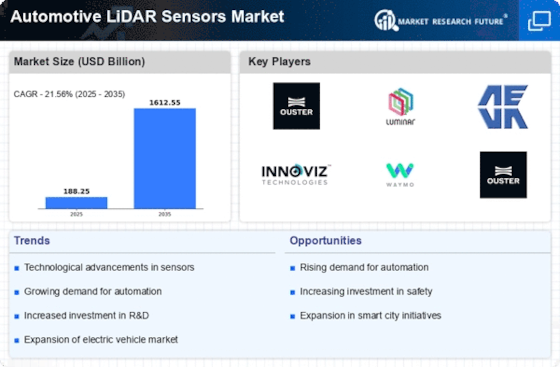
As per Market Research Future analysis, the Automotive LiDAR Sensors Market was estimated at 188.25 USD Billion in 2024. The Automotive LiDAR Sensors industry is projected to grow from 228.84 USD Billion in 2025 to 1612.55 USD Billion by 2035, exhibiting a compound annual growth rate (CAGR) of 21.5% during the forecast period 2025 - 2035

Key Market Trends & Highlights

The Automotive LiDAR Sensors Market is poised for substantial growth driven by technological advancements and increasing integration with autonomous systems.

  • Technological advancements in LiDAR are enhancing sensor capabilities and performance. North America remains the largest market, while Asia-Pacific is emerging as the fastest-growing region. The Advanced Driver Assistance Systems segment leads in market share, whereas the Autonomous Driving segment is experiencing rapid growth. Rising demand for advanced driver assistance systems and the growth of electric and autonomous vehicles are key drivers of market expansion.

Market Size & Forecast

2024 Market Size 188.25 (USD Billion)
2035 Market Size 1612.55 (USD Billion)
CAGR (2025 - 2035) 21.56%
Largest Regional Market Share in 2024 North America

Major Players

Velodyne Lidar (US), <a href="https://www.luminartech.com/technology">Luminar Technologies</a> (US), Aeva (US), Innoviz Technologies (IL), Waymo (US), Ouster (US), LeddarTech (CA), Quanergy Systems (US), Blickfeld (DE)

Market Trends

The Automotive LiDAR Sensors Market is currently experiencing a transformative phase, driven by advancements in sensor technology and increasing demand for autonomous vehicles. As manufacturers strive to enhance vehicle safety and navigation capabilities, LiDAR sensors are becoming integral components in modern automotive systems. The growing emphasis on smart transportation solutions and the integration of artificial intelligence into vehicle systems further bolster the automotive lidar sensor market.  expansion. Additionally, regulatory frameworks promoting safety standards are likely to accelerate the adoption of these sensors across various vehicle segments. Moreover, the Automotive LiDAR Sensors Market appears to be influenced by the rising trend of electric vehicles, which often incorporate advanced driver-assistance systems. This shift towards electrification is expected to create new opportunities for LiDAR technology, as manufacturers seek to differentiate their offerings through enhanced safety features. Furthermore, collaborations between automotive companies and technology firms may lead to innovative applications of LiDAR, potentially reshaping the competitive landscape. As the market evolves, it is essential to monitor these developments closely to understand their implications for future growth and technological advancements.

Technological Advancements in LiDAR

Recent innovations in LiDAR technology are enhancing the performance and affordability of sensors. Developments in solid-state LiDAR and miniaturization techniques are likely to make these sensors more accessible for a broader range of vehicles, potentially increasing market penetration. in the automotive lidar sensors market.

Integration with Autonomous Systems

The Automotive LiDAR Sensors Market is increasingly intertwined with the rise of autonomous driving technologies. As vehicles become more automated, the demand for precise and reliable sensing solutions is expected to grow, driving further investment in LiDAR systems.

Regulatory Influence on Adoption

Government regulations aimed at improving road safety are likely to play a crucial role in the adoption of Automotive LiDAR sensors. As standards evolve, manufacturers may be compelled to integrate these sensors into their vehicles to comply with new safety requirements.

Automotive LIDAR Sensors Market Market Drivers

Regulatory Support for Safety Standards

Regulatory support for safety standards is emerging as a significant driver in the Automotive LiDAR Sensors Market. Governments worldwide are implementing stringent safety regulations that mandate the inclusion of advanced safety features in vehicles. This regulatory landscape is fostering the adoption of LiDAR technology, as it is essential for meeting these safety requirements. For example, the European Union has proposed regulations that require all new vehicles to be equipped with advanced safety systems by 2024. Such mandates are likely to accelerate the integration of LiDAR sensors in vehicles, thereby propelling growth in the Automotive LiDAR Sensors Market.

Growth of Electric and Autonomous Vehicles

The Automotive LiDAR Sensors Market is significantly influenced by the growth of electric and autonomous vehicles. As manufacturers pivot towards electrification and automation, the demand for sophisticated sensing technologies, such as LiDAR, is expected to rise. The autonomous vehicle market is projected to reach USD 556 billion by 2026, with LiDAR playing a crucial role in enabling safe navigation and obstacle detection. This technology allows vehicles to perceive their surroundings in real-time, which is essential for the development of fully autonomous systems. Thus, the increasing adoption of electric and autonomous vehicles serves as a vital driver for the Automotive LiDAR Sensors Market.

Technological Innovations in LiDAR Systems

Technological innovations are propelling the Automotive LiDAR Sensors Market forward. Recent advancements in LiDAR technology, such as solid-state LiDAR and miniaturization, are enhancing the performance and reducing the costs of these sensors. For instance, solid-state LiDAR systems are becoming more compact and reliable, making them suitable for mass-market applications. The market for LiDAR sensors is anticipated to grow at a compound annual growth rate (CAGR) of 25% from 2023 to 2030. These innovations not only improve the accuracy and efficiency of LiDAR systems but also expand their applicability across various vehicle types, thereby driving growth in the Automotive LiDAR Sensors Market.

Increasing Investment in Research and Development

Investment in research and development (R&D) is a critical driver for the Automotive LiDAR Sensors Market. As competition intensifies among automotive manufacturers and technology providers, there is a concerted effort to innovate and enhance LiDAR technologies. Companies are allocating substantial resources to develop next-generation sensors that offer improved range, resolution, and reliability. This trend is reflected in the increasing number of partnerships and collaborations aimed at advancing LiDAR technology. The R&D expenditure in the automotive sector is projected to reach USD 100 billion by 2025, indicating a robust commitment to innovation that will likely benefit the Automotive LiDAR Sensors Market.

Rising Demand for Advanced Driver Assistance Systems

The Automotive LiDAR Sensors Market is experiencing a notable surge in demand for advanced driver assistance systems (ADAS). As safety regulations become more stringent, automotive manufacturers are increasingly integrating LiDAR technology to enhance vehicle safety features. This trend is underscored by the projected growth of the ADAS market, which is expected to reach USD 83 billion by 2025. LiDAR sensors provide high-resolution 3D mapping capabilities, enabling vehicles to detect obstacles and navigate complex environments. Consequently, the integration of LiDAR in ADAS not only improves safety but also enhances the overall driving experience, making it a pivotal driver in the Automotive LiDAR Sensors Market.

Market Segment Insights

By Application: Advanced Driver Assistance Systems (Largest) vs. Autonomous Driving (Fastest-Growing)

In the Automotive LiDAR Sensors Market, the Advanced Driver Assistance Systems (ADAS) segment holds the largest market share due to the increasing demand for safety features in vehicles. ADAS technologies that employ LiDAR sensors are becoming vital for enhancing vehicle safety and reducing traffic accidents. Meanwhile, the Autonomous Driving segment is rapidly gaining traction, showcasing significant growth potential driven by technological advancements and the increasing investment from automakers and tech companies in autonomous vehicle research and development.

ADAS (Dominant) vs. Autonomous Driving (Emerging)

The Advanced Driver Assistance Systems (ADAS) segment leads the Automotive LiDAR Sensors Market, characterized by its established presence and essential role in modern vehicles. Featuring a range of technologies including adaptive cruise control, lane-keeping assistance, and automatic emergency braking, ADAS applications rely on accurate and reliable LiDAR data to enhance safety and system performance. Meanwhile, the Autonomous Driving segment represents an emerging market, propelled by rapid innovations in AI and sensor technology. This segment is focused on developing fully autonomous vehicles that require advanced perception systems, positioning it as a significant area of growth for LiDAR sensors as the industry evolves.

By Technology: Solid-State LiDAR (Largest) vs. Mechanical LiDAR (Fastest-Growing)

The Automotive LiDAR Sensors Market is predominantly driven by Solid-State LiDAR, which holds the largest market share due to its compact design and reliability. This technology has rapidly gained traction owing to its efficiency in producing high-resolution 3D maps, enabling advanced <a href="https://www.marketresearchfuture.com/reports/driver-assistance-system-market-794">driver-assistance systems</a> (ADAS) that enhance safety. Mechanical LiDAR follows, catering to specific applications, but is slowly being overshadowed by the innovations in solid-state technologies. The frequency-modulated continuous wave (FMCW) LiDAR, while smaller in share, is emerging as a noteworthy competitor as it provides superior range detection and resilience under varying environmental conditions. Growth in this segment is primarily propelled by escalating demand for autonomous vehicles and enhanced safety regulations in the automotive industry. The need for higher accuracy in navigation and collision avoidance systems is increasing the adoption of advanced LiDAR technologies. Furthermore, substantial investments in research and development are leading to significant advancements, making Solid-State LiDAR an attractive option for automakers looking for reliability and cost-effectiveness. Meanwhile, Mechanical LiDAR is witnessing a resurgence, driven by its proven track record, while FMCW is on the rise, offering robust performance capabilities.

Technology: Solid-State LiDAR (Dominant) vs. Mechanical LiDAR (Emerging)

Solid-State LiDAR is currently the dominant technology in the Automotive LiDAR Sensors Market, recognized for its durability, compactness, and high performance in various weather conditions. It eliminates the moving parts associated with traditional mechanical systems, thereby enhancing reliability and reducing maintenance needs. In contrast, Mechanical LiDAR, while traditional, is still valued for its longevity and versatility in specific applications. It is characterized by rotating components that provide expansive field coverage and detailed environmental mapping. Despite being in the shadow of solid-state technologies, Mechanical LiDAR continues to find niche applications in industries where detailed scanning is paramount. As such, the segment features enduring demand as technological advancements unfold.

By Type: Long-Range LiDAR (Largest) vs. Short-Range LiDAR (Fastest-Growing)

In the Automotive LiDAR Sensors Market, the distribution of market share among the types reveals that Long-Range LiDAR holds a significant portion due to its critical role in advanced driver-assistance systems (ADAS) and autonomous driving applications. Its ability to detect objects at greater distances provides essential data for vehicle navigation and obstacle avoidance, reinforcing its position as the largest segment. In contrast, Short-Range LiDAR is rapidly gaining traction, primarily driven by the increasing demand for urban mobility solutions and parking assistance features in vehicles, marking it as the fastest-growing segment in the market.

LiDAR Types: Long-Range LiDAR (Dominant) vs. Short-Range LiDAR (Emerging)

Long-Range LiDAR is recognized as the dominant technology in the automotive sector, offering unparalleled object detection capabilities over extended distances. This technology is essential for autonomous vehicles as it facilitates high-speed navigation and safety features within complex environments. Meanwhile, Short-Range LiDAR is emerging as a crucial complement to Long-Range systems, focusing on improving the functionality of vehicles in confined spaces and urban settings. This segment is increasingly important for functions like advanced parking systems and low-speed collision avoidance, further driving innovation in this space.

By End Use: Passenger Vehicles (Largest) vs. Commercial Vehicles (Fastest-Growing)

The Automotive LiDAR Sensors Market is seeing diverse distribution across its primary end-use segments, with Passenger Vehicles holding the largest share. These vehicles leverage LiDAR technology for enhanced safety and autonomous driving capabilities, driving substantial market presence. In contrast, Commercial Vehicles are emerging as a strong contender, increasingly incorporating advanced sensing technologies which align with the industry's focus on automation and safety standards. Public Transport, while significant, is overshadowed by the rapid growth in the other two segments.

Passenger Vehicles (Dominant) vs. Commercial Vehicles (Emerging)

Passenger Vehicles have long been the dominant segment in the Automotive LiDAR Sensors Market, driven by factors such as consumer demand for advanced driver assistance systems (ADAS) and self-driving technologies. These vehicles benefit from a stable installation of LiDAR sensors, enhancing overall safety and efficiency. Conversely, Commercial Vehicles are rapidly emerging as a vital segment due to their increasing adoption of automation technologies and regulatory pressures for safety enhancements. As logistics and freight operations integrate smarter technologies, the demand for LiDAR in commercial applications is swiftly increasing, signaling a transformative period in automotive sensing solutions.

Get more detailed insights about Automotive LiDAR Sensors Market Research Report - Global Forecast to 2035

Regional Insights

The Automotive LiDAR Sensors Market is anticipated to witness significant growth across its regional segments, reflecting an overall market value of 2.05 USD billion in 2024. In this landscape, North America emerges as a major player, holding a value of 0.85 USD billion in 2024 and projected to reach 5.25 USD billion by 2035, driven by advancements in vehicle automation and supportive regulatory frameworks. Europe follows, valued at 0.65 USD billion in 2024 and estimated to grow to 4.25 USD billion by 2035, as countries within the region push for higher safety standards in transportation.

Meanwhile, South America, with a valuation of 0.15 USD billion in 2024, presents gradual growth opportunities, reaching 1.0 USD billion by 2035, primarily through increasing investment in smart mobility solutions. Asia Pacific also shows promise, valued at 0.35 USD billion in 2024 and projected to grow to 2.75 USD billion by 2035, as major automotive manufacturers invest in innovative technologies. Lastly, the Middle East and Africa, although trailing, are valued at 0.05 USD billion in 2024 with a forecasted growth to 0.25 USD billion by 2035, highlighting the potential for growth in autonomous vehicle infrastructure.

The rising demand for safer, more efficient vehicular systems is a key driver for the Automotive LiDAR Sensors Market across these regions, creating numerous opportunities for investment and technological development.

Key Players and Competitive Insights

The Automotive LiDAR Sensors Market is characterized by rapidly evolving technologies and increasing competition as manufacturers strive to innovate and enhance sensor capabilities for vehicle automation and safety. With the rise of autonomous vehicles and advanced driver-assistance systems, the demand for high-resolution and reliable LiDAR sensors has surged, prompting various players in the market to expand their offerings. The competitive landscape is shaped by established automotive suppliers, technology innovators, and startups aiming to capture market share through differentiated products, strategic partnerships, and investments in research and development. Companies are also focusing on regulatory compliance and safety standards, which significantly influence product design and implementation in the automotive sector. The increasing emphasis on smart transportation solutions further intensifies competition, as firms seek to provide integrated systems that combine LiDAR with other sensing technologies to enhance vehicle perception capabilities. Innoviz Technologies has established a significant presence in the Automotive LiDAR Sensors Market with its cutting-edge sensor capabilities designed for the autonomous vehicle sector. The company is known for its innovative solid-state LiDAR solutions that provide high-resolution 3D imaging, ensuring precision in obstacle detection and navigation. Innoviz Technologies has strategically collaborated with key automotive manufacturers to integrate its LiDAR systems into next-generation vehicles, thus expanding its market reach. The company boasts strong technical expertise in sensor technology, enabling it to create highly reliable products. Its commitment to producing cost-effective solutions while maintaining performance standards sets it apart from competitors, positioning Innoviz as a prominent player within the global market. Ouster has made notable strides in the Automotive LiDAR Sensors Market with its versatile and technologically advanced LiDAR sensors that cater to various applications in autonomous driving and smart city initiatives. The company offers a range of products, including its digital LiDAR sensors that deliver high performance at competitive prices, attracting attention from automakers and technology developers. Ouster's presence in the global market is strengthened by its robust supply chain and strategic partnerships that enhance its distribution capabilities. The company's focus on innovation is demonstrated through consistent product launches and advancements in sensor technology, making it a strong competitor in the industry. Moreover, Ouster has engaged in mergers and acquisitions to bolster its technological capabilities, expanding its portfolio and enhancing its market position. By leveraging these strengths, Ouster aims to solidify its role as a leading provider of LiDAR solutions in the automotive sector.

Key Companies in the Automotive LIDAR Sensors Market include

Industry Developments

  • Q2 2024: Hesai Technology secures major supply contract with leading Chinese automaker for automotive LiDAR sensors Hesai Technology announced it has signed a significant supply agreement with a top Chinese automaker to provide automotive LiDAR sensors for upcoming electric vehicle models, reinforcing its leadership in the sector.
  • Q2 2024: Innoviz Technologies wins multi-year LiDAR supply deal with Volkswagen Group Innoviz Technologies revealed it has been selected by Volkswagen Group as a direct LiDAR supplier for its next-generation autonomous vehicle platforms, marking a major contract win for the Israeli sensor company.
  • Q3 2024: Luminar Technologies opens new manufacturing facility in Mexico to scale automotive LiDAR production Luminar Technologies inaugurated a new manufacturing plant in Monterrey, Mexico, aimed at increasing production capacity for its automotive LiDAR sensors to meet growing demand from global automakers.
  • Q2 2024: Valeo launches third-generation Scala LiDAR sensor for automotive OEMs Valeo introduced its third-generation Scala LiDAR sensor, offering improved range and resolution, and announced new partnerships with several European automakers for integration into advanced driver-assistance systems.
  • Q1 2025: RoboSense announces partnership with Hyundai Motor Group for LiDAR-equipped vehicles RoboSense disclosed a strategic partnership with Hyundai Motor Group to supply LiDAR sensors for the automaker’s upcoming line of semi-autonomous vehicles, with production slated to begin later in 2025.
  • Q2 2025: Ouster appoints new CEO to accelerate automotive LiDAR business expansion Ouster named a new Chief Executive Officer, citing the need for experienced leadership as the company seeks to expand its presence in the automotive LiDAR sensor market and secure additional OEM contracts.
  • Q3 2024: Hesai Technology opens European headquarters in Munich to support automotive LiDAR customers Hesai Technology announced the opening of its European headquarters in Munich, Germany, to better serve its growing base of automotive clients and partners across the continent.
  • Q2 2024: Cepton secures $100 million funding round to scale automotive LiDAR production Cepton completed a $100 million funding round led by strategic automotive investors, with proceeds earmarked for expanding manufacturing capacity and accelerating product development for automotive LiDAR sensors.
  • Q1 2025: Innovusion announces mass production of Falcon LiDAR for NIO’s new electric vehicles Innovusion began mass production of its Falcon LiDAR sensor, which will be integrated into NIO’s latest electric vehicle models, marking a milestone in the commercial deployment of high-performance automotive LiDAR.
  • Q2 2025: Valeo signs supply agreement with Stellantis for next-gen LiDAR sensors Valeo entered into a multi-year supply agreement with Stellantis to provide next-generation LiDAR sensors for integration into the automaker’s advanced driver-assistance and autonomous driving systems.
  • Q3 2024: Luminar Technologies partners with Mercedes-Benz to deliver LiDAR for Level 3 autonomous vehicles Luminar Technologies announced a partnership with Mercedes-Benz to supply LiDAR sensors for the automaker’s Level 3 autonomous vehicles, with initial deployments planned for 2025.
  • Q1 2025: RoboSense raises $150 million in Series D funding to expand global automotive LiDAR operations RoboSense closed a $150 million Series D funding round to support the expansion of its global operations and accelerate the development of next-generation automotive LiDAR sensors.

Future Outlook

Automotive LIDAR Sensors Market Future Outlook

The Automotive LiDAR Sensors Market is projected to grow at a 21.56% CAGR from 2025 to 2035, driven by advancements in autonomous driving technology, safety regulations, and increased demand for smart vehicles.

New opportunities lie in:

  • <p>Development of integrated LiDAR systems for electric vehicles Partnerships with tech firms for enhanced data analytics Expansion into emerging markets with tailored solutions</p>

By 2035, the market is expected to be robust, driven by innovation and strategic partnerships.

Market Segmentation

Automotive LIDAR Sensors Market Type Outlook

  • Long-Range LiDAR
  • Short-Range LiDAR
  • Mid-Range LiDAR

Automotive LIDAR Sensors Market End Use Outlook

  • Passenger Vehicles
  • Commercial Vehicles
  • Public Transport

Automotive LIDAR Sensors Market Technology Outlook

  • Solid-State LiDAR
  • Mechanical LiDAR
  • Frequency Modulated Continuous Wave LiDAR

Automotive LIDAR Sensors Market Application Outlook

  • Advanced Driver Assistance Systems
  • Autonomous Driving
  • Traffic Monitoring
  • Mapping and Surveying

Report Scope

MARKET SIZE 2024 188.25(USD Billion)
MARKET SIZE 2025 228.84(USD Billion)
MARKET SIZE 2035 1612.55(USD Billion)
COMPOUND ANNUAL GROWTH RATE (CAGR) 21.56% (2025 - 2035)
REPORT COVERAGE Revenue Forecast, Competitive Landscape, Growth Factors, and Trends
BASE YEAR 2024
Market Forecast Period 2025 - 2035
Historical Data 2019 - 2024
Market Forecast Units USD Billion
Key Companies Profiled Velodyne Lidar (US), Luminar Technologies (US), Aeva (US), Innoviz Technologies (IL), Waymo (US), Ouster (US), LeddarTech (CA), Quanergy Systems (US), Blickfeld (DE)
Segments Covered Application, Technology, Type, End Use, Regional
Key Market Opportunities Integration of advanced Automotive LiDAR Sensors in autonomous vehicle systems enhances safety and navigation capabilities.
Key Market Dynamics Rising demand for advanced driver assistance systems drives innovation and competition in the Automotive LiDAR Sensors market.
Countries Covered North America, Europe, APAC, South America, MEA

FAQs

What is the projected market valuation of the Automotive LiDAR Sensors Market by 2035?

<p>The Automotive LiDAR Sensors Market is projected to reach approximately 1612.55 USD Billion by 2035.</p>

What was the market valuation of the Automotive LiDAR Sensors Market in 2024?

<p>In 2024, the market valuation of the Automotive LiDAR Sensors Market was 188.25 USD Billion.</p>

What is the expected CAGR for the Automotive LiDAR Sensors Market during the forecast period 2025 - 2035?

<p>The expected CAGR for the Automotive LiDAR Sensors Market during the forecast period 2025 - 2035 is 21.56%.</p>

Which application segment is expected to dominate the Automotive LiDAR Sensors Market?

<p>The Autonomous Driving application segment is expected to dominate, with a projected valuation of 600.0 USD Billion by 2035.</p>

What are the key technologies driving the Automotive LiDAR Sensors Market?

<p>Key technologies include Solid-State LiDAR, Mechanical LiDAR, and Frequency Modulated Continuous Wave LiDAR, with Solid-State LiDAR projected to reach 650.0 USD Billion by 2035.</p>

How do the end-use segments of the Automotive LiDAR Sensors Market compare?

<p>Passenger Vehicles lead the end-use segments, with a projected valuation of 650.0 USD Billion by 2035, followed by Commercial Vehicles and Public Transport.</p>

Who are the leading players in the Automotive LiDAR Sensors Market?

<p>Leading players in the Automotive LiDAR Sensors Market include Velodyne Lidar, Luminar Technologies, and Waymo, among others.</p>

What is the projected valuation for the Traffic Monitoring application segment by 2035?

<p>The Traffic Monitoring application segment is projected to reach approximately 250.0 USD Billion by 2035.</p>

What is the expected growth trajectory for Short-Range LiDAR technology?

<p>Short-Range LiDAR technology is expected to grow significantly, with a projected valuation of 600.0 USD Billion by 2035.</p>

How does the market for Mechanical LiDAR compare to Solid-State LiDAR?

<p>The Mechanical LiDAR market is projected to reach 500.0 USD Billion by 2035, whereas Solid-State LiDAR is expected to surpass this with a valuation of 650.0 USD Billion.</p>

  1. SECTION I: EXECUTIVE SUMMARY AND KEY HIGHLIGHTS
    1. | 1.1 EXECUTIVE SUMMARY
    2. | | 1.1.1 Market Overview
    3. | | 1.1.2 Key Findings
    4. | | 1.1.3 Market Segmentation
    5. | | 1.1.4 Competitive Landscape
    6. | | 1.1.5 Challenges and Opportunities
    7. | | 1.1.6 Future Outlook
  2. SECTION II: SCOPING, METHODOLOGY AND MARKET STRUCTURE
    1. | 2.1 MARKET INTRODUCTION
    2. | | 2.1.1 Definition
    3. | | 2.1.2 Scope of the study
    4. | | | 2.1.2.1 Research Objective
    5. | | | 2.1.2.2 Assumption
    6. | | | 2.1.2.3 Limitations
    7. | 2.2 RESEARCH METHODOLOGY
    8. | | 2.2.1 Overview
    9. | | 2.2.2 Data Mining
    10. | | 2.2.3 Secondary Research
    11. | | 2.2.4 Primary Research
    12. | | | 2.2.4.1 Primary Interviews and Information Gathering Process
    13. | | | 2.2.4.2 Breakdown of Primary Respondents
    14. | | 2.2.5 Forecasting Model
    15. | | 2.2.6 Market Size Estimation
    16. | | | 2.2.6.1 Bottom-Up Approach
    17. | | | 2.2.6.2 Top-Down Approach
    18. | | 2.2.7 Data Triangulation
    19. | | 2.2.8 Validation
  3. SECTION III: QUALITATIVE ANALYSIS
    1. | 3.1 MARKET DYNAMICS
    2. | | 3.1.1 Overview
    3. | | 3.1.2 Drivers
    4. | | 3.1.3 Restraints
    5. | | 3.1.4 Opportunities
    6. | 3.2 MARKET FACTOR ANALYSIS
    7. | | 3.2.1 Value chain Analysis
    8. | | 3.2.2 Porter's Five Forces Analysis
    9. | | | 3.2.2.1 Bargaining Power of Suppliers
    10. | | | 3.2.2.2 Bargaining Power of Buyers
    11. | | | 3.2.2.3 Threat of New Entrants
    12. | | | 3.2.2.4 Threat of Substitutes
    13. | | | 3.2.2.5 Intensity of Rivalry
    14. | | 3.2.3 COVID-19 Impact Analysis
    15. | | | 3.2.3.1 Market Impact Analysis
    16. | | | 3.2.3.2 Regional Impact
    17. | | | 3.2.3.3 Opportunity and Threat Analysis
  4. SECTION IV: QUANTITATIVE ANALYSIS
    1. | 4.1 Automobile, BY Application (USD Billion)
    2. | | 4.1.1 Advanced Driver Assistance Systems
    3. | | 4.1.2 Autonomous Driving
    4. | | 4.1.3 Traffic Monitoring
    5. | | 4.1.4 Mapping and Surveying
    6. | 4.2 Automobile, BY Technology (USD Billion)
    7. | | 4.2.1 Solid-State LiDAR
    8. | | 4.2.2 Mechanical LiDAR
    9. | | 4.2.3 Frequency Modulated Continuous Wave LiDAR
    10. | 4.3 Automobile, BY Type (USD Billion)
    11. | | 4.3.1 Long-Range LiDAR
    12. | | 4.3.2 Short-Range LiDAR
    13. | | 4.3.3 Mid-Range LiDAR
    14. | 4.4 Automobile, BY End Use (USD Billion)
    15. | | 4.4.1 Passenger Vehicles
    16. | | 4.4.2 Commercial Vehicles
    17. | | 4.4.3 Public Transport
    18. | 4.5 Automobile, BY Region (USD Billion)
    19. | | 4.5.1 North America
    20. | | | 4.5.1.1 US
    21. | | | 4.5.1.2 Canada
    22. | | 4.5.2 Europe
    23. | | | 4.5.2.1 Germany
    24. | | | 4.5.2.2 UK
    25. | | | 4.5.2.3 France
    26. | | | 4.5.2.4 Russia
    27. | | | 4.5.2.5 Italy
    28. | | | 4.5.2.6 Spain
    29. | | | 4.5.2.7 Rest of Europe
    30. | | 4.5.3 APAC
    31. | | | 4.5.3.1 China
    32. | | | 4.5.3.2 India
    33. | | | 4.5.3.3 Japan
    34. | | | 4.5.3.4 South Korea
    35. | | | 4.5.3.5 Malaysia
    36. | | | 4.5.3.6 Thailand
    37. | | | 4.5.3.7 Indonesia
    38. | | | 4.5.3.8 Rest of APAC
    39. | | 4.5.4 South America
    40. | | | 4.5.4.1 Brazil
    41. | | | 4.5.4.2 Mexico
    42. | | | 4.5.4.3 Argentina
    43. | | | 4.5.4.4 Rest of South America
    44. | | 4.5.5 MEA
    45. | | | 4.5.5.1 GCC Countries
    46. | | | 4.5.5.2 South Africa
    47. | | | 4.5.5.3 Rest of MEA
  5. SECTION V: COMPETITIVE ANALYSIS
    1. | 5.1 Competitive Landscape
    2. | | 5.1.1 Overview
    3. | | 5.1.2 Competitive Analysis
    4. | | 5.1.3 Market share Analysis
    5. | | 5.1.4 Major Growth Strategy in the Automobile
    6. | | 5.1.5 Competitive Benchmarking
    7. | | 5.1.6 Leading Players in Terms of Number of Developments in the Automobile
    8. | | 5.1.7 Key developments and growth strategies
    9. | | | 5.1.7.1 New Product Launch/Service Deployment
    10. | | | 5.1.7.2 Merger & Acquisitions
    11. | | | 5.1.7.3 Joint Ventures
    12. | | 5.1.8 Major Players Financial Matrix
    13. | | | 5.1.8.1 Sales and Operating Income
    14. | | | 5.1.8.2 Major Players R&D Expenditure. 2023
    15. | 5.2 Company Profiles
    16. | | 5.2.1 Velodyne Lidar (US)
    17. | | | 5.2.1.1 Financial Overview
    18. | | | 5.2.1.2 Products Offered
    19. | | | 5.2.1.3 Key Developments
    20. | | | 5.2.1.4 SWOT Analysis
    21. | | | 5.2.1.5 Key Strategies
    22. | | 5.2.2 Luminar Technologies (US)
    23. | | | 5.2.2.1 Financial Overview
    24. | | | 5.2.2.2 Products Offered
    25. | | | 5.2.2.3 Key Developments
    26. | | | 5.2.2.4 SWOT Analysis
    27. | | | 5.2.2.5 Key Strategies
    28. | | 5.2.3 Aeva (US)
    29. | | | 5.2.3.1 Financial Overview
    30. | | | 5.2.3.2 Products Offered
    31. | | | 5.2.3.3 Key Developments
    32. | | | 5.2.3.4 SWOT Analysis
    33. | | | 5.2.3.5 Key Strategies
    34. | | 5.2.4 Innoviz Technologies (IL)
    35. | | | 5.2.4.1 Financial Overview
    36. | | | 5.2.4.2 Products Offered
    37. | | | 5.2.4.3 Key Developments
    38. | | | 5.2.4.4 SWOT Analysis
    39. | | | 5.2.4.5 Key Strategies
    40. | | 5.2.5 Waymo (US)
    41. | | | 5.2.5.1 Financial Overview
    42. | | | 5.2.5.2 Products Offered
    43. | | | 5.2.5.3 Key Developments
    44. | | | 5.2.5.4 SWOT Analysis
    45. | | | 5.2.5.5 Key Strategies
    46. | | 5.2.6 Ouster (US)
    47. | | | 5.2.6.1 Financial Overview
    48. | | | 5.2.6.2 Products Offered
    49. | | | 5.2.6.3 Key Developments
    50. | | | 5.2.6.4 SWOT Analysis
    51. | | | 5.2.6.5 Key Strategies
    52. | | 5.2.7 LeddarTech (CA)
    53. | | | 5.2.7.1 Financial Overview
    54. | | | 5.2.7.2 Products Offered
    55. | | | 5.2.7.3 Key Developments
    56. | | | 5.2.7.4 SWOT Analysis
    57. | | | 5.2.7.5 Key Strategies
    58. | | 5.2.8 Quanergy Systems (US)
    59. | | | 5.2.8.1 Financial Overview
    60. | | | 5.2.8.2 Products Offered
    61. | | | 5.2.8.3 Key Developments
    62. | | | 5.2.8.4 SWOT Analysis
    63. | | | 5.2.8.5 Key Strategies
    64. | | 5.2.9 Blickfeld (DE)
    65. | | | 5.2.9.1 Financial Overview
    66. | | | 5.2.9.2 Products Offered
    67. | | | 5.2.9.3 Key Developments
    68. | | | 5.2.9.4 SWOT Analysis
    69. | | | 5.2.9.5 Key Strategies
    70. | 5.3 Appendix
    71. | | 5.3.1 References
    72. | | 5.3.2 Related Reports
  6. LIST OF FIGURES
    1. | 6.1 MARKET SYNOPSIS
    2. | 6.2 NORTH AMERICA MARKET ANALYSIS
    3. | 6.3 US MARKET ANALYSIS BY APPLICATION
    4. | 6.4 US MARKET ANALYSIS BY TECHNOLOGY
    5. | 6.5 US MARKET ANALYSIS BY TYPE
    6. | 6.6 US MARKET ANALYSIS BY END USE
    7. | 6.7 CANADA MARKET ANALYSIS BY APPLICATION
    8. | 6.8 CANADA MARKET ANALYSIS BY TECHNOLOGY
    9. | 6.9 CANADA MARKET ANALYSIS BY TYPE
    10. | 6.10 CANADA MARKET ANALYSIS BY END USE
    11. | 6.11 EUROPE MARKET ANALYSIS
    12. | 6.12 GERMANY MARKET ANALYSIS BY APPLICATION
    13. | 6.13 GERMANY MARKET ANALYSIS BY TECHNOLOGY
    14. | 6.14 GERMANY MARKET ANALYSIS BY TYPE
    15. | 6.15 GERMANY MARKET ANALYSIS BY END USE
    16. | 6.16 UK MARKET ANALYSIS BY APPLICATION
    17. | 6.17 UK MARKET ANALYSIS BY TECHNOLOGY
    18. | 6.18 UK MARKET ANALYSIS BY TYPE
    19. | 6.19 UK MARKET ANALYSIS BY END USE
    20. | 6.20 FRANCE MARKET ANALYSIS BY APPLICATION
    21. | 6.21 FRANCE MARKET ANALYSIS BY TECHNOLOGY
    22. | 6.22 FRANCE MARKET ANALYSIS BY TYPE
    23. | 6.23 FRANCE MARKET ANALYSIS BY END USE
    24. | 6.24 RUSSIA MARKET ANALYSIS BY APPLICATION
    25. | 6.25 RUSSIA MARKET ANALYSIS BY TECHNOLOGY
    26. | 6.26 RUSSIA MARKET ANALYSIS BY TYPE
    27. | 6.27 RUSSIA MARKET ANALYSIS BY END USE
    28. | 6.28 ITALY MARKET ANALYSIS BY APPLICATION
    29. | 6.29 ITALY MARKET ANALYSIS BY TECHNOLOGY
    30. | 6.30 ITALY MARKET ANALYSIS BY TYPE
    31. | 6.31 ITALY MARKET ANALYSIS BY END USE
    32. | 6.32 SPAIN MARKET ANALYSIS BY APPLICATION
    33. | 6.33 SPAIN MARKET ANALYSIS BY TECHNOLOGY
    34. | 6.34 SPAIN MARKET ANALYSIS BY TYPE
    35. | 6.35 SPAIN MARKET ANALYSIS BY END USE
    36. | 6.36 REST OF EUROPE MARKET ANALYSIS BY APPLICATION
    37. | 6.37 REST OF EUROPE MARKET ANALYSIS BY TECHNOLOGY
    38. | 6.38 REST OF EUROPE MARKET ANALYSIS BY TYPE
    39. | 6.39 REST OF EUROPE MARKET ANALYSIS BY END USE
    40. | 6.40 APAC MARKET ANALYSIS
    41. | 6.41 CHINA MARKET ANALYSIS BY APPLICATION
    42. | 6.42 CHINA MARKET ANALYSIS BY TECHNOLOGY
    43. | 6.43 CHINA MARKET ANALYSIS BY TYPE
    44. | 6.44 CHINA MARKET ANALYSIS BY END USE
    45. | 6.45 INDIA MARKET ANALYSIS BY APPLICATION
    46. | 6.46 INDIA MARKET ANALYSIS BY TECHNOLOGY
    47. | 6.47 INDIA MARKET ANALYSIS BY TYPE
    48. | 6.48 INDIA MARKET ANALYSIS BY END USE
    49. | 6.49 JAPAN MARKET ANALYSIS BY APPLICATION
    50. | 6.50 JAPAN MARKET ANALYSIS BY TECHNOLOGY
    51. | 6.51 JAPAN MARKET ANALYSIS BY TYPE
    52. | 6.52 JAPAN MARKET ANALYSIS BY END USE
    53. | 6.53 SOUTH KOREA MARKET ANALYSIS BY APPLICATION
    54. | 6.54 SOUTH KOREA MARKET ANALYSIS BY TECHNOLOGY
    55. | 6.55 SOUTH KOREA MARKET ANALYSIS BY TYPE
    56. | 6.56 SOUTH KOREA MARKET ANALYSIS BY END USE
    57. | 6.57 MALAYSIA MARKET ANALYSIS BY APPLICATION
    58. | 6.58 MALAYSIA MARKET ANALYSIS BY TECHNOLOGY
    59. | 6.59 MALAYSIA MARKET ANALYSIS BY TYPE
    60. | 6.60 MALAYSIA MARKET ANALYSIS BY END USE
    61. | 6.61 THAILAND MARKET ANALYSIS BY APPLICATION
    62. | 6.62 THAILAND MARKET ANALYSIS BY TECHNOLOGY
    63. | 6.63 THAILAND MARKET ANALYSIS BY TYPE
    64. | 6.64 THAILAND MARKET ANALYSIS BY END USE
    65. | 6.65 INDONESIA MARKET ANALYSIS BY APPLICATION
    66. | 6.66 INDONESIA MARKET ANALYSIS BY TECHNOLOGY
    67. | 6.67 INDONESIA MARKET ANALYSIS BY TYPE
    68. | 6.68 INDONESIA MARKET ANALYSIS BY END USE
    69. | 6.69 REST OF APAC MARKET ANALYSIS BY APPLICATION
    70. | 6.70 REST OF APAC MARKET ANALYSIS BY TECHNOLOGY
    71. | 6.71 REST OF APAC MARKET ANALYSIS BY TYPE
    72. | 6.72 REST OF APAC MARKET ANALYSIS BY END USE
    73. | 6.73 SOUTH AMERICA MARKET ANALYSIS
    74. | 6.74 BRAZIL MARKET ANALYSIS BY APPLICATION
    75. | 6.75 BRAZIL MARKET ANALYSIS BY TECHNOLOGY
    76. | 6.76 BRAZIL MARKET ANALYSIS BY TYPE
    77. | 6.77 BRAZIL MARKET ANALYSIS BY END USE
    78. | 6.78 MEXICO MARKET ANALYSIS BY APPLICATION
    79. | 6.79 MEXICO MARKET ANALYSIS BY TECHNOLOGY
    80. | 6.80 MEXICO MARKET ANALYSIS BY TYPE
    81. | 6.81 MEXICO MARKET ANALYSIS BY END USE
    82. | 6.82 ARGENTINA MARKET ANALYSIS BY APPLICATION
    83. | 6.83 ARGENTINA MARKET ANALYSIS BY TECHNOLOGY
    84. | 6.84 ARGENTINA MARKET ANALYSIS BY TYPE
    85. | 6.85 ARGENTINA MARKET ANALYSIS BY END USE
    86. | 6.86 REST OF SOUTH AMERICA MARKET ANALYSIS BY APPLICATION
    87. | 6.87 REST OF SOUTH AMERICA MARKET ANALYSIS BY TECHNOLOGY
    88. | 6.88 REST OF SOUTH AMERICA MARKET ANALYSIS BY TYPE
    89. | 6.89 REST OF SOUTH AMERICA MARKET ANALYSIS BY END USE
    90. | 6.90 MEA MARKET ANALYSIS
    91. | 6.91 GCC COUNTRIES MARKET ANALYSIS BY APPLICATION
    92. | 6.92 GCC COUNTRIES MARKET ANALYSIS BY TECHNOLOGY
    93. | 6.93 GCC COUNTRIES MARKET ANALYSIS BY TYPE
    94. | 6.94 GCC COUNTRIES MARKET ANALYSIS BY END USE
    95. | 6.95 SOUTH AFRICA MARKET ANALYSIS BY APPLICATION
    96. | 6.96 SOUTH AFRICA MARKET ANALYSIS BY TECHNOLOGY
    97. | 6.97 SOUTH AFRICA MARKET ANALYSIS BY TYPE
    98. | 6.98 SOUTH AFRICA MARKET ANALYSIS BY END USE
    99. | 6.99 REST OF MEA MARKET ANALYSIS BY APPLICATION
    100. | 6.100 REST OF MEA MARKET ANALYSIS BY TECHNOLOGY
    101. | 6.101 REST OF MEA MARKET ANALYSIS BY TYPE
    102. | 6.102 REST OF MEA MARKET ANALYSIS BY END USE
    103. | 6.103 KEY BUYING CRITERIA OF AUTOMOBILE
    104. | 6.104 RESEARCH PROCESS OF MRFR
    105. | 6.105 DRO ANALYSIS OF AUTOMOBILE
    106. | 6.106 DRIVERS IMPACT ANALYSIS: AUTOMOBILE
    107. | 6.107 RESTRAINTS IMPACT ANALYSIS: AUTOMOBILE
    108. | 6.108 SUPPLY / VALUE CHAIN: AUTOMOBILE
    109. | 6.109 AUTOMOBILE, BY APPLICATION, 2024 (% SHARE)
    110. | 6.110 AUTOMOBILE, BY APPLICATION, 2024 TO 2035 (USD Billion)
    111. | 6.111 AUTOMOBILE, BY TECHNOLOGY, 2024 (% SHARE)
    112. | 6.112 AUTOMOBILE, BY TECHNOLOGY, 2024 TO 2035 (USD Billion)
    113. | 6.113 AUTOMOBILE, BY TYPE, 2024 (% SHARE)
    114. | 6.114 AUTOMOBILE, BY TYPE, 2024 TO 2035 (USD Billion)
    115. | 6.115 AUTOMOBILE, BY END USE, 2024 (% SHARE)
    116. | 6.116 AUTOMOBILE, BY END USE, 2024 TO 2035 (USD Billion)
    117. | 6.117 BENCHMARKING OF MAJOR COMPETITORS
  7. LIST OF TABLES
    1. | 7.1 LIST OF ASSUMPTIONS
    2. | | 7.1.1
    3. | 7.2 North America MARKET SIZE ESTIMATES; FORECAST
    4. | | 7.2.1 BY APPLICATION, 2025-2035 (USD Billion)
    5. | | 7.2.2 BY TECHNOLOGY, 2025-2035 (USD Billion)
    6. | | 7.2.3 BY TYPE, 2025-2035 (USD Billion)
    7. | | 7.2.4 BY END USE, 2025-2035 (USD Billion)
    8. | 7.3 US MARKET SIZE ESTIMATES; FORECAST
    9. | | 7.3.1 BY APPLICATION, 2025-2035 (USD Billion)
    10. | | 7.3.2 BY TECHNOLOGY, 2025-2035 (USD Billion)
    11. | | 7.3.3 BY TYPE, 2025-2035 (USD Billion)
    12. | | 7.3.4 BY END USE, 2025-2035 (USD Billion)
    13. | 7.4 Canada MARKET SIZE ESTIMATES; FORECAST
    14. | | 7.4.1 BY APPLICATION, 2025-2035 (USD Billion)
    15. | | 7.4.2 BY TECHNOLOGY, 2025-2035 (USD Billion)
    16. | | 7.4.3 BY TYPE, 2025-2035 (USD Billion)
    17. | | 7.4.4 BY END USE, 2025-2035 (USD Billion)
    18. | 7.5 Europe MARKET SIZE ESTIMATES; FORECAST
    19. | | 7.5.1 BY APPLICATION, 2025-2035 (USD Billion)
    20. | | 7.5.2 BY TECHNOLOGY, 2025-2035 (USD Billion)
    21. | | 7.5.3 BY TYPE, 2025-2035 (USD Billion)
    22. | | 7.5.4 BY END USE, 2025-2035 (USD Billion)
    23. | 7.6 Germany MARKET SIZE ESTIMATES; FORECAST
    24. | | 7.6.1 BY APPLICATION, 2025-2035 (USD Billion)
    25. | | 7.6.2 BY TECHNOLOGY, 2025-2035 (USD Billion)
    26. | | 7.6.3 BY TYPE, 2025-2035 (USD Billion)
    27. | | 7.6.4 BY END USE, 2025-2035 (USD Billion)
    28. | 7.7 UK MARKET SIZE ESTIMATES; FORECAST
    29. | | 7.7.1 BY APPLICATION, 2025-2035 (USD Billion)
    30. | | 7.7.2 BY TECHNOLOGY, 2025-2035 (USD Billion)
    31. | | 7.7.3 BY TYPE, 2025-2035 (USD Billion)
    32. | | 7.7.4 BY END USE, 2025-2035 (USD Billion)
    33. | 7.8 France MARKET SIZE ESTIMATES; FORECAST
    34. | | 7.8.1 BY APPLICATION, 2025-2035 (USD Billion)
    35. | | 7.8.2 BY TECHNOLOGY, 2025-2035 (USD Billion)
    36. | | 7.8.3 BY TYPE, 2025-2035 (USD Billion)
    37. | | 7.8.4 BY END USE, 2025-2035 (USD Billion)
    38. | 7.9 Russia MARKET SIZE ESTIMATES; FORECAST
    39. | | 7.9.1 BY APPLICATION, 2025-2035 (USD Billion)
    40. | | 7.9.2 BY TECHNOLOGY, 2025-2035 (USD Billion)
    41. | | 7.9.3 BY TYPE, 2025-2035 (USD Billion)
    42. | | 7.9.4 BY END USE, 2025-2035 (USD Billion)
    43. | 7.10 Italy MARKET SIZE ESTIMATES; FORECAST
    44. | | 7.10.1 BY APPLICATION, 2025-2035 (USD Billion)
    45. | | 7.10.2 BY TECHNOLOGY, 2025-2035 (USD Billion)
    46. | | 7.10.3 BY TYPE, 2025-2035 (USD Billion)
    47. | | 7.10.4 BY END USE, 2025-2035 (USD Billion)
    48. | 7.11 Spain MARKET SIZE ESTIMATES; FORECAST
    49. | | 7.11.1 BY APPLICATION, 2025-2035 (USD Billion)
    50. | | 7.11.2 BY TECHNOLOGY, 2025-2035 (USD Billion)
    51. | | 7.11.3 BY TYPE, 2025-2035 (USD Billion)
    52. | | 7.11.4 BY END USE, 2025-2035 (USD Billion)
    53. | 7.12 Rest of Europe MARKET SIZE ESTIMATES; FORECAST
    54. | | 7.12.1 BY APPLICATION, 2025-2035 (USD Billion)
    55. | | 7.12.2 BY TECHNOLOGY, 2025-2035 (USD Billion)
    56. | | 7.12.3 BY TYPE, 2025-2035 (USD Billion)
    57. | | 7.12.4 BY END USE, 2025-2035 (USD Billion)
    58. | 7.13 APAC MARKET SIZE ESTIMATES; FORECAST
    59. | | 7.13.1 BY APPLICATION, 2025-2035 (USD Billion)
    60. | | 7.13.2 BY TECHNOLOGY, 2025-2035 (USD Billion)
    61. | | 7.13.3 BY TYPE, 2025-2035 (USD Billion)
    62. | | 7.13.4 BY END USE, 2025-2035 (USD Billion)
    63. | 7.14 China MARKET SIZE ESTIMATES; FORECAST
    64. | | 7.14.1 BY APPLICATION, 2025-2035 (USD Billion)
    65. | | 7.14.2 BY TECHNOLOGY, 2025-2035 (USD Billion)
    66. | | 7.14.3 BY TYPE, 2025-2035 (USD Billion)
    67. | | 7.14.4 BY END USE, 2025-2035 (USD Billion)
    68. | 7.15 India MARKET SIZE ESTIMATES; FORECAST
    69. | | 7.15.1 BY APPLICATION, 2025-2035 (USD Billion)
    70. | | 7.15.2 BY TECHNOLOGY, 2025-2035 (USD Billion)
    71. | | 7.15.3 BY TYPE, 2025-2035 (USD Billion)
    72. | | 7.15.4 BY END USE, 2025-2035 (USD Billion)
    73. | 7.16 Japan MARKET SIZE ESTIMATES; FORECAST
    74. | | 7.16.1 BY APPLICATION, 2025-2035 (USD Billion)
    75. | | 7.16.2 BY TECHNOLOGY, 2025-2035 (USD Billion)
    76. | | 7.16.3 BY TYPE, 2025-2035 (USD Billion)
    77. | | 7.16.4 BY END USE, 2025-2035 (USD Billion)
    78. | 7.17 South Korea MARKET SIZE ESTIMATES; FORECAST
    79. | | 7.17.1 BY APPLICATION, 2025-2035 (USD Billion)
    80. | | 7.17.2 BY TECHNOLOGY, 2025-2035 (USD Billion)
    81. | | 7.17.3 BY TYPE, 2025-2035 (USD Billion)
    82. | | 7.17.4 BY END USE, 2025-2035 (USD Billion)
    83. | 7.18 Malaysia MARKET SIZE ESTIMATES; FORECAST
    84. | | 7.18.1 BY APPLICATION, 2025-2035 (USD Billion)
    85. | | 7.18.2 BY TECHNOLOGY, 2025-2035 (USD Billion)
    86. | | 7.18.3 BY TYPE, 2025-2035 (USD Billion)
    87. | | 7.18.4 BY END USE, 2025-2035 (USD Billion)
    88. | 7.19 Thailand MARKET SIZE ESTIMATES; FORECAST
    89. | | 7.19.1 BY APPLICATION, 2025-2035 (USD Billion)
    90. | | 7.19.2 BY TECHNOLOGY, 2025-2035 (USD Billion)
    91. | | 7.19.3 BY TYPE, 2025-2035 (USD Billion)
    92. | | 7.19.4 BY END USE, 2025-2035 (USD Billion)
    93. | 7.20 Indonesia MARKET SIZE ESTIMATES; FORECAST
    94. | | 7.20.1 BY APPLICATION, 2025-2035 (USD Billion)
    95. | | 7.20.2 BY TECHNOLOGY, 2025-2035 (USD Billion)
    96. | | 7.20.3 BY TYPE, 2025-2035 (USD Billion)
    97. | | 7.20.4 BY END USE, 2025-2035 (USD Billion)
    98. | 7.21 Rest of APAC MARKET SIZE ESTIMATES; FORECAST
    99. | | 7.21.1 BY APPLICATION, 2025-2035 (USD Billion)
    100. | | 7.21.2 BY TECHNOLOGY, 2025-2035 (USD Billion)
    101. | | 7.21.3 BY TYPE, 2025-2035 (USD Billion)
    102. | | 7.21.4 BY END USE, 2025-2035 (USD Billion)
    103. | 7.22 South America MARKET SIZE ESTIMATES; FORECAST
    104. | | 7.22.1 BY APPLICATION, 2025-2035 (USD Billion)
    105. | | 7.22.2 BY TECHNOLOGY, 2025-2035 (USD Billion)
    106. | | 7.22.3 BY TYPE, 2025-2035 (USD Billion)
    107. | | 7.22.4 BY END USE, 2025-2035 (USD Billion)
    108. | 7.23 Brazil MARKET SIZE ESTIMATES; FORECAST
    109. | | 7.23.1 BY APPLICATION, 2025-2035 (USD Billion)
    110. | | 7.23.2 BY TECHNOLOGY, 2025-2035 (USD Billion)
    111. | | 7.23.3 BY TYPE, 2025-2035 (USD Billion)
    112. | | 7.23.4 BY END USE, 2025-2035 (USD Billion)
    113. | 7.24 Mexico MARKET SIZE ESTIMATES; FORECAST
    114. | | 7.24.1 BY APPLICATION, 2025-2035 (USD Billion)
    115. | | 7.24.2 BY TECHNOLOGY, 2025-2035 (USD Billion)
    116. | | 7.24.3 BY TYPE, 2025-2035 (USD Billion)
    117. | | 7.24.4 BY END USE, 2025-2035 (USD Billion)
    118. | 7.25 Argentina MARKET SIZE ESTIMATES; FORECAST
    119. | | 7.25.1 BY APPLICATION, 2025-2035 (USD Billion)
    120. | | 7.25.2 BY TECHNOLOGY, 2025-2035 (USD Billion)
    121. | | 7.25.3 BY TYPE, 2025-2035 (USD Billion)
    122. | | 7.25.4 BY END USE, 2025-2035 (USD Billion)
    123. | 7.26 Rest of South America MARKET SIZE ESTIMATES; FORECAST
    124. | | 7.26.1 BY APPLICATION, 2025-2035 (USD Billion)
    125. | | 7.26.2 BY TECHNOLOGY, 2025-2035 (USD Billion)
    126. | | 7.26.3 BY TYPE, 2025-2035 (USD Billion)
    127. | | 7.26.4 BY END USE, 2025-2035 (USD Billion)
    128. | 7.27 MEA MARKET SIZE ESTIMATES; FORECAST
    129. | | 7.27.1 BY APPLICATION, 2025-2035 (USD Billion)
    130. | | 7.27.2 BY TECHNOLOGY, 2025-2035 (USD Billion)
    131. | | 7.27.3 BY TYPE, 2025-2035 (USD Billion)
    132. | | 7.27.4 BY END USE, 2025-2035 (USD Billion)
    133. | 7.28 GCC Countries MARKET SIZE ESTIMATES; FORECAST
    134. | | 7.28.1 BY APPLICATION, 2025-2035 (USD Billion)
    135. | | 7.28.2 BY TECHNOLOGY, 2025-2035 (USD Billion)
    136. | | 7.28.3 BY TYPE, 2025-2035 (USD Billion)
    137. | | 7.28.4 BY END USE, 2025-2035 (USD Billion)
    138. | 7.29 South Africa MARKET SIZE ESTIMATES; FORECAST
    139. | | 7.29.1 BY APPLICATION, 2025-2035 (USD Billion)
    140. | | 7.29.2 BY TECHNOLOGY, 2025-2035 (USD Billion)
    141. | | 7.29.3 BY TYPE, 2025-2035 (USD Billion)
    142. | | 7.29.4 BY END USE, 2025-2035 (USD Billion)
    143. | 7.30 Rest of MEA MARKET SIZE ESTIMATES; FORECAST
    144. | | 7.30.1 BY APPLICATION, 2025-2035 (USD Billion)
    145. | | 7.30.2 BY TECHNOLOGY, 2025-2035 (USD Billion)
    146. | | 7.30.3 BY TYPE, 2025-2035 (USD Billion)
    147. | | 7.30.4 BY END USE, 2025-2035 (USD Billion)
    148. | 7.31 PRODUCT LAUNCH/PRODUCT DEVELOPMENT/APPROVAL
    149. | | 7.31.1
    150. | 7.32 ACQUISITION/PARTNERSHIP
    151. | | 7.32.1

Automobile Market Segmentation

Automobile By Application (USD Billion, 2025-2035)

  • Advanced Driver Assistance Systems
  • Autonomous Driving
  • Traffic Monitoring
  • Mapping and Surveying

Automobile By Technology (USD Billion, 2025-2035)

  • Solid-State LiDAR
  • Mechanical LiDAR
  • Frequency Modulated Continuous Wave LiDAR

Automobile By Type (USD Billion, 2025-2035)

  • Long-Range LiDAR
  • Short-Range LiDAR
  • Mid-Range LiDAR

Automobile By End Use (USD Billion, 2025-2035)

  • Passenger Vehicles
  • Commercial Vehicles
  • Public Transport
Infographic

Free Sample Request

Kindly complete the form below to receive a free sample of this Report

Get Free Sample

Customer Strories

Compare Licence

×
Features License Type
Single User Multiuser License Enterprise User
Price $4,950 $5,950 $7,250
Maximum User Access Limit 1 User Upto 10 Users Unrestricted Access Throughout the Organization
Free Customization
Direct Access to Analyst
Deliverable Format
Platform Access
Discount on Next Purchase 10% 15% 15%
Printable Versions