Request Free Sample ×

Kindly complete the form below to receive a free sample of this Report

* Please use a valid business email

Leading companies partner with us for data-driven Insights

clients tt-cursor
Hero Background
English
Chinese
French
Japanese
Korean
German
Spanish

Automotive Head up Display Market Size

ID: MRFR/AT/1828-CR
128 Pages
Shubham Munde
September 2024

Automotive Head-up Display (HUD) Market Research Report By HUD Type (Combiner HUD, Windshield HUD, & Augmented Reality HUD), by Dimension Type (2D-HUD, & 3D-HUD), by Passenger Car (Economic Cars, Mid-Segment Cars, Luxury Car), by Vehicle Type (Passenger Cars, Commercial Vehicle), by Propulsion Type (ICE, Electric), By Electric Vehicle Type (ICE, and Electric), By Level of Autonomy (Non-Autonomous Cars, Semi-Autonomous Cars, Autonomous Cars), By Sales Channel (OE Fitted, Aftermarket), By Offering (Software, Hardware), By Region (North America, Europe, Asia-Pacific, Middle East and Africa, South America) - Growth & Industry Forecast to 2035

Share:
Download PDF ×

We do not share your information with anyone. However, we may send you emails based on your report interest from time to time. You may contact us at any time to opt-out.

Automotive Head up Display Market Infographic
Purchase Options

Automotive Head Up Display Size

Automotive Head up Display Market Growth Projections and Opportunities

A range of factors govern the automotive head-up display (HUD) industry altogether. First, the growing need for advanced driver assistance systems (ADAS) and a strong concern about road safety are important factors. HUDs have proven to be fundamental in improving driver safety by displaying important information on the windshield so that drivers receive crucial data without taking their eyes off what is playing out before them. In the field of automotive, technological developments play a significant role in increasing HUD market growth. As automobile manufacturers continue to incorporate innovative technologies into vehicles, the current demand for high-tech HUD systems increases. The surge towards connected and autonomous vehicles drives the market even more, as HUDs are central elements for transferring real-time information and notifications to drivers facilitating an easy driving experience. Another major market driver is the consumer desire for a more integrated and participatory driving experience. Apart from augmenting information related to speed, navigation and warnings; automotive HUDs also have entertainment and connectivity options. The advent of augmented reality (AR) in HUDs creates the need for more sophisticated and feature-rich solutions due to the opportunities that AR integration offers. Government regulations and safety standards play a significant role in automotive HUD market. With authorities all over the world stressing on ways towards road safety, HUD implementation becomes a strategic initiative by automakers to meet regulatory norms. This regulatory initiative spurs the uptake of HUD technology throughout a variety of vehicle types, which helps in propelling market growth. The competitive landscape and strategic partnerships in the automotive world play a vital role in driving HUD market dynamics. Partnerships and collaborations between OEMs and HUD suppliers help them improve their product offerings in the market to gain a competitive advantage. The market for HUDs shows significant growth because high-stake players are investing in research and development to come up with new innovations. One of the most important factors that impact shaping automotive HUD market is volatile economic situations and consumer purchasing ability, thus. The increased economic stability and growing disposable incomes significantly favor high-end vehicles equipped with sophisticated additions such as HUDs. Contrastingly, economic recessions have the potential to influence consumers’ consumption behaviors thus influencing HUD technology adoption rates. Global dimensions, for example new focus on sustainable production and environment awareness have impact upon the automotive industry like that of car-mounted HUD market. With the integration of HUDs in electric and hybrid vehicles, this concept also becomes a significant differentiator driving market growth. The focus on greener transportation methods coincides with the development of technologically advanced HUDs and presents new possibilities for growth. Finally, pricing strategies used by market players as well as the manufacturing cost affect accessibility of HUD technology. Such affordability of HUD systems is necessary for their acceptance in a broad range of vehicle segments. Players in the market need to find a balance between providing high-end features and fair pricing competitive enough for all consumers.

Automotive Head up Display Market Size Graph
Author
Author Profile
Shubham Munde
Team Lead - Research

Shubham brings over 7 years of expertise in Market Intelligence and Strategic Consulting, with a strong focus on the Automotive, Aerospace, and Defense sectors. Backed by a solid foundation in semiconductors, electronics, and software, he has successfully delivered high-impact syndicated and custom research on a global scale. His core strengths include market sizing, forecasting, competitive intelligence, consumer insights, and supply chain mapping. Widely recognized for developing scalable growth strategies, Shubham empowers clients to navigate complex markets and achieve a lasting competitive edge. Trusted by start-ups and Fortune 500 companies alike, he consistently converts challenges into strategic opportunities that drive sustainable growth.

Leave a Comment

FAQs

What is the projected market valuation for the Automotive Head-up Display (HUD) Market in 2035?

<p>The projected market valuation for the Automotive Head-up Display (HUD) Market in 2035 is 8852.66 USD Million.</p>

What was the market valuation of the Automotive Head-up Display (HUD) Market in 2024?

<p>The market valuation of the Automotive Head-up Display (HUD) Market in 2024 was 1793.5 USD Million.</p>

What is the expected CAGR for the Automotive Head-up Display (HUD) Market from 2025 to 2035?

<p>The expected CAGR for the Automotive Head-up Display (HUD) Market during the forecast period 2025 - 2035 is 15.62%.</p>

Which companies are considered key players in the Automotive Head-up Display (HUD) Market?

<p>Key players in the Automotive Head-up Display (HUD) Market include Continental AG, Denso Corporation, Visteon Corporation, and Robert Bosch GmbH.</p>

What are the different types of HUDs and their market valuations?

<p>The market valuations for HUD types include Combiner HUD at 300.0 to 1500.0 USD Million, Windshield HUD at 800.0 to 4000.0 USD Million, and Augmented Reality HUD at 693.5 to 3352.66 USD Million.</p>

How do the market valuations for 2D-HUD and 3D-HUD compare?

The market valuation for 2D-HUD ranges from 716.4 to 3480.53 USD Million, while 3D-HUD ranges from 1077.1 to 5372.13 USD Million.

What is the market valuation for HUDs in luxury cars?

The market valuation for HUDs in luxury cars is projected to be between 897.0 and 4452.66 USD Million.

What is the market size for Electric vehicles in the Automotive Head-up Display (HUD) Market?

The market size for Electric vehicles in the Automotive Head-up Display (HUD) Market is between 793.5 and 4352.66 USD Million.

What are the market valuations for different levels of autonomy in vehicles?

Market valuations for levels of autonomy include Non-Autonomous Cars at 800.0 to 3500.0 USD Million, Semi-Autonomous Cars at 600.0 to 3000.0 USD Million, and Autonomous Cars at 393.5 to 3352.66 USD Million.

What is the sales channel distribution for HUDs in the market?

The sales channel distribution for HUDs shows OE Fitted at 1070.0 to 5300.0 USD Million and Aftermarket at 723.5 to 3552.66 USD Million.

Market Summary

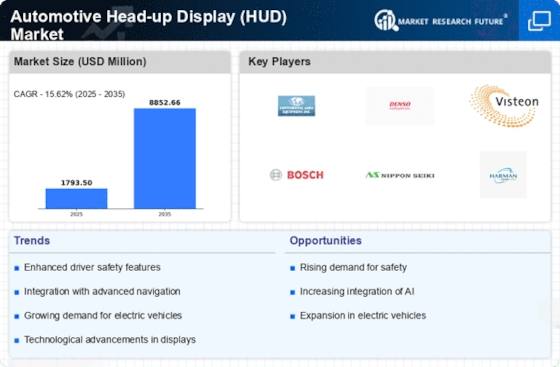
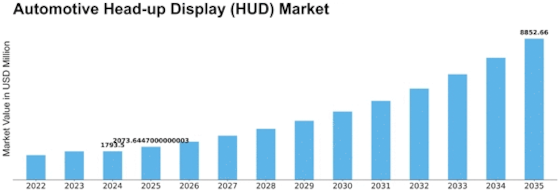
As per Market Research Future analysis, the Automotive Head-up Display (HUD) Market Size was estimated at 1793.5 USD Million in 2024. The Automotive Head-up Display industry is projected to grow from 2073.65 USD Million in 2025 to 8852.66 USD Million by 2035, exhibiting a compound annual growth rate (CAGR) of 15.6% during the forecast period 2025 - 2035

Key Market Trends & Highlights

The Automotive Head-up Display (HUD) Market is poised for substantial growth driven by technological advancements and evolving consumer preferences.

  • The integration of Augmented Reality in HUD systems is gaining traction, particularly in the Asia-Pacific region. North America remains the largest market for Windshield HUDs, which continue to dominate due to their established presence in vehicles. The 3D-HUD segment is currently the largest, while the 2D-HUD segment is experiencing rapid growth as manufacturers seek to enhance user experience. Rising demand for advanced safety features and regulatory pushes for enhanced driver information systems are key drivers propelling market expansion.

Market Size & Forecast

2024 Market Size 1793.5 (USD Million)
2035 Market Size 8852.66 (USD Million)
CAGR (2025 - 2035) 15.62%
Largest Regional Market Share in 2024 Europe

Major Players

Continental AG (DE), Denso Corporation (JP), Visteon Corporation (US), Robert Bosch GmbH (DE), Nippon Seiki Co., Ltd. (JP), Harman International (US), Panasonic Corporation (JP), LG Electronics (KR), Magna International Inc. (CA)

Market Trends

The Automotive Head-up Display (HUD) Market is currently experiencing a notable transformation, driven by advancements in technology and increasing consumer demand for enhanced driving experiences. This market segment appears to be evolving as manufacturers integrate sophisticated features into HUD systems, such as augmented reality and real-time data visualization.

These innovations not only improve safety by minimizing distractions but also provide drivers with essential information directly in their line of sight. As a result, the Automotive Head-up Display (HUD) Market is likely to witness a surge in adoption across various vehicle categories, including luxury and mid-range models.

Moreover, the growing emphasis on driver assistance systems and smart vehicle technologies suggests that the Automotive Head-up Display (HUD) Market will continue to expand. Consumers are increasingly seeking vehicles equipped with advanced features that promote convenience and safety. This trend indicates a shift towards more interactive and user-friendly interfaces, which could redefine the driving experience. Consequently, the Automotive Head-up Display (HUD) Market is poised for significant growth, as stakeholders recognize the potential of HUD technology to enhance vehicle functionality and user engagement.

Integration of Augmented Reality

The incorporation of augmented reality into Automotive Head-up Displays (HUD) is becoming increasingly prevalent. This technology allows for the overlay of digital information onto the real-world view, enhancing navigation and situational awareness for drivers. As manufacturers explore this integration, the potential for improved safety and user experience appears promising.

Focus on Driver Assistance Systems

There is a growing trend towards the integration of Automotive Head-up Displays (HUD) with advanced driver assistance systems (ADAS). This synergy aims to provide real-time feedback and alerts to drivers, thereby enhancing safety and reducing the likelihood of accidents. The alignment of HUD technology with ADAS indicates a strategic move towards smarter vehicles.

Customization and Personalization

The Automotive Head-up Display (HUD) Market is witnessing a shift towards customization and personalization options for users. Manufacturers are increasingly offering tailored HUD interfaces that allow drivers to select the information displayed according to their preferences. This trend reflects a broader movement towards user-centric design in automotive technology.

Automotive Head up Display Market Market Drivers

Growing Electric Vehicle Adoption

The growing adoption of electric vehicles (EVs) is emerging as a significant driver for the Automotive Head-up Display (HUD) Market. As the automotive landscape shifts towards electrification, manufacturers are increasingly incorporating HUDs into their EV models to enhance user experience and provide essential information about battery status, range, and charging locations. This trend is particularly relevant as consumers seek more intuitive interfaces that align with the advanced technology of electric vehicles. Market data indicates that the EV segment is expected to account for a substantial share of the automotive market in the coming years, further propelling the demand for HUDs. Consequently, the Automotive Head-up Display (HUD) Market is likely to see a robust increase in applications within the electric vehicle sector, reflecting the broader transition towards sustainable mobility.

Rising Demand for Advanced Safety Features

The Automotive Head-up Display (HUD) Market is experiencing a notable surge in demand for advanced safety features. As consumers become increasingly aware of road safety, automakers are integrating HUDs to provide critical information directly in the driver's line of sight. This technology minimizes distractions by allowing drivers to access navigation, speed, and other vital data without taking their eyes off the road. According to recent data, the market for automotive HUDs is projected to grow at a compound annual growth rate of approximately 20% over the next five years. This growth is driven by the increasing adoption of driver assistance systems, which are becoming standard in new vehicle models. Consequently, the Automotive Head-up Display (HUD) Market is poised for significant expansion as manufacturers prioritize safety and convenience.

Consumer Preference for Enhanced Connectivity

Consumer preference for enhanced connectivity features is significantly shaping the Automotive Head-up Display (HUD) Market. As vehicles become more connected, drivers are seeking seamless integration of their smartphones and other devices with their vehicle systems. HUDs serve as a critical interface for displaying notifications, navigation, and other connected services without diverting attention from the road. This trend is particularly pronounced among younger consumers who prioritize technology and connectivity in their vehicle choices. Market Research Future suggests that the demand for connected car technologies is expected to grow substantially, with HUDs playing a pivotal role in this evolution. As a result, the Automotive Head-up Display (HUD) Market is likely to expand as manufacturers respond to consumer desires for enhanced connectivity and integrated digital experiences.

Technological Advancements in Display Technologies

Technological advancements in display technologies are significantly influencing the Automotive Head-up Display (HUD) Market. Innovations such as OLED and LCD technologies are enhancing the clarity and brightness of HUDs, making them more effective in various lighting conditions. These advancements allow for the integration of more complex graphics and real-time data, which can improve the overall driving experience. Furthermore, the introduction of augmented reality features in HUDs is expected to revolutionize how information is presented to drivers. As these technologies continue to evolve, the market is likely to see an increase in consumer interest and adoption rates. The Automotive Head-up Display (HUD) Market is thus positioned to benefit from these technological improvements, which may lead to a broader acceptance of HUDs in both luxury and mainstream vehicles.

Regulatory Push for Enhanced Driver Information Systems

Regulatory bodies are increasingly advocating for enhanced driver information systems, which is positively impacting the Automotive Head-up Display (HUD) Market. Governments are recognizing the importance of reducing road accidents and improving driver awareness, leading to mandates for advanced safety technologies in vehicles. This regulatory push is encouraging automakers to adopt HUDs as a means to comply with safety standards while also enhancing the driving experience. As regulations evolve, the integration of HUDs is likely to become a standard feature in new vehicles, further driving market growth. The Automotive Head-up Display (HUD) Market is thus positioned to benefit from these regulatory changes, which may lead to increased investments in HUD technology and innovation.

Market Segment Insights

By Type: Windshield HUD (Largest) vs. Augmented Reality HUD (Fastest-Growing)

In the Automotive Head-up Display (HUD) market, the distribution of market share among the types reveals that Windshield HUD leads as the largest segment, capturing significant attention from automotive manufacturers and consumers alike. It is widely preferred for its seamless integration into vehicles and ease of use, allowing drivers to access critical information without taking their eyes off the road. Meanwhile, Combiner HUD holds a notable share, primarily used in lower-end models, while Augmented Reality HUD, a newer contender, is rapidly gaining traction with its innovative features offering enhanced driving experiences. The growth trends in the Automotive HUD market indicate a shift towards more sophisticated technologies, with Augmented Reality HUDs emerging as the fastest-growing segment. This surge is driven by advancements in display technologies and increasing consumer demand for enhanced safety features and driver assistance systems. As automotive manufacturers strive to differentiate their offerings, the integration of AR HUDs is anticipated to create new opportunities and drive significant investments in research and development, leading to a more extensive adoption in premium vehicles.

Windshield HUD (Dominant) vs. Augmented Reality HUD (Emerging)

Windshield HUD represents the dominant type in the Automotive HUD market, providing drivers with essential information projected directly onto the windshield. This integration not only enhances driving safety but also improves convenience and user interaction. The technology behind Windshield HUDs has matured, leading to increased reliability and performance, making it a preferred choice for premium and mid-range vehicles. In contrast, <a href="https://www.marketresearchfuture.com/reports/automotive-augmented-reality-market-7147">Augmented Reality</a> HUD is considered an emerging technology poised to disrupt the market. Its ability to overlay critical data onto real-world views provides a more interactive driving experience. As AR technology evolves, manufacturers are investing in this segment, aiming to enhance user engagement and safety, thereby gradually reshaping consumer expectations and driving widespread adoption in future automotive designs.

By Dimension Type: 3D-HUD (Largest) vs. 2D-HUD (Fastest-Growing)

In the Automotive Head-up Display (HUD) market, the 3D-HUD segment holds the largest share, reflecting a significant consumer preference for immersive and realistic visual displays. The enhanced depth perception and visual impact provided by 3D-HUD systems have made them a sought-after feature in modern vehicles. On the other hand, the 2D-HUD segment, while currently smaller in market share, is rapidly gaining traction due to its simplicity and cost-effectiveness, appealing particularly to budget-conscious consumers and manufacturers.

Dimension Type: 3D-HUD (Dominant) vs. 2D-HUD (Emerging)

3D-HUD technology is characterized by its ability to project complex visual information onto the windshield, enabling drivers to receive critical information without diverting attention from the road. This immersive experience enhances safety and engagement, making 3D-HUDs highly attractive to premium vehicle manufacturers. Meanwhile, the 2D-HUD segment is emerging as a popular choice for entry-level and mid-range vehicles, offering a less complex but still effective means of delivering essential information. The growth of 2D-HUDs is driven by advancements in display technology and increasing consumer demand for cost-efficient solutions.

By Passenger Car: Economic Cars (Largest) vs. Luxury Cars (Fastest-Growing)

The Automotive Head-up Display market is categorized predominantly into Economic Cars, Mid-Segment Cars, and Luxury Cars. Among these, Economic Cars hold the largest market share due to their affordability and growing adoption among cost-conscious consumers. Luxury Cars, on the other hand, are gaining traction with their innovative features and high-tech installations, marking them as a significant player in the HUD market. Mid-Segment Cars find themselves in the middle, catering to consumers seeking a balance of performance and affordability, contributing to the overall diversification of the market.

Economic Cars (Dominant) vs. Luxury Cars (Emerging)

Economic Cars are fundamentally centered around affordability and functionality, attracting a large consumer base that prefers budget-friendly options. They typically feature basic yet effective head-up display systems without overly complicated technology that could drive up costs. Conversely, Luxury Cars represent the emerging trend in the Automotive Head-up Display market, marked by advanced technology integration, customization, and superior user experience. These vehicles often include high-resolution displays, augmented reality features, and driver assistance systems that enhance safety and convenience. The growing luxury car segment is driven by increased consumer spending power and a demand for premium features.

By Vehicle Type: Passenger Cars (Largest) vs. Commercial Vehicle (Fastest-Growing)

In the Automotive Head-up Display (HUD) Market, <a href="https://www.marketresearchfuture.com/reports/passenger-cars-market-42133" target="_blank" title="passenger cars">Passenger Cars</a> command the largest share, primarily due to their widespread adoption among consumers who seek enhanced driving experiences. As vehicle manufacturers increasingly integrate advanced technologies into their models, the demand for HUDs in Passenger Cars remains robust. Meanwhile, <a href="https://www.marketresearchfuture.com/reports/commercial-vehicle-market-34525" target="_blank" title="commercial vehicle">Commercial Vehicles</a> are gaining traction as they embrace HUD technology to enhance driver safety and operational efficiency. This growing interest points toward shifting market dynamics that must be closely monitored.

Passenger Cars (Dominant) vs. Commercial Vehicle (Emerging)

Passenger Cars represent the dominant segment in the Automotive Head-up Display (HUD) Market, characterized by their integration into both luxury and standard models, thereby significantly improving driver engagement and safety. These displays provide crucial real-time information without distracting the driver, making them highly favorable among consumers. Conversely, the Commercial Vehicle segment is emerging rapidly as fleet operators recognize the benefits of HUD technology for navigation and operational efficiency. This segment is also increasingly focusing on safety features, which is crucial given the demanding operational environments of commercial vehicles. As regulations become stricter, both segments are expected to evolve with tailored HUD solutions.

By Propulsion Type: ICE (Largest) vs. Electric (Fastest-Growing)

In the Automotive Head-up Display (HUD) market, the distribution of market share between propulsion types reveals a significant preference for Internal Combustion Engine (ICE) vehicles, which currently occupy the largest share. ICE vehicles have been prevalent due to their established infrastructure and consumer familiarity. On the other hand, Electric vehicles, while in a smaller share, are quickly gaining traction as technological advancements and increased environmental awareness drive consumer demand. As manufacturers invest heavily in the electric segment, we expect to see a shift in market dynamics moving forward.

Propulsion Types: ICE (Dominant) vs. Electric (Emerging)

The ICE segment remains dominant in the Automotive Head-up Display (HUD) market, characterized by its wide adoption across various vehicle classes and a strong consumer base rooted in traditional automotive preferences. This dominance is supported by established manufacturing processes, a robust supply chain, and a well-understood technology landscape. Conversely, the Electric segment is emerging rapidly, driven by technological innovations, growing infrastructure, and a shift in consumer preferences towards sustainability. This segment is characterized by its potential for enhanced features and integration of advanced technologies within the HUD systems. As these electric vehicles aim to redefine driving experiences, they represent a vibrant and evolving market segment that is likely to disrupt traditional norms.

By Level of Autonomy: Semi-Autonomous Cars (Largest) vs. Autonomous Cars (Fastest-Growing)

In the Automotive Head-up Display (HUD) Market, the level of autonomy is a significant factor influencing market dynamics. Currently, Semi-Autonomous Cars represent the largest share, driven by consumer preference for vehicles that enhance safety while still allowing for driver control. This segment bridges traditional driving and fully automated systems, appealing to a broad audience. On the other hand, Autonomous Cars are rapidly gaining traction due to advancements in AI and machine learning, positioning them for swift growth in the coming years. Their increasing acceptance among consumers is reflected in the growing number of prototypes and regulatory approvals. The growth trends in this segment are predominantly fueled by technological innovations and the rising demand for enhanced driver assistance systems. Semi-Autonomous Cars are benefiting from the integration of smart technologies, making them more appealing to consumers who desire convenience without relinquishing complete control. Meanwhile, Autonomous Cars are undergoing exponential advancements in sensor technology and data processing, positioning them as the future of transportation. As infrastructure evolves to accommodate these vehicles, we can anticipate significant market acceleration driven by autonomous solutions.

Semi-Autonomous Cars (Dominant) vs. Autonomous Cars (Emerging)

In the Automotive Head-up Display (HUD) Market, Semi-Autonomous Cars represent a dominant segment characterized by their blend of traditional driving experiences with advanced safety features. This category appeals to a wide demographic, including those hesitant to fully relinquish control. The integration of HUD technology in these vehicles enhances situational awareness, prompting greater adoption. Conversely, Autonomous Cars are emerging as a transformative force, showcasing cutting-edge innovations and appeal to tech-savvy consumers. Their development is marked by rapid advancements in onboard systems that enable real-time data processing and vehicle communication. As regulatory frameworks become more supportive, the market for Autonomous Cars is expected to flourish, making them a key player in future automotive trends.

By Sales Channel: OE Fitted (Largest) vs. Aftermarket (Fastest-Growing)

In the Automotive Head-up Display (HUD) Market, the sales channels are primarily divided into two categories: OE Fitted and Aftermarket. The OE Fitted segment dominates the market, accounting for a substantial share of overall sales. This segment benefits from the increasing integration of head-up displays in new vehicles by manufacturers, which enhances safety and driving experience, leading to consistent demand from consumers who value modern technology in their vehicles. On the other hand, the Aftermarket segment is recognized as the fastest-growing channel, driven by the increasing interest in retrofitting vehicles with advanced HUD systems. Factors such as rising consumer awareness regarding safety features, ease of installation, and the desire for augmented driving experiences are significantly propelling the growth within this segment. This trend indicates a shift towards enhancing older vehicles with newer technology, creating a dynamic market landscape for HUD manufacturers.

Sales Channel: OE Fitted (Dominant) vs. Aftermarket (Emerging)

The OE Fitted segment stands as the dominant sales channel in the Automotive Head-up Display market, with manufacturers increasingly integrating advanced HUD systems into their vehicle designs to meet consumer demand for cutting-edge technology. This segment typically appeals to new car buyers who prefer built-in safety features. In contrast, the Aftermarket segment is emerging rapidly, appealing to vehicle owners looking to enhance their existing cars without purchasing a new model. This segment comprises a range of aftermarket products designed for easy installation, allowing consumers to benefit from HUD technology post-purchase. Both segments showcase different strategies and consumer bases, with the OE segment rooted in OEM partnerships and the Aftermarket thriving on consumer retrofitting trends.

Get more detailed insights about Automotive Head-up Display (HUD) Market Research Report — Global Forecast till 2035

Regional Insights

North America : Technological Innovation Leader

North America is the largest market for Automotive Head-up Displays (HUD), accounting for approximately 40% of the global market share. The region's growth is driven by increasing consumer demand for advanced safety features and the integration of HUD technology in electric and autonomous vehicles. Regulatory support for enhanced vehicle safety standards further propels market expansion, with initiatives aimed at reducing road accidents and improving driver awareness. The United States and Canada are the leading countries in this market, with major automotive manufacturers and technology firms investing heavily in HUD technology. Key players such as Continental AG, Visteon Corporation, and Harman International are at the forefront, driving innovation and competition. The presence of established automotive hubs and a strong focus on R&D contribute to a dynamic competitive landscape, ensuring continuous advancements in HUD technology.

Europe : Emerging Regulatory Frameworks

Europe is the second-largest market for Automotive Head-up Displays, holding around 30% of the global market share. The region's growth is fueled by stringent safety regulations and a strong push towards electric vehicles. The European Union's commitment to reducing carbon emissions and enhancing road safety has led to increased investments in advanced driver-assistance systems (ADAS), including HUD technology, which is seen as a critical component in achieving these goals. Germany, France, and the UK are the leading countries in this market, with a robust automotive industry that includes major players like Robert Bosch GmbH and Denso Corporation. The competitive landscape is characterized by a mix of established companies and innovative startups, all vying to capture market share. The presence of significant automotive events and collaborations among manufacturers and tech firms further enhances the region's position in the HUD market.

Asia-Pacific : Rapidly Growing Automotive Sector

Asia-Pacific is witnessing rapid growth in the Automotive Head-up Display market, contributing approximately 25% to the global market share. The region's expansion is driven by increasing vehicle production, rising disposable incomes, and a growing preference for luxury vehicles equipped with advanced technologies. Government initiatives promoting smart transportation and vehicle safety are also significant catalysts for market growth, encouraging manufacturers to adopt HUD technology in their offerings. China, Japan, and South Korea are the leading countries in this market, with a strong presence of key players like Nippon Seiki Co., Ltd. and Panasonic Corporation. The competitive landscape is marked by aggressive investments in R&D and partnerships between automotive manufacturers and technology firms. As the region continues to embrace innovation, the demand for HUD systems is expected to rise significantly, further solidifying its market position.

Middle East and Africa : Emerging Market Potential

The Middle East and Africa region is gradually emerging as a potential market for Automotive Head-up Displays, currently holding about 5% of the global market share. The growth in this region is primarily driven by increasing vehicle sales, urbanization, and a rising focus on vehicle safety features. Governments are beginning to implement regulations aimed at enhancing road safety, which is expected to boost the adoption of advanced technologies like HUDs in vehicles. Countries such as South Africa and the UAE are leading the way in this market, with a growing automotive sector that is attracting investments from global players. The competitive landscape is still developing, with opportunities for both established companies and new entrants to capture market share. As consumer awareness of advanced automotive technologies increases, the demand for HUD systems is anticipated to grow, paving the way for future market expansion.

Key Players and Competitive Insights

The automotive head-up display (HUD) market is highly competitive, and it has several well-settled giants and new entrants or startups. Some of the market players include Nippon Seiki Co., Ltd., Continental AG, Panasonic Corporation, Denso Corporation, and Valeo that is working towards improving their production line and broadening the range of products they offer. These companies rely on high technology to create highly developed HUD systems that enhance driver safety and comfort. Start-ups like Head-Up Display Technology, Pilot Technology, and HUD Solutions are major in defining and exploiting growth opportunities. They are flexible enough to capture the changing market and customer needs, and most often present new ideas that can revolutionize the incumbents. For instance, Pilot Technology’s driver assistance HUD displays important information at a safe distance from the driver; Head Up Display Technology on the other hand wires directly to the vehicle’s OBDII port for real time data display. Huawei Technologies Co., Ltd., WayRay AG, and HARMAN International are among some of the leading organizations in the sphere of HUD with augmented reality for better integration of digital information into the driving process. This ever-changing environment is rather stimulating and in the long run, it enhances consumers’ safety by providing them with better and more convenient ways of driving.

Key Companies in the Automotive Head up Display Market include

Industry Developments

  • In January 2023, HARMAN has introduced Ready Vision, an Augmented Reality (AR) head-up display (HUD) aimed at improving the driver’s safety. With a large field of view and without wedge, Ready Vision uses AR software and vehicle sensors to share audio-visual warning messages and other important information in real time. Some of them include clear and natural turn-by-turn navigation, 3D objects’ detection for the risk of collision, and compatibility with other products from HARMAN. This innovative technology seeks to close the gap between the physical and the virtual environment and therefore enhance safety and reduce risks of an accident.
  • In January 2022 Panasonic Automotive Systems launched its new product known as Augmented Reality HUD or AR HUD 2. 0 at CES 2022, it was equipped with an innovative patented eye tracking system (ETS) that improves the AR experience. This advanced solution is based on the SkipGen2 eCockpit infotainment controller; in contrast to many other HUD designs, it does not require a separate driver-facing camera; instead, the IR camera is integrated into the projector. The ETS then also adjusts AR imagery according to the driver’s field of view to avoid blurring and confusion to the driver.

Future Outlook

Automotive Head up Display Market Future Outlook

The Automotive Head-up Display (HUD) Market is projected to grow at a 15.62% CAGR from 2025 to 2035, driven by advancements in augmented reality, increased safety regulations, and consumer demand for enhanced driving experiences.

New opportunities lie in:

  • <p>Integration of HUDs with advanced driver-assistance systems (ADAS) for improved safety features. Development of customizable HUD interfaces for personalized user experiences. Expansion into electric vehicle markets with tailored HUD solutions for energy management.</p>

By 2035, the Automotive Head-up Display market is expected to be a pivotal component of modern vehicle technology.

Market Segmentation

Automotive Head up Display Market Type Outlook

  • Combiner HUD
  • Windshield HUD
  • Augmented Reality HUD

Automotive Head up Display Market Vehicle Type Outlook

  • Passenger Cars
  • Commercial Vehicle

Automotive Head up Display Market Passenger Car Outlook

  • Economic Cars
  • Mid-Segment Cars
  • Luxury Car

Automotive Head up Display Market Sales Channel Outlook

  • OE Fitted
  • Aftermarket

Automotive Head up Display Market Dimension Type Outlook

  • 2D-HUD
  • 3D-HUD

Automotive Head up Display Market Propulsion Type Outlook

  • ICE
  • Electric

Automotive Head up Display Market Level of Autonomy Outlook

  • Non-Autonomous Cars
  • Semi-Autonomous Cars
  • Autonomous Cars

Report Scope

MARKET SIZE 2024 1793.5(USD Million)
MARKET SIZE 2025 2073.65(USD Million)
MARKET SIZE 2035 8852.66(USD Million)
COMPOUND ANNUAL GROWTH RATE (CAGR) 15.62% (2025 - 2035)
REPORT COVERAGE Revenue Forecast, Competitive Landscape, Growth Factors, and Trends
BASE YEAR 2024
Market Forecast Period 2025 - 2035
Historical Data 2019 - 2024
Market Forecast Units USD Million
Key Companies Profiled Continental AG (DE), Denso Corporation (JP), Visteon Corporation (US), Robert Bosch GmbH (DE), Nippon Seiki Co., Ltd. (JP), Harman International (US), Panasonic Corporation (JP), LG Electronics (KR), Magna International Inc. (CA)
Segments Covered HUD Type, Dimension Type, Passenger Car, Vehicle Type, Propulsion Type, Electric Vehicle Type, Level of Autonomy, Sales Channel, Offering, Region
Key Market Opportunities Integration of augmented reality features enhances user experience in the Automotive Head-up Display (HUD) Market.
Key Market Dynamics Rising demand for advanced driver assistance systems drives innovation in Automotive Head-up Display technology and features.
Countries Covered North America, Europe, APAC, South America, MEA

FAQs

What is the projected market valuation for the Automotive Head-up Display (HUD) Market in 2035?

<p>The projected market valuation for the Automotive Head-up Display (HUD) Market in 2035 is 8852.66 USD Million.</p>

What was the market valuation of the Automotive Head-up Display (HUD) Market in 2024?

<p>The market valuation of the Automotive Head-up Display (HUD) Market in 2024 was 1793.5 USD Million.</p>

What is the expected CAGR for the Automotive Head-up Display (HUD) Market from 2025 to 2035?

<p>The expected CAGR for the Automotive Head-up Display (HUD) Market during the forecast period 2025 - 2035 is 15.62%.</p>

Which companies are considered key players in the Automotive Head-up Display (HUD) Market?

<p>Key players in the Automotive Head-up Display (HUD) Market include Continental AG, Denso Corporation, Visteon Corporation, and Robert Bosch GmbH.</p>

What are the different types of HUDs and their market valuations?

<p>The market valuations for HUD types include Combiner HUD at 300.0 to 1500.0 USD Million, Windshield HUD at 800.0 to 4000.0 USD Million, and Augmented Reality HUD at 693.5 to 3352.66 USD Million.</p>

How do the market valuations for 2D-HUD and 3D-HUD compare?

The market valuation for 2D-HUD ranges from 716.4 to 3480.53 USD Million, while 3D-HUD ranges from 1077.1 to 5372.13 USD Million.

What is the market valuation for HUDs in luxury cars?

The market valuation for HUDs in luxury cars is projected to be between 897.0 and 4452.66 USD Million.

What is the market size for Electric vehicles in the Automotive Head-up Display (HUD) Market?

The market size for Electric vehicles in the Automotive Head-up Display (HUD) Market is between 793.5 and 4352.66 USD Million.

What are the market valuations for different levels of autonomy in vehicles?

Market valuations for levels of autonomy include Non-Autonomous Cars at 800.0 to 3500.0 USD Million, Semi-Autonomous Cars at 600.0 to 3000.0 USD Million, and Autonomous Cars at 393.5 to 3352.66 USD Million.

What is the sales channel distribution for HUDs in the market?

The sales channel distribution for HUDs shows OE Fitted at 1070.0 to 5300.0 USD Million and Aftermarket at 723.5 to 3552.66 USD Million.

  1. SECTION I: EXECUTIVE SUMMARY AND KEY HIGHLIGHTS
    1. | 1.1 EXECUTIVE SUMMARY
    2. | | 1.1.1 Market Overview
    3. | | 1.1.2 Key Findings
    4. | | 1.1.3 Market Segmentation
    5. | | 1.1.4 Competitive Landscape
    6. | | 1.1.5 Challenges and Opportunities
    7. | | 1.1.6 Future Outlook
  2. SECTION II: SCOPING, METHODOLOGY AND MARKET STRUCTURE
    1. | 2.1 MARKET INTRODUCTION
    2. | | 2.1.1 Definition
    3. | | 2.1.2 Scope of the study
    4. | | | 2.1.2.1 Research Objective
    5. | | | 2.1.2.2 Assumption
    6. | | | 2.1.2.3 Limitations
    7. | 2.2 RESEARCH METHODOLOGY
    8. | | 2.2.1 Overview
    9. | | 2.2.2 Data Mining
    10. | | 2.2.3 Secondary Research
    11. | | 2.2.4 Primary Research
    12. | | | 2.2.4.1 Primary Interviews and Information Gathering Process
    13. | | | 2.2.4.2 Breakdown of Primary Respondents
    14. | | 2.2.5 Forecasting Model
    15. | | 2.2.6 Market Size Estimation
    16. | | | 2.2.6.1 Bottom-Up Approach
    17. | | | 2.2.6.2 Top-Down Approach
    18. | | 2.2.7 Data Triangulation
    19. | | 2.2.8 Validation
  3. SECTION III: QUALITATIVE ANALYSIS
    1. | 3.1 MARKET DYNAMICS
    2. | | 3.1.1 Overview
    3. | | 3.1.2 Drivers
    4. | | 3.1.3 Restraints
    5. | | 3.1.4 Opportunities
    6. | 3.2 MARKET FACTOR ANALYSIS
    7. | | 3.2.1 Value chain Analysis
    8. | | 3.2.2 Porter's Five Forces Analysis
    9. | | | 3.2.2.1 Bargaining Power of Suppliers
    10. | | | 3.2.2.2 Bargaining Power of Buyers
    11. | | | 3.2.2.3 Threat of New Entrants
    12. | | | 3.2.2.4 Threat of Substitutes
    13. | | | 3.2.2.5 Intensity of Rivalry
    14. | | 3.2.3 COVID-19 Impact Analysis
    15. | | | 3.2.3.1 Market Impact Analysis
    16. | | | 3.2.3.2 Regional Impact
    17. | | | 3.2.3.3 Opportunity and Threat Analysis
  4. SECTION IV: QUANTITATIVE ANALYSIS
    1. | 4.1 Automobile, BY Type (USD Million)
    2. | | 4.1.1 Combiner HUD
    3. | | 4.1.2 Windshield HUD
    4. | | 4.1.3 Augmented Reality HUD
    5. | 4.2 Automobile, BY Dimension Type (USD Million)
    6. | | 4.2.1 2D-HUD
    7. | | 4.2.2 3D-HUD
    8. | 4.3 Automobile, BY Passenger Car (USD Million)
    9. | | 4.3.1 Economic Cars
    10. | | 4.3.2 Mid-Segment Cars
    11. | | 4.3.3 Luxury Car
    12. | 4.4 Automobile, BY Vehicle Type (USD Million)
    13. | | 4.4.1 Passenger Cars
    14. | | 4.4.2 Commercial Vehicle
    15. | 4.5 Automobile, BY Propulsion Type (USD Million)
    16. | | 4.5.1 ICE
    17. | | 4.5.2 Electric
    18. | 4.6 Automobile, BY Level of Autonomy (USD Million)
    19. | | 4.6.1 Non-Autonomous Cars
    20. | | 4.6.2 Semi-Autonomous Cars
    21. | | 4.6.3 Autonomous Cars
    22. | 4.7 Automobile, BY Sales Channel (USD Million)
    23. | | 4.7.1 OE Fitted
    24. | | 4.7.2 Aftermarket
    25. | 4.8 Automobile, BY Region (USD Million)
    26. | | 4.8.1 North America
    27. | | | 4.8.1.1 US
    28. | | | 4.8.1.2 Canada
    29. | | 4.8.2 Europe
    30. | | | 4.8.2.1 Germany
    31. | | | 4.8.2.2 UK
    32. | | | 4.8.2.3 France
    33. | | | 4.8.2.4 Russia
    34. | | | 4.8.2.5 Italy
    35. | | | 4.8.2.6 Spain
    36. | | | 4.8.2.7 Rest of Europe
    37. | | 4.8.3 APAC
    38. | | | 4.8.3.1 China
    39. | | | 4.8.3.2 India
    40. | | | 4.8.3.3 Japan
    41. | | | 4.8.3.4 South Korea
    42. | | | 4.8.3.5 Malaysia
    43. | | | 4.8.3.6 Thailand
    44. | | | 4.8.3.7 Indonesia
    45. | | | 4.8.3.8 Rest of APAC
    46. | | 4.8.4 South America
    47. | | | 4.8.4.1 Brazil
    48. | | | 4.8.4.2 Mexico
    49. | | | 4.8.4.3 Argentina
    50. | | | 4.8.4.4 Rest of South America
    51. | | 4.8.5 MEA
    52. | | | 4.8.5.1 GCC Countries
    53. | | | 4.8.5.2 South Africa
    54. | | | 4.8.5.3 Rest of MEA
  5. SECTION V: COMPETITIVE ANALYSIS
    1. | 5.1 Competitive Landscape
    2. | | 5.1.1 Overview
    3. | | 5.1.2 Competitive Analysis
    4. | | 5.1.3 Market share Analysis
    5. | | 5.1.4 Major Growth Strategy in the Automobile
    6. | | 5.1.5 Competitive Benchmarking
    7. | | 5.1.6 Leading Players in Terms of Number of Developments in the Automobile
    8. | | 5.1.7 Key developments and growth strategies
    9. | | | 5.1.7.1 New Product Launch/Service Deployment
    10. | | | 5.1.7.2 Merger & Acquisitions
    11. | | | 5.1.7.3 Joint Ventures
    12. | | 5.1.8 Major Players Financial Matrix
    13. | | | 5.1.8.1 Sales and Operating Income
    14. | | | 5.1.8.2 Major Players R&D Expenditure. 2023
    15. | 5.2 Company Profiles
    16. | | 5.2.1 Continental AG (DE)
    17. | | | 5.2.1.1 Financial Overview
    18. | | | 5.2.1.2 Products Offered
    19. | | | 5.2.1.3 Key Developments
    20. | | | 5.2.1.4 SWOT Analysis
    21. | | | 5.2.1.5 Key Strategies
    22. | | 5.2.2 Denso Corporation (JP)
    23. | | | 5.2.2.1 Financial Overview
    24. | | | 5.2.2.2 Products Offered
    25. | | | 5.2.2.3 Key Developments
    26. | | | 5.2.2.4 SWOT Analysis
    27. | | | 5.2.2.5 Key Strategies
    28. | | 5.2.3 Visteon Corporation (US)
    29. | | | 5.2.3.1 Financial Overview
    30. | | | 5.2.3.2 Products Offered
    31. | | | 5.2.3.3 Key Developments
    32. | | | 5.2.3.4 SWOT Analysis
    33. | | | 5.2.3.5 Key Strategies
    34. | | 5.2.4 Robert Bosch GmbH (DE)
    35. | | | 5.2.4.1 Financial Overview
    36. | | | 5.2.4.2 Products Offered
    37. | | | 5.2.4.3 Key Developments
    38. | | | 5.2.4.4 SWOT Analysis
    39. | | | 5.2.4.5 Key Strategies
    40. | | 5.2.5 Nippon Seiki Co., Ltd. (JP)
    41. | | | 5.2.5.1 Financial Overview
    42. | | | 5.2.5.2 Products Offered
    43. | | | 5.2.5.3 Key Developments
    44. | | | 5.2.5.4 SWOT Analysis
    45. | | | 5.2.5.5 Key Strategies
    46. | | 5.2.6 Harman International (US)
    47. | | | 5.2.6.1 Financial Overview
    48. | | | 5.2.6.2 Products Offered
    49. | | | 5.2.6.3 Key Developments
    50. | | | 5.2.6.4 SWOT Analysis
    51. | | | 5.2.6.5 Key Strategies
    52. | | 5.2.7 Panasonic Corporation (JP)
    53. | | | 5.2.7.1 Financial Overview
    54. | | | 5.2.7.2 Products Offered
    55. | | | 5.2.7.3 Key Developments
    56. | | | 5.2.7.4 SWOT Analysis
    57. | | | 5.2.7.5 Key Strategies
    58. | | 5.2.8 LG Electronics (KR)
    59. | | | 5.2.8.1 Financial Overview
    60. | | | 5.2.8.2 Products Offered
    61. | | | 5.2.8.3 Key Developments
    62. | | | 5.2.8.4 SWOT Analysis
    63. | | | 5.2.8.5 Key Strategies
    64. | | 5.2.9 Magna International Inc. (CA)
    65. | | | 5.2.9.1 Financial Overview
    66. | | | 5.2.9.2 Products Offered
    67. | | | 5.2.9.3 Key Developments
    68. | | | 5.2.9.4 SWOT Analysis
    69. | | | 5.2.9.5 Key Strategies
    70. | 5.3 Appendix
    71. | | 5.3.1 References
    72. | | 5.3.2 Related Reports
  6. LIST OF FIGURES
    1. | 6.1 MARKET SYNOPSIS
    2. | 6.2 NORTH AMERICA MARKET ANALYSIS
    3. | 6.3 US MARKET ANALYSIS BY TYPE
    4. | 6.4 US MARKET ANALYSIS BY DIMENSION TYPE
    5. | 6.5 US MARKET ANALYSIS BY PASSENGER CAR
    6. | 6.6 US MARKET ANALYSIS BY VEHICLE TYPE
    7. | 6.7 US MARKET ANALYSIS BY PROPULSION TYPE
    8. | 6.8 US MARKET ANALYSIS BY LEVEL OF AUTONOMY
    9. | 6.9 US MARKET ANALYSIS BY SALES CHANNEL
    10. | 6.10 CANADA MARKET ANALYSIS BY TYPE
    11. | 6.11 CANADA MARKET ANALYSIS BY DIMENSION TYPE
    12. | 6.12 CANADA MARKET ANALYSIS BY PASSENGER CAR
    13. | 6.13 CANADA MARKET ANALYSIS BY VEHICLE TYPE
    14. | 6.14 CANADA MARKET ANALYSIS BY PROPULSION TYPE
    15. | 6.15 CANADA MARKET ANALYSIS BY LEVEL OF AUTONOMY
    16. | 6.16 CANADA MARKET ANALYSIS BY SALES CHANNEL
    17. | 6.17 EUROPE MARKET ANALYSIS
    18. | 6.18 GERMANY MARKET ANALYSIS BY TYPE
    19. | 6.19 GERMANY MARKET ANALYSIS BY DIMENSION TYPE
    20. | 6.20 GERMANY MARKET ANALYSIS BY PASSENGER CAR
    21. | 6.21 GERMANY MARKET ANALYSIS BY VEHICLE TYPE
    22. | 6.22 GERMANY MARKET ANALYSIS BY PROPULSION TYPE
    23. | 6.23 GERMANY MARKET ANALYSIS BY LEVEL OF AUTONOMY
    24. | 6.24 GERMANY MARKET ANALYSIS BY SALES CHANNEL
    25. | 6.25 UK MARKET ANALYSIS BY TYPE
    26. | 6.26 UK MARKET ANALYSIS BY DIMENSION TYPE
    27. | 6.27 UK MARKET ANALYSIS BY PASSENGER CAR
    28. | 6.28 UK MARKET ANALYSIS BY VEHICLE TYPE
    29. | 6.29 UK MARKET ANALYSIS BY PROPULSION TYPE
    30. | 6.30 UK MARKET ANALYSIS BY LEVEL OF AUTONOMY
    31. | 6.31 UK MARKET ANALYSIS BY SALES CHANNEL
    32. | 6.32 FRANCE MARKET ANALYSIS BY TYPE
    33. | 6.33 FRANCE MARKET ANALYSIS BY DIMENSION TYPE
    34. | 6.34 FRANCE MARKET ANALYSIS BY PASSENGER CAR
    35. | 6.35 FRANCE MARKET ANALYSIS BY VEHICLE TYPE
    36. | 6.36 FRANCE MARKET ANALYSIS BY PROPULSION TYPE
    37. | 6.37 FRANCE MARKET ANALYSIS BY LEVEL OF AUTONOMY
    38. | 6.38 FRANCE MARKET ANALYSIS BY SALES CHANNEL
    39. | 6.39 RUSSIA MARKET ANALYSIS BY TYPE
    40. | 6.40 RUSSIA MARKET ANALYSIS BY DIMENSION TYPE
    41. | 6.41 RUSSIA MARKET ANALYSIS BY PASSENGER CAR
    42. | 6.42 RUSSIA MARKET ANALYSIS BY VEHICLE TYPE
    43. | 6.43 RUSSIA MARKET ANALYSIS BY PROPULSION TYPE
    44. | 6.44 RUSSIA MARKET ANALYSIS BY LEVEL OF AUTONOMY
    45. | 6.45 RUSSIA MARKET ANALYSIS BY SALES CHANNEL
    46. | 6.46 ITALY MARKET ANALYSIS BY TYPE
    47. | 6.47 ITALY MARKET ANALYSIS BY DIMENSION TYPE
    48. | 6.48 ITALY MARKET ANALYSIS BY PASSENGER CAR
    49. | 6.49 ITALY MARKET ANALYSIS BY VEHICLE TYPE
    50. | 6.50 ITALY MARKET ANALYSIS BY PROPULSION TYPE
    51. | 6.51 ITALY MARKET ANALYSIS BY LEVEL OF AUTONOMY
    52. | 6.52 ITALY MARKET ANALYSIS BY SALES CHANNEL
    53. | 6.53 SPAIN MARKET ANALYSIS BY TYPE
    54. | 6.54 SPAIN MARKET ANALYSIS BY DIMENSION TYPE
    55. | 6.55 SPAIN MARKET ANALYSIS BY PASSENGER CAR
    56. | 6.56 SPAIN MARKET ANALYSIS BY VEHICLE TYPE
    57. | 6.57 SPAIN MARKET ANALYSIS BY PROPULSION TYPE
    58. | 6.58 SPAIN MARKET ANALYSIS BY LEVEL OF AUTONOMY
    59. | 6.59 SPAIN MARKET ANALYSIS BY SALES CHANNEL
    60. | 6.60 REST OF EUROPE MARKET ANALYSIS BY TYPE
    61. | 6.61 REST OF EUROPE MARKET ANALYSIS BY DIMENSION TYPE
    62. | 6.62 REST OF EUROPE MARKET ANALYSIS BY PASSENGER CAR
    63. | 6.63 REST OF EUROPE MARKET ANALYSIS BY VEHICLE TYPE
    64. | 6.64 REST OF EUROPE MARKET ANALYSIS BY PROPULSION TYPE
    65. | 6.65 REST OF EUROPE MARKET ANALYSIS BY LEVEL OF AUTONOMY
    66. | 6.66 REST OF EUROPE MARKET ANALYSIS BY SALES CHANNEL
    67. | 6.67 APAC MARKET ANALYSIS
    68. | 6.68 CHINA MARKET ANALYSIS BY TYPE
    69. | 6.69 CHINA MARKET ANALYSIS BY DIMENSION TYPE
    70. | 6.70 CHINA MARKET ANALYSIS BY PASSENGER CAR
    71. | 6.71 CHINA MARKET ANALYSIS BY VEHICLE TYPE
    72. | 6.72 CHINA MARKET ANALYSIS BY PROPULSION TYPE
    73. | 6.73 CHINA MARKET ANALYSIS BY LEVEL OF AUTONOMY
    74. | 6.74 CHINA MARKET ANALYSIS BY SALES CHANNEL
    75. | 6.75 INDIA MARKET ANALYSIS BY TYPE
    76. | 6.76 INDIA MARKET ANALYSIS BY DIMENSION TYPE
    77. | 6.77 INDIA MARKET ANALYSIS BY PASSENGER CAR
    78. | 6.78 INDIA MARKET ANALYSIS BY VEHICLE TYPE
    79. | 6.79 INDIA MARKET ANALYSIS BY PROPULSION TYPE
    80. | 6.80 INDIA MARKET ANALYSIS BY LEVEL OF AUTONOMY
    81. | 6.81 INDIA MARKET ANALYSIS BY SALES CHANNEL
    82. | 6.82 JAPAN MARKET ANALYSIS BY TYPE
    83. | 6.83 JAPAN MARKET ANALYSIS BY DIMENSION TYPE
    84. | 6.84 JAPAN MARKET ANALYSIS BY PASSENGER CAR
    85. | 6.85 JAPAN MARKET ANALYSIS BY VEHICLE TYPE
    86. | 6.86 JAPAN MARKET ANALYSIS BY PROPULSION TYPE
    87. | 6.87 JAPAN MARKET ANALYSIS BY LEVEL OF AUTONOMY
    88. | 6.88 JAPAN MARKET ANALYSIS BY SALES CHANNEL
    89. | 6.89 SOUTH KOREA MARKET ANALYSIS BY TYPE
    90. | 6.90 SOUTH KOREA MARKET ANALYSIS BY DIMENSION TYPE
    91. | 6.91 SOUTH KOREA MARKET ANALYSIS BY PASSENGER CAR
    92. | 6.92 SOUTH KOREA MARKET ANALYSIS BY VEHICLE TYPE
    93. | 6.93 SOUTH KOREA MARKET ANALYSIS BY PROPULSION TYPE
    94. | 6.94 SOUTH KOREA MARKET ANALYSIS BY LEVEL OF AUTONOMY
    95. | 6.95 SOUTH KOREA MARKET ANALYSIS BY SALES CHANNEL
    96. | 6.96 MALAYSIA MARKET ANALYSIS BY TYPE
    97. | 6.97 MALAYSIA MARKET ANALYSIS BY DIMENSION TYPE
    98. | 6.98 MALAYSIA MARKET ANALYSIS BY PASSENGER CAR
    99. | 6.99 MALAYSIA MARKET ANALYSIS BY VEHICLE TYPE
    100. | 6.100 MALAYSIA MARKET ANALYSIS BY PROPULSION TYPE
    101. | 6.101 MALAYSIA MARKET ANALYSIS BY LEVEL OF AUTONOMY
    102. | 6.102 MALAYSIA MARKET ANALYSIS BY SALES CHANNEL
    103. | 6.103 THAILAND MARKET ANALYSIS BY TYPE
    104. | 6.104 THAILAND MARKET ANALYSIS BY DIMENSION TYPE
    105. | 6.105 THAILAND MARKET ANALYSIS BY PASSENGER CAR
    106. | 6.106 THAILAND MARKET ANALYSIS BY VEHICLE TYPE
    107. | 6.107 THAILAND MARKET ANALYSIS BY PROPULSION TYPE
    108. | 6.108 THAILAND MARKET ANALYSIS BY LEVEL OF AUTONOMY
    109. | 6.109 THAILAND MARKET ANALYSIS BY SALES CHANNEL
    110. | 6.110 INDONESIA MARKET ANALYSIS BY TYPE
    111. | 6.111 INDONESIA MARKET ANALYSIS BY DIMENSION TYPE
    112. | 6.112 INDONESIA MARKET ANALYSIS BY PASSENGER CAR
    113. | 6.113 INDONESIA MARKET ANALYSIS BY VEHICLE TYPE
    114. | 6.114 INDONESIA MARKET ANALYSIS BY PROPULSION TYPE
    115. | 6.115 INDONESIA MARKET ANALYSIS BY LEVEL OF AUTONOMY
    116. | 6.116 INDONESIA MARKET ANALYSIS BY SALES CHANNEL
    117. | 6.117 REST OF APAC MARKET ANALYSIS BY TYPE
    118. | 6.118 REST OF APAC MARKET ANALYSIS BY DIMENSION TYPE
    119. | 6.119 REST OF APAC MARKET ANALYSIS BY PASSENGER CAR
    120. | 6.120 REST OF APAC MARKET ANALYSIS BY VEHICLE TYPE
    121. | 6.121 REST OF APAC MARKET ANALYSIS BY PROPULSION TYPE
    122. | 6.122 REST OF APAC MARKET ANALYSIS BY LEVEL OF AUTONOMY
    123. | 6.123 REST OF APAC MARKET ANALYSIS BY SALES CHANNEL
    124. | 6.124 SOUTH AMERICA MARKET ANALYSIS
    125. | 6.125 BRAZIL MARKET ANALYSIS BY TYPE
    126. | 6.126 BRAZIL MARKET ANALYSIS BY DIMENSION TYPE
    127. | 6.127 BRAZIL MARKET ANALYSIS BY PASSENGER CAR
    128. | 6.128 BRAZIL MARKET ANALYSIS BY VEHICLE TYPE
    129. | 6.129 BRAZIL MARKET ANALYSIS BY PROPULSION TYPE
    130. | 6.130 BRAZIL MARKET ANALYSIS BY LEVEL OF AUTONOMY
    131. | 6.131 BRAZIL MARKET ANALYSIS BY SALES CHANNEL
    132. | 6.132 MEXICO MARKET ANALYSIS BY TYPE
    133. | 6.133 MEXICO MARKET ANALYSIS BY DIMENSION TYPE
    134. | 6.134 MEXICO MARKET ANALYSIS BY PASSENGER CAR
    135. | 6.135 MEXICO MARKET ANALYSIS BY VEHICLE TYPE
    136. | 6.136 MEXICO MARKET ANALYSIS BY PROPULSION TYPE
    137. | 6.137 MEXICO MARKET ANALYSIS BY LEVEL OF AUTONOMY
    138. | 6.138 MEXICO MARKET ANALYSIS BY SALES CHANNEL
    139. | 6.139 ARGENTINA MARKET ANALYSIS BY TYPE
    140. | 6.140 ARGENTINA MARKET ANALYSIS BY DIMENSION TYPE
    141. | 6.141 ARGENTINA MARKET ANALYSIS BY PASSENGER CAR
    142. | 6.142 ARGENTINA MARKET ANALYSIS BY VEHICLE TYPE
    143. | 6.143 ARGENTINA MARKET ANALYSIS BY PROPULSION TYPE
    144. | 6.144 ARGENTINA MARKET ANALYSIS BY LEVEL OF AUTONOMY
    145. | 6.145 ARGENTINA MARKET ANALYSIS BY SALES CHANNEL
    146. | 6.146 REST OF SOUTH AMERICA MARKET ANALYSIS BY TYPE
    147. | 6.147 REST OF SOUTH AMERICA MARKET ANALYSIS BY DIMENSION TYPE
    148. | 6.148 REST OF SOUTH AMERICA MARKET ANALYSIS BY PASSENGER CAR
    149. | 6.149 REST OF SOUTH AMERICA MARKET ANALYSIS BY VEHICLE TYPE
    150. | 6.150 REST OF SOUTH AMERICA MARKET ANALYSIS BY PROPULSION TYPE
    151. | 6.151 REST OF SOUTH AMERICA MARKET ANALYSIS BY LEVEL OF AUTONOMY
    152. | 6.152 REST OF SOUTH AMERICA MARKET ANALYSIS BY SALES CHANNEL
    153. | 6.153 MEA MARKET ANALYSIS
    154. | 6.154 GCC COUNTRIES MARKET ANALYSIS BY TYPE
    155. | 6.155 GCC COUNTRIES MARKET ANALYSIS BY DIMENSION TYPE
    156. | 6.156 GCC COUNTRIES MARKET ANALYSIS BY PASSENGER CAR
    157. | 6.157 GCC COUNTRIES MARKET ANALYSIS BY VEHICLE TYPE
    158. | 6.158 GCC COUNTRIES MARKET ANALYSIS BY PROPULSION TYPE
    159. | 6.159 GCC COUNTRIES MARKET ANALYSIS BY LEVEL OF AUTONOMY
    160. | 6.160 GCC COUNTRIES MARKET ANALYSIS BY SALES CHANNEL
    161. | 6.161 SOUTH AFRICA MARKET ANALYSIS BY TYPE
    162. | 6.162 SOUTH AFRICA MARKET ANALYSIS BY DIMENSION TYPE
    163. | 6.163 SOUTH AFRICA MARKET ANALYSIS BY PASSENGER CAR
    164. | 6.164 SOUTH AFRICA MARKET ANALYSIS BY VEHICLE TYPE
    165. | 6.165 SOUTH AFRICA MARKET ANALYSIS BY PROPULSION TYPE
    166. | 6.166 SOUTH AFRICA MARKET ANALYSIS BY LEVEL OF AUTONOMY
    167. | 6.167 SOUTH AFRICA MARKET ANALYSIS BY SALES CHANNEL
    168. | 6.168 REST OF MEA MARKET ANALYSIS BY TYPE
    169. | 6.169 REST OF MEA MARKET ANALYSIS BY DIMENSION TYPE
    170. | 6.170 REST OF MEA MARKET ANALYSIS BY PASSENGER CAR
    171. | 6.171 REST OF MEA MARKET ANALYSIS BY VEHICLE TYPE
    172. | 6.172 REST OF MEA MARKET ANALYSIS BY PROPULSION TYPE
    173. | 6.173 REST OF MEA MARKET ANALYSIS BY LEVEL OF AUTONOMY
    174. | 6.174 REST OF MEA MARKET ANALYSIS BY SALES CHANNEL
    175. | 6.175 KEY BUYING CRITERIA OF AUTOMOBILE
    176. | 6.176 RESEARCH PROCESS OF MRFR
    177. | 6.177 DRO ANALYSIS OF AUTOMOBILE
    178. | 6.178 DRIVERS IMPACT ANALYSIS: AUTOMOBILE
    179. | 6.179 RESTRAINTS IMPACT ANALYSIS: AUTOMOBILE
    180. | 6.180 SUPPLY / VALUE CHAIN: AUTOMOBILE
    181. | 6.181 AUTOMOBILE, BY TYPE, 2024 (% SHARE)
    182. | 6.182 AUTOMOBILE, BY TYPE, 2024 TO 2035 (USD Million)
    183. | 6.183 AUTOMOBILE, BY DIMENSION TYPE, 2024 (% SHARE)
    184. | 6.184 AUTOMOBILE, BY DIMENSION TYPE, 2024 TO 2035 (USD Million)
    185. | 6.185 AUTOMOBILE, BY PASSENGER CAR, 2024 (% SHARE)
    186. | 6.186 AUTOMOBILE, BY PASSENGER CAR, 2024 TO 2035 (USD Million)
    187. | 6.187 AUTOMOBILE, BY VEHICLE TYPE, 2024 (% SHARE)
    188. | 6.188 AUTOMOBILE, BY VEHICLE TYPE, 2024 TO 2035 (USD Million)
    189. | 6.189 AUTOMOBILE, BY PROPULSION TYPE, 2024 (% SHARE)
    190. | 6.190 AUTOMOBILE, BY PROPULSION TYPE, 2024 TO 2035 (USD Million)
    191. | 6.191 AUTOMOBILE, BY LEVEL OF AUTONOMY, 2024 (% SHARE)
    192. | 6.192 AUTOMOBILE, BY LEVEL OF AUTONOMY, 2024 TO 2035 (USD Million)
    193. | 6.193 AUTOMOBILE, BY SALES CHANNEL, 2024 (% SHARE)
    194. | 6.194 AUTOMOBILE, BY SALES CHANNEL, 2024 TO 2035 (USD Million)
    195. | 6.195 BENCHMARKING OF MAJOR COMPETITORS
  7. LIST OF TABLES
    1. | 7.1 LIST OF ASSUMPTIONS
    2. | | 7.1.1
    3. | 7.2 North America MARKET SIZE ESTIMATES; FORECAST
    4. | | 7.2.1 BY TYPE, 2025-2035 (USD Million)
    5. | | 7.2.2 BY DIMENSION TYPE, 2025-2035 (USD Million)
    6. | | 7.2.3 BY PASSENGER CAR, 2025-2035 (USD Million)
    7. | | 7.2.4 BY VEHICLE TYPE, 2025-2035 (USD Million)
    8. | | 7.2.5 BY PROPULSION TYPE, 2025-2035 (USD Million)
    9. | | 7.2.6 BY LEVEL OF AUTONOMY, 2025-2035 (USD Million)
    10. | | 7.2.7 BY SALES CHANNEL, 2025-2035 (USD Million)
    11. | 7.3 US MARKET SIZE ESTIMATES; FORECAST
    12. | | 7.3.1 BY TYPE, 2025-2035 (USD Million)
    13. | | 7.3.2 BY DIMENSION TYPE, 2025-2035 (USD Million)
    14. | | 7.3.3 BY PASSENGER CAR, 2025-2035 (USD Million)
    15. | | 7.3.4 BY VEHICLE TYPE, 2025-2035 (USD Million)
    16. | | 7.3.5 BY PROPULSION TYPE, 2025-2035 (USD Million)
    17. | | 7.3.6 BY LEVEL OF AUTONOMY, 2025-2035 (USD Million)
    18. | | 7.3.7 BY SALES CHANNEL, 2025-2035 (USD Million)
    19. | 7.4 Canada MARKET SIZE ESTIMATES; FORECAST
    20. | | 7.4.1 BY TYPE, 2025-2035 (USD Million)
    21. | | 7.4.2 BY DIMENSION TYPE, 2025-2035 (USD Million)
    22. | | 7.4.3 BY PASSENGER CAR, 2025-2035 (USD Million)
    23. | | 7.4.4 BY VEHICLE TYPE, 2025-2035 (USD Million)
    24. | | 7.4.5 BY PROPULSION TYPE, 2025-2035 (USD Million)
    25. | | 7.4.6 BY LEVEL OF AUTONOMY, 2025-2035 (USD Million)
    26. | | 7.4.7 BY SALES CHANNEL, 2025-2035 (USD Million)
    27. | 7.5 Europe MARKET SIZE ESTIMATES; FORECAST
    28. | | 7.5.1 BY TYPE, 2025-2035 (USD Million)
    29. | | 7.5.2 BY DIMENSION TYPE, 2025-2035 (USD Million)
    30. | | 7.5.3 BY PASSENGER CAR, 2025-2035 (USD Million)
    31. | | 7.5.4 BY VEHICLE TYPE, 2025-2035 (USD Million)
    32. | | 7.5.5 BY PROPULSION TYPE, 2025-2035 (USD Million)
    33. | | 7.5.6 BY LEVEL OF AUTONOMY, 2025-2035 (USD Million)
    34. | | 7.5.7 BY SALES CHANNEL, 2025-2035 (USD Million)
    35. | 7.6 Germany MARKET SIZE ESTIMATES; FORECAST
    36. | | 7.6.1 BY TYPE, 2025-2035 (USD Million)
    37. | | 7.6.2 BY DIMENSION TYPE, 2025-2035 (USD Million)
    38. | | 7.6.3 BY PASSENGER CAR, 2025-2035 (USD Million)
    39. | | 7.6.4 BY VEHICLE TYPE, 2025-2035 (USD Million)
    40. | | 7.6.5 BY PROPULSION TYPE, 2025-2035 (USD Million)
    41. | | 7.6.6 BY LEVEL OF AUTONOMY, 2025-2035 (USD Million)
    42. | | 7.6.7 BY SALES CHANNEL, 2025-2035 (USD Million)
    43. | 7.7 UK MARKET SIZE ESTIMATES; FORECAST
    44. | | 7.7.1 BY TYPE, 2025-2035 (USD Million)
    45. | | 7.7.2 BY DIMENSION TYPE, 2025-2035 (USD Million)
    46. | | 7.7.3 BY PASSENGER CAR, 2025-2035 (USD Million)
    47. | | 7.7.4 BY VEHICLE TYPE, 2025-2035 (USD Million)
    48. | | 7.7.5 BY PROPULSION TYPE, 2025-2035 (USD Million)
    49. | | 7.7.6 BY LEVEL OF AUTONOMY, 2025-2035 (USD Million)
    50. | | 7.7.7 BY SALES CHANNEL, 2025-2035 (USD Million)
    51. | 7.8 France MARKET SIZE ESTIMATES; FORECAST
    52. | | 7.8.1 BY TYPE, 2025-2035 (USD Million)
    53. | | 7.8.2 BY DIMENSION TYPE, 2025-2035 (USD Million)
    54. | | 7.8.3 BY PASSENGER CAR, 2025-2035 (USD Million)
    55. | | 7.8.4 BY VEHICLE TYPE, 2025-2035 (USD Million)
    56. | | 7.8.5 BY PROPULSION TYPE, 2025-2035 (USD Million)
    57. | | 7.8.6 BY LEVEL OF AUTONOMY, 2025-2035 (USD Million)
    58. | | 7.8.7 BY SALES CHANNEL, 2025-2035 (USD Million)
    59. | 7.9 Russia MARKET SIZE ESTIMATES; FORECAST
    60. | | 7.9.1 BY TYPE, 2025-2035 (USD Million)
    61. | | 7.9.2 BY DIMENSION TYPE, 2025-2035 (USD Million)
    62. | | 7.9.3 BY PASSENGER CAR, 2025-2035 (USD Million)
    63. | | 7.9.4 BY VEHICLE TYPE, 2025-2035 (USD Million)
    64. | | 7.9.5 BY PROPULSION TYPE, 2025-2035 (USD Million)
    65. | | 7.9.6 BY LEVEL OF AUTONOMY, 2025-2035 (USD Million)
    66. | | 7.9.7 BY SALES CHANNEL, 2025-2035 (USD Million)
    67. | 7.10 Italy MARKET SIZE ESTIMATES; FORECAST
    68. | | 7.10.1 BY TYPE, 2025-2035 (USD Million)
    69. | | 7.10.2 BY DIMENSION TYPE, 2025-2035 (USD Million)
    70. | | 7.10.3 BY PASSENGER CAR, 2025-2035 (USD Million)
    71. | | 7.10.4 BY VEHICLE TYPE, 2025-2035 (USD Million)
    72. | | 7.10.5 BY PROPULSION TYPE, 2025-2035 (USD Million)
    73. | | 7.10.6 BY LEVEL OF AUTONOMY, 2025-2035 (USD Million)
    74. | | 7.10.7 BY SALES CHANNEL, 2025-2035 (USD Million)
    75. | 7.11 Spain MARKET SIZE ESTIMATES; FORECAST
    76. | | 7.11.1 BY TYPE, 2025-2035 (USD Million)
    77. | | 7.11.2 BY DIMENSION TYPE, 2025-2035 (USD Million)
    78. | | 7.11.3 BY PASSENGER CAR, 2025-2035 (USD Million)
    79. | | 7.11.4 BY VEHICLE TYPE, 2025-2035 (USD Million)
    80. | | 7.11.5 BY PROPULSION TYPE, 2025-2035 (USD Million)
    81. | | 7.11.6 BY LEVEL OF AUTONOMY, 2025-2035 (USD Million)
    82. | | 7.11.7 BY SALES CHANNEL, 2025-2035 (USD Million)
    83. | 7.12 Rest of Europe MARKET SIZE ESTIMATES; FORECAST
    84. | | 7.12.1 BY TYPE, 2025-2035 (USD Million)
    85. | | 7.12.2 BY DIMENSION TYPE, 2025-2035 (USD Million)
    86. | | 7.12.3 BY PASSENGER CAR, 2025-2035 (USD Million)
    87. | | 7.12.4 BY VEHICLE TYPE, 2025-2035 (USD Million)
    88. | | 7.12.5 BY PROPULSION TYPE, 2025-2035 (USD Million)
    89. | | 7.12.6 BY LEVEL OF AUTONOMY, 2025-2035 (USD Million)
    90. | | 7.12.7 BY SALES CHANNEL, 2025-2035 (USD Million)
    91. | 7.13 APAC MARKET SIZE ESTIMATES; FORECAST
    92. | | 7.13.1 BY TYPE, 2025-2035 (USD Million)
    93. | | 7.13.2 BY DIMENSION TYPE, 2025-2035 (USD Million)
    94. | | 7.13.3 BY PASSENGER CAR, 2025-2035 (USD Million)
    95. | | 7.13.4 BY VEHICLE TYPE, 2025-2035 (USD Million)
    96. | | 7.13.5 BY PROPULSION TYPE, 2025-2035 (USD Million)
    97. | | 7.13.6 BY LEVEL OF AUTONOMY, 2025-2035 (USD Million)
    98. | | 7.13.7 BY SALES CHANNEL, 2025-2035 (USD Million)
    99. | 7.14 China MARKET SIZE ESTIMATES; FORECAST
    100. | | 7.14.1 BY TYPE, 2025-2035 (USD Million)
    101. | | 7.14.2 BY DIMENSION TYPE, 2025-2035 (USD Million)
    102. | | 7.14.3 BY PASSENGER CAR, 2025-2035 (USD Million)
    103. | | 7.14.4 BY VEHICLE TYPE, 2025-2035 (USD Million)
    104. | | 7.14.5 BY PROPULSION TYPE, 2025-2035 (USD Million)
    105. | | 7.14.6 BY LEVEL OF AUTONOMY, 2025-2035 (USD Million)
    106. | | 7.14.7 BY SALES CHANNEL, 2025-2035 (USD Million)
    107. | 7.15 India MARKET SIZE ESTIMATES; FORECAST
    108. | | 7.15.1 BY TYPE, 2025-2035 (USD Million)
    109. | | 7.15.2 BY DIMENSION TYPE, 2025-2035 (USD Million)
    110. | | 7.15.3 BY PASSENGER CAR, 2025-2035 (USD Million)
    111. | | 7.15.4 BY VEHICLE TYPE, 2025-2035 (USD Million)
    112. | | 7.15.5 BY PROPULSION TYPE, 2025-2035 (USD Million)
    113. | | 7.15.6 BY LEVEL OF AUTONOMY, 2025-2035 (USD Million)
    114. | | 7.15.7 BY SALES CHANNEL, 2025-2035 (USD Million)
    115. | 7.16 Japan MARKET SIZE ESTIMATES; FORECAST
    116. | | 7.16.1 BY TYPE, 2025-2035 (USD Million)
    117. | | 7.16.2 BY DIMENSION TYPE, 2025-2035 (USD Million)
    118. | | 7.16.3 BY PASSENGER CAR, 2025-2035 (USD Million)
    119. | | 7.16.4 BY VEHICLE TYPE, 2025-2035 (USD Million)
    120. | | 7.16.5 BY PROPULSION TYPE, 2025-2035 (USD Million)
    121. | | 7.16.6 BY LEVEL OF AUTONOMY, 2025-2035 (USD Million)
    122. | | 7.16.7 BY SALES CHANNEL, 2025-2035 (USD Million)
    123. | 7.17 South Korea MARKET SIZE ESTIMATES; FORECAST
    124. | | 7.17.1 BY TYPE, 2025-2035 (USD Million)
    125. | | 7.17.2 BY DIMENSION TYPE, 2025-2035 (USD Million)
    126. | | 7.17.3 BY PASSENGER CAR, 2025-2035 (USD Million)
    127. | | 7.17.4 BY VEHICLE TYPE, 2025-2035 (USD Million)
    128. | | 7.17.5 BY PROPULSION TYPE, 2025-2035 (USD Million)
    129. | | 7.17.6 BY LEVEL OF AUTONOMY, 2025-2035 (USD Million)
    130. | | 7.17.7 BY SALES CHANNEL, 2025-2035 (USD Million)
    131. | 7.18 Malaysia MARKET SIZE ESTIMATES; FORECAST
    132. | | 7.18.1 BY TYPE, 2025-2035 (USD Million)
    133. | | 7.18.2 BY DIMENSION TYPE, 2025-2035 (USD Million)
    134. | | 7.18.3 BY PASSENGER CAR, 2025-2035 (USD Million)
    135. | | 7.18.4 BY VEHICLE TYPE, 2025-2035 (USD Million)
    136. | | 7.18.5 BY PROPULSION TYPE, 2025-2035 (USD Million)
    137. | | 7.18.6 BY LEVEL OF AUTONOMY, 2025-2035 (USD Million)
    138. | | 7.18.7 BY SALES CHANNEL, 2025-2035 (USD Million)
    139. | 7.19 Thailand MARKET SIZE ESTIMATES; FORECAST
    140. | | 7.19.1 BY TYPE, 2025-2035 (USD Million)
    141. | | 7.19.2 BY DIMENSION TYPE, 2025-2035 (USD Million)
    142. | | 7.19.3 BY PASSENGER CAR, 2025-2035 (USD Million)
    143. | | 7.19.4 BY VEHICLE TYPE, 2025-2035 (USD Million)
    144. | | 7.19.5 BY PROPULSION TYPE, 2025-2035 (USD Million)
    145. | | 7.19.6 BY LEVEL OF AUTONOMY, 2025-2035 (USD Million)
    146. | | 7.19.7 BY SALES CHANNEL, 2025-2035 (USD Million)
    147. | 7.20 Indonesia MARKET SIZE ESTIMATES; FORECAST
    148. | | 7.20.1 BY TYPE, 2025-2035 (USD Million)
    149. | | 7.20.2 BY DIMENSION TYPE, 2025-2035 (USD Million)
    150. | | 7.20.3 BY PASSENGER CAR, 2025-2035 (USD Million)
    151. | | 7.20.4 BY VEHICLE TYPE, 2025-2035 (USD Million)
    152. | | 7.20.5 BY PROPULSION TYPE, 2025-2035 (USD Million)
    153. | | 7.20.6 BY LEVEL OF AUTONOMY, 2025-2035 (USD Million)
    154. | | 7.20.7 BY SALES CHANNEL, 2025-2035 (USD Million)
    155. | 7.21 Rest of APAC MARKET SIZE ESTIMATES; FORECAST
    156. | | 7.21.1 BY TYPE, 2025-2035 (USD Million)
    157. | | 7.21.2 BY DIMENSION TYPE, 2025-2035 (USD Million)
    158. | | 7.21.3 BY PASSENGER CAR, 2025-2035 (USD Million)
    159. | | 7.21.4 BY VEHICLE TYPE, 2025-2035 (USD Million)
    160. | | 7.21.5 BY PROPULSION TYPE, 2025-2035 (USD Million)
    161. | | 7.21.6 BY LEVEL OF AUTONOMY, 2025-2035 (USD Million)
    162. | | 7.21.7 BY SALES CHANNEL, 2025-2035 (USD Million)
    163. | 7.22 South America MARKET SIZE ESTIMATES; FORECAST
    164. | | 7.22.1 BY TYPE, 2025-2035 (USD Million)
    165. | | 7.22.2 BY DIMENSION TYPE, 2025-2035 (USD Million)
    166. | | 7.22.3 BY PASSENGER CAR, 2025-2035 (USD Million)
    167. | | 7.22.4 BY VEHICLE TYPE, 2025-2035 (USD Million)
    168. | | 7.22.5 BY PROPULSION TYPE, 2025-2035 (USD Million)
    169. | | 7.22.6 BY LEVEL OF AUTONOMY, 2025-2035 (USD Million)
    170. | | 7.22.7 BY SALES CHANNEL, 2025-2035 (USD Million)
    171. | 7.23 Brazil MARKET SIZE ESTIMATES; FORECAST
    172. | | 7.23.1 BY TYPE, 2025-2035 (USD Million)
    173. | | 7.23.2 BY DIMENSION TYPE, 2025-2035 (USD Million)
    174. | | 7.23.3 BY PASSENGER CAR, 2025-2035 (USD Million)
    175. | | 7.23.4 BY VEHICLE TYPE, 2025-2035 (USD Million)
    176. | | 7.23.5 BY PROPULSION TYPE, 2025-2035 (USD Million)
    177. | | 7.23.6 BY LEVEL OF AUTONOMY, 2025-2035 (USD Million)
    178. | | 7.23.7 BY SALES CHANNEL, 2025-2035 (USD Million)
    179. | 7.24 Mexico MARKET SIZE ESTIMATES; FORECAST
    180. | | 7.24.1 BY TYPE, 2025-2035 (USD Million)
    181. | | 7.24.2 BY DIMENSION TYPE, 2025-2035 (USD Million)
    182. | | 7.24.3 BY PASSENGER CAR, 2025-2035 (USD Million)
    183. | | 7.24.4 BY VEHICLE TYPE, 2025-2035 (USD Million)
    184. | | 7.24.5 BY PROPULSION TYPE, 2025-2035 (USD Million)
    185. | | 7.24.6 BY LEVEL OF AUTONOMY, 2025-2035 (USD Million)
    186. | | 7.24.7 BY SALES CHANNEL, 2025-2035 (USD Million)
    187. | 7.25 Argentina MARKET SIZE ESTIMATES; FORECAST
    188. | | 7.25.1 BY TYPE, 2025-2035 (USD Million)
    189. | | 7.25.2 BY DIMENSION TYPE, 2025-2035 (USD Million)
    190. | | 7.25.3 BY PASSENGER CAR, 2025-2035 (USD Million)
    191. | | 7.25.4 BY VEHICLE TYPE, 2025-2035 (USD Million)
    192. | | 7.25.5 BY PROPULSION TYPE, 2025-2035 (USD Million)
    193. | | 7.25.6 BY LEVEL OF AUTONOMY, 2025-2035 (USD Million)
    194. | | 7.25.7 BY SALES CHANNEL, 2025-2035 (USD Million)
    195. | 7.26 Rest of South America MARKET SIZE ESTIMATES; FORECAST
    196. | | 7.26.1 BY TYPE, 2025-2035 (USD Million)
    197. | | 7.26.2 BY DIMENSION TYPE, 2025-2035 (USD Million)
    198. | | 7.26.3 BY PASSENGER CAR, 2025-2035 (USD Million)
    199. | | 7.26.4 BY VEHICLE TYPE, 2025-2035 (USD Million)
    200. | | 7.26.5 BY PROPULSION TYPE, 2025-2035 (USD Million)
    201. | | 7.26.6 BY LEVEL OF AUTONOMY, 2025-2035 (USD Million)
    202. | | 7.26.7 BY SALES CHANNEL, 2025-2035 (USD Million)
    203. | 7.27 MEA MARKET SIZE ESTIMATES; FORECAST
    204. | | 7.27.1 BY TYPE, 2025-2035 (USD Million)
    205. | | 7.27.2 BY DIMENSION TYPE, 2025-2035 (USD Million)
    206. | | 7.27.3 BY PASSENGER CAR, 2025-2035 (USD Million)
    207. | | 7.27.4 BY VEHICLE TYPE, 2025-2035 (USD Million)
    208. | | 7.27.5 BY PROPULSION TYPE, 2025-2035 (USD Million)
    209. | | 7.27.6 BY LEVEL OF AUTONOMY, 2025-2035 (USD Million)
    210. | | 7.27.7 BY SALES CHANNEL, 2025-2035 (USD Million)
    211. | 7.28 GCC Countries MARKET SIZE ESTIMATES; FORECAST
    212. | | 7.28.1 BY TYPE, 2025-2035 (USD Million)
    213. | | 7.28.2 BY DIMENSION TYPE, 2025-2035 (USD Million)
    214. | | 7.28.3 BY PASSENGER CAR, 2025-2035 (USD Million)
    215. | | 7.28.4 BY VEHICLE TYPE, 2025-2035 (USD Million)
    216. | | 7.28.5 BY PROPULSION TYPE, 2025-2035 (USD Million)
    217. | | 7.28.6 BY LEVEL OF AUTONOMY, 2025-2035 (USD Million)
    218. | | 7.28.7 BY SALES CHANNEL, 2025-2035 (USD Million)
    219. | 7.29 South Africa MARKET SIZE ESTIMATES; FORECAST
    220. | | 7.29.1 BY TYPE, 2025-2035 (USD Million)
    221. | | 7.29.2 BY DIMENSION TYPE, 2025-2035 (USD Million)
    222. | | 7.29.3 BY PASSENGER CAR, 2025-2035 (USD Million)
    223. | | 7.29.4 BY VEHICLE TYPE, 2025-2035 (USD Million)
    224. | | 7.29.5 BY PROPULSION TYPE, 2025-2035 (USD Million)
    225. | | 7.29.6 BY LEVEL OF AUTONOMY, 2025-2035 (USD Million)
    226. | | 7.29.7 BY SALES CHANNEL, 2025-2035 (USD Million)
    227. | 7.30 Rest of MEA MARKET SIZE ESTIMATES; FORECAST
    228. | | 7.30.1 BY TYPE, 2025-2035 (USD Million)
    229. | | 7.30.2 BY DIMENSION TYPE, 2025-2035 (USD Million)
    230. | | 7.30.3 BY PASSENGER CAR, 2025-2035 (USD Million)
    231. | | 7.30.4 BY VEHICLE TYPE, 2025-2035 (USD Million)
    232. | | 7.30.5 BY PROPULSION TYPE, 2025-2035 (USD Million)
    233. | | 7.30.6 BY LEVEL OF AUTONOMY, 2025-2035 (USD Million)
    234. | | 7.30.7 BY SALES CHANNEL, 2025-2035 (USD Million)
    235. | 7.31 PRODUCT LAUNCH/PRODUCT DEVELOPMENT/APPROVAL
    236. | | 7.31.1
    237. | 7.32 ACQUISITION/PARTNERSHIP
    238. | | 7.32.1

Automobile Market Segmentation

Automobile By Type (USD Million, 2025-2035)

  • Combiner HUD
  • Windshield HUD
  • Augmented Reality HUD

Automobile By Dimension Type (USD Million, 2025-2035)

  • 2D-HUD
  • 3D-HUD

Automobile By Passenger Car (USD Million, 2025-2035)

  • Economic Cars
  • Mid-Segment Cars
  • Luxury Car

Automobile By Vehicle Type (USD Million, 2025-2035)

  • Passenger Cars
  • Commercial Vehicle

Automobile By Propulsion Type (USD Million, 2025-2035)

  • ICE
  • Electric

Automobile By Level of Autonomy (USD Million, 2025-2035)

  • Non-Autonomous Cars
  • Semi-Autonomous Cars
  • Autonomous Cars

Automobile By Sales Channel (USD Million, 2025-2035)

  • OE Fitted
  • Aftermarket
Infographic

Free Sample Request

Kindly complete the form below to receive a free sample of this Report

Get Free Sample

Customer Strories

Compare Licence

×
Features License Type
Single User Multiuser License Enterprise User
Price $4,950 $5,950 $7,250
Maximum User Access Limit 1 User Upto 10 Users Unrestricted Access Throughout the Organization
Free Customization
Direct Access to Analyst
Deliverable Format
Platform Access
Discount on Next Purchase 10% 15% 15%
Printable Versions
%>