×
Request Free Sample ×

Kindly complete the form below to receive a free sample of this Report

* Please use a valid business email

Leading companies partner with us for data-driven Insights

clients tt-cursor
Hero Background
English
Chinese
French
Japanese
Korean
German
Spanish

Automotive Fuel Delivery System Market Trends

ID: MRFR/AT/1629-HCR
100 Pages
Swapnil Palwe
October 2025

Automotive Fuel Delivery System Market by Component (Fuel Pump, Fuel Injector, Fuel Pressure regulator, Fuel Filter, Fuel Rail, Air control Valve, Throttle position sensor) by Fuel type (Gasoline, Diesel and Alternative fuels), by Vehicle (LCV, HCV, Passenger and Hybrid), and by Region (North America, Asia-Oceania, Europe, Middle-East & Africa, South America) - Forecast 2032

Share:
Download PDF ×

We do not share your information with anyone. However, we may send you emails based on your report interest from time to time. You may contact us at any time to opt-out.

Automotive Fuel Delivery System Market Infographic
×
Automotive Fuel Delivery System Market Infographic Full View
Purchase Options

Market Trends

Introduction

The world market for automotive fuel delivery systems will be experiencing a major transformation by 2023, driven by a confluence of macroeconomic and technological factors. A shift towards hybrid and electric vehicles is pushing manufacturers to develop new fuel delivery systems that increase efficiency and reduce emissions. The implementation of stricter regulations to reduce the carbon footprint of vehicles is also driving the industry to adopt cleaner and more effective fuel delivery systems. And changing consumer preferences towards vehicles that are more sustainable and higher performing are also influencing the design and functionality of fuel delivery systems. These trends are presenting a major strategic challenge for the industry, as it seeks to ensure compliance with regulations while meeting the demands of an increasingly discerning and eco-conscious consumer base.

Top Trends

  1. Electrification of Fuel Systems
    The emergence of electric vehicles is causing manufacturers to develop new fuel systems that can accommodate hybrid technology. For example, the leading car companies are investing in electric pumps to increase fuel efficiency. According to industry reports, the demand for electric fuel systems is expected to increase substantially, which will affect the use of conventional fueling systems. This may result in a reduction in the use of conventional fueling systems, which could affect the supply chains.
  2. Integration of Advanced Sensors
    The sensors of the fuel-delivery systems are able to monitor the engine's performance and diagnose faults. Companies are developing systems that provide real-time data on fuel consumption and emissions. For example, Bosch has introduced smart injectors that adjust the injection pressure to suit the driving conditions. The trend is towards better performance and reduced emissions, in line with the new regulations.
  3. Focus on Sustainability
    The development of a new fuel for the future, biofuels, is becoming a focus of the automobile industry. Incentive payments to governments are bringing companies to adapt their technology. Denso, for example, is working on a system that can help reduce the carbon footprint of vehicles by using alternative fuels. This trend will lead to innovation in the materials and processes used in fuel systems.
  4. Digitalization and Connectivity
    The development of the Internet of Things and the Internet of Things is leading to a need for digitally integrated fuel supply systems. Companies are now using the Internet of Things to enhance fuel management and monitoring. For example, TI Automotive is developing systems that can communicate with the vehicle’s onboard controller to optimize fuel consumption. This is expected to increase operational efficiency and provide manufacturers with valuable data.
  5. Regulatory Compliance and Emission Standards
    Stricter emissions regulations are driving manufacturers to develop new ways of delivering fuel to engines. Across the world governments are implementing policies that require vehicles to produce fewer emissions. This is having a major influence on design and technology. Among other things, the European Union’s tightening regulations are encouraging companies to develop cleaner fuels. This is likely to speed up the take-up of advanced fuel systems that comply with these regulations.
  6. Increased Investment in R&D
    There has been a considerable increase in the expenditure of research and development on the improvement of the methods of fuel delivery. In this respect, the major players are putting a large budget. For example, Magneti Marelli has increased the expenditure on the development of the next generation of fuel systems. It is expected that this trend will bring about a considerable improvement in fuel efficiency and performance, with a consequent effect on market competition.
  7. Adoption of Lightweight Materials
    The car industry is increasingly turning to light materials for its fuel systems, to improve performance and reduce vehicle weight. To replace the traditional metals, companies are developing advanced composites and plastics. UCAL Fuel System, for example, is working on lightweight designs that will enhance fuel economy. This trend is expected to bring about improvements in the performance and fuel economy of vehicles as a whole.
  8. Customization and Modular Systems
    There is a growing trend towards a bespoke, modular fuelling system to meet the varied requirements of the individual consumer. The manufacturers are developing components which can be easily adapted to different vehicle types. For example, Delphi Automotive offers a range of bespoke fuelling systems for different applications. This is expected to increase the flexibility of production and to reduce the time taken to launch new models.
  9. Enhanced Safety Features
    It is the first concern of the fuel-delivery systems to ensure their safety. In this respect, innovations are being made which reduce risks. The companies are introducing leak-detection devices and pressure-gauging devices in order to increase safety. For example, Infineon Technologies is developing sensors which can detect leaks in real time. This is likely to increase both confidence in the system and compliance with the safety regulations.
  10. Global Supply Chain Resilience
    In the car fuel delivery systems market, a trend towards the construction of resilient supply chains has been observed in response to the world's crises. In order to reduce the risk of disruption, companies are diversifying their suppliers and investing in local production. The main operators, for example, are re-examining their supply chains to ensure continuity of supply. This trend should improve the stability of the operations and reduce the risks of the market.

Conclusion: Navigating Competitive Waters in Fuel Delivery

The Automotive Fuel System Market in 2023 is characterized by intense competition and significant fragmentation. The competition is between established and new players. The trend is towards innovation and sustainable development, which will encourage the established players to improve their products and the new players to use advanced technology. Suppliers are increasingly focusing on capabilities such as AI, automation, and flexibility to differentiate themselves and meet the needs of consumers. The strategy of suppliers is to invest in sustainable development and adopt agile methods to stay competitive. Those who can integrate these capabilities well will probably be the winners in this fast-changing environment.

Author
Swapnil Palwe
Team Lead - Research

With a technical background as Bachelor's in Mechanical Engineering, with MBA in Operations Management , Swapnil has 6+ years of experience in market research, consulting and analytics with the tasks of data mining, analysis, and project execution. He is the POC for our clients, for their consulting projects running under the Automotive/A&D domain. Swapnil has worked on major projects in verticals such as Aerospace & Defense, Automotive and many other domain projects. He has worked on projects for fortune 500 companies' syndicate and consulting projects along with several government projects.

Leave a Comment

FAQs

At what CAGR can the automotive fuel delivery market expand?

The automotive fuel delivery market can surge at 5% CAGR in review period.

What is the estimated valuation for the automotive fuel delivery market?

MRFR reveals that the automotive fuel delivery market poised to attain sizable valuation by the end of study period.

Who are the key players of the automotive fuel delivery market?

TI Automotive INC, Infineon Technologies AG, UCAL Fuel Systems, NGK Spark Plug Co. Ltd, and Toyoda Gosei are some reputed names in the automotive fuel delivery market.

What is the automotive fuel delivery market growth driver?

Upscaling production of commercial vehicles can impel the global automotive fuel delivery market expansion.

What is the regional analysis of the automotive fuel delivery market?

MRFR findings state that APAC automotive fuel delivery market generate high profits in the evaluation period.

Market Summary

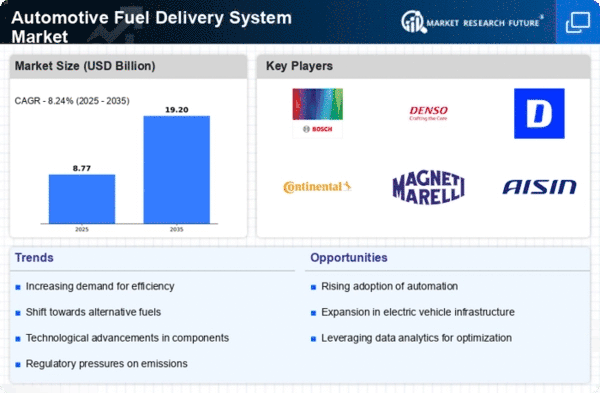
As per MRFR analysis, the Automotive Fuel Delivery System Market Size was estimated at 8.1 USD Billion in 2024. The Automotive Fuel Delivery System industry is projected to grow from 8.7 in 2025 to 19.2 by 2035, exhibiting a compound annual growth rate (CAGR) of 8.24 during the forecast period 2025 - 2035.

Key Market Trends & Highlights

The Automotive Fuel Delivery System Market is poised for growth driven by technological advancements and shifting consumer preferences.

  • Technological advancements are enhancing the efficiency and performance of fuel delivery systems across various vehicle types.
  • The North American market remains the largest, while the Asia-Pacific region is emerging as the fastest-growing market for automotive fuel delivery systems.
  • Passenger vehicles dominate the market, yet heavy-duty vehicles are experiencing the most rapid growth in demand.
  • Increasing demand for fuel efficiency and stringent regulatory compliance are key drivers propelling market expansion.

Market Size & Forecast

2024 Market Size 8.1 (USD Billion)
2035 Market Size 19.2 (USD Billion)
CAGR (2025 - 2035) 8.24%
Largest Regional Market Share in 2024 North America

Major Players

<p>Bosch (DE), Denso (JP), Delphi Technologies (GB), Continental (DE), Magneti Marelli (IT), Aisin Seiki (JP), Hitachi Automotive Systems (JP), Valeo (FR), TI Fluid Systems (GB)</p>

Market Trends

The Automotive Fuel Delivery System Market is currently experiencing a transformative phase, driven by advancements in technology and evolving consumer preferences. The increasing emphasis on fuel efficiency and environmental sustainability is prompting manufacturers to innovate and enhance their fuel delivery systems. This market is characterized by a shift towards more sophisticated systems that integrate electronic controls and sensors, which optimize fuel injection and improve overall vehicle performance. As regulatory standards become more stringent, the demand for advanced fuel delivery solutions is likely to rise, compelling companies to invest in research and development to meet these challenges. Moreover, the Automotive Fuel Delivery System Market is witnessing a growing trend towards alternative fuel sources, including electric and hybrid vehicles. This shift is influencing the design and functionality of fuel delivery systems, as manufacturers adapt to accommodate new energy sources. The integration of smart technologies, such as IoT and AI, is also becoming prevalent, enhancing the efficiency and reliability of fuel delivery mechanisms. As the automotive industry continues to evolve, the Automotive Fuel Delivery System Market is poised for significant growth, driven by innovation and a commitment to sustainability.

Technological Advancements

The Automotive Fuel Delivery System Market is increasingly influenced by technological innovations. Manufacturers are adopting advanced materials and electronic components to enhance system efficiency and performance. This trend indicates a move towards more precise fuel management, which could lead to improved fuel economy and reduced emissions.

Shift Towards Alternative Fuels

There is a noticeable shift in the Automotive Fuel Delivery System Market towards accommodating alternative fuels. As electric and hybrid vehicles gain traction, fuel delivery systems are being redesigned to support these new energy sources. This transition suggests a broader industry commitment to sustainability and reduced reliance on traditional fossil fuels.

Integration of Smart Technologies

The integration of smart technologies within the Automotive Fuel Delivery System Market is becoming increasingly prevalent. The use of IoT and AI in fuel delivery systems may enhance operational efficiency and reliability. This trend reflects a growing emphasis on data-driven solutions that optimize vehicle performance and user experience.

Automotive Fuel Delivery System Market Market Drivers

Stringent Emission Regulations

The implementation of stringent emission regulations worldwide significantly influences the Global Automotive Fuel Delivery System Market Industry. Governments are increasingly mandating lower emissions from vehicles, prompting manufacturers to adopt advanced fuel delivery systems that comply with these regulations. For instance, the European Union's Euro 6 standards necessitate the use of sophisticated fuel injection systems to minimize pollutants. This regulatory landscape is expected to drive the market value to 140.1 USD Billion by 2035, as manufacturers invest in cleaner technologies. Compliance not only helps in meeting legal requirements but also enhances brand reputation among environmentally conscious consumers.

Rising Demand for Fuel Efficiency

The increasing emphasis on fuel efficiency among consumers drives the Global Automotive Fuel Delivery System Market Industry. As fuel prices fluctuate, consumers are more inclined to invest in vehicles that offer better mileage. This trend is reflected in the projected market value of 90.2 USD Billion in 2024, indicating a robust demand for advanced fuel delivery systems that optimize fuel consumption. Manufacturers are responding by integrating innovative technologies such as direct fuel injection and electronic fuel injection systems, which enhance performance while reducing emissions. This shift not only meets consumer expectations but also aligns with global regulatory standards aimed at reducing carbon footprints.

Increasing Global Vehicle Production

The continuous growth in global vehicle production serves as a significant driver for the Global Automotive Fuel Delivery System Market Industry. As emerging economies expand their automotive sectors, the demand for efficient fuel delivery systems becomes paramount. Countries such as India and China are witnessing a surge in vehicle manufacturing, leading to an increased need for advanced fuel delivery technologies. This trend is expected to bolster the market, with projections indicating a value of 90.2 USD Billion in 2024. The expansion of production facilities and the introduction of new vehicle models necessitate innovative fuel systems that enhance performance and meet consumer expectations.

Growth of Electric and Hybrid Vehicles

The rise of electric and hybrid vehicles is reshaping the Global Automotive Fuel Delivery System Market Industry. As consumers become more environmentally aware, the demand for alternative fuel vehicles is surging. While traditional fuel delivery systems remain essential, the integration of hybrid technologies necessitates the development of advanced fuel management systems that can efficiently handle both electric and conventional fuel sources. This transition is indicative of a broader shift in the automotive landscape, where manufacturers are increasingly focusing on sustainability. Consequently, the market is likely to witness a transformation as it adapts to the evolving needs of consumers and regulatory frameworks.

Technological Advancements in Fuel Delivery Systems

Technological innovation plays a pivotal role in shaping the Global Automotive Fuel Delivery System Market Industry. The introduction of advanced fuel delivery technologies, such as variable valve timing and turbocharging, enhances engine performance and efficiency. These advancements are likely to contribute to the market's growth, with a projected CAGR of 4.08% from 2025 to 2035. As manufacturers invest in research and development, the integration of smart fuel management systems is becoming commonplace. These systems not only improve fuel efficiency but also provide real-time data analytics, allowing for better vehicle performance monitoring and maintenance, thus appealing to tech-savvy consumers.

Market Segment Insights

By Application: Passenger Vehicle (Largest) vs. Heavy-Duty Vehicle (Fastest-Growing)

<p>The Automotive Fuel Delivery System Market is segmented into Passenger Vehicles, Commercial Vehicles, Motorcycles, and Heavy-Duty Vehicles. The Passenger Vehicle segment represents the largest share, driven by the increasing demand for personal transportation and advancements in fuel technology that enhance efficiency. Conversely, the Heavy-Duty Vehicle segment, while smaller in share, is experiencing rapid growth as the demand for freight transport escalates, fueled by the booming e-commerce and logistics industries. Growth trends within this sector indicate a shift towards more efficient fuel delivery systems. The Passenger Vehicle segment continues to innovate with hybrid and electric solutions tailored to consumer preferences for sustainability. On the other hand, Heavy-Duty Vehicles are adopting advanced fuel delivery systems to meet stricter emissions regulations and improve performance, making this segment the fastest-growing within the market.</p>

<p>Passenger Vehicle (Dominant) vs. Heavy-Duty Vehicle (Emerging)</p>

<p>In the Automotive Fuel Delivery System Market, Passenger Vehicles are currently dominating the market, characterized by their wide adoption and reliance on sophisticated fuel systems that ensure optimal engine performance and fuel efficiency. This segment benefits significantly from consumer preference for personal vehicles, increasing fuel economy standards, and electrification trends. Conversely, the Heavy-Duty Vehicle segment represents an emerging opportunity within the market. With stricter emissions regulations and the rise of logistics demands, heavy-duty vehicles are adapting to innovative fuel delivery technologies that enhance efficiency and reduce environmental impact. This segment is rapidly evolving as manufacturers invest in advanced systems, making it a critical area for future growth as the industry shifts towards sustainability.</p>

By Fuel Type: Gasoline (Largest) vs. Diesel (Fastest-Growing)

<p>The Automotive Fuel Delivery System market is predominantly driven by gasoline, which has established itself as the largest segment, accounting for a substantial portion of fuel consumption in vehicles globally. Diesel follows as a significant contributor, with a lesser share but with notable growth due to its efficiency and suitability for heavy-duty vehicles.</p>

<p>Gasoline (Dominant) vs. Alternative Fuel (Emerging)</p>

<p>Gasoline remains at the forefront as the dominant fuel type in the automotive sector, largely due to its widespread availability and established infrastructure supporting internal combustion engines. In contrast, alternative fuels, such as electricity and hydrogen, are emerging due to increased focus on sustainability and reducing carbon footprint. The shift towards alternative fuels is propelled by technological advancements, government incentives, and changing consumer preferences, marking a transformative phase in the automotive fuel landscape.</p>

By Component Type: Fuel Pump (Largest) vs. Fuel Injector (Fastest-Growing)

<p>The Automotive Fuel Delivery System market is primarily driven by the demand for fuel pumps, fuel injectors, fuel filters, and fuel rails. Among these components, the fuel pump holds the largest market share, attributed to its essential role in maintaining optimal fuel pressure for modern engine systems. Fuel injectors, while not the largest in the segment, are experiencing rapid growth due to the shift toward more fuel-efficient technologies and the increased adoption of advanced internal combustion engines.</p>

<p>Fuel Pump (Dominant) vs. Fuel Injector (Emerging)</p>

<p>Fuel pumps are pivotal in the automotive fuel delivery system; they ensure the smooth transport of fuel from the tank to the engine, thus maintaining engine performance and efficiency. Their dominance is solidified by technological advancements that have led to the development of more efficient and reliable pumps, catering to the needs of both gasoline and diesel engines. Conversely, fuel injectors are gaining traction as the market shifts towards enhanced efficiency and performance. These components play a crucial role in the precise delivery of fuel into the combustion chamber, contributing to lower emissions and better fuel economy, thereby emerging as a vital element in the transition to greener automotive technologies.</p>

By Technology: Electronic Fuel Injection (Largest) vs. Direct Fuel Injection (Fastest-Growing)

<p>The Automotive Fuel Delivery System Market is predominantly driven by the Electronic Fuel Injection (EFI) technology, which holds a substantial share due to its efficiency and performance advantages. Mechanically inclined alternatives such as Mechanical Fuel Injection are witnessing a decline, while Direct Fuel Injection is gradually carving out its niche, indicating a shift in consumer preferences towards more advanced technologies. Port Fuel Injection remains a reliable option for many manufacturers, balancing cost and performance. Growth trends within this segment are shaped by a combination of stricter emission regulations and advancements in combustion technology. The rise in electric vehicle adoption is pushing automakers to innovate fuel delivery systems, leading to a heightened focus on Direct Fuel Injection technologies. As consumer demand for fuel efficiency grows, the market is evolving rapidly, establishing new benchmarks for performance and sustainability across different fuel injection technologies.</p>

<p>Technology: Electronic Fuel Injection (Dominant) vs. Direct Fuel Injection (Emerging)</p>

<p>Electronic Fuel Injection (EFI) technology is recognized as the dominant force in the Automotive Fuel Delivery System Market, providing enhanced control over fuel mixture and timing, thereby improving overall engine efficiency and performance. It employs advanced electronic controls to optimize fuel delivery, significantly improving vehicle responsiveness and reducing emissions. In contrast, Direct Fuel Injection is emerging as a key player, leveraging its ability to deliver fuel directly into the combustion chamber, which enhances fuel atomization and increases power output while minimizing fuel consumption. This innovation positions Direct Fuel Injection as an attractive solution for newer models aiming for higher efficiency standards. As regulatory pressures increase, both technologies are expected to adapt and align with the evolving automotive landscape.</p>

Get more detailed insights about Global Automotive Fuel Delivery System Market Research Report – Forecast to 2035

Regional Insights

North America : Market Leader in Fuel Systems

North America is poised to maintain its leadership in the Automotive Fuel Delivery System market, holding a significant market share of 3.5 in 2024. The region's growth is driven by increasing vehicle production, stringent emission regulations, and a shift towards fuel-efficient technologies. The demand for advanced fuel delivery systems is further propelled by the rising adoption of electric vehicles (EVs) and hybrid models, which require sophisticated fuel management solutions. Regulatory support for cleaner technologies is also a key catalyst for market expansion. The competitive landscape in North America is characterized by the presence of major players such as Bosch, Denso, and Delphi Technologies. These companies are investing heavily in R&D to innovate and enhance fuel delivery systems. The U.S. and Canada are the leading countries in this market, with a robust automotive industry that fosters collaboration between manufacturers and suppliers. The focus on sustainability and efficiency is driving the development of next-generation fuel systems, ensuring North America's continued dominance in this sector.

Europe : Innovative Automotive Hub

Europe's Automotive Fuel Delivery System market is projected to grow significantly, with a market size of 2.5 in 2025. The region is witnessing a shift towards sustainable automotive technologies, driven by stringent EU regulations aimed at reducing carbon emissions. The demand for advanced fuel delivery systems is increasing as manufacturers focus on enhancing fuel efficiency and meeting regulatory standards. The European market is also influenced by the rising popularity of electric and hybrid vehicles, which require innovative fuel management solutions. Leading countries in this region include Germany, France, and Italy, where major automotive manufacturers are based. Key players such as Bosch and Valeo are at the forefront of innovation, developing cutting-edge fuel delivery technologies. The competitive landscape is marked by collaborations between automotive manufacturers and technology providers, ensuring that Europe remains a hub for automotive innovation. As stated by the European Commission, "The automotive sector is crucial for achieving our climate goals, driving innovation and sustainability in fuel systems."

Asia-Pacific : Emerging Market Potential

The Asia-Pacific region is emerging as a significant player in the Automotive Fuel Delivery System market, with a projected market size of 2.7 in 2025. The growth is fueled by increasing vehicle production, urbanization, and rising disposable incomes in countries like China and India. Additionally, government initiatives promoting electric vehicles and stricter emission norms are driving demand for advanced fuel delivery systems. The region's focus on sustainable transportation solutions is expected to further enhance market growth. China is the leading country in this market, followed by Japan and India, where major automotive manufacturers are investing in R&D to develop innovative fuel systems. The competitive landscape is characterized by the presence of key players such as Denso and Aisin Seiki, who are focusing on technological advancements to meet the growing demand. The Asia-Pacific market is rapidly evolving, with a strong emphasis on efficiency and sustainability, positioning it as a vital region for future growth in the automotive sector.

Middle East and Africa : Developing Automotive Sector

The Middle East and Africa region is gradually developing its Automotive Fuel Delivery System market, with a market size of 0.4 in 2025. The growth is primarily driven by increasing vehicle ownership and infrastructure development in countries like South Africa and the UAE. Additionally, the region is witnessing a rise in demand for fuel-efficient vehicles, spurred by government initiatives aimed at reducing emissions and promoting sustainable transportation. The automotive sector is becoming increasingly important for economic diversification in these countries. South Africa is the leading country in this region, with a growing automotive manufacturing base. Key players such as TI Fluid Systems are establishing a presence to cater to the rising demand for advanced fuel delivery systems. The competitive landscape is evolving, with local manufacturers collaborating with international firms to enhance technology and production capabilities. As the region continues to develop, opportunities for growth in the automotive fuel delivery market are expected to expand significantly.

Key Players and Competitive Insights

The Automotive Fuel Delivery System Market is characterized by a dynamic competitive landscape, driven by technological advancements and increasing demand for fuel efficiency. Key players such as Bosch (DE), Denso (JP), and Delphi Technologies (GB) are at the forefront, each adopting distinct strategies to enhance their market positioning. Bosch (DE) emphasizes innovation in fuel injection systems, focusing on developing advanced technologies that improve fuel efficiency and reduce emissions. Denso (JP) is strategically investing in electric vehicle (EV) technologies, aligning its operations with the growing trend towards electrification. Meanwhile, Delphi Technologies (GB) is concentrating on expanding its product portfolio through strategic partnerships, particularly in the realm of hybrid and electric fuel delivery systems. Collectively, these strategies contribute to a competitive environment that is increasingly focused on sustainability and technological advancement.

In terms of business tactics, companies are localizing manufacturing to reduce costs and enhance supply chain efficiency. This approach is particularly evident in regions with high automotive production, where proximity to manufacturers can lead to significant logistical advantages. The market structure appears moderately fragmented, with several key players exerting influence while also facing competition from emerging firms. The collective actions of these major companies shape a landscape where innovation and operational efficiency are paramount.

In November 2025, Bosch (DE) announced the launch of a new line of fuel injectors designed specifically for hybrid vehicles, which is expected to enhance fuel efficiency by up to 15%. This strategic move not only reinforces Bosch's commitment to sustainability but also positions the company as a leader in the hybrid fuel delivery segment. The introduction of these injectors is likely to attract attention from major automotive manufacturers looking to improve their hybrid offerings.

In October 2025, Denso (JP) entered into a partnership with a leading EV manufacturer to develop integrated fuel delivery systems for electric vehicles. This collaboration is significant as it underscores Denso's proactive approach to adapting to the evolving automotive landscape, where electric mobility is becoming increasingly prevalent. By aligning with an EV manufacturer, Denso is likely to enhance its technological capabilities and market reach in the growing electric vehicle sector.

In September 2025, Delphi Technologies (GB) expanded its collaboration with a prominent automotive supplier to co-develop advanced fuel delivery systems that utilize AI for predictive maintenance. This initiative is indicative of Delphi's focus on integrating cutting-edge technology into its product offerings, which may lead to improved reliability and performance in fuel delivery systems. Such advancements could provide Delphi with a competitive edge in a market that is increasingly leaning towards smart automotive solutions.

As of December 2025, current trends in the Automotive Fuel Delivery System Market are heavily influenced by digitalization, sustainability, and the integration of AI technologies. Strategic alliances are becoming more prevalent, as companies recognize the need to pool resources and expertise to stay competitive. The competitive differentiation is likely to evolve from traditional price-based competition to a focus on innovation, technological advancements, and supply chain reliability. This shift suggests that companies that prioritize R&D and strategic partnerships will be better positioned to thrive in the future.

Key Companies in the Automotive Fuel Delivery System Market include

Industry Developments

  • Q2 2024: Bosch opens new fuel systems plant in Mexico to meet North American demand Bosch inaugurated a new manufacturing facility in Querétaro, Mexico, dedicated to producing advanced automotive fuel delivery systems for the North American market. The plant is expected to create over 1,000 jobs and expand Bosch’s regional supply capabilities.
  • Q2 2024: Denso announces partnership with Toyota for next-generation fuel injection systems Denso Corporation and Toyota Motor Corporation announced a strategic partnership to co-develop next-generation fuel injection systems aimed at improving efficiency and reducing emissions in hybrid and internal combustion vehicles.
  • Q3 2024: Continental AG secures major contract with Ford for electric fuel pumps Continental AG won a multi-year supply contract to provide advanced electric fuel pumps for Ford’s new line of hybrid vehicles, with production set to begin in late 2024.
  • Q1 2024: Delphi Technologies launches high-pressure fuel rail for turbocharged engines Delphi Technologies introduced a new high-pressure fuel rail system designed for turbocharged gasoline engines, targeting improved performance and lower emissions for OEM customers in Europe and Asia.
  • Q2 2024: Magneti Marelli expands fuel systems R&D center in Italy Magneti Marelli announced the expansion of its research and development center in Bologna, Italy, focusing on advanced fuel delivery technologies and alternative fuel compatibility.
  • Q3 2024: Hitachi Astemo opens new fuel pump production line in Thailand Hitachi Astemo launched a new production line for automotive fuel pumps at its Rayong, Thailand facility, aiming to serve growing demand from Southeast Asian automakers.
  • Q1 2025: TI Fluid Systems appoints new CEO to drive global fuel systems growth TI Fluid Systems announced the appointment of Maria Lopez as Chief Executive Officer, with a mandate to accelerate innovation and global expansion in automotive fuel delivery solutions.
  • Q2 2025: Valeo acquires minority stake in hydrogen fuel system startup HyMotion Valeo acquired a 20% stake in HyMotion, a French startup specializing in hydrogen fuel delivery systems, to strengthen its position in alternative fuel technologies.
  • Q2 2024: Bosch receives regulatory approval for new low-emission fuel injector Bosch announced it has received European regulatory approval for its latest low-emission fuel injector, designed to meet Euro 7 standards and reduce particulate emissions in gasoline engines.
  • Q4 2024: Keihin opens new technical center in India for fuel system innovation Keihin, a Honda group company, opened a new technical center in Pune, India, focused on developing advanced fuel delivery systems for both domestic and export markets.
  • Q1 2025: BorgWarner wins contract to supply fuel delivery modules for Stellantis hybrid SUVs BorgWarner secured a contract to supply integrated fuel delivery modules for Stellantis’ upcoming hybrid SUV models, with deliveries scheduled to start in early 2025.
  • Q2 2025: Mahle launches new ethanol-compatible fuel pump for Brazilian market Mahle introduced a new fuel pump specifically designed for high-ethanol blends, targeting the Brazilian flex-fuel vehicle market and supporting the country’s biofuel initiatives.

Automotive Fuel Delivery System Market, By Component

    • Fuel pump
    • Fuel injector
    • Fuel pressure regulator
    • Fuel filter
    • Fuel rail
    • Air control valve
    • Throttle position sensor

Automotive Fuel Delivery System Market, By Alternative Fuel Vehicles

    • CNG
    • LPG
    • LNG

Automotive Fuel Delivery System Market, By Region

    • Asia-Oceania
    • Europe
    • North America
    • RoW

Future Outlook

Automotive Fuel Delivery System Market Future Outlook

<p>The Automotive Fuel Delivery System Market is projected to grow at an 8.24% CAGR from 2024 to 2035, driven by technological advancements, increasing vehicle production, and rising fuel efficiency standards.</p>

New opportunities lie in:

  • <p>Development of advanced fuel injection systems for electric vehicles</p>
  • <p>Integration of IoT for real-time fuel monitoring solutions</p>
  • <p>Expansion into emerging markets with tailored fuel delivery solutions</p>

<p>By 2035, the market is expected to achieve robust growth, reflecting evolving consumer demands and technological innovations.</p>

Market Segmentation

Automotive Fuel Delivery System Market Fuel Type Outlook

  • Gasoline
  • Diesel
  • Alternative Fuel
  • Biofuel

Automotive Fuel Delivery System Market Technology Outlook

  • Electronic Fuel Injection
  • Mechanical Fuel Injection
  • Direct Fuel Injection
  • Port Fuel Injection

Automotive Fuel Delivery System Market Application Outlook

  • Passenger Vehicle
  • Commercial Vehicle
  • Motorcycle
  • Heavy-Duty Vehicle

Automotive Fuel Delivery System Market Component Type Outlook

  • Fuel Pump
  • Fuel Injector
  • Fuel Filter
  • Fuel Rail

Report Scope

MARKET SIZE 20248.1(USD Billion)
MARKET SIZE 20258.7(USD Billion)
MARKET SIZE 203519.2(USD Billion)
COMPOUND ANNUAL GROWTH RATE (CAGR)8.24% (2024 - 2035)
REPORT COVERAGERevenue Forecast, Competitive Landscape, Growth Factors, and Trends
BASE YEAR2024
Market Forecast Period2025 - 2035
Historical Data2019 - 2024
Market Forecast UnitsUSD Billion
Key Companies ProfiledBosch (DE), Denso (JP), Delphi Technologies (GB), Continental (DE), Magneti Marelli (IT), Aisin Seiki (JP), Hitachi Automotive Systems (JP), Valeo (FR), TI Fluid Systems (GB)
Segments CoveredApplication, Fuel Type, Component Type, Technology
Key Market OpportunitiesIntegration of advanced fuel injection technologies enhances efficiency in the Automotive Fuel Delivery System Market.
Key Market DynamicsTechnological advancements in fuel injection systems drive efficiency and performance in the automotive fuel delivery sector.
Countries CoveredNorth America, Europe, APAC, South America, MEA

FAQs

At what CAGR can the automotive fuel delivery market expand?

The automotive fuel delivery market can surge at 5% CAGR in review period.

What is the estimated valuation for the automotive fuel delivery market?

MRFR reveals that the automotive fuel delivery market poised to attain sizable valuation by the end of study period.

Who are the key players of the automotive fuel delivery market?

TI Automotive INC, Infineon Technologies AG, UCAL Fuel Systems, NGK Spark Plug Co. Ltd, and Toyoda Gosei are some reputed names in the automotive fuel delivery market.

What is the automotive fuel delivery market growth driver?

Upscaling production of commercial vehicles can impel the global automotive fuel delivery market expansion.

What is the regional analysis of the automotive fuel delivery market?

MRFR findings state that APAC automotive fuel delivery market generate high profits in the evaluation period.

  1. SECTION I: EXECUTIVE SUMMARY AND KEY HIGHLIGHTS
    1. | 1.1 EXECUTIVE SUMMARY
  2. SECTION II: SCOPING, METHODOLOGY AND MARKET STRUCTURE
    1. | 2.1 MARKET INTRODUCTION
    2. | 2.2 RESEARCH METHODOLOGY
  3. SECTION III: QUALITATIVE ANALYSIS
    1. | 3.1 MARKET DYNAMICS
    2. | 3.2 MARKET FACTOR ANALYSIS
  4. SECTION IV: QUANTITATIVE ANALYSIS
    1. | 4.1 Automobile, BY Application (USD Billion)
    2. | 4.2 Automobile, BY Fuel Type (USD Billion)
    3. | 4.3 Automobile, BY Component Type (USD Billion)
    4. | 4.4 Automobile, BY Technology (USD Billion)
    5. | 4.5 Automobile, BY Region (USD Billion)
  5. SECTION V: COMPETITIVE ANALYSIS
    1. | 5.1 Competitive Landscape
    2. | 5.2 Company Profiles
    3. | 5.3 Appendix

Global Automotive Fuel Delivery System Market Segmentation

Market Segmentation Overview

  • Detailed segmentation data will be available in the full report
  • Comprehensive analysis by multiple parameters
  • Regional and country-level breakdowns
  • Market size forecasts by segment
Infographic

Free Sample Request

Kindly complete the form below to receive a free sample of this Report

Get Free Sample

Customer Strories

Compare Licence

×
Features License Type
Single User Multiuser License Enterprise User
Price $4,950 $5,950 $7,250
Maximum User Access Limit 1 User Upto 10 Users Unrestricted Access Throughout the Organization
Free Customization
Direct Access to Analyst
Deliverable Format
Platform Access
Discount on Next Purchase 10% 15% 15%
Printable Versions