×
Hero Background
English
Chinese
French
Japanese
Korean
German
Spanish

Automotive Front end Module Market Share

ID: MRFR/AT/1484-HCR
100 Pages
Sejal Akre
October 2025

Automotive Front End Module Market Research Report Information By Vehicle Type (Passenger Cars, Light Commercial Vehicle, and Heavy Commercial Vehicle), By Raw Material Type (Metal and Composite), and By Region (North America, Europe, Asia-Pacific, and Rest Of The World) – Market Forecast Till 2035

Share:
Download PDF ×

We do not share your information with anyone. However, we may send you emails based on your report interest from time to time. You may contact us at any time to opt-out.

Automotive Front end Module Market Infographic
Purchase Options

Market Share

Automotive Front end Module Market Share Analysis

In the fiercely competitive landscape of the Automotive Front End Module (FEM) market, market share positioning strategies are crucial for manufacturers aiming to establish and maintain a strong foothold. One primary strategy revolves around product differentiation. Companies strive to distinguish their FEM offerings by incorporating unique features, advanced technologies, and innovative designs. By providing something distinctive, manufacturers can attract customers seeking specific functionalities or aesthetic elements, thereby gaining a competitive edge and a larger market share. Collaborations and strategic partnerships are another key aspect of market share positioning. Companies often form alliances with other players in the automotive ecosystem, including original equipment manufacturers (OEMs), suppliers, and technology providers. These partnerships enable access to complementary resources, expertise, and technologies, fostering an environment of mutual benefit. Such collaborations can enhance the overall value proposition of the FEMs, making them more appealing to a broader customer base and contributing to an increased market share. Pricing strategies play a pivotal role in market share positioning. Setting competitive and attractive prices is essential for capturing market share, especially in price-sensitive segments. Manufacturers may adopt penetration pricing strategies to enter new markets or gain a larger share in existing ones. Alternatively, premium pricing can be employed for FEMs with advanced features and superior performance, targeting customers who prioritize quality over cost. Striking the right balance between pricing and perceived value is critical for market share growth. Geographical expansion is a common strategy employed by FEM manufacturers to increase market share. By entering new regions or strengthening their presence in existing markets, companies can tap into diverse customer bases and respond to regional trends and preferences. Understanding the unique demands of different markets allows manufacturers to tailor their FEM offerings to suit local requirements, gaining acceptance and market share in various geographical locations. Innovation and continuous product development contribute significantly to market share positioning in the Automotive Front End Module market. Companies that invest in research and development to stay ahead of technological trends can introduce cutting-edge FEMs that cater to evolving customer needs. Whether it's integrating smart features, enhancing safety technologies, or improving energy efficiency, innovation serves as a powerful driver for capturing market share by offering products that outperform competitors. Effective marketing and brand positioning also play a vital role in market share strategies. Building a strong brand image, communicating the unique selling propositions of FEMs, and creating awareness among target customers are essential components. Customer-centric strategies focus on understanding and fulfilling the specific needs of target customers. This involves conducting market research to identify customer preferences, pain points, and emerging trends. By aligning FEM offerings with customer expectations, manufacturers can build loyalty, enhance customer satisfaction, and secure a more significant share of the market. This customer-centric approach involves continuous feedback mechanisms to adapt products and strategies in response to changing customer preferences. Global economic conditions also significantly impact the Automotive Front End Module market. Economic stability and growth contribute to increased consumer spending power, positively influencing the sales of automobiles. In times of economic prosperity, consumers are more inclined to invest in vehicles equipped with advanced features, including cutting-edge front end modules. On the other hand, economic downturns may lead to a temporary decline in automotive sales, affecting the FEM market. This sensitivity to economic fluctuations underscores the market's susceptibility to broader financial conditions. Technological advancements play a pivotal role in shaping the Automotive Front End Module market. As technology continues to advance, FEM manufacturers are incorporating state-of-the-art materials and production techniques to enhance the performance and durability of their products. The integration of sensors, adaptive lighting systems, and other smart features further propels the market forward. Automotive companies are also focusing on lightweight materials to improve fuel efficiency, and this trend has a direct impact on the design and composition of front end modules.


Author
Sejal Akre
Senior Research Analyst

She has over 5 years of rich experience, in market research and consulting providing valuable market insights to client. Hands on expertise in management consulting, and extensive knowledge in domain including ICT, Automotive & Transportation and Aerospace & Defense. She is skilled in Go-to market strategy, industry analysis, market sizing, in depth company profiling, competitive intelligence & benchmarking and value chain amongst others.

Leave a Comment

FAQs

What is the projected market valuation of the Automotive Front End Module Market by 2035?

The projected market valuation for the Automotive Front End Module Market is 142.58 USD Billion by 2035.

What was the market valuation of the Automotive Front End Module Market in 2024?

The market valuation of the Automotive Front End Module Market was 81.79 USD Billion in 2024.

What is the expected CAGR for the Automotive Front End Module Market during the forecast period 2025 - 2035?

The expected CAGR for the Automotive Front End Module Market during the forecast period 2025 - 2035 is 5.18%.

Which vehicle type segment had the highest valuation in the Automotive Front End Module Market?

The Passenger Cars segment had the highest valuation, reaching 70.0 USD Billion.

What are the two main raw material types in the Automotive Front End Module Market?

The two main raw material types in the Automotive Front End Module Market are Metal and Composite.

Which key player in the Automotive Front End Module Market is based in Canada?

Magna International, based in Canada, is a key player in the Automotive Front End Module Market.

Market Summary

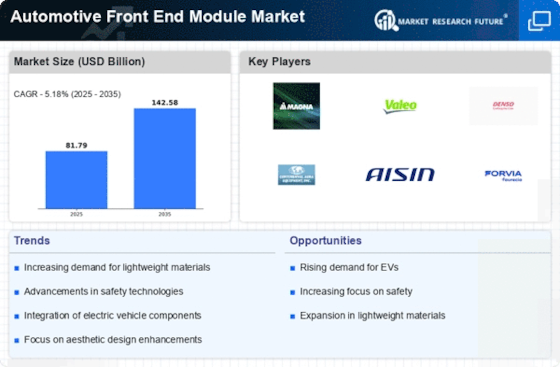
As per MRFR analysis, the Automotive Front End Module Market Size was estimated at 81.79 USD Billion in 2024. The Automotive Front End Module industry is projected to grow from 86.03 USD Billion in 2025 to 142.58 USD Billion by 2035, exhibiting a compound annual growth rate (CAGR) of 5.18 during the forecast period 2025 - 2035.

Key Market Trends & Highlights

The Automotive Front End Module Market is experiencing a transformative shift towards advanced materials and technologies.

  • The market is witnessing a notable shift towards lightweight materials, enhancing fuel efficiency and performance.
  • Integration of smart technologies is becoming increasingly prevalent, aligning with consumer demands for connectivity and innovation.
  • Sustainability initiatives are driving manufacturers to adopt eco-friendly materials, particularly in the passenger car segment.
  • Rising demand for electric vehicles and advancements in safety regulations are key drivers propelling growth in both North America and the Asia-Pacific region.

Market Size & Forecast

2024 Market Size 81.79 (USD Billion)
2035 Market Size 142.58 (USD Billion)
CAGR (2025 - 2035) 5.18%
Largest Regional Market Share in 2024 North America

Major Players

<p>Magna International (CA), Valeo (FR), Denso Corporation (JP), Continental AG (DE), Aisin Seiki Co., Ltd. (JP), Faurecia (FR), BASF SE (DE), Plastic Omnium (FR), Hyundai Mobis (KR)</p>

Market Trends

The Automotive Front End Module Market is currently experiencing a transformative phase, driven by advancements in technology and evolving consumer preferences. This sector encompasses various components, including the grille, headlights, and bumper, which are crucial for both aesthetic appeal and functional performance. As manufacturers increasingly prioritize lightweight materials and enhanced aerodynamics, the market is likely to witness a shift towards innovative designs that improve fuel efficiency and safety. Furthermore, the integration of smart technologies, such as adaptive lighting and pedestrian detection systems, appears to be gaining traction, reflecting a broader trend towards vehicle automation and connectivity. In addition, the growing emphasis on sustainability is influencing the Automotive Front End Module Market. Manufacturers are exploring eco-friendly materials and production processes to meet regulatory standards and consumer demand for greener vehicles. This shift not only aligns with global environmental goals but also presents opportunities for companies to differentiate themselves in a competitive landscape. As the market evolves, collaboration between automotive manufacturers and technology firms may become increasingly vital, fostering the development of cutting-edge solutions that enhance vehicle performance and consumer satisfaction.

Shift Towards Lightweight Materials

The Automotive Front End Module Market is witnessing a notable transition towards lightweight materials. This trend is driven by the need for improved fuel efficiency and reduced emissions. Manufacturers are increasingly adopting materials such as advanced composites and high-strength steel, which not only enhance performance but also contribute to overall vehicle safety.

Integration of Smart Technologies

The incorporation of smart technologies within the Automotive Front End Module Market is becoming more prevalent. Features such as adaptive lighting systems and integrated sensors for pedestrian detection are indicative of a broader movement towards vehicle automation. This trend reflects consumer demand for enhanced safety and convenience in modern vehicles.

Focus on Sustainability

Sustainability is emerging as a key focus within the Automotive Front End Module Market. Manufacturers are exploring eco-friendly materials and sustainable production methods to align with environmental regulations and consumer preferences. This trend not only addresses ecological concerns but also offers companies a competitive edge in a rapidly evolving market.

Automotive Front end Module Market Market Drivers

Advancements in Safety Regulations

Stringent safety regulations are increasingly influencing the Automotive Front End Module Market. Governments worldwide are implementing more rigorous standards for vehicle safety, which necessitates the incorporation of advanced safety features into front end modules. This includes pedestrian protection systems, enhanced crumple zones, and integrated sensor technologies. As a result, manufacturers are compelled to innovate and adapt their designs to meet these evolving regulations. The market is expected to grow as companies invest in research and development to create front end modules that not only comply with safety standards but also enhance overall vehicle performance.

Rising Demand for Electric Vehicles

The increasing consumer preference for electric vehicles (EVs) is a pivotal driver for the Automotive Front End Module Market. As manufacturers pivot towards electrification, the design and functionality of front end modules are evolving to accommodate new technologies. In 2025, it is projected that EV sales will account for a substantial percentage of total vehicle sales, necessitating innovative front end solutions. This shift not only enhances vehicle aerodynamics but also integrates advanced cooling systems for battery management. Consequently, the Automotive Front End Module Market is likely to witness a surge in demand for components that support these electric architectures, thereby reshaping the competitive landscape.

Technological Integration and Connectivity

The integration of smart technologies and connectivity features is transforming the Automotive Front End Module Market. As vehicles become more connected, front end modules are increasingly equipped with sensors, cameras, and communication systems that facilitate advanced driver-assistance systems (ADAS). This trend is expected to drive market growth, as the demand for enhanced safety and convenience features rises. By 2025, the market for ADAS is anticipated to expand significantly, leading to a corresponding increase in the complexity and functionality of front end modules. Manufacturers are likely to focus on developing modular designs that can easily accommodate these technological advancements.

Consumer Preference for Aesthetics and Customization

The growing consumer inclination towards vehicle aesthetics and customization is a notable driver for the Automotive Front End Module Market. As consumers seek personalized vehicles that reflect their individual styles, manufacturers are responding by offering a wider array of design options for front end modules. This trend is particularly pronounced in the premium vehicle segment, where aesthetic appeal is paramount. The market is projected to expand as manufacturers invest in innovative designs and materials that enhance the visual appeal of front end modules, thereby attracting a broader customer base. This focus on customization may also lead to increased competition among manufacturers.

Sustainability Initiatives and Eco-Friendly Materials

The emphasis on sustainability and the use of eco-friendly materials is increasingly shaping the Automotive Front End Module Market. As environmental concerns gain prominence, manufacturers are exploring sustainable alternatives to traditional materials. This includes the use of recycled plastics and bio-based composites in front end module production. The market is likely to experience growth as companies align their strategies with sustainability initiatives, responding to consumer demand for greener vehicles. By 2025, the adoption of eco-friendly materials is expected to become a standard practice, influencing design and manufacturing processes within the Automotive Front End Module Market.

Market Segment Insights

By Vehicle Type: Passenger Cars (Largest) vs. Heavy Commercial Vehicles (Fastest-Growing)

<p>In the Automotive Front End Module Market, Passenger Cars hold the largest market share due to their high demand driven by personal mobility and urbanization. The popularity of electric vehicles also contributes to the substantial size of this segment. In contrast, Heavy Commercial Vehicles are rapidly gaining traction, aligned with the growth in logistics and freight transportation, highlighting their emerging significance in the market.</p>

<p>Passenger Cars (Dominant) vs. Heavy Commercial Vehicles (Emerging)</p>

<p>Passenger Cars remain the dominant segment in the Automotive Front End Module Market, renowned for their versatile designs and integration of advanced technologies. They cater to consumer preferences for safety, comfort, and connectivity features. On the other hand, Heavy Commercial Vehicles represent an emerging market, fueled by a growing emphasis on efficient logistics and transportation solutions. With advancements in technology and sustainability goals, manufacturers are innovating these vehicles to meet new emissions regulations and improve operational efficiencies, indicating robust growth opportunities in the coming years.</p>

By Raw Material Type: Metal (Largest) vs. Composite (Fastest-Growing)

<p>In the Automotive Front End Module Market, the segment distribution by raw material type highlights the predominance of metal materials in current applications, significantly holding a substantial share. Metal components are traditionally favored for their strength and durability, supporting the load-bearing requirements of front-end modules. In contrast, composites have been gaining traction in recent years, appealing to manufacturers seeking to reduce weight and enhance fuel efficiency, albeit starting from a smaller base.</p>

<p>Raw Material Type: Metal (Dominant) vs. Composite (Emerging)</p>

<p>The metal segment is notably dominant in the Automotive Front End Module Market due to its well-established performance characteristics, including robustness and structural integrity. Traditionally used for components like bumpers and supports, metals allow for reliable manufacturing processes and long service life. Conversely, composites represent an emerging trend. Lightweight yet strong, composite materials are increasingly utilized for specific applications where reducing weight without sacrificing performance is crucial. This shift towards composites is spurred by stringent regulations on emissions, driving automotive manufacturers to innovate and adopt new materials that align with sustainability goals.</p>

Get more detailed insights about Automotive Front End Module Market Research Report - Forecast to 2035

Regional Insights

By region, the study provides the Automotive Front End Module market insights into North America, Europe, Asia-Pacific and Rest of the World. The North America Automotive Front End Module Market dominated this market in 2022 (45.80%). This is due to the massive production of cars and government laws that favour high efficiency, low emission vehicles. A good growth rate in the industry is predicted due to the increasing demand for premium vehicles. Further, the U.S.

Automotive Front End Module market held the largest market share, and the Canada Automotive Front End Module market was the fastest growing market in the North America region.

Further, the major countries studied in the Automotive Front End Module market report are The US, Canada, German, France, the UK, Italy, Spain, China, Japan, India, Australia, South Korea, and Brazil.

Figure 2: Automotive Front End Module Market Share By Region 2022 (USD Billion)

Automotive Front End Module Market Share By Region 2022

Source: Secondary Research, Primary Research, Market Research Future Database and Analyst Review

Europe Automotive Front End Module market accounted for the healthy market share in 2022. This is because significant manufacturers are found in nations like Germany, the U.K., France, and Spain. With a growing population and an evolving lifestyle that makes transportation more modern and safe, the market for automobile front end modules is anticipated to see increased growth. Further, the German Automotive Front End Module market held the largest market share, and the U.K Automotive Front End Module market was the fastest growing market in the European region

The Asia Pacific Automotive Front End Module market is expected to register significant growth from 2024 to 2032. This is because major front-end module producers are well-represented in Japan, South Korea, China, and India. The market's demand is further bolstered by rising vehicle production in important regional economies and a growing emphasis on lightweight vehicle manufacture among different automotive OEMs.

In addition to China and India, South Korea and Japan are becoming more significant due to the presence of significant automobile industry giants like Nissan.  The automotive front end module (FEM) market is predicted to grow at a significant double-digit CAGR in this area. Moreover, China’s Automotive Front End Module market held the largest market share, and the Indian Automotive Front End Module market was the fastest growing market in the Asia-Pacific region.

Key Players and Competitive Insights

Leading market players are investing heavily in research and development in order to expand their product lines, which will help the Automotive Front End Module market, grow even more. Market participants are also undertaking a variety of strategic activities to expand their global footprint, with important market developments including new product launches, contractual agreements, mergers and acquisitions, higher investments, and collaboration with other organizations. To expand and survive in a more competitive and rising market climate, Automotive Front End Module industry must offer cost-effective items.

Manufacturing locally to minimize operational costs is one of the key business tactics used by manufacturers in the global Automotive Front End Module industry to benefit clients and increase the market sector. In recent years, the Automotive Front End Module industry has offered some of the most significant advantages to medicine. Major players in the Automotive Front End Module market, including Mahle GmbH, Faurecia SA, Denso Corporation, Calsonic Kansei Corporation, Hbpo Group, Magna International Inc., Hyundai Mobis, Plastic Omnium, SL Corporation, and Valeo S.A., are attempting to increase market demand by investing in research and development operations.

Samvardhana Motherson International Ltd (SAMIL), formerly known as Motherson Sumi Systems Limited, provides the automotive industries with wiring harness design, development, manufacture, and supply services as well as interior and exterior modules. Door panels, instrument panels, bumpers, centre consoles, decorative interior trims, assist system signal lights, blow-molded components, and high precision plastic parts are among the company's product offerings. SAMIL products are used in medical systems, earth moving and material handling equipment, tractors and farm equipment, MUVs, two-wheelers, commercial and passenger vehicles, and two-wheeled vehicles.

Additionally, it provides IT services, production assistance, and product commerce to the automotive and other industries. The corporation has operations in the Americas, Europe, Asia Pacific, and Africa. The headquarters of SAMIL are in Noida, Uttar Pradesh, India. Through its subsidiary Samvardhana Motherson Reflectec, Mother Son Group completes the acquisition of a majority stake in Turkey's Plast Met Group in May 2021. The Motherson Group now has access to the sizeable Turkish automotive market as a result of the successful completion of this transaction.

Compagnie Plastic Omnium SA (Plastic Omnium), a division of Burelle SA, produces and markets high-tech goods and automobile parts. It creates and sells bodywork modules, bumpers and front-end assemblies, body panels and spoilers, rear closure systems, semi-structural and structural elements, and other front-end modules. It also produces and sells painted external plastic and composite components. It provides goods to companies that make cars and trucks. The company conducts business across the Americas, Europe, and Asia. The headquarters of Plastic Omnium are located in Levallois, Ile-de-France, France.

Plastic Omnium announced the launch of a number of new programmes for 100% electric vehicles in October 2020. The front and rear bumpers, as well as front-end modules, are provided by Plastic Omnium for the Tesla Model 3 and Model Y. These models are made in both North America and China. Additionally, it offers front and rear bumpers for VW ID.3 and ID.4, as well as a centre console and front-end module.

Key Companies in the Automotive Front end Module Market market include

Industry Developments

May 2023: One of the top semiconductor foundries in the world, United Microelectronics Corporation, announced today that its 40nm RFSOI technology platform is now prepared for the manufacturing of millimeter-wave (mmWave) radio frequency (RF) front-end products. This will facilitate the widespread adoption of 5G wireless networks and applications, such as smartphones, Fixed Wireless Access (FWA) systems, and small cell base stations. While most current 5G networks operate in the sub-8GHz range, mmWave technology uses a new frequency spectrum between 24GHz and 60GHz, enabling the delivery of incredibly low latency, blazing-fast transfer speeds, and more dependable connectivity.

In order to produce RF switches, low noise amplifiers, and power amplifiers that can handle the greater bandwidth of mmWave frequencies, UMC has developed a new platform called 40RFSOI. 40RFSOI is the perfect choice for clients creating integrated RF chips that incorporate beamformers, core and passive devices, as well as front-end components on a single IC, balancing the demand for additional RF components in mmWave modules while keeping the size low.

June 2023: Broadcom has introduced an integrated front-end module (FiFEM), for WiFi 7 access point (AP) applications on routers, home gateways, and business Aps.In order to improve 5GHz and 6GHz band coexistence and low in-band insertion loss while drastically lowering the bill of materials (BOM) at the RF front end, FiFEM devices employ FBAR filter technology. Furthermore, the devices contain non-linear power amplifiers (PA) that are designed for Broadcom's WiFi SoC Digital Predistortion (DPD) operation, allowing for a 40% reduction in RF front-end consumption.

The second-generation Wi-Fi FBAR filter is integrated to improve band isolation and efficiency, decrease RF BOM and board space, and prevent yield loss due to external filter mismatch. This is the first non-linear FEM that has been approved for use with Broadcom's Wireless FEM Active Management (WiFAM) Gen2 technology.

July 2022: Hella GmbH & Co. KGaA (Hella), which conducts business under the FORVIA umbrella brand, has decided to sell its 33.33% ownership part in HBPO Beteiligungsgesellschaft GmbH ("HBPO") to its co-shareholder, Plastic Omnium. The agreed-upon acquisition price is 290 million euros. The deal must receive the usual regulatory approvals. The deal should close in the fourth quarter of 2022. Plastic Omnium will own all of HBPO at 100% and will be in a good position to create new lighting-based modules and systems. One in five front-end modules produced globally is assembled by HBPO.

Future Outlook

Automotive Front end Module Market Future Outlook

<p>The Automotive Front End Module Market is projected to grow at a 5.18% CAGR from 2024 to 2035, driven by advancements in vehicle design, safety regulations, and consumer demand for aesthetics.</p>

New opportunities lie in:

  • <p>Integration of advanced driver-assistance systems (ADAS) into front end modules.</p>
  • <p>Development of lightweight materials to enhance fuel efficiency.</p>
  • <p>Expansion into electric vehicle front end module solutions.</p>

<p>By 2035, the market is expected to be robust, reflecting significant advancements and strategic growth.</p>

Market Segmentation

Automotive Front end Module Market Vehicle Type Outlook

  • Passenger Cars
  • Light Commercial Vehicle
  • Heavy Commercial Vehicle

Automotive Front end Module Market Raw Material Type Outlook

  • Metal
  • Composite

Report Scope

MARKET SIZE 202481.79(USD Billion)
MARKET SIZE 202586.03(USD Billion)
MARKET SIZE 2035142.58(USD Billion)
COMPOUND ANNUAL GROWTH RATE (CAGR)5.18% (2024 - 2035)
REPORT COVERAGERevenue Forecast, Competitive Landscape, Growth Factors, and Trends
BASE YEAR2024
Market Forecast Period2025 - 2035
Historical Data2019 - 2024
Market Forecast UnitsUSD Billion
Key Companies ProfiledMarket analysis in progress
Segments CoveredMarket segmentation analysis in progress
Key Market OpportunitiesIntegration of advanced driver assistance systems in Automotive Front End Module Market enhances safety and consumer appeal.
Key Market DynamicsRising demand for lightweight materials in Automotive Front End Modules drives innovation and competitive dynamics in the market.
Countries CoveredNorth America, Europe, APAC, South America, MEA

FAQs

What is the projected market valuation of the Automotive Front End Module Market by 2035?

The projected market valuation for the Automotive Front End Module Market is 142.58 USD Billion by 2035.

What was the market valuation of the Automotive Front End Module Market in 2024?

The market valuation of the Automotive Front End Module Market was 81.79 USD Billion in 2024.

What is the expected CAGR for the Automotive Front End Module Market during the forecast period 2025 - 2035?

The expected CAGR for the Automotive Front End Module Market during the forecast period 2025 - 2035 is 5.18%.

Which vehicle type segment had the highest valuation in the Automotive Front End Module Market?

The Passenger Cars segment had the highest valuation, reaching 70.0 USD Billion.

What are the two main raw material types in the Automotive Front End Module Market?

The two main raw material types in the Automotive Front End Module Market are Metal and Composite.

Which key player in the Automotive Front End Module Market is based in Canada?

Magna International, based in Canada, is a key player in the Automotive Front End Module Market.

  1. SECTION I: EXECUTIVE SUMMARY AND KEY HIGHLIGHTS
    1. EXECUTIVE SUMMARY
      1. Market Overview
      2. Key Findings
      3. Market Segmentation
      4. Competitive Landscape
      5. Challenges and Opportunities
      6. Future Outlook
  2. SECTION II: SCOPING, METHODOLOGY AND MARKET STRUCTURE
    1. MARKET INTRODUCTION
      1. Definition
      2. Scope of the study
    2. RESEARCH METHODOLOGY
      1. Overview
      2. Data Mining
      3. Secondary Research
      4. Primary Research
      5. Forecasting Model
      6. Market Size Estimation
      7. Data Triangulation
      8. Validation
  3. SECTION III: QUALITATIVE ANALYSIS
    1. MARKET DYNAMICS
      1. Overview
      2. Drivers
      3. Restraints
      4. Opportunities
    2. MARKET FACTOR ANALYSIS
      1. Value chain Analysis
      2. Porter's Five Forces Analysis
      3. COVID-19 Impact Analysis
  4. SECTION IV: QUANTITATIVE ANALYSIS
    1. Automobile, BY Vehicle Type (USD Billion)
      1. Passenger Cars
      2. Light Commercial Vehicle
      3. Heavy Commercial Vehicle
    2. Automobile, BY Raw Material Type (USD Billion)
      1. Metal
      2. Composite
    3. Automobile, BY Region (USD Billion)
      1. North America
      2. Europe
      3. APAC
      4. South America
      5. MEA
  5. SECTION V: COMPETITIVE ANALYSIS
    1. Competitive Landscape
      1. Overview
      2. Competitive Analysis
      3. Market share Analysis
      4. Major Growth Strategy in the Automobile
      5. Competitive Benchmarking
      6. Leading Players in Terms of Number of Developments in the Automobile
      7. Key developments and growth strategies
      8. Major Players Financial Matrix
    2. Company Profiles
      1. Magna International (CA)
      2. Valeo (FR)
      3. Denso Corporation (JP)
      4. Continental AG (DE)
      5. Aisin Seiki Co., Ltd. (JP)
      6. Faurecia (FR)
      7. BASF SE (DE)
      8. Plastic Omnium (FR)
      9. Hyundai Mobis (KR)
    3. Appendix
      1. References
      2. Related Reports
  6. LIST OF FIGURES
    1. MARKET SYNOPSIS
    2. NORTH AMERICA MARKET ANALYSIS
    3. US MARKET ANALYSIS BY VEHICLE TYPE
    4. US MARKET ANALYSIS BY RAW MATERIAL TYPE
    5. CANADA MARKET ANALYSIS BY VEHICLE TYPE
    6. CANADA MARKET ANALYSIS BY RAW MATERIAL TYPE
    7. EUROPE MARKET ANALYSIS
    8. GERMANY MARKET ANALYSIS BY VEHICLE TYPE
    9. GERMANY MARKET ANALYSIS BY RAW MATERIAL TYPE
    10. UK MARKET ANALYSIS BY VEHICLE TYPE
    11. UK MARKET ANALYSIS BY RAW MATERIAL TYPE
    12. FRANCE MARKET ANALYSIS BY VEHICLE TYPE
    13. FRANCE MARKET ANALYSIS BY RAW MATERIAL TYPE
    14. RUSSIA MARKET ANALYSIS BY VEHICLE TYPE
    15. RUSSIA MARKET ANALYSIS BY RAW MATERIAL TYPE
    16. ITALY MARKET ANALYSIS BY VEHICLE TYPE
    17. ITALY MARKET ANALYSIS BY RAW MATERIAL TYPE
    18. SPAIN MARKET ANALYSIS BY VEHICLE TYPE
    19. SPAIN MARKET ANALYSIS BY RAW MATERIAL TYPE
    20. REST OF EUROPE MARKET ANALYSIS BY VEHICLE TYPE
    21. REST OF EUROPE MARKET ANALYSIS BY RAW MATERIAL TYPE
    22. APAC MARKET ANALYSIS
    23. CHINA MARKET ANALYSIS BY VEHICLE TYPE
    24. CHINA MARKET ANALYSIS BY RAW MATERIAL TYPE
    25. INDIA MARKET ANALYSIS BY VEHICLE TYPE
    26. INDIA MARKET ANALYSIS BY RAW MATERIAL TYPE
    27. JAPAN MARKET ANALYSIS BY VEHICLE TYPE
    28. JAPAN MARKET ANALYSIS BY RAW MATERIAL TYPE
    29. SOUTH KOREA MARKET ANALYSIS BY VEHICLE TYPE
    30. SOUTH KOREA MARKET ANALYSIS BY RAW MATERIAL TYPE
    31. MALAYSIA MARKET ANALYSIS BY VEHICLE TYPE
    32. MALAYSIA MARKET ANALYSIS BY RAW MATERIAL TYPE
    33. THAILAND MARKET ANALYSIS BY VEHICLE TYPE
    34. THAILAND MARKET ANALYSIS BY RAW MATERIAL TYPE
    35. INDONESIA MARKET ANALYSIS BY VEHICLE TYPE
    36. INDONESIA MARKET ANALYSIS BY RAW MATERIAL TYPE
    37. REST OF APAC MARKET ANALYSIS BY VEHICLE TYPE
    38. REST OF APAC MARKET ANALYSIS BY RAW MATERIAL TYPE
    39. SOUTH AMERICA MARKET ANALYSIS
    40. BRAZIL MARKET ANALYSIS BY VEHICLE TYPE
    41. BRAZIL MARKET ANALYSIS BY RAW MATERIAL TYPE
    42. MEXICO MARKET ANALYSIS BY VEHICLE TYPE
    43. MEXICO MARKET ANALYSIS BY RAW MATERIAL TYPE
    44. ARGENTINA MARKET ANALYSIS BY VEHICLE TYPE
    45. ARGENTINA MARKET ANALYSIS BY RAW MATERIAL TYPE
    46. REST OF SOUTH AMERICA MARKET ANALYSIS BY VEHICLE TYPE
    47. REST OF SOUTH AMERICA MARKET ANALYSIS BY RAW MATERIAL TYPE
    48. MEA MARKET ANALYSIS
    49. GCC COUNTRIES MARKET ANALYSIS BY VEHICLE TYPE
    50. GCC COUNTRIES MARKET ANALYSIS BY RAW MATERIAL TYPE
    51. SOUTH AFRICA MARKET ANALYSIS BY VEHICLE TYPE
    52. SOUTH AFRICA MARKET ANALYSIS BY RAW MATERIAL TYPE
    53. REST OF MEA MARKET ANALYSIS BY VEHICLE TYPE
    54. REST OF MEA MARKET ANALYSIS BY RAW MATERIAL TYPE
    55. KEY BUYING CRITERIA OF AUTOMOBILE
    56. RESEARCH PROCESS OF MRFR
    57. DRO ANALYSIS OF AUTOMOBILE
    58. DRIVERS IMPACT ANALYSIS: AUTOMOBILE
    59. RESTRAINTS IMPACT ANALYSIS: AUTOMOBILE
    60. SUPPLY / VALUE CHAIN: AUTOMOBILE
    61. AUTOMOBILE, BY VEHICLE TYPE, 2024 (% SHARE)
    62. AUTOMOBILE, BY VEHICLE TYPE, 2024 TO 2035 (USD Billion)
    63. AUTOMOBILE, BY RAW MATERIAL TYPE, 2024 (% SHARE)
    64. AUTOMOBILE, BY RAW MATERIAL TYPE, 2024 TO 2035 (USD Billion)
    65. BENCHMARKING OF MAJOR COMPETITORS
  7. LIST OF TABLES
    1. LIST OF ASSUMPTIONS
    2. North America MARKET SIZE ESTIMATES; FORECAST
      1. BY VEHICLE TYPE, 2025-2035 (USD Billion)
      2. BY RAW MATERIAL TYPE, 2025-2035 (USD Billion)
    3. US MARKET SIZE ESTIMATES; FORECAST
      1. BY VEHICLE TYPE, 2025-2035 (USD Billion)
      2. BY RAW MATERIAL TYPE, 2025-2035 (USD Billion)
    4. Canada MARKET SIZE ESTIMATES; FORECAST
      1. BY VEHICLE TYPE, 2025-2035 (USD Billion)
      2. BY RAW MATERIAL TYPE, 2025-2035 (USD Billion)
    5. Europe MARKET SIZE ESTIMATES; FORECAST
      1. BY VEHICLE TYPE, 2025-2035 (USD Billion)
      2. BY RAW MATERIAL TYPE, 2025-2035 (USD Billion)
    6. Germany MARKET SIZE ESTIMATES; FORECAST
      1. BY VEHICLE TYPE, 2025-2035 (USD Billion)
      2. BY RAW MATERIAL TYPE, 2025-2035 (USD Billion)
    7. UK MARKET SIZE ESTIMATES; FORECAST
      1. BY VEHICLE TYPE, 2025-2035 (USD Billion)
      2. BY RAW MATERIAL TYPE, 2025-2035 (USD Billion)
    8. France MARKET SIZE ESTIMATES; FORECAST
      1. BY VEHICLE TYPE, 2025-2035 (USD Billion)
      2. BY RAW MATERIAL TYPE, 2025-2035 (USD Billion)
    9. Russia MARKET SIZE ESTIMATES; FORECAST
      1. BY VEHICLE TYPE, 2025-2035 (USD Billion)
      2. BY RAW MATERIAL TYPE, 2025-2035 (USD Billion)
    10. Italy MARKET SIZE ESTIMATES; FORECAST
      1. BY VEHICLE TYPE, 2025-2035 (USD Billion)
      2. BY RAW MATERIAL TYPE, 2025-2035 (USD Billion)
    11. Spain MARKET SIZE ESTIMATES; FORECAST
      1. BY VEHICLE TYPE, 2025-2035 (USD Billion)
      2. BY RAW MATERIAL TYPE, 2025-2035 (USD Billion)
    12. Rest of Europe MARKET SIZE ESTIMATES; FORECAST
      1. BY VEHICLE TYPE, 2025-2035 (USD Billion)
      2. BY RAW MATERIAL TYPE, 2025-2035 (USD Billion)
    13. APAC MARKET SIZE ESTIMATES; FORECAST
      1. BY VEHICLE TYPE, 2025-2035 (USD Billion)
      2. BY RAW MATERIAL TYPE, 2025-2035 (USD Billion)
    14. China MARKET SIZE ESTIMATES; FORECAST
      1. BY VEHICLE TYPE, 2025-2035 (USD Billion)
      2. BY RAW MATERIAL TYPE, 2025-2035 (USD Billion)
    15. India MARKET SIZE ESTIMATES; FORECAST
      1. BY VEHICLE TYPE, 2025-2035 (USD Billion)
      2. BY RAW MATERIAL TYPE, 2025-2035 (USD Billion)
    16. Japan MARKET SIZE ESTIMATES; FORECAST
      1. BY VEHICLE TYPE, 2025-2035 (USD Billion)
      2. BY RAW MATERIAL TYPE, 2025-2035 (USD Billion)
    17. South Korea MARKET SIZE ESTIMATES; FORECAST
      1. BY VEHICLE TYPE, 2025-2035 (USD Billion)
      2. BY RAW MATERIAL TYPE, 2025-2035 (USD Billion)
    18. Malaysia MARKET SIZE ESTIMATES; FORECAST
      1. BY VEHICLE TYPE, 2025-2035 (USD Billion)
      2. BY RAW MATERIAL TYPE, 2025-2035 (USD Billion)
    19. Thailand MARKET SIZE ESTIMATES; FORECAST
      1. BY VEHICLE TYPE, 2025-2035 (USD Billion)
      2. BY RAW MATERIAL TYPE, 2025-2035 (USD Billion)
    20. Indonesia MARKET SIZE ESTIMATES; FORECAST
      1. BY VEHICLE TYPE, 2025-2035 (USD Billion)
      2. BY RAW MATERIAL TYPE, 2025-2035 (USD Billion)
    21. Rest of APAC MARKET SIZE ESTIMATES; FORECAST
      1. BY VEHICLE TYPE, 2025-2035 (USD Billion)
      2. BY RAW MATERIAL TYPE, 2025-2035 (USD Billion)
    22. South America MARKET SIZE ESTIMATES; FORECAST
      1. BY VEHICLE TYPE, 2025-2035 (USD Billion)
      2. BY RAW MATERIAL TYPE, 2025-2035 (USD Billion)
    23. Brazil MARKET SIZE ESTIMATES; FORECAST
      1. BY VEHICLE TYPE, 2025-2035 (USD Billion)
      2. BY RAW MATERIAL TYPE, 2025-2035 (USD Billion)
    24. Mexico MARKET SIZE ESTIMATES; FORECAST
      1. BY VEHICLE TYPE, 2025-2035 (USD Billion)
      2. BY RAW MATERIAL TYPE, 2025-2035 (USD Billion)
    25. Argentina MARKET SIZE ESTIMATES; FORECAST
      1. BY VEHICLE TYPE, 2025-2035 (USD Billion)
      2. BY RAW MATERIAL TYPE, 2025-2035 (USD Billion)
    26. Rest of South America MARKET SIZE ESTIMATES; FORECAST
      1. BY VEHICLE TYPE, 2025-2035 (USD Billion)
      2. BY RAW MATERIAL TYPE, 2025-2035 (USD Billion)
    27. MEA MARKET SIZE ESTIMATES; FORECAST
      1. BY VEHICLE TYPE, 2025-2035 (USD Billion)
      2. BY RAW MATERIAL TYPE, 2025-2035 (USD Billion)
    28. GCC Countries MARKET SIZE ESTIMATES; FORECAST
      1. BY VEHICLE TYPE, 2025-2035 (USD Billion)
      2. BY RAW MATERIAL TYPE, 2025-2035 (USD Billion)
    29. South Africa MARKET SIZE ESTIMATES; FORECAST
      1. BY VEHICLE TYPE, 2025-2035 (USD Billion)
      2. BY RAW MATERIAL TYPE, 2025-2035 (USD Billion)
    30. Rest of MEA MARKET SIZE ESTIMATES; FORECAST
      1. BY VEHICLE TYPE, 2025-2035 (USD Billion)
      2. BY RAW MATERIAL TYPE, 2025-2035 (USD Billion)
    31. PRODUCT LAUNCH/PRODUCT DEVELOPMENT/APPROVAL
    32. ACQUISITION/PARTNERSHIP

Automotive Front End Module Market Segmentation

Automotive Front End Module Market Vehicle Type Outlook (USD Billion, 2018-2032)

  • Passenger Cars
  • Light Commercial Vehicle
  • Heavy Commercial Vehicle

Automotive Front End Module Market Raw Material Type Outlook (USD Billion, 2018-2032)

  • Metal
  • Composite

Automotive Front End Module Market Regional Outlook (USD Billion, 2018-2032)

  • North America Outlook (USD Billion, 2018-2032)

    • Automotive Front End Module Market by Vehicle Type
      • Passenger Cars
      • Light Commercial Vehicle
      • Heavy Commercial Vehicle
    • Automotive Front End Module Market by Raw Material Type
      • Metal
      • Composite
    • US Outlook (USD Billion, 2018-2032)

    • Automotive Front End Module Market by Vehicle Type
      • Passenger Cars
      • Light Commercial Vehicle
      • Heavy Commercial Vehicle
    • Automotive Front End Module Market by Raw Material Type
      • Metal
      • Composite
    • Canada Outlook (USD Billion, 2018-2032)

    • Automotive Front End Module Market by Vehicle Type
      • Passenger Cars
      • Light Commercial Vehicle
      • Heavy Commercial Vehicle
    • Automotive Front End Module Market by Raw Material Type
      • Metal
      • Composite
  • Europe Outlook (USD Billion, 2018-2032)

    • Automotive Front End Module Market by Vehicle Type
      • Passenger Cars
      • Light Commercial Vehicle
      • Heavy Commercial Vehicle
    • Automotive Front End Module Market by Raw Material Type
      • Metal
      • Composite
    • Germany Outlook (USD Billion, 2018-2032)

    • Automotive Front End Module Market by Vehicle Type
      • Passenger Cars
      • Light Commercial Vehicle
      • Heavy Commercial Vehicle
    • Automotive Front End Module Market by Raw Material Type
      • Metal
      • Composite
    • France Outlook (USD Billion, 2018-2032)

    • Automotive Front End Module Market by Vehicle Type
      • Passenger Cars
      • Light Commercial Vehicle
      • Heavy Commercial Vehicle
    • Automotive Front End Module Market by Raw Material Type
      • Metal
      • Composite
    • UK Outlook (USD Billion, 2018-2032)

    • Automotive Front End Module Market by Vehicle Type
      • Passenger Cars
      • Light Commercial Vehicle
      • Heavy Commercial Vehicle
    • Automotive Front End Module Market by Raw Material Type
      • Metal
      • Composite
    • Italy Outlook (USD Billion, 2018-2032)

    • Automotive Front End Module Market by Vehicle Type
      • Passenger Cars
      • Light Commercial Vehicle
      • Heavy Commercial Vehicle
    • Automotive Front End Module Market by Raw Material Type
      • Metal
      • Composite
    • Spain Outlook (USD Billion, 2018-2032)

    • Automotive Front End Module Market by Vehicle Type
      • Passenger Cars
      • Light Commercial Vehicle
      • Heavy Commercial Vehicle
    • Automotive Front End Module Market by Raw Material Type
      • Metal
      • Composite
    • Rest Of Europe Outlook (USD Billion, 2018-2032)

    • Automotive Front End Module Market by Vehicle Type
      • Passenger Cars
      • Light Commercial Vehicle
      • Heavy Commercial Vehicle
    • Automotive Front End Module Market by Raw Material Type
      • Metal
      • Composite
  • Asia-Pacific Outlook (USD Billion, 2018-2032)

    • Automotive Front End Module Market by Vehicle Type
      • Passenger Cars
      • Light Commercial Vehicle
      • Heavy Commercial Vehicle
    • Automotive Front End Module Market by Raw Material Type
      • Metal
      • Composite
    • China Outlook (USD Billion, 2018-2032)

    • Automotive Front End Module Market by Vehicle Type
      • Passenger Cars
      • Light Commercial Vehicle
      • Heavy Commercial Vehicle
    • Automotive Front End Module Market by Raw Material Type
      • Metal
      • Composite
    • Japan Outlook (USD Billion, 2018-2032)

    • Automotive Front End Module Market by Vehicle Type
      • Passenger Cars
      • Light Commercial Vehicle
      • Heavy Commercial Vehicle
    • Automotive Front End Module Market by Raw Material Type
      • Metal
      • Composite
    • India Outlook (USD Billion, 2018-2032)

    • Automotive Front End Module Market by Vehicle Type
      • Passenger Cars
      • Light Commercial Vehicle
      • Heavy Commercial Vehicle
    • Automotive Front End Module Market by Raw Material Type
      • Metal
      • Composite
    • Australia Outlook (USD Billion, 2018-2032)

    • Automotive Front End Module Market by Vehicle Type
      • Passenger Cars
      • Light Commercial Vehicle
      • Heavy Commercial Vehicle
    • Automotive Front End Module Market by Raw Material Type
      • Metal
      • Composite
    • Rest of Asia-Pacific Outlook (USD Billion, 2018-2032)

    • Automotive Front End Module Market by Vehicle Type
      • Passenger Cars
      • Light Commercial Vehicle
      • Heavy Commercial Vehicle
    • Automotive Front End Module Market by Raw Material Type
      • Metal
      • Composite
  • Rest of the World Outlook (USD Billion, 2018-2032)

    • Automotive Front End Module Market by Vehicle Type
      • Passenger Cars
      • Light Commercial Vehicle
      • Heavy Commercial Vehicle
    • Automotive Front End Module Market by Raw Material Type
      • Metal
      • Composite
    • Middle East Outlook (USD Billion, 2018-2032)

    • Automotive Front End Module Market by Vehicle Type
      • Passenger Cars
      • Light Commercial Vehicle
      • Heavy Commercial Vehicle
    • Automotive Front End Module Market by Raw Material Type
      • Metal
      • Composite
    • Africa Outlook (USD Billion, 2018-2032)

    • Automotive Front End Module Market by Vehicle Type
      • Passenger Cars
      • Light Commercial Vehicle
      • Heavy Commercial Vehicle
    • Automotive Front End Module Market by Raw Material Type
      • Metal
      • Composite
    • Latin America Outlook (USD Billion, 2018-2032)

    • Automotive Front End Module Market by Vehicle Type
      • Passenger Cars
      • Light Commercial Vehicle
      • Heavy Commercial Vehicle
    • Automotive Front End Module Market by Raw Material Type
      • Metal
      • Composite
Infographic

Free Sample Request

Kindly complete the form below to receive a free sample of this Report

Get Free Sample

Customer Strories

Compare Licence

×
Features License Type
Single User Multiuser License Enterprise User
Price $4,950 $5,950 $7,250
Maximum User Access Limit 1 User Upto 10 Users Unrestricted Access Throughout the Organization
Free Customization
Direct Access to Analyst
Deliverable Format
Platform Access
Discount on Next Purchase 10% 15% 15%
Printable Versions