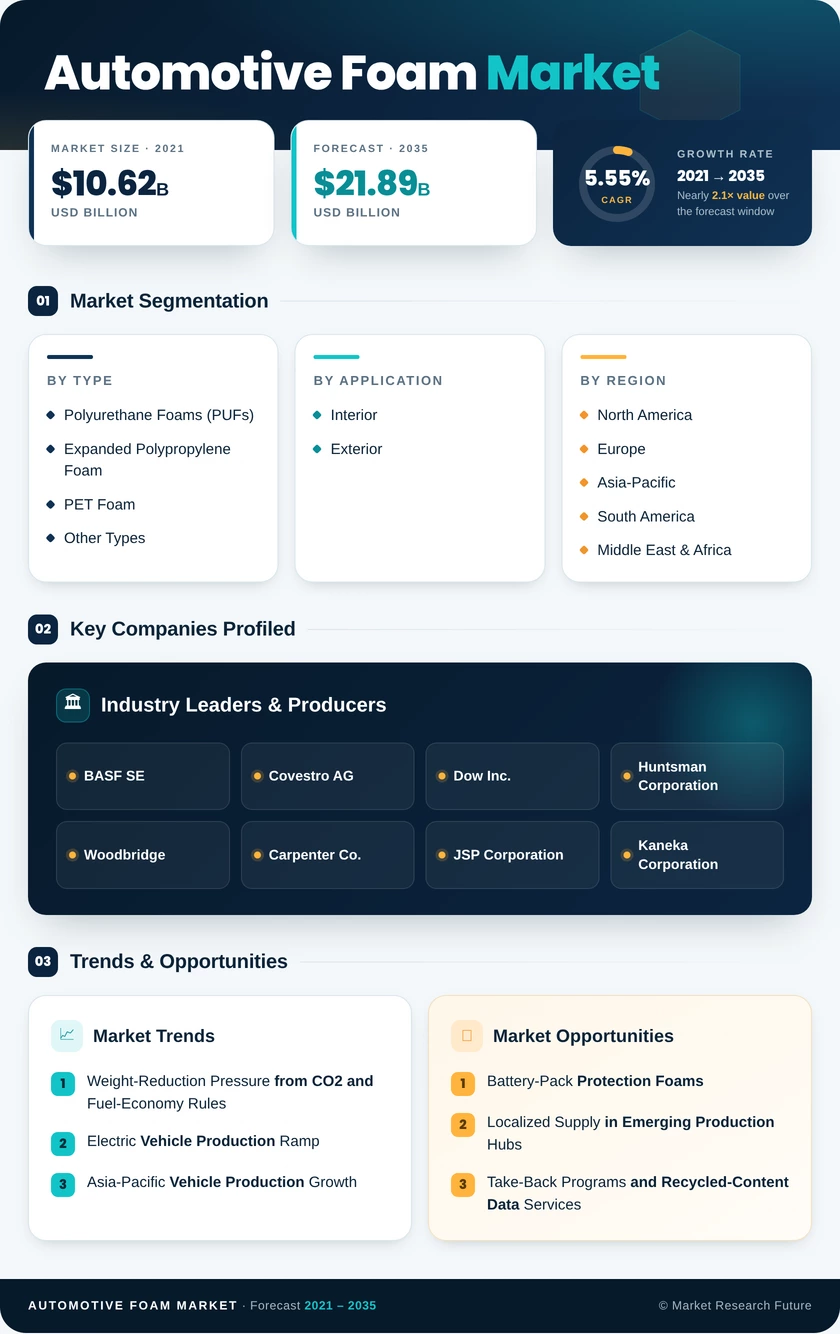
Segmentation Quick Reference
| Dimension | Sub-Segments | Dominant Segment | Fastest Growing Segment |
|---|
| By Type | Polyurethane Foams (PUFs); Expanded Polypropylene Foam; PET Foam; Other Types | Polyurethane Foams (PUFs) (64.5% share) | Expanded Polypropylene Foam (7.2% CAGR) |
| By Application | Interior; Exterior | Interior (72.0% share) | Exterior (6.3% CAGR) |
| By Region | North America; Europe; Asia-Pacific; South America; Middle East & Africa | Asia-Pacific (46.5% share) | Asia-Pacific (46.5% share) |
Market Segmentation Overview
| Sub-Segment | Key Trend |
|---|
| Polyurethane Foams (PUFs) | Closed-loop and bio-attributed polyols entering seat programs |
| Expanded Polypropylene Foam | Substitution of steel seat pans and bumper absorbers |
| PET Foam | Recyclable cores for underbody and trunk panels |
| Other Types | Melamine and polyethylene foams for heat and sealing niches |
Polyurethane Foams (PUFs) lead this dimension of the Automotive Foam Market because molded flexible foam is still the only economical way to tune seat comfort across density zones. Expanded Polypropylene Foam grows fastest since its beads mold into rigid, lightweight structures that survive repeated impacts and recycle mechanically, which aligns with the recycled-content proposal. PET Foam gains share in panels where recyclability outweighs cushioning.
| Sub-Segment | Key Trend |
|---|
| Interior | Multi-density, ventilated and lounge-style seating |
| Exterior | Pedestrian-safety bumpers and EV underbody shielding |
Interior applications lead the Automotive Foam Market because seats, headliners and door panels carry most foam weight in every vehicle class. Exterior applications grow faster as stricter pedestrian-protection scoring and battery underbody protection require energy-absorbing foam that tolerates heat, water and stone impact.


 Noah Malgeri
Co-Founder

 Peter Groot koerkamp
Account and Business Manager

 Younghwan Choi
Senior Retail Manager

 Mark Irwin
Management Consultant

 Akif Moroglu
Strategy & Business Development Director

 Guilherme Gomes Martins
Product Management Director

 Joseph Aguayo
Sales Operations & Pricing Manager

 La Terria Dodd
Program Support Specialist

 Rob Kooiker
Group Product Manager HVAC & Fire Protection GMA