Request Free Sample ×

Kindly complete the form below to receive a free sample of this Report

* Please use a valid business email

Leading companies partner with us for data-driven Insights

clients tt-cursor
Hero Background
English
Chinese
French
Japanese
Korean
German
Spanish

Automotive Flex Fuel Engine Market Share

ID: MRFR/AT/4809-HCR
100 Pages
Triveni Bhoyar
April 2026

Automotive Flex Fuel Engine Market Research Report Information By Engine Capacity Type (Compact-Size Engine, Full-Size Engine), Fuel Type (Gasoline, Diesel), and Vehicle Type (Passenger Vehicles, Commercial Vehicles) And Region (Asia-Pacific, Europe, North America, And Rest Of The World) –Market Forecast Till 2035

Share:
Download PDF ×

We do not share your information with anyone. However, we may send you emails based on your report interest from time to time. You may contact us at any time to opt-out.

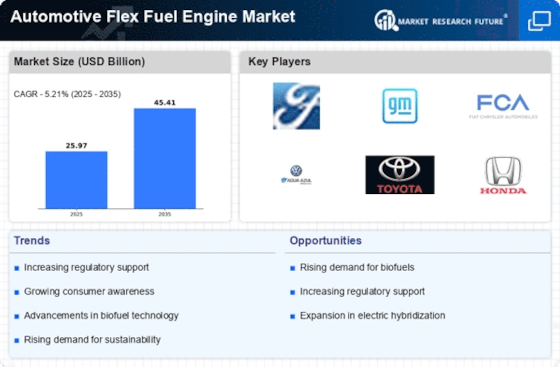
Automotive Flex Fuel Engine Market Infographic
Purchase Options

Market Share

Automotive Flex Fuel Engine Market Share Analysis

The Automotive Flex Fuel Engine Market is experiencing notable trends as the automotive industry navigates the changing landscape of fuel options and environmental considerations. A significant trend in this market is the increasing adoption of flexible fuel engines designed to run on a blend of gasoline and ethanol, typically referred to as E85. As the automotive sector places greater emphasis on sustainable and renewable fuel sources, flex fuel engines offer consumers the flexibility to choose between conventional gasoline and ethanol, contributing to a more diverse and eco-friendly fuel landscape.

Moreover, the market is witnessing a surge in the production and promotion of flex fuel vehicles (FFVs) by automakers. FFVs are equipped with engines capable of running on gasoline, ethanol, or any mixture of the two. This trend aligns with the industry's commitment to reducing greenhouse gas emissions and meeting stringent fuel efficiency standards. Automakers are increasingly incorporating flex fuel technology into their lineup, providing consumers with a broader range of choices to align with their preferences and environmental considerations.

Another noteworthy trend is the growing government support and incentives for the production and consumption of ethanol-based fuels. Many countries and regions are implementing policies and subsidies to promote the use of biofuels, including ethanol. These initiatives aim to reduce dependence on fossil fuels, decrease carbon emissions, and stimulate the growth of the automotive flex fuel engine market. Government backing plays a pivotal role in encouraging both consumers and manufacturers to embrace flex fuel technologies.

Furthermore, the market is responding to increased consumer awareness and environmental consciousness. As consumers become more informed about the environmental impact of their vehicle choices, there is a growing interest in flex fuel engines as a more sustainable option. The ability to use ethanol, a renewable and domestically produced fuel, resonates with environmentally conscious consumers seeking to reduce their carbon footprint and contribute to cleaner air quality.

Additionally, advancements in engine technology and fuel management systems are shaping trends in the automotive flex fuel engine market. Automakers are continually improving the efficiency and performance of flex fuel engines, optimizing combustion processes to ensure smooth operation with varying ethanol-gasoline blends. Advanced electronic control systems allow these engines to dynamically adjust parameters based on the fuel mixture, maximizing efficiency and power output.

Moreover, the market is witnessing collaborations between automakers and biofuel producers to create a more comprehensive ecosystem for flex fuel vehicles. Partnerships between the automotive and biofuel industries aim to address challenges related to fuel availability, infrastructure, and consumer awareness. These collaborations contribute to building a more robust and integrated support system for flex fuel vehicles, fostering market growth and sustainability.

In conclusion, the Automotive Flex Fuel Engine Market is undergoing transformative trends driven by the industry's commitment to sustainable fuel options, government support for biofuels, increased consumer awareness, advancements in engine technology, and collaborative efforts between automakers and biofuel producers. The adoption of flex fuel engines, the promotion of flex fuel vehicles, and the continuous improvement of engine efficiency underscore the automotive sector's dedication to providing environmentally friendly choices for consumers. As the market continues to evolve, flex fuel engines are positioned to play a significant role in the transition towards more sustainable and diverse fuel solutions in the automotive industry.


Author
Author Profile
Triveni Bhoyar
Senior Research Analyst

Triveni Bhoyar has over 5 years of experience in the market research industry, specializing in the Automotive and Aerospace & Defense sectors. She has contributed to 200+ reports, including numerous custom projects for leading global companies, delivering solutions to complex business challenges. Renowned for her ability to generate valuable insights, Triveni excels in addressing unique market dynamics with precision and depth. Her expertise spans market sizing, competitive intelligence, and trend analysis, enabling clients to craft data-driven growth strategies. With strong analytical rigor and a client-centric approach, she plays a pivotal role in driving impactful, strategic decision-making.

Leave a Comment

FAQs

What is the projected market valuation for the Automotive Flex Fuel Engine Market in 2035?

<p>The projected market valuation for the Automotive Flex Fuel Engine Market in 2035 is 45.41 USD Billion.</p>

What was the market valuation for the Automotive Flex Fuel Engine Market in 2024?

<p>The market valuation for the Automotive Flex Fuel Engine Market in 2024 was 25.97 USD Billion.</p>

What is the expected CAGR for the Automotive Flex Fuel Engine Market from 2025 to 2035?

<p>The expected CAGR for the Automotive Flex Fuel Engine Market during the forecast period 2025 - 2035 is 5.21%.</p>

Which companies are considered key players in the Automotive Flex Fuel Engine Market?

<p>Key players in the Automotive Flex Fuel Engine Market include Ford Motor Company, General Motors, Fiat Chrysler Automobiles, and Toyota Motor Corporation.</p>

What are the projected valuations for Compact-Size and Full-Size Engines in the Automotive Flex Fuel Engine Market?

<p>The projected valuation for Compact-Size Engines is between 10.0 and 17.0 USD Billion, while Full-Size Engines range from 15.97 to 28.41 USD Billion.</p>

How do the valuations for gasoline and diesel fuel types compare in the Automotive Flex Fuel Engine Market?

<p>The projected valuation for gasoline fuel types is between 15.0 and 25.0 USD Billion, whereas diesel fuel types range from 10.97 to 20.41 USD Billion.</p>

What is the market segmentation for passenger and commercial vehicles in the Automotive Flex Fuel Engine Market?

The projected valuation for passenger vehicles is between 15.0 and 25.0 USD Billion, while commercial vehicles range from 10.97 to 20.41 USD Billion.

How does the Automotive Flex Fuel Engine Market's growth potential appear in the context of increasing environmental regulations?

The growth potential of the Automotive Flex Fuel Engine Market appears promising, as increasing environmental regulations may drive demand for more flexible fuel options.

What role do major automotive manufacturers play in the Automotive Flex Fuel Engine Market?

Major automotive manufacturers like Volkswagen AG and Honda Motor Co., Ltd. play a crucial role in advancing technology and expanding the Automotive Flex Fuel Engine Market.

What trends are likely to influence the Automotive Flex Fuel Engine Market between 2025 and 2035?

Trends such as advancements in engine technology and shifts towards sustainable fuel sources are likely to influence the Automotive Flex Fuel Engine Market between 2025 and 2035.

Market Summary

As per Market Research Future analysis, the Automotive Flex Fuel Engine Market Size was estimated at 25.97 USD Billion in 2024. The Automotive Flex Fuel Engine industry is projected to grow from 27.32 USD Billion in 2025 to 45.41 USD Billion by 2035, exhibiting a compound annual growth rate (CAGR) of 5.21% during the forecast period 2025 - 2035

Key Market Trends & Highlights

The Automotive Flex Fuel Engine Market is poised for growth driven by sustainability and technological advancements.

  • The market experiences rising demand for sustainable vehicles, particularly in North America, which remains the largest market. Technological advancements in engine design are enhancing performance and efficiency, appealing to environmentally conscious consumers. The expansion of biofuel infrastructure is facilitating the adoption of flex fuel vehicles, especially in the Asia-Pacific region, the fastest-growing market. Increasing environmental regulations and consumer preference for fuel efficiency are key drivers propelling the market forward.

Market Size & Forecast

2024 Market Size 25.97 (USD Billion)
2035 Market Size 45.41 (USD Billion)
CAGR (2025 - 2035) 5.21%
Largest Regional Market Share in 2024 North America

Major Players

Ford Motor Company (US), General Motors (US), Fiat Chrysler Automobiles (IT), Volkswagen AG (DE), Toyota Motor Corporation (JP), Honda Motor Co., Ltd. (JP), Nissan Motor Co., Ltd. (JP), BMW AG (DE), Daimler AG (DE)

Market Trends

The Automotive Flex Fuel Engine Market is currently experiencing a notable transformation, driven by a confluence of environmental regulations and consumer preferences for sustainable alternatives. As governments worldwide implement stricter emissions standards, manufacturers are increasingly focusing on developing vehicles that can operate on multiple fuel types, including ethanol and gasoline. This shift not only aligns with global sustainability goals but also caters to a growing demographic of eco-conscious consumers. Furthermore, advancements in engine technology are enhancing the efficiency and performance of flex fuel vehicles, making them more appealing to a broader audience. In addition to regulatory pressures, the Automotive Flex Fuel Engine Market is influenced by the rising availability of biofuels and the expansion of infrastructure to support these alternative energy sources. The increasing production of ethanol from renewable resources is likely to bolster the market, as it provides a viable solution to reduce dependency on fossil fuels. Moreover, collaborations between automotive manufacturers and biofuel producers may further accelerate the adoption of flex fuel technology. As the market evolves, it appears poised for growth, with innovations and strategic partnerships playing a crucial role in shaping its future landscape.

Rising Demand for Sustainable Vehicles

There is a growing consumer inclination towards vehicles that minimize environmental impact. This trend is likely to drive the Automotive Flex Fuel Engine Market as more individuals seek alternatives to traditional gasoline engines.

Technological Advancements in Engine Design

Innovations in engine technology are enhancing the performance and efficiency of flex fuel vehicles. These advancements may attract a wider range of consumers, thereby expanding the market.

Expansion of Biofuel Infrastructure

The development of infrastructure to support biofuels is crucial for the Automotive Flex Fuel Engine Market. Increased availability of ethanol and other renewable fuels could facilitate greater adoption of flex fuel technology.

Automotive Flex Fuel Engine Market Market Drivers

Advancements in Biofuel Technology

The Automotive Flex Fuel Engine Market is significantly influenced by advancements in biofuel technology. As research and development efforts continue to enhance the production and efficiency of biofuels, the viability of flex fuel engines is further solidified. Innovations in feedstock selection and processing techniques have led to the creation of more sustainable and cost-effective biofuels. For instance, the development of second and third-generation biofuels, derived from non-food sources, is expected to expand the market for flex fuel vehicles. By 2025, it is projected that biofuels could account for over 10% of the total fuel market, thereby providing a robust foundation for the Automotive Flex Fuel Engine Market. This trend not only supports environmental goals but also encourages manufacturers to integrate flex fuel capabilities into their vehicle offerings.

Government Incentives and Subsidies

Government incentives and subsidies play a crucial role in shaping the Automotive Flex Fuel Engine Market. Many governments are offering financial incentives to consumers who purchase flex fuel vehicles, which can significantly lower the initial cost barrier. These incentives may include tax credits, rebates, or reduced registration fees, making flex fuel vehicles more appealing to potential buyers. Additionally, manufacturers are often provided with subsidies to encourage the development and production of flex fuel engines. As of 2025, it is estimated that several countries have allocated substantial budgets to support the transition to alternative fuel vehicles, thereby enhancing the attractiveness of the Automotive Flex Fuel Engine Market. This financial support is likely to stimulate market growth and encourage wider adoption of flex fuel technology.

Increasing Environmental Regulations

The Automotive Flex Fuel Engine Market is experiencing a surge in demand due to increasing environmental regulations aimed at reducing greenhouse gas emissions. Governments worldwide are implementing stricter emissions standards, which compel manufacturers to innovate and adopt cleaner technologies. Flex fuel engines, capable of running on a blend of gasoline and biofuels, align with these regulations, offering a viable solution for compliance. As of 2025, it is estimated that over 30 countries have enacted policies promoting the use of flex fuel vehicles, thereby enhancing their market presence. This regulatory push not only encourages manufacturers to invest in flex fuel technology but also drives consumer interest in environmentally friendly vehicles, further propelling the Automotive Flex Fuel Engine Market.

Consumer Preference for Fuel Efficiency

In the Automotive Flex Fuel Engine Market, consumer preference for fuel efficiency is a pivotal driver. As fuel prices fluctuate, consumers are increasingly seeking vehicles that offer better mileage and lower operating costs. Flex fuel engines, which can utilize a variety of fuel blends, provide an attractive option for cost-conscious consumers. Recent data indicates that vehicles equipped with flex fuel technology can achieve up to 20% better fuel economy compared to traditional gasoline engines. This efficiency not only appeals to individual consumers but also to fleet operators looking to reduce fuel expenditures. Consequently, the growing emphasis on fuel efficiency is likely to bolster the Automotive Flex Fuel Engine Market, as manufacturers respond to this demand with innovative flex fuel solutions.

Rising Awareness of Renewable Energy Sources

The Automotive Flex Fuel Engine Market is benefiting from the rising awareness of renewable energy sources among consumers and policymakers alike. As the global community increasingly recognizes the importance of transitioning to renewable energy to combat climate change, flex fuel vehicles, which can utilize renewable biofuels, are gaining traction. This awareness is driving demand for vehicles that not only reduce dependency on fossil fuels but also contribute to a more sustainable future. Surveys indicate that a significant percentage of consumers are willing to pay a premium for vehicles that utilize renewable energy sources. Consequently, this growing consciousness is likely to enhance the Automotive Flex Fuel Engine Market, as manufacturers respond to consumer preferences by expanding their offerings of flex fuel vehicles.

Market Segment Insights

By Engine Capacity: Compact-Size Engine (Largest) vs. Full-Size Engine (Fastest-Growing)

In the Automotive Flex Fuel Engine Market, the Compact-Size Engine holds a significant share due to its efficiency and lower emissions, appealing to environmentally conscious consumers. This segment appeals particularly to compact car manufacturers, which dominate a large portion of the automotive market. In contrast, the Full-Size Engine is rapidly gaining traction, catering to consumers seeking power and versatility in their vehicles, particularly in SUVs and trucks, aligning with the growing demand for performance vehicles.

Engine Capacity: Compact-Size (Dominant) vs. Full-Size (Emerging)

The Compact-Size Engine segment remains dominant in the market, celebrated for its blend of fuel efficiency, affordability, and reduced emissions, making it highly attractive to urban drivers and eco-conscious consumers. Its widespread adoption is bolstered by government initiatives promoting smaller, more efficient vehicles that comply with stricter emissions regulations. Conversely, the Full-Size Engine segment is marking its presence as an emerging player, driven by the increasing popularity of SUVs and trucks among consumers who prioritize performance and towing capacity. With advancements in flex fuel technology, full-size engines are becoming more efficient, thus appealing to a broader range of customers interested in capabilities without sacrificing environmental considerations.

By Fuel Type: Gasoline (Largest) vs. Diesel (Fastest-Growing)

In the automotive flex fuel engine market, fuel types are primarily divided into gasoline and diesel. Gasoline dominates the segment with a significant share due to its widespread availability and consumer preference for vehicles that utilize it. Numerous manufacturers are focusing on enhancing the performance and efficiency of gasoline engines, which reinforces its strong foothold in the market. On the other hand, diesel is gaining traction rapidly, thanks to its efficiency and the consistent push for lower emissions, appealing to both manufacturers and eco-conscious consumers.

Fuel Type: Gasoline (Dominant) vs. Diesel (Emerging)

Gasoline, as the dominant fuel type in the automotive flex fuel engine market, holds a robust position due to its long-standing use in vehicles and extensive infrastructure for refueling. The advantages of gasoline include lower upfront costs and a more extensive model availability among manufacturers. In contrast, diesel is emerging as a significant alternative due to its enhanced fuel efficiency and the ability to perform better under heavy loads, making it a preferred choice for certain vehicle categories. The increasing popularity of diesel can be attributed to stringent emission regulations driving innovations in cleaner diesel technology. Consequently, while gasoline remains the primary choice, diesel is carving out a growing niche, appealing to specific consumer segments.

By Vehicle Type: Passenger Vehicles (Largest) vs. Commercial Vehicles (Fastest-Growing)

The Automotive Flex Fuel Engine Market is primarily driven by the passenger vehicle segment, which holds the largest market share. This segment's dominance is attributed to the increasing consumer preferences for flexible fuel options that optimally balance performance and efficiency. Additionally, the rise in environmentally conscious consumers has propelled manufacturers to focus on developing flex fuel technologies that align with sustainability goals, further enhancing the segment's prominence. On the other hand, the commercial vehicles segment is emerging as the fastest-growing segment within the market. The growth in this segment is propelled by rising demand for fuel-efficient and eco-friendly vehicles among fleet operators. Additionally, government initiatives supporting the adoption of flexible fuel technology in commercial transportation are anticipated to drive the commercial vehicle segment's growth in the coming years, positioning it as a critical player in the overall market landscape.

Passenger Vehicles (Dominant) vs. Commercial Vehicles (Emerging)

Passenger vehicles represent a dominant force in the Automotive Flex Fuel Engine Market, favored for their ability to provide consumers with flexibility and choice regarding fuel types. With a broad array of models available, from sedans to SUVs, this segment benefits from the growing trend towards more sustainable and efficient fuel use. In contrast, the commercial vehicle segment, while currently smaller, is regarded as an emerging player with significant growth potential. Commercial vehicles are increasingly integrating flex fuel technology to comply with stringent emissions regulations and enhance operational efficiency for businesses. As the market evolves, both segments are expected to play vital roles, albeit in differing capacities, with passenger vehicles remaining dominant and commercial vehicles experiencing rapid growth.

Get more detailed insights about Automotive Flex Fuel Engine Market Research Report Forecast to 2035

Regional Insights

North America : Market Leader in Flex Fuel

North America is the largest market for automotive flex fuel engines, holding approximately 60% of the global market share. The region's growth is driven by increasing consumer demand for environmentally friendly vehicles and supportive government regulations promoting alternative fuels. The U.S. government has implemented various incentives to encourage the adoption of flex fuel vehicles, further boosting market growth. The competitive landscape in North America is dominated by major players such as Ford Motor Company and General Motors, which have invested heavily in flex fuel technology. These companies are continuously innovating to enhance engine performance and fuel efficiency. Additionally, the presence of a well-established infrastructure for ethanol production supports the market, making it easier for consumers to access flex fuel options.

Europe : Emerging Market for Flex Fuel

Europe is witnessing a significant shift towards flex fuel engines, driven by stringent emissions regulations and a growing emphasis on sustainability. The region holds about 25% of the global market share, with countries like Germany and France leading the charge. The European Union has set ambitious targets for reducing greenhouse gas emissions, which is catalyzing the adoption of flex fuel technology across member states. Germany, home to major automotive manufacturers like Volkswagen AG and BMW AG, is at the forefront of this transition. The competitive landscape is characterized by a mix of traditional automakers and new entrants focusing on eco-friendly technologies. The European market is also supported by government initiatives aimed at promoting alternative fuels, enhancing the overall growth of the flex fuel engine segment.

Asia-Pacific : Rapidly Growing Market

Asia-Pacific is rapidly emerging as a significant market for automotive flex fuel engines, accounting for approximately 10% of the global market share. The region's growth is fueled by increasing urbanization, rising disposable incomes, and a growing awareness of environmental issues. Countries like Japan and India are leading the way, with government policies encouraging the use of alternative fuels to combat pollution and reduce dependence on fossil fuels. Japan, with key players like Toyota and Honda, is focusing on developing advanced flex fuel technologies. The competitive landscape is evolving, with both domestic and international manufacturers vying for market share. Additionally, the presence of a robust automotive supply chain in the region supports the growth of flex fuel engines, making them more accessible to consumers.

Middle East and Africa : Emerging Opportunities

The Middle East and Africa region is gradually recognizing the potential of automotive flex fuel engines, currently holding about 5% of the global market share. The growth is primarily driven by increasing fuel prices and a rising awareness of environmental sustainability. Countries like South Africa are beginning to explore alternative fuel options, supported by government initiatives aimed at reducing carbon emissions and promoting cleaner technologies. The competitive landscape in this region is still developing, with a few key players starting to invest in flex fuel technology. The presence of oil-rich nations provides a unique challenge, as traditional fuel sources remain dominant. However, the growing interest in renewable energy and alternative fuels presents significant opportunities for market expansion in the coming years.

Key Players and Competitive Insights

Leading market players are investing heavily in research and development to expand their product lines, which will help the automotive flex fuel engine market grow even more. Market participants are also undertaking various strategic activities to expand their global footprint, with important market developments including new product launches, contractual agreements, mergers and acquisitions, higher investments, and collaboration with other organizations. The automotive flex fuel engine industry must offer cost-effective items to expand and survive in a more competitive and rising market climate.
Manufacturing locally to minimize operational costs is one of the key business tactics manufacturers use in the global automotive flex fuel engine industry to benefit clients and increase the market sector. The automotive flex fuel engine industry has offered some of the most significant advantages in recent years. Major players in the automotive flex fuel engine market, Mitsubishi Motors Corporation (Japan), Nissan Motor Co. Ltd. (Japan), Volvo Cars (Sweden), AUDI (Germany), Fiat Chrysler Automobiles (UK), Toyota Motor Corporation (Japan), Honda Motor Co.
Ltd. (Japan), General Motors Company (US), Ford Motor Company (US) and Volkswagen (Germany) are attempting to increase market demand by investing in research and development operations.
Nissan Motor Corporation, commonly abbreviated as Nissan, is a global Japanese automaker headquartered in Nishi-ku, Yokohama. The labels under which the firm distributes its cars are Nissan, Infiniti, and formerly Datsun. Nismo is the name of their in-house performance tuning line of goods, including automobiles. The organization's first predecessor is the Nissan Zaibatsu or Nissan Group. To gain an advantage over its rivals, Nissan Motor Co. Ltd. (Japan) invests a sizeable amount of money in the research and development of flex-fuel engines. This will assist the business in increasing sales revenue.
Volkswagen, sometimes known as VW, is a German automaker headquartered in Wolfsburg, Lower Saxony. Ivan Hirst, a British Army officer, revived the German Labour Front's 1937 global brand after World War II. It is best known for the iconic Beetle and serves as the flagship brand of the Volkswagen Group, the largest automaker by global sales in 2016 and 2017. China is the group's largest market, accounting for 40% of sales and profits.
Audi, SEAT, Porsche, Lamborghini, Bentley, Bugatti, Scania, MAN, and Koda are just a few of the automotive and truck brands that fall under the umbrella of the Volkswagen Group, a huge international organization. The global headquarters of Volkswagen Group is situated in Wolfsburg, Germany, the birthplace of Volkswagen. Volkswagen has decided to turn Brazil into a hub for flex-fuel engines that operate on ethanol or petrol for hybrid vehicles starting in 2021.

Key Companies in the Automotive Flex Fuel Engine Market include

Industry Developments

Mitsubishi Motors Corporation (Japan): March, 2024: The company revealed plans to expand its flex fuel engine technology to more models by 2025, aiming for a 30% increase in production capacity and Mitsubishi announced the launch of a new flex fuel version of its popular SUV, featuring improved fuel efficiency and lower emissions.

Fiat Chrysler Automobiles (UK): May, 2024: Fiat Chrysler introduced a new flex fuel engine in its compact car lineup, promising better performance and efficiency and the company committed to increasing the production of flex fuel vehicles by 40% by 2026, aiming to meet growing consumer demand for sustainable options.

February 2022: In Brazil, BMW unveiled a 3-series vehicle with ethanol-compatible fuel. The new BMW 3 series can run on ethanol and operate normally. The 3-series 2.0-liter four-cylinder B48 turbo engine has been slightly tweaked to operate on ethanol-based gasoline.

July 2021: Volkswagen has decided to turn Brazil into a hub for flex-fuel engines, which can operate on either ethanol or petrol and are used in hybrid vehicles. The objective is to export the technology and the upcoming engines to nations in Latin America and farther-off locations like South Africa and India.

Future Outlook

Automotive Flex Fuel Engine Market Future Outlook

The Automotive Flex Fuel Engine Market is projected to grow at a 5.21% CAGR from 2025 to 2035, driven by increasing environmental regulations, consumer demand for alternative fuels, and technological advancements.

New opportunities lie in:

  • Development of advanced biofuel production facilities
  • Partnerships with renewable energy providers for fuel supply
  • Integration of flex fuel technology in electric hybrid vehicles

By 2035, the market is expected to be robust, driven by innovation and strategic partnerships.

Market Segmentation

Automotive Flex Fuel Engine Market Fuel Type Outlook

  • Gasoline
  • Diesel

Automotive Flex Fuel Engine Market Vehicle Type Outlook

  • Passenger Vehicles
  • Commercial Vehicles

Automotive Flex Fuel Engine Market Engine Capacity Outlook

  • Compact-Size Engine
  • Full-Size Engine

Report Scope

MARKET SIZE 2024 25.97(USD Billion)
MARKET SIZE 2025 27.32(USD Billion)
MARKET SIZE 2035 45.41(USD Billion)
COMPOUND ANNUAL GROWTH RATE (CAGR) 5.21% (2025 - 2035)
REPORT COVERAGE Revenue Forecast, Competitive Landscape, Growth Factors, and Trends
BASE YEAR 2024
Market Forecast Period 2025 - 2035
Historical Data 2019 - 2024
Market Forecast Units USD Billion
Key Companies Profiled Ford Motor Company (US), General Motors (US), Fiat Chrysler Automobiles (IT), Volkswagen AG (DE), Toyota Motor Corporation (JP), Honda Motor Co., Ltd. (JP), Nissan Motor Co., Ltd. (JP), BMW AG (DE), Daimler AG (DE)
Segments Covered Engine Capacity Type
Key Market Opportunities Growing consumer preference for sustainable fuel options drives demand in the Automotive Flex Fuel Engine Market.
Key Market Dynamics Rising consumer demand for sustainable fuel options drives innovation in Automotive Flex Fuel Engine technology and production.
Countries Covered North America, Europe, APAC, South America, MEA

FAQs

What is the projected market valuation for the Automotive Flex Fuel Engine Market in 2035?

<p>The projected market valuation for the Automotive Flex Fuel Engine Market in 2035 is 45.41 USD Billion.</p>

What was the market valuation for the Automotive Flex Fuel Engine Market in 2024?

<p>The market valuation for the Automotive Flex Fuel Engine Market in 2024 was 25.97 USD Billion.</p>

What is the expected CAGR for the Automotive Flex Fuel Engine Market from 2025 to 2035?

<p>The expected CAGR for the Automotive Flex Fuel Engine Market during the forecast period 2025 - 2035 is 5.21%.</p>

Which companies are considered key players in the Automotive Flex Fuel Engine Market?

<p>Key players in the Automotive Flex Fuel Engine Market include Ford Motor Company, General Motors, Fiat Chrysler Automobiles, and Toyota Motor Corporation.</p>

What are the projected valuations for Compact-Size and Full-Size Engines in the Automotive Flex Fuel Engine Market?

<p>The projected valuation for Compact-Size Engines is between 10.0 and 17.0 USD Billion, while Full-Size Engines range from 15.97 to 28.41 USD Billion.</p>

How do the valuations for gasoline and diesel fuel types compare in the Automotive Flex Fuel Engine Market?

<p>The projected valuation for gasoline fuel types is between 15.0 and 25.0 USD Billion, whereas diesel fuel types range from 10.97 to 20.41 USD Billion.</p>

What is the market segmentation for passenger and commercial vehicles in the Automotive Flex Fuel Engine Market?

The projected valuation for passenger vehicles is between 15.0 and 25.0 USD Billion, while commercial vehicles range from 10.97 to 20.41 USD Billion.

How does the Automotive Flex Fuel Engine Market's growth potential appear in the context of increasing environmental regulations?

The growth potential of the Automotive Flex Fuel Engine Market appears promising, as increasing environmental regulations may drive demand for more flexible fuel options.

What role do major automotive manufacturers play in the Automotive Flex Fuel Engine Market?

Major automotive manufacturers like Volkswagen AG and Honda Motor Co., Ltd. play a crucial role in advancing technology and expanding the Automotive Flex Fuel Engine Market.

What trends are likely to influence the Automotive Flex Fuel Engine Market between 2025 and 2035?

Trends such as advancements in engine technology and shifts towards sustainable fuel sources are likely to influence the Automotive Flex Fuel Engine Market between 2025 and 2035.

  1. SECTION I: EXECUTIVE SUMMARY AND KEY HIGHLIGHTS
    1. | 1.1 EXECUTIVE SUMMARY
    2. | | 1.1.1 Market Overview
    3. | | 1.1.2 Key Findings
    4. | | 1.1.3 Market Segmentation
    5. | | 1.1.4 Competitive Landscape
    6. | | 1.1.5 Challenges and Opportunities
    7. | | 1.1.6 Future Outlook
  2. SECTION II: SCOPING, METHODOLOGY AND MARKET STRUCTURE
    1. | 2.1 MARKET INTRODUCTION
    2. | | 2.1.1 Definition
    3. | | 2.1.2 Scope of the study
    4. | | | 2.1.2.1 Research Objective
    5. | | | 2.1.2.2 Assumption
    6. | | | 2.1.2.3 Limitations
    7. | 2.2 RESEARCH METHODOLOGY
    8. | | 2.2.1 Overview
    9. | | 2.2.2 Data Mining
    10. | | 2.2.3 Secondary Research
    11. | | 2.2.4 Primary Research
    12. | | | 2.2.4.1 Primary Interviews and Information Gathering Process
    13. | | | 2.2.4.2 Breakdown of Primary Respondents
    14. | | 2.2.5 Forecasting Model
    15. | | 2.2.6 Market Size Estimation
    16. | | | 2.2.6.1 Bottom-Up Approach
    17. | | | 2.2.6.2 Top-Down Approach
    18. | | 2.2.7 Data Triangulation
    19. | | 2.2.8 Validation
  3. SECTION III: QUALITATIVE ANALYSIS
    1. | 3.1 MARKET DYNAMICS
    2. | | 3.1.1 Overview
    3. | | 3.1.2 Drivers
    4. | | 3.1.3 Restraints
    5. | | 3.1.4 Opportunities
    6. | 3.2 MARKET FACTOR ANALYSIS
    7. | | 3.2.1 Value chain Analysis
    8. | | 3.2.2 Porter's Five Forces Analysis
    9. | | | 3.2.2.1 Bargaining Power of Suppliers
    10. | | | 3.2.2.2 Bargaining Power of Buyers
    11. | | | 3.2.2.3 Threat of New Entrants
    12. | | | 3.2.2.4 Threat of Substitutes
    13. | | | 3.2.2.5 Intensity of Rivalry
    14. | | 3.2.3 COVID-19 Impact Analysis
    15. | | | 3.2.3.1 Market Impact Analysis
    16. | | | 3.2.3.2 Regional Impact
    17. | | | 3.2.3.3 Opportunity and Threat Analysis
  4. SECTION IV: QUANTITATIVE ANALYSIS
    1. | 4.1 Automobile, BY Engine Capacity (USD Billion)
    2. | | 4.1.1 Compact-Size Engine
    3. | | 4.1.2 Full-Size Engine
    4. | 4.2 Automobile, BY Fuel Type (USD Billion)
    5. | | 4.2.1 Gasoline
    6. | | 4.2.2 Diesel
    7. | 4.3 Automobile, BY Vehicle Type (USD Billion)
    8. | | 4.3.1 Passenger Vehicles
    9. | | 4.3.2 Commercial Vehicles
    10. | 4.4 Automobile, BY Region (USD Billion)
    11. | | 4.4.1 North America
    12. | | | 4.4.1.1 US
    13. | | | 4.4.1.2 Canada
    14. | | 4.4.2 Europe
    15. | | | 4.4.2.1 Germany
    16. | | | 4.4.2.2 UK
    17. | | | 4.4.2.3 France
    18. | | | 4.4.2.4 Russia
    19. | | | 4.4.2.5 Italy
    20. | | | 4.4.2.6 Spain
    21. | | | 4.4.2.7 Rest of Europe
    22. | | 4.4.3 APAC
    23. | | | 4.4.3.1 China
    24. | | | 4.4.3.2 India
    25. | | | 4.4.3.3 Japan
    26. | | | 4.4.3.4 South Korea
    27. | | | 4.4.3.5 Malaysia
    28. | | | 4.4.3.6 Thailand
    29. | | | 4.4.3.7 Indonesia
    30. | | | 4.4.3.8 Rest of APAC
    31. | | 4.4.4 South America
    32. | | | 4.4.4.1 Brazil
    33. | | | 4.4.4.2 Mexico
    34. | | | 4.4.4.3 Argentina
    35. | | | 4.4.4.4 Rest of South America
    36. | | 4.4.5 MEA
    37. | | | 4.4.5.1 GCC Countries
    38. | | | 4.4.5.2 South Africa
    39. | | | 4.4.5.3 Rest of MEA
  5. SECTION V: COMPETITIVE ANALYSIS
    1. | 5.1 Competitive Landscape
    2. | | 5.1.1 Overview
    3. | | 5.1.2 Competitive Analysis
    4. | | 5.1.3 Market share Analysis
    5. | | 5.1.4 Major Growth Strategy in the Automobile
    6. | | 5.1.5 Competitive Benchmarking
    7. | | 5.1.6 Leading Players in Terms of Number of Developments in the Automobile
    8. | | 5.1.7 Key developments and growth strategies
    9. | | | 5.1.7.1 New Product Launch/Service Deployment
    10. | | | 5.1.7.2 Merger & Acquisitions
    11. | | | 5.1.7.3 Joint Ventures
    12. | | 5.1.8 Major Players Financial Matrix
    13. | | | 5.1.8.1 Sales and Operating Income
    14. | | | 5.1.8.2 Major Players R&D Expenditure. 2023
    15. | 5.2 Company Profiles
    16. | | 5.2.1 Ford Motor Company (US)
    17. | | | 5.2.1.1 Financial Overview
    18. | | | 5.2.1.2 Products Offered
    19. | | | 5.2.1.3 Key Developments
    20. | | | 5.2.1.4 SWOT Analysis
    21. | | | 5.2.1.5 Key Strategies
    22. | | 5.2.2 General Motors (US)
    23. | | | 5.2.2.1 Financial Overview
    24. | | | 5.2.2.2 Products Offered
    25. | | | 5.2.2.3 Key Developments
    26. | | | 5.2.2.4 SWOT Analysis
    27. | | | 5.2.2.5 Key Strategies
    28. | | 5.2.3 Fiat Chrysler Automobiles (IT)
    29. | | | 5.2.3.1 Financial Overview
    30. | | | 5.2.3.2 Products Offered
    31. | | | 5.2.3.3 Key Developments
    32. | | | 5.2.3.4 SWOT Analysis
    33. | | | 5.2.3.5 Key Strategies
    34. | | 5.2.4 Volkswagen AG (DE)
    35. | | | 5.2.4.1 Financial Overview
    36. | | | 5.2.4.2 Products Offered
    37. | | | 5.2.4.3 Key Developments
    38. | | | 5.2.4.4 SWOT Analysis
    39. | | | 5.2.4.5 Key Strategies
    40. | | 5.2.5 Toyota Motor Corporation (JP)
    41. | | | 5.2.5.1 Financial Overview
    42. | | | 5.2.5.2 Products Offered
    43. | | | 5.2.5.3 Key Developments
    44. | | | 5.2.5.4 SWOT Analysis
    45. | | | 5.2.5.5 Key Strategies
    46. | | 5.2.6 Honda Motor Co., Ltd. (JP)
    47. | | | 5.2.6.1 Financial Overview
    48. | | | 5.2.6.2 Products Offered
    49. | | | 5.2.6.3 Key Developments
    50. | | | 5.2.6.4 SWOT Analysis
    51. | | | 5.2.6.5 Key Strategies
    52. | | 5.2.7 Nissan Motor Co., Ltd. (JP)
    53. | | | 5.2.7.1 Financial Overview
    54. | | | 5.2.7.2 Products Offered
    55. | | | 5.2.7.3 Key Developments
    56. | | | 5.2.7.4 SWOT Analysis
    57. | | | 5.2.7.5 Key Strategies
    58. | | 5.2.8 BMW AG (DE)
    59. | | | 5.2.8.1 Financial Overview
    60. | | | 5.2.8.2 Products Offered
    61. | | | 5.2.8.3 Key Developments
    62. | | | 5.2.8.4 SWOT Analysis
    63. | | | 5.2.8.5 Key Strategies
    64. | | 5.2.9 Daimler AG (DE)
    65. | | | 5.2.9.1 Financial Overview
    66. | | | 5.2.9.2 Products Offered
    67. | | | 5.2.9.3 Key Developments
    68. | | | 5.2.9.4 SWOT Analysis
    69. | | | 5.2.9.5 Key Strategies
    70. | 5.3 Appendix
    71. | | 5.3.1 References
    72. | | 5.3.2 Related Reports
  6. LIST OF FIGURES
    1. | 6.1 MARKET SYNOPSIS
    2. | 6.2 NORTH AMERICA MARKET ANALYSIS
    3. | 6.3 US MARKET ANALYSIS BY ENGINE CAPACITY
    4. | 6.4 US MARKET ANALYSIS BY FUEL TYPE
    5. | 6.5 US MARKET ANALYSIS BY VEHICLE TYPE
    6. | 6.6 CANADA MARKET ANALYSIS BY ENGINE CAPACITY
    7. | 6.7 CANADA MARKET ANALYSIS BY FUEL TYPE
    8. | 6.8 CANADA MARKET ANALYSIS BY VEHICLE TYPE
    9. | 6.9 EUROPE MARKET ANALYSIS
    10. | 6.10 GERMANY MARKET ANALYSIS BY ENGINE CAPACITY
    11. | 6.11 GERMANY MARKET ANALYSIS BY FUEL TYPE
    12. | 6.12 GERMANY MARKET ANALYSIS BY VEHICLE TYPE
    13. | 6.13 UK MARKET ANALYSIS BY ENGINE CAPACITY
    14. | 6.14 UK MARKET ANALYSIS BY FUEL TYPE
    15. | 6.15 UK MARKET ANALYSIS BY VEHICLE TYPE
    16. | 6.16 FRANCE MARKET ANALYSIS BY ENGINE CAPACITY
    17. | 6.17 FRANCE MARKET ANALYSIS BY FUEL TYPE
    18. | 6.18 FRANCE MARKET ANALYSIS BY VEHICLE TYPE
    19. | 6.19 RUSSIA MARKET ANALYSIS BY ENGINE CAPACITY
    20. | 6.20 RUSSIA MARKET ANALYSIS BY FUEL TYPE
    21. | 6.21 RUSSIA MARKET ANALYSIS BY VEHICLE TYPE
    22. | 6.22 ITALY MARKET ANALYSIS BY ENGINE CAPACITY
    23. | 6.23 ITALY MARKET ANALYSIS BY FUEL TYPE
    24. | 6.24 ITALY MARKET ANALYSIS BY VEHICLE TYPE
    25. | 6.25 SPAIN MARKET ANALYSIS BY ENGINE CAPACITY
    26. | 6.26 SPAIN MARKET ANALYSIS BY FUEL TYPE
    27. | 6.27 SPAIN MARKET ANALYSIS BY VEHICLE TYPE
    28. | 6.28 REST OF EUROPE MARKET ANALYSIS BY ENGINE CAPACITY
    29. | 6.29 REST OF EUROPE MARKET ANALYSIS BY FUEL TYPE
    30. | 6.30 REST OF EUROPE MARKET ANALYSIS BY VEHICLE TYPE
    31. | 6.31 APAC MARKET ANALYSIS
    32. | 6.32 CHINA MARKET ANALYSIS BY ENGINE CAPACITY
    33. | 6.33 CHINA MARKET ANALYSIS BY FUEL TYPE
    34. | 6.34 CHINA MARKET ANALYSIS BY VEHICLE TYPE
    35. | 6.35 INDIA MARKET ANALYSIS BY ENGINE CAPACITY
    36. | 6.36 INDIA MARKET ANALYSIS BY FUEL TYPE
    37. | 6.37 INDIA MARKET ANALYSIS BY VEHICLE TYPE
    38. | 6.38 JAPAN MARKET ANALYSIS BY ENGINE CAPACITY
    39. | 6.39 JAPAN MARKET ANALYSIS BY FUEL TYPE
    40. | 6.40 JAPAN MARKET ANALYSIS BY VEHICLE TYPE
    41. | 6.41 SOUTH KOREA MARKET ANALYSIS BY ENGINE CAPACITY
    42. | 6.42 SOUTH KOREA MARKET ANALYSIS BY FUEL TYPE
    43. | 6.43 SOUTH KOREA MARKET ANALYSIS BY VEHICLE TYPE
    44. | 6.44 MALAYSIA MARKET ANALYSIS BY ENGINE CAPACITY
    45. | 6.45 MALAYSIA MARKET ANALYSIS BY FUEL TYPE
    46. | 6.46 MALAYSIA MARKET ANALYSIS BY VEHICLE TYPE
    47. | 6.47 THAILAND MARKET ANALYSIS BY ENGINE CAPACITY
    48. | 6.48 THAILAND MARKET ANALYSIS BY FUEL TYPE
    49. | 6.49 THAILAND MARKET ANALYSIS BY VEHICLE TYPE
    50. | 6.50 INDONESIA MARKET ANALYSIS BY ENGINE CAPACITY
    51. | 6.51 INDONESIA MARKET ANALYSIS BY FUEL TYPE
    52. | 6.52 INDONESIA MARKET ANALYSIS BY VEHICLE TYPE
    53. | 6.53 REST OF APAC MARKET ANALYSIS BY ENGINE CAPACITY
    54. | 6.54 REST OF APAC MARKET ANALYSIS BY FUEL TYPE
    55. | 6.55 REST OF APAC MARKET ANALYSIS BY VEHICLE TYPE
    56. | 6.56 SOUTH AMERICA MARKET ANALYSIS
    57. | 6.57 BRAZIL MARKET ANALYSIS BY ENGINE CAPACITY
    58. | 6.58 BRAZIL MARKET ANALYSIS BY FUEL TYPE
    59. | 6.59 BRAZIL MARKET ANALYSIS BY VEHICLE TYPE
    60. | 6.60 MEXICO MARKET ANALYSIS BY ENGINE CAPACITY
    61. | 6.61 MEXICO MARKET ANALYSIS BY FUEL TYPE
    62. | 6.62 MEXICO MARKET ANALYSIS BY VEHICLE TYPE
    63. | 6.63 ARGENTINA MARKET ANALYSIS BY ENGINE CAPACITY
    64. | 6.64 ARGENTINA MARKET ANALYSIS BY FUEL TYPE
    65. | 6.65 ARGENTINA MARKET ANALYSIS BY VEHICLE TYPE
    66. | 6.66 REST OF SOUTH AMERICA MARKET ANALYSIS BY ENGINE CAPACITY
    67. | 6.67 REST OF SOUTH AMERICA MARKET ANALYSIS BY FUEL TYPE
    68. | 6.68 REST OF SOUTH AMERICA MARKET ANALYSIS BY VEHICLE TYPE
    69. | 6.69 MEA MARKET ANALYSIS
    70. | 6.70 GCC COUNTRIES MARKET ANALYSIS BY ENGINE CAPACITY
    71. | 6.71 GCC COUNTRIES MARKET ANALYSIS BY FUEL TYPE
    72. | 6.72 GCC COUNTRIES MARKET ANALYSIS BY VEHICLE TYPE
    73. | 6.73 SOUTH AFRICA MARKET ANALYSIS BY ENGINE CAPACITY
    74. | 6.74 SOUTH AFRICA MARKET ANALYSIS BY FUEL TYPE
    75. | 6.75 SOUTH AFRICA MARKET ANALYSIS BY VEHICLE TYPE
    76. | 6.76 REST OF MEA MARKET ANALYSIS BY ENGINE CAPACITY
    77. | 6.77 REST OF MEA MARKET ANALYSIS BY FUEL TYPE
    78. | 6.78 REST OF MEA MARKET ANALYSIS BY VEHICLE TYPE
    79. | 6.79 KEY BUYING CRITERIA OF AUTOMOBILE
    80. | 6.80 RESEARCH PROCESS OF MRFR
    81. | 6.81 DRO ANALYSIS OF AUTOMOBILE
    82. | 6.82 DRIVERS IMPACT ANALYSIS: AUTOMOBILE
    83. | 6.83 RESTRAINTS IMPACT ANALYSIS: AUTOMOBILE
    84. | 6.84 SUPPLY / VALUE CHAIN: AUTOMOBILE
    85. | 6.85 AUTOMOBILE, BY ENGINE CAPACITY, 2024 (% SHARE)
    86. | 6.86 AUTOMOBILE, BY ENGINE CAPACITY, 2024 TO 2035 (USD Billion)
    87. | 6.87 AUTOMOBILE, BY FUEL TYPE, 2024 (% SHARE)
    88. | 6.88 AUTOMOBILE, BY FUEL TYPE, 2024 TO 2035 (USD Billion)
    89. | 6.89 AUTOMOBILE, BY VEHICLE TYPE, 2024 (% SHARE)
    90. | 6.90 AUTOMOBILE, BY VEHICLE TYPE, 2024 TO 2035 (USD Billion)
    91. | 6.91 BENCHMARKING OF MAJOR COMPETITORS
  7. LIST OF TABLES
    1. | 7.1 LIST OF ASSUMPTIONS
    2. | | 7.1.1
    3. | 7.2 North America MARKET SIZE ESTIMATES; FORECAST
    4. | | 7.2.1 BY ENGINE CAPACITY, 2025-2035 (USD Billion)
    5. | | 7.2.2 BY FUEL TYPE, 2025-2035 (USD Billion)
    6. | | 7.2.3 BY VEHICLE TYPE, 2025-2035 (USD Billion)
    7. | 7.3 US MARKET SIZE ESTIMATES; FORECAST
    8. | | 7.3.1 BY ENGINE CAPACITY, 2025-2035 (USD Billion)
    9. | | 7.3.2 BY FUEL TYPE, 2025-2035 (USD Billion)
    10. | | 7.3.3 BY VEHICLE TYPE, 2025-2035 (USD Billion)
    11. | 7.4 Canada MARKET SIZE ESTIMATES; FORECAST
    12. | | 7.4.1 BY ENGINE CAPACITY, 2025-2035 (USD Billion)
    13. | | 7.4.2 BY FUEL TYPE, 2025-2035 (USD Billion)
    14. | | 7.4.3 BY VEHICLE TYPE, 2025-2035 (USD Billion)
    15. | 7.5 Europe MARKET SIZE ESTIMATES; FORECAST
    16. | | 7.5.1 BY ENGINE CAPACITY, 2025-2035 (USD Billion)
    17. | | 7.5.2 BY FUEL TYPE, 2025-2035 (USD Billion)
    18. | | 7.5.3 BY VEHICLE TYPE, 2025-2035 (USD Billion)
    19. | 7.6 Germany MARKET SIZE ESTIMATES; FORECAST
    20. | | 7.6.1 BY ENGINE CAPACITY, 2025-2035 (USD Billion)
    21. | | 7.6.2 BY FUEL TYPE, 2025-2035 (USD Billion)
    22. | | 7.6.3 BY VEHICLE TYPE, 2025-2035 (USD Billion)
    23. | 7.7 UK MARKET SIZE ESTIMATES; FORECAST
    24. | | 7.7.1 BY ENGINE CAPACITY, 2025-2035 (USD Billion)
    25. | | 7.7.2 BY FUEL TYPE, 2025-2035 (USD Billion)
    26. | | 7.7.3 BY VEHICLE TYPE, 2025-2035 (USD Billion)
    27. | 7.8 France MARKET SIZE ESTIMATES; FORECAST
    28. | | 7.8.1 BY ENGINE CAPACITY, 2025-2035 (USD Billion)
    29. | | 7.8.2 BY FUEL TYPE, 2025-2035 (USD Billion)
    30. | | 7.8.3 BY VEHICLE TYPE, 2025-2035 (USD Billion)
    31. | 7.9 Russia MARKET SIZE ESTIMATES; FORECAST
    32. | | 7.9.1 BY ENGINE CAPACITY, 2025-2035 (USD Billion)
    33. | | 7.9.2 BY FUEL TYPE, 2025-2035 (USD Billion)
    34. | | 7.9.3 BY VEHICLE TYPE, 2025-2035 (USD Billion)
    35. | 7.10 Italy MARKET SIZE ESTIMATES; FORECAST
    36. | | 7.10.1 BY ENGINE CAPACITY, 2025-2035 (USD Billion)
    37. | | 7.10.2 BY FUEL TYPE, 2025-2035 (USD Billion)
    38. | | 7.10.3 BY VEHICLE TYPE, 2025-2035 (USD Billion)
    39. | 7.11 Spain MARKET SIZE ESTIMATES; FORECAST
    40. | | 7.11.1 BY ENGINE CAPACITY, 2025-2035 (USD Billion)
    41. | | 7.11.2 BY FUEL TYPE, 2025-2035 (USD Billion)
    42. | | 7.11.3 BY VEHICLE TYPE, 2025-2035 (USD Billion)
    43. | 7.12 Rest of Europe MARKET SIZE ESTIMATES; FORECAST
    44. | | 7.12.1 BY ENGINE CAPACITY, 2025-2035 (USD Billion)
    45. | | 7.12.2 BY FUEL TYPE, 2025-2035 (USD Billion)
    46. | | 7.12.3 BY VEHICLE TYPE, 2025-2035 (USD Billion)
    47. | 7.13 APAC MARKET SIZE ESTIMATES; FORECAST
    48. | | 7.13.1 BY ENGINE CAPACITY, 2025-2035 (USD Billion)
    49. | | 7.13.2 BY FUEL TYPE, 2025-2035 (USD Billion)
    50. | | 7.13.3 BY VEHICLE TYPE, 2025-2035 (USD Billion)
    51. | 7.14 China MARKET SIZE ESTIMATES; FORECAST
    52. | | 7.14.1 BY ENGINE CAPACITY, 2025-2035 (USD Billion)
    53. | | 7.14.2 BY FUEL TYPE, 2025-2035 (USD Billion)
    54. | | 7.14.3 BY VEHICLE TYPE, 2025-2035 (USD Billion)
    55. | 7.15 India MARKET SIZE ESTIMATES; FORECAST
    56. | | 7.15.1 BY ENGINE CAPACITY, 2025-2035 (USD Billion)
    57. | | 7.15.2 BY FUEL TYPE, 2025-2035 (USD Billion)
    58. | | 7.15.3 BY VEHICLE TYPE, 2025-2035 (USD Billion)
    59. | 7.16 Japan MARKET SIZE ESTIMATES; FORECAST
    60. | | 7.16.1 BY ENGINE CAPACITY, 2025-2035 (USD Billion)
    61. | | 7.16.2 BY FUEL TYPE, 2025-2035 (USD Billion)
    62. | | 7.16.3 BY VEHICLE TYPE, 2025-2035 (USD Billion)
    63. | 7.17 South Korea MARKET SIZE ESTIMATES; FORECAST
    64. | | 7.17.1 BY ENGINE CAPACITY, 2025-2035 (USD Billion)
    65. | | 7.17.2 BY FUEL TYPE, 2025-2035 (USD Billion)
    66. | | 7.17.3 BY VEHICLE TYPE, 2025-2035 (USD Billion)
    67. | 7.18 Malaysia MARKET SIZE ESTIMATES; FORECAST
    68. | | 7.18.1 BY ENGINE CAPACITY, 2025-2035 (USD Billion)
    69. | | 7.18.2 BY FUEL TYPE, 2025-2035 (USD Billion)
    70. | | 7.18.3 BY VEHICLE TYPE, 2025-2035 (USD Billion)
    71. | 7.19 Thailand MARKET SIZE ESTIMATES; FORECAST
    72. | | 7.19.1 BY ENGINE CAPACITY, 2025-2035 (USD Billion)
    73. | | 7.19.2 BY FUEL TYPE, 2025-2035 (USD Billion)
    74. | | 7.19.3 BY VEHICLE TYPE, 2025-2035 (USD Billion)
    75. | 7.20 Indonesia MARKET SIZE ESTIMATES; FORECAST
    76. | | 7.20.1 BY ENGINE CAPACITY, 2025-2035 (USD Billion)
    77. | | 7.20.2 BY FUEL TYPE, 2025-2035 (USD Billion)
    78. | | 7.20.3 BY VEHICLE TYPE, 2025-2035 (USD Billion)
    79. | 7.21 Rest of APAC MARKET SIZE ESTIMATES; FORECAST
    80. | | 7.21.1 BY ENGINE CAPACITY, 2025-2035 (USD Billion)
    81. | | 7.21.2 BY FUEL TYPE, 2025-2035 (USD Billion)
    82. | | 7.21.3 BY VEHICLE TYPE, 2025-2035 (USD Billion)
    83. | 7.22 South America MARKET SIZE ESTIMATES; FORECAST
    84. | | 7.22.1 BY ENGINE CAPACITY, 2025-2035 (USD Billion)
    85. | | 7.22.2 BY FUEL TYPE, 2025-2035 (USD Billion)
    86. | | 7.22.3 BY VEHICLE TYPE, 2025-2035 (USD Billion)
    87. | 7.23 Brazil MARKET SIZE ESTIMATES; FORECAST
    88. | | 7.23.1 BY ENGINE CAPACITY, 2025-2035 (USD Billion)
    89. | | 7.23.2 BY FUEL TYPE, 2025-2035 (USD Billion)
    90. | | 7.23.3 BY VEHICLE TYPE, 2025-2035 (USD Billion)
    91. | 7.24 Mexico MARKET SIZE ESTIMATES; FORECAST
    92. | | 7.24.1 BY ENGINE CAPACITY, 2025-2035 (USD Billion)
    93. | | 7.24.2 BY FUEL TYPE, 2025-2035 (USD Billion)
    94. | | 7.24.3 BY VEHICLE TYPE, 2025-2035 (USD Billion)
    95. | 7.25 Argentina MARKET SIZE ESTIMATES; FORECAST
    96. | | 7.25.1 BY ENGINE CAPACITY, 2025-2035 (USD Billion)
    97. | | 7.25.2 BY FUEL TYPE, 2025-2035 (USD Billion)
    98. | | 7.25.3 BY VEHICLE TYPE, 2025-2035 (USD Billion)
    99. | 7.26 Rest of South America MARKET SIZE ESTIMATES; FORECAST
    100. | | 7.26.1 BY ENGINE CAPACITY, 2025-2035 (USD Billion)
    101. | | 7.26.2 BY FUEL TYPE, 2025-2035 (USD Billion)
    102. | | 7.26.3 BY VEHICLE TYPE, 2025-2035 (USD Billion)
    103. | 7.27 MEA MARKET SIZE ESTIMATES; FORECAST
    104. | | 7.27.1 BY ENGINE CAPACITY, 2025-2035 (USD Billion)
    105. | | 7.27.2 BY FUEL TYPE, 2025-2035 (USD Billion)
    106. | | 7.27.3 BY VEHICLE TYPE, 2025-2035 (USD Billion)
    107. | 7.28 GCC Countries MARKET SIZE ESTIMATES; FORECAST
    108. | | 7.28.1 BY ENGINE CAPACITY, 2025-2035 (USD Billion)
    109. | | 7.28.2 BY FUEL TYPE, 2025-2035 (USD Billion)
    110. | | 7.28.3 BY VEHICLE TYPE, 2025-2035 (USD Billion)
    111. | 7.29 South Africa MARKET SIZE ESTIMATES; FORECAST
    112. | | 7.29.1 BY ENGINE CAPACITY, 2025-2035 (USD Billion)
    113. | | 7.29.2 BY FUEL TYPE, 2025-2035 (USD Billion)
    114. | | 7.29.3 BY VEHICLE TYPE, 2025-2035 (USD Billion)
    115. | 7.30 Rest of MEA MARKET SIZE ESTIMATES; FORECAST
    116. | | 7.30.1 BY ENGINE CAPACITY, 2025-2035 (USD Billion)
    117. | | 7.30.2 BY FUEL TYPE, 2025-2035 (USD Billion)
    118. | | 7.30.3 BY VEHICLE TYPE, 2025-2035 (USD Billion)
    119. | 7.31 PRODUCT LAUNCH/PRODUCT DEVELOPMENT/APPROVAL
    120. | | 7.31.1
    121. | 7.32 ACQUISITION/PARTNERSHIP
    122. | | 7.32.1

Automobile Market Segmentation

Automobile By Engine Capacity (USD Billion, 2025-2035)

  • Compact-Size Engine
  • Full-Size Engine

Automobile By Fuel Type (USD Billion, 2025-2035)

  • Gasoline
  • Diesel

Automobile By Vehicle Type (USD Billion, 2025-2035)

  • Passenger Vehicles
  • Commercial Vehicles
Infographic

Free Sample Request

Kindly complete the form below to receive a free sample of this Report

Get Free Sample

Customer Strories

Compare Licence

×
Features License Type
Single User Multiuser License Enterprise User
Price $4,950 $5,950 $7,250
Maximum User Access Limit 1 User Upto 10 Users Unrestricted Access Throughout the Organization
Free Customization
Direct Access to Analyst
Deliverable Format
Platform Access
Discount on Next Purchase 10% 15% 15%
Printable Versions
%>