Request Free Sample ×

Kindly complete the form below to receive a free sample of this Report

* Please use a valid business email

Leading companies partner with us for data-driven Insights

clients tt-cursor
Hero Background
English
Chinese
French
Japanese
Korean
German
Spanish

Automotive Engine Market Share

ID: MRFR/AT/1612-HCR
100 Pages
Shubham Munde
March 2026

Automotive Engine Market Research Report By Engine Type (Internal Combustion Engine, Hybrid Engine, Electric Engine, Hydrogen Fuel Cell Engine), By Engine Size (Small Engine, Medium Engine, Large Engine), By Fuel Type (Gasoline, Diesel, Natural Gas, Ethanol), By Application (Passenger Vehicles, Commercial Vehicles, Heavy-Duty Vehicles) and By Regional (North America, Europe, South America, Asia Pacific, Middle East and Africa) - Forecast to 2035

Share:
Download PDF ×

We do not share your information with anyone. However, we may send you emails based on your report interest from time to time. You may contact us at any time to opt-out.

Automotive Engine Market Infographic
Purchase Options

Market Share

Automotive Engine Market Share Analysis

In the profoundly cutthroat scene of the Automotive Engine Market, organizations utilize different market share situating procedures to acquire an upper hand and lay out serious areas of strength for a. Organizations put vigorously in innovative work to present high level engine advancements that upgrade execution, eco-friendliness, and natural maintainability. This draws in naturally cognizant purchasers as well as positions the organization as an industry chief, adding to a bigger market share. By highlighting functional proficiency, economies of scale, and store network streamlining, organizations can offer great engines at cutthroat costs. This system expects to catch a more extensive client base, particularly in cost delicate markets. Financially savvy creation processes and key organizations with providers empower organizations to keep up with serious evaluating, along these lines expanding their market share. By lining up with central members in the automotive business, organizations can get to new markets and client sections, reinforcing their situation in the market. By understanding the assorted prerequisites of various fragments, organizations can foster engines that take special care of explicit applications, like games vehicles, electric vehicles, or rigid trucks. This designated approach permits organizations to infiltrate specialty markets and lay out areas of strength for a, adding to an expanded market share inside those sections. Brand situating is basic in affecting purchaser discernment and, thusly, market share. Laying out zones of strength for a positive brand picture can separate an organization from its rivals. This includes successful marketing systems, accentuating the unwavering quality, execution, and in general worth of the engines. Brand steadfastness, worked through predictable quality and positive client encounters, contributes fundamentally to market share development. Organizations in the Automotive Engine Market are consolidating green advances, like mixture and electric engines, to line up with worldwide ecological worries. Positioning as eco-accommodating and socially dependable draws in naturally cognizant buyers as well as positions the organization as a ground breaking industry player, in this way impacting market share decidedly. Whether through mechanical development, cost initiative, key collusions, market division, brand situating, or natural maintainability, organizations endeavor to separate themselves and catch a bigger portion of the market. The viability of these techniques relies upon a blend of variables, including market patterns, buyer inclinations, and the capacity to adjust to the developing scene of the automotive business.

Author
Author Profile
Shubham Munde
Team Lead - Research

Shubham brings over 7 years of expertise in Market Intelligence and Strategic Consulting, with a strong focus on the Automotive, Aerospace, and Defense sectors. Backed by a solid foundation in semiconductors, electronics, and software, he has successfully delivered high-impact syndicated and custom research on a global scale. His core strengths include market sizing, forecasting, competitive intelligence, consumer insights, and supply chain mapping. Widely recognized for developing scalable growth strategies, Shubham empowers clients to navigate complex markets and achieve a lasting competitive edge. Trusted by start-ups and Fortune 500 companies alike, he consistently converts challenges into strategic opportunities that drive sustainable growth.

Leave a Comment

FAQs

What is the projected market valuation of the Automotive Engine Market by 2035?

<p>The Automotive Engine Market is projected to reach a valuation of 711.65 USD Billion by 2035.</p>

What was the market valuation of the Automotive Engine Market in 2024?

<p>In 2024, the Automotive Engine Market was valued at 509.74 USD Billion.</p>

What is the expected CAGR for the Automotive Engine Market from 2025 to 2035?

<p>The expected CAGR for the Automotive Engine Market during the forecast period 2025 - 2035 is 3.08%.</p>

Which companies are considered key players in the Automotive Engine Market?

<p>Key players in the Automotive Engine Market include Toyota Motor Corporation, Volkswagen AG, General Motors Company, and Ford Motor Company.</p>

What are the projected valuations for different engine types in 2035?

<p>By 2035, Internal Combustion Engines are projected to reach 400.0 USD Billion, Hybrid Engines 150.0 USD Billion, Electric Engines 130.0 USD Billion, and Hydrogen Fuel Cell Engines 31.65 USD Billion.</p>

How does the market size for large engines compare to small and medium engines in 2035?

<p>In 2035, the market size for large engines is projected to be 291.65 USD Billion, compared to 140.0 USD Billion for small engines and 280.0 USD Billion for medium engines.</p>

What is the expected market performance for different fuel types by 2035?

<p>By 2035, gasoline engines are expected to reach 300.0 USD Billion, diesel engines 200.0 USD Billion, natural gas engines 80.0 USD Billion, and ethanol engines 11.65 USD Billion.</p>

What is the projected market size for passenger vehicles in 2035?

<p>The market size for passenger vehicles is projected to reach 300.0 USD Billion by 2035.</p>

How do commercial and heavy-duty vehicle markets compare in 2035?

<p>In 2035, the commercial vehicle market is projected at 200.0 USD Billion, while the heavy-duty vehicle market is expected to reach 211.65 USD Billion.</p>

What trends are influencing the growth of the Automotive Engine Market?

<p>Trends such as the increasing demand for fuel-efficient engines and the shift towards electric and hybrid technologies are influencing the growth of the Automotive Engine Market.</p>

Market Summary

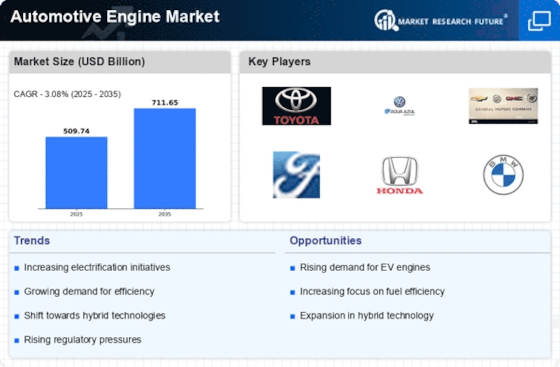
As per Market Research Future analysis, the Automotive Engine Market Size was estimated at 509.74 USD Billion in 2024. The Automotive Engine industry is projected to grow from 525.44 USD Billion in 2025 to 711.65 USD Billion by 2035, exhibiting a compound annual growth rate (CAGR) of 3.0% during the forecast period 2025 - 2035

Key Market Trends & Highlights

The Automotive Engine Market is currently experiencing a transformative shift towards electrification and advanced technologies.

  • The market is witnessing a pronounced shift towards electrification, particularly in the Asia-Pacific region, which is the fastest-growing market. Integration of smart technologies is becoming increasingly prevalent, enhancing engine performance and user experience across various segments. Fuel efficiency remains a critical focus, especially in North America, the largest market, where consumer demand drives innovation. Rising demand for fuel efficiency and regulatory compliance are major drivers, particularly influencing the growth of electric engines and large engine segments.

Market Size & Forecast

2024 Market Size 509.74 (USD Billion)
2035 Market Size 711.65 (USD Billion)
CAGR (2025 - 2035) 3.08%
Largest Regional Market Share in 2024 Asia Pacific

Major Players

Toyota Motor Corporation (JP), Volkswagen AG (DE), General Motors Company (US), Ford Motor Company (US), Honda Motor Co., Ltd. (JP), BMW AG (DE), Daimler AG (DE), Nissan Motor Co., Ltd. (JP), Hyundai Motor Company (KR)

Market Trends

The Automotive Engine Market is currently undergoing a transformative phase, driven by advancements in technology and shifting consumer preferences across the engine industry. The increasing emphasis on sustainability and environmental concerns has prompted auto engine manufacturers  to innovate and develop engines that are more efficient and less polluting. This evolution is not merely a response to regulatory pressures but also reflects a broader societal shift towards greener alternatives as automakers develop engine platforms that prioritize lower emissions and higher efficiency.

As a result, hybrid and powertrains within engines automotive applications are gaining traction, indicating a potential decline in traditional combustion engines. Furthermore, the integration of smart technologies into engine design is enhancing performance and user experience, suggesting a future where connectivity and automation play pivotal roles in automotive engineering and are frequently highlighted in each new engine report.. In addition to technological advancements, the Automotive Engine Market is influenced by global economic factors and changing consumer behaviors shaping the wider engine industry.

The rise of electric vehicles is reshaping market dynamics, as consumers increasingly prioritize fuel efficiency and lower emissions. This trend is likely to continue, with manufacturers investing heavily in research and development to meet evolving demands. Moreover, the competitive landscape is becoming more complex, with new entrants challenging established players. As the market adapts to these changes, it appears poised for growth, driven by innovation and a commitment to sustainability.

Shift Towards Electrification

The Automotive Engine Market is witnessing a notable shift towards electrification, as manufacturers increasingly focus on developing electric and hybrid engines. This trend is largely driven by consumer demand for environmentally friendly vehicles and government regulations aimed at reducing emissions. As battery technology improves, electric engines are becoming more viable, potentially leading to a decline in traditional internal combustion engines.

Integration of Smart Technologies

The incorporation of smart technologies into engine design is becoming more prevalent in the Automotive Engine Market. Features such as real-time monitoring, predictive maintenance, and enhanced connectivity are enhancing engine performance and user experience. This trend suggests that future engines will not only be more efficient but also more integrated with the overall vehicle ecosystem.

Focus on Fuel Efficiency

There is a growing emphasis on fuel efficiency within the Automotive Engine Market, as consumers seek to reduce operating costs and environmental impact. Manufacturers are responding by developing engines that optimize fuel consumption without compromising performance. This trend indicates a potential shift in engineering priorities, as efficiency becomes a key selling point in a competitive landscape.

Automotive Engine Market Market Drivers

Rising Demand for Fuel Efficiency

The Automotive Engine Market is experiencing a notable shift towards fuel-efficient engines, driven by increasing consumer awareness and regulatory pressures. As fuel prices fluctuate, consumers are more inclined to choose vehicles that offer better mileage. In 2025, it is estimated that fuel-efficient vehicles will account for over 60% of new car sales, reflecting a significant trend in consumer preferences. Manufacturers are investing heavily in research and development to create engines that not only meet but exceed fuel efficiency standards. This trend is further supported by government initiatives aimed at reducing carbon emissions, which are likely to bolster the demand for advanced engine technologies. Consequently, the Automotive Engine Market is poised for growth as it adapts to these evolving consumer expectations and regulatory frameworks.

Growth of Hybrid and Electric Vehicles

The Automotive Engine Market is significantly influenced by the increasing adoption of hybrid and electric vehicles. As consumers become more environmentally conscious, the demand for vehicles that utilize alternative powertrains is on the rise. In 2025, hybrid and electric vehicles are anticipated to represent approximately 30% of total vehicle sales, a substantial increase from previous years. This shift is prompting traditional automotive manufacturers to invest in developing engines that can accommodate hybrid technologies, thereby expanding their product offerings. Additionally, government incentives for electric vehicle purchases are likely to further stimulate market growth. Consequently, the Automotive Engine Market is adapting to this trend, focusing on integrating electric and hybrid technologies into their engine designs to meet evolving consumer demands.

Technological Advancements in Engine Design

The Automotive Engine Market is witnessing rapid technological advancements that enhance engine performance and efficiency. Innovations such as turbocharging, direct fuel injection, and variable valve timing are becoming increasingly prevalent. These technologies allow manufacturers to produce engines that deliver higher power outputs while maintaining lower emissions. In 2025, it is projected that engines equipped with these advanced technologies will dominate the market, potentially comprising over 70% of new engine production. Furthermore, the integration of artificial intelligence in engine management systems is likely to optimize performance in real-time, further driving the evolution of engine design. As a result, the Automotive Engine Market is expected to benefit from these advancements, leading to improved consumer satisfaction and compliance with stringent environmental regulations.

Regulatory Compliance and Emission Standards

The Automotive Engine Market is heavily influenced by stringent regulatory compliance and emission standards imposed by governments worldwide. As environmental concerns escalate, regulations aimed at reducing greenhouse gas emissions are becoming more rigorous. In 2025, it is expected that many regions will enforce stricter emission limits, compelling manufacturers to innovate and develop cleaner engine technologies. This regulatory landscape is likely to drive investments in research and development, as companies strive to meet these standards while maintaining performance. The Automotive Engine Market must navigate these challenges, which could lead to a surge in demand for engines that utilize alternative fuels and advanced emission control technologies. As a result, compliance with these regulations is not only a necessity but also a potential driver of growth within the industry.

Consumer Preference for Performance and Reliability

The Automotive Engine Market is significantly shaped by consumer preferences for performance and reliability in vehicles. As consumers increasingly seek vehicles that offer superior driving experiences, manufacturers are compelled to enhance engine performance while ensuring durability. In 2025, it is projected that engines delivering high torque and horsepower will be favored, particularly in the luxury and performance vehicle segments. This trend indicates a shift towards engines that not only meet basic transportation needs but also provide an exhilarating driving experience. Consequently, the Automotive Engine Market is likely to focus on developing high-performance engines that cater to these consumer demands, thereby fostering brand loyalty and enhancing market competitiveness.

Market Segment Insights

By Engine Type: Internal Combustion Engine (Largest) vs. Electric Engine (Fastest-Growing)

The Automotive Engine Market is characterized by a diverse range of engine types, with the <a href="https://www.marketresearchfuture.com/reports/internal-combustion-engine-market-28193">Internal Combustion Engine (ICE) </a>commanding a significant share. Despite slow growth in recent years due to environmental concerns and regulatory changes, ICE remains the most widely used engine type in vehicles. In contrast, the Electric Engine segment is rapidly gaining traction, largely driven by increasing consumer demand for eco-friendly transportation. Market dynamics are shifting as hybrid and hydrogen fuel cell engines also begin to capture interest, offering alternative solutions that fit various consumer preferences.

Hybrid Engine (Emerging) vs. Hydrogen Fuel Cell Engine (Emerging)

The Hybrid Engine segment is increasingly viewed as a transitional technology, combining the benefits of both traditional Internal Combustion Engines and Electric Engines to improve fuel efficiency and reduce emissions. As fuel efficiency regulations become stricter, hybrid technology continues to attract interest, particularly among consumers looking for a balance of performance and eco-friendliness. On the other hand, Hydrogen Fuel Cell Engines represent an emerging market with significant potential. Their ability to produce zero emissions through a chemical reaction offers a unique selling proposition. However, challenges such as infrastructure development and cost of production remain key hurdles to widespread adoption. Both engine types are poised for growth as the industry moves towards sustainable transportation solutions.

By Engine Size: Small Engine (Largest) vs. Large Engine (Fastest-Growing)

The Automotive Engine Market exhibits a diverse distribution of engine sizes, with the small engine segment capturing the largest share, driven by its wide application in compact vehicles and growing consumer preference for fuel-efficient options. Meanwhile, medium and large engines cater to specific markets, such as premium and performance vehicles, though they occupy lesser market shares. In particular, small engines have established a stronghold within urban environments, promoting adoption due to their economical benefits.

Small Engine (Dominant) vs. Large Engine (Emerging)

The small engine segment is characterized by its efficiency, lightweight design, and cost-effectiveness, making it the dominant option for manufacturers targeting urban consumers. These engines are ideal for small cars, hybrids, and even scooters, aligning well with environmental regulations emphasizing lower emissions. Conversely, the large engine segment is emerging as a response to demands for higher performance and power, frequently utilized in SUVs and trucks. Despite its smaller market share, it is witnessing growth propelled by the popularity of larger vehicles, emphasizing performance and capability.

By Fuel Type: Gasoline (Largest) vs. Diesel (Fastest-Growing)

The automotive engine market is significantly influenced by the fuel types utilized in vehicles. Currently, gasoline engines dominate the market, accounting for the majority of vehicle sales due to their widespread availability and consumer preference for performance and cost. On the other hand, diesel engines, traditionally favored for heavy-duty applications, are experiencing rapid growth as advancements in technology make them more efficient and suitable for passenger vehicles in certain regions. This trend is leading to an increased share for diesel fuel in the overall automotive landscape. In terms of growth trends, the demand for diesel engines is being propelled by the need for fuel efficiency and lower CO2 emissions, especially in commercial vehicles. Government regulations concerning emissions are also pushing manufacturers to adopt cleaner diesel technologies. Meanwhile, alternative fuel options, such as natural gas and ethanol, are emerging but currently hold a smaller share of the market. Their growth is largely reliant on evolving infrastructure and changing consumer attitudes towards sustainability, positioning them as potential drivers of future trends in the automotive engine segment.

Gasoline: Dominant vs. Natural Gas: Emerging

Gasoline serves as the prevailing choice in the automotive engine market, primarily attributed to its performance characteristics and infrastructure support. It delivers a balance of affordability, efficiency, and driving experience that resonates well with consumers. On the other hand, natural gas, while currently an emerging fuel type, is gaining traction due to its lower emissions and the global push toward more sustainable transport solutions. The natural gas engine market benefits from growing investments in refueling infrastructure and shifts in consumer preferences towards greener alternatives. As regulations become stricter regarding emissions, both fuel types will need to adapt; however, gasoline's strong foothold in the market provides it with a distinct advantage over the still-nascent natural gas sector.

By Application: Passenger Vehicles (Largest) vs. Commercial Vehicles (Fastest-Growing)

In the Automotive Engine Market, the application segment is predominantly led by passenger vehicles, which hold the largest market share. This segment benefits from strong consumer demand spurred by increasing disposable income and a rise in urbanization. Meanwhile, commercial vehicles account for a significant portion of demand, primarily driven by economic activities in sectors like transportation and logistics. Heavy-duty vehicles, though critical, represent a smaller share, mainly due to their specialized nature and higher costs.

Passenger Vehicles (Dominant) vs. Heavy-Duty Vehicles (Emerging)

Passenger vehicles stand as the dominant application in the automotive engine market, reflecting consumer preferences for personal mobility and comfort. Global urbanization trends have led to an increased production of sedans and SUVs, bolstering this segment. On the other hand, heavy-duty vehicles are emerging due to growing demand in construction and freight transport. These engines are engineered for durability and efficiency under rigorous conditions, catering to niche sectors. The heavy-duty segment is potentially poised for growth as global infrastructure projects expand, creating opportunities for innovations that enhance fuel efficiency and lower emissions.

Get more detailed insights about Automotive Engine Market Research Report – Forecast to 2035

Regional Insights

The Automotive Engine Market was experiencing significant growth across various regions. North America led with a valuation of 145.0 USD Billion, accounting for a sizeable share, thanks to its advanced automotive technology and high demand for efficient engines. Europe followed closely at 120.0 USD Billion, driven by strict emission regulations and the increasing adoption of electric vehicles.

The APAC region was notable for its rapid expansion, with a valuation of 180.0 USD Billion, where countries like China and Japan played crucial roles due to high production rates and consumer demand.

Meanwhile, South America, valued at 20.0 USD Billion, and MEA, at 29.51 USD Billion, represented smaller yet significant markets that were growing due to improving automotive infrastructure and economic development.

The dominance of North America and APAC indicated their pivotal role in shaping the Automotive Engine Market's future, propelling overall market growth with innovations and investments in cleaner technologies.

Key Players and Competitive Insights

The Automotive Engine Market is witnessing dynamic competitive landscapes influenced by technological advancements, stringent emissions regulations, and shifting consumer preferences toward fuel efficiency and electrification. Various automotive manufacturers are striving to innovate their engine technologies while optimizing performance and reducing environmental impact. This market variability fosters an environment of competition driven by advancements in engine designs, alternative fuel sources, and electric vehicle integration. Participants in this sector must not only stay ahead of current trends but also adapt to the growing demand for sustainable solutions, making competitive insights crucial for strategic planning and market positioning. General Motors has established a significant presence in the Automotive Engine Market through its continuous innovations and strong brand recognition. The company is recognized for its commitment to producing high-performance and reliable engines that cater to a diverse range of vehicles. General Motors invests heavily in research and development, allowing them to enhance engine efficiency while focusing on reducing emissions. Their strategy emphasizes diversification in powertrain offerings, capitalizing on both traditional combustion engines and a growing lineup of electric and hybrid vehicles. A robust supply chain and various partnerships further reinforce General Motors' strengths in manufacturing and distributing engines globally, positioning the company as a formidable player in this highly competitive market. BMW also plays a prominent role in the Automotive Engine Industry, known for its engineering excellence and commitment to performance. This company's focus on performance-oriented engines and luxury vehicles is well-recognized, and they leverage their expertise to develop innovative technologies such as turbocharging and hybrid powertrains. BMW emphasizes sustainability without compromising on the driving experience, which has become a hallmark of its brand. The company's strategic partnerships with technology firms enhance its capabilities in electric mobility, positioning them favorably in a market that increasingly leans toward electrification. Furthermore, BMW's reputation for high-quality performance engines reinforces its competitive advantage, allowing it to maintain a strong market presence while responding effectively to consumer demands for advanced automotive solutions.

Key Companies in the Automotive Engine Market include

Industry Developments

  • Q2 2024: Toyota to invest $1.4 billion in Indiana plant for new hybrid engine production Toyota announced a $1.4 billion investment to expand its Princeton, Indiana facility, adding new lines for hybrid engine production to support upcoming electrified vehicle models.
  • Q2 2024: Cummins launches new hydrogen internal combustion engine for commercial vehicles Cummins unveiled its new hydrogen-powered internal combustion engine, targeting commercial truck fleets seeking zero-emission solutions while leveraging existing engine platforms.
  • Q2 2024: Ford opens new engine testing center in Michigan to accelerate hybrid and EV powertrain development Ford inaugurated a state-of-the-art engine and powertrain testing facility in Dearborn, Michigan, focused on hybrid and electric vehicle engine systems.
  • Q3 2024: Volkswagen and Mahle partner to develop next-generation turbocharged gasoline engines Volkswagen and Mahle announced a strategic partnership to co-develop advanced turbocharged gasoline engines with improved efficiency and lower emissions for global markets.
  • Q3 2024: Renault secures €500 million contract to supply hybrid engines to Geely Renault signed a major contract with Geely to supply hybrid engine systems for Geely’s new range of electrified vehicles in Asia and Europe.
  • Q3 2024: General Motors appoints new head of global engine and propulsion systems General Motors named Dr. Lisa Chen as the new executive vice president overseeing global engine and propulsion system development, signaling a renewed focus on hybrid and alternative fuel engines.
  • Q4 2024: Honda opens new engine manufacturing plant in Thailand Honda officially opened a new engine manufacturing facility in Thailand, designed to produce both internal combustion and hybrid engines for Southeast Asian markets.
  • Q4 2024: Hyundai launches next-generation Smartstream engine family for global markets Hyundai introduced its new Smartstream engine lineup, featuring improved fuel efficiency and lower emissions, to be deployed across multiple vehicle models worldwide.
  • Q1 2025: Stellantis announces $800 million investment in Italian engine plant for hybrid and EV powertrains Stellantis revealed plans to invest $800 million in its Termoli, Italy plant to convert it for the production of hybrid and electric vehicle engines.
  • Q1 2025: Daimler Truck secures major contract to supply heavy-duty engines to Volvo Group Daimler Truck signed a multi-year agreement to supply heavy-duty diesel and hybrid engines to Volvo Group for use in commercial vehicles across Europe.
  • Q2 2025: Nissan and Mitsubishi form joint venture for next-gen hybrid engine development Nissan and Mitsubishi announced the formation of a joint venture focused on developing next-generation hybrid engines, aiming to accelerate electrification in their global vehicle lineups.
  • Q2 2025: Cummins opens new hydrogen engine R&D center in Germany Cummins inaugurated a dedicated research and development center in Germany to advance hydrogen internal combustion engine technology for commercial and industrial applications.

Future Outlook

Automotive Engine Market Future Outlook

The Automotive Engine Market is projected to grow at a 3.08% CAGR from 2025 to 2035, driven by advancements in fuel efficiency, emissions regulations, and electric vehicle integration.

New opportunities lie in:

  • <p>Development of hybrid engine technologies for enhanced fuel efficiency. Investment in alternative fuel engine research to meet regulatory demands. Expansion of aftermarket services for engine performance optimization.</p>

By 2035, the market is expected to exhibit robust growth, adapting to evolving consumer and regulatory demands.

Market Segmentation

Automotive Engine Market Fuel Type Outlook

  • Gasoline
  • Diesel
  • Natural Gas
  • Ethanol

Automotive Engine Market Application Outlook

  • Passenger Vehicles
  • Commercial Vehicles
  • Heavy-Duty Vehicles

Automotive Engine Market Engine Size Outlook

  • Small Engine
  • Medium Engine
  • Large Engine

Automotive Engine Market Engine Type Outlook

  • Internal Combustion Engine
  • Hybrid Engine
  • Electric Engine
  • Hydrogen Fuel Cell Engine

Report Scope

MARKET SIZE 2024 509.74(USD Billion)
MARKET SIZE 2025 525.44(USD Billion)
MARKET SIZE 2035 711.65(USD Billion)
COMPOUND ANNUAL GROWTH RATE (CAGR) 3.08% (2025 - 2035)
REPORT COVERAGE Revenue Forecast, Competitive Landscape, Growth Factors, and Trends
BASE YEAR 2024
Market Forecast Period 2025 - 2035
Historical Data 2019 - 2024
Market Forecast Units USD Billion
Key Companies Profiled Toyota Motor Corporation (JP), Volkswagen AG (DE), General Motors Company (US), Ford Motor Company (US), Honda Motor Co., Ltd. (JP), BMW AG (DE), Daimler AG (DE), Nissan Motor Co., Ltd. (JP), Hyundai Motor Company (KR)
Segments Covered Engine Type, Engine Size, Fuel Type, Application, Regional
Key Market Opportunities Integration of advanced electric powertrains in the Automotive Engine Market enhances efficiency and reduces emissions.
Key Market Dynamics Technological advancements in electric and hybrid engines are reshaping competitive dynamics in the automotive engine market.
Countries Covered North America, Europe, APAC, South America, MEA

FAQs

What is the projected market valuation of the Automotive Engine Market by 2035?

<p>The Automotive Engine Market is projected to reach a valuation of 711.65 USD Billion by 2035.</p>

What was the market valuation of the Automotive Engine Market in 2024?

<p>In 2024, the Automotive Engine Market was valued at 509.74 USD Billion.</p>

What is the expected CAGR for the Automotive Engine Market from 2025 to 2035?

<p>The expected CAGR for the Automotive Engine Market during the forecast period 2025 - 2035 is 3.08%.</p>

Which companies are considered key players in the Automotive Engine Market?

<p>Key players in the Automotive Engine Market include Toyota Motor Corporation, Volkswagen AG, General Motors Company, and Ford Motor Company.</p>

What are the projected valuations for different engine types in 2035?

<p>By 2035, Internal Combustion Engines are projected to reach 400.0 USD Billion, Hybrid Engines 150.0 USD Billion, Electric Engines 130.0 USD Billion, and Hydrogen Fuel Cell Engines 31.65 USD Billion.</p>

How does the market size for large engines compare to small and medium engines in 2035?

<p>In 2035, the market size for large engines is projected to be 291.65 USD Billion, compared to 140.0 USD Billion for small engines and 280.0 USD Billion for medium engines.</p>

What is the expected market performance for different fuel types by 2035?

<p>By 2035, gasoline engines are expected to reach 300.0 USD Billion, diesel engines 200.0 USD Billion, natural gas engines 80.0 USD Billion, and ethanol engines 11.65 USD Billion.</p>

What is the projected market size for passenger vehicles in 2035?

<p>The market size for passenger vehicles is projected to reach 300.0 USD Billion by 2035.</p>

How do commercial and heavy-duty vehicle markets compare in 2035?

<p>In 2035, the commercial vehicle market is projected at 200.0 USD Billion, while the heavy-duty vehicle market is expected to reach 211.65 USD Billion.</p>

What trends are influencing the growth of the Automotive Engine Market?

<p>Trends such as the increasing demand for fuel-efficient engines and the shift towards electric and hybrid technologies are influencing the growth of the Automotive Engine Market.</p>

  1. SECTION I: EXECUTIVE SUMMARY AND KEY HIGHLIGHTS
    1. | 1.1 EXECUTIVE SUMMARY
    2. | | 1.1.1 Market Overview
    3. | | 1.1.2 Key Findings
    4. | | 1.1.3 Market Segmentation
    5. | | 1.1.4 Competitive Landscape
    6. | | 1.1.5 Challenges and Opportunities
    7. | | 1.1.6 Future Outlook
  2. SECTION II: SCOPING, METHODOLOGY AND MARKET STRUCTURE
    1. | 2.1 MARKET INTRODUCTION
    2. | | 2.1.1 Definition
    3. | | 2.1.2 Scope of the study
    4. | | | 2.1.2.1 Research Objective
    5. | | | 2.1.2.2 Assumption
    6. | | | 2.1.2.3 Limitations
    7. | 2.2 RESEARCH METHODOLOGY
    8. | | 2.2.1 Overview
    9. | | 2.2.2 Data Mining
    10. | | 2.2.3 Secondary Research
    11. | | 2.2.4 Primary Research
    12. | | | 2.2.4.1 Primary Interviews and Information Gathering Process
    13. | | | 2.2.4.2 Breakdown of Primary Respondents
    14. | | 2.2.5 Forecasting Model
    15. | | 2.2.6 Market Size Estimation
    16. | | | 2.2.6.1 Bottom-Up Approach
    17. | | | 2.2.6.2 Top-Down Approach
    18. | | 2.2.7 Data Triangulation
    19. | | 2.2.8 Validation
  3. SECTION III: QUALITATIVE ANALYSIS
    1. | 3.1 MARKET DYNAMICS
    2. | | 3.1.1 Overview
    3. | | 3.1.2 Drivers
    4. | | 3.1.3 Restraints
    5. | | 3.1.4 Opportunities
    6. | 3.2 MARKET FACTOR ANALYSIS
    7. | | 3.2.1 Value chain Analysis
    8. | | 3.2.2 Porter's Five Forces Analysis
    9. | | | 3.2.2.1 Bargaining Power of Suppliers
    10. | | | 3.2.2.2 Bargaining Power of Buyers
    11. | | | 3.2.2.3 Threat of New Entrants
    12. | | | 3.2.2.4 Threat of Substitutes
    13. | | | 3.2.2.5 Intensity of Rivalry
    14. | | 3.2.3 COVID-19 Impact Analysis
    15. | | | 3.2.3.1 Market Impact Analysis
    16. | | | 3.2.3.2 Regional Impact
    17. | | | 3.2.3.3 Opportunity and Threat Analysis
  4. SECTION IV: QUANTITATIVE ANALYSIS
    1. | 4.1 Automobile, BY Engine Type (USD Billion)
    2. | | 4.1.1 Internal Combustion Engine
    3. | | 4.1.2 Hybrid Engine
    4. | | 4.1.3 Electric Engine
    5. | | 4.1.4 Hydrogen Fuel Cell Engine
    6. | 4.2 Automobile, BY Engine Size (USD Billion)
    7. | | 4.2.1 Small Engine
    8. | | 4.2.2 Medium Engine
    9. | | 4.2.3 Large Engine
    10. | 4.3 Automobile, BY Fuel Type (USD Billion)
    11. | | 4.3.1 Gasoline
    12. | | 4.3.2 Diesel
    13. | | 4.3.3 Natural Gas
    14. | | 4.3.4 Ethanol
    15. | 4.4 Automobile, BY Application (USD Billion)
    16. | | 4.4.1 Passenger Vehicles
    17. | | 4.4.2 Commercial Vehicles
    18. | | 4.4.3 Heavy-Duty Vehicles
    19. | 4.5 Automobile, BY Region (USD Billion)
    20. | | 4.5.1 North America
    21. | | | 4.5.1.1 US
    22. | | | 4.5.1.2 Canada
    23. | | 4.5.2 Europe
    24. | | | 4.5.2.1 Germany
    25. | | | 4.5.2.2 UK
    26. | | | 4.5.2.3 France
    27. | | | 4.5.2.4 Russia
    28. | | | 4.5.2.5 Italy
    29. | | | 4.5.2.6 Spain
    30. | | | 4.5.2.7 Rest of Europe
    31. | | 4.5.3 APAC
    32. | | | 4.5.3.1 China
    33. | | | 4.5.3.2 India
    34. | | | 4.5.3.3 Japan
    35. | | | 4.5.3.4 South Korea
    36. | | | 4.5.3.5 Malaysia
    37. | | | 4.5.3.6 Thailand
    38. | | | 4.5.3.7 Indonesia
    39. | | | 4.5.3.8 Rest of APAC
    40. | | 4.5.4 South America
    41. | | | 4.5.4.1 Brazil
    42. | | | 4.5.4.2 Mexico
    43. | | | 4.5.4.3 Argentina
    44. | | | 4.5.4.4 Rest of South America
    45. | | 4.5.5 MEA
    46. | | | 4.5.5.1 GCC Countries
    47. | | | 4.5.5.2 South Africa
    48. | | | 4.5.5.3 Rest of MEA
  5. SECTION V: COMPETITIVE ANALYSIS
    1. | 5.1 Competitive Landscape
    2. | | 5.1.1 Overview
    3. | | 5.1.2 Competitive Analysis
    4. | | 5.1.3 Market share Analysis
    5. | | 5.1.4 Major Growth Strategy in the Automobile
    6. | | 5.1.5 Competitive Benchmarking
    7. | | 5.1.6 Leading Players in Terms of Number of Developments in the Automobile
    8. | | 5.1.7 Key developments and growth strategies
    9. | | | 5.1.7.1 New Product Launch/Service Deployment
    10. | | | 5.1.7.2 Merger & Acquisitions
    11. | | | 5.1.7.3 Joint Ventures
    12. | | 5.1.8 Major Players Financial Matrix
    13. | | | 5.1.8.1 Sales and Operating Income
    14. | | | 5.1.8.2 Major Players R&D Expenditure. 2023
    15. | 5.2 Company Profiles
    16. | | 5.2.1 Toyota Motor Corporation (JP)
    17. | | | 5.2.1.1 Financial Overview
    18. | | | 5.2.1.2 Products Offered
    19. | | | 5.2.1.3 Key Developments
    20. | | | 5.2.1.4 SWOT Analysis
    21. | | | 5.2.1.5 Key Strategies
    22. | | 5.2.2 Volkswagen AG (DE)
    23. | | | 5.2.2.1 Financial Overview
    24. | | | 5.2.2.2 Products Offered
    25. | | | 5.2.2.3 Key Developments
    26. | | | 5.2.2.4 SWOT Analysis
    27. | | | 5.2.2.5 Key Strategies
    28. | | 5.2.3 General Motors Company (US)
    29. | | | 5.2.3.1 Financial Overview
    30. | | | 5.2.3.2 Products Offered
    31. | | | 5.2.3.3 Key Developments
    32. | | | 5.2.3.4 SWOT Analysis
    33. | | | 5.2.3.5 Key Strategies
    34. | | 5.2.4 Ford Motor Company (US)
    35. | | | 5.2.4.1 Financial Overview
    36. | | | 5.2.4.2 Products Offered
    37. | | | 5.2.4.3 Key Developments
    38. | | | 5.2.4.4 SWOT Analysis
    39. | | | 5.2.4.5 Key Strategies
    40. | | 5.2.5 Honda Motor Co., Ltd. (JP)
    41. | | | 5.2.5.1 Financial Overview
    42. | | | 5.2.5.2 Products Offered
    43. | | | 5.2.5.3 Key Developments
    44. | | | 5.2.5.4 SWOT Analysis
    45. | | | 5.2.5.5 Key Strategies
    46. | | 5.2.6 BMW AG (DE)
    47. | | | 5.2.6.1 Financial Overview
    48. | | | 5.2.6.2 Products Offered
    49. | | | 5.2.6.3 Key Developments
    50. | | | 5.2.6.4 SWOT Analysis
    51. | | | 5.2.6.5 Key Strategies
    52. | | 5.2.7 Daimler AG (DE)
    53. | | | 5.2.7.1 Financial Overview
    54. | | | 5.2.7.2 Products Offered
    55. | | | 5.2.7.3 Key Developments
    56. | | | 5.2.7.4 SWOT Analysis
    57. | | | 5.2.7.5 Key Strategies
    58. | | 5.2.8 Nissan Motor Co., Ltd. (JP)
    59. | | | 5.2.8.1 Financial Overview
    60. | | | 5.2.8.2 Products Offered
    61. | | | 5.2.8.3 Key Developments
    62. | | | 5.2.8.4 SWOT Analysis
    63. | | | 5.2.8.5 Key Strategies
    64. | | 5.2.9 Hyundai Motor Company (KR)
    65. | | | 5.2.9.1 Financial Overview
    66. | | | 5.2.9.2 Products Offered
    67. | | | 5.2.9.3 Key Developments
    68. | | | 5.2.9.4 SWOT Analysis
    69. | | | 5.2.9.5 Key Strategies
    70. | 5.3 Appendix
    71. | | 5.3.1 References
    72. | | 5.3.2 Related Reports
  6. LIST OF FIGURES
    1. | 6.1 MARKET SYNOPSIS
    2. | 6.2 NORTH AMERICA MARKET ANALYSIS
    3. | 6.3 US MARKET ANALYSIS BY ENGINE TYPE
    4. | 6.4 US MARKET ANALYSIS BY ENGINE SIZE
    5. | 6.5 US MARKET ANALYSIS BY FUEL TYPE
    6. | 6.6 US MARKET ANALYSIS BY APPLICATION
    7. | 6.7 CANADA MARKET ANALYSIS BY ENGINE TYPE
    8. | 6.8 CANADA MARKET ANALYSIS BY ENGINE SIZE
    9. | 6.9 CANADA MARKET ANALYSIS BY FUEL TYPE
    10. | 6.10 CANADA MARKET ANALYSIS BY APPLICATION
    11. | 6.11 EUROPE MARKET ANALYSIS
    12. | 6.12 GERMANY MARKET ANALYSIS BY ENGINE TYPE
    13. | 6.13 GERMANY MARKET ANALYSIS BY ENGINE SIZE
    14. | 6.14 GERMANY MARKET ANALYSIS BY FUEL TYPE
    15. | 6.15 GERMANY MARKET ANALYSIS BY APPLICATION
    16. | 6.16 UK MARKET ANALYSIS BY ENGINE TYPE
    17. | 6.17 UK MARKET ANALYSIS BY ENGINE SIZE
    18. | 6.18 UK MARKET ANALYSIS BY FUEL TYPE
    19. | 6.19 UK MARKET ANALYSIS BY APPLICATION
    20. | 6.20 FRANCE MARKET ANALYSIS BY ENGINE TYPE
    21. | 6.21 FRANCE MARKET ANALYSIS BY ENGINE SIZE
    22. | 6.22 FRANCE MARKET ANALYSIS BY FUEL TYPE
    23. | 6.23 FRANCE MARKET ANALYSIS BY APPLICATION
    24. | 6.24 RUSSIA MARKET ANALYSIS BY ENGINE TYPE
    25. | 6.25 RUSSIA MARKET ANALYSIS BY ENGINE SIZE
    26. | 6.26 RUSSIA MARKET ANALYSIS BY FUEL TYPE
    27. | 6.27 RUSSIA MARKET ANALYSIS BY APPLICATION
    28. | 6.28 ITALY MARKET ANALYSIS BY ENGINE TYPE
    29. | 6.29 ITALY MARKET ANALYSIS BY ENGINE SIZE
    30. | 6.30 ITALY MARKET ANALYSIS BY FUEL TYPE
    31. | 6.31 ITALY MARKET ANALYSIS BY APPLICATION
    32. | 6.32 SPAIN MARKET ANALYSIS BY ENGINE TYPE
    33. | 6.33 SPAIN MARKET ANALYSIS BY ENGINE SIZE
    34. | 6.34 SPAIN MARKET ANALYSIS BY FUEL TYPE
    35. | 6.35 SPAIN MARKET ANALYSIS BY APPLICATION
    36. | 6.36 REST OF EUROPE MARKET ANALYSIS BY ENGINE TYPE
    37. | 6.37 REST OF EUROPE MARKET ANALYSIS BY ENGINE SIZE
    38. | 6.38 REST OF EUROPE MARKET ANALYSIS BY FUEL TYPE
    39. | 6.39 REST OF EUROPE MARKET ANALYSIS BY APPLICATION
    40. | 6.40 APAC MARKET ANALYSIS
    41. | 6.41 CHINA MARKET ANALYSIS BY ENGINE TYPE
    42. | 6.42 CHINA MARKET ANALYSIS BY ENGINE SIZE
    43. | 6.43 CHINA MARKET ANALYSIS BY FUEL TYPE
    44. | 6.44 CHINA MARKET ANALYSIS BY APPLICATION
    45. | 6.45 INDIA MARKET ANALYSIS BY ENGINE TYPE
    46. | 6.46 INDIA MARKET ANALYSIS BY ENGINE SIZE
    47. | 6.47 INDIA MARKET ANALYSIS BY FUEL TYPE
    48. | 6.48 INDIA MARKET ANALYSIS BY APPLICATION
    49. | 6.49 JAPAN MARKET ANALYSIS BY ENGINE TYPE
    50. | 6.50 JAPAN MARKET ANALYSIS BY ENGINE SIZE
    51. | 6.51 JAPAN MARKET ANALYSIS BY FUEL TYPE
    52. | 6.52 JAPAN MARKET ANALYSIS BY APPLICATION
    53. | 6.53 SOUTH KOREA MARKET ANALYSIS BY ENGINE TYPE
    54. | 6.54 SOUTH KOREA MARKET ANALYSIS BY ENGINE SIZE
    55. | 6.55 SOUTH KOREA MARKET ANALYSIS BY FUEL TYPE
    56. | 6.56 SOUTH KOREA MARKET ANALYSIS BY APPLICATION
    57. | 6.57 MALAYSIA MARKET ANALYSIS BY ENGINE TYPE
    58. | 6.58 MALAYSIA MARKET ANALYSIS BY ENGINE SIZE
    59. | 6.59 MALAYSIA MARKET ANALYSIS BY FUEL TYPE
    60. | 6.60 MALAYSIA MARKET ANALYSIS BY APPLICATION
    61. | 6.61 THAILAND MARKET ANALYSIS BY ENGINE TYPE
    62. | 6.62 THAILAND MARKET ANALYSIS BY ENGINE SIZE
    63. | 6.63 THAILAND MARKET ANALYSIS BY FUEL TYPE
    64. | 6.64 THAILAND MARKET ANALYSIS BY APPLICATION
    65. | 6.65 INDONESIA MARKET ANALYSIS BY ENGINE TYPE
    66. | 6.66 INDONESIA MARKET ANALYSIS BY ENGINE SIZE
    67. | 6.67 INDONESIA MARKET ANALYSIS BY FUEL TYPE
    68. | 6.68 INDONESIA MARKET ANALYSIS BY APPLICATION
    69. | 6.69 REST OF APAC MARKET ANALYSIS BY ENGINE TYPE
    70. | 6.70 REST OF APAC MARKET ANALYSIS BY ENGINE SIZE
    71. | 6.71 REST OF APAC MARKET ANALYSIS BY FUEL TYPE
    72. | 6.72 REST OF APAC MARKET ANALYSIS BY APPLICATION
    73. | 6.73 SOUTH AMERICA MARKET ANALYSIS
    74. | 6.74 BRAZIL MARKET ANALYSIS BY ENGINE TYPE
    75. | 6.75 BRAZIL MARKET ANALYSIS BY ENGINE SIZE
    76. | 6.76 BRAZIL MARKET ANALYSIS BY FUEL TYPE
    77. | 6.77 BRAZIL MARKET ANALYSIS BY APPLICATION
    78. | 6.78 MEXICO MARKET ANALYSIS BY ENGINE TYPE
    79. | 6.79 MEXICO MARKET ANALYSIS BY ENGINE SIZE
    80. | 6.80 MEXICO MARKET ANALYSIS BY FUEL TYPE
    81. | 6.81 MEXICO MARKET ANALYSIS BY APPLICATION
    82. | 6.82 ARGENTINA MARKET ANALYSIS BY ENGINE TYPE
    83. | 6.83 ARGENTINA MARKET ANALYSIS BY ENGINE SIZE
    84. | 6.84 ARGENTINA MARKET ANALYSIS BY FUEL TYPE
    85. | 6.85 ARGENTINA MARKET ANALYSIS BY APPLICATION
    86. | 6.86 REST OF SOUTH AMERICA MARKET ANALYSIS BY ENGINE TYPE
    87. | 6.87 REST OF SOUTH AMERICA MARKET ANALYSIS BY ENGINE SIZE
    88. | 6.88 REST OF SOUTH AMERICA MARKET ANALYSIS BY FUEL TYPE
    89. | 6.89 REST OF SOUTH AMERICA MARKET ANALYSIS BY APPLICATION
    90. | 6.90 MEA MARKET ANALYSIS
    91. | 6.91 GCC COUNTRIES MARKET ANALYSIS BY ENGINE TYPE
    92. | 6.92 GCC COUNTRIES MARKET ANALYSIS BY ENGINE SIZE
    93. | 6.93 GCC COUNTRIES MARKET ANALYSIS BY FUEL TYPE
    94. | 6.94 GCC COUNTRIES MARKET ANALYSIS BY APPLICATION
    95. | 6.95 SOUTH AFRICA MARKET ANALYSIS BY ENGINE TYPE
    96. | 6.96 SOUTH AFRICA MARKET ANALYSIS BY ENGINE SIZE
    97. | 6.97 SOUTH AFRICA MARKET ANALYSIS BY FUEL TYPE
    98. | 6.98 SOUTH AFRICA MARKET ANALYSIS BY APPLICATION
    99. | 6.99 REST OF MEA MARKET ANALYSIS BY ENGINE TYPE
    100. | 6.100 REST OF MEA MARKET ANALYSIS BY ENGINE SIZE
    101. | 6.101 REST OF MEA MARKET ANALYSIS BY FUEL TYPE
    102. | 6.102 REST OF MEA MARKET ANALYSIS BY APPLICATION
    103. | 6.103 KEY BUYING CRITERIA OF AUTOMOBILE
    104. | 6.104 RESEARCH PROCESS OF MRFR
    105. | 6.105 DRO ANALYSIS OF AUTOMOBILE
    106. | 6.106 DRIVERS IMPACT ANALYSIS: AUTOMOBILE
    107. | 6.107 RESTRAINTS IMPACT ANALYSIS: AUTOMOBILE
    108. | 6.108 SUPPLY / VALUE CHAIN: AUTOMOBILE
    109. | 6.109 AUTOMOBILE, BY ENGINE TYPE, 2024 (% SHARE)
    110. | 6.110 AUTOMOBILE, BY ENGINE TYPE, 2024 TO 2035 (USD Billion)
    111. | 6.111 AUTOMOBILE, BY ENGINE SIZE, 2024 (% SHARE)
    112. | 6.112 AUTOMOBILE, BY ENGINE SIZE, 2024 TO 2035 (USD Billion)
    113. | 6.113 AUTOMOBILE, BY FUEL TYPE, 2024 (% SHARE)
    114. | 6.114 AUTOMOBILE, BY FUEL TYPE, 2024 TO 2035 (USD Billion)
    115. | 6.115 AUTOMOBILE, BY APPLICATION, 2024 (% SHARE)
    116. | 6.116 AUTOMOBILE, BY APPLICATION, 2024 TO 2035 (USD Billion)
    117. | 6.117 BENCHMARKING OF MAJOR COMPETITORS
  7. LIST OF TABLES
    1. | 7.1 LIST OF ASSUMPTIONS
    2. | | 7.1.1
    3. | 7.2 North America MARKET SIZE ESTIMATES; FORECAST
    4. | | 7.2.1 BY ENGINE TYPE, 2025-2035 (USD Billion)
    5. | | 7.2.2 BY ENGINE SIZE, 2025-2035 (USD Billion)
    6. | | 7.2.3 BY FUEL TYPE, 2025-2035 (USD Billion)
    7. | | 7.2.4 BY APPLICATION, 2025-2035 (USD Billion)
    8. | 7.3 US MARKET SIZE ESTIMATES; FORECAST
    9. | | 7.3.1 BY ENGINE TYPE, 2025-2035 (USD Billion)
    10. | | 7.3.2 BY ENGINE SIZE, 2025-2035 (USD Billion)
    11. | | 7.3.3 BY FUEL TYPE, 2025-2035 (USD Billion)
    12. | | 7.3.4 BY APPLICATION, 2025-2035 (USD Billion)
    13. | 7.4 Canada MARKET SIZE ESTIMATES; FORECAST
    14. | | 7.4.1 BY ENGINE TYPE, 2025-2035 (USD Billion)
    15. | | 7.4.2 BY ENGINE SIZE, 2025-2035 (USD Billion)
    16. | | 7.4.3 BY FUEL TYPE, 2025-2035 (USD Billion)
    17. | | 7.4.4 BY APPLICATION, 2025-2035 (USD Billion)
    18. | 7.5 Europe MARKET SIZE ESTIMATES; FORECAST
    19. | | 7.5.1 BY ENGINE TYPE, 2025-2035 (USD Billion)
    20. | | 7.5.2 BY ENGINE SIZE, 2025-2035 (USD Billion)
    21. | | 7.5.3 BY FUEL TYPE, 2025-2035 (USD Billion)
    22. | | 7.5.4 BY APPLICATION, 2025-2035 (USD Billion)
    23. | 7.6 Germany MARKET SIZE ESTIMATES; FORECAST
    24. | | 7.6.1 BY ENGINE TYPE, 2025-2035 (USD Billion)
    25. | | 7.6.2 BY ENGINE SIZE, 2025-2035 (USD Billion)
    26. | | 7.6.3 BY FUEL TYPE, 2025-2035 (USD Billion)
    27. | | 7.6.4 BY APPLICATION, 2025-2035 (USD Billion)
    28. | 7.7 UK MARKET SIZE ESTIMATES; FORECAST
    29. | | 7.7.1 BY ENGINE TYPE, 2025-2035 (USD Billion)
    30. | | 7.7.2 BY ENGINE SIZE, 2025-2035 (USD Billion)
    31. | | 7.7.3 BY FUEL TYPE, 2025-2035 (USD Billion)
    32. | | 7.7.4 BY APPLICATION, 2025-2035 (USD Billion)
    33. | 7.8 France MARKET SIZE ESTIMATES; FORECAST
    34. | | 7.8.1 BY ENGINE TYPE, 2025-2035 (USD Billion)
    35. | | 7.8.2 BY ENGINE SIZE, 2025-2035 (USD Billion)
    36. | | 7.8.3 BY FUEL TYPE, 2025-2035 (USD Billion)
    37. | | 7.8.4 BY APPLICATION, 2025-2035 (USD Billion)
    38. | 7.9 Russia MARKET SIZE ESTIMATES; FORECAST
    39. | | 7.9.1 BY ENGINE TYPE, 2025-2035 (USD Billion)
    40. | | 7.9.2 BY ENGINE SIZE, 2025-2035 (USD Billion)
    41. | | 7.9.3 BY FUEL TYPE, 2025-2035 (USD Billion)
    42. | | 7.9.4 BY APPLICATION, 2025-2035 (USD Billion)
    43. | 7.10 Italy MARKET SIZE ESTIMATES; FORECAST
    44. | | 7.10.1 BY ENGINE TYPE, 2025-2035 (USD Billion)
    45. | | 7.10.2 BY ENGINE SIZE, 2025-2035 (USD Billion)
    46. | | 7.10.3 BY FUEL TYPE, 2025-2035 (USD Billion)
    47. | | 7.10.4 BY APPLICATION, 2025-2035 (USD Billion)
    48. | 7.11 Spain MARKET SIZE ESTIMATES; FORECAST
    49. | | 7.11.1 BY ENGINE TYPE, 2025-2035 (USD Billion)
    50. | | 7.11.2 BY ENGINE SIZE, 2025-2035 (USD Billion)
    51. | | 7.11.3 BY FUEL TYPE, 2025-2035 (USD Billion)
    52. | | 7.11.4 BY APPLICATION, 2025-2035 (USD Billion)
    53. | 7.12 Rest of Europe MARKET SIZE ESTIMATES; FORECAST
    54. | | 7.12.1 BY ENGINE TYPE, 2025-2035 (USD Billion)
    55. | | 7.12.2 BY ENGINE SIZE, 2025-2035 (USD Billion)
    56. | | 7.12.3 BY FUEL TYPE, 2025-2035 (USD Billion)
    57. | | 7.12.4 BY APPLICATION, 2025-2035 (USD Billion)
    58. | 7.13 APAC MARKET SIZE ESTIMATES; FORECAST
    59. | | 7.13.1 BY ENGINE TYPE, 2025-2035 (USD Billion)
    60. | | 7.13.2 BY ENGINE SIZE, 2025-2035 (USD Billion)
    61. | | 7.13.3 BY FUEL TYPE, 2025-2035 (USD Billion)
    62. | | 7.13.4 BY APPLICATION, 2025-2035 (USD Billion)
    63. | 7.14 China MARKET SIZE ESTIMATES; FORECAST
    64. | | 7.14.1 BY ENGINE TYPE, 2025-2035 (USD Billion)
    65. | | 7.14.2 BY ENGINE SIZE, 2025-2035 (USD Billion)
    66. | | 7.14.3 BY FUEL TYPE, 2025-2035 (USD Billion)
    67. | | 7.14.4 BY APPLICATION, 2025-2035 (USD Billion)
    68. | 7.15 India MARKET SIZE ESTIMATES; FORECAST
    69. | | 7.15.1 BY ENGINE TYPE, 2025-2035 (USD Billion)
    70. | | 7.15.2 BY ENGINE SIZE, 2025-2035 (USD Billion)
    71. | | 7.15.3 BY FUEL TYPE, 2025-2035 (USD Billion)
    72. | | 7.15.4 BY APPLICATION, 2025-2035 (USD Billion)
    73. | 7.16 Japan MARKET SIZE ESTIMATES; FORECAST
    74. | | 7.16.1 BY ENGINE TYPE, 2025-2035 (USD Billion)
    75. | | 7.16.2 BY ENGINE SIZE, 2025-2035 (USD Billion)
    76. | | 7.16.3 BY FUEL TYPE, 2025-2035 (USD Billion)
    77. | | 7.16.4 BY APPLICATION, 2025-2035 (USD Billion)
    78. | 7.17 South Korea MARKET SIZE ESTIMATES; FORECAST
    79. | | 7.17.1 BY ENGINE TYPE, 2025-2035 (USD Billion)
    80. | | 7.17.2 BY ENGINE SIZE, 2025-2035 (USD Billion)
    81. | | 7.17.3 BY FUEL TYPE, 2025-2035 (USD Billion)
    82. | | 7.17.4 BY APPLICATION, 2025-2035 (USD Billion)
    83. | 7.18 Malaysia MARKET SIZE ESTIMATES; FORECAST
    84. | | 7.18.1 BY ENGINE TYPE, 2025-2035 (USD Billion)
    85. | | 7.18.2 BY ENGINE SIZE, 2025-2035 (USD Billion)
    86. | | 7.18.3 BY FUEL TYPE, 2025-2035 (USD Billion)
    87. | | 7.18.4 BY APPLICATION, 2025-2035 (USD Billion)
    88. | 7.19 Thailand MARKET SIZE ESTIMATES; FORECAST
    89. | | 7.19.1 BY ENGINE TYPE, 2025-2035 (USD Billion)
    90. | | 7.19.2 BY ENGINE SIZE, 2025-2035 (USD Billion)
    91. | | 7.19.3 BY FUEL TYPE, 2025-2035 (USD Billion)
    92. | | 7.19.4 BY APPLICATION, 2025-2035 (USD Billion)
    93. | 7.20 Indonesia MARKET SIZE ESTIMATES; FORECAST
    94. | | 7.20.1 BY ENGINE TYPE, 2025-2035 (USD Billion)
    95. | | 7.20.2 BY ENGINE SIZE, 2025-2035 (USD Billion)
    96. | | 7.20.3 BY FUEL TYPE, 2025-2035 (USD Billion)
    97. | | 7.20.4 BY APPLICATION, 2025-2035 (USD Billion)
    98. | 7.21 Rest of APAC MARKET SIZE ESTIMATES; FORECAST
    99. | | 7.21.1 BY ENGINE TYPE, 2025-2035 (USD Billion)
    100. | | 7.21.2 BY ENGINE SIZE, 2025-2035 (USD Billion)
    101. | | 7.21.3 BY FUEL TYPE, 2025-2035 (USD Billion)
    102. | | 7.21.4 BY APPLICATION, 2025-2035 (USD Billion)
    103. | 7.22 South America MARKET SIZE ESTIMATES; FORECAST
    104. | | 7.22.1 BY ENGINE TYPE, 2025-2035 (USD Billion)
    105. | | 7.22.2 BY ENGINE SIZE, 2025-2035 (USD Billion)
    106. | | 7.22.3 BY FUEL TYPE, 2025-2035 (USD Billion)
    107. | | 7.22.4 BY APPLICATION, 2025-2035 (USD Billion)
    108. | 7.23 Brazil MARKET SIZE ESTIMATES; FORECAST
    109. | | 7.23.1 BY ENGINE TYPE, 2025-2035 (USD Billion)
    110. | | 7.23.2 BY ENGINE SIZE, 2025-2035 (USD Billion)
    111. | | 7.23.3 BY FUEL TYPE, 2025-2035 (USD Billion)
    112. | | 7.23.4 BY APPLICATION, 2025-2035 (USD Billion)
    113. | 7.24 Mexico MARKET SIZE ESTIMATES; FORECAST
    114. | | 7.24.1 BY ENGINE TYPE, 2025-2035 (USD Billion)
    115. | | 7.24.2 BY ENGINE SIZE, 2025-2035 (USD Billion)
    116. | | 7.24.3 BY FUEL TYPE, 2025-2035 (USD Billion)
    117. | | 7.24.4 BY APPLICATION, 2025-2035 (USD Billion)
    118. | 7.25 Argentina MARKET SIZE ESTIMATES; FORECAST
    119. | | 7.25.1 BY ENGINE TYPE, 2025-2035 (USD Billion)
    120. | | 7.25.2 BY ENGINE SIZE, 2025-2035 (USD Billion)
    121. | | 7.25.3 BY FUEL TYPE, 2025-2035 (USD Billion)
    122. | | 7.25.4 BY APPLICATION, 2025-2035 (USD Billion)
    123. | 7.26 Rest of South America MARKET SIZE ESTIMATES; FORECAST
    124. | | 7.26.1 BY ENGINE TYPE, 2025-2035 (USD Billion)
    125. | | 7.26.2 BY ENGINE SIZE, 2025-2035 (USD Billion)
    126. | | 7.26.3 BY FUEL TYPE, 2025-2035 (USD Billion)
    127. | | 7.26.4 BY APPLICATION, 2025-2035 (USD Billion)
    128. | 7.27 MEA MARKET SIZE ESTIMATES; FORECAST
    129. | | 7.27.1 BY ENGINE TYPE, 2025-2035 (USD Billion)
    130. | | 7.27.2 BY ENGINE SIZE, 2025-2035 (USD Billion)
    131. | | 7.27.3 BY FUEL TYPE, 2025-2035 (USD Billion)
    132. | | 7.27.4 BY APPLICATION, 2025-2035 (USD Billion)
    133. | 7.28 GCC Countries MARKET SIZE ESTIMATES; FORECAST
    134. | | 7.28.1 BY ENGINE TYPE, 2025-2035 (USD Billion)
    135. | | 7.28.2 BY ENGINE SIZE, 2025-2035 (USD Billion)
    136. | | 7.28.3 BY FUEL TYPE, 2025-2035 (USD Billion)
    137. | | 7.28.4 BY APPLICATION, 2025-2035 (USD Billion)
    138. | 7.29 South Africa MARKET SIZE ESTIMATES; FORECAST
    139. | | 7.29.1 BY ENGINE TYPE, 2025-2035 (USD Billion)
    140. | | 7.29.2 BY ENGINE SIZE, 2025-2035 (USD Billion)
    141. | | 7.29.3 BY FUEL TYPE, 2025-2035 (USD Billion)
    142. | | 7.29.4 BY APPLICATION, 2025-2035 (USD Billion)
    143. | 7.30 Rest of MEA MARKET SIZE ESTIMATES; FORECAST
    144. | | 7.30.1 BY ENGINE TYPE, 2025-2035 (USD Billion)
    145. | | 7.30.2 BY ENGINE SIZE, 2025-2035 (USD Billion)
    146. | | 7.30.3 BY FUEL TYPE, 2025-2035 (USD Billion)
    147. | | 7.30.4 BY APPLICATION, 2025-2035 (USD Billion)
    148. | 7.31 PRODUCT LAUNCH/PRODUCT DEVELOPMENT/APPROVAL
    149. | | 7.31.1
    150. | 7.32 ACQUISITION/PARTNERSHIP
    151. | | 7.32.1

Automobile Market Segmentation

Automobile By Engine Type (USD Billion, 2025-2035)

  • Internal Combustion Engine
  • Hybrid Engine
  • Electric Engine
  • Hydrogen Fuel Cell Engine

Automobile By Engine Size (USD Billion, 2025-2035)

  • Small Engine
  • Medium Engine
  • Large Engine

Automobile By Fuel Type (USD Billion, 2025-2035)

  • Gasoline
  • Diesel
  • Natural Gas
  • Ethanol

Automobile By Application (USD Billion, 2025-2035)

  • Passenger Vehicles
  • Commercial Vehicles
  • Heavy-Duty Vehicles
Infographic

Free Sample Request

Kindly complete the form below to receive a free sample of this Report

Get Free Sample

Customer Strories

Compare Licence

×
Features License Type
Single User Multiuser License Enterprise User
Price $4,950 $5,950 $7,250
Maximum User Access Limit 1 User Upto 10 Users Unrestricted Access Throughout the Organization
Free Customization
Direct Access to Analyst
Deliverable Format
Platform Access
Discount on Next Purchase 10% 15% 15%
Printable Versions