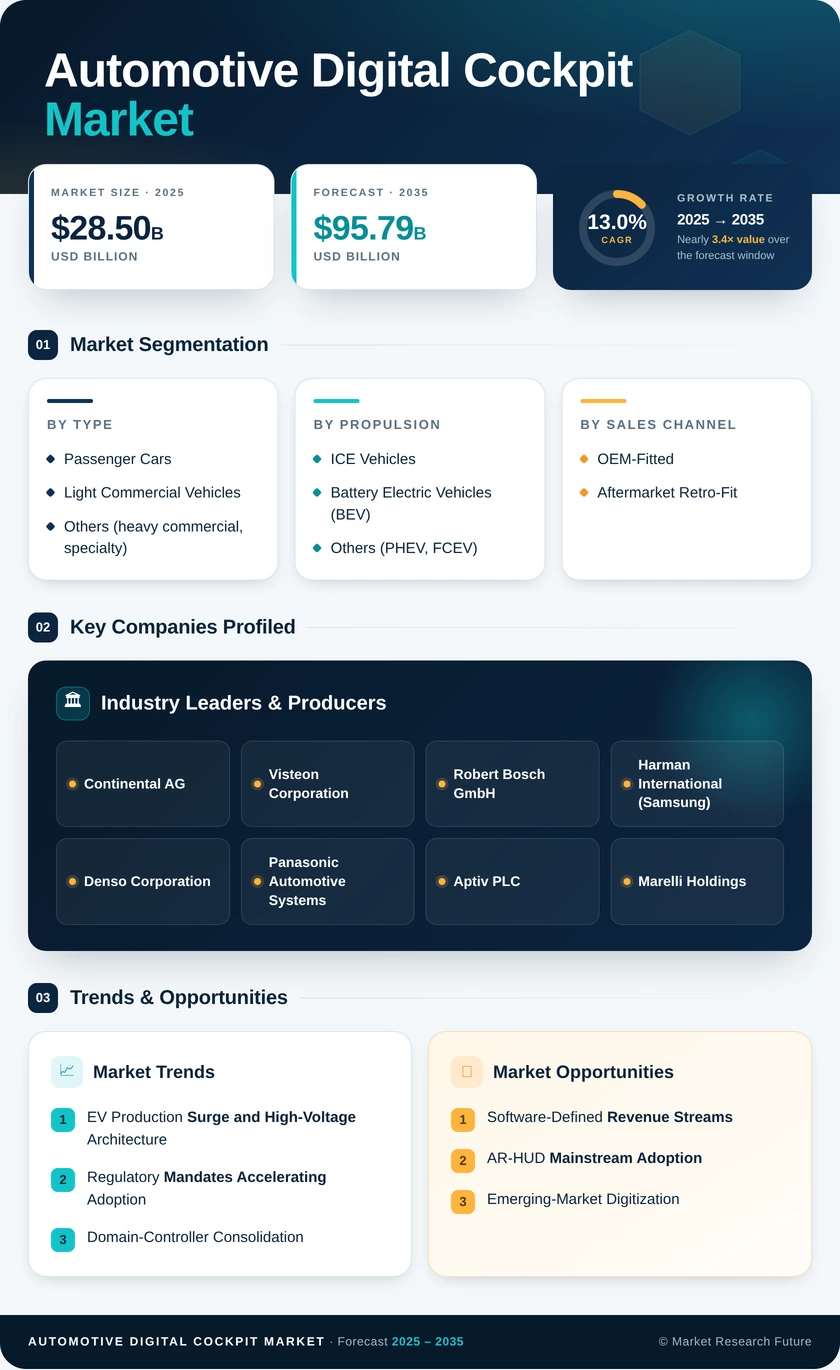
Segmentation Quick Reference
| Dimension | Sub-Segments | Dominant Segment | Fastest Growing Segment |
| Type | Digital Instrument Cluster, Heads-Up Display (HUD), Center Stack Display, Others | Digital Instrument Cluster | Heads-Up Display (HUD) |
| Vehicle Type | Passenger Cars, Light Commercial Vehicles, Others | Passenger Cars | Light Commercial Vehicles |
| Propulsion | ICE, Battery Electric Vehicles (BEV), Others | ICE | Battery Electric Vehicles (BEV) |
| Sales Channel | OEM-Fitted, Aftermarket Retro-Fit | OEM-Fitted | Aftermarket Retro-Fit |
| Region | North America, Europe, Asia-Pacific, South America, Middle East & Africa | Asia-Pacific | Asia-Pacific |
Market Segmentation Overview
By Type
| Sub-Segment | Key Trend |
| Digital Instrument Cluster | Migration from partial- to full-LCD configurations across all vehicle price segments |
| Heads-Up Display (HUD) | AR waveguide cost reduction enabling mid-tier vehicle penetration |
| Center Stack Display | Screen-size upsizing and integration with HVAC/vehicle controls |
| Others (Rear-Seat, Passenger, Mirror Displays) | Passenger-economy demand driving rear-entertainment and co-driver screens |
The type segmentation reflects the sequential digitization of the driver's forward field of view. Digital instrument clusters were the first cockpit surface to convert from analog to digital, followed by center stack infotainment displays. HUDs represent the next wave, projecting critical information directly onto the windshield or a combiner element. Emerging categories — rear-seat entertainment, co-driver displays, and digital mirror replacements — are adding new addressable surface area to the cockpit electronics opportunity.
By Vehicle Type
| Sub-Segment | Key Trend |
| Passenger Cars | Cockpit sophistication becoming a top-three purchase criterion for consumers. |
| Light Commercial Vehicles | Fleet digitization driving adoption of integrated cockpit-telematics platforms. |
| Others (Heavy Commercial, Specialty) | Truck platooning and off-highway applications introducing specialized cockpit interfaces |
Passenger cars remain the volume engine of the market. Still, the fastest growth is occurring in light commercial vehicles where fleet operators are demanding integrated cockpit solutions that combine navigation, route optimization, and driver monitoring in a single interface.
By Propulsion
| Sub-Segment | Key Trend |
| ICE Vehicles | Digital cockpit retrofits extending the technology lifecycle of combustion platforms. |
| Battery Electric Vehicles (BEV) | Higher per-vehicle display count and cockpit-content value as standard |
| Others (PHEV, FCEV) | Transitional powertrains inheriting cockpit architectures from BEV platforms |
BEVs carry inherently higher cockpit-electronics content because their electrical architectures natively support the power and data throughput that multiple high-resolution displays demand. ICE vehicles continue to digitize, but the incremental cost of adding cockpit features to legacy 12-volt architectures limits the pace of adoption.
By Sales Channel
| Sub-Segment | Key Trend |
| OEM-Fitted | Platform-level integration requiring factory calibration with vehicle electronics |
| Aftermarket Retro-Fit | Digital cluster conversion kits gaining traction in markets with older vehicle parcs |
OEM-fitted installations dominate because modern cockpit systems must interface with vehicle-wide communication networks (CAN-FD, Automotive Ethernet) and comply with functional-safety standards that aftermarket solutions rarely meet. The aftermarket channel serves a niche but growing role in extending digital cockpit features to the existing global vehicle parc.


 Noah Malgeri
Co-Founder
Noah Malgeri
Co-Founder

 Peter Groot koerkamp
Account and Business Manager
Peter Groot koerkamp
Account and Business Manager

 Younghwan Choi
Senior Retail Manager
Younghwan Choi
Senior Retail Manager

 Mark Irwin
Management Consultant
Mark Irwin
Management Consultant

 Akif Moroglu
Strategy & Business Development Director
Akif Moroglu
Strategy & Business Development Director

 Guilherme Gomes Martins
Product Management Director
Guilherme Gomes Martins
Product Management Director

 Joseph Aguayo
Sales Operations & Pricing Manager
Joseph Aguayo
Sales Operations & Pricing Manager

 La Terria Dodd
Program Support Specialist
La Terria Dodd
Program Support Specialist

 Rob Kooiker
Group Product Manager HVAC & Fire Protection GMA
Rob Kooiker
Group Product Manager HVAC & Fire Protection GMA