Request Free Sample ×

Kindly complete the form below to receive a free sample of this Report

* Please use a valid business email

Leading companies partner with us for data-driven Insights

clients tt-cursor
Hero Background
English
Chinese
French
Japanese
Korean
German
Spanish

Automotive Collision Avoidance System Market Trends

ID: MRFR/AT/5309-HCR
200 Pages
Shubham Munde
March 2026

Automotive Collision Avoidance System Market Research Report By Technology (Laser Sensors, Radar Sensors, Camera-Based Systems, Ultrasonic Sensors), By Type (Adaptive Cruise Control, Automatic Emergency Braking, Lane Departure Warning, Blind Spot Detection), By End Use (Passenger Vehicles, Commercial Vehicles, Two Wheelers, Heavy-Duty Vehicles), By Sensor Type (Lidar, Radar, Camera, Infrared) and By Regional (North America, Europe, South America, Asia Pacific, Middle East and Africa)-Forecast to 2035

Share:
Download PDF ×

We do not share your information with anyone. However, we may send you emails based on your report interest from time to time. You may contact us at any time to opt-out.

Automotive Collision Avoidance System Market Infographic
Purchase Options

Market Trends

Key Emerging Trends in the Automotive Collision Avoidance System Market

The growth in automotive collision avoidance system market over recent years is being fueled by an increasing emphasis on safety and new technological developments. The priority of road safety increases the attention to vehicle collision avoidance systems from both consumers and regulatory organisms. These systems use a variety of sensors, cameras, and radar technologies to detect imminent collisions, either alerting the driver or intervene so as to prevent accidents. An important market trend is the increasing use of ADAS, which includes crash prevention systems. These features are becoming a standard or optional addition to the vehicle by automakers contributing further towards an increase in market. Improvements in the awareness of collision avoidance system benefits among consumers, including reduced collisions and improved overall vehicle safety, are resulting to increased demand for cars that incorporate such technologies. The market trends of automotive collision avoidance systems are dictated by government regulations and standards that ensure safety. There are several regions that impose strict safety standards and these automakers have to incorporate the latest accident prevention mechanisms in order to comply with them. This has caused a trickle-down effect in the market, forcing not only OEMs but also aftermarket suppliers to invest into R&D for improved collision avoidance systems. The automotive collision avoidance system market is being driven by swift technological advancements. A lot of these systems today have incorporated artificial intelligence, machine learning and sensor fusion technologies which has improved their ability to realistically detects collision threats. This process is not only making the systems more efficient but also helping in creating a competitive environment where organizations aim to distinguish their offerings through technological innovations. Market trends in the automotive collision avoidance system segment are also impacted by the growing use of electric and autonomous vehicles. With these futuristic modes of transport gaining popularity, the importance for reliable and efficient collision avoidance systems becomes even more crucial. The merging of these systems is deemed as an important facet in maintaining occupant and pedestrian safety during the self-driving period. The aftermarket segment of the automotive collision avoidance system market is also growing quite prominently. Consumers are looking to retrofit their cars with collision avoidance systems in order to improve safety.


Author
Author Profile
Shubham Munde
Team Lead - Research

Shubham brings over 7 years of expertise in Market Intelligence and Strategic Consulting, with a strong focus on the Automotive, Aerospace, and Defense sectors. Backed by a solid foundation in semiconductors, electronics, and software, he has successfully delivered high-impact syndicated and custom research on a global scale. His core strengths include market sizing, forecasting, competitive intelligence, consumer insights, and supply chain mapping. Widely recognized for developing scalable growth strategies, Shubham empowers clients to navigate complex markets and achieve a lasting competitive edge. Trusted by start-ups and Fortune 500 companies alike, he consistently converts challenges into strategic opportunities that drive sustainable growth.

Leave a Comment

FAQs

What is the projected market valuation for the Automotive Collision Avoidance System Market in 2035?

<p>The projected market valuation for the Automotive Collision Avoidance System Market in 2035 is 198.02 USD Billion.</p>

What was the market valuation for the Automotive Collision Avoidance System Market in 2024?

<p>The market valuation for the Automotive Collision Avoidance System Market in 2024 was 94.35 USD Billion.</p>

What is the expected CAGR for the Automotive Collision Avoidance System Market from 2025 to 2035?

<p>The expected CAGR for the Automotive Collision Avoidance System Market during the forecast period 2025 - 2035 is 6.97%.</p>

Which technology segment is projected to have the highest valuation in the Automotive Collision Avoidance System Market?

<p>The Camera-Based Systems segment is projected to have the highest valuation, ranging from 35.0 to 70.0 USD Billion.</p>

What are the key players in the Automotive Collision Avoidance System Market?

<p>Key players in the Automotive Collision Avoidance System Market include Bosch, Denso, Continental, Aptiv, Mobileye, Nissan, Ford, Toyota, and General Motors.</p>

Which type of collision avoidance system is expected to see significant growth by 2035?

<p>The Blind Spot Detection type is expected to see significant growth, with a projected valuation between 31.35 and 73.02 USD Billion.</p>

What is the valuation range for the Radar Sensors segment in the Automotive Collision Avoidance System Market?

<p>The valuation range for the Radar Sensors segment is projected to be between 25.0 and 50.0 USD Billion.</p>

How does the market for Commercial Vehicles compare to Passenger Vehicles in 2025?

<p>In 2025, the market for Passenger Vehicles is projected to be valued between 37.74 and 79.2 USD Billion, while Commercial Vehicles are expected to range from 28.76 to 59.8 USD Billion.</p>

What is the expected valuation for Ultrasonic Sensors in the Automotive Collision Avoidance System Market?

<p>The expected valuation for Ultrasonic Sensors is projected to range from 19.35 to 48.02 USD Billion.</p>

Which sensor type is anticipated to have the lowest valuation in the Automotive Collision Avoidance System Market?

<p>The Lidar sensor type is anticipated to have the lowest valuation, projected between 15.0 and 30.0 USD Billion.</p>

Market Summary

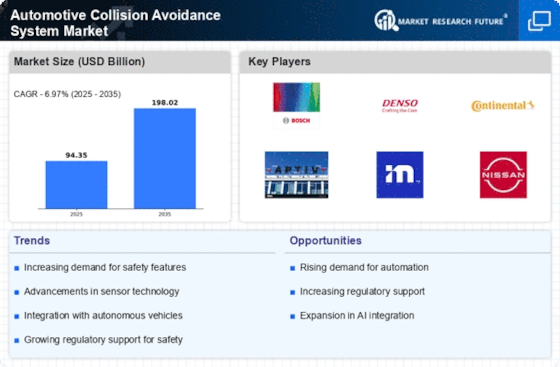
As per Market Research Future analysis, the Automotive Collision Avoidance System Market was estimated at 94.35 USD Billion in 2024. The Automotive Collision Avoidance System industry is projected to grow from 100.93 USD Billion in 2025 to 198.02 USD Billion by 2035, exhibiting a compound annual growth rate (CAGR) of 6.97% during the forecast period 2025 - 2035

Key Market Trends & Highlights

The Automotive Collision Avoidance System Market is poised for substantial growth driven by technological advancements and increasing safety regulations.

  • The integration of advanced technologies is transforming the Automotive Collision Avoidance System Market, particularly in North America. Consumer demand for enhanced safety features is propelling the adoption of camera-based systems, which are currently the fastest-growing segment. Regulatory influence on safety standards is shaping market dynamics, especially in the Asia-Pacific region, which is the fastest-growing market. Rising incidence of road accidents and government regulations are key drivers fueling the demand for automatic emergency braking systems, the largest segment in the market.

Market Size & Forecast

2024 Market Size 94.35 (USD Billion)
2035 Market Size 198.02 (USD Billion)
CAGR (2025 - 2035) 6.97%
Largest Regional Market Share in 2024 North America

Major Players

Bosch (DE), <a href="https://www.denso.com/global/en/business/products-and-services/mobility/safety-cockpit/">Denso</a> (JP), Continental (DE), Aptiv (IE), Mobileye (IL), Nissan (JP), Ford (US), <a href="https://www.toyota.com/safety-sense/">Toyota</a> (JP), General Motors (US)

Market Trends

The Automotive Collision Avoidance System Market is currently experiencing a transformative phase, driven by advancements in technology and increasing consumer awareness regarding vehicle safety. As manufacturers integrate sophisticated sensors, cameras, and artificial intelligence into their vehicles, the demand for these systems is likely to rise. This trend is further supported by regulatory bodies emphasizing the importance of safety features in automobiles, which may lead to stricter compliance requirements. Consequently, automotive companies are investing heavily in research and development to enhance the effectiveness of collision avoidance technologies, thereby fostering a competitive landscape. Moreover, the growing trend towards electric and autonomous vehicles is expected to significantly influence the Automotive Collision Avoidance System Market. As these vehicles become more prevalent, the integration of advanced safety systems is not merely an option but a necessity. The convergence of connectivity and automation appears to create a synergistic effect, enhancing the overall driving experience while minimizing risks. This evolving market landscape suggests that stakeholders must remain agile and responsive to emerging technologies and consumer preferences to maintain a competitive edge.

Integration of Advanced Technologies

The Automotive Collision Avoidance System Market is witnessing a notable shift towards the incorporation of cutting-edge technologies. Innovations such as machine learning, radar systems, and enhanced imaging techniques are becoming increasingly prevalent. These advancements not only improve the accuracy of collision detection but also facilitate real-time decision-making, thereby enhancing overall vehicle safety.

Regulatory Influence on Safety Standards

Regulatory bodies are playing a crucial role in shaping the Automotive Collision Avoidance System Market. As governments worldwide implement stricter safety regulations, manufacturers are compelled to adopt advanced collision avoidance technologies. This regulatory push is likely to accelerate the development and deployment of these systems, ensuring that vehicles meet evolving safety standards.

Consumer Demand for Enhanced Safety Features

There is a growing consumer inclination towards vehicles equipped with advanced safety features. As awareness regarding road safety increases, potential buyers are prioritizing vehicles that offer robust collision avoidance systems. This trend indicates a shift in market dynamics, where consumer preferences are driving manufacturers to innovate and enhance their safety offerings.

Automotive Collision Avoidance System Market Market Drivers

Rising Incidence of Road Accidents

The rising incidence of road accidents is a pressing concern that propels the Automotive Collision Avoidance System Market. Statistics indicate that road traffic injuries are a leading cause of death worldwide, prompting governments and organizations to prioritize safety measures. The implementation of collision avoidance systems is seen as a viable solution to mitigate these risks. As awareness of road safety increases, the demand for advanced safety technologies is expected to rise, potentially leading to a market expansion. This trend underscores the urgency for manufacturers to innovate and integrate effective collision avoidance systems into their vehicles.

Government Regulations and Incentives

Government regulations and incentives play a pivotal role in shaping the Automotive Collision Avoidance System Market. Many countries are enacting stringent safety regulations that mandate the inclusion of advanced safety features in new vehicles. These regulations not only enhance consumer safety but also encourage manufacturers to invest in innovative collision avoidance technologies. Additionally, various governments are offering incentives for consumers to purchase vehicles equipped with these systems, further driving market growth. The alignment of regulatory frameworks with technological advancements is likely to create a conducive environment for the Automotive Collision Avoidance System Market.

Integration of Artificial Intelligence

The integration of artificial intelligence (AI) into the Automotive Collision Avoidance System Market is transforming vehicle safety. AI algorithms enhance the ability of vehicles to interpret data from various sensors, allowing for real-time decision-making. This technology can predict potential collisions by analyzing driving patterns and environmental conditions. As a result, the market is projected to grow significantly, with estimates suggesting a compound annual growth rate (CAGR) of over 10% in the coming years. The increasing complexity of urban driving environments necessitates advanced AI solutions, making them a critical driver in the Automotive Collision Avoidance System Market.

Consumer Awareness and Demand for Safety

Consumer awareness regarding vehicle safety is increasingly influencing the Automotive Collision Avoidance System Market. As individuals become more informed about the benefits of collision avoidance technologies, their demand for vehicles equipped with such systems is rising. Surveys indicate that a significant percentage of consumers prioritize safety features when purchasing a vehicle, which is compelling manufacturers to enhance their offerings. This shift in consumer behavior is expected to drive market growth, as companies strive to meet the evolving expectations of safety-conscious buyers. The interplay between consumer demand and technological advancements is likely to shape the future of the Automotive Collision Avoidance System Market.

Technological Advancements in Sensor Technologies

Technological advancements in sensor technologies are a crucial driver of the Automotive Collision Avoidance System Market. The development of high-resolution cameras, radar, and lidar systems has significantly improved the accuracy and reliability of collision avoidance systems. These sensors enable vehicles to detect obstacles and assess their surroundings with remarkable precision. As sensor technology continues to evolve, the capabilities of collision avoidance systems are expected to expand, leading to enhanced safety features. The increasing integration of these advanced sensors into vehicles is likely to propel the growth of the Automotive Collision Avoidance System Market, as manufacturers seek to leverage cutting-edge technology.

Market Segment Insights

By Technology: Radar Sensors (Largest) vs. Camera-Based Systems (Fastest-Growing)

In the Automotive Collision Avoidance System Market, Radar Sensors hold the largest market share due to their reliability and effectiveness in various weather conditions, ensuring accurate obstacle detection. Camera-Based Systems, while previously overshadowed, are gaining traction as technology evolves, providing enhanced vision-based capabilities that complement radar systems.

Technology: Radar Sensors (Dominant) vs. Camera-Based Systems (Emerging)

<a href="https://www.marketresearchfuture.com/reports/radar-sensors-market-4159">Radar Sensors</a> are the cornerstone of modern automotive collision avoidance systems, offering unparalleled accuracy and performance in detecting objects at varying distances and speeds. Their dominance is reinforced by advancements in radar technology, contributing to safety in autonomous driving features. On the other hand, Camera-Based Systems are emerging as a critical component, leveraging advanced image processing algorithms to identify pedestrians and obstacles. As these systems improve in resolution and data processing capabilities, their adoption rate is increasing rapidly, and they are expected to play a vital role in enhancing overall vehicle safety.

By Type: Automatic Emergency Braking (Largest) vs. Adaptive Cruise Control (Fastest-Growing)

In the Automotive Collision Avoidance System Market, Automatic Emergency Braking holds the largest market share among the various system types, significantly driving overall market dynamics. This technology has become a standard feature in many new vehicles, accounting for a substantial portion of consumer preferences due to its proven effectiveness in accident prevention. In contrast, Adaptive Cruise Control, while also popular, is rapidly gaining market traction as technological advancements enable more sophisticated features and improved user experiences, leading to a steady increase in adoption rates.

Technology: Automatic Emergency Braking (Dominant) vs. Adaptive Cruise Control (Emerging)

Automatic Emergency Braking (AEB) is characterized by its crucial role in enhancing vehicle safety, preventing collisions through automatic braking when a potential impact is detected. It dominates the market due to regulatory support and consumer demand for safer driving solutions. Meanwhile, Adaptive Cruise Control (ACC) is emerging as a key player, integrating advanced sensors and algorithms that allow for automatic speed adjustments based on traffic conditions. This technology caters to the increasing consumer demand for convenience and safety, making it one of the fastest-growing segments within the automotive collision avoidance systems.

By End Use: Passenger Vehicles (Largest) vs. Commercial Vehicles (Fastest-Growing)

In the Automotive Collision Avoidance System Market, passenger vehicles hold the largest share, reflecting the high demand for safety features among everyday drivers. This segment benefits from increased consumer awareness regarding safety and a surge in government initiatives promoting advanced driver-assistance systems (ADAS). In contrast, commercial vehicles, while having a smaller market share, are emerging as the fastest-growing segment due to changes in logistics and transportation dynamics, with more fleets adopting collision avoidance technology to enhance safety and efficiency.

Passenger Vehicles (Dominant) vs. Commercial Vehicles (Emerging)

Passenger vehicles serve as the dominant segment in the Automotive Collision Avoidance System Market, characterized by extensive integration of safety features, facilitated by consumer demand for increased protection. Various technologies, such as automatic emergency braking and lane departure warnings, are being widely adopted to ensure the safety of occupants. On the other hand, commercial vehicles represent an emerging segment, driven by the need for enhanced safety in operating environments and regulations requiring safety technologies. Fleet owners are increasingly valuing collision avoidance systems to minimize accidents, thereby improving business operational efficiencies and lowering insurance costs.

By Sensor Type: Lidar (Largest) vs. Radar (Fastest-Growing)

The Automotive Collision Avoidance System Market showcases a diverse array of sensor types, with Lidar taking the lead in market share. Lidar is preferred for its high precision and accuracy, essential in collision detection and avoidance scenarios. Meanwhile, Radar has been gaining momentum as manufacturers expand their use due to its reliability in varying weather conditions, leading to a notable increase in adoption rates. As vehicle autonomy progresses, both sensor types are essential to ensure safety and regulatory compliance.

Lidar (Dominant) vs. Radar (Emerging)

Lidar technology stands out as the dominant sensor type in the Automotive Collision Avoidance System Market, renowned for its advanced distance measuring capabilities and ability to create detailed 3D maps of environments. It largely benefits manufacturers committed to developing autonomous vehicles, offering superior object detection and recognition compared to traditional sensors. Radar, while currently emerging, is rapidly evolving, capitalizing on its cost-effectiveness and enhanced functionality in adverse weather conditions. It is proving crucial for applications that require reliable performance, enabling its swift integration into both semi-autonomous and fully autonomous driving systems.

Get more detailed insights about Automotive Collision Avoidance System Market Research Report—Forecast till 2035

Regional Insights

North America : Technological Innovation Leader

North America is the largest market for automotive collision avoidance systems, holding approximately 40% of the global market share. The region's growth is driven by stringent safety regulations, increasing consumer awareness, and advancements in technology. The U.S. government has implemented various initiatives to enhance vehicle safety, which further fuels demand for these systems. Leading countries in this region include the United States and Canada, with major automotive manufacturers like Ford, General Motors, and Tesla investing heavily in collision avoidance technologies. The competitive landscape is characterized by a mix of established players and innovative startups, ensuring a dynamic market environment.

Europe : Regulatory Compliance Focus

Europe is the second-largest market for automotive collision avoidance systems, accounting for around 30% of the global market share. The region's growth is significantly influenced by stringent EU regulations aimed at enhancing road safety and reducing accidents. The European Commission has set ambitious targets for vehicle safety, which are expected to drive demand for advanced collision avoidance technologies. Key players in Europe include Bosch, Continental, and Denso, with Germany and France leading the market. The competitive landscape is robust, with a focus on innovation and compliance with regulatory standards. European manufacturers are increasingly collaborating with tech companies to integrate advanced features into their vehicles, ensuring they meet safety requirements.

Asia-Pacific : Emerging Market Potential

Asia-Pacific is witnessing rapid growth in the automotive collision avoidance system market, driven by increasing vehicle production and rising consumer demand for safety features. The region holds approximately 25% of the global market share, with countries like Japan and China leading the charge. Government initiatives promoting vehicle safety and technological advancements are key growth drivers. Japan and China are the leading countries in this region, with major automotive players like Nissan and Toyota heavily investing in collision avoidance technologies. The competitive landscape is evolving, with both domestic and international companies vying for market share, making it a dynamic environment for innovation and development.

Middle East and Africa : Untapped Market Opportunities

The Middle East and Africa region is gradually emerging in the automotive collision avoidance system market, holding about 5% of the global market share. The growth is primarily driven by increasing awareness of road safety and the rising number of vehicles on the road. Governments in this region are beginning to implement regulations aimed at improving vehicle safety, which is expected to boost demand for collision avoidance systems. Leading countries include South Africa and the UAE, where local manufacturers are starting to adopt advanced safety technologies. The competitive landscape is still developing, with opportunities for both local and international players to establish a foothold in this growing market.

Key Players and Competitive Insights

The Automotive Collision Avoidance System Market is currently characterized by a dynamic competitive landscape, driven by rapid technological advancements and increasing consumer demand for safety features. Key players such as Bosch (Germany), Denso (Japan), and Mobileye (Israel) are at the forefront, each adopting distinct strategies to enhance their market positioning. Bosch (Germany) focuses on innovation through extensive research and development, particularly in sensor technology and artificial intelligence, which are critical for the evolution of collision avoidance systems. Meanwhile, Denso (Japan) emphasizes strategic partnerships with automotive manufacturers to integrate their systems seamlessly into new vehicle models, thereby enhancing their market reach and operational efficiency. Mobileye (Israel), a leader in advanced driver-assistance systems, is leveraging its expertise in computer vision and machine learning to develop cutting-edge solutions that not only prevent collisions but also pave the way for autonomous driving. The business tactics employed by these companies reflect a concerted effort to optimize supply chains and localize manufacturing processes. The market structure appears moderately fragmented, with a mix of established players and emerging startups vying for market share. This fragmentation is indicative of the diverse technological approaches and regional strategies being employed, which collectively influence the competitive dynamics of the market. In August 2025, Bosch (Germany) announced a significant investment in a new research facility dedicated to the development of next-generation collision avoidance technologies. This move is likely to enhance Bosch's capabilities in creating more sophisticated systems that integrate seamlessly with electric and autonomous vehicles, thereby reinforcing its competitive edge in a rapidly evolving market. Similarly, in July 2025, Denso (Japan) expanded its collaboration with a leading automotive manufacturer to co-develop advanced safety features, which underscores the importance of partnerships in driving innovation and market penetration. Mobileye (Israel) made headlines in September 2025 by launching a new software platform designed to enhance vehicle-to-everything (V2X) communication. This platform is expected to significantly improve the effectiveness of collision avoidance systems by allowing vehicles to communicate with each other and their surroundings, thus reducing the likelihood of accidents. This strategic initiative not only positions Mobileye as a leader in the integration of AI and connectivity but also highlights the growing trend towards smart mobility solutions. As of October 2025, the competitive trends within the Automotive Collision Avoidance System Market are increasingly defined by digitalization, sustainability, and the integration of artificial intelligence. Strategic alliances are becoming more prevalent, as companies recognize the need to pool resources and expertise to stay ahead in a technology-driven landscape. Looking forward, it is anticipated that competitive differentiation will increasingly pivot from traditional price-based competition to a focus on innovation, technological advancement, and the reliability of supply chains. This shift is likely to reshape the market, fostering an environment where cutting-edge solutions and strategic collaborations will be paramount.

Key Companies in the Automotive Collision Avoidance System Market include

Industry Developments

  • Q2 2024: Mobileye and Volkswagen Group Announce Partnership to Integrate Advanced Collision Avoidance Systems in Next-Gen Vehicles Mobileye and Volkswagen Group entered a strategic partnership to equip upcoming Volkswagen models with Mobileye’s latest collision avoidance and driver-assistance technologies, aiming to enhance vehicle safety and accelerate the adoption of advanced driver-assistance systems.
  • Q2 2024: Continental Opens New R&D Center in Japan Focused on Automotive Collision Avoidance Systems Continental AG inaugurated a new research and development facility in Yokohama, Japan, dedicated to the development and testing of next-generation collision avoidance and ADAS technologies for global automotive markets.
  • Q1 2024: Tesla Receives Regulatory Approval in Europe for Enhanced Collision Avoidance Suite Tesla secured regulatory approval from the European Union for its upgraded collision avoidance system, which includes improved emergency braking and lane-keeping features, allowing deployment in all new Model 3 and Model Y vehicles sold in the region.
  • Q2 2024: Aptiv Launches Next-Generation Collision Avoidance Platform for Commercial Fleets Aptiv unveiled a new collision avoidance platform specifically designed for commercial vehicle fleets, featuring advanced sensor fusion and AI-powered predictive analytics to reduce accident rates and improve fleet safety.
  • Q1 2024: Hyundai Motor Group Acquires Minority Stake in Israeli Collision Avoidance Startup Arbe Robotics Hyundai Motor Group acquired a significant minority stake in Arbe Robotics, an Israeli company specializing in 4D imaging radar for automotive collision avoidance, to accelerate the integration of advanced radar solutions in its vehicles.
  • Q2 2024: NHTSA Approves New Collision Avoidance Standards for Light Vehicles in the US The US National Highway Traffic Safety Administration (NHTSA) finalized new regulations mandating advanced collision avoidance systems, including automatic emergency braking and lane departure warning, in all new light vehicles sold from 2026 onward.
  • Q1 2024: Waymo and Volvo Announce Joint Development of AI-Based Collision Avoidance for Autonomous Vehicles Waymo and Volvo Cars revealed a joint development agreement to co-create AI-driven collision avoidance systems tailored for fully autonomous vehicles, with pilot testing scheduled for late 2024.
  • Q2 2024: Bosch Unveils New Generation of Camera-Based Collision Avoidance Systems at Auto Shanghai Bosch introduced its latest camera-based collision avoidance system at the Auto Shanghai 2024 exhibition, featuring improved object detection and real-time decision-making capabilities for both passenger and commercial vehicles.
  • Q1 2025: Denso Signs Multi-Year Supply Agreement with General Motors for Collision Avoidance Modules Denso Corporation signed a multi-year contract to supply General Motors with advanced collision avoidance modules for integration into GM’s next generation of electric and combustion vehicles.
  • Q2 2025: Magna International Acquires Swedish Collision Avoidance Software Firm Veoneer Magna International completed the acquisition of Veoneer, a Swedish company specializing in collision avoidance software, to strengthen its position in the global ADAS and safety systems market.
  • Q1 2025: Toyota Launches Over-the-Air Update for Collision Avoidance in 2024 Camry and RAV4 Models Toyota rolled out a major over-the-air software update for its 2024 Camry and RAV4 models, enhancing the vehicles’ collision avoidance capabilities with improved pedestrian and cyclist detection.
  • Q2 2025: Autoliv Opens New Manufacturing Facility in Mexico for Advanced Collision Avoidance Systems Autoliv inaugurated a new manufacturing plant in Monterrey, Mexico, dedicated to producing advanced collision avoidance system components for North American and global automotive OEMs.

Future Outlook

Automotive Collision Avoidance System Market Future Outlook

The Automotive Collision Avoidance System Market is projected to grow at a 6.97% CAGR from 2025 to 2035, driven by technological advancements, regulatory support, and increasing consumer safety awareness.

New opportunities lie in:

  • <p>Integration of AI-driven predictive analytics for real-time hazard detection. Development of aftermarket collision avoidance retrofit kits for older vehicles. Partnerships with insurance companies for premium discounts based on system usage.</p>

By 2035, the market is expected to be robust, driven by innovation and widespread adoption.

Market Segmentation

Automotive Collision Avoidance System Market Type Outlook

  • Adaptive Cruise Control
  • Automatic Emergency Braking
  • Lane Departure Warning
  • Blind Spot Detection

Automotive Collision Avoidance System Market End Use Outlook

  • Passenger Vehicles
  • Commercial Vehicles
  • Two Wheelers
  • Heavy-Duty Vehicles

Automotive Collision Avoidance System Market Technology Outlook

  • Laser Sensors
  • Radar Sensors
  • Camera-Based Systems
  • Ultrasonic Sensors

Automotive Collision Avoidance System Market Sensor Type Outlook

  • Lidar
  • Radar
  • Camera
  • Infrared

Report Scope

MARKET SIZE 2024 94.35(USD Billion)
MARKET SIZE 2025 100.93(USD Billion)
MARKET SIZE 2035 198.02(USD Billion)
COMPOUND ANNUAL GROWTH RATE (CAGR) 6.97% (2025 - 2035)
REPORT COVERAGE Revenue Forecast, Competitive Landscape, Growth Factors, and Trends
BASE YEAR 2024
Market Forecast Period 2025 - 2035
Historical Data 2019 - 2024
Market Forecast Units USD Billion
Key Companies Profiled Bosch (DE), Denso (JP), Continental (DE), Aptiv (IE), Mobileye (IL), Nissan (JP), Ford (US), Toyota (JP), General Motors (US)
Segments Covered Technology, Type, End Use, Sensor Type, Regional
Key Market Opportunities Integration of advanced sensor technologies enhances safety features in the Automotive Collision Avoidance System Market.
Key Market Dynamics Rising demand for advanced safety features drives innovation in Automotive Collision Avoidance Systems and regulatory compliance.
Countries Covered North America, Europe, APAC, South America, MEA

FAQs

What is the projected market valuation for the Automotive Collision Avoidance System Market in 2035?

<p>The projected market valuation for the Automotive Collision Avoidance System Market in 2035 is 198.02 USD Billion.</p>

What was the market valuation for the Automotive Collision Avoidance System Market in 2024?

<p>The market valuation for the Automotive Collision Avoidance System Market in 2024 was 94.35 USD Billion.</p>

What is the expected CAGR for the Automotive Collision Avoidance System Market from 2025 to 2035?

<p>The expected CAGR for the Automotive Collision Avoidance System Market during the forecast period 2025 - 2035 is 6.97%.</p>

Which technology segment is projected to have the highest valuation in the Automotive Collision Avoidance System Market?

<p>The Camera-Based Systems segment is projected to have the highest valuation, ranging from 35.0 to 70.0 USD Billion.</p>

What are the key players in the Automotive Collision Avoidance System Market?

<p>Key players in the Automotive Collision Avoidance System Market include Bosch, Denso, Continental, Aptiv, Mobileye, Nissan, Ford, Toyota, and General Motors.</p>

Which type of collision avoidance system is expected to see significant growth by 2035?

<p>The Blind Spot Detection type is expected to see significant growth, with a projected valuation between 31.35 and 73.02 USD Billion.</p>

What is the valuation range for the Radar Sensors segment in the Automotive Collision Avoidance System Market?

<p>The valuation range for the Radar Sensors segment is projected to be between 25.0 and 50.0 USD Billion.</p>

How does the market for Commercial Vehicles compare to Passenger Vehicles in 2025?

<p>In 2025, the market for Passenger Vehicles is projected to be valued between 37.74 and 79.2 USD Billion, while Commercial Vehicles are expected to range from 28.76 to 59.8 USD Billion.</p>

What is the expected valuation for Ultrasonic Sensors in the Automotive Collision Avoidance System Market?

<p>The expected valuation for Ultrasonic Sensors is projected to range from 19.35 to 48.02 USD Billion.</p>

Which sensor type is anticipated to have the lowest valuation in the Automotive Collision Avoidance System Market?

<p>The Lidar sensor type is anticipated to have the lowest valuation, projected between 15.0 and 30.0 USD Billion.</p>

  1. SECTION I: EXECUTIVE SUMMARY AND KEY HIGHLIGHTS
    1. | 1.1 EXECUTIVE SUMMARY
    2. | | 1.1.1 Market Overview
    3. | | 1.1.2 Key Findings
    4. | | 1.1.3 Market Segmentation
    5. | | 1.1.4 Competitive Landscape
    6. | | 1.1.5 Challenges and Opportunities
    7. | | 1.1.6 Future Outlook
  2. SECTION II: SCOPING, METHODOLOGY AND MARKET STRUCTURE
    1. | 2.1 MARKET INTRODUCTION
    2. | | 2.1.1 Definition
    3. | | 2.1.2 Scope of the study
    4. | | | 2.1.2.1 Research Objective
    5. | | | 2.1.2.2 Assumption
    6. | | | 2.1.2.3 Limitations
    7. | 2.2 RESEARCH METHODOLOGY
    8. | | 2.2.1 Overview
    9. | | 2.2.2 Data Mining
    10. | | 2.2.3 Secondary Research
    11. | | 2.2.4 Primary Research
    12. | | | 2.2.4.1 Primary Interviews and Information Gathering Process
    13. | | | 2.2.4.2 Breakdown of Primary Respondents
    14. | | 2.2.5 Forecasting Model
    15. | | 2.2.6 Market Size Estimation
    16. | | | 2.2.6.1 Bottom-Up Approach
    17. | | | 2.2.6.2 Top-Down Approach
    18. | | 2.2.7 Data Triangulation
    19. | | 2.2.8 Validation
  3. SECTION III: QUALITATIVE ANALYSIS
    1. | 3.1 MARKET DYNAMICS
    2. | | 3.1.1 Overview
    3. | | 3.1.2 Drivers
    4. | | 3.1.3 Restraints
    5. | | 3.1.4 Opportunities
    6. | 3.2 MARKET FACTOR ANALYSIS
    7. | | 3.2.1 Value chain Analysis
    8. | | 3.2.2 Porter's Five Forces Analysis
    9. | | | 3.2.2.1 Bargaining Power of Suppliers
    10. | | | 3.2.2.2 Bargaining Power of Buyers
    11. | | | 3.2.2.3 Threat of New Entrants
    12. | | | 3.2.2.4 Threat of Substitutes
    13. | | | 3.2.2.5 Intensity of Rivalry
    14. | | 3.2.3 COVID-19 Impact Analysis
    15. | | | 3.2.3.1 Market Impact Analysis
    16. | | | 3.2.3.2 Regional Impact
    17. | | | 3.2.3.3 Opportunity and Threat Analysis
  4. SECTION IV: QUANTITATIVE ANALYSIS
    1. | 4.1 Automobile, BY Technology (USD Billion)
    2. | | 4.1.1 Laser Sensors
    3. | | 4.1.2 Radar Sensors
    4. | | 4.1.3 Camera-Based Systems
    5. | | 4.1.4 Ultrasonic Sensors
    6. | 4.2 Automobile, BY Type (USD Billion)
    7. | | 4.2.1 Adaptive Cruise Control
    8. | | 4.2.2 Automatic Emergency Braking
    9. | | 4.2.3 Lane Departure Warning
    10. | | 4.2.4 Blind Spot Detection
    11. | 4.3 Automobile, BY End Use (USD Billion)
    12. | | 4.3.1 Passenger Vehicles
    13. | | 4.3.2 Commercial Vehicles
    14. | | 4.3.3 Two Wheelers
    15. | | 4.3.4 Heavy-Duty Vehicles
    16. | 4.4 Automobile, BY Sensor Type (USD Billion)
    17. | | 4.4.1 Lidar
    18. | | 4.4.2 Radar
    19. | | 4.4.3 Camera
    20. | | 4.4.4 Infrared
    21. | 4.5 Automobile, BY Region (USD Billion)
    22. | | 4.5.1 North America
    23. | | | 4.5.1.1 US
    24. | | | 4.5.1.2 Canada
    25. | | 4.5.2 Europe
    26. | | | 4.5.2.1 Germany
    27. | | | 4.5.2.2 UK
    28. | | | 4.5.2.3 France
    29. | | | 4.5.2.4 Russia
    30. | | | 4.5.2.5 Italy
    31. | | | 4.5.2.6 Spain
    32. | | | 4.5.2.7 Rest of Europe
    33. | | 4.5.3 APAC
    34. | | | 4.5.3.1 China
    35. | | | 4.5.3.2 India
    36. | | | 4.5.3.3 Japan
    37. | | | 4.5.3.4 South Korea
    38. | | | 4.5.3.5 Malaysia
    39. | | | 4.5.3.6 Thailand
    40. | | | 4.5.3.7 Indonesia
    41. | | | 4.5.3.8 Rest of APAC
    42. | | 4.5.4 South America
    43. | | | 4.5.4.1 Brazil
    44. | | | 4.5.4.2 Mexico
    45. | | | 4.5.4.3 Argentina
    46. | | | 4.5.4.4 Rest of South America
    47. | | 4.5.5 MEA
    48. | | | 4.5.5.1 GCC Countries
    49. | | | 4.5.5.2 South Africa
    50. | | | 4.5.5.3 Rest of MEA
  5. SECTION V: COMPETITIVE ANALYSIS
    1. | 5.1 Competitive Landscape
    2. | | 5.1.1 Overview
    3. | | 5.1.2 Competitive Analysis
    4. | | 5.1.3 Market share Analysis
    5. | | 5.1.4 Major Growth Strategy in the Automobile
    6. | | 5.1.5 Competitive Benchmarking
    7. | | 5.1.6 Leading Players in Terms of Number of Developments in the Automobile
    8. | | 5.1.7 Key developments and growth strategies
    9. | | | 5.1.7.1 New Product Launch/Service Deployment
    10. | | | 5.1.7.2 Merger & Acquisitions
    11. | | | 5.1.7.3 Joint Ventures
    12. | | 5.1.8 Major Players Financial Matrix
    13. | | | 5.1.8.1 Sales and Operating Income
    14. | | | 5.1.8.2 Major Players R&D Expenditure. 2023
    15. | 5.2 Company Profiles
    16. | | 5.2.1 Bosch (DE)
    17. | | | 5.2.1.1 Financial Overview
    18. | | | 5.2.1.2 Products Offered
    19. | | | 5.2.1.3 Key Developments
    20. | | | 5.2.1.4 SWOT Analysis
    21. | | | 5.2.1.5 Key Strategies
    22. | | 5.2.2 Denso (JP)
    23. | | | 5.2.2.1 Financial Overview
    24. | | | 5.2.2.2 Products Offered
    25. | | | 5.2.2.3 Key Developments
    26. | | | 5.2.2.4 SWOT Analysis
    27. | | | 5.2.2.5 Key Strategies
    28. | | 5.2.3 Continental (DE)
    29. | | | 5.2.3.1 Financial Overview
    30. | | | 5.2.3.2 Products Offered
    31. | | | 5.2.3.3 Key Developments
    32. | | | 5.2.3.4 SWOT Analysis
    33. | | | 5.2.3.5 Key Strategies
    34. | | 5.2.4 Aptiv (IE)
    35. | | | 5.2.4.1 Financial Overview
    36. | | | 5.2.4.2 Products Offered
    37. | | | 5.2.4.3 Key Developments
    38. | | | 5.2.4.4 SWOT Analysis
    39. | | | 5.2.4.5 Key Strategies
    40. | | 5.2.5 Mobileye (IL)
    41. | | | 5.2.5.1 Financial Overview
    42. | | | 5.2.5.2 Products Offered
    43. | | | 5.2.5.3 Key Developments
    44. | | | 5.2.5.4 SWOT Analysis
    45. | | | 5.2.5.5 Key Strategies
    46. | | 5.2.6 Nissan (JP)
    47. | | | 5.2.6.1 Financial Overview
    48. | | | 5.2.6.2 Products Offered
    49. | | | 5.2.6.3 Key Developments
    50. | | | 5.2.6.4 SWOT Analysis
    51. | | | 5.2.6.5 Key Strategies
    52. | | 5.2.7 Ford (US)
    53. | | | 5.2.7.1 Financial Overview
    54. | | | 5.2.7.2 Products Offered
    55. | | | 5.2.7.3 Key Developments
    56. | | | 5.2.7.4 SWOT Analysis
    57. | | | 5.2.7.5 Key Strategies
    58. | | 5.2.8 Toyota (JP)
    59. | | | 5.2.8.1 Financial Overview
    60. | | | 5.2.8.2 Products Offered
    61. | | | 5.2.8.3 Key Developments
    62. | | | 5.2.8.4 SWOT Analysis
    63. | | | 5.2.8.5 Key Strategies
    64. | | 5.2.9 General Motors (US)
    65. | | | 5.2.9.1 Financial Overview
    66. | | | 5.2.9.2 Products Offered
    67. | | | 5.2.9.3 Key Developments
    68. | | | 5.2.9.4 SWOT Analysis
    69. | | | 5.2.9.5 Key Strategies
    70. | 5.3 Appendix
    71. | | 5.3.1 References
    72. | | 5.3.2 Related Reports
  6. LIST OF FIGURES
    1. | 6.1 MARKET SYNOPSIS
    2. | 6.2 NORTH AMERICA MARKET ANALYSIS
    3. | 6.3 US MARKET ANALYSIS BY TECHNOLOGY
    4. | 6.4 US MARKET ANALYSIS BY TYPE
    5. | 6.5 US MARKET ANALYSIS BY END USE
    6. | 6.6 US MARKET ANALYSIS BY SENSOR TYPE
    7. | 6.7 CANADA MARKET ANALYSIS BY TECHNOLOGY
    8. | 6.8 CANADA MARKET ANALYSIS BY TYPE
    9. | 6.9 CANADA MARKET ANALYSIS BY END USE
    10. | 6.10 CANADA MARKET ANALYSIS BY SENSOR TYPE
    11. | 6.11 EUROPE MARKET ANALYSIS
    12. | 6.12 GERMANY MARKET ANALYSIS BY TECHNOLOGY
    13. | 6.13 GERMANY MARKET ANALYSIS BY TYPE
    14. | 6.14 GERMANY MARKET ANALYSIS BY END USE
    15. | 6.15 GERMANY MARKET ANALYSIS BY SENSOR TYPE
    16. | 6.16 UK MARKET ANALYSIS BY TECHNOLOGY
    17. | 6.17 UK MARKET ANALYSIS BY TYPE
    18. | 6.18 UK MARKET ANALYSIS BY END USE
    19. | 6.19 UK MARKET ANALYSIS BY SENSOR TYPE
    20. | 6.20 FRANCE MARKET ANALYSIS BY TECHNOLOGY
    21. | 6.21 FRANCE MARKET ANALYSIS BY TYPE
    22. | 6.22 FRANCE MARKET ANALYSIS BY END USE
    23. | 6.23 FRANCE MARKET ANALYSIS BY SENSOR TYPE
    24. | 6.24 RUSSIA MARKET ANALYSIS BY TECHNOLOGY
    25. | 6.25 RUSSIA MARKET ANALYSIS BY TYPE
    26. | 6.26 RUSSIA MARKET ANALYSIS BY END USE
    27. | 6.27 RUSSIA MARKET ANALYSIS BY SENSOR TYPE
    28. | 6.28 ITALY MARKET ANALYSIS BY TECHNOLOGY
    29. | 6.29 ITALY MARKET ANALYSIS BY TYPE
    30. | 6.30 ITALY MARKET ANALYSIS BY END USE
    31. | 6.31 ITALY MARKET ANALYSIS BY SENSOR TYPE
    32. | 6.32 SPAIN MARKET ANALYSIS BY TECHNOLOGY
    33. | 6.33 SPAIN MARKET ANALYSIS BY TYPE
    34. | 6.34 SPAIN MARKET ANALYSIS BY END USE
    35. | 6.35 SPAIN MARKET ANALYSIS BY SENSOR TYPE
    36. | 6.36 REST OF EUROPE MARKET ANALYSIS BY TECHNOLOGY
    37. | 6.37 REST OF EUROPE MARKET ANALYSIS BY TYPE
    38. | 6.38 REST OF EUROPE MARKET ANALYSIS BY END USE
    39. | 6.39 REST OF EUROPE MARKET ANALYSIS BY SENSOR TYPE
    40. | 6.40 APAC MARKET ANALYSIS
    41. | 6.41 CHINA MARKET ANALYSIS BY TECHNOLOGY
    42. | 6.42 CHINA MARKET ANALYSIS BY TYPE
    43. | 6.43 CHINA MARKET ANALYSIS BY END USE
    44. | 6.44 CHINA MARKET ANALYSIS BY SENSOR TYPE
    45. | 6.45 INDIA MARKET ANALYSIS BY TECHNOLOGY
    46. | 6.46 INDIA MARKET ANALYSIS BY TYPE
    47. | 6.47 INDIA MARKET ANALYSIS BY END USE
    48. | 6.48 INDIA MARKET ANALYSIS BY SENSOR TYPE
    49. | 6.49 JAPAN MARKET ANALYSIS BY TECHNOLOGY
    50. | 6.50 JAPAN MARKET ANALYSIS BY TYPE
    51. | 6.51 JAPAN MARKET ANALYSIS BY END USE
    52. | 6.52 JAPAN MARKET ANALYSIS BY SENSOR TYPE
    53. | 6.53 SOUTH KOREA MARKET ANALYSIS BY TECHNOLOGY
    54. | 6.54 SOUTH KOREA MARKET ANALYSIS BY TYPE
    55. | 6.55 SOUTH KOREA MARKET ANALYSIS BY END USE
    56. | 6.56 SOUTH KOREA MARKET ANALYSIS BY SENSOR TYPE
    57. | 6.57 MALAYSIA MARKET ANALYSIS BY TECHNOLOGY
    58. | 6.58 MALAYSIA MARKET ANALYSIS BY TYPE
    59. | 6.59 MALAYSIA MARKET ANALYSIS BY END USE
    60. | 6.60 MALAYSIA MARKET ANALYSIS BY SENSOR TYPE
    61. | 6.61 THAILAND MARKET ANALYSIS BY TECHNOLOGY
    62. | 6.62 THAILAND MARKET ANALYSIS BY TYPE
    63. | 6.63 THAILAND MARKET ANALYSIS BY END USE
    64. | 6.64 THAILAND MARKET ANALYSIS BY SENSOR TYPE
    65. | 6.65 INDONESIA MARKET ANALYSIS BY TECHNOLOGY
    66. | 6.66 INDONESIA MARKET ANALYSIS BY TYPE
    67. | 6.67 INDONESIA MARKET ANALYSIS BY END USE
    68. | 6.68 INDONESIA MARKET ANALYSIS BY SENSOR TYPE
    69. | 6.69 REST OF APAC MARKET ANALYSIS BY TECHNOLOGY
    70. | 6.70 REST OF APAC MARKET ANALYSIS BY TYPE
    71. | 6.71 REST OF APAC MARKET ANALYSIS BY END USE
    72. | 6.72 REST OF APAC MARKET ANALYSIS BY SENSOR TYPE
    73. | 6.73 SOUTH AMERICA MARKET ANALYSIS
    74. | 6.74 BRAZIL MARKET ANALYSIS BY TECHNOLOGY
    75. | 6.75 BRAZIL MARKET ANALYSIS BY TYPE
    76. | 6.76 BRAZIL MARKET ANALYSIS BY END USE
    77. | 6.77 BRAZIL MARKET ANALYSIS BY SENSOR TYPE
    78. | 6.78 MEXICO MARKET ANALYSIS BY TECHNOLOGY
    79. | 6.79 MEXICO MARKET ANALYSIS BY TYPE
    80. | 6.80 MEXICO MARKET ANALYSIS BY END USE
    81. | 6.81 MEXICO MARKET ANALYSIS BY SENSOR TYPE
    82. | 6.82 ARGENTINA MARKET ANALYSIS BY TECHNOLOGY
    83. | 6.83 ARGENTINA MARKET ANALYSIS BY TYPE
    84. | 6.84 ARGENTINA MARKET ANALYSIS BY END USE
    85. | 6.85 ARGENTINA MARKET ANALYSIS BY SENSOR TYPE
    86. | 6.86 REST OF SOUTH AMERICA MARKET ANALYSIS BY TECHNOLOGY
    87. | 6.87 REST OF SOUTH AMERICA MARKET ANALYSIS BY TYPE
    88. | 6.88 REST OF SOUTH AMERICA MARKET ANALYSIS BY END USE
    89. | 6.89 REST OF SOUTH AMERICA MARKET ANALYSIS BY SENSOR TYPE
    90. | 6.90 MEA MARKET ANALYSIS
    91. | 6.91 GCC COUNTRIES MARKET ANALYSIS BY TECHNOLOGY
    92. | 6.92 GCC COUNTRIES MARKET ANALYSIS BY TYPE
    93. | 6.93 GCC COUNTRIES MARKET ANALYSIS BY END USE
    94. | 6.94 GCC COUNTRIES MARKET ANALYSIS BY SENSOR TYPE
    95. | 6.95 SOUTH AFRICA MARKET ANALYSIS BY TECHNOLOGY
    96. | 6.96 SOUTH AFRICA MARKET ANALYSIS BY TYPE
    97. | 6.97 SOUTH AFRICA MARKET ANALYSIS BY END USE
    98. | 6.98 SOUTH AFRICA MARKET ANALYSIS BY SENSOR TYPE
    99. | 6.99 REST OF MEA MARKET ANALYSIS BY TECHNOLOGY
    100. | 6.100 REST OF MEA MARKET ANALYSIS BY TYPE
    101. | 6.101 REST OF MEA MARKET ANALYSIS BY END USE
    102. | 6.102 REST OF MEA MARKET ANALYSIS BY SENSOR TYPE
    103. | 6.103 KEY BUYING CRITERIA OF AUTOMOBILE
    104. | 6.104 RESEARCH PROCESS OF MRFR
    105. | 6.105 DRO ANALYSIS OF AUTOMOBILE
    106. | 6.106 DRIVERS IMPACT ANALYSIS: AUTOMOBILE
    107. | 6.107 RESTRAINTS IMPACT ANALYSIS: AUTOMOBILE
    108. | 6.108 SUPPLY / VALUE CHAIN: AUTOMOBILE
    109. | 6.109 AUTOMOBILE, BY TECHNOLOGY, 2024 (% SHARE)
    110. | 6.110 AUTOMOBILE, BY TECHNOLOGY, 2024 TO 2035 (USD Billion)
    111. | 6.111 AUTOMOBILE, BY TYPE, 2024 (% SHARE)
    112. | 6.112 AUTOMOBILE, BY TYPE, 2024 TO 2035 (USD Billion)
    113. | 6.113 AUTOMOBILE, BY END USE, 2024 (% SHARE)
    114. | 6.114 AUTOMOBILE, BY END USE, 2024 TO 2035 (USD Billion)
    115. | 6.115 AUTOMOBILE, BY SENSOR TYPE, 2024 (% SHARE)
    116. | 6.116 AUTOMOBILE, BY SENSOR TYPE, 2024 TO 2035 (USD Billion)
    117. | 6.117 BENCHMARKING OF MAJOR COMPETITORS
  7. LIST OF TABLES
    1. | 7.1 LIST OF ASSUMPTIONS
    2. | | 7.1.1
    3. | 7.2 North America MARKET SIZE ESTIMATES; FORECAST
    4. | | 7.2.1 BY TECHNOLOGY, 2025-2035 (USD Billion)
    5. | | 7.2.2 BY TYPE, 2025-2035 (USD Billion)
    6. | | 7.2.3 BY END USE, 2025-2035 (USD Billion)
    7. | | 7.2.4 BY SENSOR TYPE, 2025-2035 (USD Billion)
    8. | 7.3 US MARKET SIZE ESTIMATES; FORECAST
    9. | | 7.3.1 BY TECHNOLOGY, 2025-2035 (USD Billion)
    10. | | 7.3.2 BY TYPE, 2025-2035 (USD Billion)
    11. | | 7.3.3 BY END USE, 2025-2035 (USD Billion)
    12. | | 7.3.4 BY SENSOR TYPE, 2025-2035 (USD Billion)
    13. | 7.4 Canada MARKET SIZE ESTIMATES; FORECAST
    14. | | 7.4.1 BY TECHNOLOGY, 2025-2035 (USD Billion)
    15. | | 7.4.2 BY TYPE, 2025-2035 (USD Billion)
    16. | | 7.4.3 BY END USE, 2025-2035 (USD Billion)
    17. | | 7.4.4 BY SENSOR TYPE, 2025-2035 (USD Billion)
    18. | 7.5 Europe MARKET SIZE ESTIMATES; FORECAST
    19. | | 7.5.1 BY TECHNOLOGY, 2025-2035 (USD Billion)
    20. | | 7.5.2 BY TYPE, 2025-2035 (USD Billion)
    21. | | 7.5.3 BY END USE, 2025-2035 (USD Billion)
    22. | | 7.5.4 BY SENSOR TYPE, 2025-2035 (USD Billion)
    23. | 7.6 Germany MARKET SIZE ESTIMATES; FORECAST
    24. | | 7.6.1 BY TECHNOLOGY, 2025-2035 (USD Billion)
    25. | | 7.6.2 BY TYPE, 2025-2035 (USD Billion)
    26. | | 7.6.3 BY END USE, 2025-2035 (USD Billion)
    27. | | 7.6.4 BY SENSOR TYPE, 2025-2035 (USD Billion)
    28. | 7.7 UK MARKET SIZE ESTIMATES; FORECAST
    29. | | 7.7.1 BY TECHNOLOGY, 2025-2035 (USD Billion)
    30. | | 7.7.2 BY TYPE, 2025-2035 (USD Billion)
    31. | | 7.7.3 BY END USE, 2025-2035 (USD Billion)
    32. | | 7.7.4 BY SENSOR TYPE, 2025-2035 (USD Billion)
    33. | 7.8 France MARKET SIZE ESTIMATES; FORECAST
    34. | | 7.8.1 BY TECHNOLOGY, 2025-2035 (USD Billion)
    35. | | 7.8.2 BY TYPE, 2025-2035 (USD Billion)
    36. | | 7.8.3 BY END USE, 2025-2035 (USD Billion)
    37. | | 7.8.4 BY SENSOR TYPE, 2025-2035 (USD Billion)
    38. | 7.9 Russia MARKET SIZE ESTIMATES; FORECAST
    39. | | 7.9.1 BY TECHNOLOGY, 2025-2035 (USD Billion)
    40. | | 7.9.2 BY TYPE, 2025-2035 (USD Billion)
    41. | | 7.9.3 BY END USE, 2025-2035 (USD Billion)
    42. | | 7.9.4 BY SENSOR TYPE, 2025-2035 (USD Billion)
    43. | 7.10 Italy MARKET SIZE ESTIMATES; FORECAST
    44. | | 7.10.1 BY TECHNOLOGY, 2025-2035 (USD Billion)
    45. | | 7.10.2 BY TYPE, 2025-2035 (USD Billion)
    46. | | 7.10.3 BY END USE, 2025-2035 (USD Billion)
    47. | | 7.10.4 BY SENSOR TYPE, 2025-2035 (USD Billion)
    48. | 7.11 Spain MARKET SIZE ESTIMATES; FORECAST
    49. | | 7.11.1 BY TECHNOLOGY, 2025-2035 (USD Billion)
    50. | | 7.11.2 BY TYPE, 2025-2035 (USD Billion)
    51. | | 7.11.3 BY END USE, 2025-2035 (USD Billion)
    52. | | 7.11.4 BY SENSOR TYPE, 2025-2035 (USD Billion)
    53. | 7.12 Rest of Europe MARKET SIZE ESTIMATES; FORECAST
    54. | | 7.12.1 BY TECHNOLOGY, 2025-2035 (USD Billion)
    55. | | 7.12.2 BY TYPE, 2025-2035 (USD Billion)
    56. | | 7.12.3 BY END USE, 2025-2035 (USD Billion)
    57. | | 7.12.4 BY SENSOR TYPE, 2025-2035 (USD Billion)
    58. | 7.13 APAC MARKET SIZE ESTIMATES; FORECAST
    59. | | 7.13.1 BY TECHNOLOGY, 2025-2035 (USD Billion)
    60. | | 7.13.2 BY TYPE, 2025-2035 (USD Billion)
    61. | | 7.13.3 BY END USE, 2025-2035 (USD Billion)
    62. | | 7.13.4 BY SENSOR TYPE, 2025-2035 (USD Billion)
    63. | 7.14 China MARKET SIZE ESTIMATES; FORECAST
    64. | | 7.14.1 BY TECHNOLOGY, 2025-2035 (USD Billion)
    65. | | 7.14.2 BY TYPE, 2025-2035 (USD Billion)
    66. | | 7.14.3 BY END USE, 2025-2035 (USD Billion)
    67. | | 7.14.4 BY SENSOR TYPE, 2025-2035 (USD Billion)
    68. | 7.15 India MARKET SIZE ESTIMATES; FORECAST
    69. | | 7.15.1 BY TECHNOLOGY, 2025-2035 (USD Billion)
    70. | | 7.15.2 BY TYPE, 2025-2035 (USD Billion)
    71. | | 7.15.3 BY END USE, 2025-2035 (USD Billion)
    72. | | 7.15.4 BY SENSOR TYPE, 2025-2035 (USD Billion)
    73. | 7.16 Japan MARKET SIZE ESTIMATES; FORECAST
    74. | | 7.16.1 BY TECHNOLOGY, 2025-2035 (USD Billion)
    75. | | 7.16.2 BY TYPE, 2025-2035 (USD Billion)
    76. | | 7.16.3 BY END USE, 2025-2035 (USD Billion)
    77. | | 7.16.4 BY SENSOR TYPE, 2025-2035 (USD Billion)
    78. | 7.17 South Korea MARKET SIZE ESTIMATES; FORECAST
    79. | | 7.17.1 BY TECHNOLOGY, 2025-2035 (USD Billion)
    80. | | 7.17.2 BY TYPE, 2025-2035 (USD Billion)
    81. | | 7.17.3 BY END USE, 2025-2035 (USD Billion)
    82. | | 7.17.4 BY SENSOR TYPE, 2025-2035 (USD Billion)
    83. | 7.18 Malaysia MARKET SIZE ESTIMATES; FORECAST
    84. | | 7.18.1 BY TECHNOLOGY, 2025-2035 (USD Billion)
    85. | | 7.18.2 BY TYPE, 2025-2035 (USD Billion)
    86. | | 7.18.3 BY END USE, 2025-2035 (USD Billion)
    87. | | 7.18.4 BY SENSOR TYPE, 2025-2035 (USD Billion)
    88. | 7.19 Thailand MARKET SIZE ESTIMATES; FORECAST
    89. | | 7.19.1 BY TECHNOLOGY, 2025-2035 (USD Billion)
    90. | | 7.19.2 BY TYPE, 2025-2035 (USD Billion)
    91. | | 7.19.3 BY END USE, 2025-2035 (USD Billion)
    92. | | 7.19.4 BY SENSOR TYPE, 2025-2035 (USD Billion)
    93. | 7.20 Indonesia MARKET SIZE ESTIMATES; FORECAST
    94. | | 7.20.1 BY TECHNOLOGY, 2025-2035 (USD Billion)
    95. | | 7.20.2 BY TYPE, 2025-2035 (USD Billion)
    96. | | 7.20.3 BY END USE, 2025-2035 (USD Billion)
    97. | | 7.20.4 BY SENSOR TYPE, 2025-2035 (USD Billion)
    98. | 7.21 Rest of APAC MARKET SIZE ESTIMATES; FORECAST
    99. | | 7.21.1 BY TECHNOLOGY, 2025-2035 (USD Billion)
    100. | | 7.21.2 BY TYPE, 2025-2035 (USD Billion)
    101. | | 7.21.3 BY END USE, 2025-2035 (USD Billion)
    102. | | 7.21.4 BY SENSOR TYPE, 2025-2035 (USD Billion)
    103. | 7.22 South America MARKET SIZE ESTIMATES; FORECAST
    104. | | 7.22.1 BY TECHNOLOGY, 2025-2035 (USD Billion)
    105. | | 7.22.2 BY TYPE, 2025-2035 (USD Billion)
    106. | | 7.22.3 BY END USE, 2025-2035 (USD Billion)
    107. | | 7.22.4 BY SENSOR TYPE, 2025-2035 (USD Billion)
    108. | 7.23 Brazil MARKET SIZE ESTIMATES; FORECAST
    109. | | 7.23.1 BY TECHNOLOGY, 2025-2035 (USD Billion)
    110. | | 7.23.2 BY TYPE, 2025-2035 (USD Billion)
    111. | | 7.23.3 BY END USE, 2025-2035 (USD Billion)
    112. | | 7.23.4 BY SENSOR TYPE, 2025-2035 (USD Billion)
    113. | 7.24 Mexico MARKET SIZE ESTIMATES; FORECAST
    114. | | 7.24.1 BY TECHNOLOGY, 2025-2035 (USD Billion)
    115. | | 7.24.2 BY TYPE, 2025-2035 (USD Billion)
    116. | | 7.24.3 BY END USE, 2025-2035 (USD Billion)
    117. | | 7.24.4 BY SENSOR TYPE, 2025-2035 (USD Billion)
    118. | 7.25 Argentina MARKET SIZE ESTIMATES; FORECAST
    119. | | 7.25.1 BY TECHNOLOGY, 2025-2035 (USD Billion)
    120. | | 7.25.2 BY TYPE, 2025-2035 (USD Billion)
    121. | | 7.25.3 BY END USE, 2025-2035 (USD Billion)
    122. | | 7.25.4 BY SENSOR TYPE, 2025-2035 (USD Billion)
    123. | 7.26 Rest of South America MARKET SIZE ESTIMATES; FORECAST
    124. | | 7.26.1 BY TECHNOLOGY, 2025-2035 (USD Billion)
    125. | | 7.26.2 BY TYPE, 2025-2035 (USD Billion)
    126. | | 7.26.3 BY END USE, 2025-2035 (USD Billion)
    127. | | 7.26.4 BY SENSOR TYPE, 2025-2035 (USD Billion)
    128. | 7.27 MEA MARKET SIZE ESTIMATES; FORECAST
    129. | | 7.27.1 BY TECHNOLOGY, 2025-2035 (USD Billion)
    130. | | 7.27.2 BY TYPE, 2025-2035 (USD Billion)
    131. | | 7.27.3 BY END USE, 2025-2035 (USD Billion)
    132. | | 7.27.4 BY SENSOR TYPE, 2025-2035 (USD Billion)
    133. | 7.28 GCC Countries MARKET SIZE ESTIMATES; FORECAST
    134. | | 7.28.1 BY TECHNOLOGY, 2025-2035 (USD Billion)
    135. | | 7.28.2 BY TYPE, 2025-2035 (USD Billion)
    136. | | 7.28.3 BY END USE, 2025-2035 (USD Billion)
    137. | | 7.28.4 BY SENSOR TYPE, 2025-2035 (USD Billion)
    138. | 7.29 South Africa MARKET SIZE ESTIMATES; FORECAST
    139. | | 7.29.1 BY TECHNOLOGY, 2025-2035 (USD Billion)
    140. | | 7.29.2 BY TYPE, 2025-2035 (USD Billion)
    141. | | 7.29.3 BY END USE, 2025-2035 (USD Billion)
    142. | | 7.29.4 BY SENSOR TYPE, 2025-2035 (USD Billion)
    143. | 7.30 Rest of MEA MARKET SIZE ESTIMATES; FORECAST
    144. | | 7.30.1 BY TECHNOLOGY, 2025-2035 (USD Billion)
    145. | | 7.30.2 BY TYPE, 2025-2035 (USD Billion)
    146. | | 7.30.3 BY END USE, 2025-2035 (USD Billion)
    147. | | 7.30.4 BY SENSOR TYPE, 2025-2035 (USD Billion)
    148. | 7.31 PRODUCT LAUNCH/PRODUCT DEVELOPMENT/APPROVAL
    149. | | 7.31.1
    150. | 7.32 ACQUISITION/PARTNERSHIP
    151. | | 7.32.1

Automobile Market Segmentation

Automobile By Technology (USD Billion, 2025-2035)

  • Laser Sensors
  • Radar Sensors
  • Camera-Based Systems
  • Ultrasonic Sensors

Automobile By Type (USD Billion, 2025-2035)

  • Adaptive Cruise Control
  • Automatic Emergency Braking
  • Lane Departure Warning
  • Blind Spot Detection

Automobile By End Use (USD Billion, 2025-2035)

  • Passenger Vehicles
  • Commercial Vehicles
  • Two Wheelers
  • Heavy-Duty Vehicles

Automobile By Sensor Type (USD Billion, 2025-2035)

  • Lidar
  • Radar
  • Camera
  • Infrared
Infographic

Free Sample Request

Kindly complete the form below to receive a free sample of this Report

Get Free Sample

Customer Strories

Compare Licence

×
Features License Type
Single User Multiuser License Enterprise User
Price $4,950 $5,950 $7,250
Maximum User Access Limit 1 User Upto 10 Users Unrestricted Access Throughout the Organization
Free Customization
Direct Access to Analyst
Deliverable Format
Platform Access
Discount on Next Purchase 10% 15% 15%
Printable Versions