Request Free Sample ×

Kindly complete the form below to receive a free sample of this Report

* Please use a valid business email

Leading companies partner with us for data-driven Insights

clients tt-cursor
Hero Background
English
Chinese
French
Japanese
Korean
German
Spanish

Automotive Actuators Market Size

ID: MRFR/AT/1590-HCR
100 Pages
Shubham Munde
April 2026

Automotive Actuators Market Size, Share & Growth Analysis Report By Application (Power Steering, Throttle Control, Transmission Control, Brake Control, Body Control), By Type (Linear Actuators, Rotary Actuators, Servo Actuators), By Fuel Type (Internal Combustion Engine, Electric, Hybrid), By Vehicle Type (Passenger Cars, Light Commercial Vehicles, Heavy Commercial Vehicles) and By Regional (North America, Europe, South America, Asia Pacific, Middle East and Africa) - Industry Outlook & Forecast to 2035

Share:
Download PDF ×

We do not share your information with anyone. However, we may send you emails based on your report interest from time to time. You may contact us at any time to opt-out.

Automotive Actuators Market Infographic
Purchase Options

Automotive Actuators Size

Automotive Actuators Market Growth Projections and Opportunities

The Automotive Actuators Market operates within the intricate web of dynamic forces that shape the automotive industry. Actuators, critical components responsible for controlling various mechanisms in vehicles, have witnessed a surge in demand due to advancements in automotive technology and the ever-increasing focus on enhancing vehicle performance, efficiency, and safety.

One key driver of market dynamics in the Automotive Actuators sector is the constant evolution of vehicle designs and functionalities. As automotive manufacturers strive to meet consumer demands for more efficient and sophisticated vehicles, the need for advanced actuators becomes paramount. Actuators play a pivotal role in enabling precise control of essential functions such as engine management, fuel injection, and braking systems. Consequently, market players are engaged in a continuous race to develop innovative actuators that align with the evolving landscape of automotive technology.

Another significant factor influencing market dynamics is the increasing emphasis on environmental sustainability and fuel efficiency. The global automotive industry is undergoing a transformative shift towards electric and hybrid vehicles to reduce carbon emissions and minimize environmental impact. This transition requires actuators with enhanced capabilities to manage electric powertrains, regenerative braking systems, and other components unique to electric vehicles. The Automotive Actuators Market is, therefore, witnessing a shift towards the development of actuators tailored to meet the specific demands of electric and hybrid vehicles.

Furthermore, the intensifying focus on vehicle safety has emerged as a crucial determinant of market dynamics. Actuators contribute significantly to the implementation of advanced safety features, such as anti-lock braking systems (ABS), electronic stability control (ESC), and advanced driver assistance systems (ADAS). With the growing awareness of safety concerns among consumers and stringent regulatory requirements, automotive manufacturers are investing in the integration of advanced actuators to enhance overall vehicle safety performance.

Market dynamics are also shaped by the competitive landscape within the automotive industry. The Automotive Actuators Market is highly competitive, with numerous players vying for market share. This competition is driving continuous innovation and the development of cost-effective solutions. Market participants are engaged in strategic collaborations, mergers, and acquisitions to strengthen their product portfolios and expand their global footprint. The pursuit of economies of scale and a diverse product range is influencing the overall pricing and availability of actuators in the market.

Moreover, geopolitical factors and macroeconomic conditions contribute to the ebb and flow of the Automotive Actuators Market. Fluctuations in raw material prices, trade policies, and geopolitical tensions can impact the manufacturing costs and supply chain dynamics, thereby influencing the pricing and availability of actuators. The industry must navigate these external factors and adapt to the evolving geopolitical landscape to maintain stability and sustained growth.

In conclusion, the Automotive Actuators Market operates within a dynamic ecosystem shaped by technological advancements, environmental considerations, safety imperatives, competitive forces, and external geopolitical factors. As the automotive industry continues to evolve, so too will the market dynamics of automotive actuators, reflecting the ongoing quest for innovation, efficiency, and safety in vehicles worldwide.

Automotive Actuators Market Size Graph
Author
Author Profile
Shubham Munde
Team Lead - Research

Shubham brings over 7 years of expertise in Market Intelligence and Strategic Consulting, with a strong focus on the Automotive, Aerospace, and Defense sectors. Backed by a solid foundation in semiconductors, electronics, and software, he has successfully delivered high-impact syndicated and custom research on a global scale. His core strengths include market sizing, forecasting, competitive intelligence, consumer insights, and supply chain mapping. Widely recognized for developing scalable growth strategies, Shubham empowers clients to navigate complex markets and achieve a lasting competitive edge. Trusted by start-ups and Fortune 500 companies alike, he consistently converts challenges into strategic opportunities that drive sustainable growth.

Leave a Comment

FAQs

What is the projected market valuation of the Automotive Actuators Market by 2035?

<p>The Automotive Actuators Market is projected to reach a valuation of 65.42 USD Billion by 2035.</p>

What was the market valuation of the Automotive Actuators Market in 2024?

<p>In 2024, the Automotive Actuators Market was valued at 40.1 USD Billion.</p>

What is the expected CAGR for the Automotive Actuators Market during the forecast period 2025 - 2035?

<p>The expected CAGR for the Automotive Actuators Market during the forecast period 2025 - 2035 is 4.55%.</p>

Which application segment is projected to have the highest valuation by 2035?

<p>The Body Control application segment is projected to reach a valuation of 17.42 USD Billion by 2035.</p>

How do linear actuators compare to rotary actuators in terms of market valuation by 2035?

<p>By 2035, linear actuators are expected to be valued at 25.0 USD Billion, while rotary actuators are projected at 20.0 USD Billion.</p>

What are the key players in the Automotive Actuators Market?

<p>Key players in the Automotive Actuators Market include Bosch, Denso, Continental, Magna International, and Aptiv.</p>

What is the projected valuation for electric fuel type actuators by 2035?

<p>The projected valuation for electric fuel type actuators is expected to reach 24.12 USD Billion by 2035.</p>

Which vehicle type segment is anticipated to dominate the market by 2035?

<p>The Passenger Cars segment is anticipated to dominate the market with a projected valuation of 32.71 USD Billion by 2035.</p>

What was the valuation of the brake control application segment in 2024?

<p>In 2024, the brake control application segment was valued at 6.0 USD Billion.</p>

How does the market for hybrid fuel type actuators compare to internal combustion engine actuators by 2035?

<p>By 2035, the market for hybrid fuel type actuators is projected at 8.59 USD Billion, significantly lower than the 32.71 USD Billion for internal combustion engine actuators.</p>

Market Summary

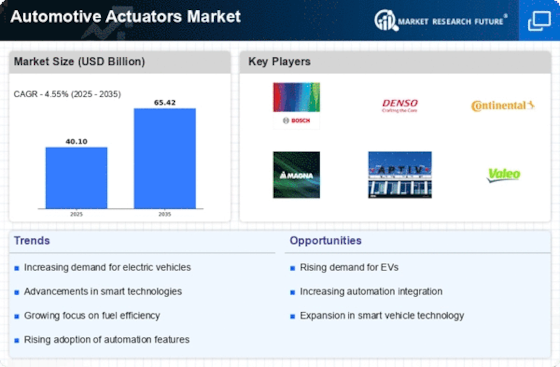
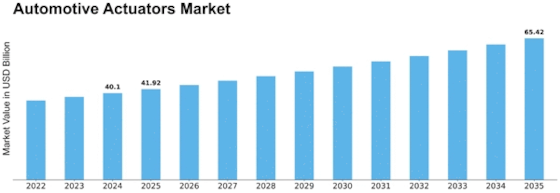
As per Market Research Future analysis, the Automotive Actuators Market Size was estimated at 40.1 USD Billion in 2024. The Automotive Actuators industry is projected to grow from 41.92 USD Billion in 2025 to 65.42 USD Billion by 2035, exhibiting a compound annual growth rate (CAGR) of 4.55% during the forecast period 2025 - 2035

Key Market Trends & Highlights

The Automotive Actuators Market is poised for substantial growth driven by technological advancements and evolving consumer preferences.

  • The market is experiencing a notable shift towards electric vehicles, influencing actuator design and functionality. Integration of smart technologies is becoming increasingly prevalent, enhancing vehicle performance and user experience. Safety and comfort features are gaining prominence, leading to higher demand for advanced actuators in various applications. Key market drivers include the rising demand for fuel efficiency and advancements in autonomous driving technologies, particularly in North America and Asia-Pacific.

Market Size & Forecast

2024 Market Size 40.1 (USD Billion)
2035 Market Size 65.42 (USD Billion)
CAGR (2025 - 2035) 4.55%
Largest Regional Market Share in 2024 Asia Pacific

Major Players

Bosch (DE), <a href="https://www.denso.com/global/en/business/products-and-services/mobility/safety-cockpit/">Denso</a> (JP), Continental (DE), Magna International (CA), Aptiv (IE), Valeo (FR), Hitachi Astemo (JP), <a href="https://discover.parker.com/electromechanical-actuators">Parker Hannifin</a> (US), Nidec Corporation (JP)

Market Trends

The Automotive Actuators Market is currently experiencing a transformative phase, driven by advancements in technology and increasing demand for vehicle automation. As vehicles become more sophisticated, the role of actuators in controlling various functions, such as throttle, brakes, and steering, becomes increasingly critical. This market is characterized by a shift towards different types of actuators in cars, including electric and hybrid vehicles, which require more precise and efficient actuator systems. Additionally, the growing emphasis on safety features and enhanced driving experiences is propelling the development of innovative actuator solutions. Manufacturers are focusing on integrating smart technologies, which may lead to improved performance and reliability in automotive applications. Moreover, the Automotive Actuators Market is likely to witness a surge in demand due to the rising consumer preference for comfort and convenience features in vehicles. As automakers strive to meet these expectations, the integration of advanced actuators that facilitate functions like automatic seat adjustments, climate control, and adaptive lighting systems is becoming more prevalent. This trend suggests a potential for growth in the market, as consumers increasingly seek vehicles that offer enhanced functionality and user experience. The ongoing evolution of automotive design and engineering is expected to further drive the adoption of advanced actuator technologies, positioning the market for sustained expansion in the coming years.

Shift Towards Electric Vehicles

The Automotive Actuators Market is witnessing a notable shift towards electric vehicles, which necessitate advanced actuator systems for optimal performance. This transition is prompting manufacturers to innovate and develop actuators that cater specifically to the unique requirements of electric drivetrains.

Integration of Smart Technologies

There is a growing trend towards the integration of smart technologies within the Automotive Actuators Market. This includes the incorporation of sensors and connectivity features that enhance the functionality and efficiency of actuators, thereby improving overall vehicle performance.

Focus on Safety and Comfort Features

The emphasis on safety and comfort in modern vehicles is driving demand for sophisticated actuator systems. Automakers are increasingly incorporating actuators that support advanced safety features and enhance passenger comfort, reflecting changing consumer preferences.

Automotive Actuators Market Market Drivers

Rising Demand for Fuel Efficiency

The Automotive Actuators Market is experiencing a notable surge in demand for fuel-efficient vehicles. As consumers become increasingly conscious of fuel costs and environmental impacts, automakers are compelled to innovate. Actuators play a crucial role in optimizing engine performance and enhancing fuel efficiency. According to recent data, vehicles equipped with advanced actuators can achieve up to 15% better fuel economy compared to traditional systems. This trend is likely to drive the adoption of sophisticated actuator technologies, as manufacturers seek to meet regulatory standards and consumer expectations. Consequently, the Automotive Actuators Market is poised for growth, as the integration of these components becomes essential for modern vehicle design.

Growth of the Electric Vehicle Market

The Automotive Actuators Market is witnessing growth driven by the expansion of the electric vehicle market. As electric vehicles (EVs) gain traction, the demand for specialized actuators tailored for electric drivetrains is increasing. These actuators are essential for managing battery systems, thermal management, and power distribution. Current projections suggest that the EV market could account for 30% of total vehicle sales by 2030, which will likely create substantial opportunities for actuator manufacturers. This shift towards electrification indicates that the Automotive Actuators Market must adapt to meet the unique requirements of electric vehicles, fostering innovation and development.

Increasing Focus on Vehicle Safety Regulations

The Automotive Actuators Market is also shaped by the increasing focus on vehicle safety regulations. Governments worldwide are implementing stringent safety standards, compelling manufacturers to enhance vehicle safety features. Actuators are pivotal in systems such as electronic stability control, anti-lock braking systems, and advanced driver-assistance systems. As a result, the demand for high-quality actuators is expected to rise. Recent statistics indicate that The Automotive Actuators Market is anticipated to grow at a CAGR of 8.5% through 2027, which will likely benefit the Automotive Actuators Market. This regulatory environment encourages innovation and investment in actuator technologies that enhance vehicle safety.

Advancements in Autonomous Driving Technologies

The Automotive Actuators Market is significantly influenced by the rapid advancements in autonomous driving technologies. As the automotive sector shifts towards automation, the demand for precise and reliable actuators is escalating. These components are integral to the functioning of various automated systems, including steering, braking, and throttle control. Market analysis indicates that the global market for autonomous vehicles is projected to reach USD 557 billion by 2026, which will likely propel the need for advanced actuators. This trend suggests that the Automotive Actuators Market will expand as manufacturers invest in developing actuators that can support the complexities of autonomous driving.

Integration of Advanced Manufacturing Technologies

The Automotive Actuators Market is being transformed by the integration of advanced manufacturing technologies. Innovations such as 3D printing, automation, and smart manufacturing are enhancing production efficiency and reducing costs. These technologies enable manufacturers to produce complex actuator designs that were previously unfeasible. As a result, the market is likely to see an influx of new actuator solutions that offer improved performance and reliability. Data suggests that the adoption of Industry 4.0 practices could increase productivity in the automotive sector by up to 30% by 2030. This trend indicates that the Automotive Actuators Market will benefit from these advancements, leading to a more competitive landscape.

Market Segment Insights

By Application: Power Steering (Largest) vs. Brake Control (Fastest-Growing)

In the Automotive Actuators Market, the application segment showcases a diverse range of functionalities, with power steering currently holding the largest market share. This dominance is attributed to the increasing preference for electric power steering systems, which enhance fuel efficiency and driving comfort. Other significant applications include throttle control and transmission control, contributing to the overall landscape but lagging behind the established power steering market. On the growth front, brake control is emerging as the fastest-growing segment, driven by rising safety regulations and advancements in braking technologies. The shift toward automatic and semi-automatic vehicles is further propelling the demand for efficient brake control actuators. The trend towards electrification and development of advanced driver-assistance systems (ADAS) is also influencing growth across the entire application segment.

Power Steering (Dominant) vs. Body Control (Emerging)

Power steering actuators play a crucial role in automotive performance, providing the necessary torque to assist drivers in steering. This segment is dominated by electric power steering (EPS) systems, which are favored for their weight reduction and efficiency compared to traditional hydraulic systems. On the other hand, body control systems are an emerging segment focused on enhancing vehicle comfort and convenience features. These systems manage various functions such as window controls, lighting, and climate control. As automation and smart vehicle technologies continue to evolve, body control actuators are gaining popularity, indicating a shift toward integrated vehicle control systems that enhance user experience and offer real-time adaptability.

By Type: Linear Actuators (Largest) vs. Rotary Actuators (Fastest-Growing)

In the Automotive Actuators Market, Linear Actuators hold the largest market share, primarily due to diverse linear actuator uses in various automotive systems such as braking, steering, and suspension adjustments. They are favored for their simplicity and reliability, which contributes to their dominance in the market. Rotary Actuators, while smaller in market share, are rapidly gaining traction, reflective of the increasing demand for advanced automotive functionalities and innovations in vehicle designs. As the automotive industry moves towards electrification and automation, the growth trends indicate a significant shift towards Rotary Actuators. Enhanced precision and efficiency provided by these actuators cater to the evolving needs for sophisticated vehicle control systems. The increasing integration of smart technologies and the pursuit of energy efficiency further drive the adoption of Rotary Actuators, positioning them as a key segment poised for substantial growth in the coming years.

Linear Actuators (Dominant) vs. Rotary Actuators (Emerging)

Linear actuator uses can be vastly found in applications like lift gates, seats, and various other mechanisms demanding linear motion. Their established track record and robust performance make them the dominant choice among manufacturers and OEMs. On the other hand, Rotary Actuators are emerging as vital components in modern vehicles, particularly in<a href="https://www.marketresearchfuture.com/reports/advanced-driver-assistance-systems-market-4434"> advanced driver-assistance systems</a> (ADAS) and automated parking functions. Their capacity for precise movement and compact design makes them suitable for innovative car designs where space is at a premium. As consumer preferences shift towards high-tech vehicles, their adoption is likely to increase, signaling a transformative period for the Automotive Actuators Market.

By Fuel Type: Internal Combustion Engine (Largest) vs. Electric (Fastest-Growing)

The automotive actuators market is seeing notable distribution among fuel types, with Internal Combustion Engine (ICE) actuators holding the largest share. This segment benefits from the established presence of traditional vehicles, which continue to dominate sales. Electric actuators are gaining momentum as manufacturers pivot towards sustainable solutions and eco-friendly technologies, enhancing their market presence. Meanwhile, hybrid actuators bridge the gap, offering versatility by integrating both electric and combustion power, appealing to a diverse customer base. Growth trends reveal a rapid evolution in consumer preferences and regulatory changes impacting the automotive sector. Electric actuators, being the fastest-growing segment, are propelled by advancements in battery technology and government incentives for electric vehicles. Conversely, ICE actuators face challenges as stricter emissions regulations drive manufacturers to innovate, thus impacting their market stability. Hybrid models remain in demand as they cater to consumers transitioning from traditional gas-powered vehicles while still providing an electric drive option.

Internal Combustion Engine (Dominant) vs. Electric (Emerging)

Internal Combustion Engine (ICE) actuators dominate the automotive actuators market due to their long-standing integration in traditional vehicles, providing significant reliability and performance. These actuators play crucial roles in controlling various engine functions, thereby ensuring optimal performance and efficiency. However, as the market shifts towards greener alternatives, Electric actuators are emerging rapidly, driven by advancements in automotive technology and declining battery costs. They represent the future of mobility, offering benefits such as lower energy consumption and reduced emissions. This shift to electric solutions not only supports environmental goals but also creates opportunities for innovation and expansion within the automotive sector, especially as manufacturers introduce more electric models.

By Vehicle Type: Passenger Cars (Largest) vs. Heavy Commercial Vehicles (Fastest-Growing)

The Automotive Actuators Market showcases varying market share dynamics across vehicle types. Passenger car actuators dominate the segment, accounting for a substantial portion of the market due to their widespread use and integration of advanced actuator technologies. In contrast, Heavy Commercial Vehicles, while smaller in share, are increasingly adopting innovative actuator solutions to enhance performance and efficiency, making this segment a significant focus for future growth.

Passenger Cars (Dominant) vs. Heavy Commercial Vehicles (Emerging)

Passenger Cars are the dominant segment in the Automotive Actuators Market, benefiting from the ongoing trend towards automation and electrification. This segment incorporates advanced actuators in cars for functionalities such as drive-by-wire systems, electronic steering, and adaptive cruise control, contributing to improved driving safety and comfort. Conversely, Heavy Commercial Vehicles are classified as an emerging segment, where technological advancements are propelling growth. The increased demand for fuel efficiency, regulatory compliance, and enhanced vehicle performance is leading to greater investment in actuator technology, particularly for automated and hybrid trucks, thus positioning Heavy Commercial Vehicles as a rapidly evolving player in the market.

Get more detailed insights about Automotive Actuators Market Research Report - Forecast to 2035

Regional Insights

The Automotive Actuators Market demonstrates a diverse regional landscape with notable valuation differences among its segments. In 2024, North America was valued at 12.0 USD Billion, emerging as a significant player due to advanced automotive technology and increasing demand for electric vehicles. Europe followed closely with a valuation of 10.5 USD Billion, driven by stringent emissions regulations and a strong push for automation in the automotive sector.

The APAC region led with a valuation of 13.5 USD Billion in 2024, highlighting its dominance as a manufacturing hub, where demand for innovative automotive solutions is rapidly rising due to population growth and urbanization.

South America, valued at 2.0 USD Billion, faces challenges in infrastructure development, which limits its market growth but holds potential for expansion in the coming years. The Middle East and Africa (MEA) segment stood at 2.1 USD Billion, with increasing automotive production bolstered by rising investments in the automotive sector. The Automotive Actuators Market revenue is notably influenced by technological advancements and consumer preferences shifting towards automation and smart vehicles, while the industry's growth can be challenged by fluctuating raw material costs and geopolitical factors impacting trade.

Key Players and Competitive Insights

The Automotive Actuators Market has witnessed significant growth due to the increasing demand for advanced automotive technologies and the ongoing shift towards electrification and automation in vehicles. Various stakeholders are competing to gain market share by innovating and developing a range of actuators, which play a critical role in various automotive applications such as engine control, transmission systems, braking, and HVAC systems. Intense competition is characterized by partnerships, mergers, and acquisitions, contributing to advancements and economies of scale in production processes. The need for increased efficiency, reliability, and performance in automotive components has driven manufacturers to invest heavily in research and development, tailoring their products to meet the diverse requirements of automotive OEMs and Tier-1 suppliers. Denso has established a significant presence in the Automotive Actuators Market through its focus on innovation and technological advancements. The strength of Denso lies in its extensive R&D capabilities and commitment to producing high-quality actuators that enhance vehicle performance and efficiency. Known for its contributions to fuel efficiency and emissions reduction, Denso's products, including electric and pneumatic actuators, have set benchmarks in the industry. The company's worldwide operations support a strong supply chain, allowing it to serve major automotive manufacturers across different regions. Denso’s emphasis on sustainability and the development of eco-friendly solutions positions it as a leader in the market, bolstering its competitive edge. Magna International has been a formidable player in the Automotive Actuators Market, specializing in a diverse array of products and services designed to meet the evolving needs of the automotive industry. The company's offerings include a wide range of actuators for various applications, such as powertrains, body controls, and safety systems. Magna’s integrated approach, combining engineering excellence and manufacturing capabilities, enables it to be flexible and responsive to market demands. The firm's strong footprint in multiple international markets is strengthened by its strategic mergers and acquisitions, which have enhanced its technological expertise and expanded its product portfolio. Magna's reputation for quality and reliability, along with its commitment to innovation and efficiency, makes it a key player in driving forward developments in automotive actuator technologies on a scale.

Key Companies in the Automotive Actuators Market include

Industry Developments

Recent developments in the Automotive Actuators Market highlight significant advancements and competitive activities among major players such as Denso, Magna International, Continental, Nidec Corporation, Hitachi Automotive Systems, Robert Bosch, Valeo, Aisin Seiki, Parker Hannifin, Transdigm Group, Delphi Technologies, Michael Electric, BorgWarner, and Honeywell. In September 2023, Nidec Corporation announced its acquisition of a technology firm to strengthen its electric actuator division, aiming to enhance efficiency and sustainability in automotive applications.

Furthermore, in June 2023, Delphi Technologies expanded its actuator product line to support the shift towards electrification in vehicles, reflecting market trends towards green technologies. The market continues to grow significantly; financial forecasts indicate a 7% CAGR over the next five years, driven by advancements in electric vehicles and autonomous technologies. In recent years, the Automotive Actuators Market has witnessed increased investments in Research and Development, leading to the introduction of advanced actuators capable of supporting enhanced vehicle functionalities.

Consequently, this growth trajectory is reshaping industry dynamics, stimulating innovation, and driving manufacturers to adopt more advanced automotive technologies to remain competitive in the ever-evolving landscape.

Future Outlook

Automotive Actuators Market Future Outlook

The Automotive Actuators Market is projected to grow at a 4.55% CAGR from 2025 to 2035, driven by advancements in electric vehicles, automation, and enhanced safety features.

New opportunities lie in:

  • <p>Integration of smart actuators in autonomous vehicles Development of energy-efficient actuators for hybrid models Expansion into emerging markets with tailored actuator solutions</p>

By 2035, the market is expected to be robust, driven by innovation and strategic expansions.

Market Segmentation

Automotive Actuators Market Type Outlook

  • Linear Actuators
  • Rotary Actuators
  • Servo Actuators

Automotive Actuators Market Fuel Type Outlook

  • Internal Combustion Engine
  • Electric
  • Hybrid

Automotive Actuators Market Application Outlook

  • Power Steering
  • Throttle Control
  • Transmission Control
  • Brake Control
  • Body Control

Automotive Actuators Market Vehicle Type Outlook

  • Passenger Cars
  • Light Commercial Vehicles
  • Heavy Commercial Vehicles

Report Scope

MARKET SIZE 2024 40.1(USD Billion)
MARKET SIZE 2025 41.92(USD Billion)
MARKET SIZE 2035 65.42(USD Billion)
COMPOUND ANNUAL GROWTH RATE (CAGR) 4.55% (2025 - 2035)
REPORT COVERAGE Revenue Forecast, Competitive Landscape, Growth Factors, and Trends
BASE YEAR 2024
Market Forecast Period 2025 - 2035
Historical Data 2019 - 2024
Market Forecast Units USD Billion
Key Companies Profiled Bosch (DE), Denso (JP), Continental (DE), Magna International (CA), Aptiv (IE), Valeo (FR), Hitachi Astemo (JP), Parker Hannifin (US), Nidec Corporation (JP)
Segments Covered Application, Type, Fuel Type, Vehicle Type, Regional
Key Market Opportunities Integration of advanced driver assistance systems driving demand for innovative Automotive Actuators.
Key Market Dynamics Rising demand for electric vehicles drives innovation and competition in the automotive actuators market.
Countries Covered North America, Europe, APAC, South America, MEA

FAQs

What is the projected market valuation of the Automotive Actuators Market by 2035?

<p>The Automotive Actuators Market is projected to reach a valuation of 65.42 USD Billion by 2035.</p>

What was the market valuation of the Automotive Actuators Market in 2024?

<p>In 2024, the Automotive Actuators Market was valued at 40.1 USD Billion.</p>

What is the expected CAGR for the Automotive Actuators Market during the forecast period 2025 - 2035?

<p>The expected CAGR for the Automotive Actuators Market during the forecast period 2025 - 2035 is 4.55%.</p>

Which application segment is projected to have the highest valuation by 2035?

<p>The Body Control application segment is projected to reach a valuation of 17.42 USD Billion by 2035.</p>

How do linear actuators compare to rotary actuators in terms of market valuation by 2035?

<p>By 2035, linear actuators are expected to be valued at 25.0 USD Billion, while rotary actuators are projected at 20.0 USD Billion.</p>

What are the key players in the Automotive Actuators Market?

<p>Key players in the Automotive Actuators Market include Bosch, Denso, Continental, Magna International, and Aptiv.</p>

What is the projected valuation for electric fuel type actuators by 2035?

<p>The projected valuation for electric fuel type actuators is expected to reach 24.12 USD Billion by 2035.</p>

Which vehicle type segment is anticipated to dominate the market by 2035?

<p>The Passenger Cars segment is anticipated to dominate the market with a projected valuation of 32.71 USD Billion by 2035.</p>

What was the valuation of the brake control application segment in 2024?

<p>In 2024, the brake control application segment was valued at 6.0 USD Billion.</p>

How does the market for hybrid fuel type actuators compare to internal combustion engine actuators by 2035?

<p>By 2035, the market for hybrid fuel type actuators is projected at 8.59 USD Billion, significantly lower than the 32.71 USD Billion for internal combustion engine actuators.</p>

  1. SECTION I: EXECUTIVE SUMMARY AND KEY HIGHLIGHTS
    1. | 1.1 EXECUTIVE SUMMARY
    2. | | 1.1.1 Market Overview
    3. | | 1.1.2 Key Findings
    4. | | 1.1.3 Market Segmentation
    5. | | 1.1.4 Competitive Landscape
    6. | | 1.1.5 Challenges and Opportunities
    7. | | 1.1.6 Future Outlook
  2. SECTION II: SCOPING, METHODOLOGY AND MARKET STRUCTURE
    1. | 2.1 MARKET INTRODUCTION
    2. | | 2.1.1 Definition
    3. | | 2.1.2 Scope of the study
    4. | | | 2.1.2.1 Research Objective
    5. | | | 2.1.2.2 Assumption
    6. | | | 2.1.2.3 Limitations
    7. | 2.2 RESEARCH METHODOLOGY
    8. | | 2.2.1 Overview
    9. | | 2.2.2 Data Mining
    10. | | 2.2.3 Secondary Research
    11. | | 2.2.4 Primary Research
    12. | | | 2.2.4.1 Primary Interviews and Information Gathering Process
    13. | | | 2.2.4.2 Breakdown of Primary Respondents
    14. | | 2.2.5 Forecasting Model
    15. | | 2.2.6 Market Size Estimation
    16. | | | 2.2.6.1 Bottom-Up Approach
    17. | | | 2.2.6.2 Top-Down Approach
    18. | | 2.2.7 Data Triangulation
    19. | | 2.2.8 Validation
  3. SECTION III: QUALITATIVE ANALYSIS
    1. | 3.1 MARKET DYNAMICS
    2. | | 3.1.1 Overview
    3. | | 3.1.2 Drivers
    4. | | 3.1.3 Restraints
    5. | | 3.1.4 Opportunities
    6. | 3.2 MARKET FACTOR ANALYSIS
    7. | | 3.2.1 Value chain Analysis
    8. | | 3.2.2 Porter's Five Forces Analysis
    9. | | | 3.2.2.1 Bargaining Power of Suppliers
    10. | | | 3.2.2.2 Bargaining Power of Buyers
    11. | | | 3.2.2.3 Threat of New Entrants
    12. | | | 3.2.2.4 Threat of Substitutes
    13. | | | 3.2.2.5 Intensity of Rivalry
    14. | | 3.2.3 COVID-19 Impact Analysis
    15. | | | 3.2.3.1 Market Impact Analysis
    16. | | | 3.2.3.2 Regional Impact
    17. | | | 3.2.3.3 Opportunity and Threat Analysis
  4. SECTION IV: QUANTITATIVE ANALYSIS
    1. | 4.1 Automobile, BY Application (USD Billion)
    2. | | 4.1.1 Power Steering
    3. | | 4.1.2 Throttle Control
    4. | | 4.1.3 Transmission Control
    5. | | 4.1.4 Brake Control
    6. | | 4.1.5 Body Control
    7. | 4.2 Automobile, BY Type (USD Billion)
    8. | | 4.2.1 Linear Actuators
    9. | | 4.2.2 Rotary Actuators
    10. | | 4.2.3 Servo Actuators
    11. | 4.3 Automobile, BY Fuel Type (USD Billion)
    12. | | 4.3.1 Internal Combustion Engine
    13. | | 4.3.2 Electric
    14. | | 4.3.3 Hybrid
    15. | 4.4 Automobile, BY Vehicle Type (USD Billion)
    16. | | 4.4.1 Passenger Cars
    17. | | 4.4.2 Light Commercial Vehicles
    18. | | 4.4.3 Heavy Commercial Vehicles
    19. | 4.5 Automobile, BY Region (USD Billion)
    20. | | 4.5.1 North America
    21. | | | 4.5.1.1 US
    22. | | | 4.5.1.2 Canada
    23. | | 4.5.2 Europe
    24. | | | 4.5.2.1 Germany
    25. | | | 4.5.2.2 UK
    26. | | | 4.5.2.3 France
    27. | | | 4.5.2.4 Russia
    28. | | | 4.5.2.5 Italy
    29. | | | 4.5.2.6 Spain
    30. | | | 4.5.2.7 Rest of Europe
    31. | | 4.5.3 APAC
    32. | | | 4.5.3.1 China
    33. | | | 4.5.3.2 India
    34. | | | 4.5.3.3 Japan
    35. | | | 4.5.3.4 South Korea
    36. | | | 4.5.3.5 Malaysia
    37. | | | 4.5.3.6 Thailand
    38. | | | 4.5.3.7 Indonesia
    39. | | | 4.5.3.8 Rest of APAC
    40. | | 4.5.4 South America
    41. | | | 4.5.4.1 Brazil
    42. | | | 4.5.4.2 Mexico
    43. | | | 4.5.4.3 Argentina
    44. | | | 4.5.4.4 Rest of South America
    45. | | 4.5.5 MEA
    46. | | | 4.5.5.1 GCC Countries
    47. | | | 4.5.5.2 South Africa
    48. | | | 4.5.5.3 Rest of MEA
  5. SECTION V: COMPETITIVE ANALYSIS
    1. | 5.1 Competitive Landscape
    2. | | 5.1.1 Overview
    3. | | 5.1.2 Competitive Analysis
    4. | | 5.1.3 Market share Analysis
    5. | | 5.1.4 Major Growth Strategy in the Automobile
    6. | | 5.1.5 Competitive Benchmarking
    7. | | 5.1.6 Leading Players in Terms of Number of Developments in the Automobile
    8. | | 5.1.7 Key developments and growth strategies
    9. | | | 5.1.7.1 New Product Launch/Service Deployment
    10. | | | 5.1.7.2 Merger & Acquisitions
    11. | | | 5.1.7.3 Joint Ventures
    12. | | 5.1.8 Major Players Financial Matrix
    13. | | | 5.1.8.1 Sales and Operating Income
    14. | | | 5.1.8.2 Major Players R&D Expenditure. 2023
    15. | 5.2 Company Profiles
    16. | | 5.2.1 Bosch (DE)
    17. | | | 5.2.1.1 Financial Overview
    18. | | | 5.2.1.2 Products Offered
    19. | | | 5.2.1.3 Key Developments
    20. | | | 5.2.1.4 SWOT Analysis
    21. | | | 5.2.1.5 Key Strategies
    22. | | 5.2.2 Denso (JP)
    23. | | | 5.2.2.1 Financial Overview
    24. | | | 5.2.2.2 Products Offered
    25. | | | 5.2.2.3 Key Developments
    26. | | | 5.2.2.4 SWOT Analysis
    27. | | | 5.2.2.5 Key Strategies
    28. | | 5.2.3 Continental (DE)
    29. | | | 5.2.3.1 Financial Overview
    30. | | | 5.2.3.2 Products Offered
    31. | | | 5.2.3.3 Key Developments
    32. | | | 5.2.3.4 SWOT Analysis
    33. | | | 5.2.3.5 Key Strategies
    34. | | 5.2.4 Magna International (CA)
    35. | | | 5.2.4.1 Financial Overview
    36. | | | 5.2.4.2 Products Offered
    37. | | | 5.2.4.3 Key Developments
    38. | | | 5.2.4.4 SWOT Analysis
    39. | | | 5.2.4.5 Key Strategies
    40. | | 5.2.5 Aptiv (IE)
    41. | | | 5.2.5.1 Financial Overview
    42. | | | 5.2.5.2 Products Offered
    43. | | | 5.2.5.3 Key Developments
    44. | | | 5.2.5.4 SWOT Analysis
    45. | | | 5.2.5.5 Key Strategies
    46. | | 5.2.6 Valeo (FR)
    47. | | | 5.2.6.1 Financial Overview
    48. | | | 5.2.6.2 Products Offered
    49. | | | 5.2.6.3 Key Developments
    50. | | | 5.2.6.4 SWOT Analysis
    51. | | | 5.2.6.5 Key Strategies
    52. | | 5.2.7 Hitachi Astemo (JP)
    53. | | | 5.2.7.1 Financial Overview
    54. | | | 5.2.7.2 Products Offered
    55. | | | 5.2.7.3 Key Developments
    56. | | | 5.2.7.4 SWOT Analysis
    57. | | | 5.2.7.5 Key Strategies
    58. | | 5.2.8 Parker Hannifin (US)
    59. | | | 5.2.8.1 Financial Overview
    60. | | | 5.2.8.2 Products Offered
    61. | | | 5.2.8.3 Key Developments
    62. | | | 5.2.8.4 SWOT Analysis
    63. | | | 5.2.8.5 Key Strategies
    64. | | 5.2.9 Nidec Corporation (JP)
    65. | | | 5.2.9.1 Financial Overview
    66. | | | 5.2.9.2 Products Offered
    67. | | | 5.2.9.3 Key Developments
    68. | | | 5.2.9.4 SWOT Analysis
    69. | | | 5.2.9.5 Key Strategies
    70. | 5.3 Appendix
    71. | | 5.3.1 References
    72. | | 5.3.2 Related Reports
  6. LIST OF FIGURES
    1. | 6.1 MARKET SYNOPSIS
    2. | 6.2 NORTH AMERICA MARKET ANALYSIS
    3. | 6.3 US MARKET ANALYSIS BY APPLICATION
    4. | 6.4 US MARKET ANALYSIS BY TYPE
    5. | 6.5 US MARKET ANALYSIS BY FUEL TYPE
    6. | 6.6 US MARKET ANALYSIS BY VEHICLE TYPE
    7. | 6.7 CANADA MARKET ANALYSIS BY APPLICATION
    8. | 6.8 CANADA MARKET ANALYSIS BY TYPE
    9. | 6.9 CANADA MARKET ANALYSIS BY FUEL TYPE
    10. | 6.10 CANADA MARKET ANALYSIS BY VEHICLE TYPE
    11. | 6.11 EUROPE MARKET ANALYSIS
    12. | 6.12 GERMANY MARKET ANALYSIS BY APPLICATION
    13. | 6.13 GERMANY MARKET ANALYSIS BY TYPE
    14. | 6.14 GERMANY MARKET ANALYSIS BY FUEL TYPE
    15. | 6.15 GERMANY MARKET ANALYSIS BY VEHICLE TYPE
    16. | 6.16 UK MARKET ANALYSIS BY APPLICATION
    17. | 6.17 UK MARKET ANALYSIS BY TYPE
    18. | 6.18 UK MARKET ANALYSIS BY FUEL TYPE
    19. | 6.19 UK MARKET ANALYSIS BY VEHICLE TYPE
    20. | 6.20 FRANCE MARKET ANALYSIS BY APPLICATION
    21. | 6.21 FRANCE MARKET ANALYSIS BY TYPE
    22. | 6.22 FRANCE MARKET ANALYSIS BY FUEL TYPE
    23. | 6.23 FRANCE MARKET ANALYSIS BY VEHICLE TYPE
    24. | 6.24 RUSSIA MARKET ANALYSIS BY APPLICATION
    25. | 6.25 RUSSIA MARKET ANALYSIS BY TYPE
    26. | 6.26 RUSSIA MARKET ANALYSIS BY FUEL TYPE
    27. | 6.27 RUSSIA MARKET ANALYSIS BY VEHICLE TYPE
    28. | 6.28 ITALY MARKET ANALYSIS BY APPLICATION
    29. | 6.29 ITALY MARKET ANALYSIS BY TYPE
    30. | 6.30 ITALY MARKET ANALYSIS BY FUEL TYPE
    31. | 6.31 ITALY MARKET ANALYSIS BY VEHICLE TYPE
    32. | 6.32 SPAIN MARKET ANALYSIS BY APPLICATION
    33. | 6.33 SPAIN MARKET ANALYSIS BY TYPE
    34. | 6.34 SPAIN MARKET ANALYSIS BY FUEL TYPE
    35. | 6.35 SPAIN MARKET ANALYSIS BY VEHICLE TYPE
    36. | 6.36 REST OF EUROPE MARKET ANALYSIS BY APPLICATION
    37. | 6.37 REST OF EUROPE MARKET ANALYSIS BY TYPE
    38. | 6.38 REST OF EUROPE MARKET ANALYSIS BY FUEL TYPE
    39. | 6.39 REST OF EUROPE MARKET ANALYSIS BY VEHICLE TYPE
    40. | 6.40 APAC MARKET ANALYSIS
    41. | 6.41 CHINA MARKET ANALYSIS BY APPLICATION
    42. | 6.42 CHINA MARKET ANALYSIS BY TYPE
    43. | 6.43 CHINA MARKET ANALYSIS BY FUEL TYPE
    44. | 6.44 CHINA MARKET ANALYSIS BY VEHICLE TYPE
    45. | 6.45 INDIA MARKET ANALYSIS BY APPLICATION
    46. | 6.46 INDIA MARKET ANALYSIS BY TYPE
    47. | 6.47 INDIA MARKET ANALYSIS BY FUEL TYPE
    48. | 6.48 INDIA MARKET ANALYSIS BY VEHICLE TYPE
    49. | 6.49 JAPAN MARKET ANALYSIS BY APPLICATION
    50. | 6.50 JAPAN MARKET ANALYSIS BY TYPE
    51. | 6.51 JAPAN MARKET ANALYSIS BY FUEL TYPE
    52. | 6.52 JAPAN MARKET ANALYSIS BY VEHICLE TYPE
    53. | 6.53 SOUTH KOREA MARKET ANALYSIS BY APPLICATION
    54. | 6.54 SOUTH KOREA MARKET ANALYSIS BY TYPE
    55. | 6.55 SOUTH KOREA MARKET ANALYSIS BY FUEL TYPE
    56. | 6.56 SOUTH KOREA MARKET ANALYSIS BY VEHICLE TYPE
    57. | 6.57 MALAYSIA MARKET ANALYSIS BY APPLICATION
    58. | 6.58 MALAYSIA MARKET ANALYSIS BY TYPE
    59. | 6.59 MALAYSIA MARKET ANALYSIS BY FUEL TYPE
    60. | 6.60 MALAYSIA MARKET ANALYSIS BY VEHICLE TYPE
    61. | 6.61 THAILAND MARKET ANALYSIS BY APPLICATION
    62. | 6.62 THAILAND MARKET ANALYSIS BY TYPE
    63. | 6.63 THAILAND MARKET ANALYSIS BY FUEL TYPE
    64. | 6.64 THAILAND MARKET ANALYSIS BY VEHICLE TYPE
    65. | 6.65 INDONESIA MARKET ANALYSIS BY APPLICATION
    66. | 6.66 INDONESIA MARKET ANALYSIS BY TYPE
    67. | 6.67 INDONESIA MARKET ANALYSIS BY FUEL TYPE
    68. | 6.68 INDONESIA MARKET ANALYSIS BY VEHICLE TYPE
    69. | 6.69 REST OF APAC MARKET ANALYSIS BY APPLICATION
    70. | 6.70 REST OF APAC MARKET ANALYSIS BY TYPE
    71. | 6.71 REST OF APAC MARKET ANALYSIS BY FUEL TYPE
    72. | 6.72 REST OF APAC MARKET ANALYSIS BY VEHICLE TYPE
    73. | 6.73 SOUTH AMERICA MARKET ANALYSIS
    74. | 6.74 BRAZIL MARKET ANALYSIS BY APPLICATION
    75. | 6.75 BRAZIL MARKET ANALYSIS BY TYPE
    76. | 6.76 BRAZIL MARKET ANALYSIS BY FUEL TYPE
    77. | 6.77 BRAZIL MARKET ANALYSIS BY VEHICLE TYPE
    78. | 6.78 MEXICO MARKET ANALYSIS BY APPLICATION
    79. | 6.79 MEXICO MARKET ANALYSIS BY TYPE
    80. | 6.80 MEXICO MARKET ANALYSIS BY FUEL TYPE
    81. | 6.81 MEXICO MARKET ANALYSIS BY VEHICLE TYPE
    82. | 6.82 ARGENTINA MARKET ANALYSIS BY APPLICATION
    83. | 6.83 ARGENTINA MARKET ANALYSIS BY TYPE
    84. | 6.84 ARGENTINA MARKET ANALYSIS BY FUEL TYPE
    85. | 6.85 ARGENTINA MARKET ANALYSIS BY VEHICLE TYPE
    86. | 6.86 REST OF SOUTH AMERICA MARKET ANALYSIS BY APPLICATION
    87. | 6.87 REST OF SOUTH AMERICA MARKET ANALYSIS BY TYPE
    88. | 6.88 REST OF SOUTH AMERICA MARKET ANALYSIS BY FUEL TYPE
    89. | 6.89 REST OF SOUTH AMERICA MARKET ANALYSIS BY VEHICLE TYPE
    90. | 6.90 MEA MARKET ANALYSIS
    91. | 6.91 GCC COUNTRIES MARKET ANALYSIS BY APPLICATION
    92. | 6.92 GCC COUNTRIES MARKET ANALYSIS BY TYPE
    93. | 6.93 GCC COUNTRIES MARKET ANALYSIS BY FUEL TYPE
    94. | 6.94 GCC COUNTRIES MARKET ANALYSIS BY VEHICLE TYPE
    95. | 6.95 SOUTH AFRICA MARKET ANALYSIS BY APPLICATION
    96. | 6.96 SOUTH AFRICA MARKET ANALYSIS BY TYPE
    97. | 6.97 SOUTH AFRICA MARKET ANALYSIS BY FUEL TYPE
    98. | 6.98 SOUTH AFRICA MARKET ANALYSIS BY VEHICLE TYPE
    99. | 6.99 REST OF MEA MARKET ANALYSIS BY APPLICATION
    100. | 6.100 REST OF MEA MARKET ANALYSIS BY TYPE
    101. | 6.101 REST OF MEA MARKET ANALYSIS BY FUEL TYPE
    102. | 6.102 REST OF MEA MARKET ANALYSIS BY VEHICLE TYPE
    103. | 6.103 KEY BUYING CRITERIA OF AUTOMOBILE
    104. | 6.104 RESEARCH PROCESS OF MRFR
    105. | 6.105 DRO ANALYSIS OF AUTOMOBILE
    106. | 6.106 DRIVERS IMPACT ANALYSIS: AUTOMOBILE
    107. | 6.107 RESTRAINTS IMPACT ANALYSIS: AUTOMOBILE
    108. | 6.108 SUPPLY / VALUE CHAIN: AUTOMOBILE
    109. | 6.109 AUTOMOBILE, BY APPLICATION, 2024 (% SHARE)
    110. | 6.110 AUTOMOBILE, BY APPLICATION, 2024 TO 2035 (USD Billion)
    111. | 6.111 AUTOMOBILE, BY TYPE, 2024 (% SHARE)
    112. | 6.112 AUTOMOBILE, BY TYPE, 2024 TO 2035 (USD Billion)
    113. | 6.113 AUTOMOBILE, BY FUEL TYPE, 2024 (% SHARE)
    114. | 6.114 AUTOMOBILE, BY FUEL TYPE, 2024 TO 2035 (USD Billion)
    115. | 6.115 AUTOMOBILE, BY VEHICLE TYPE, 2024 (% SHARE)
    116. | 6.116 AUTOMOBILE, BY VEHICLE TYPE, 2024 TO 2035 (USD Billion)
    117. | 6.117 BENCHMARKING OF MAJOR COMPETITORS
  7. LIST OF TABLES
    1. | 7.1 LIST OF ASSUMPTIONS
    2. | | 7.1.1
    3. | 7.2 North America MARKET SIZE ESTIMATES; FORECAST
    4. | | 7.2.1 BY APPLICATION, 2025-2035 (USD Billion)
    5. | | 7.2.2 BY TYPE, 2025-2035 (USD Billion)
    6. | | 7.2.3 BY FUEL TYPE, 2025-2035 (USD Billion)
    7. | | 7.2.4 BY VEHICLE TYPE, 2025-2035 (USD Billion)
    8. | 7.3 US MARKET SIZE ESTIMATES; FORECAST
    9. | | 7.3.1 BY APPLICATION, 2025-2035 (USD Billion)
    10. | | 7.3.2 BY TYPE, 2025-2035 (USD Billion)
    11. | | 7.3.3 BY FUEL TYPE, 2025-2035 (USD Billion)
    12. | | 7.3.4 BY VEHICLE TYPE, 2025-2035 (USD Billion)
    13. | 7.4 Canada MARKET SIZE ESTIMATES; FORECAST
    14. | | 7.4.1 BY APPLICATION, 2025-2035 (USD Billion)
    15. | | 7.4.2 BY TYPE, 2025-2035 (USD Billion)
    16. | | 7.4.3 BY FUEL TYPE, 2025-2035 (USD Billion)
    17. | | 7.4.4 BY VEHICLE TYPE, 2025-2035 (USD Billion)
    18. | 7.5 Europe MARKET SIZE ESTIMATES; FORECAST
    19. | | 7.5.1 BY APPLICATION, 2025-2035 (USD Billion)
    20. | | 7.5.2 BY TYPE, 2025-2035 (USD Billion)
    21. | | 7.5.3 BY FUEL TYPE, 2025-2035 (USD Billion)
    22. | | 7.5.4 BY VEHICLE TYPE, 2025-2035 (USD Billion)
    23. | 7.6 Germany MARKET SIZE ESTIMATES; FORECAST
    24. | | 7.6.1 BY APPLICATION, 2025-2035 (USD Billion)
    25. | | 7.6.2 BY TYPE, 2025-2035 (USD Billion)
    26. | | 7.6.3 BY FUEL TYPE, 2025-2035 (USD Billion)
    27. | | 7.6.4 BY VEHICLE TYPE, 2025-2035 (USD Billion)
    28. | 7.7 UK MARKET SIZE ESTIMATES; FORECAST
    29. | | 7.7.1 BY APPLICATION, 2025-2035 (USD Billion)
    30. | | 7.7.2 BY TYPE, 2025-2035 (USD Billion)
    31. | | 7.7.3 BY FUEL TYPE, 2025-2035 (USD Billion)
    32. | | 7.7.4 BY VEHICLE TYPE, 2025-2035 (USD Billion)
    33. | 7.8 France MARKET SIZE ESTIMATES; FORECAST
    34. | | 7.8.1 BY APPLICATION, 2025-2035 (USD Billion)
    35. | | 7.8.2 BY TYPE, 2025-2035 (USD Billion)
    36. | | 7.8.3 BY FUEL TYPE, 2025-2035 (USD Billion)
    37. | | 7.8.4 BY VEHICLE TYPE, 2025-2035 (USD Billion)
    38. | 7.9 Russia MARKET SIZE ESTIMATES; FORECAST
    39. | | 7.9.1 BY APPLICATION, 2025-2035 (USD Billion)
    40. | | 7.9.2 BY TYPE, 2025-2035 (USD Billion)
    41. | | 7.9.3 BY FUEL TYPE, 2025-2035 (USD Billion)
    42. | | 7.9.4 BY VEHICLE TYPE, 2025-2035 (USD Billion)
    43. | 7.10 Italy MARKET SIZE ESTIMATES; FORECAST
    44. | | 7.10.1 BY APPLICATION, 2025-2035 (USD Billion)
    45. | | 7.10.2 BY TYPE, 2025-2035 (USD Billion)
    46. | | 7.10.3 BY FUEL TYPE, 2025-2035 (USD Billion)
    47. | | 7.10.4 BY VEHICLE TYPE, 2025-2035 (USD Billion)
    48. | 7.11 Spain MARKET SIZE ESTIMATES; FORECAST
    49. | | 7.11.1 BY APPLICATION, 2025-2035 (USD Billion)
    50. | | 7.11.2 BY TYPE, 2025-2035 (USD Billion)
    51. | | 7.11.3 BY FUEL TYPE, 2025-2035 (USD Billion)
    52. | | 7.11.4 BY VEHICLE TYPE, 2025-2035 (USD Billion)
    53. | 7.12 Rest of Europe MARKET SIZE ESTIMATES; FORECAST
    54. | | 7.12.1 BY APPLICATION, 2025-2035 (USD Billion)
    55. | | 7.12.2 BY TYPE, 2025-2035 (USD Billion)
    56. | | 7.12.3 BY FUEL TYPE, 2025-2035 (USD Billion)
    57. | | 7.12.4 BY VEHICLE TYPE, 2025-2035 (USD Billion)
    58. | 7.13 APAC MARKET SIZE ESTIMATES; FORECAST
    59. | | 7.13.1 BY APPLICATION, 2025-2035 (USD Billion)
    60. | | 7.13.2 BY TYPE, 2025-2035 (USD Billion)
    61. | | 7.13.3 BY FUEL TYPE, 2025-2035 (USD Billion)
    62. | | 7.13.4 BY VEHICLE TYPE, 2025-2035 (USD Billion)
    63. | 7.14 China MARKET SIZE ESTIMATES; FORECAST
    64. | | 7.14.1 BY APPLICATION, 2025-2035 (USD Billion)
    65. | | 7.14.2 BY TYPE, 2025-2035 (USD Billion)
    66. | | 7.14.3 BY FUEL TYPE, 2025-2035 (USD Billion)
    67. | | 7.14.4 BY VEHICLE TYPE, 2025-2035 (USD Billion)
    68. | 7.15 India MARKET SIZE ESTIMATES; FORECAST
    69. | | 7.15.1 BY APPLICATION, 2025-2035 (USD Billion)
    70. | | 7.15.2 BY TYPE, 2025-2035 (USD Billion)
    71. | | 7.15.3 BY FUEL TYPE, 2025-2035 (USD Billion)
    72. | | 7.15.4 BY VEHICLE TYPE, 2025-2035 (USD Billion)
    73. | 7.16 Japan MARKET SIZE ESTIMATES; FORECAST
    74. | | 7.16.1 BY APPLICATION, 2025-2035 (USD Billion)
    75. | | 7.16.2 BY TYPE, 2025-2035 (USD Billion)
    76. | | 7.16.3 BY FUEL TYPE, 2025-2035 (USD Billion)
    77. | | 7.16.4 BY VEHICLE TYPE, 2025-2035 (USD Billion)
    78. | 7.17 South Korea MARKET SIZE ESTIMATES; FORECAST
    79. | | 7.17.1 BY APPLICATION, 2025-2035 (USD Billion)
    80. | | 7.17.2 BY TYPE, 2025-2035 (USD Billion)
    81. | | 7.17.3 BY FUEL TYPE, 2025-2035 (USD Billion)
    82. | | 7.17.4 BY VEHICLE TYPE, 2025-2035 (USD Billion)
    83. | 7.18 Malaysia MARKET SIZE ESTIMATES; FORECAST
    84. | | 7.18.1 BY APPLICATION, 2025-2035 (USD Billion)
    85. | | 7.18.2 BY TYPE, 2025-2035 (USD Billion)
    86. | | 7.18.3 BY FUEL TYPE, 2025-2035 (USD Billion)
    87. | | 7.18.4 BY VEHICLE TYPE, 2025-2035 (USD Billion)
    88. | 7.19 Thailand MARKET SIZE ESTIMATES; FORECAST
    89. | | 7.19.1 BY APPLICATION, 2025-2035 (USD Billion)
    90. | | 7.19.2 BY TYPE, 2025-2035 (USD Billion)
    91. | | 7.19.3 BY FUEL TYPE, 2025-2035 (USD Billion)
    92. | | 7.19.4 BY VEHICLE TYPE, 2025-2035 (USD Billion)
    93. | 7.20 Indonesia MARKET SIZE ESTIMATES; FORECAST
    94. | | 7.20.1 BY APPLICATION, 2025-2035 (USD Billion)
    95. | | 7.20.2 BY TYPE, 2025-2035 (USD Billion)
    96. | | 7.20.3 BY FUEL TYPE, 2025-2035 (USD Billion)
    97. | | 7.20.4 BY VEHICLE TYPE, 2025-2035 (USD Billion)
    98. | 7.21 Rest of APAC MARKET SIZE ESTIMATES; FORECAST
    99. | | 7.21.1 BY APPLICATION, 2025-2035 (USD Billion)
    100. | | 7.21.2 BY TYPE, 2025-2035 (USD Billion)
    101. | | 7.21.3 BY FUEL TYPE, 2025-2035 (USD Billion)
    102. | | 7.21.4 BY VEHICLE TYPE, 2025-2035 (USD Billion)
    103. | 7.22 South America MARKET SIZE ESTIMATES; FORECAST
    104. | | 7.22.1 BY APPLICATION, 2025-2035 (USD Billion)
    105. | | 7.22.2 BY TYPE, 2025-2035 (USD Billion)
    106. | | 7.22.3 BY FUEL TYPE, 2025-2035 (USD Billion)
    107. | | 7.22.4 BY VEHICLE TYPE, 2025-2035 (USD Billion)
    108. | 7.23 Brazil MARKET SIZE ESTIMATES; FORECAST
    109. | | 7.23.1 BY APPLICATION, 2025-2035 (USD Billion)
    110. | | 7.23.2 BY TYPE, 2025-2035 (USD Billion)
    111. | | 7.23.3 BY FUEL TYPE, 2025-2035 (USD Billion)
    112. | | 7.23.4 BY VEHICLE TYPE, 2025-2035 (USD Billion)
    113. | 7.24 Mexico MARKET SIZE ESTIMATES; FORECAST
    114. | | 7.24.1 BY APPLICATION, 2025-2035 (USD Billion)
    115. | | 7.24.2 BY TYPE, 2025-2035 (USD Billion)
    116. | | 7.24.3 BY FUEL TYPE, 2025-2035 (USD Billion)
    117. | | 7.24.4 BY VEHICLE TYPE, 2025-2035 (USD Billion)
    118. | 7.25 Argentina MARKET SIZE ESTIMATES; FORECAST
    119. | | 7.25.1 BY APPLICATION, 2025-2035 (USD Billion)
    120. | | 7.25.2 BY TYPE, 2025-2035 (USD Billion)
    121. | | 7.25.3 BY FUEL TYPE, 2025-2035 (USD Billion)
    122. | | 7.25.4 BY VEHICLE TYPE, 2025-2035 (USD Billion)
    123. | 7.26 Rest of South America MARKET SIZE ESTIMATES; FORECAST
    124. | | 7.26.1 BY APPLICATION, 2025-2035 (USD Billion)
    125. | | 7.26.2 BY TYPE, 2025-2035 (USD Billion)
    126. | | 7.26.3 BY FUEL TYPE, 2025-2035 (USD Billion)
    127. | | 7.26.4 BY VEHICLE TYPE, 2025-2035 (USD Billion)
    128. | 7.27 MEA MARKET SIZE ESTIMATES; FORECAST
    129. | | 7.27.1 BY APPLICATION, 2025-2035 (USD Billion)
    130. | | 7.27.2 BY TYPE, 2025-2035 (USD Billion)
    131. | | 7.27.3 BY FUEL TYPE, 2025-2035 (USD Billion)
    132. | | 7.27.4 BY VEHICLE TYPE, 2025-2035 (USD Billion)
    133. | 7.28 GCC Countries MARKET SIZE ESTIMATES; FORECAST
    134. | | 7.28.1 BY APPLICATION, 2025-2035 (USD Billion)
    135. | | 7.28.2 BY TYPE, 2025-2035 (USD Billion)
    136. | | 7.28.3 BY FUEL TYPE, 2025-2035 (USD Billion)
    137. | | 7.28.4 BY VEHICLE TYPE, 2025-2035 (USD Billion)
    138. | 7.29 South Africa MARKET SIZE ESTIMATES; FORECAST
    139. | | 7.29.1 BY APPLICATION, 2025-2035 (USD Billion)
    140. | | 7.29.2 BY TYPE, 2025-2035 (USD Billion)
    141. | | 7.29.3 BY FUEL TYPE, 2025-2035 (USD Billion)
    142. | | 7.29.4 BY VEHICLE TYPE, 2025-2035 (USD Billion)
    143. | 7.30 Rest of MEA MARKET SIZE ESTIMATES; FORECAST
    144. | | 7.30.1 BY APPLICATION, 2025-2035 (USD Billion)
    145. | | 7.30.2 BY TYPE, 2025-2035 (USD Billion)
    146. | | 7.30.3 BY FUEL TYPE, 2025-2035 (USD Billion)
    147. | | 7.30.4 BY VEHICLE TYPE, 2025-2035 (USD Billion)
    148. | 7.31 PRODUCT LAUNCH/PRODUCT DEVELOPMENT/APPROVAL
    149. | | 7.31.1
    150. | 7.32 ACQUISITION/PARTNERSHIP
    151. | | 7.32.1

Automobile Market Segmentation

Automobile By Application (USD Billion, 2025-2035)

  • Power Steering
  • Throttle Control
  • Transmission Control
  • Brake Control
  • Body Control

Automobile By Type (USD Billion, 2025-2035)

  • Linear Actuators
  • Rotary Actuators
  • Servo Actuators

Automobile By Fuel Type (USD Billion, 2025-2035)

  • Internal Combustion Engine
  • Electric
  • Hybrid

Automobile By Vehicle Type (USD Billion, 2025-2035)

  • Passenger Cars
  • Light Commercial Vehicles
  • Heavy Commercial Vehicles
Infographic

Free Sample Request

Kindly complete the form below to receive a free sample of this Report

Get Free Sample

Customer Strories

Compare Licence

×
Features License Type
Single User Multiuser License Enterprise User
Price $4,950 $5,950 $7,250
Maximum User Access Limit 1 User Upto 10 Users Unrestricted Access Throughout the Organization
Free Customization
Direct Access to Analyst
Deliverable Format
Platform Access
Discount on Next Purchase 10% 15% 15%
Printable Versions
%>