
×
Request Free Sample ×

Kindly complete the form below to receive a free sample of this Report

* Please use a valid business email

Leading companies partner with us for data-driven Insights

clients tt-cursor
Hero Background
English
Chinese
French
Japanese
Korean
German
Spanish

Automatic Content Recognition Market Trends

ID: MRFR/ICT/0701-CR
91 Pages
Shubham Munde
August 2018

Automatic Content Recognition (ACR) Market Size, Share and Research Report: By Solution (Audio, Video and Image Recognition, Voice, Real Time Content Analytics), By Service (Professional, Managed), By End User (IT & Telecommunication, Healthcare), And By Region (North America, Europe, Asia-Pacific, And Rest Of The World) –Market Forecast Till 2035.

Share:
Download PDF ×

We do not share your information with anyone. However, we may send you emails based on your report interest from time to time. You may contact us at any time to opt-out.

Automatic Content Recognition Market Infographic
Purchase Options

Market Trends

Key Emerging Trends in the Automatic Content Recognition Market

The rising prevalence of Automatic Content Recognition (ACR) technology in smart TVs is reshaping the landscape of home entertainment. ACR serves as a sophisticated tool designed to identify and recognize content on media devices. Leveraging source devices, ACR engages in a thorough comparison and processing of files, identifying content based on distinctive characteristics like images, audio, or video through watermark or fingerprinting technology. This innovative technology is instrumental in tailoring the TV viewing experience, providing personalized recommendations for shows aligned with the user's preferences, derived from their viewing history.

One of the primary advantages of ACR is its capability to enhance user engagement by delivering targeted advertisements. By understanding the preferences of users and their family members, ACR facilitates advertisers in delivering precisely tailored ads. For instance, a pizza franchise can strategically deploy an ad with a coupon across personal devices once the family has viewed its commercial on their smart TV. This level of precision in ad targeting contributes to a more effective and engaging advertising strategy.

Industry leaders like Nielsen are actively integrating real-time interactive ads into smart TVs to captivate and sustain audience interest. Nielsen's Grabix is a notable initiative that merges Nielsen's ratings with real-time viewing data obtained from smart TVs. This integration offers minute-by-minute insights into viewership behavior across various smart TV markets and over 400 stations. This breakthrough allows both networks and advertisers to gain a nuanced understanding of viewer engagement, pinpointing moments when viewers switch channels or tune in to competing networks.

Gracenote, a key player in the field, has embedded ACR software into numerous smart TV models, particularly those manufactured by LG. This ACR software has achieved global penetration, reaching over 40 million TVs across eight different brands. The widespread adoption of ACR in smart TVs signifies a pivotal driver behind the growth of the market.

As the demand for personalized and interactive TV experiences continues to surge, the integration of ACR in smart TVs plays a crucial role in reshaping how content is consumed and advertisements are delivered. The marriage of advanced technologies, real-time data analytics, and viewer preferences is fostering a new era in home entertainment, where the TV viewing experience is not only immersive but also finely tuned to individual tastes and preferences. The trajectory of the ACR market in smart TVs is undeniably on an upward incline, with its multifaceted applications promising to redefine the dynamics of the television industry.

Author
Shubham Munde
Team Lead - Research

Shubham brings over 7 years of expertise in Market Intelligence and Strategic Consulting, with a strong focus on the Automotive, Aerospace, and Defense sectors. Backed by a solid foundation in semiconductors, electronics, and software, he has successfully delivered high-impact syndicated and custom research on a global scale. His core strengths include market sizing, forecasting, competitive intelligence, consumer insights, and supply chain mapping. Widely recognized for developing scalable growth strategies, Shubham empowers clients to navigate complex markets and achieve a lasting competitive edge. Trusted by start-ups and Fortune 500 companies alike, he consistently converts challenges into strategic opportunities that drive sustainable growth.

Leave a Comment

FAQs

What is the projected market valuation of the Automatic Content Recognition (ACR) Market by 2035?

<p>The projected market valuation for the Automatic Content Recognition (ACR) Market by 2035 is 2837.75 USD Billion.</p>

What was the overall market valuation of the ACR Market in 2024?

<p>The overall market valuation of the ACR Market in 2024 was 209.37 USD Billion.</p>

What is the expected CAGR for the ACR Market during the forecast period 2025 - 2035?

<p>The expected CAGR for the ACR Market during the forecast period 2025 - 2035 is 26.74%.</p>

Which segment of the ACR Market had the highest valuation in 2024?

<p>In 2024, the Video and Image Recognition segment had the highest valuation at 1200.0 USD Billion.</p>

What are the key players in the Automatic Content Recognition (ACR) Market?

<p>Key players in the ACR Market include Gracenote, Shazam, Acronym, Mediaclip, SoundHound, Verance, Audible Magic, Civolution, and Tremor Video.</p>

How much is the Audio segment projected to be valued at by 2035?

<p>The Audio segment is projected to be valued at 400.0 USD Billion by 2035.</p>

What is the valuation range for the Real-Time Content Analytics segment in 2024?

The valuation range for the Real-Time Content Analytics segment in 2024 was between 49.37 and 637.75 USD Billion.

Which end-user segment is expected to grow the most by 2035?

The Healthcare end-user segment is expected to grow the most, with a projected valuation of 1702.75 USD Billion by 2035.

What is the projected valuation for the Managed Service segment by 2035?

The Managed Service segment is projected to reach a valuation of 2237.75 USD Billion by 2035.

How does the IT & Telecommunication segment's valuation compare to the Healthcare segment in 2024?

In 2024, the IT &amp; Telecommunication segment was valued at 1135.0 USD Billion, while the Healthcare segment was valued at 1702.75 USD Billion.

Market Summary

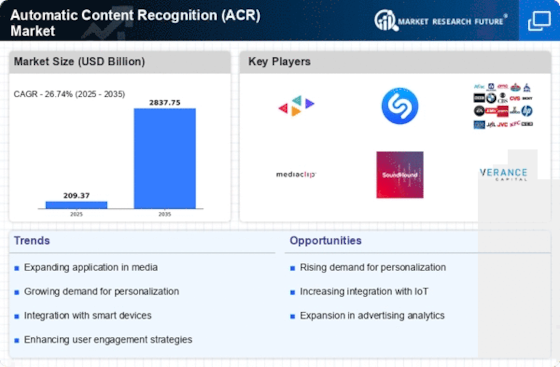
As per Market Research Future analysis, the Automatic Content Recognition Market (ACR) Market Size was estimated at 209.37 USD Billion in 2024. The ACR industry is projected to grow from USD 265.36 Billion in 2025 to USD 2837.75 Billion by 2035, exhibiting a compound annual growth rate (CAGR) of 26.74% during the forecast period 2025 - 2035

Key Market Trends & Highlights

The Automatic Content Recognition Market (ACR) Market is experiencing robust growth driven by technological advancements and evolving consumer preferences.

  • The integration of AI and machine learning is transforming the capabilities of ACR technologies, enhancing accuracy and efficiency. North America remains the largest market for ACR, while the Asia-Pacific region is emerging as the fastest-growing area, driven by increasing digital content consumption. Video and image recognition segments dominate the market, whereas the audio recognition segment is witnessing the fastest growth due to rising demand for interactive applications. Key market drivers include the rising demand for personalized content and the growth of streaming services, which are fueling the expansion of ACR solutions.

Market Size & Forecast

2024 Market Size 209.37 (USD Billion)
2035 Market Size 2837.75 (USD Billion)
CAGR (2025 - 2035) 26.74%
Largest Regional Market Share in 2024 North America

Major Players

Gracenote (US), Shazam (GB), Acronym (US), Mediaclip (CA), SoundHound (US), Verance (US), Audible Magic (US), Civolution (NL), Tremor Video (US)

Market Trends

The Automatic Content Recognition Market (ACR) Market is currently experiencing a transformative phase, driven by advancements in technology and the increasing demand for personalized content experiences. As consumers become more accustomed to tailored media consumption, the need for sophisticated recognition systems that can identify and analyze audio and visual content is becoming paramount.The adoption of automatic content recognition technology is expanding across smart TVs, connected devices, and streaming platforms to enable enhanced audience measurement and targeted advertising. This market appears to be evolving rapidly, with various sectors, including entertainment, advertising, and education, seeking to leverage ACR technologies to enhance user engagement and streamline content delivery. The rapid evolution of ACR technology, supported by artificial intelligence and machine learning, is significantly improving content identification accuracy and processing speed. Furthermore, the integration of artificial intelligence and machine learning into ACR solutions is likely to improve accuracy and efficiency, thereby expanding their applicability across diverse platforms. In addition, the growing emphasis on data privacy and security is influencing the development of ACR technologies. Stakeholders in the Automatic Content Recognition Market (ACR) Market are increasingly focusing on creating solutions that not only meet consumer expectations for personalized experiences but also adhere to stringent regulatory requirements. This dual focus on innovation and compliance suggests a dynamic landscape where companies must navigate both technological advancements and evolving legal frameworks. ACR (Automatic Content Recognition) refers to the process of identifying audio, video, or image content using digital fingerprinting and watermarking technologies. As the Automatic Content Recognition market continues to mature, it may witness the emergence of new players and partnerships, further enriching the ecosystem and driving competitive differentiation.Automatic content recognition solutions are increasingly used to generate real-time TV viewership data, enabling broadcasters and advertisers to optimize audience measurement and targeted advertising strategies.

Integration of AI and Machine Learning

The incorporation of artificial intelligence and machine learning into ACR systems is enhancing their capabilities. These technologies enable more precise content recognition and analysis, allowing for improved user experiences and more effective content recommendations.The shift toward automated content recognition is reducing manual intervention and enabling real-time analysis of media content across digital platforms.

Focus on Data Privacy

As concerns regarding data privacy grow, ACR solutions are increasingly designed with compliance in mind. Companies are prioritizing the development of technologies that protect user data while still delivering personalized content experiences.

Expansion into New Sectors

The Automatic Content Recognition (ACR) Market is broadening its reach beyond traditional media and entertainment. Industries such as education and retail are beginning to adopt ACR technologies to enhance customer engagement and streamline operations.

Automatic Content Recognition Market Market Drivers

Emergence of Smart Devices

The Automatic Content Recognition Market (ACR) Market is witnessing growth due to the emergence of smart devices. As smart TVs, smartphones, and other connected devices become increasingly prevalent, the demand for ACR technologies that can seamlessly integrate with these platforms is on the rise. ACR enables devices to recognize and interact with content in real-time, enhancing user experience and engagement. The proliferation of smart devices is projected to reach billions in the coming years, creating a substantial market opportunity for ACR solutions. This trend suggests that as consumers adopt more smart technologies, the reliance on ACR for content recognition and interaction will likely intensify, further driving market expansion.

Growth of Streaming Services

The Automatic Content Recognition Market (ACR) Market is significantly influenced by the rapid expansion of streaming services. With the proliferation of platforms such as Netflix, Hulu, and Amazon Prime, the need for effective content recognition has become paramount. ACR technologies enable these services to enhance user experience by providing seamless content discovery and personalized recommendations. Market data suggests that the streaming industry is projected to reach a valuation of over 200 billion dollars by 2025, underscoring the potential for ACR solutions to play a pivotal role in this growth. As competition intensifies among streaming providers, the adoption of ACR technologies is likely to accelerate, further propelling market dynamics.

Increased Focus on Data Analytics

The Automatic Content Recognition Market (ACR) Market is benefiting from an increased focus on data analytics. Organizations are recognizing the importance of data-driven decision-making, leading to a surge in demand for ACR technologies that facilitate comprehensive content analysis. By leveraging ACR, businesses can gain valuable insights into viewer behavior, preferences, and trends, which can inform content creation and marketing strategies. This analytical capability is becoming essential as companies strive to optimize their content offerings and enhance audience engagement. Market Research Future indicates that the data analytics sector is expected to grow significantly, with ACR playing a crucial role in this evolution. As the industry continues to embrace data analytics, the relevance and adoption of ACR technologies are likely to expand.

Rising Demand for Personalized Content

The Automatic Content Recognition Market (ACR) Market is experiencing a notable surge in demand for personalized content. As consumers increasingly seek tailored experiences, businesses are leveraging ACR technologies to analyze viewer preferences and deliver customized recommendations. This trend is supported by data indicating that personalized content can enhance user engagement by up to 80%. Consequently, companies are investing in ACR solutions to refine their content delivery strategies, thereby driving market growth. The ability to provide relevant content not only improves customer satisfaction but also fosters brand loyalty, which is crucial in a competitive landscape. As a result, the integration of ACR technologies is becoming a strategic priority for content providers aiming to meet evolving consumer expectations.

Advancements in AI and Machine Learning

The Automatic Content Recognition Market (ACR) Market is poised for growth due to advancements in artificial intelligence and machine learning. These technologies enhance the accuracy and efficiency of content recognition processes, enabling businesses to analyze vast amounts of data in real-time. The integration of AI-driven algorithms allows for improved content tagging and categorization, which is essential for effective content management. As organizations increasingly recognize the value of data-driven insights, the demand for sophisticated ACR solutions is expected to rise. This trend is reflected in market forecasts, which indicate a compound annual growth rate of over 20% for ACR technologies in the coming years. The synergy between ACR and AI is likely to redefine content consumption patterns and drive innovation within the industry.

Market Segment Insights

By Solution: Video and Image Recognition (Largest) vs. Audio (Fastest-Growing)

In the Automatic Content Recognition Market (ACR) Market, Video and Image Recognition holds the largest market share, driven by the increasing demand for visual content monetization and enhanced user engagement. This segment capitalizes on <a href="https://www.marketresearchfuture.com/reports/advanced-technologies-market-41462">advanced technologies</a> that enable seamless identification and analysis of visual data across multiple platforms.The audio content recognition segment is witnessing rapid growth due to increasing adoption of smart assistants, music identification applications, and voice-enabled devices In contrast, the Audio recognition segment, while smaller in share, is speeding ahead with rapid growth, attributed to the rising integration of voice-activated technologies and smart assistants in everyday applications.

Video and Image Recognition (Dominant) vs. Audio (Emerging)

Video and Image Recognition stands as the dominant force in the ACR market, leveraging robust algorithms to analyze and categorize video streams and images efficiently. This segment benefits from a wide array of applications, including content monetization, copyright enforcement, and recommendation systems. As users increasingly consume and share visual content, the demand for sophisticated ACR solutions in video and image recognition continues to surge. Meanwhile, the Audio segment is emerging, fueled by advancements in machine learning that enhance voice detection accuracy. The adoption of smart speakers and voice-controlled devices positions this segment rapidly on the rise, promising to transform how content is discovered and engaged with in the digital realm.

By Service: Professional (Largest) vs. Managed (Fastest-Growing)

In the Automatic Content Recognition Market (ACR) Market, the Professional service segment holds the largest share, driven by a strong demand for advanced content analysis and identification services. Organizations are leveraging professional ACR services to enhance content delivery, improve user engagement, and gain competitive advantages in their respective industries. Meanwhile, the Managed service segment is rapidly gaining traction, catering to organizations looking for tailored solutions without the overhead of managing the technology in-house. This segment is becoming crucial for businesses that prefer subscription-based services that promise operational efficiency and lower capital expenditures.

Service: Professional (Dominant) vs. Managed (Emerging)

The Professional service segment in the ACR market is characterized by its comprehensive offerings that include tailored solutions, expert consultation, and integration with existing systems. This segment serves a diverse client base, from media companies to enterprises seeking robust content recognition capabilities. In contrast, the Managed service segment represents an emerging trend, focusing on providing ACR solutions through a service model that offloads operational responsibility to the provider. Clients benefit from reduced complexity and the ability to leverage up-to-date technologies without significant capital investment. As the demand for ACR technology grows, both segments will play pivotal roles, with professionals being the backbone of innovation and managed services facilitating accessibility.

By End User: IT & Telecommunication (Largest) vs. Healthcare (Fastest-Growing)

The Automatic Content Recognition Market (ACR) market shows a diverse distribution among its end users, with <a href="https://www.marketresearchfuture.com/reports/telecom-it-market-26552">IT &amp; Telecommunication</a> leading the sector. This segment captures a significant portion of the market due to its extensive application in media consumption, security, and data protection services. The healthcare sector, while currently smaller in comparison, plays a crucial role in innovation by leveraging ACR for patient monitoring, medical imaging, and data analytics, making it a vital participant in the market landscape. Growth trends indicate that the healthcare sector is evolving rapidly and adopting ACR technologies at an unprecedented pace. Drivers such as increasing patient data, demand for enhanced diagnostic tools, and the rise of telemedicine are fueling this segment's expansion. The IT &amp; Telecommunication sector, while maintaining dominance, must keep innovating to retain its leadership amidst the burgeoning growth in healthcare applications of ACR.

IT &amp; Telecommunication: Dominant vs. Healthcare: Emerging

In the context of the Automatic Content Recognition Market, the IT &amp; Telecommunication sector stands out as the dominant end user largely due to its extensive use of ACR for streamlining media distribution and enhancing user engagement. This sector benefits from the growing demand for real-time data analysis and secure content verification. On the other hand, the healthcare sector, identified as emerging, is witnessing a swift increase in the adoption of ACR technologies for applications such as automated patient record management and real-time monitoring systems. This transition is driven by advancements in AI and machine learning, specifically tailored for healthcare needs, resulting in improved patient outcomes and operational efficiencies.

Get more detailed insights about Automatic Content Recognition (ACR) Market Research Report - Forecast to 2035

Regional Insights

By Region, the study provides market insights into North America, Europe, Asia-Pacific, and the Rest of the World. The North American automatic content recognition (ACR) market will dominate this market, owing to increasing investment in research & development activity with respect to automatic content recognition technology, which will boost the market growth in this Region.

Further, the major countries studied in the market report are The U.S., Canada, German, France, the UK, Italy, Spain, China, Japan, India, Australia, South Korea, and Brazil.

Figure 3: AUTOMATIC CONTENT RECOGNITION (ACR) MARKET SHARE BY REGION 2022 (%)

Europe's automatic content recognition (ACR) market accounts for the second-largest market share due to the media industry's increasing deployment of ACR technologies. Further, the German automatic content recognition (ACR) market held the largest market share, and the UK automatic content recognition (ACR) market was the fastest-growing market in the European Region.

The Asia-Pacific automatic content recognition (ACR) marketis expected to grow at the fastest CAGR from 2023 to 2032. This is due to expanding awareness of a healthy lifestyle and nutrition and rising per capita disposable income.Moreover, China’s automatic content recognition (ACR) market held the largest market share, and the Indian automatic content recognition (ACR) market was the fastest-growing market in the Asia-Pacific region.

Key Players and Competitive Insights

The Automatic Content Recognition (ACR) Market is currently characterized by a dynamic competitive landscape, driven by rapid technological advancements and increasing demand for content identification solutions across various sectors. Key players such as Gracenote (US), Shazam (GB), and SoundHound (US) are strategically positioned to leverage their innovative capabilities and extensive data analytics to enhance user experiences. Gracenote (US), for instance, focuses on expanding its content recognition services through partnerships with streaming platforms, thereby solidifying its market presence. Meanwhile, Shazam (GB) continues to innovate its music recognition technology, integrating it with social media platforms to enhance user engagement. These strategies collectively contribute to a competitive environment that emphasizes technological prowess and user-centric solutions.

In terms of business tactics, companies in the ACR market are increasingly localizing their operations and optimizing supply chains to enhance efficiency and responsiveness to market demands. The market structure appears moderately fragmented, with several players vying for market share, yet the influence of major companies remains substantial. This competitive structure allows for a diverse range of offerings, catering to various consumer needs while fostering innovation through competition.

In August 2025, SoundHound (US) announced a strategic partnership with a leading automotive manufacturer to integrate its ACR technology into in-car entertainment systems. This move is significant as it not only expands SoundHound's reach into the automotive sector but also positions the company as a key player in the growing market for connected vehicles. The integration of ACR technology in vehicles is likely to enhance user experiences by providing seamless access to music and content recognition while driving, thereby tapping into a lucrative market segment.

In September 2025, Gracenote (US) launched an advanced version of its ACR platform, which incorporates machine learning algorithms to improve content recognition accuracy. This development is crucial as it reflects the company's commitment to innovation and its ability to adapt to the evolving needs of content providers and consumers. By enhancing the accuracy of its recognition services, Gracenote is likely to strengthen its competitive edge and attract more partnerships with media companies seeking reliable content identification solutions.

In October 2025, Shazam (GB) unveiled a new feature that allows users to identify songs playing in advertisements, thereby expanding its utility beyond music recognition. This strategic enhancement is indicative of Shazam's efforts to diversify its offerings and capture additional market segments. By integrating ACR capabilities into advertising, Shazam not only increases user engagement but also provides advertisers with valuable insights into consumer behavior, potentially transforming the advertising landscape.

As of October 2025, the ACR market is witnessing trends that emphasize digitalization, AI integration, and sustainability. Companies are increasingly forming strategic alliances to enhance their technological capabilities and market reach. This shift towards collaboration suggests that competitive differentiation will evolve from traditional price-based competition to a focus on innovation, technology, and supply chain reliability. As the market continues to mature, the ability to deliver unique, high-quality solutions will likely become the cornerstone of competitive advantage.

Key Companies in the Automatic Content Recognition Market include

Industry Developments

Leading automatic content recognition companies such as Gracenote, Shazam, Audible Magic, and Civolution are focusing on innovation and strategic partnerships to strengthen their market position.

  • Q2 2024: Gracenote Launches New ACR Solution for Smart TVs to Enhance Audience Measurement Gracenote, a Nielsen company, announced the launch of a next-generation Automatic Content Recognition Market (ACR) solution for smart TV manufacturers, aimed at improving real-time audience measurement and personalized content delivery.
  • Q2 2024: ACRCloud Partners with Samsung to Integrate ACR Technology into 2024 Smart TV Lineup ACRCloud announced a strategic partnership with Samsung to embed its automatic content recognition technology into Samsung’s 2024 smart TVs, enabling advanced content identification and interactive advertising features.
  • Q3 2024: Shazam Expands ACR Capabilities with Launch of Real-Time Video Recognition Feature Shazam, owned by Apple, launched a new real-time video recognition feature, extending its automatic content recognition technology beyond audio to support interactive TV and advertising applications.
  • Q4 2024: Audible Magic Acquires MediaSync to Bolster ACR Offerings for Streaming Platforms Audible Magic completed the acquisition of MediaSync, a provider of ACR solutions for streaming services, to strengthen its portfolio and expand its reach in the global content recognition market.
  • Q4 2024: Nielsen Secures Multi-Year Contract with Major US Broadcaster for ACR-Based Audience Analytics Nielsen announced a multi-year agreement with a leading US broadcaster to deploy its ACR-powered audience analytics platform across the broadcaster’s digital and linear properties.
  • Q1 2025: Veritone Raises $60 Million in Series D Funding to Expand AI-Driven Content Recognition Veritone, an AI company specializing in content recognition, closed a $60 million Series D funding round to accelerate development of its automatic content recognition and media analytics solutions.
  • Q1 2025: Sony Pictures Networks India Deploys ACRCloud for Real-Time TV Content Monitoring Sony Pictures Networks India selected ACRCloud’s automatic content recognition platform to monitor and analyze real-time TV content, enhancing compliance and audience engagement capabilities.
  • Q2 2025: Gracenote Partners with LG Electronics to Power Personalized Content Discovery on Smart TVs Gracenote announced a partnership with LG Electronics to integrate its ACR technology into LG’s smart TVs, enabling personalized content recommendations and advanced audience measurement.
  • Q2 2025: Beatgrid Launches Cross-Platform ACR Solution for Mobile and Connected TV Beatgrid introduced a new cross-platform automatic content recognition solution designed to synchronize audience measurement across mobile devices and connected TVs for advertisers and broadcasters.
  • Q3 2025: Audible Magic Opens New R&D Facility in Berlin to Advance ACR Technology Audible Magic announced the opening of a new research and development center in Berlin, Germany, focused on advancing automatic content recognition and media identification technologies.

Future Outlook

Automatic Content Recognition Market Future Outlook

The Automatic Content Recognition Market (ACR) Market is projected to grow at a 26.74% CAGR from 2025 to 2035, driven by advancements in AI, increased media consumption, and demand for personalized content.

New opportunities lie in:

  • <p>Integration of ACR technology in smart home devices Development of ACR solutions for live sports broadcasting Partnerships with streaming services for enhanced user engagement</p>

By 2035, the ACR market is expected to be a pivotal component of digital content strategies.

Market Segmentation

Automatic Content Recognition Market Service Outlook

  • Professional
  • Managed

Automatic Content Recognition Market End User Outlook

  • IT & Telecommunication
  • Healthcare

Automatic Content Recognition Market Solution Outlook

  • Audio
  • Video and Image Recognition
  • Voice
  • Real-Time Content Analytics

Report Scope

MARKET SIZE 2024 209.37(USD Billion)
MARKET SIZE 2025 265.36(USD Billion)
MARKET SIZE 2035 2837.75(USD Billion)
COMPOUND ANNUAL GROWTH RATE (CAGR) 26.74% (2025 - 2035)
REPORT COVERAGE Revenue Forecast, Competitive Landscape, Growth Factors, and Trends
BASE YEAR 2024
Market Forecast Period 2025 - 2035
Historical Data 2019 - 2024
Market Forecast Units USD Billion
Key Companies Profiled Gracenote (US), Shazam (GB), Acronym (US), Mediaclip (CA), SoundHound (US), Verance (US), Audible Magic (US), Civolution (NL), Tremor Video (US)
Segments Covered Solution, Service, End User, Region
Key Market Opportunities Integration of Artificial Intelligence enhances personalization in the Automatic Content Recognition (ACR) Market.
Key Market Dynamics Rising demand for personalized content drives innovation and competition in the Automatic Content Recognition market.
Countries Covered North America, Europe, APAC, South America, MEA

FAQs

What is the projected market valuation of the Automatic Content Recognition (ACR) Market by 2035?

<p>The projected market valuation for the Automatic Content Recognition (ACR) Market by 2035 is 2837.75 USD Billion.</p>

What was the overall market valuation of the ACR Market in 2024?

<p>The overall market valuation of the ACR Market in 2024 was 209.37 USD Billion.</p>

What is the expected CAGR for the ACR Market during the forecast period 2025 - 2035?

<p>The expected CAGR for the ACR Market during the forecast period 2025 - 2035 is 26.74%.</p>

Which segment of the ACR Market had the highest valuation in 2024?

<p>In 2024, the Video and Image Recognition segment had the highest valuation at 1200.0 USD Billion.</p>

What are the key players in the Automatic Content Recognition (ACR) Market?

<p>Key players in the ACR Market include Gracenote, Shazam, Acronym, Mediaclip, SoundHound, Verance, Audible Magic, Civolution, and Tremor Video.</p>

How much is the Audio segment projected to be valued at by 2035?

<p>The Audio segment is projected to be valued at 400.0 USD Billion by 2035.</p>

What is the valuation range for the Real-Time Content Analytics segment in 2024?

The valuation range for the Real-Time Content Analytics segment in 2024 was between 49.37 and 637.75 USD Billion.

Which end-user segment is expected to grow the most by 2035?

The Healthcare end-user segment is expected to grow the most, with a projected valuation of 1702.75 USD Billion by 2035.

What is the projected valuation for the Managed Service segment by 2035?

The Managed Service segment is projected to reach a valuation of 2237.75 USD Billion by 2035.

How does the IT & Telecommunication segment's valuation compare to the Healthcare segment in 2024?

In 2024, the IT &amp; Telecommunication segment was valued at 1135.0 USD Billion, while the Healthcare segment was valued at 1702.75 USD Billion.

  1. SECTION I: EXECUTIVE SUMMARY AND KEY HIGHLIGHTS
    1. | 1.1 EXECUTIVE SUMMARY
    2. | | 1.1.1 Market Overview
    3. | | 1.1.2 Key Findings
    4. | | 1.1.3 Market Segmentation
    5. | | 1.1.4 Competitive Landscape
    6. | | 1.1.5 Challenges and Opportunities
    7. | | 1.1.6 Future Outlook
  2. SECTION II: SCOPING, METHODOLOGY AND MARKET STRUCTURE
    1. | 2.1 MARKET INTRODUCTION
    2. | | 2.1.1 Definition
    3. | | 2.1.2 Scope of the study
    4. | | | 2.1.2.1 Research Objective
    5. | | | 2.1.2.2 Assumption
    6. | | | 2.1.2.3 Limitations
    7. | 2.2 RESEARCH METHODOLOGY
    8. | | 2.2.1 Overview
    9. | | 2.2.2 Data Mining
    10. | | 2.2.3 Secondary Research
    11. | | 2.2.4 Primary Research
    12. | | | 2.2.4.1 Primary Interviews and Information Gathering Process
    13. | | | 2.2.4.2 Breakdown of Primary Respondents
    14. | | 2.2.5 Forecasting Model
    15. | | 2.2.6 Market Size Estimation
    16. | | | 2.2.6.1 Bottom-Up Approach
    17. | | | 2.2.6.2 Top-Down Approach
    18. | | 2.2.7 Data Triangulation
    19. | | 2.2.8 Validation
  3. SECTION III: QUALITATIVE ANALYSIS
    1. | 3.1 MARKET DYNAMICS
    2. | | 3.1.1 Overview
    3. | | 3.1.2 Drivers
    4. | | 3.1.3 Restraints
    5. | | 3.1.4 Opportunities
    6. | 3.2 MARKET FACTOR ANALYSIS
    7. | | 3.2.1 Value chain Analysis
    8. | | 3.2.2 Porter's Five Forces Analysis
    9. | | | 3.2.2.1 Bargaining Power of Suppliers
    10. | | | 3.2.2.2 Bargaining Power of Buyers
    11. | | | 3.2.2.3 Threat of New Entrants
    12. | | | 3.2.2.4 Threat of Substitutes
    13. | | | 3.2.2.5 Intensity of Rivalry
    14. | | 3.2.3 COVID-19 Impact Analysis
    15. | | | 3.2.3.1 Market Impact Analysis
    16. | | | 3.2.3.2 Regional Impact
    17. | | | 3.2.3.3 Opportunity and Threat Analysis
  4. SECTION IV: QUANTITATIVE ANALYSIS
    1. | 4.1 Information and Communications Technology, BY Solution (USD Billion)
    2. | | 4.1.1 Audio
    3. | | 4.1.2 Video and Image Recognition
    4. | | 4.1.3 Voice
    5. | | 4.1.4 Real-Time Content Analytics
    6. | 4.2 Information and Communications Technology, BY Service (USD Billion)
    7. | | 4.2.1 Professional
    8. | | 4.2.2 Managed
    9. | 4.3 Information and Communications Technology, BY End User (USD Billion)
    10. | | 4.3.1 IT & Telecommunication
    11. | | 4.3.2 Healthcare
    12. | 4.4 Information and Communications Technology, BY Region (USD Billion)
    13. | | 4.4.1 North America
    14. | | | 4.4.1.1 US
    15. | | | 4.4.1.2 Canada
    16. | | 4.4.2 Europe
    17. | | | 4.4.2.1 Germany
    18. | | | 4.4.2.2 UK
    19. | | | 4.4.2.3 France
    20. | | | 4.4.2.4 Russia
    21. | | | 4.4.2.5 Italy
    22. | | | 4.4.2.6 Spain
    23. | | | 4.4.2.7 Rest of Europe
    24. | | 4.4.3 APAC
    25. | | | 4.4.3.1 China
    26. | | | 4.4.3.2 India
    27. | | | 4.4.3.3 Japan
    28. | | | 4.4.3.4 South Korea
    29. | | | 4.4.3.5 Malaysia
    30. | | | 4.4.3.6 Thailand
    31. | | | 4.4.3.7 Indonesia
    32. | | | 4.4.3.8 Rest of APAC
    33. | | 4.4.4 South America
    34. | | | 4.4.4.1 Brazil
    35. | | | 4.4.4.2 Mexico
    36. | | | 4.4.4.3 Argentina
    37. | | | 4.4.4.4 Rest of South America
    38. | | 4.4.5 MEA
    39. | | | 4.4.5.1 GCC Countries
    40. | | | 4.4.5.2 South Africa
    41. | | | 4.4.5.3 Rest of MEA
  5. SECTION V: COMPETITIVE ANALYSIS
    1. | 5.1 Competitive Landscape
    2. | | 5.1.1 Overview
    3. | | 5.1.2 Competitive Analysis
    4. | | 5.1.3 Market share Analysis
    5. | | 5.1.4 Major Growth Strategy in the Information and Communications Technology
    6. | | 5.1.5 Competitive Benchmarking
    7. | | 5.1.6 Leading Players in Terms of Number of Developments in the Information and Communications Technology
    8. | | 5.1.7 Key developments and growth strategies
    9. | | | 5.1.7.1 New Product Launch/Service Deployment
    10. | | | 5.1.7.2 Merger & Acquisitions
    11. | | | 5.1.7.3 Joint Ventures
    12. | | 5.1.8 Major Players Financial Matrix
    13. | | | 5.1.8.1 Sales and Operating Income
    14. | | | 5.1.8.2 Major Players R&D Expenditure. 2023
    15. | 5.2 Company Profiles
    16. | | 5.2.1 Gracenote (US)
    17. | | | 5.2.1.1 Financial Overview
    18. | | | 5.2.1.2 Products Offered
    19. | | | 5.2.1.3 Key Developments
    20. | | | 5.2.1.4 SWOT Analysis
    21. | | | 5.2.1.5 Key Strategies
    22. | | 5.2.2 Shazam (GB)
    23. | | | 5.2.2.1 Financial Overview
    24. | | | 5.2.2.2 Products Offered
    25. | | | 5.2.2.3 Key Developments
    26. | | | 5.2.2.4 SWOT Analysis
    27. | | | 5.2.2.5 Key Strategies
    28. | | 5.2.3 Acronym (US)
    29. | | | 5.2.3.1 Financial Overview
    30. | | | 5.2.3.2 Products Offered
    31. | | | 5.2.3.3 Key Developments
    32. | | | 5.2.3.4 SWOT Analysis
    33. | | | 5.2.3.5 Key Strategies
    34. | | 5.2.4 Mediaclip (CA)
    35. | | | 5.2.4.1 Financial Overview
    36. | | | 5.2.4.2 Products Offered
    37. | | | 5.2.4.3 Key Developments
    38. | | | 5.2.4.4 SWOT Analysis
    39. | | | 5.2.4.5 Key Strategies
    40. | | 5.2.5 SoundHound (US)
    41. | | | 5.2.5.1 Financial Overview
    42. | | | 5.2.5.2 Products Offered
    43. | | | 5.2.5.3 Key Developments
    44. | | | 5.2.5.4 SWOT Analysis
    45. | | | 5.2.5.5 Key Strategies
    46. | | 5.2.6 Verance (US)
    47. | | | 5.2.6.1 Financial Overview
    48. | | | 5.2.6.2 Products Offered
    49. | | | 5.2.6.3 Key Developments
    50. | | | 5.2.6.4 SWOT Analysis
    51. | | | 5.2.6.5 Key Strategies
    52. | | 5.2.7 Audible Magic (US)
    53. | | | 5.2.7.1 Financial Overview
    54. | | | 5.2.7.2 Products Offered
    55. | | | 5.2.7.3 Key Developments
    56. | | | 5.2.7.4 SWOT Analysis
    57. | | | 5.2.7.5 Key Strategies
    58. | | 5.2.8 Civolution (NL)
    59. | | | 5.2.8.1 Financial Overview
    60. | | | 5.2.8.2 Products Offered
    61. | | | 5.2.8.3 Key Developments
    62. | | | 5.2.8.4 SWOT Analysis
    63. | | | 5.2.8.5 Key Strategies
    64. | | 5.2.9 Tremor Video (US)
    65. | | | 5.2.9.1 Financial Overview
    66. | | | 5.2.9.2 Products Offered
    67. | | | 5.2.9.3 Key Developments
    68. | | | 5.2.9.4 SWOT Analysis
    69. | | | 5.2.9.5 Key Strategies
    70. | 5.3 Appendix
    71. | | 5.3.1 References
    72. | | 5.3.2 Related Reports
  6. LIST OF FIGURES
    1. | 6.1 MARKET SYNOPSIS
    2. | 6.2 NORTH AMERICA MARKET ANALYSIS
    3. | 6.3 US MARKET ANALYSIS BY SOLUTION
    4. | 6.4 US MARKET ANALYSIS BY SERVICE
    5. | 6.5 US MARKET ANALYSIS BY END USER
    6. | 6.6 CANADA MARKET ANALYSIS BY SOLUTION
    7. | 6.7 CANADA MARKET ANALYSIS BY SERVICE
    8. | 6.8 CANADA MARKET ANALYSIS BY END USER
    9. | 6.9 EUROPE MARKET ANALYSIS
    10. | 6.10 GERMANY MARKET ANALYSIS BY SOLUTION
    11. | 6.11 GERMANY MARKET ANALYSIS BY SERVICE
    12. | 6.12 GERMANY MARKET ANALYSIS BY END USER
    13. | 6.13 UK MARKET ANALYSIS BY SOLUTION
    14. | 6.14 UK MARKET ANALYSIS BY SERVICE
    15. | 6.15 UK MARKET ANALYSIS BY END USER
    16. | 6.16 FRANCE MARKET ANALYSIS BY SOLUTION
    17. | 6.17 FRANCE MARKET ANALYSIS BY SERVICE
    18. | 6.18 FRANCE MARKET ANALYSIS BY END USER
    19. | 6.19 RUSSIA MARKET ANALYSIS BY SOLUTION
    20. | 6.20 RUSSIA MARKET ANALYSIS BY SERVICE
    21. | 6.21 RUSSIA MARKET ANALYSIS BY END USER
    22. | 6.22 ITALY MARKET ANALYSIS BY SOLUTION
    23. | 6.23 ITALY MARKET ANALYSIS BY SERVICE
    24. | 6.24 ITALY MARKET ANALYSIS BY END USER
    25. | 6.25 SPAIN MARKET ANALYSIS BY SOLUTION
    26. | 6.26 SPAIN MARKET ANALYSIS BY SERVICE
    27. | 6.27 SPAIN MARKET ANALYSIS BY END USER
    28. | 6.28 REST OF EUROPE MARKET ANALYSIS BY SOLUTION
    29. | 6.29 REST OF EUROPE MARKET ANALYSIS BY SERVICE
    30. | 6.30 REST OF EUROPE MARKET ANALYSIS BY END USER
    31. | 6.31 APAC MARKET ANALYSIS
    32. | 6.32 CHINA MARKET ANALYSIS BY SOLUTION
    33. | 6.33 CHINA MARKET ANALYSIS BY SERVICE
    34. | 6.34 CHINA MARKET ANALYSIS BY END USER
    35. | 6.35 INDIA MARKET ANALYSIS BY SOLUTION
    36. | 6.36 INDIA MARKET ANALYSIS BY SERVICE
    37. | 6.37 INDIA MARKET ANALYSIS BY END USER
    38. | 6.38 JAPAN MARKET ANALYSIS BY SOLUTION
    39. | 6.39 JAPAN MARKET ANALYSIS BY SERVICE
    40. | 6.40 JAPAN MARKET ANALYSIS BY END USER
    41. | 6.41 SOUTH KOREA MARKET ANALYSIS BY SOLUTION
    42. | 6.42 SOUTH KOREA MARKET ANALYSIS BY SERVICE
    43. | 6.43 SOUTH KOREA MARKET ANALYSIS BY END USER
    44. | 6.44 MALAYSIA MARKET ANALYSIS BY SOLUTION
    45. | 6.45 MALAYSIA MARKET ANALYSIS BY SERVICE
    46. | 6.46 MALAYSIA MARKET ANALYSIS BY END USER
    47. | 6.47 THAILAND MARKET ANALYSIS BY SOLUTION
    48. | 6.48 THAILAND MARKET ANALYSIS BY SERVICE
    49. | 6.49 THAILAND MARKET ANALYSIS BY END USER
    50. | 6.50 INDONESIA MARKET ANALYSIS BY SOLUTION
    51. | 6.51 INDONESIA MARKET ANALYSIS BY SERVICE
    52. | 6.52 INDONESIA MARKET ANALYSIS BY END USER
    53. | 6.53 REST OF APAC MARKET ANALYSIS BY SOLUTION
    54. | 6.54 REST OF APAC MARKET ANALYSIS BY SERVICE
    55. | 6.55 REST OF APAC MARKET ANALYSIS BY END USER
    56. | 6.56 SOUTH AMERICA MARKET ANALYSIS
    57. | 6.57 BRAZIL MARKET ANALYSIS BY SOLUTION
    58. | 6.58 BRAZIL MARKET ANALYSIS BY SERVICE
    59. | 6.59 BRAZIL MARKET ANALYSIS BY END USER
    60. | 6.60 MEXICO MARKET ANALYSIS BY SOLUTION
    61. | 6.61 MEXICO MARKET ANALYSIS BY SERVICE
    62. | 6.62 MEXICO MARKET ANALYSIS BY END USER
    63. | 6.63 ARGENTINA MARKET ANALYSIS BY SOLUTION
    64. | 6.64 ARGENTINA MARKET ANALYSIS BY SERVICE
    65. | 6.65 ARGENTINA MARKET ANALYSIS BY END USER
    66. | 6.66 REST OF SOUTH AMERICA MARKET ANALYSIS BY SOLUTION
    67. | 6.67 REST OF SOUTH AMERICA MARKET ANALYSIS BY SERVICE
    68. | 6.68 REST OF SOUTH AMERICA MARKET ANALYSIS BY END USER
    69. | 6.69 MEA MARKET ANALYSIS
    70. | 6.70 GCC COUNTRIES MARKET ANALYSIS BY SOLUTION
    71. | 6.71 GCC COUNTRIES MARKET ANALYSIS BY SERVICE
    72. | 6.72 GCC COUNTRIES MARKET ANALYSIS BY END USER
    73. | 6.73 SOUTH AFRICA MARKET ANALYSIS BY SOLUTION
    74. | 6.74 SOUTH AFRICA MARKET ANALYSIS BY SERVICE
    75. | 6.75 SOUTH AFRICA MARKET ANALYSIS BY END USER
    76. | 6.76 REST OF MEA MARKET ANALYSIS BY SOLUTION
    77. | 6.77 REST OF MEA MARKET ANALYSIS BY SERVICE
    78. | 6.78 REST OF MEA MARKET ANALYSIS BY END USER
    79. | 6.79 KEY BUYING CRITERIA OF INFORMATION AND COMMUNICATIONS TECHNOLOGY
    80. | 6.80 RESEARCH PROCESS OF MRFR
    81. | 6.81 DRO ANALYSIS OF INFORMATION AND COMMUNICATIONS TECHNOLOGY
    82. | 6.82 DRIVERS IMPACT ANALYSIS: INFORMATION AND COMMUNICATIONS TECHNOLOGY
    83. | 6.83 RESTRAINTS IMPACT ANALYSIS: INFORMATION AND COMMUNICATIONS TECHNOLOGY
    84. | 6.84 SUPPLY / VALUE CHAIN: INFORMATION AND COMMUNICATIONS TECHNOLOGY
    85. | 6.85 INFORMATION AND COMMUNICATIONS TECHNOLOGY, BY SOLUTION, 2024 (% SHARE)
    86. | 6.86 INFORMATION AND COMMUNICATIONS TECHNOLOGY, BY SOLUTION, 2024 TO 2035 (USD Billion)
    87. | 6.87 INFORMATION AND COMMUNICATIONS TECHNOLOGY, BY SERVICE, 2024 (% SHARE)
    88. | 6.88 INFORMATION AND COMMUNICATIONS TECHNOLOGY, BY SERVICE, 2024 TO 2035 (USD Billion)
    89. | 6.89 INFORMATION AND COMMUNICATIONS TECHNOLOGY, BY END USER, 2024 (% SHARE)
    90. | 6.90 INFORMATION AND COMMUNICATIONS TECHNOLOGY, BY END USER, 2024 TO 2035 (USD Billion)
    91. | 6.91 BENCHMARKING OF MAJOR COMPETITORS
  7. LIST OF TABLES
    1. | 7.1 LIST OF ASSUMPTIONS
    2. | | 7.1.1
    3. | 7.2 North America MARKET SIZE ESTIMATES; FORECAST
    4. | | 7.2.1 BY SOLUTION, 2025-2035 (USD Billion)
    5. | | 7.2.2 BY SERVICE, 2025-2035 (USD Billion)
    6. | | 7.2.3 BY END USER, 2025-2035 (USD Billion)
    7. | 7.3 US MARKET SIZE ESTIMATES; FORECAST
    8. | | 7.3.1 BY SOLUTION, 2025-2035 (USD Billion)
    9. | | 7.3.2 BY SERVICE, 2025-2035 (USD Billion)
    10. | | 7.3.3 BY END USER, 2025-2035 (USD Billion)
    11. | 7.4 Canada MARKET SIZE ESTIMATES; FORECAST
    12. | | 7.4.1 BY SOLUTION, 2025-2035 (USD Billion)
    13. | | 7.4.2 BY SERVICE, 2025-2035 (USD Billion)
    14. | | 7.4.3 BY END USER, 2025-2035 (USD Billion)
    15. | 7.5 Europe MARKET SIZE ESTIMATES; FORECAST
    16. | | 7.5.1 BY SOLUTION, 2025-2035 (USD Billion)
    17. | | 7.5.2 BY SERVICE, 2025-2035 (USD Billion)
    18. | | 7.5.3 BY END USER, 2025-2035 (USD Billion)
    19. | 7.6 Germany MARKET SIZE ESTIMATES; FORECAST
    20. | | 7.6.1 BY SOLUTION, 2025-2035 (USD Billion)
    21. | | 7.6.2 BY SERVICE, 2025-2035 (USD Billion)
    22. | | 7.6.3 BY END USER, 2025-2035 (USD Billion)
    23. | 7.7 UK MARKET SIZE ESTIMATES; FORECAST
    24. | | 7.7.1 BY SOLUTION, 2025-2035 (USD Billion)
    25. | | 7.7.2 BY SERVICE, 2025-2035 (USD Billion)
    26. | | 7.7.3 BY END USER, 2025-2035 (USD Billion)
    27. | 7.8 France MARKET SIZE ESTIMATES; FORECAST
    28. | | 7.8.1 BY SOLUTION, 2025-2035 (USD Billion)
    29. | | 7.8.2 BY SERVICE, 2025-2035 (USD Billion)
    30. | | 7.8.3 BY END USER, 2025-2035 (USD Billion)
    31. | 7.9 Russia MARKET SIZE ESTIMATES; FORECAST
    32. | | 7.9.1 BY SOLUTION, 2025-2035 (USD Billion)
    33. | | 7.9.2 BY SERVICE, 2025-2035 (USD Billion)
    34. | | 7.9.3 BY END USER, 2025-2035 (USD Billion)
    35. | 7.10 Italy MARKET SIZE ESTIMATES; FORECAST
    36. | | 7.10.1 BY SOLUTION, 2025-2035 (USD Billion)
    37. | | 7.10.2 BY SERVICE, 2025-2035 (USD Billion)
    38. | | 7.10.3 BY END USER, 2025-2035 (USD Billion)
    39. | 7.11 Spain MARKET SIZE ESTIMATES; FORECAST
    40. | | 7.11.1 BY SOLUTION, 2025-2035 (USD Billion)
    41. | | 7.11.2 BY SERVICE, 2025-2035 (USD Billion)
    42. | | 7.11.3 BY END USER, 2025-2035 (USD Billion)
    43. | 7.12 Rest of Europe MARKET SIZE ESTIMATES; FORECAST
    44. | | 7.12.1 BY SOLUTION, 2025-2035 (USD Billion)
    45. | | 7.12.2 BY SERVICE, 2025-2035 (USD Billion)
    46. | | 7.12.3 BY END USER, 2025-2035 (USD Billion)
    47. | 7.13 APAC MARKET SIZE ESTIMATES; FORECAST
    48. | | 7.13.1 BY SOLUTION, 2025-2035 (USD Billion)
    49. | | 7.13.2 BY SERVICE, 2025-2035 (USD Billion)
    50. | | 7.13.3 BY END USER, 2025-2035 (USD Billion)
    51. | 7.14 China MARKET SIZE ESTIMATES; FORECAST
    52. | | 7.14.1 BY SOLUTION, 2025-2035 (USD Billion)
    53. | | 7.14.2 BY SERVICE, 2025-2035 (USD Billion)
    54. | | 7.14.3 BY END USER, 2025-2035 (USD Billion)
    55. | 7.15 India MARKET SIZE ESTIMATES; FORECAST
    56. | | 7.15.1 BY SOLUTION, 2025-2035 (USD Billion)
    57. | | 7.15.2 BY SERVICE, 2025-2035 (USD Billion)
    58. | | 7.15.3 BY END USER, 2025-2035 (USD Billion)
    59. | 7.16 Japan MARKET SIZE ESTIMATES; FORECAST
    60. | | 7.16.1 BY SOLUTION, 2025-2035 (USD Billion)
    61. | | 7.16.2 BY SERVICE, 2025-2035 (USD Billion)
    62. | | 7.16.3 BY END USER, 2025-2035 (USD Billion)
    63. | 7.17 South Korea MARKET SIZE ESTIMATES; FORECAST
    64. | | 7.17.1 BY SOLUTION, 2025-2035 (USD Billion)
    65. | | 7.17.2 BY SERVICE, 2025-2035 (USD Billion)
    66. | | 7.17.3 BY END USER, 2025-2035 (USD Billion)
    67. | 7.18 Malaysia MARKET SIZE ESTIMATES; FORECAST
    68. | | 7.18.1 BY SOLUTION, 2025-2035 (USD Billion)
    69. | | 7.18.2 BY SERVICE, 2025-2035 (USD Billion)
    70. | | 7.18.3 BY END USER, 2025-2035 (USD Billion)
    71. | 7.19 Thailand MARKET SIZE ESTIMATES; FORECAST
    72. | | 7.19.1 BY SOLUTION, 2025-2035 (USD Billion)
    73. | | 7.19.2 BY SERVICE, 2025-2035 (USD Billion)
    74. | | 7.19.3 BY END USER, 2025-2035 (USD Billion)
    75. | 7.20 Indonesia MARKET SIZE ESTIMATES; FORECAST
    76. | | 7.20.1 BY SOLUTION, 2025-2035 (USD Billion)
    77. | | 7.20.2 BY SERVICE, 2025-2035 (USD Billion)
    78. | | 7.20.3 BY END USER, 2025-2035 (USD Billion)
    79. | 7.21 Rest of APAC MARKET SIZE ESTIMATES; FORECAST
    80. | | 7.21.1 BY SOLUTION, 2025-2035 (USD Billion)
    81. | | 7.21.2 BY SERVICE, 2025-2035 (USD Billion)
    82. | | 7.21.3 BY END USER, 2025-2035 (USD Billion)
    83. | 7.22 South America MARKET SIZE ESTIMATES; FORECAST
    84. | | 7.22.1 BY SOLUTION, 2025-2035 (USD Billion)
    85. | | 7.22.2 BY SERVICE, 2025-2035 (USD Billion)
    86. | | 7.22.3 BY END USER, 2025-2035 (USD Billion)
    87. | 7.23 Brazil MARKET SIZE ESTIMATES; FORECAST
    88. | | 7.23.1 BY SOLUTION, 2025-2035 (USD Billion)
    89. | | 7.23.2 BY SERVICE, 2025-2035 (USD Billion)
    90. | | 7.23.3 BY END USER, 2025-2035 (USD Billion)
    91. | 7.24 Mexico MARKET SIZE ESTIMATES; FORECAST
    92. | | 7.24.1 BY SOLUTION, 2025-2035 (USD Billion)
    93. | | 7.24.2 BY SERVICE, 2025-2035 (USD Billion)
    94. | | 7.24.3 BY END USER, 2025-2035 (USD Billion)
    95. | 7.25 Argentina MARKET SIZE ESTIMATES; FORECAST
    96. | | 7.25.1 BY SOLUTION, 2025-2035 (USD Billion)
    97. | | 7.25.2 BY SERVICE, 2025-2035 (USD Billion)
    98. | | 7.25.3 BY END USER, 2025-2035 (USD Billion)
    99. | 7.26 Rest of South America MARKET SIZE ESTIMATES; FORECAST
    100. | | 7.26.1 BY SOLUTION, 2025-2035 (USD Billion)
    101. | | 7.26.2 BY SERVICE, 2025-2035 (USD Billion)
    102. | | 7.26.3 BY END USER, 2025-2035 (USD Billion)
    103. | 7.27 MEA MARKET SIZE ESTIMATES; FORECAST
    104. | | 7.27.1 BY SOLUTION, 2025-2035 (USD Billion)
    105. | | 7.27.2 BY SERVICE, 2025-2035 (USD Billion)
    106. | | 7.27.3 BY END USER, 2025-2035 (USD Billion)
    107. | 7.28 GCC Countries MARKET SIZE ESTIMATES; FORECAST
    108. | | 7.28.1 BY SOLUTION, 2025-2035 (USD Billion)
    109. | | 7.28.2 BY SERVICE, 2025-2035 (USD Billion)
    110. | | 7.28.3 BY END USER, 2025-2035 (USD Billion)
    111. | 7.29 South Africa MARKET SIZE ESTIMATES; FORECAST
    112. | | 7.29.1 BY SOLUTION, 2025-2035 (USD Billion)
    113. | | 7.29.2 BY SERVICE, 2025-2035 (USD Billion)
    114. | | 7.29.3 BY END USER, 2025-2035 (USD Billion)
    115. | 7.30 Rest of MEA MARKET SIZE ESTIMATES; FORECAST
    116. | | 7.30.1 BY SOLUTION, 2025-2035 (USD Billion)
    117. | | 7.30.2 BY SERVICE, 2025-2035 (USD Billion)
    118. | | 7.30.3 BY END USER, 2025-2035 (USD Billion)
    119. | 7.31 PRODUCT LAUNCH/PRODUCT DEVELOPMENT/APPROVAL
    120. | | 7.31.1
    121. | 7.32 ACQUISITION/PARTNERSHIP
    122. | | 7.32.1

Information and Communications Technology Market Segmentation

Information and Communications Technology By Solution (USD Billion, 2025-2035)

  • Audio
  • Video and Image Recognition
  • Voice
  • Real-Time Content Analytics

Information and Communications Technology By Service (USD Billion, 2025-2035)

  • Professional
  • Managed

Information and Communications Technology By End User (USD Billion, 2025-2035)

  • IT & Telecommunication
  • Healthcare
Infographic

Free Sample Request

Kindly complete the form below to receive a free sample of this Report

Get Free Sample

Customer Strories

Compare Licence

×
Features License Type
Single User Multiuser License Enterprise User
Price $4,950 $5,950 $7,250
Maximum User Access Limit 1 User Upto 10 Users Unrestricted Access Throughout the Organization
Free Customization
Direct Access to Analyst
Deliverable Format
Platform Access
Discount on Next Purchase 10% 15% 15%
Printable Versions