×
Request Free Sample ×

Kindly complete the form below to receive a free sample of this Report

* Please use a valid business email

Leading companies partner with us for data-driven Insights

clients tt-cursor
Hero Background
English
Chinese
French
Japanese
Korean
German
Spanish

Automated Material Handling Market Size

ID: MRFR/SEM/0523-HCR
110 Pages
Ankit Gupta
October 2025

Automated Material Handling (AMH) Market Size, Share and Research Report By Component (Software, Services), Operation (Packaging & Distribution, Storage & Transportation, Waste Management, Assembly), Equipment (Automated Guided Vehicles, Robotic System, Conveyors, Automated Cranes, Automated Storage & Retrieval System), Application (E-Commerce, Food & Beverages, Automotive, Semiconductor & Electronics, Healthcare, Aviation, Chemicals) and Region (North America, Europe, Asia-Pacific & Rest Of The World)- Industry Size,... read more

Share:
Download PDF ×

We do not share your information with anyone. However, we may send you emails based on your report interest from time to time. You may contact us at any time to opt-out.

Automated Material Handling Market Infographic
×
Automated Material Handling Market Infographic Full View
Purchase Options

Automated Material Handling Size

Automated Material Handling Market Growth Projections and Opportunities

There are several key factors that influence the growth and progression of Automated Material Handling (AMH) industry. This is because the market for AMH is being driven by increasing calls for easier and well-run materials handling operations in various industries. High productivity coupled with low costs can only be achieved through automation if a business seeks to maximize its profits. Another reason why enterprises invest in automatic material handling systems is to improve efficiencies levels while at the same time reducing dependence on human labor.

On the other hand, technological advancements can immensely influence AMH industry. This has led to introduction of intelligent material handling solutions which are as a result of continuous improvements in AI, sensors and robot technologies. With such integrations, automation systems become more accurate in their functions and flexible enough to meet requirements of different sectors or even industries. In order to remain competitive within this sector businesses may adopt innovative methods arising from these ongoing changes so that they are able to meet new expectations from their market.

Moreover, there has been an increase in online shopping globally leading to a tremendous impact on AMH industry. The rise of internet shopping means companies have more products to handle and deliver necessitating more warehouses as well as distribution centers across the globe. Furthermore, firms involved in online trading opt for automated material handling systems due to demand for faster order fulfillment, lesser mistakes made during packaging and delivery process resulting into greater customer satisfaction rates among consumers. Besides that, e-commerce is growing rapidly mostly in developing countries thus it continues being one of the driving forces behind AMH growth.

However, automated material handling systems are yet not widely used owing their high cost implications. Thus despite apparently high expenses associated with advanced technologies they reduce expenditure by providing better accuracy and efficiency over time. The affordability limits small-medium-sized firms (SMEs) from purchasing them as they cannot afford paying large amounts upfront. However if technology develops into standardization then prices will fall with economy scale making it affordable for more companies.
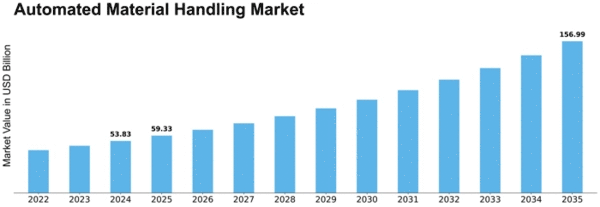
Automated Material Handling Market Size Graph
Author
Ankit Gupta
Senior Research Analyst

Ankit Gupta is an analyst in market research industry in ICT and SEMI industry. With post-graduation in "Telecom and Marketing Management" and graduation in "Electronics and Telecommunication" vertical he is well versed with recent development in ICT industry as a whole. Having worked on more than 150+ reports including consultation for fortune 500 companies such as Microsoft and Rio Tinto in identifying solutions with respect to business problems his opinions are inclined towards mixture of technical and managerial aspects.

Leave a Comment

FAQs

How much is the Automated Material Handling (AMH) market?

Automated Material Handling (AMH) Market was valued at USD 53.83 billion in 2024

What is the market size for 2035, for the Automated Material Handling (AMH) Market?

Automated Material Handling (AMH) Market is projected to reach USD 156.99 billion by 2035

What is the growth rate of the Automated Material Handling (AMH) market?

Automated Material Handling (AMH) Market Size is predicetd to hit at a CAGR of 10.22% by 2035

Which region held the largest market share in the Automated Material Handling (AMH) market?

Europe is expected to hold the highest market share in the global Automated Material Handling (AMH) Market

Who are the prominent players in the Automated Material Handling (AMH) market?

Schaefer Systems International Pvt Ltd, Daifuku Co. Ltd, Dematic, Murata Machinery, Ltd., Mecalux, S.A., Vanderlande Industries B.V., BEUMER Group, Swisslog AG, Kardex , Honeywell Intelligrated, Toyota Industries Corporation, KNAPP AG, Hyster-Yale Materials Handling, Inc., TGW Logistics Group, John Bean Technologies, and Others.

Market Summary

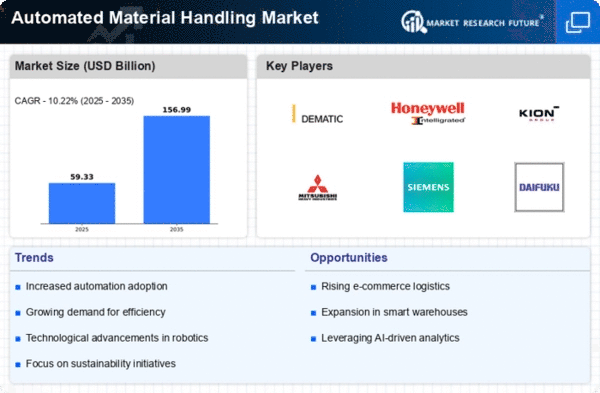
As per MRFR analysis, the Automated Material Handling Market Size was estimated at 53.83 USD Billion in 2024. The Automated Material Handling industry is projected to grow from 59.33 USD Billion in 2025 to 156.99 USD Billion by 2035, exhibiting a compound annual growth rate (CAGR) of 10.22 during the forecast period 2025 - 2035.

Key Market Trends & Highlights

The Automated Material Handling Market is poised for substantial growth driven by technological advancements and evolving consumer demands.

  • The integration of robotics and AI is transforming operational efficiencies across various sectors. Sustainability initiatives are increasingly influencing material handling practices, particularly in North America. Real-time data utilization is becoming essential for optimizing warehouse management and order fulfillment processes. The rising demand for efficiency and the growing e-commerce sector are key drivers propelling market expansion.

Market Size & Forecast

2024 Market Size 53.83 (USD Billion)
2035 Market Size 156.99 (USD Billion)
CAGR (2025 - 2035) 10.22%
Largest Regional Market Share in 2024 North America

Major Players

<p>Dematic (US), Honeywell Intelligrated (US), KION Group (DE), MHI (JP), Siemens (DE), Daifuku (JP), Swisslog (CH), Toyota Industries (JP), Vanderlande (NL)</p>

Market Trends

The Automated Material Handling Market is currently experiencing a transformative phase, driven by advancements in technology and increasing demand for efficiency in logistics and supply chain operations. Companies are increasingly adopting automated solutions to streamline processes, reduce labor costs, and enhance productivity. This shift is largely influenced by the need for real-time data analytics and improved inventory management, which are essential for maintaining competitiveness in a rapidly evolving marketplace. Furthermore, the integration of artificial intelligence and robotics into material handling systems appears to be reshaping traditional practices, allowing for greater flexibility and responsiveness to market demands. In addition, sustainability concerns are prompting organizations to seek eco-friendly solutions within the Automated Material Handling Market. The emphasis on reducing carbon footprints and optimizing resource utilization is leading to the development of innovative technologies that align with environmental goals. As businesses strive to meet regulatory requirements and consumer expectations, the market is likely to witness a surge in the adoption of green technologies. Overall, the Automated Material Handling Market is poised for substantial growth, characterized by technological advancements and a strong focus on sustainability, which may redefine operational paradigms across various industries.

Integration of Robotics and AI

The incorporation of robotics and artificial intelligence into material handling systems is becoming increasingly prevalent. This trend suggests that organizations are leveraging these technologies to enhance operational efficiency, reduce human error, and improve safety in warehouses and distribution centers.

Focus on Sustainability

There is a growing emphasis on sustainable practices within the Automated Material Handling Market. Companies are exploring eco-friendly solutions and technologies that minimize environmental impact, indicating a shift towards greener operations and compliance with environmental regulations.

Real-time Data Utilization

The use of real-time data analytics is gaining traction in the Automated Material Handling Market. This trend indicates that businesses are prioritizing data-driven decision-making to optimize inventory management and streamline logistics processes, thereby enhancing overall efficiency.

Automated Material Handling Market Market Drivers

Labor Shortages

Labor shortages present a compelling driver for the Global Automated Material Handling Market AMH Market Industry. As industries face challenges in recruiting skilled labor, automation emerges as a viable solution to maintain productivity levels. Automated systems can operate continuously, alleviating the pressure on human resources. For instance, many manufacturing plants are implementing automated guided vehicles to transport materials, thereby reducing reliance on manual labor. This shift not only addresses labor shortages but also enhances safety and efficiency. The anticipated CAGR of 10.22% from 2025 to 2035 underscores the increasing reliance on automation in response to workforce challenges.

Sustainability Initiatives

Sustainability initiatives are becoming a pivotal driver for the Global Automated Material Handling Market AMH Market Industry. As environmental concerns gain prominence, companies are increasingly adopting automated solutions that reduce waste and energy consumption. For instance, automated systems can optimize energy use in warehouses, leading to lower carbon footprints. Furthermore, the integration of eco-friendly technologies in material handling processes aligns with corporate sustainability goals. This shift not only enhances operational efficiency but also meets the growing consumer demand for environmentally responsible practices. The market's evolution reflects this trend, as organizations prioritize sustainability in their automation strategies.

Technological Advancements

The Global Automated Material Handling Market AMH Market Industry experiences rapid growth due to continuous technological advancements. Innovations such as robotics, artificial intelligence, and the Internet of Things are revolutionizing material handling processes. For instance, autonomous mobile robots are increasingly utilized in warehouses, enhancing efficiency and reducing labor costs. The integration of advanced software solutions for inventory management further streamlines operations. As a result, the market is projected to reach 53.8 USD Billion in 2024, reflecting a growing demand for automation in logistics and manufacturing sectors.

Increased Demand for Efficiency

The Global Automated Material Handling Market AMH Market Industry is driven by an escalating demand for operational efficiency across various sectors. Companies are increasingly adopting automated solutions to minimize human error and optimize workflow. For example, automated storage and retrieval systems significantly enhance inventory management, leading to reduced operational costs. This trend is particularly evident in e-commerce and retail, where speed and accuracy are paramount. The market's growth trajectory suggests a potential valuation of 157.0 USD Billion by 2035, indicating that businesses recognize the necessity of automation to remain competitive.

Global Supply Chain Optimization

The Global Automated Material Handling Market AMH Market Industry is significantly influenced by the need for supply chain optimization. Companies are increasingly adopting automated solutions to enhance visibility and control over their supply chains. Technologies such as real-time tracking and automated sorting systems allow businesses to respond swiftly to market demands. For example, logistics firms are utilizing automated material handling systems to streamline operations and reduce lead times. This optimization is crucial in a globalized economy, where efficiency can determine competitive advantage. The market's growth reflects this trend, as organizations seek to leverage automation for improved supply chain performance.

Market Segment Insights

By Application: Warehouse Management (Largest) vs. Order Fulfillment (Fastest-Growing)

<p>In the Automated Material Handling Market, Warehouse Management holds a significant share, leveraging its established role in optimizing storage operations and inventory control. This segment significantly influences overall market dynamics due to its integration with various technologies, facilitating smoother workflows and enhanced efficiency in warehouses. Order Fulfillment, while smaller in market share compared to Warehouse Management, is rapidly expanding as companies seek to improve customer satisfaction through effective order processing, making it a critical focus area for future investments.</p>

<p>Warehouse Management: Dominant vs. Order Fulfillment: Emerging</p>

<p>Warehouse Management, being the dominant application in the Automated Material Handling Market, focuses on optimizing various processes such as inventory tracking, space utilization, and labor management. It plays a crucial role in enhancing operational effectiveness and reducing costs. On the other hand, Order Fulfillment, identified as an emerging segment, is gaining traction due to the rise of e-commerce and increased consumer expectations for faster delivery times. This segment emphasizes technologies like robotics and AI to streamline operations, ensuring timely and accurate order deliveries, ultimately driving its growth in the market.</p>

By End Use: Manufacturing (Largest) vs. Food and Beverage (Fastest-Growing)

<p>In the Automated Material Handling Market, the manufacturing sector holds the largest share, driven by the increasing need for efficiency and automation in production processes. This segment benefits from advancements in robotics and software solutions that optimize operations, reduce costs, and enhance productivity. Retail and automotive also represent significant portions of the market but trail behind manufacturing and food and beverage in terms of growth potential. Growth trends within the food and beverage sector are particularly noteworthy, as demand for automation increases in response to labor shortages and the need for improved safety and efficiency in processing and distribution. Additionally, the pharmaceutical industry is experiencing growth in automated handling due to regulatory requirements and the need for precision in handling sensitive products. These drivers indicate a shift towards greater reliance on automated solutions across all sectors, with food and beverage emerging as a pivotal area of growth.</p>

<p>Manufacturing: Dominant vs. Food and Beverage: Emerging</p>

<p>The manufacturing segment is characterized by its heavy reliance on automated systems for production processes, showcasing advanced robotics and integrated software solutions that streamline operations and enhance productivity. This segment dominates the Automated Material Handling Market, as manufacturers seek to modernize facilities and drive efficiencies. Conversely, the food and beverage segment, while emerging, demonstrates rapid adaptability to automation technologies driven by safety and efficiency needs. Companies are increasingly investing in automation to overcome challenges like labor shortages and to comply with stringent safety regulations. As a result, this segment is experiencing robust growth, with innovations focused on specialized systems for handling varying products and maintaining quality control. The interplay between these two segments demonstrates the varied landscape of automation adoption within the market.</p>

By System Type: Automated Guided Vehicle (Largest) vs. Conveyor System (Fastest-Growing)

<p>The Automated Material Handling Market is witnessing a significant distribution of market share among various system types. The Automated Guided Vehicle segment leads the pack, owing to its versatility and efficiency in transport and logistics operations. Conveyor Systems, while historically dominant, are now facing stiff competition from Robotic Systems and <a href="https://www.marketresearchfuture.com/reports/automated-storage-retrieval-system-market-3886">Automated Storage and Retrieval Systems</a>, which are also garnering attention for their role in enhancing operational efficiency and reducing labor costs. On the growth front, the market is experiencing a surge with the increased adoption of technology-driven solutions, particularly in logistics and warehousing. The need for faster, more efficient systems is pushing industries towards Robotic Systems, which are proving pivotal in automating processes. Meanwhile, the Conveyor System's growth is being fueled by innovations aimed at integrating advanced technologies to optimize performance, making it the fastest-growing system type in the sector.</p>

<p>Automated Guided Vehicle (Dominant) vs. Robotic System (Emerging)</p>

<p>The Automated Guided Vehicle (AGV) segment is characterized by its robust presence in the Automated Material Handling Market, primarily due to its ability to transport materials effectively and safely within various facility layouts. AGVs are predominately utilized in environments such as warehouses and manufacturing plants, providing significant reduction in operational costs while enhancing productivity. On the other hand, Robotic Systems have emerged as a transformative force in this sector. They boast advanced capabilities for complex tasks such as picking, packing, and sorting, positioning them as a key player in automating workflows. The rising demand for customizable and flexible automation solutions supports the growth of Robotic Systems, while AGVs maintain their market dominance due to established applications and reliability.</p>

By Technology: Artificial Intelligence (Largest) vs. Robotics (Fastest-Growing)

<p>In the Automated Material Handling Market, the technology segment consists of various impactful elements, including Artificial Intelligence (AI), Internet of Things (IoT), Machine Learning, Robotics, and Automation Software. Among these, AI holds a dominant position, significantly contributing to efficiency enhancements and operational optimization. Meanwhile, Robotics has emerged as the fastest-growing area, driven by continuous advancements in automation technologies, appealing to industries seeking superior handling capabilities and productivity gains.</p>

<p>Technology: Artificial Intelligence (Dominant) vs. Robotics (Emerging)</p>

<p>Artificial Intelligence has established itself as a dominant force in the Automated Material Handling Market, enhancing decision-making and operational efficiencies through advanced data analysis and predictive capabilities. As businesses increasingly rely on AI to streamline processes, it has become integral in optimizing logistics and supply chain operations. Conversely, Robotics is recognized as an emerging technology that is rapidly transforming material handling. With innovations such as collaborative robots and autonomous vehicles, Robotics contributes significantly to reducing labor costs and increasing throughput, making it a key player for businesses aiming to improve their material handling processes.</p>

Get more detailed insights about Automated Material Handling Market Research Report - Forecast to 2035

Regional Insights

North America : Market Leader in Automation

North America is poised to maintain its leadership in the Automated Material Handling Market, holding a significant market share of 27.0% as of 2024. The region's growth is driven by increasing demand for efficiency in logistics and warehousing, alongside advancements in technology. Regulatory support for automation and safety standards further catalyzes market expansion, making it a hub for innovation and investment in automated solutions. The competitive landscape is robust, with key players such as Dematic, Honeywell Intelligrated, and KION Group leading the charge. The U.S. stands out as a primary market, supported by a strong infrastructure and a focus on e-commerce. Companies are increasingly investing in automation technologies to enhance operational efficiency, positioning North America as a critical player in the global market.

Europe : Innovation and Sustainability Focus

Europe is experiencing a notable shift towards automation in material handling, with a market size of €15.0 billion. The region's growth is fueled by a strong emphasis on sustainability and efficiency, driven by regulatory frameworks that promote green technologies. The European Union's initiatives to enhance logistics efficiency and reduce carbon footprints are pivotal in shaping market dynamics, encouraging investments in automated solutions. Leading countries such as Germany, France, and the UK are at the forefront of this transformation, with major players like KION Group and Siemens driving innovation. The competitive landscape is characterized by a mix of established firms and emerging startups, all vying for a share of the growing market. The focus on Industry 4.0 and smart manufacturing further enhances the region's attractiveness for investment in automated material handling solutions.

Asia-Pacific : Emerging Market Potential

Asia-Pacific is rapidly emerging as a significant player in the Automated Material Handling Market, with a market size of $10.0 billion. The region's growth is driven by increasing industrialization, urbanization, and a rising demand for efficient supply chain solutions. Countries like China and Japan are leading the charge, supported by government initiatives aimed at enhancing manufacturing capabilities and logistics efficiency. The competitive landscape is diverse, with key players such as MHI and Daifuku making substantial investments in automation technologies. The region is witnessing a surge in demand for robotics and automated systems, particularly in sectors like e-commerce and manufacturing. As companies strive to optimize operations, Asia-Pacific is set to become a crucial hub for automated material handling solutions, attracting global investments.

Middle East and Africa : Untapped Market Opportunities

The Middle East and Africa region is gradually recognizing the potential of automated material handling, with a market size of $1.83 billion. The growth is primarily driven by increasing investments in infrastructure and logistics, alongside a rising demand for efficiency in supply chain operations. Governments are actively promoting automation to enhance productivity and competitiveness in various sectors, paving the way for market expansion. Countries like the UAE and South Africa are leading the way in adopting automated solutions, supported by initiatives aimed at modernizing logistics and warehousing. The competitive landscape is still developing, with both local and international players exploring opportunities in this emerging market. As the region continues to invest in technology and infrastructure, the potential for automated material handling solutions is expected to grow significantly.

Key Players and Competitive Insights

The Automated Material Handling Market is currently characterized by a dynamic competitive landscape, driven by technological advancements and increasing demand for efficiency in logistics and supply chain operations. Key players such as Dematic (US), Honeywell Intelligrated (US), and KION Group (DE) are strategically positioning themselves through innovation and partnerships. For instance, Dematic (US) focuses on integrating AI and robotics into their systems, enhancing operational efficiency and reducing labor costs. Meanwhile, Honeywell Intelligrated (US) emphasizes digital transformation, leveraging IoT technologies to optimize warehouse management. KION Group (DE) is actively pursuing regional expansion, particularly in Asia, to capitalize on the growing demand for automated solutions in emerging markets. Collectively, these strategies contribute to a competitive environment that is increasingly reliant on technological innovation and strategic collaborations.

The market structure appears moderately fragmented, with numerous players competing for market share. Key business tactics include localizing manufacturing to reduce costs and enhance supply chain resilience. Companies are also optimizing their supply chains to respond swiftly to market demands. This competitive structure allows for a diverse range of solutions, catering to various industry needs while fostering innovation among the players.

In November 2025, KION Group (DE) announced a strategic partnership with a leading robotics firm to develop next-generation automated guided vehicles (AGVs). This collaboration is poised to enhance KION's product offerings, enabling them to provide more advanced solutions tailored to the evolving needs of their customers. The partnership underscores KION's commitment to innovation and its strategic focus on expanding its technological capabilities in the automated material handling sector.

In October 2025, Honeywell Intelligrated (US) launched a new AI-driven warehouse management system designed to improve inventory accuracy and reduce operational costs. This system integrates seamlessly with existing infrastructure, allowing clients to enhance their logistics operations without significant capital investment. The introduction of this technology reflects Honeywell's focus on digital transformation and its aim to provide scalable solutions that meet the demands of modern supply chains.

In September 2025, Dematic (US) unveiled a new suite of robotic solutions aimed at automating order fulfillment processes. This launch is particularly significant as it addresses the growing need for efficiency in e-commerce logistics. By enhancing their product line with advanced robotics, Dematic positions itself as a leader in the market, catering to the increasing demand for automation in fulfillment centers.

As of December 2025, current trends in the Automated Material Handling Market indicate a strong emphasis on digitalization, sustainability, and AI integration. Strategic alliances are increasingly shaping the competitive landscape, allowing companies to pool resources and expertise to drive innovation. The shift from price-based competition to a focus on technological advancement and supply chain reliability is evident. Moving forward, competitive differentiation will likely hinge on the ability to innovate and adapt to changing market demands, with a clear emphasis on sustainable practices and advanced technological solutions.

Key Companies in the Automated Material Handling Market include

Industry Developments

  • Q2 2024: Honeywell launches new autonomous mobile robot for warehouse automation Honeywell announced the launch of its latest autonomous mobile robot (AMR) designed to optimize warehouse material handling, featuring advanced navigation and AI-driven task management.
  • Q2 2024: Fetch Robotics secures $25M Series C funding to expand automated material handling solutions Fetch Robotics raised $25 million in Series C funding to accelerate development and deployment of its automated material handling robots for logistics and manufacturing sectors.
  • Q3 2024: KION Group opens new automated material handling facility in Texas KION Group inaugurated a state-of-the-art facility in Texas dedicated to manufacturing and assembling automated material handling equipment, aiming to meet growing North American demand.
  • Q3 2024: Daifuku partners with Microsoft to integrate cloud-based analytics into material handling systems Daifuku announced a strategic partnership with Microsoft to incorporate Azure cloud analytics into its automated material handling solutions, enhancing real-time monitoring and predictive maintenance.
  • Q4 2024: Swisslog wins major contract to automate distribution center for leading European retailer Swisslog secured a contract to deploy its automated material handling systems in a new distribution center for a top European retail chain, focusing on robotics and AI-driven logistics.
  • Q4 2024: Dematic launches next-generation automated storage and retrieval system Dematic introduced its latest automated storage and retrieval system (AS/RS), featuring enhanced speed, scalability, and energy efficiency for large-scale warehouse operations.
  • Q1 2025: Toyota Industries acquires US-based robotics startup to boost material handling automation Toyota Industries completed the acquisition of a US robotics startup specializing in automated material handling, aiming to expand its portfolio of intelligent warehouse solutions.
  • Q1 2025: Honeywell and DHL sign multi-year agreement for automated warehouse solutions Honeywell entered a multi-year agreement with DHL to supply and implement automated material handling systems across DHL's global logistics centers.
  • Q2 2025: Geek+ raises $100M in Series D funding to scale global AMR deployments Geek+ secured $100 million in Series D funding to expand its autonomous mobile robot (AMR) deployments in warehouses and distribution centers worldwide.
  • Q2 2025: SSI SCHAEFER opens new R&D center for automated material handling technologies in Germany SSI SCHAEFER announced the opening of a new research and development center in Germany focused on advancing automated material handling and robotics technologies.
  • Q3 2025: Murata Machinery partners with Amazon to pilot next-gen warehouse automation Murata Machinery entered a partnership with Amazon to pilot advanced automated material handling systems in select fulfillment centers, leveraging robotics and AI.
  • Q3 2025: Vanderlande launches new robotic picking system for e-commerce fulfillment Vanderlande unveiled a new robotic picking system designed for high-speed, accurate order fulfillment in e-commerce warehouses, integrating machine vision and AI.

Future Outlook

Automated Material Handling Market Future Outlook

<p>The Automated Material Handling Market is projected to grow at a 10.22% CAGR from 2024 to 2035, driven by advancements in robotics, IoT integration, and increased demand for efficiency.</p>

New opportunities lie in:

  • <p>Development of AI-driven predictive maintenance solutions</p>
  • <p>Expansion of automated storage and retrieval systems in e-commerce</p>
  • <p>Integration of autonomous mobile robots for last-mile delivery</p>

<p>By 2035, the market is expected to achieve substantial growth, reflecting evolving technological advancements and increased operational efficiencies.</p>

Market Segmentation

Automated Material Handling Market End Use Outlook

  • Manufacturing
  • Retail
  • Food and Beverage
  • Pharmaceutical
  • Automotive

Automated Material Handling Market Technology Outlook

  • Artificial Intelligence
  • Internet of Things
  • Machine Learning
  • Robotics
  • Automation Software

Automated Material Handling Market Application Outlook

  • Warehouse Management
  • Order Fulfillment
  • Production Line
  • Transportation
  • Inventory Management

Automated Material Handling Market System Type Outlook

  • Automated Guided Vehicle
  • Conveyor System
  • Robotic System
  • Automated Storage and Retrieval System
  • Sortation System

Report Scope

MARKET SIZE 2024 53.83(USD Billion)
MARKET SIZE 2025 59.33(USD Billion)
MARKET SIZE 2035 156.99(USD Billion)
COMPOUND ANNUAL GROWTH RATE (CAGR) 10.22% (2024 - 2035)
REPORT COVERAGE Revenue Forecast, Competitive Landscape, Growth Factors, and Trends
BASE YEAR 2024
Market Forecast Period 2025 - 2035
Historical Data 2019 - 2024
Market Forecast Units USD Billion
Key Companies Profiled Dematic (US), Honeywell Intelligrated (US), KION Group (DE), MHI (JP), Siemens (DE), Daifuku (JP), Swisslog (CH), Toyota Industries (JP), Vanderlande (NL)
Segments Covered Application, End Use, System Type, Technology
Key Market Opportunities Integration of artificial intelligence and robotics enhances efficiency in the Automated Material Handling Market.
Key Market Dynamics Rising automation adoption in logistics drives efficiency, reshaping supply chain dynamics and competitive forces in material handling.
Countries Covered North America, Europe, APAC, South America, MEA

FAQs

How much is the Automated Material Handling (AMH) market?

Automated Material Handling (AMH) Market was valued at USD 53.83 billion in 2024

What is the market size for 2035, for the Automated Material Handling (AMH) Market?

Automated Material Handling (AMH) Market is projected to reach USD 156.99 billion by 2035

What is the growth rate of the Automated Material Handling (AMH) market?

Automated Material Handling (AMH) Market Size is predicetd to hit at a CAGR of 10.22% by 2035

Which region held the largest market share in the Automated Material Handling (AMH) market?

Europe is expected to hold the highest market share in the global Automated Material Handling (AMH) Market

Who are the prominent players in the Automated Material Handling (AMH) market?

Schaefer Systems International Pvt Ltd, Daifuku Co. Ltd, Dematic, Murata Machinery, Ltd., Mecalux, S.A., Vanderlande Industries B.V., BEUMER Group, Swisslog AG, Kardex , Honeywell Intelligrated, Toyota Industries Corporation, KNAPP AG, Hyster-Yale Materials Handling, Inc., TGW Logistics Group, John Bean Technologies, and Others.

  1. SECTION I: EXECUTIVE SUMMARY AND KEY HIGHLIGHTS |
    1. EXECUTIVE SUMMARY 2
  2. SECTION II: SCOPING, METHODOLOGY AND MARKET STRUCTURE |
    1. MARKET INTRODUCTION |
    2. RESEARCH METHODOLOGY 3
  3. SECTION III: QUALITATIVE ANALYSIS |
    1. MARKET DYNAMICS |
    2. MARKET FACTOR ANALYSIS 4
  4. SECTION IV: QUANTITATIVE ANALYSIS |
    1. Semiconductor & Electronics, BY Application (USD Billion) |
    2. Semiconductor & Electronics, BY End Use (USD Billion) |
    3. Semiconductor & Electronics, BY System Type (USD Billion) |
    4. Semiconductor & Electronics, BY Technology (USD Billion) |
    5. Semiconductor & Electronics, BY Region (USD Billion) 5
  5. SECTION V: COMPETITIVE ANALYSIS |
    1. Competitive Landscape |
    2. Company Profiles |
    3. Appendix

Automated Material Handling Market Segmentation

Market Segmentation Overview

  • Detailed segmentation data will be available in the full report
  • Comprehensive analysis by multiple parameters
  • Regional and country-level breakdowns
  • Market size forecasts by segment
Infographic

Free Sample Request

Kindly complete the form below to receive a free sample of this Report

Get Free Sample

Customer Strories

Compare Licence

×
Features License Type
Single User Multiuser License Enterprise User
Price $4,950 $5,950 $7,250
Maximum User Access Limit 1 User Upto 10 Users Unrestricted Access Throughout the Organization
Free Customization
Direct Access to Analyst
Deliverable Format
Platform Access
Discount on Next Purchase 10% 15% 15%
Printable Versions