
×
Request Free Sample ×

Kindly complete the form below to receive a free sample of this Report

* Please use a valid business email

Leading companies partner with us for data-driven Insights

clients tt-cursor
Hero Background
English
Chinese
French
Japanese
Korean
German
Spanish

Augmented Virtual Reality Hardware Market Trends

ID: MRFR/ICT/9481-CR
110 Pages
Aarti Dhapte
April 2023

AR/VR Hardware Market Research Report Information By Hardware Type (Sensors, Processors, Controllers, Cameras, Headphones, Display Monitors, and Others), By Application (Head Mounted Display, Head Up Display, and Handheld Devices), By Industry Vertical (Aerospace & Defense, Gaming & Entertainment, Education & Training, Healthcare, Automotive, and Others), and By Region (North America, Europe, Asia-Pacific, Middle East & Africa, and South America) - Forecast till 2035

Share:
Download PDF ×

We do not share your information with anyone. However, we may send you emails based on your report interest from time to time. You may contact us at any time to opt-out.

Augmented Virtual Reality Hardware Market Infographic
Purchase Options

Market Trends

Key Emerging Trends in the Augmented Virtual Reality Hardware Market

The AR/VR hardware market has witnessed tremendous growth and innovation because of the increasing popularity of 3D technologies in various industries. AR/VR hardware has an overview of head-mounted displays, activity GPS beacons and information peripherals that are designed to provide remarkable and interactive experiences in augmented reality virtual environment. However, this market is being swamped by demand in that the development of AR/VR reception for gaming, entertainment, education and training applications continues to grow.

Among the obvious market trends in the AR/VR hardware market is a focus on improved display and optics technology. As the need for clear and high-fidelity visual environments grows, AR/VR hardware manufacturers are making investments into advanced displays, optics and rendering technologies to improve resolution, screen size (field of view), refresh rates and colour accuracy. This trend propels the development of state-of-the art AR/VR headsets and displays able to deliver more authentic, comfortable, and visually appealing experiences for end users.

Secondly, the marriage of spatial visualization and 3D design integration is redefining AR/VR hardware. Spatial processing enables persistent reconciliation of digital satisfaction with the natural setup, making it possible for users to interact with virtual objects and information in real surroundings. AR/VR Solutions Providers are integrating advanced sensors, depth vision cameras and spatial positioning capabilities to support immersive and interactive AR experiences thereby significantly opening up the potential applications of such technologies in gaming, navigation, design as well as collaboration workplaces.

Another important trend in the AR/VR hardware market is to focus on ergonomics and comfort. With AR/VR devices becoming more popular, there is increasing emphasis on developing lightweight and comfortable systems that can be used continuously without any discomfort. This trend is pushing the development of AR/VR headsets with adjustable bands, breathable materials and ergonomic weight distribution for improved comfort reducing weakness during prolonged use ultimately improving user experience.

Additionally, the integration of biometric sensors and haptic criticism innovations is influencing AR/VR hardware development. For instance, AR/VR devices are integrating biometric sensors such as eye-following and pulse monitors as well gaze recognition to facilitate more personalized interactions. In addition, the development of haptic criticism innovations including material feedback and force input systems is increasing physical presence in virtual conditions whereby AR/VR contraption capacities are being enhanced.

In addition, the trend towards self-contained and isolated AR/VR devices is redefining the market dynamics. Portable standalone AR/VR headsets that do not require attachment to external devices or computers provide greater freedom of movement and convenience, so they have a better appeal for consumers, business and educational customers. This trend fuels the development of self-contained AR/VR hardware with on-site processing, remote network and all in one dimension variables that allow detached and mobile immersive experiences.

Additionally, the combination of AR/VR with 5G and edge processing is another notable trend in the market. 5G organizations and edge figuring structure is set to upgrade the abilities of AR/VR equipment by enabling low-latency, high-speed availability for continuous streaming multiplayer encounters cooperative applications. With more AR/VR devices that can leverage 5G and edge computing to provide seamless, high-quality immersive experiences across various use cases and industries.


Author
Aarti Dhapte
AVP - Research

A consulting professional focused on helping businesses navigate complex markets through structured research and strategic insights. I partner with clients to solve high-impact business problems across market entry strategy, competitive intelligence, and opportunity assessment. Over the course of my experience, I have led and contributed to 100+ market research and consulting engagements, delivering insights across multiple industries and geographies, and supporting strategic decisions linked to $500M+ market opportunities. My core expertise lies in building robust market sizing, forecasting, and commercial models (top-down and bottom-up), alongside deep-dive competitive and industry analysis. I have played a key role in shaping go-to-market strategies, investment cases, and growth roadmaps, enabling clients to make confident, data-backed decisions in dynamic markets.

Leave a Comment

FAQs

What is the current valuation of the Augmented Virtual Reality Hardware Market?

<p>The market valuation reached approximately 57519.41 USD Million in 2024.</p>

What is the projected market valuation for the Augmented Virtual Reality Hardware Market by 2035?

<p>The market is expected to reach a valuation of around 1910487.15 USD Million by 2035.</p>

What is the expected CAGR for the Augmented Virtual Reality Hardware Market during the forecast period?

<p>The market is anticipated to grow at a CAGR of 37.5% from 2025 to 2035.</p>

Which companies are considered key players in the Augmented Virtual Reality Hardware Market?

<p>Key players include Meta Platforms, Microsoft, Apple, Sony, Google, HTC, NVIDIA, Samsung, and Magic Leap.</p>

What are the primary applications driving the Augmented Virtual Reality Hardware Market?

<p>The main applications include Gaming, Education, Healthcare, Military, and Retail, with Gaming valued at 11500.0 USD Million in 2024.</p>

How does the market segment by end use look in terms of valuation?

In 2024, the Commercial segment led with a valuation of 15000.0 USD Million, followed by Consumer Electronics at 11500.0 USD Million.

What technologies are contributing to the Augmented Virtual Reality Hardware Market?

Key technologies include Virtual Reality, Augmented Reality, Mixed Reality, Haptic Technology, and Display Technology, with Virtual Reality valued at 23000.0 USD Million in 2024.

What is the projected growth for the Gaming application in the Augmented Virtual Reality Hardware Market?

The Gaming application is projected to grow significantly, having been valued at 11500.0 USD Million in 2024.

How does the Healthcare segment perform in the Augmented Virtual Reality Hardware Market?

The Healthcare segment was valued at 10000.0 USD Million in 2024 and is expected to see substantial growth.

What is the significance of Mixed Reality in the Augmented Virtual Reality Hardware Market?

Mixed Reality, valued at 10000.0 USD Million in 2024, is likely to play a crucial role in the market's future development.

Market Summary

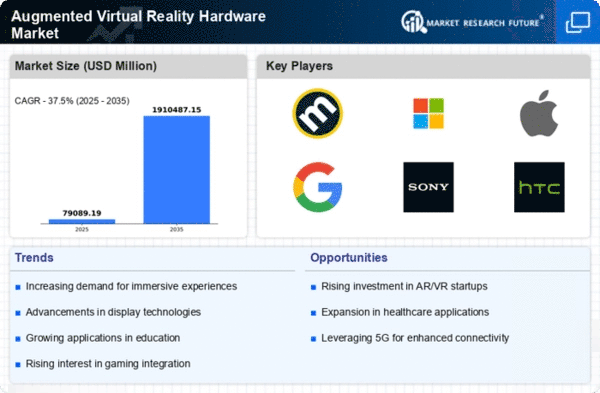
As per MRFR analysis, the Augmented Virtual Reality Hardware Market Size was estimated at 57519.41 USD Million in 2024. The Augmented Virtual Reality Hardware industry is projected to grow from 79089.19 in 2025 to 1910487.15 by 2035, exhibiting a compound annual growth rate (CAGR) of 37.5% during the forecast period 2025 - 2035.

Key Market Trends & Highlights

The Augmented Virtual Reality Hardware Market is poised for substantial growth driven by technological advancements and sector expansion.

  • North America remains the largest market for augmented virtual reality hardware, showcasing robust consumer demand.
  • The Asia-Pacific region is emerging as the fastest-growing market, fueled by increasing investments in technology and innovation.
  • The gaming segment continues to dominate the market, while healthcare applications are rapidly gaining traction as a key growth area.
  • Technological advancements and increased adoption in education are significant drivers propelling market expansion.

Market Size & Forecast

2024 Market Size 57519.41 (USD Million)
2035 Market Size 1910487.15 (USD Million)
CAGR (2025 - 2035) 37.5%
Largest Regional Market Share in 2024 North America

Major Players

Meta (US), Microsoft (US), Apple (US), Google (US), Sony (JP), HTC (TW), NVIDIA (US), Samsung (KR), Magic Leap (US)

Market Trends

The Augmented Virtual Reality Hardware Market is currently experiencing a transformative phase, characterized by rapid advancements in technology and increasing consumer interest. This market encompasses a diverse range of devices, including headsets, sensors, and other peripherals that enhance user experiences in both augmented and virtual environments. As industries such as gaming, education, and healthcare continue to explore the potential of immersive technologies, the demand for sophisticated hardware solutions appears to be on the rise. Furthermore, the integration of artificial intelligence and machine learning into these devices may enhance their functionality, making them more appealing to a broader audience. In addition to technological advancements, the Augmented Virtual Reality Hardware Market is influenced by evolving consumer preferences and expectations. Users are increasingly seeking more immersive and interactive experiences, which drives manufacturers to innovate and improve their offerings. The growing popularity of social and collaborative applications within virtual environments suggests that the market may expand beyond traditional sectors. As companies strive to meet these changing demands, the focus on user-friendly designs and enhanced performance is likely to shape the future landscape of this dynamic market.

Technological Integration

The integration of advanced technologies such as artificial intelligence and machine learning into augmented virtual reality hardware is becoming increasingly prevalent. This trend suggests that devices will not only provide immersive experiences but also adapt to user behaviors and preferences, enhancing overall functionality.

Consumer-Centric Design

There is a noticeable shift towards designing augmented virtual reality hardware with the end-user in mind. Manufacturers are focusing on ergonomics, usability, and aesthetic appeal, which indicates a growing recognition of the importance of user experience in driving market growth.

Expansion into New Sectors

The Augmented Virtual Reality Hardware Market is likely to see expansion into various sectors beyond gaming and entertainment. Industries such as healthcare, education, and real estate are exploring the potential of immersive technologies, suggesting that the market may diversify significantly in the coming years.

Augmented Virtual Reality Hardware Market Market Drivers

Expansion of AR and VR in Retail

The retail sector is increasingly adopting augmented and virtual reality technologies, significantly impacting the Augmented Virtual Reality Hardware Market. Retailers are leveraging AR and VR to create immersive shopping experiences, allowing customers to visualize products in their own environments before making a purchase. This trend is evident in the rise of virtual fitting rooms and interactive product displays, which enhance customer engagement and satisfaction. According to market analysis, the use of AR in retail is expected to grow by over 40% in the next few years. As retailers recognize the potential of AR and VR to drive sales and improve customer experiences, investments in specialized hardware are likely to increase, further propelling the growth of the market.

Technological Advancements in Hardware

Technological advancements play a pivotal role in shaping the Augmented Virtual Reality Hardware Market. Innovations in processing power, display technology, and sensor capabilities are enhancing the performance and functionality of AR and VR devices. For instance, the introduction of lightweight headsets with high-resolution displays has significantly improved user comfort and visual fidelity. Furthermore, advancements in motion tracking and haptic feedback systems are creating more realistic and immersive experiences. According to recent data, the market for AR and VR hardware is projected to grow at a compound annual growth rate of over 30% in the coming years. This rapid evolution of technology not only attracts consumers but also encourages developers to create more sophisticated applications, thereby expanding the overall market landscape.

Rising Demand for Immersive Experiences

The Augmented Virtual Reality Hardware Market is witnessing a notable surge in demand for immersive experiences across various sectors. As consumers increasingly seek engaging and interactive content, industries such as entertainment, gaming, and tourism are investing heavily in augmented and virtual reality technologies. This trend is reflected in the projected growth of the market, which is expected to reach approximately USD 100 billion by 2026. Companies are focusing on developing hardware that enhances user experience, thereby driving innovation and competition within the market. The integration of augmented reality in live events and exhibitions further amplifies this demand, as it offers unique ways to captivate audiences. Consequently, the hardware segment is likely to experience substantial growth, as businesses strive to meet the evolving expectations of consumers.

Growing Applications in Training and Simulation

The application of augmented and virtual reality in training and simulation is emerging as a significant driver for the Augmented Virtual Reality Hardware Market. Industries such as aviation, military, and healthcare are increasingly utilizing AR and VR technologies to provide realistic training environments. These immersive simulations enhance learning outcomes and improve skill acquisition, as trainees can practice in a safe and controlled setting. Recent data suggests that the market for AR and VR in training is projected to grow at a compound annual growth rate of approximately 35% over the next few years. This growth is likely to stimulate demand for specialized hardware that supports these applications, thereby contributing to the overall expansion of the market.

Increased Investment in Research and Development

Investment in research and development is a critical driver for the Augmented Virtual Reality Hardware Market. Companies are allocating substantial resources to explore new applications and improve existing technologies. This focus on R&D is essential for fostering innovation and maintaining competitive advantage in a rapidly evolving market. As organizations strive to create cutting-edge hardware solutions, partnerships with academic institutions and technology firms are becoming more common. This collaborative approach is likely to yield breakthroughs that enhance the capabilities of AR and VR devices. Recent statistics indicate that R&D spending in the AR and VR sector has increased by over 25% in the last few years, underscoring the commitment of industry players to advance hardware technology and meet the growing demands of consumers.

Market Segment Insights

By Application: Gaming (Largest) vs. Education (Fastest-Growing)

<p>In the Augmented Virtual Reality (AR) Hardware Market, the application segment showcases a dynamic distribution among its main values: Gaming, Education, Healthcare, Military, and Retail. Gaming remains the largest segment, driven by the increasing popularity of immersive gaming experiences. Education follows closely, benefiting from the rising adoption of AR technologies in learning environments. Healthcare, Military, and Retail are also gaining traction, contributing to a diversified application landscape.</p>

<p>Gaming (Dominant) vs. Education (Emerging)</p>

<p>Gaming stands out as the dominant segment in the AR hardware market, characterized by its robust user base and constant innovation in game development. It draws significant investments and interest from both consumers and developers, enhancing engagement through sophisticated graphics and interactivity. In contrast, Education is the emerging segment, rapidly leveraging AR to transform learning experiences. Institutions are increasingly incorporating AR tools to facilitate interactive learning and practical training. This segment benefits from the growing demand for innovative methods in educational delivery, positioning itself for substantial growth as technology advances and educational paradigms shift.</p>

By End Use: Consumer Electronics (Largest) vs. Healthcare (Fastest-Growing)

The Augmented Virtual Reality Hardware Market showcases a diverse portfolio of end-use segments, with Consumer Electronics leading in market share. This segment encompasses devices like AR glasses and smartphones integrated with AR capabilities, appealing primarily to consumers seeking immersive gaming and interactive experiences. Following Consumer Electronics, the Commercial segment also holds significant stakes, leveraging augmented reality for efficient customer engagement and marketing strategies. On the other hand, the Healthcare sector is emerging as the fastest-growing segment within this landscape. The increasing adoption of AR applications in surgical procedures, medical training, and patient education is driving rapid growth. As this technology enhances precision and efficiency, healthcare providers are investing heavily in AR equipment, further propelling its market expansion.

Consumer Electronics: Dominant vs. Healthcare: Emerging

The Consumer Electronics segment represents the dominant force in the Augmented Virtual Reality Hardware Market, characterized by its widespread use in recreational activities, gaming, and social interactions. With major players continuously innovating to enhance user experiences, this segment is focused on developing user-friendly devices that integrate seamlessly into daily life. Conversely, the Healthcare segment is emerging rapidly, driven by its transformative potential in medical training, visualization, and surgical assistance. Advanced AR technologies are revolutionizing how healthcare professionals engage with patients and complex data, allowing for enhanced treatment options. This dynamic interplay between established consumer gadgets and cutting-edge healthcare solutions is shaping the future of the augmented reality market.

By Technology: Virtual Reality (Largest) vs. Augmented Reality (Fastest-Growing)

The Augmented Virtual Reality Hardware Market showcases a diverse range of technologies, with Virtual Reality commanding the largest market share. This dominance reflects the significant investment and consumer interest in fully immersive experiences, appealing particularly to gaming and simulation applications. In contrast, Augmented Reality is rapidly gaining traction, carving out a significant niche for itself with applications in areas such as retail and training. As businesses increasingly seek innovative solutions, Augmented Reality's market presence is expected to expand at a remarkable pace. Growth trends indicate that while Virtual Reality remains the cornerstone of immersive experiences, Augmented Reality is on a distinct upward trajectory due to advancements in smartphone technology and wearable devices. Mixed Reality and Haptic Technology also show promise, driven by demand for more interactive experiences, especially in gaming and training. Display Technology enhances these experiences by providing improved visuals and user engagement, propelling the overall segment toward significant evolution in application and utility in the coming years.

Virtual Reality: Dominant vs. Mixed Reality: Emerging

Virtual Reality stands as the dominant force in the Augmented Virtual Reality Hardware Market, primarily due to its extensive use in gaming, entertainment, and professional training industries. It offers immersive experiences that fully engage users, catering to a broad audience. Its widespread adoption is supported by substantial investments in VR hardware and content, enhancing its market stability. On the other hand, Mixed Reality, though emerging, presents a unique integration of real and virtual environments, enabling users to interact with both simultaneously. This technology is gaining popularity in sectors such as education and architecture, where practical applications can significantly benefit from combined physical and digital elements. As both segments mature, the competition will likely drive innovation and enhance user experiences further.

By Component: Processors (Largest) vs. Displays (Fastest-Growing)

In the Augmented Virtual Reality Hardware Market, the component segment is increasingly vital, with displays, processors, sensors, input devices, and cameras playing pivotal roles. Among these, processors hold the largest share due to their essential function in ensuring smooth, high-performance graphics computation. Displays are emerging rapidly, driven by advancements in technology and growing consumer acceptance, making them the fastest-growing segment in this market.

Processors (Dominant) vs. Displays (Emerging)

Processors are the dominant component in the Augmented Virtual Reality Hardware Market, essential for delivering high-quality virtual experiences. These units are designed to handle complex calculations and render graphics efficiently, making them crucial for the user experience. Meanwhile, displays are considered the emerging segment, benefiting from innovations in LCD and OLED technology. As users demand sharper and more immersive visuals, the growth of HD and even 4K displays has surged, positioning them as a key differentiator in AR hardware offerings. The interplay between these components significantly influences overall performance and user satisfaction in augmented reality experiences.

By Form Factor: Head-Mounted Displays (Largest) vs. Smart Glasses (Fastest-Growing)

The Augmented Virtual Reality Hardware market is primarily dominated by Head-Mounted Displays (HMDs), which capture a significant share due to their immersive experience and advanced technology. Following HMDs, Handheld Devices and Mobile Devices maintain a notable presence, providing flexibility and accessibility to users. Smart Glasses, while currently a smaller segment, showcase a growing trend, appealing to consumers seeking lightweight and portable AR experiences. Projection Systems represent a niche category with utility in specialized applications, but overall, they take a backseat in the comparative distribution of market share among these segment values. The growth trends indicate a robust interest in Smart Glasses, reflecting the shift towards miniaturization and user convenience. This segment's fast expansion is driven by increasing consumer demand for hands-free applications, particularly in industries such as healthcare and training. Head-Mounted Displays continue to evolve with enhanced functionalities that cater to gaming and entertainment, maintaining their position as the heavyweight segment. Moreover, advancements in mobile technology are fostering the emergence of Handheld and Mobile Devices, although they face stiff competition from the larger, inherently immersive HMDs. Overall, innovation and tailored user experiences are critical growth drivers across these form factors.

Head-Mounted Displays (Dominant) vs. Smart Glasses (Emerging)

Head-Mounted Displays (HMDs) hold a dominant position in the Augmented Virtual Reality Hardware market, characterized by extensive immersive capabilities and critical applications in gaming and training environments. These devices are equipped with advanced sensors, high-definition visuals, and an extensive ecosystem of applications, making them preferred by consumers seeking deep AR experiences. On the other hand, Smart Glasses represent an emerging segment, gaining traction for their lightweight design and practicality in professional fields such as logistics and maintenance. Smart Glasses offer hands-free interaction, appealing to users for navigation and data display in real-time. Their growing adoption signifies a trend towards more integrated and conveniently wearable AR solutions, providing a compelling alternative to the more cumbersome HMDs.

Get more detailed insights about Augmented and Virtual Reality Hardware Market Research Report—Global Forecast till 2035

Regional Insights

North America : Innovation and Market Leadership

North America continues to lead the Augmented Virtual Reality Hardware Market, holding a significant share of 28759.71 million in 2024. The region's growth is driven by rapid technological advancements, increasing investments in AR applications, and a strong consumer base eager for immersive experiences. Regulatory support for tech innovation further fuels this growth, making it a prime market for AR hardware development. The competitive landscape is dominated by key players such as Meta, Microsoft, and Apple, all based in the US. These companies are at the forefront of AR technology, continuously innovating to enhance user experiences. The presence of major tech firms and a robust startup ecosystem contribute to a vibrant market, ensuring North America remains a hub for AR hardware advancements.

Europe : Emerging Market with Growth Potential

Europe's Augmented Virtual Reality Hardware Market is poised for significant growth, with a market size of 14400.0 million. The region benefits from increasing adoption of AR technologies across various sectors, including education, healthcare, and entertainment. Regulatory frameworks promoting digital innovation and sustainability are also key drivers, enhancing the market's appeal and fostering investment. Leading countries such as Germany, the UK, and France are at the forefront of this expansion, supported by a strong presence of tech companies and research institutions. The competitive landscape features both established players and innovative startups, creating a dynamic environment for AR hardware development. As Europe embraces digital transformation, the AR market is expected to flourish, attracting further investments.

Asia-Pacific : Rapid Growth and Adoption

The Asia-Pacific region is witnessing a rapid surge in the Augmented Virtual Reality Hardware Market, with a market size of 10000.0 million. This growth is fueled by increasing consumer demand for immersive experiences, particularly in gaming and entertainment. Additionally, government initiatives promoting digital transformation and technological innovation are catalyzing market expansion across countries in the region. Countries like Japan, China, and South Korea are leading the charge, with significant investments from both local and international players. The competitive landscape is vibrant, featuring major companies such as Sony and HTC, alongside emerging startups. As the region continues to embrace AR technology, the market is expected to grow exponentially, driven by innovation and consumer engagement.

Middle East and Africa : Niche Market with Potential

The Middle East and Africa (MEA) region represents a niche market for Augmented Virtual Reality Hardware, with a market size of 359.7 million. Despite its smaller size, the region is experiencing growth driven by increasing interest in AR applications across sectors like tourism, education, and retail. Government initiatives aimed at diversifying economies and enhancing digital infrastructure are also contributing to market development. Countries such as the UAE and South Africa are leading the way in AR adoption, supported by investments from both local and international firms. The competitive landscape is evolving, with a mix of established companies and startups entering the market. As awareness and demand for AR technology grow, the MEA region presents unique opportunities for innovation and investment.

Key Players and Competitive Insights

The Augmented Virtual Reality Hardware Market is currently characterized by a dynamic competitive landscape, driven by rapid technological advancements and increasing consumer demand for immersive experiences. Major players such as Meta (US), Microsoft (US), and Apple (US) are at the forefront, each adopting distinct strategies to enhance their market positioning. Meta (US) continues to focus on innovation through its extensive investment in the Metaverse, aiming to create a seamless integration of augmented and virtual reality experiences. Meanwhile, Microsoft (US) emphasizes partnerships, particularly with enterprise clients, to leverage its HoloLens technology for business applications, thereby expanding its reach in the corporate sector. Apple (US), on the other hand, appears to be concentrating on product differentiation, with its anticipated AR headset expected to integrate seamlessly with its existing ecosystem, potentially reshaping user engagement.In terms of business tactics, companies are increasingly localizing manufacturing and optimizing supply chains to enhance efficiency and reduce costs. The market structure is moderately fragmented, with a mix of established giants and emerging players. This fragmentation allows for diverse offerings, yet the collective influence of key players like Sony (JP) and NVIDIA (US) is significant, as they drive innovation and set industry standards.

In November Sony (JP) announced the launch of its latest augmented reality headset, which integrates advanced eye-tracking technology. This strategic move is likely to enhance user interaction and engagement, positioning Sony as a leader in the consumer AR segment. The introduction of this technology not only showcases Sony's commitment to innovation but also reflects a broader trend towards more personalized and immersive user experiences in the market.

In October NVIDIA (US) unveiled a new software platform designed to optimize AR applications for developers. This initiative is crucial as it provides developers with the tools necessary to create more sophisticated and efficient AR experiences. By focusing on software development, NVIDIA is not only enhancing its hardware offerings but also fostering a robust ecosystem that could lead to increased adoption of AR technologies across various sectors.

In September Apple (US) revealed its plans to expand its ARKit framework, which supports developers in creating AR applications for its devices. This expansion is indicative of Apple's strategy to solidify its presence in the AR market, potentially leading to a surge in AR content creation. By enhancing its developer tools, Apple is likely to attract a broader range of applications, thereby increasing user engagement and market penetration.

As of December the competitive trends in the Augmented Virtual Reality Hardware Market are increasingly defined by digitalization, sustainability, and AI integration. Strategic alliances among key players are shaping the landscape, fostering innovation and collaboration. The shift from price-based competition to a focus on technological advancement and supply chain reliability is evident. Companies are likely to differentiate themselves through unique offerings and enhanced user experiences, suggesting a future where innovation is paramount in maintaining competitive advantage.

Key Companies in the Augmented Virtual Reality Hardware Market include

Industry Developments

October 2020 Samsung partnered with Stanford University for the development of an AR/VR display that is capable of packing more than 10,000 pixels per inch for use in VR/AR headsets and future contact lenses. The major aim of this partnership is to reduce the perception of the dreaded “screen door effect” in VR displays.

May 2021 HTC Corporation partnered with Agora a VR company, the partnership aims to develop future VR technologies and experiences, and the partnership will bring HTCs hardware expertise and Agora software expertise for future development in VR technologies.

Intended Audience

    • Sensor Industry

    • Semiconductor Industry

    • Factories And Manufacturing Facilities

    • Technology Investors

    • Regulatory Industries

    • Government Bodies

    • Augmented and Virtual Reality Industries

Future Outlook

Augmented Virtual Reality Hardware Market Future Outlook

The Augmented Virtual Reality Hardware Market is projected to grow at a 37.5% CAGR from 2025 to 2035, driven by advancements in technology, increased consumer demand, and expanding applications across industries.

New opportunities lie in:

  • Development of enterprise-grade AR hardware solutions for training and simulation.
  • Integration of AR with IoT devices for enhanced user experiences.
  • Creation of subscription-based models for continuous software updates and support.

By 2035, the market is expected to be robust, driven by innovation and diverse applications.

Market Segmentation

Augmented Virtual Reality Hardware Market End Use Outlook

  • Consumer Electronics
  • Commercial
  • Industrial
  • Healthcare
  • Military

Augmented Virtual Reality Hardware Market Component Outlook

  • Sensors
  • Displays
  • Processors
  • Input Devices
  • Cameras

Augmented Virtual Reality Hardware Market Technology Outlook

  • Virtual Reality
  • Augmented Reality
  • Mixed Reality
  • Haptic Technology
  • Display Technology

Augmented Virtual Reality Hardware Market Application Outlook

  • Gaming
  • Education
  • Healthcare
  • Military
  • Retail

Augmented Virtual Reality Hardware Market Form Factor Outlook

  • Head-Mounted Displays
  • Handheld Devices
  • Smart Glasses
  • Projection Systems
  • Mobile Devices

Report Scope

MARKET SIZE 2024 57519.41(USD Million)
MARKET SIZE 2025 79089.19(USD Million)
MARKET SIZE 2035 1910487.15(USD Million)
COMPOUND ANNUAL GROWTH RATE (CAGR) 37.5% (2025 - 2035)
REPORT COVERAGE Revenue Forecast, Competitive Landscape, Growth Factors, and Trends
BASE YEAR 2024
Market Forecast Period 2025 - 2035
Historical Data 2019 - 2024
Market Forecast Units USD Million
Key Companies Profiled Meta (US), Microsoft (US), Apple (US), Google (US), Sony (JP), HTC (TW), NVIDIA (US), Samsung (KR), Magic Leap (US)
Segments Covered Application, End Use, Technology, Component, Form Factor
Key Market Opportunities Integration of artificial intelligence enhances user experience in the Augmented Virtual Reality Hardware Market.
Key Market Dynamics Technological advancements and consumer demand drive innovation and competition in the Augmented Virtual Reality Hardware Market.
Countries Covered North America, Europe, APAC, South America, MEA

FAQs

What is the current valuation of the Augmented Virtual Reality Hardware Market?

<p>The market valuation reached approximately 57519.41 USD Million in 2024.</p>

What is the projected market valuation for the Augmented Virtual Reality Hardware Market by 2035?

<p>The market is expected to reach a valuation of around 1910487.15 USD Million by 2035.</p>

What is the expected CAGR for the Augmented Virtual Reality Hardware Market during the forecast period?

<p>The market is anticipated to grow at a CAGR of 37.5% from 2025 to 2035.</p>

Which companies are considered key players in the Augmented Virtual Reality Hardware Market?

<p>Key players include Meta Platforms, Microsoft, Apple, Sony, Google, HTC, NVIDIA, Samsung, and Magic Leap.</p>

What are the primary applications driving the Augmented Virtual Reality Hardware Market?

<p>The main applications include Gaming, Education, Healthcare, Military, and Retail, with Gaming valued at 11500.0 USD Million in 2024.</p>

How does the market segment by end use look in terms of valuation?

In 2024, the Commercial segment led with a valuation of 15000.0 USD Million, followed by Consumer Electronics at 11500.0 USD Million.

What technologies are contributing to the Augmented Virtual Reality Hardware Market?

Key technologies include Virtual Reality, Augmented Reality, Mixed Reality, Haptic Technology, and Display Technology, with Virtual Reality valued at 23000.0 USD Million in 2024.

What is the projected growth for the Gaming application in the Augmented Virtual Reality Hardware Market?

The Gaming application is projected to grow significantly, having been valued at 11500.0 USD Million in 2024.

How does the Healthcare segment perform in the Augmented Virtual Reality Hardware Market?

The Healthcare segment was valued at 10000.0 USD Million in 2024 and is expected to see substantial growth.

What is the significance of Mixed Reality in the Augmented Virtual Reality Hardware Market?

Mixed Reality, valued at 10000.0 USD Million in 2024, is likely to play a crucial role in the market's future development.

  1. SECTION I: EXECUTIVE SUMMARY AND KEY HIGHLIGHTS
    1. | 1.1 EXECUTIVE SUMMARY
    2. | | 1.1.1 Market Overview
    3. | | 1.1.2 Key Findings
    4. | | 1.1.3 Market Segmentation
    5. | | 1.1.4 Competitive Landscape
    6. | | 1.1.5 Challenges and Opportunities
    7. | | 1.1.6 Future Outlook
  2. SECTION II: SCOPING, METHODOLOGY AND MARKET STRUCTURE
    1. | 2.1 MARKET INTRODUCTION
    2. | | 2.1.1 Definition
    3. | | 2.1.2 Scope of the study
    4. | | | 2.1.2.1 Research Objective
    5. | | | 2.1.2.2 Assumption
    6. | | | 2.1.2.3 Limitations
    7. | 2.2 RESEARCH METHODOLOGY
    8. | | 2.2.1 Overview
    9. | | 2.2.2 Data Mining
    10. | | 2.2.3 Secondary Research
    11. | | 2.2.4 Primary Research
    12. | | | 2.2.4.1 Primary Interviews and Information Gathering Process
    13. | | | 2.2.4.2 Breakdown of Primary Respondents
    14. | | 2.2.5 Forecasting Model
    15. | | 2.2.6 Market Size Estimation
    16. | | | 2.2.6.1 Bottom-Up Approach
    17. | | | 2.2.6.2 Top-Down Approach
    18. | | 2.2.7 Data Triangulation
    19. | | 2.2.8 Validation
  3. SECTION III: QUALITATIVE ANALYSIS
    1. | 3.1 MARKET DYNAMICS
    2. | | 3.1.1 Overview
    3. | | 3.1.2 Drivers
    4. | | 3.1.3 Restraints
    5. | | 3.1.4 Opportunities
    6. | 3.2 MARKET FACTOR ANALYSIS
    7. | | 3.2.1 Value chain Analysis
    8. | | 3.2.2 Porter's Five Forces Analysis
    9. | | | 3.2.2.1 Bargaining Power of Suppliers
    10. | | | 3.2.2.2 Bargaining Power of Buyers
    11. | | | 3.2.2.3 Threat of New Entrants
    12. | | | 3.2.2.4 Threat of Substitutes
    13. | | | 3.2.2.5 Intensity of Rivalry
    14. | | 3.2.3 COVID-19 Impact Analysis
    15. | | | 3.2.3.1 Market Impact Analysis
    16. | | | 3.2.3.2 Regional Impact
    17. | | | 3.2.3.3 Opportunity and Threat Analysis
  4. SECTION IV: QUANTITATIVE ANALYSIS
    1. | 4.1 Information and Communications Technology, BY Application (USD Million)
    2. | | 4.1.1 Gaming
    3. | | 4.1.2 Education
    4. | | 4.1.3 Healthcare
    5. | | 4.1.4 Military
    6. | | 4.1.5 Retail
    7. | 4.2 Information and Communications Technology, BY End Use (USD Million)
    8. | | 4.2.1 Consumer Electronics
    9. | | 4.2.2 Commercial
    10. | | 4.2.3 Industrial
    11. | | 4.2.4 Healthcare
    12. | | 4.2.5 Military
    13. | 4.3 Information and Communications Technology, BY Technology (USD Million)
    14. | | 4.3.1 Virtual Reality
    15. | | 4.3.2 Augmented Reality
    16. | | 4.3.3 Mixed Reality
    17. | | 4.3.4 Haptic Technology
    18. | | 4.3.5 Display Technology
    19. | 4.4 Information and Communications Technology, BY Region (USD Million)
    20. | | 4.4.1 North America
    21. | | | 4.4.1.1 US
    22. | | | 4.4.1.2 Canada
    23. | | 4.4.2 Europe
    24. | | | 4.4.2.1 Germany
    25. | | | 4.4.2.2 UK
    26. | | | 4.4.2.3 France
    27. | | | 4.4.2.4 Russia
    28. | | | 4.4.2.5 Italy
    29. | | | 4.4.2.6 Spain
    30. | | | 4.4.2.7 Rest of Europe
    31. | | 4.4.3 APAC
    32. | | | 4.4.3.1 China
    33. | | | 4.4.3.2 India
    34. | | | 4.4.3.3 Japan
    35. | | | 4.4.3.4 South Korea
    36. | | | 4.4.3.5 Malaysia
    37. | | | 4.4.3.6 Thailand
    38. | | | 4.4.3.7 Indonesia
    39. | | | 4.4.3.8 Rest of APAC
    40. | | 4.4.4 South America
    41. | | | 4.4.4.1 Brazil
    42. | | | 4.4.4.2 Mexico
    43. | | | 4.4.4.3 Argentina
    44. | | | 4.4.4.4 Rest of South America
    45. | | 4.4.5 MEA
    46. | | | 4.4.5.1 GCC Countries
    47. | | | 4.4.5.2 South Africa
    48. | | | 4.4.5.3 Rest of MEA
  5. SECTION V: COMPETITIVE ANALYSIS
    1. | 5.1 Competitive Landscape
    2. | | 5.1.1 Overview
    3. | | 5.1.2 Competitive Analysis
    4. | | 5.1.3 Market share Analysis
    5. | | 5.1.4 Major Growth Strategy in the Information and Communications Technology
    6. | | 5.1.5 Competitive Benchmarking
    7. | | 5.1.6 Leading Players in Terms of Number of Developments in the Information and Communications Technology
    8. | | 5.1.7 Key developments and growth strategies
    9. | | | 5.1.7.1 New Product Launch/Service Deployment
    10. | | | 5.1.7.2 Merger & Acquisitions
    11. | | | 5.1.7.3 Joint Ventures
    12. | | 5.1.8 Major Players Financial Matrix
    13. | | | 5.1.8.1 Sales and Operating Income
    14. | | | 5.1.8.2 Major Players R&D Expenditure. 2023
    15. | 5.2 Company Profiles
    16. | | 5.2.1 Meta Platforms (US)
    17. | | | 5.2.1.1 Financial Overview
    18. | | | 5.2.1.2 Products Offered
    19. | | | 5.2.1.3 Key Developments
    20. | | | 5.2.1.4 SWOT Analysis
    21. | | | 5.2.1.5 Key Strategies
    22. | | 5.2.2 Microsoft (US)
    23. | | | 5.2.2.1 Financial Overview
    24. | | | 5.2.2.2 Products Offered
    25. | | | 5.2.2.3 Key Developments
    26. | | | 5.2.2.4 SWOT Analysis
    27. | | | 5.2.2.5 Key Strategies
    28. | | 5.2.3 Apple (US)
    29. | | | 5.2.3.1 Financial Overview
    30. | | | 5.2.3.2 Products Offered
    31. | | | 5.2.3.3 Key Developments
    32. | | | 5.2.3.4 SWOT Analysis
    33. | | | 5.2.3.5 Key Strategies
    34. | | 5.2.4 Sony (JP)
    35. | | | 5.2.4.1 Financial Overview
    36. | | | 5.2.4.2 Products Offered
    37. | | | 5.2.4.3 Key Developments
    38. | | | 5.2.4.4 SWOT Analysis
    39. | | | 5.2.4.5 Key Strategies
    40. | | 5.2.5 Google (US)
    41. | | | 5.2.5.1 Financial Overview
    42. | | | 5.2.5.2 Products Offered
    43. | | | 5.2.5.3 Key Developments
    44. | | | 5.2.5.4 SWOT Analysis
    45. | | | 5.2.5.5 Key Strategies
    46. | | 5.2.6 HTC (TW)
    47. | | | 5.2.6.1 Financial Overview
    48. | | | 5.2.6.2 Products Offered
    49. | | | 5.2.6.3 Key Developments
    50. | | | 5.2.6.4 SWOT Analysis
    51. | | | 5.2.6.5 Key Strategies
    52. | | 5.2.7 NVIDIA (US)
    53. | | | 5.2.7.1 Financial Overview
    54. | | | 5.2.7.2 Products Offered
    55. | | | 5.2.7.3 Key Developments
    56. | | | 5.2.7.4 SWOT Analysis
    57. | | | 5.2.7.5 Key Strategies
    58. | | 5.2.8 Samsung (KR)
    59. | | | 5.2.8.1 Financial Overview
    60. | | | 5.2.8.2 Products Offered
    61. | | | 5.2.8.3 Key Developments
    62. | | | 5.2.8.4 SWOT Analysis
    63. | | | 5.2.8.5 Key Strategies
    64. | | 5.2.9 Magic Leap (US)
    65. | | | 5.2.9.1 Financial Overview
    66. | | | 5.2.9.2 Products Offered
    67. | | | 5.2.9.3 Key Developments
    68. | | | 5.2.9.4 SWOT Analysis
    69. | | | 5.2.9.5 Key Strategies
    70. | 5.3 Appendix
    71. | | 5.3.1 References
    72. | | 5.3.2 Related Reports
  6. LIST OF FIGURES
    1. | 6.1 MARKET SYNOPSIS
    2. | 6.2 NORTH AMERICA MARKET ANALYSIS
    3. | 6.3 US MARKET ANALYSIS BY APPLICATION
    4. | 6.4 US MARKET ANALYSIS BY END USE
    5. | 6.5 US MARKET ANALYSIS BY TECHNOLOGY
    6. | 6.6 CANADA MARKET ANALYSIS BY APPLICATION
    7. | 6.7 CANADA MARKET ANALYSIS BY END USE
    8. | 6.8 CANADA MARKET ANALYSIS BY TECHNOLOGY
    9. | 6.9 EUROPE MARKET ANALYSIS
    10. | 6.10 GERMANY MARKET ANALYSIS BY APPLICATION
    11. | 6.11 GERMANY MARKET ANALYSIS BY END USE
    12. | 6.12 GERMANY MARKET ANALYSIS BY TECHNOLOGY
    13. | 6.13 UK MARKET ANALYSIS BY APPLICATION
    14. | 6.14 UK MARKET ANALYSIS BY END USE
    15. | 6.15 UK MARKET ANALYSIS BY TECHNOLOGY
    16. | 6.16 FRANCE MARKET ANALYSIS BY APPLICATION
    17. | 6.17 FRANCE MARKET ANALYSIS BY END USE
    18. | 6.18 FRANCE MARKET ANALYSIS BY TECHNOLOGY
    19. | 6.19 RUSSIA MARKET ANALYSIS BY APPLICATION
    20. | 6.20 RUSSIA MARKET ANALYSIS BY END USE
    21. | 6.21 RUSSIA MARKET ANALYSIS BY TECHNOLOGY
    22. | 6.22 ITALY MARKET ANALYSIS BY APPLICATION
    23. | 6.23 ITALY MARKET ANALYSIS BY END USE
    24. | 6.24 ITALY MARKET ANALYSIS BY TECHNOLOGY
    25. | 6.25 SPAIN MARKET ANALYSIS BY APPLICATION
    26. | 6.26 SPAIN MARKET ANALYSIS BY END USE
    27. | 6.27 SPAIN MARKET ANALYSIS BY TECHNOLOGY
    28. | 6.28 REST OF EUROPE MARKET ANALYSIS BY APPLICATION
    29. | 6.29 REST OF EUROPE MARKET ANALYSIS BY END USE
    30. | 6.30 REST OF EUROPE MARKET ANALYSIS BY TECHNOLOGY
    31. | 6.31 APAC MARKET ANALYSIS
    32. | 6.32 CHINA MARKET ANALYSIS BY APPLICATION
    33. | 6.33 CHINA MARKET ANALYSIS BY END USE
    34. | 6.34 CHINA MARKET ANALYSIS BY TECHNOLOGY
    35. | 6.35 INDIA MARKET ANALYSIS BY APPLICATION
    36. | 6.36 INDIA MARKET ANALYSIS BY END USE
    37. | 6.37 INDIA MARKET ANALYSIS BY TECHNOLOGY
    38. | 6.38 JAPAN MARKET ANALYSIS BY APPLICATION
    39. | 6.39 JAPAN MARKET ANALYSIS BY END USE
    40. | 6.40 JAPAN MARKET ANALYSIS BY TECHNOLOGY
    41. | 6.41 SOUTH KOREA MARKET ANALYSIS BY APPLICATION
    42. | 6.42 SOUTH KOREA MARKET ANALYSIS BY END USE
    43. | 6.43 SOUTH KOREA MARKET ANALYSIS BY TECHNOLOGY
    44. | 6.44 MALAYSIA MARKET ANALYSIS BY APPLICATION
    45. | 6.45 MALAYSIA MARKET ANALYSIS BY END USE
    46. | 6.46 MALAYSIA MARKET ANALYSIS BY TECHNOLOGY
    47. | 6.47 THAILAND MARKET ANALYSIS BY APPLICATION
    48. | 6.48 THAILAND MARKET ANALYSIS BY END USE
    49. | 6.49 THAILAND MARKET ANALYSIS BY TECHNOLOGY
    50. | 6.50 INDONESIA MARKET ANALYSIS BY APPLICATION
    51. | 6.51 INDONESIA MARKET ANALYSIS BY END USE
    52. | 6.52 INDONESIA MARKET ANALYSIS BY TECHNOLOGY
    53. | 6.53 REST OF APAC MARKET ANALYSIS BY APPLICATION
    54. | 6.54 REST OF APAC MARKET ANALYSIS BY END USE
    55. | 6.55 REST OF APAC MARKET ANALYSIS BY TECHNOLOGY
    56. | 6.56 SOUTH AMERICA MARKET ANALYSIS
    57. | 6.57 BRAZIL MARKET ANALYSIS BY APPLICATION
    58. | 6.58 BRAZIL MARKET ANALYSIS BY END USE
    59. | 6.59 BRAZIL MARKET ANALYSIS BY TECHNOLOGY
    60. | 6.60 MEXICO MARKET ANALYSIS BY APPLICATION
    61. | 6.61 MEXICO MARKET ANALYSIS BY END USE
    62. | 6.62 MEXICO MARKET ANALYSIS BY TECHNOLOGY
    63. | 6.63 ARGENTINA MARKET ANALYSIS BY APPLICATION
    64. | 6.64 ARGENTINA MARKET ANALYSIS BY END USE
    65. | 6.65 ARGENTINA MARKET ANALYSIS BY TECHNOLOGY
    66. | 6.66 REST OF SOUTH AMERICA MARKET ANALYSIS BY APPLICATION
    67. | 6.67 REST OF SOUTH AMERICA MARKET ANALYSIS BY END USE
    68. | 6.68 REST OF SOUTH AMERICA MARKET ANALYSIS BY TECHNOLOGY
    69. | 6.69 MEA MARKET ANALYSIS
    70. | 6.70 GCC COUNTRIES MARKET ANALYSIS BY APPLICATION
    71. | 6.71 GCC COUNTRIES MARKET ANALYSIS BY END USE
    72. | 6.72 GCC COUNTRIES MARKET ANALYSIS BY TECHNOLOGY
    73. | 6.73 SOUTH AFRICA MARKET ANALYSIS BY APPLICATION
    74. | 6.74 SOUTH AFRICA MARKET ANALYSIS BY END USE
    75. | 6.75 SOUTH AFRICA MARKET ANALYSIS BY TECHNOLOGY
    76. | 6.76 REST OF MEA MARKET ANALYSIS BY APPLICATION
    77. | 6.77 REST OF MEA MARKET ANALYSIS BY END USE
    78. | 6.78 REST OF MEA MARKET ANALYSIS BY TECHNOLOGY
    79. | 6.79 KEY BUYING CRITERIA OF INFORMATION AND COMMUNICATIONS TECHNOLOGY
    80. | 6.80 RESEARCH PROCESS OF MRFR
    81. | 6.81 DRO ANALYSIS OF INFORMATION AND COMMUNICATIONS TECHNOLOGY
    82. | 6.82 DRIVERS IMPACT ANALYSIS: INFORMATION AND COMMUNICATIONS TECHNOLOGY
    83. | 6.83 RESTRAINTS IMPACT ANALYSIS: INFORMATION AND COMMUNICATIONS TECHNOLOGY
    84. | 6.84 SUPPLY / VALUE CHAIN: INFORMATION AND COMMUNICATIONS TECHNOLOGY
    85. | 6.85 INFORMATION AND COMMUNICATIONS TECHNOLOGY, BY APPLICATION, 2024 (% SHARE)
    86. | 6.86 INFORMATION AND COMMUNICATIONS TECHNOLOGY, BY APPLICATION, 2024 TO 2035 (USD Million)
    87. | 6.87 INFORMATION AND COMMUNICATIONS TECHNOLOGY, BY END USE, 2024 (% SHARE)
    88. | 6.88 INFORMATION AND COMMUNICATIONS TECHNOLOGY, BY END USE, 2024 TO 2035 (USD Million)
    89. | 6.89 INFORMATION AND COMMUNICATIONS TECHNOLOGY, BY TECHNOLOGY, 2024 (% SHARE)
    90. | 6.90 INFORMATION AND COMMUNICATIONS TECHNOLOGY, BY TECHNOLOGY, 2024 TO 2035 (USD Million)
    91. | 6.91 BENCHMARKING OF MAJOR COMPETITORS
  7. LIST OF TABLES
    1. | 7.1 LIST OF ASSUMPTIONS
    2. | | 7.1.1
    3. | 7.2 North America MARKET SIZE ESTIMATES; FORECAST
    4. | | 7.2.1 BY APPLICATION, 2025-2035 (USD Million)
    5. | | 7.2.2 BY END USE, 2025-2035 (USD Million)
    6. | | 7.2.3 BY TECHNOLOGY, 2025-2035 (USD Million)
    7. | 7.3 US MARKET SIZE ESTIMATES; FORECAST
    8. | | 7.3.1 BY APPLICATION, 2025-2035 (USD Million)
    9. | | 7.3.2 BY END USE, 2025-2035 (USD Million)
    10. | | 7.3.3 BY TECHNOLOGY, 2025-2035 (USD Million)
    11. | 7.4 Canada MARKET SIZE ESTIMATES; FORECAST
    12. | | 7.4.1 BY APPLICATION, 2025-2035 (USD Million)
    13. | | 7.4.2 BY END USE, 2025-2035 (USD Million)
    14. | | 7.4.3 BY TECHNOLOGY, 2025-2035 (USD Million)
    15. | 7.5 Europe MARKET SIZE ESTIMATES; FORECAST
    16. | | 7.5.1 BY APPLICATION, 2025-2035 (USD Million)
    17. | | 7.5.2 BY END USE, 2025-2035 (USD Million)
    18. | | 7.5.3 BY TECHNOLOGY, 2025-2035 (USD Million)
    19. | 7.6 Germany MARKET SIZE ESTIMATES; FORECAST
    20. | | 7.6.1 BY APPLICATION, 2025-2035 (USD Million)
    21. | | 7.6.2 BY END USE, 2025-2035 (USD Million)
    22. | | 7.6.3 BY TECHNOLOGY, 2025-2035 (USD Million)
    23. | 7.7 UK MARKET SIZE ESTIMATES; FORECAST
    24. | | 7.7.1 BY APPLICATION, 2025-2035 (USD Million)
    25. | | 7.7.2 BY END USE, 2025-2035 (USD Million)
    26. | | 7.7.3 BY TECHNOLOGY, 2025-2035 (USD Million)
    27. | 7.8 France MARKET SIZE ESTIMATES; FORECAST
    28. | | 7.8.1 BY APPLICATION, 2025-2035 (USD Million)
    29. | | 7.8.2 BY END USE, 2025-2035 (USD Million)
    30. | | 7.8.3 BY TECHNOLOGY, 2025-2035 (USD Million)
    31. | 7.9 Russia MARKET SIZE ESTIMATES; FORECAST
    32. | | 7.9.1 BY APPLICATION, 2025-2035 (USD Million)
    33. | | 7.9.2 BY END USE, 2025-2035 (USD Million)
    34. | | 7.9.3 BY TECHNOLOGY, 2025-2035 (USD Million)
    35. | 7.10 Italy MARKET SIZE ESTIMATES; FORECAST
    36. | | 7.10.1 BY APPLICATION, 2025-2035 (USD Million)
    37. | | 7.10.2 BY END USE, 2025-2035 (USD Million)
    38. | | 7.10.3 BY TECHNOLOGY, 2025-2035 (USD Million)
    39. | 7.11 Spain MARKET SIZE ESTIMATES; FORECAST
    40. | | 7.11.1 BY APPLICATION, 2025-2035 (USD Million)
    41. | | 7.11.2 BY END USE, 2025-2035 (USD Million)
    42. | | 7.11.3 BY TECHNOLOGY, 2025-2035 (USD Million)
    43. | 7.12 Rest of Europe MARKET SIZE ESTIMATES; FORECAST
    44. | | 7.12.1 BY APPLICATION, 2025-2035 (USD Million)
    45. | | 7.12.2 BY END USE, 2025-2035 (USD Million)
    46. | | 7.12.3 BY TECHNOLOGY, 2025-2035 (USD Million)
    47. | 7.13 APAC MARKET SIZE ESTIMATES; FORECAST
    48. | | 7.13.1 BY APPLICATION, 2025-2035 (USD Million)
    49. | | 7.13.2 BY END USE, 2025-2035 (USD Million)
    50. | | 7.13.3 BY TECHNOLOGY, 2025-2035 (USD Million)
    51. | 7.14 China MARKET SIZE ESTIMATES; FORECAST
    52. | | 7.14.1 BY APPLICATION, 2025-2035 (USD Million)
    53. | | 7.14.2 BY END USE, 2025-2035 (USD Million)
    54. | | 7.14.3 BY TECHNOLOGY, 2025-2035 (USD Million)
    55. | 7.15 India MARKET SIZE ESTIMATES; FORECAST
    56. | | 7.15.1 BY APPLICATION, 2025-2035 (USD Million)
    57. | | 7.15.2 BY END USE, 2025-2035 (USD Million)
    58. | | 7.15.3 BY TECHNOLOGY, 2025-2035 (USD Million)
    59. | 7.16 Japan MARKET SIZE ESTIMATES; FORECAST
    60. | | 7.16.1 BY APPLICATION, 2025-2035 (USD Million)
    61. | | 7.16.2 BY END USE, 2025-2035 (USD Million)
    62. | | 7.16.3 BY TECHNOLOGY, 2025-2035 (USD Million)
    63. | 7.17 South Korea MARKET SIZE ESTIMATES; FORECAST
    64. | | 7.17.1 BY APPLICATION, 2025-2035 (USD Million)
    65. | | 7.17.2 BY END USE, 2025-2035 (USD Million)
    66. | | 7.17.3 BY TECHNOLOGY, 2025-2035 (USD Million)
    67. | 7.18 Malaysia MARKET SIZE ESTIMATES; FORECAST
    68. | | 7.18.1 BY APPLICATION, 2025-2035 (USD Million)
    69. | | 7.18.2 BY END USE, 2025-2035 (USD Million)
    70. | | 7.18.3 BY TECHNOLOGY, 2025-2035 (USD Million)
    71. | 7.19 Thailand MARKET SIZE ESTIMATES; FORECAST
    72. | | 7.19.1 BY APPLICATION, 2025-2035 (USD Million)
    73. | | 7.19.2 BY END USE, 2025-2035 (USD Million)
    74. | | 7.19.3 BY TECHNOLOGY, 2025-2035 (USD Million)
    75. | 7.20 Indonesia MARKET SIZE ESTIMATES; FORECAST
    76. | | 7.20.1 BY APPLICATION, 2025-2035 (USD Million)
    77. | | 7.20.2 BY END USE, 2025-2035 (USD Million)
    78. | | 7.20.3 BY TECHNOLOGY, 2025-2035 (USD Million)
    79. | 7.21 Rest of APAC MARKET SIZE ESTIMATES; FORECAST
    80. | | 7.21.1 BY APPLICATION, 2025-2035 (USD Million)
    81. | | 7.21.2 BY END USE, 2025-2035 (USD Million)
    82. | | 7.21.3 BY TECHNOLOGY, 2025-2035 (USD Million)
    83. | 7.22 South America MARKET SIZE ESTIMATES; FORECAST
    84. | | 7.22.1 BY APPLICATION, 2025-2035 (USD Million)
    85. | | 7.22.2 BY END USE, 2025-2035 (USD Million)
    86. | | 7.22.3 BY TECHNOLOGY, 2025-2035 (USD Million)
    87. | 7.23 Brazil MARKET SIZE ESTIMATES; FORECAST
    88. | | 7.23.1 BY APPLICATION, 2025-2035 (USD Million)
    89. | | 7.23.2 BY END USE, 2025-2035 (USD Million)
    90. | | 7.23.3 BY TECHNOLOGY, 2025-2035 (USD Million)
    91. | 7.24 Mexico MARKET SIZE ESTIMATES; FORECAST
    92. | | 7.24.1 BY APPLICATION, 2025-2035 (USD Million)
    93. | | 7.24.2 BY END USE, 2025-2035 (USD Million)
    94. | | 7.24.3 BY TECHNOLOGY, 2025-2035 (USD Million)
    95. | 7.25 Argentina MARKET SIZE ESTIMATES; FORECAST
    96. | | 7.25.1 BY APPLICATION, 2025-2035 (USD Million)
    97. | | 7.25.2 BY END USE, 2025-2035 (USD Million)
    98. | | 7.25.3 BY TECHNOLOGY, 2025-2035 (USD Million)
    99. | 7.26 Rest of South America MARKET SIZE ESTIMATES; FORECAST
    100. | | 7.26.1 BY APPLICATION, 2025-2035 (USD Million)
    101. | | 7.26.2 BY END USE, 2025-2035 (USD Million)
    102. | | 7.26.3 BY TECHNOLOGY, 2025-2035 (USD Million)
    103. | 7.27 MEA MARKET SIZE ESTIMATES; FORECAST
    104. | | 7.27.1 BY APPLICATION, 2025-2035 (USD Million)
    105. | | 7.27.2 BY END USE, 2025-2035 (USD Million)
    106. | | 7.27.3 BY TECHNOLOGY, 2025-2035 (USD Million)
    107. | 7.28 GCC Countries MARKET SIZE ESTIMATES; FORECAST
    108. | | 7.28.1 BY APPLICATION, 2025-2035 (USD Million)
    109. | | 7.28.2 BY END USE, 2025-2035 (USD Million)
    110. | | 7.28.3 BY TECHNOLOGY, 2025-2035 (USD Million)
    111. | 7.29 South Africa MARKET SIZE ESTIMATES; FORECAST
    112. | | 7.29.1 BY APPLICATION, 2025-2035 (USD Million)
    113. | | 7.29.2 BY END USE, 2025-2035 (USD Million)
    114. | | 7.29.3 BY TECHNOLOGY, 2025-2035 (USD Million)
    115. | 7.30 Rest of MEA MARKET SIZE ESTIMATES; FORECAST
    116. | | 7.30.1 BY APPLICATION, 2025-2035 (USD Million)
    117. | | 7.30.2 BY END USE, 2025-2035 (USD Million)
    118. | | 7.30.3 BY TECHNOLOGY, 2025-2035 (USD Million)
    119. | 7.31 PRODUCT LAUNCH/PRODUCT DEVELOPMENT/APPROVAL
    120. | | 7.31.1
    121. | 7.32 ACQUISITION/PARTNERSHIP
    122. | | 7.32.1

Information and Communications Technology Market Segmentation

Information and Communications Technology By Application (USD Million, 2025-2035)

  • Gaming
  • Education
  • Healthcare
  • Military
  • Retail

Information and Communications Technology By End Use (USD Million, 2025-2035)

  • Consumer Electronics
  • Commercial
  • Industrial
  • Healthcare
  • Military

Information and Communications Technology By Technology (USD Million, 2025-2035)

  • Virtual Reality
  • Augmented Reality
  • Mixed Reality
  • Haptic Technology
  • Display Technology
Infographic

Free Sample Request

Kindly complete the form below to receive a free sample of this Report

Get Free Sample

Customer Strories

Compare Licence

×
Features License Type
Single User Multiuser License Enterprise User
Price $4,950 $5,950 $7,250
Maximum User Access Limit 1 User Upto 10 Users Unrestricted Access Throughout the Organization
Free Customization
Direct Access to Analyst
Deliverable Format
Platform Access
Discount on Next Purchase 10% 15% 15%
Printable Versions