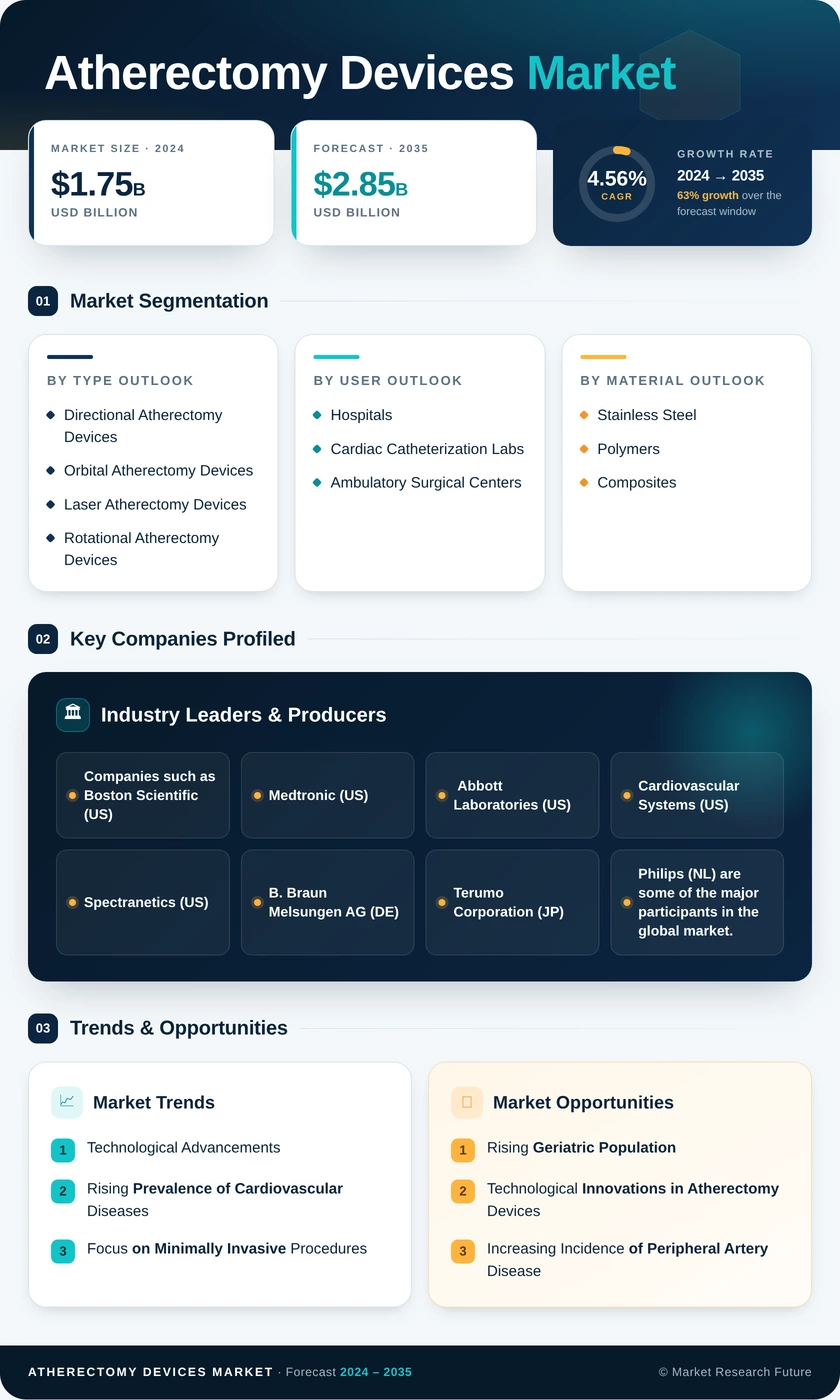
Segmentation Quick Reference
| Dimension | Sub-Segments | Dominant Segment | Fastest Growing Segment |
| By Product | Directional Atherectomy Systems; Orbital Atherectomy Systems; Photo-Ablative (Laser) Atherectomy Systems; Rotational Atherectomy Systems | Rotational Atherectomy Systems | Orbital Atherectomy Systems |
| By Application | Peripheral Vascular Applications; Cardiovascular Applications; Neurovascular Applications | Peripheral Vascular Applications | Neurovascular Applications |
| By End User | Hospitals and Surgical Centers; Ambulatory Care Centers; Others | Hospitals and Surgical Centers | Ambulatory Care Centers |
| By Geography | North America; Europe; Asia-Pacific; South America; Middle East & Africa | North America | Asia-Pacific |
Market Segmentation Overview
By Product
| Sub-Segment | Key Trend |
| Rotational Systems | Entrenched in coronary practice; incremental burr and shaft refinements rather than platform change |
| Orbital Systems | Fastest expansion; bidirectional sanding favored for eccentric peripheral calcium |
| Directional Systems | Tissue-capture advantage sustains femoropopliteal use despite higher unit cost |
| Photo-Ablative (Laser) Systems | Concentrated in in-stent restenosis and thrombotic lesion management |
Product choice is converging on lesion morphology rather than institutional preference, which rewards suppliers offering more than one modality under a single contract.
By Application
| Sub-Segment | Key Trend |
| Peripheral Vascular Applications | Largest revenue pool; limb salvage economics justify device escalation |
| Cardiovascular Applications | Steady growth constrained by lithotripsy substitution in calcified anatomy |
| Neurovascular Applications | Smallest base; early clinical exploration in carotid and intracranial disease |
Peripheral work will keep carrying the category through 2035, though neurovascular represents the largest proportional upside if clearance pathways open.
By End User
| Sub-Segment | Key Trend |
| Hospitals and Surgical Centers | Retains complex and high-risk cases requiring surgical backup |
| Ambulatory Care Centers | Fastest-growing channel; price-sensitive, fast-cycle purchasing behavior |
| Others | Specialty vascular clinics and clinical research sites |
The ambulatory shift is the single most consequential channel change of the decade, and suppliers still organized around hospital committee selling risk losing share to more nimble competitors.
By Geography
| Sub-Segment | Key Trend |
| North America | Reimbursement-driven dominance tempered by audit exposure |
| Europe | Regulatory compliance costs reshaping the supplier field |
| Asia-Pacific | Capacity buildout and domestic manufacturing driving fastest growth |
| South America | Private insurance penetration determines premium device access |
| Middle East & Africa | Diabetes burden creates clinical need ahead of operator supply |
Geographic strategy increasingly requires distinct commercial models per region — a single global playbook no longer performs across such divergent payment systems.

 Noah Malgeri
Co-Founder
Noah Malgeri
Co-Founder

 Peter Groot koerkamp
Account and Business Manager
Peter Groot koerkamp
Account and Business Manager

 Younghwan Choi
Senior Retail Manager
Younghwan Choi
Senior Retail Manager

 Mark Irwin
Management Consultant
Mark Irwin
Management Consultant

 Akif Moroglu
Strategy & Business Development Director
Akif Moroglu
Strategy & Business Development Director

 Guilherme Gomes Martins
Product Management Director
Guilherme Gomes Martins
Product Management Director

 Joseph Aguayo
Sales Operations & Pricing Manager
Joseph Aguayo
Sales Operations & Pricing Manager

 La Terria Dodd
Program Support Specialist
La Terria Dodd
Program Support Specialist

 Rob Kooiker
Group Product Manager HVAC & Fire Protection GMA
Rob Kooiker
Group Product Manager HVAC & Fire Protection GMA