Request Free Sample ×

Kindly complete the form below to receive a free sample of this Report

* Please use a valid business email

Leading companies partner with us for data-driven Insights

clients tt-cursor
Hero Background
English
Chinese
French
Japanese
Korean
German
Spanish

Assisted Reproductive Technology Market Analysis

ID: MRFR/HC/4898-HCR
200 Pages
Rahul Gotadki
Last Updated: April 11, 2026

Assisted Reproductive Technology Market Research Report: Size, Share, Trend Analysis By Procedure Type (In Vitro Fertilization, Intracytoplasmic Sperm Injection, Frozen Embryo Transfer, Egg Donation, Sperm Donation), By End Users (Fertility Clinics, Hospitals, Home Care), By Technology (Cryopreservation, Preimplantation Genetic Diagnosis, Assisted Hatching), By Product Type (Reagents, Consumables, Equipment) and By Regional (North America, Europe, South America, Asia Pacific, Middle East and Africa) - Growth Outlook & Industry Forecast 2025 To 2035

Share:
Download PDF ×

We do not share your information with anyone. However, we may send you emails based on your report interest from time to time. You may contact us at any time to opt-out.

Assisted Reproductive Technology Market Infographic
Purchase Options

Market Analysis

In-depth Analysis of Assisted Reproductive Technology Market Industry Landscape

Medical insurance for same-sex couples encompasses coverage for artificial insemination procedures, a provision that holds validity in various countries, including the United States and the United Kingdom. In these nations, adherence to specific guidelines is essential for same-sex couples seeking fertility treatments. The National Institute for Health and Clinical Excellence (NICE) outlines recommendations, necessitating registration for fertility therapies.

For same-sex couples in the United Kingdom, eligibility for fertility procedures supported by the National Health Service (NHS) is contingent upon having undergone six self-funded artificial insemination cycles. This criterion serves as a prerequisite for accessing NHS-supported fertility treatments. Artificial insemination stands out as the initial line of therapy for addressing infertility concerns, given its minimally invasive nature and cost-effectiveness compared to more intricate procedures like In Vitro Fertilization (IVF).

The landscape of medical insurance for same-sex couples has witnessed significant advancements, reflecting societal changes and evolving perspectives on inclusivity. A noteworthy development in the United States is marked by the legalization of same-sex marriage, which has had discernible impacts on the healthcare landscape for gay men. According to a working paper published by the National Bureau of Economic Research in June 2018, the approval of same-sex marriage in the United States correlated with notable improvements in healthcare outcomes for gay men.

Following the legalization of same-sex marriage, the study reported that a higher proportion of gay men sought medical care, gained increased access to medical services, and participated in annual health check-ups. This positive trend suggests that the legal recognition of same-sex marriages not only contributes to societal acceptance but also has tangible effects on healthcare-seeking behavior within the gay community.

The inclusion of artificial insemination procedures in medical insurance coverage for same-sex couples reflects a commitment to providing comprehensive healthcare solutions that cater to diverse family structures. By aligning with established guidelines and leveraging advancements in reproductive technologies, healthcare systems in countries like the United States and the United Kingdom contribute to fostering an inclusive and supportive environment for same-sex couples navigating fertility challenges.

As societal attitudes continue to evolve and legal frameworks adapt to embrace diversity, the landscape of medical insurance for same-sex couples is likely to witness further refinements. The goal remains to ensure equitable access to fertility treatments and healthcare services, irrespective of the gender or sexual orientation of the individuals involved. Through such initiatives, healthcare systems strive to reinforce the principles of equality and inclusivity, acknowledging the unique healthcare needs of diverse populations.


Author
Author Profile
Rahul Gotadki
Research Manager

He holds an experience of about 9+ years in Market Research and Business Consulting, working under the spectrum of Life Sciences and Healthcare domains. Rahul conceptualizes and implements a scalable business strategy and provides strategic leadership to the clients. His expertise lies in market estimation, competitive intelligence, pipeline analysis, customer assessment, etc.

Leave a Comment

FAQs

What is the current valuation of the Assisted Reproductive Technology Market?

<p>The market valuation reached 27.51 USD Billion in 2024.</p>

What is the projected market size for the Assisted Reproductive Technology Market by 2035?

<p>The market is expected to grow to 45.02 USD Billion by 2035.</p>

What is the expected CAGR for the Assisted Reproductive Technology Market from 2025 to 2035?

<p>The market is projected to experience a CAGR of 4.58% during the forecast period.</p>

Which procedure type holds the largest market share in the Assisted Reproductive Technology sector?

<p>In Vitro Fertilization is anticipated to dominate with a valuation range of 10.0 to 16.0 USD Billion.</p>

How do fertility clinics compare to hospitals in terms of market valuation?

<p>Fertility clinics are projected to generate 10.0 to 16.0 USD Billion, while hospitals are expected to reach 9.0 to 14.0 USD Billion.</p>

What are the key technologies driving growth in the Assisted Reproductive Technology Market?

<p>Cryopreservation, with a projected valuation of 10.0 to 16.0 USD Billion, is among the leading technologies.</p>

Which companies are considered key players in the Assisted Reproductive Technology Market?

<p>Key players include IVF Australia, Fertility Associates, and CCRM, among others.</p>

What is the expected market performance for egg donation services?

<p>Egg donation services are projected to generate between 3.0 and 5.0 USD Billion.</p>

How does the market for assisted hatching technology compare to other technologies?

<p>Assisted hatching is expected to reach a valuation of 9.51 to 17.02 USD Billion, indicating strong growth.</p>

What is the anticipated market size for consumables in the Assisted Reproductive Technology sector?

<p>Consumables are projected to generate between 10.0 and 16.0 USD Billion, reflecting their critical role in the market.</p>

Market Summary

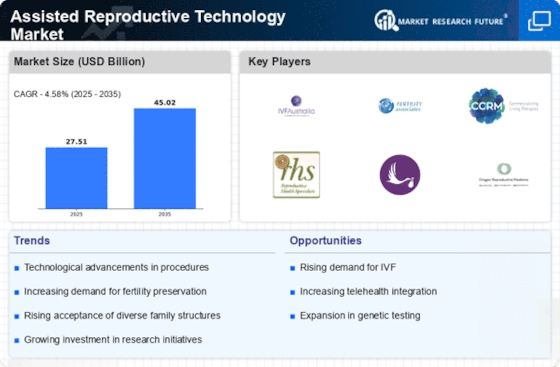
Global Assisted Reproductive Technology Market Size was valued at USD 27.51 Billion in 2024 & the market is projected to grow from USD 28.77 Billion in 2025 to USD 45.02 Billion by 2035, registering a CAGR of 4.5% during the forecast period 2025–2035. North America led the market with over 45.07% share, generating around USD 12.4 billion in revenue.
 
Rising infertility prevalence driven by lifestyle changes, delayed pregnancies, and medical conditions is a primary growth driver for the market, increasing demand for advanced fertility treatments and improving access to innovative reproductive solutions globally. 
 

  • According to WHO, infertility affects approximately 17.5% (1 in 6) adults globally, while UNFPA highlights that the average age of first childbirth has risen beyond 30 years in many countries, significantly increasing reliance on ART procedures.

Key Market Trends & Highlights

The Assisted Reproductive Technology Market is experiencing robust growth driven by technological advancements, devices and changing societal norms.

  • North America leads with 45.07% share and over 389,000 ART procedures annually, supported by advanced healthcare infrastructure. Europe reached USD 8.25 Billion with 30% share in 2024, supported by over 1 million ART cycles annually. IVF dominates with 68% share, while ICSI at 32% grows rapidly due to rising male infertility and technological advancements. Fertility clinics hold 72% share, while hospitals at 28% expand rapidly through integrated reproductive healthcare services.

Market Size & Forecast

2024 Market Size 27.51 (USD Billion)
2035 Market Size 45.02 (USD Billion)
CAGR (2025 - 2035) 4.58%
Largest Regional Market Share in 2024 North America

Major Players

Companies such as <a href="https://www.ivf.com.au/treatments/fertility-treatments" target="_blank" rel="noopener">IVF Australia</a> (AU), Fertility Associates (NZ), CCRM (US), Reproductive Health Specialists (US), New Hope Fertility Center (US), Oregon Reproductive Medicine (US), Boston IVF (US), <a href="https://www.fertilitycenter.com/">The Fertility Center</a> (US), Clinica de Fertilidad (ES) are some of the major participants in the global market.

Market Trends

The assisted reproductive technology market trends suggest that the industry is currently experiencing a notable evolution, driven by advancements in medical technology and increasing awareness of fertility issues. As societal norms shift, more individuals and couples are seeking assistance in conception, leading to a growing demand for various reproductive services.

This market encompasses a range of procedures, including in vitro fertilization, artificial insemination, and egg freezing, which are becoming more accessible and widely accepted. Furthermore, the integration of innovative technologies, such as artificial intelligence and genetic screening, is enhancing the effectiveness of these treatments, thereby attracting a broader demographic of potential clients. 

In addition to technological advancements, the Assisted Reproductive Technology Market is influenced by changing regulations and ethical considerations surrounding reproductive health. Governments and regulatory bodies are increasingly focusing on ensuring the safety and efficacy of reproductive technologies, which may lead to more standardized practices across the industry.

As public perception continues to evolve, the market is likely to see a rise in investment and research aimed at improving success rates and expanding the range of services offered. Overall, according to the market trends, the future of the market appears promising, with ongoing developments poised to reshape the landscape of reproductive health services.

Technological Advancements

The Assisted Reproductive Technology Market is witnessing rapid technological innovations that enhance treatment efficacy. Assisted reproductive technology statistics claim that such as preimplantation genetic testing and cryopreservation are becoming more refined, allowing for better selection of viable embryos and improved success rates in pregnancies. These advancements not only increase the likelihood of successful outcomes but also expand the options available to patients.

The market is advancing with innovations such as preimplantation genetic testing, improved IVF techniques, and cryopreservation. According to the Centers for Disease Control and Prevention, assisted reproductive technology accounts for about 2–3% of all births in the United States each year, highlighting the growing reliance on advanced fertility treatments.

  • According to CDC, 389,993 ART cycles were performed in the U.S. in 2021, resulting in 91,906 live births, demonstrating improved success rates. Additionally, European monitoring reports indicate over 1 million ART cycles annually, reflecting rapid adoption of advanced technologies like genetic testing and cryopreservation.

Increased Awareness and Acceptance

There is a growing societal acceptance of assisted reproductive technologies, leading to heightened awareness among individuals facing fertility challenges. As more people openly discuss their experiences and seek assistance, the stigma surrounding infertility is diminishing. This cultural shift is likely to drive demand for services within the Assisted Reproductive Technology Market.

  • WHO estimates infertility impacts 1 in 6 people globally, while UNICEF-supported programs show reproductive health awareness initiatives expanding across 100+ countries, improving early diagnosis and treatment adoption. This rising awareness significantly reduces stigma and increases the number of individuals seeking ART services worldwide.

Regulatory Developments

Assisted reproductive technology statistics claim that the landscape of the market is being shaped by evolving regulations and ethical considerations. Governments are implementing stricter guidelines to ensure patient safety and the ethical use of reproductive technologies. These regulatory changes may influence market dynamics, as providers adapt to comply with new standards while striving to maintain high-quality care.

Governments and regulatory bodies are strengthening oversight to ensure safe and ethical fertility treatments. Organizations such as the European Society of Human Reproduction and Embryology report over 1 million ART cycles performed annually in Europe, reflecting expanding clinical activity alongside evolving regulatory standards.

  • PAHO reports strengthening reproductive health policies across 35+ countries in the Americas, while UNFPA supports reproductive health programs in over 150 countries, ensuring ethical ART practices. These regulatory advancements enhance patient safety, standardize procedures, and boost confidence in assisted reproductive technologies globally.

Assisted Reproductive Technology Market Market Drivers

Changing Societal Norms

Shifting societal norms regarding family planning and reproductive choices are influencing the Assisted Reproductive Technology Market. As more individuals prioritize career and personal development before starting families, the age of first-time parents is increasing. This trend has led to a rise in infertility rates, subsequently driving demand for assisted reproductive technologies.
 
Additionally, societal acceptance of alternative family structures, such as single parenthood and same-sex couples, has broadened the market for fertility services. The changing landscape of family dynamics suggests that the market will continue to adapt, offering diverse solutions to meet the needs of various demographics. This evolution may lead to innovative service models and increased accessibility for all individuals seeking reproductive assistance.

Rising Infertility Rates

The increasing prevalence of infertility is a primary driver for the Assisted Reproductive Technology Market. Factors such as delayed childbearing, lifestyle changes, and environmental influences contribute to this trend. According to recent data, infertility affects approximately 15% of couples worldwide, leading to a heightened demand for assisted reproductive technologies.
 
This growing need for solutions has prompted healthcare providers to expand their offerings, thereby stimulating market growth. As more individuals seek assistance in conceiving, the market is likely to experience significant expansion, with projections indicating a compound annual growth rate of over 10% in the coming years. This trend underscores the urgency for innovative treatments and services within the sector.

Technological Innovations

Technological advancements play a crucial role in shaping the Assisted Reproductive Technology Market. Innovations such as preimplantation genetic testing, cryopreservation techniques, and artificial intelligence in embryo selection are revolutionizing the field. These technologies enhance the success rates of procedures like in vitro fertilization (IVF), making them more accessible and effective for patients.
 
For instance, the introduction of time-lapse imaging has improved embryo monitoring, leading to better outcomes. As these technologies continue to evolve, they are expected to drive market growth by attracting more patients seeking effective reproductive solutions. The integration of cutting-edge technology not only enhances the efficiency of treatments but also fosters a competitive landscape among service providers in the market.

Regulatory Support and Policy Changes

Regulatory support and favorable policy changes are pivotal in shaping the Assisted Reproductive Technology Market. Governments are increasingly recognizing the importance of reproductive health and are implementing policies that promote access to fertility treatments. This includes funding for assisted reproductive technologies and the establishment of guidelines to ensure safety and efficacy.
 
Recent legislative changes in several regions have expanded insurance coverage for fertility treatments, making them more affordable for patients. Such regulatory frameworks not only enhance the accessibility of services but also encourage investment in the sector. As policies continue to evolve, the market is likely to benefit from increased participation and innovation, ultimately improving patient outcomes.

Increased Investment in Fertility Clinics

The surge in investment in fertility clinics is a significant driver of the Assisted Reproductive Technology Market. As awareness of infertility issues rises, private and public sectors are channeling funds into establishing and expanding fertility centers. This influx of capital enables clinics to adopt advanced technologies and improve patient care.
 
Recent statistics indicate that the number of fertility clinics has increased by over 20% in the last five years, reflecting the growing demand for assisted reproductive services. Furthermore, partnerships between clinics and technology firms are becoming more common, enhancing service offerings. This trend is likely to continue, as the market evolves to meet the needs of an expanding patient base.

Market Segment Insights

By Procedure Type: In Vitro Fertilization (Largest) vs. Intracytoplasmic Sperm Injection (Fastest-Growing)

The Procedure Type segment in the market is primarily dominated by in vitro fertilization (IVF), which commands a substantial 68% share in the assisted reproductive technology market. IVF stands out as the preferred method for couples seeking fertility assistance, accounting for a significant portion of procedures performed. In contrast, Assisted reproductive technology statistics suggest that Intracytoplasmic Sperm Injection (ICSI) is rapidly gaining traction, particularly among couples facing male factor infertility, making it one of the fastest-growing procedures in the market.

In Vitro Fertilization: Dominant vs. Intracytoplasmic Sperm Injection: Emerging

In Vitro Fertilization (IVF) remains the dominant procedure in the market. It offers a comprehensive solution for various infertility issues, combining advanced technology with effective treatment protocols. The growing preference for IVF can be attributed to its high success rates and the ability to handle complex cases. On the other hand, Intracytoplasmic Sperm Injection (ICSI) is emerging rapidly due to its specialized approach in directly injecting sperm into the egg, which significantly enhances the chances of fertilization. As awareness of male infertility issues increases, ICSI is expected to see heightened adoption, establishing itself as a key player alongside IVF in the market.

By End User: Fertility Clinics (Largest) vs. Hospitals (Fastest-Growing)

The end-user segment is primarily dominated by fertility clinics, which hold the largest share in the assisted reproductive technology market at 72% due to their specialized services. These clinics provide comprehensive reproductive health services, making them a preferred choice for couples seeking assisted reproduction. In contrast, hospitals are emerging as significant players in this market, as they increasingly offer reproductive health options and integrate assisted reproductive technologies into their services, thus elevating their standing in the market.

Fertility Clinics (Dominant) vs. Hospitals (Emerging)

Fertility clinics are at the forefront of the market, providing focused, personalized services that cater specifically to individuals facing fertility challenges. Their specialized nature allows them to offer advanced procedures like IVF and ICSI, attracting a wide clientele seeking targeted reproductive solutions. On the other hand, hospitals are recognizing the growing demand for assisted reproductive services and are investing in these technologies, thus becoming an emerging contender in the market. They benefit from our established health frameworks, offering comprehensive medical care alongside reproductive services, which is appealing to patients looking for integrated solutions.

By Technology: Cryopreservation (Largest) vs. Assisted Hatching (Fastest-Growing)

In the Assisted Reproductive Technology Market, the distribution of market share across the technology segment reveals cryopreservation as the largest contributor, accounting for a 41% share. This method of preserving embryos has seen widespread adoption due to its effectiveness in enabling better outcomes for patients undergoing fertility treatments. Close competitors, including Preimplantation Genetic Diagnosis and Assisted Hatching, also play significant roles, but their market shares are comparatively smaller. As the reproductive landscape evolves, these techniques continue to solidify their positions within the market, catering to various patient needs and preferences. Growth trends for the technology segment in market are primarily driven by increased awareness and advances in fertility treatments. Factors such as rising infertility rates and changing societal norms surrounding family planning are propelling the demand for innovative reproductive technologies. Furthermore, continuous investments in research and development help in enhancing the efficacy of existing procedures, which contributes to the rapid growth of emerging techniques like Assisted Hatching, currently positioning itself as a key driver in the market as it gains broader acceptance among fertility specialists.

Cryopreservation: Dominant vs. Assisted Hatching: Emerging

Cryopreservation has emerged as the dominant technology in the market, valued for its capability to freeze and store embryos, thereby facilitating future fertility treatments. Its advantages include preserving the viability of embryos over extended periods and allowing for the synchronization of treatment cycles, enhancing the chances of successful pregnancies. On the other hand, Assisted Hatching is viewed as an emerging technology that is gaining traction for its innovative approach in improving embryo implantation rates. This technique involves creating a small opening in the protective shell of the embryo, which can enhance the hatching process. As fertility specialists look to improve success rates further, both these technologies play crucial roles, with Cryopreservation maintaining its significant hold while Assisted Hatching steadily garners attention for its potential benefits.

By Product Type: Reagents (Largest) vs. Equipment (Fastest-Growing)

The distribution of product types reveals that reagents hold the largest share in the assisted reproductive technology market at 54%, underscoring their essential role in procedures such as in vitro fertilization (IVF) and artificial insemination, which also drive market growth. Consumables also contribute significantly to the market, while equipment, though smaller in market share, is becoming increasingly critical as technology advances. Growth trends within this segment are primarily driven by rising fertility rates and increased awareness regarding reproductive health. The equipment segment, in particular, is experiencing rapid growth due to innovations in technology, enhancing procedure success rates and efficiency. The demand for high-quality reagents and consumables continues to climb as ART procedures become widespread and more accessible.

Reagents (Dominant) vs. Equipment (Emerging)

Assisted reproductive technology notes point toward the fact that Reagents, as the dominant segment in the market, play a pivotal role in various reproductive procedures, providing the necessary biochemical components for successful fertilization and embryo development. Their critical nature is matched by a wide variety of options, catering to different procedural requirements. In contrast, the equipment segment is emerging as a crucial driver of market growth due to technological advancements that are improving clinical outcomes in ART. Emerging equipment includes advanced imaging systems and embryo culture devices, which are significantly enhancing precision in ART practices. This dual landscape of reagents and equipment positions the ART market on a path of continuous innovation and expansion, catering to the evolving needs of healthcare providers and patients alike.

Get more detailed insights about Assisted Reproductive Technology Market Research Report - Forecast to 2035

Regional Insights

North America : Leading Innovation and Access

North America leads in the Assisted Reproductive Technology Market Size, accounting for over 45.07% of the global revenue in 2024. The region benefits from advanced healthcare infrastructure, high disposable incomes, and increasing awareness of fertility treatments. Regulatory support, such as the FDA's guidelines on ART practices, further drives market growth.

  • CDC data shows ART contributes to approximately 2.3% of total U.S. births, with over 389,000 procedures annually, while NIH highlights continuous multi-billion-dollar investments in reproductive health research, strengthening innovation and maintaining North America's leadership in ART adoption.

The demand for ART is also fueled by rising infertility rates and changing societal norms regarding family planning. The United States is the primary player in this market, with a significant concentration of leading fertility clinics and specialists. Key players include CCRM, New Hope Fertility Center, and Boston IVF, which offer a range of ART services.

Assisted reproductive technology Canada also plays a vital role, with a growing number of clinics and supportive government policies. The competitive landscape is characterized by innovation and collaboration among healthcare providers, ensuring high-quality services for patients.

Europe : Regulatory Framework and Growth

Europe Assisted Reproductive Technology Market size was valued at USD 8.25 Billion in 2024, making it the second-largest regional market with a 30% share. The region's growth is driven by increasing infertility rates, advancements in reproductive technologies, and supportive regulatory frameworks.

  • European IVF monitoring data indicates more than 1 million ART cycles annually, while WHO Europe reports increasing maternal age exceeding 30–32 years on average, contributing to infertility trends and accelerating demand for assisted reproductive technologies across the region.

Countries like Spain and assisted reproductive technology UK are at the forefront, with regulations that promote ethical practices in ART. The European Society of Human Reproduction and Embryology (ESHRE) plays a crucial role in setting standards and guidelines that enhance patient safety and treatment efficacy.

Leading countries in Europe include Spain, the UK, and Germany, where numerous fertility clinics are established. Spain, in particular, has become a hub for international patients seeking ART services due to its favorable regulations and high success rates. Key players such as Clinica de Fertilidad and various UK-based clinics contribute to a competitive landscape that prioritizes patient care and innovative treatments.

Asia-Pacific : Rapid Growth and Adoption

Asia-Pacific is witnessing rapid growth in the Assisted Reproductive Technology Market, accounting for approximately 20% of the global share. The region's growth is driven by increasing awareness of fertility issues, rising disposable incomes, and advancements in medical technology. Assisted reproductive technology Australia and New Zealand lead the market, supported by favorable regulations and a growing acceptance of ART among the population.

The demand for ART services is further fueled by changing family structures and delayed parenthood trends. Assisted reproductive technology in Australia proves to be a key contributing factor, with established clinics like IVF Australia and Fertility Associates leading the way. New Zealand also shows significant growth potential, with increasing investments in reproductive health services. Assisted reproductive technology in India are also gaining momentum due to the developing healthcare infrastructure in the country.

Along with assisted reproductive technology India, assisted reproductive technology Singapore and assisted reproductive technology in Malaysia are also emerging as notable contributors, augmenting the regional market. The competitive landscape is characterized by a mix of local and international players, all striving to provide innovative solutions to meet the rising demand for ART services.

Middle East and Africa : Emerging Market with Potential

The Middle East and Africa region is gradually emerging in the market, holding about 5% of the global share. The growth is driven by increasing awareness of infertility issues, rising healthcare investments, and a growing number of fertility clinics. Countries like South Africa and the UAE are leading the way, with supportive government policies and a rising demand for ART services. The region's unique cultural dynamics also play a role in shaping the market, as more individuals seek fertility treatments.

South Africa is a key player, with several established clinics offering a range of ART services. The UAE is also witnessing a surge in demand, with investments in advanced reproductive technologies. The competitive landscape is evolving, with both local and international players entering the market to cater to the growing needs of patients seeking ART solutions.

Key Players and Competitive Insights

The Assisted Reproductive Technology Market is currently characterized by a dynamic competitive landscape, driven by increasing demand for fertility treatments and advancements in reproductive technologies. Key players such as IVF Australia (AU), CCRM (US), and New Hope Fertility Center (US) are strategically positioning themselves through innovation and regional expansion. IVF Australia (AU) focuses on enhancing patient experience through personalized treatment plans, while CCRM (US) emphasizes cutting-edge research and technology integration to improve success rates. New Hope Fertility Center (US) is notable for its commitment to sustainable practices and affordability, which collectively shape a competitive environment that prioritizes patient-centric solutions and technological advancements.
 
The market exhibits a moderately fragmented structure, with numerous players competing for market share. Key business tactics include localizing manufacturing and optimizing supply chains to enhance service delivery. The collective influence of these major players fosters a competitive atmosphere where innovation and operational efficiency are paramount. As companies strive to differentiate themselves, the focus on patient outcomes and technological integration becomes increasingly critical. 
 
In August 2025, CCRM (US) announced a partnership with a leading biotechnology firm to develop next-generation genetic screening technologies. This strategic move is expected to enhance their service offerings, allowing for more precise embryo selection and improved success rates in IVF procedures. Such advancements not only bolster CCRM's competitive edge but also reflect a broader trend towards personalized medicine in the ART sector. 
 
In September 2025, New Hope Fertility Center (US) launched a new initiative aimed at reducing the costs associated with fertility treatments through innovative financing options. This initiative is significant as it addresses the financial barriers many patients face, potentially increasing access to ART services. By prioritizing affordability, New Hope Fertility Center positions itself as a leader in patient advocacy within the market. 
 
In October 2025, IVF Australia (AU) unveiled a digital platform designed to streamline patient interactions and enhance the overall treatment experience. This platform integrates telehealth services, allowing patients to consult with specialists remotely. The introduction of such technology not only improves patient engagement but also reflects the growing trend of digital transformation within the market, where convenience and accessibility are becoming essential. 
 
As of October 2025, the market is witnessing trends such as digitalization, sustainability, and the integration of artificial intelligence. Strategic alliances among key players are increasingly shaping the competitive landscape, fostering innovation and collaboration. Looking ahead, it appears that competitive differentiation will evolve from traditional price-based competition to a focus on technological innovation, patient-centric solutions, and supply chain reliability. This shift suggests that companies that prioritize these aspects will likely emerge as leaders in the market.

Key Companies in the Assisted Reproductive Technology Market include

Industry Developments

The Assisted Reproductive Technology Market has seen significant developments recently. Anova Fertility, known for its innovative approaches, continues to expand its service offerings, while Boston IVF has recently integrated new techniques that enhance patient care.

Ferring Pharmaceuticals has been actively investing in Research and Development to advance hormonal treatments, which is reshaping protocols within the sector. Meanwhile, IVF America has been acquiring smaller clinics, reinforcing its position in the market. In significant mergers, CooperSurgical acquired a major asset in June 2023 that enhances its portfolio of reproductive health products.

Companies like Reproductive Medicine Associates of New Jersey have expanded their reach internationally, indicating growth in market valuation and increasing demand for ART services. In addition, advancements in Preimplantation Genetic Diagnosis are becoming more widespread, allowing for improved screening processes. IVF clinics are realizing substantial growth, with Vitrolife reporting a marked increase in revenue attributed to the rising number of patients seeking fertility treatments worldwide.

Future Outlook

Assisted Reproductive Technology Market Future Outlook

The Assisted Reproductive Technology Market size is projected to reach USD 45.02 Billion by 2035, growing at a CAGR of 4.5%, driven by technological advancements, increasing infertility rates, and rising awareness.

New opportunities lie in:

  • <p>Expansion of telehealth services for remote consultations Development of personalized fertility treatment plans Investment in AI-driven embryo selection technologies</p>

By 2035, the market is expected to be robust, driven by innovation and increased accessibility.

Market Segmentation

Assisted Reproductive Technology Market End User Outlook

  • Fertility Clinics
  • Hospitals
  • Home Care

Assisted Reproductive Technology Market Technology Outlook

  • Cryopreservation
  • Preimplantation Genetic Diagnosis
  • Assisted Hatching

Assisted Reproductive Technology Market Product Type Outlook

  • Reagents
  • Consumables
  • Equipment

Assisted Reproductive Technology Market Procedure Type Outlook

  • In Vitro Fertilization
  • Intracytoplasmic Sperm Injection
  • Frozen Embryo Transfer
  • Egg Donation
  • Sperm Donation

Report Scope

MARKET SIZE 2024 27.51(USD Billion)
MARKET SIZE 2025 28.77(USD Billion)
MARKET SIZE 2035 45.02(USD Billion)
COMPOUND ANNUAL GROWTH RATE (CAGR) 4.58% (2025 - 2035)
REPORT COVERAGE Revenue Forecast, Competitive Landscape, Growth Factors, and Trends
BASE YEAR 2024
Market Forecast Period 2025 - 2035
Historical Data 2019 - 2024
Market Forecast Units USD Billion
Key Companies Profiled IVF Australia (AU), Fertility Associates (NZ), CCRM (US), Reproductive Health Specialists (US), New Hope Fertility Center (US), Oregon Reproductive Medicine (US), Boston IVF (US), The Fertility Center (US), Clinica de Fertilidad (ES)
Segments Covered Procedure Type, End Users, Technology, Product Type, Regional
Key Market Opportunities Integration of artificial intelligence in embryo selection enhances success rates in the market.
Key Market Dynamics Technological advancements and regulatory changes are reshaping the competitive landscape of the market.
Countries Covered North America, Europe, APAC, South America, MEA

FAQs

What is the current valuation of the Assisted Reproductive Technology Market?

<p>The market valuation reached 27.51 USD Billion in 2024.</p>

What is the projected market size for the Assisted Reproductive Technology Market by 2035?

<p>The market is expected to grow to 45.02 USD Billion by 2035.</p>

What is the expected CAGR for the Assisted Reproductive Technology Market from 2025 to 2035?

<p>The market is projected to experience a CAGR of 4.58% during the forecast period.</p>

Which procedure type holds the largest market share in the Assisted Reproductive Technology sector?

<p>In Vitro Fertilization is anticipated to dominate with a valuation range of 10.0 to 16.0 USD Billion.</p>

How do fertility clinics compare to hospitals in terms of market valuation?

<p>Fertility clinics are projected to generate 10.0 to 16.0 USD Billion, while hospitals are expected to reach 9.0 to 14.0 USD Billion.</p>

What are the key technologies driving growth in the Assisted Reproductive Technology Market?

<p>Cryopreservation, with a projected valuation of 10.0 to 16.0 USD Billion, is among the leading technologies.</p>

Which companies are considered key players in the Assisted Reproductive Technology Market?

<p>Key players include IVF Australia, Fertility Associates, and CCRM, among others.</p>

What is the expected market performance for egg donation services?

<p>Egg donation services are projected to generate between 3.0 and 5.0 USD Billion.</p>

How does the market for assisted hatching technology compare to other technologies?

<p>Assisted hatching is expected to reach a valuation of 9.51 to 17.02 USD Billion, indicating strong growth.</p>

What is the anticipated market size for consumables in the Assisted Reproductive Technology sector?

<p>Consumables are projected to generate between 10.0 and 16.0 USD Billion, reflecting their critical role in the market.</p>

  1. SECTION I: EXECUTIVE SUMMARY AND KEY HIGHLIGHTS |
    1. EXECUTIVE SUMMARY | |
      1. Market Overview | |
      2. Key Findings | |
      3. Market Segmentation | |
      4. Competitive Landscape | |
      5. Challenges and Opportunities | |
      6. Future Outlook 2
  2. SECTION II: SCOPING, METHODOLOGY AND MARKET STRUCTURE |
    1. MARKET INTRODUCTION | |
      1. Definition | |
      2. Scope of the study | | |
    2. RESEARCH METHODOLOGY | |
      1. Overview | |
      2. Data Mining | |
      3. Secondary Research | |
      4. Primary Research | | |
      5. Forecasting Model | |
      6. Market Size Estimation | | |
      7. Data Triangulation | |
      8. Validation 3
  3. SECTION III: QUALITATIVE ANALYSIS |
    1. MARKET DYNAMICS | |
      1. Overview | |
      2. Drivers | |
      3. Restraints | |
      4. Opportunities |
    2. MARKET FACTOR ANALYSIS | |
      1. Value chain Analysis | |
      2. Porter's Five Forces Analysis | | |
      3. COVID-19 Impact Analysis | | |
  4. SECTION IV: QUANTITATIVE ANALYSIS |
    1. Healthcare, BY Procedure Type (USD Billion) | |
      1. In Vitro Fertilization | |
      2. Intracytoplasmic Sperm Injection | |
      3. Frozen Embryo Transfer | |
      4. Egg Donation | |
      5. Sperm Donation |
    2. Healthcare, BY End User (USD Billion) | |
      1. Fertility Clinics | |
      2. Hospitals | |
      3. Home Care |
    3. Healthcare, BY Technology (USD Billion) | |
      1. Cryopreservation | |
      2. Preimplantation Genetic Diagnosis | |
      3. Assisted Hatching |
    4. Healthcare, BY Product Type (USD Billion) | |
      1. Reagents | |
      2. Consumables | |
      3. Equipment |
    5. Healthcare, BY Region (USD Billion) | |
      1. North America | | |
      2. Europe | | |
      3. APAC | | |
      4. South America | | |
      5. MEA | | |
  5. SECTION V: COMPETITIVE ANALYSIS |
    1. Competitive Landscape | |
      1. Overview | |
      2. Competitive Analysis | |
      3. Market share Analysis | |
      4. Major Growth Strategy in the Healthcare | |
      5. Competitive Benchmarking | |
      6. Leading Players in Terms of Number of Developments in the Healthcare | |
      7. Key developments and growth strategies | | |
      8. Major Players Financial Matrix | | |
    2. Company Profiles | |
      1. IVF Australia (AU) | | |
      2. Fertility Associates (NZ) | | |
      3. CCRM (US) | | |
      4. Reproductive Health Specialists (US) | | |
      5. New Hope Fertility Center (US) | | |
      6. Oregon Reproductive Medicine (US) | | |
      7. Boston IVF (US) | | |
      8. The Fertility Center (US) | | |
      9. Clinica de Fertilidad (ES) | | |
    3. Appendix | |
      1. References | |
      2. Related Reports 6 LIST OF FIGURES |
    4. MARKET SYNOPSIS |
    5. NORTH AMERICA MARKET ANALYSIS |
    6. US MARKET ANALYSIS BY PROCEDURE TYPE |
    7. US MARKET ANALYSIS BY END USER |
    8. US MARKET ANALYSIS BY TECHNOLOGY |
    9. US MARKET ANALYSIS BY PRODUCT TYPE |
    10. CANADA MARKET ANALYSIS BY PROCEDURE TYPE |
    11. CANADA MARKET ANALYSIS BY END USER |
    12. CANADA MARKET ANALYSIS BY TECHNOLOGY |
    13. CANADA MARKET ANALYSIS BY PRODUCT TYPE |
    14. EUROPE MARKET ANALYSIS |
    15. GERMANY MARKET ANALYSIS BY PROCEDURE TYPE |
    16. GERMANY MARKET ANALYSIS BY END USER |
    17. GERMANY MARKET ANALYSIS BY TECHNOLOGY |
    18. GERMANY MARKET ANALYSIS BY PRODUCT TYPE |
    19. UK MARKET ANALYSIS BY PROCEDURE TYPE |
    20. UK MARKET ANALYSIS BY END USER |
    21. UK MARKET ANALYSIS BY TECHNOLOGY |
    22. UK MARKET ANALYSIS BY PRODUCT TYPE |
    23. FRANCE MARKET ANALYSIS BY PROCEDURE TYPE |
    24. FRANCE MARKET ANALYSIS BY END USER |
    25. FRANCE MARKET ANALYSIS BY TECHNOLOGY |
    26. FRANCE MARKET ANALYSIS BY PRODUCT TYPE |
    27. RUSSIA MARKET ANALYSIS BY PROCEDURE TYPE |
    28. RUSSIA MARKET ANALYSIS BY END USER |
    29. RUSSIA MARKET ANALYSIS BY TECHNOLOGY |
    30. RUSSIA MARKET ANALYSIS BY PRODUCT TYPE |
    31. ITALY MARKET ANALYSIS BY PROCEDURE TYPE |
    32. ITALY MARKET ANALYSIS BY END USER |
    33. ITALY MARKET ANALYSIS BY TECHNOLOGY |
    34. ITALY MARKET ANALYSIS BY PRODUCT TYPE |
    35. SPAIN MARKET ANALYSIS BY PROCEDURE TYPE |
    36. SPAIN MARKET ANALYSIS BY END USER |
    37. SPAIN MARKET ANALYSIS BY TECHNOLOGY |
    38. SPAIN MARKET ANALYSIS BY PRODUCT TYPE |
    39. REST OF EUROPE MARKET ANALYSIS BY PROCEDURE TYPE |
    40. REST OF EUROPE MARKET ANALYSIS BY END USER |
    41. REST OF EUROPE MARKET ANALYSIS BY TECHNOLOGY |
    42. REST OF EUROPE MARKET ANALYSIS BY PRODUCT TYPE |
    43. APAC MARKET ANALYSIS |
    44. CHINA MARKET ANALYSIS BY PROCEDURE TYPE |
    45. CHINA MARKET ANALYSIS BY END USER |
    46. CHINA MARKET ANALYSIS BY TECHNOLOGY |
    47. CHINA MARKET ANALYSIS BY PRODUCT TYPE |
    48. INDIA MARKET ANALYSIS BY PROCEDURE TYPE |
    49. INDIA MARKET ANALYSIS BY END USER |
    50. INDIA MARKET ANALYSIS BY TECHNOLOGY |
    51. INDIA MARKET ANALYSIS BY PRODUCT TYPE |
    52. JAPAN MARKET ANALYSIS BY PROCEDURE TYPE |
    53. JAPAN MARKET ANALYSIS BY END USER |
    54. JAPAN MARKET ANALYSIS BY TECHNOLOGY |
    55. JAPAN MARKET ANALYSIS BY PRODUCT TYPE |
    56. SOUTH KOREA MARKET ANALYSIS BY PROCEDURE TYPE |
    57. SOUTH KOREA MARKET ANALYSIS BY END USER |
    58. SOUTH KOREA MARKET ANALYSIS BY TECHNOLOGY |
    59. SOUTH KOREA MARKET ANALYSIS BY PRODUCT TYPE |
    60. MALAYSIA MARKET ANALYSIS BY PROCEDURE TYPE |
    61. MALAYSIA MARKET ANALYSIS BY END USER |
    62. MALAYSIA MARKET ANALYSIS BY TECHNOLOGY |
    63. MALAYSIA MARKET ANALYSIS BY PRODUCT TYPE |
    64. THAILAND MARKET ANALYSIS BY PROCEDURE TYPE |
    65. THAILAND MARKET ANALYSIS BY END USER |
    66. THAILAND MARKET ANALYSIS BY TECHNOLOGY |
    67. THAILAND MARKET ANALYSIS BY PRODUCT TYPE |
    68. INDONESIA MARKET ANALYSIS BY PROCEDURE TYPE |
    69. INDONESIA MARKET ANALYSIS BY END USER |
    70. INDONESIA MARKET ANALYSIS BY TECHNOLOGY |
    71. INDONESIA MARKET ANALYSIS BY PRODUCT TYPE |
    72. REST OF APAC MARKET ANALYSIS BY PROCEDURE TYPE |
    73. REST OF APAC MARKET ANALYSIS BY END USER |
    74. REST OF APAC MARKET ANALYSIS BY TECHNOLOGY |
    75. REST OF APAC MARKET ANALYSIS BY PRODUCT TYPE |
    76. SOUTH AMERICA MARKET ANALYSIS |
    77. BRAZIL MARKET ANALYSIS BY PROCEDURE TYPE |
    78. BRAZIL MARKET ANALYSIS BY END USER |
    79. BRAZIL MARKET ANALYSIS BY TECHNOLOGY |
    80. BRAZIL MARKET ANALYSIS BY PRODUCT TYPE |
    81. MEXICO MARKET ANALYSIS BY PROCEDURE TYPE |
    82. MEXICO MARKET ANALYSIS BY END USER |
    83. MEXICO MARKET ANALYSIS BY TECHNOLOGY |
    84. MEXICO MARKET ANALYSIS BY PRODUCT TYPE |
    85. ARGENTINA MARKET ANALYSIS BY PROCEDURE TYPE |
    86. ARGENTINA MARKET ANALYSIS BY END USER |
    87. ARGENTINA MARKET ANALYSIS BY TECHNOLOGY |
    88. ARGENTINA MARKET ANALYSIS BY PRODUCT TYPE |
    89. REST OF SOUTH AMERICA MARKET ANALYSIS BY PROCEDURE TYPE |
    90. REST OF SOUTH AMERICA MARKET ANALYSIS BY END USER |
    91. REST OF SOUTH AMERICA MARKET ANALYSIS BY TECHNOLOGY |
    92. REST OF SOUTH AMERICA MARKET ANALYSIS BY PRODUCT TYPE |
    93. MEA MARKET ANALYSIS |
    94. GCC COUNTRIES MARKET ANALYSIS BY PROCEDURE TYPE |
    95. GCC COUNTRIES MARKET ANALYSIS BY END USER |
    96. GCC COUNTRIES MARKET ANALYSIS BY TECHNOLOGY |
    97. GCC COUNTRIES MARKET ANALYSIS BY PRODUCT TYPE |
    98. SOUTH AFRICA MARKET ANALYSIS BY PROCEDURE TYPE |
    99. SOUTH AFRICA MARKET ANALYSIS BY END USER |
    100. SOUTH AFRICA MARKET ANALYSIS BY TECHNOLOGY |
    101. SOUTH AFRICA MARKET ANALYSIS BY PRODUCT TYPE |
    102. REST OF MEA MARKET ANALYSIS BY PROCEDURE TYPE |
    103. REST OF MEA MARKET ANALYSIS BY END USER |
    104. REST OF MEA MARKET ANALYSIS BY TECHNOLOGY |
    105. REST OF MEA MARKET ANALYSIS BY PRODUCT TYPE |
    106. KEY BUYING CRITERIA OF HEALTHCARE |
    107. RESEARCH PROCESS OF MRFR |
    108. DRO ANALYSIS OF HEALTHCARE |
    109. DRIVERS IMPACT ANALYSIS: HEALTHCARE |
    110. RESTRAINTS IMPACT ANALYSIS: HEALTHCARE |
    111. SUPPLY / VALUE CHAIN: HEALTHCARE |
    112. HEALTHCARE, BY PROCEDURE TYPE, 2024 (% SHARE) |
    113. HEALTHCARE, BY PROCEDURE TYPE, 2024 TO 2035 (USD Billion) |
    114. HEALTHCARE, BY END USER, 2024 (% SHARE) |
    115. HEALTHCARE, BY END USER, 2024 TO 2035 (USD Billion) |
    116. HEALTHCARE, BY TECHNOLOGY, 2024 (% SHARE) |
    117. HEALTHCARE, BY TECHNOLOGY, 2024 TO 2035 (USD Billion) |
    118. HEALTHCARE, BY PRODUCT TYPE, 2024 (% SHARE) |
    119. HEALTHCARE, BY PRODUCT TYPE, 2024 TO 2035 (USD Billion) |
    120. BENCHMARKING OF MAJOR COMPETITORS 7 LIST OF TABLES |
    121. LIST OF ASSUMPTIONS | |
      1. |
    122. North America MARKET SIZE ESTIMATES; FORECAST | |
      1. BY PROCEDURE TYPE, 2025-2035 (USD Billion) | |
      2. BY END USER, 2025-2035 (USD Billion) | |
      3. BY TECHNOLOGY, 2025-2035 (USD Billion) | |
      4. BY PRODUCT TYPE, 2025-2035 (USD Billion) |
    123. US MARKET SIZE ESTIMATES; FORECAST | |
      1. BY PROCEDURE TYPE, 2025-2035 (USD Billion) | |
      2. BY END USER, 2025-2035 (USD Billion) | |
      3. BY TECHNOLOGY, 2025-2035 (USD Billion) | |
      4. BY PRODUCT TYPE, 2025-2035 (USD Billion) |
    124. Canada MARKET SIZE ESTIMATES; FORECAST | |
      1. BY PROCEDURE TYPE, 2025-2035 (USD Billion) | |
      2. BY END USER, 2025-2035 (USD Billion) | |
      3. BY TECHNOLOGY, 2025-2035 (USD Billion) | |
      4. BY PRODUCT TYPE, 2025-2035 (USD Billion) |
    125. Europe MARKET SIZE ESTIMATES; FORECAST | |
      1. BY PROCEDURE TYPE, 2025-2035 (USD Billion) | |
      2. BY END USER, 2025-2035 (USD Billion) | |
      3. BY TECHNOLOGY, 2025-2035 (USD Billion) | |
      4. BY PRODUCT TYPE, 2025-2035 (USD Billion) |
    126. Germany MARKET SIZE ESTIMATES; FORECAST | |
      1. BY PROCEDURE TYPE, 2025-2035 (USD Billion) | |
      2. BY END USER, 2025-2035 (USD Billion) | |
      3. BY TECHNOLOGY, 2025-2035 (USD Billion) | |
      4. BY PRODUCT TYPE, 2025-2035 (USD Billion) |
    127. UK MARKET SIZE ESTIMATES; FORECAST | |
      1. BY PROCEDURE TYPE, 2025-2035 (USD Billion) | |
      2. BY END USER, 2025-2035 (USD Billion) | |
      3. BY TECHNOLOGY, 2025-2035 (USD Billion) | |
      4. BY PRODUCT TYPE, 2025-2035 (USD Billion) |
    128. France MARKET SIZE ESTIMATES; FORECAST | |
      1. BY PROCEDURE TYPE, 2025-2035 (USD Billion) | |
      2. BY END USER, 2025-2035 (USD Billion) | |
      3. BY TECHNOLOGY, 2025-2035 (USD Billion) | |
      4. BY PRODUCT TYPE, 2025-2035 (USD Billion) |
    129. Russia MARKET SIZE ESTIMATES; FORECAST | |
      1. BY PROCEDURE TYPE, 2025-2035 (USD Billion) | |
      2. BY END USER, 2025-2035 (USD Billion) | |
      3. BY TECHNOLOGY, 2025-2035 (USD Billion) | |
      4. BY PRODUCT TYPE, 2025-2035 (USD Billion) |
    130. Italy MARKET SIZE ESTIMATES; FORECAST | |
      1. BY PROCEDURE TYPE, 2025-2035 (USD Billion) | |
      2. BY END USER, 2025-2035 (USD Billion) | |
      3. BY TECHNOLOGY, 2025-2035 (USD Billion) | |
      4. BY PRODUCT TYPE, 2025-2035 (USD Billion) |
    131. Spain MARKET SIZE ESTIMATES; FORECAST | |
      1. BY PROCEDURE TYPE, 2025-2035 (USD Billion) | |
      2. BY END USER, 2025-2035 (USD Billion) | |
      3. BY TECHNOLOGY, 2025-2035 (USD Billion) | |
      4. BY PRODUCT TYPE, 2025-2035 (USD Billion) |
    132. Rest of Europe MARKET SIZE ESTIMATES; FORECAST | |
      1. BY PROCEDURE TYPE, 2025-2035 (USD Billion) | |
      2. BY END USER, 2025-2035 (USD Billion) | |
      3. BY TECHNOLOGY, 2025-2035 (USD Billion) | |
      4. BY PRODUCT TYPE, 2025-2035 (USD Billion) |
    133. APAC MARKET SIZE ESTIMATES; FORECAST | |
      1. BY PROCEDURE TYPE, 2025-2035 (USD Billion) | |
      2. BY END USER, 2025-2035 (USD Billion) | |
      3. BY TECHNOLOGY, 2025-2035 (USD Billion) | |
      4. BY PRODUCT TYPE, 2025-2035 (USD Billion) |
    134. China MARKET SIZE ESTIMATES; FORECAST | |
      1. BY PROCEDURE TYPE, 2025-2035 (USD Billion) | |
      2. BY END USER, 2025-2035 (USD Billion) | |
      3. BY TECHNOLOGY, 2025-2035 (USD Billion) | |
      4. BY PRODUCT TYPE, 2025-2035 (USD Billion) |
    135. India MARKET SIZE ESTIMATES; FORECAST | |
      1. BY PROCEDURE TYPE, 2025-2035 (USD Billion) | |
      2. BY END USER, 2025-2035 (USD Billion) | |
      3. BY TECHNOLOGY, 2025-2035 (USD Billion) | |
      4. BY PRODUCT TYPE, 2025-2035 (USD Billion) |
    136. Japan MARKET SIZE ESTIMATES; FORECAST | |
      1. BY PROCEDURE TYPE, 2025-2035 (USD Billion) | |
      2. BY END USER, 2025-2035 (USD Billion) | |
      3. BY TECHNOLOGY, 2025-2035 (USD Billion) | |
      4. BY PRODUCT TYPE, 2025-2035 (USD Billion) |
    137. South Korea MARKET SIZE ESTIMATES; FORECAST | |
      1. BY PROCEDURE TYPE, 2025-2035 (USD Billion) | |
      2. BY END USER, 2025-2035 (USD Billion) | |
      3. BY TECHNOLOGY, 2025-2035 (USD Billion) | |
      4. BY PRODUCT TYPE, 2025-2035 (USD Billion) |
    138. Malaysia MARKET SIZE ESTIMATES; FORECAST | |
      1. BY PROCEDURE TYPE, 2025-2035 (USD Billion) | |
      2. BY END USER, 2025-2035 (USD Billion) | |
      3. BY TECHNOLOGY, 2025-2035 (USD Billion) | |
      4. BY PRODUCT TYPE, 2025-2035 (USD Billion) |
    139. Thailand MARKET SIZE ESTIMATES; FORECAST | |
      1. BY PROCEDURE TYPE, 2025-2035 (USD Billion) | |
      2. BY END USER, 2025-2035 (USD Billion) | |
      3. BY TECHNOLOGY, 2025-2035 (USD Billion) | |
      4. BY PRODUCT TYPE, 2025-2035 (USD Billion) |
    140. Indonesia MARKET SIZE ESTIMATES; FORECAST | |
      1. BY PROCEDURE TYPE, 2025-2035 (USD Billion) | |
      2. BY END USER, 2025-2035 (USD Billion) | |
      3. BY TECHNOLOGY, 2025-2035 (USD Billion) | |
      4. BY PRODUCT TYPE, 2025-2035 (USD Billion) |
    141. Rest of APAC MARKET SIZE ESTIMATES; FORECAST | |
      1. BY PROCEDURE TYPE, 2025-2035 (USD Billion) | |
      2. BY END USER, 2025-2035 (USD Billion) | |
      3. BY TECHNOLOGY, 2025-2035 (USD Billion) | |
      4. BY PRODUCT TYPE, 2025-2035 (USD Billion) |
    142. South America MARKET SIZE ESTIMATES; FORECAST | |
      1. BY PROCEDURE TYPE, 2025-2035 (USD Billion) | |
      2. BY END USER, 2025-2035 (USD Billion) | |
      3. BY TECHNOLOGY, 2025-2035 (USD Billion) | |
      4. BY PRODUCT TYPE, 2025-2035 (USD Billion) |
    143. Brazil MARKET SIZE ESTIMATES; FORECAST | |
      1. BY PROCEDURE TYPE, 2025-2035 (USD Billion) | |
      2. BY END USER, 2025-2035 (USD Billion) | |
      3. BY TECHNOLOGY, 2025-2035 (USD Billion) | |
      4. BY PRODUCT TYPE, 2025-2035 (USD Billion) |
    144. Mexico MARKET SIZE ESTIMATES; FORECAST | |
      1. BY PROCEDURE TYPE, 2025-2035 (USD Billion) | |
      2. BY END USER, 2025-2035 (USD Billion) | |
      3. BY TECHNOLOGY, 2025-2035 (USD Billion) | |
      4. BY PRODUCT TYPE, 2025-2035 (USD Billion) |
    145. Argentina MARKET SIZE ESTIMATES; FORECAST | |
      1. BY PROCEDURE TYPE, 2025-2035 (USD Billion) | |
      2. BY END USER, 2025-2035 (USD Billion) | |
      3. BY TECHNOLOGY, 2025-2035 (USD Billion) | |
      4. BY PRODUCT TYPE, 2025-2035 (USD Billion) |
    146. Rest of South America MARKET SIZE ESTIMATES; FORECAST | |
      1. BY PROCEDURE TYPE, 2025-2035 (USD Billion) | |
      2. BY END USER, 2025-2035 (USD Billion) | |
      3. BY TECHNOLOGY, 2025-2035 (USD Billion) | |
      4. BY PRODUCT TYPE, 2025-2035 (USD Billion) |
    147. MEA MARKET SIZE ESTIMATES; FORECAST | |
      1. BY PROCEDURE TYPE, 2025-2035 (USD Billion) | |
      2. BY END USER, 2025-2035 (USD Billion) | |
      3. BY TECHNOLOGY, 2025-2035 (USD Billion) | |
      4. BY PRODUCT TYPE, 2025-2035 (USD Billion) |
    148. GCC Countries MARKET SIZE ESTIMATES; FORECAST | |
      1. BY PROCEDURE TYPE, 2025-2035 (USD Billion) | |
      2. BY END USER, 2025-2035 (USD Billion) | |
      3. BY TECHNOLOGY, 2025-2035 (USD Billion) | |
      4. BY PRODUCT TYPE, 2025-2035 (USD Billion) |
    149. South Africa MARKET SIZE ESTIMATES; FORECAST | |
      1. BY PROCEDURE TYPE, 2025-2035 (USD Billion) | |
      2. BY END USER, 2025-2035 (USD Billion) | |
      3. BY TECHNOLOGY, 2025-2035 (USD Billion) | |
      4. BY PRODUCT TYPE, 2025-2035 (USD Billion) |
    150. Rest of MEA MARKET SIZE ESTIMATES; FORECAST | |
      1. BY PROCEDURE TYPE, 2025-2035 (USD Billion) | |
      2. BY END USER, 2025-2035 (USD Billion) | |
      3. BY TECHNOLOGY, 2025-2035 (USD Billion) | |
      4. BY PRODUCT TYPE, 2025-2035 (USD Billion) |
    151. PRODUCT LAUNCH/PRODUCT DEVELOPMENT/APPROVAL | |
      1. |
    152. ACQUISITION/PARTNERSHIP | |

Healthcare Market Segmentation

Healthcare By Procedure Type (USD Billion, 2025-2035)

  • In Vitro Fertilization
  • Intracytoplasmic Sperm Injection
  • Frozen Embryo Transfer
  • Egg Donation
  • Sperm Donation

Healthcare By End User (USD Billion, 2025-2035)

  • Fertility Clinics
  • Hospitals
  • Home Care

Healthcare By Technology (USD Billion, 2025-2035)

  • Cryopreservation
  • Preimplantation Genetic Diagnosis
  • Assisted Hatching

Healthcare By Product Type (USD Billion, 2025-2035)

  • Reagents
  • Consumables
  • Equipment
Infographic

Free Sample Request

Kindly complete the form below to receive a free sample of this Report

Get Free Sample

Customer Strories

Compare Licence

×
Features License Type
Single User Multiuser License Enterprise User
Price $4,950 $5,950 $7,250
Maximum User Access Limit 1 User Upto 10 Users Unrestricted Access Throughout the Organization
Free Customization
Direct Access to Analyst
Deliverable Format
Platform Access
Discount on Next Purchase 10% 15% 15%
Printable Versions