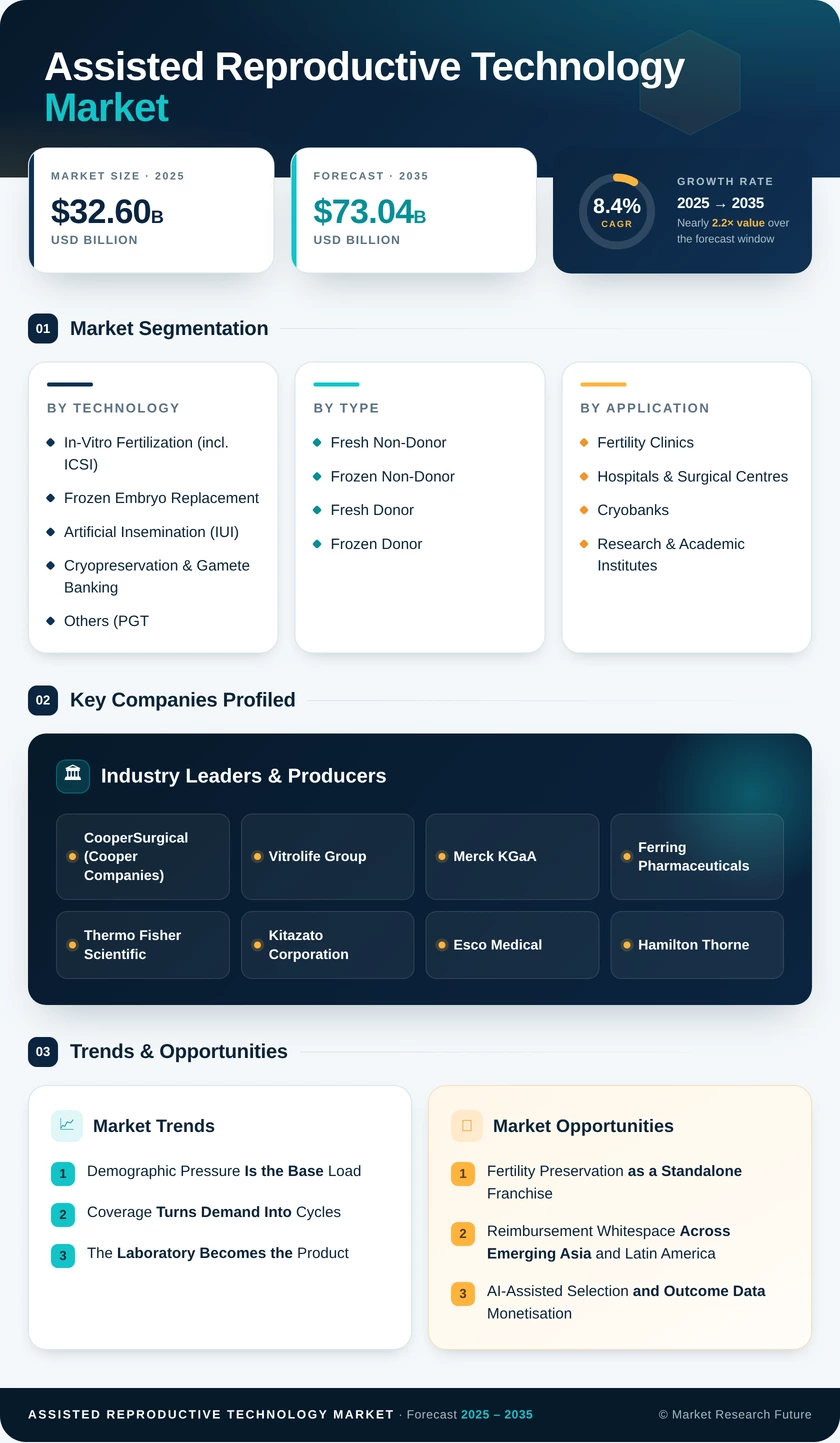
Segmentation Quick Reference
| Dimension | Sub-Segments | Dominant Segment | Fastest Growing Segment |
| By Technology | In-Vitro Fertilization (incl. ICSI); Frozen Embryo Replacement; Artificial Insemination (IUI); Cryopreservation & Gamete Banking; Others (PGT, GIFT/ZIFT, Surgical Retrieval) | In-Vitro Fertilization (incl. ICSI) | Cryopreservation & Gamete Banking |
| By Procedure Type | Fresh Non-Donor; Frozen Non-Donor; Fresh Donor; Frozen Donor | Fresh Non-Donor | Frozen Non-Donor |
| By End User | Fertility Clinics; Hospitals & Surgical Centres; Cryobanks; Research & Academic Institutes | Fertility Clinics | Cryobanks |
| By Offering | Reagents, Media & Consumables; Instruments & Equipment; Accessories & Disposables; Software, Witnessing & Data Systems | Reagents, Media & Consumables | Accessories & Disposables |
| By Region | North America; Europe; Asia-Pacific; South America; Middle East & Africa | North America | Asia-Pacific |
Market Segmentation Overview
By Technology
| Sub-Segment | Key Trend |
| In-Vitro Fertilization (incl. ICSI) | ICSI applied in the majority of cycles regardless of male-factor diagnosis |
| Frozen Embryo Replacement | Freeze-all protocols shift transfers into subsequent cycles. |
| Artificial Insemination (IUI) | Retained as a low-cost first-line step in funded systems |
| Cryopreservation & Gamete Banking | Vitrification survival above 95% enables elective preservation at scale. |
| Others (PGT, GIFT/ZIFT, Surgical Retrieval) | Genetic screening attaches to a rising share of retrievals |
Technology mix is migrating away from single-event fresh transfers toward banked, multi-transfer pathways. That shift lifts consumable intensity per patient and extends the revenue tail of each stimulated cycle well beyond the initial treatment episode.
By Procedure Type
| Sub-Segment | Key Trend |
| Fresh Non-Donor | Still the default first cycle, though its share erodes annually |
| Frozen Non-Donor | Fastest-expanding pathway as banked embryos support sibling transfers. |
| Fresh Donor | Growth tracks advanced maternal age caseload in high-income markets. |
| Frozen Donor | Bank inventory depth determines availability and pricing. |
Procedure mix is a direct consequence of cryobiology improvements. Where clinics once optimised for a single fresh transfer, they now optimise for embryo yield per retrieval, which changes stimulation strategy, laboratory scheduling and storage capacity planning.
By End User
| Sub-Segment | Key Trend |
| Fertility Clinics | Throughput-driven specialisation and network consolidation |
| Hospitals & Surgical Centres | Integrated oncology and obstetrics referral pathways |
| Cryobanks | Annuity-like storage contracts with multi-decade duration |
| Research & Academic Institutes | Protocol development, embryologist training and trial activity |
End-user structure rewards scale in the laboratory and patience in storage. Networks that combine high-volume clinical throughput with disciplined custodial operations achieve both the best outcome data and the most durable recurring revenue.
By Offering
| Sub-Segment | Key Trend |
| Reagents, Media & Consumables | Recurring per-cycle spend tied to installed incubator platforms |
| Instruments & Equipment | Refresh cycles driven by time-lapse and closed-culture adoption |
| Accessories & Disposables | Single-use safety and contamination-control requirements expand volume. |
| Software, Witnessing & Data Systems | Electronic witnessing becoming an accreditation expectation. |
Offering economics favour recurring revenue. Capital equipment sets the platform, but media, disposables and traceability software determine lifetime vendor value — which is why leading suppliers now sell laboratory systems rather than individual products.


 Noah Malgeri
Co-Founder
Noah Malgeri
Co-Founder

 Peter Groot koerkamp
Account and Business Manager
Peter Groot koerkamp
Account and Business Manager

 Younghwan Choi
Senior Retail Manager
Younghwan Choi
Senior Retail Manager

 Mark Irwin
Management Consultant
Mark Irwin
Management Consultant

 Akif Moroglu
Strategy & Business Development Director
Akif Moroglu
Strategy & Business Development Director

 Guilherme Gomes Martins
Product Management Director
Guilherme Gomes Martins
Product Management Director

 Joseph Aguayo
Sales Operations & Pricing Manager
Joseph Aguayo
Sales Operations & Pricing Manager

 La Terria Dodd
Program Support Specialist
La Terria Dodd
Program Support Specialist

 Rob Kooiker
Group Product Manager HVAC & Fire Protection GMA
Rob Kooiker
Group Product Manager HVAC & Fire Protection GMA