
×
Request Free Sample ×

Kindly complete the form below to receive a free sample of this Report

* Please use a valid business email

Leading companies partner with us for data-driven Insights

clients tt-cursor
Hero Background
English
Chinese
French
Japanese
Korean
German
Spanish

Artificial Intelligence (AI) in manufacturing Market Analysis

ID: MRFR/ICT/6276-CR
189 Pages
Aarti Dhapte
September 2024

Artificial Intelligence (AI) in Manufacturing Market Size, Share and Trends Analysis Report By Application (Predictive Maintenance, Quality Control, Supply Chain Management, Robotics, Production Planning), By Technology (Machine Learning, Natural Language Processing, Computer Vision, Robotic Process Automation, Deep Learning), By Deployment Type (On-Premise, Cloud, Hybrid), By End Use Industry (Automotive, Electronics, Aerospace, Food and Beverage, Pharmaceuticals) and By Regional (North America, Europe, South America, Asia Pacific, Middle East and Africa) - Forecast to 2035

Share:
Download PDF ×

We do not share your information with anyone. However, we may send you emails based on your report interest from time to time. You may contact us at any time to opt-out.

Artificial Intelligence (AI) in manufacturing Market Infographic
Purchase Options

Market Analysis

In-depth Analysis of Artificial Intelligence (AI) in manufacturing Market Industry Landscape

The market dynamics of Artificial Intelligence (AI) in the manufacturing sector are experiencing transformative shifts, redefining how industries approach production processes and efficiency. A significant dynamic is the integration of AI-driven technologies to enhance operational efficiency and optimize production workflows. Manufacturers are leveraging AI for predictive maintenance, quality control, and demand forecasting, allowing for proactive decision-making and minimizing downtime. This dynamic reflects the industry's recognition of AI as a pivotal tool for achieving operational excellence and ensuring a competitive edge in the rapidly evolving manufacturing landscape.

Another notable dynamic in the AI in manufacturing market is the emergence of smart factories. AI technologies, including machine learning and robotics, are instrumental in creating intelligent and interconnected manufacturing environments. Smart factories leverage AI to enable real-time data analysis, predictive analytics, and adaptive manufacturing processes. This dynamic marks a paradigm shift towards Industry 4.0, where AI plays a central role in transforming traditional manufacturing facilities into agile, data-driven, and interconnected ecosystems.

The customization trend is influencing the dynamics of AI adoption in manufacturing. As consumer demands for personalized and customized products rise, manufacturers are turning to AI-driven solutions to accommodate these preferences efficiently. AI enables adaptive manufacturing processes that can quickly reconfigure production lines to meet changing demands. This dynamic reflects the industry's responsiveness to evolving consumer expectations and the need for agile manufacturing systems.

Supply chain optimization is a key dynamic driven by AI in the manufacturing sector. Manufacturers are increasingly relying on AI algorithms for demand forecasting, inventory management, and logistics optimization. AI enables real-time analysis of vast datasets, allowing for more accurate predictions and agile responses to supply chain disruptions. This dynamic reflects the industry's commitment to creating resilient and responsive supply chains, especially in the face of global uncertainties and market fluctuations.

Collaborative robots, or cobots, are shaping the dynamics of AI adoption on the manufacturing floor. These robots work alongside human workers, enhancing efficiency and safety in various manufacturing tasks. The integration of AI allows cobots to adapt to changing production requirements, collaborate seamlessly with human workers, and contribute to increased productivity. This dynamic represents a collaborative and synergistic approach to leveraging AI technologies in manufacturing, emphasizing the coexistence of human and machine capabilities.

AI is also influencing quality control and defect detection in manufacturing processes. Advanced machine vision systems, powered by AI algorithms, enable real-time inspection and identification of defects in products. Manufacturers leverage AI-driven quality control to enhance product quality, reduce waste, and ensure compliance with industry standards. This dynamic reflects the industry's commitment to achieving higher levels of precision and quality assurance through AI technologies.

Data security and privacy considerations are becoming increasingly important dynamics in the AI in manufacturing market. As manufacturers accumulate vast amounts of sensitive data for AI-driven analysis, ensuring the security and privacy of this information becomes paramount. Manufacturers are investing in robust cybersecurity measures and compliance frameworks to address these concerns. This dynamic underscores the industry's recognition of the importance of securing data in the age of AI-driven manufacturing.

The talent gap is a notable challenge influencing the dynamics of AI adoption in manufacturing. While the demand for AI expertise in manufacturing is growing, there is a shortage of skilled professionals with the necessary knowledge. Manufacturers are addressing this challenge through training programs, collaborations with educational institutions, and strategic partnerships with AI solution providers. This dynamic highlights the industry's proactive efforts to bridge the talent gap and cultivate a workforce capable of harnessing the full potential of AI technologies.


Author
Aarti Dhapte
Team Lead - Research

She holds an experience of about 6+ years in Market Research and Business Consulting, working under the spectrum of Information Communication Technology, Telecommunications and Semiconductor domains. Aarti conceptualizes and implements a scalable business strategy and provides strategic leadership to the clients. Her expertise lies in market estimation, competitive intelligence, pipeline analysis, customer assessment, etc.

Leave a Comment

FAQs

What is the projected market size for the Global Artificial Intelligence (AI) in Manufacturing Market by 2035?

The Global Artificial Intelligence (AI) in Manufacturing Market is expected to reach a value of 22.5 USD Billion by 2035.

What is the expected CAGR for the Global Artificial Intelligence (AI) in Manufacturing Market from 2025 to 2035?

The Artificial Intelligence (AI) in Manufacturing Market is anticipated to grow at a CAGR of 18.44% from 2025 to 2035.

Which region is expected to hold the largest market share for the Global Artificial Intelligence (AI) in Manufacturing Market by 2035?

North America is projected to dominate the Artificial Intelligence (AI) in Manufacturing Market with a value of 9.0 USD Billion by 2035.

What are the forecasted market values for Predictive Maintenance in the Global Artificial Intelligence (AI) in Manufacturing Market by 2035?

Predictive Maintenance is expected to be valued at 6.5 USD Billion by 2035.

Who are some of the key players in the Global Artificial Intelligence (AI) in Manufacturing Market?

Major players include IBM, Rockwell Automation, SAP, Infosys, and NVIDIA.

What is the market value for Quality Control in the Global Artificial Intelligence (AI) in Manufacturing Market in 2024?

The Artificial Intelligence (AI) in Manufacturing Market value for Quality Control is projected to be 0.8 USD Billion in 2024.

How much is the Artificial Intelligence (AI) in Manufacturing Market for Supply Chain Management expected to grow by 2035?

The market for Supply Chain Management is expected to reach 4.5 USD Billion by 2035.

What will be the market value for Robotics within the Global Artificial Intelligence (AI) in Manufacturing Market by 2035?

The Artificial Intelligence (AI) in Manufacturing Market for Robotics is forecasted to grow to 5.5 USD Billion by 2035.

What is the expected market size for the Global Artificial Intelligence (AI) in Manufacturing Market in 2024?

The overall market is expected to be valued at 3.5 USD Billion in 2024.

What is the growth forecast for the APAC region in the Global Artificial Intelligence (AI) in Manufacturing Market by 2035?

The APAC region is anticipated to grow to 4.5 USD Billion by 2035.

Market Summary

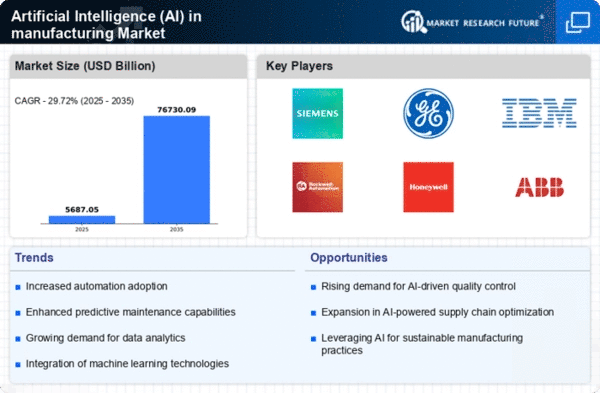
As per MRFR analysis, the Artificial Intelligence (AI) in manufacturing Market Size was estimated at 4384.1 USD Billion in 2024. The AI in manufacturing industry is projected to grow from 5687.07 USD Billion in 2025 to 76730.09 USD Billion by 2035, exhibiting a compound annual growth rate (CAGR) of 29.72 during the forecast period 2025 - 2035.

Key Market Trends & Highlights

The Artificial Intelligence in manufacturing market is experiencing robust growth driven by automation and data analytics.

  • North America remains the largest market for AI in manufacturing, showcasing a strong demand for advanced automation solutions. The Asia-Pacific region is emerging as the fastest-growing market, fueled by rapid technological advancements and increased investment in AI. Predictive maintenance continues to dominate the market, while quality control is witnessing the fastest growth due to rising quality standards. Enhanced operational efficiency and supply chain optimization are key drivers propelling the adoption of AI technologies in manufacturing.

Market Size & Forecast

2024 Market Size 4384.1 (USD Billion)
2035 Market Size 76730.09 (USD Billion)
CAGR (2025 - 2035) 29.72%
Largest Regional Market Share in 2024 North America

Major Players

Siemens (DE), General Electric (US), IBM (US), Rockwell Automation (US), Honeywell (US), ABB (CH), C3.ai (US), Microsoft (US), SAP (DE), Oracle (US)

Market Trends

The Artificial Intelligence (AI) in manufacturing Market is currently experiencing a transformative phase, characterized by the integration of advanced technologies that enhance operational efficiency and productivity. Companies are increasingly adopting AI-driven solutions to optimize processes, reduce waste, and improve quality control. This shift appears to be driven by the need for manufacturers to remain competitive in a rapidly evolving landscape. As organizations embrace automation and data analytics, the role of AI becomes more pronounced, suggesting a future where intelligent systems play a pivotal role in decision-making and resource management. Moreover, the current landscape indicates a growing emphasis on sustainability and smart manufacturing practices. Manufacturers are leveraging AI to not only streamline operations but also to minimize environmental impact. This trend reflects a broader societal shift towards responsible production methods. As the Artificial Intelligence (AI) in manufacturing Market continues to evolve, it seems poised to redefine traditional manufacturing paradigms, fostering innovation and resilience in the face of emerging challenges. The potential for AI to revolutionize the sector is substantial, as it offers solutions that could lead to unprecedented levels of efficiency and adaptability. The growing adoption of artificial intelligence is enhancing business intelligence in the manufacturing industry by enabling real-time analytics and predictive insights.

Increased Automation

The trend towards increased automation within the Artificial Intelligence (AI) in manufacturing Market is becoming more pronounced. Companies are implementing AI technologies to automate repetitive tasks, thereby enhancing productivity and reducing human error. This shift allows manufacturers to allocate human resources to more complex and strategic roles, potentially leading to improved operational efficiency.

Data-Driven Decision Making

Data-driven decision making is emerging as a critical trend in the Artificial Intelligence (AI) in manufacturing Market. Organizations are harnessing vast amounts of data generated from production processes to inform strategic choices. By utilizing AI algorithms, manufacturers can analyze data patterns, predict outcomes, and optimize processes, which may lead to enhanced performance and competitiveness.

Focus on Sustainability

A notable trend in the Artificial Intelligence (AI) in manufacturing Market is the increasing focus on sustainability. Manufacturers are adopting AI solutions to optimize resource usage and minimize waste, aligning their operations with environmental standards. This commitment to sustainability not only addresses regulatory pressures but also appeals to a growing consumer base that values eco-friendly practices.

Artificial Intelligence (AI) in manufacturing Market Market Drivers

Enhanced Quality Control

Quality control is a critical aspect of manufacturing, and the Global Artificial Intelligence (AI) in Manufacturing Market Industry is increasingly leveraging AI to enhance this process. AI systems can analyze vast amounts of data in real-time, identifying defects and inconsistencies that human inspectors might overlook. For example, AI-powered visual inspection systems can detect anomalies in products with over 95% accuracy. This capability not only reduces waste but also ensures that products meet stringent quality standards. As manufacturers strive to maintain competitiveness, the integration of AI in quality control processes is likely to become a standard practice.

Market Growth Projections

The Global Artificial Intelligence (AI) in Manufacturing Market Industry is poised for substantial growth, with projections indicating a market size of 3.5 USD Billion in 2024 and an anticipated increase to 22.5 USD Billion by 2035. This growth represents a compound annual growth rate (CAGR) of 18.43% from 2025 to 2035. The increasing adoption of AI technologies across various manufacturing sectors underscores the industry's commitment to innovation and efficiency. As manufacturers continue to integrate AI into their operations, the market is expected to expand significantly, reflecting the transformative impact of AI on the manufacturing landscape.

Supply Chain Optimization

The Global Artificial Intelligence (AI) in Manufacturing Market Industry is also driven by the need for supply chain optimization. AI technologies facilitate better demand forecasting, inventory management, and logistics planning. By analyzing historical data and market trends, AI can predict fluctuations in demand, allowing manufacturers to adjust their production schedules accordingly. This adaptability can lead to a reduction in excess inventory and associated costs. As the market is expected to grow to 22.5 USD Billion by 2035, the role of AI in enhancing supply chain efficiency is becoming increasingly vital for manufacturers aiming to remain agile in a dynamic market.

Data-Driven Decision Making

The Global Artificial Intelligence (AI) in Manufacturing Market Industry is increasingly characterized by a shift towards data-driven decision making. AI systems can process and analyze large datasets, providing insights that inform strategic decisions. This capability allows manufacturers to identify trends, optimize processes, and enhance product development. For instance, companies utilizing AI analytics have reported improved decision-making speed by up to 50%. As the industry evolves, the ability to harness data effectively will likely become a key differentiator for manufacturers, driving further investment in AI technologies.

Labor Shortages and Skill Gaps

Labor shortages and skill gaps present significant challenges in the Global Artificial Intelligence (AI) in Manufacturing Market Industry. As the workforce ages and fewer skilled workers enter the field, manufacturers are turning to AI to fill these gaps. Automation and AI-driven systems can perform repetitive tasks, allowing human workers to focus on more complex responsibilities. This shift not only addresses labor shortages but also enhances overall productivity. The increasing reliance on AI solutions is indicative of a broader trend where manufacturers seek to leverage technology to mitigate workforce challenges and maintain operational continuity.

Increased Efficiency and Productivity

The Global Artificial Intelligence (AI) in Manufacturing Market Industry is witnessing a surge in demand for solutions that enhance efficiency and productivity. AI technologies, such as machine learning and predictive analytics, enable manufacturers to optimize operations by minimizing downtime and streamlining processes. For instance, companies employing AI-driven predictive maintenance have reported reductions in equipment failure rates by up to 30%. This efficiency translates into significant cost savings and improved output quality. As the market is projected to reach 3.5 USD Billion in 2024, the drive towards operational excellence remains a pivotal factor in the industry's growth.

Market Segment Insights

By Application: Predictive Maintenance (Largest) vs. Quality Control (Fastest-Growing)

In the Artificial Intelligence (AI) in manufacturing market, predictive maintenance holds the largest share due to its proven capability to reduce downtime and maintenance costs. This application leverages AI algorithms to predict equipment failures before they happen, thus allowing manufacturers to schedule maintenance effectively and minimize unplanned outages. As manufacturers increasingly look towards AI to enhance efficiency and reliability, predictive maintenance remains the cornerstone of AI applications in this sector. On the other hand, quality control emerges as the fastest-growing segment, driven by the rising demand for defect-free products in a highly competitive market. AI-enabled quality control solutions utilize machine learning algorithms to analyze production processes and identify defects in real-time, thus ensuring superior product quality and customer satisfaction.

Quality Control: Dominant vs. Supply Chain Optimization: Emerging

Quality control has established itself as a dominant force in the AI in manufacturing market, enabling firms to integrate AI technologies that enhance their inspection processes. This application benefits from computer vision and data analytics, allowing for real-time monitoring of production lines, detecting anomalies, and ensuring compliance with quality standards. As industries prioritize product reliability and performance, AI-driven quality control systems deliver substantial value through reduced wastage and increased customer trust. Conversely, supply chain optimization is considered an emerging segment, gaining traction as businesses aim to enhance their operational efficiency. AI technologies analyze vast amounts of data to forecast demand, optimize inventory levels, and streamline logistics. As manufacturers focus on building resilient and flexible supply chains, the role of AI in this domain is expected to grow significantly.

By End Use: Automotive (Largest) vs. Electronics (Fastest-Growing)

In the Artificial Intelligence (AI) in manufacturing market, the end use segment is significantly shaped by its diverse applications across various industries. The automotive sector holds the largest share, driven by the increasing adoption of automation and AI-driven technologies to enhance manufacturing efficiency and safety. Conversely, the electronics sector is witnessing the fastest growth due to the rapid advancement of AI technologies tailored for accelerated production processes and enhanced product quality. As manufacturers strive to meet consumer demands, these sectors are driving the overall market forward.

Automotive: Dominant vs. Electronics: Emerging

The automotive sector stands out as the dominant end use for AI in manufacturing, leveraging technology to optimize production lines, enhance quality control, and ensure compliance with safety standards. Companies in this domain are integrating AI solutions for predictive maintenance, supply chain optimization, and smart manufacturing practices. On the other hand, the electronics sector is an emerging powerhouse, harnessing AI to innovate product design and streamline production processes. As consumer electronics evolve, manufacturers are increasingly embedding AI for improved efficiency, leading to lower costs and enhanced user experiences. The interplay between these segments signifies a robust trajectory for AI technologies across manufacturing industries.

By Technology: Machine Learning (Largest) vs. Robotic Process Automation (Fastest-Growing)

In the Artificial Intelligence in manufacturing market, Machine Learning has emerged as the largest segment, capturing a substantial share with its ability to analyze vast amounts of data and improve decision-making processes. Following closely, Natural Language Processing and Computer Vision also hold significant portions of the Artificial Intelligence (AI) in Manufacturing Market. As businesses increasingly adopt AI technologies, the distribution among these segments reflects a growing recognition of their crucial roles in enhancing manufacturing efficiency and productivity. The growth trends in this segment are primarily driven by the rise of Industry 4.0, which emphasizes automation and data exchange in manufacturing technologies. Machine Learning continues to dominate due to its applications in predictive maintenance and quality control, while Robotic Process Automation is rapidly gaining traction as manufacturers seek to streamline operations and reduce errors. As organizations strive to remain competitive, the integration of these AI technologies is expected to accelerate, highlighting both current capabilities and emerging potentials in the Artificial Intelligence (AI) in Manufacturing Market.

Technology: Machine Learning (Dominant) vs. Robotic Process Automation (Emerging)

Machine Learning (ML) stands out as the dominant force in the AI in manufacturing sector due to its vast applications that span predictive analytics, real-time monitoring, and optimization of manufacturing operations. It facilitates improved decision-making and operational efficiency. In contrast, Robotic Process Automation (RPA) is rapidly emerging as a key player, driven by the increasing demand for automated workflows and enhanced operational efficiency. RPA solutions streamline business processes by enabling robots to complete tasks that traditionally required human intervention, thus reducing errors and operational costs and paving the way for significant advancements in manufacturing capabilities.

By Deployment Type: Cloud-Based (Largest) vs. On-Premises (Fastest-Growing)

The deployment type segment of the Artificial Intelligence in manufacturing market is characterized by three main categories: On-Premises, Cloud-Based, and Hybrid. Among these, Cloud-Based solutions currently hold the largest Artificial Intelligence (AI) in Manufacturing Market share, driven by their flexibility, scalability, and ease of access. On-Premises solutions, while traditionally preferred for their security, are facing challenges in terms of market share due to the growing adoption of Cloud-based models. Meanwhile, Hybrid solutions are gaining traction as manufacturers look to blend the robustness of on-premises installations with the agility of cloud services.

Deployment Types: Cloud-Based (Dominant) vs. On-Premises (Emerging)

Cloud-Based deployment has emerged as the dominant choice in the Artificial Intelligence in manufacturing market, largely due to its unrivaled scalability and ease of integration with existing systems. Organizations benefit from reduced initial investments and can rapidly scale operations according to fluctuating demands. In contrast, On-Premises solutions are becoming increasingly regarded as emerging, driven by heightened concerns over data security and regulatory compliance. Manufacturers adopting On-Premises AI solutions appreciate the control over sensitive data and the ability to tailor systems to specific business needs. As these deployment types evolve, the adoption rates reflect a strategic shift toward hybrid models that leverage the benefits of both, allowing manufacturers to optimize their AI initiatives.

By Component: Software (Largest) vs. Services (Fastest-Growing)

In the Artificial Intelligence (AI) in manufacturing market, the component segment is primarily dominated by software solutions, which hold the largest market share. This dominance can be attributed to the increasing demand for data-driven insights and the rising complexity of manufacturing processes. Software technologies provide the necessary tools for automation, predictive maintenance, and real-time analytics, making them indispensable in modern manufacturing environments. On the other hand, services are emerging rapidly, fueled by the need for specialized support in deploying and optimizing AI applications. The integration of advanced AI technologies requires comprehensive support solutions, thus pushing the service component to become one of the fastest-growing segments.

Software (Dominant) vs. Services (Emerging)

Software solutions in the AI manufacturing market are characterized by their ability to enhance operational efficiency and decision-making processes. They encompass various applications, including machine learning algorithms, computer vision, and natural language processing, that drive innovation across industries. Companies leverage these software tools to optimize production lines, reduce downtime, and improve product quality. Meanwhile, services, which include consulting, implementation, and maintenance, are vital for companies that seek to adopt AI but lack the expertise. As manufacturing firms increasingly prioritize digital transformation, they are turning to service providers for tailored support and solutions, making services an emerging segment with significant growth potential in the AI landscape.

By Functionality: Predictive Analytics (Largest) vs. Data Analysis (Fastest-Growing)

The Artificial Intelligence (AI) in manufacturing market is dominated by Predictive Analytics, which has established itself as the largest segment due to its ability to forecast outcomes and optimize processes. This segment utilizes historical data to predict future trends, giving manufacturers a significant competitive edge. Data Analysis, while smaller in share, has seen rapid adoption as more manufacturers recognize its value in interpreting vast amounts of data for better decision-making. The growth in the functionality segment is driven by the increasing need for manufacturers to enhance operational efficiency and reduce costs. The widespread integration of smart technologies and IoT in manufacturing processes has significantly boosted the popularity of Process Optimization and Predictive Analytics. Additionally, the push towards data-driven decision-making continues to elevate the importance of all functionality segments in the AI in manufacturing landscape.

Predictive Analytics (Dominant) vs. Process Optimization (Emerging)

Predictive Analytics has emerged as the dominant functionality in the AI in manufacturing market, enabling companies to leverage historical data for forecasting and improving processes. This approach allows for advanced insights into Artificial Intelligence (AI) in Manufacturing Market dynamics, production efficiency, and strategic planning. Its capability to anticipate various operational challenges empowers manufacturers to proactively address issues, allowing for smoother production cycles. On the other hand, Process Optimization is an emerging functionality that focuses on refining manufacturing processes through AI-driven insights. This segment is gaining traction as businesses seek ways to streamline operations, minimize waste, and enhance productivity. While still growing, Process Optimization shows tremendous potential, supported by technological advancements that facilitate real-time adjustments to manufacturing processes.

Get more detailed insights about AI in manufacturing Market Research Report - Global Forecast till 2035

Regional Insights

The Global Artificial Intelligence (AI) in Manufacturing Market is projected to experience substantial growth across various regions, significantly contributing to its overall valuation. By 2024, North America leads with a valuation of 1.4 USD Billion and is expected to reach 9.0 USD Billion by 2035, showcasing its majority holding and importance in the Artificial Intelligence (AI) in Manufacturing Market due to advanced technology adoption and infrastructure. Europe follows closely, with a valuation of 1.0 USD Billion in 2024, reaching 7.0 USD Billion in 2035, reflecting a significant commitment to integrating AI in manufacturing processes.

The Asia-Pacific (APAC) region, although valued at 0.8 USD Billion in 2024 and projected to grow to 4.5 USD Billion by 2035, plays a crucial role in market dynamics due to rapid industrialization and technology initiatives. South America and the Middle East and Africa (MEA) represent the smaller segments with respective values of 0.2 USD Billion and 0.1 USD Billion in 2024, expected to grow to 1.5 USD Billion and 0.5 USD Billion by 2035. The variations in Artificial Intelligence (AI) in Manufacturing Market size among these regions highlight the diversity in manufacturing capabilities and the strategic importance of regional investments.

The demand for automation, efficiency enhancement, and predictive maintenance is driving the Global Artificial Intelligence (AI) in Manufacturing Market segmentation forward.

Figure 3: Artificial Intelligence (AI) in Manufacturing Market Regional Insights

Key Players and Competitive Insights

The Artificial Intelligence (AI) in manufacturing Market is currently characterized by a dynamic competitive landscape, driven by rapid technological advancements and increasing demand for automation. Leading AI manufacturing companies are focusing on automation, predictive maintenance, and intelligent analytics to strengthen their market presence. Key players such as Siemens (DE), General Electric (US), and IBM (US) are at the forefront, each adopting distinct strategies to enhance their market positioning. Siemens (DE) focuses on digital transformation and innovation, leveraging its expertise in automation to integrate AI solutions into manufacturing processes. General Electric (US) emphasizes partnerships and collaborations, particularly in the energy sector, to expand its AI capabilities. IBM (US) is heavily investing in research and development, aiming to enhance its AI offerings through advanced analytics and machine learning, thereby shaping a competitive environment that prioritizes technological leadership and strategic alliances.
The market structure appears moderately fragmented, with a mix of established players and emerging startups. Key business tactics such as localizing manufacturing and optimizing supply chains are prevalent among major companies, allowing them to respond swiftly to market demands. The collective influence of these players fosters a competitive atmosphere where innovation and operational efficiency are paramount, driving the adoption of AI technologies across various manufacturing sectors.
In November 2025, Siemens (DE) announced a strategic partnership with a leading robotics firm to develop AI-driven automation solutions tailored for the automotive industry. This collaboration is expected to enhance Siemens' product offerings, enabling manufacturers to achieve greater efficiency and flexibility in production lines. The strategic importance of this move lies in Siemens' commitment to staying ahead in the competitive landscape by integrating cutting-edge technologies into its solutions.
In October 2025, General Electric (US) unveiled a new AI platform designed to optimize energy consumption in manufacturing facilities. This platform utilizes predictive analytics to reduce operational costs and improve sustainability. The introduction of this platform signifies GE's focus on leveraging AI to address pressing environmental concerns while enhancing operational efficiency, thus reinforcing its competitive edge in the Artificial Intelligence (AI) in Manufacturing Market.
In September 2025, IBM (US) launched an AI-driven supply chain management tool aimed at improving inventory accuracy and reducing lead times for manufacturers. This tool employs machine learning algorithms to analyze data in real-time, allowing companies to make informed decisions swiftly. The strategic significance of this launch is evident in IBM's effort to position itself as a leader in AI solutions that directly impact operational performance and supply chain reliability.
As of December 2025, current trends in the Artificial Intelligence (AI) in Manufacturing Market include a pronounced shift towards digitalization, sustainability, and the integration of AI technologies. Strategic alliances are increasingly shaping the competitive landscape, enabling companies to pool resources and expertise to drive innovation. Looking ahead, competitive differentiation is likely to evolve from traditional price-based competition to a focus on technological innovation, enhanced supply chain reliability, and sustainable practices. This shift underscores the importance of adaptability and forward-thinking strategies in maintaining a competitive advantage in the rapidly evolving AI in manufacturing Market.

Key Companies in the Artificial Intelligence (AI) in manufacturing Market include

Industry Developments

Recent developments in the Global Artificial Intelligence (AI) in Manufacturing Market highlight a period of significant growth and innovation. In September 2023, Nvidia announced a collaboration with Siemens to enhance AI-powered manufacturing solutions, which is expected to drive efficiency and reduce downtime in factories globally. In August 2023, IBM launched new AI tools targeting predictive maintenance for manufacturing, reinforcing its position in the sector. Within the last few years, strategic mergers and acquisitions have also shaped the landscape, with Microsoft acquiring Nuance Communications in April 2021, focused on conversational AI to improve industrial processes.

Similarly, in March 2022, Rockwell Automation announced the acquisition of Fiix Software to bolster its AI capabilities in maintenance and asset management. Notably, SAP's continuous investment in AI applications has driven its Artificial Intelligence (AI) in Manufacturing Market valuation higher, marking a significant trend towards integration of AI for operational excellence. The market's valuation has surged, propelled by enterprises' increasing reliance on advanced technologies to optimize production and enhance decision-making processes. These strategic advancements demonstrate a robust shift towards AI as a cornerstone of modern manufacturing practices globally.

Future Outlook

Artificial Intelligence (AI) in manufacturing Market Future Outlook

The Artificial Intelligence in manufacturing market is projected to grow at a 29.72% CAGR from 2025 to 2035, driven by automation, data analytics, and enhanced operational efficiency.

New opportunities lie in:

  • <p>Predictive maintenance solutions for machinery optimization. AI-driven quality control systems to reduce defects. Robotic process automation for supply chain efficiency.</p>

By 2035, the market is expected to be a cornerstone of manufacturing innovation and efficiency.

Market Segmentation

Artificial Intelligence (AI) in manufacturing Market End Use Outlook

  • Automotive
  • Electronics
  • Aerospace
  • Consumer Goods
  • Pharmaceuticals

Artificial Intelligence (AI) in manufacturing Market Component Outlook

  • Hardware
  • Software
  • Services

Artificial Intelligence (AI) in manufacturing Market Technology Outlook

  • Machine Learning
  • Natural Language Processing
  • Computer Vision
  • Deep Learning
  • Robotic Process Automation

Artificial Intelligence (AI) in manufacturing Market Application Outlook

  • Predictive Maintenance
  • Quality Control
  • Supply Chain Optimization
  • Robotics Automation
  • Process Automation

Artificial Intelligence (AI) in manufacturing Market Deployment Type Outlook

  • On-Premises
  • Cloud-Based
  • Hybrid

Report Scope

MARKET SIZE 2024 4384.1(USD Billion)
MARKET SIZE 2025 5687.07(USD Billion)
MARKET SIZE 2035 76730.09(USD Billion)
COMPOUND ANNUAL GROWTH RATE (CAGR) 29.72% (2025 - 2035)
REPORT COVERAGE Revenue Forecast, Competitive Landscape, Growth Factors, and Trends
BASE YEAR 2024
Market Forecast Period 2025 - 2035
Historical Data 2019 - 2024
Market Forecast Units USD Billion
Key Companies Profiled Siemens (DE), General Electric (US), IBM (US), Rockwell Automation (US), Honeywell (US), ABB (CH), C3.ai (US), Microsoft (US), SAP (DE), Oracle (US)
Segments Covered Application, End Use, Technology, Deployment Type, Component
Key Market Opportunities Integration of advanced predictive analytics enhances operational efficiency in the Artificial Intelligence (AI) in manufacturing Market.
Key Market Dynamics Rising adoption of Artificial Intelligence in manufacturing enhances operational efficiency and drives competitive advantage across industries.
Countries Covered North America, Europe, APAC, South America, MEA

FAQs

What is the projected market size for the Global Artificial Intelligence (AI) in Manufacturing Market by 2035?

The Global Artificial Intelligence (AI) in Manufacturing Market is expected to reach a value of 22.5 USD Billion by 2035.

What is the expected CAGR for the Global Artificial Intelligence (AI) in Manufacturing Market from 2025 to 2035?

The Artificial Intelligence (AI) in Manufacturing Market is anticipated to grow at a CAGR of 18.44% from 2025 to 2035.

Which region is expected to hold the largest market share for the Global Artificial Intelligence (AI) in Manufacturing Market by 2035?

North America is projected to dominate the Artificial Intelligence (AI) in Manufacturing Market with a value of 9.0 USD Billion by 2035.

What are the forecasted market values for Predictive Maintenance in the Global Artificial Intelligence (AI) in Manufacturing Market by 2035?

Predictive Maintenance is expected to be valued at 6.5 USD Billion by 2035.

Who are some of the key players in the Global Artificial Intelligence (AI) in Manufacturing Market?

Major players include IBM, Rockwell Automation, SAP, Infosys, and NVIDIA.

What is the market value for Quality Control in the Global Artificial Intelligence (AI) in Manufacturing Market in 2024?

The Artificial Intelligence (AI) in Manufacturing Market value for Quality Control is projected to be 0.8 USD Billion in 2024.

How much is the Artificial Intelligence (AI) in Manufacturing Market for Supply Chain Management expected to grow by 2035?

The market for Supply Chain Management is expected to reach 4.5 USD Billion by 2035.

What will be the market value for Robotics within the Global Artificial Intelligence (AI) in Manufacturing Market by 2035?

The Artificial Intelligence (AI) in Manufacturing Market for Robotics is forecasted to grow to 5.5 USD Billion by 2035.

What is the expected market size for the Global Artificial Intelligence (AI) in Manufacturing Market in 2024?

The overall market is expected to be valued at 3.5 USD Billion in 2024.

What is the growth forecast for the APAC region in the Global Artificial Intelligence (AI) in Manufacturing Market by 2035?

The APAC region is anticipated to grow to 4.5 USD Billion by 2035.

  1. SECTION I: EXECUTIVE SUMMARY AND KEY HIGHLIGHTS
    1. EXECUTIVE SUMMARY
      1. Market Overview
      2. Key Findings
      3. Market Segmentation
      4. Competitive Landscape
      5. Challenges and Opportunities
      6. Future Outlook 2 SECTION II: SCOPING, METHODOLOGY AND MARKET STRUCTURE
    2. MARKET INTRODUCTION
      1. Definition
      2. Scope of the study
    3. RESEARCH METHODOLOGY
      1. Overview
      2. Data Mining
      3. Secondary Research
      4. Primary Research
      5. Forecasting Model
      6. Market Size Estimation
      7. Data Triangulation
      8. Validation 3 SECTION III: QUALITATIVE ANALYSIS
    4. MARKET DYNAMICS
      1. Overview
      2. Drivers
      3. Restraints
      4. Opportunities
    5. MARKET FACTOR ANALYSIS
      1. Value chain Analysis
      2. Porter's Five Forces Analysis
      3. COVID-19 Impact Analysis
    6. Information and Communications Technology, BY Application (USD Billion)
      1. Predictive Maintenance
      2. Quality Control
      3. Supply Chain Optimization
      4. Robotics Automation
      5. Process Automation
    7. Information and Communications Technology, BY End Use (USD Billion)
      1. Automotive
      2. Electronics
      3. Aerospace
      4. Consumer Goods
      5. Pharmaceuticals
    8. Information and Communications Technology, BY Technology (USD Billion)
      1. Machine Learning
      2. Natural Language Processing
      3. Computer Vision
      4. Deep Learning
      5. Robotic Process Automation
    9. Information and Communications Technology, BY Deployment Type (USD Billion)
      1. On-Premises
      2. Cloud-Based
      3. Hybrid
    10. Information and Communications Technology, BY Component (USD Billion)
      1. Hardware
      2. Software
      3. Services
    11. Information and Communications Technology, BY Region (USD Billion)
      1. North America
      2. Europe
      3. APAC
      4. South America
      5. MEA
    12. Competitive Landscape
      1. Overview
      2. Competitive Analysis
      3. Market share Analysis
      4. Major Growth Strategy in the Information and Communications Technology
      5. Competitive Benchmarking
      6. Leading Players in Terms of Number of Developments in the Information and Communications Technology
      7. Key developments and growth strategies
      8. Major Players Financial Matrix
    13. Company Profiles
      1. Siemens (DE)
      2. General Electric (US)
      3. IBM (US)
      4. Rockwell Automation (US)
      5. Honeywell (US)
      6. ABB (CH)
      7. C3.ai (US)
      8. Microsoft (US)
      9. SAP (DE)
      10. Oracle (US)
    14. Appendix
      1. References
      2. Related Reports

Information and Communications Technology Market Segmentation

Information and Communications Technology By Application (USD Billion, 2025-2035)

  • Predictive Maintenance
  • Quality Control
  • Supply Chain Optimization
  • Robotics Automation
  • Process Automation

Information and Communications Technology By End Use (USD Billion, 2025-2035)

  • Automotive
  • Electronics
  • Aerospace
  • Consumer Goods
  • Pharmaceuticals

Information and Communications Technology By Technology (USD Billion, 2025-2035)

  • Machine Learning
  • Natural Language Processing
  • Computer Vision
  • Deep Learning
  • Robotic Process Automation

Information and Communications Technology By Deployment Type (USD Billion, 2025-2035)

  • On-Premises
  • Cloud-Based
  • Hybrid

Information and Communications Technology By Component (USD Billion, 2025-2035)

  • Hardware
  • Software
  • Services
Infographic

Free Sample Request

Kindly complete the form below to receive a free sample of this Report

Get Free Sample

Customer Strories

Compare Licence

×
Features License Type
Single User Multiuser License Enterprise User
Price $4,950 $5,950 $7,250
Maximum User Access Limit 1 User Upto 10 Users Unrestricted Access Throughout the Organization
Free Customization
Direct Access to Analyst
Deliverable Format
Platform Access
Discount on Next Purchase 10% 15% 15%
Printable Versions