Request Free Sample ×

Kindly complete the form below to receive a free sample of this Report

* Please use a valid business email

Leading companies partner with us for data-driven Insights

clients tt-cursor
Hero Background
English
Chinese
French
Japanese
Korean
German
Spanish

Artificial Disc Replacement Market Share

ID: MRFR/MED/0886-HCR
85 Pages
Nidhi Mandole
April 2026

Artificial Disc Replacement Market Research Report Information, by Disc Type (Composite Discs, Elastic Discs, Mechanical Discs, Others), Location (Cervical Discs Replacement and Lumber Disc Replacement), Material (Metal, Biopolymer, and Others) - Global Forecast Till 2035

Share:
Download PDF ×

We do not share your information with anyone. However, we may send you emails based on your report interest from time to time. You may contact us at any time to opt-out.

Artificial Disc Replacement Market Infographic
Purchase Options

Market Share

Artificial Disc Replacement Market Share Analysis

The rising event of degenerative circle illnesses, which are much of the time connected to way of life decisions and the maturing system, has altogether influenced the market interest for artificial disc replacement. A genuine option for people experiencing plate related confusions, ADR adds to the extension of the market.

Movements in Clinical Innovation: The plan and viability of counterfeit plates have been considerably upgraded by mechanical advancements in the field of clinical gadgets. By prudence of its creative plans, predominant materials, and improved careful procedures, ADR has turned into a seriously engaging option for medical services suppliers and patients the same.

A noticeable change in understanding tendency from ordinary spinal combination to options that protect movement, for example, ADR, has been noted. A developing number of specialists and patients are becoming mindful of the benefits of safeguarding regular spinal movement, which has added to the extension of the fake circle substitution market.

Positive Clinical Results: The market reception of ADR systems has been altogether impelled by solid clinical results and patient fulfillment. The gathering of extra information with respect to the drawn-out viability and benefits of counterfeit plate substitution cements the place of ADR as a practical and victorious remedial other option.

The presentation of negligibly obtrusive careful strategies has affected the market. The potential for diminished postoperative torment, more limited recovery periods, and more modest entry points requests to patients, delivering counterfeit plate substitution is a more positive choice in contrast with customary open medical procedures.

Administrative endorsement and backing processes: Administrative associations, like the FDA, altogether affect the ADR market. The quick confirmation of fake plate substitutions onto the market is worked with by smoothed out endorsement processes, which awards patients’ admittance to supported and inventive treatment choices.

The raising old segment: In created countries, specifically, this segment pattern expands the requirement for cures that target age-related wellbeing concerns, like degenerative circle sicknesses. As the senior grown-up populace builds, the interest for fake plate substitutions likewise extends.

The market elements are fundamentally influenced by the repayment arrangements and inclusion scene that oversee ADR methods. Great repayment strategies boost medical care suppliers to offer counterfeit plate substitutions, along these lines cultivating market extension and expanded patient openness.

Patient Schooling and Mindfulness: A propelling power has been the expanded mindfulness among patients with respect to accessible treatment choices, including ADR. Bringing issues to light and working with correspondence in regard to the upsides of fake circle substitution are components that encourage all around educated decisions and advance the reception regarding this innovation.

Market Extension and Development: The cutthroat climate inside the ADR market fills in as an impetus for market development and progression. Associations try to upgrade engineered circles, expand their scope of items, and explore undiscovered worldwide business sectors, consequently developing a dynamic and moderate area.

Hardships in Reception and Suspicion: Despite the reassuring examples, obstructions keep on persevering in the domain of broad reception. Notwithstanding concerns in regard to the drawn-out solidness of artificial disc replacement, suspicion among a few medical care suppliers and patients presents snags that the business keeps on tending to through training and exploration.


Author
Author Profile
Nidhi Mandole
Senior Research Analyst

She is an extremely curious individual currently working in Healthcare and Medical Devices Domain. Nidhi is comfortably versed in data centric research backed by healthcare educational background. She leverages extensive data mining and analytics tools such as Primary and Secondary Research, Statistical Analysis, Machine Learning, Data Modelling. Her key role also involves Technical Sales Support, Client Interaction and Project management within the Healthcare team. Lastly, she showcases extensive affinity towards learning new skills and remain fascinated in implementing them.

Leave a Comment

FAQs

What is the projected market valuation of the Artificial Disc Replacement Market by 2035?

<p>The projected market valuation for the Artificial Disc Replacement Market by 2035 is approximately 5.859 USD Billion.</p>

What was the market valuation of the Artificial Disc Replacement Market in 2024?

<p>The market valuation of the Artificial Disc Replacement Market in 2024 was 1.9 USD Billion.</p>

What is the expected CAGR for the Artificial Disc Replacement Market during the forecast period 2025 - 2035?

<p>The expected CAGR for the Artificial Disc Replacement Market during the forecast period 2025 - 2035 is 10.78%.</p>

Which companies are considered key players in the Artificial Disc Replacement Market?

<p>Key players in the Artificial Disc Replacement Market include Medtronic, DePuy Synthes, Stryker, NuVasive, and Globus Medical.</p>

What are the projected valuations for Cervical and Lumbar Artificial Discs by 2035?

<p>The projected valuation for Cervical Artificial Discs is 2.4 USD Billion, while Lumbar Artificial Discs is expected to reach 3.46 USD Billion by 2035.</p>

What materials are primarily used in Artificial Disc Replacement, and what are their projected market values?

The primary materials used are Metal on Polymer and Metal on Metal, both projected to reach 2.93 USD Billion by 2035.

What are the expected market values for different end-users of Artificial Disc Replacement by 2035?

By 2035, the market value for Hospitals and Clinics is projected to be 3.43 USD Billion, while Ambulatory Surgery Centers may reach 2.43 USD Billion.

How does the market for Artificial Disc Replacement compare between 2024 and 2035?

The market for Artificial Disc Replacement is expected to grow from 1.9 USD Billion in 2024 to approximately 5.859 USD Billion by 2035.

What segment of the Artificial Disc Replacement Market is expected to see the most growth?

The Lumbar Artificial Disc segment appears to be on track for substantial growth, projected to reach 3.46 USD Billion by 2035.

What role do hospitals and clinics play in the Artificial Disc Replacement Market?

Hospitals and Clinics are significant end-users, with a projected market value of 3.43 USD Billion by 2035.

Market Summary

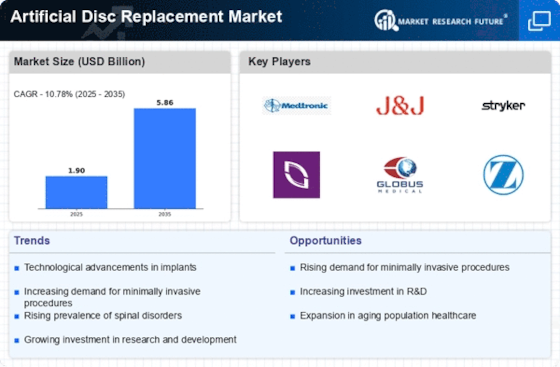
As per Market Research Future analysis, the Artificial Disc Replacement Market Size was estimated at 1.9 USD Billion in 2024. The Artificial Disc Replacement industry is projected to grow from 2.105 USD Billion in 2025 to 5.859 USD Billion by 2035, exhibiting a compound annual growth rate (CAGR) of 10.78% during the forecast period 2025 - 2035

Key Market Trends & Highlights

The Artificial Disc Replacement Market is poised for substantial growth driven by technological advancements and increasing patient awareness.

  • North America remains the largest market for artificial disc replacements, driven by advanced healthcare infrastructure. The Asia-Pacific region is emerging as the fastest-growing market, fueled by rising healthcare investments and population aging. Cervical artificial discs dominate the market, while lumbar artificial discs are experiencing the fastest growth due to increasing demand for effective treatments. Key market drivers include the rising incidence of spine disorders and the growing demand for minimally invasive surgeries.

Market Size & Forecast

2024 Market Size 1.9 (USD Billion)
2035 Market Size 5.859 (USD Billion)
CAGR (2025 - 2035) 10.78%
Largest Regional Market Share in 2024 North America

Major Players

<a href="https://www.medtronic.com/uk-en/patients/treatments-therapies/cervical-herniated-disc-artificial/benefits-and-risks.html">Medtronic</a> (US), DePuy Synthes (US), <a href="https://www.stryker.com/us/en/interventional-spine/products/dekompressor-disc-removal-system.html">Stryker</a> (US), NuVasive (US), Globus Medical (US), Zimmer Biomet (US), Amedica Corporation (US), B. Braun Melsungen AG (DE), Orthofix Medical Inc. (US)

Market Trends

The Artificial Disc Replacement Market is currently experiencing a notable transformation, driven by advancements in technology and an increasing demand for minimally invasive surgical options. Surgeons and patients alike are gravitating towards artificial disc replacements due to their potential to alleviate chronic pain and restore mobility. This shift is further supported by ongoing research and development efforts aimed at enhancing the efficacy and safety of these devices. As healthcare systems evolve, the integration of artificial disc replacements into standard treatment protocols appears to be gaining traction, suggesting a promising future for this sector. Moreover, the growing prevalence of spinal disorders, coupled with an aging population, is likely to fuel the demand for artificial disc replacements. Patients are increasingly seeking alternatives to traditional spinal fusion surgeries, which may involve longer recovery times and more complications. The Artificial Disc Replacement Market seems poised for growth as healthcare providers recognize the benefits of these innovative solutions. Additionally, the rise of telemedicine and digital health technologies may further facilitate patient access to these procedures, potentially reshaping the landscape of spinal care in the coming years.

Technological Advancements

The Artificial Disc Replacement Market is witnessing rapid technological innovations that enhance the design and functionality of artificial discs. These advancements may lead to improved patient outcomes, as newer materials and manufacturing techniques are developed to mimic the natural biomechanics of the spine more effectively.

Increasing Patient Awareness

There is a growing awareness among patients regarding the benefits of artificial disc replacements. Educational initiatives and patient advocacy groups are playing a crucial role in informing individuals about their options, which may lead to higher demand for these procedures.

Shift Towards Minimally Invasive Procedures

The trend towards minimally invasive surgical techniques is becoming more pronounced within the Artificial Disc Replacement Market. Surgeons are increasingly adopting these methods, which could result in shorter recovery times and reduced hospital stays, thereby appealing to both patients and healthcare providers.

Artificial Disc Replacement Market Market Drivers

Increasing Healthcare Expenditure

The rise in healthcare expenditure across various regions is a significant driver for the Artificial Disc Replacement Market. As countries invest more in healthcare infrastructure and services, the availability of advanced medical technologies, including artificial disc replacements, increases. Recent reports indicate that healthcare spending is projected to grow, driven by factors such as an aging population and the rising burden of chronic diseases. This increase in expenditure allows for greater access to innovative treatments, thereby expanding the market for artificial disc replacements. Additionally, as insurance coverage for these procedures improves, more patients are likely to seek out artificial disc replacements as a viable option for managing spine disorders. This trend suggests a promising outlook for the market.

Rising Incidence of Spine Disorders

The increasing prevalence of spine disorders, such as degenerative disc disease and herniated discs, is a primary driver for the Artificial Disc Replacement Market. As populations age, the incidence of these conditions tends to rise, leading to a greater demand for effective treatment options. According to recent data, spine disorders affect millions worldwide, prompting healthcare providers to seek innovative solutions. The Artificial Disc Replacement Market is positioned to address this need, offering alternatives to traditional spinal fusion surgeries. This shift not only enhances patient outcomes but also aligns with the growing trend of personalized medicine, where treatments are tailored to individual patient needs. As awareness of these disorders increases, so does the potential for market growth, suggesting a robust future for artificial disc technologies.

Enhanced Patient Education and Awareness

The growing emphasis on patient education and awareness is emerging as a key driver for the Artificial Disc Replacement Market. As patients become more informed about their treatment options, they are more likely to seek out advanced solutions for spine disorders. Educational initiatives by healthcare providers and organizations are helping to demystify artificial disc replacement procedures, highlighting their benefits and potential outcomes. Increased awareness is also leading to higher patient demand for these surgeries, as individuals seek alternatives to traditional treatments. Data indicates that patients who are well-informed about their conditions and treatment options tend to have better outcomes and satisfaction levels. This trend is likely to continue, further stimulating growth in the artificial disc replacement market.

Technological Innovations in Disc Replacement

Technological advancements play a crucial role in shaping the Artificial Disc Replacement Market. Innovations in materials and design have led to the development of more effective and durable artificial discs. For instance, the introduction of bio-compatible materials and improved manufacturing techniques has enhanced the performance and longevity of these devices. Recent studies indicate that the success rates of artificial disc replacements have improved significantly, with many patients experiencing reduced pain and increased mobility. Furthermore, the integration of robotics and minimally invasive surgical techniques is revolutionizing the way these procedures are performed, potentially reducing recovery times and hospital stays. As these technologies continue to evolve, they are likely to attract more patients and healthcare providers, thereby driving market growth.

Growing Demand for Minimally Invasive Surgeries

The trend towards minimally invasive surgical techniques is significantly influencing the Artificial Disc Replacement Market. Patients increasingly prefer procedures that promise shorter recovery times, reduced pain, and minimal scarring. This shift is evident in the rising number of surgeries performed using minimally invasive methods, which have been shown to yield favorable outcomes compared to traditional approaches. Data suggests that minimally invasive disc replacement surgeries are gaining traction, with many healthcare facilities adopting these techniques to enhance patient satisfaction. As more surgeons become trained in these methods, the demand for artificial disc replacements is expected to rise, further propelling the market forward. This trend reflects a broader movement within the healthcare sector towards patient-centered care.

Market Segment Insights

By Type: Cervical Artificial Disc (Largest) vs. Lumbar Artificial Disc (Fastest-Growing)

In the Artificial Disc Replacement Market, the distribution of market share between cervical and lumbar artificial discs reveals a noticeable dominance of cervical artificial discs. These devices have consistently been preferred due to their effectiveness in treating a broader range of cervical spine disorders. Conversely, while the lumbar artificial disc segment holds a smaller share in comparison, it is gaining traction rapidly, driven by an increase in lumbar surgeries and patient awareness about alternative treatments.

Artificial Discs: Cervical (Dominant) vs. Lumbar (Emerging)

The cervical artificial disc segment is characterized by its strong market presence, attributed to its established efficacy in treating cervical disc degenerations and related conditions. This segment appeals greatly to surgeons and patients alike due to its benefits, such as preserving motion and maintaining spinal stability. On the other hand, the lumbar artificial disc segment is emerging quickly, with increased focus on minimally invasive surgical techniques and innovative product designs. As patient demand for lumbar interventions grows, and with more clinical studies validating the safety and effectiveness of lumbar discs, this segment is poised for substantial growth, shaping the future landscape of the market.

By Material: Metal on Polymer (Largest) vs. Metal on Metal (Fastest-Growing)

In the Artificial Disc Replacement Market, the material composition of the discs significantly impacts their popularity and usage rates. Currently, Metal on Polymer is the largest segment, favored for its balance of durability and flexibility, leading to widespread adoption among healthcare providers. Whereas, Metal on Metal is growing at a faster pace, capturing attention due to advancements in materials technology that improve performance and longevity, appealing to a segment of patients seeking enhanced mobility post-surgery.

Material Type: Metal on Polymer (Dominant) vs. Metal on Metal (Emerging)

Metal on Polymer has established a dominant presence in the Artificial Disc Replacement Market, known for its superior wear resistance and biocompatibility, making it a preferred choice for many surgeons. This material combination minimizes friction, leading to better patient outcomes and longevity of the implant. In contrast, Metal on Metal, though emerging, is gaining traction due to its high strength and durability. Innovations in manufacturing processes are also allowing for reduced wear debris and improved patient outcomes, positioning this segment as a robust competitor that caters to patients seeking long-lasting solutions.

By End-User: Hospitals and Clinics (Largest) vs. Ambulatory Surgery Centers (Fastest-Growing)

In the Artificial Disc Replacement Market, the end-user segment is primarily dominated by hospitals and clinics, which account for a significant share due to their established infrastructure, specialized personnel, and comprehensive patient care capabilities. Hospitals offer advanced surgical facilities and are often the preferred choice for complex procedures, thereby attracting a large volume of patients requiring artificial disc replacements. On the other hand, ambulatory surgery centers are rapidly gaining traction as they provide specialized, outpatient <a href="https://www.marketresearchfuture.com/reports/surgical-equipment-market-556">surgical services</a> that cater to the growing demand for minimally invasive procedures.

Hospitals and Clinics (Dominant) vs. Ambulatory Surgery Centers (Emerging)

Hospitals and clinics represent the dominant force within the Artificial Disc Replacement Market, leveraging their comprehensive resources, specialized staff, and broad scope of services. They not only provide advanced surgical options but also ensure patient continuity of care post-surgery, which is crucial for recovery. In contrast, ambulatory surgery centers are emerging as a vital segment, appealing to patients seeking convenience and lower costs associated with outpatient procedures. These centers focus on efficiency and patient satisfaction, capitalizing on advancements in minimally invasive surgical techniques and technologies, thus contributing to their rapid market growth.

Get more detailed insights about Artificial disc replacement market Research Report- Forecast to 2035

Regional Insights

North America : Market Leader in Innovation

North America is the largest market for artificial disc replacement, holding approximately 45% of the global share. The region's growth is driven by advanced healthcare infrastructure, increasing prevalence of spinal disorders, and a rising aging population. Regulatory support from agencies like the FDA has also catalyzed market expansion, facilitating quicker approvals for innovative products. The United States is the primary contributor, with key players such as Medtronic, DePuy Synthes, and Stryker leading the competitive landscape. The presence of these major companies fosters innovation and enhances product availability. Additionally, the focus on minimally invasive surgical techniques is expected to further boost market growth in this region.

Europe : Emerging Market with Potential

Europe is the second-largest market for artificial disc replacement, accounting for around 30% of the global market share. The region's growth is fueled by increasing healthcare expenditure, advancements in medical technology, and a growing elderly population. Regulatory frameworks, such as the EU Medical Device Regulation, are enhancing product safety and efficacy, thereby encouraging market growth. Leading countries include Germany, France, and the UK, where significant investments in healthcare infrastructure are observed. Key players like B. Braun Melsungen AG and Zimmer Biomet are actively involved in product development and innovation. The competitive landscape is characterized by a mix of established companies and emerging startups, driving a dynamic market environment.

Asia-Pacific : Rapidly Growing Market

Asia-Pacific is witnessing rapid growth in the artificial disc replacement market, holding approximately 20% of the global share. The region's expansion is driven by increasing healthcare access, rising disposable incomes, and a growing awareness of advanced medical treatments. Countries like China and India are experiencing significant demand due to their large populations and increasing prevalence of spinal disorders. China is the leading market in this region, with a burgeoning healthcare sector and investments in medical technology. The competitive landscape features both local and international players, including NuVasive and Orthofix Medical Inc. The focus on improving healthcare infrastructure and regulatory support is expected to further enhance market growth in Asia-Pacific.

Middle East and Africa : Emerging Market Opportunities

The Middle East and Africa region is gradually emerging in the artificial disc replacement market, accounting for about 5% of the global share. The growth is driven by increasing healthcare investments, rising awareness of spinal health, and a growing number of surgical procedures. Countries like South Africa and the UAE are leading the way, with improvements in healthcare infrastructure and access to advanced medical technologies. The competitive landscape is still developing, with a mix of local and international players. Companies are focusing on establishing partnerships and collaborations to enhance their market presence. The region's potential for growth is significant, especially as healthcare systems continue to evolve and adapt to new technologies.

Key Players and Competitive Insights

The Artificial Disc Replacement Market is currently characterized by a dynamic competitive landscape, driven by technological advancements and an increasing demand for minimally invasive surgical options. Key players such as Medtronic (US), DePuy Synthes (US), and Stryker (US) are at the forefront, each adopting distinct strategies to enhance their market presence. Medtronic (US) focuses on innovation through the development of advanced disc replacement technologies, while DePuy Synthes (US) emphasizes strategic partnerships to expand its product offerings. Stryker (US) is actively pursuing mergers and acquisitions to bolster its portfolio, indicating a trend towards consolidation in the market. Collectively, these strategies contribute to a competitive environment that is increasingly centered on technological differentiation and strategic collaborations.
In terms of business tactics, companies are localizing manufacturing to reduce costs and enhance supply chain efficiency. This approach is particularly relevant in the context of the Artificial Disc Replacement Market, which is moderately fragmented, with several players vying for market share. The collective influence of these key players shapes the market structure, as they leverage their operational strengths to gain competitive advantages. The focus on supply chain optimization and localized production is likely to enhance responsiveness to market demands and improve overall operational efficiency.
In August 2025, Medtronic (US) announced the launch of its latest artificial disc technology, which incorporates AI-driven analytics to improve surgical outcomes. This strategic move not only reinforces Medtronic's commitment to innovation but also positions the company as a leader in integrating advanced technologies into surgical procedures. The introduction of AI capabilities is expected to enhance the precision of disc placements, thereby potentially reducing recovery times and improving patient satisfaction.
Similarly, in July 2025, DePuy Synthes (US) entered into a partnership with a leading robotics firm to develop a next-generation surgical platform for artificial disc replacement procedures. This collaboration signifies a strategic shift towards incorporating robotic assistance in spinal surgeries, which may enhance surgical precision and reduce the risk of complications. The partnership is indicative of a broader trend towards the integration of robotics in orthopedic procedures, which could redefine surgical standards in the industry.
In September 2025, Stryker (US) completed the acquisition of a smaller competitor specializing in innovative spinal technologies. This acquisition is likely to expand Stryker's product portfolio and enhance its competitive positioning in the artificial disc replacement segment. By integrating new technologies and expertise, Stryker aims to strengthen its market presence and respond more effectively to evolving customer needs.
As of October 2025, the competitive trends in the Artificial Disc Replacement Market are increasingly influenced by digitalization, sustainability, and the integration of artificial intelligence. Strategic alliances are becoming more prevalent, as companies recognize the value of collaboration in driving innovation and enhancing product offerings. Looking ahead, competitive differentiation is expected to evolve, with a shift from traditional price-based competition towards a focus on technological innovation, reliability in supply chains, and enhanced patient outcomes. This transition underscores the importance of adaptability and forward-thinking strategies in maintaining a competitive edge in the market.

Key Companies in the Artificial Disc Replacement Market include

Industry Developments

  • In 2018, January, the acquisition has been made between NuVasive Inc the SafePassage to strengthen the IONM business model.
  • In February 2016, K2M Inc received CE for the marking approval of the new generation Rin Cervical Disc System and that treatment has been done by degenerative disease. Hence, this approval has helped the company to strengthen the existing product and the generation of the revenue.
  • In September 2016 the Globus Medical Inc has been acquired to maintain the international operation as well as the distribution channel of Alphatec Holdings in the field of medical devices.

Future Outlook

Artificial Disc Replacement Market Future Outlook

The Artificial Disc Replacement Market is projected to grow at a 10.78% CAGR from 2025 to 2035, driven by technological advancements, increasing geriatric population, and rising demand for minimally invasive procedures.

New opportunities lie in:

  • <p>Development of AI-driven surgical planning software for enhanced precision.</p>
  • <p> </p>
  • <p>Expansion into emerging markets with tailored product offerings.</p>
  • <p>Partnerships with rehabilitation centers for integrated post-operative care solutions.</p>

By 2035, the market is expected to achieve substantial growth, positioning itself as a leader in spinal health solutions.

Market Segmentation

Artificial Disc Replacement Market Type Outlook

  • Cervical Artificial Disc
  • Lumbar Artificial Disc

Artificial Disc Replacement Market End-User Outlook

  • Hospital and Clinics
  • Ambulatory Surgery centers

Artificial Disc Replacement Market Material Outlook

  • Metal on Polymer
  • Metal on Metal

Report Scope

MARKET SIZE 2024 1.9(USD Billion)
MARKET SIZE 2025 2.105(USD Billion)
MARKET SIZE 2035 5.859(USD Billion)
COMPOUND ANNUAL GROWTH RATE (CAGR) 10.78% (2025 - 2035)
REPORT COVERAGE Revenue Forecast, Competitive Landscape, Growth Factors, and Trends
BASE YEAR 2024
Market Forecast Period 2025 - 2035
Historical Data 2019 - 2024
Market Forecast Units USD Billion
Key Companies Profiled Medtronic (US), DePuy Synthes (US), Stryker (US), NuVasive (US), Globus Medical (US), Zimmer Biomet (US), Amedica Corporation (US), B. Braun Melsungen AG (DE), Orthofix Medical Inc. (US)
Segments Covered Disc Type
Key Market Opportunities Advancements in minimally invasive surgical techniques enhance growth potential in the Artificial Disc Replacement Market.
Key Market Dynamics Technological advancements and regulatory changes drive innovation and competition in the Artificial Disc Replacement Market.
Countries Covered North America, Europe, APAC, South America, MEA

FAQs

What is the projected market valuation of the Artificial Disc Replacement Market by 2035?

<p>The projected market valuation for the Artificial Disc Replacement Market by 2035 is approximately 5.859 USD Billion.</p>

What was the market valuation of the Artificial Disc Replacement Market in 2024?

<p>The market valuation of the Artificial Disc Replacement Market in 2024 was 1.9 USD Billion.</p>

What is the expected CAGR for the Artificial Disc Replacement Market during the forecast period 2025 - 2035?

<p>The expected CAGR for the Artificial Disc Replacement Market during the forecast period 2025 - 2035 is 10.78%.</p>

Which companies are considered key players in the Artificial Disc Replacement Market?

<p>Key players in the Artificial Disc Replacement Market include Medtronic, DePuy Synthes, Stryker, NuVasive, and Globus Medical.</p>

What are the projected valuations for Cervical and Lumbar Artificial Discs by 2035?

<p>The projected valuation for Cervical Artificial Discs is 2.4 USD Billion, while Lumbar Artificial Discs is expected to reach 3.46 USD Billion by 2035.</p>

What materials are primarily used in Artificial Disc Replacement, and what are their projected market values?

The primary materials used are Metal on Polymer and Metal on Metal, both projected to reach 2.93 USD Billion by 2035.

What are the expected market values for different end-users of Artificial Disc Replacement by 2035?

By 2035, the market value for Hospitals and Clinics is projected to be 3.43 USD Billion, while Ambulatory Surgery Centers may reach 2.43 USD Billion.

How does the market for Artificial Disc Replacement compare between 2024 and 2035?

The market for Artificial Disc Replacement is expected to grow from 1.9 USD Billion in 2024 to approximately 5.859 USD Billion by 2035.

What segment of the Artificial Disc Replacement Market is expected to see the most growth?

The Lumbar Artificial Disc segment appears to be on track for substantial growth, projected to reach 3.46 USD Billion by 2035.

What role do hospitals and clinics play in the Artificial Disc Replacement Market?

Hospitals and Clinics are significant end-users, with a projected market value of 3.43 USD Billion by 2035.

  1. SECTION I: EXECUTIVE SUMMARY AND KEY HIGHLIGHTS |
    1. EXECUTIVE SUMMARY | |
      1. Market Overview | |
      2. Key Findings | |
      3. Market Segmentation | |
      4. Competitive Landscape | |
      5. Challenges and Opportunities | |
      6. Future Outlook 2
  2. SECTION II: SCOPING, METHODOLOGY AND MARKET STRUCTURE |
    1. MARKET INTRODUCTION | |
      1. Definition | |
      2. Scope of the study | | |
    2. RESEARCH METHODOLOGY | |
      1. Overview | |
      2. Data Mining | |
      3. Secondary Research | |
      4. Primary Research | | |
      5. Forecasting Model | |
      6. Market Size Estimation | | |
      7. Data Triangulation | |
      8. Validation 3
  3. SECTION III: QUALITATIVE ANALYSIS |
    1. MARKET DYNAMICS | |
      1. Overview | |
      2. Drivers | |
      3. Restraints | |
      4. Opportunities |
    2. MARKET FACTOR ANALYSIS | |
      1. Value chain Analysis | |
      2. Porter's Five Forces Analysis | | |
      3. COVID-19 Impact Analysis | | |
  4. SECTION IV: QUANTITATIVE ANALYSIS |
    1. Healthcare, BY Type (USD Billion) | |
      1. Cervical Artificial Disc | |
      2. Lumbar Artificial Disc |
    2. Healthcare, BY Material (USD Billion) | |
      1. Metal on Polymer | |
      2. Metal on Metal |
    3. Healthcare, BY End-User (USD Billion) | |
      1. Hospital and Clinics | |
      2. Ambulatory Surgery centers |
    4. Healthcare, BY Region (USD Billion) | |
      1. North America | | |
      2. Europe | | |
      3. APAC | | |
      4. South America | | |
      5. MEA | | |
  5. SECTION V: COMPETITIVE ANALYSIS |
    1. Competitive Landscape | |
      1. Overview | |
      2. Competitive Analysis | |
      3. Market share Analysis | |
      4. Major Growth Strategy in the Healthcare | |
      5. Competitive Benchmarking | |
      6. Leading Players in Terms of Number of Developments in the Healthcare | |
      7. Key developments and growth strategies | | |
      8. Major Players Financial Matrix | | |
    2. Company Profiles | |
      1. Medtronic (US) | | |
      2. DePuy Synthes (US) | | |
      3. Stryker (US) | | |
      4. NuVasive (US) | | |
      5. Globus Medical (US) | | |
      6. Zimmer Biomet (US) | | |
      7. Amedica Corporation (US) | | |
      8. B. Braun Melsungen AG (DE) | | |
      9. Orthofix Medical Inc. (US) | | |
    3. Appendix | |
      1. References | |
      2. Related Reports 6 LIST OF FIGURES |
    4. MARKET SYNOPSIS |
    5. NORTH AMERICA MARKET ANALYSIS |
    6. US MARKET ANALYSIS BY TYPE |
    7. US MARKET ANALYSIS BY MATERIAL |
    8. US MARKET ANALYSIS BY END-USER |
    9. CANADA MARKET ANALYSIS BY TYPE |
    10. CANADA MARKET ANALYSIS BY MATERIAL |
    11. CANADA MARKET ANALYSIS BY END-USER |
    12. EUROPE MARKET ANALYSIS |
    13. GERMANY MARKET ANALYSIS BY TYPE |
    14. GERMANY MARKET ANALYSIS BY MATERIAL |
    15. GERMANY MARKET ANALYSIS BY END-USER |
    16. UK MARKET ANALYSIS BY TYPE |
    17. UK MARKET ANALYSIS BY MATERIAL |
    18. UK MARKET ANALYSIS BY END-USER |
    19. FRANCE MARKET ANALYSIS BY TYPE |
    20. FRANCE MARKET ANALYSIS BY MATERIAL |
    21. FRANCE MARKET ANALYSIS BY END-USER |
    22. RUSSIA MARKET ANALYSIS BY TYPE |
    23. RUSSIA MARKET ANALYSIS BY MATERIAL |
    24. RUSSIA MARKET ANALYSIS BY END-USER |
    25. ITALY MARKET ANALYSIS BY TYPE |
    26. ITALY MARKET ANALYSIS BY MATERIAL |
    27. ITALY MARKET ANALYSIS BY END-USER |
    28. SPAIN MARKET ANALYSIS BY TYPE |
    29. SPAIN MARKET ANALYSIS BY MATERIAL |
    30. SPAIN MARKET ANALYSIS BY END-USER |
    31. REST OF EUROPE MARKET ANALYSIS BY TYPE |
    32. REST OF EUROPE MARKET ANALYSIS BY MATERIAL |
    33. REST OF EUROPE MARKET ANALYSIS BY END-USER |
    34. APAC MARKET ANALYSIS |
    35. CHINA MARKET ANALYSIS BY TYPE |
    36. CHINA MARKET ANALYSIS BY MATERIAL |
    37. CHINA MARKET ANALYSIS BY END-USER |
    38. INDIA MARKET ANALYSIS BY TYPE |
    39. INDIA MARKET ANALYSIS BY MATERIAL |
    40. INDIA MARKET ANALYSIS BY END-USER |
    41. JAPAN MARKET ANALYSIS BY TYPE |
    42. JAPAN MARKET ANALYSIS BY MATERIAL |
    43. JAPAN MARKET ANALYSIS BY END-USER |
    44. SOUTH KOREA MARKET ANALYSIS BY TYPE |
    45. SOUTH KOREA MARKET ANALYSIS BY MATERIAL |
    46. SOUTH KOREA MARKET ANALYSIS BY END-USER |
    47. MALAYSIA MARKET ANALYSIS BY TYPE |
    48. MALAYSIA MARKET ANALYSIS BY MATERIAL |
    49. MALAYSIA MARKET ANALYSIS BY END-USER |
    50. THAILAND MARKET ANALYSIS BY TYPE |
    51. THAILAND MARKET ANALYSIS BY MATERIAL |
    52. THAILAND MARKET ANALYSIS BY END-USER |
    53. INDONESIA MARKET ANALYSIS BY TYPE |
    54. INDONESIA MARKET ANALYSIS BY MATERIAL |
    55. INDONESIA MARKET ANALYSIS BY END-USER |
    56. REST OF APAC MARKET ANALYSIS BY TYPE |
    57. REST OF APAC MARKET ANALYSIS BY MATERIAL |
    58. REST OF APAC MARKET ANALYSIS BY END-USER |
    59. SOUTH AMERICA MARKET ANALYSIS |
    60. BRAZIL MARKET ANALYSIS BY TYPE |
    61. BRAZIL MARKET ANALYSIS BY MATERIAL |
    62. BRAZIL MARKET ANALYSIS BY END-USER |
    63. MEXICO MARKET ANALYSIS BY TYPE |
    64. MEXICO MARKET ANALYSIS BY MATERIAL |
    65. MEXICO MARKET ANALYSIS BY END-USER |
    66. ARGENTINA MARKET ANALYSIS BY TYPE |
    67. ARGENTINA MARKET ANALYSIS BY MATERIAL |
    68. ARGENTINA MARKET ANALYSIS BY END-USER |
    69. REST OF SOUTH AMERICA MARKET ANALYSIS BY TYPE |
    70. REST OF SOUTH AMERICA MARKET ANALYSIS BY MATERIAL |
    71. REST OF SOUTH AMERICA MARKET ANALYSIS BY END-USER |
    72. MEA MARKET ANALYSIS |
    73. GCC COUNTRIES MARKET ANALYSIS BY TYPE |
    74. GCC COUNTRIES MARKET ANALYSIS BY MATERIAL |
    75. GCC COUNTRIES MARKET ANALYSIS BY END-USER |
    76. SOUTH AFRICA MARKET ANALYSIS BY TYPE |
    77. SOUTH AFRICA MARKET ANALYSIS BY MATERIAL |
    78. SOUTH AFRICA MARKET ANALYSIS BY END-USER |
    79. REST OF MEA MARKET ANALYSIS BY TYPE |
    80. REST OF MEA MARKET ANALYSIS BY MATERIAL |
    81. REST OF MEA MARKET ANALYSIS BY END-USER |
    82. KEY BUYING CRITERIA OF HEALTHCARE |
    83. RESEARCH PROCESS OF MRFR |
    84. DRO ANALYSIS OF HEALTHCARE |
    85. DRIVERS IMPACT ANALYSIS: HEALTHCARE |
    86. RESTRAINTS IMPACT ANALYSIS: HEALTHCARE |
    87. SUPPLY / VALUE CHAIN: HEALTHCARE |
    88. HEALTHCARE, BY TYPE, 2024 (% SHARE) |
    89. HEALTHCARE, BY TYPE, 2024 TO 2035 (USD Billion) |
    90. HEALTHCARE, BY MATERIAL, 2024 (% SHARE) |
    91. HEALTHCARE, BY MATERIAL, 2024 TO 2035 (USD Billion) |
    92. HEALTHCARE, BY END-USER, 2024 (% SHARE) |
    93. HEALTHCARE, BY END-USER, 2024 TO 2035 (USD Billion) |
    94. BENCHMARKING OF MAJOR COMPETITORS 7 LIST OF TABLES |
    95. LIST OF ASSUMPTIONS | |
      1. |
    96. North America MARKET SIZE ESTIMATES; FORECAST | |
      1. BY TYPE, 2025-2035 (USD Billion) | |
      2. BY MATERIAL, 2025-2035 (USD Billion) | |
      3. BY END-USER, 2025-2035 (USD Billion) |
    97. US MARKET SIZE ESTIMATES; FORECAST | |
      1. BY TYPE, 2025-2035 (USD Billion) | |
      2. BY MATERIAL, 2025-2035 (USD Billion) | |
      3. BY END-USER, 2025-2035 (USD Billion) |
    98. Canada MARKET SIZE ESTIMATES; FORECAST | |
      1. BY TYPE, 2025-2035 (USD Billion) | |
      2. BY MATERIAL, 2025-2035 (USD Billion) | |
      3. BY END-USER, 2025-2035 (USD Billion) |
    99. Europe MARKET SIZE ESTIMATES; FORECAST | |
      1. BY TYPE, 2025-2035 (USD Billion) | |
      2. BY MATERIAL, 2025-2035 (USD Billion) | |
      3. BY END-USER, 2025-2035 (USD Billion) |
    100. Germany MARKET SIZE ESTIMATES; FORECAST | |
      1. BY TYPE, 2025-2035 (USD Billion) | |
      2. BY MATERIAL, 2025-2035 (USD Billion) | |
      3. BY END-USER, 2025-2035 (USD Billion) |
    101. UK MARKET SIZE ESTIMATES; FORECAST | |
      1. BY TYPE, 2025-2035 (USD Billion) | |
      2. BY MATERIAL, 2025-2035 (USD Billion) | |
      3. BY END-USER, 2025-2035 (USD Billion) |
    102. France MARKET SIZE ESTIMATES; FORECAST | |
      1. BY TYPE, 2025-2035 (USD Billion) | |
      2. BY MATERIAL, 2025-2035 (USD Billion) | |
      3. BY END-USER, 2025-2035 (USD Billion) |
    103. Russia MARKET SIZE ESTIMATES; FORECAST | |
      1. BY TYPE, 2025-2035 (USD Billion) | |
      2. BY MATERIAL, 2025-2035 (USD Billion) | |
      3. BY END-USER, 2025-2035 (USD Billion) |
    104. Italy MARKET SIZE ESTIMATES; FORECAST | |
      1. BY TYPE, 2025-2035 (USD Billion) | |
      2. BY MATERIAL, 2025-2035 (USD Billion) | |
      3. BY END-USER, 2025-2035 (USD Billion) |
    105. Spain MARKET SIZE ESTIMATES; FORECAST | |
      1. BY TYPE, 2025-2035 (USD Billion) | |
      2. BY MATERIAL, 2025-2035 (USD Billion) | |
      3. BY END-USER, 2025-2035 (USD Billion) |
    106. Rest of Europe MARKET SIZE ESTIMATES; FORECAST | |
      1. BY TYPE, 2025-2035 (USD Billion) | |
      2. BY MATERIAL, 2025-2035 (USD Billion) | |
      3. BY END-USER, 2025-2035 (USD Billion) |
    107. APAC MARKET SIZE ESTIMATES; FORECAST | |
      1. BY TYPE, 2025-2035 (USD Billion) | |
      2. BY MATERIAL, 2025-2035 (USD Billion) | |
      3. BY END-USER, 2025-2035 (USD Billion) |
    108. China MARKET SIZE ESTIMATES; FORECAST | |
      1. BY TYPE, 2025-2035 (USD Billion) | |
      2. BY MATERIAL, 2025-2035 (USD Billion) | |
      3. BY END-USER, 2025-2035 (USD Billion) |
    109. India MARKET SIZE ESTIMATES; FORECAST | |
      1. BY TYPE, 2025-2035 (USD Billion) | |
      2. BY MATERIAL, 2025-2035 (USD Billion) | |
      3. BY END-USER, 2025-2035 (USD Billion) |
    110. Japan MARKET SIZE ESTIMATES; FORECAST | |
      1. BY TYPE, 2025-2035 (USD Billion) | |
      2. BY MATERIAL, 2025-2035 (USD Billion) | |
      3. BY END-USER, 2025-2035 (USD Billion) |
    111. South Korea MARKET SIZE ESTIMATES; FORECAST | |
      1. BY TYPE, 2025-2035 (USD Billion) | |
      2. BY MATERIAL, 2025-2035 (USD Billion) | |
      3. BY END-USER, 2025-2035 (USD Billion) |
    112. Malaysia MARKET SIZE ESTIMATES; FORECAST | |
      1. BY TYPE, 2025-2035 (USD Billion) | |
      2. BY MATERIAL, 2025-2035 (USD Billion) | |
      3. BY END-USER, 2025-2035 (USD Billion) |
    113. Thailand MARKET SIZE ESTIMATES; FORECAST | |
      1. BY TYPE, 2025-2035 (USD Billion) | |
      2. BY MATERIAL, 2025-2035 (USD Billion) | |
      3. BY END-USER, 2025-2035 (USD Billion) |
    114. Indonesia MARKET SIZE ESTIMATES; FORECAST | |
      1. BY TYPE, 2025-2035 (USD Billion) | |
      2. BY MATERIAL, 2025-2035 (USD Billion) | |
      3. BY END-USER, 2025-2035 (USD Billion) |
    115. Rest of APAC MARKET SIZE ESTIMATES; FORECAST | |
      1. BY TYPE, 2025-2035 (USD Billion) | |
      2. BY MATERIAL, 2025-2035 (USD Billion) | |
      3. BY END-USER, 2025-2035 (USD Billion) |
    116. South America MARKET SIZE ESTIMATES; FORECAST | |
      1. BY TYPE, 2025-2035 (USD Billion) | |
      2. BY MATERIAL, 2025-2035 (USD Billion) | |
      3. BY END-USER, 2025-2035 (USD Billion) |
    117. Brazil MARKET SIZE ESTIMATES; FORECAST | |
      1. BY TYPE, 2025-2035 (USD Billion) | |
      2. BY MATERIAL, 2025-2035 (USD Billion) | |
      3. BY END-USER, 2025-2035 (USD Billion) |
    118. Mexico MARKET SIZE ESTIMATES; FORECAST | |
      1. BY TYPE, 2025-2035 (USD Billion) | |
      2. BY MATERIAL, 2025-2035 (USD Billion) | |
      3. BY END-USER, 2025-2035 (USD Billion) |
    119. Argentina MARKET SIZE ESTIMATES; FORECAST | |
      1. BY TYPE, 2025-2035 (USD Billion) | |
      2. BY MATERIAL, 2025-2035 (USD Billion) | |
      3. BY END-USER, 2025-2035 (USD Billion) |
    120. Rest of South America MARKET SIZE ESTIMATES; FORECAST | |
      1. BY TYPE, 2025-2035 (USD Billion) | |
      2. BY MATERIAL, 2025-2035 (USD Billion) | |
      3. BY END-USER, 2025-2035 (USD Billion) |
    121. MEA MARKET SIZE ESTIMATES; FORECAST | |
      1. BY TYPE, 2025-2035 (USD Billion) | |
      2. BY MATERIAL, 2025-2035 (USD Billion) | |
      3. BY END-USER, 2025-2035 (USD Billion) |
    122. GCC Countries MARKET SIZE ESTIMATES; FORECAST | |
      1. BY TYPE, 2025-2035 (USD Billion) | |
      2. BY MATERIAL, 2025-2035 (USD Billion) | |
      3. BY END-USER, 2025-2035 (USD Billion) |
    123. South Africa MARKET SIZE ESTIMATES; FORECAST | |
      1. BY TYPE, 2025-2035 (USD Billion) | |
      2. BY MATERIAL, 2025-2035 (USD Billion) | |
      3. BY END-USER, 2025-2035 (USD Billion) |
    124. Rest of MEA MARKET SIZE ESTIMATES; FORECAST | |
      1. BY TYPE, 2025-2035 (USD Billion) | |
      2. BY MATERIAL, 2025-2035 (USD Billion) | |
      3. BY END-USER, 2025-2035 (USD Billion) |
    125. PRODUCT LAUNCH/PRODUCT DEVELOPMENT/APPROVAL | |
      1. |
    126. ACQUISITION/PARTNERSHIP | |

Healthcare Market Segmentation

Healthcare By Type (USD Billion, 2025-2035)

  • Cervical Artificial Disc
  • Lumbar Artificial Disc

Healthcare By Material (USD Billion, 2025-2035)

  • Metal on Polymer
  • Metal on Metal

Healthcare By End-User (USD Billion, 2025-2035)

  • Hospital and Clinics
  • Ambulatory Surgery centers
Infographic

Free Sample Request

Kindly complete the form below to receive a free sample of this Report

Get Free Sample

Customer Strories

Compare Licence

×
Features License Type
Single User Multiuser License Enterprise User
Price $4,950 $5,950 $7,250
Maximum User Access Limit 1 User Upto 10 Users Unrestricted Access Throughout the Organization
Free Customization
Direct Access to Analyst
Deliverable Format
Platform Access
Discount on Next Purchase 10% 15% 15%
Printable Versions
%>